







Abstract
Introductory sociology courses encourage students to shift from understanding social relations and inequalities through an individualistic lens toward a more sociological one. It is difficult for students to know how far they have advanced toward a sociological perspective if they do not have a good sense of where they began. This paper describes an approach intended to assess a sociological shift over the course of a semester by combining various recursive techniques that take place at the beginning and end of the semester: letters to oneself, social opinion surveys, and recorded small discussion groups. Although the shift was often not dramatic, the approach proved to be useful not only to help students keep track of their own developing sociological perspective but also as a way to improve teaching and assess student learning outcomes. Although ideal for small classes or discussion sections, I discuss ways to also adapt it for larger classes.
Keywords
An introductory sociology class can help students see their own and others’ experiences through a framework that often runs counter to hegemonic individualistic perspectives (Eckstein, Schoenike, and Delaney 1995; Schwalbe 2005). It is a starting point for many to learn about the importance of social structures, systematic evidence, representation, and power relations (Kebede 2009)—in short, to develop a sociological imagination (Mills 1959).
As sociology instructors, it is difficult to know for certain through objective methods how students learn to think sociologically (Eckstein et al. 1995). A “sociological shift”—whereby one moves away from an individualistic way of viewing social relations toward one that recognizes patterned relationships embedded in power relations—is often gradual and thus sometimes difficult to observe. Given this, how do instructors know, and how do they help students to know, if they are making progress toward thinking sociologically? An effective strategy is to capture an early snapshot of the “preunderstandings” students bring to the class, before introducing content. In this way students and faculty can more clearly see how students’ thinking evolves over the course of the semester (Hudd and Bronson 2007). It is a form of recursive learning: seeing previous knowledge and opinions in light of new knowledge and frameworks. It is pedagogy of metacognition that helps one to value one’s intellectual development by noticing shifts as they occur (Stalker and Pridmore 2009). The use of a metacognitive approach, requiring that one self-monitor progress toward learning goals, is one of the key ways in which people attain and retain information (Bransford, Brown, and Cocking 2000:18).
There are a variety of ways to heighten awareness of self-growth, including autobiographical writing (Kebede 2009), analysis of one’s own journals as text (Hudd, Smart, and Delohery 2011), and pretests (Rickles et al. 2013). The use of reflexive or recursive techniques, such as these, is particularly useful in efforts to develop the elusive sociological imagination (Hudd and Bronson 2007; Stalker and Pridmore 2009). It requires that one take the position of a “double subject,” looking at an earlier version of oneself as “text” for later analysis and reformulation (Hoop 2009; Kebede 2009).
I have used recursive approaches in my courses for several years. In a variety of ways, I have asked students to embark on self-assessment, wherein they consider how their views and understandings may have shifted from the beginning of the semester to the end. I have found this form of pedagogy to be useful not only as a way for students to see what they have learned but also as a way to inform my teaching by helping me to identify students’ key learning moments.
I have refined and expanded this pedagogy into a method for my introductory sociology class. The method is one in which students reassess early opinions and narratives about identity, social problems, and inequalities at the end of the semester. The students examine early stories and explanations, using them as baseline data to rework assumptions, shift perspectives, and home arguments. It combines responses to survey questions, letters written to oneself, and recorded small-group discussions—integrated in an effort to help students develop social views and evaluate their own learning. Specifically, I used it to guide students to identify individualistic cultural narratives (their own and that of their classmates) and to become more aware of how those perspectives are culturally rooted and shaped by their particular social environment. Next, I provide some brief background on the introductory course I teach, followed by a description of the specific recursive pedagogy that is the primary focus of this article.
Context and Course Objectives
The introductory sociology courses at Edgewood College in Madison, Wisconsin, where I teach, are taught by full-time and adjunct faculty. The class sizes—as is customary at small, liberal arts colleges—are usually under 25 students. About 20 percent of the students enrolled in the introductory sociology course will major in sociology or another social science degree, such as criminal justice, with the remainder taking the course as an elective and/or to fulfill general education requirements. The college enrolls students who are majority white (85 percent) and majority women (69 percent) and primarily (88 percent) from Wisconsin. There is variation in class background and academic ability, with a sizeable student population of first-generation students (28 percent) and those with family incomes below $50,000 per year (30 percent).
My introductory sociology course is a thematically structured format, similar to that described by Howard et al. (2014). That is, rather than teaching the course as a survey of the discipline, my ultimate goal was to teach students to think sociologically by having them apply sociological concepts and logic to relevant topical areas. I introduced the students to a brief overview of the field of sociology, theoretical frameworks, and methodology through early course readings, but the substantive focus of the class was on social inequalities, particularly around race, gender, and class—topics to which students can be resistant to accept (Haddad and Lieberman 2002; Kleinmann and Copp 2009). Students read two texts (Henslin 2007; Schwalbe 2005) and supplementary articles, watched short films, and heard from guest speakers from the community.
To help students shift toward sociological perspectives, I offered multiple opportunities for application. Often, I did this simply by structuring small assignments and class activities that required students to reflect on their own attitudes and beliefs and compare them to those advanced by authors and speakers. In addition to traditional forms of assessment, such as exams, I assessed students on their participation. Part of students’ participation grade was based on their completion of in-class journal entries. During some class periods, students wrote entries in 10- to 15-minute blocks of time, where they quietly reflected upon and reacted to what they had just learned from lecture and class discussion. The general prompt might have asked them to reassess their previous belief system or framework in light of the new information or in comparison to an example that I have identified as sociological. At other times, I asked them to think simply about what was surprising or new. At various points during the semester, students worked, first in small groups and later as an entire class, at imagining arguments for understanding particular social problems under study, such as homelessness. Then, as a class, we would contrast individualistic explanations, such as those that focus on the shortcomings of the homeless individuals, to sociological perspectives that identified structural barriers to affordable housing. Throughout the semester, students also had ample practice identifying and reacting to sociological concepts and arguments through their completion of 10 short reading responses. In those reflections, I asked them to identify key sociological concepts or arguments and then to offer up a reaction to a particular question that would later be a central focus of the next class period’s discussion. Often, the question asked students to reconsider their previous knowledge in light of new information. Last, toward the end of the semester, students chose an article from the sociology journal Contexts to present on a panel of their peers. During the panel, students were to explain the research, offer a reflection on it, and explain how the scholarship represented a sociological framework on the world. Through these various assignments and class activities, students were given opportunities to pinpoint key learning moments as well as to identify examples of sociological frameworks on topics, often contrasting them to an individualistic lens.
In line with Schwalbe’s (2005) characterization of sociological mindfulness, I guide students to step back and to train in seeing social relations, especially those that result in social disadvantages and advantages, through the lens of social science: as patterned and predictable, and as best understood with empirical evidence and interpreted through social theories. I expect students to reflect upon their own belief systems and to consider how they are shaped by their social position and the widely circulated representations of social inequalities and problems available through mass media. The primary goal is to shift from individualistic ways of evaluating these problems to social structural explanations, with a critical perspective, wherein beliefs and opinions are understood to be shaped by one’s social position and environment, and inseparable from the stories of others (Kebede 2009).
I anticipate that students will be able to identify the narratives or the cultural “tool kits” (Swidler 1986:273) that they and others typically draw upon to explain social problems, such as economic inequality, poverty, sexism, and racism. Ideally, I want students to articulate their views using the appropriate terminology as part of the language and logic of sociology (Eckstein et al. 1995)—even if those concepts are not always perfectly applied. Rather than simply retaining vocabulary or concepts, however, I feel, similarly to others who have contributed to this journal, that it is important to structure opportunities for them to actively engage and apply their developing perspectives (Auster and MacRone 1994; Eckstein et al. 1995). To accomplish the aforementioned goals, I employed a series of recursive learning assignments to identify sociological shifts.
Recursive Pedagogy: Detecting Shifts in One’s Learning
The recursive learning assignments were meant to help students to identify and reformulate the narratives that they typically draw upon to explain their own social positionality and sociopolitical values, including their thoughts on social mobility, inequalities, and problems. Ultimately, my aim was for students to evaluate their own previously held beliefs, values, and social positions; gain some insight into where they originate; and potentially adjust them in light of new information and a sociological framework.
I applied this technique to two sections of an introductory sociology course in the fall of 2014 and one in the spring of 2015. Each of the three classes consisted of approximately 20 students. Students completed three assignments, two times each: once during the first week of classes and again during the final weeks of class. They included the following:
Responses to a sociopolitical opinion survey
A “letter to self”
Participation in a one-hour, audio-recorded small-group discussion
The assignments together composed about 30 percent of the students’ grades, with two thirds weighted on the final letter to self, which was expected to require more time and analysis.
Below, I describe each of the assignments and exercises, including how they are meant to complement one another, followed by an analysis of how well the method seemed to accomplish its objectives. I conclude by discussing some limitations and unexpected benefits as well as offering some advice for instructors wishing to use the method in settings that might differ from my own, particularly in large classroom environments.
Sociopolitical Opinion Survey (Week 1 and Week 15)
The first day of class, I asked students to complete a questionnaire, posted through our institution’s Qualtrics online survey platform. In addition to a few questions about social identity and social problems, the majority of the items related to social inequalities and other political and social outcomes borrowed from the General Social Survey and were intended to measure the extent to which individuals subscribe to the tenants of utilitarian individualism (Bellah et al. 1995). I asked students to save their responses to a PDF file and to be prepared to explain some of them as the basis for letters that they would later write to themselves and discuss in small groups (see below). I then invited students to respond to a subset of identical closed-ended questions at the end of the semester (the 15th week). Their end-of-the-semester comparisons between time 1 and time 2 survey responses, along with the recorded small-group discussions, would serve as the foundation for the final letter to self and small-group discussion.
Letters to Self (Week 1 and Week 17)
Students wrote two letters to themselves (which they also submitted to me electronically; see the Appendix for the first and final letter-to-self assignment instructions). During the first week of class, they wrote a three- to four-page letter in which they were asked to clarify their thoughts about the survey questions. The instructions stated that although the paper should be typed, readable, and clear, I would not be evaluating them on grammar; instead, I was looking for thoroughness and deep engagement with the questions. My hope was that by allowing them the freedom to write without regard to formal grammar rules and paper structure, they would be free to think outside their habitual framework. Anne Lamott (1994:29) refers to this as letting our writing “breath and move,” letting go of our metaphorical concern for “tidiness,” which can obstruct original thinking. The practice of writing a letter to oneself is somewhat like journaling in the sense that it approximates a conversation with oneself (and the instructor). As informal writing, it is meant to be a reflection of developing thoughts, not a demonstration of writing skills or polished argumentation (Singh and Unnithan 1989). I instructed students that they should try to be creative, using first-person voice (for instance, “Dear Megan, It’s been a while . . .”) and write in a way that felt comfortable to them. The first letter assignment gave them an opportunity to think through and explain their responses to the survey questions and as preparation for their participation in a small-group discussion. In the final week, I asked students to repeat the exercise. In the final letter, I instructed them to teach their earlier self how to think more sociologically. Similar to the instructions for the first letter, I asked them to write in an informal way, addressing their earlier selves as if they were a different person (for instance, “Dear January Megan”).
Although informal and not graded on the basis of traditional grammar rules, the final letter required quite a bit more time and effort. In this assignment, students were to read their earlier letter to self, compare before and after survey responses, and review what they and their classmates had to say in their first discussion group (described below) by listening to an audio recording of the discussion posted to the class website. All of this was to be used as “text” for a reassessment of their knowledge and opinions.
For each of the earlier items students reviewed, I asked them to rethink their views, as well as the examples and framework through which they developed them, in light of new information and a sociological lens on social relations. Based on those, I asked them to identify points they or their classmates made in their first letter and discussion group that they would like to correct or restate as their new, more “sociological self.” They were also to compare their before and after survey questions and to think about why their views may have changed—and go the additional step of identifying instances of individualistic ideology evidenced in themselves or their classmates, relying upon direct quotes, to ensure close listening and accuracy. In the final version of their letter to themselves, they were also to incorporate evidence from readings, lectures, guest speakers, or films to make their sociological arguments. I instructed them to explain any change of opinion or shift in perspective in a way that was gentle, compassionate, yet assertive with their previous selves. The point was to assess and take pride in one’s own growth, not to be embarrassed or shamed by previous lack of knowledge or an individualistic point of view.
Small-group Discussions (Week 1 and Week 16)
As with the other assignments, the small-group discussions were held at the beginning of the semester and repeated at the end. They lasted for one hour each and were composed of six or seven students. I assigned students to groups based on responses to one of the items on the survey, “How often do you discuss politics or other current events with family/friends?” I sought diversity within the small groups using responses to this item, since it seemed to be a good measure of how experienced and comfortable students would be engaging in similar conversations in the context of small groups. They would meet again with the same group at the end of the semester to promote a sense of comfort, ease of expression, and continuity with their peers.
I scheduled time to complete the discussion groups during the first and second weeks of regular class time, scheduled in shifts of one hour. By organizing the group discussions in shifts, each set of students had the luxury of having a quiet classroom to itself, with my undivided attention. To make the most effective use of our time, I asked students to arrive five minutes early and to prepare notes on the questions I would be asking them, which were given in advance. All of the questions were centered on their responses to survey questions. I led the conversations with a combination of round-robin responses and open discussion, where I encouraged students to respond directly to one another. I treated the discussion much like an interactive focus group, attempting to create a relaxed atmosphere that allowed a nonjudgmental space for students to explore their emerging ideas about social issues in conversation with one another (Kitzinger 1994). I called on students directly, with attention to achieving balance in responses. Rather than use the discussion groups as an opportunity to teach, I listened to them carefully and probed them in order to encourage elaboration and clarification. Much like good pedagogy within a regular classroom setting, I tried to promote an atmosphere wherein students could develop their thoughts and respond to one another without my interference (Finkel 2000). Listening carefully, pondering, and reacting to one another was an important part of the process, meant to promote the value of students’ experiences as a source of knowledge for others (Stoeker et al. 1993).
I recorded each of the first discussions with a digital recorder and uploaded the files to the course Blackboard site. To ensure some level of confidentiality, the files were available only to students who participated in the group discussion. As part of the recursive learning strategy, whereby the learner is aware of how and when knowledge and significant insights are gained (Stalker and Pridmore 2009). I asked students to talk about how they responded to the survey questions and how and why the shifts might have occurred. In the second discussion group, students were to be prepared to explain those changes. In preparation for the last discussion group, I asked them to listen to the audio recording of the first discussion from the beginning of the semester, to think about and take notes on instances of individualistic narratives, and to discuss them in the second set of small groups. The final discussion groups (although recorded for my own research purposes) were meant only as verbal practice for the students, who were asked to address some of the same questions in their final letter.
Interpretation/Assessment
Together, the interwoven activities described above composed the recursive pedagogy. Specifically, I wished to assess the following student outcomes:
How well the method affected the quantity and quality of student engagement
Whether the method seemed to help foster sociological shifts
To assess these two major objectives, I relied upon the assignments as data. All students enrolled in the class were expected to take part in all of these activities but were not required to allow me to use their course material as data for my research. I followed our institution’s human subject protocol, which involved submitting a proposal to the committee to guarantee students’ confidentiality and voluntary participation. In the end, my analysis included assessment of 59/60 students: comparisons of time 1 and time 2 survey responses and letters to self as well as narrative analysis of the full transcripts of each of the 18 small discussion groups in three classes. Although not always possible to disentangle, as much as possible, I looked for ways in which the recursive pedagogy seemed to be effective, beyond what students gained through the other classroom instruction and assignments.
Participation and Level of Engagement
There was a high level of engagement and follow-through with the assignments, as well as participation in the discussions, in comparison to other assignments and larger class discussion. Almost every student (57/59) turned in the required papers by the deadlines, and almost all (52/59) showed up on time, prepared to take part in the conversation. By comparison, students completed less than 75 percent of the required reading responses in the three classes. Although the point value for the two were comparable, I believe that the freedom to write without being stymied by grammatical rules, the extra performance pressure, and desire to participate in the small group motivated most students to be prepared.
The discussions tended to be more stimulating and rich than other classroom discussions. By my own assessment, and from what I gathered through informal student comments, there was a high level of engagement and interest; the discussions involved more personal storytelling, elaboration of ideas, constructive debate, and peer teaching than typical class conversations. Of the nine groups, only one seemed to be reluctant to share opinions, reactions, and ideas, perhaps due to the unfortunate combination of seemingly unmotivated and quiet students. More commonly, students, even those who did not typically speak in class, had much more to say in the small discussion groups. The exercises were meant to complement each other, and as a side benefit, I hoped that they might improve the quality of class discussions. I found it striking how well this objective was achieved: the survey questions were focal points for the letters and small-group discussions, the first letter served as a rehearsal for conversations in the discussion group, and the comments and insights from the small-group discussions were frequently repeated in class discussions.
Taking Note of Sociological Shifts
My second goal was to assess whether there were “sociological shifts” and, more importantly, whether the exercises seemed to help students to see their own growth more clearly. To assess this, I focused on how students explained the changes in their survey responses from the beginning of the semester to the end and whether the recursive exercises seemed to play a role in that process. This section begins with a brief account of some of the most dramatic shifts in order to put the assessment of the pedagogy in context. Following that is my assessment of whether the recursive exercises appeared to help students to understand those changes better and, as a result, increase their ability to think sociologically.
There were some dramatic changes in students’ sociopolitical views from the beginning of the semester to the end (see Table 1). For instance, in response to the item “One of the problems in this country is that we don’t give everyone an equal chance,” agreement levels jumped from 66 percent at the beginning of the semester to 86 percent by the end; uncertainty levels dropped from 22 to 7 percent. On the item “All in all, I think that social differences in this country are justified,” agreement levels decreased from 41 percent to 22 percent and uncertainty decreased from 29 percent to 17. In response to the statement “The differences in income level in America are too large,” most agreed at the beginning of the semester. A significant percentage, 17 percent, was uncertain. At the end of the semester, there was much stronger conviction, with a majority, 64 percent, agreeing strongly, up from 29 percent at the beginning, and very low levels (3 percent) of uncertainty. Last, on the survey item “On the whole, I think it’s the government’s responsibility to reduce income differences between the rich and the poor,” there was a significant jump over the course of the semester in the number who agreed with this, from 49 to 78 percent, and a decrease in uncertainty from 27 to 10 percent. (A full list of questions and question phrasings is available from the author.)
Change in Students’ Sociopolitical Perspectives over the Course of the Semester (Percentages).
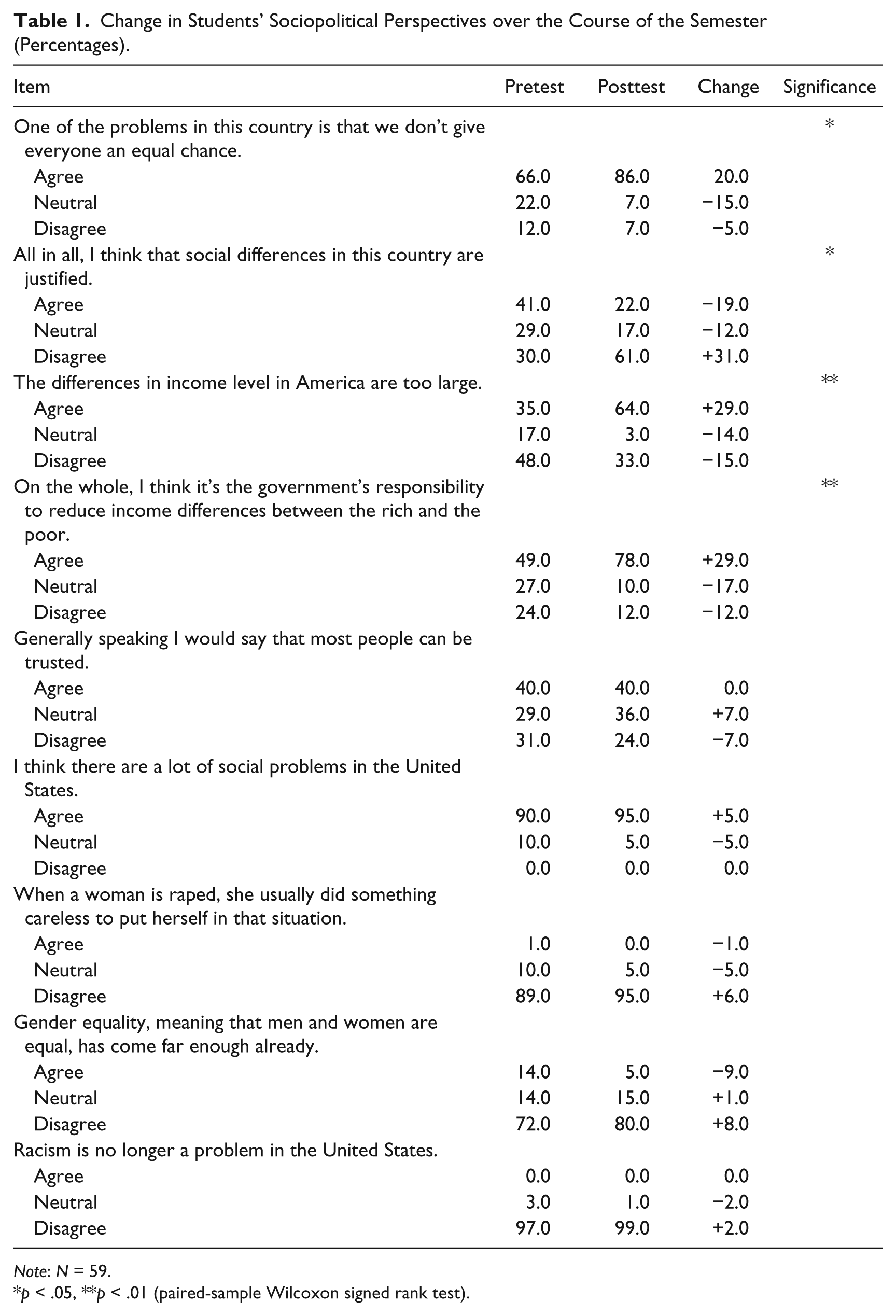
Note: N = 59.
p < .05, **p < .01 (paired-sample Wilcoxon signed rank test).
The other unintended benefit of the method was that it appeared to give students practice and confidence in stating their social and political views outside of class. Although some of this might have occurred using more traditional teaching methods, based on students’ comments, it also seemed that the exercises, particularly the discussion groups, helped as a forum to develop their views. Based on the responses to the survey question “How often do you talk about social issues or politics with family and friends?” there was a slight increase in the level of engagement. The number who reported that they talked about issues frequently or occasionally jumped from 61 percent to 71 percent, and those who claimed that they “never” talked about it dropped from seven to two students. Many students discussed having conversations, particularly with friends and roommates, about class content. Several mentioned having gained more confidence to embark in conversations on controversial topics, such as racism, because of what they had learned in the class and discussed in the small groups. A couple of students even mentioned that the ground rules and format of the discussion group—including reminders to listen fully and nonjudgmentally, to give everyone a voice in the conversation, and to maintain confidentiality—served as a useful model for how to engage in civil debates with friends and family with whom they disagreed.
In my assessment of the pedagogy, I wanted to know whether students observed their own shifts in opinion, understood why they changed their opinions, and were able to reformulate their explanations using sociological concepts and frameworks. Specifically, I attempted to evaluate whether listening to the first discussion group audio and reading their first letter to themselves, combined with the reflection on what they had learned, were useful exercises. Disentangling the exact point of and cause of the shift, however, was challenging since I had to take care not to lead or pressure students to unduly credit the assignment structure. In judging whether the exercises played a part in students’ shifts in sociopolitical views, I first examined the overall content of the discussion and to what extent it changed from the first discussion groups to the last. Then—based on students’ comments in the end of semester discussion groups and the final letters to themselves—I paid attention to whether students themselves seemed to detect a shift in their own knowledge and framework.
In the first discussion groups, some of the examples that students offered to support their opinions on social inequalities included their personal experience with family, high school friends, or acquaintances. For instance, students relied upon illustrations of people they knew who were affected by the recent General Motors plant closing in Wisconsin, neighbors who were successful in their business ventures, or high school friends who benefited from “rich parents.” Even more common than references to family, friends, and acquaintances were examples of celebrities and other public figures. In eight of the nine discussion groups, students talked about well-known public figures to illustrate their thinking on their survey responses to items related to economic inequality and class mobility. Celebrities and professional athletes were cited as prominent examples of people who students reasoned were either deserving or undeserving of their status and wealth. Laura’s explanation was typical. She said that generally she agrees with the survey item “Those with high economic or social status can be assumed to have worked hard or had special abilities.” She invoked the counterexample, however, of celebrity Paris Hilton to illustrate an exception to the general principle.
I’m thinking of socialites like Paris Hilton. All of her money came from her dad’s hard work. . . . She just kind of goes off, spends the money, does whatever she wants and she doesn’t really have any special abilities.
The students’ heavy reliance on these kinds of anecdotes seemed to stem from a lack of exposure to or familiarity with information about the broader population’s economic experiences. Celebrity references were so ubiquitous in the discussion groups, they were used as substitutes for more generalizable narratives about how class or other social positions influence the relationship between effort and social and economic rewards.
By the end of the semester, the types of examples and information that students used to illustrate and defend their opinions and their thinking shifted dramatically. In the first discussion group, in addition to celebrity examples, students cited very few examples (in only three of the nine discussion groups) that illustrated the counterargument of whether high social and economic status is due to merit: that some people work very hard without ever achieving high status or social recognition. By the end of the semester, the situation was reversed. That is, all discussions included multiple references to the disconnection between hard work, opportunity, and economic outcomes—particularly when considering gender, race, and ethnicity—with no references to celebrity culture or public figures. Several students noticed their earlier tendencies to focus on famous people. For instance, Anne critiqued her own use of celebrities as illustrations of merit and economic worthiness. When listening to the first discussion, she remarked, “In January I focused on celebrities versus like average people and [by the end of the semester] I changed my view.” Although she does not elaborate much more than this simple statement, she is expressing something important: that it is important also to consider the plight of “average people” when asserting a position on sociopolitical issues related to merit and economic status, rather than only media-hyped outlier cases. By the time she wrote her final letter to herself, she was more capable of formulating a sociological argument. She recognized that the earlier comments she made about the relationship between hard work and merit were misguided. She said, “Celebrities were not the best examples.” She explained,
I could reframe this comment now in a new sociological lens by addressing the many factors involved with people who have higher social and economic standing in society. . . . I believe I changed my view because, though success should be earned by the individual, there are other factors involved behind the success of one’s life. For instance, one’s economical background, racial biases (including white privilege), and the systematic structure that our society is founded on contributes to the success or opportunities one is given.
By listening to the audio recording of the first discussions, some students also noticed that the examples they used were narrow and specific to their own social circle, rather than a fuller consideration of the general population, and were able to critique their frame of reference. Sandy remarked,
I don’t know . . . like before I was thinking of my hometown, like the differences there. But, now it’s just like an overall picture . . . Not every town is like that.
Likewise, Nina recognized that her opinions on social matters were derived from limited observations of close acquaintances rather than from a fuller consideration of historical patterns, in particular, those of people of color. After she described the changes in her opinion from the beginning of the semester to the end, I asked, “What do you think caused that shift for you?”
Learning more in detail about racism, like current events [and] like past history and how it’s continuing to um happen probably every day and we just don’t know about it and probably be more aware of that instead of just being so focused in on people that I know instead of just people in general.
In interpreting these changes, and thinking about how much the process of self-reflection benefited the students’ learning, I am cautiously optimistic. As is often the case in academic settings with wide variation in student ability and interest, there were some individuals who seemed to just go through the motions, without authentic deliberation and careful reassessment. For instance, in the discussion groups, when I asked students to report on why their views had changed, Tricia reported that the class “just opened up my eyes” to problems such as poverty and racism. When I asked her to elaborate, she stated, “We had hit those hard in this class.” Likewise, Miles said that he came to agree that the difference in income in America is too large because of “that video we had watched in class.” He added, without further elaboration, “A lot of my views have changed based on what you’ve taught us in this class.” These kinds of responses, although in the minority, represented a more superficial expression of what they were supposed to be learning, based on the themes of the class or perhaps echoing what they heard other students say in the discussion group.
The majority of students, however, were able to more authentically reflect on their earlier state of knowledge and cite specific lessons from the class that influenced them—even if they were not always able to recall authors’ names or statistics or articulate a clear sociological argument. For example, several students admitted a lack of awareness about the severity and forms of inequality or the extent of social disadvantages that some groups, particularly, racial minorities, face in multiple arenas of their lives. Several expressed that they were “clueless” or “had no idea” as to the severity of particular social problems, such as mass incarceration, poverty, or racism. In reference to survey items related to social mobility and economic inequalities, about one half of students talked about having a complete reversal of opinion on at least one item from the beginning to the end of the semester. Sadie’s explanation of her reversal on questions about merit, hard work, and economic outcomes was typical:
Well, I think that the first time I was just like, “Yea, ya’ know people work for what they get.” . . . That’s fine. But, then um learning about all the things that we learned about, like especially discrimination . . . If you’re born with a certain skin color or if you’re born a woman like you have a less chance of having that status.
The majority of students pointed to specific class content that influenced their opinion, most commonly a YouTube video we watched in class called “Wealth Inequality in the United States,” guest speakers, or specific articles. Less commonly, yet present in every discussion group, were unprompted references to the importance of listening to the audio recording of the first discussion group. This was especially true for students who talked about taking a stand on something, shifting from a neutral position to a stronger stance. Claire was representative of this type of shift. She described the shift on many questions as “huge.”
When I took the survey the first time a lot of my answers were like neutral, like I didn’t really have a position on any of them. But this time I noticed that . . . I took a firm stance on every single one. . . . Listening to [the first discussion] I realized that . . . hearing everybody else’s input on it really made me . . . think about what I wrote previously.
As demonstrated by students like Claire, it seemed that revisiting the audio discussion and reformulating opinion based on the discussion offered insights into what and how they shifted their views.
In every discussion group, there were clear examples of students having learned something from others especially after listening to the audio recording of the first conversation. Yet, many were challenged to recall and explain how they thought about the questions previously. Typically, when I pressed them to articulate their earlier views, students responded like Sarah: “I’m not quite sure what I was thinking. . . . I was just really oblivious and I wasn’t aware of a lot of things that were going on.” Likewise, Leila was certain that her opinion had shifted. She said, “I actually counted on the first time I took it I had nine that fell under neutral and then the second time I only had three that fell under neutral.” She was not quite able to explain, however, why the change had occurred. She simply stated, “A lot of them had to do with social class inequalities, things like that, which I definitely, the second time around, I identified that as a bigger problem than I did the first time.” Thus, although students could plainly recognize that their views had shifted, many had trouble depicting their earlier framework clearly.
In addition to identifying changes and being able to explain them, I also wanted to know if students would be able to frame them within a clear, sociological framework. This outcome was quite mixed. Erica represented one positive extreme. In her case, she clearly gained a great deal of insight from listening to the recording of the first discussion group, rereading her previous letter, and comparing survey responses—and was able to articulate well what was individualistic about it and what a sociological framework might look like. She remarked, “I am able to recognize individualistic thinking from myself and others now.” She pointed to a statement she made in the previous discussion group, where she claimed that one should address the problem of racism by “starting with yourself.” In her final letter to herself, she critiqued her original stance and reformulated it to focus on institutions, such as the media, schools, and the criminal justice system, as influential in shaping perceptions of race. Similarly, Megan talked about her shift to a more sociological way of viewing social problems and the effects they have on her. She critiqued comments she had made in the first discussion group about civil rights for gay people, an issue she contended did not affect her since she was straight. In her final letter to herself, Megan referenced laws that protect the rights of minority groups, framing her position in terms of social interdependence.
From a sociological perspective, every social problem/issue affects everyone. . . . We know some of these rights may not directly apply to us, but they do affect our environment and our thinking. It is because we are all interdependent.
Erica and Megan were ideal students in the sense that they rarely missed class, were prepared for discussions, and completed other assignments with care and on time.
On the other extreme, there was a handful of students who were less engaged in the class in general, including in the discussion groups. Perhaps due to their low level of engagement in the class, they seemed to go through the motions of the assignment, sometimes reiterating my words or authors’ ideas without truly applying them to the reformulation of their previous understandings. Also, a significant minority of students, even those who appeared to be interested in the material, had only a basic understanding of what it meant to think individualistically and thus were only partially able to reformulate their original thoughts more sociologically. For instance, Adam wrote in his final letter to himself,
Back in January, someone mentioned that the homeless were lazy and you also agreed with that . . . Maybe they lost their job or they just grew up with nothing to start out with. They’re not lazy or “druggies” and they didn’t chose [sic] to be homeless, it just happens and for the most part, they can’t help it. The January Adam was also guilty of thinking this way about the homeless through an individualistic lens.
Although he recognized that his earlier statements lacked empathy, it was not clear that Adam fully understood the concept of individualism. If he had, he might have focused on alternative explanations with reference to social structural conditions, like unemployment, lack of adequate affordable housing, and other social policies—issues we had covered in the course.
Adam’s partial reformulation was fairly typical: he was on the right track in terms of identifying individualistic ways of thinking but was not quite able to adequately reformulate it into a sociological narrative. In the first discussion group, for instance, I asked students to think about the social problems they identified in their survey and to talk about how the problem affected them. In the vast majority of cases, students claimed that problems such as racism (if white) and poverty (if not poor) did not have an effect on them. Later, most students critiqued their original statements and asserted that, indeed, social problems, like poverty and racism, have an effect on them. Few were able to convincingly explain, however, how these problems might affect them in a sociological sense. Instead, most, like Ethan, provided somewhat vague explanations of the effects that problems such as economic inequality might have on him: “Even though you may not think it affects you but it kind of does in some little way.” Similarly, Michael accepted that poverty might hurt others, besides those directly affected, but was not able to make the point convincingly or with any specifics. He remarked, “It hurts everyone else in the country as well having this group that’s not able to have food to eat or anything.”
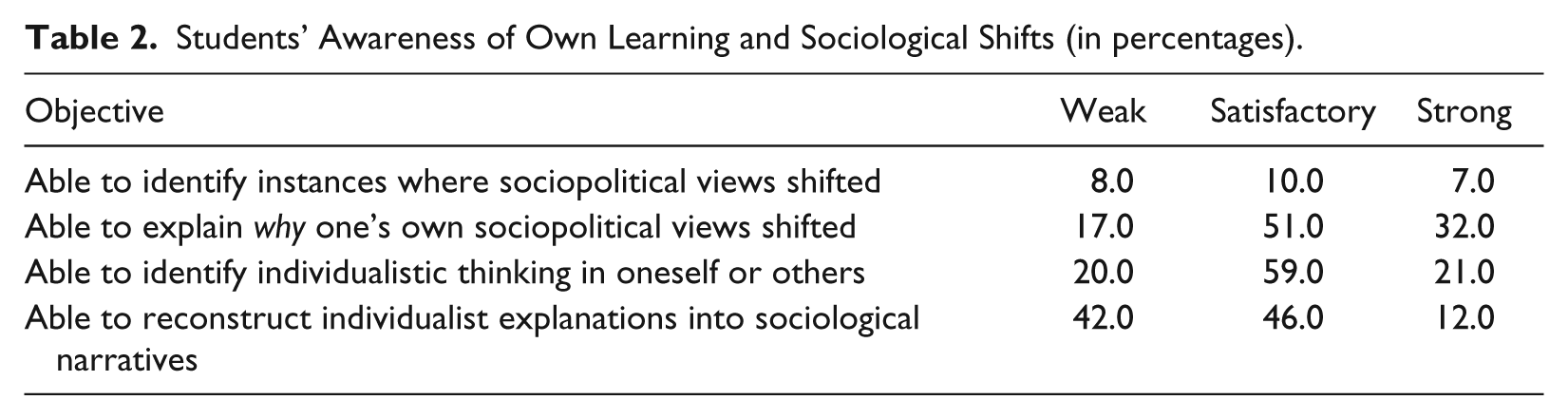
I had high expectations for these exercises. I hoped that the recursive exercises would help students to identify key learning moments and reshape their understanding of the social issue we covered in class effectively through a sociological lens. In the end, there were consistent and major shifts in opinions on sociopolitical questions that students clearly noticed. Some were able to be quite specific about where and how those shifts occurred for them and, particularly by the time they wrote their final letters, were exemplars of how powerful the method was in heightening their awareness of their own learning. Other students were able to accomplish some of the goals, but many—particularly those who may not have put genuine effort into the exercises or their study of sociology in general—were less successful at articulating, with adequate and specific evidence, a clear understanding of sociological concepts or how and why their views had changed. See Table 2 for a summary of the percentage of students who demonstrated awareness of their own learning and sociological shifts.
Students’ Awareness of Own Learning and Sociological Shifts (in percentages).
Conclusion: Limitations, Unexpected Benefits, and Adaptations
Recursive practices are meant “to document changes in knowledge as well as changes in the ways in which information is accumulated and processed over time” (Hudd et al. 2011:180). Thus, they can help a great deal in informing instruction. The assignment structure, which required students to state, review, and explain their own opinions on social issues and then share them with others in a small-group setting, helped to facilitate this. The focus on students’ personal opinions and the time provided to think through their positions before coming into the discussion encouraged engagement. This format seemed to nudge students to overcome the mental inertia that often occurs when they consume instruction more passively or where the class content may not seem relevant to their lives (Brookfield and Preskill 1999:75).
Although most students cited shifts in their opinions on questions about social inequalities and mobility, there was a great deal of variability in their abilities to scrutinize their “earlier selves” and reformulate their arguments with evidence from the class and use of sociological concepts. Based on what I observed in the discussion groups, some of this variation reflected the wide range of student backgrounds, abilities, and effort. Despite the variability, the method had the benefit of motivating the majority of students to become more interested and engaged in the material. As I mentioned, the discussion groups were stimulating, and students seemed to genuinely enjoy the conversations. The practice in articulating their position on sociopolitical issues helped to ground larger class discussion.
When it came to identifying individualistic thinking in themselves or others and reformulating that sociologically, there was less success than I had hoped. Gaining a clear understanding of the concepts and the vocabulary is important as tools for developing an understanding of complex social issues and having the confidence to take part in public discourse (Eckstein et al. 1995). Students tend to find it difficult to use sociological terminology and concepts immediately since, as when learning a foreign language, it is not typically part of their everyday vocabulary. The process of developing a sociological voice is a gradual one, learned through trial and error (Kebede 2009). Perhaps it would have been worthwhile to devote more time in class for students to practice identifying individualistic thinking and formulating sociological alternatives as well as modeling this more regularly myself. Of course, this would have to be balanced by the time required for exams, discussion groups, journaling, listening to my lectures and guest speakers, films, and exploring one’s own feelings and opinions on social issues.
Although there was some important variation in student learning outcomes, not all the shortcomings can be attributed to some lack of preparation or effort on the part of the students. Indeed, there were some limitations of the method itself. For instance, the final letter asked them to incorporate a myriad of material from the class, such as their journals, readings, and the group audio recording, in their reassessment. Some students may have found this task to be too constraining and forced. A more flexible process, whereby students were permitted to draw from material they found to be most instructive, might have been prevented some from feeling overwhelmed. Also, while I would like to assume that the changes students expressed were indicative of real shifts in awareness and position, I recognize that there is serious potential for social desirability bias in the method (wherein the professor asks the students what they have learned in front of their peers, and they are aware that it is potentially offensive and socially inappropriate to say, “Nothing”). To some extent this is unavoidable since, as their instructor, students had to report their views to me in order to be evaluated and receive feedback on what and how they claimed to have learned and developed. Moreover, their responses were not intended to be anonymous. What is more, anonymity would have been counterproductive since the peer pressure of the discussion groups and the structure of the assignments held students accountable to be thoughtful and reflective and to motivate and engage most of them. One method for reducing this bias might have been to have a capable teaching assistant lead the discussions. Others have found that this intermediary role can effectively put students at greater ease in stating their opinions and developing their understanding of sociology (Stoeker et al. 1993).
Designating the discussion group leadership to experienced or trained teaching assistants would also be a way to adapt this method to larger classes. Since many introductory classes are taught in a lecture format with separate discussion sections guided by teaching assistants, this could be a practical and effective division of labor. Alternatively, with adequate instruction, the students could meet and record the conversation outside of class. Although they would lose the benefit of a skilled facilitator, the lack of an authority figure and evaluator might put them at greater ease to express themselves more openly. The online surveys, which can be distributed to large numbers of individuals, and the written “letters to self,” which are not much different from short papers, could easily be assigned to a large class.
There is another somewhat minor practical problem that should be mentioned. Since I did not want the class content to “contaminate” students’ responses to the survey or their first letter to self, I made the survey available and set the due date for the letter during the first week of class. For the most part, this was fine; however, it was complicated by a handful of students who dropped or added the class during the second week. I was able to work this out without negative consequences, although it was logistically more difficult.
Despite these limitations, there were also some unintended benefits of the pedagogy. Specifically, by homing in on what students identified as key learning moments and asking them to talk about how their opinions or understandings might have shifted, I gained invaluable insight into what material was retained and influential. Thus, I consider the discussion groups to have been an important method of formative assessment. Moreover, the discussions groups, particularly the one held during the first week of class, provided a useful structured time to have intensive conversations with students in a more intimate setting. Although clearly a commitment of substantial class time, I felt I was able to get to know the students better, which affected my rapport with them throughout the semester. Simply having time to learn their names, a little about their backgrounds, and their opinions in some depth was extremely valuable. All of this helped to shape the tone and content of my lectures and the emphasis I placed on certain readings and other class material, even allowing me (without identifying the source) to address specific examples, comments, or issues that were raised in the small groups.
Students’ increased motivation to engage in civil debates on social and political issues with friends and family outside of class is an important and unintended benefit of the pedagogy—particularly since, for students not pursuing majors or minors in sociology, introductory sociology class can represent the “first and often the only contact that students will have with the discipline of sociology” (Greenwood and Howard 2011:16). Given that many students will not take a sociology class again, this may be the only exposure they have to sociological thinking about social inequalities during their higher education experience. Thus, the shift in social views and an increase in interest and willingness to talk about issues outside of class opinions are significant—even if their sociological voice is not fully developed in one semester.
Footnotes
Appendix
Acknowledgements
I appreciate the thoughtfulness and openness of the students who participated in the research, Dallas Riddle’s wonderful research assistance, Patrick Este’s competent technical guidance, and David Long’s helpful editorial suggestions. I also benefited from multiple stimulating hallway conversations about my teaching method and research with my colleagues Sue Pastor and Cynthia Rolling. Last, I would like to thank the anonymous reviewers for Teaching Sociology who offered extremely useful suggestions for improvements and clarifications.
Editor’s Note
Reviewers of this manuscript were, in alphabetical order, Katrina Hoop, Jay Howard, and Melinda Messineo.