







Abstract
An entrepreneurial mindset is action-oriented and characterized by adaptation to novel circumstances. The 3Cs framework (curiosity, connections, creating value) was developed to promote this mindset among engineering students. The current study uses a mixed methods approach to (1) demonstrate how the 3Cs can be translated into activities for sociology courses and (2) assess student perceptions of the activities. In anonymous surveys (N = 389 responses), students agreed that the cooperative activities fostered curiosity, helped them to make connections with prior knowledge and the real world, and created societal value. Students learned novel information, considered divergent perspectives, and were enthusiastic about the team-based nature of the activities. Regression models demonstrated that perceptions were mostly similar across gender and college major. The findings suggest the 3Cs may help students develop core concepts and competencies of the sociological literacy framework, such as their sociological eye and the application of sociological knowledge to novel situations.
In recent years, there has been a growing interest in helping college students develop their “entrepreneurial mindset.” For some sociologists, the phrase may bring to mind Weber’s description of the “capitalistic spirit” that drives individuals to earn money through work. Other sociologists may be skeptical of ideas related to entrepreneurship because of perceived connections to an employability agenda of universities that prioritizes job-preparation majors (e.g., engineering or business) over liberal arts majors, such as sociology (Harris 2018).
In this article, we argue that promoting an entrepreneurial mindset using the approach developed by the Kern Entrepreneurial Engineering Network (KEEN) can be useful for sociology instructors. We developed a group of activities designed to promote an entrepreneurial mindset across multiple semesters of two upper-division sociology courses. The activities are described here in brief, and five of the activities are available in full through ASA TRAILS. We provide quantitative and qualitative evidence that these activities promote curiosity and connection and create social value (the 3Cs) and are enjoyable for students and helped them learn new perspectives. Therefore, although sociologists may balk at the suggestion that they consider promoting an entrepreneurial mindset in their courses, our results show that this approach can be integrated into existing courses to promote learning and achieve course objectives.
The Entrepreneurial Mindset
An entrepreneurial mindset has been defined in various ways that emphasize the flexibility and action-oriented nature of the mindset (Naumann 2017). For instance, Haynie and Shepherd (2007:9) note that an entrepreneurial mindset is characterized by the “ability to adapt thinking processes to changing contexts and task demands,” whereas Kuratko, Fisher, and Audretsch (2021:1682) emphasize that the mindset propels individuals “to come up with new ideas, solve problems, generate creative solutions, and take action to pursue opportunities.” Thus, the mindset can include cognitive components, such as reasoning; metacognitive components, such as reflecting on one’s own thinking process; and behavioral components, including acting in response to novel situations (Naumann 2017).
KEEN has dedicated substantial resources toward creating a novel framework for developing students’ entrepreneurial mindset to promote personal, economic, and societal value (Rae and Melton 2017). The 3Cs are at the core of the framework. The first “C” is curiosity. This tenant recognizes the importance of students developing thoughtful questions to promote understanding and internal motivation to learn and to seek out information. Students are encouraged to question and investigate their rapidly changing world. The second “C” of the process is connection. This tenant recognizes that students must integrate new information into their broader body of knowledge and that they must be able to apply the material to the real world. The focus is creating deep learning and connections between diverse ideas. The third “C” of the process is creating value. Students are encouraged to consider various solutions and ultimately make decisions to solve problems. “Value” is conceptualized broadly and not narrowly focused on economics; instead, social value (e.g., the creation of an informed educational program or social policy) is also important.
Scholars have argued that an entrepreneurial mindset is best developed through experiential or active learning techniques (Robinson and Gough 2020). Active learning techniques are those that are student-centered and can include small group activities, vignettes or hypothetical scenarios or dilemmas, and discussions (Prince 2004). These activities stand in stark contrast with traditional instructor-dominated techniques in which instructors relay information to students while students are passive recipients of content. Related and conceptually overlapping techniques include experiential learning, problem-based learning, and collaborative learning. Although the techniques can vary, a common thread is that students are thinking about something (“heads-on”) while they are doing something (“hands-on”; Hake 1998). In sociology, research demonstrates that these student-directed approaches help students apply concepts, benefit student learning, increase confidence in comprehension of course material, improve student engagement, and shift student values and their compassionate orientation (Adkins 2021; McDuff 2012; Pedersen 2010; Strangfeld 2013). The widespread use of student-directed approaches across higher education more broadly, however, has been hampered by institutional-, teacher-, and student-related barriers (Børte, Nesje, and Lillejord 2023).
Although these student-oriented techniques may be familiar to many sociology professors, a key component that differentiates the entrepreneurial mindset is the emphasis on taking action to solve problems. Many active learning techniques help students make connections between the real world and class content, and some (but certainly not all) help students develop their curiosity by encouraging questions. The third “C,” creating value, distinguishes this approach. Students are pushed to create innovative solutions that improve the lives of others. Students must consider the risks and benefits of various solutions for different stakeholders while anticipating the needs of a quickly changing society through forward thinking. Often, the 3Cs framework is implemented by engineering instructors through group-based applied assignments in which students design solutions to specific real-world issues (for thousands of examples or “cards,” see https://engineeringunleashed.com/card).
The Current Study
To demonstrate to sociologists the value and applicability of the entrepreneurial mindset, our study has two primary aims. First, we demonstrate how the 3Cs can be translated into activities for sociology courses. We direct interested readers to the TRAILS website, where examples of our activities are described and available in full. Second, we assess student perceptions of these approaches and test whether associations are consistent across student gender and college major. To meet these study aims, we conducted a mixed methods study (Creswell 2013) incorporating quantitative survey and open-ended student responses.
Methods
Institutional Context and Course Descriptions
The current study occurred at a public research university in the Rocky Mountain West. The student population is predominantly White (>80 percent) and characterized by diversity with regard to rurality and social class. Undergraduates are 21 years old, on average, and approximately half are male. We (the authors) are two sociology faculty members who attended workshops related to the entrepreneurial mindset. Learning about this framework motivated us to create activities intentionally designed to promote the 3Cs. These activities were created for two upper-division sociology courses with typical enrollments of 30 to 40 students. The first, Sociology of Health and Medicine, is an upper-division elective taken by sociology students and students pursuing careers in the medical field. The second, Criminology, is focused on theories of crime and is required for those pursuing a sociology degree with a criminology concentration.
Procedures and Participant Characteristics
Data were collected across three semesters (between 2021 and 2023) of Sociology of Health and Medicine (n = 4 activities) and one semester (spring 2023) of Criminology (n = 3 activities). Students were provided a link to an anonymous voluntary Qualtrics survey at the end of each activity, and 397 students completed the survey. 1 We omitted 8 students with missing data on gender and major, resulting in a sample of 389 responses across seven activities. Of the students, 67.4 percent were female, 28.0 percent were male, and 4.6 percent were nonbinary. In terms of college major, 46.0 percent were sociology majors, 27.5 percent were majoring in a health science field, and 26.5 percent were pursuing another major.
Measures
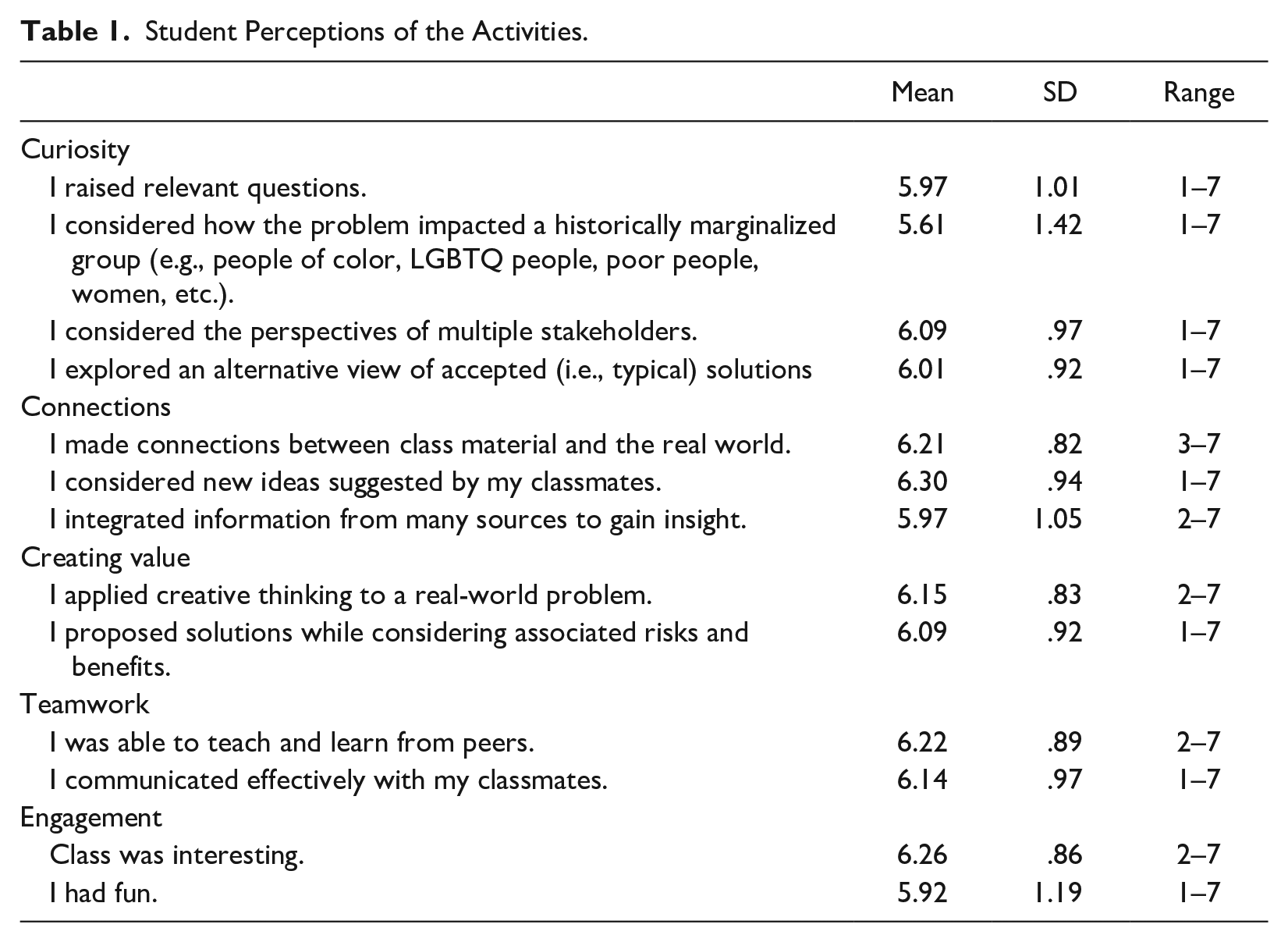
Drawing from the KEEN materials and our own sociological lens, we developed questions about the 3Cs (see Table 1). Items were measured on a scale from 1 (strongly agree) to 7 (strongly disagree) and began with prompt: “As a result of participating in this activity . . . .” Curiosity was examined with four questions (e.g., “I raised relevant questions”). Three questions explored connections (e.g., “I made connections between class material and the real world”). And the final “C,” creating value, was examined with two questions (e.g., “I proposed solutions while considering associated risks and benefits”). We also examined whether the activities promoted teamwork skills (e.g, “I was able to teach and learn from peers”) and whether students were affectively engaged (e.g., “I had fun”).
Student Perceptions of the Activities.
Gender was measured with three response options: male (reference), female, or nonbinary/another gender. Students identified their college major and were categorized into sociology/criminology majors, health-related majors, and other majors.
Analytical Approach
Quantitative data
We aggregated the data and conducted descriptive statistics to understand student perceptions of the activities. Subsequently, we conducted a series of regression models in which we examined whether college major or gender predicted perceptions of the activities. Standard errors were clustered by the class attended by the student.
Qualitative data
For the qualitative responses, students were asked to explain how the activities either challenged their thinking or strengthened their existing ideas. They were also asked to describe any thoughts they had related to working in a group on this activity. To analyze the data, both authors read 200 student responses and inductively created a codebook from those responses. Then, the authors independently read all responses in their entirety and engaged in descriptive coding and theming of the data (Saldaña 2012). Minor coding discrepancies were resolved through discussion and consensus. Additional coding explored whether responses fit into one of the 3Cs of curiosity, connection, or creating value.
Results
Description of the Activities
We created seven cooperative, team-based in-class activities. Activities were graded for completion (pass/fail) because we wanted students to be engaged in discussion and grappling with ideas rather than worrying about a grade. When introducing the activities, we did not explicitly discuss the KEEN framework or entrepreneurial-minded learning (EML) with students. We did, however, incorporate language related to sparking curiosity, making real-world connections, and generating solutions. Four of the activities used a jigsaw cooperative learning strategy to help students understand illness experience, disease criminalization, crime data, and criminal labeling (Aronson and Patnoe 2011). Two activities explored medicalization and crime theory using a modified DENT approach in which students were asked to (1) describe a problem(s), (2) explore possible ideas and solutions, (3) narrow the solutions, and then (4) test the solution (Ommundsen 2001). One activity used a rank-ordering activity that included individual research and group discussion. Full descriptions of five of these activities are available on TRAILS: Teaching Resources and Innovation Library for Sociology (see Appendix A).
Students’ Quantitative Perceptions of the Activities
Table 1 presents statistics on student perceptions of the activities. Most scores fell between 6 (agree) and 7 (strongly agree) on the scale, indicating that students perceived that the activities helped them to be curious learners, make connections, and create value. The activities also fostered teamwork and were enjoyable. Taken together, the quantitative means demonstrate that the activities were a positive experience for the students.
Regression models suggested that the quantitative indicators of the 3Cs in Table 1 did not significantly differ across college major or gender. There was, however, one exception related to affective engagement. Compared to male students, females expressed lower agreement that as a result of the activity they “had fun” (b = −.46, SE = .10, p < .05) and “class was interesting” (b = −.33, SE = .09, p < .05). We explored this trend by looking more closely at the qualitative responses (see the following).
Students’ Qualitative Perceptions of the Activities
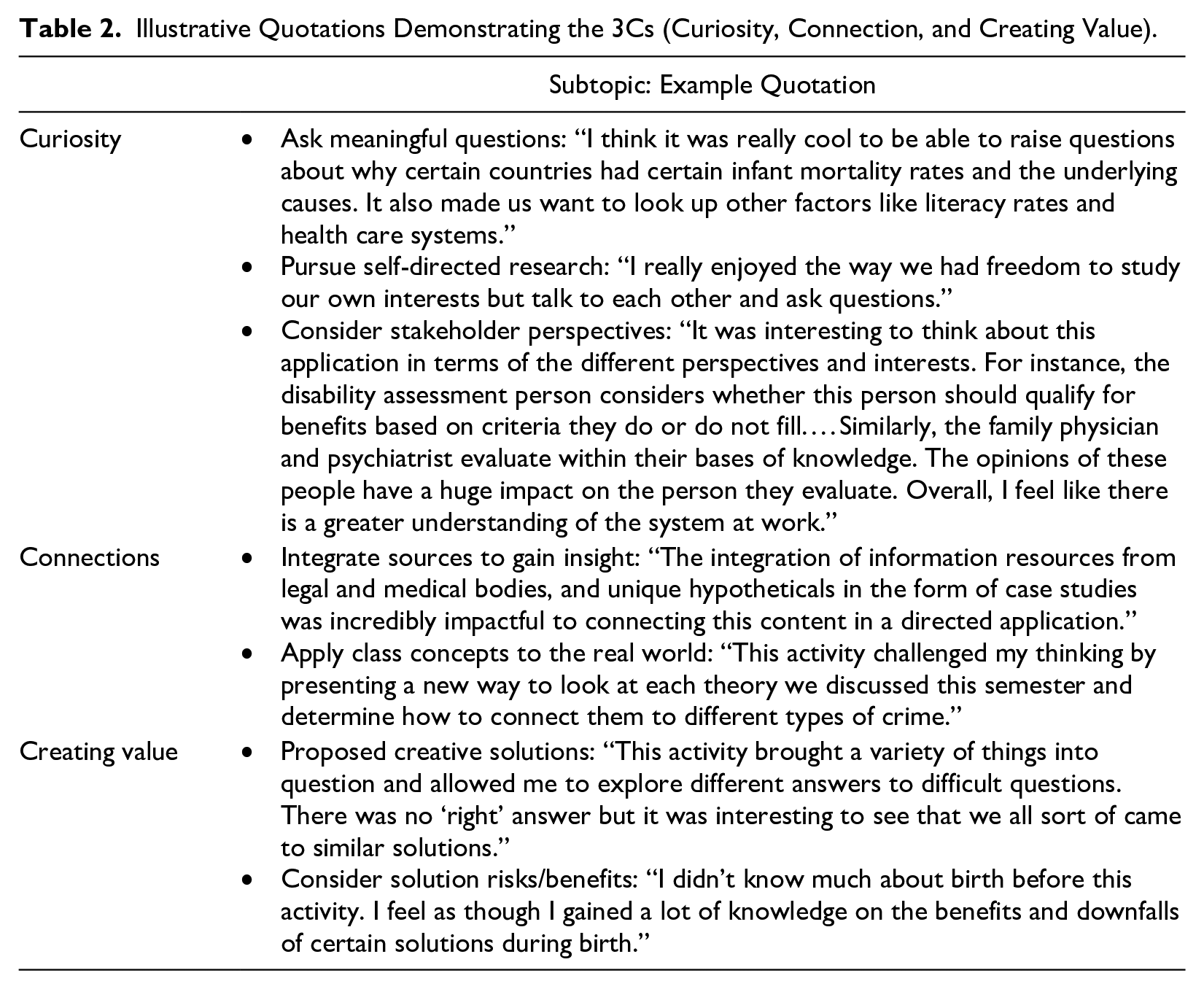
In line with the quantitative findings, open-ended responses also indicated that students experienced the 3Cs. Regarding curiosity, students noted that the activities let them seek out new information about a topic and generate questions that would help them better understand an issue. One student explained, “It opened up a safe space to ask questions about certain topics I didn’t know much about and receive information about said topics in a safe area.” Students also made connections between course content and new real-world data. One noted, “This activity allowed me to connect the material we are learning in the class to real-world issues. It was very eye-opening.” Finally, regarding creating value, students explained how they had to come up with novel, “outside-of-the box” ideas and policy solutions to difficult problems. One student described, “I had to think of solutions that would both benefit this woman [in the fictional scenario] and others in her situation. I also had to think of solutions that would work within current systems and of solutions that would require the systems to change.” This response explains that the student recognized that a solution could “benefit” or create value for individuals facing a particular problem and also that structural changes might be necessary. Table 2 provides additional examples illustrating how the activities helped students develop the 3Cs.
Illustrative Quotations Demonstrating the 3Cs (Curiosity, Connection, and Creating Value).
When we coded the qualitative data inductively, five major themes emerged from the open-ended responses. In many responses (41 percent), students mentioned that they (1) learned new information. One described how the activity “allowed me to . . . gather new information about topics that I assumed I knew a lot about.” Others explained that “nearly everything surprised me” and it (i.e., crime data) was “very interesting for me to discover.” Another commonly mentioned theme (30 percent of responses) was that students (2) considered diverse perspectives in the activities. For instance, one noted, This activity helped me to consider multiple points of view (the patient, physician, psychiatrist, etc.). I think it’s easy to only consider the issue from one side but by hearing from everyone and considering the research that they had done, it helped me to think about how each side wanted a different outcome.
A third theme was that the activity helped students (3) gain critical thinking skills (24 percent). One described, “It made me think critically about a common issue that women have. I thought this activity was interesting because I came into it believing the perspective of one way and ended up looking at new ideas.” Students also explained how they (4) generated solutions to real-world problems (13 percent). One student explained how the activity was challenging because, “It is hard to come up with solutions to a problem that has many answers, none of which are wrong or right. It is new to think about how many solutions in health could be considered.” And finally, the activity encouraged students to (5) consider heterogeneity and marginalized populations (13 percent). As one student explained, “This challenged my thinking regarding intersectionality, marginalized groups, privileged groups (and the upper class) and agents of crime.” Open-ended responses could include one or more themes; thus, these percentages do not add to 100 percent.
Regarding the group-based nature of the work, three main themes emerged. First, in 44 percent of student responses, students explained how they had (1) positive group dynamics. One student noted, “I enjoyed working in a group because it offered opportunities for communication practice, thinking about what questions I could ask, and actively listening.” About one-third (34 percent) of responses described how the group-based nature of the activity helped them to (2) gain new points of view from their peers. As one student explained, “I really liked working in a group, it brought in more insights that I would have never thought of and several people actually brought up sources that I hadn’t seen to provide evidence for some of the group’s ideas.” Similarly, about one-third of responses mentioned that the students thought that working in a group was (3) fun or interesting. A student noted, “I think it was fun and kept the class engaging, and moving around the room.” Another noted, “It was fantastic! It’s a great way of sharing ideas and tackling problems!”
Although the feedback was generally quite positive, about 10 percent of responses mentioned challenges related to the group-based nature of the activities. When this occurred, it was sometimes because group members did not adequately contribute to the discussion. As one student wrote, “Some members were not as active in the process making it difficult to have meaningful discussions.” Other responses suggested that some students were uncomfortable participating in group activities.
Follow-up Analyses
Due to gender differences in quantitative engagement, we analyzed the negative qualitative responses by gender. Results demonstrated that 91 percent of the negative responses about group work were from women despite representing only 67.4 percent of the sample. Comments coalesced around a few themes, including (1) a general dislike of group work, (2) some group members either dominating the activity or doing the bare minimum, and (3) logistical issues (e.g., too much moving around or too chaotic).
Discussion
In this study, we described how KEEN’s 3Cs entrepreneurial mindset framework can be adapted for use in sociology courses. We created a series of activities for upper-division courses designed to promote curiosity, foster connection, and create value. We presented descriptive qualitative and quantitative findings demonstrating that activities helped students gain in-depth knowledge and develop teamwork skills. Although economic value is often imagined to be the goal of entrepreneurial endeavors (notably, making money with a new idea or business model), combining an entrepreneurial mindset with sociology’s disciplinary lens can foster creativity and innovation and lead to other types of value. In particular, benefits to society (what we call “social” value) can accrue from students creating something, such as an institutional solution to a hypothetical scenario, a sociologically informed policy that centers the needs of marginalized groups, or a descriptive handout informing policymakers about issues with crime data.
We argue that when adapted by sociologists, the 3Cs approach can improve students’ sociological understanding. For instance, the sociological literacy framework (SLF) (Ferguson 2016) outlines essential concepts and competencies that comprise the core of the sociology major. In our activities, there is evidence that students demonstrated three essential concepts: their sociological eye, their understanding of social structure, and their knowledge of social stratification. With regard to the sociological eye, the activities compelled students to use their sociological imagination and recognize that everyday life is socially constructed (including social groups, data and evidence, and medical categories). With regard to social structure, instead of just considering individual solutions to problems (which is often easiest for students), they considered the structural roots of problems and identified macro and institutional solutions. Finally, as students considered diverse perspectives, they thought about the power of different groups, historically marginalized populations, and how different solutions would advantage or disadvantage certain people. By engaging in these thought exercises and debates, they applied their understanding of social stratification (Ferguson 2016).
The results also showed that students perceived they developed the 3Cs and new skills. Three essential SLF competencies were developed. First, students successfully applied theories and concepts from sociology to novel contexts. Second, students grew their critical thinking skills by critically evaluating real-world or hypothetical social phenomenon. Finally, students informed or created policies that were grounded in their sociological knowledge (Ferguson 2016).
Students found the activities not only informative but also fun and engaging. Most students liked the group-based nature of the activities, noting that they developed their communication and teamwork skills. Although the activities were perceived similarly across major and gender, men perceived them to be slightly more affectively engaging than women. Our follow-up analyses suggested that gender differences in engagement may be rooted in group dynamics or logistical challenges. Previous research has noted that a “chilly climate” persists for women in higher education because men tend to dominate classroom conversations and are more likely to interrupt other students than women (Lee and Mccabe 2021). In addition, men are more likely to be “free riders” who do not sufficiently contribute to group work but benefit from the work of teammates (Monson 2019). Instructors may want to consider strategies to minimize these teamwork challenges to the extent possible, for instance by setting clear communication ground rules at the start of an activity and monitoring and enforcing those rules (Lee and Mccabe 2021).
Limitations and Strengths
Limitations of the study are apparent as well. We conducted anonymous cross-sectional online surveys to encourage honesty. As a result, we only have indicators of student perceptions; we cannot determine change over time or causality. Nonetheless, the current article tested novel activities applying the 3Cs framework across multiple courses, semesters, and instructors. The application of the 3Cs approach crosses disciplinary boundaries and demonstrates sociology instructors can integrate and build on pedagogical ideas and insights from engineering.
Concluding Reflections
Sociologists may be wary of ideas related to entrepreneurship. Existing sociological literature has been critical of the economic origins of the term “entrepreneur” and the strict links to the founding of businesses or organizations. Some advocate for a view where individuals are also “entrepreneurs of the self” who seek to innovate and create value both within and outside of the work context (Du Gay 1996). Contemporary sociologists may also fear that entrepreneurial ideas are associated with an employability agenda that devalues liberal arts majors such as sociology (Harris 2018). Our results suggest that incorporating ideas related to EML has the potential to enhance the sociological curriculum. As Ciabattari et al. (2018:203) argued, there is “no dichotomy between liberal education and practical education for careers.” Indeed, various career-readiness competencies—including critical thinking/problem solving, oral/written communication, teamwork/collaboration, and global/intercultural fluency—are aligned with EML activities (Ghafar 2020; National Association of Colleges and Employers 2021). Thus, sociologists should not shy away from ideas related to entrepreneurship.
The 3Cs is a simple approach to promote EML that sociology instructors might consider adopting. Interested instructors should consider the activity duration that would best fit in their course; EML activities can be brief micro-moment activities that take a few minutes (Morin and Goldberg 2022) or large-scale assignments that occur over the course of multiple weeks (Gorlewicz and Jayaram 2020). For instructors using problem-based learning techniques, implementing the 3Cs might involve tweaking existing activities. We recommend that when reviewing existing activities or creating new ones, instructors reflect and ask themselves, “What changes could I make to ensure that students are developing the 3Cs in this activity?” To develop curiosity, instructors could incorporate independent in-class research or have students create lists of questions about a prompt. To develop connections, instructors could use real-life problems or hypothetical scenarios that are as detailed and real as possible (e.g., local places are identified and local issues emphasized). Finally, to create value, students must collaborate and produce something that is meaningful and could improve society through policy changes or direct intervention. As noted, we have activity examples available on TRAILS that instructors can implement or use to adapt to their own subject area (see Appendix A). Taken as a whole, our findings demonstrate that the 3Cs framework can be used to create activities that facilitate engagement in sociology courses and promote student learning.
Footnotes
Appendix A
Acknowledgements
A previous version of this article was presented at the 2023 American Sociological Association Annual Meeting. The authors are grateful for the students who participated in the anonymous surveys.
Funding
The author(s) disclosed receipt of the following financial support for the research, authorship, and/or publication of this article: Creation of the activities inspired by entrepreneurial-minded learning was funded by a mini-grant from Montana State University funded by the Kern Family Foundation.
