







Abstract
Critical service-learning is intended to address some of the critiques of traditional service-learning, such as that it benefits the university more than the community and offers temporary or band-aid solutions to endemic social issues. However, scholars have emphasized the logistical and financial challenges of developing critical service-learning programs. This article describes a case study of a service-learning project in which undergraduate students facilitated youth participatory action research (YPAR) projects with middle school partners. We analyze undergraduate journal entries, student projects, and focus groups with both middle school students and undergraduates to evaluate how YPAR might present an opportunity to create critical service-learning experiences. We demonstrate how the YPAR project (1) engages undergraduates in a collaborative experience with middle school students that results in undergraduates articulating a nuanced analysis of the structural causes of inequity, (2) prioritizes meaningful relationship building between undergraduates and students, (3) shifts power dynamics by uplifting projects that are student-led and student-organized, and (4) supports student organizing to make transformative change in their schools. We conclude by arguing that YPAR offers a productive methodology to move universities toward models of critical service-learning.
Introduction
Service-learning is a pedagogical strategy, often used in higher education, in which undergraduate students complete a community service project that provides real-life experience to supplement their academic coursework (Butin 2006; Mitchell 2008). Frequently stated aims of service-learning are to enhance undergraduate learning outcomes, connect universities and undergraduates with the communities around them, and merge undergraduate and community needs (Battistoni 1997; Eby 1998). The majority of universities in the United States have service-learning programs (Eby 1998; Kilgo, Ezell Sheets, and Pascarella 2015; Vaughan 2021), yet these programs vary greatly in their structure, aims, and quality.
The benefits for undergraduates who participate in service-learning programs and universities who host service-learning programs have been well documented (Battistoni 1997; Becker and Paul 2015; Celio, Durlak, and Dymnicki 2011; Eby 1998; Lum and Jacob 2012; Mitchell 2015; Sax, Astin, and Avalos 1999; Stukas, Snyder, and Clary 1999). Alongside the tangible benefits of service-learning for universities and their students, there are critiques of service-learning. It may reinforce existing power dynamics on both individual and institutional levels. Service-learning is typically structured for the benefit of the university community, where undergraduates’ learning is enhanced, their biases challenged, and their civic identity developed (Becker and Paul 2015; Eby 1998; Mitchell 2015; Warren 2012). In this schema, positive community outcomes are assumed yet often unmeasured and deprioritized. Service-learning can also assert the power of the university over the community. The university has resources, including land and money, that could be useful to the community, but these resources are not meaningfully shared (Marullo, Moayedi, and Cooke 2009). Instead, universities offer only unskilled, short-term, contingent undergraduate labor—often performed by privileged, white students—that fails to address the root causes of community issues (Butin 2006). At times, those students may also be unreliable or poorly trained (Blouin and Perry 2009).
Service-learning has also been critiqued for its lack of intent to promote social transformation and its preoccupation with “band-aid solutions” (Eby 1998; Mitchell 2008; Mobley 2007; Swords and Kiely 2010). Often, service-learning does not challenge structural issues themselves but rather, their manifestations. Volunteering in general is encouraged without a concurrent push to understand why the volunteer work is needed in the first place. Many traditional service-learning programs are structured around ideals of personal responsibility and apolitical notions of citizenship (Westheimer and Kahne 2004). Approaching service-learning with this perspective normalizes the status quo, whether that be homelessness or underfunded schools. For some undergraduates, participating in service work is a satisfying, much less challenging engagement than that of building collective, meaningful political action (Knapp, Fisher, and Levesque-Bristol 2010). Moreover, the majority of service-learning participants are women, making the goal of instilling in students an ethic of service largely redundant: In fact, the commitment to service . . . is an integral part of gender role learning for American females: an extension of their traditional nurturing functions and caretaking role and analytically parallel to housework–both forms of “women’s work” that are socially necessary, defined as part of our obligations as wives and mothers, and, of course, unpaid. (Strand 2023:34)
In promoting apolitical volunteerism as a social good, universities contribute to a long tradition of demanding that women bear the responsibility of fixing holes in a social safety net that can only be adequately addressed through government action.
Service-learning programs may also send the message that the community lacks the motivation or ability to solve their own problems (Bocci 2016; Eby 1998), positioning the community as the site of problems and the university as the site of solutions (Verjee 2022). Recipients of help may feel worse after interacting with undergraduates engaged in service-learning through being “reminded of their place in society and their ‘neediness’” (Stukas et al. 1999:12). Traditional service-learning can reinforce students’ preexisting negative stereotypes and biases (Becker and Paul 2015; Hauver and Iverson 2018; Hollis 2004; Seider, Rabinowicz, and Gillmor 2011), which may create harm and distance between undergraduates and the communities they work with (Marullo et al. 2009). For example, one study found that in “unstructured” service-learning programs, with limited opportunities for reflection, participants were more likely to place blame on community members for their struggles, assuming that they did not care to improve their situation or were “wasting” government funds on inessential things (Hollis 2004). Because of this, some scholars have emphasized the importance of integrating sociological pedagogy, which should imbue students with a critical and subversive orientation toward the issues they encounter, into all service-learning courses (Hochschild, Farley, and Chee 2014; Strand 2023).
Critical Service-Learning
To address these critiques, scholars have developed the concept of critical service-learning, a strengths-based approach that applies a social justice and social transformation lens to service-learning (Battistoni 1997; Mitchell 2008; Owens, Johnson, and Thornton 2022; Rice and Pollack 2000; Rosenberger 2000). Within this framework, the state of societal power dynamics is at the forefront of the service work, and the intended goal is the alteration or elimination of practices that produce and reproduce inequality (Marullo et al. 2009; Mobley 2007; Vergés Bosch, Freude, and Camps Calvet 2021). Critical service-learning draws on anti-racist and feminist scholarship to demand that service-learning facilitators and participants engage in the messy, political work of social transformation, led by local community members, rather than staying in the safer and purer world of charity or volunteerism (Verjee 2022; Walker 2023). This should include explicit attention to power dynamics, a focus on consciousness raising, developing authentic relationships, an emphasis on action, and learning to see the self as an agent of change (Hauver and Iverson 2018; Huisman 2010; Vergés Bosch et al. 2021).
Critical service-learning is intended to transform traditional service-learning programs, emphasizing work that is done with the community rather than for it (Marullo et al. 2009; Mitchell 2008; Owens et al. 2021). However, it is challenging to create service-learning programs that overcome these shortcomings. Universities do not always have adequate resources or institutional philosophies to promote goals of social change, as opposed to charity (Lewis 2004). Professors, burdened by their institutional responsibilities, may not have time to create and teach a course that includes a thorough selection process for participating students, meaningful relationship building with the community, or appropriate training, orientation, and reflection (Butin 2006; Mabry 1998; Rooks and Winkler 2012). Without this, service-learning programs can be harmful to communities and reproduce power dynamics (Eby 1998; Lewis 2004). Moreover, some scholars contend that without the institutional transformation of the university—for example, to promote race, gender, and class equity and to be accessible to all in the community—critical service-learning programs are not possible (Verjee 2022). Lewis’s (2004) case study demonstrates some of the challenges of implementing critical service-learning. Creating authentic connections with a grassroot community group took immense time and effort, students who attended the community meetings reported feeling like “invaders,” the community group’s meetings were poorly attended, and undergraduates struggled to plug into their work. Eventually, the partnership fell apart, and students reverted to a traditional service-learning model, volunteering at a local after-school program.
Youth Participatory Action Research as Critical Service-Learning
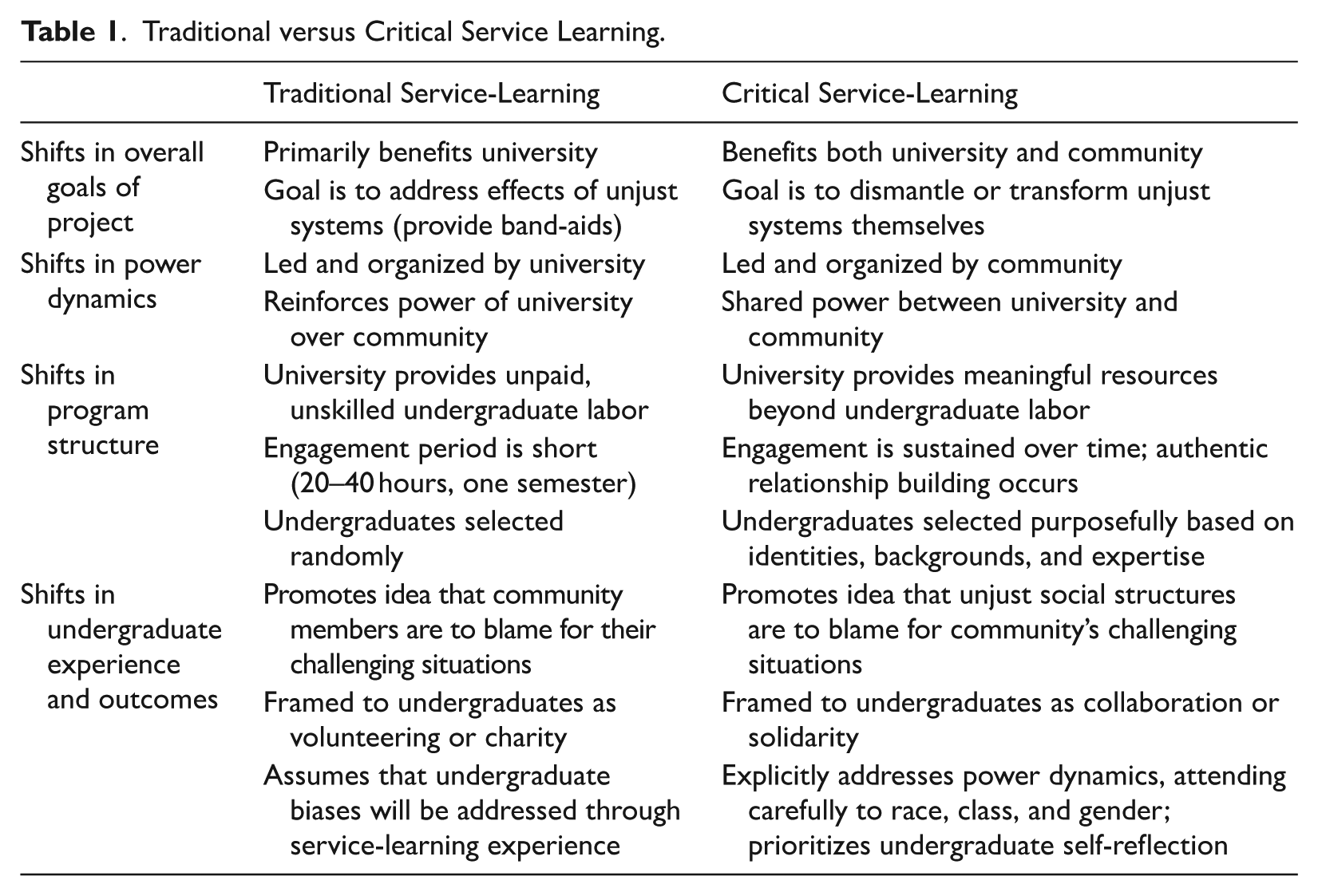
We hypothesize that engaging undergraduates in youth participatory action research (YPAR) projects with middle school partners has the potential to create critical service-learning experiences that fulfill or move toward the 10 elements of critical service-learning listed in Table 1. YPAR is a critical community-engaged research methodology that gives youth the tools to identify issues in their social and material environments, research these issues, and create solutions and action items to help remedy them (Anderson 2020; Brion-Meisels and Alter 2018; Ozer and Piatt 2017; Payne 2023). YPAR encourages youth to engage in scientific inquiry as collaborators with adults, bringing them into and thus expanding the sphere of knowledge production (Anderson 2020; Call-Cummings, Ní Sheanáin, and Buttimer 2022; Cammarota and Fine 2008). In contrast to traditional service-learning partnerships with youth, such as tutoring programs, YPAR positions young people as experts rather than as students with deficits in reading or math. Moreover, the methodology prioritizes taking action to ameliorate the issues identified through research, a move that has the potential to create lasting transformation in young people’s schools and communities.
Traditional versus Critical Service Learning.
YPAR projects are student-led and therefore shift power dynamics between undergraduates and students. 1 Various projects have demonstrated the success of YPAR in developing young people’s agency and leadership skills across various contexts, including when embedded in school sites and within existing curricula (Anyon et al. 2018; Buttimer 2018; Gonell et al. 2021; Ozer, Ritterman, and Wanis 2010; Phillips et al. 2010; Schensul, LoBianco, and Lombardo 2004). For students, participation in YPAR can result in the development of increased agency and capacity for leadership, academic and career opportunities, cognitive and interpersonal skills, and critical consciousness (Anyon et al. 2018; Ozer and Wright 2012). Through YPAR, students have the opportunity to identify issues that affect them, such as negative youth-adult relationships or punitive school policies, and work to change them (Ozer and Wright 2012). YPAR projects often provide participants with opportunities to present their findings to the wider community, where their voices can be heard on a larger scale (Richards-Schuster et al. 2021; Warren and Marciano 2018). In some instances, school administrators listen to students’ projects and presentations and agree to collaborate for change (Kohfeldt et al. 2011). This may result in the development of school and community environments that are more responsive to youth needs. These outcomes can promote transformation in schools, which has the potential to provide lasting benefits for student and school partners.
YPAR includes an explicit commitment to authentic relationship building, which requires deep engagement over time and positions facilitators as collaborators rather than teachers. Between participating youth and adult facilitators, engagement in YPAR should be considered “entangled self-assertion,” where the collective—students, facilitators, and administrators—is engaged in ongoing negotiations in order to relate to one another through nonhierarchical means (Call-Cummings et al. 2022:77). The collective cocreates knowledge and works out language and actions to situate youth as experts of their own experience. Traditional youth-adult roles are challenged in YPAR spaces, and adult facilitators are tasked with operating from the perspective that relationships are sites of healing and guiding youth from that standpoint (Gonell et al. 2021). Power sharing between adult facilitators and participating students helps to develop students’ critical consciousness, or their ability to attribute issues in society to systems of inequality (Anyon et al. 2018; Gonell et al. 2021; Nagrotsky and Mizell 2024). Projects in which YPAR researchers and facilitators had strong relationships with the communities or schools they worked within are more successful (Anderson 2020). A five-year school-based YPAR program in Minneapolis demonstrated how integration into existing school structures can result in highly organized, influential, and positive projects (Richards-Schuster et al. 2021).
Aims of the Study
The aim of this current study is to understand how a YPAR project with middle school students could function as a critical service-learning experience for undergraduates. Specifically, we use a case study to answer the following research question:
Results of the study will inform university attempts to create critical service-learning programs that better address the long-term needs of community partners and undergraduates.
Methods
Study Context
This article describes a year-long collaboration between the Coalition for Compassionate Schools, a research lab at the first author’s R1 university, and three public charter schools in a medium-sized Southern U.S. city. As part of a service-learning program, seven undergraduates trained 18 middle school students in YPAR and guided them through the development and implementation of research projects aimed at improving their school environments. Through the university’s Center for Public Service, undergraduates earned both academic credit and service hours for their participation.
The Coalition is housed in the university’s psychology department and is funded by the Substance Abuse and Mental Health Administration Services as a National Child Traumatic Stress Network Category II Center (6H79SM085077-01M001). The Coalition primarily focuses on training school leaders and school staff on best practices to support students who have experienced trauma in order to positively shift school culture and provide students with greater social and emotional support. Coalition members noted the lack of youth agency and participation in the conceptualization and implementation of their trauma-informed schools model (Davis et al. 2022) and thus piloted a YPAR program to meaningfully engage the voices of Black and Latinx youth in the 2023–2024 school year.
Undergraduate Participants and Context
Although this project fulfilled the service-learning requirement for undergraduates, its structure varied from many of the university’s other service-learning opportunities. First, undergraduates were required to make a year-long commitment and dedicated 80 to 120 hours to the project from August 2023 through May 2024, significantly more than in a traditional service-learning course. Additionally, we opened the course to undergraduates in consortium schools across the city, so students from the second author’s university and a third university also participated. This decision was an attempt to diversify the undergraduate cohort because the first university’s student body skews white and wealthy. The second university has more racial and economic diversity than the first, and the third university is an HBCU (Historically Black College and University) that serves a mostly upper-middle-class Black student population. The cohort was small—seven students total. We recruited undergraduates through service-learning networks at the first university, personal connections at the second and third universities, and the first university’s psychology department. We aimed to attract diverse undergraduates from all three universities who had prior experience working with children and had previously taken courses on race and equity, preparing them to relate to our middle school students. The course was open to upper-level students, and all selected undergraduates were juniors or seniors at their respective universities. Although the course was offered through the psychology department, the first author’s training is in sociology, and undergraduates’ majors included psychology, sociology, and criminal justice. We required that undergraduates apply to participate in the YPAR project, emphasized the year-long commitment, and interviewed each applicant individually, eventually choosing a cohort that was much more diverse than the general student body at the first author’s university. Table 2 breaks down the demographic characteristics of undergraduate mentors (all undergraduate and school names are pseudonyms).
Undergraduate Mentors (18–22-year-Old College Students).
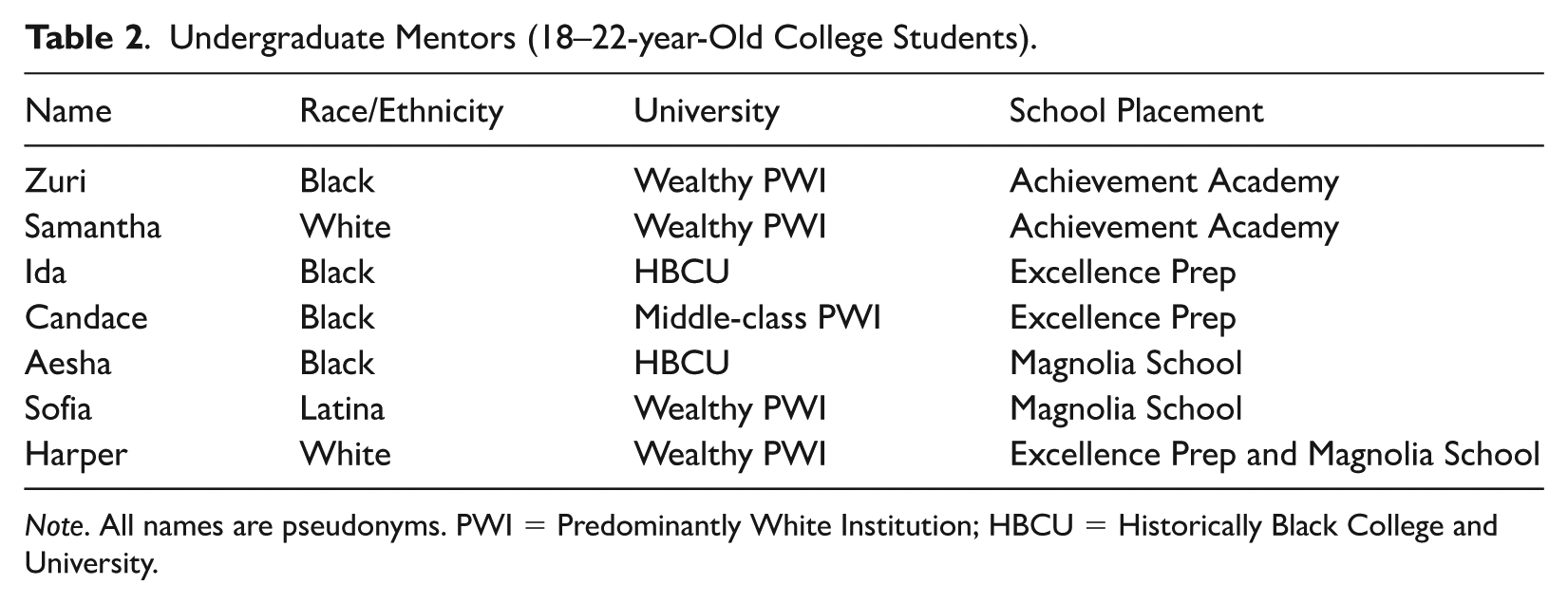
Note. All names are pseudonyms. PWI = Predominantly White Institution; HBCU = Historically Black College and University.
Finally, although the project received support from the Center for Public Service, it was framed to the undergraduates as a “research opportunity” to investigate the factors that make a school feel trauma-informed to its middle school students. The purposeful selection of undergraduates, shifting away from narratives of “giving back” to the community, and the longer time commitment were intended to create the structures for a critical service-learning experience. We hoped that prioritizing the inclusion of Black and Latina undergraduates, who reflected the racial demographics of the middle school students, would help undergraduates build rapport with their students, appropriately contextualize their school placements, and view the work as solidarity rather than charity.
The undergraduates enrolled in a seminar course for the fall semester, which was taught by the first author, director of the YPAR project and postdoctoral fellow at the Coalition. This course, which undergraduates took concurrently with their initial work at school sites, provided critical texts and discussions around participatory research, service-learning, trauma, adolescent development, and contemporary issues in education. In addition to reading scholarly articles about participatory research, undergraduates analyzed examples of YPAR projects from around the country, including Twisted Garden (Stevenson 2023), the Minneapolis Youth Participatory Education project (Minneapolis Youth Participatory Evaluation n.d.), and the Pa’lante Restorative Justice project (Pa’lante Restorative Justice 2021). Undergraduates also had an opportunity during class time to lesson plan for their schools, discuss issues that arose, and problem-solve with their peers. All undergraduates completed weekly reflections about their experiences at the middle school sites. In the spring term, undergraduates enrolled in an independent study with the first author in which they met weekly to plan lessons and activities, reflect on their school sites, and ensure the research projects were progressing as intended. Through these courses, reflection was prioritized, and undergraduates had the opportunity to collectively make sense of their experiences in the schools.
Undergraduates were closely supervised by the first author using an apprenticeship model. At the beginning of the year, the first author planned and facilitated all lessons while undergraduates observed or facilitated small activities; then, she slowly pulled back both the planning and facilitation until undergraduates felt comfortable running the sessions independently. This allowed the first author to model pedagogical techniques as well as lay the groundwork for the participatory research process. With the exception of Harper, who switched between two schools, undergraduates worked with the same team of six students all year long, facilitating the creation of authentic and sustained relationships. The small cohort and the staff time and resources dedicated to this project helped ensure that undergraduates were effective in their work and challenged to be creative, flexible, and student-centered in their pedagogy.
Middle School Participants and Context
To recruit middle school students (12- to 14-year-olds), we partnered with three public charter schools with whom the research lab had a prior relationship. In the 2023–2024 school year, 100 percent of public schools in the city were run as publicly funded and privately governed charters. System-wide, the public schools serve 43,500 students, of whom 92 percent are students of color and 82 percent qualify for free or reduced-price lunch (New Schools for New Orleans 2025). However, our partner schools were even more economically and racially segregated than the district as a whole (see Table 3). At each school, we recruited six students to participate in the program. We asked school leaders to select a diverse cohort, including students who struggled academically, were English-language learners, and received discipline referrals. Despite this, participating students seemed generally to be higher performing than many of their peers. Of the 18 middle school participants, 15 were Black and 3 Latinx, reflecting the populations of their schools. Thirteen of the students were girls, and 5 were boys, primarily because Achievement wanted to run the YPAR team as a girls’ empowerment group and thus selected only girls to participate. We held weekly meetings during and after school at each partner school and then as a full group across all participating schools one Saturday per month. Students were paid a stipend of $80 each month to incentivize their participation and to recognize their role as researchers working to make substantive change in their schools.
Demographic Breakdown of Partner Schools.
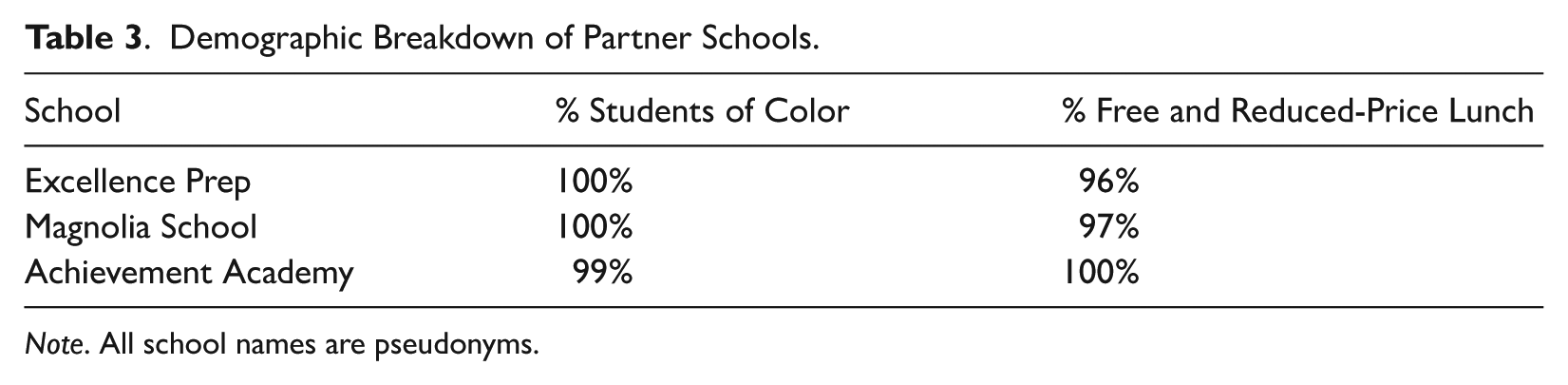
Note. All school names are pseudonyms.
YPAR Curriculum
The YPAR program started two months after the beginning of school due to delays in getting approval to begin from school partners. The first author and the undergraduate facilitators guided students through the development and implementation of their own school-based research projects while also covering topics such as power and adultism to prepare them to advocate for changes in their schools. For an overview of the yearly scope and sequence, Se33e Table 4. The curriculum also drew on publicly available curricula from U.C. Berkeley’s “YPAR Hub” (U.C. Berkeley 2025) and U.C. Davis’s “Stepping Stones” program (U.C. Davis 2025). In May, we held a final showcase where students presented their findings and recommendations to their peers, families, Coalition staff, and school stakeholders. Students then had the option to participate in a three-week “summer camp” in which they collaborated to create a short professional development seminar for teachers that drew on their research to explain, from students’ perspectives, what students need to be successful in school. Fifteen of the 18 students participated in that summer camp, and many of them have continued their involvement in the 2024–2025 school year by presenting that seminar to teachers and students across the city.
YPAR Scope and Sequence.
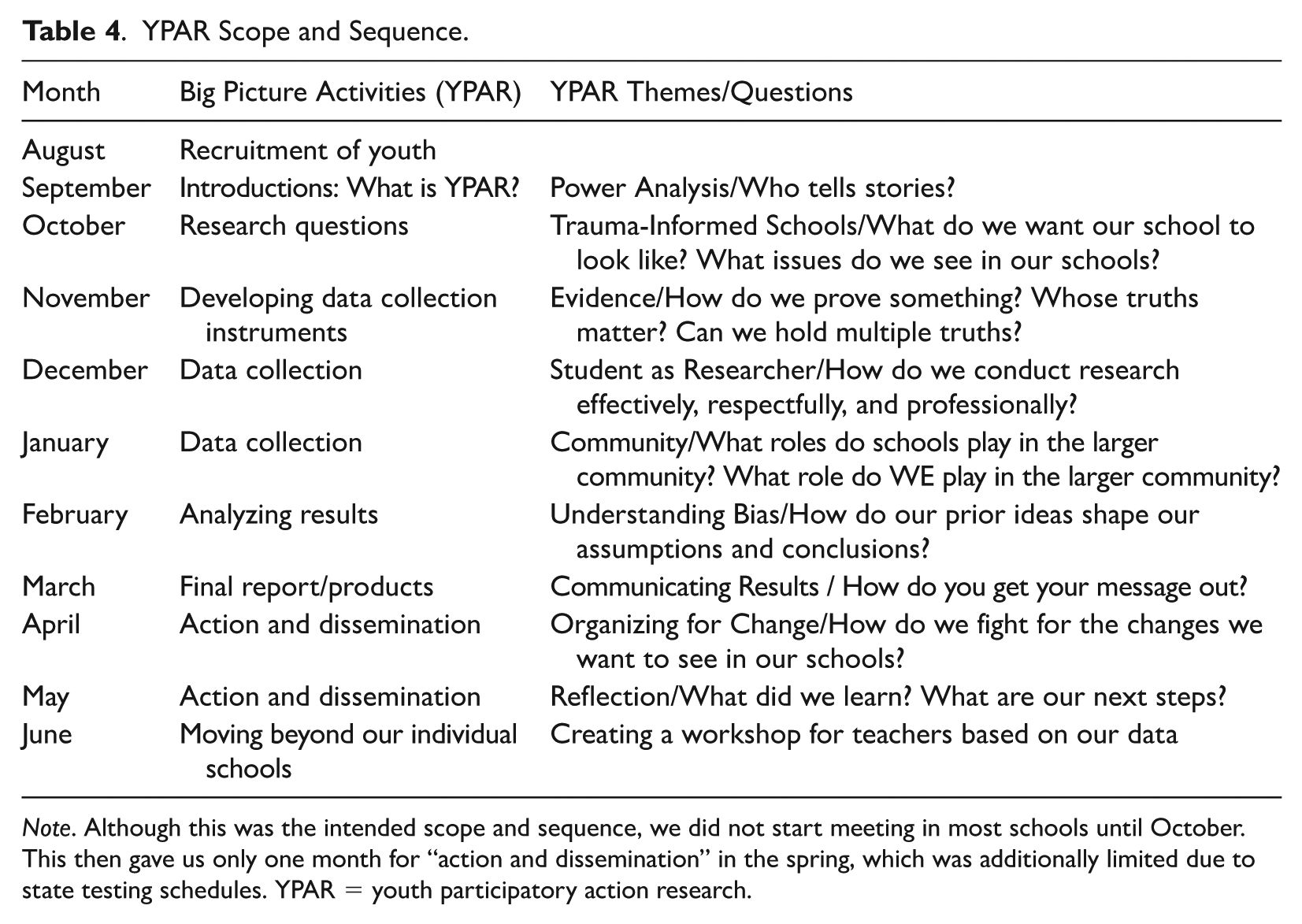
Note. Although this was the intended scope and sequence, we did not start meeting in most schools until October. This then gave us only one month for “action and dissemination” in the spring, which was additionally limited due to state testing schedules. YPAR = youth participatory action research.
Data Collection
This case study primarily draws on undergraduate journal entries. Each undergraduate was required to submit a weekly reflection that discussed their experiences at their school sites. These reflections were one to two pages in length and touched on major accomplishments of the week, any challenges they encountered, surprising moments, and assistance they needed to successfully facilitate their YPAR group. There were 98 total journal entries. We anonymized these journal entries and removed any personal or school details.
In addition to the journals, undergraduates participated in a focus group reflecting on their experiences in May 2024. The focus group was facilitated by a staff member at the Coalition who otherwise had not interacted with the YPAR program. The facilitator followed a focus group guide that asked undergraduates to describe their relationship with their students, define the goals of the program, comment on challenges, and reflect on the impact the program had on them and their students. All seven undergraduates participated in the focus group, which was audio recorded and transcribed.
Middle school students additionally participated in a focus group in June 2024, on the final day of their three-week summer camp. Students were asked to describe the program in their own words, list their favorite and least favorite components, describe their ideal school, and reflect on how they think change occurs. The focus group was facilitated by the same Coalition staff person, who was not part of the YPAR program. The focus group was audio recorded and transcribed. Fifteen of 18 students participated in the focus group.
Data Analysis
The research team (the first author and the second author, an undergraduate who participated in the program) was directly involved in carrying out the YPAR project, which may result in bias. To minimize this, we used a three-phase grounded theory approach to developing codes, moving from open coding to axial coding to selective coding (Williams and Moser 2019). In the open coding process, we read through randomly selected focus group transcripts and journal entries and brainstormed a long list of themes. Then, we categorized and combined the themes to create unique and mutually exclusive categories, gaining a higher level of abstraction (e.g., moving from “issues with university shuttle” to “transportation issues”). In the final step, we further refined the codes to create broader themes and relate those themes, when relevant, to aspects of traditional and critical service-learning (e.g., moving from “transportation issues” to “undergrad challenges” because the undergraduates arriving late due to issues with the university shuttle was a challenge that the undergraduates brought to the project). This process ensured that the codes emerged directly from the data, and only at later stages did we attempt to connect the codes to theories of critical service-learning and YPAR in schools. Following the three-phase code development process, the research team finalized a codebook (Table 5) that had four key categories: (1) Analysis (three codes), contained codes related to participants identifying unjust social structures as the cause of student and school struggles; (2) Program Goals (four codes), contained codes connected to student empowerment/agency and codes about attempts to create transformative change within schools; (3) Undergraduate Experience (nine codes), contained codes about undergraduates’ core takeaways from the program, both personally and professionally; and (4) Challenges (four codes), contained codes about challenges brought by the schools, scheduling, students, and undergraduates themselves. These codes encompassed the majority of themes discussed by undergraduates in their journals and focus groups and highlighted core components of both traditional and critical service-learning.
Codebook.
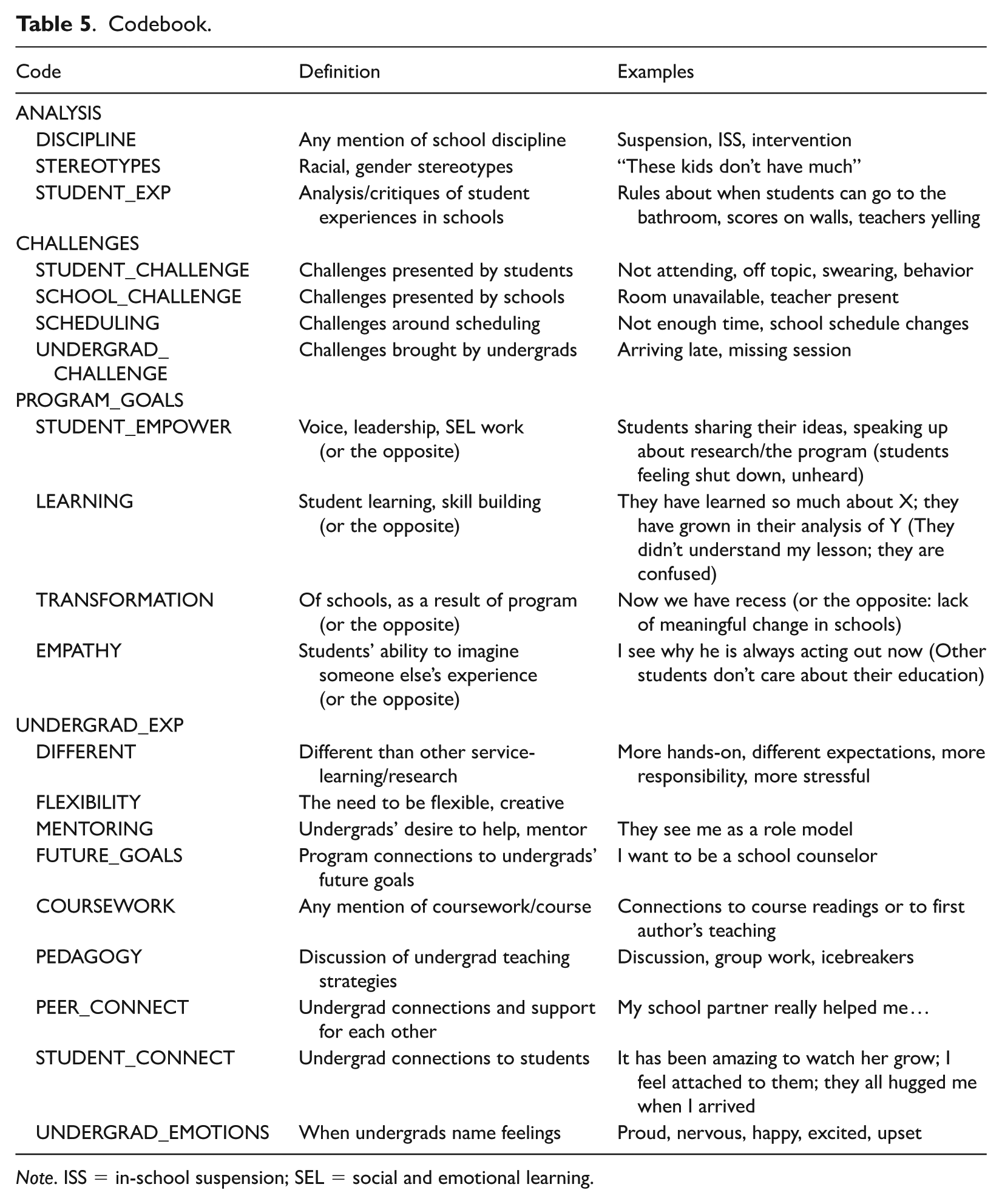
Note. ISS = in-school suspension; SEL = social and emotional learning.
The research team then conducted four intercoder reliability training sessions. After each training, they discussed places of discord and refined the codebook further. In the fourth training, they achieved a pooled Cohen’s kappa of 0.76, which suggests good agreement. Each coder then randomly divided up transcripts and coded them in Dedoose, a collaborative, cloud-based qualitative coding program. When coding was complete, the coders exported the excerpts out of Dedoose and wrote qualitative memos for each code, for a total of 17 memos. The memos varied in length from one to nine pages. Each memo further refined the code into more precise buckets, with bullet points and exemplar quotes. The authors then used those memos to highlight and record major results.
In addition to the journal entries and two focus groups, we conducted a document analysis of the students’ final slide decks. There were three slide decks, one per school. We attempted to find evidence to determine when students were advocating for solutions that might realistically result in changes in their schools versus when they were attempting to put “band-aid” solutions on larger systemic issues.
These multiple data sources—journal entries, undergraduate focus group, student focus group, and student final presentations—were used to triangulate the data and ensure credibility. We honed in on themes that appeared across sources and discarded those that showed up in only one. We further compared themes within and across schools, which should help readers consider whether findings will be relevant in different contexts. In the following results, we indicate clearly whenever a theme was particular to only one school environment. Finally, to increase trustworthiness, when possible, we have attributed quotes directly to undergraduate participants so that readers can evaluate the positionality of each speaker. We also include the date that journal entries were written, allowing readers to trace the development of undergraduate ideas over the course of the internship.
Results
Overall, we find that YPAR represents a promising model for critical service-learning because it (1) shifts undergraduate experiences and outcomes by engaging undergraduates in a genuinely collaborative experience with middle school students that results in undergraduates articulating a more nuanced analysis of the structural causes of inequity, (2) shifts program structure to prioritize authentic relationship building between undergraduates and students, (3) shifts power dynamics by supporting projects that are student-led and student-organized, and (4) shifts the overall goals of the service-learning project by supporting student organizing to make transformative change in their schools.
Understanding the Structural Causes of Inequity
In a critical service-learning experience, undergraduates should gain an appreciation for the structural causes of inequity rather than blaming individuals for the challenges they face. In working with Black and Latino middle school students, this necessitates moving away from a deficit model that categorizes students as performing below grade level, understands their behavior as a discipline issue, and views their critiques of their schools as the unserious complaints of children. Instead, undergraduates took student concerns seriously, recognized and commented on the brilliance of their students, and aligned themselves with their students in critiquing unjust policies at the school and district levels. This orientation resulted in undergraduates leaving the internship with a deep appreciation of their students’ experiences and struggles and a strong analysis of the ways in which our public school system—and our local and national macroeconomic policies—are failing these students and communities.
Across all three schools, undergraduates focused on recognizing student strengths despite prevalent narratives about their academic failure. When she was struggling with lack of focus with her group, Candace reflected, “They are extremely capable, it’s just a matter of making a space where they can demonstrate their academic capacity” (January 15). Instead of blaming students for being distracted, Candace recognized that it was undergraduates’ responsibility to create the conditions for student success. Undergraduates articulated this work as explicitly countering negative stereotypes about Black and Latino students: Hearing all of those stereotypes about how students are hard to teach . . . or they’re rowdy and stuff. It’s for a reason, just listen to them. They want to be heard, they want to be understood. We should be able to do that for them. They shouldn’t have to even want it, it should be a given. (Undergraduate focus group)
These negative stereotypes were especially prevalent at Achievement Academy, which was slated for closure by the school board midway through the year due to low test scores. After a powerful session with their undergraduate mentors, the students at Achievement decided to change their research focus from sexism at the school to the experience of attending a closing school: “The students’ responses highlighted the emotional toll of stereotypes about their intelligence (not being ‘smart’) and perceptions of staff turnover. This reshaped our research focus. . . . The students’ candidness emphasized the importance of centering our study on their experiences” (Zuri, January 22). Students at Achievement often commented that adults blamed them for the school’s poor performance; they organized their research project to challenge those assumptions and demonstrate the traumas caused by narratives of school failure.
The YPAR process emphasizes that those who are most impacted by social systems have unique insights about how those systems function and about their impact on communities. This orientation comes from feminist and critical race epistemologies (e.g., Harding 2013; Solórzano and Yosso 2002). The undergraduates recognized this in their students: They have a lot to say. They’re very bright, they’re very smart, and they are very, very aware. I think that this program also gives students a chance to voice those opinions as well and to show that they actually do have something meaningful to contribute to the larger conversation. (Undergraduate focus group).
This was explicitly connected to an anti-racist analysis: “Black and Latino kids aren’t a monolith, and even in the little group that we have with six kids, they’re all so different” (undergraduate focus group). Through the YPAR process, undergraduates helped elevate students’ complaints by reframing them as research questions worthy of study: Hearing the girls’ testimony today made me realize just how many problems exist at Achievement. When we were discussing sexism, the things they had to say were disheartening, yes, but they were all in the scope of sexism. Now that we have zoomed out, I find that they have a lot more to say about the systemic issues that plague their school. (Samantha, December 4)
In this example, Samantha also helped the students move beyond an analysis that was focused solely on gender to think more broadly about how intersecting forms of oppression characterized their experience at school. By transforming these experiences into research projects, undergraduates helped facilitate a process that allowed students to feel heard and validated as well as confident in advocating for changes that would improve the educational experience for themselves and their classmates.
Over the year-long project, undergraduates aligned themselves with their students, developing substantive critiques of teacher, school, and district policies that they felt negatively impacted students and undermined their success. For example, undergraduates criticized systems of school discipline, which they found to be overly punitive: If they were pushing, and shoving, or yelling, that’s different, but most of the time they’ll just be chit-chatting, and be yelled at. . . . I heard once, “If you keep this up, no recess tomorrow.” They’re threatened with taking away going outside. . . . That should be a given, that you can go outside, and breathe air, and not sit at a desk for eight hours. (Undergraduate focus group)
Undergraduates were shocked by policies that required students to be quiet most of the time and punished them for small infractions; at Magnolia School, they also expressed that students had been “trained in submission” (undergraduate focus group). The undergraduates assigned to Magnolia worked for a large part of the year to create an environment in which students felt “safe to share their opinions and thoughts without being scared” (Sofia, October 30). These undergraduates articulated a powerful rebuke of the school’s culture, which they felt rewarded students for compliance and getting the “right” answer at the expense of critical thinking, risk taking, and sharing their honest opinions. All of these examples demonstrate how undergraduates were able to hold the inherent dignity and intelligence of their students as a given and place blame on the school-wide conditions that limit students’ ability to thrive. At the same time, undergraduates felt severely limited in their ability to intervene in school policies that upset them, both because of their limited power in the situation and because of the necessity of maintaining strong relationships with schools to ensure access to students.
No examples were identified of undergraduates stereotyping their students or blaming them for the negative conditions in their schools, although one undergraduate did suggest that course readings made her feel intimidated to enter her school site: I think that reading so much literature at the beginning that dealt with these kinds of stereotypes, and all of the difficulties of public and charter school systems, and underfunded schools and everything, I think that engaging so intensely and frequently with that sort of made it difficult to go into this school and feel normal about it. (Undergraduate focus group)
This undergraduate, who came from a privileged, white background, felt intimidated by readings critiquing economic and racial inequality in school, which she saw as reinforcing of stereotypes about Black and Latino students. However, once she got to know her students and got used to the school, she was able to articulate the ways in which systems of inequity had produced a school experience for her students that was vastly different than her own. Overall, although undergraduates may certainly have held negative views about their students or their abilities, they did not express those in their reflections.
Shifts in Program Structure Allow for Meaningful Relationship Building
Foundational to the philosophy of YPAR is a commitment to building and sustaining meaningful relationships. The year-long time commitment and small class sizes allowed for the development of trusting relationships and the creation of a safe environment. Building those relationships was a critical piece of the program. Much of the course readings and discussions during the first semester emphasized the necessity of secure, positive relationships with adults for the well-being of children and adolescents. Undergraduates wanted to be positive role models for students—“I wanted to achieve a close connection, that was one of my main goals” (undergraduate focus group)—and worked to build those relationships as the project progressed. Recurring themes included undergraduates’ efforts to listen closely to student input, make adjustments based on student needs, and support student emotional well-being.
Responding to Student Feedback
Undergraduate facilitators took care in constructing learning environments that would make students feel safe, heard, and empowered. They did this through deeply listening to students’ expressed wants and needs. Furthermore, the open lesson planning structure gave undergraduates the space to bring in their own passions or speak to the passions of their students, often in a way that was not permissible during students’ regular school day. For example: “We particularly noticed a heated discussion about cartoon shows and anime so we decided to do a mock focus group based on cartoon shows” (Ida, December 4). Because their groups were only six students, the undergraduates were able to get to know each student individually and incorporate their interests into lessons. This strategy helped the undergraduates feel like their sessions were enjoyable for students, even as research goals were met: “Aesha and I are trying to plan more fun activities where students can clear their minds and feel like they are not in class time” (Sofia, November 6). Undergraduates developed cogent critiques of some of their school sites, as described previously, and were focused on making sure that their YPAR sessions felt liberatory for their students. Key to achieving this goal was adjusting lesson plans, research trajectories, and classroom management strategies based on student voice and input throughout the year. This exemplifies a sustained commitment to uplifting youth voices and creating trusting relationships.
Supporting Students’ Emotional Well-Being
Undergraduates were focused on supporting youth researchers’ emotional well-being, a crucial component of building trusting relationships. They wanted to balance students’ emotional needs with their capacity to be engaged with the material: “I want them to know that I’m hearing them and stuff like that. That’s it, just knowing that they want to be understood, and that that’s what needs to happen when I walk into the room” (undergraduate focus group). In a charter school context that is highly focused on test scores, holding social-emotional goals at the forefront of our work distinguished the project from students’ academic courseload. Undergraduates noticed when students seemed down and made efforts to lift them back up, “[Two students] seemed upset and disappointed, so I called them over before they left and told them that it was okay that it didn’t work out right that day, and that projects like these often involve a lot of guessing, checking, and improvising” (Candace, March 4). After a couple of months working with the students at Excellence Prep, one was suspended: “[A student] wasn’t there Tuesday, since he was suspended. Thursday he seemed upset. I asked him if he was alright and he said yes. . . . I plan to follow up with him this week, because I think the suspension really impacted him” (Candace, November 6). To be a trusted adult, undergraduates understood that they needed to be attentive to students’ emotional realities, check in with them regularly, and make sure to follow up on previous conversations and concerns. Candace additionally was able to contextualize the suspension within course readings that critiqued the overpolicing and overdisciplining of Black boys, helping her to understand the suspension as not solely the student’s “fault.”
Undergraduates were attentive not only to the content of students’ research projects but also to the emotional and social impacts their questions had on their lives. Writing about the conversation that was had after the announcement that Achievement Academy would close, Zuri (January 22) reflected: The students voiced concerns about the potential impact of their future, questioning whether a “better” school would accept them given their association with a now-closed charter school like Achievement Academy. This aspect adds another layer of nuance to our research, emphasizing the need to explore not only the emotional aspects of the closure but also its potential repercussions on students’ educational trajectories.
This illustrates how the undergraduates had created a classroom environment in which students felt comfortable being vulnerable; it additionally reflects Zuri’s attentiveness to the students’ feelings and her desire to uplift their ideas by incorporating them into their research project.
Although undergraduates were sensitive to building authentic relationships with their students when they were present, undergraduate attendance and timeliness were persistent issues. Partly this was because university and public school calendars are not aligned; for example, many undergraduates returned home at the beginning of December, missing three weeks of programming that month. However, they also missed sessions for a variety of personal and logistical reasons. These absences, which were often communicated at the last minute, led to session cancellations or one undergraduate holding the session alone. Similarly, undergraduates sometimes struggled to arrive on time to their school sites, both because of their own errors in estimating traffic and because of inconsistency with the university-provided shuttle: “So we were late and four kids either weren’t coming or had left” (Candace, March 18). These struggles with attendance and timeliness created gaps in programming and left students at times feeling disappointed as well as deprioritized by their undergraduate mentors.
Shifts in Power Dynamics
Solidarity and Power Sharing
One goal of the YPAR program was to create student-driven research projects that would create sustainable improvements in schools, and thus, student empowerment was core to the program’s mission. This helped create a dynamic of solidarity and collaboration between undergraduates and their middle school students rather than one of charity or “giving back,” which sometimes characterizes service-learning programs. To achieve this, undergraduates needed to genuinely allow students to develop and carry out the projects, to trust students’ expertise around their own educational experience, and to see their role as teaching and guiding students but not directing them. This, then, resulted in power sharing between undergraduates and middle school students.
At all schools, students developed their research question and the methods they wanted to use and then created data collection instruments. Although undergraduates presented and explained different research methods, for example, students ultimately decided which methods they thought would best produce quality data: They also came up with a research question and wanted to try the focus group research method, which I think is cool! I thought they would have wanted to do a survey, so I am glad they picked something a little different [which] could be more challenging since it is their first time conducting a research experiment. (Aesha, November 13)
Students were invested in the projects because they had designed them and chosen methods that connected to their interests: “It has been really cool to see their passion for the methods” (Candace, November 27). Students were particularly enthusiastic when it came to actually beginning to collect data, perhaps because it was hands-on and connected to their goal of improving their schools. Along with designing data collection instruments, such as interview guides and surveys, students facilitated interviews and focus groups and recruited their peers to participate: “The kids seem more up and excited in this meeting than ever before. I would say most likely because we are actually starting research and their projects” (Aesha, December 4). Students—and their undergraduate mentors—felt like they were participating in something greater than a school project because they were producing novel data and working to make meaningful change in their schools: “They are excited about collecting the data and showing all the work and effort they have put in over the past few months to their teachers and classmates” (Sofia, January 22). Undergraduates built on student enthusiasm to guide them through the creation of projects that were timely, focused on key issues within the schools, and tailored to students’ interests and experiences.
As described previously, undergraduates did sometimes struggle to strike the appropriate balance between giving students autonomy and guiding their projects. However, as the year progressed and their relationships with their students deepened, they became more confident in letting students direct the research: “I’ve learned the importance of listening to students’ authentic voices and adapting research strategies accordingly. Moving forward, I’m eager to delve deeper into their experiences and explore avenues of support for a more comprehensive study” (Zuri, January 22). The undergraduates’ growing confidence in their students corresponded with a rise in confidence from the students as well. “[One student] really stepped up as well and was asking this teacher some of the questions he had missed in the beginning. It really showed her confidence in her ability to lead this focus group and her understanding of the questions they had created” (Harper, February 26). When the students were facilitating using materials they had created and they knew they had their undergraduate mentors’ support behind them, they confidently carried out their research studies, analyzed results, and presented their findings.
Creating an Engaging and Challenging Learning Environment
Undergraduates worked to challenge their students, give them opportunities to lead, and engage them in high-level, meaningful tasks, which is crucial in a school environment that is largely characterized by preparing students for rote, standardized tests. Providing challenges and demanding critical thinking helped deepen undergraduate and student relationships as they worked together to solve real problems and demonstrated their respect for each other’s intelligence, skills, and life experiences. They also held high-level discussions with students. After it was announced that Achievement Academy would be closing, undergraduates wanted to empower their students with historical context, “Zuri and I facilitated a lesson on school closures in New Orleans. . . . After reading an article and watching a video about all of this, we discussed how many circumstances and events culminated in the New Orleans school system we know today” (Samantha, March 4). By helping students understand the larger context and the racial and economic dimensions of the closure, Zuri and Samantha challenged their students to connect their experience to overarching institutional dynamics and develop a project that spoke to a city-wide phenomenon.
The creation of a stimulating learning environment was a gratifying process for both parties, with undergraduates frequently commenting on the progress of the student researchers. They documented breakthrough moments: We’ve been doing a lot of data analysis with their research, watching them have their aha moments, and see things click, and be able to make those deeper analyses that weren’t possible four weeks ago, because we just hadn’t talked about it. But just watching them learn and be able to make those connections, and just be able to talk for five minutes about what they’re realizing, and I’m like, “Yes, exactly. That’s what we’re doing.” And it’s been nice. (Undergraduate focus group)
In general, undergraduates and student researchers felt like they were collaborating to complete a challenging yet meaningful task, one that had the potential to make a difference in their lives and the lives of their peers.
Of course, sometimes undergraduates’ lessons were unsuccessful and/or they failed to meaningfully engage and guide students: “Overall, I think the lesson probably was a bit too complex and we could have done a better job facilitating and making it less like classroom lecturing them” (Harper, December 4). This then resulted in behaviors and attitudes that were tricky for undergraduates to navigate. Shyness and reticence were an issue primarily at Magnolia School: “They usually look at Sofia or I to tell them what to do or say next, but I kept reminding them that it is their project and they can decide whatever they would like to do” (Aesha, December 4). The undergraduates at Magnolia worried that their project was becoming too undergraduate-driven because their students sometimes seemed disengaged or passive. At the other schools, students sometimes had excess energy, and it was hard for them to stay on task. This led to frequent distractions and occasional inappropriate behavior: “In between the lessons, the kids kept interrupting for side conservations, leaving the room and/or using inappropriate language. It was very difficult to keep them focused on the lesson and they seemed a little irritable” (Ida, April 11). We did not experience these behavioral issues as much at the Saturday sessions; we theorize that meeting after a long school day was challenging for students. Additionally, the Saturday sessions were held at neutral locations, such as local universities or community centers, whereas the weekday sessions were held at students’ schools, which may have been traumatizing or difficult sites for some students. Nevertheless, when students were acting rowdy or refusing to participate, the power dynamics in the sessions often resembled a traditional classroom rather than a youth-led collaborative space.
Challenges with student attendance at some schools may reflect fluctuating student investment in the YPAR project. However, middle school students also have limited control over their attendance due to their reliance on adults for transportation and permission to attend. Students most often missed our sessions due to participating in school athletics or other school activities (e.g., prom, band), sickness, the school bus not picking them up, state testing, and being suspended or otherwise barred from attending the school due to discipline issues. This resulted in delays in getting research off the ground and significant undergraduate frustration: “Unfortunately, after arriving at Magnolia, there was only one student present, and we had no choice but to postpone the lesson” (Sofia, October 30). Students also arrived late to sessions, either because they were held in their classes or because they were chatting with their friends. Sometimes, students were not in their usual classrooms, and undergraduates had trouble locating them. Situations such as these were sometimes tricky for undergraduates to navigate because they were not always sure, especially after school, which staff they should ask for assistance. These dynamics were demoralizing for undergraduates and sometimes made them feel as though the students were not seriously invested in the research.
Shifts in Project Goals to Promote Transformative Change
Another core goal of the YPAR program was to create sustainable change in schools to make those institutions more responsive to the needs of students. We struggled to achieve this goal due to difficulties engaging school administrators as well as the fact that one of our partner schools shut down at the end of the year. However, we were more successful in raising students’ critical consciousness and feelings of personal efficacy. Additionally, some students had the opportunity to present their work to educators at other institutions throughout the district, hopefully spurring some change at those schools. Although significant improvement did not occur at partner schools, students did understand that our goal was change and transformation, they went through their own personal processes of growth and transformation, and they created presentations that highlighted key recommendations that would, if followed, make schools more student-centered and trauma-informed.
The Project’s Goal was Change
This project drew on the tradition of YPAR as an attempt to disrupt the traditional banking model of education and empower young people to transform their school environments. Undergraduates grasped the Coalition’s mission and felt passionate about the expansion of trauma-informed research programming in schools, “Ideally, it would go further, and extend into the schools, and then spread from the schools that. . . . Not just ones we’re working with, but other schools in the New Orleans area, and [those schools would] make these changes with the research that we’ve done in mind” (undergraduate focus group). Undergraduates recognized the power of the YPAR methodology and saw it as a potentially fruitful avenue to create positive change in schools.
Middle school students were similarly encouraged to see themselves as agents of transformation, and many did: “I want to create change” (student focus group). Students created and proposed solutions in their final research presentations, which were aimed to improve their school environments and give school leaders concrete steps to take to address some of the concerns they had uncovered. When the project was over, students expressed that they now thought of themselves as leaders and advocates for improvement: “I want to see what else I can do for my school and make changes” (student focus group). Students developed an awareness of their role in their school communities as leaders with the ability to enact change.
Students’ work provides compelling data detailing some of the pressing issues within schools. They expressed their ideas about school closure, student-teacher relationships, and lack of student motivation in their projects. They also provided a clear path forward for school administrations interested in enacting change. For example, students at Achievement Academy, who experienced a school closure, argued that students and staff deserved more time to adjust to the closure and should have had more of a voice in the decision to close the school down. Students at Excellence Prep, who were researching student-teacher relationships, suggested that teachers should create policies with students for the sake of fairness and that schools should devote meeting time to help teachers develop deeper, more respectful connections with students. These youth researchers’ presentations serve as recommendations from experts on student experience of possible ways forward in improving the quality of their schools.
Student Personal Growth and Transformation
Over the course of the project, youth researchers developed their research skills and their confidence. Undergraduates noted their students’ growth over the course of the year: I would like to highlight how much they have learned doing this project and how even if they don’t see as much change in their school setting, which we hope they do, their participation in this research challenged them to step out of their comfort zone and learn more about themselves and their abilities. (Sofia, January 22)
Student researchers conducted a research project from start to finish. They learned what makes a good research question, methods, how to collect data, and how to analyze it. They practiced leading focus groups, interviewing their peers and teachers, making graphs, and giving presentations. Undergraduates felt that they were helping to prepare students for success at school and beyond: “I know that a lot of these tools will help them in the future in school, and I think they’re also helpful life skills, public speaking, all of those things will help prepare them for the future” (undergraduate focus group). Undergraduates also noticed students taking on new leadership roles and feeling more capable of sharing their thoughts and ideas with their peers and with school administrators: “I think a lot of them gained confidence. I think that was one of the biggest things. . . . This gave them a newfound confidence to act and do” (undergraduate focus group). Throughout the course of the YPAR project, undergraduates were invested in building students’ knowledge, skills, and confidence, and students developed trust in their own capabilities.
Student researchers sharpened their critical consciousness throughout the year, guided by undergraduates who pushed them toward a deeper and more nuanced understanding of the issues they identified. As one undergraduate noted, students’ language about their schools became more specific: “Not just saying, ‘Oh, I go to a bad school.’ Like, ‘Oh no, it’s these aspects that I wish would improve.’ It makes it more tolerable to be in school” (undergraduate focus group). This exemplifies students’ increased ability to use language and data to express themselves. Additionally, they gained an awareness of the ways that power works within schools and within the city, allowing them to think more deeply about how real change occurs: “In school, they teach us math, science, history, social studies, ELA [English language arts], but [at YPAR] they taught us about the different power systems, racism, sexism, adultism, there are a lot of isms, ableism. . . . So, like, yeah, they would never teach us about any of that at school” (student focus group). By creating an environment where students were able to talk about the factors that structured their lives and their school experiences, undergraduates helped students transform their understanding of the world around them and push for real solutions to the issues they had identified.
Obstacles in Creating Institutional Change
We experienced some challenges from our school partners that limited our student researchers’ ability to take meaningful action or create lasting institutional change in their schools. First, we did not start working in the schools until mid-October, instead of August as originally planned, and thus, the research timeline was crunched, and the “action” part of the project did not occur at some schools. The timeline was particularly abridged at Achievement Academy because the students changed their research question midway through the year when the district announced the school was closing. This late start was then exacerbated by our decision to put that study through the university’s institutional review board (IRB), which added additional weeks of delays before students could start collecting data: “I can’t help but feel a bit anxious about the fact that other schools are already working on data collection. I really hope that we hear back from the IRB soon so that we can too!” (Samantha, March 4). Although students did eventually complete their research project at Achievement, the rushed timeline meant that students did not have the chance to present their findings and recommendations to school leaders, aside from those leaders who attended their final showcase. This limited the potential for the students to have a meaningful dialogue with leaders about their experience of the school closing down.
Additionally, we struggled to maintain consistent communication with teachers and other school staff, which manifested in few opportunities to share our work and at some schools, the absence of a dedicated meeting space and time. In general, we felt like school leaders had low investment in the project both in assisting with program logistics and in hearing youth feedback. We had few contacts with teachers, and some school employees seemed to have no idea who we were or what we were doing in the schools: “Every time I walk into the school and ask to speak to a teacher, they’re like, ‘Why are you here? You’re 20, why are you in my middle school?’” (undergraduate focus group). Students at Excellence Prep wanted teachers to complete a survey but could not get any teachers to fill it out. Teachers also sometimes made inappropriate requests of undergraduates, such as asking them to cover their classes while they stepped out.
Scheduling and reserving meeting space was a significant issue with schools. At Magnolia, their assigned meeting space was often occupied by other staff when undergraduates arrived at the school: Trying to find a space to meet is also sometimes an issue, ‘cause they’ll put us outside, but sometimes the outside isn’t great ‘cause it’ll be freezing, and windy. . . . Or where we sit outside is occupied, and then we have to find a random open classroom, and that takes five minutes just to wander through the halls of school until we find something. (Undergraduate focus group)
When undergraduates were moved at the last minute to new classrooms, there were sometimes technology issues, such as broken speakers and missing adapters, that undermined their lesson plans. On top of this, school and student schedules frequently changed with little advanced notification. Undergraduates were frustrated when they planned lessons and commuted to the schools only to be turned away. It was, then, little surprise that school administrators did not prioritize listening deeply to students’ final presentations and working with them to integrate their recommendations into school policy.
Limitations
This study presents a qualitative case study of a service-learning experience centered around YPAR in schools. Additional quantitative data, such as pretest/posttest survey, and a control group of undergraduates who participated in a more traditional service-learning experience would be useful in understanding how the experience doing YPAR affected students’ critical thinking around issues such as the causes of poverty, racism, and poor educational outcomes. Although journal entries and focus group quotes suggest that undergraduates aligned themselves with their students and critiqued the social structures that limited student growth and potential, this could be due to selection bias. Undergraduates were not selected randomly for the project but instead were chosen due to their perceived fit with program goals. Rather than a weakness, we suggest that critical service-learning programs should do exactly this—select students least likely to perpetuate harm in the community. However, this selection process does limit the claims that can be made about undergraduate growth due to their participation in the program.
Another key limitation is that engagement in the three schools was limited to one year, so we were not able to assess to what degree the YPAR projects instigated meaningful institutional change. With that said, we know that no change occurred at Achievement, because it was closed at the end of the year, and we strongly suspect that no meaningful change occurred at Excellence or Magnolia, because school leaders from those schools did not attend the final showcase or agree to meet with student researchers. More extended engagement is needed, over the course of several years, to shift school culture and policies; additionally, program staff need to invest more in school leaders to build their capacity to hear youth feedback. In later iterations of this project, we requested a three-year commitment from partner schools and were thus able to build stronger relationships with school staff. Additionally, later iterations of this project prioritized time at the end of the year for students to plan actions to push for change at their schools regardless of school leaders’ investment in the project.
Discussion
Despite these limitations in the study design and program execution, we argue that school-based YPAR presents an opportunity to create authentic critical service-learning experiences that equally benefit university and community partners. Undergraduates gained research skills, built meaningful relationships with their students, and emerged from the program with a sharp analysis of the ways in which structural factors create disproportionate educational and economic burdens for poor students and students of color. Meanwhile, middle school students gained research, critical thinking, and public speaking skills; enhanced their critical consciousness; and began to see themselves as leaders capable of making change in their lives and their schools. As one undergraduate reflected, “It was honestly like magic” (Candace, January 29). When undergraduates planned successful lessons that effectively spurred student engagement, students were able to demonstrate their brilliance and expertise, creating projects that effectively highlighted endemic issues at their schools and proposing actionable solutions. Partner schools also benefited through being introduced to programs that support student voice and student recommendations that could potentially lead to updated school policies and school cultures that are more trauma-informed and support the engagement and achievement of all students. Student voice in educational decision-making is especially important in the middle grades, when students are capable of creative thinking and their ideas have the potential to improve learning environments (Schaefer et al. 2024).
It should also be noted that the vast majority of participants, including the program director, all seven undergraduates, nearly three-fourths of middle school researchers, and most school leaders and school staff, were women. As noted earlier, women continue to bear responsibility for the unpaid service work that occurs across the country to ensure that our communities, families, and institutions function smoothly (Strand 2023; Walker 2023). Moving from a traditional to a critical service-learning framework mitigates the often unspoken expectation that women should be volunteering as a central expression of their goodness, instead demanding that both students and undergraduates see their work as political, potentially conflictual, and about creating change (Walker 2023). Moreover, we tried to make sure that groups were fairly compensated for their time, offering students cash stipends and undergraduates a total of six course credits (three per semester) as well as an opportunity to potentially coauthor papers based on YPAR findings.
YPAR is a particularly useful methodology to ground a critical service-learning program because when implemented with fidelity, it inherently addresses some of the same issues that critical service-learning targets. YPAR requires power sharing and the cocreation of knowledge; its central tenet is fostering leadership and voice from community members who are often silenced or ignored. Facilitating a YPAR experience requires a framework of collaboration rather than charity. Moreover, the “action” piece of YPAR attempts to address endemic issues identified by student researchers and enact sustainable change that will improve young people’s lives and the institutions that serve them. Other parts of our program had to be specifically engineered to shift toward a model of critical service-learning. For example, the intentional selection of undergraduate participants; the longer time commitment, which allowed for relationship building; and the allocation of meaningful resources from the university all pushed the program away from a more traditional model. A course structure that prioritized reflection and encouraged undergraduates to critically analyze contemporary issues in schools also enhanced the critical service-learning experience and ensured that undergraduates questioned their stereotypes and assumptions about their students.
The challenges that we faced in implementing successful school-based YPAR are well documented in the literature and echo the challenges of implementing a critical service-learning program. A sustained and effective project relies on many different factors, including youth capacity for critical consciousness, school support, funding, and the energy and consistency of facilitators, among others (Baggett and Andrzejewski 2017; Buttimer 2018; Call-Cummings et al. 2022; Ozer et al. 2010; Phillips et al. 2010). When implemented within schools, most challenges result from a lack of institutional support for YPAR from the educational institution (Anderson 2020; Buttimer 2018; Keddie 2021; Kirshner and Pozzoboni 2011). A lack of wider community support for YPAR projects makes the work much more difficult due to issues such as administrative barriers and little assistance for teachers (Buttimer 2018). Clashing educational philosophies of involved parties can also create a disjointed and ideologically inconsistent project, which limits its effectiveness in empowering students and delivering on its core mission (Phillips et al. 2010). School administrators that are reluctant to support the (sometimes subversive) action of YPAR projects can play a powerful role in quelling the voices of student participants (Keddie 2021). Standardized curriculums in public schools make it more challenging to successfully integrate YPAR programs, as does the prioritization of testing (Buttimer 2018; Phillips et al. 2010). When implemented inside a classroom in a public school, it is difficult to obtain extra resources for the YPAR project in addition to other classroom materials (Buttimer 2018). When YPAR is implemented outside of the classroom curriculum, student engagement can become an issue, with student attendance rates and enthusiasm for the project dropping over time (Ozer et al. 2010). In our case, the first author and undergraduate mentors felt unable to directly challenge school policies they found to be unjust because they did not want to jeopardize their relationship with the school and potentially lose access to student researchers.
Further research is needed to explore the ways in which YPAR projects, such as the one described in this article, could lead to substantive improvements in school environments. Although students in our program developed recommendations, they ran out of time to advocate for the implementation of those recommendations. Moreover, because many of them were eighth graders, they moved onto high school before seeing if any of their suggestions were incorporated by school leaders. To create a more sustainable program, deeper partnerships would need to be built with school administration, with multiyear commitments to engagement. Longitudinal data would also be needed to analyze shifts in school culture and how sustainable those shifts are.
Future research might also examine the potential to scale a YPAR project such as this one so that more undergraduates could participate in a critical service-learning experience. Although this is resource-intensive for the university, the benefits for both the university and the community are much greater when an authentic and long-lasting partnership is established. A model in which schools assigned a staff person to facilitate the YPAR group, supported by undergraduates from the university, might also be a strategy to create greater school investment and a more sustainable and longer lasting partnership while also allowing the program to serve a greater number of schools. Alternatively, YPAR projects organized outside of a school context might avoid some of the persistent issues we encountered around navigating relationships and space with adults in schools, although this would bring a new set of challenges as well.
Footnotes
Acknowledgements
We want to acknowledge our three partner schools, who allowed us to pilot this project; our seven fantastic undergraduate facilitators; and of course, the inaugural cohort of the Little Researchers of Creative Change, whose brilliance and leadership has inspired our work and shaped our thinking about critical service-learning.

Funding
The authors disclosed receipt of the following financial support for the research, authorship, and/or publication of this article: The youth participatory research project was made possible in part by a grant from the Spencer Foundation (No. 202300205).
Declaration of Conflicting Interests
The authors declared no potential conflicts of interest with respect to the research, authorship, and/or publication of this article.