







Abstract
This article presents photography as an effective tool to help students understand sociological ideas and practice. After examining the historical relationship between sociology and photography, the article catalogues the ways that sociologists have used photography in the classroom. Building on this foundation, I discuss how I use photography in an upper division course on social change to teach students how to “see” sociologically and do sociology. I pay special attention to the photographic work of Dorothea Lange, whose famous photo “Migrant Mother” provides an entrée into discussions of how sociologists (and photographers) frame their subject, work with their material, and tell their story. The article outlines three photo essay assignments and presents assessment data to demonstrate how these assignments allow students to see the world in more meaningful and sociological ways.
Many articles published in this journal have suggested ways to incorporate photography into teaching sociology (Bostean and Leitz 2022; Grauerholz and Settembrino 2016; Sargent and Corse 2013)—and for good reason. Photography adds an element of creativity to the sociology classroom; it introduces students to the subfield of visual sociology; and it helps students see the “strange in the familiar” (Berger 1963). This article builds on the ongoing engagement between photography and sociology by suggesting that photography can also provide students an entrée into understanding how sociology is done and how the sociological story gets told. Both photography and sociology entail a careful observation of the world and an attempt to interpret that world. In addition, decisions about how to capture, edit, curate, and display photos mirror the decisions that sociologists make every day when they study and write about the social world. In this article, I demonstrate these connections and introduce three photo essay assignments that can sharpen students’ understanding of sociological ideas and practice.
This article begins by exploring some of the ways that sociologists have used photography in research and teaching. It charts the rise of the subfield of visual sociology and its contributions to the discipline and then reviews how sociologists have incorporated photography into the sociology classroom. I suggest another form of engagement with photography in undergraduate sociology courses, one that uses photography to hone students’ ability to frame a study, work with data, and tell a story grounded in sociological theory. Thinking about how photographers make specific choices about framing, processing, and presenting their images helps to explore how sociologists approach theoretical and analytical questions in research. It may also help us rethink the writing conventions that have defined our discipline. As I suggest elsewhere (Mannon and Camfield 2019), academic writing is but one way of telling a sociological story. And it may not always be the best choice for communicating sociological insights.
In a third section, I outline how I use photography in an upper division sociology course called Social and Cultural Change. Across the three units of the course, I assign a series of increasingly complex photo essays to get students to think visually and sociologically through the themes of each unit. I also offer an extended exploration of the famous Depression era photographer Dorothea Lange (1936) and a series of photographs she took in California in 1936 that culminated in her iconic “Migrant Mother” portrait. The story behind this photo gives us space to probe the techniques and ethics of social investigation as we examine three ethnographies of social change. Finally, I present assessment data to examine whether these photo assignments help meet the learning objectives of the course. I conclude with a call to engage the visually rich culture in which our society is now embedded, using photographs to show the world how to “see like a sociologist.”
Sociology and Photography: A Short History
Sociology and photography were born of the same historical era, a point made by both Becker (1974) and Harper (1988). Becker (1974) goes so far as to trace them to the same precise year—1839—when Comte first articulated the study of the social and Daguerre announced his method of fixing an image onto a metal plate. Notwithstanding this historical overlap, the two enterprises have rarely been in conversation. Photographs did appear in early articles of the American Journal of Sociology (Bushnell 1901), but they disappeared from the journal entirely by 1920 (Chaplin 1994; Harper 1988). In the post-World War II era, there was a further distancing between social inquiry and photographic representation as sociology attempted to legitimate itself as a science. As Harper (1988:58) explains: “The research program of sociology became the examination of statistical patterns among variables rather than the description of social life.” Hence, photo documentation, which became so central to anthropological fieldwork, was excised from mainstream sociology. 1
Although marginalized from the discipline’s mainstream, photography played a central role in more popular renderings of U.S. social life and problems. At the turn of the century, for example, Riis’s (1890) How the Other Half Lives and Lewis Hine’s photographs for the National Child Labor Committee captured the problems of early American slums and workplaces, galvanizing social reformers in the process. Likewise, in 1900, sociologist W. E. B. DuBois featured over 500 photographs of African Americans in a multimedia exhibit that he curated for the 1900 World Fair in Paris. 2 The images depicted African American life in the decades following the end of slavery to highlight African Americans’ contributions to U.S. history and culture. As with Riis and Hines, DuBois did not intend the exhibit for an academic audience but for social reformers who might push—from abroad—an end to U.S. racial segregation (Battle-Baptiste and Rusert 2018; Forrest 2018; Lewis and Willis 2010). In the 1930s, photographers such as Dorothea Lange and Walker Evans documented the devastating effects of the Great Depression under the aegis of the Farm Security Administration. Finally, in 1959, photographer Robert Frank published a groundbreaking photo book called The Americans, which was a collection of photos he took of various social classes as he crisscrossed the United States. This tradition of documentary photography, however, evolved separate from not in conversation with sociology. Even in the case of DuBois, little is known of his groundbreaking data visualizations and use of photography within mainstream sociology itself.
It was not until the 1960s and 1970s that a subfield known as visual sociology began to take form, drawing from both photojournalism and ethnographic research. Visual sociology consists of three separate traditions (Pauwels 2012). One tradition involves analyzing visual images, such as print advertisements, to understand their underlying social messages. Among the most well known in this regard is Goffman’s (1976) analysis of gender displays in advertising. Visual sociology can also involve a method known as “photo elicitation,” wherein photographs are inserted into qualitative interviews to elicit deeper conversations about social processes or phenomena (Harper 2002:13). A final form of visual sociology, and probably what it is known best for, is the careful documentation of the social world through visual means. Often referred to as the “visual essay” (Grady 1991; Pauwels 2012) or the “visual ethnographic narrative” (Harper 1987), this type of visual sociology includes photographic essays, documentary films, or interactive webpages that utilize the visual to document the social. In this article, I am primarily interested in this third tradition and the photo essay in particular.
The visual or photo essay is not a mere collection of images. It is sociologically informed, intentionally curated, and analytically annotated in such a way that the images constitute a sociological analysis. Noting the social scientific value of the photo essay, Pauwels (2012) explains: “The major strength of this scholarly format, resides in the synergy of the distinct forms of expression that are combined: images, words, layout and design, adding up to a scientifically informed statement.” Harper’s (1981) study of tramps, for example, contains many photographs, not as illustrations but as key elements of Harper’s analysis. The photographs are surrounded—in much the same way that a statistical analysis might be—by text that draws out an interpretation of the data. Becker (1995:12) argues that Harper’s analysis is distinguishable from photojournalism because the photographs were taken during a prolonged engagement in the field and are embedded within sociological knowledge. In contrast to the photojournalist, who comes to the camera already knowing what homelessness is, the visual sociologist comes to the camera wanting to know. In this respect, the photograph can become not just a way of “telling about society” but also a way of knowing (Becker 1995:13).
Photographs are both informative and evocative (Rose 2016:310). In other words, they capture both what is and how it feels, which is precisely why the visual essay is seen as unscientific. Yet as Becker (1995) notes, the natural sciences make avid use of visual material. Anthropologists and historians are also accustomed to using photographs in their analyses. The aversion to photography appears to be unique among those branches of the social sciences that are most intent on appearing scientific, such as sociology and economics (Becker 1995:8). In Grady’s (1991:35) estimation, sociology “has tended to consciously distance itself from artistic expression ever since its birth, motivated by a desire for power and for status recognition.” Thus, the marginality of visual sociology may be understood as “anxiety about status insecurity” (Grady 1991:24), which results in “an overwhelming pressure to conform to a particular model of analytic reason that values abstraction, mechanism, and emotional disengagement” (Grady 1991:25).
Grady (1991:25) disparages sociology’s view of itself as a positive science, which operates “as a kind of professional superego, censoring a freer play of the imagination” and offering “no place for the personal voice, or authorship.” Visual data, Grady (1991) points out, are no different from large quantitative data sets in that they offer a means to describe and interpret the social world. It is true that visual data provide more creative license in sociological work and at its best, a deep connection and identification with others. Like more narrative approaches to sociology, it uses character, scene, and drama to tell a story and does not always “provide the kind of closure and determinacy that sociologists’ image of science requires” (Grady 1991:35). As such, it does something different than a large quantitative data set or even a more conventional qualitative analysis. It “develops new avenues to evoke lived experience and augment a sociologist’s own storytelling abilities” (Wynn 2009:450).
The time for a visual sociology may well have arrived given that our current culture is saturated with visual imagery (Burri 2012). Knowles and Sweetman (2004) note some of the forces leading to this explosion of visual media, including the development of inexpensive digital technologies and the proliferation of accessible ways of distributing visual material. For example, Instagram, a photo sharing application, is among the most popular social media sites. These forces have resulted in a mass culture that is “hyper-visual” (Knowles and Sweetman 2004:1). As Lisa Wade and Gwen Sharp, the cofounders of the popular sociology blog Sociological Images, note: “a good image is often more effective for getting a point across than all the citations, repetition, or jumping up and down and saying ‘really I swear’ will be” (Sociological Images n.d.). 3 For this reason, there have been many reports on incorporating visual material into the sociology classroom in recent years. In the next section, I review some of them.
Photography in the Sociology Classroom: A Review
By far the most popular classroom exercise utilizing visual material is the use of magazine advertisements to analyze gender stereotypes in society (Curry and Clarke 1983). Grauerholz and Settembrino (2016) argue, however, that if we want students to become keen observers of the social world, photography is another effective medium to use. The practice of putting social scenes in the frame of a camera helps “to make what is often unseen or ignored more noticeable to students” (Grauerholz and Settembrino 2016:202). Images can also be an important tool for social reasoning (Burri 2012). Like diagrams, tables, and illustrations, they help stabilize ideas in a way that text cannot. This is precisely why visual images have been central to scientific practice and why many instructors use visual images in the classroom.
Table 1 provides an overview of image-based assignments described in articles from Teaching Sociology. 4 As Table 1 suggests, all six assignments involve the use of photography, although Whitley (2013) also allows students to use artistic representations. Most of the assignments were developed in large survey courses, such as Introduction to Sociology and Social Problems, although Bostean and Leitz (2022), Eisen (2012), and Sargent and Corse (2013) suggest ways that their assignments may be modified for advanced seminars. Three of the projects involve students taking photographs that illustrate some course concept (Bostean and Leitz 2022; Eisen 2012; Whitley 2013). Sargent and Corse (2013), Mount (2018), and Grauerholz and Settembrino (2016) offer a more open-ended version of this assignment. Instead of illustrating a specific concept, photos must document some aspect of “doing gender,” social problems, or urban inequality, respectively. Except for Grauerholz and Settembrino (2016), students must annotate these pictures, providing a sociological analysis of the scene, object, or person depicted in the photo. In terms of the number of images students are expected to use in these assignments, it ranges from 3 (Bostean and Leitz 2022; Grauerholz and Settembrino 2016) to 20 (Eisen 2012), with the more typical number being 10 (Mount 2018; Whitley 2013).
Image-Based Assignments from Teaching Sociology.
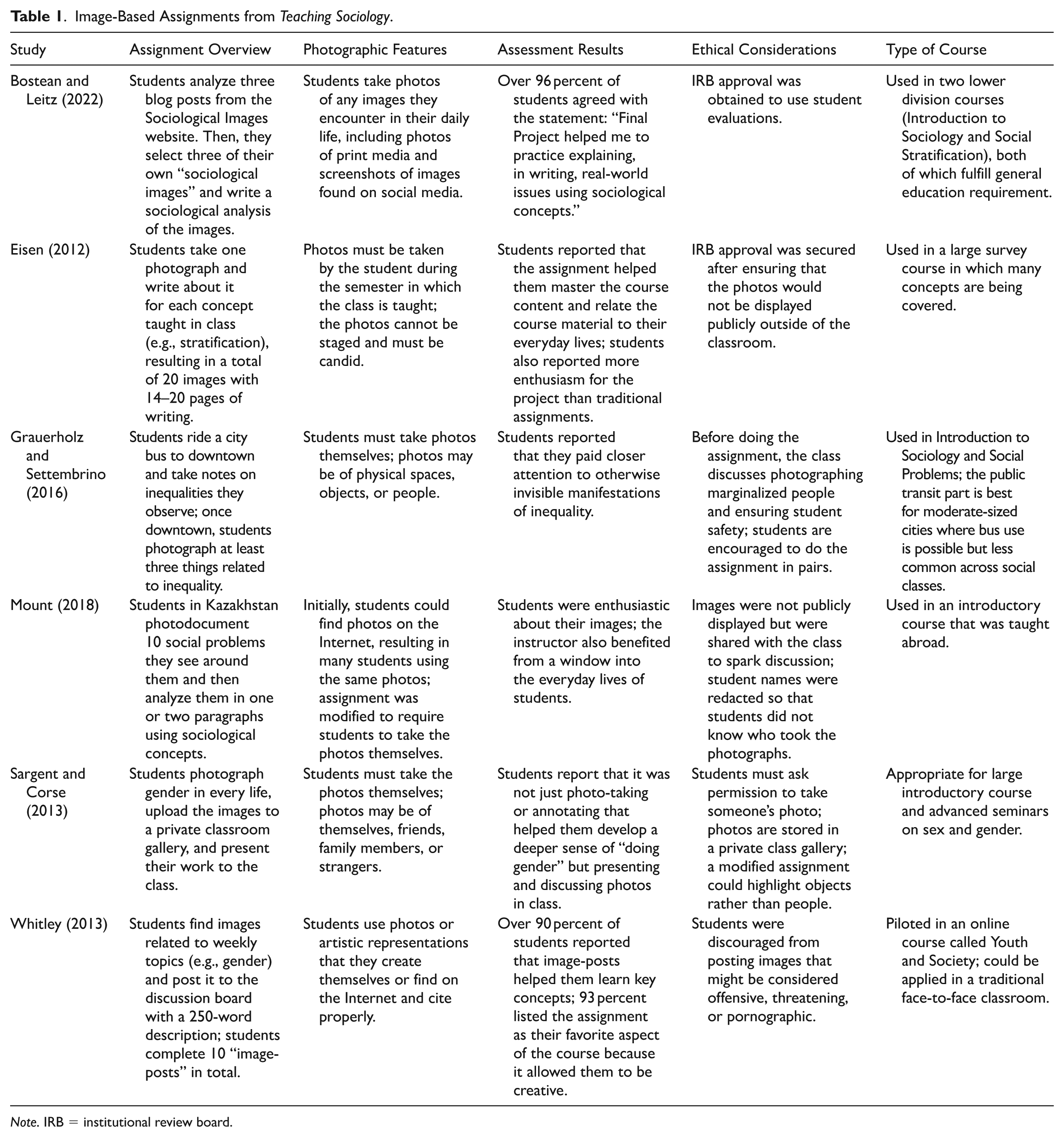
Note. IRB = institutional review board.
In most of these assignments, students are expected to take the photographs themselves. Whitley (2013) allows students to find photos on the Internet if they cite them properly. Bostean and Leitz (2022) and Mount (2018) originally did the same but found it resulted in too much overlap in the photos selected. In both cases, assignments were modified to require that students take the photo themselves. Ethical considerations were resolved by not displaying the photos publicly and limiting their display to the physical classroom or online learning platform (Eisen 2012; Sargent and Corse 2013; Whitley 2013). Sargent and Corse (2013) suggest that if instructors want to display the photographs more publicly, they might restrict students to photographing objects rather than people. Sargent and Corse also instruct students to ask permission of others before they photograph them. Grauerholz and Settembrino (2016) go further, discussing with their students the ethics of photographing marginalized people and ensuring student safety. As they argue: “Asking relatively advantaged students to observe and photograph less affluent areas . . . can be problematic. . . . It is important to be aware of the ethical issues surrounding these practices and sensitize students to these issues” (Grauerholz and Settembrino 2016:209–10). Assessments of the assignments suggest high student enthusiasm, appreciation for the creative nature of the assignment, and better understanding of sociological concepts and their application to the real world. Eisen (2012) and Sargent and Corse (2013) received further positive feedback for having students share their images in class, which allowed for class discussion and alternative interpretations of the photos.
These examples provide provocative ideas about how to utilize photos in the classroom. Using this work as a foundation, I began exploring other ways that photography could help students “see” sociologically and develop sociological insight. I argue that there are at least three reasons why photography has value to the sociology classroom. First, as the subfield of visual sociology reminds us, images—like words and numbers—can serve as data. Just as we might use transcripts or statistics to describe and analyze the social world, so too can we use images. Photography is therefore a method of social research. Second, because students learn best by doing but may not have sufficient time to complete in-depth research in a semester or quarter length course, taking a photo or writing a photo essay may be a more manageable way to help students understand the discipline at an experiential level. Photo assignments, in this sense, provide a means to do sociology in a short span of time. Finally, photography has significant symbolic value because it involves an act of “seeing” and can be tied to the sociological eye, a core component of the sociological literacy framework (Ferguson 2016). Like sociology, photography represents an act of close observation and captures both “what we see and how we see it” (Knowles and Sweetman 2004:2). Therefore, it offers a metaphor for the social research process. In the section that follows, I draw on my experiences teaching an upper division elective called Social and Cultural Change to show how I center photography as a method, means, and metaphor for sociological seeing.
Photography as Sociology: Three Assignments
Social and Cultural Change is an upper division elective in sociology at University of the Pacific, a midsize comprehensive university located in Stockton, California. The class usually enrolls 20 to 25 students, about half of whom are sociology majors. The university is an Asian American and Native American Pacific Islander Serving Institution as well as a Hispanic Serving Institution, so the class is typically racially and ethnically diverse. About 25 percent of students at the university are first-generation college students, many of them children of immigrant families in California. I teach the class from a global perspective, assigning ethnographic monographs to explore social change in three societies: a study of a labor-intensive factory in Shenzhen, China (Ngai 2005); an ethnography of life in a Brazilian favela (Goldstein 2003); and a book about women and HIV in Kenya (Mojola 2014). I also ask students to consider California’s Central Valley, where our university is located, as a comparative case of social change. The learning objectives for the course are as follows: (1) identify and explain sociological concepts in the study of social change; (2) analyze how race, class, and gender inequalities are implicated in social change; (3) compare social forces and processes across historical periods and geographic areas; (4) locate and use sociological scholarship to understand social change; and (5) communicate sociological ideas clearly to a public audience.
Photography anchors this course as a key metaphor. On the first day, for example, I explain that the class is going to travel across time and space, to enter different sociocultural worlds and eras, and to carefully observe larger social processes as we do so. To the extent possible, I take them to “study abroad” while we remain “rooted in place.” As metaphoric travelers, I explain, they will use a toolkit that includes maps, journals, and cameras to navigate, observe, and analyze social processes. In addition to using photography as a metaphor, I employ it as a method and means of sociological analysis. In the following sections, I outline how I do so, highlighting relevant lecture materials, class activities, and photo assignments across the three units of the course.
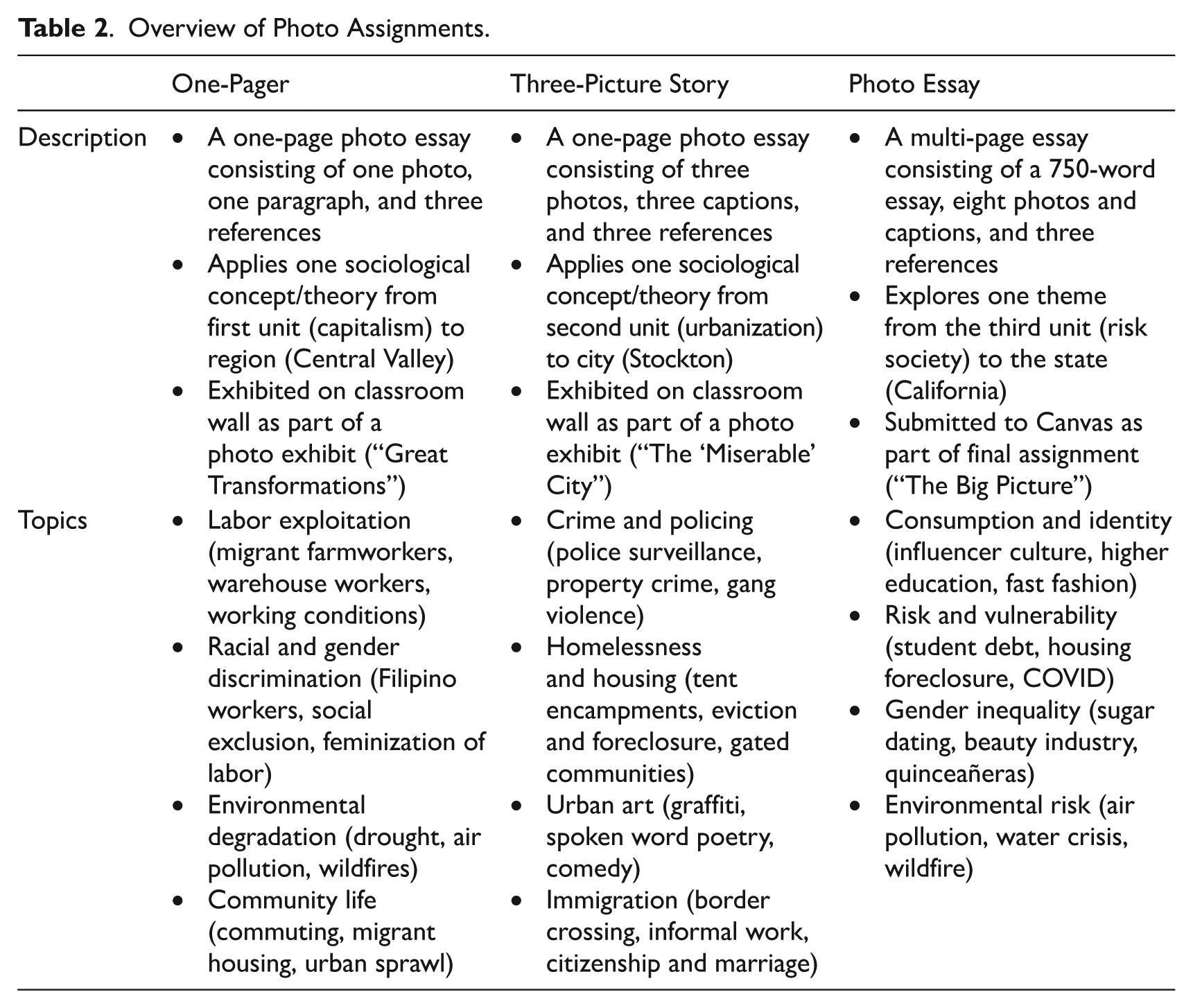
Table 2 provides an overview of the photo assignments for those readers interested in using one or more of them in other sociology courses. Although the assignments build in complexity across the course, all the assignments are versions of the classic visual essay in sociology (Grady 1991; Harper 1987). That is, they combine images and writing, with images serving as data and not just “window dressing”; they use sequencing, layout, and juxtaposition to build a sociological argument; they reflect the author’s subjectivity, inviting viewers to develop their own interpretations of the data; and they move beyond basic descriptive analysis, using emotions and symbols to explore deeper social messages. Although the learning objectives for the class could certainly be met through another type of assignment, photo assignments may be uniquely advantageous to meeting them. By focusing on the photographic shot, the assignments teach students how to frame an analysis, work with data, and reflect on interpretation.
Overview of Photo Assignments.
Framing the Study
Although there are no unbreakable rules in photography, photographers generally use a set of techniques to compose or frame a shot—everything from placing elements along key lines and intersects to using natural elements to frame a subject (Grill and Scanlon 1983). In sociology, framing is akin to theory. Indeed, the sociologist Howard Becker (1974:11–12) likens the initial decision of the photographer—what to photograph and how to position it in within the lens of the camera—to the way in which theory guides the researcher in data collection: “As you look through the viewfinder you wait until what you see ‘looks great,’ until the composition and the moment make sense. . . . The theory tells you when an image contains information of value, when it communicates something worth communicating.”
After describing this analogy early in the first unit of the course, I introduce my students to the famous photographer Dorothea Lange. Lange may be well known to professors, but many of today’s college students are encountering her for the first time. Therefore, I spend some time providing the requisite background information on Lange and situating her work in terms of the class topic. In class, we read excerpts from Polanyi’s (1944) The Great Transformation and about the historical emergence of capitalism and its consequences. Polanyi was writing in the aftermath of the Great Depression, which left millions of people in the United States out of work and often homeless and hungry. Adding to the destitution was a prolonged drought and a series of dust storms that led to the mass migration of hundreds of thousands of families out of the Midwest and into states like California in search of work. In that I teach in California, this story has marked relevance for those students who descend from “Okies” (migrants to California from Oklahoma) as well as those who migrated from Mexico under similar conditions or who suffered alongside their families in the Great Recession.
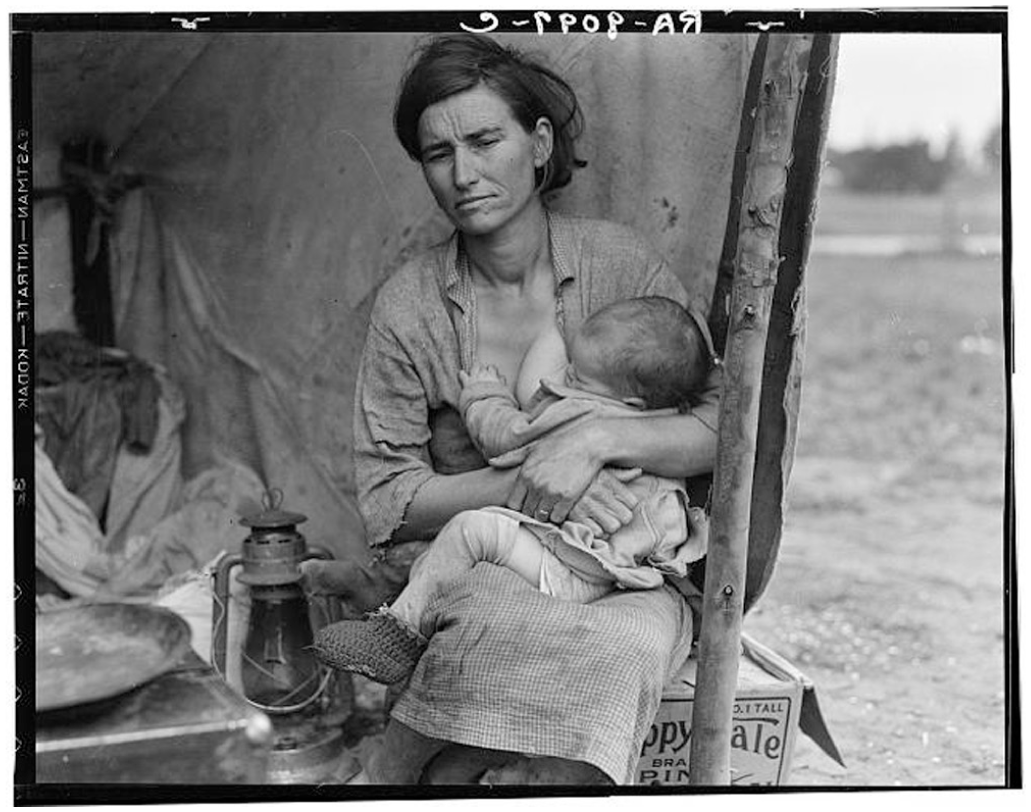
In response to the Great Depression, many signature government agencies, such as the Social Security Administration, were established. Among these was the Farm Security Administration, which employed Dorothea Lange from 1935 to 1939 to document rural poverty in the country. By far her most famous photograph in this regard was “Migrant Mother” (Lange 1936), but I do not show the students this photo until the second unit of the class. Instead, I spend the first unit “setting up the shot.” In later interviews, when she recalled how she came to take this photo, Lange (1996) explained that she had been traveling in California photographing migrant workers. Driving near San Luis Obispo, she passed a sign that read “Pea Pickers Camp,” and she pulled off to find a makeshift camp and a woman sitting under a tent with her children. After asking permission, Lange took seven photographs of the woman and her children that day, five of which she sent to the Farm Security Administration. She did not take extensive notes or even the woman’s name, but the caption she provided read in part “Nipomo, Calif. Mar. 1936. Migrant agricultural worker’s family. Seven hungry children. Mother aged 32 . . . Destitute in a pea pickers camp” (Library of Congress 2019). I show students some of the photos that Lange took that day, again saving “Migrant Mother” for later inspection (see Figures 1–3).
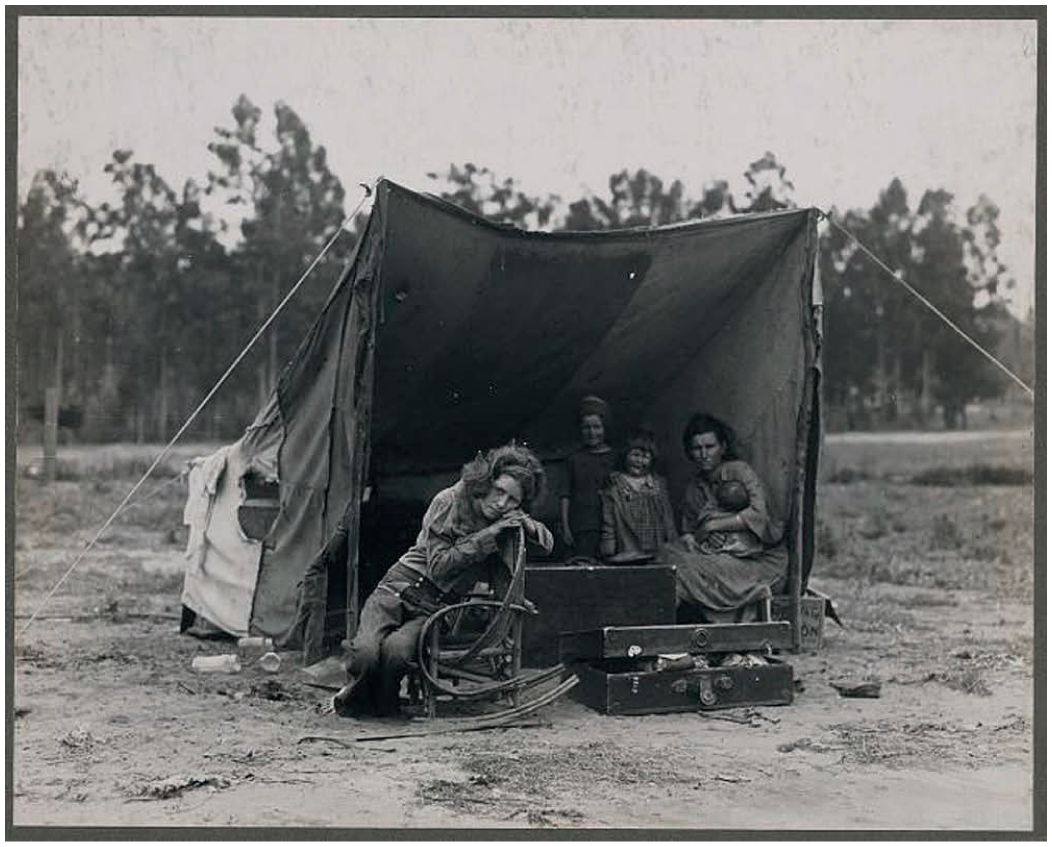
Lange’s first shot of migrant mother.
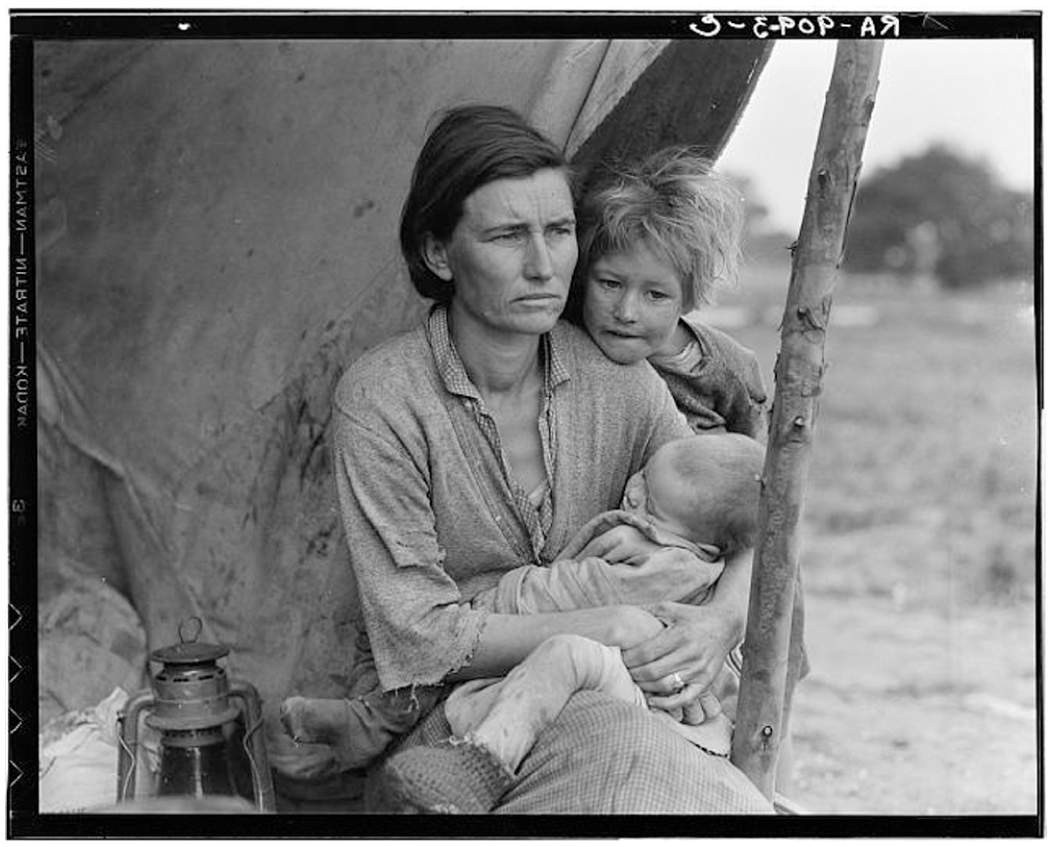
Close-up of migrant mother and young children.
Migrant mother and baby breastfeeding.
Lange claims to have quickly taken the pictures, but critics point out that the camera equipment she used was clunky and that the photographs suggest that she carefully framed the scenes (Davis 2020). In one, for example, the woman’s teenager daughter is present. But in the rest, she is absent, and only the three youngest children are in the frame. Lange was clearly trying to capture a particular story, and as a class, we discuss how she might have framed each shot. I point out that Roy Stryker, who led the documentary photography program at the Farm Security Administration, provided photographers with “shooting scripts,” which provided key words and guidelines on what scenes to focus on (Library of Congress 2024). I emphasize, too, how sociologists come to the field with ideas that affect what they focus on. Thus, in both photography and sociology, one must have the aim of a deeper engagement, a more specific focus to direct one’s lens. To use Becker’s (1974:12) words, you want to write about something “sufficiently complex to sustain the weight of a real exploration of society.”
Many students are familiar with the inverted pyramid, whereby your topic starts broadly and then narrows as you get closer to the focus of your writing. We use this visual to map out the author’s research focus in the first monograph we read: Ngai’s (2005) Made in China, which explores the mass migration of young Chinese women to the city of Shenzhen to work in factories. Drawing on the introductory chapter, we map out Ngai’s broad focus and her narrower research question. We ask, “What is her angle?” to better understand how her theory of capitalist exploitation and the patriarchal family shape where and how she focuses her sociological lens. I am careful to point out that academic writing can be heavy, laden with jargon. It can be easier to “read” Lange’s photography, but both are just tools for telling a story. Here, I situate academic writing—descriptive ethnographic material but also quantitative analyses—as storytelling devices that we can pick and choose depending on our audience.
Having established academic writing and the photographic image as two ways of telling a sociological story, I assign students a “one-pager,” which is a short, one-page photo essay. I describe the assignment as a study of the various “great transformations” that have defined California’s Central Valley. In class, we review the assignment instructions, which are to (1) select one concept or theory from Unit 1 and brainstorm how it might relate to the region; (2) review at least three scholarly sources that address the topic as it relates to the region; (3) find or take five photos that capture the concept as it applies to the region, selecting one to be the centerpiece of the essay; (4) write a paragraph (at least eight sentences) below the photo, describing and applying the concept to the region; (5) add a title and a section called “Further Reading,” in which the scholarly sources are cited; (6) write a reflection on the second page that explains why the photo helps to frame the concept and what challenges or insights emerged from the assignment; and (7) upload the assignment to Canvas but also print the first page in color.
Because this assignment is quite different from other assignments students may have encountered, I provide them with a sample assignment to clarify expectations around formatting and content. Note, too, that students can either find their images on the Internet, and cite them accordingly, or use photos of their own. In this course, about one-third of the students take their own pictures for these assignments. On the day the essay is due, I bring painter’s tape to class, and we hang the essays on the wall to form an exhibit. The class then does a gallery walk, using sticky notes to tag the essays they find most compelling. We conclude with a class discussion of the photos and the concepts they depict, which simultaneously serves as a unit wrap-up activity.
Working with Data
Once pictures are taken, photographers process the images. At one point, this process occurred in a dark room, wherein film was literally processed. Today, processing occurs digitally, with photographers deleting, cropping, and adjusting images to present a theme in the most artistic and evocative manner. In research, this is akin to working with one’s data. Not all data in a study are used, and certain aspects of the data are highlighted to bolster a sociological analysis. For example, quotes are often edited, much like a photograph might be cropped, to focus the reader’s attention. Finally, the data are presented in a particular order to tell a story. At best, this presentation can help make a coherent sociological case; at worst, it can result in a misleading or even fabricated representation of a subject. As Knowles and Sweetman (2004:13) argue: “It is as easy to select a particular quotation that supports the point one is making as it is to manipulate the framing, lighting or tone of a photograph to present the desired effect.” Thus, both photographer and sociologist must be conscious that the choices they make are ethical and in keeping with the world they are observing.
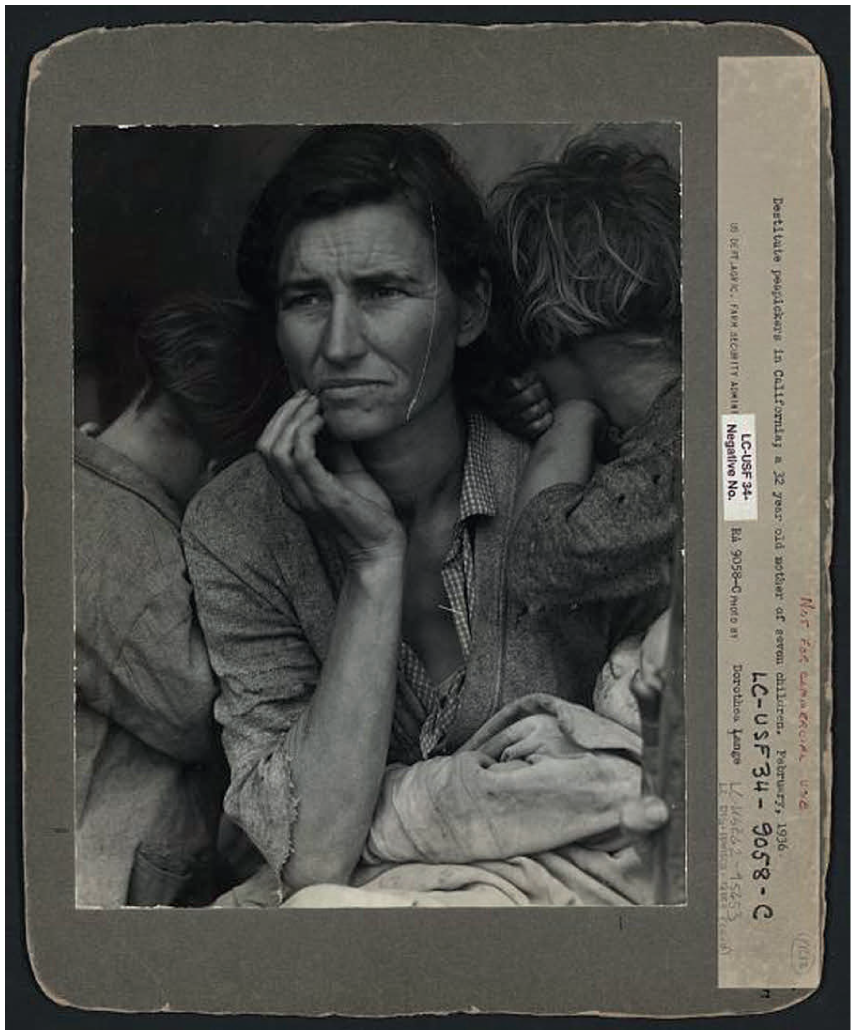
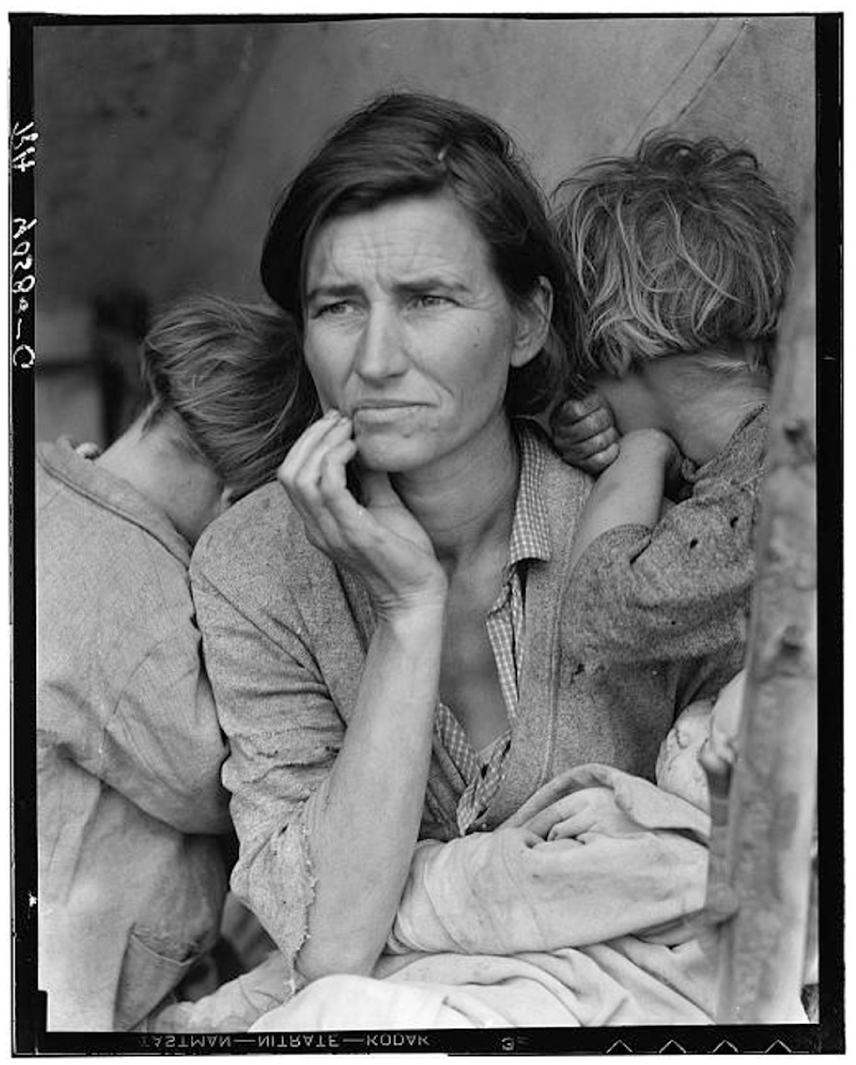
The process of working with data—whether it be a photographic image, ethnographic observations, interview quotes, or statistical results—is a crucial one. It is the shift from what is to how we portray what is. Students often do not know how to critically read a sociological monograph, assuming that what is published and printed on a page is truth. Therefore, it is important for instructors to emphasize that it is a scientifically constructed truth bound by norms, methods, and ethics. To demonstrate, we consider the final image that Dorothea Lange took that fateful day—the image that would become the “face” of the Great Depression (see Figures 4 and 5). There are two remarkable aspects of the image that came to be known as “Migrant Mother.” First, when we compare it to the other images that Lange took that day, it appears that Lange might have positioned the mother and children for the shot. Indeed, Davis (2020) urges us to consider what the encounter between Lange and the family looked like that day:
We can look at the photo as an iconic representation of true American grit in the face of adversity. But a photograph also performs an act of transformation; it takes a moment fluid in time and fixes it into a timeless image. Thus, Lange’s photo has turned an impoverished woman . . . into an object — whether of admiration, pity, or fascination — for the consumption of a more affluent public. But what if we try to return the picture to its fluid moment, as an encounter between two people?
How, Davis (2020) wonders, did the children end up at their mother’s side looking away when in earlier images they are smiling and milling about the camp?
Original Version of “Migrant Mother.”
Final Version of “Migrant Mother.”
The second notable aspect of the photo is that when we compare the negative to the final image, we see that Lange edited the image. Specifically, in the final photograph (Figure 5), the woman’s thumb grabbing the tent pole in the lower righthand side has been removed. Records suggest that Roy Stryker protested the erasure of the thumb by Lange, arguing that it ruined the integrity of the photo. Lange, however, insisted that the thumb was too glaring a problem with the photo and removed it anyway (Davis 2020). This does not suggest anything nefarious; photographers routinely alter photos for aesthetic reasons. But it does suggest that the image is not a pure representation of reality. And this provides an opportunity in class to consider how social scientists and other scientists do not simply document reality, what Gusfield (1976) refers to as the “windowpane theory” of science. Certainly, they write in a way that creates the illusion that they are mirroring reality, just like Dorothea Lange did. For example, scientists might use passive voice to write themselves and their decisions out of the picture. Acknowledging these rhetoric devices, argues Gusfield (1976:31), does not render science “corrupt and useless.” It simply recognizes that science frames and represents the world in a particular way and that this “interpretation involves theater—it involves a performance” (Gusfield 1976:32).
Gusfield’s (1976) observations about the rhetoric of social science is helpful to understanding social science texts. As with all writers, sociologists maneuver the text to tell a cogent story, rearranging words, sentences, and chapters so that the sequencing of the argument is logical. They also write in a particular way to portray itself as a social science. To write scientifically, argues Gusfield (1976:17), is to write for peer-reviewed journals or university presses; to highlight theory, methods, and data; and to document institutional affiliation and credentials. Ethnographers push these boundaries by using thick description and discussing the relationship between the scientist and subject. Even here, however, the tone is often detached and authoritative. Having examined these rhetorical choices, the class delves into the ethnography for Unit 2 (Donna Goldstein’s [2003] Laughter Out of Place: Race, Class, Violence, and Sexuality in a Rio Shantytown) in a more intentional way. What is the author trying to say? How does she say it? And why does she say it this way? I ask students to diagram the author’s major arguments and their sequencing. Then, we discuss the author’s writing choices, exploring how she cites other scholars, highlights theoretical concepts, and inserts herself into the text to establish authority.
The skill of piecing together an argument comes front and center in the photo assignment for this unit. Building on the one-pager, I ask students to construct a “three-picture story.” In art, this form is called a “triptych,” and it consists of three pictures displayed together as a single piece of art. Historically, triptychs were three-panel wooden carvings that were hinged together and displayed on altars. Today, they are usually paintings or photographs that are hung in some arrangement on a wall. In either case, their purpose is to tell a story, and in this case, it is a more complex form of storytelling than the one-pager. Not only does the assignment involve three separate photographs, but also the photographs must relate to one another aesthetically and thematically. Given that the theme of the second unit is urban precarity, we turn our attention to Stockton, the city in which our university is located. Forbes magazine once dubbed Stockton the country’s most “miserable city” due to its high rates of unemployment, poverty, and crime. Therefore, the assignment is titled “The ‘Miserable’ City,” with “miserable” in quotes to suggest that urban precarity is historically and socially constructed.
For this assignment, students are required, again, to select a sociological concept explored in the unit, do some research on how it might relate to Stockton, and find or take six photographs that tell a story about the topic, selecting three to be the centerpiece of the photo essay. Next, the guidelines instruct students to (1) work with the images, adjusting their size and composition to give the photos a particular and coherent effect for the story; (2) arrange the photos on one page in whatever size or layout makes sense; and (3) accompany each photo with a three- to four-sentence caption that together tell a sociological story related to social change. As before, students must give the essay a title; add a section called “Further Reading,” wherein they list three reputable sources on the topic; and include a reflection on a second page. The reflections for these photo essays are a critical part of these assignments. Here, students make the cognitive connection between photography and sociology and think through what it means to study social life accurately and systematically. As with the first assignment, these essays are hung on the wall on the final day of the unit as a basis for class discussion and unit review.
Telling the Story
Photography is riddled with ethical questions. Did the photographer set up the shot to get a particular image, or were the pictures truly candid? Did the photographer’s presence alter the scene they captured on camera in important ways? What did the photographer choose not to photograph and, thus, not to tell? Is it ethical to take pictures of others, even with their consent? Should we protect the identities of the people we photograph? Might the pictures we take have unintended or harmful consequences to particular people? In many ways, photography mimics ethnography: It introduces an outsider’s gaze into a social situation, a gaze that arguably alters the situation through its very presence and a gaze that has the power to “speak” and define the situation in a particular way (Lutz and Collins 1991; Pink 2001). Thus, ethnographers must be attuned to the power they exercise and the responsibility they have to the people they are studying, especially because those people do not usually get a say in how their story is told and are routinely caricatured or cast in a deviant or primitive light.
To explore these ethical issues, I share with students the ending to the story of “Migrant Mother.” In 1978, many years after Lange took and published this photo, a Modesto Bee reporter named Emmett Corrigan tracked down the woman from the photograph. She was 75 years old by then and living in a trailer park outside Modesto, California. Her name was Florence Owens Thompson, and she was born in Indian Territory, Oklahoma, in 1903. Although she was understood to be white by Lange and the Farm Security Administration, Thompson was of Cherokee descent. She married at 17 and migrated west to California with her family to work in the sawmills and farms of the Sacramento Valley. When she was 28 years old and pregnant with her sixth child, her husband died of tuberculosis. She would go on to remarry and have four more children, all while migrating throughout California for work. One day, while she and her family were driving to Watsonville, where they had hoped to find work picking lettuce, their car broke down. They towed the car to a migrant camp in Nipomo, and her husband and sons went into town to find car parts. As Thompson waited with her daughters under a makeshift tent, Lange appeared with her camera. As Thompson later recalled, she was not excited about having her picture taken that day. After Lange told her that the pictures might help educate the public about migrant workers and convince the government to help, Thompson consented. In a later interview, Thompson asserted, “She said she wouldn’t sell the pictures. She said she’d send me a copy. She never did” (quoted in Davis 2020).
As we can see, Lange got many details wrong about Florence Thompson and her family. They were not pea pickers; they were just at the camp waiting to repair their car. They were also not recently arrived Dust Bowl refugees; they had lived in California for more than a decade. And if we are to believe Thompson, Lange was not altogether truthful. She said she would not publish the pictures, but after taking them, she sent them to the San Francisco News, which ran the iconic photo on March 11, 1936, above an editorial titled “What Does the ‘New Deal’ Mean to This Mother and Her Child?” (Dunn 2002). Although the government responded to the photo by sending food assistance to the camp, the Thompson family had long left the camp to find work in Watsonville. As Thompson’s son, Troy, later recalled “That photo may well have saved some peoples’ lives, but I can tell you for certain, it didn’t save ours’” (Dunn 2002). By all accounts, the Thompson family was familiar with the photo. Thompson told her husband and sons about Lange taking her picture when they returned to camp that day. Later, when the photo was published, her son saw it and shared it with the family. In later interviews, Thompson’s children suggested they were ashamed of it because it became the face of poverty and downplayed all that their mother did to ensure that they had the best possible lives. Katherine McIntosh, the daughter to the left of Thompson in the picture, explained “We never had a lot, but she always made sure we had something” (Gutierrez and Drash 2008).
In 1983, at the age of 80, Florence Owens Thompson died of a stroke. Her children had to collect donations to help defray the costs of her medical care before her death. Lange did not profit financially from the photographs either. Because she took them while employed by the government, they are considered a government work and are in the public domain. The photographs did enhance Lange’s reputation, however. In addition to helping earn her a Guggenheim fellowship, they conferred fame and a permanent place in the canon of American photographers. Lange was no evil monster, I point out to the class. She was a gifted photographer, and her work did help raise awareness of American poverty. But on the other side of the lens that day, there was a person. And whether we are behind the camera or collecting data, we must never forget that these are real people and that they will live and they will suffer long after we have written their story.
The story behind “Migrant Mother” has a parallel in scholarly studies of HIV in sub-Saharan Africa, which is the topic of our third and final unit. In this unit, we read Sonya Mojola’s (2014) ethnography about HIV in Kenya (Love, Money, and HIV). By way of introduction, I talk about how journalists and academics have represented the problem of HIV in sub-Saharan Africa—from maps depicting the prevalence of HIV to photographs of dying Africans whose identities and countries are never named. In these narratives, sub-Saharan Africa is often depicted in terms of infection and contagion—something that must be contained and even feared. One gets the sense that the entire continent is infected, although fewer than 5 percent of the continent’s population is HIV positive. The tragic story of the disease’s effects—often told through sensational pictures of dying Africans, dusty funerals, and orphaned children—focuses almost entirely on victimhood, stripping Africans of agency in fighting the disease. Like Thompson, they become the face of a particular tragedy. But they themselves rarely profit from the research funds and findings that their stories inspire. Both “Migrant Mother” and the larger narrative of HIV in Africa give us a place to discuss our responsibility toward the people we study and the power our narratives have to erase or empower them. We also discuss the assumptions behind these narratives and their potential to reinforce stereotypes.
The final assignment in the class is a photo essay titled “The Big Picture.” As I explain in the assignment guidelines, “the big picture” refers to both the complexity of the assignment and our responsibility toward our research subjects and the larger purpose of sociological research. The assignment is modeled on the “Photo Essays” feature in Contexts, a quarterly magazine published by the American Sociological Association that makes social research available and accessible to a general audience. 5 Students are instructed to write a 750-word essay on a theme from the third unit as it relates to California. The title, essay, and recommended sources should take up the first page of the essay. Next, students must find or take eight photographs that capture the theme as it relates to California. Photos should be arranged across multiple pages (however many they choose) in whatever size, color, or layout makes sense aesthetically or thematically. Each photo must be accompanied by a one- to three-sentence caption that describes the photo and contextualizes it within the essay that precedes it. Because these essays are due on the last day of class, there is no exhibit or class discussion of the essays. Nor do I ask students to reflect on their positionality or the ethical dimensions of the assignment because its due date competes with final exams. In reviewing the assignment guidelines in class, however, I remind students that photography, like ethnography, is an act of power. In deciding what to photograph, what photos to display, how to display them, and how to annotate them, students are giving voice to a particular narrative that the subject of the photo has little role in shaping. Who gets to “see” and who is “seen” by the research encounter? Who benefits and who does not from the essay? Who is erased and who is empowered by the interpretation? Students do not answer these questions; but the questions are posed for students to ponder.
Understanding Sociology Through Photography: an Assessment
In this final section, I turn to the question of whether these assignments work. Do they help meet the learning objectives of the class? Do they allow students to encounter sociology in new and meaningful ways? To answer these questions, I review assessment data that I collected in fall 2021, which was the last time I taught this course. In addition to considering the photo essays themselves, I analyze the reflections that students wrote for the first two assignments. A total of 24 students were enrolled in the course that semester, and most turned in every assignment, resulting in 66 photo essays and 44 student reflections.
The first part of this assessment was a straightforward evaluation of the 66 photo essays using a three-level rubric (accomplished, satisfactory, beginning) to see whether the learning objectives were met. The first learning objective was to define and apply a sociological concept to a local or regional issue or phenomenon. Students appeared to have a strong grasp of the concepts introduced in each unit, as evidenced by the local/regional issues on which they focused: (1) fictive commodities (Polanyi 1944), used to understand everything from the exploitation of farm workers to the overcultivation of land in the Central Valley; (2) quiet encroachment (Bayat 2000), applied to issues like the spread of homeless encampments and the crossing of migrants across international borders; and (3) risk society (Beck 1992), used as a framework to understand phenomena like the 2008 foreclosure crisis in California and the devastation wrought by wildfires. Of the 66 essays assessed, 42 were rated as satisfactory in their ability to define concepts and understand them in relation to local or regional phenomena (Learning Objective 1). Another 23 essays were rated as accomplished in this respect.
Compared to defining and applying concepts, more essays were rated as beginning in their ability to incorporate race, class, and gender (Learning Objective 2) and to draw out historical or geographic comparisons (Learning Objective 3). Even here, though, most essays were rated as satisfactory (36 and 38 for Learning Objectives 2 and 3, respectively) or accomplished (24 and 16 for Learning Objectives 2 and 3, respectively). One student, for example, wrote about the feminization of farm labor in the Central Valley, noting the intersection of race, gender, and class across time. Another focused on quinceañeras, a celebration of a girl’s 15th birthday and coming of age in Latino cultures. In the essay, the student compared photographs of quinceañeras across different generations of her family to explore the idea of “gendered modernity.” Still another essay looked at the environmental transformation of the Central Valley that resulted from the rise of industrial agriculture, noting the similarities between the region and Shenzhen, China, which went from fishing village to manufacturing metropolis in the span of four decades.
The final two learning objectives addressed whether students could locate and incorporate relevant scholarship (Learning Objective 4) and communicate sociological ideas clearly (Learning Objective 5). Again, a majority demonstrated an ability to do both. Of the 66 essays, 45 were rated as satisfactory and 17 as accomplished in identifying relevant scholarship. When it came to communicating sociological ideas clearly, students exceeded expectations. This objective relates to technical questions around wording, organization, and length but also photo choice, composition, and layout. Of the 66 essays assessed, 30 were rated as satisfactory and 35 as accomplished in their ability to find, select, and arrange photos, captions, and text to tell a sociological story.
When designing these assignments, I did not simply want to know if the learning outcomes were met but how students grappled with the learning process. Therefore, I intentionally added a reflection section to the first two assignments. As part of my assessment, I read through each of the 44 reflections, using a more grounded qualitative approach. Following standard procedures for analyzing qualitative assessment data (Barkley and Major 2016), I read and reread the textual data, noting themes and patterns that emerged from the text. My initial analysis identified 11 themes ranging from frustration with the learning process to the invisibility of marginalized people. As I reread the reflections and finetuned the themes, I noticed that many of the themes related in some way to the metaphor for “seeing.” Ultimately, I categorized each theme into one of three different learning encounters that I labeled (1) not seeing, (2) seeing anew, and (3) seeing beyond.
Not Seeing
The initial feeling that most students described in encountering these assignments was that of frustration. They used words like “hard,” “challenging,” “difficult,” “tough,” and “hellish” to describe the learning process. One student, for example, described “trouble,” another felt “frustrated,” and a third admitted the assignment was “no small task.” As one student summed up, the assignment was “far more difficult than [he] imagined it would be.” Of the difficulties students described, condensing a massive amount of information into a short narrative (n = 12) and finding and selecting photos (n = 12) were the most frequently mentioned. Identifying scholarly sources (n = 10), choosing or narrowing the topic (n = 7), and taking, editing, and moving the photos (n = 7) were other common challenges. Students described an overall sense of discomfort with the assignment because it was something new and different:
I have never done that before. I am quite inexperienced in this type of storytelling. I didn’t know where to look.
This not knowing can be understood as a kind of not seeing or going into the assignment blind.
The reflections suggested that students had to work through these frustrations to complete the assignments. Again, to use the metaphor of “seeing,” they had to see the project through. They did so in two ways. One was to “dig” for information—a word that at least three students used to describe the process of reading local news, looking through academic databases, and drawing on their existing knowledge. In their essay about a local controversy surrounding a neighborhood golf course, one student describes this process as follows:
I really wanted to know why a golf course like this would be struggling and I happened to stumble across a scholarly article that detailed the rise of golf courses in the U.S. . . . between 1970 and 2000. . . . In this time period, developers . . . oversaturated the market with golf courses everywhere. As golf died in popularity, the demand for these golf courses decreased and they either closed or became subsidized by their local government.
Other examples of this strategy abound in the reflection papers. One student drove around Stockton to better understand the city, another got in touch with a former high school teacher who taught about environmental change in the Central Valley, and still another reviewed the minutes of city council meetings to understand a proposal to build more low-income housing.
A second strategy that students used to see their way through the assignment was to narrow down topics and images, to be intentional about what information they included, and to edit text and crop pictures to focus on the most important things. If the digging they described was a kind of groping in the dark, this strategy was more akin to bringing something into clear focus. One student described this as “reducing, rephrasing, and rearranging.” The not seeing, the digging, and the focusing that students experienced reveals something about the learning process. As psychologists have long shown, learning often results in cognitive-emotional states such as frustration in students (Britt and Janus 1940; Graesser and D’Mello 2012). These challenges need not be negative, however, especially if they increase information-seeking behaviors and motivation (Wong 1979), which in this case they clearly did. As one student concluded: “Every day is another day to learn something new. If I could do this for another course, I would totally recommend it.”
Seeing Anew
After an initial experience of “not seeing,” students encountered a process of “seeing” or “seeing anew.” Some students described this as seeing connections between the course material and what they had learned previously or what they saw daily. When explaining how they arrived at a topic, for example, they said:
[I related] my surroundings to what I am reading about. I pictured the warehouses and farmland that follows when you [come] from the Bay Area, entering the Central Valley. I selected these photos because these are the things that I see every day on my way home.
Some students described an “aha moment” when they first “saw” the concepts we were learning in class in the world around them. For example, one student wrote about a local controversy that erupted when Stockton’s former mayor suggested closing a rarely used (and publicly subsidized) golf course to create space for low-income housing units:
The topic of my paper came to me rather spontaneously. I was driving to pick up my brother from school one day and as I passed by the Swenson Golf Course . . . it hit me. The controversy about the closing of Swenson Park erupted during my last year of high school and for months on end I was unable to avoid the many picket signs. . . . Seemingly everyone in the Lincoln Unified School District felt as if their community was threatened by the suggestion of low-income housing units in the area.
This quote suggests a moment of cognitive recognition (“seeing”) made possible by careful observation of everyday life. Students built on these observations to understand course material, as this extended quote suggests:
I remember reading somewhere that people used to take boats to ferry from the Central Valley to the Bay Area. It is difficult to imagine the rest of the Central Valley looking like the photo I took. A lot of water, birds, shrubs, wildlife, and plenty of oak trees. When I look at the Central Valley, it is just an extensive system of water control and irrigation, monoculture that stretches for miles, hot and dry weather with little water in sight, and hazy from the smog. I would imagine someone in China would feel the same way seeing Shenzhen before the 1980s and afterwards. It is completely different.
Using photography to help students “see” the connections between course material and surrounding communities can help bring sociological concepts to life.
In addition to seeing connections and the “strange in the familiar,” many students described the way in which these assignments helped make visible populations that had previously been unseen or invisible to society. The most common example of this form of “seeing”—one that was mentioned by five students—was the highlighting of homeless people who live in public view but are otherwise ignored by most residents and public officials. In another example, three students focused on the hidden labor histories of the Central Valley, such as the experiences of Black farmers and Filipino farm workers. Two other students showcased local celebrities, whose contributions are often overshadowed by narratives focusing on crime and violence in Stockton. Finally, many students noted the invisibility of workers who toil throughout the Central Valley—from people working in large warehouses hidden from view to farm workers laboring in open fields who are socially “unseen.” As one student remarked:
I think this photo emphasizes the fact that when it comes to the exploitation of people, those on the outside do not want to see faces, they do not want to really see the people, because then it makes it much more real and much more personal.
Another student described these examples as the “faces of people not being seen,” and as many students noted, it is not simply people who are made invisible but also places whose landscapes are hidden, erased, or ignored—from managed wetlands to poor neighborhoods.
The unveiling of the Central Valley’s social and physical landscapes evoked different emotions in students. One student described feeling “overwhelmed and claustrophobic” thinking about an Amazon warehouse worker and how there was “someone like her running around every time I buy something online.” Other students remarked that they were saddened by the fact that it was so difficult to find information and images of the hardworking, ethnic communities that helped develop the Central Valley. But students also reported a sense of enjoyment and pride in “researching [their] people” and showcasing their community. As one student remarked, “I was excited to work on the visual essay because I’ve lived in Stockton my whole life, so this was a great opportunity to talk about my community.” Indeed, many students felt personally connected to these essays. Making course content relevant to students’ lives can foster student learning (Bernard 2010), and the process of “making seen” can help students reconsider and redefine narratives often written by others. Perhaps for this reason, students used words like “liked,” “helpful,” “fun,” “interesting,” and “excited” to describe their learning experience because it gave them the opportunity to explore their history, showcase their community, and make seen a people or place that they cared about.
Seeing Beyond
The third and final learning experience that students described moved beyond actual seeing to a deeper analysis that I am calling “seeing beyond.” Here, students described the photos but also drew out the photos’ symbolic, aesthetic, and sociological value. Five students, for example, noted the symbolism in the photos they took or selected. One essay featured an image of the inside of an Amazon warehouse with row after row of floor-to-ceiling shelves of products. In the center of the picture is a lone worker standing on a ladder to reach for a product. Later, the student reflects on the photo:
I chose the picture with the woman picking products from the shelves because she looks tiny compared to the aisles full of products. . . . I decided not to crop the image because what makes an impact is the aisles and shelves. . . . However, I did edit the photo by [centering] the woman. I did it to emphasize the woman and to point to the viewer that her job and her life are more valuable than the stuff around her.
In another example, a student photographed a homeless encampment from her car window. Later, she noticed the side mirror of her car in the photo:
There is a message located on the mirror which reads, ‘Objects in mirror are closer than they appear.’ First off, I think a lot of people look down on homeless people and think of them as ‘lesser’ because of the belief that if they are on the streets, they must deserve to be there. . . . In this way, a person who is homeless may be dehumanized to the point where they are almost seen as an object. Second, I believe in a similar way people try to distance themselves from the homeless population by avoiding them or ignoring them when possible.
In both examples, the students are delving more deeply into the data—in this case, images—to not simply illustrate a topic but also tell a sociologically informed story.
In other cases, students drew out details in the photos or grappled with the photos to try and understand the sociological story that they told. I came to see student references to “stories” and “storytelling” as commentary on their attempts to make sociological sense of the photos, or to “see” the photos in less obvious and more sociological ways. One student, for example, observed the sacks of cotton in historic photos of Black farmers in the Central Valley and wondered “what story can be told” through these details. In another example, an essay about a neighborhood’s fight to keep its golf course became a story about suburban society. Golf courses, even if rarely used, signal or convey an ordered suburban environment. In contrast, the very idea of affordable housing conjures up ideas of crime and urban disorder. Hence, the fight to “save” a golf course was really a battle over maintaining a particular social order. This analysis went far beyond pictures of yard signs and weeds growing through cracks in a public golf course. It read into those signs and cracks to see something not in the images—demographic change and downward mobility in a Californian neighborhood.
“Seeing beyond” represents not simply seeing symbolically or sociologically but also questioning how things are seen. In one essay, a student reflects on a homeless man standing at an intersection asking for money. Read one way, his presence is indecent—a sign of urban blight and disorder. Read another way, the student opines, his presence represents an act of astonishing humility—the courage to be seen when everyone would rather that he and the problems he represents (urban poverty, unaffordable housing, social inequality) stay out of view. In that same essay, the student reflects on his photographic encounter, noting how later when studying the photo, it looked like the man in the image was looking at him, the photographer: “I knew he couldn’t see me, but when I looked at photos, it felt like he was looking right at me.” In this last learning encounter, we come closest to the photographic encounter between Lange and the “migrant mother.” Like Lange, students could be applying a story of their own making rather than drawing out the “real” story, infringing on the privacy and singularity of the people they are studying, and/or benefiting from the encounter in ways that their research “subjects” are not. The same problem, however, could occur in any experience with student field work and no doubt occurs when professional sociologists go to the field as well. “Seeing beyond,” in this case, becomes an opportunity to entertain alternative interpretations and to appreciate what makes for a strong (or weak) sociological analysis.
Conclusion
In Dorothea Lange: A Life beyond Limits (Gordon 2010), historian and biographer Linda Gordon described Lange as a “visual sociologist.” 6 By this, she meant that Lange brought scientific precision and sociological interest to documenting the lives of the people she photographed. But what if we did not have to add the qualifier “visual” to this description? What if Lange were simply a sociologist who used photography as her evidence and her medium? What if we took our cue from DuBois at the turn of the last century and embraced a wider repertoire of sociological tools to tell the sociological story, one that might include quantitative data but also documentary photography, ethnographic description, even popular fiction and nonfiction? Most importantly, what if we taught our students to do the same? In this article, I have suggested that sociology instructors might not simply assign a photo essay or some rendition thereof but that they legitimate photography as a sociological metaphor, a type of sociological data, and a form of sociological storytelling. Students may not become skilled researchers as a result. But they might learn to appreciate the complexities and the challenges that go into seeing, studying, and communicating about the social world. In the end, sociology takes many forms—some visual, some quantitative, some narrative—and students should explore them all. As Lange once explained: “You see it’s evidence. It’s not pictorial illustration, it’s evidence. . . . We were after the truth, not just making effective pictures” (Bullock 2020). Lange could have been talking about sociology. And in the end, she was.
Footnotes
Acknowledgements
Special thanks to the two anonymous reviewers whose invaluable comments helped improve the ideas and analysis in this article.

Funding
The author received no financial support for the research, authorship, and/or publication of this article.
Declaration of Conflicting Interests
The author declared no potential conflicts of interest with respect to the research, authorship, and/or publication of this article.