







Abstract
The goal of this study is to examine—theoretically and empirically—the implications of unrestricted, computer-mediated social interactions for civil society. Discussions of 207,419 participants in 35 newsgroups over 6 years are examined. Patterns of participation and attention attraction follow a power–law degree distribution—a highly skewed distribution—as is expected in large networks. Furthermore, analysis shows that these patterns are dependent on group size: The larger a group, the more skewed is its distribution. These patterns indicate hierarchical social structures that limit equality among participants and well-informed citizenry. The growth of discussions, which can empower civil society, is in fact making it more hierarchical.
Introduction
Over the past decade, the very idea of the Internet as a provider of a free and open space for civil society to flourish has brought much debate. Theories on civil society have developed for the past three centuries, within a realm of individuals’ and societies’ desires to be liberated from political tyranny, which led to emphasizing freedom and associating it as essential for civil society (Kumar, 1993; Seligman, 1992). Literature on Internet and society follows these lines, as it emphasizes the tension between the technology—free in most of the world—and the aspiration to break restrictions placed upon it by societies, politics, and markets (Bagdikian, 2004; Papacharissi, 2002, 2004). Current literature, however, has overseen the theoretical and practical possibilities that patterns of unrestricted online social interactions may not necessarily work in favor of strong and healthy civil societies.
Political discussions are pivotal to civil society (de Tocqueville, 1839), and online fora host free and open discussions. The oldest and still popular discussion platform, Usenet, is the least likely to be restricted by external political or economic powers because of its decentralized technological configuration (Usenet, 2008).
The goal of this study is to examine the free and unrestricted computer-mediated social interactions in the theoretical framework of civil society. First, civil society as a concept is explicated in terms of social and technological expectations and its related concepts. In light of this conceptual framework, messages posted by more than a quarter of a million individuals in 35 politically and philosophically focused newsgroups over 6 years were retrieved. Patterns of message posting and replying and the distributions of these activities were examined. Content analysis of a sample of messages was used to complement the structural analysis.
Civil Society
The concept of civil society and its ideals can be traced to the heydays of the Roman and Greek empires. But not until the revolutions of the 18th century did civil society become central to Western philosophical and political debates. Civil society has held varied meanings to philosophers and social scientists across time: From the great empires of the 18th and 19th centuries to the 80s and the 90s of the 20th century; across ideologies, such as neoliberal, liberal, and Marxist; and in terms of its ontological and theological grounds (Dunn, 1967; Ellis, 1999; Ferguson, 1782; Kumar, 1993; Riedel, 1981; Taylor, 1975; for further discussion see: Foley & Edwards, 1996; Kaviraj & Khilnan, 2001; Keane, 1998; Seligman, 1992).
This article examines the structure of online communication networks in the context of civil society. In this section, contemporary literature on civil society is reviewed to identify related concepts and the characteristics of social interactions and their environments that, if supported, civil society would benefit from.
In Democracy in America, de Tocqueville referred to civil life as notable for the proliferation of voluntary associations. Town meetings and voluntary associations, he argued, are free schools for democracy. Citizens learn to exchange views and to organize and monitor the government independently. Voluntary civil associations thus constitute civil society. Participation is, therefore, vital to a strong and civil society. Political participation refers to activities of citizens that attempt to influence the structure and selection of policies of the government. However, active forms are not considered the only methods of political participation. More passive activities such as supporting the political activities of others and searching and exchanging information are also considered political participation (Conway, 2000). Civil engagement is defined more broadly as people’s connections with the life of their communities, not only with politics (Putnam, 1996; Skocpol & Fiorina, 1999).
Ingelhart (1997) argued that the potential for civic associations and movements to take political actions has risen in the past decades. This change is attributed to the increase of education, which enhanced citizens’ skills to cope with political life; the increase of postindustrial job skills that emphasize innovation and collaborative work in complex environments; and the increased availability of political information via new technologies and policies. These processes challenge the historical elite dominance over political participation.
Over the past several decades, however, concerns about the decline of trust in governments, the decline of social capital, and citizens’ feelings of disconnect from the civic decision-making process have risen. Toward the end of the century, Putnam (1995) showed a decrease in the U.S. participation in civic organizations such as church-related groups, labor unions, PTAs, and fraternal organizations. Sirianni and Friedland (2001), however, found evidence for a growing movement of civic innovations, in which citizens and civil associations examine and experiment with civil participation in a variety of arenas, including community organizations, environmental movements, and community health projects. Almost a decade later, a Pew Report (Pew Internet and American Lifestyle Project, 2009) showed that nearly two thirds of all Americans have participated in some form of political activity. Civil society, then, can be seen as more than the traditional networks of formal associations, but also as informal associations, which are often characterized as weaker and sometimes short-term relationships.
Social capital is an important outcome of civic associations and civil society, but it is also a great contributor. Social capital refers to a list of nontenable reserves, such as social trust, norms, and networks that members in social groups can draw upon to solve problems. Putnam (1995) suggested that the denser and more diverse a web of voluntary association is, the stronger the social capital is for the participants and their civil association. The decline in civic participation, he argued, led to a decline of social capital. Sirianni and Friedland (2001), however, suggested that the relationship between civic participation and social capital is more complex and should take into account the quality of participation and be examined within the context of specific communities, institutions, and policy contexts.
Friedland (2001) argued that beyond a public of citizens, communities are vital for functioning democracy and that communication within and among communities is a key to their success. Furthermore,
Communities in which there are rich, cross cutting network associations and public discussions are more likely to formulate real problems, find solutions, apply and test these solutions, learn from them and correct if they are flawed: in short, to rule themselves, to work democratically. (p. 360)
Theories on civil society acknowledge the problem of inequalities in civil life. Citizen organizations are based on horizontal relationships of equals and, therefore, can work together without the fear of sanctions (Naidoo & Tandon, 1999). Some people, however, know better how to find resources, are more connected to the “right” people, or have a better understanding of the “system.” Walzer argued that the state should play a role in remedying inequalities in civil society and increase pluralism of voluntary associations by financially supporting the weaker associations first and foremost. Such support strengthens services they provide their members as well as their cultural and political voices in civil life. Perfect equality, obviously, is not realistic. Extreme inequalities, however, are harmful for civil society, as they contribute to extremists’ claims, expressions of group hatred, and narrow chauvinism (Walzer, 2002).
Civil Society and the Social System
Habermas (2006) suggested that the social system includes three macrosocial systems: Civil society—formal and informal civil associations; the political system—parliaments, courts, administrative agencies, and government; and the functional system, which includes systems such as commerce or the labor market, education, energy, and health. Representatives of the agencies in the functional system—lobbyists and special interest groups—negotiate with the political administration to promote their interests. One function of civil society is to communicate public problems from citizens, including advocates, public interest groups, intellectuals, and moral entrepreneurs, to the political system, which should in turn address and accommodate these issues (Friedland, Hove, & Rojas, 2006). Habermas (1989) argued that civil society is “the genuine domain of private autonomy [that] stood opposed to the state” (p. 12), defining an adversarial relationship between the social entities.
The public sphere should provide social space where citizens’ opinions can move from civil society to the political public sphere, where elite opinions are generated and decisions are made. A strong and healthy civil society produces a wide variety of information, opinions, and demands. However, the political system cannot respond to it all, and parts of it can be noise, distortions, and manipulation. The public sphere, therefore, should filter information coming from civil society so only that which is “considered public opinion” will become center to the public debate. In the core of the public sphere, hence, is mediated communication, which informs the elite discourse (Friedland et al., 2006; Habermas, 2006).
“Considered public opinion” should be a result of deliberative communication in the public sphere, including one of its most central parts—the media system. The political system is informed by the media system that filters considered public opinion for its decision making. Although, according to Habermas, this process currently lacks defining characteristics of deliberation, it is ultimately the goal of political communication within the public sphere to facilitate deliberation. To reach deliberation, the media system should be independent from politics, market, and special interest actors, and should keep open a two-way commutation channel between civil society and the public sphere, so public opinions can be revisited, reconsidered, and responded to. Within the public sphere, reasoned discourse should be based on arguments, not statuses or tradition. A successful flow of information from civil society to the political sphere results in a communicative power toward the latter, which although relatively weak, provides the needed legitimacy of the political sphere (Calhoun, 1992; Dahlberg, 2001; Friedland et al., 2006; Garnham, 1992; Habermas, 2006).
The market has a unique role in the social system. Contemporary civil society literature often distinguishes between three separated entities—civil society, the state, and the market (Keane, 1998; Seligman, 1992). According to Habermas (1989), market economies and state power are not discursive modes of coordination, offer no intrinsic opening to reason and will, and suffer from tendencies toward domination and reification. State and economy, then, can be seen as rivals to the democratic public sphere and civil society (Calhoun, 1992). Capitalistic economies, however, also provide the basis of civil society, and allow the traffic of information, including news, across distances (Calhoun, 1992). The, London School of Economics Centre for Civil Society (2008) suggests that “In theory, its [civil society] institutional forms are distinct from those of the state, family and market, though in practice, the boundaries between state, civil society, family and market are often complex, blurred and negotiated.” Considering that the market and civil society often have competing interests and expectations from the political system, for the purposes of this discussion, the market is considered a distinct entity. This study accepts this conceptualization while acknowledging that others see no reason to exclude the market from civil society (for further discussion see Arato & Cohen, 1992).
Civil society is, therefore, in the base of this pyramid and is the first step of the process in which citizens in formal and informal civil association aim to influence the public discussion and ultimately the decision making process. Each part of the process is critical for its success, but without a strong and healthy civil society, the grounds for the entire process are lacking and the legitimacy of the political system is in jeopardy. But what makes civil society strong? Next, a working conceptualization of civil society is composed.
Conceptual Framework
In its broadest definition, civil society includes the formal and informal civil associations. The conceptual terrain that was discussed hitherto, together with contemporary definitions of civil society, allows us to extract characteristics of social interactions and their environments that, if supported, would benefit civil society. Naidoo and Tandon (1999) expected civil associations to be autonomous and voluntary and citizens to be rights bearing and responsible. Citizens are free to associate and develop a range of relationships and are considered the first among equals. The social environment should not only enable freedom of association but also support a wide range of channels in which citizens can express their voices in public life, cutting across societal cleavages.
The London School of Economics Centre for Civil Society (2008) seeks to capture the multifaceted nature of the concept and suggests the following definition:
Civil society refers to the arena of uncoerced collective action around shared interests, purposes, and values. . . . Civil society commonly embraces a diversity of spaces, actors, and institutional forms, varying in their degree of formality, autonomy, and power. Civil societies are often populated by organisations such as registered charities, developmental non-governmental organisations, community groups, women’s organisations, faith-based organisations, professional associations, trades unions, self-help groups, social movements, business associations, coalitions, and advocacy groups.
The Centre’s definition shares some of the common characteristics of civil society.
Associations of actors across social milieus, the lack of sanctions over collective actions, diversity of spaces, and pursuing common interests are central to civil society in this definition as well. LSE’s definition emphasizes the diversity of association in civil society to include practically any network of people and organizations outside the state and market.
There may not be a common agreement on all aspects of civil society, as discussed in length earlier and by many others (see, for example, Foley & Edwards, 1996; Keane, 1998). In order to examine the possible contribution of the Internet to civil society, it is crucial, aside from recognizing differences, to find a common ground. One, therefore, can identify the following facets of a strong and healthy civil society: (a) free, voluntary, and autonomous associations of social actors; (b) diversity of choices—channels—for associations on a range of interests; (c) a large body of participants; (d) well-informed, active citizenry; (e) freedom from institutional coercion and sanctions; and (e) equality among participants (considering the limitations of equality that were discussed earlier).
In the next section, the potential of the Internet’s contribution to civil society is examined. Building upon the literature of civil society and its related concepts, the above six aspects of social interactions and their environments will be examined. This set of characteristics might not be conclusive, but it provides a conceptual framework for examining existing and new research on computer-mediated communication.
Civil Society and the Internet
The literature on Internet and society is very rich. However, it is more limited within the context of civil society. Yang (2008) illustrated how the Internet helped transform Chinese nonprofit organizations from passive into active participants in civil society. Jongpil (2007) compared the impact of the Internet on civil society in China and South Korea: In China, the government has used the Internet to expand the surveillance over political activities, whereas in South Korea the government has played an important role in developing the Internet. Chu and Tang (2005) examined collective action in Hong Kong. They found that the technology has facilitated novel types of collective action, cultivated their sense of community, and helped individual activists to seek each other out and launch collective actions. Yang (2003) argued that social uses of the Internet have fostered public debate and problem articulation. These uses have also shaped social organizations by expanding old principles of association, facilitating the activities of existing organizations, and creating a new associational form—the virtual community. Baber (2002) examined the use of the Internet in Singapore and concluded that though the Internet contributed to enhancing surveillance capacities, it also helped bypass traditional forms of regulation and contribute to the public sphere.
Many studies have examined the interactions of the Internet and society, even if not addressing civil society specifically. In most of the world, anyone with a computer and Internet access can cut across social milieus, interest groups, localities, organizations, or nations, exchange information, and create social ties that otherwise could have not been formulated (Naughton, 2001; Oblak, 2003). These characteristics of the Internet have the potential to support the civil society, as they allow social actors free or inexpensive ways and platforms to create and participate in voluntary and autonomous associations. Studies indicated that Internet use has increased civil engagement and interpersonal involvement, elicited participation in political events, and mobilized social movements (Kahn & Kellner, 2003; Räsänen & Kouvo, 2007; Shah, Kwak, & Holbert, 2001; Wellman, 2001). Contradicting Putnam’s (1996) argument that social capital has decreased, Quan-Haase and Wellman (2004) showed that the Internet introduced alternative ways to be involved in groups and to pursue interests outside the traditional realm of formal memberships in groups and associations. Furthermore, heavy Internet use was found to be associated with increased participation in voluntary organizations and politics (Wellman, Haase, Witte, & Hampton, 2001).
Indeed, a large number of participants are important for the potential of civil associations to become a potent force in society. Potentially more voices can be heard and are passed along, through the public sphere, to the political system. The Internet is accessible and used by a growing number of individuals around the world, even within the limitations of the digital divide. In the United States alone more than 74% of Americans are regular Internet users (Internet World Stats, 2009). The ability to withhold personal information and operate in a race- and gender-blind environment has allowed citizens to experiment with new ideas and opinions (Levine, 2000). This makes it harder for Internet activity and users to be subjected to institutional coercions or sanctions, with a few exceptions, such as China. The large number of participants also has downsides. Pingree (2009) identified the participation of a large group of people in discussions as problem for deliberation, as participants cannot comprehend all information posted.
Does the Internet promote equality among its users? Beyond issues of accessibility and the “digital divide” (Compaine, 2001), many social and demographic factors are associated with the extent to which users can benefit from the Internet. Individuals’ characteristics such as education, income, gender, and occupation were found to be associated with the quality of hardware and software they use to access the Internet, their confidence of online skills, and the availability of social support that can help overcome barriers in Internet use. These characteristics predict the extent and quality of Internet use, and ultimately participants’ social capital (DiMaggio, Hargittai, Celeste, & Shafer, 2004; Hargittai, 1999; Horrigan & Rainie, 2002; Kiesler, Adaniuk, Lundmark, & Kraut, 2001).
The technology of the Internet itself, however, still gives opportunities to its users to freely interact, consume, contribute, and exchange information and ideas. Web 2.0 made it easier than ever for even the least technologically savvy users to create content and connect to others via blogs and social networking sites. The Internet can contribute to a well-informed citizenry by providing a diversity of choices and channels for information exchange. Individuals can access information and opinions posted by their fellow social actors on blogs, personal websites, social networking sites, and others (Gillmor, 2004; Rainie, 2005). It is now harder than ever for governments and corporations to conceal information (Naughton, 2001). Governments around the world provide more information than before via the Internet (Estabrook & Rainie, 2007).
de Tocqueville (1839) identified two mechanisms used to achieve a communication forum in civil society—the meeting hall and the newspaper. Online political fora, where information and ideas can be shared, discussed, and debated, can be considered informal versions of meeting halls. Indeed, online discussion spaces have the potential to be venues for individuals and organizations to form civil associations in a free and unrestricted environment.
Discussions in Online Political Fora
Online discussion platforms evoke exciting reactions in the context of democracy and civil society. Corrado and Firestone (1996) argued that online discussions, especially Usenet, will create a conversational democracy, where “citizens and political leaders interact in new and exciting ways” (p. 17). Hauben and Hauben (1997) suggested that online discussion groups allow citizens to participate within their daily schedules. Rheingold (1993) declared that if discussion boards are not democratizing technology, there is no such thing.
Muhlberger (2004) found that a wide variety of demographics were represented in political discussion spaces. Online fora allowed voters to engage in political discussions, exchange information, and debate during the 1992 elections (Hacker, Howl, Scott, & Steiner, 1996). Kelly, Fisher, and Smith (2006), in a study of eight politically oriented discussion groups, showed that individuals often preferred discussing issues with users with whom they disagree. This study supports the potential of the Internet to expose its users to a wide range of opinions and ideas. According to a report of the Pew Internet and American Lifestyle Project (2004), one in five U.S. Internet users reported visiting online discussion groups, and about half of them posted messages.
Shah et al. (2001) found that people who used the Internet for information exchange have a positive impact on all three criteria of social capital—civic engagement, interpersonal trust, and contentment. Wellman et al. (2001) showed a positive correlation between engaging in online political discussions and engaging in offline political activities, which thus increases social capital. Discussions via online mailing lists were found to further empower GLBT individuals to participate in political events and social activities (Mehra, Merkel, & Peterson Bishop, 2004). Also, participation in online breast cancer support groups contributed to a feeling of empowerment (Sharf, 1997).
Usenet, the oldest and still popular discussion platform, corresponds with the expectation for association in civil society that is free of external pressures—a growing problem with the commercialization of the Internet (Bagdikian, 2004; Papacharissi, 2002). Usenet provides a free space for social actors to associate and to exchange information and opinions. In most of the world, individuals can choose from a wide range of newsgroups to participate in without fear of sanctions. Usenet, just like the infrastructure of the Internet, was designed so that no single person or organization can control it, thus making it a unique case for examining the relationship between Internet and society (Usenet, 2008).
Studies have shown that some inequalities were replicated on online discussion fora. The overrepresentation of the voices of some privileged segments of the population was found in other online politically oriented fora (Davis, 1999; Hill & Hughes, 1998; Wilhelm, 2000). Zaphiris and Sarwar (2006) found that teen newsgroups had a higher reciprocity, whereas senior newsgroups had more centrally dominant participants, which the rest of the network depended on for communication flow. Fisher, Smith, and Welser (2006) examined aspects of user equality on nine newsgroups of a variety of topics, such as technical and social support, politics, and flame. Most groups showed a highly unequal distribution of message posting and attraction. Indicators of equality, however, were found as the most people had the same sort of reply rates as their being-replied-to rates.
At the technological level, as discussed earlier, the Internet can empower citizens to participate in associations that build civil society and promote individual and shared interests. At the societal level, loci of power as government and economy often restrict social actors’ use of this technology. For example, the Chinese government restricts and monitors Internet use (Jongpil, 2007). Economies still play a role in inequality in Internet access and use (Compaine, 2001; DiMaggio et al., 2004). What have remained understudied are the implications of the actual free social interactions on the Internet—regardless of external restrictions—for civil society.
In order to examine patterns of computer-mediated social interactions, the emphasis should shift from the individual social players to the relationships among them. A network-based conceptual framework would examine the network structure created by the collection of social interactions.
Social Interactions, Networks, and Civil Society
Joseph Nye (2002) suggested that “a plenitude of information leads to a poverty of attention” (p. 68). Patterns of online social interactions reflect attention giving and receiving and are thus pivotal to the social implications of online participation. People are free to join discussions on the Internet and suggest new topics for discussion. But if only a few are successful in attracting attention to information they present, can we still argue that they are equal? This is an important distinction. The benefit from participation is related to whether one can influence the discussion, either by receiving information asked for or attempting to promote issues or an action by evoking a discussion around it. Furthermore, an almost endless number of information sources exist on the Internet. But if only a very few attract Internet users, this may undermine the argument that the Internet contributes to a well-informed citizenry or that the value of the mere existence of a diversity of choices on the Internet contributes to civil society. The assumption about equality and diversity that voices or channels do not necessarily represent the diversity of content presented in discussions will be examined in this study.
Patterns of interactions, therefore, can be useful for understanding the free online political discussion in the context of civil society. Social interactions create networks, which are constellations of nodes, social actors, links, and the ties between them (Wasserman & Faust, 1999). In online discussion fora, nodes are participants and links are replies they send to one another’s posted messages. Replies constitute directed links, as posting a reply to one’s posted message does not guarantee that one will reciprocate by posting a reply back. Participants, therefore, can differ in terms of the number of participants they post replies to—out-degrees—and number of participants that post replies to their message—in-degrees. An out-degree is an indicator for a user’s level of activity. In-degree is a barometer of a user’s ability to influence the discussion. Within the context of political discussions, a participant with a high in-degree is more likely to influence the topics that are being discussed and, thus, in a sense, set the agenda.
The question of equality in online fora can first be examined via the relationship between participants’ in- and out-degrees. A high correlation between one’s contribution to the network and replies receiving would be an indication for equability—the more one contributes, the more she receives back from the group.
Research Question 1: What is the correlation between in-degrees and out-degrees in discussion groups?
The distribution of replies received among participants in a network — in-degree distribution — is another indicator for equality or inequality among nodes in a network. A highly skewed degree distribution points out that a network includes a few highly connected nodes, whereas most of the nodes have a few links in the network, if any. It is common in large-scale networks that degrees are distributed unequally throughout a population, following a “power-law” degree distribution. Very few nodes have a large number of links, whereas most of the nodes have very few links. Power-law was identified in a variety of networks, including social groups, citation networks, communication, phone calls, and biological networks, but not in random networks (Broder et al., 2000; Huberman & Adamic, 1999; Jeong, Tombor, Albert, Oltvai, & Barabasi, 2000). Power-law was also identified in online discussions: A few participants attracted a large and disproportionate number of replies to messages they posted (Raban & Rabin, 2007).
Hypothesis 1: The in-degree distribution in newsgroups will follow a power-law distribution.
In large networks, individual nodes, or actors, tend to connect themselves with already highly connected nodes. This phenomenon is known as preferential attachment: In large networks, new links are attached preferably to nodes that are already well connected (Newman, 2001). Consequently, highly connected nodes increase their connectivity faster than their less connected peers. The conjecture that with the increase of size, “the rich get richer” has been tested on collaboration network data, namely, social networks of academic collaborations (Barabási et al., 2000; Newman, 2001). If the same dynamics characterize activity in online fora, one should expect a positive correlation between group size and the extent to which the distribution is unequal. Specifically,
Hypothesis 2: The greater number of participants in a discussion group, the more skewed the distribution of replies and repliers.
A complementing way to address the relationship between in- and out-degrees is to compare the extent of the skewness of their distribution. Both in- and out-degrees are expected to show unequal distributions. However, differences of extents of skewness have implications for equality in groups. If in-degree distribution is more highly unequally distributed than out-degree distribution, then the inequality in these fora is cannot be attributed to the unequal participation alone, but to network dynamics.
Research Question 3: Are inequalities in in-degrees distribution larger, equal to, or smaller than the inequalities in out-degrees distribution?
Another way to tackle the question on equalities in online fora is to examine reciprocity among actors. Reciprocity in network literature is often considered an indication of equality among social actors (Wasserman & Faust, 1999). In online fora, a reciprocal link would be formulated if two authors have exchanged replies among themselves (for a more technical discussion, see the methods section). Highly reciprocal fora can indicate more equality among participants and support the notion that the Internet can contribute to civil society.
Research Question 4: How reciprocal are newsgroups networks?
Patterns of in-degree distribution can provide a limited insight into another important aspect of civil society—well-informed citizenry. On one hand, if indeed a few participants attract many more replies than others, and a few newsgroups attract more activity than others, that may affect the exposure of participants to a variety of issues or opinions in general, and specifically in a forum. On the other hand, to be well informed, citizens do not necessarily need to “listen” to every individual, only to the various positions on an issue, as it is very likely that repetition of claims exists. Tying power-law distribution to questions of informed citizenry is limited, as a small amount of very popular posted content does not necessarily mean limited diversity in ideas. Only if the few highly popular participants do not represent the range of angles on a topic, then one can argue for negative implications of power-law degree distribution on informed citizenry. To examine, even if in a limited way, the potential influence of patterns of replies on informed citizenry, the last research question is
Research Question 5: Does content presented by highly popular participants differ from content presented by other participants? If yes, how?
Method
Measures
The main dependent variable in this study is the extent to which a distribution is skewed. A statistic that measured this “skewness” is introduced, since large-scale networks tend to form a skewed degree distribution—power-law— which is typically described by a logarithmic formula of the best-fit regression line (see Barabási, 2003; Newman, 2001, 2003). Power-law distribution can be captured in functional terms, y = βx−ρ. Hancock’s (2003) package “Models for Skewed Count Distributions” was used via the statistics software “R” to test whether the distributions of newsgroups’ activities fit the Yule distribution (Simon, 1955). The statistical measure also provides the value of the slope (rho) and confidence intervals. If Yule’s rho coefficient (ρ) falls within the intervals, the measured population fits the Yule distribution and, therefore, follows power-law. This test also provides a BIC criterion, which measure the strength of the test. A BIC value that is larger than 2.3 is considered high (Nagin, 1999).
The Yule distribution may look complicated at first. Figures 1a and 1b help simplify it. For lines A and B, x is the number of repliers—participants who replied to messages posted by a given participant; y is the number of participants who correspond to the number of in-degrees on the x axis, similar to a histogram. The distribution on a natural scale forms a positively skewed distribution in which a few participants attract many repliers and others attract very few (Figure 1a). On a logarithmic scale, the best-fit-line for the distribution takes the form of a straight line (Figure 1b). The distribution here can best be described by the regression line y = βx−ρ, in which rho is the slope of the line and beta is the intercept. From a statistical standpoint, the regression line is a standardized measurement; therefore, the rho coefficient and the number of responses in a group are orthogonal variables.
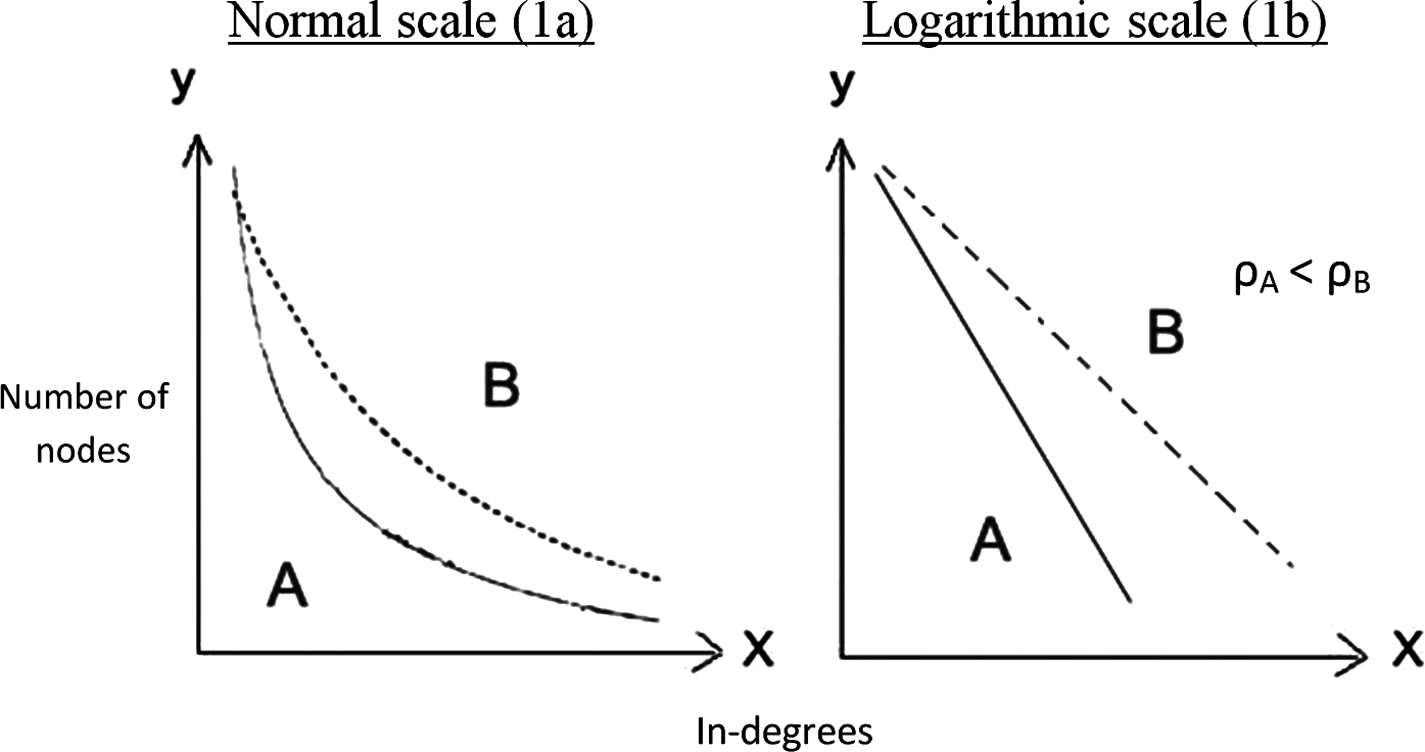
The slope of power-law degree distribution
Figures 1a and 1b also compare two hypothetical distributions. Regression lines A and B represent degree distributions of two hypothetical networks. The two distributions are skewed, but Network A has a more skewed degree distribution than Network B, as the natural graph shows (A is steeper than B; Figure 1a). When representing the graphs on a logarithmic scale (Figure 1b), ρ represents the slope of the regression line. The ρ coefficient allows us to compare the two networks: Regression line A is more skewed and thus has a smaller ρ than regression line B. In other words, the structure in Network A is more unequal in terms of distribution of degrees than Network B.
Reciprocity
A link is considered reciprocal if it was sent between two nodes in both directions at least once. In discussion fora, if Author A replied to Author B and Author B replied to a message author A posted, the link between the two is considered reciprocal. The ratio of the number of reciprocal links over the number of overall links indicates how reciprocal the entire network is. Given that R was the reciprocity level of a network j, Rj was measured here as number of reciprocal links over the total number of links in a network.
Reciprocity level in a group ranges, therefore, between zero (no reciprocal links) and one (all links are reciprocal). The smaller the value of Rj, the less reciprocal a network is. A perfect reciprocal network is one in which every node responds at least once to every other node who responded to it initially. Social network literature has many measures for reciprocity. For this study a rather loose definition of reciprocity was used because the large networks were expected to be loosely connected. The total number of links in a network was the number of dyads that had at least one link exchanged among them (one-way or reciprocal).
Data and Sampling
Following de Tocqueville’s (1839) discussion on importance of the meeting hall to achieve a communication forum in civil society, two types of topics that are expected to host an exchange of ideas and opinions were selected—politics and philosophy.
Usenet data were available through the Microsoft Netscan dataset. First, newsgroups were sampled if they had the keywords “politic” or “philosoph” in their group name. Next, the complete data set was used to identify newsgroups that were active between 2001 and 2006 (at least 15 active participants in the first [January 2001] and last [December 2006] months of data collection were selected). Netscan stopped collecting data during 2007. Second, a random sample of 20 groups per topic was chosen. If less than 20 groups in a given category fit the requirements, all of them were included. Politics-related groups included local politics such as in Alabama, Washington, and Minnesota, and national American domestic politics and specific issues such as homosexuality. A variety of philosophical matters such as Taoism, liberalism, objectivism, and atheism were addressed in these newsgroups.
Content Analysis
To address the fifth research question, a content analysis of root messages (the first message in a thread that starts a discussion) was conducted. The author and colleagues’ (published elsewhere) previous work has systematically identified the highly replied participants (hubs) and their content in a 6-month period (July-December, 2006) in these 15 political newsgroups. An analysis of their root messages’ contents showed that 95.4% of messages posted by these were content imported from other news sources (of them, 60% from traditional media online, 8% from blogs and personal websites, 15% from online-only news sites, and 6% from government and nonprofit organizations) and 12% of all messages were designated as presenting their own comments and opinions.
Building upon this work, a random sample of 375 messages was taken from all other participants (who were not identified as hubs) on these groups and during this time period; 285 (76%) of the messages were retrieved using Google Groups, analyzed, and compared to findings of hubs’ messages; 24% of the messages could not be retrieved due to cancelled messages or Google restrictions. Messages were analyzed for their content (personal contribution and imported content) and for sources of imported content (blogs, user-generated and personal sites, government and NGOs, online news sites, private advocacy organizations, and traditional media); another 10% of the messages were recoded for intercoder reliability, which was high (Scott’s Pi = 0.96).
Findings
Discussions from the 72-month-long periods (January 2001 to December 2006) from 35 newsgroups on politics and philosophy were retrieved and analyzed in terms of their activity and network structures. Although the goal was to choose 20 newsgroups for each of the 2 topics, only 15 philosophy-related newsgroups were active across the data collection period. 1 A total of 207,419 participants posted 7,406,660 messages on political newsgroups, and 47,573 participants posted 931,833 messages on philosophy-related newsgroups. Activity in the newsgroups was represented via two measures—number of messages and number of participants. No meaningful linear correlation was found between time and measures of activity.
Research Question 1: What is the correlation between in-degrees and out-degrees in discussion groups?
Examining a participant as the unit of analysis, findings showed a strong positive correlation (p < .001 for all comparisons) between the contribution of a participant to a group and replies one receives from the group (Table 1). The number of messages one posted was a better predictor for number of replies received, as it accounted for 28% of variance in politics newsgroups and 64% in philosophy newsgroups. Correlations between in-degrees and out-degrees were lower.
Pearson Correlations Between Message Contribution and Attraction
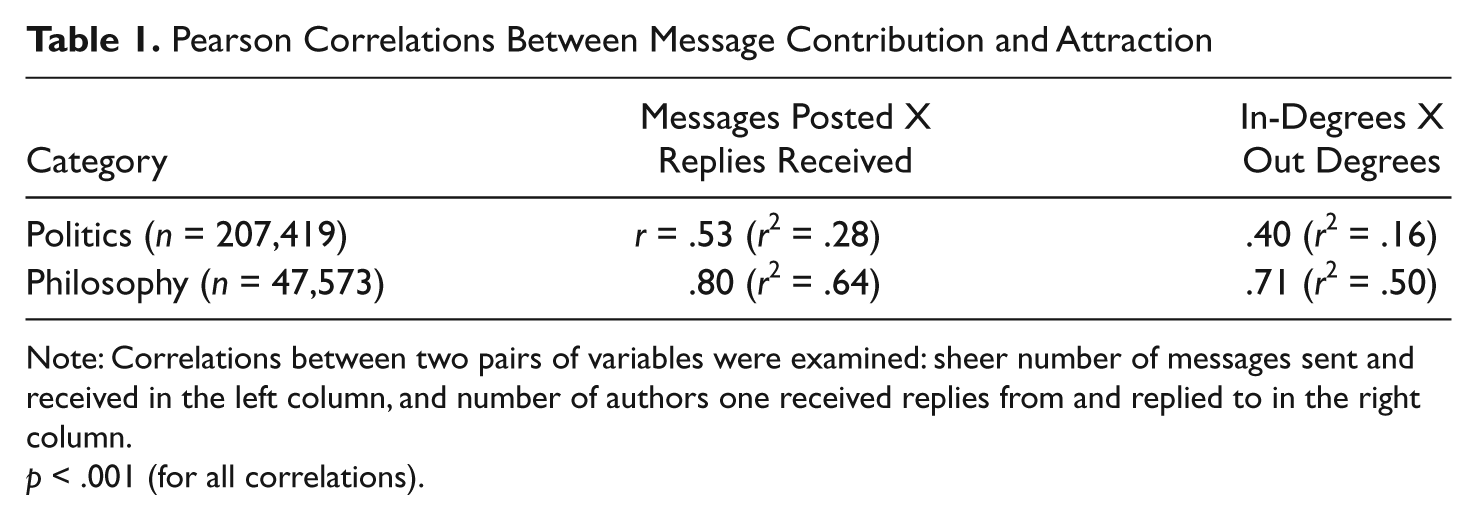
Note: Correlations between two pairs of variables were examined: sheer number of messages sent and received in the left column, and number of authors one received replies from and replied to in the right column.
p < .001 (for all correlations).
Hypothesis 1: The in-degree distribution in newsgroups will follow a power-law distribution.
Examination of distributions of newsgroups’ activity (in-replies, in-degrees, out-replies, and out-degrees) found that rho coefficient values fell between the confidence intervals, and, therefore, the distributions fit Yule and thus power-law. The distribution of activity measures was examined in 1-month periods. For example, rho value for in-degree distribution in the newsgroup alt.politics.usa.congress during January 2001 was 1.92. The confidence intervals were 1.79 (lower 95%) and 2.05 (upper 95%). The in-degrees fit the Yule distribution, as the rho value fell between the CIs. The distribution, consequently, followed the power-law. The BIC criteria value was 1313.10, which is considered high. Further explanation is in the Methods section.
The individual values of rho are meaningful in the context of this analysis only in comparison among newsgroups (presented and examined later), and it is not feasible to report all 10,500 values (72 months x 35 groups x 4 measures of activity). Average rho values are reported later in Table 3. Across group magnitude and topic, therefore, the distributions of ties were highly unequal, where a few individuals attracted a disproportionate number of replies.
For illustration, let us examine in Figure 2 the distribution of replying authors via an exemplary distribution of a single month in a single newsgroup. However, when measuring the slope of a distribution the entire network is the unit of analysis. When drawing the distribution of replies for a single group, a participant is the unit. In Figure 2, the x-axis is the number of replying authors (in-degrees) and the y-axis represents the number of authors in the group that correspond to the x values. The unequal distribution is salient. A handful of participants at the top left of the graph attracted replies from many more authors than others, similar to the power-law distribution described in Figure 1a.
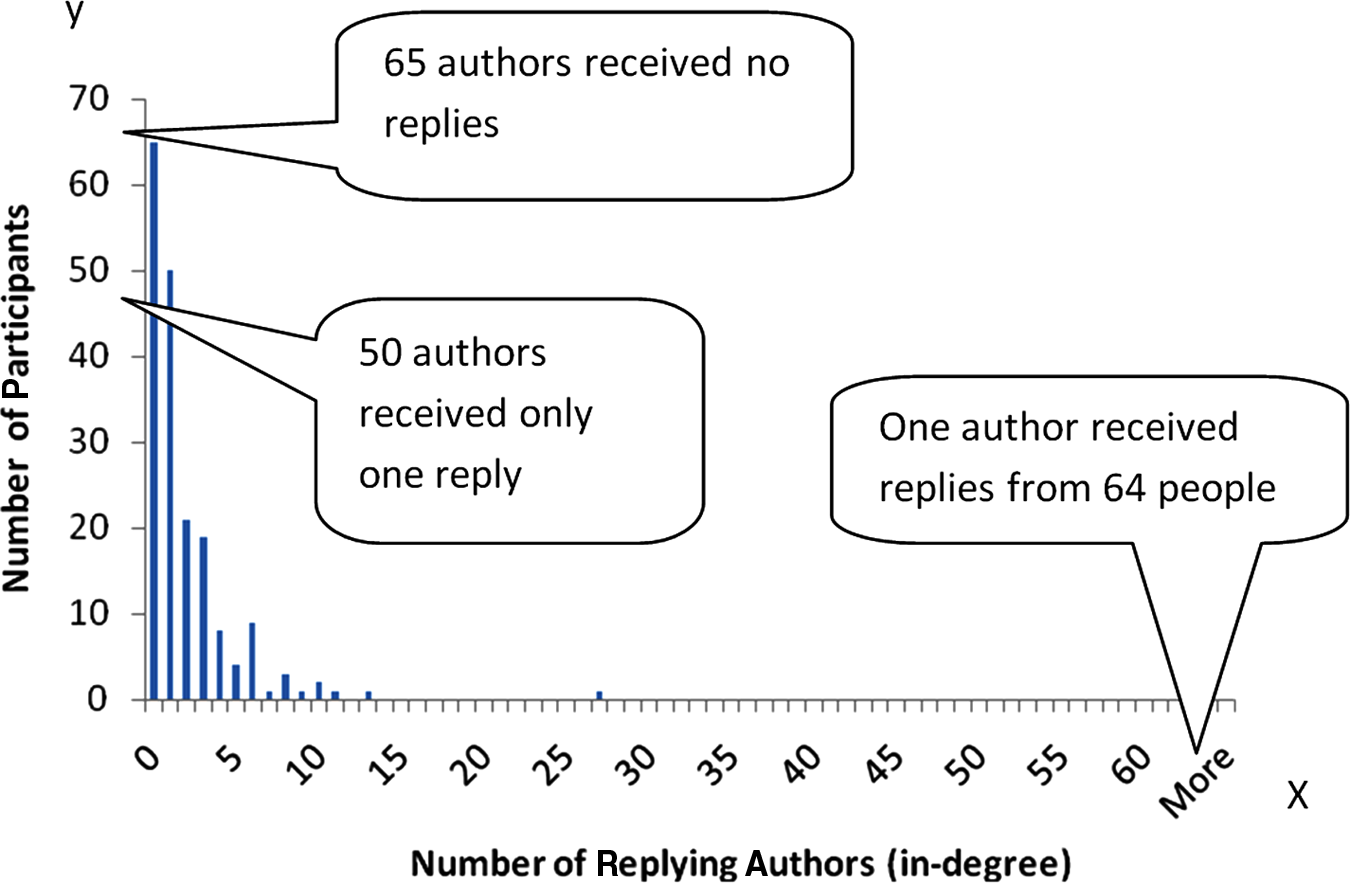
An example of histogram of in-degrees (Nauthors = 187, Nlinks = 430)
Research Question 3: Are inequalities in in-degrees distribution larger, equal to, or smaller than the inequalities in out-degrees distribution?
Although all newsgroups followed a power-law distribution, a t test showed that ρ in-degree was significantly larger than ρ out-degree, and ρ in-replies was significantly larger than ρ out-replies for all topical categories (Table 2). In political newsgroups, for example, the rho coefficient was significantly smaller (t = 34.61, p < .001) for the distribution of in-replies (1.79) than for out-replies (1.98). In other words, the distribution of participants’ contributions to their group was less unequal than the distribution of replies they received (see Figure 1 earlier for an illustration of the meaning of a slope).
Differences Among Slope of Distribution (ρ) by Newsgroup Category
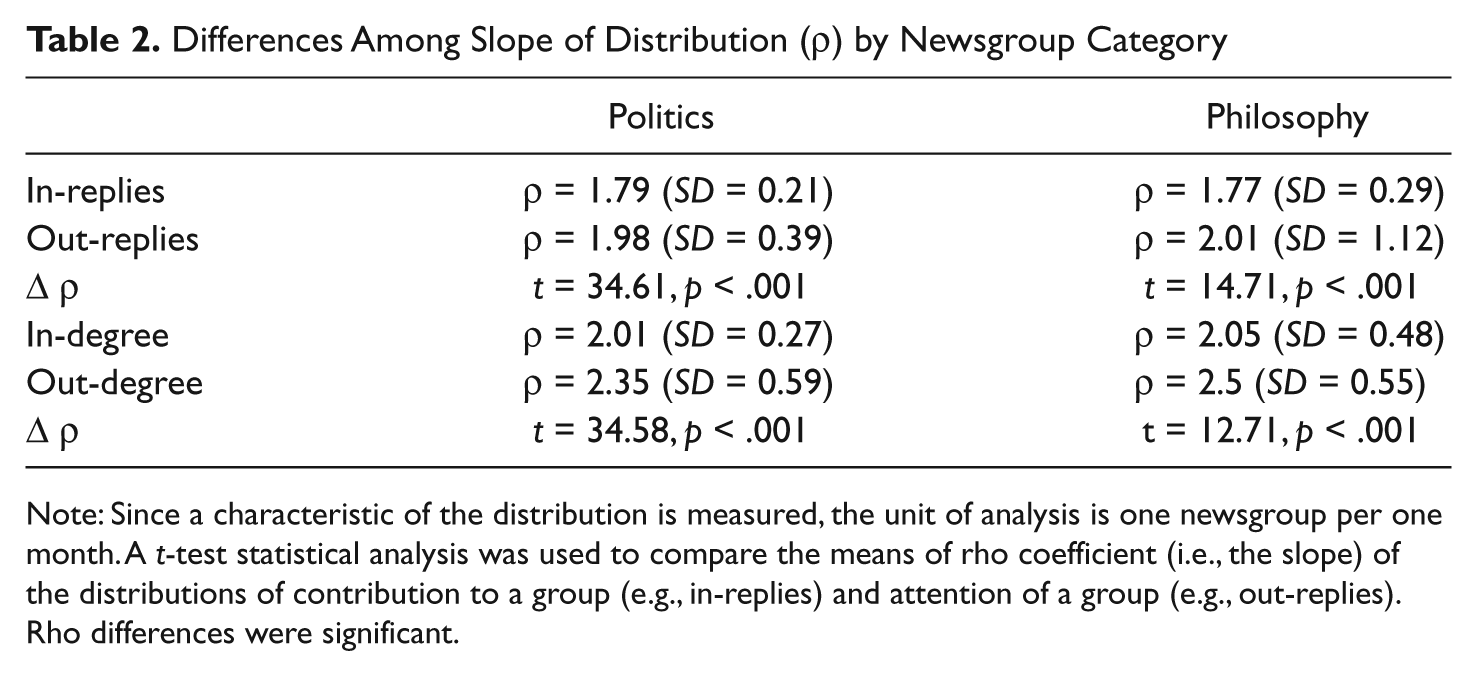
Note: Since a characteristic of the distribution is measured, the unit of analysis is one newsgroup per one month. A t-test statistical analysis was used to compare the means of rho coefficient (i.e., the slope) of the distributions of contribution to a group (e.g., in-replies) and attention of a group (e.g., out-replies). Rho differences were significant.
As discussed in the Method section, the slope of the power-law distribution is an indicator of the extent to which a distribution is skewed or unequal. Each newsgroup was represented by a rho value for each month-long period. These values allowed us to test the second hypotheses.
Hypothesis 2: The greater number of participants in a discussion group, the more skewed the distribution of replies and repliers.
A significant negative correlation was found between newsgroups’ size and activity and the slope of the distribution of in-degrees and in-replies (p < 0.001 for all comparisons; Table 3). In political newsgroups, correlation between activity and group size ranged between –.349 and –.453. In philosophy newsgroups, however, correlations were overall low, especially between size and in-replies correlations’ rho, which was almost zero (.093). One possible explanation for these low correlation values is the small range of group sizes as well as the fact that the total number of participants and messages was the lower than in political newsgroups.
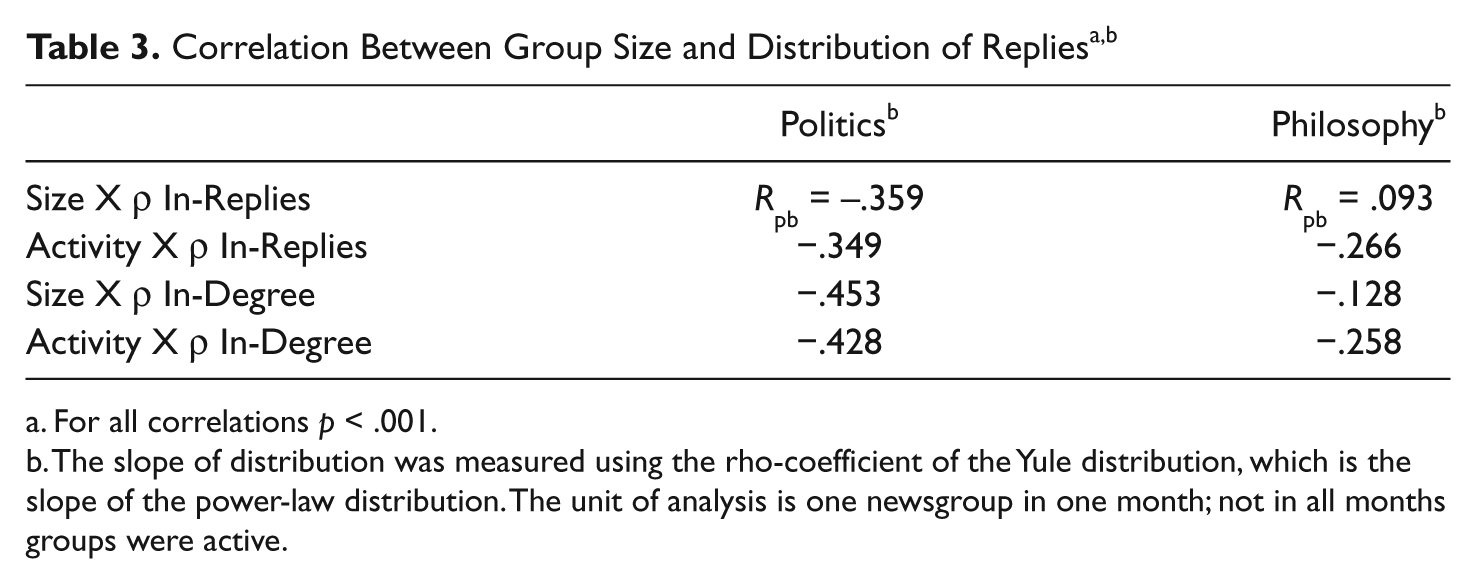
For all correlations p < .001.
The slope of distribution was measured using the rho-coefficient of the Yule distribution, which is the slope of the power-law distribution. The unit of analysis is one newsgroup in one month; not in all months groups were active.
In political newsgroups, the proportion of variance in in-degree distribution (number of replying authors) that was linearly accountable for by variance in group size and activity was 20.52% and 18.32%, respectively. For the relationship between in-replies and out-replies, those values were 12.88% and 12.18%, respectively. In philosophy newsgroups, group size and volume accounted for much less in the variance in the distribution of in-degrees and in-replies (between 7.08 and 0.8%). From a statistical standpoint, it should be noted that whereas the distribution of in-degrees in each newsgroup was highly unequal, the distribution of ρ in-degrees across newsgroups was close to normal and, therefore, did not violate Pearson test’s assumption of normal distribution.
Research Question 4: How reciprocal are newsgroups networks?
Across topics of newsgroups, the reciprocity ratio was on average 0.44 (SD = 0.08) for political newsgroups and M = 0.53 (SD = 0.16) for philosophy-related groups. This means that on average, about half of the replying participants were reciprocated. In the study, reciprocity ranged between 0 and 0.91. In other words, whereas some newsgroups had very high levels of reciprocity, potentially an indication of an egalitarian structure, others had low levels of reciprocity, which suggests a hierarchical structure. The unit of analysis was one newsgroup in 1 month. Group size and volume were not good predictors for level of reciprocity.
Research Question 5: Does content presented by highly popular participants differ from content presented by other participants? If yes, how?
Examining root messages posted by nonhubs, 61.4% of messages included a substantial individual contribution (more than two sentences of content not pasted from elsewhere), 15.44% included a brief individual contribution (1-2 sentences), and 23.26% included no individual contribution. For hubs, as examined elsewhere (Himelboim, Gleave, & Smith, 2009), the allocation was much different (12%, 65%, and 23% correspondingly). Examining data sources, nonhubs posted 259 links to sources elsewhere on the web, sometimes with more than one link in a message: 27.41% to traditional media (compared to 60% in hubs’ messages); 24.71% to blogs, both user generated and personal sites (compared to 8%); 6.18% to governmental and NGO sites (compared to 6%); and 8.11% to online news sites (compared to 15%); 22.78% went to private advocacy groups and organizations, which could not be found in hubs, and 10.81% of links were broken (see Figure 3).
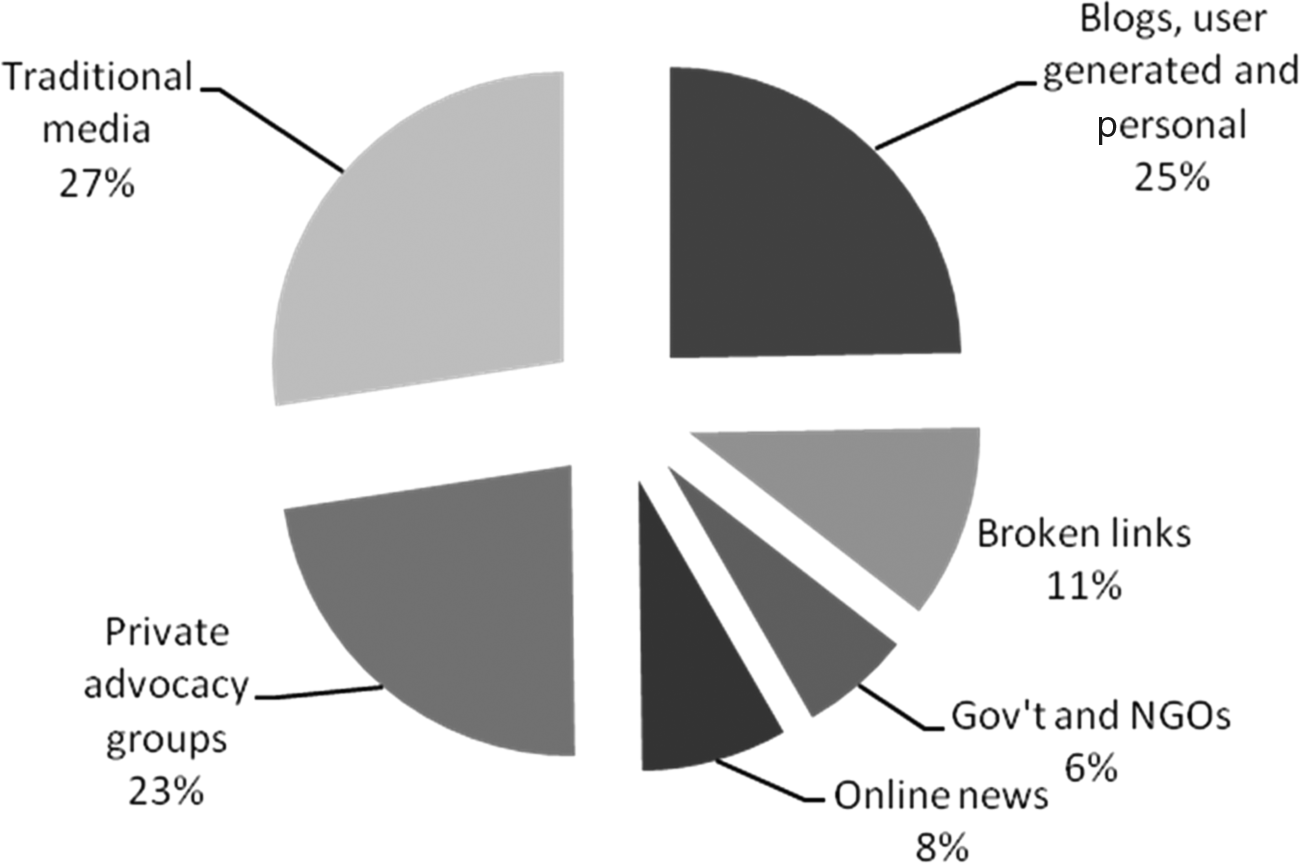
Sources of imported content (NLinks = 259)
Discussion
Civil associations have long been a fundamental foundation for any civil society (de Tocqueville, 1839). For many generations these associations were not free and participation was restricted based on a wide range of social and individual attributes, such as class, gender, or opinion. Following de Tocqueville’s ideas about the importance of free and open exchange of ideas for civil society, this study has examined social interactions on newsgroups, being one of the most decentralized spaces on the Internet (Usenet, 2008). Findings, nonetheless, showed that some patterns of unrestricted online interactions do not necessarily benefit civil society, as the larger and more active a discussion group is, the more unequal participants become.
The technology of the Internet secures, throughout most of the world, two important necessities for civil society—free associations of social actors and freedom from institutional coercion and sanctions. This study provides support for another criterion for civil society—a large number of participants. Between 2001 and 2006, more than a quarter of a million Usenet participants posted in excess of 8 million times in just the 35 discussion newsgroups examined in this study. Regardless of the growing number of alternative spaces for political interactions on the Internet, such as blogs and social networking sites, activity in political and philosophy newsgroups has not declined.
Across size and topic of discussion, however, a few participants attracted a large and disproportionate number of replies to messages they posted, whereas most participants attracted very few, if any. These patterns of social interactions in online political discussions were unsurprisingly similar to structures of many other networks outside the Internet. This phenomenon of inequality should be attributed to the technology only to the extent that it allows a large number of individuals to interact. By doing so it replicates existing patterns in other domains of research, online or offline. Notwithstanding, these patterns can pose a challenge for the expected contribution of the Internet to civil society from the standpoint of the need for equality among participants, well-informed citizenry, and diversity of choices.
Equality Among Participants
The technology of the Internet ensures that all users are created equal. When connected to the Internet, we can all access e-mail, Usenet, and the World Wide Web to exchange information and opinions. In practice, findings from this study show that the ability to influence and thus benefit from discussion spaces is highly unequal, as a few participants attracted much more attention than others. Internet technology may have egalitarian potential, but when users take advantage of the opportunity to participate in online discussion fora, patterns of interaction indicate a sharp inequality among participants.
The positive correlation between participants’ contribution to the discussion and replies they received from it is an encouraging finding. Being active in a discussion helps in attracting more attention from the groups. A closer look at the degrees of inequalities in groups, however, reveals that the distribution of replies received is significantly higher than that of replies given. In other words, the inequality among participants goes beyond the inequality of contribution. Furthermore, the correlation between in- and out-degrees explains only parts of the variances.
Examining reciprocity among participants in political discussions allows us to look at the question of equalities and inequalities from a different perspective. On average, about half of all dyads of participants were reciprocal, meaning that if Participant A has replied to a message posted by Participant B, the latter has replied at least once to participant A during that month. Such reciprocity levels can be seen as encouraging to civil society, as it can be received as an indication for rather equal relationships in newsgroups. This is with some contrast to the high inequality revealed by the distribution of replies. Level of reciprocity, however, was not predicted successfully by activity or group size. Further research is needed for better understanding of reciprocity in discussion fora.
Well-Informed Citizenry and Diversity of Choices
The technology of the Internet and its widespread use can be of great promise to well-informed citizenry. The mere existence of information on an almost endless array of topics and points of view, nonetheless, does not ensure that people will take advantage of it. Sunstein (2006) warned that the availability of a growing number of sources leads to a narrowing of the scope of news and views to which people choose to expose themselves. Adamic and Glance (2005) showed that political bloggers preferred sending hyperlinks to bloggers with whom they shared political opinions. This study adds to these concerns. Patterns of social interaction in discussions on politics and philosophy illustrate that, given the freedom to choose from a wide range of issues of discussions, participants preferred joining the already-popular discussion threads. At any period of time and across discussion threads, topics brought by a few participants attracted most of the participants and discussion activity. Content—topics, issues, or opinions—presented by most participants, however, evoked little or no discussion and most likely less attention.
Findings showed that the larger and more active a newsgroup is, the more disproportionate the distribution of replies is among its participants. The social implications are that on the Internet, fulfilling one need of civil society—a large body of participants—may compete with fulfilling three others. The more participants who join a discussion on a topic, the more likely a greater number of opinions and facts will be exchanged—an asset for civil society. However, with the growth of the discussion, participants’ equality is polarized and fewer discussion channels are taken. Many replies can be an indication of the perceived merit of some of the content. However, preferential attachment suggests that, at least to some extent, the growing popularity of some content over other is related to its current popularity.
One of the major promises of the Internet lies in its potential to expand the sources of information beyond traditional news media and to allow easy access to these sources. Indeed, many of the participants posted links to blogs and websites of advocacy groups as well as to websites of traditional media. Comparing the messages of the most popular authors to those of other participants, however, showed that the skewed distribution in replies is manifested in a bias toward traditional sources of information over more grassroots ones and of imported content over participants’ individual contributions of content or opinions. These findings provide some support to the argument that the disproportionate distribution of replies can bias the content participants are exposed to in discussion fora.
Limitations and Future Research
Opinions presented in messages were not examined in this study, and, therefore, the implications of the findings to well-informed citizenry are limited. A large amount of content contribution of some participants may or may not mean a diversity of opinions. This is important, as opinions presented by the highly popular participants have the potential of influencing opinions presented by others in the group. Research shows that the argumentative “climate” of group opinion, as expressed by group members, can shape the character of individually expressed opinions (Price, Nir, & Cappella, 2006). Considering the disproportionate distribution of replies, future examination of opinions in forums, especially comparing content presented by hubs, should examine whether the disproportionate exposure to participants leads to a biased exposure to opinions.
This study operationalized participation in forums only as actively posting messages, leaving unexamined those who read messages but do not post—lurkers. Literature, however, suggests that many, and occasionally even the majority of users, follow discussions but choose not to participate (Jones, Ravid, & Rafaeli, 2002). The decision to operationalize a link in the network as a reply and not as reading a message not only excludes this important subpopulation but can also potentially limit the interpretations of the findings. Do active users and lurkers show similar patterns of exposure to messages? Do they have similar preferences in terms of their popular messages, the information sources these messages link to, or opinions presented? Future studies examining lurking patterns and comparing them to patterns of active participants can allow us to potentially shed new light on the role political forums may play in civil society.
Another limitation of this study is the selection of forums designated for political issues. In fact, many discussion forums designated for leisure (e.g., hobbies) have become platforms for political exchange of opinions. Furthermore, participants of political discussions on leisure forums were exposed to cross-cutting political views more than on political forums (Wojcieszak & Mutz, 2009). Future research could replicate this study and compare its findings to patterns of interactions of political discourse on leisure forums.
Conclusions
This study fills two gaps in the literature of Internet and civil society. First, it draws from the rich literature on civil society to provide a conceptual framework for the study of Internet and civil society. Second, it illustrates the importance of the relationship between the Internet and civil society via patterns of online social interactions and offers theoretical and methodological frameworks to studying it.
Taking a network approach, this study examined patterns of free and unrestricted interactions on online discussion fora and draws mixed conclusions. On one hand, the Internet indeed provides a wide range of opportunities to interact on almost any topic with a growing number of people. That could not have been available without the technology. Furthermore, reciprocity—one indicator for equality—was high relative to the large number of participants. On the other hand, distribution of replies—another measure of equality—was highly skewed across time and topics of discussion. For most participants it is rather unlikely to evoke a discussion on issues of their interest. Content brought by those who attract large and disproportionate portions to the discussions tends to be biased toward traditional media and existing content. These conclusions are quite different from the existing literature on Internet and society, which suggests that external social and political forces are the main constraints for social actors to freely us the Internet and contribute to civil society. Network patterns of social interactions, which are neither dependent on technology nor on society, to some extent limit the ability of the Internet to contribute to civil society.
Footnotes
The author declared no potential conflicts of interest with respect to the authorship and/or publication of this article.
The author received no financial support for the research and/or authorship of this article.
1.
The political newsgroups selected for this study were as follows: alabama.politics, alt.politics.british, alt.politics.bush, alt.politics.clinton, alt.politics.equality, alt.politics.greens, alt.politics.homosexuality, alt.politics.radical-left, alt.politics.republicans, alt.politics.usa.congress, az.politics, ca.politics, houston.politics, mn.politics, nj.politics, nyc.politics, ont.politics, talk.politics.european-union, talk.politics.tibet, wash.politics. Newsgroups related to philosophy that were selected for this study were: alt.christnet.philosophy, alt.philosophy, alt.philosophy.debate, alt.philosophy.kant, alt.philosophy.law, alt.philosophy.objectivism, alt.philosophy.taoism, alt.philosophy.zen, comp.ai.philosophy, humanities.philosophy.objectivism, sci.philosophy.meta, talk.philosophy.humanism, talk.philosophy.misc, uk.philosophy.atheism, uk.philosophy.humanism.