







Abstract
Cultivation theory and research have been criticized for their failures to consider variation in effects by genre, employ appropriate third-variable controls, and determine causal direction. Recent studies, controlling for a variety of demographic characteristics and media use variables, have found that exposure to local television (TV) newscasts is associated with a variety of problematic “real-world” beliefs. However, many of these studies have not adequately assessed causal direction. Redressing this limitation, we analyzed data from a two-wave national representative survey which permitted tests of lagged association between overall TV viewing, local TV news viewing, and fatalistic beliefs about cancer prevention. We first replicated the original cultivation effect and found a positive association between overall TV viewing at Time 1 and increased fatalistic beliefs about cancer prevention at Time 2. Analyses also provided evidence that local TV news viewing at Time 1 predicts increased fatalistic beliefs about cancer prevention at Time 2. There was little evidence for reverse causation in predicting changes in overall TV viewing or local TV news viewing. The article concludes with a discussion of theoretical and practical implications of these findings.
Introduction
Cultivation theory is among the best-known and widely taught theories of mass media effects (Bryant & Oliver, 2008; Morgan & Shanahan, 1997). The theory posits that habitual exposure to TV influences beliefs about the nature, prevalence, and importance of social problems (Gerbner & Gross, 1976). In other words, people who are heavily exposed to TV are more likely than those with low or moderate exposure to adhere to TV’s version of social reality (Gerbner, Gross, Morgan, Signorielli, & Shanahan, 2002). Over the past three decades, scholars have expanded the scope of cultivation analysis, starting with a focus on the effect of TV exposure on violence and moving to other areas like racial stereotypes, gender roles, political opinions, science, and health beliefs (Gerbner et al., 2002). A review of cultivation research has found, on average, a small but statistically significant association between TV viewing and beliefs about a variety of topics (Morgan & Shanahan, 1997).
The current study begins by applying cultivation theory to predict fatalistic beliefs about cancer prevention, beliefs that are at odds with the reality of cancer prevention. Considering that the general public and cancer patients alike heavily depend on TV and other forms of mass media for information about cancer, TV exposure is likely to play a major role in influencing knowledge, beliefs, and attitudes about the disease (Brodie, Hamel, Altman, Blendon, &Benson, 2003; Lee, 2010). Thus, this study begins with a test of the original cultivation theory to examine whether people’s total TV exposure cultivates their fatalistic beliefs about cancer prevention.
To apply the cultivation theory to any topic areas and contribute to its theoretical and methodological development, one should also consider scholarly debates revolving around this theory. First, although the creators of cultivation theory focused on common content features cutting across diverse TV programs and genres (Gerbner et al., 2002; Morgan & Shanahan, 1997), many theorists have contended that cultivation effects may be program- or genre-specific (e.g., Hawkins & Pingree, 1981; Potter & Chang, 1990). Second, some critics have argued that early cultivation findings may be spurious because these studies did not employ a comprehensive set of control variables (e.g., Hirsch, 1980, 1981; Hughes, 1980). Third, and perhaps most importantly, a majority of cultivation studies have offered only cross-sectional associations between TV viewing and real-world beliefs. The lack of longitudinal studies in cultivation analysis is surprising given that the key theoretical claim of cultivation theory—a causal effect of long-term TV exposure on changes in perceptions of social reality—cannot be confirmed using cross-sectional data (Cook & Campbell, 1979).
To address these limitations, we use a two-wave longitudinal panel survey to examine lagged associations between overall TV viewing (original cultivation hypothesis), local TV news viewing (genre-specific cultivation hypothesis), and fatalistic beliefs about cancer prevention, controlling for several plausible third-variable explanations. In doing so, we aim to (a) provide more definitive tests of causal order between TV viewing and the perception of reality and (b) test the possibility that original and genre-specific cultivation effects may coexist.
Criticisms of Cultivation Theory
Since Gerbner and Gross (1976) first published the first empirical evidence in support of the cultivation effect, cultivation research has been subject to a variety of criticisms which include failures to (a) consider differences in exposure and effects by genre, (b) account for plausible third-variable explanations, and (c) collect data that can rule out spurious causation (Rossmann & Brosius, 2004; Williams, 2006).
Variation in Cultivation Effects by Media Genre or Channel
Gerbner and colleagues (2002) argued that all TV programs contribute to “massive, long-term, and common exposure of large and heterogeneous publics to centrally produced, mass-distributed, and repetitive systems of stories” (p. 47). By opposing the “tendency of media research to isolate and dissect pieces from the whole” (Gerbner, Gross, Morgan, & Signorielli, 1986, p. 21), they primarily concerned the effects of overall patterns of TV viewing. The theory was developed in the 1970s, a time when there were far fewer channels and programs on TV than there are today. Thus audiences in the 1970s might have encountered similar types of content even if they were selective in choosing what they watch. However, this assumption is questionable amid the number of channels and genres available in cable and digital TV, at least in the United States. Indeed, many scholars have argued that media effects researchers should focus assessments of media effects on specific programs, genres, or channels of content to which audiences are exposed (Annenberg Media Exposure Research Group, 2008; Bleakley et al., 2008).
Many cultivation studies have demonstrated that content-specific extensions of cultivation theory are useful additions to the original formulation of the theory (e.g., Cohen & Weimann, 2000; Hawkins & Pingree, 1981; Potter & Chang, 1990). For example, Potter and Chang (1990) constructed program-specific media exposure measures (situation comedies, action adventures, and so on) and showed that these measures were associated with audiences’ perception of reality, even after controlling for overall TV viewing. Program-specific measures were also more strongly associated with real-world beliefs than a measure of total TV viewing hours. Cohen and Weimann (2000) have also shown that different genres (news, suspense and horror, MTV, and so on) influenced attitudes in different sub-populations using a sample of Israeli junior-high and high-school students. These studies have argued that different programs on TV offer different types of content, contradicting an original assumption of the theory.
Several recent studies have focused specifically on the effects of local TV news broadcasts (e.g., Gross & Aday, 2003; Niederdeppe, Fowler, Goldstein, & Pribble, 2010; Romer, Jamieson, & Aday, 2003). Two of these studies examined associations between local TV news viewing and fear of crime victimization. Both concluded that local TV news viewing increased real-world perceptions about crime, including fear and concern about violence (Romer et al., 2003), and the extent to which crime is an important public problem (Gross & Aday, 2003). A third study found that local TV news viewing was associated with more fatalistic beliefs about cancer causes and prevention (Niederdeppe et al., 2010). All three studies controlled for exposure to other genres of programming (e.g., national TV news exposure) and found substantial differences in effects by program type. In the aggregate, these studies demonstrate that (a) both genre- and channel-specific TV exposure predicts beliefs about the social world, and (b) different genres and channels are likely to have divergent effects on real-world beliefs.
However, the utility of genre-specific extensions does not necessarily mean that the original cultivation theory is invalid. That is, cultivation theory (traditionally conceived) can coexist with effects from specific TV genres or programs. Even if TV programs and genres provide different images and messages about social reality, there could still be a consistent meta-message (Gerbner et al., 2002; Morgan & Shanahan, 1997). Morgan and Shanahan (1997, p. 6), for example, argued that “cultivation theory does not deny that programs differ, that viewing can be selective . . . Focusing primarily on selectivity and diversity . . . can blind us to subtle commonalities underlying superficially different program types.” Thus, it may still be important to assess the effects of overall time spent watching TV on real-world beliefs. Indeed, Potter and Chang (1990) and Niederdeppe and colleagues (2010) each found significant associations between overall TV viewing, genre-specific TV exposure, and real-world beliefs. Moreover, tests of the original cultivation theory could serve as a baseline against which one can better judge the value of extensions of cultivation theory. Therefore, we begin our analysis by testing the original cultivation hypothesis and then move to genre-specific (TV news) viewing.
Failure to Account for Third-Variable Explanations
Many cultivation studies have been criticized for their failure to account for correlations between TV viewing, real-world beliefs, and potential third-variable explanations, including viewer demographics, media selectivity, and neighborhood context (e.g., Hirsch, 1980, 1981; Hughes, 1980). These shortcomings have lead to potentially invalid inferences about causal relationships between media use and real-world beliefs (see Rossmann & Brosius, 2004; Williams, 2006 for detailed critiques). Early studies, as well as more recent meta-analytic assessments, have relied on simple bivariate correlations in assessing cultivation effects (see Morgan & Shanahan, 1997). Although many of the recent, genre-specific studies have included a variety of demographic, neighborhood, and media use controls (e.g., Gross & Aday, 2003; Romer et al., 2003), observational studies (without random assignment) always run the risk of omitting important third-variable explanations. A strong body of evidence in support of genre-specific cultivation effects requires a variety of independent studies, across settings and contexts, which account for a wide variety of potential third-variable explanations. It remains important to control for a wide variety of demographic characteristics, media use, and other confounds that may influence selective exposure to TV and real-world perceptions in cultivation analysis.
Causal Order
Another major critique of cultivation studies lies in the lack of evidence about causal order between TV viewing and perceptions of reality. Given that one of the necessary conditions for causality claims is a clear temporal order between independent variable and dependent variable (i.e., independent variables should be measured before dependent variables), cultivation studies with cross-sectional data are limited in establishing the causal argument that TV viewing influences audiences’ perception of reality rather than the reverse (Rossmann & Brosius, 2004).
Two common methods allow researchers to draw stronger causal claims than cross-sectional surveys: randomized experiments and panel survey designs. Among these, laboratory experiments are not optimal methods by which to test the central hypotheses of cultivation theory as they pertain to genre-specific TV exposure. Cultivation research is intended to capture long-term, cumulative effects of TV exposure on audiences’ perception of reality (although experiments have been used to test specific mechanisms by which cultivation effects occur; e.g., Shrum, 1995). It is theoretically possible to randomly assign participants to become exposed to a specific genre of content in a laboratory session over an extended period of time (e.g., weekly sessions in a laboratory). In fact, this approach was used by Williams (2006) to assess causal cultivation effects of a virtual video game on perceptions of real-world dangers. The problem lies in controlling unplanned TV exposure outside of the laboratory, since the average American adult spends hours in front of the TV each day (e.g., Pettee, Ham, Macera, & Ainsworth, 2009). Thus, longitudinal panel survey designs are arguably better suited to address the causality issue in cultivation research related to genre-specific TV exposure.
Fatalistic Beliefs about Cancer Prevention as Problematic Real-World Beliefs
Nearly half of cancer incidence can be attributed to preventable causes like smoking and obesity (Calle, Rodriguez, Walker-Thurmond, & Thun, 2003; Peto, Lopez, Boreham, Thun, & Heath, 1994). National organizations (e.g., American Cancer Society, ACS; National Cancer Institute, NCI; Task Force on Preventive Services) have provided clear recommendations about behaviors that reduce the likelihood of getting cancer, such as avoiding smoking, regular exercise, frequent fruit, and vegetable consumption, and taking cancer screening tests at regular intervals according to recommended guidelines (Brown et al., 2003; Rock & Demark-Wahnefried, 2002). Nevertheless, a large proportion of the American public still holds fatalistic beliefs about cancer prevention. According to recent national survey data, almost half of all American adults agree that “It seems like almost everything causes cancer,” a quarter say that “there’s not much people can do to lower their chances of getting cancer,” and more than 7 out of 10 believe that “There are so many recommendations about preventing cancer, it’s hard to know which ones to follow” (see Niederdeppe & Levy, 2007).
Fatalistic beliefs about cancer prevention constitute a threat to public health. People who hold fatalistic beliefs (a) have lower self-efficacy regarding cancer risk-reducing behaviors (Schnoll et al., 2002; Straughan & Seow, 1998), (b) are less likely to adhere to screening guidelines for several cancers (Chavez, Hubbell, Mishra, & Valdez, 1997; Conrad, Brown, & Conrad, 1996; Mayo, Ureda, & Parker, 2001), (c) are more likely to engage in health-threatening behaviors such as smoking (Niederdeppe & Levy, 2007), and (4) engage in fewer risk-reducing behaviors like frequent fruit and vegetable consumption (Niederdeppe & Levy, 2007).
While many cultivation studies control for real-world prevalence of the phenomena under study (e.g., real vs. perceived crime rates), we assume that views about cancer prevention are consequential and need not be fatalistic. Everything does not cause cancer, there are ways to substantially reduce cancer risk, and national organizations have made clear recommendations about effective ways to reduce cancer risk. Thus, the beliefs that “everything causes cancer,” “there’s not much people can do” to reduce their risk, or “there are too many recommendations” about cancer prevention constitute a discrepancy between viewer perceptions and reality.
The Case for Local TV News as a Cultivator of Fatalistic Beliefs about Cancer Prevention
Despite news industry-wide declines in advertising revenue and audiences, Americans rate TV as their most important source of health news (Brodie et al., 2003; Pew Research Center, 2009a) and have more favorable views of local TV news than daily newspapers or network TV news broadcasts (Pew Research Center, 2009b). Local TV health news coverage is thus likely to be quite influential in shaping health-related beliefs. Nevertheless, analyses of the production and content of this coverage suggest that local TV may cover health, and cancer prevention more specifically, in a way that promotes fatalistic beliefs. Specifically, we argue that local TV news coverage tends to (a) frequently mention cancer causes, (b) infrequently mention specific preventive actions to reduce cancer risk, (c) focus on new research findings rather than established recommendations, and (d) spend insufficient time on each story to permit discussions of the strength of scientific evidence for a particular cause or recommendation or to offer viewers information that would permit them to follow-up on the story. Each serves to increase the likelihood that repeated exposure to cancer stories on local TV news would cultivate fatalistic beliefs about cancer prevention.
The Project for Excellence in Journalism (2006) compared local TV news with national TV news, newspapers, and other sources, and concluded that, in general, “local TV news stories emerged as the most thinly sourced and shallowly reported of any medium studied other than local radio” (p. 1). Many local TV news stories are based directly on press releases (Project for Excellence in Journalism, 2005), which in the case of health news rarely acknowledge study limitations and often present results in terms of relative rather than absolute risk (Woloshin & Schwartz, 2002). Members of the public misinterpret relative risk, leading to overestimates of their own risk of disease or exposure to one of its causes (Schwartz, Woloshin, Black, & Welch, 1997). Content analyses of local TV health news coverage raise particular concern. Pribble and colleagues (2006) found that health topics represented 11% of nonsports or weather-related local TV news stories in a sample of October 2002, but averaged only 33 s in length, oversimplified the interpretation of scientific research, rarely cited specific sources, and (in several cases) provided medically inaccurate information. Similarly, Wang and Gantz (2007) found that health topics represented 10% of local TV news stories in 2000, were less than a minute in length, and provided very little follow-up information. A subsequent analysis of a subset of these stories found similar patterns for cancer: the average cancer story was less than a minute in length and offered very little follow-up information (Gantz & Wang, 2009). Twenty-five percent of cancer stories focused on new cancer research. The authors did not report the frequency of a focus on causes of cancer, although we suspect that the coding category labeled “prevention” (26%) included cancer causes and preventive actions.
To our knowledge, despite the recent proliferation of content analyses of cancer news (e.g., Slater, Long, Bettinghaus, & Reineke, 2008; Stryker, Moriarty, & Jensen, 2008), only two studies directly compared local TV cancer news coverage with other sources. Niederdeppe and colleagues (2010), using a subsample of cancer stories collected in October 2002 by Pribble and colleagues (2006), found that local TV cancer news stories were more likely than newspaper cancer stories to mention cancer causes, focus primarily on these causes, and describe findings from scientific studies. Local TV stories were far less likely than newspaper stories to provide follow-up information. The authors did not report the relative frequency of prevention information. A second study (i.e., Lee, Long, & Slater, 2010) compared a nationally representative sample of local night TV with national network TV (i.e., ABC, CBS, NBC, and CNN) cancer news stories that aired during 2002 and 2003. While there was no difference in the proportion of stories that mentioned cancer causes, compared with national TV stories, local TV segments were (a) much shorter in length, (b) less likely to report on cancer prevention and screening, and (c) less likely to reference national organizations (e.g., NCI, ACS) that have made clear recommendations about ways to prevent cancer. Combined, these findings demonstrate that local TV news coverage differs systematically from national TV and newspaper coverage in ways that are likely to promote fatalistic beliefs about cancer prevention.
Cross-sectional surveys have also demonstrated positive relationships between local TV news viewing and fatalistic beliefs about cancer prevention. Using a national survey of adults, Niederdeppe and colleagues (2010) found that local TV news viewing (but not newspaper readership or national TV news viewing) was positively associated with fatalistic beliefs about cancer prevention, controlling for a variety of demographic predictors. The authors concluded that these findings “make plausible” the claim that local TV cancer news coverage may cultivate fatalistic beliefs about cancer prevention (Niederdeppe et al., 2010). However, this study’s reliance on cross-sectional associations does not permit causal claims about the relationship between local TV news coverage and fatalistic beliefs about cancer prevention (Cook & Campbell, 1979).
Study Hypotheses
The current study attempts to redress the limitations of Niederdeppe and colleagues (2010) and those associated with cultivation research more generally. It is equally plausible that (a) local TV exposure causes fatalistic beliefs about cancer prevention or (b) fatalistic beliefs cause viewers to select local TV news (Niederdeppe et al., 2010). Moreover, it is possible that the relationship between local TV news viewing and cancer fatalism may form so-called a reinforcing spiral, where audiences’ fatalistic beliefs about cancer prevention lead them to select local TV news, which in turn strengthens their fatalistic beliefs, and so on (see Slater, 2007). This test is theoretically and practically important because, although many cultivation researchers (including Gerbner himself) have raised the possibility that TV viewing and beliefs may reinforce each other (Hawkins & Pingree, 1981), little empirical evidence has been brought to bear on this assertion.
In keeping these in mind, the current study made use of a two-wave longitudinal panel dataset in which overall TV watching, local TV news viewing, and fatalistic beliefs about cancer prevention were measured from the same respondents in successive waves. This design permits the assessment of four hypotheses:
Hypothesis 1 (H1): (Traditional Cultivation Hypothesis): Overall TV watching at Wave 1 will be positively associated with fatalistic beliefs about cancer prevention at Wave 2, controlling for fatalistic beliefs and potential confounders at Wave 1.
Hypothesis 2 (H2): (Genre-Specific Cultivation Hypothesis): Local TV news viewing at Wave 1 will be positively associated with fatalistic beliefs about cancer prevention at Wave 2, controlling for fatalistic beliefs, potential confounders, and overall TV viewing at Wave 1.
Hypothesis 3 (H3): (Traditional Selection Hypothesis): Fatalistic beliefs about cancer prevention at Wave 1 will be associated with overall TV viewing at Wave 2, controlling for overall TV viewing and potential confounders at Wave 1.
Hypothesis 4 (H4): (Genre-Specific Selection Hypothesis): Fatalistic beliefs about cancer prevention at Wave 1 will be associated with local TV news viewing at Wave 2, controlling for local TV news viewing and potential confounders at Wave 1.
The data would be consistent with a reinforcing spiral framework if both H1 (overall TV watching causing fatalistic beliefs) and H3 (fatalistic beliefs causing overall TV watching) were supported, or both H2 (local TV news causing fatalistic beliefs) and H4 (fatalistic beliefs causing local TV news) were supported. The survey’s detailed measurement of other genre- and channel-specific media use, a variety of socio-demographic variables, self-rated health status, and health behaviors also addresses limitations of previous cultivation studies by permitting the analysis to account for a variety of possible third-variable explanations.
Method
Data Source
This study uses a two-wave longitudinal panel dataset collected as part of the Annenberg National Health Communication Survey (ANHCS). The ANHCS was designed to collect a nationally representative sample of 250 respondents each month, starting January 2005, to monitor the American public’s health-related media exposure, behavior, knowledge and beliefs, and policy preferences. The ANHCS featured a national probability sample of civilian, noninstitutional adults (18 and above) in the United States. Knowledge Networks (KN) recruited a panel of respondents (panel recruitment rate = 31.4%) using random digit dialing (RDD) procedures. Selected households who did not already have home Internet access were provided with free hardware (Web TV) and Internet access.
Although the ANHCS has been conducted since January 2005, the two-wave panel design was limited to the 1,486 respondents who were first interviewed between March 2005 and July 2005. They were eligible to be included in the 1-year follow-up survey conducted from March 2006 through July 2006. Of those who were in the panel and were asked to participate, 73.3% agreed to participate in the ANHCS first-round questionnaire. Thus, the response rate for the Wave 1 study was 23 %, the product of the overall panel recruitment rate (31.4) and the cooperation rate (73.3). By the 1-year follow-up survey, 21.9% had dropped out of the panel, leaving 1,161 respondents eligible for recontact. Of those, 89.9% completed the follow-up survey. The product of the original panel recruitment rate (31.4), the first-wave cooperation rate (73.3), and the second-wave nondropout (78.1) and cooperation rates (89.9) produced an overall response rate for the two-wave study of 16.2%. Although there were 1,044 cases available for the two-wave study, the sample size for this study ranges from 425 to 447 because (a) the survey items of fatalistic beliefs about cancer prevention were asked only to a random half of all respondents and (b) a subset of these respondents had missing data on at least one variable.
Data from the Current Population Survey (CPS) were used to create population weights so the data would reflect U.S. population estimates for such variables as age, gender, race, Hispanic ethnicity, census region, metropolitan status, and education. These weights were not created to account for oversampling, or differences in response rates by population groups, a circumstance that would necessitate their inclusion to ensure that statistical tests were valid (see Magee, Robb, & Burbidge, 1998). Rather, they were created simply and largely for the purpose of generalizing results to the U.S. population. Use of weights produces inflated standard errors, however, and thus reduces statistical power. This article is meant to test theory, not to make claims of national representativeness. As a result, primary tests of study hypotheses were conducted without population weights to maximize sensitivity and power for these tests of theory. At the same time, results were substantively equivalent regardless of whether or not weights were included in the analysis.
Measures
Fatalistic Beliefs about Cancer Prevention
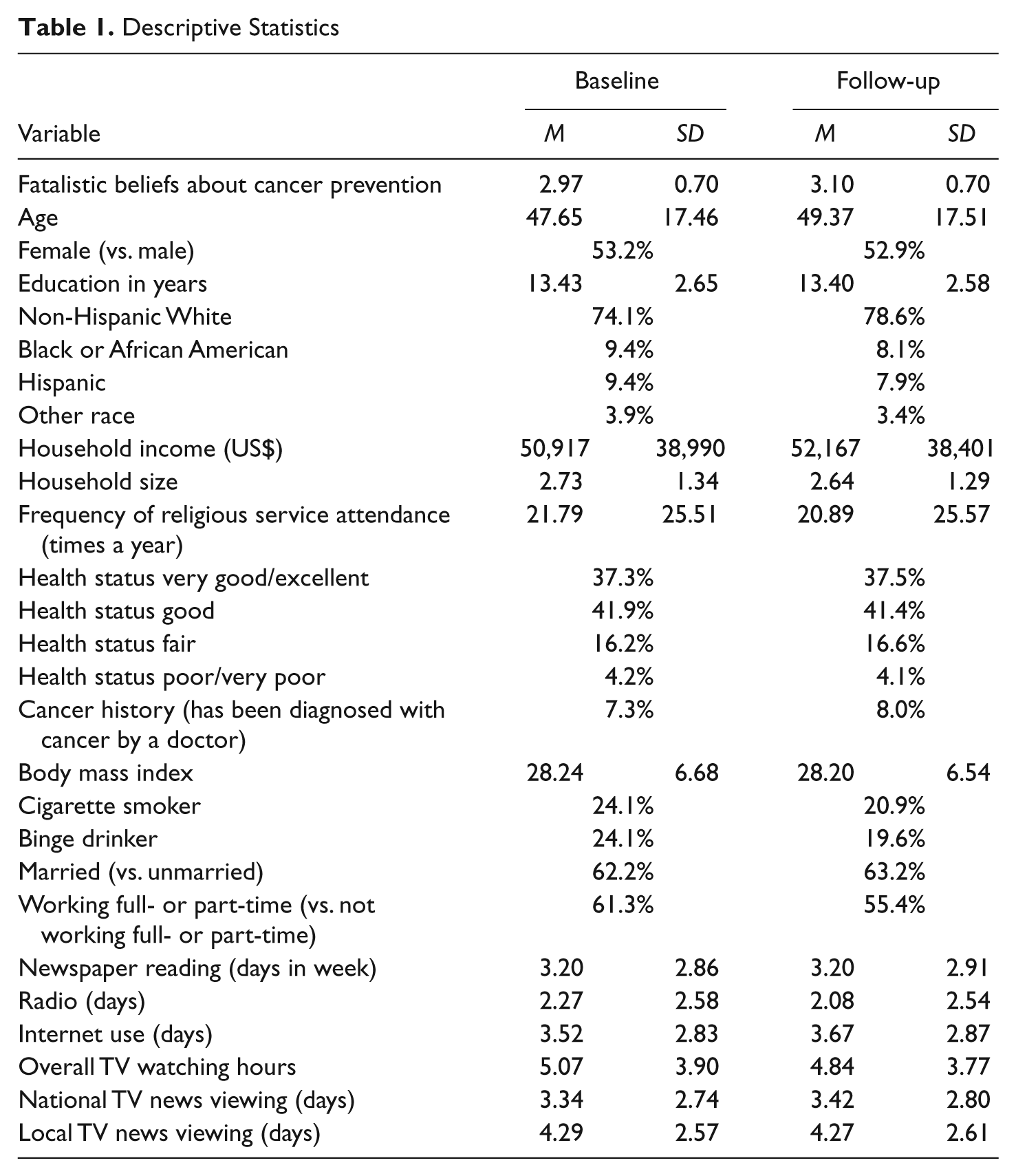
The dependent variable (DV) for tests of H1 and H2 (cultivation hypotheses) was measured by asking respondents to report their levels of agreement with the following statements: “It seems like almost everything causes cancer” and “there are so many recommendations about preventing cancer, it’s hard to know which ones to follow.” Each item was measured with a 5-point Likert-type scale with response categories from 1 (strongly disagree) to 5 (strongly agree). The two belief items were highly correlated (Wave 1 r = .41; Wave 2 r = .54). We thus created a two-item index of fatalistic beliefs about cancer prevention (Table 1 provides descriptive statistics for all study variables). The Wave 2 version of this variable was the DV for analyses testing H1 and H2. All models related to H1 and H2 controlled for fatalistic beliefs about cancer prevention at Wave 1, such that any variable association with Wave 2 beliefs can be interpreted as an effect on the change in beliefs over the 1-year period between surveys. The Wave 1 version of this variable was used as an independent variable (IV) in tests of H3 and H4 (selection hypotheses).
Descriptive Statistics
Overall TV Viewing Hours
We constructed overall TV viewing measures by combining responses to two questions: “On a typical weekday, about how many hours do you watch TV each day?” and “During a typical weekend, about how many total hours do you watch TV?” The Wave 1 version of this variable is the IV for analyses testing H1. The Wave 2 version of this variable is DV for analyses testing H3, controlling for the Wave 1 version.
Local TV News Viewing and National TV News Viewing
We measured local TV news viewing by asking, “In the past seven days, on how many days did you watch the local news on TV?” The Wave 1 version of this variable is the IV for analyses testing H2. The Wave 2 version of this variable was the DV for analyses testing H4, controlling for the Wave 1 version. For comparison purposes, we also asked respondents on how many days they watched the national news on TV in the past seven days.
Control Variables: Other Media Use
In order to account for associations between total TV watching hours, local TV news viewing, national TV news viewing, and other media genres, we controlled for Wave 1 measures of other media use. We asked respondents: “In the past seven days, on how many days did you . . . [read a newspaper; listen to radio talk shows or news; and use the Internet, other than email?].”
Control Variables: Demographic, Health, and Behavioral Variables
Previous studies identified several demographic factors that are associated with fatalistic beliefs about cancer prevention (see Niederdeppe & Levy, 2007). We thus measured a variety of demographic variables to control for factors that might influence both cancer fatalism and TV exposure, including age, sex, education, household income, race/ethnicity, marital status, working status, household size, the frequency of religious service attendance, and personal cancer history. We also included a variety of health-related variables that might influence both beliefs about cancer prevention and TV viewing patterns. Self-rated health was worded as follows: “In general, would you say that your health is . . .” with responses including poor or very poor, fair, good, and very good or excellent. We also calculated body mass index (BMI: a measure of overweight) by dividing self-reported weight (in kilograms) by height (in meters squared). Finally, we accounted for smoking and binge drinking behaviors by asking whether a respondent had smoked a cigarette or drank five or more drinks in one sitting in the past 30 days.
Analytic Procedure
We used ordinary least squares (OLS) regression to test study hypotheses. We conducted tests of H1 and H2 in a series of steps. First, we examined the bivariate relationship between the Wave 1 predictors (overall TV watching, local TV news viewing, and all control variables) and fatalistic beliefs at Wave 2 in a series of separate models, in each controlling only for fatalistic beliefs at Wave 1. Next, we conducted a series of stepwise OLS regressions to predict Wave 2 fatalistic beliefs. Step 1 included overall TV viewing, along with Wave 1 fatalistic beliefs. Step 2 added demographic, media use (except local and national TV news), health, and behavioral controls that were significant in bivariate models. This step constituted the test of the original cultivation hypothesis. We would consider H1 supported if the coefficient for overall TV viewing was positive and statistically significant in this model. Step 3 added genre-specific TV viewing (local and national TV news) in a comprehensive multivariable model. We would consider H2 supported if the coefficient for local TV news viewing was positive and statistically significant in this model.
Tests of the two selection hypotheses, H3 and H4, followed a similar logic. For H3, we began by examining the bivariate relationship between Wave 1 predictors (fatalistic beliefs, all media use, and other control variables) and overall TV viewing at Wave 2 in a series of separate models, in each controlling only for overall TV viewing at Wave 1. Next, we conducted a series of stepwise OLS regressions to predict Wave 2 overall TV viewing. Step 1 included fatalistic beliefs, along with Wave 1 overall TV viewing. Steps 2 and 3 added third-variable controls that were significant in bivariate models. Step 4 added local and national TV news viewing in a comprehensive multivariable model. We would consider H3 supported if the coefficient for fatalistic beliefs was positive and statistically significant in the comprehensive model (Step 4).
For H4, we first examined the bivariate relationship between Wave 1 predictors (fatalistic beliefs, all media use, and other control variables) and local TV news viewing at Wave 2 in separate models, in each controlling only for local TV news viewing at Wave 1, and continued with a series of stepwise OLS regressions to predict Wave 2 local TV news viewing. Step 1 included fatalistic beliefs, along with Wave 1 local TV news viewing. Step 2 added controls that were significant in bivariate models. Step 3 added local and national TV news viewing in a comprehensive multivariable model. We would consider H4 supported if the coefficient for fatalistic beliefs was positive and statistically significant in the comprehensive model (Step 3).
Results
H1 was supported. Overall TV viewing was a significant, positive predictor of Time 2 fatalistic beliefs. This relationship remained statistically significant and of approximately the same magnitude when including possible confounders (multivariable model Step 2 β = .11, p < .01; Table 2). H2 was also supported. Local TV news viewing was a significant, positive predictor of Time 2 fatalistic beliefs, even when controlling for overall TV viewing and possible confounders (multivariable model Step 3 β = .13, p < .01; Table 2). Coefficients for overall TV viewing (β = .10, p < .05) and local TV news viewing were of comparable magnitude in this model. This suggests that local TV news viewing does not explain the overall cultivation effect, but rather that both effects are independent. Among the third-variable controls, only increased age (β = −.14, p < .01) and education (β = −.10, p < .05) were associated with declines in cancer fatalism between Time 1 and Time 2 at p < .05.
OLS Regression Predicting Wave 2 Fatalistic Beliefs About Cancer Prevention
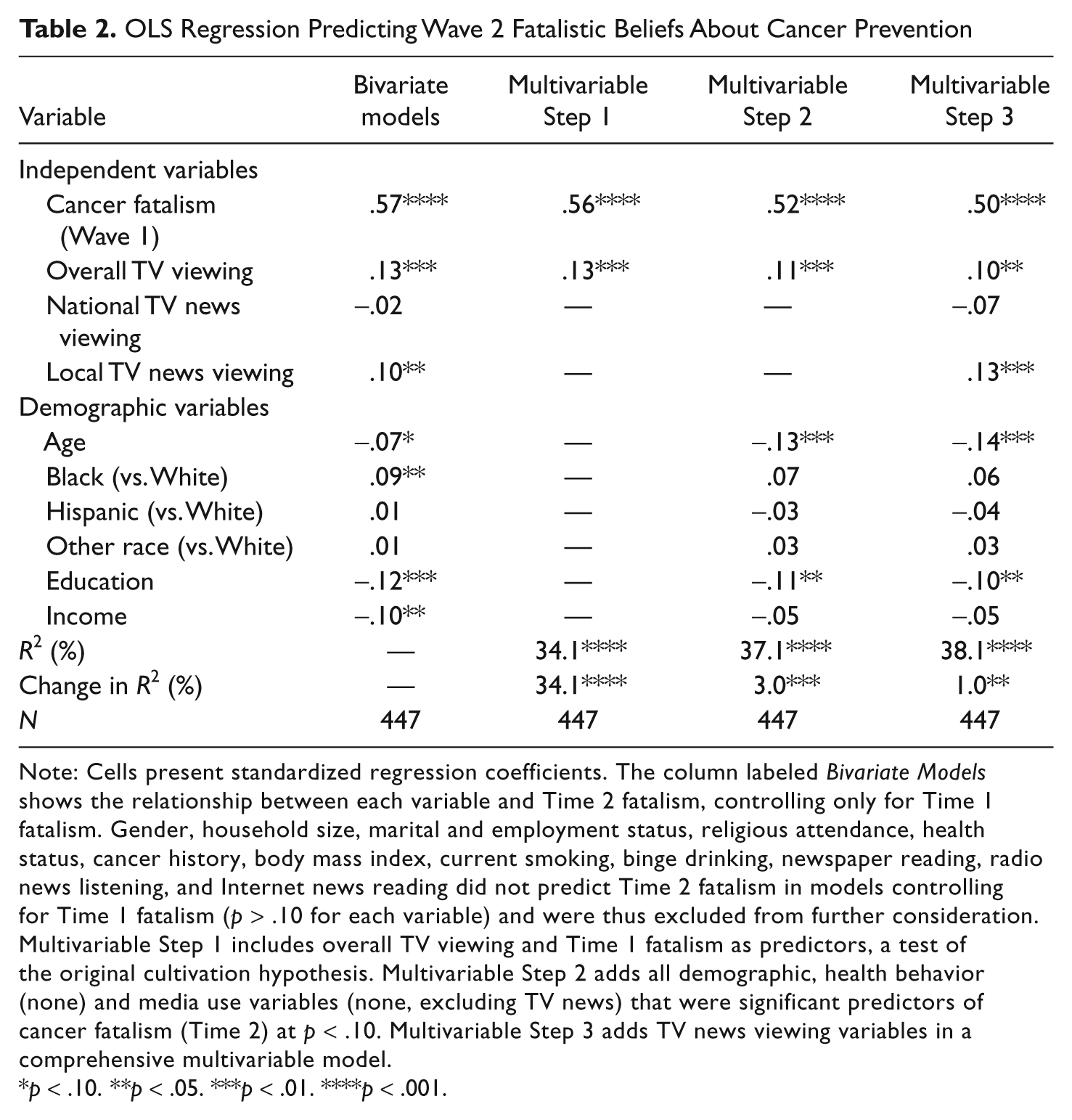
Note: Cells present standardized regression coefficients. The column labeled Bivariate Models shows the relationship between each variable and Time 2 fatalism, controlling only for Time 1 fatalism. Gender, household size, marital and employment status, religious attendance, health status, cancer history, body mass index, current smoking, binge drinking, newspaper reading, radio news listening, and Internet news reading did not predict Time 2 fatalism in models controlling for Time 1 fatalism (p > .10 for each variable) and were thus excluded from further consideration. Multivariable Step 1 includes overall TV viewing and Time 1 fatalism as predictors, a test of the original cultivation hypothesis. Multivariable Step 2 adds all demographic, health behavior (none) and media use variables (none, excluding TV news) that were significant predictors of cancer fatalism (Time 2) at p < .10. Multivariable Step 3 adds TV news viewing variables in a comprehensive multivariable model.
p < .10. **p < .05. ***p < .01. ****p < .001.
H3 was not supported. While cancer fatalism was a significant predictor of Time 2 overall TV viewing in a model controlling only for Time 1 TV viewing (multivariable model Step 1 β = .13, p < .01; Table 3), this association was more than halved in size and become nonsignificant (multivariable model Step 4 β = .06, p > .10) when controlling for demographic, media use, health, and behavior variables. Results of each step in the stepwise model indicate that the effect of cancer fatalism on overall TV viewing was largely driven by positive associations between cancer fatalism and self-rated health, BMI, and smoking. These factors (fair self-rated health vs. excellent β = .11, p < .05; poor self-rated health vs. excellent β = .09, p < .05; BMI β = .15, p < .01; current smoking β = .11, p < .01) were each significant predictors (p < .05) of increased overall TV viewing between Time 1 and Time 2 in the full multivariable model.
OLS Regression Predicting Wave 2 Overall TV Viewing
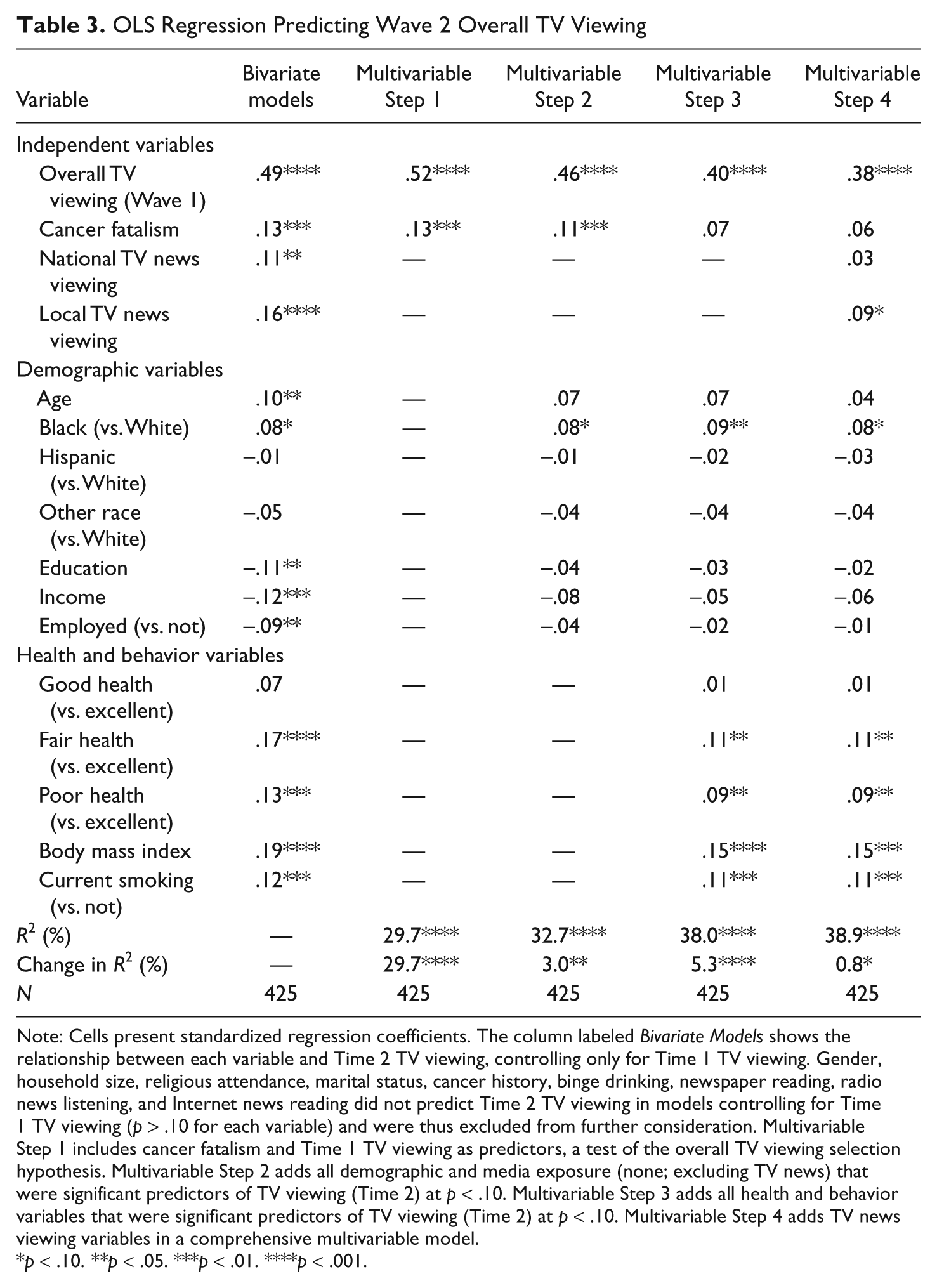
Note: Cells present standardized regression coefficients. The column labeled Bivariate Models shows the relationship between each variable and Time 2 TV viewing, controlling only for Time 1 TV viewing. Gender, household size, religious attendance, marital status, cancer history, binge drinking, newspaper reading, radio news listening, and Internet news reading did not predict Time 2 TV viewing in models controlling for Time 1 TV viewing (p > .10 for each variable) and were thus excluded from further consideration. Multivariable Step 1 includes cancer fatalism and Time 1 TV viewing as predictors, a test of the overall TV viewing selection hypothesis. Multivariable Step 2 adds all demographic and media exposure (none; excluding TV news) that were significant predictors of TV viewing (Time 2) at p < .10. Multivariable Step 3 adds all health and behavior variables that were significant predictors of TV viewing (Time 2) at p < .10. Multivariable Step 4 adds TV news viewing variables in a comprehensive multivariable model.
p < .10. **p < .05. ***p < .01. ****p < .001.
OLS Regression Predicting Wave 2 Local TV News Viewing
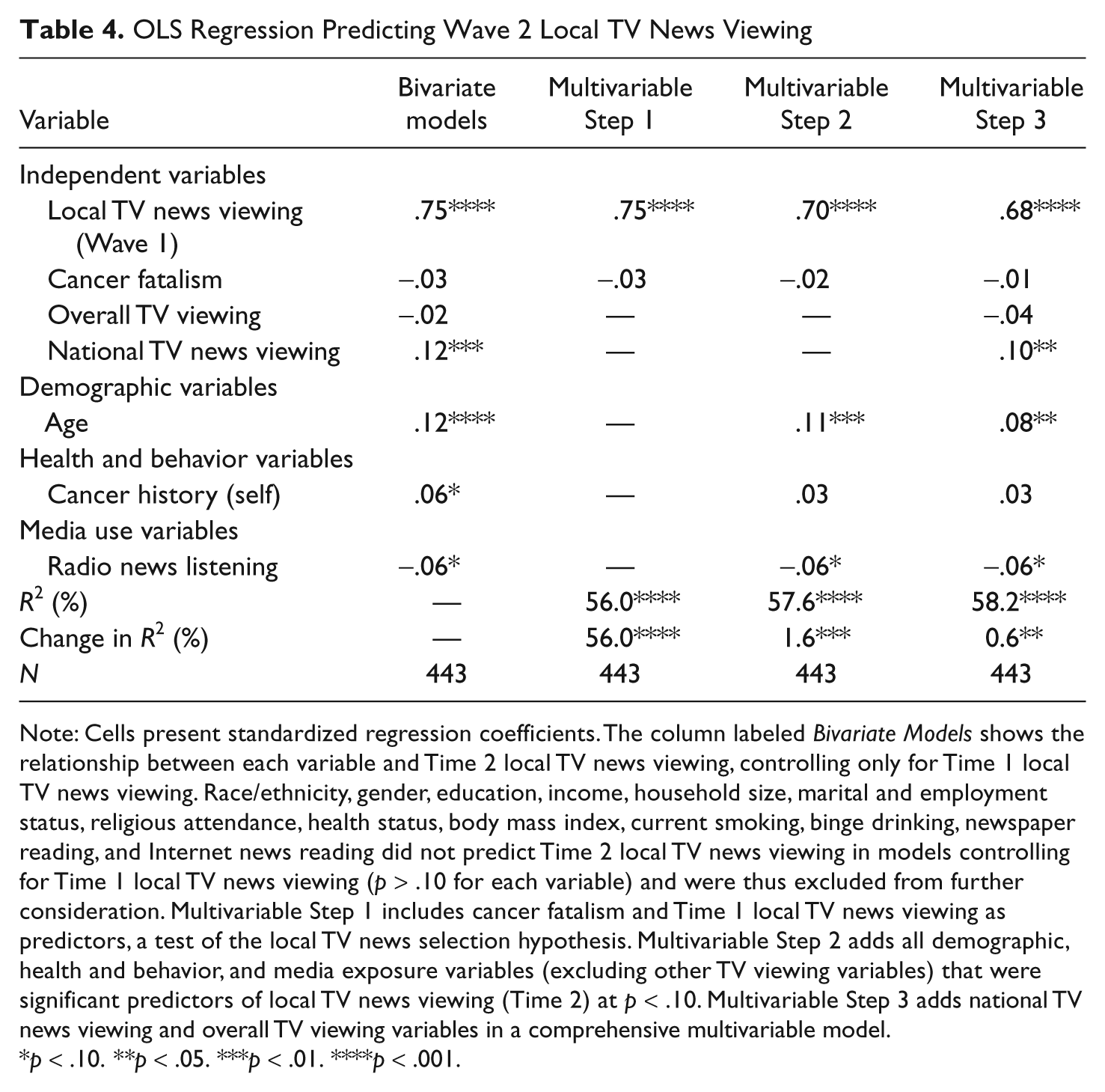
Note: Cells present standardized regression coefficients. The column labeled Bivariate Models shows the relationship between each variable and Time 2 local TV news viewing, controlling only for Time 1 local TV news viewing. Race/ethnicity, gender, education, income, household size, marital and employment status, religious attendance, health status, body mass index, current smoking, binge drinking, newspaper reading, and Internet news reading did not predict Time 2 local TV news viewing in models controlling for Time 1 local TV news viewing (p > .10 for each variable) and were thus excluded from further consideration. Multivariable Step 1 includes cancer fatalism and Time 1 local TV news viewing as predictors, a test of the local TV news selection hypothesis. Multivariable Step 2 adds all demographic, health and behavior, and media exposure variables (excluding other TV viewing variables) that were significant predictors of local TV news viewing (Time 2) at p < .10. Multivariable Step 3 adds national TV news viewing and overall TV viewing variables in a comprehensive multivariable model.
p < .10. **p < .05. ***p < .01. ****p < .001.
H4 was not supported. Cancer fatalism did not predict Time 2 local TV news viewing in a bivariate model controlling only for Time 1 local TV news viewing (multivariable model Step 1 β = −.03, p > .10; Table 4) and in a comprehensive model controlling for demographic, media use, health, and behavior variables (multivariable model Step 3 β = −.01, p > .10). National TV news viewing (β = .10, p < .05) and age (β = .08, p < .05) were the only two variables associated with changes in local TV news viewing between Time 1 and Time 2 at p < .05.
Discussion
This study demonstrates that cultivation theory offers a useful explanation for why many Americans have fatalistic beliefs about cancer prevention. Moreover, this study provides additional evidence that local TV news cultivates fatalistic beliefs about cancer prevention. Building on content analytic and cross-sectional analyses conducted by Niederdeppe and colleagues (2010), the two-wave panel survey design adopted here provides stronger evidence that observed associations between overall TV viewing, TV news viewing, and fatalistic beliefs about cancer prevention reflect a causal relationship. Analyses of the reverse causal paths provided little evidence that fatalistic beliefs about cancer prevention drive selective exposure to TV content in general and local TV news in particular. Consequently, we found no evidence of a “reinforcing spirals” model, where total TV viewing and local TV news exposure increase fatalistic beliefs about cancer prevention, which in turn produce increased exposure to TV content in general and local TV news in particular, and so on (Slater, 2007).
To address the possibility of variation in cultivation effects across genres and channels, we examined the effect of both local TV news and national TV news on fatalistic beliefs about cancer prevention. Our finding that the cultivation effect was found only for local TV news supports the broader argument that cultivation effects vary according to TV genres (Cohen & Weimann, 2000). This information is valuable for both practical and theoretical reasons. On the practical point of view, identifying specific causes of problematic beliefs provides those interested in reducing these beliefs with specific targets for intervention. In the case of cancer prevention, researchers and public health officials might consider conducting educational or training sessions with local TV journalists to report on cancer in a way that minimizes the likelihood of developing fatalistic beliefs. These trainings might take the form of providing appropriate caveats to new research on cancer causes, providing detailed follow-up information, and emphasizing evidence-based recommendations for cancer prevention offered by scientific and governmental authorities like the NCI, ACS, or Task Force for Preventive Services.
On the theoretical point of view, developing a greater understanding of the ways through which TV exposure may lead to problematic real-world beliefs adds to the theory’s ability to predict and explain. Previous studies, however, have not provided us with satisfactory answers to the question of why local TV news may be particularly harmful, relative to national TV news or other news sources. Even though two studies (Lee et al., 2010; Niederdeppe et al., 2010) have documented several differences between cancer coverage in local TV news and coverage in national TV news and newspapers, many questions remain unanswered. For example, are local TV news stories more likely than national TV news or newspaper stories to describe research findings without appropriate caveats and hedges (Jensen, 2008)? Do local TV news stories portray people suffering from cancer without providing information about what caused these cases of cancer or how it might be prevented? Answers to these questions will help to identify plausible mechanisms through which local TV news may lead to harmful outcomes. In addition, they may also possible targets for intervention by identifying specific tactics reporters should (or should not) use to minimize the potential for harmful effects on audiences.
Acknowledging differential patterns of cultivation effects across genres does not mean that the original cultivation hypothesis is invalid. Instead, we observed that overall TV watching was associated with increased fatalistic beliefs about cancer prevention, even after controlling for local TV news and national TV news viewing. Therefore, this study shows that genre-specific extension of the original cultivation theory is useful and valid by explaining additional variance in fatalistic beliefs, rather than by displacing the original formulation of cultivation theory. This leads to another fundamental question: How does overall TV exposure influence fatalistic beliefs about cancer prevention, over and above local TV news and national TV news viewing?
First, if cultivation effects stem solely from the similarities in content and format features observed across all TV programs and genres, one could potentially control for exposure to a comprehensive list of TV channels and genres, and eliminate the effect of total TV exposure. Given that the correlation between overall TV viewing and local TV news viewing is only moderate (r = .349, p < .001, N = 464) and that local TV news viewing likely accounts for a very small percentage of overall TV viewing (see Table 3), it is not surprising that overall TV and local TV news viewing have independent cultivation effects. In fact, in addition to local TV and national TV news, health topics are frequently portrayed on other TV genres like soap operas, prime-time medical dramas, and talk-shows. TV viewers are also likely exposed to a variety of advertisements with some relevance to cancer. Content within these programs may shape beliefs about cancer prevention. Our data are not equipped to examine the influence of other TV channels and genres, or to test whether overall TV viewing still cultivates cancer fatalism even after considering these channels and genres. This represents a promising area for future research.
Second, overall TV viewing may still have an effect on fatalistic beliefs about cancer prevention even after controlling for exposure to specific TV channels and genres. The “subtle commonalities underlying superficially different program types” (Morgan & Shanahan, 1997, p. 6) may convey a meta-message that is greater than the sum of its parts. If overall TV cultivation effects occur primarily through TV’s “more broad-based ideological” functions like maintaining the status quo or raising fears that can be soothed only by the purchase of advertised goods (Morgan & Shanahan, 1997, p. 7), such an effect would not be adequately captured by separately examining the effects of specific channels and genres. For instance, Kubey and Csikszentmihalyi (2002) have argued that watching TV in itself leads people to be passive and less alert by inducing a lethargic state regardless of types of content exposed. Similarly, it may be that overall TV viewing cultivates a state that is characterized by a sense of low control over one’s life. Fatalistic beliefs about cancer prevention may simply represent a topic-specific manifestation of a sense of low self control. Future research might explore this type of mediation hypothesis using social psychological measures like Pearlin and Schooler’s (1978) mastery scale, which taps the extent to which one feels efficacious in dealing with his or her problems of life.
Effect sizes (in this case, βs) for overall TV viewing and local TV news viewing on changes in fatalistic beliefs about cancer prevention were very similar in magnitude. It is worth noting, however, that measures of effect size gauge the magnitude of an independent variable’s effect on a dependent variable in terms of standard deviations, and thus do not directly account for differences in the overall magnitude of exposure between different predictors. People spend considerably more time on watching TV than they do watching local TV news on TV. 1 Thus, the cumulative, population-level effect of overall TV viewing (effect per exposure multiplied by the volume of that exposure, which is several hours a day for most Americans) has the potential to be considerably larger than the cumulative, population-level effect of local TV news viewing (which is likely no more than a few hours a week; see Table 1).
We argue that, even after three decades of cultivation research, more theoretical and empirical endeavors are required to elucidate the conditions under which cultivation effects occur, and the mechanisms by which TV viewing (overall or genre-specific) leads to cultivation effects. As noted above, cultivation research has expanded from a relatively narrow focus on TV and violence to a wide variety of topics in many cultures, countries, and contexts (Gerbner et al., 2002; Morgan & Shanahan, 1997; Williams, 2006). Despite an ever-increasing volume of empirical and theoretical work on the topic, we do not yet have a complete understanding about when and how cultivation effects occur. Indeed, previous studies suggest that cultivation effects are likely to vary according to the outcome of interest. For example, Annenberg Media Exposure Research Group (2008) found that overall time spent with TV did not predict sexual behaviors among teens, while our study found an overall TV viewing effect on beliefs about cancer. Future cultivation research should consider both overall TV viewing and genre-specific TV viewing across diverse outcomes in different contexts. These efforts would contribute to a broader set of knowledge about the topic areas in which overall, genre- and channel-specific TV exposure lead to cultivation effects.
Limitations
This study is not without limitations. Even though we included many control variables that were found in previous research to be associated with total TV viewing, local TV news viewing, and fatalistic beliefs about cancer prevention, we did not control for an exhaustive list of possible confounding factors. In particular, we did not gauge a variety of personality traits that have been found to be consequential in previous cultivation research. While only a few cultivation studies have examined how personality traits moderate the association between TV exposure and perception of the social world, Nabi and Riddle (2008) found that the cultivation effects regarding personal vulnerability to crime were more prominent among low trait-anxious individuals and high-sensation seekers. It is plausible that trait anxiety and sensation seeking would also play a role in shaping total TV viewing, local TV news exposure, and fatalistic beliefs about cancer prevention. Total TV viewing and local TV news viewing may also be associated with personality traits like locus of control, which is also associated with cancer fatalism (Niederdeppe & Levy, 2007; Potter, 1987; Wallston, Wallston, & DeVellis, 1978). Future studies on cancer fatalism would benefit from building on this research by including these health-related personality traits in lagged panel studies.
While we did not detect an effect of cancer fatalism on 1-year changes in overall TV viewing or local TV news viewing, one must exercise caution before interpreting these results as definitive evidence for rejecting selection hypotheses. The fact that cancer fatalism did not predict overall TV viewing and local TV news viewing 1 year later does not necessarily mean that cultivation is a unidirectional process from TV exposure to beliefs and attitudes. Scholars have noted that one of difficult issues in panel survey design is to adopt time lags that can adequately capture both media effects and media selectivity (e.g., Hornik & Yanovitzky, 2003; Slater, 2007). If a longitudinal survey design does not match the expected time lag between a hypothesized cause and effect, researchers may come to an erroneous conclusion about causal effects. For example, Slater, Henry, Swaim & Anderson (2003) found that the effect of aggressiveness on violent media use was concurrent rather than lagged, whereas the effect of violent media use on aggressiveness was both concurrent and lagged. The appropriate lag between fatalistic beliefs and increased TV viewing (overall or local news) may be greater or less than 1 year. Future studies should consider alternate time lags between these variables to provide a stronger, more definitive test of this hypothesis.
In addition, while the current study did detect an effect of overall TV and local TV news viewing on 1-year changes in fatalistic beliefs about cancer prevention, this time lag may not adequately capture the true nature of this causal relationship. For instance, one might reasonably ask whether TV viewing effects dissipate after 1 year or continue to escalate over extended periods of time. Multivariable model results suggest that effects of overall TV and local TV news viewing on increased fatalistic beliefs about cancer may be offset by a negative relationship between age and these beliefs. One might speculate that, while TV viewing increases fatalistic beliefs about cancer prevention over time, the wisdom of getting older (and perhaps, even more speculatively, the experience of watching friends or family members who smoke or are obese develop different types of cancer) works to offset the escalation of these beliefs. Future research could explore these possibilities in greater detail by following a large cohort of adults over a longer period of time, tracking TV viewing and fatalistic beliefs repeatedly over several years.
Conclusions
This study replicates both the traditional cultivation effect in the realm of cancer control and provides new evidence consistent with the causal argument that local TV news cultivates fatalistic beliefs about cancer prevention. These findings have notable implications for cultivation theory, public communication about cancer prevention, and news reporting about health issues more generally. Future work should continue to explore why overall TV viewing and local TV news viewing may increase fatalistic beliefs about cancer prevention using more detailed content analyses, meditational analyses, and experimental manipulations of local TV news content. Additional studies should also clarify the role of personality traits like anxiety, sensation seeking, and locus of control in understanding the pattern of results observed here.
Footnotes
The author(s) declared no potential conflicts of interest with respect to the authorship and/or publication of this article.
The authors disclosed receipt of the following financial support for the research and/or authorship of this article: This article was supported by grant from the National Cancer Institute (5P50CA095856-05). The Annenberg National Health Communication Survey (ANHCS) was conducted by Knowledge Networks for the Annenberg Schools for Communication at the University of Pennsylvania and the University of Southern California, with support from the Annenberg Trust at Sunnylands.