







Abstract
This study explored long-term memories for childhood exposure to disturbing televised news reports in order to uncover possible mechanisms through which children experience the emotion of fear. In an online survey, 328 undergraduates at a Midwestern university were questioned about their long-term memories for a disturbing news report seen during childhood. Results revealed that 50% of participants could remember a specific news event that frightened them during childhood, a majority of which were seen accidentally. Participants were most likely to remember news stories about terrorist attacks, murders, and kidnappings. They were more frightened when news events were rated as personally relevant, when they continued to think about the news event after it had ended, and when the news events elicited feelings of shock and surprise.
Within the research tradition exploring the effects of media content on children, the study of children’s fright reactions has grown to be a fruitful and important area of discovery (for a review, see Cantor, 2009). This research has helped scholars gain a greater understanding of the types of media portrayals most likely to frighten children and the types of children most likely to become scared. Despite these advances, however, we still have much to learn about children’s fear reactions to the media. For example, there are only a few studies exploring the long-term effects of exposure to disturbing media during childhood. Furthermore, there has been minimal theorizing on the mechanisms through which children experience the emotion of fear. The goal of the present study, therefore, is to explore some of the routes through which children become frightened during and after exposure to disturbing media stimuli.
The present study will focus on children’s fright reactions during and after exposure to a specific type of media content: television news. The past two decades have produced a growth in research exploring the effects of news reports on children, and due to some of the inherent properties of television news stories (e.g., reporting about real events with a goal of informing adult viewers), the news provides a unique opportunity for studying children’s fear reactions. That is, we might gain a better understanding of what frightens children and why by studying their fear reactions to disturbing news reports, and contrasting those responses to what we already know about children’s fright reactions to fictional media.
Televised News Reports and Enduring Fright Reactions
Numerous studies confirm that children do in fact become frightened during and shortly after exposure to the news. Some of this research documents children’s fear reactions to major crises reported on the news, such as the 9/11 terrorist attacks (Saylor, Cowart, Lipovsky, Jackson, & Finch, 2003; Schuster et al., 2001; Smith, Moyer, Boyson, & Pieper, 2002), the space shuttle Challenger explosion (Monaco & Gaier, 1987; Terr et al., 1999), and the first and second Gulf Wars (Cantor, Mares, & Oliver, 1993; Hoffner & Haefner, 1994; Moyer-Gusé & Smith, 2007; Smith & Moyer-Gusé, 2006; Walma van der Molen & Konijn, 2007). Other studies have demonstrated the tendency for children to become frightened due to “everyday” news exposure, even in the absence of a major crisis or news event (Cantor & Nathanson, 1996; Smith & Wilson, 2002; Walma van der Molen, Valkenburg, & Peeters, 2002).
These studies document a range of symptoms children experience during and shortly after exposure to disturbing news stories, such as sadness (Buijzen, Walma van der Molen, & Sondij, 2007), fear (Cantor & Nathanson, 1996; Smith & Wilson, 2002), anxiety-related behaviors (Smith & Moyer-Gusé, 2006), and even posttraumatic stress disorder (Saylor et al., 2003), to name a few. The vast majority of these studies focus on relatively short-term effects of exposure, however, interviewing children in the immediate weeks or months after a disturbing news event. Only one known study explored long-term effects of exposure to disturbing news, in a study conducted in the wake of the Challenger explosion. Terr and colleagues (1999) initially interviewed children 5 to 7 weeks after the shuttle explosion and then recontacted them 14 months later. In the first interview, children described postexposure symptoms such as bad dreams, posttraumatic play, and drawing pictures depicting explosions. Fourteen months later, these symptoms had dramatically diminished, though children still reported apprehension toward careers related to space exploration.
Thus, the limited research suggests that fear responses caused by disturbing news stories seen during childhood might diminish over time, but more research is needed to understand the degree to which these news stories can affect children over the long term. Research on disturbing fictional media seen during childhood has already demonstrated some relatively strong enduring fright reactions that often last into adulthood. Harrison and Cantor (1999), for example, found that more than 90% of young adults could remember watching something in a fictional television program or movie in the past that caused a fear reaction that lasted after exposure ended. They described postviewing symptoms such as sleep disturbances, eating problems, and avoidance of depicted events (e.g., avoiding clowns or swimming pools). Amazingly, 26% of the young adult participants indicated that the feelings of fear and worry still continued “to this day.” In a separate study, Cantor (2004) analyzed 530 essays written by college students about frightening media seen in the past. Once again, participants described numerous postviewing symptoms such as sleep disturbances and ongoing anxiety. Furthermore, one third of participants indicated that these effects were still continuing in the present day.
There is reason to suspect that long-term, enduring fear responses caused by disturbing news reports will not be as prevalent as those documented in these studies of fiction. First, children are less likely to watch the news than they are to watch fictional movies and television programs. Second, the producers of horror movies and other frightening fictional media content tend to have an explicit goal of frightening viewers, and they have an arsenal of tools to help them achieve that goal: sound effects, music, lighting, costumes, makeup, actors and actresses, and frightening locations, to name a few. Therefore, fictional media such as horror films are likely to include the very types of stimuli (e.g., monsters, creatures, darkness, sudden movements) that are known to evoke fear responses almost universally in humans (Izard, 1977). Journalists, on the other hand, do not (ostensibly) have an explicit goal of terrifying their audiences, and thus, are not deliberately using tools such as lighting and special effects to generate fear.
Furthermore, television news stories tend not to show graphic photographs and imagery when presenting a disturbing news story. During the Iraq War, for example, journalists did not even provide pictures of coffins (Smolkin, 2004), and a content analysis of 2,500 news images in the early days of the 2003 Iraq War revealed that only 10% showed injury or death (Silcock, Schwalbe, & Keith, 2008). As Smith and Wilson (2002) argued, television news relies heavily on newscasters who describe events orally and employs techniques such as eyewitness reports and interviews. Thus, though some graphic imagery undoubtedly appears in televised news reports, news viewers are probably not as likely to encounter graphic visual images as are viewers of fictional horror films. Given young children’s reliance on visual stimuli when processing information (Bruner, 1966), they may not experience the same intensity of fright reactions when watching the news as compared to fiction.
On the other hand, the news depicts real events that have actually occurred, and thus, children should probably be more frightened by disturbing news stories than they are by fiction. This would especially be the case for older children (e.g., ages 8+) who can distinguish between fiction and reality (Flavell, 1963), who understand the purpose of the news (Smith & Wilson, 2002), and who are concerned about their own vulnerability (Cantor & Nathanson, 1996). Indeed, older children tend to be more frightened by the news than younger children are (Cantor & Nathanson, 1996; Smith & Wilson, 2002; Wilson, Martins, & Marske, 2005). Thus, it might be the case that children, especially older children, might be just as likely to experience enduring, long-term fright reactions due to news exposure as they are to fiction.
To explore this possibility, the present study will assess long-term memories for the news to better understand the degree to which disturbing news stories seen during childhood affect viewers over the long term. In a replication of prior research focusing on fiction (Cantor, 2004; Harrison & Cantor, 1999), the following research questions are posed:
Research Question 1: How prevalent are long-term memories of television news–induced fright reactions in a sample of college undergraduates?
Research Question 2: How long-lasting are television news–induced fright reactions?
Research Question 3: What is the range of symptoms reported?
Fear Mechanisms
Although existing research has clearly demonstrated the prevalence of children’s fear reactions to televised news stories, it has yet to demonstrate how and why children experience the emotion of fear when faced with a disturbing news story. Similarly, it would be useful to know which features of television news stories are most likely to cause a young child to become frightened.
There is no unified theoretical perspective that explains how people experience fear, though there is some agreement among researchers that there must be multiple routes through which the emotion of fear is triggered (Izard, 1993). Numerous researchers have focused on the role that cognitions play in the process of emotional reactions, with heightened attention paid to appraisal processes. An appraisal is an evaluation of an event, the process through which we examine a stimulus and determine its importance (Arnold & Gasson, 1954). Appraisal theorists (e.g., Frijda, 1986; Lazarus, 1991; Scherer, 1993) posit, in general, that emotions occur due to our appraisal of events and stimuli, which can affect action tendencies (e.g., running) and physiological responses (e.g., sweating). Lazarus argues that individuals undergo primary and secondary appraisals when faced with a stimulus. In the primary appraisal, we assess the relevance of the stimulus to our goals, morals, values, and self-esteem. In the secondary appraisal, we consider coping resources or our ability to handle a possible threat.
Scherer (1984) also argues that relevance detection is an important part of the appraisal process. Scherer posits that to generate an emotional reaction, a person must consider how relevant any event or stimulus is to him or her. In addition to relevance, Scherer also focuses on the role of novelty, the degree to which a stimulus is sudden, intense, or unexpected. Novel stimuli tend to be judged as deserving attention and require further processing (Scherer, 2001). Indeed, research shows that stimuli judged as sudden and surprising tend to be linked with intense emotional reactions (Pillemer, 1984; Rubin & Kozin, 1984), especially fear (Izard, 1977).
Appraisal theories suggest, therefore, that a stimulus appraised as being personally relevant will be more likely to lead to fear reactions than those not seen as relevant. There should also be a connection between the level of surprise experienced during an event and strong negative emotional reactions to that event. In the case of children, their appraisals will reflect what is personally meaningful to them at any given time (Lewis, 2001), and thus the types of stimuli judged as being personally relevant and surprising would change over the course of development (for a brief review, see Roseman & Smith, 2001). In the present study, I will explore the degree to which personal relevance and surprise are connected to the emotion of fear in the case of children watching television news. The following hypotheses are posed:
Hypothesis 1: Among remembered news events, the amount of personal importance assigned to an event will be positively correlated with fright reactions while viewing.
Hypothesis 2: Among remembered news events, the amount of surprise experienced during exposure will be positively correlated with fright reactions while viewing.
Two additional cognitive factors that could enhance fear responses, especially over the long term, are rehearsal and memory vividness. The term rehearsal refers to the degree to which individuals elaborate on a prior event by replaying that event repeatedly in memory. Rehearsal is especially likely for events that are initially high in terms of emotional intensity, since emotional events are worth thinking about and can lead to deep contemplation (Heuer & Reisberg, 1992). In turn, the constant rehearsing and rehashing of emotional events can lead to a slow decay in terms of emotional experience and memory (Bower, 1992). Indeed, mental preoccupation and rehearsal are factors that predict whether or not an event is encoded into long-term memory (Brown & Kulik, 1977), and thus, emotional events tend to be remembered better over the long term.
A related issue is memory vividness. Vivid memories are those that are highly detailed, the “clearest, most vivid, most lifelike, autobiographical memories” (Rubin & Kozin, 1984, p. 82). Baddeley and Andrade (2000) describe “vividness” as the richness of sensory information in imagery stored in memory. As Nisbett and Ross (1980) argue, vivid memories are more easily remembered and more likely to be retrieved at a later date. Indeed, vivid memories tend to be remembered better (Bradley, Greenwald, Petry, & Lang, 1992) and are more accessible than less vivid memories and images (D’Angiulli & Reeves, 2002). The high accessibility of vivid memories is due in large part to the role of emotion. The arousal that accompanies emotional experiences leads to a release in hormones, which enhances encoding into long-term memory (Bradley et al., 1992; Brown & Kulik, 1977).
There are several media implications, therefore, for the research into rehearsal and memory vividness. Televised news reports that are initially frightening for children could lead to ongoing rehearsal and elaboration. That is, children might ruminate over highly emotional news stories, finding it hard to stop thinking about them or obsessing over them. If a child does indeed obsess over a disturbing news event, his or her fear reactions should last for a longer duration. A similar effect should occur for memory vividness. If a child has a crisp, vivid memory of a news story seen on television, that memory should remain highly accessible over time. Thus, the more vivid the memory for disturbing news stories, the more likely the child will experience fear reactions over the long term. To test these possibilities, the following hypotheses are posed:
Hypothesis 3: Among remembered news events, the amount of rehearsal after a news event experienced during childhood will be positively correlated with the duration of ongoing fright reactions.
Hypothesis 4: Among remembered news events, the level of memory vividness for the news story will be positively correlated with the duration of ongoing fright reactions.
Method
Participants
Participants were undergraduate students at a large Midwestern university. A total of 397 students were given extra credit for filling out a questionnaire online. Data from five students were removed because they wrote about fright reactions to fictional rather than news media. Data from 64 students were dropped because of computer problems and missing data. 1 Thus, the final sample consisted of 328 participants, 33.5% of whom were males and 66.5% were females (three participants neglected to state their gender). The average age of participants was 19.1 years and ranged from 17 to 27 years (SD = 1.01).
Measures
Participants were first presented with a question that asked, “Do you remember ever seeing something on the television news as a young child (i.e., ages 2 to 10) that frightened, worried, or upset you?” The question asked participants to focus on the 2- to 10-year period to avoid a recency effect found in prior autobiographical memory studies (Harrison & Cantor, 1999). Furthermore, it was assumed that most participants would write about the 9/11 terrorist attacks if they were given the freedom to write about any momentous news event from their past. Since many of the participants in this sample would have been over 10 years old during the 9/11 attacks, the 2- to 10-year period was chosen to solicit a variety of news topics. Participants were given three response options: yes, no, and don’t know. Participants who responded by selecting no or don’t know skipped ahead to the final questions in the questionnaire that assessed demographics.
If participants responded “yes,” they were asked to write a small essay about the news event that frightened them. They were told to describe the news event, the circumstances in which they watched the news event, and their responses to the news event as they remember them. After writing the brief essay, participants were given a series of questions about the news event they had just described.
Fear during exposure
Participants were first asked about their fear reactions during exposure to their remembered news event. Participants were asked two separate questions, one asking the degree to which they had been frightened during exposure, and a second asking the degree to which they were worried during exposure to the news event. Participants indicated their responses by circling a number between 1 (not at all) and 7 (extremely). Participants’ answers to these two questions were strongly correlated (r = .70, p < .001) and were, therefore, averaged together to create an overall fear scale (M = 5.00, SD = 1.05)
Duration of fright reactions
Participants were next presented with a categorical question taken from prior autobiographical memory research (Cantor, Mares, & Hyde, 2003) in which they were asked to choose among nine total options to indicate when their feelings of fright ended. The answer options included (a) shortly after viewing, (b) a few hours after viewing, (c) about a day later, (d) 2 to 7 days later, (e) 2 to 4 weeks later, (f) 2 to 6 months later, (g) 7 to 12 months later, (h) a few years later, and (i) the feelings still continue to this day.
Surprise and personal importance
The measures of surprise and personal importance were taken from prior research on flashbulb memories (e.g., Rubin & Kozin, 1984). The level of shock and surprise associated with the event was measured by asking participants, “How surprised were you when this event occurred?” on a 7-point scale (M = 5.25, SD = 1.58). To measure personal importance, participants were asked to indicate on a 7-point scale, “How personally important was this news event?” (M = 3.99, SD = 1.75).
Rehearsal
Questions measuring rehearsal were taken from the memory vividness literature (Niedzwienska, 2003). The first question asked participants to indicate how often they had thought about the news event since it occurred (1 = never or almost never, 7 = frequently), and the second asked them to indicate how often they had imagined their remembered news event on the same 7-point scale. These two questions were strongly correlated (r = .84, p < .001) and were averaged together to produce a measure of rehearsal (M = 3.0, SD = 1.57).
Vividness
The present study employed two separate measures of memory vividness. The first is participants’ self-reports of memory vividness (Niedzwienska, 2003), as measured via a question asking participants to indicate on a 7-point scale how vivid their memory was for the details of the news event (M = 3.91, SD = 1.83).
The second vividness measure was calculated from the open-ended essays participants wrote about the disturbing news event. Prior research into autobiographical memory vividness has also asked participants to write essays describing past events, with researchers counting up the number of words written by participants as an operationalization of memory vividness (Jay, King, & Duncan, 2006; Vitelli & Endler, 1993). Therefore, the number of words written in participants’ essays was counted and ranged from 1 to 281 words (M = 66.20, SD = 45.15).
Coding open-ended essays
Two undergraduate research assistants coded all participants’ open-ended essays. They were first trained to master all definitions and coding procedures, followed by several practice rounds in which disagreements were resolved via discussion. Following the practice runs, the coders participated in a reliability test in which they coded an overlap of 10% of the sample. Consistent with Neuendorf (2002), Pearson correlation coefficients were used as a test of intercoder reliability. The correlations for all variables were above 80%, with most achieving a coefficient of 100%.
Type of news story: Although participants were asked to write about only one news event, 19 participants wrote about more than one. Thus, the coders first noted the total number of news events about which each participant wrote. The coders next recorded the type of news stories remembered by participants. For each remembered news story, coders chose from among 10 mutually exclusive categories: murders/killings, robberies, school shootings, terrorism, natural disasters, fires, kidnappings, wars, plane crashes, and other. Although several of these categories could involve murder (e.g., terrorism, school shootings, kidnapping), the coders were instructed to select “murder/killing” only when the written essay did not also qualify as falling in one of the other categories. For example, a participant who wrote about the Columbine school shooting would be counted under “school shootings” only, even if it also represents a mass murder. Thus, each remembered news story fell into one category only. For each of the 10 news story types, participants’ essays were coded as either a “1” (they mentioned this type of event) or a “0” (they did not mention this type of event).
Specific news event: After reading through participants’ essays, it became clear that a handful of specific, high-profile news events were being remembered quite often. Thus, coders rated each essay to determine whether or not participants were remembering one of the following events: 9/11, the Columbine shooting, Elizabeth Smart’s kidnapping, JonBenet Ramsey’s murder, the OJ Simpson trial, the Gulf War, the Oklahoma City bombing, or Y2K. For each of these events, participants’ essays were coded either as a “1” (they mentioned the specific event) or a “0” (they did not mention the specific event).
Immediate symptom: Similar to Harrison and Cantor (1999), participants’ essays were also coded for the presence of six immediate emotional symptoms. Each essay was coded for the presence (coded as “1”) or absence (coded as “0”) of the following immediate symptoms: fear (including synonyms such as scared, frightened, terrified, etc.), worry (including synonyms such as anxiety or concern), shock, crying/sobbing, and confusion (e.g., expressing a lack of understanding of what was happening or saying that the news event was “over their heads”).
Enduring effects: Once again consistent with Harrison and Cantor (1999), participants’ essays were also coded for the presence of enduring, ongoing effects. Each essay was coded for the presence (coded as “1”) or absence (coded as “0”) of the following ongoing effects: altering behavior (including trying or wanting to alter behavior), increased alertness (e.g., being more suspicious or aware of one’s surroundings), obsessive thinking, sleep disturbances, growing up too fast (e.g., comments such as, “this really opened up my eyes”), and personal susceptibility (e.g., acknowledging that this could happen to them).
Viewing circumstances
A categorical question was used to ask participants their age at exposure to the news event. Response options were (a) under 2, (b) 2 to 3 years old, (c) 4 to 5 years old, (d) 6 to 7 years old, (e) 8 to 9 years old, (f) 10 to 11 years old, (g) 12 to 13 years old, and (h) other. Participants were also asked to indicate why they were watching the news on that particular day and were given three response options: (a) They had chosen to watch the news, (b) Their parents were watching and they accidentally saw it, and (c) Other.
Results
Analysis of Research Questions
Research Question 1 asked about the prevalence of long-term memories for frightening television news stories seen during childhood. Out of 328 participants, 164 (50%) said they could remember seeing something on the television news as a child that frightened them. A total of 103 participants (31.4%) said they could not remember a news event, and 61 (18.6%) answered, “Don’t know.” In terms of participants’ age at exposure, 63 participants (38.4% of the 164 who remembered) were between the ages of 2 and 7 at the time of exposure, whereas 101 (61.6%) were between the ages of 8 and 13 at the time of exposure. Women (54.6%) were more likely to remember a frightening news event than men were (40.4%), χ2(2, N = 325) = 9.23, p < .05.
A majority of participants frightened (65.3%) reported that their parents were watching the news story and they saw it accidentally. Only 24 participants (14.6%) indicated that they had chosen to watch the news program themselves. Fourteen of the participants (8.5%) wrote that they had watched the news story at school; in all cases, this was for the 9/11 terrorist attacks. Two participants said the news story interrupted the television programming they had been watching.
Out of 164 participants who could remember a specific news event, 162 wrote essays to describe the event and their reactions to it. Table 1 provides a summary of the news topics listed most frequently as causing fear based on participants’ answers to the open-ended essay. The most common category of news topic mentioned by participants was terrorism, followed by murders and kidnappings. In terms of specific news events that were remembered, 9/11 was the most frequently listed individual event, despite efforts to prevent participants from writing about this particular crisis. Other events remembered by participants included the Columbine school shooting, Elizabeth Smart’s kidnapping, and JonBenet Ramsey’s murder.
News Events Remembered as Causing Fear During Childhood
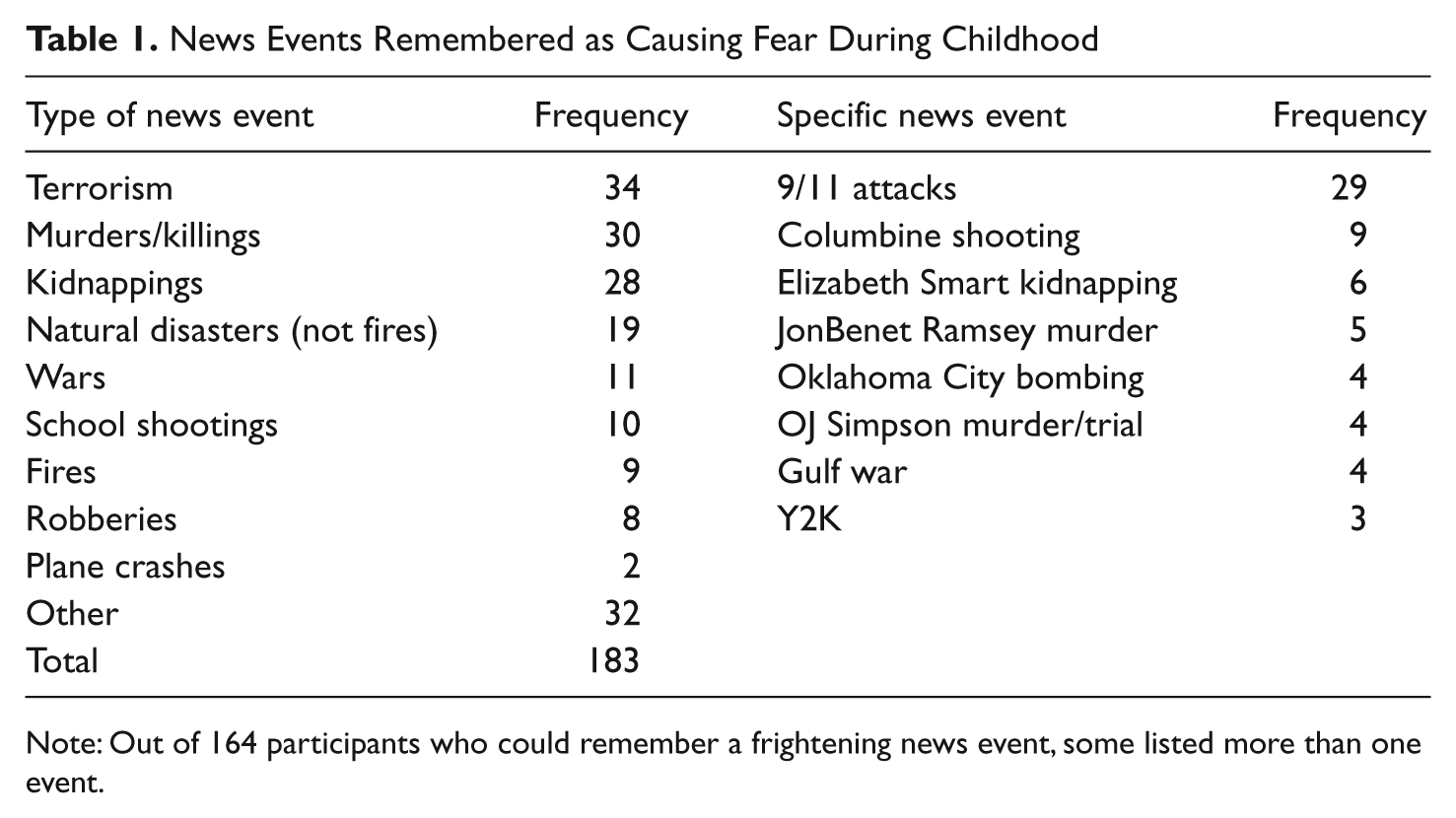
Note: Out of 164 participants who could remember a frightening news event, some listed more than one event.
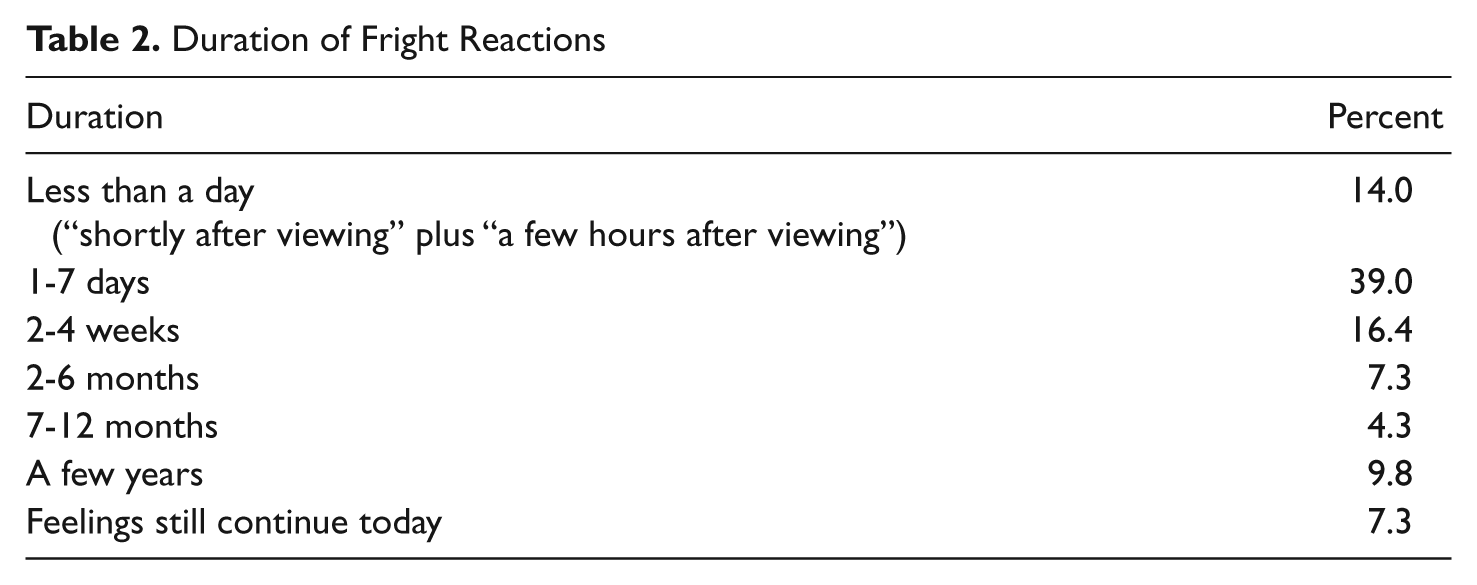
Research Question 2 asked about the duration of television news–induced fright reactions. Out of all participants who could remember a frightening news event, 14.0% indicated that the fear lasted less than 1 day, and 39.0% indicated their fear lasted between 1 and 7 days. The full distribution of fear duration is displayed in Table 2. Out of all participants who remembered a frightening childhood news event, only 7.3% indicated that they are still frightened or bothered to this day. The data for this question were also recoded into a binary variable because the duration of fright reactions is the dependent variables for Hypotheses 3 and 4. Participants were coded as either a 1, indicating their fright ended at least 7 days after viewing (54% of participants who could remember), or a 2, indicating their fright ended for more than 7 days (46% of participants frightened).
Duration of Fright Reactions
Research Question 3 asked about the range of symptoms reported by participants. In terms of immediate symptoms, 123 out of 162 (76%) mentioned at least one type of immediate symptom. The most common symptom was being scared or frightened, with 105 (64.8%) mentioning this symptom. A total of 18 essays (11.1%) mentioned being concerned or worried. Seventeen essays (10.5%) mentioned that the individual had been confused as a child about the nature of what was happening in the news event. For example, one participant wrote about the O. J. Simpson trial, “I was 7, so I didn’t really understand what was going on.” Another participant wrote about the first Gulf war, saying, “I was relatively young and being somewhat frightened and confused by the images of warfare.” Only seven essays mentioned being shocked, three mentioned crying, and two mentioned clinging or hugging someone or something.
In terms of enduring effects, 77 essays (47.5%) mentioned at least one type of continuing effect. The most common enduring effect was the lingering thought that this horrible event could happen to them (50 essays, 30.9%). For example, one participant remembered news stories about shootings and robberies in the local area, writing, “I was always freaked out for weeks after I saw one of these stories thinking I was going to get killed or someone was going to break into my house.” The second most common enduring effect were sleep disturbances, with 20 essays (12.3%) mentioning some kind of ongoing sleep problem. For example, one participant wrote, “I couldn’t sleep for days,” after a news story about a family murdered in their home. Fourteen essays mentioned altering behavior (8.6%), eight mentioned obsessive thinking about the news event (4.9%), and two mentioned being more alert (1.2%). Only one essay mentioned the feeling of growing up too fast as an enduring effect.
Tests of Hypotheses
Hypotheses 1 and 2 predicted that personal importance (Hypothesis 1) and surprise (Hypothesis 2) would be positively correlated with participants’ fear intensity levels during exposure to their remembered news event. To test Hypothesis 1 and Hypothesis 2, a hierarchical multiple regression was run employing the fear-during-exposure scale as the dependent variable. Because both gender (Cantor, 2009) and age at the time of exposure (Cantor, Wilson, & Hoffner, 1986) are related to children’s fear responses, these two variables were entered in Step 1 as controls. In Step 2, the variables of surprise and personal importance were entered into the equation. The results are displayed in Table 3, F(4, 155) = 8.1, p < .001. Consistent with Hypothesis 1 and Hypothesis 2, both surprise and personal importance are positive predictors of fear levels during exposure. Furthermore, they contribute to 15.8% of the explained variance in fear responses.
Hierarchical Regression Predicting Fear During Exposure
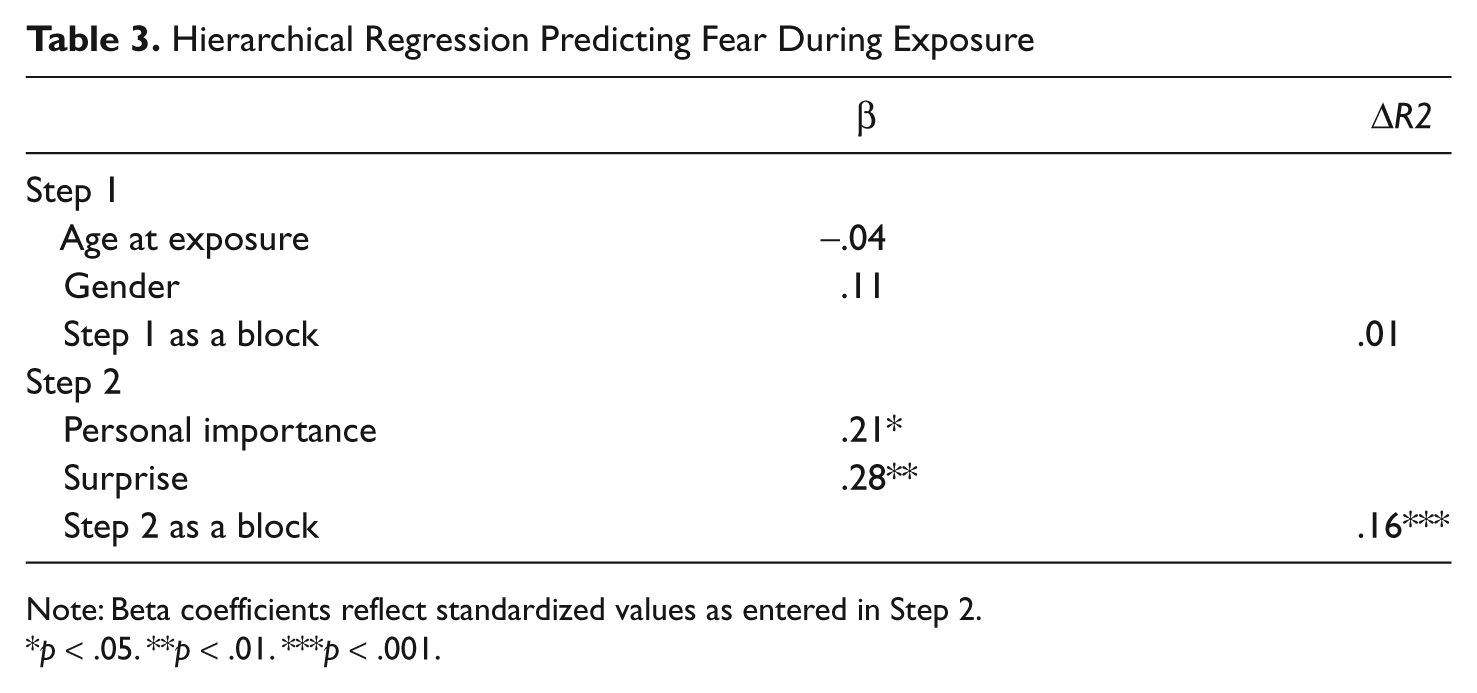
Note: Beta coefficients reflect standardized values as entered in Step 2.
p < .05. **p < .01. ***p < .001.
Hypotheses 3 and 4 predicted that rehearsal (Hypothesis 3) and memory vividness (Hypothesis 4) would positively predict the duration of participants’ fear reactions. Because the duration of fright was recoded into a binary variable, a binary logistic regression analysis was computed. Once again, age at exposure and gender are entered at Step 1. Rehearsal and both measures of vividness (self-reported and number of words) are entered in Step 2. The results of the model are provided in Table 4, χ2(5, N = 155) = 10.53, p = .06. As Table 4 depicts, however, rehearsal is the only positive predictor of fright and worry duration, in support of Hypothesis 3. Individuals who had rehearsed the news story were 1.5 times more likely to be frightened more than a week (OR = 1.37, p < .05). Neither measure of memory vividness was related to participants’ duration of fright or worry. Thus, Hypothesis 4 is not supported.
Binary Logistic Regression Predicting the Duration of Fright Responses
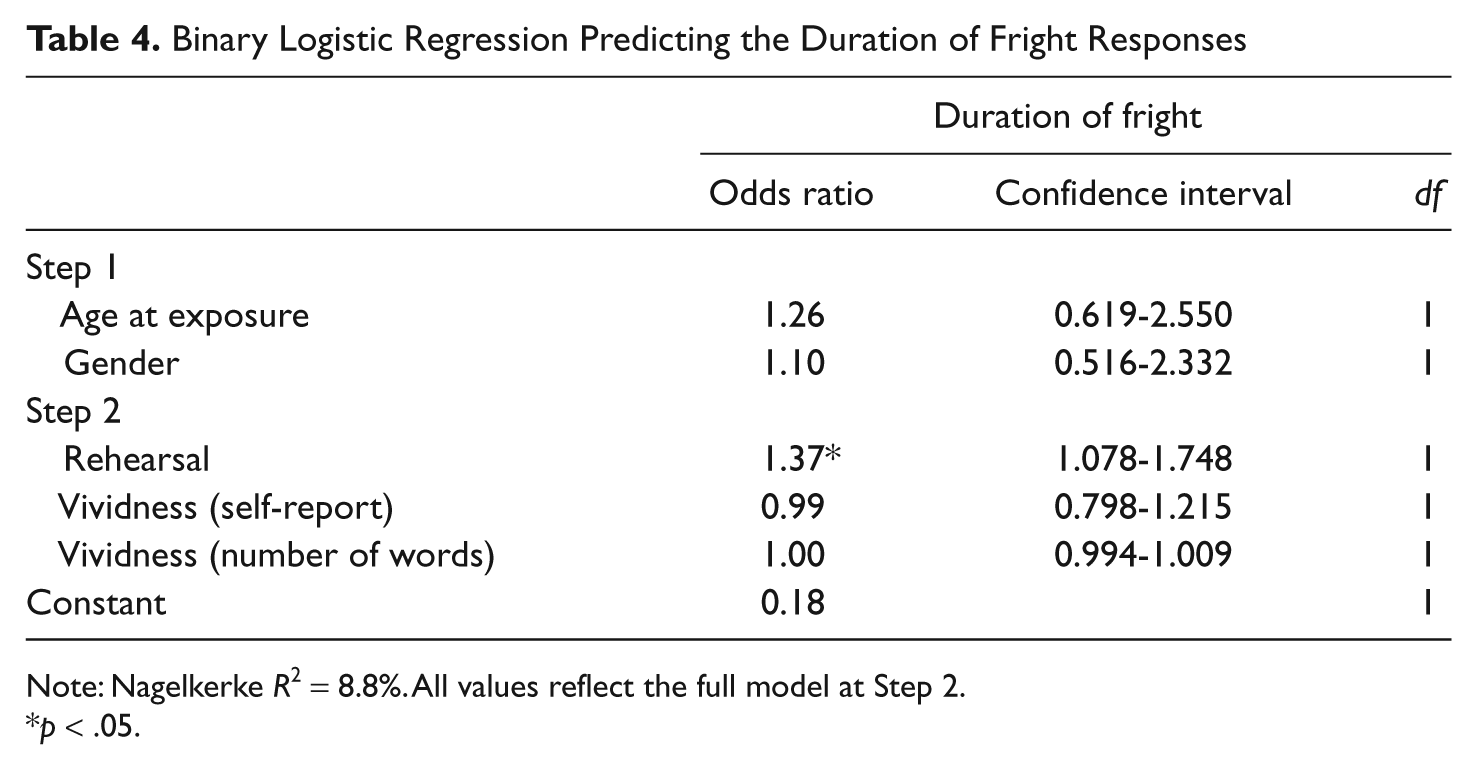
Note: Nagelkerke R2 = 8.8%. All values reflect the full model at Step 2.
p < .05.
Despite efforts to prevent participants from writing about the 9/11 terrorist attacks, 29 participants wrote about 9/11 as their remembered event. An independent sample t test reveals that participants who remembered 9/11 reported stronger fright reactions while viewing (M = 5.40, SD = .92) than did participants remembering a different event (M = 4.94, SD = 1.05), t(160) = −2.18, p < .05. Thus, the results of Hypotheses 1 to 4 were recalculated by removing the 29 participants who remembered 9/11 to determine whether or not this momentous news event was driving the findings. The results reveal that this is not the case: The findings were largely upheld even when the individuals remembering 9/11 were removed. In the case of Hypotheses 1 and 2, the model predicting fright reactions is still significant when the 9/11 participants are removed, F(4, 129) = 4.36, p < .01. Level of surprise is still positively correlated with fear (β = .24, p < .05), as is personal importance, though only nearing significance (β = .18, p = .058). In the case of Hypotheses 3 and 4, the amount of rehearsal is still related to fright duration, whereas memory vividness continues to be not related to fright duration.
Discussion
The results of the present study help us to understand long-term memories for disturbing childhood news events and also shed light on situations in which children are most likely to experience the emotion of fear. Among a convenience sample of young adult college students, 50% could remember a specific instance during childhood in which they were frightened by a televised news report. An examination of participants’ essays revealed ongoing effects that lingered after exposure, such as an inability to sleep or feeling scared or uncomfortable after exposure. Furthermore, 46% of participants reported that their feelings of fear lasted more than a week after the remembered news event occurred, and 7.3% indicated they are still frightened to this day. Therefore, this study is among the first to document enduring, long-term fright reactions caused by childhood exposure to televised news reports.
At the same time, the prevalence and intensity of fear reactions caused by televised news reports appears to be smaller than those documented in prior research studies exploring fiction. Whereas 50% of participants could remember a frightening news story seen during childhood, this percentage is noticeably smaller than the findings of prior studies of fictional media (e.g., Cantor, 2004; Harrison & Cantor, 1999), in which more than 90% of participants could remember frightening fictional media seen in the past. Because these differences could be due to the amount of children’s exposure to news versus fiction, however, we can also compare the duration of fear responses. Harrison and Cantor found that 26% of participants indicated they were still frightened “to this day” by one specific fictional movie or television program seen in the past, compared to only 7.3% in the present study who remembered one specific news story. Furthermore, 54% of participants in the present study said their feelings of fear caused by a news report lasted 7 days or less. In Harrison and Cantor’s study, on the other hand, only 33% said their fear lasted 7 days or less.
It should be noted, however, that these comparisons are merely speculative, since a direct comparison between the present research project and the one conducted by Harrison and Cantor cannot be made. After all, more than 10 years separate the two studies, and neither uses a nationally representative sample. Furthermore, participants in the present study were asked to remember news media viewed between the ages of 2 and 10, whereas participants in Harrison and Cantor’s study largely wrote about disturbing media seen during adolescence. Finally, the present study instructed participants to think only about the news, whereas Harrison and Cantor allowed participants to remember any kind of disturbing media event (though an overwhelming majority remembered fiction).
Thus, though the present study suggests that long-term memories for frightening news media seen during childhood are less common than long-term memories for frightening fictional media—and the duration of fear responses is shorter—future research needs to explore this possibility further using different research methods. It may be the case that young children’s reliance on concrete visuals when processing information (Bruner, 1966) may actually protect them when watching television news, especially in situations in which the news relies heavily on oral reports. In addition, young children’s inability to distinguish fantasy from reality (Flavell, 1963) and difficulty understanding the purpose of the news (Smith & Wilson, 2002) provide further explanation as to why real events depicted on the news do not affect children as much as fiction. Future research using an experimental research design, however, could further illuminate some of the differences between news and fiction in terms of children and fear reactions.
One of the goals of this research project was to understand some of the possible mechanisms through which children experience fear reactions. The findings support appraisal theories of emotion, since participants who thought a news event was personally important were more likely to feel frightened during exposure. Furthermore, the most common enduring effect uncovered in participants’ essays was that many of them remembered worrying that the news event would happen to them. This suggests that children, like adults, are able to make judgments of personal relevance, as found in prior research on health messages in which children were affected by information about susceptibility (Bush & Iannotti, 1990; Sturges & Rogers, 1996).
The results of the present study, however, reveal some limitations in children’s ability to assess personal relevance, since an examination of participants’ open-ended essays reveals that perceptions of personal relevance might be very different from reality. For example, several participants mentioned that they believed, during childhood, that a news event was taking place in close proximity to their residence but acknowledged now as adults that this was not in fact true. For example, one participant wrote about robberies, “I know that the story was about the inner city, but I do not think I was old enough at the time to acknowledge that I lived in a suburb far from the robbery.” Another wrote about the DC sniper attacks, “Though I lived in New York, I remember always having the thought in the back of my mind about how close Washington D.C. really was to my home.” Thus, when some participants indicated that a news story was personally relevant, they may have been referring to their perceptions, during childhood, of the relevance of this event, or they may have corrected these perceptions to account for their adjusted adult beliefs. On the other hand, we do not know how important factors such as proximity (perceived or real) get weighed when participants answer a question pertaining to personal relevance. Thus, there is still much to be learned about how children formulate perceptions about personal relevance, which is important given its relationship to emotions such as fear.
In terms of emotional mechanisms, the results of the present study show that the more surprising a news event was, the more frightened and worried participants felt during exposure. These two emotions often occur together (Izard, 1977), and given the present study’s research design, we cannot determine for certain that the feelings of surprise preceded the feelings of fear. Future research, therefore, should explore the relationship between surprise and fear in children. Regardless the outcome of future research, however, parents should take extra caution when their children are exposed to shocking and surprising news stories, as they are the ones most likely to lead to feelings of fright.
The present study also revealed the important role that rehearsal may play in terms of prolonging feelings of fear. Participants who had thought about the news event and imagined it afterward were more likely to have feelings of fright that lasted for longer periods of time. Of course, the order of causality could also be reversed in this case: perhaps the children who were badly frightened could not stop thinking about it. Still, given that rehearsal and elaboration leads to high ongoing accessibility, it seems likely to assume that ruminating over a disturbing news event would be a contributing factor that might increase the duration of one’s fear reactions. This is a difficult finding to translate into advice for parents, however, as parents may not be aware that their children are obsessively thinking about a disturbing news event seen on television. Perhaps parents need to be more vigilant at the time of exposure to a disturbing news story, by distracting their children and attempting to minimize the severity of a potentially frightening news story. This in turn might reduce the likelihood that their child will continue to ruminate over the news event.
Finally, it was not surprising that a vast majority of participants (64.5%) reported being exposed to the news event accidentally while their parents were watching. Given the growing popularity of the 24-hr cable networks as well as the internet, children today likely have even more opportunities to stumble upon disturbing news reports accidentally. Indeed, a growing body of research documents the prevalence of background television (e.g., Rideout & Hamel, 2006) and its possible effects on children (e.g., Anderson & Evans, 2001; Schmidt, Pempek, Kirkorian, Lund, & Anderson, 2008). The present study adds fright reactions to the growing list of possible effects of background television, at least in situations in which the news serves as the background program. Thus, parents need to take care when watching news stories in the presence of their children.
Some limitations of the present study must be acknowledged. First, the use of a convenience sample clearly limits the generalizability of the findings. In addition, the sample was not evenly balanced between men and women, making it difficult to draw definitive conclusions regarding gender differences. Furthermore, participants were instructed to focus on just one news event that stands out in memory. Thus, the findings of this study may not describe the way children react to disturbing news stories that are not as memorable. Furthermore, it is impossible to determine how much surprise, personal importance, and fear occurred for news events that participants could not remember. Nor can we rule out the possibility that the participants who wrote essays in this study are simply people who are easily frightened, and thus, remember more instances of being scared during childhood. Indeed, the use of a retrospective memory technique is not without its limitations. At the same time, long-term memory scholars have acknowledged the importance of studying people’s memories for unique, one-time events (e.g., Brown & Kulik, 1977; Pillemer, 2001), and because autobiographical memories (regardless of their veracity) help people understand their own self-concept, they help facilitate social interactions, and they guide the formations of opinions and attitudes that guide behaviors. Thus, it is important to study how people remember experiencing a prior event, as those memories can affect the way people currently interact with the social world around them.
The inclusion of 29 individuals who wrote about the 9/11 terrorist attacks provides a further limitation of the present study. The extant literature exploring children’s fear reactions to the news has revealed some rather robust developmental trends. For example, younger children are more likely to become frightened by natural disasters, whereas older children are more frightened by interpersonal violence (Cantor & Nathanson, 1996). In addition, numerous studies document that older children (ages 8+) are overall more likely to watch the news and become frightened by it than younger children (Cantor & Nathanson, 1996; Smith & Wilson, 2002). Indeed, among participants in the present study who could remember a disturbing news event, there were more who were between the ages of 8 and 13 at the time of exposure (62%) than those who were between the ages of 2 and 7 (38%). Further developmental comparisons were not made in the present study, however, due to a possible confound provided by the participants who remembered 9/11. All participants in the present study that remembered the 9/11 terrorist attacks were between the ages of 10 and 13 at the time of exposure, representing 29% of “older children” (i.e., age ranging from 8-13 at exposure). Thus, the 8 to 13 age group in this study not only reflects a group that has made advances in terms of fantasy/reality distinctions and the ability to process complex, nonvisual stimuli (as compared to 2- to 7-year-olds). They were also more likely to have remembered an extremely frightening and surprising news crisis, the 9/11 terrorist attacks. Thus, any differences between the younger and older children in the present study in terms of amount of fear, fear duration, and type of news story causing fear could be caused by either developmental differences or the mere fact that the older children were more likely to remember 9/11. Thus, few developmental comparisons were made in the present study.
Finally, it is important to acknowledge that children’s exposure to the news is not inherently a bad thing. Certainly, the news can provide educational opportunities for children, teaching them about both local and global events. Furthermore, part of media literacy involves learning how to be a critical and engaged consumer of the news, a skill children can only master through exposure to the news. Thus, many parents may desire that their children gain exposure to the news at a young age. At the same time, parents should try to prevent their children from becoming severely frightened or worried by reports they see or hear in the news. Therefore, continued research on children’s exposure to the news is important, as it will allow parents to predict the situations in which their children are likely to become frightened and then help them minimize their children’s feelings of fright and anxiety.
Footnotes
Declaration of Conflicting Interests
The author declared no potential conflicts of interest with respect to the research, authorship, and/or publication of this article.
Funding
The author received no financial support for the research, authorship, and/or publication of this article.