







Abstract
While the majority of previous research suggests there are positive relationships between digital media use and political participation and knowledge, most studies have relied on cross-sectional surveys and have thus not been able to firmly establish the chain of causality. Also, there is little research investigating use of different forms of digital media and their relative effects on political participation and knowledge. This study examines (a) the effects of digital media use on political participation and knowledge and (b) whether different forms of digital media use affect people differently. Drawing on two representative panel surveys, the study demonstrates that there are only weak effects of digital media use on political learning, but that the use of some digital media forms has appreciable effects on political participation.
Introduction
Will digital media contribute to strengthening democracy through increasing political participation and diffusion of knowledge in general or during election campaigns? This question has been discussed since the mid 1990s when the Internet was launched. At first the discussion focused on the effects of the Internet (Web 1.0), but more recently scholarly attention has shifted to the effects of social media (Web 2.0). In both cases, some have argued that new digital media will have positive and potentially strong effects on political participation and knowledge (Hendricks & Denton, 2010; Norris, 2001; Papacharissi, 2002), while others have seen them as predominantly entertainment-oriented and argued that factors other than technology are more important as determinants of political participation and knowledge (Baumgartner & Morris, 2010; Bimber, 2001; Prior, 2007; Putnam, 2000). Cyber optimists have been pitted against cyber pessimists.
In broad terms, research has generally confirmed that there are significant positive relationships between the use of digital media and political participation and knowledge, at least during election campaigns (Boulianne, 2009; Dalrymple & Scheufele, 2007; Tolbert & McNeal, 2003). However, correlation does not equal causation and, as most research to date has been based on cross-sectional surveys, the chain of causality is not yet firmly established. Furthermore, there is only little research investigating the relationship between the use of different forms of digital media and their relative effects on political participation and knowledge. In addition, most research in this area has been done in the United States, which makes the generalizability of results unclear.
Against this background, the purpose of this study is to examine the use and effects of different forms of digital media on political learning and participation during election campaigns. More specifically, this study investigates (a) the effects of digital media use on political knowledge and political participation and (b) whether the use of different forms of digital media affects people differently. The study proceeds with a theoretical discussion of the role of digital media in election campaigns, followed by a review of prior research on digital media effects. By using two representative panel surveys the study assesses not only correlations but also the causal relationships between the use of different forms of digital media and political knowledge and participation.
Digital Media in Election Campaigns
The use and importance of digital media in election campaigns has grown steadily over time. Starting with the 1992 Clinton campaign, campaign-related information was placed on the Internet although the medium at the time was accessible to only a fraction of the electorate (Bimber & Davis, 2003). By the time of the 2000 presidential election, candidate web sites had become a common campaign tool, which led some to proclaim 2000 as the “first Internet election” (Foot & Schneider, 2006). In 2004, political candidates moved beyond perceiving the web as an electronic brochure to viewing it as “electronic headquarters” (Foot & Schneider, 2006, p. 10). In 2008, newer online tools such as social networking and microblogging gained popularity and were effectively used by the Obama campaign to mobilize and organize supporters (Hendricks & Denton, 2010). Today no candidate or party can enter an election cycle without having an online presence, and “there is little doubt that the effects of Internet and Internet tools on political campaigns at all levels will grow exponentially” (Trent & Friedenberg, 2008, p. 408).
Despite general agreement about the critical importance of digital media in today’s political world, their definition has been somewhat elusive. It has been suggested that new media technologies should encompass both new forms of media technology as well as new applications of existing media technology (Dimitrova, 2008). The Encyclopedia of Political Communication includes the following online tools as critical in the political communication process: blogging, podcasting, political web sites with mechanisms for online feedback and participation, social networking, and online video sharing (Kaid & Holtz-Bacha, 2008).
Although these new media tools are generally seen as playing a complementary role to traditional media (Bimber & Davis, 2003; Holbert, 2005), there are several characteristics that distinguish digital media from traditional mass media (Quintelier & Vissers, 2008). First, the Internet offers multiple and diverse opportunities for political engagement—for example, participating in online polls, debates, blogging, or social networks. Second, online technologies significantly lower the cost of participation for citizens both in terms of time and effort. It is certainly easier to access multiple online news sources via the Internet at any time and place, compared with traditional media. In addition, the Internet offers a wealth of information about politics and civic life, which has the potential to contribute to a more informed electorate. Finally, a unique feature of online media is their interactivity: they allow direct (albeit mediated) contact with politicians and instant feedback from campaign headquarters. Another important feature of online media is that they make the campaign and the political system as a whole appear more accessible to the average citizen (Bucy & Gregson, 2001) and as such provide a new public space to discuss politics (Papacharissi, 2002).
There are several levels of effects on citizens one might expect from digital media use within a political communication context. These effects, according to Bimber and Davis (2003, p. 127), follow a schematic hierarchy, ranging from simply motivating more online visits to motivating political action. At the first and basic level, using Internet sites should encourage citizens to come back for return visits to those digital media sites. The next level of effects includes changes in people’s knowledge or attitudes. The third and final level, which is sometimes deemed most important, is motivating some kind of political action by the citizens (Bimber & Davis, 2003).
Even if using digital media does not result in direct behavioral changes, however, these media represent an important part of the political communication process from the standpoint of democratic participation. According to media participation approaches, new media not only make a highly professionalized and sometimes exclusionary political system more accessible but they also play a symbolically empowering role for the average citizen (Bucy & Gregson, 2001). “Rather than being proscribed a passive role in the political process, the electorate is symbolically or materially empowered . . . through the two-way communication architecture to interact directly with the candidates” (Bucy & Gregson, 2001, p. 368). Even if such interactivity is only perceived and not truly realized, the very perception of opportunities to participate may contribute to higher internal and external self-efficacy. In this sense, digital media use may be highly empowering and psychologically rewarding, making the public feel more engaged in the political process.
Digital Media and Political Knowledge
One of the primary functions of news media in a democratic society is to inform its citizens. This function becomes even more crucial during election campaigns when voters need to know about the political issues and platforms of the competing parties and candidates. Indeed, the question of how the media contribute to political learning is “perhaps the [emphasis in original] central question for the discipline” (Holbert, 2005, p. 511). While a large body of research has generally shown a positive impact of traditional news media use on political knowledge (Chaffee & Frank, 1996; Chaffee, Zhao, & Leshner, 1994; Drew & Weaver, 1998; Scheufele, 2002; Wei & Lo, 2008; Zhao & Chaffee, 1995), although with some variations across media channels and types of political learning, there is still relatively little known about the cognitive effects of digital media.
In the U.S. context, a number of studies have examined how different types of digital media influence citizen knowledge of political issues. Both Internet access and online exposure to campaign information were identified as significant predictors of political knowledge levels during the 2000 presidential election (Kenski & Stroud, 2006). Also in the 2000 election, Bimber and Davis (2003) found that those who visited candidate web sites were more knowledgeable about political issues than those who didn’t. Their survey findings were further buttressed by experimental results, which showed that 19% of research subjects increased their levels of political knowledge by viewing these sites.
Looking at online newspapers rather than candidate web sites, Mossberger, Tolbert, and McNeal (2008) reported that reading online news was a positive predictor of political knowledge. A study of the 2004 presidential election also examined the role of online newspapers and found a positive impact on both differentiated and integrated knowledge (Dalrymple & Scheufele, 2007). Similarly, Drew and Weaver’s (2006) research on how media impact learning found a significant positive effect of Internet use. Xenos and Moy (2007) also identified direct and positive effects of Internet use on information acquisition during the 2004 election. More recently, Groshek and Dimitrova’s survey during the 2008 presidential election showed that increased exposure and attention to online news was positively related to political knowledge (Groshek & Dimitrova, 2011). Overall, these studies show a positive relationship between digital media use and learning about politics although the forms of digital media under investigation and the sampling frames vary widely across studies.
Digital Media and Political Participation
Learning from digital media does not, however, necessarily translate into increased political activity. From a theoretical standpoint, it is important to investigate the impact of digital media on political participation beyond their potential contributions to knowledge. Some scholars have argued that the two concepts—political knowledge and political participation—are part of the same construct (Zaller, 1990) although each dimension is regarded as a separate measurable outcome (Scheufele, 2002). This study treats them as separate dependent variables and uses the definition of political participation suggested by Verba, Schlozman, Brady, and Nie (1995, p. 9): “Political participation is activity that is intended to or has the consequence of affecting, either directly or indirectly, government action.”
Looking at the likelihood of voting in the 1996 and 2000 U.S. presidential elections, Tolbert and McNeal (2003) showed that Internet access and online news use for political purposes had a positive influence. Analysis of 2004 Pew Internet and American Life data showed that reading online news, email mobilization, and online political discussion were positively related to the probability of voting (Mossberger et al., 2008). Gil de Zúñiga and colleagues found that the strongest predictor of offline political participation was online expressive participation among a purposive sample of blog readers (Gil de Zúñiga, Veenstra, Vraga, & Shah, 2010). Similarly, Kaufhold, Valenzuela, and Gil de Zúñiga (2010) reported a positive effect of citizen news media use on online participation and, more importantly, on offline participation as well.
Other studies have also examined the impact of digital media on different types of political engagement and suggested an overall positive effect (Bachmann, Kaufhold, Lewis, & Gil de Zúñiga, 2010; Kenski & Stroud, 2006; Mossberger et al., 2008; Shah, Kwak, & Holbert, 2001; Weber, Loumakis, & Bergman, 2003). Outside the United States research has shown similar patterns. For example, looking at a national sample of 16-year-olds in Belgium, Quintelier and Vissers (2008) found that certain online activities, including following the news, blogging, and forwarding political emails, were significantly associated with offline political participation.
The evidence regarding the association between online media use and offline political participation points to a positive relationship although some previous studies have failed to demonstrate a tangible impact of digital media on participation. For instance, Groshek and Dimitrova (2011) found no significant impact of social media use on vote intention in the 2008 U.S. presidential election. Zhang, Johnson, Seltzer, and Bichard (2010) found that reliance of social networking sites had no effect on political participation although it was significantly related to civic participation. In general though, published research shows a positive influence of digital media use on political knowledge as well as political participation. As demonstrated in a recent meta analysis of studies focusing on Internet effects on civic and political engagement, academic research by and large supports the proposition that online media have a positive impact on engagement, as the number of studies that found positive effects significantly outnumbered those with negative effects (Boulianne, 2009). Therefore, we advance the following hypotheses:
Differential Effects of Digital Media
The impact of digital media on voters may, however, differ depending on the type of digital media under examination, that is, different forms of digital media, which carry different primary functions, may lead to differential effects on voters (Gibson & Ward, 2000; Oates, 2008; Quintelier & Vissers, 2008). Indeed, checking out political news web sites may be qualitatively different from blogging or connecting with a politician or with like-minded others on a social networking site, as theorized below. Although there are distinct functions of different digital media forms, their comparative effects have not been systematically examined. In fact, most prior research is limited to investigating the effects of only one or a few forms of online media such as online news use or blogging. One of the goals of the present study then is to capture the effects of several different forms of digital media, namely, online news sites, political party web sites, and social media (including blogs, online video sites, and social networks), on our two key variables of interest—political knowledge and political participation.
One approach that can be used to distinguish between different digital media involves their use of interactivity, a characteristic unique to Internet applications (Oates, 2008). In the Web 1.0 era, digital media sources resembled little more than online brochures, similar to traditional media in providing mostly one-way communication with potential voters (Bimber & Davis, 2003). As digital media evolved, the sites of political candidates and political parties became more interactive and began to incorporate more multimedia and interactive features (Foot & Schneider, 2006). Newer digital media forms, including blogs, online video sites such as YouTube, and social networks such as Facebook, provide even more opportunities for connecting politicians and voters. These so-called Web 2.0 tools offer a higher level of interactivity than other forms of digital media (Trent & Friedenberg, 2008). Conceptually, the varying degrees of interactivity may be used to differentiate between different forms of digital media and may hypothetically lead to different impacts on voters.
Another difference between digital media, in addition to interactivity, concerns the degree of involvement that the user is allowed on the site (Strandberg, 2009). Indeed, it is quite feasible that reading the news online requires little involvement compared with following a politician or a political party on Facebook or Twitter, which can then lead to different types of cognitive and behavioral effects. In particular, one might expect that more informational use such as reading political news online will have a stronger effect on learning but a weaker effect on participation compared with more active involvement such as commenting on a political blog or engaging in an online discussion about politics.
A useful framework in this regard was proposed by Foot and Schneider (2006) who distinguish between four functions of web campaigning: informing voters, involving supporters, connecting online users with political actors and, lastly, mobilizing citizens. Under their framework, informing refers to the traditional role of providing information to the public. The function of involving concerns establishing an interaction between the site creators and the site visitors, which may range from receiving emails to contributing funds to a campaign—functions that are now commonplace on candidate web sites. Connecting involves “the creation of an online structure that serves as a bridge between the user of the site and a third actor,” either online or offline (Foot & Schneider, 2006, p. 22) as in the case of social media. Finally, mobilizing refers to citizens’ show of support by taking some kind of political action such as wearing a campaign sticker, attending rallies, or persuading others. We theorize below that different forms of digital media will have different effects on the audience depending on what their primary function is—informing, involving, connecting, or mobilizing.
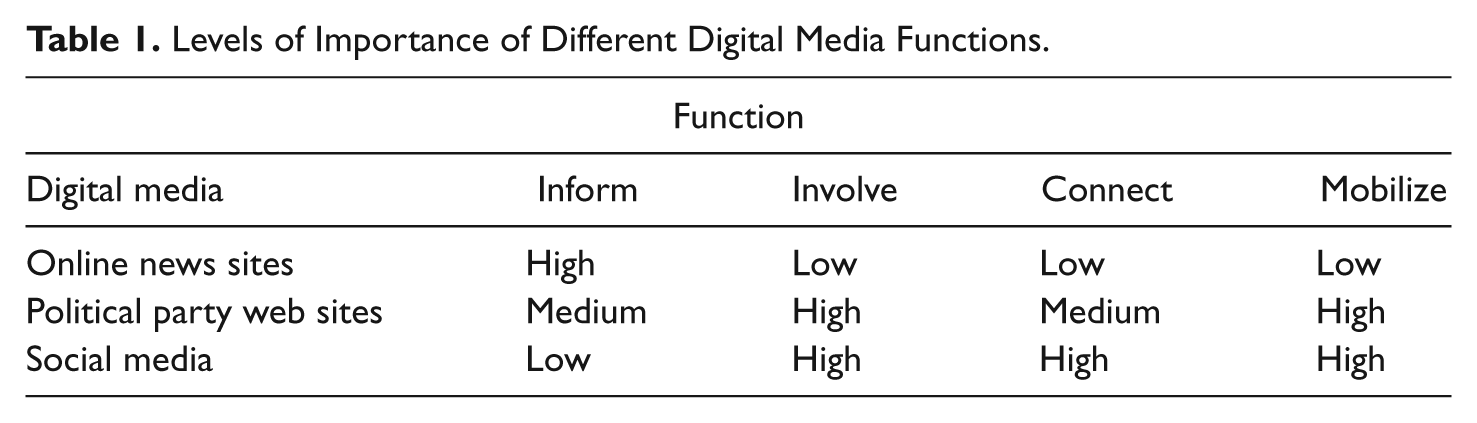
Each of the different types of digital media examined in this study differs conceptually in terms of primary function. Online news sites—either those published by traditional media or those created by online-only news organizations—exist first and foremost to inform visitors. Political party web sites, although carrying an information function as well, are designed to reinforce, recruit, and persuade (Bimber & Davis, 2003; Oates, 2008). Thus, we argue that they display a high level of involving and mobilizing. Lastly, the primary function of social media is to connect as well as involve and facilitate voter mobilization. The relative importance of these digital media functions is displayed in Table 1.
Levels of Importance of Different Digital Media Functions.
The effects of digital media on political knowledge and participation is, however, not only a matter of the function or technical features of different types of digital media. Equally important are characteristics of the users, in themselves and in relation to the technological features and functions of different types of digital media. As suggested by Delli Carpini and Keeter (1996, pp. 106-116), Prior (2007, pp. 28-34), and others, crucial in understanding any forms of knowledge acquisition and, in extension, participation, is citizens’ Opportunities, Motivations, and Abilities (the OMA framework). While digital media have increased citizens’ opportunities to learn and participate in politics, ultimately the degree of learning and participation depends on whether citizens have the motivation and the abilities to learn and participate. In extension, the motivations for using different types of digital media may vary, hypothetically leading to different effects on political knowledge and participation.
Given the distinctive properties of each digital media type, and that citizens’ motivations to use digital media may vary, what are the possible effects on political knowledge and participation? First, we expect that use of online news sites will have stronger effects on political knowledge than use of political party web sites and social media, but weak or no effects on political participation. The rationale is that online news sites rank higher on the information function than political party web sites and social media and that the primary motivation for use of online news sites is information seeking. Second, we expect that use of political party web sites and social media for political purposes will have stronger effects on political participation than use of online news sites, and weaker effects on political knowledge. The rationale is that political party web sites and social media rank higher on the functions of involving and mobilizing than online news sites and that those who turn to political party web sites and social media may be driven primarily by the motivation to find reinforcement and to connect rather than to get information. Third, we expect that use of social media for political purposes will have the strongest effect on political participation but the weakest effect on political knowledge. Again the rationale follows from the functions of the different types of media in conjunction with the motivations citizens have for using these media. Social media rank lowest on the informing function and high on the involving as well as the connecting and the mobilizing functions. In addition, the likelihood of accidental exposure to others who are participating politically is higher when using social media—particularly sites such as Facebook where people are “friends” with a broad range of people—than when using online news sites and party web sites. Thus, a combination of the functions of different types of digital media and what motivations citizens may have for using these leads us to advance the following hypotheses:
Method
To test the hypotheses above, two panel studies were conducted during the 2010 Swedish election campaign. One of the major strengths of panel surveys is the ability to analyze stability and change at the individual level. Both panel surveys (Panel A and Panel B) were conducted by the Centre for Political Communication Research at Mid Sweden University, in cooperation with the polling institute Synovate in Sweden.
The samples for both surveys were drawn using stratified probability sampling from a database of approximately 28,000 citizens from Synovate’s pool of web survey participants. The participants included in this pool are recruited continuously using both random digit dialing and mail surveys based on random probability samples. Approximately 5% of those who are initially contacted and invited agree to be part of this pool of respondents. This may weaken the external validity of our sample as those who agree to be part of the pool of participants are not likely to be representative of Swedish citizens in general. However, as the invitations are not done for this specific study, but rather for the purpose of doing market research, the common bias toward politically interested citizens is avoided. Furthermore, the pool of web survey participants covers different segments of the population in terms of residence, age, education, occupation, and so on, as explained below.
Panel Survey A is based on a stratified probability sample of 4,010 respondents aged 18 to 74 years from this pool, stratified by gender, age, county size, political interest, and Internet use, so as to be as representative of the Swedish population aged 18 to 74 as possible. A complementary sample of 750 respondents was drawn and added for the second wave of the panel, resulting in a total sample of 4,760. Respondents in Panel A were asked to complete a web survey four times during a period of approximately 5 months leading up to the election. Wave 1 of the panel took place in May (May 3-May 20), Wave 2 in mid-June (June 14-June 23), Wave 3 in mid-August (August 16-23), and Wave 4 immediately after Election Day (September 20-September 27). All respondents who completed the Wave 3 and Wave 4 questionnaires were selected for analysis in this study, resulting in a total cooperation rate of 34% (Cooperation Rate 2 [COOP2], American Association for Public Opinion Research [AAPOR]). The cooperation rates for each wave are presented in Appendix A/Table A1.
Panel survey B was conducted as a two-wave panel study completely mirroring the final two waves of Panel A in terms of timing and question wording, with the specific purpose of validating findings from the four-wave panel study. A stratified probability sample of 1,912 pool members was drawn based on gender, age, county size, political interest, and Internet use. Following Panel A, the first wave of Panel B was conducted in mid-August (August 16-23), while the second wave took place the week after Election Day (September 20-September 27). Approximately 68% completed the Wave 1 questionnaire in August and of those 1,305 respondents, 75% also completed the September questionnaire—yielding a total cooperation rate of 51% (COOP2, AAPOR).
Measures
This study estimates the effects of three forms of digital media use on political learning and offline political participation, controlling for several key background political and media variables. All variables, their mean values, and standard deviations as well as question wording are provided in Appendix B/Table B1.
Political learning
Our measure of political learning is based on a set of eight knowledge questions included in the last wave of the two panel studies. In order to capture political learning during the campaign, each of the eight knowledge questions focuses on new political information, that is, events that made news in major national news media during the weeks between the two final panel waves. This construction has two important implications for inferences regarding political learning. First, the focus on newly available information entails that knowledge gains must have taken place during the final weeks of the election campaign. Second, compared to general political knowledge acquired earlier in life, the media is much more likely to be the major source for learning this kind of newly available political information. The eight items used in both panel studies focus on issue positions and policy proposals presented either in party manifestoes or at press conferences during the last weeks of the election campaign (five items), domestic real-world events and developments (two items), as well as foreign policy events (one item). Five response categories, including “Don’t Know,” were given for each knowledge question in order to minimize the chance of randomly guessing the correct answer. Furthermore, following the work by Iyengar, Curran, Brink Lund, Salovaara-Moring, and Hahn (2010), a time limit of 20 seconds for answering each question was used to avoid web searches for the correct answers. The eight items were summed to form an additive index ranging from 0 (no correct answers) to 8 (all questions answered correctly).
Offline political participation
Our second dependent variable is an index of participation variables measured in the last survey round. Respondents were asked whether, and to what extent, they engaged in eight predefined political activities during the election campaign. These included visiting a campaign rally, attending a political meeting, contacting a politician, trying to convince others to vote for a specific party, and so on. These eight three-level items were summed to form an additive index of offline participation ranging from 0 (taken part in no activity during the election campaign) to 16 (taken part in eight activities several times during the election campaign).
Digital media
The primary focus of this study is on the effects of different forms of digital media use on political knowledge and participation. We base our measures of different forms of digital media use on the results of a principal components analysis (see Appendix A/Table A2). Use of online news media was measured based on a set of questions concerning exposure to a range of specific news media outlets on the Internet. Respondents were asked how often they watched/read/listened to several leading news television and radio programs, as well as newspapers, during the past week. Based on the principal components analysis the use of online news media was grouped into three categories: (a) exposure to television news programs on the Internet (Cronbach’s α = .88), (b) exposure to tabloids on the Internet (Cronbach’s α = .71), and (c) exposure to the two leading national dailies on the Internet (Cronbach’s α = .74).
Use of political party web sites was measured by a survey item tapping how often the respondents had visited a number of party web sites during the last month—ranging from 1 (never) to 5 (daily). Nine party web sites were grouped into two categories along partisan lines, following the underlying dimensionality revealed by the principal components analysis. The first measure taps the frequency of visits to the web sites of the three left-wing parties (the Left Party, the Social Democrats, and the Green Party) as well as their joint coalition web site (Cronbach’s α = .90). The second measure similarly taps the frequency of visits to the web sites of the four right-wing parties (the Center Party, the Liberal Party, the Christian Democrats, and the Moderate Party) as well as their joint coalition web site (Cronbach’s α = .92).
Finally, use of social media was measured using six survey items that focus on political use of social media. Respondents were asked how often they had engaged in several social media activities during the last month. These activities included reading a blog about current affairs or politics, writing texts on a personal blog about current affairs or politics, commenting/discussing current affairs issues or politics on the Internet, or following a politician or political party on either Twitter, Facebook, or YouTube. As the principal components analysis showed that these six activities all loaded on a single dimension, they were summed to form a social media index, ranging from 0 to 24 (Cronbach’s α = .77).
Control variables
Each of the models estimated includes a number of key control variables. Apart from standard sociodemographic characteristics—such as gender, age, and education—attention to news about politics in traditional news media is a potentially important factor related both to political knowledge and participation on the one hand, and to use of digital media on the other. Attention to politics in traditional news media is based on three survey items, each tapping the amount of attention respondents pay to news about politics on television, on radio, and in dailies—ranging from 1 (no attention at all) to 5 (very close attention). These three measures were summed to form an additive index of attention to news about politics (Cronbach’s α = .81). Political interest is based on two items, tapping the respondents’ level of interest in politics as well as in the election campaign, measured as two four-level variables ranging from 1 (not interested at all) to 4 (very interested; Cronbach’s α = .86).
Finally, we use the strength of the panel design by also including a measure of general, or prior, political knowledge measured in the first wave of each panel study. General political knowledge is an additive index based on eight political knowledge questions focused on personalities (three items), political processes (three items), and issue positions (two items). Similarly, in the models estimating effects on participation, we use past offline political participation—a measure of the number of political activities respondents were engaged in during the last 12 months—measured in the August panel wave. Controlling for lagged values of the dependent variables in this way is one of the great advantages of panel surveys, as it changes the interpretation of the coefficients to effects on changes in the dependent variable between panel waves (Finkel, 1995). Strictly speaking, however, the models estimating learning effects are not autoregressive in nature since our lagged dependent variable (prior knowledge) is based on different knowledge questions intended to capture general political knowledge. What these models do capture is the effects of digital media use on the acquisition of new political information during the campaign, controlling for knowledge acquired earlier, attention to politics in traditional media, political interest, and so on. The models estimating effects on offline participation are autoregressive though by including the lagged values of participation on the right-hand side of the regression equation. Since the measure of past offline participation is only available in Panel A, we will rely on this panel study only when testing our participation hypotheses.
Results
Before addressing our hypotheses, we look at how often respondents in our sample used different forms of digital media. The results displayed in Table 2 show that online news media, and in particular the online versions of the tabloids Aftonbladet and Expressen, were the most widely used digital media. The use of these digital media clearly surpassed the use of party web sites and different social media for political purposes. The most widely used social media for political purposes were blogs.
Frequency of Use of Different Forms of Digital Media (%).
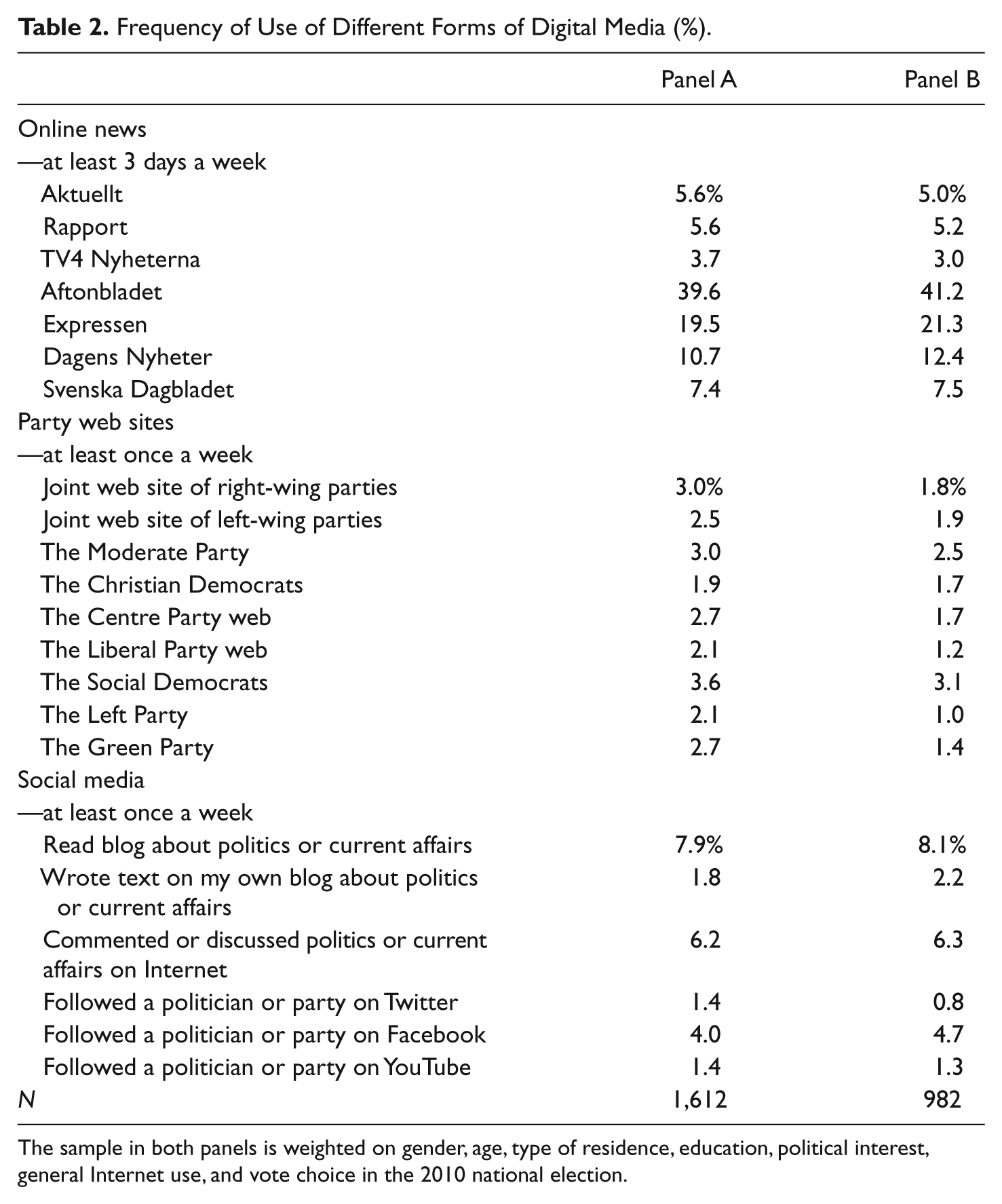
The sample in both panels is weighted on gender, age, type of residence, education, political interest, general Internet use, and vote choice in the 2010 national election.
Our first hypothesis predicted that higher frequency of use of digital media, including online news, political party web sites, and social media, would lead to higher levels of political knowledge. This hypothesis is tested in a series of regression models presented in Table 3—five models estimated using Panel A data and the same five models estimated using Panel B data. Model 1 is a baseline model including no digital media use variables. It shows that political interest, general (prior) political knowledge, and attention to news about politics in traditional news media have positive effects on learning during the campaign. Men also tend to learn more than women. The model accounts for approximately 43% of the variance in learning. Models 2 to 4 tested the effects of each form of digital media use separately, while Model 5 estimated the effect of each form of digital media controlling for the others. As can be seen, the only type of digital media use that influences learning is online news. More specifically, reading tabloids online has the most consistent effect on learning, while reading dailies is significant in Panel B only. The findings with regard to the other forms of digital media are consistent across the two panel studies. Consequently, while Hypothesis 1 is only partly supported, Hypotheses 3a and 3b, stating that use of online news sites would have a stronger effect on political knowledge than use of political party web sites and social media, are confirmed. In order to conduct a formal test of the relative contribution of each group of digital media variables, we compared the statistical performance of three nested regression models, in which each set of media use variables was excluded, to the full model (Model 5), and calculated the corresponding F statistic. 1 The results showed that eliminating the online news variables significantly reduced overall model performance by increasing the standard error of the regression (F = 3.020, p < .05), while neither party web sites (F = 0.355, p > .05) nor social media made any statistically significant contribution when predicting knowledge (F = 0.999, p > .05). These tests support the previous findings and are in line with Hypotheses 3a and 3b. Finally, as indicated by the adjusted R2 change, including the full range of digital media variables (Model 5) adds only 1 percentage point to the amount of explained variance, compared to the baseline model. In that sense, while online news has a significant positive impact on learning, these variables do not improve prediction much beyond what is accounted for by the control variables.
Effects on Political Knowledge (OLS).
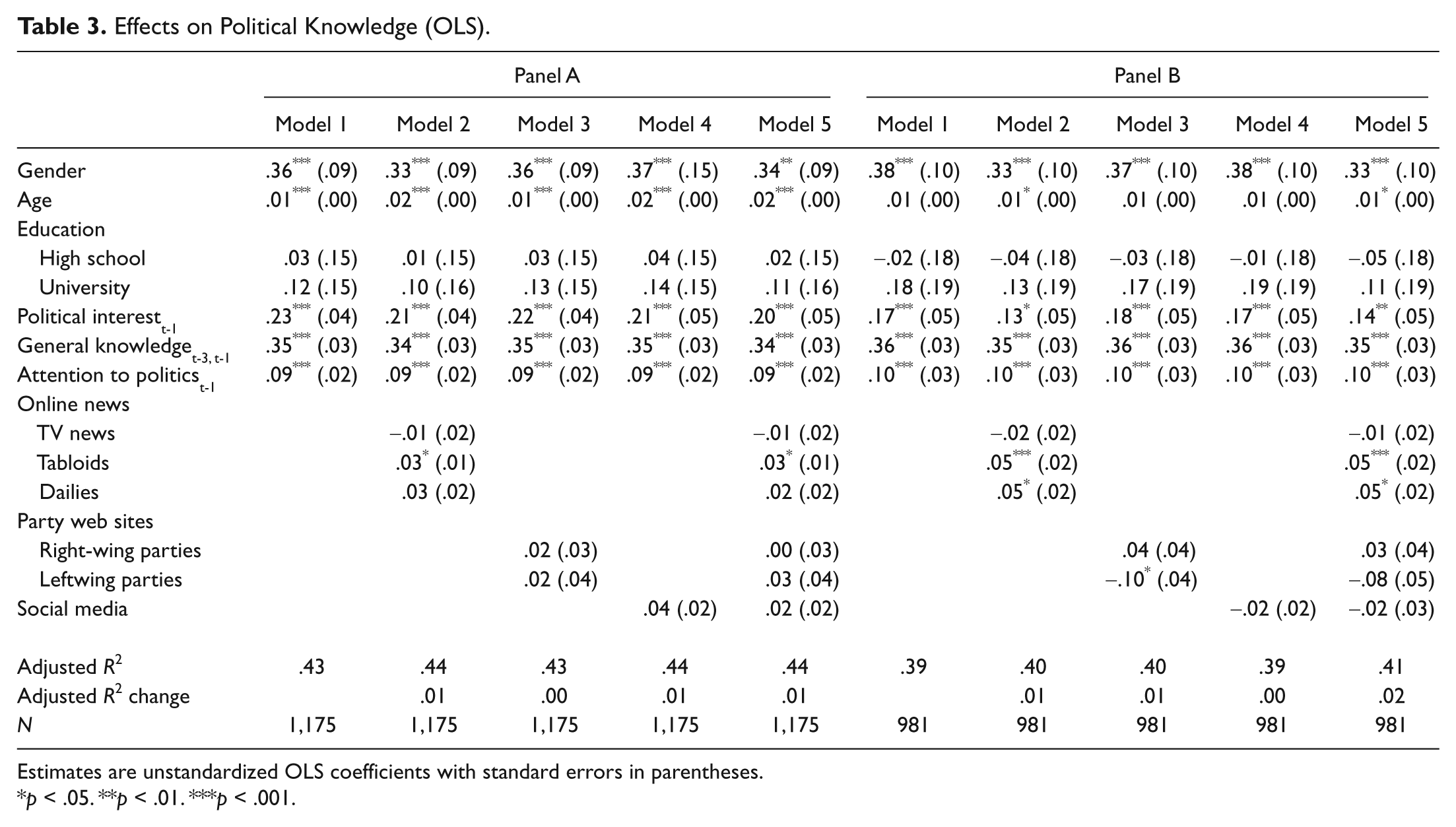
Estimates are unstandardized OLS coefficients with standard errors in parentheses.
p < .05. **p < .01. ***p < .001.
The second hypothesis predicted that higher frequency of use of digital media, including online news, political party web sites, and social media, would lead to increased political participation. This hypothesis is only partially supported by the results presented in Table 3. While consuming online news has no effect on changes in offline political participation during the campaign, there is some evidence that visiting party web sites and using social media for political purposes increases participation during the campaign. The results are most clear with respect to social media, where Models 4 and 5 show that higher use of social media during the campaign increases participation offline, even when controlling for the lagged values of offline participation, political interest, general political knowledge, attention to news about politics in traditional media channels, as well as sociodemographic variables. When it comes to party web sites, Model 3 shows that there are similar positive effects of visiting web sites belonging to the left-wing but not to the right-wing parties, an effect that holds even when controlling for online news consumption and social media use in Model 5.
The differential effects of different forms of digital media use on offline participation also support Hypothesis 4, which predicted that use of political party web sites (H4a) and social media (H4b) would have a stronger effect on political participation than use of online news sites. Again, these findings are supported by a series of F tests comparing nested models to the full model presented in Table 4. In terms of overall contribution to the model, online news is unimportant (F = 0.460, p > .05), while both the party web sites variables (F = 4.246, p < .05) and social media use (F = 71.997, p < .05) make significant improvements to the overall performance of the model. What seems to matter in terms of mobilizing citizens to act politically, then, is party web sites and social media use—not online news. At the same time, the adjusted R2 changes reveal the somewhat limited improvement in amount of explained variance compared to the baseline model. While online news and party web sites each increase the amount of variance explained by 1 percentage point, social media use increases the amount of explained variance by 3 percentage points—numbers that correspond to the results of the F tests.
Effects on Offline Political Participation (OLS).
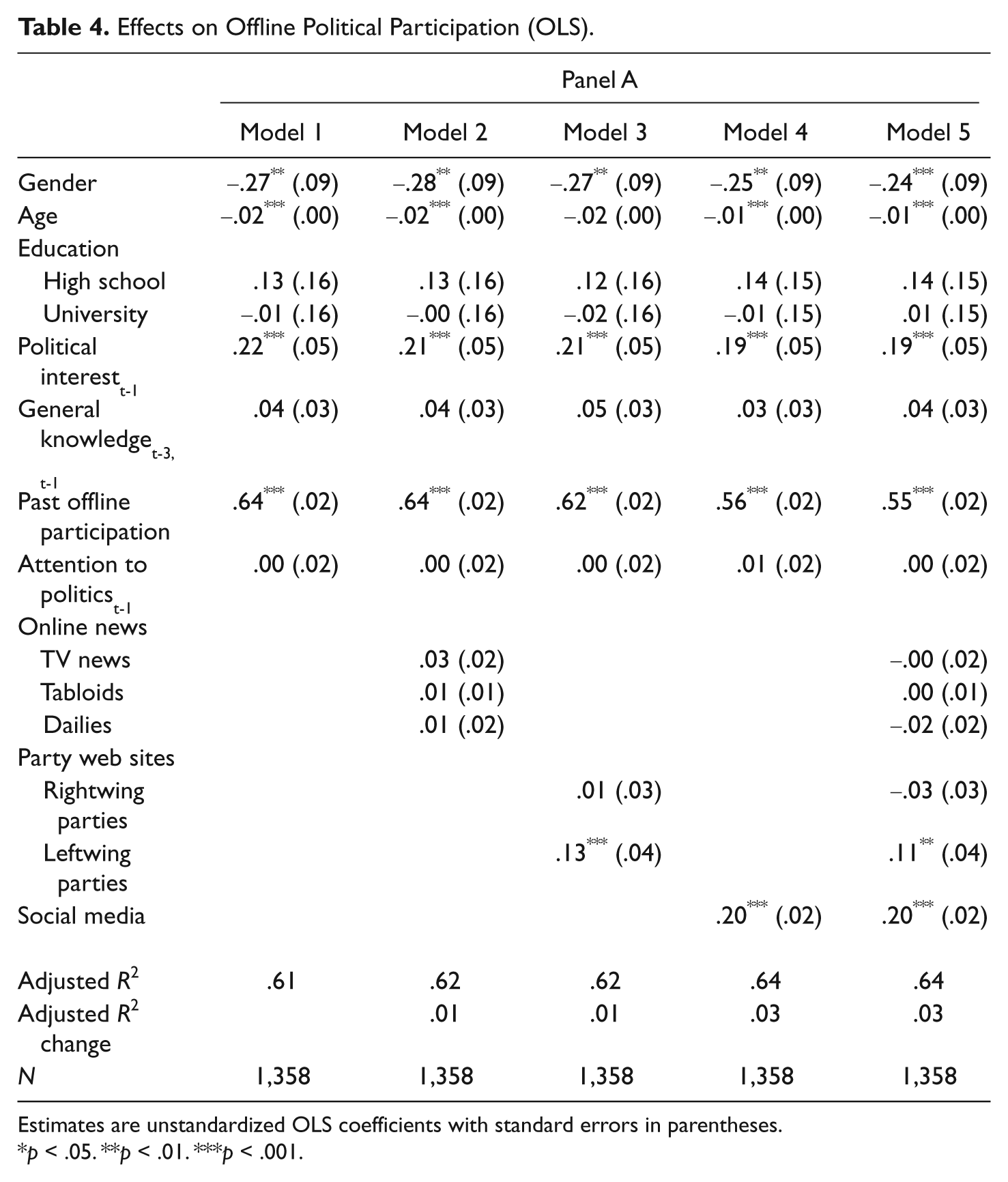
Estimates are unstandardized OLS coefficients with standard errors in parentheses.
p < .05. **p < .01. ***p < .001.
Finally, Hypothesis 5 stated that use of social media would have the strongest effect on political participation (H5a) and the weakest effect on political knowledge (H5b). This hypothesis is also supported by the data. While social media use has no effect on learning, it exerts the strongest impact on offline participation, as measured both by the size of the slope coefficients in Table 4 as well its contribution to the overall model performance as evident by the F tests presented above. 2
Discussion
The overall purpose of this study was to investigate (a) the effects of digital media use on political knowledge and participation and (b) whether the use of different forms of digital media affects people differently. Unlike much prior research that relies on cross-sectional surveys to study media effects, we used panel data, which is better suited for analyzing causal relationships (Prior, 2005; Strömbäck & Shehata, 2010). Such data allow us to detect changes at the individual level and attribute causality with greater confidence (Eveland, Hayes, Shah, & Kwak, 2005).
Based on prior research, on a general level we hypothesized that higher frequency of use of digital media would lead to higher levels of political knowledge and political participation. Theorizing that different forms of digital media have different functions and properties, and that individuals’ motivations for using digital media may vary across different forms of digital media, we furthermore hypothesized that the effects of digital media use would vary significantly, depending on what forms of digital media people use. More specifically, we proposed that use of online news sites would have a stronger effect on political knowledge than use of political party web sites and social media; that use of political party web sites and social media would have stronger effects on political participation than use of online news sites; and that the use of social media would have the strongest effects on political participation and the weakest effects on political knowledge.
In terms of the general effects of digital media use, our results demonstrate that use of digital media has only limited effects on political knowledge and political participation. When controlling for factors such as age, gender, education, political interest, general knowledge, and attention to politics in traditional media, the effects on political knowledge are very limited. In fact, only the use of some online news sites leads to higher levels of political knowledge while party web sites and social media do not. And although reading news online has a significant and positive effect on learning, that effect is relatively weak. The overall conclusion is thus that the use of different forms of digital media, controlling for other factors, has little impact on political knowledge. As in the era before the Internet, what matters more for political learning is political interest, prior political knowledge, and attention to politics in traditional media formats.
Our finding is consistent with recent U.S.-based studies on the effects of new media use on political knowledge (see Groshek & Dimitrova, 2011; Kaufhold et al., 2010). The nonexistent or sometimes negative relationship between online media use and knowledge, however, may be related to the nature of the survey questions used, as they are typically derived from daily news that appeared in traditional media outlets. Nevertheless, such findings beg the question of what type of content are citizens accessing online, especially since some research has demonstrated that entertainment content tends to increase gaps in political knowledge among the public (see Prior, 2005, 2007).
In terms of effects on political participation, our results show some support for the notion that use of digital media leads to increased political activity among the public at large—a point of vigorous debate between cyber pessimists and cyber optimists. In our study though, clear differences across different forms of digital media use emerged. As hypothesized, the use of political party web sites and, in particular, social media showed both significant and positive effects on political participation. Along with political interest and past offline participation, using social media for political purposes was one of the strongest predictors of participation while use of online news sites, as expected, did not increase participation.
Theoretically, these findings are important since they suggest that different functions and properties of different forms of digital media, in conjunction with the motivations people may have for using them, clearly matter for the effects on political knowledge and political participation. In essence, there may be no general effects of using digital media, contrary to what both cyber optimists and cyber pessimists have suggested. Instead, it seems more appropriate to look at how different forms of digital media influence different aspects of civic engagement.
Following a more nuanced framework of digital media effects suggests that scholars should be cautious not to lump all digital media together and to further distinguish between different types of digital and social media use—from reading news online to blog posting to following a politician on Facebook or Twitter. From a practical standpoint, our findings also suggest that different forms of digital media may have different logics, which is an important lesson for political parties and candidates attempting to use digital media for political purposes.
Whether the differential effects of digital media mainly stem from their different functions and properties, or from the different motivations people have for using different forms of digital media is, however, unclear. Aside from the need to investigate whether the differential effects of digital media hold true in other countries and settings, one of the main challenges in future research on the effects of digital media use would be to disentangle whether the functions and properties of different digital media—that is, technological factors—or the motivations people have for using different media—that is, sociopsychological factors—matter most in the political communication process. In the end, future research should not simply focus on whether or not digital media contribute to strengthening democracy through increasing political participation and diffusion of knowledge, but rather investigate what forms of digital media use have what kinds of effects on political participation and political learning, and under what circumstances.
Footnotes
Appendix A
Principal Components Analysis of Digital Media Use (Rotated Pattern Matrix).
| Right-wing party web sites α = .92 | Online TV news α = .89 | Social media α = .87 | Online dailies α = .74 | Online tabloids α = .71 | Left-wing party web sites α = .90 | |
|---|---|---|---|---|---|---|
| Online News | ||||||
| Aktuellt | −.02 | .93 | −.01 | .03 | .02 | −.02 |
| Rapport | .02 | .92 | −.01 | .03 | .04 | .01 |
| TV4 Nyheterna | −.05 | .85 | .02 | −.07 | −.11 | −.03 |
| Aftonbladet | .11 | .02 | −.01 | −.06 | −.90 | .09 |
| Expressen | −.10 | .04 | .01 | .10 | −.83 | −.07 |
| Dagens Nyheter | −.07 | .00 | .02 | .82 | −.08 | −.05 |
| Svenska Dagbladet | −.20 | −.03 | −.00 | .84 | −.05 | −.15 |
| Göteborgs-Posten | .20 | .10 | −.05 | .49 | .05 | .20 |
| Party web sites | ||||||
| Joint web site for Right-wing Party Coalition | .73 | −.02 | .07 | −.02 | .01 | −.14 |
| Joint web site for Left-wing party coalition | .08 | −.03 | .09 | .01 | .01 | −.79 |
| Moderate Party | .81 | −.03 | .03 | −.06 | .03 | −.03 |
| Christian Democratic Party | .83 | −.03 | .05 | −.00 | −.02 | −.06 |
| Center Party | .79 | −.00 | −.01 | .03 | −.01 | −.13 |
| Liberal Party | .83 | −.02 | .03 | −.02 | −.02 | −.07 |
| Social Democratic Party | .03 | .01 | .02 | .05 | .05 | −.83 |
| Left Party | .17 | −.00 | −.03 | −.00 | −.02 | −.79 |
| Green party | .14 | .03 | −.02 | −.04 | .00 | −.80 |
| Social media | ||||||
| Read blog about politics or public issues | .01 | .03 | .54 | −.29 | .11 | −.06 |
| Wrote text on my own blog about politics or public issues | .03 | −.02 | .72 | .04 | −.02 | .00 |
| Commented or discussed politics or public issues on Internet | −.01 | .05 | .72 | −.04 | .07 | .02 |
| Followed a politician or party on Twitter | .07 | −.05 | .75 | .01 | −.06 | .08 |
| Followed a politician or party on Facebook | −.07 | .04 | .75 | .09 | .03 | −.06 |
| Followed a politician or party on Youtube | .08 | −.06 | .67 | −.01 | −.06 | −.03 |
| Eigenvalues | 7.18 | 2.83 | 2.16 | 1.54 | 1.14 | 1.03 |
| Variance explained | 31.2 % | 12.3 % | 9.4 % | 6.7 % | 4.9 % | 4.5 % |
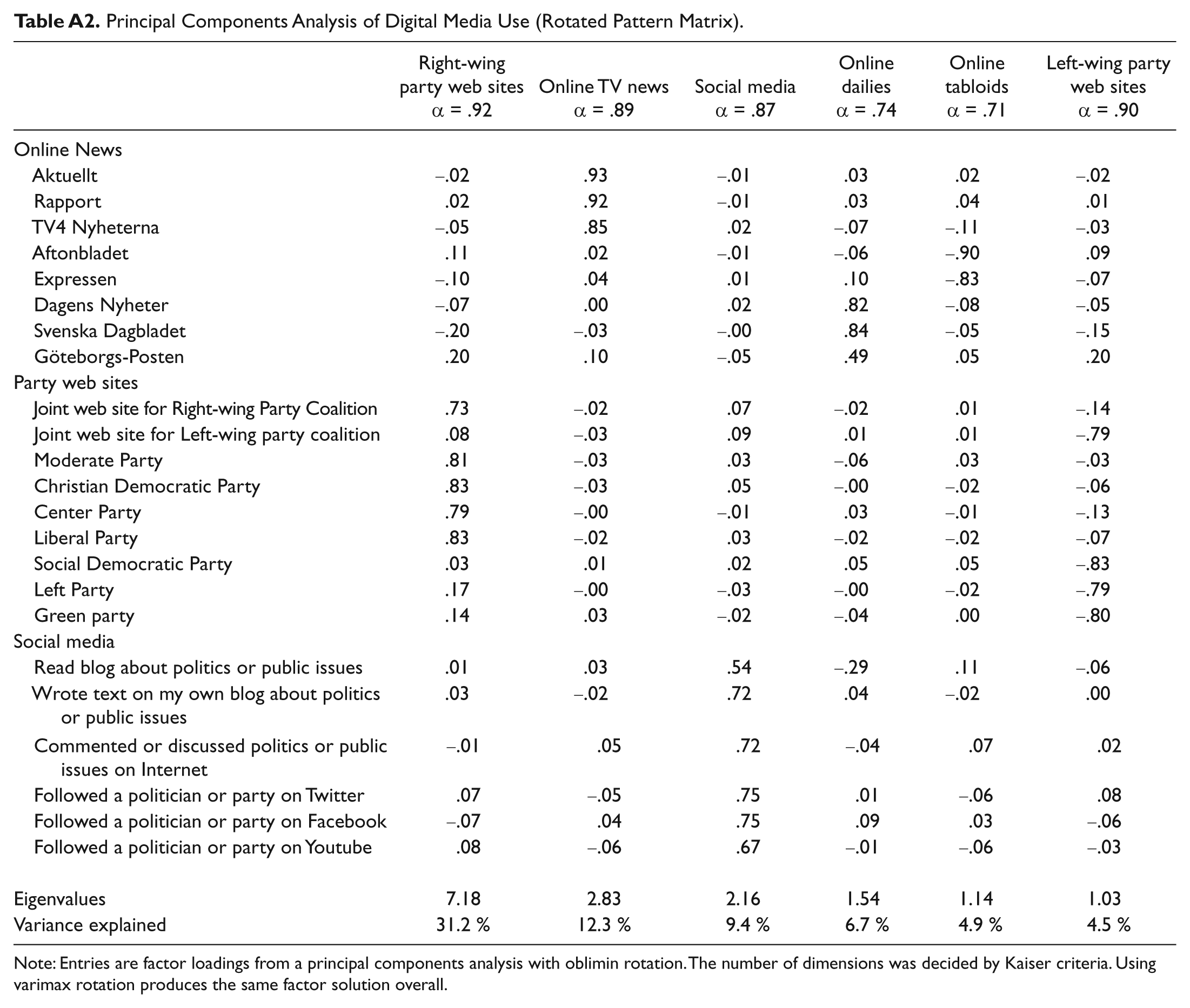
Note: Entries are factor loadings from a principal components analysis with oblimin rotation. The number of dimensions was decided by Kaiser criteria. Using varimax rotation produces the same factor solution overall.
Appendix B
Mean Values and Standard Deviations of Each Measure.
| Panel A |
Panel B |
|||
|---|---|---|---|---|
| Variable | Items | Range | mean (SD) | mean (SD) |
| Political knowledge (t) a | 8 items | 0-8 | 4.51 (1.97) | 4.48 (1.91) |
| General political knowledge (t-1, t-3) b | 8 items | 0-8 | 4.73 (2.05) | 4.59 (1.91) |
| Offline participation (t) c | 8 items | 0-16 | 1.40 (2.26) | Not measured |
| Past offline participation (t-1) d | 8 items | 0-16 | 1.57 (2.44) | Not measured |
| Political interest (t-1) e | 2 items | 0-6 | 3.08 (1.54) | 3.15 (1.46) |
| Attention to news about politics (t-1) f | 3 items | 0-12 | 5.11 (2.87) | 4.88 (2.84) |
| Online news (t) | ||||
| National TV g | 3 items | 0-16 | 1.20 (2.55) | 1.39 (2.66) |
| Tabloids h | 2 items | 0-10 | 3.24 (3.34) | 3.48 (3.46) |
| National dailies i | 2 items | 0-10 | 1.11 (2.31) | 1.20 (2.39) |
| Left-wing party web sites (t) j | 4 items | 0-16 | 0.45 (1.63) | 0.44 (1.51) |
| Right-wing party web sites (t) k | 5 items | 0-20 | 0.49 (1.89) | 0.49 (1.60) |
| Social media l | 6 items | 0-24 | 0.81 (2.27) | 0.86 (2.15) |

Based on the following eight survey questions: (1) Last week, the EU commissioner of justice delivered strong criticism regarding the treatment of Romani people in one of the EU member states. What country was criticized? (2) The Financial Supervisory Authority recently withdrew the permission of one Swedish bank to engage in financial activities. What bank had its permission withdrawn? (3) During the election campaign, the left-wing parties agreed on a policy for the Swedish military presence in Afghanistan. What did they agree on? (4) The Central Bureau of Statistics recently presented news unemployment statistics for Sweden. What is the unemployment rate in Sweden? (5) Which of the following proposals were presented in the common party manifesto of the left-wing parties? (6) Which of the following proposals were presented in the common party manifesto of the right-wing parties? (7) What party did recently present a proposal involving “butlers” in the Stockholm subway? (8) The common right-wing party manifesto included a proposal to change the restaurant sales tax. What did the proposal entail? Five response categories were provided for each of the questions, including a “don’t know” option.
Based on the following eight survey questions: (1) What party is the Swedish finance minister a member of? (2) What is required to make an amendment to the Swedish constitution? (3) What political institution decides on Swedish laws? (4) What party has the largest number of MPs today? (5) What is the name of the current speaker of parliament; (6) What party has most strongly campaigned for child care allowance? (7) What is the name of the current Swedish EU commissioner? (8) What party has most strongly campaigned for a Swedish NATO membership? Five response categories were provided for each of the questions, including “don’t know.”
Based on one survey question and eight political activities: “Did you engage in any of the following activities during the election campaign on account of the election?” (a) Signed a petition; (b) Contacted a politician; (c) Wrote a letter to the editor; (d) Argued for your opinions in a political discussion; (e) Contacted mass media; (f) Participated in a demonstration; (g) Tried to convince others to vote for a specific party. Three response categories were provided for each activity: (1) “Yes, once,” (2) “Yes, several times,” and (3) “No.”
Based on one survey question and eight political activities: “Have you ever been engaged in any of the following activities during the last 12 months in order to influence a public issue?”: (a) Signed a petition; (b) Contacted a politician; (c) Wrote a letter to the editor; (d) Argued for your opinions in a political discussion; (e) Contacted mass media; (f) Participated in a demonstration; (g) Tried to convince others to vote for a specific party. Three response categories were provided for each activity: (1) “Yes, once,” (2) “Yes, several times,” and (3) “No.”
Based on two survey questions: (1) “In general, how interested are you in politics?” (2) “How interested are you in the ongoing national election campaign?” Four response categories were provided, ranging from 1 (not interested at all) to 4 (very interested).
Based on three survey questions: (1) “How much attention do you pay to news about politics on television?” (2) “How much attention do you pay to news about politics on radio?” (3) “How much attention do you pay to news about politics in newspapers? Five response categories were provided, ranging from 1 (no attention at all) to 4 (very close attention).
Based on one survey question and three specific online news media channels: “How often have you, during the last week, listened to or watched the following television and radio newscasts (on the Internet)?”: (a) Aktuellt i SVT; (b) Rapport i SVT; (c) TV4 Nyheterna. Six response categories were provided, ranging from 1 (daily) to 6 (never). All scales were inverted before summed.
Based on one survey question and two specific online news media channels: “How often have you, during the last week, read the newspapers (on the Internet)?”: (a) Aftonbladet; (b) Expressen. Six response categories were provided, ranging from 1 (daily) to 6 (never). All scales were inverted before summed.
Based on one survey question and two specific online news media channels: “How often have you, during the last week, read the newspapers (on the Internet)?”: (a) Dagens Nyheter; (b) Svenska Dagbladet. Six response categories were provided, ranging from 1 (daily) to 6 (never). All scales were inverted before summed.
Based on one survey question and four specific party web sites: “How often have you, during the last month, visited any of the following web sites?”: (a) the joint web site of the left-wing parties; (b) the web site of the Social Democratic party; (c) the web site of the Left party; (d) the web site of the Green party. Five response categories were provided, ranging from 1 (never) to 5 (daily).
Based on one survey question and five specific party web sites: “How often have you, during the last month, visited any of the following web sites?”: (a) the joint web site of the right-wing parties; (b) the web site of the Centre party; (c) the web site of the Liberal party; (d) the web site of the Christian Democratic party; (e) the web site of the Moderate party. Five response categories were provided, ranging from 1 (never) to 5 (daily).
Based on one survey question and six specific social media activities: “How often have you, during the last month, done any of the following on the Internet?”: (a) Read a blog about politics or current affairs; (b) written texts on my own blog about politics or current affairs; (c) commented or discussed politics or current affairs on the Internet; (d) followed a politician or party on Twitter; (e) followed a politician or party on Facebook; (f) followed a politician or party on YouTube. Five response categories were provided, ranging from 1 (never) to 5 (daily).
Declaration of Conflicting Interests
The authors declared no potential conflicts of interest with respect to the research, authorship, and/or publication of this article.
Funding
The authors received no financial support for the research, authorship, and/or publication of this article.
1.
The F statistics were calculated using the following
formula:
2.
Given the identical scales of the frequency of party web site visits and social media use (see Appendix B), the unstandardized regression coefficients also reveal that social media use (b = 0.20) has a stronger effect on offline participation than visiting leftwing party web sites (b = 0.11).