







Abstract
Using data from 192 undergraduates asked to imagine a stressful experience, this study finds support for two primary contentions of a dual-process theory of supportive message outcomes: (a) message content impacts anticipated affect improvement (AAI) when processing motivation is high but not when low and (b) processing extent mediates the relationship between verbal person centeredness (VPC) and AAI for highly motivated participants. In addition, the dual-process framework was used to forward a modified theory of conversationally induced reappraisals. In support of this model, positive emotion words and situation reappraisal mediated the VPC-AAI link only when recipients afforded close attention to message content. The discussion focuses on how the dual-process framework might assist in modifying theories of supportive communication in other ways.
When confronted with major or minor life stress, people seek support from others(Rime, Corsini, & Herbette, 2002). Although support from others can buffer the negative impact of stressful events (Cohen & McKay, 1984), it does not always help and can often make things worse (Bodie, in press-b; Dunkel-Schetter, Blasband, Feinstein, & Herbert, 1992). In an attempt to discover the underlying mechanisms that drive the helpfulness of support, sophisticated theories of supportive messages have been advanced that, together, suggest when support providers sincerely convey acknowledgment, comprehension, and understanding, the impact of stress can be mitigated; attempts to blame the stressed other or minimize her difficult emotions tend to be unhelpful and even harmful (for reviews see, Cunningham & Barbee, 2000; MacGeorge, Feng, & Burleson, 2011). Indeed, the quality of supportive messages is a key reason that some support attempts work while others fail.
However useful message-based theories have been in explicating the message features that typically help or hinder the buffering potential of enacted support, only recently have these theories been incorporated into more comprehensive theories of how messages “work” (i.e., have their effects). One of the earliest of these attempts was Burleson and Goldsmith’s (1998) theory of conversationally induced reappraisals which proposes that successful supportive messages work by soliciting and helping individuals “alter . . . emotions by constructing a new relational meaning of the stressful encounter” (Lazarus, 1999, p. 116). Within appraisal theory and the treatment of this theory by Burleson and Goldsmith, affect change is the primary outcome variable of interest, and that change is fostered not by changing the event itself but by changing the way the event is framed in the mind of the affected individual. 1 Although the theory of conversationally induced reappraisals provides for the possibility that other mechanisms of affect change might be operative, and empirical data confirms this possibility (see Jones & Wirtz, 2006), the primary path through which change occurs is assumed to be a cognitively demanding one. This path is referred to as cognitive appraisal to “emphasize the complex, judgmental, and conscious process that must often be involved in appraising” (Lazarus, 2001, p. 51).
Indeed, a largely untested assumption in the supportive communication literature is that recipients are cognitively engaged and, thus, that message content is thoughtfully considered as one attempts to cope with problems. As Goldsmith (2004) states, “any support that is enacted during the course of a conversation [is] subject to evaluation by the participants . . . evaluations of [supportive communication] mediate the effects that enacted support might have on individual coping” (p. 26; emphases in original). This model, although specifically focused on coping, suggests more broadly that for supportive messages to work, they have to be first evaluated as helpful by a relatively conscious recipient (see Bodieet al., 2012). But when is a supportive message “subject” to evaluation? And when do people think rather superficially about supportive encounters? That is, when do support recipients pay comparatively close attention to message content, and when do they likely afford little cognitive effort to this task?
This manuscript seeks to extend current explanations of how supportive messages work by advancing a dual-process theory of supportive message processing. This theory calls into question the tenability of an ever-monitoring and evaluating support recipient and assumes individual’s process supportive message content more or less extensively depending on their motivation and ability to do so. In addition, this theory provides specific answers to questions regarding when and why supportive message content will be subject to evaluation. Even when messages are not subject to evaluation (e.g., when motivation is low), they can still have an impact on affect change but the mechanisms driving this change involve relatively less extensive thinking. Indeed, comforting communication “works” through various mechanisms, some of which require extensive processing (e.g., cognitive appraisal, message evaluation) and some of which require very little cognitive effort (e.g., distraction; Bodie & Burleson, 2008). The study outlined below specifically focuses on demonstrating how thinking about message content (i.e., processing) can help explain the connection between the content of supportive messages and relevant outcomes by appealing to a newly developed dual-process theory of supportive message outcomes (Bodie & Burleson, 2008; Burleson, 2009, 2010). In service of this goal, the next section provides an overview of the theory, summarizes tests of the theory to date, and then outlines the hypotheses to be tested in the current study.
A Dual-Process Framework for Explaining Supportive Communication Outcomes
Dual-process theories of message outcomes postulate that (a) multiple factors influence the amount of scrutiny people afford message content; (b) the effects of messages vary as a function of recipient processing extent, with message content having the strongest effect on outcomes when messages are extensively scrutinized; and (c) when message content receives little scrutiny, other factors such as cognitive heuristics tied to environmental cues may substantially influence recipient outcomes (Chaiken & Trope, 1999). Although the general dual-process framework broadly implies that aspects of supportive interactions may influence various outcomes, dual-process theories developed to explain other functional communication (e.g., attitude change; Chaiken, 1980; Petty & Cacioppo, 1986) do not directly translate to the supportive context. Indeed, current dual-process theories tell us little about (a) which variables should have effects in a supportive context, (b) the effects of central importance in a supportive context, (c) how various modes of thinking influence the impact of supportive communication, and (d) the operative mechanisms explaining the relationship between supportive communication variables and their effects. Although several other issues are relevant to the dual-process theory of supportive message outcomes, the four outlined here constitute the most fundamental. Thus, this study proposes specific variables of interest within each of these concerns to test the viability of the general framework as well as extend what we already know about supportive message processing and the role of thinking in the comforting process.
Prior to doing so, however, it is important to note that dual-process theories developed in other functional domains do hold important implications for theorizing about supportive message processing because they highlight important general features about how people work on information as they make relevant decisions and judgments (see Bodie, in press-a). Most generally, supportive messages should vary in their effects as a function of how they (and accompanying elements of the situation) are processed by recipients (Bodie & Burleson, 2008; Burleson, 2009, 2010). The dual-process theory of supportive message outcomes assumes that listeners process supportive messages on a processing continuum that ranges from the highly extensive and thoughtful to the quick and intuitive. When processing messages extensively, recipients carefully reflect on the content of the supportive message and thoughtfully consider this information in relation to prior ideas and viewpoints (e.g., support received in the past, how well those messages achieved relevant goals). When processing extensiveness decreases, recipients afford comparatively less attention to supportive message content. Consequently, supportive message content should impact outcomes to a lesser extent; less extensive processing of message content opens the door for the increasing impact of environmental cues and other, more peripheral features of the supportive interaction to influence outcomes (e.g., helper sex, relational closeness). Thus, the effects of supportive messages (i.e., how they work) are hypothesized to be a joint function of message quality and message processing.
Which Variables Should Have Effects in a Supportive Context?
A variety of specific verbal and nonverbal message features along with various demographic (e.g., biological sex), cognitive (e.g., interpersonal cognitive complexity), personality (e.g., attachment style), and situational (e.g., task stressfulness) features have been shown to impact supportive message outcomes (Bodie & Burleson, 2008; Cutrona, Cohen, & Igram, 1990). Perhaps more than any other feature of supportive interactions, verbal person centeredness (VPC) has been studied most extensively. VPC in the context of support refers to the extent to which messages explicitly acknowledge, elaborate, legitimize, and contextualize the feelings and perspective of a distressed other (Burleson, 1994). Messages that exhibit low person centeredness (LPC) deny the other’s feelings and perspective by criticizing or challenging their legitimacy, or by telling the other how he or she should act and feel. Moderately person-centered (MPC) comforting messages afford an implicit recognition of feelings by attempting to distract attention from the troubling situation, offering expressions of sympathy, or presenting nonfeeling-centered explanations of the situation. Highly person-centered (HPC) comforting messages explicitly recognize and legitimize the other’s feelings by helping the other to articulate those feelings, elaborate reasons why those feelings might be felt, and explore how those feelings fit within a broader context.
What are the Important Outcomes in a Supportive Context?
Although VPC comfort can affect a variety of outcomes important in their own right, this type of emotional support is primarily aimed at “changing the feelings of someone who appears to be angry, anxious, despondent, sad, or otherwise upset” (Burleson, 2010, p. 160); that is, VPC “emotional support is primarily about alleviating upset” (Jones & Wirtz, 2006, p. 217). Even more distal outcomes such as physical health and mental well-being “are generally viewed as influenced by affective change, which is why [affect change is regarded] as the critical variable in studies of emotional support” (Burleson, 2010, p. 176). Curiously, however, affect change seems the least studied outcome in the supportive communication literature; this is especially true when it comes to the study of VPC (Jones & Guerrero, 2001).
One reason involves the ethical and logistical challenges inherent in inducing stress within a laboratory setting or with attempting to explore affect change in situ (Burleson & MacGeorge, 2002). To get around these issues, the most popular method has been to use hypothetical scenarios that ask participants to imagine a realistic stressful experience then report on messages that vary along relevant theoretical lines (for recent examples, see, Feng, 2009; Holmstrom & Burleson, 2011). Although there is certainly a difference between imagining and experiencing stress, Robinson and Clore (2002), in an excellent review of emotional self-report, assert that:
Self report is the most common and potentially the best . . . way to measure a person’s emotional experiences. In addition to being convenient, it is also true that unlike physiological measures of emotion, self-report measures are not limited to current emotions. In this respect, people can answer all kinds of questions about their emotional experiences, including how they felt in the past, how they think they will feel in the future, and how they would feel in a particular situation(p. 934; emphasis added).
In this manuscript, while acknowledging the potential problems with the chosen methods (see Discussion), recipient anticipated affect improvement (AAI) is assessed after receiving either a LPC, MPC, or HPC message in response to a hypothetical stressful event. Even granting research suggesting the elicitation of emotions may differ somewhat from immediate experience to the recall of emotions to the elicitation via hypothetical scenarios, there is no reason to suspect that the hypothetical nature of the situation in this study in any way might cause the results. If anything, supporting the current theory using these easily executed and readily available methods provide fertile ground and empirical warrant for investing resources into more costly and logistically challenging methods.
How do Various Modes of Thinking Influence the Impact of Supportive Communication?
The dual-process framework suggests that recipients carefully scrutinize supportive messages (and, thus, explicit message features have their largest impact on affect change) only when they are able and motivated to do so. Indeed, growing evidence indicates that the effect of VPC is moderated by several qualities of the individual (e.g., personality traits, cognitive capacities, demographic variables) and the situation (e.g., characteristics of the message source, aspects of the topic, features of the interactional setting) thought to primarily impact processing ability and/or motivation (for review, see, Bodie & Burleson, 2008). As the human information processing system is finite, humans must make choices (conscious or unconscious) about the information in the environment that will be processed and used when engaged in a decisional task (Broadbent, 1958; Deutsch & Deutsch, 1963; Handel, 1989). Drawing from cognitive theories of emotion (e.g., Lazarus, 1991a, 1991b; Lazarus & Folkman, 1984; Oatley & Johnson-Laird, 1987) and theories that propose various motivational roles for specific emotions (Izard & Ackerman, 2000), the dual-process theory of supportive message outcomes proposes that when faced with a situation eliciting negative affect, people are primarily motivated by a desire to feel better or the desire to ameliorate that affect (see Bodie, Burleson, Holmstrom, et al., 2011). Theoretically, as stressors or negative affect states become more severe, so should the desire to do something toward mitigating that affect. Attending to certain aspects of the supportive interaction (i.e., supportive message content) may enable the distressed individual to, for instance, (a) appraise the situation more properly (Schwartz & Bohner, 1996), (b) deal with feelings associated with the problem (Rime et al., 2002), and (c) control or manage relevant emotions (Kennedy-Moore & Watson, 1999). As a situation is perceived as more severe the motivation to attend to supportive message content will increase. To date, studies assessing the role of stress severity have only assumed that this variable impacts motivation (e.g., Burleson, 2008; Study 3); direct empirical support for this claim is lacking. Thus, one interest of the present study is to link stressor severity with the motivation to seek out and attend to the emotional support provided by others. 2
Hypothesis 1: Stress severity is related to processing motivation such that people exposed to a more serious stressor report more motivation to seek out and attend to support than people exposed to a less serious stressor.
The current theory additionally proposes that VPC will make a larger difference on outcomes under conditions of heightened motivation than under conditions of lower motivation. To date, research testing this prediction has relied solely on participant evaluations of message helpfulness using a repeated measures design (Bodie, Burleson, Gill-Rosier, et al., 2011; Burleson, 2008; Burleson et al., 2009); that is, in all prior research participants were provided with messages of all levels of VPC and were asked to rate the putative quality of these messages. Message evaluations, judgments or reactions to the message and/or its sender, are not isomorphic with message outcomes like affect change that happen after the message is evaluated (Bodie et al., 2012). Indeed, message evaluations are thought to have their primary importance because they mediate the effect of message on more pragmatically relevant outcomes (e.g., coping; Goldsmith, 2004). 3
Research shows that VPC typically explains up to 98% of the within-subject variance in ratings of message quality (Jones & Burleson, 1997), whereas studies utilizing between-groups designs and other dependent variables (e.g., affect improvement) often report effect sizes of much lower magnitude (Bodie, in press-b; Jones, 2004; Jones & Guerrero, 2001; Jones & Wirtz, 2006). Moreover, although a recent test of the dual-process theory of supportive message outcomes found that the linear trend for VPC was stronger in a moderately severe problematic situation than in a mildly severe situation (Burleson, 2008, Study 3), the effect size for VPC in the latter situation was still rather substantial (η2 = .59 versus .76). Thus, in past research testing the dual-process theory of supportive message outcomes, perceptual contrast was possible (Sherif, Taub, & Hovland, 1958). To address this issue, the current study employs a between-subjects design, exposing participants to only one level of VPC and assessing its influence on AAI.
Hypothesis 2: The effect of VPC on AAI is moderated by stressor severity such that the effect of VPC is stronger under a more stressful situation than a less stressful situation.
Prior research testing the current theory has also assumed (based on its methodological choice to include VPC as a within-subjects factor) that “greater discrimination between low and high quality supportive messages signals more extensive processing” of those messages (Burleson et al., 2009, p. 267). Although message discrimination has been cited as a valid proxy for processing depth (Petty & Wegener, 1998), a more direct test of how processing depth operates is warranted (see Stephenson, Benoit, & Tschida, 2001, for a similar argument in the domain of persuasion). The current theory asserts that the cognitive responses generated with respect to the stressful situation and the supportive message is the mechanism that explains why message content matters in situations where motivation to process is high (i.e., when stressor severity is relatively high); indeed, there is no theoretical rationale to propose that processing extent will mediate this relationship when stress is relatively mild since motivation to engage in extensive processing is low. Thus,
Hypothesis 3: The effect of VPC on AAI is mediated by processing of message content in more but not less stressful situations.
A recent theoretical analysis of moderated mediation by Preacher and Hayes (2008; Preacher, Rucker, & Hayes, 2007) demonstrates that there are at least three possible ways in which a single moderator can influence the paths defined by a three-variable mediation model: the moderator can impact the path between (a) the independent variable and the mediator, (b) the mediator and the dependent variable, or (c) both of these. The alternative specified for testing must be guided by theory (MacKinnon, 2008), and the dual-process theory of supportive communication outcomes suggests that stress severity (the moderator) should primarily impact the path between VPC (the independent variable) and processing extent (the mediator). That is, as stressor severity increases the relationship between VPC and cognitive responses to the message should be stronger. However, there is no particular reason for thinking that stressor severity will moderate the path between processing extent and outcomes; once the recipient of a message formulates a series of cognitive responses to that message, those responses should influence outcomes equivalently no matter how much recipients are motivated to think about the quality of the message. These considerations led to the formulation of the following predictions:
Hypothesis 4: Stressor severity (a) moderates the mediating influence of processing extent for the effect of VPC on AAI, doing so by (b) altering the degree to which VPC affects processing extent.
What are the Operative Mechanisms Underlying Effects of Supportive Messages?
The degree to which support recipients are motivated to seek out and attend to supportive communication should also influence the relative operation of underlying mechanisms that drive the impact of various elements of the supportive efforts of a helper. The dual-process theory of supportive message outcomes proposes that supportive communication “works” (i.e., has its effects) through a variety of mechanisms, some of which involve extensive thinking and some of which take little thought. The core thesis of this theory is that the elements of supportive interactions produce certain effects as a joint function of the intrinsic properties of these elements (e.g., the sophistication of supportive messages) and how these elements are processed cognitively by their recipients (i.e., various gradations of elaboration).
Drawing from appraisal theories of emotion, Burleson and Goldsmith (1998) identified cognitive reappraisal as a high-thinking affect change mechanism; reappraisal involves changing judgments about the meaning and personal significance of events and most likely occurs when recipients elaborately process high-quality supportive messages. HPC comforting messages and other beneficial forms of support are more likely than their unhelpful counterparts to facilitate a cognitive reappraisal of the problematic situation because these messages address the underlying causes of emotional states and coping orientations—the recipient’s cognitive appraisals of the problematic situation. As Burleson (2010) states, “if these messages are to successfully foster reappraisals, it would seem that they must receive relatively extensive processing” (p. 30).
Other mechanisms of affect change do not require much thought to operate. For instance, Lazarus (2001) distinguished between cognitive appraisal, the highly demanding mechanism invoked by Burleson and Goldsmith, and other modes of appraisal that are more “intuitive, automatic, and unconscious” (p. 51). Lazarus (as well as others) identified a range of low-thinking mechanisms such as distraction, disengagement, and heuristic thinking that are more likely operative when individuals are not primed to think much about explicit message content. This helps explain why Jones and Wirtz (2006) found both a direct effect and an indirect effect through the elicitation of positive emotion words and cognitive reappraisals on emotional improvement. That is, the impact of VPC was partially explained by the ability of messages of increasing person centeredness to elicit an increasing amount of positive emotion words, which, in turn, generated increasing ability to positively reappraise the problematic situation in more constructive terms. There may have additionally been less consciously driven appraisal processes (or processes other than appraisal) that were driving the remaining effect of VPC (and Jones and Wirtz acknowledge such contributions in their article).
As argued above, one of the primary contributions of the dual-process theory of supportive message outcomes is to suggest revisions to current theories explaining how the comforting process works. The test of Burleson and Goldsmith’s theory of conversationally induced reappraisals conducted by Jones and Wirtz (2006) can be thought of as specifying one particular type of thinking (i.e., cognitive appraisal) that occurs during exposure to supportive messages that vary in quality. Whereas Hypothesis 3 and Hypothesis 4 presented above provide a general picture of the role of recipient thought in mediating the impact of message content on its outcomes, and a general test of the feasibility of the dual-process framework in explaining variability in the impact of supportive message content, Hypothesis 5 tests the role of specific types of thought derived from a particular theory of supportive communication. The modification suggested by the dual-process framework to the theory of cognitively induced reappraisals is that the conceptual model will be moderated by processing motivation. Specifically,
Hypothesis 5: Stressor severity moderates the mediating influence of positive emotion words and cognitive reappraisal such that the mediating model fits individuals exposed to a moderately stressful situation but not individuals exposed to a mildly stressful situation.
Testing this particular model of how supportive communication works provides an additional rationale to focus on affect change as the primary outcome variable. 4 From an appraisal theory perspective, the reason VPC comforting is helpful (or unhelpful) is that it speaks directly to the primary appraisal of “whether or not what is happening is relevant to one’s values, goal commitments, beliefs about self and world, and situational intentions” (Lazarus, 1999, p. 75, italics in original). Indeed, Burleson and Goldsmith’s adaptation of appraisal theory is primarily concerned with explaining the process through which supportive communication generates affect change. The construct of cognitively induced reappraisal, then, provides a mechanism, a means, by which social support reduces distress because it entails an alteration to the answer of the fundamental questions posed by the primary appraisal, the function of which is to arouse a stress reaction in the first place.
Method
Participants
Undergraduate students (N = 192, 96 males, 96 females) at a large Midwestern university reported an average age of 20.1 years (SD = 1.89, 0 missing values) and were primarily White (n = 146, 76.0%). All class ranks were represented: freshmen (n = 67, 34.9%), sophomore (n = 28, 14.6%), junior (n = 44, 22.9%), and senior (n = 50, 26%), and students reported a variety of academic majors.
Procedures
Participants were recruited from courses offered in the Department of Communication and were awarded research or extra credit for their participation. After providing informed consent, a research assistant led participants into a 13 × 13 room. Participants were seated approximately 20 inches from a 15-inch Dell flat screen CPU monitor that was connected to a Toshiba Tablet PC Protégé M200 2 and were handed a stapled packet that contained a Thought List Form (see below). All voice files for the experimental materials were projected through two Logitech R-10, 9" (H) × 3" (W) × 3.5" (D) speakers which were positioned on the left and right sides of the monitor, approximately 25 inches from the participant; the volume was set at 3.2 watts.
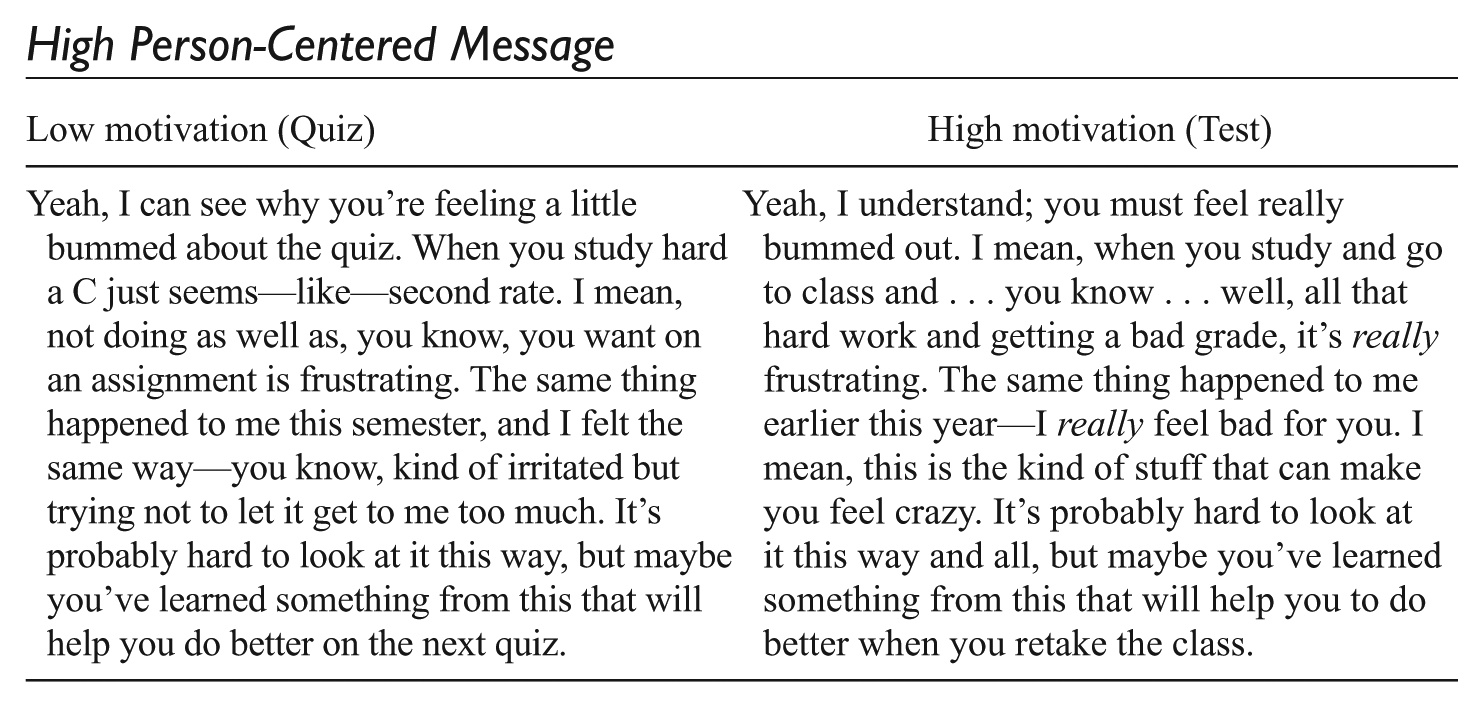
The experimental manipulation of stressor severity was accomplished using a series of PowerPoint slides with narration, pictures, and text. 5 In the mildly stressful condition, students were asked to imagine that they were in a college class in which the professor gave frequent in-class reading quizzes (each worth 1% of the total course grade). They were then asked to assume that although they had made an “A” or a “B” on all prior quizzes, they supposedly earned a “C” on the last quiz they took. In the moderately stressful condition, students were asked to imagine that they were awaiting final grades at the end of the semester. Admittance into their desired major was dependent on the outcome of the final exam of a course in which they had to receive a B to be allowed into the major; they received a D in this class. 6 After the situation, participants were asked to imagine they encountered a recent acquaintance at the student union who delivered a message that was high, moderate, or low in person centeredness (see appendix); no text accompanied the verbal message. These messages were created by adapting the wording of messages manipulated to exhibit low, moderate, and high levels of person centeredness in past studies (e.g., Bodie, Burleson, Gill-Rosier, et al., 2011; Burleson, Holmstrom, & Gilstrap, 2005; Holmstrom, et al., 2005) and were subsequently judged by a panel of experts (see below). Message length was between 86 and 97 words and, when recorded, 26 to 28 seconds. After the stressful situation, participants were asked to respond to several Likert scaled items (7 point).
Motivation
Motivation to process was measured with five items written for the current study: After experiencing this situation, I felt like I needed to talk to someone about it. The situation I experienced motivated me to seek support. After experiencing this situation, I felt no need to talk about it (R). The situation I experienced was stressful enough to motivate me to talk about it with someone. After experiencing this situation, I was interested in what my acquaintance had to say. Removing the last item (λ = .24) resulted in an adequate model, χ2 (2) = 2.39, p = .30, CFI = .99, SRMR = .02, RMSEA = .03 (.00, .15), and scale (α = .82).
Ability
As two factors are purported to underlie processing extent, namely motivation and ability, we also employed a self-report measure of processing ability to test whether stressor severity was solely influencing motivation. This measure contained nine items, six of which loaded highly (λ > .60) on a single latent construct, χ2 (9) = 11.47, p = .25, CFI = 1.00, SRMR = .02, RMSEA = .03 (.00, .09), and produced a high level of internal consistency (α = .92). 7
A two-factor model consisting of all ten items loading on their respective factors, which were allowed to freely covary, also achieved excellent fit, χ2 (34) = 45.60, p = .09, CFI = .99, SRMR = .03, RMSEA = .04 (.00, .07). The correlation between the two factors was estimated to be .25, and a one-factor model produced a statistically inferior model, Δχ 2 (1) = 7.63, p < .01, ΔCFI >.01; thus, motivation and ability represented two operationally distinct constructs.
Anticipated Affect Improvement (AAI)
AAI was measured with six items, one written for the present study (After listening to my acquaintance, I feel better about things.); the other five were borrowed from Jones and Wirtz (2006). As an appropriate operationalization of AAI, all items referred to the recipient’s putative emotional state as opposed to evaluations of the helper or the message. Fit indices suggested an adequate scale, χ2 (5) = 19.77, p = .02, CFI = .99, SRMR = .02, RMSEA = .07 (.03, .12), with high internal consistency (α = .93).
Processing Extent
The thought list protocol originally developed to measure cognitive responding in a persuasive context (Cacioppo & Petty, 1981) was modified for the present study. Participants were asked to “list everything you were thinking while you were viewing and listening to” the stressful situation and the supportive message. After being trained on similar data unassociated with the current study, research assistants independently coded a random subset (20%) of these data. Unitization was accomplished by defining one thought as “any statement that can stand alone; an independent thought.” After establishing unitizing reliability (U = .01), the three coders each coded 1/3 of the thought lists. The mean number of thoughts was 6.30 (SD = 2.45).
Research assistants were then trained to categorize all thoughts as relevant or irrelevant (κ = .95); all relevant thoughts were further coded as positive, negative, or neutral (κ = .76). Relevant thoughts were designated as those directly related to the situation or the message (e.g., “If I received a C I would not really be bummed out or frustrated”) including thoughts about the acquaintance (e.g., “My acquaintance was nice”), whereas irrelevant thoughts were defined as thoughts that have nothing to do with the situation or message (e.g., “Wondered if I was the last one to finish the survey”). The mean number of relevant thoughts listed was 5.84 (SD = 2.60).
Thought valence (positive, negative, neutral) was determined by the general affective tone of the thought with positive thoughts mentioning specific desirable attributes or positive associations, statements of positive affect about the situation or message (e.g., “It seemed I was receiving consistent grades on the quizzes in the class so I’d be happy”); negative thoughts being statements involving the situation or message that mention specific undesirable attributes or negative associations, statements of negative affect (e.g., “He was judging my work ethic without even knowing me”); and neutral thoughts including general thoughts about the situation or message that have no affective tone or that are merely descriptions of the situation or message (e.g., “This could really happen”). There were an average of 1.50 (SD = 1.48) positive thoughts, 2.38 (SD = 2.26) negative thoughts, and 1.70 (SD = 1.59) neutral thoughts. Based on the protocol developed in persuasion research (Wegener, Downing, Krosnick, & Petty, 1995), a dominant cognitive response index was created by subtracting the number of negative from positive thoughts and dividing the absolute value of this difference by the total number of thoughts. Values can range from 0 to 1 with higher numbers indicating more extensive thinking. As expected, participants in the low stress condition demonstrated less extensive thinking (M = .09, SD = .42) than participants in the high stress condition (M = .34, SD = .42), t(184) = 7.08, p < .001, r2 = .21.
To test Hypothesis 5, two additional variables were created from these data. First, the positive thoughts generated on the thought listing task were all conceptually equivalent to the definition of positive emotional words offered by Jones and Wirtz; thus, the number of positive thoughts a participant listed constituted this variable. Second, coders determined if each of the relevant thoughts exhibited a reappraisal of the situation defined as (a) thoughts about the situation or message that indicate a re-evaluation or revision of the situation (e.g., “My acquaintance motivated me to work harder”); (b) thoughts about how to deal with the situation (e.g., “It’s definitely not worth getting upset over”); or (c) thoughts about how to avoid such an event in the future (e.g., “I would study harder for the next quiz”). Coding as either reappraisal or not, two coders were highly reliable, κ = .94. There was an average of 1.07 (SD = 1.04) reappraisal thoughts. The two variables, positive emotion words and reappraisal, were moderately correlated, r = .41, p < .001.
Manipulation Checks
Several manipulation checks were also instituted. Situation realism was measured by four items (e.g., “This situation was realistic”). Removal of the one reverse-coded item(“This situation could never happen”) improved the reliability estimate from .80 to .82, so the three-item scale was retained. To assess whether participants differed in their perceptions of situation realism by condition, a 2 (problem severity) × 3 (VPC: LPC, MPC, HPC) between-groups ANOVA was run with the situation realism measure as the dependent variable. No main or interaction effects were statistically significant, ps > .35.
Perceived problem severity was measured by three items (e.g., “This situation was severe” α = .85). As expected, participants in the low stress condition (M = 3.08, SD = 1.26) perceived their situation as less severe than participants in the moderate stress condition(M = 5.74, SD = 1.03), t(190) = 16.01, p < .001, r2 = .56.
A final check was included for the manipulation of VPC. Perceived message quality was assessed by developing six, 7-point Likert scaled items, adapted from Goldsmith, McDermott, and Alexander (2000); items included “My acquaintance was supportive”; “My acquaintance was encouraging”; “My acquaintance was insensitive” (reverse scored); “What my acquaintance said was heartless” (reverse scored); “My acquaintance was understanding”; and “My acquaintance was considerate”. As appropriate to a measure of message evaluation, each of these items taps perceptions of the behavior of the helper; they do not refer to the participant’s emotional state. 8 The resulting 6-item scale produced high internal consistency (α = .93). The omnibus ANOVA for VPC was significant, F(2, 191) = 38.14, p < 001, η2 = .29. LPC messages (M = 3.80, SD = 1.40) differed from both MPC (M = 5.40, SD = .86), t(126) = 7.77, p < .001, r2 = .32, and HPC messages (M = 5.25, SD = 1.10), t(126) = 6.49, p < .001, r2 = .25; MPC and HPC messages did not differ, t(126) = .87, p = .39, a result common when using a between-subjects design (for review, see, MacGeorge, Graves, Feng, Gillihan, & Burleson, 2004). To ensure that the messages used manifested the appropriate level of VPC, eight experts trained in constructivist analysis of comforting message strategies were asked to indicate the level of VPC of each message. There was 100% agreement that VPC was correctly manipulated.
Results
With N = 192, α = .05, power to detect a significant t-value was .28 for a small effect (d = .20), .93 for a moderate effect (d = .50), and in excess of .99 for a large effect (d = .80). Power to detect a two-way interaction (numerator df = 2, total groups = 6) was .22 for a small effect (f = .10), .88 for a moderate effect (f = .25), and in excess of .99 for a large effect(f = .40). Power to detect significant mediation was .50 for small effects (f2 = .02), and in excess of .99 for medium (f2 = .15) and large effects (f2 = .35). Power to detect significant moderated mediation was .17 for small effects (q = .10), .66 for medium effects (q = .30), and .96 for large effects (q = .50).
Hypothesis 1 predicted that individuals exposed to a more serious stressor would report more motivation to seek out and attend to support than individuals exposed to a less serious stressor. Supporting this hypothesis, individuals exposed to a moderately severe academic stressor reported more motivation to process message content (M = 4.83, SD = 1.22) than those exposed to a mildly severe academic stressor (M = 3.38, SD = 1.25), t(190) = 8.18,p < .001, r2 = .26. In addition, recipients did not report differential levels of processing ability as a function of stressor severity, t(190) = .18, p = .86.
Hypothesis 2 predicted that the effect of VPC on AAI would be moderated by stressor severity such that the effect of VPC would be stronger under a more stressful situation than a less stressful situation. To test this prediction, a 3 (VPC: low, moderate, high) × 2 (stressor severity: mild, moderate) ANOVA was run with AAI as the dependent variable. Although main effects were found for both stressor severity, F(1, 186) = 10.45, p < .001, η2 = .04, partial η2 = .05, and VPC, F(2, 186) = 28.72, p < .001, η2 = .14, partial η2 = .16, they were qualified by a significant interaction between the two variables, F(2, 186) = 11.04, p = .002, η2 = .05, partial η2 = .07. This interaction was decomposed by assessing the simple effect of VPC at each level of stressor severity. As predicted, VPC had a significant main effect on AAI when stress was moderate, F(2, 93) = 37.02, p < .001, η2 = .37, partial η2 = .37, but not when stress was mild, F(2, 93) = 1.41, p = .25. Whereas LPC, MPC, and HPC messages were all statistically similar in the mildly stressful condition (p > .30), when stress was moderate, LPC messages caused less anticipated improvement than MPC, t(62) = 7.00, p < .01, r2 = .43, or HPC messages, t(62) = 5.63, p < .001, r2 = .33; MPC and HPC messages did not differ, t(62) = .72, p = 47 (see Table 1).
Descriptive Statistics for Anticipated Affect Improvement in Various Combinations of VPC and Stressor Severity.
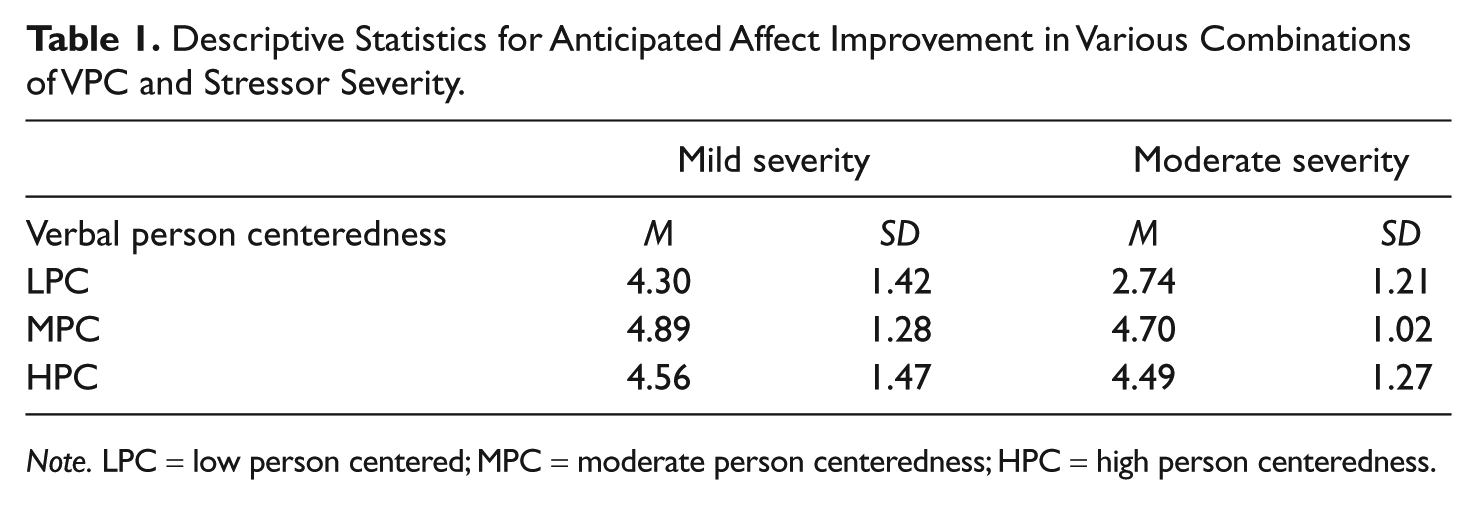
Note. LPC = low person centered; MPC = moderate person centeredness; HPC = high person centeredness.
Hypothesis 3 predicted that the cognitive responses generated after exposure to the stressful situation and supportive message would mediate the relationship between VPC and anticipated affect improvement when stress was relatively high but not when stress was relatively low. Hypothesis 4 specified the primary path stress severity would moderate, namely altering the degree to which VPC affects extent of processing. To assess these hypotheses, three models were evaluated using methods outlined by Preacher et al. (2007): the moderator was specified to influence (a) the path between VPC and processing extent (the predicted model), (b) the path between processing extent and anticipated affect improvement, and (c) paths between VPC and processing extent and processing extent and anticipated affect improvement.
In support of Hypothesis 3, a conditional indirect effect of VPC on anticipated affect improvement was found. Specifically, the indirect effect was significant when stress was moderate, B = .22, SE = .09, Z = 2.32, ps > .20, but not when stress was mild, B = .05, SE = .09, Z = .53, p = .59. When stress was moderate, processing extent explained 23% of the variance in AAI resulting from VPC. Consistent with Hypothesis 4, the predicted model in which the moderator influenced the effect of VPC on processing extent best fit these data. Specifically, stress severity moderated the effect of VPC on processing extent, B = 0.64,SE = .16, t(188) = 3.96, p < .001. In contrast, models in which stress severity was specified to moderate the effect of processing extent on AAI did not fit these data well (p > .20). Thus, Hypothesis 3 and Hypothesis 4 were supported with no support for alternative models.
For comparative purposes, methods similar to those used by Jones and Wirtz were used in the analysis of Hypothesis 5. Specifically, the model depicted in Figure 1 was tested using structural equation modeling techniques, and model fit was assessed by examining the comparative fit index and the error of approximation. VPC, positive emotion words, and reappraisals were modeled as observed variables, whereas AAI was a latent variable with six indicators (see note 4 for measurement model statistics). The model fit the combined data adequately, χ2 (26) = 55.70, p = .001, CFI = .97, RMSEA = .07 (.04, .10); no standardized residual covariances were above two in absolute value. The model achieved statistically superior fit for participants exposed to a moderately stressful situation, χ2 (26) = 45.85,p = .01, CFI = .96, RMSEA = .08 (.04, .13), as compared to those exposed to mild stress, χ2 (26) = 59.30, p < .001, CFI = .95, RMSEA = .11 (.07, .15). Moreover, as seen in Figures 1b and 1c, all path coefficients were statistically significant for highly motivated participants, whereas two key paths, VPC to positive emotion words and VPC to AAI, were not statistically significant for those with low levels of motivation. The latter path is consistent with data reported for Hypothesis 2. As for the extent of mediation, when all data were considered, 7.8% of the variance of VPC on AAI was mediated, a figure slightly lower than the 13.6% reported by Jones and Wirtz. As predicted by the dual-process theory, substantially more (32.8%) of VPC-AAI relationship was mediated when only highly motivated participants were modeled. Thus, Hypothesis 5 was fully supported.
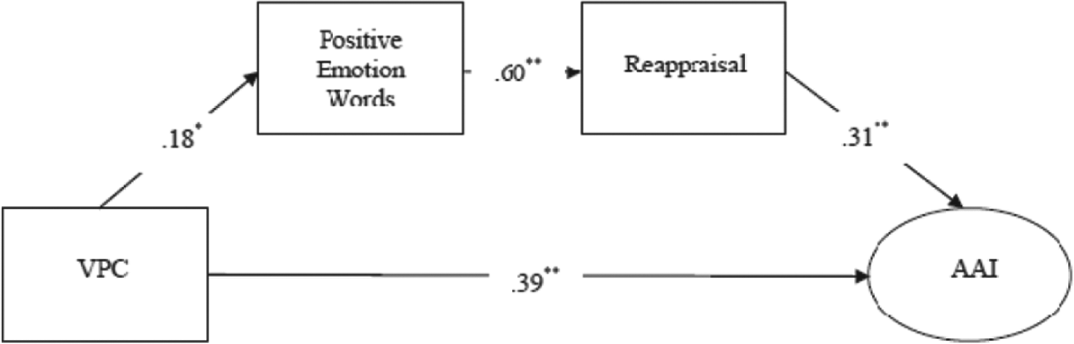
Path coefficients for the combined data testing the conceptual model for Hypothesis 5.
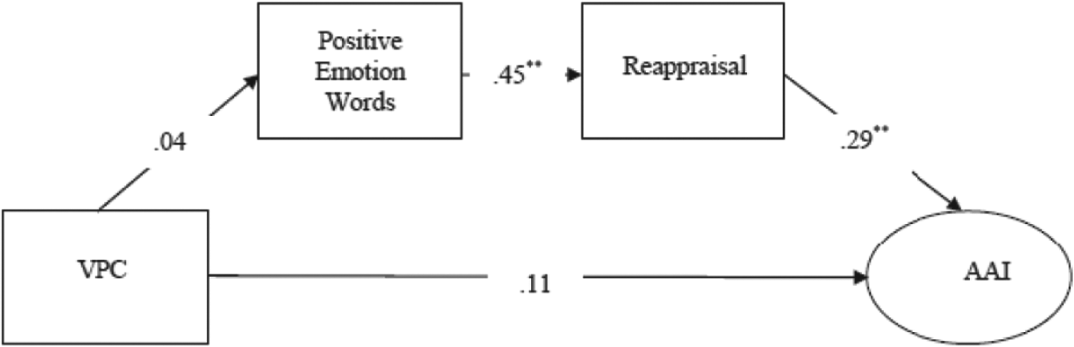
Path coefficients for the mild stress participants testing the conceptual model for Hypothesis 5.
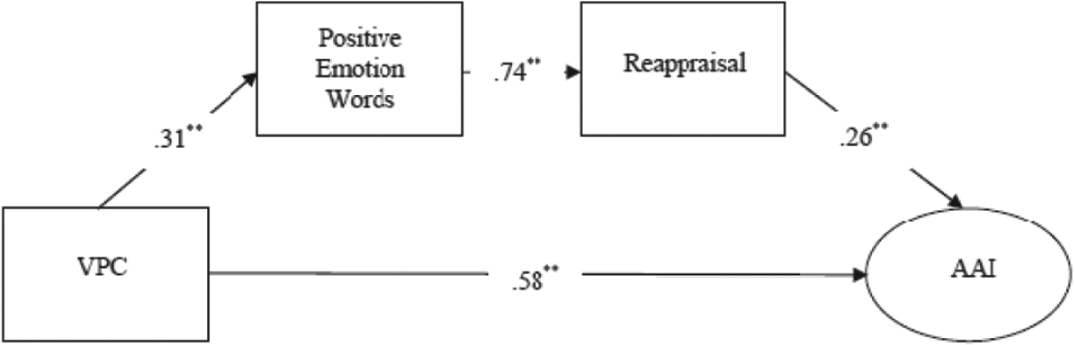
Path coefficients for the moderate stress participants testing the conceptual model for Hypothesis 5.
Discussion
The present study sought to evaluate several predictions derived from a recently proposed dual-process theory of supportive message outcomes. The dual-process framework affords a potentially useful modification to theories explaining how supportive messages work, namely that recipients operate as motivated tacticians, utilizing cognitive resources to analyze message content only when sufficiently motivated and able to do so. Thus, people sometimes think extensively and other times think rather superficially about the enacted support produced by others. In other words, supportive message content is primarily “subject to evaluation” when participants are motivated to evaluate that content (Goldsmith, 2004, p. 26).
The current study focused specifically on stress severity as an influence on message outcomes and speculated that stress severity would influence how elaborately support recipients would think about (i.e., process) comforting messages. Results showed that individuals exposed to a more severe stressor were more motivated to attend to and process supportive message content. In addition, message content had its primary impact on anticipated affect improvement (AAI) when stress severity was moderate but no effect when it was mild. More important, support was found for the prediction that people with greater motivation to process supportive messages actually processed those messages more deeply, as evidenced by the fact that they elaborated more extensively on these messages.
The current results complement those obtained in past tests of this theory, studies that have found individuals discriminate more sharply among better and worse supportive messages as a function of their cognitive complexity, attachment style, and degree of emotional upset (Bodie, Burleson, Gill-Rosier, et al., 2011; Bodie, Burleson, Holmstrom, et al., 2011; Burleson et al., 2009). The primary contribution of the present study to advancing the applicability of the dual-process framework to explaining the outcomes of supportive messages was to test one theoretical mechanism, namely whether processing extent mediates the relationship between supportive message content and its outcomes, especially when processing motivation is high. Indeed, this test is crucial to providing evidence of a general theoretical pathway through which supportive messages are thought to have their effects.
Consistent with predictions derived from the theory, the extent to which participants elaborated on the stressful situation and the provided supportive message partially mediated the effects of VPC on AAI. Specifically, extent of processing mediated about 1/4 of the variance in AAI from comforting messages sent in the moderately stressful situation; there was no mediation in the mildly severe condition—indeed, there was no variation to mediate in that condition. Moreover, results from Hypothesis 4 showed that as stressor severity increased the connection between variations in message quality and cognitive responses to the message became stronger; stressor severity did not moderate any other path in the model. Thus, it appears that once a message recipient engages in issue-relevant thinking about a stressful situation and the corresponding supportive message, those responses influence outcomes equivalently irrespective of stress (see also Bodie et al., 2012). These results provide important additional corroboration for the dual-process theory of supportive message outcomes by demonstrating that VPC influences outcomes, at least in part, through its influence on message processing.
In addition, data were available to investigate the potential for the dual-process framework to modify one exemplar theory of the comforting process that assumes recipients closely attend to the content of supportive messages. The conceptual model originally offered by Burleson and Goldsmith (1998) and initially tested by Jones and Wirtz (2006) was tested separately for participants exposed to moderate and mild stressors with the prediction that the former would exhibit greater AAI as a function of the mediating variables. This prediction was supported, and 1/3 of the relationship between VPC and anticipated affect improvement was a function of the two mediating variables for those with a high degree of motivation to process message content.
Taken together, these results suggest that the dual-process framework has the potential to add unique insight into the comforting process. In particular, this approach suggests a need to account for the degree to which support recipients are motivated to process the content of the messages provided by potential helpers. Of course, in the tests for Hypothesis 3 through Hypothesis 5, processing extent did not account for all the explained variance between VPC and AAI. This result mirrors those presented by Jones and Wirtz (2006) who found that the majority of the VPC-Emotional Improvement effect was direct. Although more of the VPC-AAI relationship was explained by the mediating variables than found in prior work, these results may be specific to the methods used (i.e., hypothetical scenarios) or to the other aspects particular to this one study. Nevertheless, the effects observed in the current study generally confirmed predictions.
With respect to appraisal theory in particular, the current study provides evidence that cognitively demanding mechanisms like reappraisal are most likely to operate under conditions that heighten the motivation to attend to and process messages likely to aid in affect change (i.e., HPC messages). This is, of course, not earth-shattering as Lazarus (1999) has long recognized “two main contrasting ways an appraisal can come about . . . the process of appraising can be deliberate and largely conscious . . . [and/or] intuitive, automatic, and unconscious” (p. 82). The results do, however, provide future scholars with a basis for distinguishing between these two forms of appraisal within the context of supportive communication, for predicting when each is more likely to happen, and for more fully investigating the implications of merging the dual-process framework with the theory of conversationally-induced reappraisals.
More generally, the dual-process framework appears to have utility in suggesting modifications to theories of supportive communication, though the specific ways in which thinking influences the impact of various aspects of the supportive encounter may be theory dependent. For instance, Goldsmith (2004) proposed that the impact enacted support has on physical and psychological well-being can be explained by two mediating variables, namely participants’ evaluation of enacted support and individual coping. Specifically, her model proposes that evaluations of enacted support primarily influence individual coping which ultimately impacts well-being. The modification from the dual-process framework is to propose a moderated mediation model whereby cognitive responding primarily influences the path from enacted support to its evaluation (Bodie et al., 2012). Results from Hypothesis 4 suggest the plausibility of this prediction, and tests of alternative models suggest that alternative paths are less plausible. In sum, the more recipients scrutinize message content, the more that variations in the quality of that content should influence judgments about message content.
Several other theories of supportive communication have been proposed, many of which assume recipients are attending to message content. Although still rather sparse, the available findings suggest that there are several important factors influencing the ability and motivation to process supportive messages. Bodie and Burleson (2008) identify several other factors that appear to influence the processing of supportive messages; future research should compare the magnitudes of effects observed for different moderators so that their relative importance can be determined.
Limitations and Directions for Future Research
Although results of the present study suggest that a comprehensive dual-process approach to supportive communication can be developed and will have important theoretical and practical insights, these insights are cautiously proclaimed given limitations in the present study. First, similar to past work treating VPC as a between-subjects factor, participants in this study did not differentially evaluate MPC and HPC messages. This result was true for the participants’ manipulation check and for the main results even though the messages were theoretically distinct. It is possible that the hypothetical nature of the stressor contributed to these nonsignificant results. Indeed, when people talk about actual stressors, evaluations of MPC and HPC messages typically do differ (Jones & Guerrero, 2001). Other research reports that participants “prefer” MPC messages over HPC messages suggesting that individuals may need only to hear a mid-level comforting response during stress (Lemieux & Tighe, 2004, 2005). Although this perspective has received some criticism (Burleson, Samter et al., 2005), it remains possible that in some stressful situations highly sophisticated forms of support may not be necessary to reduce stress. Indeed, a recent study (Bodie et al., 2012; Study 2) found that in a mildly stressful situation VPC had a direct, negative influence on AAI, and we speculated that HPC messages may be evaluated as “making a mountain out of a molehill” or may imply that the helper thinks the recipient is upset by a minimally significant matter. Perhaps, instead, lower levels of VPC are more casual and imply that the recipient can cope easily with the problem. This might be especially true when support comes from relatively unknown others. Indeed, in this study participants heard a message from a putative acquaintance; whether the same results will be observed when studying intact relationships is an open empirical question. Clearly, future research should seek to isolate and determine the mechanisms through which aspects of VPC result in emotional improvement and discomfort for the recipients of these messages.
A second limitation of this study is its prospective design and the measure of anticipated affect improvement that it consequently used. That is, participants responded to hypothetical situations and reported their anticipated affect improvement following exposure to a comforting message. Although this method is a staple in the supportive communication research tradition (MacGeorge et al., 2011) and it affords the ability to retain tight experimental control over variables of interest, imagining stress and experiencing stress are undoubtedly different and attention should be paid to testing the dual-process theory in more realistic situations (see Bodie, in press-b). Certainly, people make inferences about their anticipated emotional states routinely in everyday life and use these expectations to inform countless decisions and activities, and there is reason to believe that these inferences are valid proxies for what might happen in “real life” (Robinson & Clore, 2002). Thus, it appears reasonable to operationalize one outcome of supportive messages as people’s expectations about their feeling states and to examine how these anticipated states are influenced by both comforting messages and evaluations of these messages. As such, the real sticking point is perhaps an issue of generalizability. In his discussion of this issue Shapiro (2002) warns communication scholars that “too often our thinking is narrowly focused on a set of ‘external validity’ techniques, such as random sampling, aimed at enhancing the surface realism of our studies” (p. 491) when a comprehensive understanding of social meaning and social behavior contributes more to generalization than does the surface representativeness of a particular study” (p. 492). Thus, he suggests that “studies and methods should be examined primarily in light of how they contribute to theoretical development” (p. 492). Issues of external validity are certainly important, but do not seem to render a “fatal flaw” especially for testing a theory at an early stage of development, which was the primary purpose of this manuscript.
A third limitation has to do with insights afforded by the current study in light of how terms are used here and in other treatments of appraisal theory within the context of supportive communication. Lazarus’s appraisal theory, and Burleson and Goldsmith’s theory of conversationally induced reappraisals, distinguishes first between primary and secondary appraisals of events. Primary appraisals concern the degree to which the individual sees the situation as relevant to well-being (goal relevant), congruent with facilitating goals (goal congruence), and the type of ego involvement (e.g., social and self-esteem, life goals) implicated by the stressful event. No studies to date (including this one) attend to how primary appraisals per se, influence issues related to supportive communication. In this study, the manipulation check for perceived severity seems analogous; however, the items used clearly do not tap goal relevance, congruence, or types of ego involvement (e.g., Peakcock & Wong, 1990). Moreover, the measure was employed after the situation and the supportive message, thus disallowing separating the contribution of each component of the scenario. Future research, therefore, should attend to the peculiarities of primary appraisals and employ longitudinal designs that are more appropriate for assessing them.
Secondary appraisals concern the available options for coping and involve perceptions of who is responsible for harm, the controllability of the stressor, and future expectations. In a sense, the measure of motivation employed in the present study seems to tap at least one component of secondary appraisal, namely the felt need and willingness to seek out support to cope with the perceived stressor; the fact that this motivation increased as a function of the severity of the stressor provides direct support for a fundamental tenet of appraisal theory. Seeking social support is, however, only one way to cope with events (Folkman & Lazarus, 1988); oftentimes, it is not the most efficient, and support has been shown to exacerbate as opposed to reduce stress (Bodie, in press-b).
A final point of clarification involves the term appraisal more generally. Appraisal is sometimes the result of evaluation and sometimes used to refer to the coping process. When used to refer to the former (the evaluative product) the term appraisal is most appropriate, whereas appraising is most appropriate when used to refer to the act of evaluating. Appraising is a process, one that can be done more or less systematically (i.e., with more or less degrees of cognitive elaboration or message processing). In the larger theory, however, appraisal is not the final product but is used to describe several more specific mechanisms that drive affect change (Lazarus & Folkman, 1984). One of these is coping which is appraisal with respect to the motivated search for information that can help “alter emotions by creating new relational meaning” (Lazarus, 1999, p. 116; i.e., create a reappraisal). This reappraisal (as mentioned above) can be either deliberative or unconscious, and Lazarus (2001) used cognitive appraisal to “emphasize the complex, judgmental, and conscious process that must often be involved in appraising” (p. 51; i.e., the act of evaluating, not the evaluative product ). It is this type of appraisal that Burleson and Goldsmith (and thus this study) deal with (that is the meditational variable that explains VPC outcomes under conditions that spark deliberative and conscious thinking about message content). Other types of appraisal exist including what Jones and Wirtz (2006) refer to as “several other functions” (p. 239) of person-centered comfort. Instead of proposing that “they ought to be a direct function of person-centered comfort” (p. 239), however, appraisal theory and the dual-process framework suggest that VPC may additionally operate through mechanisms that are more intuitive, spontaneous, and automatic.
Perhaps the primary limitation of this study is that while it focused on one particular message feature generated by an unfamiliar helper at one point in time, support is generally embedded within conversation, particularly with close others, that take place over time (Goldsmith, 2004). Thus, the current study is limited, as is most past work that studies the impact of VPC on various outcomes, primarily by concerns of external validity. Given the focus on one particular message feature, it should be noted that the advantage of using the person-centered paradigm, and the reason this line of research (and similar research by Goldsmith and Barbee and colleagues) has been influential across academic disciplines, is that it allows researchers to actually examine the content and quality of supportive communication and its impact. Moreover, concerns of this nature seem to be minimized by other research finding that when VPC comfort is embedded in conversation it has similar effects (e.g., Jones, 2004; Jones & Guerrero, 2001; Jones & Wirtz, 2006). Certainly, the findings reported above would be strengthened by longitudinal research focused on the effects of VPC comfort over time on a variety of outcomes in a variety of relationships. Nevertheless, the present study suggests the role of thinking in the comforting process should be afforded a more central role.
Footnotes
Appendix
High Person-Centered Message
| Low motivation (Quiz) | High motivation (Test) |
|---|---|
| Yeah, I can see why you’re feeling a little bummed about the quiz. When you study hard a C just seems—like—second rate. I mean, not doing as well as, you know, you want on an assignment is frustrating. The same thing happened to me this semester, and I felt the same way—you know, kind of irritated but trying not to let it get to me too much. It’s probably hard to look at it this way, but maybe you’ve learned something from this that will help you do better on the next quiz. | Yeah, I understand; you must feel really bummed out. I mean, when you study and go to class and . . . you know . . . well, all that hard work and getting a bad grade, it’s really frustrating. The same thing happened to me earlier this year—I really feel bad for you. I mean, this is the kind of stuff that can make you feel crazy. It’s probably hard to look at it this way and all, but maybe you’ve learned something from this that will help you to do better when you retake the class. |
Acknowledgements
I express gratitude to Drs. ErinaMacGeorge, Melanie Morgan, and Duane Wegener for their insights as committee members. Thanks are also extended to John Greene and Susanne Jones for reading a previous version of this manuscript and to JerilynMincy, Ashton Steffen, and Laura Sivy for assisting with data collection.
Author’s Note
This manuscript is part of the author’s doctoral dissertation completed under the direction of Dr. Brant Burleson at Purdue University. A previous version of this manuscript was awarded Top Paper in Communication Theory at the 2011 Southern States Communication Association meeting.
Declaration of Conflicting Interests
The author declared no potential conflicts of interest with respect to the authorship and/or publication of this article.
Funding
Partial funding for this project was provided by the Central States Federation Prize and a Purdue Research Foundation Dissertation Grant, both awarded to the author and his academic advisor, Brant Burleson.