







Abstract
With the academic risk and resilience perspective, this study examined whether global, authority, and teacher discrimination were indirectly related to academic motivation through self-esteem and depressive symptoms (H1), determined whether supportive maternal and paternal parenting moderated such associations (H2), and considered developmental differences (H3 & RQ1). Using self-reported data from 338 Mexican-origin female adolescents, the results partially supported the hypotheses. Indirect association and moderation were found among middle adolescent females of Mexican descent, but not for early adolescent females. Among middle adolescent females of Mexican descent, global discrimination was indirectly related to academic motivation through self-esteem but not through depressive symptoms. Supportive maternal parenting and supportive paternal parenting were moderators for Mexican-origin middle adolescent females but in unexpected ways.
Keywords
Latino adolescents often face ethnic/racial discrimination because of their accent and language skills (Ajayi, 2006), nativity (Pérez, Jennings, & Gover, 2008), documented versus undocumented status (Dovidio, Gluszek, John, Ditlmann, & Lagunes, 2010), and physical features (DeGarmo & Martinez, 2006). Ethnic/racial discrimination occurs in a number of ways such as through racial slurs, teasing, physical threats, exclusion, and receiving unequal opportunities (Ajayi). Thus perpetrators of ethnic/racial discrimination use verbal and nonverbal communication to convey their negative attitudes toward others based on ethnic/racial group membership. Perceived ethnic/racial discrimination refers to individuals’ beliefs that they have been treated unfairly as a result of others’ negative attitudes toward them as ethnic/racial outgroup members (Kam & Cleveland, 2011). Given the unfair and undesirable nature of ethnic/racial discrimination, the perception of this communicative act has been directly and indirectly linked to Latino adolescents’ poor psychological and academic adjustment such as low academic motivation (Perreira, Fuligni, & Potochnick, 2010), low self-esteem (Umaña-Taylor & Updegraff, 2007) and depressive symptoms (Moradi & Risco, 2006).
To theoretically explain why perceived ethnic/racial discrimination is associated with poor psychological and academic adjustment, researchers have applied the academic risk and resilience perspective (Alfaro, Umaña-Taylor, & Bámaca, 2006). According to this perspective, risk factors are events, environments, situations, or experiences that increase the probability of developing negative outcomes (Gewirtz & Edleson, 2007). When individuals face adversity, such challenges are often stressful, undesirable, and uncomfortable, thereby making individuals vulnerable (i.e., at risk) to poor psychological adjustment (e.g., low self-esteem, depressive symptoms) and academic adjustment (e.g., low academic motivation, low grades, and low standardized test scores; Alfaro, Umaña-Taylor, Gonzales-Backen, Bámaca, & Zeiders, 2009).
Yet not everyone who perceives ethnic/racial discrimination develops low self-esteem, depressive symptoms, and low academic motivation (Umaña-Taylor & Updegraff, 2007). The academic risk and resilience perspective postulates that support from significant others (e.g., parents, partners, and friends) operates as a protective resource by weakening perceived ethnic/racial discrimination’s associations with poor psychological and academic adjustment (Alfaro et al., 2009). A supportive environment protects youth against adversity by making them feel safe, confident, and important (Scaramella, Conger, & Simmons, 1999). Thus we use the present study to test the assumptions set forth by the academic risk and resilience perspective. We examine whether perceived ethnic/racial discrimination is indirectly related to academic motivation through poor psychological adjustment and whether supportive maternal and paternal parenting function as protective resources.
Differences based on Ethnicity, Sex, and Developmental Stages
Adolescents from various ethnicities experience discrimination as well as poor psychological and academic adjustment, but Mexican-origin adolescents are particularly susceptible to these negative outcomes (Joiner, Perez, Wagner, Berenson, & Marquina, 2001). They often report lower self-esteem, greater depressive symptoms, and weaker academic performance compared to adolescents from other ethnic groups (Umaña-Taylor, Updegraff, & Gonzales-Backen, 2011). Language barriers, perceived ethnic/racial discrimination, and acculturation gaps between parents and children are several explanations for Mexican-origin adolescents being at greater risk (Umaña-Taylor et al., 2011). In addition, individuals of Mexican descent tend to report more pessimism than other ethnic groups (Domino, Fragoso, & Moreno, 1991). As Mexican-origin adolescents face adversity, they are more likely to interpret it through pessimism and hopelessness than other ethnic groups, thereby resulting in poorer psychological adjustment (Joiner et al., 2001).
As variations exist between ethnic groups, heterogeneity also exists within ethnic groups. For example, adolescent females of Mexican origin are often more susceptible to poor psychological adjustment compared to their male counterparts (Céspedes & Huey, 2008). To explain this finding, research points to developmental differences. Benjet and Hernandez-Guzman (2001) found no sex differences in self-esteem and depression for male and female Mexican youth prior to the females’ premenarche, but postmenarche Mexican-origin females reported lower self-esteem and greater depressive symptoms than males. Thus at the onset of adolescence, developmental factors may have a stronger influence on Mexican-origin females’ psychological adjustment. Accordingly, we examine potential within-group variability among Mexican-origin females by focusing on two developmental stages: early and middle adolescence (García Coll et al., 1996). Such distinctions shed light on unique developmental processes among female adolescents that may affect how parents function as protective resources in the context of perceived ethnic/racial discrimination, psychological adjustment, and academic adjustment (Umaña-Taylor et al., 2011).
Perceived Ethnic/Racial Discrimination in Relation to Psychological and Academic Adjustment
Given the undesirable and unwarranted nature of perceived ethnic/racial discrimination, the academic risk and resilience framework views this phenomenon as an adverse experience that is likely to result in negative outcomes (Umaña-Taylor & Updegraff, 2007). Although not all adverse experiences inevitably lead to poor psychological and academic adjustment, Agnew (2001) argued that oppressive, unfair, and uncontrollable ones such as perceived ethnic/racial discrimination are likely to place adolescents at greater risk for negative psychological and behavioral outcomes. When individuals face unfair treatment based on their ethnicity, they experience exposure to a negative stimulus (e.g., teasing, being called racial slurs), lose their sense of security (e.g., receiving physical threats), and are unable to accomplish their goal of receiving equal treatment (e.g., being afforded fewer opportunities, exclusion) or gaining social acceptance (Kam & Cleveland, 2011). Because of these negative experiences, perceived ethnic/racial discrimination makes individuals, including Mexican-origin adolescents, vulnerable to poor psychological and academic adjustment (DeGarmo & Martinez, 2006).
Psychological Adjustment: Self-esteem and Depressive Symptoms
Perceived ethnic/racial discrimination threatens one’s self-worth and self-concept, which are components of self-esteem (Romero & Roberts, 1998). Suárez-Orozco and Suárez-Orozco (2001) suggested that youth of immigrant families develop their identities based on how mainstream culture perceives and treats them, a phenomenon referred to as social mirroring. Both social identity theory (SIT; Tajfel & Turner, 1986) and symbolic interactionism (Blumer, 1969) postulate that people define and evaluate themselves in relation to their interactions with significant others. Applied to the context of perceived ethnic/racial discrimination, noxious and unwarranted treatment toward one’s group can lead individuals, such as Mexican-origin female adolescents, to internalize the negative perceptions of others (Umaña-Taylor et al., 2011).
Using SIT and symbolic interactionism, individuals who encounter unfair treatment based on their ethnic group are likely to internalize the negative messages and develop low self-esteem (Delgado, Updegraff, Roosa, & Umaña-Taylor, 2011). When others tease, threaten, or exclude them, when store clerks suspect them of wrongdoing, or when teachers underestimate their academic abilities, such discriminatory behaviors challenge individuals’ self-esteem (Armenta & Hunt, 2009). Furthermore, self-esteem is often influenced by the desire for social acceptance, but perceived ethnic/racial discrimination is a form of social rejection (Carlson, Uppal, & Prosser, 2000). Consistent with this notion, Umaña-Taylor and Updegraff (2007) found a negative association between perceived ethnic/racial discrimination and self-esteem among a sample comprising mostly of Mexican adolescents.
As individuals internalize unfair treatment, they also are likely to experience loneliness, vulnerability, helplessness, and a lack of belonging; these feelings characterize depressive symptoms (Wong, Eccles, & Sameroff, 2003). Among Latino adolescents, perceived ethnic/racial discrimination has been associated with higher levels of depressive symptoms (Umaña-Taylor & Updegraff, 2007). Moreover, past research indicates that individuals of Mexican descent tend to be more pessimistic when faced with adversity compared to other ethnic groups, making them more vulnerable to depressive symptoms (Joiner et al., 2001). When facing unfair treatment because of their ethnic group membership, Mexican-origin females are likely to develop negative psychological reactions in the form of depressive symptoms (Umaña-Taylor et al., 2011), which in turn may inhibit their academic motivation.
Academic Adjustment: Academic Motivation
A primary predictor of performing well in school is academic motivation, which refers to the belief that succeeding in school is important and that one tries hard to obtain such success (Plunkett & Bámaca-Gómez, 2003; Robbins et al., 2004). For example, a meta-analysis found that academic motivation was the second strongest predictor of college students’ GPA (Robbins et al., 2004), and another study revealed that academic motivation predicted standardized test scores (Anderson & Keith, 1997). Having a desire to perform well in school and valuing an education are related to better academic performance; however, certain adverse experiences may threaten academic motivation (Alfaro et al., 2006, 2009).
As Mexican-origin females experience low self-esteem and depressive symptoms related to perceived ethnic/racial discrimination, their feelings of helplessness may, in turn, inhibit their academic motivation. With low self-esteem, female adolescents may feel less efficacious about school, thereby lacking motivation to succeed in school (Lane, Lane, & Kyprianou, 2004). As they experience depressive symptoms, they may be distracted by such feelings, which may, in turn, prevent them from concentrating on school (Fröjd et al., 2008). Such feelings of disengagement with school, coupled with feelings of alienation, are likely associated with lower levels of academic motivation (Wong et al., 2003).
Different Types of Perceived Ethnic/Racial Discrimination
Much of the perceived ethnic/racial discrimination research (e.g., Umaña-Taylor & Updegraff, 2007) only considers global discrimination in relation to psychological and academic adjustment. Global discrimination refers to general forms of unfair treatment carried out by anyone, and it includes being excluded from activities and interactions, receiving insults and racial slurs, and encountering threats of harm (Whitbeck et al., 2001). Whitbeck et al., (2001) however, identified two additional types: authority and teacher discrimination. Authority discrimination involves adult figures such as store owners and people working at a place of business who may suspect individuals of wrongdoing because of their ethnicity. Teacher discrimination refers to occasions when teachers underestimate individuals’ abilities because of their ethnicity. To extend past research, this study examines the potentially harmful associations that the three types of perceived ethnic/racial discrimination share with self-esteem and depressive symptoms and, in turn, academic motivation. All three types of perceived ethnic/racial discrimination are stressful, unwarranted, and undesirable; therefore, the academic risk and resilience perspective would consider all of them as threats to psychological and academic adjustment (Agnew, 2001; Delgado et al., 2011). Yet it is possible that certain kinds of perceived ethnic/racial discrimination may be more strongly related to psychological adjustment than others because of the nature of the relationships that the adolescents share with the people who discriminate against them.
SIT and symbolic interactionism (Blumer, 1969) suggest that perceptions of significant others (e.g., family members, friends, teachers) influence how people see themselves and feel about themselves. We posit that perceived ethnic/racial discrimination from teachers is more likely to threaten Mexican-origin females’ self-esteem and encourage depressive symptoms than authority discrimination because teachers are considered significant others. If teachers do not believe their students will succeed, students are likely to internalize those perceptions, thereby developing lower psychological adjustment (Harter, 1996). By definition, however, authority discrimination occurs when adult strangers suspect adolescents of doing something wrong because of their ethnicity (Whitbeck et al., 2001). This type of discrimination most likely involves store clerks, sales people, and business owners with whom the victims share more impersonal relationships. Given the more distant nature of the relationships in authority discrimination, this type of offensive behavior may have weaker (although still significant) direct associations with poor psychological adjustment. Yet based on symbolic interactionism, receiving negative feedback from teachers is likely to be more detrimental because of the more proximal and interpersonal nature of their relationships. Finally, drawing from the definition of global discrimination (Whitbeck et al., 2001), anyone (e.g., classmates, friends, adults, strangers, store clerks, teachers, school principals) can carry out this type of unfair and noxious treatment, regardless of whether they share a personal or impersonal relationship with the victim. This conceptualization of global discrimination means that it encompasses unfair and undesirable treatment from significant and insignificant others. Because it captures both types of relationships, we propose that global discrimination is likely to be particularly harmful to Mexican-origin females’ psychological adjustment. To represent these unique associations, we developed a mediation model with the following hypothesis:
Hypothesis 1a (H1a): Global, authority, and teacher discrimination will be negatively associated with self-esteem and positively associated with depressive symptoms. In turn, self-esteem will be positively related and depressive symptoms will be negatively related to academic motivation.
Hypothesis 1a (H1b): Global discrimination will exhibit the strongest direct associations with self-esteem and depressive symptoms, followed by teacher and then authority discrimination.
Supportive Maternal and Paternal Parenting as Protective Resources
From the academic risk and resilience perspective (Alfaro et al., 2006), protective resources refer to variables that interact with adverse experiences such that the protective resource has little or no effect for low-risk groups but greater positive effects for high-risk groups (Donahue & Pearl, 2003). One such protective resource is a supportive family environment. Through verbal and nonverbal messages, parents may convey to their children feelings of concern, love, security, trust, understanding, and respect; this communication process is known as supportive parenting (Armsden & Greenberg, 1987; Gutman, Sameroff, & Eccles, 2002). Among families of Mexican descent, emphasis is placed on providing and receiving support in a reciprocal nature, thereby creating a secure and trusting family environment (Romero & Ruiz, 2007). DeGarmo and Martinez (2006) found that supportive parenting, rather than school or peer support, buffered against perceived ethnic/racial discrimination such that Latino adolescents high in supportive parenting exhibited a weaker association between perceived ethnic/racial discrimination and academic adjustment. Hence supportive parenting may protect Mexican-origin female adolescents against perceived ethnic/racial discrimination.
A current limitation, however, is the lack of attention to paternal supportive parenting, particularly among underserved groups (Cabrera, Tamis-LeMonda, Bradley, Hofferth, & Lamb, 2000). Past studies (e.g., Scaramella et al., 1999) often combine maternal and paternal supportive parenting into one composite score or only consider maternal supportive parenting (e.g., Hill, Bush, & Roosa, 2003). Investigating the protective nature of maternal and paternal supportive parenting is crucial, given that mothers and fathers both play important roles in their daughters’ lives, but they may differ in how they moderate the association between perceived ethnic/racial discrimination and psychological adjustment (Lytton & Romney, 1991; Russell & Saebel, 1997). For instance, the mother–daughter relationship is often described as unique in its close, connected, and interdependent nature, more so than the father–daughter relationship (Miller-Day, 2004). Yet the few studies that have been conducted on fathers of Mexican descent revealed that such fathers are generally engaged, affectionate, and supportive with their children (Caldera, Fitzpatrick, & Wampler, 2000). The problem is that research on father–child relationships and how they influence their children’s well-being remains sparse (Cabrera et al., 2000).
In sum, we set forth a mediated moderation model in which the hypothesized direct and indirect associations of perceived ethnic/racial discrimination with psychological and academic adjustment may be weaker for Mexican-origin females high in supportive maternal and paternal parenting and stronger for Mexican-origin girls low in such resources. Here, we suggest that the moderation of supportive maternal and paternal parenting is mediated by self-esteem and depressive symptoms; hence, we posited the following hypothesis:
Hypothesis 2 (H2): Supportive maternal parenting and supportive paternal parenting will operate as protective resources that attenuate global, authority, and teacher discrimination’s associations with psychological adjustment.
Developmental Differences
Wierson and Forehand (1992) argued that adolescents should not be treated as a homogenous group because unique cognitive, physical, and social changes emerge as youth experience adolescence. During that period, developing an identity and feelings of self-worth often becomes more salient and important (Whitbeck et al., 2001). Furthermore, their mental processing abilities also develop throughout adolescence and their capability for perceiving and comprehending discriminatory behaviors becomes sharper, as they become more aware of their ethnic identity (Delgado et al., 2011; Stone & Han, 2005). Given this developmental change, it is possible that Mexican-origin females in middle adolescence may be more sensitive to experiences with perceived ethnic/racial discrimination that threaten their self-esteem compared to early adolescents. Thus the following hypothesis was set forth:
Hypothesis 3 (H3): The mediation model, as posited in H1, will operate differently among Mexican-origin females in early and middle adolescence.
When considering the ways in which developmental changes impact the protective nature of parent-based resources, multiple perspectives exist. Both interactional theory (Thornberry, 1987) and the Sullivan-Piaget thesis (Nathanson, 2001) suggest that parental attachment and involvement play more dominant roles in pre- and early-adolescence, but as youth grow older, peer influences become stronger and more salient compared to parental influences. In contrast, other researchers (e.g., Quick & Stephenson, 2007) have argued that parents maintain their salient role throughout adolescence. Few studies have considered the developmental differences in family-based protective resources, particularly with respect to the associations between perceived ethnic/racial discrimination and adjustment variables (Wierson & Forehand, 1992). Hence, we proposed the following research question:
Research Question 1 (RQ1): Will the mediated moderation model, as posited in H2, operate differently for Mexican-origin females in early and middle adolescence?
Method
Participants
Data for this study come from a larger project that obtained self-reported cross-sectional data from Mexican-origin mother–daughter dyads. The goal was to examine the role of developmental, cultural, and mother–daughter relationship factors in relation to female adolescents’ depressive symptoms. The original sample comprised of 338 adolescent females, and among them, 319 had a mother who completed a survey. The analyses of the current study, however, are based on data from the 338 adolescents because mothers completed a shorter survey that did not include all the variables of interest.
During data collection, Mexican-origin females were in 7th (early adolescence) or 10th grade (middle adolescence) and came from four middle schools and six high schools in a U.S. Southwestern metropolitan area. At the participating schools, a high percentage of the student body was of Latino descent (i.e., from 67% to 88%). Most participants (80%) completed the English version of the survey. Among eligible participants (i.e., female 7th or 10th graders identified by school records as Latina), school rates of participation ranged from 17.1% to 25.9% for the 7th-grade sample and from 6.1% to 17.9% for the 10th-grade sample. To qualify for this study, both mother and daughter had to participate and adolescents had to attend an information meeting at school prior to completing the survey, which likely explains the low response rate.
The seventh-grade sample comprised of 170 adolescents ranging in age from 11 to 14 years (M = 12.27, SD = .48). Most of them (65.7%) reported being born in the United States, followed by Mexico (34.0%), but one female was born in the United States, raised in Mexico, and then later returned to the United States. The 10th-grade sample comprised of 168 adolescents whose ages ranged from 14 to 17 years (M = 15.21, SD = .46). Over half (62.5%) of the 10th-grade participants reported being born in the United States. Most of them (59.8%) lived in households with their biological mother and father, but other family constellations (e.g., mother and stepfather and mother-only) were reported as well. Many mothers (82.5%) and fathers (83.7%) were born in Mexico. With respect to parents’ educational attainment, most mothers (67.6%) received some formal schooling but had not finished high school; 18.5% had a high school degree or equivalent; 11.7% had some college experience, and 2.2% had a bachelor’s degree. Among fathers, most (72.2%) received some formal schooling but had not finished high school; 15.0% had a high school degree or equivalent; 9.9% had some college experience, 2.6% had a bachelor’s degree, and .3% had a master’s degree.
Design and Procedures
School personnel mailed letters home detailing the study and requesting that families return an informational sheet if they were interested in participating. Adolescents who provided signed consent and assent forms completed the questionnaire in a group setting (i.e., classroom, school cafeteria, or school library), which took approximately 1 hour to complete. All documents that were not originally available in Spanish were translated by the first author and back-translated by a researcher of Mexican origin. For participating, adolescents received US$10.
Measures
For each scale items were averaged, with higher scores indicating more perceived ethnic/racial discrimination, self-esteem, depressive symptoms, academic motivation, and supportive parenting (see Table 1 for descriptive statistics and bivariate correlations). Prior to averaging the items, confirmatory factor analyses (CFAs) were conducted and evaluated based on Hu’s and Bentler’s (1999) goodness-of-fit criteria. The scales were based on CFA models that yielded the best fit (detailed CFA results are available upon request).
Means, Standard Deviations, Bivariate Correlations, and Reliability.
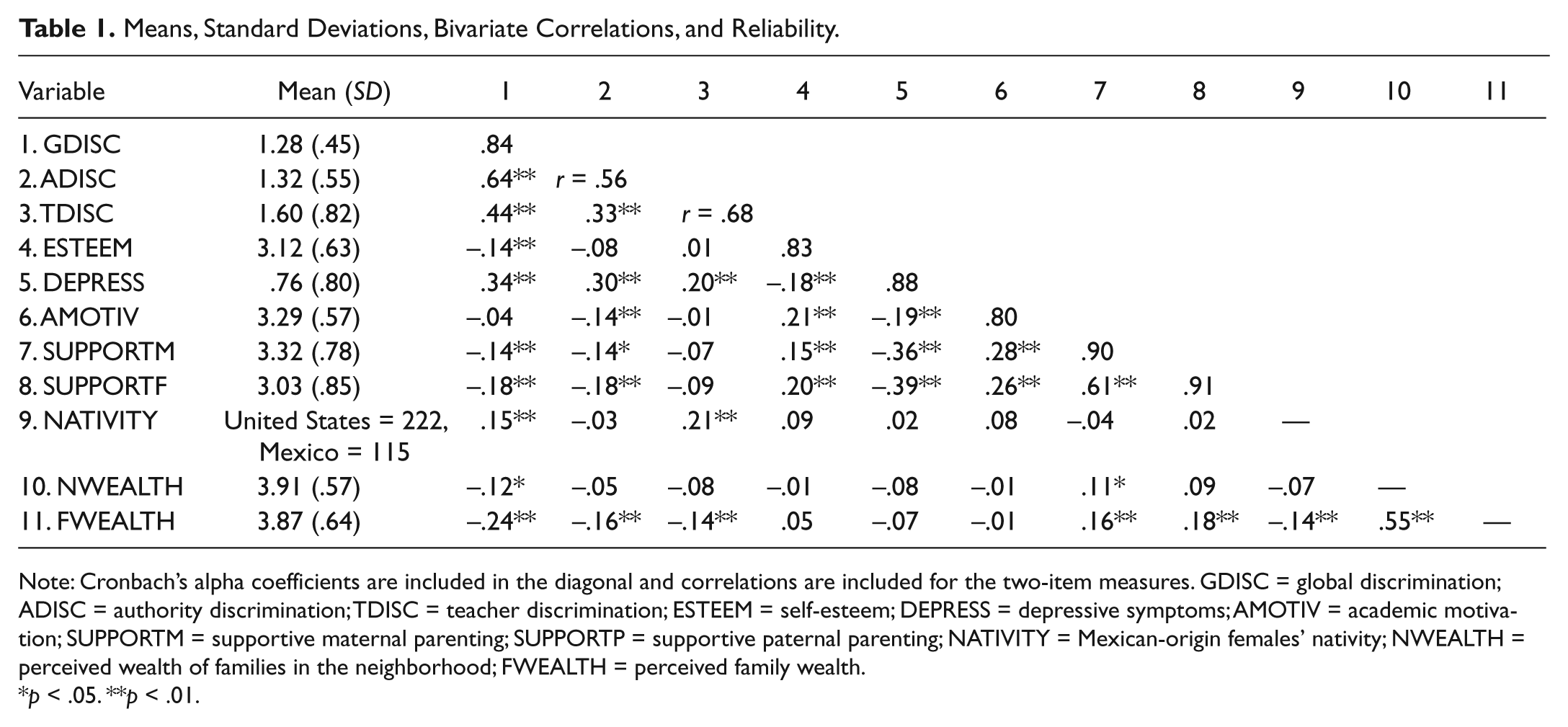
Note: Cronbach’s alpha coefficients are included in the diagonal and correlations are included for the two-item measures. GDISC = global discrimination; ADISC = authority discrimination; TDISC = teacher discrimination; ESTEEM = self-esteem; DEPRESS = depressive symptoms; AMOTIV = academic motivation; SUPPORTM = supportive maternal parenting; SUPPORTP = supportive paternal parenting; NATIVITY = Mexican-origin females’ nativity; NWEALTH = perceived wealth of families in the neighborhood; FWEALTH = perceived family wealth.
p < .05. **p < .01.
Perceived ethnic/racial discrimination
This study used a revised version of the Perceived Discrimination Scale (Whitbeck et al., 2001). Adolescents’ were asked how often they perceived global (5 items; e.g., “How often has someone yelled racial slurs or racial insults at you?”), authority (2 items; e.g., “How often has a store owner, sales clerk, or person working at a place of business treated you in a disrespectful way because you are Hispanic/Latino?”), and teacher (2 items; e.g., “How often have you encountered teachers who are surprised that you as a Hispanic/Latino person did something really well?”) discrimination. Adolescents used a 3-point scale of never (1) to always (3). The alpha coefficient was .84 for global and correlations between the two authority discrimination items and the two teacher discrimination items were .56 and .68, respectively.
Self-esteem
Four items from the Rosenberg Self-Esteem Scale (Rosenberg, 1965) were used to assess adolescents’ positive self-esteem (e.g., “I am able to do things as well as most other people”). Adolescents responded to a 4-point scale of strongly disagree (1) to strongly agree (4). The Rosenberg Self-Esteem Scale is comprised of 10 items with negatively worded items reverse coded. Nevertheless, similar to Supple and Plunkett (2011), the best fitting model was the 4-item CFA with positively worded self-esteem items that did not need reverse coding. The alpha coefficient for the positive self-esteem measures was .83.
Depressive symptoms
This study assessed depressive symptoms with the 6-item depressive affect subscale from the Center for Epidemiologic Studies Depression Scale (CES-D; Radloff, 1977). To operationalize depressive symptoms, we asked adolescents how often in the past week they felt a certain way (e.g., “I felt depressed.”). Items were rated on a 4-point scale, with end points of rarely or none of the time (0; less than 1 day) and mostly or almost all the time (3; 5-7 days). The CES-D originally comprised of 20 items and included multiple dimensions (e.g., depressive affect, somatic symptoms, and interpersonal problems). We chose the 6-item measure of depressive affect because it garnered support when examining the CFA model and Cronbach’s alpha (α = .90). Also, the subscale appeared to capture a more general conceptualization of depressive symptoms.
Academic motivation
This study used the Academic Motivation Scale (Plunkett & Bámaca-Gómez, 2003). Four items (e.g., “I try hard in school”) were scored on a 4-point scale with anchors of strongly disagree (1) to strongly agree (4). The alpha coefficient was .79.
Supportive parenting
Six items from the Inventory of Parent and Peer Attachment (Armsden & Greenberg, 1987) assessed adolescents’ perceptions of their mothers’ and fathers’ Supportive Parenting (e.g., “If this parent knew something bug me, she/he would ask about it”). Items were rated on a 4-point scale with end points of almost never or never (1) to almost always or always (4). The alpha coefficients for mothers and fathers were .91 and .90, respectively.
Control variables
In the analyses, we included nativity, adolescent females’ perceived wealth of families in their neighborhood, and perceived family wealth as control variables because they were significantly related with several of the dependent variables at p < .25. Here, we applied a more liberal significance level for control variables, as suggested by Chatterjee, Hadi, and Price (2000). Mexican-origin females’ nativity (1 = United States, 2 = Mexico) was positively related to self-esteem and academic motivation. Their perceived wealth of families in their neighborhood (1 = very poor to 5 = upper-middle class) and perceived family wealth (1 = very poor to 5 = upper-middle class) were negatively related to depressive symptoms. The language that adolescents primarily spoke at home and their parents’ highest educational level were obtained; however, these two variables were not significantly related to any of the mediators or dependent variables at p < .25. Hence, they were excluded as control variables.
Analysis Summary
We used Mplus 6.0 to examine the hypothesized models. Although most variables had less than 2% missingness, supportive paternal parenting had 10% to 12% missingness. As suggested by Graham (2009), the full information maximum likelihood (FIML) was applied to handle the data’s missingness and the maximum likelihood estimator with robust standard errors (MLR) was used for the data’s nonnormality.
To test H1a, H1b, and H3, a restricted mediation model was assessed, with indirect paths from the three perceived ethnic/racial discrimination variables to academic motivation through self-esteem and depressive symptoms. Direct paths from the perceived ethnic/racial discrimination variables to academic motivation also were examined. In the restricted mediation model, the parameters were constrained to be equal for early and middle adolescents. Then, an unrestricted model was examined in which the parameters were freely estimated across early and middle adolescents. A chi-square difference test indicated whether the unrestricted mediation model significantly improved the model fit.
When conducting the multigroup mediation analyses (H2 & RQ1), bias-corrected bootstrap confidence intervals (CI) were obtained, with the number of bootstrapping set at 5,000 (Preacher, Rucker, & Hayes, 2007). Multigroup mediated moderation analyses were conducted to examine the moderating role of supportive maternal and paternal parenting. First, interaction terms were created in which each centered supportive parenting variable was multiplied by each centered perceived ethnic/racial discrimination variable (Aiken & West, 1991). For each multigroup mediation moderation model (see Figure 1 for an example), the global discrimination variable (X1), authority discrimination variable (X2), teacher discrimination variable (X3), supportive maternal or paternal parenting variable (W), three interaction variables (X1W; X2W; X3W), self-esteem (M1), depressive symptoms (M2), and academic motivation (Y) were included (Preacher et al., 2007). A set of restricted and unrestricted models was examined for each protective resource, with chi-square difference tests conducted to determine whether the mediated moderation models significantly differed for early and middle adolescents.
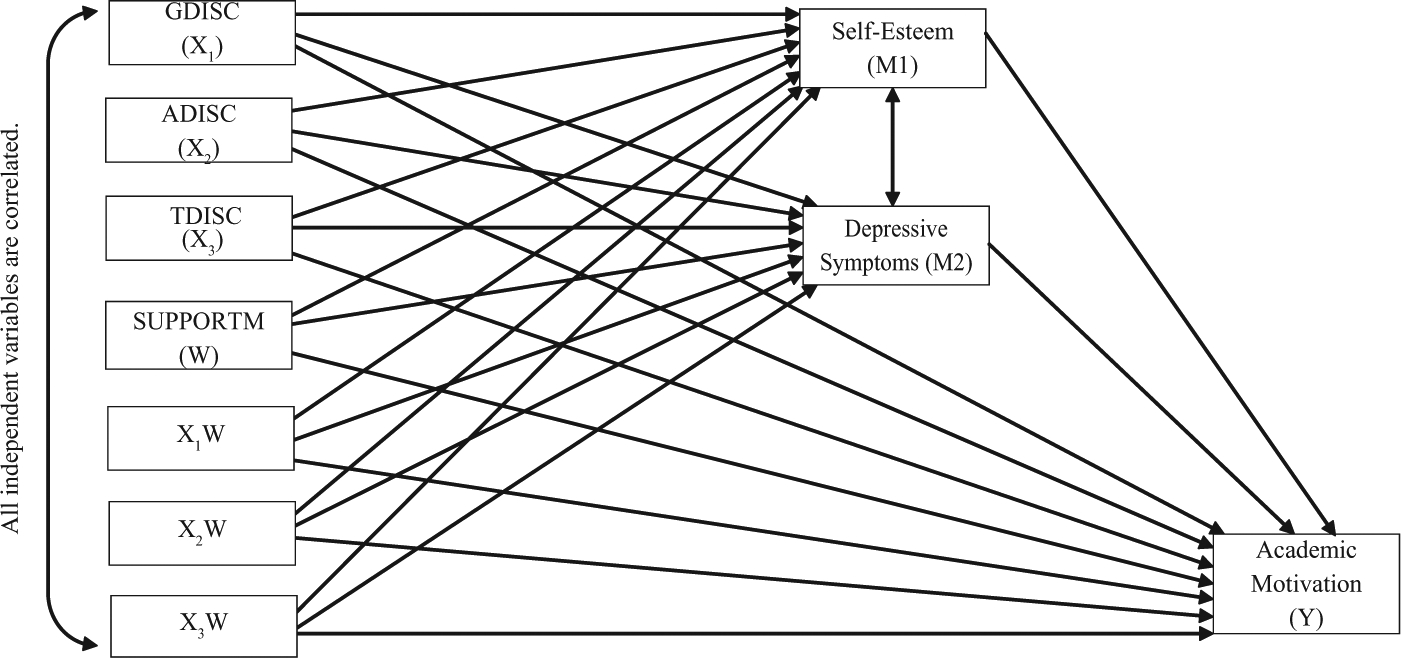
A mediated moderation model with supportive maternal parenting as an example.
We used a more conservative significance value of p < .025 to decrease the likelihood of performing a Type I error for the two mediated moderation models. This significance value was obtained by dividing p = .05 by two because the results for the second hypothesis are based on two mediated moderation models: supportive maternal parenting and supportive paternal parenting (Matsunaga, 2007). When interactions were significant, we obtained the simple slopes in SPSS 17.0 to determine the associations between the perceived ethnic/racial discrimination and the psychological adjustment variables at high and low supportive parenting. Each centered supportive parenting variable mean was subtracted from or added to its corresponding standard deviation, thereby representing high and low levels of supportive parenting. Then, the centered perceived ethnic/racial discrimination variable was multiplied by high or low supportive parenting. Regression analyses were conducted for a subsample of Mexican-origin early or middle adolescents, depending on which group had the significant interaction.
Results
As preliminary analyses, independent sample t tests were conducted to determine whether significant differences in the study’s variables existed between Mexican-origin early or middle adolescent females. Significant differences between early and middle adolescent females were found for depressive symptoms, t(325) = −2.43, p < .05; M = .66, SD = .76 vs. M = .87, SD = .84; Cohen’s d = .26, self-esteem, t(317) = −4.49, p < .05; M = 2.97, SD = .67 vs. M = 3.27, SD = .55; Cohen’s d = .49, and supportive paternal parenting, t(286) = 3.05, p < .05; M = 3.17, SD = .77 vs. M = 2.88, SD = .89; Cohen’s d = .35. No other significant differences were found.
For the hypothesized mediation model, a restricted model was examined, which did not fit the data well: χ2(29) = 44.59, p < .05; RMSEA = .06, 90% CI = [.02, .09]; CFI = .85; SRMR = .06. The unrestricted model provided a good fit: χ2(10) = 12.49, p = .25; RMSEA = .04, 90% CI = [.00, .10]; CFI = .98; SRMR = .02. The chi-square difference test revealed that the unrestricted model improved the fit, thus supporting H3, which posited developmental differences: χ2diff(19) = 32.1, p < .05. The model for early adolescents explained .01% of the variance in self-esteem, 18% in depressive symptoms, and 10% in academic motivation. For middle adolescent females, the model explained 13% of the variance in self-esteem, 10% in depressive symptoms, and 16% in academic motivation.
With respect to H1a, none of the three types of perceived ethnic/racial discrimination were significantly related to psychological adjustment, nor were they associated with academic motivation for early adolescent females (see Figure 2). Furthermore, only depressive symptoms, not self-esteem, were significantly related to academic motivation. The bias-corrected 95% CIs revealed that neither self-esteem nor depressive symptoms were significant mediators among early adolescents. H1a was not supported for early adolescent females. For H1b, statistical comparisons were made by calculating the z-values, using the unstandardized path coefficients and standard errors. Contrary to H1b, the three types of discrimination did not significantly differ in their associations with self-esteem and depressive symptoms.
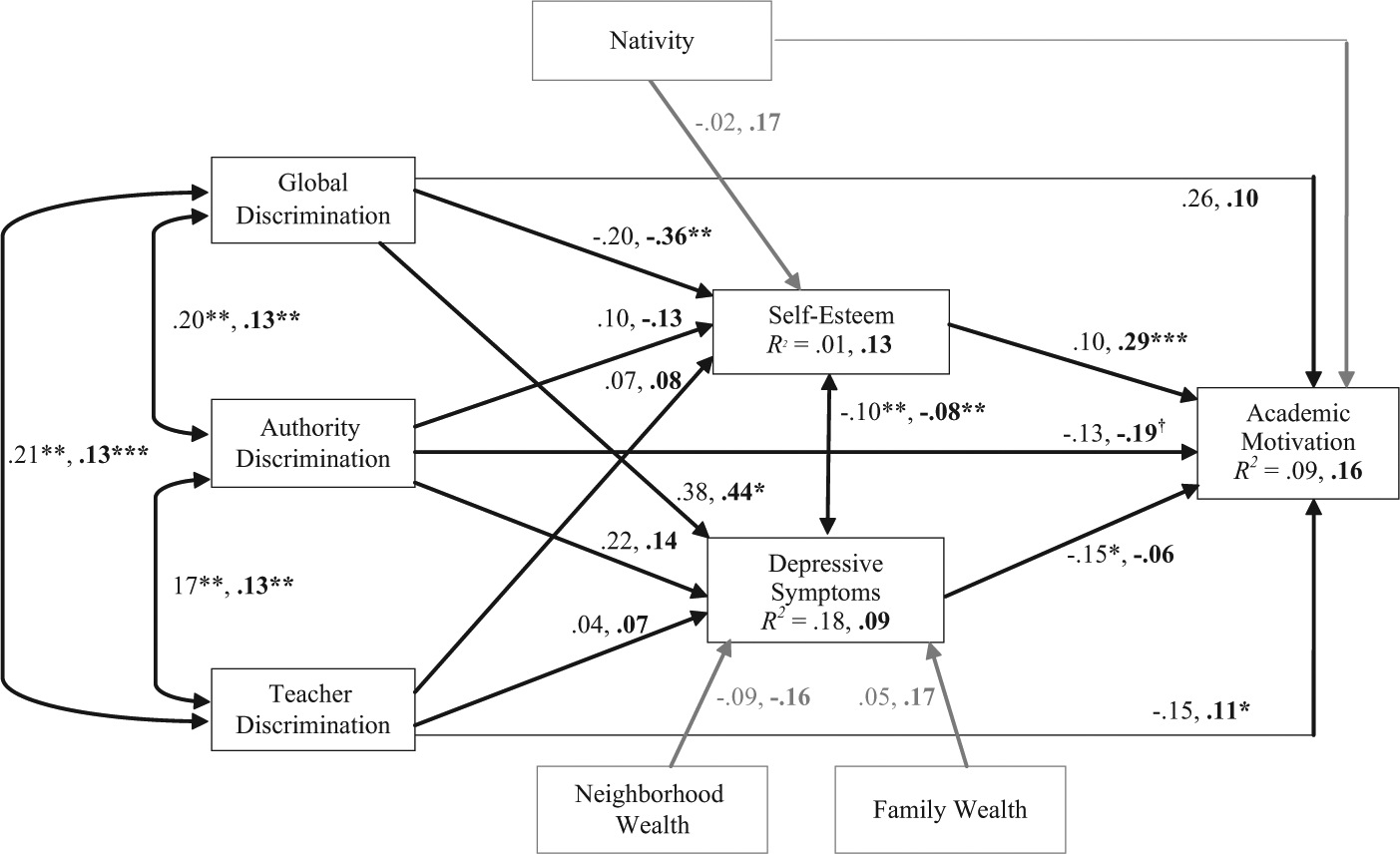
A multigroup mediation model for early and middle adolescent females of Mexican origin.
For Mexican-origin middle adolescent females, H1a received partial support. Global discrimination was negatively related to self-esteem and positively related to depressive symptoms. Yet only self-esteem was significantly related to academic motivation. When assessing direct associations, authority discrimination was marginally significantly related to academic motivation and teacher discrimination was positively related to academic motivation. The bias-corrected 95% CIs (Indirect Association = −.104; CI = [–.217, –.039]) revealed that self-esteem mediated the association between global discrimination and academic motivation. For H1b, the three types of discrimination did not significantly differ in their associations with depressive symptoms for middle adolescent females. Yet global discrimination’s association with self-esteem was significantly stronger than teacher discrimination’s association with self-esteem (z = −3.52, p < .01), but not authority discrimination’s. Interestingly, authority discrimination’s association with self-esteem was significantly stronger than teacher discrimination’s association (z = −1.97, p < .05).
For the multigroup mediated moderation models (H2 & RQ1), a set of restricted and unrestricted models was examined with respect to supportive maternal and paternal parenting. The restricted model with the three discrimination variables, supportive maternal parenting, three interaction terms, self-esteem, depressive symptoms, and academic motivation did not fit the data well: χ2(60) = 126.59, p < .05; RMSEA = .08, 90% CI = [.06, .10]; CFI = .61; SRMR = .09. The unrestricted model fit the data well: χ2(10) = 9.81, p = .46; RMSEA = .00, 90% CI = [.00, .08]; CFI = 1.0; SRMR = .01. The chi-square difference test revealed that the unrestricted model significantly improved the model fit, thereby providing support for group differences: χ2diff(50) = 106.96, p < .05. For early adolescents, supportive maternal parenting was not a significant moderator. In addition, the bias-corrected 95% CIs revealed that for early adolescents neither self-esteem nor depressive symptoms significantly mediated the associations between the interaction terms and academic motivation.
Among female middle adolescents, supportive maternal parenting was not a significant moderator for the associations between the three types of perceived ethnic/racial discrimination and self-esteem. Yet supportive maternal parenting exhibited a significant interaction with teacher discrimination in relation to depressive symptoms (β = .23, p < .025). Interestingly, for female middle adolescents high in supportive maternal parenting, teacher discrimination was positively related to depressive symptoms (β = .25, p < .05). Yet this association was not significant among middle adolescents low in supportive maternal parenting (β = .09, p = .45). The bias-corrected 95% CIs revealed that none of the interactions were significantly indirectly related to academic motivation through self-esteem or depressive symptoms.
With respect to supportive paternal parenting, the restricted model did not fit the data well: (χ2 [60] = 107.30, p < .05; RMSEA = .07, 90% CI = .05, .09; CFI = .72; SRMR = .07). The unrestricted model fit the data well: (χ2 [10] = 8.45, p = .59; RMSEA = .00, 90% CI = .00, .07; CFI = 1.0; SRMR = .01). The chi-square difference also provided support for group differences: χ2diff (10) = 95.85, p < .05. Similar to supportive maternal parenting, supportive paternal parenting did not significantly interact with the perceived ethnic/racial discrimination variables in relation to self-esteem or depressive symptoms among early adolescents. Further, the bias-corrected 95% CIs revealed that the interaction terms were not significantly indirectly related to academic motivation through self-esteem or depressive symptoms. In contrast, among middle adolescents, paternal support significantly interacted with teacher discrimination in relation to depressive symptoms (β = .29, p < .025). For middle adolescents high in supportive paternal parenting, teacher discrimination was positively related to depressive symptoms (β = .27, p < .05); however, the association was not significant for middle adolescents low in paternal support (β = .02, p = .83). Despite this significant interaction, the bias-corrected 95% CIs indicated that self-esteem and depressive symptoms did not significantly mediate the associations between the interaction terms and academic motivation for middle adolescents.
Lastly, we compared the mediated moderation models to the mediation model to determine which model fit the data better. Based on the Akaike information criterion (AIC) and Bayesian information criteria (BIC), the mediation model fit the data better than the mediated moderation models. The AIC and BIC values were smaller for the mediation models. Caution, however, should be given to interpreting this finding because H2 was intended to assess significant interactions. Although the mediation model provided a better fit, the mediated moderation models still exhibited good fits (independent of the mediation model), and the interactions were still significant (regardless of the mediation model).
Discussion
This study extended past research on the academic risk and resilience perspective by (1) examining the indirect associations that three types of perceived ethnic/racial discrimination shared with academic motivation, (2) investigating parent-based resources among Mexican-origin female adolescents, and (3) determining whether developmental differences existed. The findings yielded partial support for the hypotheses and shed light on previous postulations regarding the changes in parental influences across adolescence. Below, we discuss the findings and their implications for Mexican-origin adolescent females.
Perceived Ethnic/Racial Discrimination among Early and Middle Adolescent Females
For early adolescent females, H1a and H1b were not supported because global, authority, and teacher discrimination were not significantly directly related to self-esteem and depressive symptoms, nor were they significantly indirectly related to academic motivation. Furthermore, the direct associations did not statistically differ from each other. With respect to middle adolescents, however, H1a and H1b received partial support. Global discrimination was negatively related to self-esteem and positively related to depressive symptoms, whereas authority and teacher discrimination were not significantly related to self-esteem and depressive symptoms. Only global discrimination was indirectly related to academic motivation through self-esteem, but no other mediation was found. Furthermore, both global and authority discrimination did not statistically differ in their associations with self-esteem; however, both were significantly stronger than teacher discrimination’s association with self-esteem. This finding provides little support for the suppositions set forth, using SIT and symbolic interactionism.
The unique associations among early and middle adolescents provide support for H3 and demonstrate the importance of considering the heterogeneity of adolescents (Wierson & Forehand, 1992). The salient nature of global discrimination among middle adolescent females has implications for Whitbeck et al.’s (2001) description of adolescence as a period in which identity development becomes heightened and more important. As youth progress into adolescence, they often become more sensitive to incidents that threaten their self-esteem, which may explain why global discrimination was negatively related to self-esteem for middle adolescent females.
Furthermore, the role of self-esteem as a significant mediator for middle adolescents has implications for social mirroring (Suárez-Orozco & Suárez-Orozco, 2001), SIT (Tajfel & Turner, 1986), and symbolic interactionism (Blumer, 1969). Based on these perspectives, how youth believe others view and treat them contributes to their self-esteem. More specifically, self-esteem is rooted in feelings of social acceptance, but receiving threats, insults, or racial slurs communicates rejection that likely hinders self-esteem (Carlson et al., 2000). Feelings of rejection and low self-worth are likely to make Mexican-origin middle adolescent females feel less confident and motivated to do their schoolwork and study (Lane et al., 2004).
Although self-esteem was a significant mediator for Mexican-origin middle adolescent females, depressive symptoms were not a significant mediator. The results showed that global discrimination was positively related to depressive symptoms; however, depressive symptoms were not significantly related to academic motivation. In contrast, depressive symptoms were significantly associated with academic motivation for early adolescents. Wierson and Forehand (1992) found that early adolescents were more vulnerable to the harmful effects of parent stressors (e.g., marital conflict, maternal depression) on their social competence compared to middle adolescents. They suggested that because middle adolescents may be more independent from the family, they may deal with the stressors through peer relationships. Although parent stressors differ from perceived ethnic/racial discrimination, it is possible that as middle adolescent females experienced depressive symptoms, they turned to peers who attenuated the link between depressive symptoms and academic motivation.
The finding that authority and teacher discrimination were not significantly associated with self-esteem and depressive symptoms, but were directly associated with academic motivation also warrants discussion. Although the negative association between authority discrimination and academic motivation was expected, teacher discrimination was instead positively associated with academic motivation for middle adolescents. This is inconsistent with past studies (e.g., DeGarmo & Martinez, 2006) that found global discrimination negatively related to academic adjustment. Suárez-Orozco et al. (2010) also stated that youth are at risk for lower academic motivation when teachers have low expectations of them. Yet the middle adolescent females in this study may have been more academically motivated to show themselves capable of performing well in school—an act of self-determination and challenge to their teachers. Suárez-Orozco and Suárez-Orozco (1995) found that the majority of Mexican immigrant students in their study thought that school was most important in life. In addition, when Suárez-Orozco and Suárez-Orozco (2001) asked immigrant parents how to succeed in the United States, the most common answer was education. For immigrant families, moving to another country is based on the desire to have better opportunities. Children of immigrant families often learn that they must work hard, value education, and perform well in school to take advantage of better opportunities in the United States (Fuligini, 1997). Thus it is possible that Mexican-origin females in this study, the majority of whom were children of immigrants, were motivated to work harder in school when their teachers underestimated them.
Interestingly, the only significant path for early adolescent females was from depressive symptoms to academic motivation. As early adolescent females of Mexican origin experienced depressive symptoms, they reported lower levels of academic motivation. Depressive symptoms are distressing regardless of whether Mexican-origin females are in early adolescence (Behnke, Plunkett, Sands, & Bámaca-Colbert, 2011). This negative psychological reaction is likely to make Mexican-origin females feel less efficacious about school and distract them from school (Fröjd et al., 2008). Unlike depressive symptoms, self-esteem is rooted in identity, which early adolescents may find less salient and developed compared to middle adolescents (Wierson & Forehand, 1992). This difference in identity formation may explain why depressive symptoms, instead of self-esteem, were related to academic motivation for early adolescent females.
Identifying Parent-based Protective Resources
When examining H2 and RQ1, this study found that supportive maternal parenting and supportive paternal parenting were not significant moderators in the early adolescent subsample. Yet for middle adolescent females, supportive maternal parenting and supportive paternal parenting were significant moderators. This study, however, revealed several other unexpected findings. Middle adolescent females high in supportive maternal or paternal parenting reported higher levels of depressive symptoms as they experienced teacher discrimination. In contrast, this association was not significant for middle adolescent females low in supportive maternal or paternal parenting. These findings are inconsistent with H2 but provide unique insight into RQ1. The second hypothesis posited that supportive parenting would function as a protective resource and the research question inquired as to whether developmental differences in the mediated moderation model existed. Thornberry (1987) and the Sullivan-Piaget thesis (Nathanson, 2001) suggested that the influential nature of parents weakens as youth undergo adolescence, whereas Quick and Stephenson (2007) argued that parents remain influential throughout adolescence. To the best of our knowledge, however, these various postulations had not been applied to supportive maternal and paternal parenting in the context of perceived ethnic/racial discrimination and academic motivation. We found that none of the interactions were significant for early adolescents. Furthermore, teacher discrimination’s association with depressive symptoms was significant and in the positive direction for middle adolescent females high in supportive maternal and paternal parenting. These results warrant further explication.
Although middle adolescent females in the high group found their mothers and fathers to be supportive, this study did not measure the specific content of the mothers’ and fathers’ supportive messages. Middle adolescent females may have had supportive parents who listened to their problems and tried to understand their problems, but the support literature tells us that some messages may be more effective than others. For example, Clark, MacGeorge, and Robinson (2009) examined peer-comforting strategies among adolescents and found that students rated account messages (i.e., explanations for the problem) and minimization messages (i.e., downplaying the problems and the feelings) the least favorable. Researchers in the future may determine the specific support messages parents provide in response to their child being discriminated against to determine the most effective messages that can increase resiliency (Kam & Ramirez, 2011).
Another interpretation of this study’s findings may be that daughters with depressive symptoms perceived their parents’ supportive messages negatively instead of positively. In particular, Coyne, Joiner, and Blalock (1999) observed that individuals with depressive symptoms often look to others for affirmation. Yet despite receiving reassurance from others, individuals with depressive symptoms question the genuine nature of such comments. Applied to the present investigation, middle adolescents high in depressive symptoms may have perceived their parents’ high levels of support as insincere and insufficient.
A final explanation may lie in Fuligini (1997) and Suárez-Orozco’s work on immigrant families and educational values, as previously mentioned. Past research (Suárez-Orozco & Suárez-Orozco, 1995, 2001) suggests that immigrant parents place a strong emphasis on obtaining an education and performing well in school to succeed in the United States. Teacher discrimination is a type of unfair treatment that specifically occurs in the school context in which teachers underestimate adolescents’ abilities. Because of the value placed on educational success in immigrant families, middle adolescent females experience depressive symptoms perhaps because they do not want to disappoint their family.
One last important finding to note is that none of the psychological adjustment variables mediated the associations between the interaction terms and academic motivation. This finding means that although supportive maternal and paternal parenting amplified the association between teacher discrimination and depressive symptoms for middle adolescent females, this augmented association was unrelated to their academic motivation. Thus, the supportive parenting resources moderated the association between teacher discrimination and depressive symptoms, but had no impact on their academic motivation.
Limitations and Future Research
Despite this study’s contributions, some limitations should be noted. First, the cross-sectional nature of the data limits claims of directionality and causality. Based on the academic risk and resilience perspective, we argued for a mediation model where perceived ethnic/racial discrimination predicts academic adjustment through psychological adjustment; however, it is possible that psychological and academic adjustment may lead to greater perceptions of ethnic/racial discrimination. In addition to the limitations of cross-sectional data, this study’s associations between constructs were assessed, using one method, self-reported survey data from Mexican-origin female adolescents, which can lead to the inflation or attenuation of relations between constructs. Further research is needed to acquire data, using multiple sources and methods, as well as longitudinal data to support this study’s posed directionality.
The lack of variation in the student population at the participating schools also poses a limitation for this study. At each school, more than half of the student body was Latino, with most of them being of Mexican descent. In Mexican majority schools, discrimination may occur more often within ethnic groups than between ethnic groups (Pérez et al., 2008). Encountering discrimination with members of U.S. mainstream culture, where Mexican-origin female adolescents are the minority, may make perceptions of discrimination more salient. Given the high concentration of Latinos in the schools, the findings may not be generalizable to other Latina adolescents.
A final limitation is in the low response rate, which could have restricted the type of Mexican-origin female adolescents that participated in this study. For instance, the recruitment procedure asked adolescent females to take informational letters home to their mothers. Daughters who had better relationships with their mothers may have been more likely to give the informational letters to their mothers. Similarly, mothers may have been more willing to participate when their relationship was more positive. Hence it is possible that the current study does not represent well Mexican-origin female adolescents who have poor relationships with their mothers.
Using the academic risk and resilience perspective, this study extended past research by considering three types of perceived ethnic/racial discrimination in relation to psychological and academic adjustment among female adolescents of Mexican descent. Furthermore, it determined whether supportive parenting attenuated perceived ethnic/racial discrimination’s associations with psychological adjustment for Mexican-origin females in early and middle adolescence. Although most studies point to strong family relationships as sources of resiliency (Delgado et al., 2011), we found that for middle adolescent females high in supportive maternal or paternal parenting, that may not always be the case. Such findings demonstrate the complex nature of perceived ethnic/racial discrimination and parent-based resources with respect to risk and resilience.
Footnotes
Acknowledgements
The authors wish to thank undergraduate research assistants for their assistance in conducting this investigation; the adolescents and mothers for their participation; and the anonymous reviewers for their feedback on this article.
Declaration of Conflicting Interests
The authors declared no potential conflicts of interest with respect to the research, authorship, and/or publication of this article.
Funding
The authors disclosed receipt of the following financial support for the research, authorship, and/or publication of this article: This research was supported by a dissertation grant from the National Institute of Mental Health (R36MH077425) and a research grant from the Graduate and Professional Student Association at Arizona State University awarded to the second author.