







Abstract
This experiment investigates effects of communication interface proximity, which was conceptualized as three different media platforms (desktop, laptop, and hand-held device), on college students’ anxiety when receiving emergency alerts about on-campus crimes via emails and text messages. It proposes a new dimension of proximity, interface proximity, and suggests a shift in the emphasis of proximity from audience to event to user to interface. Ninety seven students received alerts on one of the three devices for 2 days. User anxiety increased for news-like information such as crime alerts and varied according to the proximity of the media platform. A three-level model of anxiety, including trait anxiety, media exposure to negative compelling news, and a trigger event, all contributed to participants’ anxiety.
Keywords
The latter half of the 20th century witnessed a rapid explosion of new hand-held communication technologies. A key feature of these hand-held devices is that they can be used nearly anywhere and at any time because of their mobility and ubiquity (Lucky, 2012; Tamminen, Oulasvirta, Toiskallio, & Kankainen, 2004). Proximity, a core concept to the study of news, needs to be reconsidered in light of the technological advances enabling ubiquity and mobility in hand-held communication devices. Proximity, measured as the physical or psychological distance from the event to the message receiver, has traditionally been considered as a defining principle for news (Shoemaker, 1996; Shoemaker, Lee, Han, & Cohen, 2007). Another dimension of proximity, sometimes referred to as timeliness, is tied to the physical and psychological salience of an event to the user. While timeliness usually is considered distinct from physical and psychological proximity; it is in fact embedded in them. Thus, proximity has three central dimensions distinguishing news from other kinds of messages: physical proximity, psychological proximity, and temporal proximity. This study argues that the ubiquity of hand-held devices diminishes the proximity of communication technology to zero. Their omnipresence has the effect of being under the user’s skin, allowing for “no down time” (Richtel, 2010).
A good example of the reconceptualization of proximity is the use of hand-held devices in the urgent landing of a U.S. Airways flight on the Hudson River on January 16, 2009. Soon after U.S. Airways Flight 1549 took off from LaGuardia Airport, the plane struck a flock of Canada geese, causing a catastrophic loss of power in both engines. The pilot executed an emergency landing on New York City’s icy Hudson River. One of the most astonishing things about the crash was the way passengers used their hand-held devices to generate breaking news without the aid or intervention of journalists. One passenger sent her family a goodbye text message as the aircraft was going down: “My plane is crashing.” After the plane came to rest, passengers climbed to safety on the wings and took pictures with the same hand-held devices. A Florida man was credited with publishing the first photo of the event on Twitter from his iPhone® only seconds after being rescued (Long, 2009). Comparatively, it took CNN much longer to get reporters on the scene.
This incident underscores how hand-held communication devices bring society a giant step closer to truly “ubiquitous computing” (Weiser, 1991, 1993; Weiser & Brown, 1996). While many designers, engineers, and producers see ubiquity as a useful outcome or “good” (Kakihara & Sørensen, 2002; Kristoffersen & Ljungberg, 2000), considerations of unintended outcomes, such as heightened user anxiety, often go unexamined. Yet the negative effects of the ubiquitous communication technologies may not be negligible and are still underexplored (Greengard, 2012). Recent studies show that constantly processing information on digital devices, such as a Blackberry, an Android, or an iPhone®, may deprive people’s brains of “down time,” which can cause stress and cognitive fatigue (Mozes, 2012; Richtel, 2010). For example, what was the emotional impact of the message informing the woman’s family her plane was about to crash? This study looks at the idea that ubiquity of communication technologies, which is conceptualized as user-interface proximity, may increase user anxiety for news-like messages.
If news is defined as timely and proximate information about dramatic events, the U.S. Airways’ emergency landing was as “good” as it gets. However, not all dramatic events ended as happily as did the Flight 1549 story, where no one was injured. On April 16, 2007, an emotionally disturbed Virginia Tech student, Seung-Hui Cho, shot himself to death after killing 32 students and faculty and wounding many others in “the deadliest mass shooting of civilians in American history” (“A Killer in Blacksburg,” 2007). After the Virginia Tech tragedy, many universities implemented emergency alert systems, designed to warn students in real time about possible threats by sending text messages and emails to desktop and laptop computers as well as cell phones, Blackberries®, pagers, and other hand-held devices. For example, by April 2008, about half of the faculty and staff and two thirds of the students at Virginia Tech had signed up for VT Alerts. A few hours away at the University of Virginia in Charlottesville, about 40% of the university’s population had signed up for UVA Alerts, a similar emergency alert system (Rowland, 2008). Other universities in the Washington, D.C. area, including American University, Howard University, George Mason University, and the University of Maryland, also implemented a text-alert system. Meanwhile, universities across the country such as University of South Florida, New York University, Pennsylvania State University, and Pace University started to develop massive notification emergency alert systems in the wake of the Virginia Tech tragedy. Many Canadian universities also started to launch cell phone alert systems after December 2007 (Choney, 2010; Dysart, 2008).
The upsurge in university crime alert systems is an interesting research topic in its own right. However, these systems represent something much larger. They are harbingers of what the future holds for the delivery of news in the larger society. Thirty three percent of the respondents in a recent Pew (Pew Research Center’s Internet & American Life Project) survey reported accessing news on their hand-held devices (Pew, 2010). Now from CNN to the New York Times, all mainstream media outlets are trying to figure out effective ways to deliver news to and from hand-held communication devices. They will, and hardly any event of significance goes untouched by these ubiquitous technologies. Ubiquity has become a watchword for engineers, manufacturers, as well as journalists.
From the standard generic cell phone to the latest iPhone®, hand-held communication technologies bring unprecedented convenience and push the boundaries of human intelligence to exciting new limits. That may be true, however, only to a point. Beyond that point, we might be ensnarled in a kind of blind faith that often characterizes society’s orientation toward technology.
One psychological feature that may come with the new device is anxiety. Anxiety has become the focus of the study of emotion, something driven by its alarming emergence as the most common dysfunctional clinical condition in contemporary society, especially with the diffusion of communication technologies (Marshall et al., 2007). Research in psychiatry shows that more than two thirds of the general population may experience a significant traumatic event with the potential to produce an anxiety or stress disorder at some point in their life, and up to one fifth of Americans may experience such an event in any given year (Galea, Nandi, & Vlahov, 2005).
The media equation theory has extensively studied how people react to computers (Lee & Nass, 2005; Nass & Moon, 2000; Reeves & Nass, 1996). This study examines how the ubiquitous and pervasive hand-held devices diminish the proximity of communication technology from the user to zero and influence user anxiety by sending crime alerts to college students through the university emergency alert system. The effects of negative emotion–laden news have been well documented (Brosius, 1993; Bucy, 2003; Geiger & Reeves, 1991; Grabe, Lang, Zhou, & Bollis, 2000; Helena, 2003; Miller & Leshner, 2007; Nabi, 2002; Newhagen, 1998; Newhagen & Reeves, 1992; Zhou, 2004). This work extends that discussion on hand-held technologies and examines whether ubiquitous hand-held devices enhance or amplify such effects.
Ubiquity of Communication Technologies
Weiser and Brown divided computing into three waves. The first wave was the mainframe computer, which once filled up entire buildings and required elaborated air conditioning and cooling systems. They could hardly be considered either mobile or ubiquitous (Beniger, 1986). The next wave was the personal computer. However, desktop personal computers and the wired Internet connections can only fit into a stationary environment and accomplish specific activities (Zheng & Yuan, 2007). The relationship between the desktop computer and the user is still uneasy (Weiser & Brown, 1996)
Ubiquitous computing is the third wave in computing. Ubiquitous computing, also called pervasive computing, is a vision about the creation of environments saturated with computing and communication technologies and integrated with human users (Satyanarayanan, 2001; Waller & Johnston, 2009; Weiser, 1991). It suggests that computers are not only tools for work but are also devices available throughout the physical environment where people live. They weave themselves into everyday lives and finally become indistinguishable from the user (Weiser, 1991, 1993). The goal of ubiquitous computing is to make the computer “disappear,” or become a natural part of the user (Hallnäs & Redström, 2002).
Weiser and Brown (1996) thought two harbingers of ubiquitous computing were the Internet and the computers embedded within everyday appliances, which have been greatly improved in the past decades. Clever affordances incorporated into the hand-held devices, however, pushed the boundaries of ubiquitous computing much further (Hallnäs & Redström, 2002). Information technologies in the form of personal digital assistant, Blackberry®, iPhone® Android, and iPad are increasingly pervading everyday lives, making the concept Apple® called a “personal computer to carry in your pocket” (Markoff, 2007) a global reality. Etoh (2007) predicted that cell phone will be the information hub in the near future because of its ubiquity.
Ubiquitous computing posits that people are not only using or interacting with information technologies but are also living with them (Hallnäs & Redström, 2002; Weiser, 1993; Weiser & Brown, 1996), moving the idea of use to presence of communication technology. Uses and gratifications theory suggests audiences are not passively exposed to media messages. Instead, they actively select media outlets or content to gratify social and psychological needs (Flanagin, 2005; Katz, Blumler, & Gurevitch, 1974; Rubin, 1993, 2002; Rubin & Rubin, 1985). Human-computer interaction research conceives of the audience in a more active way but is still dominated by the functions of the device and is based on the notion of use or usability (Hallnäs & Redström, 2002; Shneiderman, 2003; Shneiderman & Plaisant, 2004).
However, presence with media is moving beyond the old ontological debates about active and passive audiences (Hallnäs & Redström, 2002; Lee & Nass, 2005; Lombard & Ditton, 1997). Presence is a psychological state in which although an individual’s experience is generated by or filtered through communication technology, the individual fails to perceive or acknowledge the role of the technology (see Lombard, 2000, cited by Lee, 2004a). Presence requires an environment where the medium should not be obvious or obtrusive so people would fail to perceive the existence of the medium (Held & Durlach, 1992; Lombard & Ditton, 1997; Sheridan, 1992). Thus, the more the medium becomes ubiquitous, the higher the feeling of presence as the medium itself will become the user’s own senses (see McLuhan, 1964/1994, for the origination of this idea; Lee, 2004a).
The Coincidence of Proximity as a Core Concept in Ubiquitous Computing and News Delivery
With the ubiquity and presence of computational artifacts, especially thanks to the rapid development of wearable computers (Barfield & Caudell, 2001) and hand-held devices, the distance between the user and the device has been significantly shortened as the device itself gradually “disappears” and becomes a natural part of the user (Hallnäs & Redström, 2002; Weiser, 1993). Proximity thus turns out to be a core dimension for both ubiquitous computing and news delivery. The concept of proximity is central to nearly any definition of news. It has been conceptualized as a measure of the physical or psychological distance between the news event and the reader or viewer (Bridges & Bridges, 1997; Morton & Warren, 1992). However, these definitions were born in an era of one-to-many mass media communication technologies, when little thought was given to the user-interface dyad.
The arrival of the era of ubiquitous computing forces us to consider communication technology in terms of the interface to truly understand its relationship to the user. Gibson (2007) thinks that the important difference between mass media and ubiquitous interface is that people used to wait for the paper or news on television, but the ubiquitous interface is a cultural skin and will evolve to the point where people just forget about it. Therefore, defining proximity as the physical or psychological distance between the event and the message receiver without taking the interface into account is problematic when the hand-held device becomes omnipresent in everyday lives.
As a measure of how recent or current the news event is, timeliness is another critical concept in news value. Timeliness has been walled off from the discussion of proximity because timeliness and proximity have been considered as two important but different factors of newsworthiness (Garrison, 1990; Gibbs & Warhover, 2002; Shoemaker, 1985). However, with the ubiquity of communication technologies, timeliness is overdue to be included as a third dimension, which is the temporal dimension of proximity because the invention of mobile computing technologies not only conquers the geographical constraints but also saves people’s time and changes the temporal dimension of human behavior (Kakihara & Sørensen, 2002; Ishii, 2006; Zheng & Yuan, 2007).
Thinking about the user-interface proximity reveals that these three dimensions of news—physical, temporal, and psychological—are related to the same concept. While isomorphic, they are not necessarily orthogonal: The hand-held device is ubiquitous in both space and time, which in turn magnifies psychological salience. It is not just physically near, but also near in time, instantly updated in ways newspapers and television news could never achieve. Therefore, it is psychologically “hot,” 1 or compelling, and means more urgent and critical information process (Zheng & Yuan, 2007).
Interface Proximity of Communication Technologies
Historical epochs have been defined by their dominant communication technologies, such as newspapers and television (Beniger, 1986). Yet there were real limits on the ability of newspapers and television to meet the expectations suggested by the core journalistic norms of timeliness (Auslander, 1999). Reductions in the size and cost of desktop did not initially solve the problem of actualizing temporal proximity. While smaller laptops began to overcome the temporal proximity problem, short battery life, restrictive bandwidth, and limited wireless access still presented obstacles to true ubiquity (Zheng & Yuan, 2007). However, as hand-held communication devices conquered size, bandwidth, and connectivity, ubiquity and mobility have become functional realities.
This suggests that even within the domain of computer-mediated communication, variations in interface proximity associated with specific platforms may make a difference in the way users receive and process information. Desktop computers require users to move to “use” the computer (Johnston, Waller, & Milton, 2005; Waller & Johnston, 2009); they are relatively “distant” and stationary in the same way as a television set (Zheng & Yuan, 2007). Laptop computers may be portable, but are still not ubiquitous due to the limitation in battery life and Internet access.
But distance between the hand-held device and the user is now functionally reduced to zero. Users can talk and text while driving (Novotney, 2009), listen to music on an iPod while checking e-mails on an iPhone, and hear the device register messages while sleeping. The mobile devices are ubiquitous and present in our everyday lives, just under our skin and always on, allowing for “no down time” (Richtel, 2010). For example, Karlson, Meyers, Jacobs, Johns, and Kane’s (2009) study of mobile phone users’ log data and in-depth interviews show that most of their participants, even those who do not heavily rely on their mobile device, would touch their phone every morning upon waking up, check e-mails in the middle of the night, and access their phone even when they are away for a lunch break to be kept up to date. Vänänen-Vaino-Mattila and Ruuska (2000) found that the constant use of mobile phones intensified “the user’s feeling of being inseparable from it” (p. 173).
Table 1 shows the conceptualization of “proximity” in this study: Putting computers on a spectrum of proximity, desktop computers are on one end, the least ubiquitous and proximate. On the other end, hand-held devices with Internet access are the most ubiquitous and proximate, while laptops are somewhere in between. Based on the proximity scale of different media platforms, the following research question is posited:
Proximity, Operational Functionality, and Device of Media Platform.
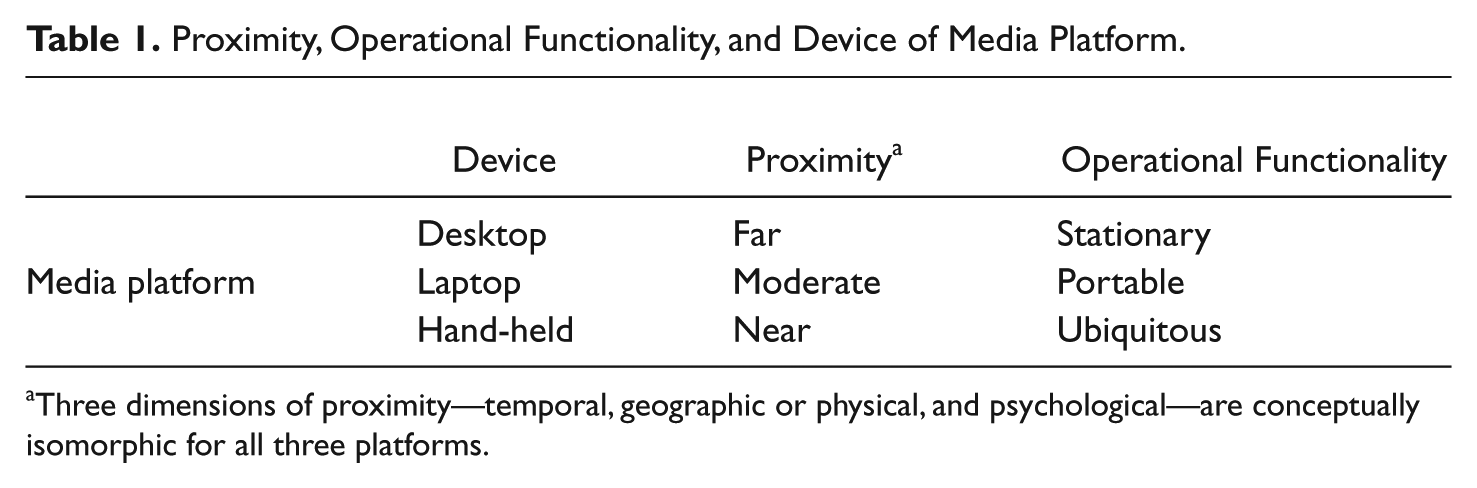
Three dimensions of proximity—temporal, geographic or physical, and psychological—are conceptually isomorphic for all three platforms.
RQ1: How will interface proximity, conceptualized as different media platforms, influence participants’ anxiety when they receive crime alerts?
Hypothesis 1 (H1): Participants receiving crime alerts on hand-held device will report the highest level of anxiety upon alert receipt, and participants receiving alerts on desktop will report the lowest level of anxiety upon alert receipt.
Hypothesis 2 (H2): Participants receiving crime alerts on hand-held device will report the highest level of anxiety increase after the study, and participants receiving alerts on desktop will report the lowest level of anxiety increase after the study.
Because the hand-held device is the most proximate, physically, temporally, and psychologically, and the desktop is the least proximate, we also expect that participants using the hand-held device will have the shortest latency in response and those using the desktop will have the longest latency. Thus, we have the following hypothesis:
Hypothesis 3 (H3): Participants receiving crime alerts on desktop computer will have the longest latency, a measure of time from message transmission to participants’ response, followed by those using laptop, and participants using hand-held device will have the shortest latency.
Effect of Negative Emotion–Laden News
It has been well known that human beings are hardwired for negatively compelling news, especially news that is essential for survival (Shoemaker, 1996). 2 However, most studies are limited to traditional mass media, especially negative images in breaking television news (Bradley, Greenwald, Petry, & Lang, 1992; Grabe & Kamhawi, 2006; Newhagen & Reeves, 1992). To our knowledge, no research has extended that discussion to the cutting-edge ubiquitous hand-held technologies.
Negative emotion–laden news, studies have found, would affect memory (Bradley et al., 1992; Miller & Leshner, 2007; Newhagen & Reeves, 1992), liking (Grabe & Kamhawi, 2006), emotion (Newhagen, 1998), and demand more attention (Grabe et al., 2000). For example, Brosius (1993) found negative visuals can focus attention on specific parts of a news item and reconstruct recall of that item. Newhagen and Lewenstein (1992) found people’s fear increases as their exposure to television images of an earthquake increases. Johnson and Davey’s (1997) study demonstrates that individuals shown news bulletins edited to display negatively valenced material experience increases in anxiety, sad mood, and were more likely to catastrophize personal worries after viewing than those shown clips edited to display either positive or neutral materials. A growing body of research also shows news stories using negative frames can promote different degrees of information accessibility, message processing, and persuasive effects (Bodenhausen, Sheppard, & Kramer, 1994; Jin, 2010; Nabi, 2002, 2003).
Moreover, numerous studies show emotional intensity of negative message content can affect emotions and recognition. For example, Lang, Bradley, Park, Shin, and Chung’s (2006) study shows recognition is better for arousing messages than for calm messages. Potter (2000) and Newhagen and Reeves (1992) found participants remember highly arousing media messages better than they do less arousing messages. Similarly, Zillmann, Gibson, and Sargent (1999) suggested that news images linked to extreme negative emotions would leave more vivid memory than do less negative images.
In crime news, stories about high-severity crimes such as violent crimes usually contain more arousing and emotionally intense content than do those about less severe crimes such as property crimes (Gross, 2006; Uribe & Gunter, 2007). Studies have shown that more severe crimes do more mental and physical harm than less severe crimes (Ramchand, MacDonald, Haviland, & Morral, 2009). Thus, in this study, we operationalize emotional intensity of crime alerts as crime severity. We expect that news stories about high-severity crimes such as forcible rapes and robberies with gunfire will induce higher level of anxiety among the receivers than will stories about low-severity crimes such as theft and loss of personal properties.
While developers and marketers tout ubiquity as a positive advance to the state of communication technology, the negative implications are not trivial and deserve a closer examination. Could, for example, the pervasive presence of the hand-held technology foster a negative emotional state in users, such as anxiety, to a higher level than the less ubiquitous desktop and laptop computers? Moreover, will such effect be moderated by emotional intensity of crime alerts?
RQ2: Will there be an interaction between media platform and emotional intensity of crime alerts, conceptualized as crime severity, on user anxiety?
Anxiety
The nature of anxiety
Anxiety has been defined as a central concept in experimental and abnormal psychology (Lang, 1985; Spielberger, 1972) and stands out as a primary reason for a person to seek professional clinical psychological help (Oei, Moylan, & Evans, 1991). Recent research reveals that anxiety is the most common type of psychopathology experienced in the aftermath of the 9/11 attacks (Eisenberg & Silver, 2011; Neria, DiGrande, & Adams, 2011).
Anxiety, as a psychophysiological state, is characterized by muscle tension, worry, restlessness, and uneasiness that often requires a great deal of effort and energy to manage (Wells, 1999). Many, including Cattell and Scheier (1962), Freud (1923), Grinker (1966), and Spielberger (1966), have attempted to define anxiety in a way that would make it distinct from other emotional states. Anxiety, according to Freud, is a state of displeasure accompanied by a signal of danger. Grinker defined anxiety as an affect participants have when they experience inexplicable foreboding, danger, or disintegration. As anxiety mounts, participants will experience a decrease in psychological defense and lose control. Levitt (1980) described anxiety as “an uncomfortable feeling of danger, accompanied by overwhelming awareness of being powerless, unable to perceive the unreality of the threat” (p. 4). Barlow (2000) concluded that at the heart of anxiety lies a sense of uncontrollability focused on future threats, danger, or other upcoming potentially negative events. According to Barlow, helplessness and vigilance (or hypervigilance) are two defining characteristics of anxiety.
Anxiety as a pre-emotional condition
The information processing theory, which integrates cognitive psychology with the study of media effects, reveals the emotional and cognitive processing of media messages and has been used to explain the “black box” in the process of communication (Geiger & Newhagen, 1993; Lang, Bradley, Chung, & Lee, 2003; Newhagen, 2000). This theory argues that the information environment, or the information ecology (Gibson, 1979), is complex. However, the information processor has only limited cognitive resources to make sense of it. This situation forces the information processor to make judgments based on limited information in real time to make functionally adaptive decisions (Beniger, 1986). As a key psychological heuristic, emotions help to tune the human organism to rapid and usually threatening change: to approach or avoid (Plutchik, 1984). Emotions have been measured by two dimensions: valence and arousal (Larsen & Diener, 1992). Valence refers to an organism’s initial response to a stimulus as good or bad, ranging from positive to negative. Arousal refers to the intensity of affect. Low levels of arousal correspond to feeling calm and peaceful, and high levels correspond to feeling alerted or excited (Bradley & Lang, 1994).
Core emotions such as anger and fear are usually activated by the appearance of a novel object or threat in an information environment. However, different from these full-blown emotions, anxiety is only qualified as one of the ambiguous pre-emotional states (Lazarus, 1991), which are well below conscious awareness. It is important to note that, different from fear, the function of anxiety is to detect a potential threat in the environment that may or may not require more specific intervention (Eysenck, 1992). Viewed as a pattern recognition problem, pre-emotional states such as anxiety may only point to areas of irregularity without “knowing” what they are or why they are there (Lazarus, 1991).
When the locus of interest appears in the environment and becomes well-defined enough to warrant action, the organism engages in full-blown emotions such as anger or fear and chooses to flee or fight (Lazarus, 1991). However, it is less clear what happens if the offensive object is difficult to define yet persists in drawing attention. For example, what if the information ecology generates emotionally provocative information that lacks a locus? This study examines hand-held technologies to see whether they can, by their very nature, generate low levels of ambiguous emotional engagement sufficient to cause anxiety in their users.
Three stepping stones to anxiety
Three distinct components have been identified that contribute to anxiety. They are trait or dispositional component, early life experience, and a trigger event (Barlow, 2000). Although each component can, in isolation, account for anxiety, their copresence is cumulative.
Trait or dispositional component
The fundamental trait of being high-strung and nervous has been regarded as a genetic component that runs in families. Eysenck (1956) found personality traits to have a significant genetic component. Studies of anxiety, neuroticism, negative affect, or behavioral inhibition also reveals that genetic contributions to the expression of anxiety are estimated to explain 30% to 50% of measured variances (Clark, Watson, & Mineka, 1994). They suggest that trait anxiety is primarily innate and relatively stable in life and individual differences in trait anxiety are largely genetically determined.
Prior life experience
To activate the specter of an anxiety disorder, genetic personality traits must incubate in the fertile ground of early experience of a trauma. Early life experiences of traumatic events have been shown to predict later manifestations of anxiety and can elicit feelings of unpredictability and uncontrollability (Barlow, 2000).
In addition to direct exposure to traumatic events, early life experiences of trauma can also be mediated. Mass media, and increasingly new media, expose viewers and users to rare but devastating events, sometimes natural and sometimes human. For example, television viewing of the 9/11 attacks has been linked to cases of posttraumatic stress disorder (PTSD) in the general U.S. population (Galea et al., 2005). Studies found exposure to television coverage of the 9/11 attacks was one of the positive predictors of PTSD, along with age, sex, and direct exposure (Galea & Resnick, 2005).
The trigger event
The third component of anxiety relates to a specific object or event that triggers the onset of anxiety or depression. Frijda’s (1988) laws of emotion suggest the emotional impact of a traumatic event never really wanes. On the contrary, emotions surge when stimuli resembling the original stimuli are triggered by a specific sequence of events. Studies show that instances of depression and anxiety are most likely to occur following a significant stressor (Pauley & Hesse, 2009).
After the Virginia Tech shootings in April 2007, universities across the country, especially those geographically near Virginia Tech, adopted strategies to alert students and faculty about emergencies in real time. Text message through emergency alert systems are a natural vehicle for potential anxiety due to the high adoption rate of cell phones among college students. Sites like Twitter and Facebook and other advances in the use of hand-held devices afford the opportunity for real-time dissemination of messages capable of triggering anxiety.
The cohort students included in this study were highly exposed to media coverage of the 9/11 attacks and the Virginia Tech campus shootings. The Virginia Tech shootings should be salient to members of this population, from which participants for this study were selected because they attended a university nearby and are in the same athletic conference. When genetic trait anxiety, prior life experience, and a trigger event are combined, contemporary college undergraduates may be especially at risk of experiencing anxiety dysfunctional to their life. Thus. we have the following hypotheses:
Hypothesis 4a (H4a): Students with higher trait anxiety will be especially at risk of experiencing anxiety and will report higher levels of general felt anxiety at the end of the study.
Hypothesis 4b (H4b): After controlling for trait anxiety, those who were exposed to more media coverage of the Virginia Tech shootings will suffer more anxiety from the crime alerts.
Hypothesis 4c (H4c): After controlling for both trait anxiety and media exposure, a trigger event alone such as the receipt of crime alerts can increase users’ general felt anxiety at the end of the study.
Method
Design
This study employed a 3 (media platform) x 2 (crime severity) x 4 (messages) fractionally factorial 3 experimental design. Media platform (desktop computer, laptop computer, and hand-held device) was a between-subject factor, and crime severity (high and low) was a within-subject factor. The four messages served as a repeated measure. Crime severity was defined based on FBI’s definitions and classification of crimes. According to FBI (2010), the descending order of crimes are violent crimes, including murder, forcible rape, robbery, and aggravated assault, followed by property crimes. Thus, high crime severity was operationalized as violent crime in which a victim was present during the crime and the crime was life threatening. Such crimes included assaults with firearms, sexual assaults, house break-ins where the victim was present, and strong-arm robberies. Low crime severity was operationalized as property crimes, including theft of a computer, wallet or purse, often a common event on a large urban college campus.
Stimuli Selection
The stimuli used in this study were adapted from crime alerts transmitted from the university police to students in 2009. All of the crimes described in the messages were real crimes that had happened on or around the university campus. For ethical and safety reasons, stimulus messages included a tag identifying them as part of the study to ensure students would not confuse them with actual alerts. The stimuli were adapted into 50- to 100-word crime news messages to fit on a hand-held screen. Efforts were taken to make the messages appear as much like real news as possible.
A pool of 32 messages representing different levels of crime severity was printed on separate sheets of paper. A total of 18 undergraduate students (10 women and 8 men, with an average age of 20) served as message raters and rated the messages. Anxiety was measured on a 5-point Likert-type scale, ranging from not anxious at all to extremely anxious. The message presentation was randomized to reduce the order effect.
Repeated measure analysis showed that crime severity, F(1, 17) = 45.27, p < .001, η2 = .73, had a main effect on anxiety. The eight messages with the highest mean anxiety scores in high crime severity condition and the eight messages with the lowest mean anxiety scores in low crime severity condition were chosen from the pool. This produced a total of 16 messages used as the experimental stimuli in the formal experiment. 4
Participants
A total of 97 students (56 women and 41 men) enrolled in different schools and departments in a large Mid-Atlantic research university were recruited to participate in the formal experiment. The age range was 18 to 22 years (M = 20.65, SD = 1.46).
The student participant pool was not drawn because of convenience. As early adopters of new technology, college students have shown the highest incidence rates of cell phone usage and mobile content adoption (Hanley & Becker, 2008) and thus are the focal group of interest. Furthermore, the university where the study was conducted was part of the Virginia Tech’s athletic conference and geographically nearby. These facts should have increased chances that the event would represent an important factor in participants’ anxiety. Of equal importance was the fact that the university had initiated an alert system in the wake of the Virginia Tech shootings. Thus, the student population already had received crime alerts and this fact could lend support for the external validity.
Procedure
This experiment was conducted in 2009, 2 years after the Virginia Tech campus shootings. After signing up for the experiment, the participants filled out a short screening questionnaire, asking about their frequency of using desktop, laptop, and hand-held device to check emails. They were then assigned into one of the three device groups based on their usage habit. That is, students most likely to monitor emails on a desktop were assigned to the desktop group and so on. 5
Participants in each device group were told to only read and reply to the alerts on that particular device. A screening question showed very few participants used hand-held devices to check e-mails. Thus, both desktop and laptop groups received and replied to messages from the investigator through emails. The hand-held device group received and replied to messages through text messages. The investigator met with each participant individually prior to the experiment and explained the procedure. The participants also signed consent forms.
During the formal experiment, participants received four alerts per day for a total of eight alerts over 2 days on the assigned device. The research investigator, through email or text message, sent messages to the participants in the morning (9-10 a.m.), the afternoon (2-3 p.m.), the evening (6-7 p.m.), and late at night (10-11 p.m.) each day. The order of the messages was randomized. Participants were required to carry a Self-Assessment Manikin (SAM) picture, which has been widely used to measure emotion (Bradley & Lang, 1994), during the 2 days and reply to the investigator through email or text message as soon as possible. In their reply, they were required to report their felt anxiety, valence, and arousal upon alert receipt.
Participants also filled out three online questionnaires: on the day before the experiment, at the end of the first day, and immediately after the experiment. Each questionnaire asked their general felt anxiety and current emotional state, which was measured as valence and arousal. The third questionnaire, conducted right after the experiment ended, also tapped questions about participants’ trait anxiety and media exposure to Virginia Tech campus shootings in April 2007.
Measures
General felt anxiety was measured by asking the question: “How anxious do you feel now?” The responses were measured on a 5-point Likert-type scale ranging from not anxious at all to extremely anxious. Participants’ general felt anxiety was measured in all three online questionnaires.
Latency to response is a widely accepted measure of mental effort (Zechmeister & Nyberg, 1982). In this study, latency of response to each message was calculated as the time when the investigator received the response from the participants minus the time when the investigator sent out the message. The latency was calculated in minutes. After all latency times were collected, data were evaluated. Unusually long response time and outliers were transformed. 6
Media exposure to the Virginia Tech campus shootings in April 2007 was measured by asking the students’ newspaper reading and TV viewing of the Virginia Tech shooting coverage during the first week after the event. It was only measured in the third questionnaire.
Trait anxiety was measured using the State-Trait Anxiety Inventory (STAI) Form Y-2 (Spielberger, Gorsuch, & Lushene, 1970) in the third questionnaire. The trait anxiety scale in the original inventory consists of 20 statements that assess how people generally feel, such as “I am a happy person,” “I am a steady person,” and so on. Only the 10 most salient questions were used.
Table 2 shows that three factors were extracted from trait anxiety scale using a principal component analysis with quartimax rotation method. 7 The three factors were named as anxiety, calmness, and compliance, based on the nature of the variables loaded into each of them. Anxiety had an eigenvalue of 2.36 and explained 26.19% of the total variances. Calmness and compliance explained 17.85% and 14.97% of the variances, respectively. The reliability coefficients of Cronbach’s alpha ranged from .68 to .80. For the purpose of this study, only the first factor, anxiety, was used. Therefore, a new index of trait anxiety was built by multiplying the item scores and their factor loadings on the first factor (Cronbach’s alpha = .80).
Factor Analysis of Trait Anxiety Inventory a .
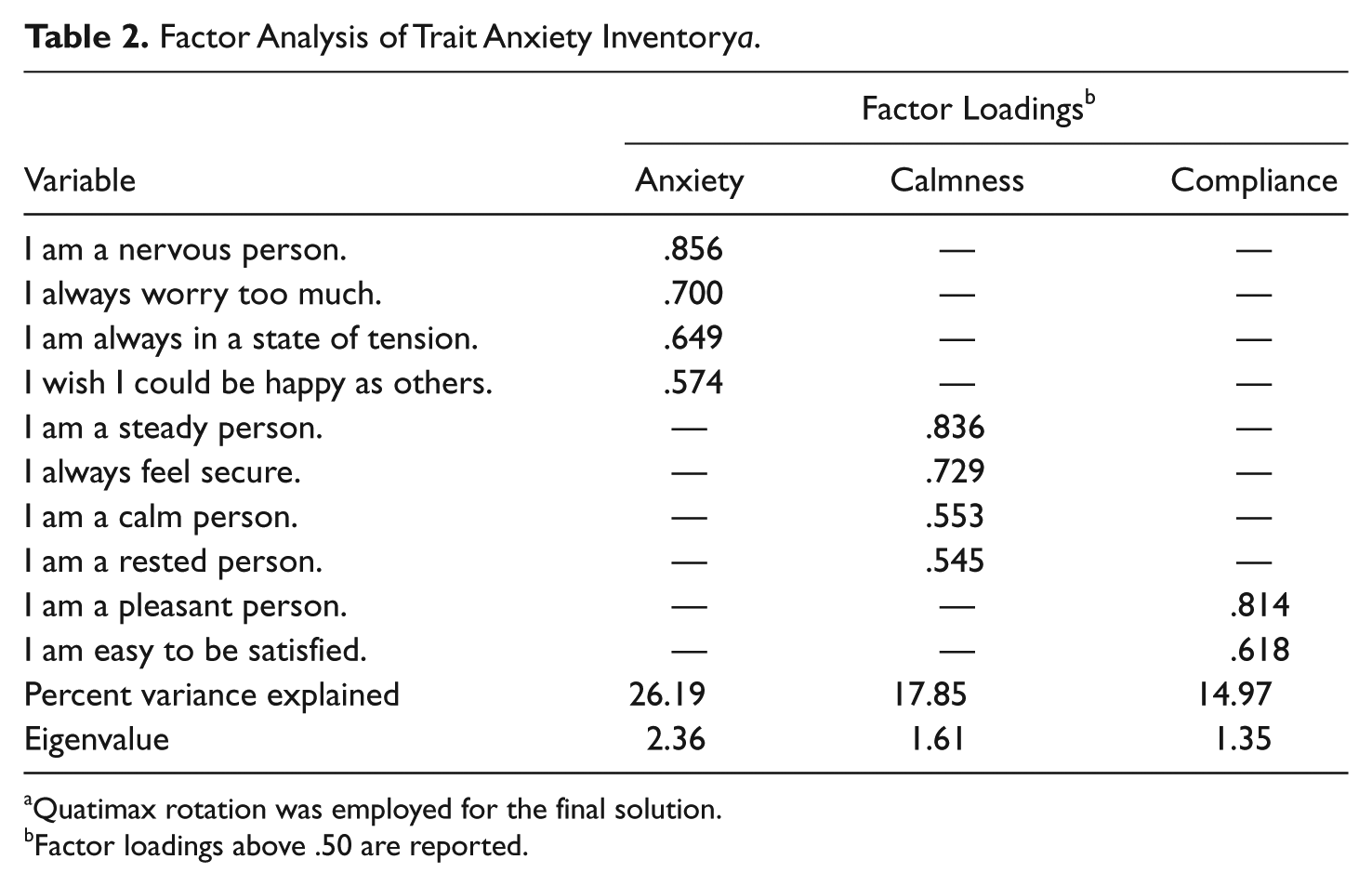
Quatimax rotation was employed for the final solution.
Factor loadings above .50 are reported.
Results
Hypothesis 1 (H1): Participants receiving crime alerts on hand-held device will report the highest level of anxiety upon alert receipt, and participants receiving alerts on desktop will report the lowest level of anxiety upon alert receipt.
Media platform has a main effect on participant anxiety reported upon alert receipt, F(2, 86) = 7.18, p < .001, η2 = .14. Scheffé’s post hoc tests show that participants reported being more anxious when they received alerts on hand-held devices (M = 3.03, SE = 0.11) and laptop computers (M = 3.00, SE = 0.12) than when they received alerts on desktop computers (M = 2.40, SE = 0.14). Thus, H1 was supported.
Figure 1 also shows an interaction between media platform and crime severity, F(2, 85) = 3.42, p = .04, η2 = .07. Post hoc analysis shows that although there was no difference between the three platform groups in their reported anxiety upon alert receipt when crime severity was high, the desktop group (M = 1.58, SE = 0.14) reported lower level of anxiety upon alert receipt than the laptop group (M = 2.45, SE = 0.11) and the hand-held group (M = 2.43, SE = 0.11), F (2, 89) = 10.84, p < .001, when crime severity was low.
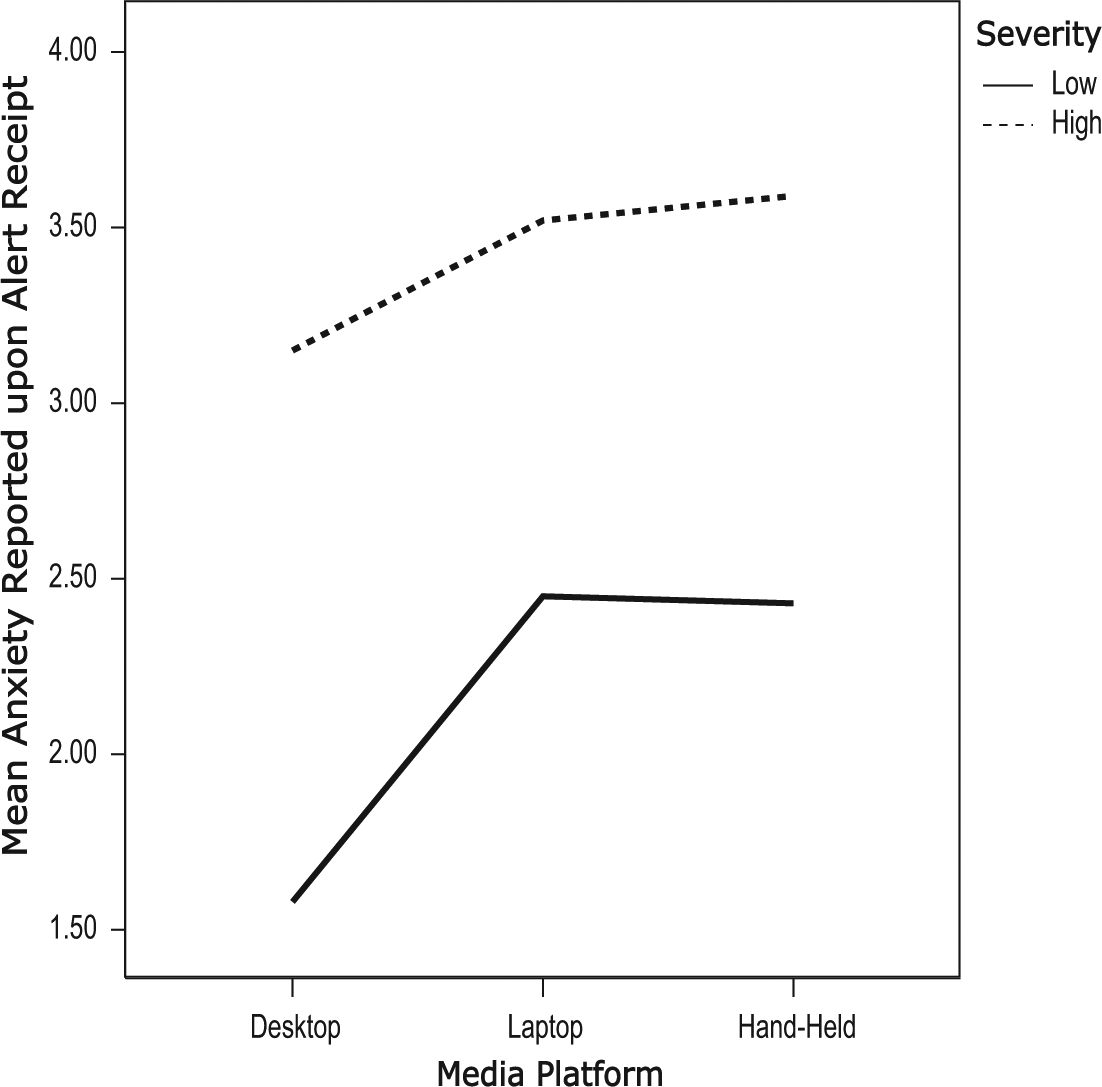
Anxiety reported upon alert receipt predicted by media platform and severity.
To examine how participants’ anxiety reported upon alert receipt changed over time across the study, mean anxiety scores at two adjacent time points were calculated to represent anxiety reported upon alert receipt on early Day 1, late Day 1, early Day 2, and late Day 2, respectively.
Figure 2 shows an interaction between time of alert receipt and media platform on anxiety reported upon alert receipt, F(3, 249) = 6.77, p < .001, η2 = .14. Although reported anxiety increased substantially for all three groups on late day one (Mdesktop = 3.32, SE = 0.20; Mlaptop = 3.17, SE = 0.16; Mhand-held = 3.49, SE = 0.16), anxiety reported upon alert receipt for the laptop (M = 2.66, SE = 0.14) and desktop groups (M = 2.27, SE = 0.17) decreased to the lowest point on early day two. The hand-held group, however, still remained a high level of anxiety upon alert receipt (M = 3.10, SE = 0.14) on early Day 2.
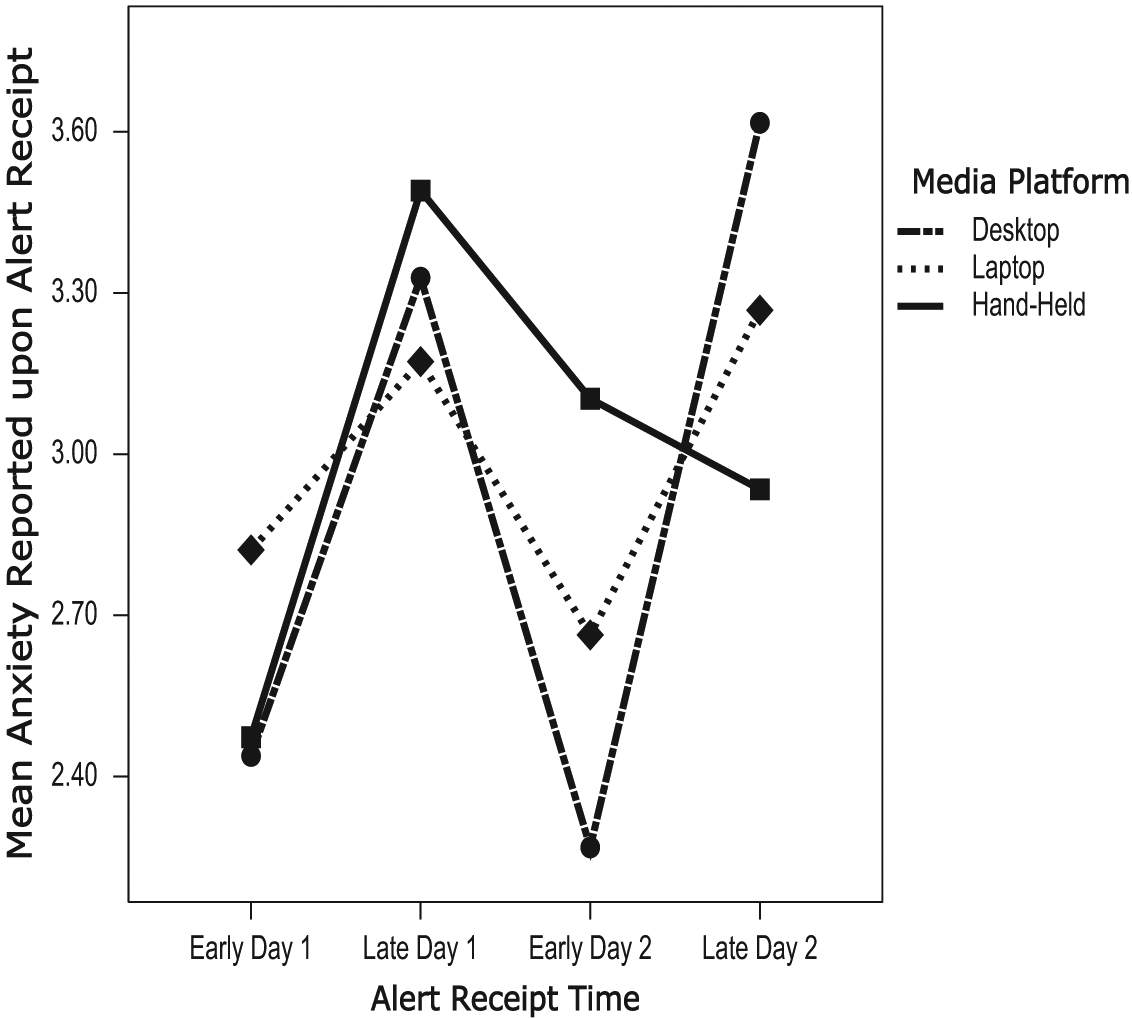
Anxiety reported upon alert receipt predicted by media platform and time of alert receipt.
There is also a similar trend of interaction between time of alert receipt and media platform on valence, F(6, 243) = 4.24, p < .001, η2 = .10, and arousal reported upon alert receipt, F(6, 249) = 8.24, p < .001, η2 = .17. For the desktop and the laptop groups, their arousal (Mdesktop = 3.43, SE = 0.19; Mlaptop = 3.05, SE = 0.15) and valence (Mdesktop = 3.98, SE = 0.20; Mlaptop = 3.82, SE = 0.16) substantially increased on late Day 1, but dropped to the lowest point on early Day 2 (Mdesktop_arousal = 2.61, SE = 0.17; Mlaptop_arousal = 2.59, SE = 0.14; Mdesktop_valence = 3.25, SE = 0.19; Mlaptop_valence = 3.05, SE = 0.15). The hand-held group still reported a high level of arousal (M = 3.16, SE = 0.14) and valence (M = 3.44, SE = 0.16) on early Day 2.
This indicates an “overnight effect” on the desktop and laptop groups where anxiety, valence, and arousal ratings upon alert receipt on the next morning were lower. The hand-held group, however, still reported a high level of anxiety, valence, and arousal upon alert receipt early Day 2, suggesting that the hand-held device is just under our skin, allowing for no down time.
Hypothesis 2 (H2): Participants receiving crime alerts on hand-held device will report the highest level of anxiety increase after the study, and participants receiving alerts on desktop will report the lowest level of anxiety increase after the study.
Participants reported higher level of general felt anxiety in the third questionnaire at the end of the study (M = 2.75, SD = 0.96) than in the first questionnaire before the study (M = 2.31, SD = 0.99), t(92) = 3.77, p < .001. To examine the effect of media platform on participants’ anxiety increase across the study, an anxiety-increase score was calculated by subtracting general felt anxiety reported in the first questionnaire from general felt anxiety reported in the third questionnaire. Media platform had a main effect on participant anxiety increase, F(2, 87) = 4.98, p < .01, η2 = .10. The hand-held group showed the greatest increase in anxiety (M = 0.88, SD =1.12) followed by the laptop group (M = 0.76, SD =1.28) and the desktop group (M = 0.02, SD =1.00). Thus, H2 was supported.
Participants’ general felt arousal at the end of the study (M = 2.69, SD = 0.95) was also higher than that reported before the study (M = 2.29, SD = 0.89), t(94) = 3.47, p < .001. An arousal increase score was calculated in the same way by subtracting reported general felt arousal in the first questionnaire from reported general felt arousal in the third questionnaire. Media platform also had a main effect on participants’ arousal increase, F(1, 87) = 5.52, p = .02, η2 = .06. The hand-held group (M = .64, SD = 0.88) and the laptop group (M = .70, SD = 1.11) showed more arousal increase across the study than the desktop group (M = 0.00, SD = 1.27).
Hypothesis 3 (H3): Participants receiving crime alerts on desktop computer will have the longest latency, a measure of time from message transmission to participants’ response, followed by those using laptop, and participants using hand-held device will have the shortest latency.
Figure 3 shows an interaction between media platform and crime severity on latency time, F(2, 78) = 3.72, p < .05, η2 = .09. Although users of desktop computer (M = 220.63 minutes, SE = 23.51 minutes) lagged behind users of laptop computer (M = 170.78 minutes, SE = 19.01 minutes) and hand-held device (M = 40.56 minutes, SE = 19.01 minutes) in responding to the alerts when crime severity was low, they were even slower when crime severity was high (Mdesktop = 262.74 minutes, SE = 26.50 minutes; Mlaptop = 161.43 minutes, SE = 21.43 minutes; Mhand-held = 21.59 minutes, SE =21.43 minutes). Thus, H3 was supported.
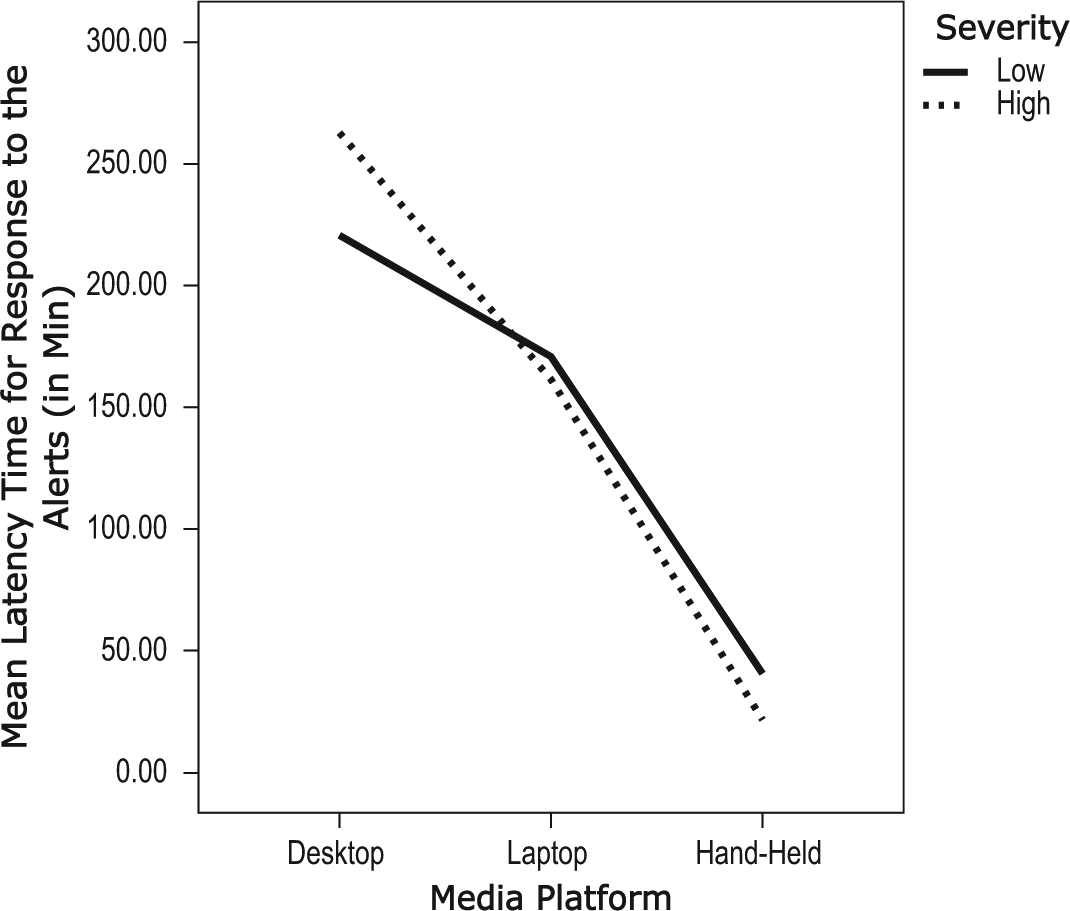
Latency time for response to alerts predicted by media platform and severity.
Decreasing latency times from desktop to laptop to hand-held fell in line with the general theory concerning mobility and ubiquity of each respective platform. In a sense, this finding can be viewed as a manipulation check because hand-held device is the most proximate and ubiquitous, physically, temporally, and psychologically, while desktop is the most far away and stationary. However, the increase in latency times for high severity crimes on desktops is especially interesting because it suggests that participants expended more mental effort in that condition.
Hypothesis 4a (H4a): Students with higher trait anxiety will be especially at risk of experiencing anxiety and will report higher levels of general felt anxiety
Hypothesis 4b (H4b): After controlling for trait anxiety, those who were exposed to more media coverage of the Virginia Tech shootings will suffer more anxiety from the messages
Hypothesis 4c (H4c): After controlling for both trait anxiety and media exposure, a trigger event alone such as the receipt of emergency alerts can increase users’ general felt anxiety at the end of the study.
To test H4 (H4a-H4c), hierarchical regression analysis was performed with participants’ general felt anxiety at the end of the study as the dependent variable and the three components of anxiety as the independent variables. Participants’ trait anxiety was entered in the first block, media exposure to the Virginia Tech campus shootings was entered in the second block, and general felt anxiety reported at the end of the first day was entered in the third block.
Table 3 shows that trait anxiety had a positive relationship with participants’ general felt anxiety at the end of the study, ΔR2 = .07, p < .001. The block of media exposure also predicted felt anxiety at the end of the study, ΔR2 = .07, p = .03. Specifically, the more TV coverage of the Virginia Tech shootings the participants had watched, the more anxious they felt at the end of the study. After controlling for trait anxiety and media exposure, anxiety reported at the end of the first day still accounted for 8% of the variances of the model, ΔR2 = .08, p = .003. The whole model was significant, F(7, 81) = 7.09, adjusted R2 = .31, p < .001. Thus, H4 was supported.
Anxiety Reported at the End of the Study Predicted by the Genetic Component of Anxiety, Media Exposure, and Anxiety Reported at the End of the First Day (Hierarchical Regression; N = 96).
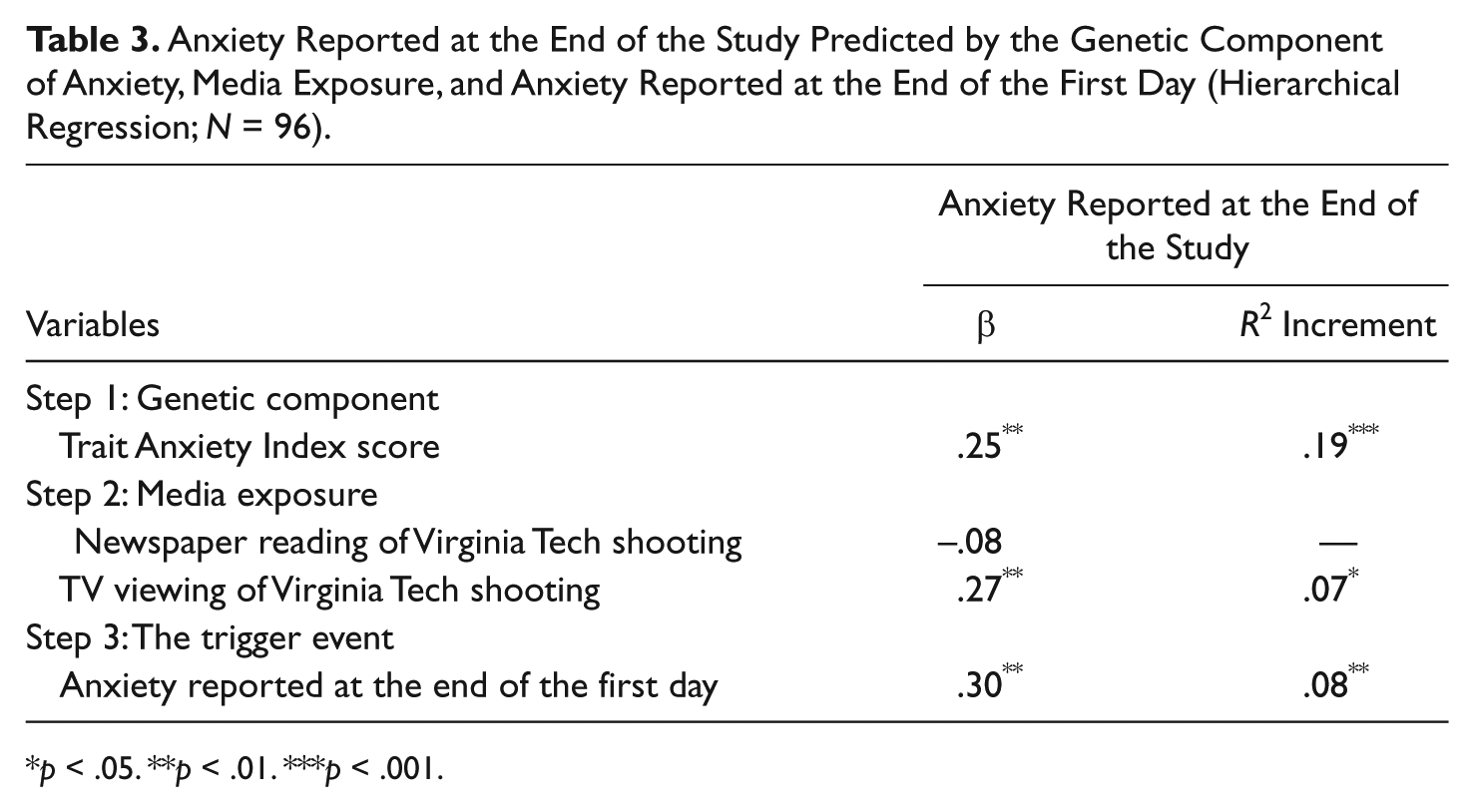
p < .05. **p < .01. ***p < .001.
Table 4 shows that both trait anxiety and media exposure to the Virginia Tech shootings predicted valence at the end of the study. Higher trait anxiety and reading more newspaper coverage of the Virginia Tech shootings made participants feel more negative at the end of the study. The whole model was also significant, F(7, 81) = 6.05, adjusted R2 = .30, p < .001.
Valence and Arousal Reported at the End of the Study Predicted by the Genetic Component, Media Exposure, and Anxiety Reported at the End of the Study (Hierarchical Regression; N = 96).
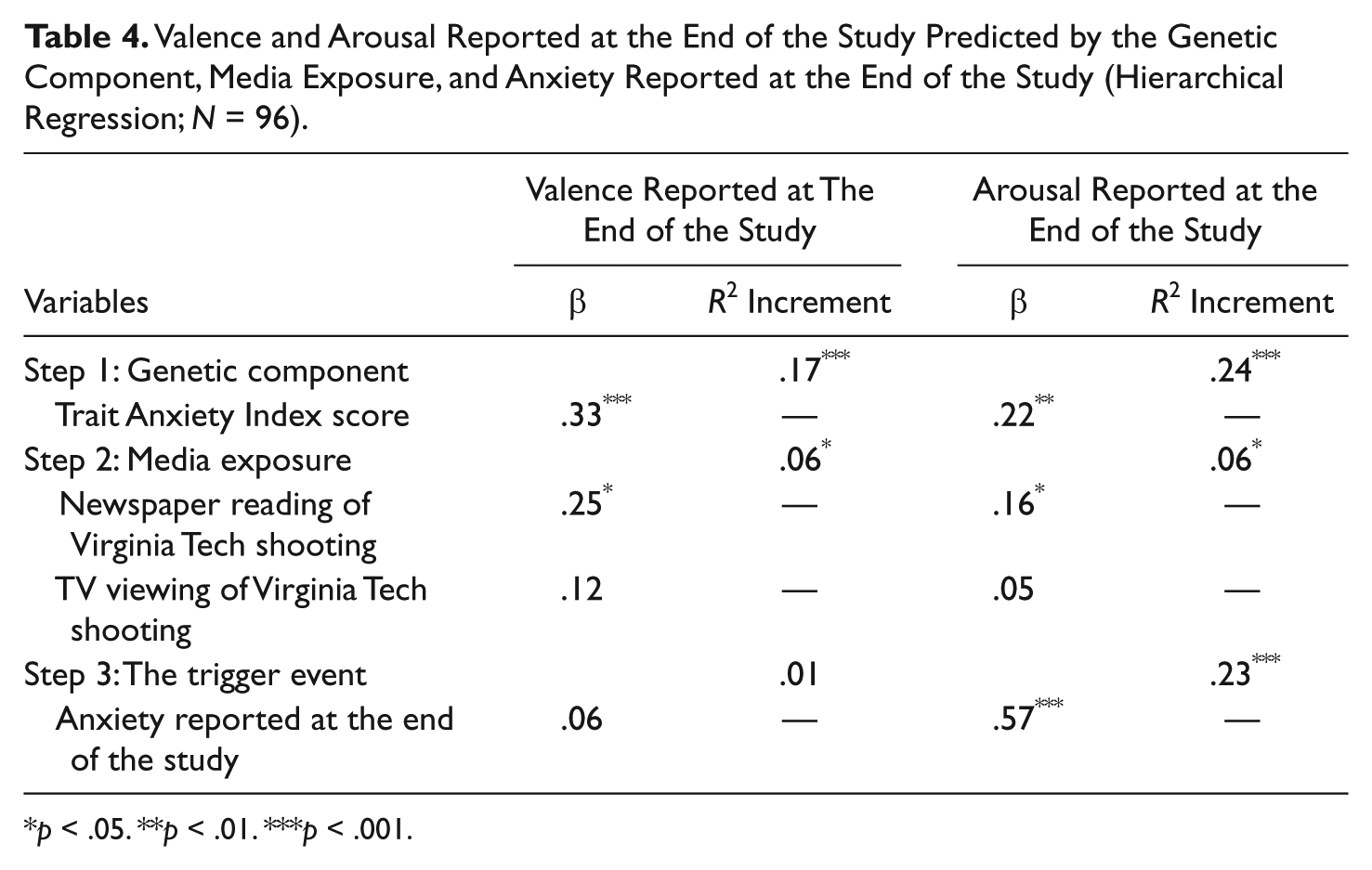
p < .05. **p < .01. ***p < .001.
Table 4 also shows that participants with higher trait anxiety reported higher arousal at the end of the study. Both media exposure to the Virginia Tech shootings. F(2, 80) = 3.28, ΔR2 = .06, p = .04, and participants’ general felt anxiety at the end of the study, F(1, 79) = 37.84, ΔR2 = .23, p < .001, predicted arousal at the end of the study. The model was significant, F(7, 81) = 7.22, adjusted R2 = .31, p < .001.
Discussion
This study experimentally examines the effects of interface proximity, conceptualized as far, moderate, and near, on participants’ anxiety when they received news-like crime alerts. Interface proximity took on three different media platforms: stationary (desktop computer), portable (laptop computer), and ubiquitous (hand-held devices). Second, it observes the contribution of the three “building blocks,” or the three components of anxiety to participants’ felt anxiety at the end of the study.
Ubiquitous computing has been widely discussed in the field of computer science and engineering (Satyanarayanan, 2001; Tamminen et al., 2004; Weiser, 1993; Weiser & Brown, 1996), usually as a positive outcome. This study, however, looks at the unintended, unexpected, and potentially negative emotional outcomes that the ubiquitous and mobile communication technologies may engender. The most striking finding in our study is that an increase in interface proximity is accompanied with increased user anxiety. Participants reported a higher level of anxiety when they received alerts on laptop and hand-held device than when they received alerts on stationary desktop computer, especially when crime severity was low. In addition, the hand-held group reported the highest increase in anxiety levels throughout the study, followed by the laptop group and the desktop group.
These results give credence to the idea that decreasing proximity, conceptualized as the spatial, temporal, and psychological distance between the media platform interface and the user, can increase user anxiety. Although previous studies identified the association between mobile phone use and psychological problems such as stress (Mozes, 2012; Richtel, 2010) and loneliness (Greengard, 2012), those studies have been criticized for using a survey method and not being able to rule out the influence of extraneous variables such as personal traits (Mozes, 2012). This study, however, can lend some support for the causal relationship between hand-held device use and anxiety by setting up an experiment and taking trait anxiety into account. Our findings affirm McLuhan’s (1964/1994) argument that “electronic technology is directly related to our central nervous systems” (p. 68). It cannot be stressed strongly enough that the shrinking of this “distance” is a function of the ubiquity and proximity of hand-held communication technologies.
Another intriguing finding is the “overnight effect” on the desktop and laptop groups, in which participants’ anxiety, valence, and arousal lessened the next morning. However, the hand-held group retained high level of anxiety, arousal and valence on early Day 2. Related to the “overnight effect” is the fact that reportedly 48% of 18- to 34-year-olds check Facebook upon waking up, 28% of whom do so from their bed (Hepburn, 2011). This underlines the idea that the ubiquity of hand-held devices is palpable. As the media equation phenomena have observed, computer users would treat computers as social actors because of the physical and psychological presence (Lee, 2004b; Nass & Moon, 2000; Reeves & Nass, 1996). The hand-held device is an “invisible” (Hallnäs & Redström, 2002; Weiser, 1993) yet omnipresent part of our lives; it is almost under our skin, with “no down time.”
Latency data, a widely accepted measure of mental work (Zechmeister & Nyberg, 1982), also supported this result. Latency time for response to the alerts was the shortest for the hand-held group, followed by the laptop and desktop groups. This would seem to be an obvious fact that hand-held devices are physically and temporally proximate. However, latency to alerts also varied according to message content. Although participants receiving the alerts on the desktop computer lagged behind the hand-held group and the laptop group in responding when crime severity was low, this group was even slower when crime severity was high. This result suggests the psychological dimension of proximity also plays a role in response time. It also further validates the idea that proximity is a complex and highly nuanced construct.
However, a careful examination of Figure 2 shows that for the desktop and laptop groups, participants’ anxiety reported upon alert receipt reached the highest point at the end of the study. The hand-held group’s anxiety curve, on the contrary, was flat at the end of the study. The same results were found with valence and arousal reported upon alert receipt. This phenomenon could be explained by the inverted U curve of the relationship between information intensity and arousal, which is suggested by Hebb (1955). Compared to those receiving alerts on the desktop and laptop, participants in the hand-held group responded to the stimuli more frequently and intensively through the day. The strong information intensity may have caused fatigue and resulted in the “graceful degradation” of performance described by Norman and Bobrow (1975). Thus, it would be interesting to extend the study into a third and fourth day to see whether the “information habituation” effect happens for users of more static platforms.
That all three anxiety components contributed to students’ general felt anxiety when receiving crime alerts is another striking finding of this study. Trait anxiety can be a factor in anxiety generated by a news-like trigger event. Genetic and trait vulnerability can also be a source of negative valence and high arousal. The mediated life experience of crimes, measured as media exposure to the Virginia Tech campus shootings, also represented a vehicle for participants’ felt anxiety at the end of the study. This result verifies the media exacerbation hypothesis (Galea et al., 2005), which proposes a positive relationship between indirect media exposure and PTSD. In their study of PTSD in the aftermath of the 9/11 attacks, Neria et al. (2011) questioned whether direct exposure to trauma should be one of the criteria of PTSD and suggested that indirect exposure through media deserves further attention in the discipline of anxiety research. This study provides some evidence for the positive relationship between indirect exposure and anxiety. Furthermore, the receipt of the crime alert also served as a psychological trigger of anxiety, explaining 8% of the variance in general felt anxiety and 23% of the variances in general felt arousal at the end of the study. This indicates that even after controlling for trait anxiety and prior life experiences, the receipt of crime alerts in isolation is sufficient to produce anxiety.
The significance of genetic factors and prior life experience suggests a snowball effect. This should be a warning that individuals prone to anxiety and depression may be especially vulnerable to the effects of stressful news delivered via ubiquitous hand-held technologies. Thus, although at a certain level H4 can be viewed as a manipulation check, the finding that all three factors contributing to anxiety worked well in the model is still astonishing. As mentioned earlier, previous studies testing the association between mobile phone use and user anxiety have been challenged for not controlling extraneous factors such as personal traits (Mozes, 2012). The fact that we applied the three-level model of anxiety and used hierarchical regression analysis controlling for trait anxiety could be regarded as a methodological advantage of this study.
While the alerts were neither the product of journalism nor disseminated via traditional media, they should be considered, in the fullest sense, “news.” As such, these results can be extended to the delivery of news to hand-held devices generally. When this study was executed, delivering news via hand-held devices was on the horizon. In addition, a recent Pew survey indicated one third of respondents reported getting news from a hand-held device (Pew, 2010). Therefore, delivery of news via hand-held devices calls for our attention to the negative effects such as anxiety it may bring.
Moreover, although media platform significantly predicted participants’ anxiety reported upon alert receipt, it did not predict emotional valence or arousal. This suggests anxiety is different from full-blown emotions, such as anger, as proposed in the theoretical explication of this project. Anxiety, more accurately, represents a pre-emotional state. However, participants’ felt anxiety was a strong positive predictor for felt arousal at the end of the study, indicating that as anxiety accumulates, it could result in a more serious condition, such as an anxiety attack or clinical depression.
Footnotes
Declaration of Conflicting Interests
The author(s) declared no potential conflicts of interest with respect to the research, authorship, and/or publication of this article.
Funding
The author(s) disclosed receipt of the following financial support for the research, authorship, and/or publication of this article: This research was supported in part by grants from the Casey Foundation from the Philip Merrill College of Journalism at the University of Maryland, College Park.