







Abstract
The present experiment investigated (a) if exposure to a high profile politician’s Twitter page (vs. newspaper interview) affects the participants’ evaluations of him and his policies and (b) how their proclivity to get deeply immersed in a narrative and identify with the story characters (i.e., transportability) moderates such effects. Even though the messages were identical, exposure to the candidate’s Twitter page heightened the sense of direct conversation with him (i.e., social presence), which in turn induced more favorable impressions of and a stronger intention to vote for him among those high in transportability. Increased social presence also led to stronger agreement with the candidate’s policy statements among those espousing favorable attitudes toward him. However, those presented with the newspaper interview better recognized the issues mentioned and had fewer thoughts about the candidate, suggesting that people adopt medium-specific processing strategies, focusing more or less on the source (vs. issue).
Social network services (SNSs), which refer to “web-based services that allow individuals to (1) construct a public or semipublic profile within a bounded system, (2) articulate a list of other users with whom they share a connection, and (3) view and traverse their list of connections and those made by others within the system” (boyd & Ellison, 2008, p. 211), seem to have become an indispensable component of our everyday communication repertoire, accounting for a significant portion of the time spent online worldwide (comScore, 2011; Nielsen, 2011). Although the extant literature on SNSs has focused mostly on their capacity for social interaction and interpersonal connections among peers, it also deserves note that public figures, especially politicians, have begun to utilize this new communication venue as a privately owned publicity channel. Not only can politicians make connections with the electorate, disseminate their policy statements bypassing traditional media outlets, and mobilize their supporters through SNSs (Gueorguieva, 2008), but their SNS posts often serve as raw materials for the mainstream media, enhancing their visibility in the public eye much beyond their followers (Levinson, 2011).
Among the variants of SNSs, Twitter is by far the most popular microblogging application that enables users to deliver short posts of up to 140 characters (i.e., tweets) to a network of associates (Jansen, Zhang, Sobel, & Chowdury, 2009). Enticed by its unprecedented capacity to instantly engage voters in a more direct, personal, and potentially interactive manner, politicians have been at the forefront of the adoption of Twitter in South Korea. Specifically, 77.3% of National Assembly members had activated a Twitter account as of November 2011 (Jun & Bae, 2011) and the incumbent party even announced its plan to use the self-developed “Twitter Influence Index” as an official criterion when nominating general election candidates (Jin, 2012).
Such immense popularity of Twitter among politicians has led researchers to address such questions as how politicians are interconnected through Twitter (Hsu & Park, 2011), what they write about in their tweets (Park, 2010), and what factors predict their Twitter adoption (Lassen & Brown, 2011). Still, the critical question of how politicians’ Twitter use compares to other, more traditional methods of communication in terms of publicizing their policy agendas and creating a positive image has largely been overlooked. Recently, Lee and Jang (2011) examined how public figures’ microblogs affect the public’s impressions of and attitudes toward them, but (a) communication channel (microblog vs. newspaper) was confounded with the degree of mediation, as the news article simply remediated the target’s microblog messages, and (b) because the authors did not measure the participants’ prior attitudes toward the target (Study 1) or used a previously unknown target (Study 2), it remains unclear how the feeling of face-to-face conversation with the target (i.e., social presence), which mediated the channel effects, might interact with the readers’ prior attitudes toward the target to shape their reactions.
To fill the void in the existing literature and address the limitations of the previous study, the current research investigated how exposure to a well-known politician’s Twitter messages (vs. newspaper interview) might affect individuals’ feelings of directly conversing with him, and how such feelings might subsequently influence their evaluations of the candidate and his issue positions, independently and jointly with their preexisting attitudes toward him. In so doing, we also (a) examined how individuals’ proclivity toward being absorbed, or “transported,” into a story (i.e., transportability; Dal Cin, Zanna, & Fong, 2004; Green & Brock, 2000) moderates the extent to which they virtually experience the candidate’s presence based on his Twitter-mediated interaction with other followers, and (b) probed their cognitive responses to further elucidate the mechanism that underlies the channel effects, if any.
How Social Are Social Media?
In the realm of political campaigns, potential benefits of direct communication between candidates and citizens have long been acknowledged, especially with the advent of the Internet (Bimber & Davis, 2003). Despite the capacity of a new medium that allows for more personal and reciprocal contact with the electorate, however, candidates do not appear to have fully utilized its interactive features, because “they are burdensome to the campaign, candidates risk losing control of the communication environment, and they no longer can provide ambiguous campaign discourse” (Stromer-Galley, 2000, p. 122). Even in the case of Twitter, despite its unparalleled capacity to support spontaneous and direct interaction between politicians and their supporters, the majority of their followers tend to remain as unobtrusive observers, silently reading the politicians’ posts or watching their interactions with more outspoken others. Granted, people may retweet the candidates’ messages to their friends and even comment on them, but most likely in a way that does not demand immediate reactions from the candidates.
The lack of direct, one-to-one communication with politicians, however, might not completely preclude the possibility that people nonetheless feel as if they were engaging in real, nonmediated interaction with them (i.e., social presence; Biocca, Harms, & Burgoon, 2003; Lee & Nass, 2005; Nowak & Biocca, 2003). Compared to a more traditional form of mediated encounter with political leaders, like a newspaper interview, reading their tweets might evoke a stronger “sense of being together with another” (Biocca, Burgoon, Harms, & Stoner, 2001, p. 2) for the following reasons. First, unlike a newspaper interview, for which questions are carefully selected a priori and the message content is subjected to editing prior to publishing, Twitter messages are not transmitted by a third party. As such, although people are aware that Twitter messages represent the candidates’ conscious, selective self-presentation, the messages might still be seen as more spontaneous and authentic than what can be expected of their carefully staged media representation (Levinson, 2011). After all, Twitter is a medium operated by the candidates themselves (or maybe their staff), and the absence of a visible intermediary like a newspaper reporter might substantially dilute the sense of mediation among message recipients, which interferes with presence (Lombard & Ditton, 1997).
Second, a politician’s Twitter page seems to preserve the interactive nature of communication better, as the conversational threads are being unfolded as if they were occurring here and now. By contrast, a newspaper interview presents the same messages as a past event with a beginning and an end, positioning its readers as passive consumers of mass-oriented information, rather than potential participants who can take part in the ongoing social transaction at their will. Such live broadcast quality of microblogging services might heighten the sense of interactivity, and hence, presence (Steuer, 1995). Taken together, just as television (TV) viewers at home feel intimate with the TV persona who casually “mingles with the studio audience in a question-and-answer exchange” (i.e., parasocial interaction; Horton & Wohl, 1956, p. 218), those reading the conversational give-and-take between the candidate and other Twitter users might be able to vicariously participate in the virtual interaction with the candidate.
Hypothesis 1 (H1): Participants experience a higher level of social presence after viewing the candidate’s Twitter page than his newspaper interview.
Despite such potential, however, considering that the feeling of being connected with remote CMC partners (electronic propinquity) varied as a function of the channel bandwidth, information complexity and the user’s communication skills (Walther & Bazarova, 2008), the extent to which people feel the presence of the candidates while reading their Twitter messages is likely to hinge on a host of factors. The present research focused on the individual’s proclivity to get immersed in a narrative and feel empathetic toward the story characters, transportability (Dal Cin et al., 2004), as one such factor.
Transportability as a Moderator of Channel Effects
According to Green et al. (2008), while reading a book or viewing a film, people may experience transportation into the story world, “a state of cognitive and emotional immersion in a text” (p. 513). As a form of experiential response to narratives, transportation makes one’s story experience seem more like a real experience, leading people to create vivid mental images of the settings and characters in the narrative and develop strong feelings toward the characters (Green & Brock, 2000; Green et al., 2008). Although transportation represents an individual’s subjective experience at a specific time in response to a specific narrative, there also exist rather stable individual differences in the degree to which people are easily absorbed into a narrative across stories and contexts (Dal Cin et al., 2004). Such general tendency toward transportation is also similar to fantasy, the tendency to identify with fictional characters, vicariously experience their feelings and get caught up in the story (Davis, 1980), but transportation was found to occur with both fictional and nonfictional stories (Green & Brock, 2000).
Given that “the idea of feeling as if one is part of a narrative world is a common core that presence and transportation share” (Green et al., 2008, pp. 513-514), individuals’ general proclivity toward transportation might affect the extent to which they experience the immediate presence of the candidates while viewing the record of their past communication with someone else. For example, although they did not examine social presence per se, Dunlop, Wakefield, and Kashima (2010) found that those who were more transported in response to health-promoting mass media messages were more likely to engage in self-referencing, suggesting a link between transportation and the readiness to relate a mediated experience of others to oneself. In addition, considering that it requires greater mental efforts to experience transportation with a print medium (e.g., book) than a visual medium (e.g., film; Green et al., 2008), it is conceivable that those chronically disposed toward transportation will be better able to imagine the interaction between the remote target and other people based solely on the transcript and furthermore, virtually participate in it, compared to those lacking such proclivity.
However, it merits note that transportability represents a domain-specific cognitive propensity that operates only in response to particular types of stimuli; that is, it moderated only the effects of narrative persuasion, but not those of advocacy persuasion (Dal Cin et al., 2004). Put differently, transportability is more or less likely to shape individuals’ experiential reactions depending on how likely the candidate’s messages are viewed as a “story.” Although no research has directly examined how “story-like” Twitter messages are seen as, the uses and gratifications research on Twitter has listed self-documentation and self-expression as primary motivations of Twitter use, along with relationship building/maintenance and information sharing (Liu, Cheung, & Lee, 2010; Shim & Hwang, 2010), suggesting that users take Twitter as a personal or interpersonal medium through which their personal experiences are shared among those within their online network.
More directly germane to the current research, several studies (Jackson & Lilleker, 2011; Park, 2010; Sæbø, 2011; Small, 2010) conducted in different countries (UK, Norway, Canada, South Korea) have found that politicians commonly tweet about personal content as well as their ongoing activities to appear as down-to-earth human beings and get closer to voters. Albeit concerned with other forms of SNSs, studies on politicians’ MySpace profiles have also reported that voters’ comments addressed to the politicians were mostly personal in content (Postelnicu & Cozma, 2007) and the visitors reported the desire for social interaction with the candidate and other supporters as the most significant motivation (Ancu & Cozma, 2009). Collectively, these findings indicate that SNSs are generally conceived of as a “user-centered,” as opposed to “topic-centered” medium (Utz, 2009, p. 223) and utilized as such by politicians and their supporters. If so, people might well expect to hear the politician’s personal story when viewing his Twitter page, which renders transportability more influential in shaping their subsequent reactions. On the other hand, the politician’s interview article might be viewed as a variant of news reports whose main objective is to inform the readers of public issues.
Hypothesis 2 (H2): Those high in transportability experience a higher level of social presence while reading the candidate’s tweets than his newspaper interview, but those low in transportability are less likely to show such differentiation.
Once induced, perceived presence of the candidate might in turn affect the individual’s evaluations of the target. For example, Bente, Rüggenberg, Krämer, and Eschenburg (2008) found that those in the text-chat condition reported a lower level of copresence with the mediated partner than those in the audio, audio-video, and avatar conditions, and that perceived copresence was positively associated with perceived trustworthiness of the partner. Similarly, while interacting with a computer agent, participants experienced a higher level of the agent’s presence when allowed to exercise greater control over message presentation, and increased presence prompted more positive thoughts about the agent (Skalski & Tamborini, 2007). In the aforementioned study, Lee and Jang (2011) also reported that the stronger the perceived presence of the celebrity target after reading his microblog messages, the more intimate the participants felt with him and became more willing to watch his upcoming movie.
Although these studies have shown uniformly positive effects of social presence, they dealt with either a virtual agent or unacquainted online partners about whom the participants had no prior attitude that might serve as an anchor for subsequent judgments. Even when a celebrity target was used, the participants’ pre-existing attitude was not measured, making it impossible to examine how it might interact with the perceptual salience of the target. However, previously documented positive effects of social presence might be more likely to occur when participants have relatively favorable or at least nonnegative attitudes toward the target. As Skalski and Tamborini (2007) suggested, for example, heightened presence of a virtual character in a violent video game might lead to more negative emotional responses. If the positive effects of social presence are more likely to occur in a “positive message environment” (p. 407), the as if experience of direct interaction with well-known politicians is expected to give an emotional boost to their fans, but unlikely to trigger positive reactions from those negatively predisposed toward them. In this sense, prior attitudes (favorable vs. unfavorable) might serve as a contingent condition, depending on which heightened social presence is more or less likely to improve subsequent evaluations of the candidates. From a different perspective, social presence might also amplify the effects of prior attitudes on subsequent judgments by escalating the cognitive salience of the target. Given that people tend to have a stronger mental model of the interactant when they feel they are with him or her (Biocca et al., 2003), and people have limited cognitive capacity to process incoming stimuli, and thus, rely on a few salient cues to make sense of their environment (Lang, 2000), heightened social presence might accentuate the effects of the participants’ initial attitudes toward the candidate, yielding polarized reactions.
Hypothesis 3a-c (H3a-c): Heightened social presence, in turn, enhances the participants’ (a) general evaluations of, (b) willingness to vote for, and (c) agreement with the candidate when they hold favorable attitudes toward the candidate, but not when they hold unfavorable attitudes.
Effects of Communication Channel on Message Processing
Meanwhile, communication channel might also affect the way people process the candidate’s messages. Although the previous research centered on the effects of communication modality (text vs. audio-visual), the well-documented findings that newspaper (written messages) facilitates message elaboration and recall, whereas TV (videotaped messages) encourages greater processing of communicator cues and amplifies their impact (e.g., Chaiken & Eagly, 1983; DeFleur, Davenport, Cronin, & DeFleur, 1992; Sparks, Areni, & Cox, 1998) seem to be relevant here. If people become more likely to process messages in a source-centered manner as perceptual salience of the source increases, exposure to the candidate’s Twitter page might foster source-centered processing and hinder message elaboration, as people consider Twitter as a “(inter)personal” medium and focus their attention on the source as reasoned above. Put differently, even when the modality, an objective property of the communication channel, is held constant, the user’s subjective expectations as to how interpersonal (vs. mass-oriented) the medium is might direct their attention to the communicator to varying degrees.
Alternatively, considering that the viewers report greater cognitive involvement when the characters in TV shows speak directly to them, “breaking the fourth wall,” and “invite their viewers to participate in the content” (Auter & Davis, 1991, p. 170), people might engage in more thorough processing of politicians’ tweets than their interview article due to perceived interactivity, whether the messages are concerned with personal matters or policy issues. That is, even when the candidate’s tweets and the newspaper interview both feature his or her interaction with a third party and do not directly engage the participants, their preconception that Twitter is an interactive medium might still trigger similar reactions as the direct audience-address does, leading to higher elaboration and better recognition of the message content. Although they dealt with actual interactivity, rather than users’ perceptions, Warnick, Xenos, Endres, and Gastil’s (2005) finding that those who viewed the candidate’s website with more campaign-to-user interactivity features (e.g., email link, comment box) recalled the candidate’s issue positions better than those presented with the website lacking such features seems to support this conjecture. With these competing possibilities, the following questions were proposed to explore if, and if so, how communication channel shapes individuals’ frame of mind and activates different message processing.
Research question 1a-c (RQ1a-c): Do participants process the candidate’s Twitter messages and his newspaper interview differently in terms of (a) the number of relevant thoughts and (b) source-related (vs. issue-related) thoughts, and (c) recognition of the issues mentioned by the candidate?
Method
Participants
A total of 217 current Twitter users (95 men, 122 women; Age M = 33.0, SD = 7.89) were recruited through an online survey company in South Korea to participate in the web-based experiment. Those on the national research panel received an email invitation and among those who visited the study website, only current Twitter users who do not follow any politicians were allowed to participate in the study.
Procedure
Upon accessing the study website, participants indicated if they would take part in a study on social media use (Twitter condition) or general media use (newspaper condition). Those who agreed to participate proceeded to answer questions concerning demographic information, Twitter and other media use, and their attitudes toward several political leaders. They were then presented with either the target politician’s mock-up Twitter page or his interview article.
For the target politician, we chose Simin Rhyu, a former minister of Health and Welfare and the leader of a liberal political party (The Unified Progressive Party), because he is not only well-known but also tends to elicit rather polarized reactions from the public. The mock-up Twitter page (see Figure 1) consisted of his profile picture and eleven messages (M = 118.45 characters, SD = 24.56) slightly modified from his actual tweets. Four out of eleven posts concerned controversial political issues, including college tuition, the sale of nonprescription medicines at convenience stores, corporatization of medical institutions, and a political rally of the Korean Teachers and Educational Workers’ Union. For example, “A few days ago, prosecutors investigated about 1,900 members of the Korean Teachers and Educational Workers’ Union and the Government Employees’ Union; this is nothing but a political witch hunt. From within, the government attempts to trample on critical opinions by oppressing the freedom of speech, which should be guaranteed for public service workers.” Another message was, “Although some argue that we should corporatize medical institutions, during my time as minister of Health and Welfare I advised former president Rho against it. It does no good in promoting public health and there are many more burning issues to be addressed.” The remaining posts concerned Rhyu’s personal life, including his vacation plan, his favorite sport, and leisure activities.
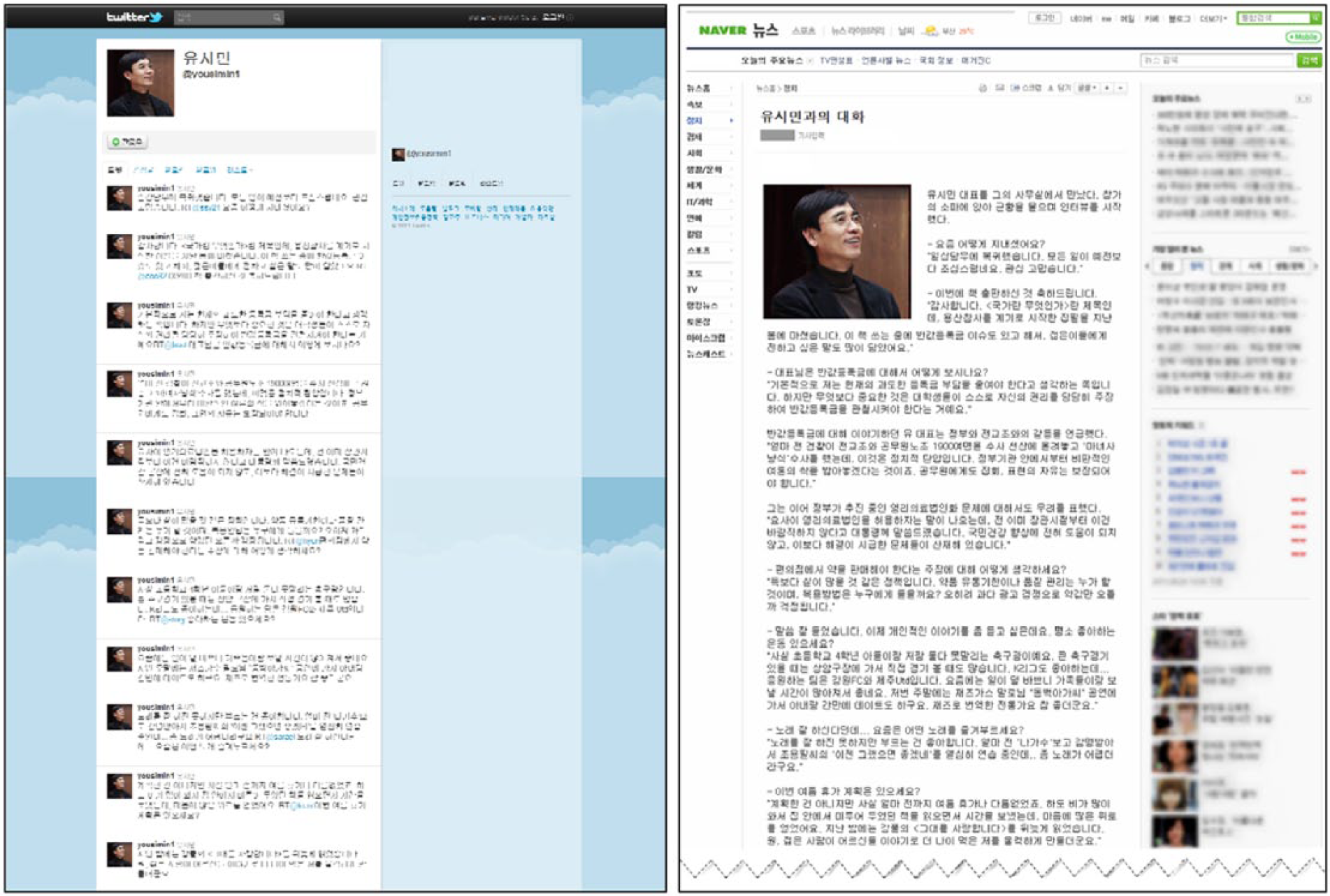
Screenshots of Twitter page (left) and newspaper interview (right).
To ensure comparability to the interview article, seven out of eleven Tweets were presented as the answers to his followers’ questions. For instance, “Actually, my fourth-grade son and I are diehard soccer fans. When there is a big game, we go to Sang-Am stadium to watch it with our own eyes. Among the K-league teams, Kangwon FC and Jeju Utd are my favorites. RT@story What’s your favorite sport?” Another example is, “In principle, I agree that the current college tuition is far too excessive and should be substantially reduced. More important, though, is that college students should take charge of this movement to achieve the goal. RT@beat What do you think of the current debate on college tuition?”
For the newspaper condition, the interface of Naver News, the most popular portal site in South Korea, was adopted (see Figure 1). The article was entitled as “Conversation with Simin Rhyu,” and the message content, including the profile picture, was identical to that of the Twitter condition, except for a few bland connecting remarks added for a more realistic look and feel of an interview (e.g., “Met him in his office,” “He commented on the conflict between the government and the Korean Teachers and Educational Workers’ Union while talking about college tuition.”). Twitter posts containing retweets of followers’ questions were converted into a question-and-answer format between the reporter and Rhyu, while the remaining messages were written as comments initiated by the candidate. To control for any confounds, medium-specific information, such as the number of following/followers and the time stamp of each post (Twitter), the date of the interview, the name of the newspaper and the reporter as well as the advertisements on each side (news article) were blurred.
Measures
Prior to viewing the stimuli, participants indicated how much time they spent on an average day reading newspapers (M = 14.61 minutes, SD = 21.72), reading news on the Internet (M = 57.79 minutes, SD = 47.34), and using Twitter (M = 43.37 minutes, SD = 35.70). They also reported how long they had been active on Twitter (M = 8.71 months, SD = 7.37). In addition, they indicated how much they liked the target (1 = Dislike him very much, 7 = Like him very much; M = 3.61, SD = 1.50), along with other political leaders. 41.5% indicated unfavorable attitudes (3 or below), 30.4% indicated a neutral position (4), and 28.1% expressed favorable attitudes toward him (5 or above).
To capture how they processed the messages, participants were given three minutes to list the thoughts that came across their mind while reading the text, immediately following the exposure to the experimental stimuli (Cacioppo & Petty, 1981; Skalski & Tamborini, 2007). After being trained together on the first 20 participants’ thought lists, two independent coders identified the thoughts relevant to the given text (N = 787) and classified them into either source-related thoughts (i.e., their personal feelings and thoughts about the target, thoughts about the target’s personal life) or issue-related thoughts (i.e., thoughts concerning issues of public interest). They also coded the valence of each thought (positive vs. neutral vs. negative). Intercoder reliability, computed using Cohen’s kappa (1960), was high for all the categories (all κs > .95) and thus, the scores were averaged between the two coders: relevant thoughts (M = 3.24, SD = 1.72), source-related thoughts (M = 2.33, SD = 1.59), issue-related thoughts (M = .85, SD = .94), positive thoughts (M = .98, SD = 1.40), neutral thoughts (M = 1.92, SD = 1.75), negative thoughts (M = .35, SD = .86).
Social presence was defined as the extent to which participants felt as if they were having a face-to-face conversation with the politician (Lee & Nass, 2005; Nowak & Biocca, 2003): “I felt as if I were engaging in an actual conversation with him,” “I felt like I was in the same room with him,” “I felt as if he was speaking directly to me,” “I could imagine him vividly” (1 = Strongly disagree, 7 = Strongly agree; α = .94, M = 3.75, SD = 1.31).
Overall evaluation of the candidate was measured by items tapping on the three subdimensions commonly used for political figures: competence, morality, and attractiveness (Rosenberg, Bohan, McCafferty, & Harris, 1986; Wyer et al., 1991). Participants rated the target on the following semantic differential scale: unintelligent (1)-intelligent (7), incompetent-competent, has no leadership-has leadership, selfish-unselfish, immoral-moral, untrustworthy-trustworthy, dishonest-honest, unlikable-likable, unattractive-attractive. Because a factor analysis yielded a single-factor solution (Eigen value = 5.20, % of variance accounted for = 57.73%), scores were averaged across the nine items, with higher scores indicating more favorable evaluations of the candidate (α = .91, M = 4.58, SD = .97).
To measure how accurately the participants recognized the issues mentioned in the text, a list of seven issues of public controversy, including three not talked about by the candidate, was presented. Participants indicated whether or not the target had mentioned an issue and the number of correct answers was recorded as the recognition score (M = 4.44, SD = 1.61).
For agreement with the politician’s issue positions, participants indicated how strongly they agreed with each of the following statements, half of which were in line with the target’s own stance as explicitly stated in his messages, while the other half contradicted it (1 = Strongly disagree, 7 = Strongly agree; M = 4.43, SD = .94). “College tuition should be drastically reduced,” “Non-prescription medicines should be available at convenience stores,” “Corporatization of medical institutions should be allowed,” “The Korean Teachers & Educational Workers’ Union should be granted the legal right to hold political rallies.”
Transportability was measured by asking how well the following statements described their experience when reading a story like a novel, an essay or a biography (Dal Cin et al., 2004; Davis, 1980): “I can easily envision myself in the events described in a story,” “I find myself feeling what the characters may feel,” “I find it difficult to tune out activity around me,” “I sometimes feel as if I am part of the story,” “Becoming extremely involved in a story is somewhat rare for me,” “I can easily take the perspective of the character(s) in the story” (1 = Describes me very poorly, 7 = Describes me very well). After appropriate recoding, the scores were averaged to create the transportability index (α = .80, M = 4.63, SD = .87). 2
Lastly, the participants indicated how willing they were to vote for the target, if given a chance (1 = Not at all willing, 11 = Very much willing; M = 6.29, SD = 2.56).
Results
To examine if exposure to the candidate’s Twitter page induces a stronger sense of social presence than his interview article does (H1) and if such effect is more pronounced for those high in transportability (H2), a simple moderation model was tested using Hayes’s (2012) PROCESS macro (Model 1). Since preference for and/or familiarity with a particular medium can influence transportation (Green et al., 2008), the time spent on reading newspapers (both paper and online) and using Twitter, as well as the duration of Twitter use were included as covariates. Specifically, social presence was regressed on control variables, communication channel (Newspaper = 0, Twitter = 1), transportability, and their interaction term. Neither communication channel, b = .26, t = 1.46, p = .15, nor transportability had significant effects on social presence, b = .08, t = .76, p = .45, failing to support H1. However, when the product term of transportability and communication channel was added, there was a significant increase in the variance accounted for, ΔR2 = .03, ΔF = 7.33, b = .56, t = 2.71, p = .007. To better understand this conditional effect, the estimated values of social presence were plotted at the 10th, 25th, 50th, 75th, and 90th percentiles of transportability for each medium. As Figure 2 shows, the candidate’s Twitter page induced significantly higher levels of social presence than the newspaper interview did, only for those high (75th percentile = 5.17 on a 7-point scale) or very high in transportability (90th percentile = 5.67). Thus, H2 was supported. Alternatively, when the interaction was decomposed for each communication channel, transportability was positively associated with social presence only in the Twitter condition, b = .34, t = 2.55, p = .01. Transportability did not significantly predict social presence when participants viewed the candidate’s interview article, b = −.21, t = −1.38, p = .17.
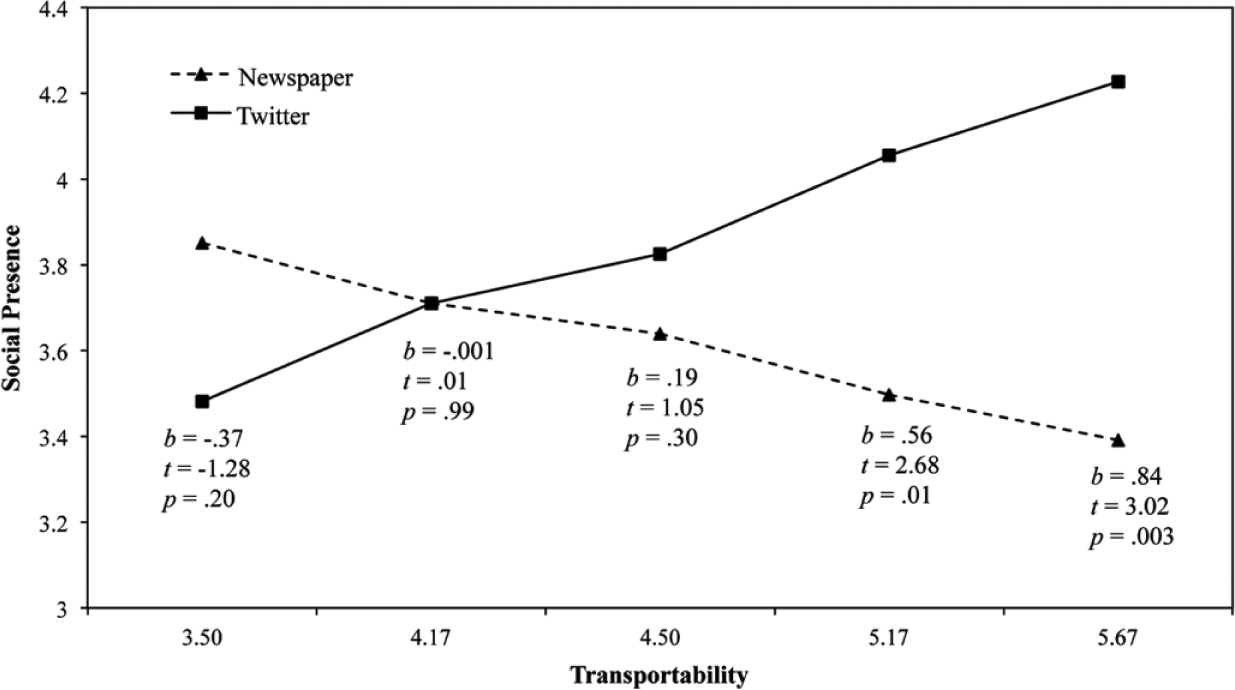
Conditional effects of communication channel on social presence: Transportability as moderator.
H3a-c predicted that social presence would enhance the participants’ evaluative judgments of the candidate in conjunction with their prior attitudes. A series of simple moderation tests (Hayes, 2012) was performed, with social presence as an IV and prior attitudes as a moderator. Each of the three DVs was regressed on social presence and prior attitudes, followed by their product term. First, the stronger the perceived presence of the candidate, b = .24, t = 5.45, p < .001, and the more favorable the participants’ prior attitudes toward the candidate, b = .27, t = 7.10, p < .001, the more positive their overall evaluation of him. However, their interaction was not statistically significant, ΔR2 = .002, ΔF < 1. Likewise, both social presence, b = .31, t = 2.89, p = .004, and prior attitudes toward the candidate, b = 1.00, t = 10.62, p < .001, had positive effects on the willingness to vote for him, but there was no significant interaction, ΔR2 = .0003, ΔF < 1. Therefore, neither H3a nor H3b was supported.
For the agreement with the candidate’s policy statements, participants’ prior attitudes had a significant effect, b = .14, t = 3.29, p = .001, but social presence did not, b = .06, t = 1.22, p = .22. Instead, a significant interaction emerged between the two, ΔR2 = .02, ΔF = 5.07, b = .06, t = 2.25, p = .03. To better understand this conditional effect, the estimated values of policy agreement at the 10th, 25th, 50th, 75th, 90th percentiles of social presence were plotted for those holding unfavorable (25th percentile = 3 on a 7-point scale), neutral (50th percentile = 4), and favorable (75th percentile = 5) attitudes toward the candidate, respectively (see Figure 3). Consistent with H3c, heightened social presence led to stronger agreement with the candidate’s issue positions only among those with favorable prior attitudes. When the interaction was decomposed for differing levels of social presence, participants’ prior attitudes had significant effects on policy agreement when they felt moderate to high levels of social presence (50th percentile = 4.00 or higher), .15 < bs < .24, 3.62 < ts < 4.05, ps < .0005. By contrast, when the participants felt very low (10th percentile = 2.00), b = .03, t = .47, p = .64, or low (25th percentile = 3.00) levels of social presence, b = .10, t = 1.94, p = .054, prior attitudes had either no significant effect or a marginally significant effect.
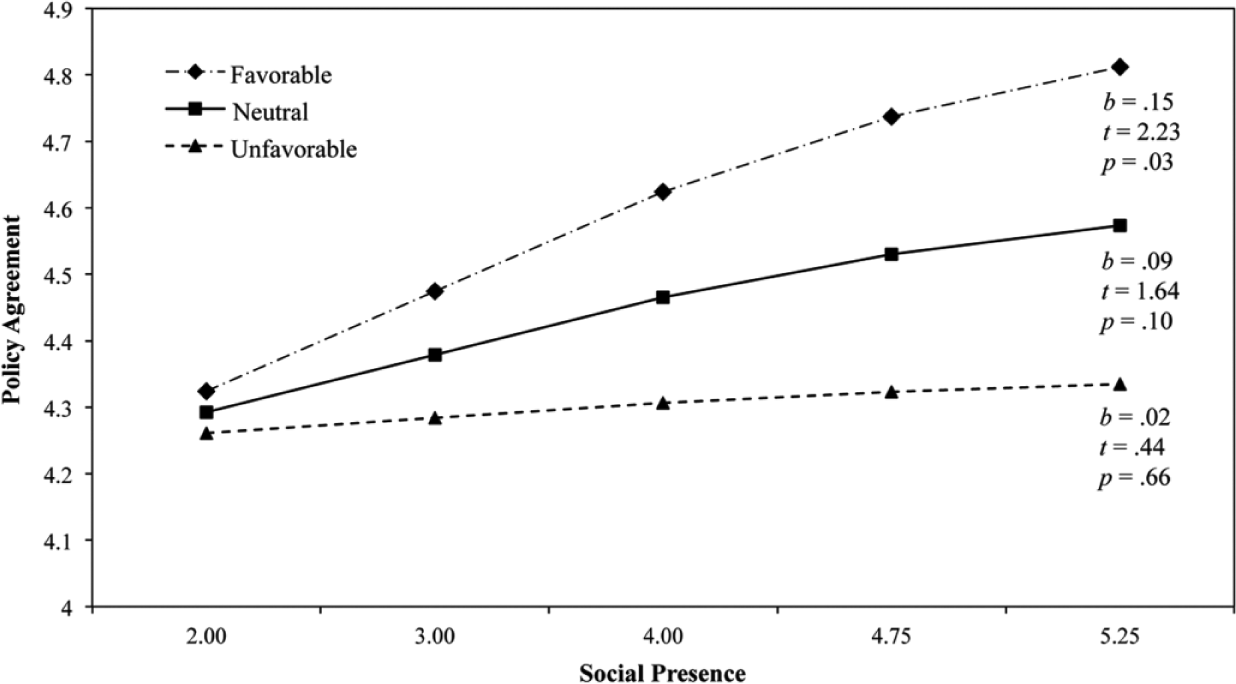
Conditional effects of social presence on policy agreement: Prior attitudes as moderator.
To portray a more complete picture of the conditional indirect effects of communication channel on DVs through social presence, PROCESS macro was employed (Model 7; see Figure 4). Given the lack of interaction between social presence and prior attitudes for overall evaluations (H3a) and vote intention (H3b), a reduced model was run with transportability as the only moderator affecting the relationship between the IV (communication channel) and the mediator (social presence). First, a simple moderation test used earlier (H1 & H2) was performed with communication channel, transportability, and their interaction as predictors of social presence, with media use variables as covariates. Second, the focal DV was regressed on both social presence and communication channel, as well as the control variables, to detect any direct effects of communication channel, not mediated by social presence. Results showed that exposure to the candidate’s Twitter page (vs. newspaper interview) yielded more positive overall evaluations of the candidate through social presence only for those with high (75th percentile = 5.17, conditional indirect effect = .1877, 95% bias-corrected 1000 bootstrap confidence interval = .0526 to 3562) or very high levels of transportability (90th percentile = 5.67, conditional indirect effect = .2813, 95% bias-corrected 1000 bootstrap confidence interval = .0814 to .5229). Likewise, those who viewed the candidate’s Twitter page reported a stronger intention to vote for him, only when they were high (75th percentile = 5.17, conditional indirect effect = .3844, 95% bias-corrected 1000 bootstrap confidence interval = .0932 to 7505) or very high in transportability (90th percentile = 5.67, conditional indirect effect = .5763, 95% bias-corrected 1000 bootstrap confidence interval = .1772 to 1.0886). Communication channel had no significant direct effect on either overall evaluation or vote intention, both |t|s < 1.03, ps > .30.
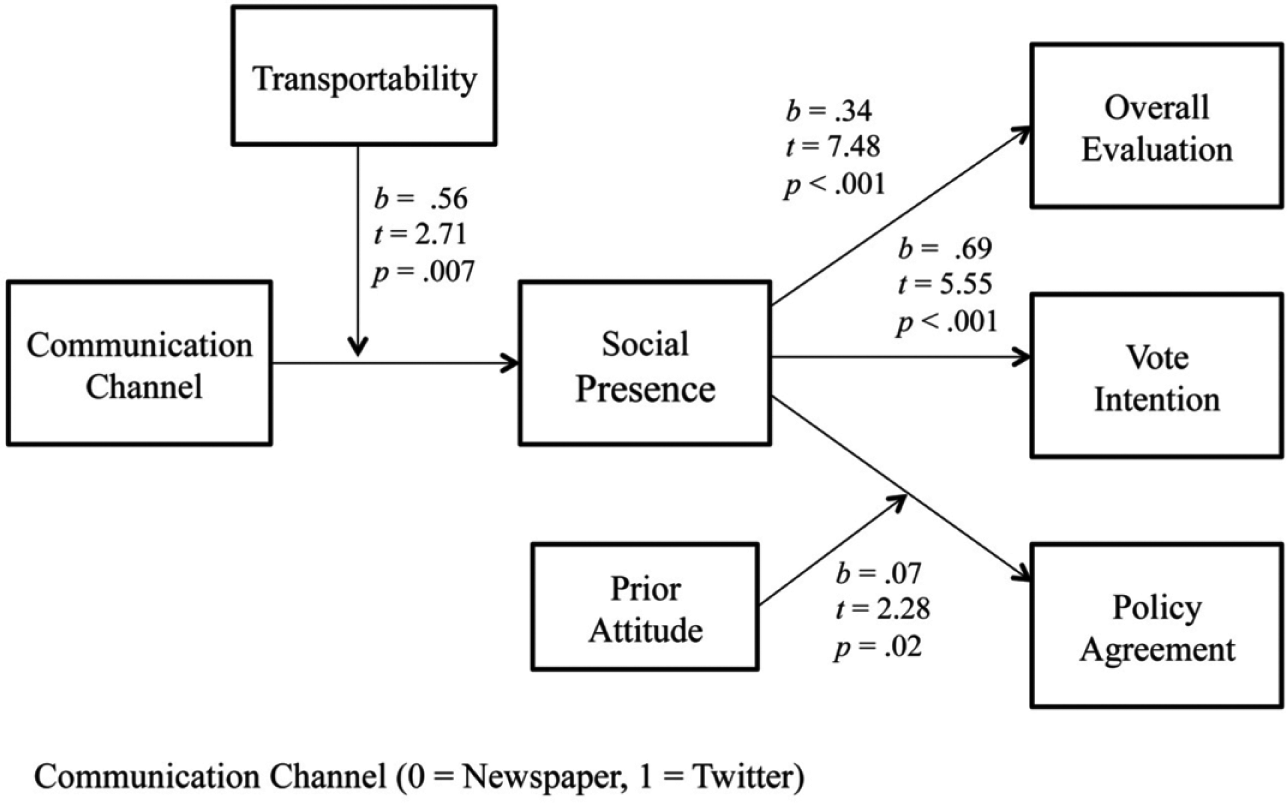
Conditional indirect effects of communication channel.
For agreement with the candidate’s policy, because there was a significant interaction between social presence and prior attitudes, prior attitudes was also included as a moderator between the mediator and the DV (Hayes, 2012, Model 21). Specifically, in addition to the simple moderation test for social presence described above, agreement with the candidate was regressed on social presence, prior attitudes toward the candidate, and their interaction term to see if the indirect channel effect through social presence was moderated by the participants’ prior attitudes, as well as on communication channel to evaluate the direct channel effect. The conditional indirect effects of communication channel through social presence on policy agreement was statistically significant only among those with favorable attitudes toward the candidate (both 75th and 90th percentile = 5.00) who were high (75th percentile = 5.17, conditional indirect effect = .0951, 95% bias-corrected 1000 bootstrap confidence interval = .0124 to 2356) or very high in transportability (90th percentile = 5.67, conditional indirect effect = .1426, 95% bias-corrected 1000 bootstrap confidence interval = .0236 to .3508). There was no significant direct effect of communication channel, t < 1.
Lastly, RQ1a-c addressed how communication channel affects the participants’ message processing. A series of multiple hierarchical regression analyses was performed. After entering media use variables and prior attitudes toward the target, which might affect the number, the object, and/or the valence of the participants’ thoughts, communication channel was added to see if it accounts for an additional variance in their cognitive responses (see Table 1).
Effects of Communication Channel on Message Processing: Hierarchical Multiple Regression Analyses.
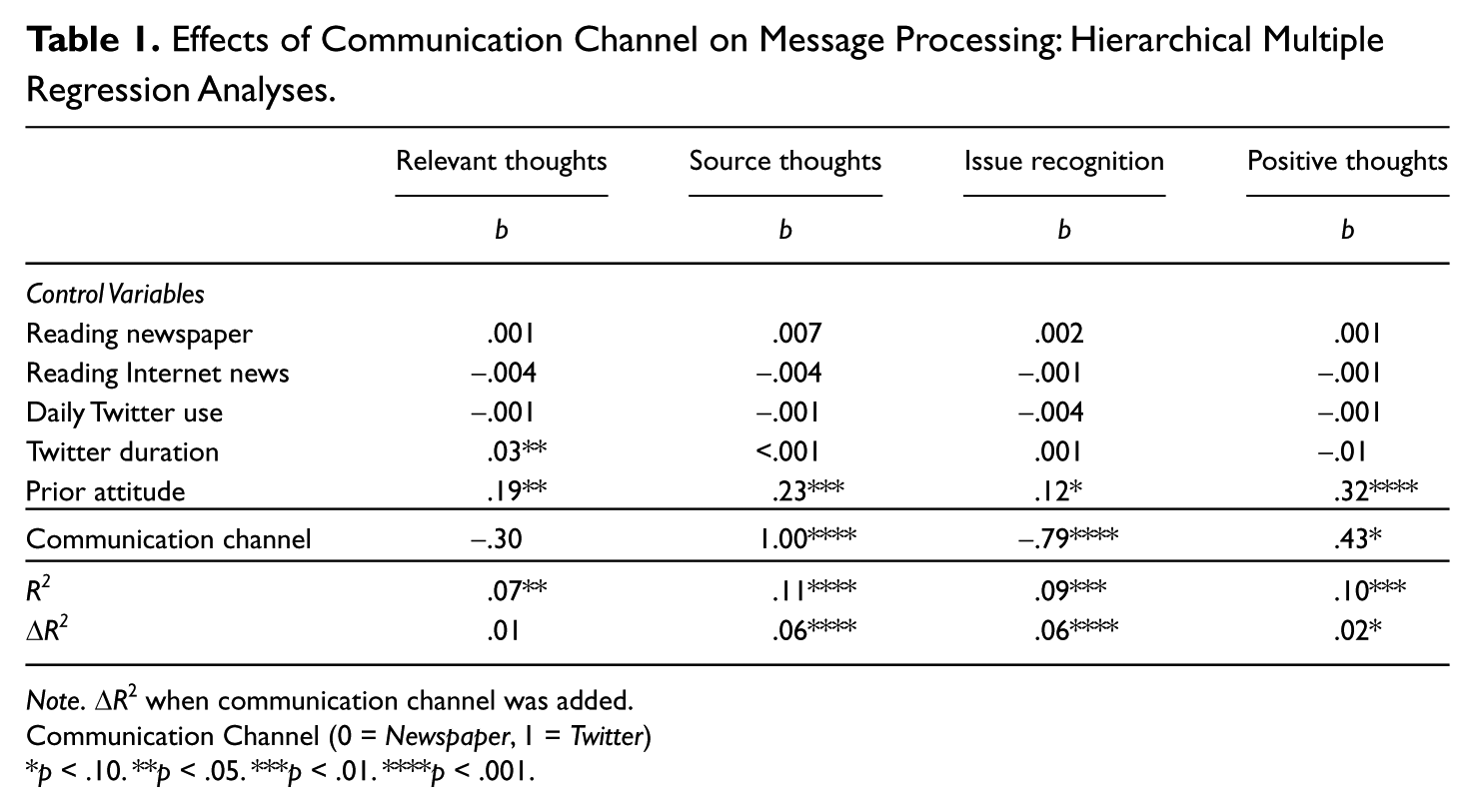
Note. ΔR2 when communication channel was added.
Communication Channel (0 = Newspaper, 1 = Twitter)
p < .10. **p < .05. ***p < .01. ****p < .001.
For the total number of relevant thoughts (RQ1a), those with more favorable attitudes toward the candidate and those who had been active on Twitter longer listed more thoughts. However, there was no significant difference between the Twitter and the newspaper condition, b = −.30, t = −1.30, p = .20. Next, to examine how source-centered the participants’ message processing was (RQ1b), the number of issue-related thoughts was subtracted from that of source-related thoughts. Results showed that positive prior attitudes engendered more thoughts about the source, controlling for the thoughts about issues. More important, exposure to the candidate’s Twitter page prompted a stronger source orientation than the newspaper interview did. Third, the same analysis for issue recognition (RQ1c) revealed that communication channel was the only significant predictor, with those who had read the newspaper interview better recognizing the issues mentioned in the text than those who had viewed Rhyu’s tweets. No other significant effects were observed, except that positive prior attitudes tended to enhance issue recognition (p = .09). Lastly, an additional analysis on the positivity of thoughts, which was computed by subtracting the number of negative thoughts from that of positive thoughts, yielded a marginally significant channel effect. Specifically, even after the effects of prior attitude were controlled for, those viewing the politician’s Twitter page tended to show more positive thinking than their newspaper counterparts, b = .43, t = 1.91, p = .06.
Discussion
In sum, the present experiment showed that exposure to a politician’s Twitter page heightened a sense of direct, face-to-face conversation with him among those more prone to get immersed in a mediated experience of others, leading them to express more favorable impressions of and a stronger intention to vote for him. Heightened presence also induced stronger agreement with the candidate’s issue positions, but such effect was confined to those favorably predisposed toward him. Those exposed to the candidate’s interview article better recognized the political issues he mentioned and showed less source-centered message processing than those who viewed his Twitter page, suggesting that people adopt different processing strategies with each medium.
Theoretical and Practical Implications
Overall, the current results indicate that people respond differently to a politician’s identical messages depending on the channel through which the messages are delivered, and such channel effects hinge on their cognitive propensity. Analogous to the findings that people rated the news segments to be more important and informative, and the comedy segments more funny and relaxing when they were shown on the “specialist” TV (“news TV” or “entertainment TV”) than the “generalist” TV (“news-entertainment TV”; Nass, Reeves, & Leshner, 1996), even though the interview article closely mirrored the candidate’s Twitter page and the screen-captured Twitter page allowed no dynamic interaction, the mock-up Twitter page elicited more positive evaluations of the candidate and a stronger vote intention among those more easily absorbed in a story by stimulating the as if feeling of direct personal encounter with the candidate. Similar to the previous finding that those high in transportability were more susceptible than lows only to narrative persuasion, but not to advocacy persuasion (Dal Cin et al., 2004), more transportable individuals formed more positive impressions of the candidate and showed stronger support for him only in response to his tweets, suggesting that people bring in different expectations when reading politicians’ Twitter messages than when reading their interview articles.
Another noteworthy effect of communication channel concerns message processing. Just as people have normative expectations about how each medium functions and choose the one best fitting their communication goal (task-media fit hypothesis; Daft & Lengel, 1986; Joinson, 2004), participants seemed to employ different processing strategies for each medium in accordance with their expectations. Unlike newspaper, a typical mass medium whose primary functions involve informing the readers of current issues and events of public significance, Twitter is generally regarded as a medium through which users can post and share their personal stories with those within their network (Liu et al., 2010; Shim & Hwang, 2010) and has been commonly exploited by politicians to deliver personal content, such as family life and leisure activities (e.g., Jackson & Lilleker, 2011; Small, 2010). Although we did not measure the participants’ normative expectations about each medium, the findings that (a) participants reported more source-thoughts after viewing the Twitter page while showing better issue recognition after reading the interview article and (b) transportability positively predicted social presence only in response to the candidate’s Twitter page comport well with this medium-specific mindset account.
Another theoretical contribution of the present study has to do with revisiting the role of transportability. Thus far, research on this front focused mostly on narrative persuasion, addressing such questions as how the transient state of transportation into a narrative world (Green & Brock, 2000) or transportability as a stable dispositional difference (Dal Cin et al., 2004) affects the degree to which people accept the attitudes and beliefs advocated in the story. Extending the literature, we predicted and found that transportability can moderate not only the effects of the message type (e.g., narrative vs. advocacy; Dal Cin et al., 2004), but also those of the medium. In fact, Green et al. (2008) found that high need for cognition individuals experienced a higher level of transportation when reading a written text than watching a film, whereas low need for cognition individuals exhibited the opposite tendency, leading to the conclusion that the extent to which a medium induces transportation varies contingent on the individual’s cognitive tendency. Similarly, this study showed that the imagined interaction with the celebrity target significantly varied across media, but such medium effect hinged on how transportation-prone an individual was and was not attributable to the differing modalities.
In the sense that our participants did not actually engage in reciprocal interaction with the target, social presence, which refers to the perceived presence of the mediated communication partner, might seem somewhat unfitting in the current context. Although social presence has been typically examined in terms of individuals’ impressions about the person they have conversed with through a medium, the construct has also been applied to situations wherein the participants were merely exposed to the messages created for an unspecified, potentially large audience. For example, participants simply heard the playback of the book reviews that were not particularly directed to them, and yet, perceived presence of unknown reviewers significantly mediated the effects of the reviews on the participants’ evaluations of the book and their purchase intention (Lee & Nass, 2004). Considering that the candidate’s messages, either as his personal tweets or his interview with a journalist, were most likely intended for a much larger audience than the person who was actually conversing with him, our participants’ imagined interaction with the target seems to be adequately captured by the construct.
Interestingly, social presence and the salience of the source (i.e., the margin of source-thoughts over issue-thoughts) were only weakly correlated (r = .15, p = .02). On one level, this result suggests that social presence is a holistic concept that encapsulates an individual’s subjective experience in its entirety, and thus not reducible to the cognitive prominence of the source. At the same time, social presence was positively associated with the number of positive thoughts over negative thoughts (r = .37, p < .001), even after controlling for prior attitudes. Taken together with the findings that heightened presence led to more positive evaluations and a stronger vote intention even among those who did not like him, such results might suggest that the feeling of face-to-face interaction entails positive connotations beyond perceived physical proximity, which demands future investigation.
The facts that participants had fewer source-related thoughts but better recognized the public issues contained in the messages after reading the candidate’s interview than his tweets bear important practical implications. First, given that source characteristics exert greater effects when the source is more cognitively salient (Chaiken & Eagly, 1983; Sparks et al., 1998), Twitter might be better leveraged to maximize the effects of positive communicator cues whereas newspapers may be more effective when publicizing the candidate’s issue statements. Second, such results comport well with Prior’s (2005) notion that increasing media choice widens the gap in political knowledge by facilitating selective exposure to and avoidance of political content. On one level, poorer issue recognition in the Twitter condition supports the claim that SNSs, albeit recognized by their users as a source of news and information, do little to inform them of political knowledge (Baumgartner & Morris, 2010). In fact, even though the same information was presented, participants paid less attention to the political issues when packaged as the candidate’s tweets than as a newspaper interview. On another level, considering that those visiting politicians’ SNS pages are the ones with higher levels of political interest (Ancu & Cozma, 2009), the present results indicate that Twitter might contribute to further segmentation even among politically engaged individuals. Going beyond the news-versus-entertainment dichotomy (Prior, 2005), those more interested in information about politicians’ ongoing activities and personal lives (soft news) than political issues (hard news) might rely more on Twitter for political content and end up being less informed than their newspaper-reading counterparts. What is more, since users are more likely to visit the websites of favored candidates (Papagiannidis, Coursaris, & Bourlakis, 2012), our finding that heightened social presence evoked stronger agreement among those with favorable prior attitudes suggests that Twitter might accelerate opinion polarization (Sunstein, 2001), not simply by expanding users’ media choices, but making them feel closer to the candidates.
Limitations and Future Directions
Although the current study advances our understanding of how individuals’ reactions to politicians’ Twitter messages differ from those to a more traditional form of mediated contact with political figures, and why such differences occur, because we used only one politician with a fixed set of messages, the generalizability of our conclusions awaits further investigation. For example, Rhyu has long been known as an avid Twitter user who boasts the largest number of followers among politicians, so his tweets might have been received more favorably as a genuine, consistent attempt to stay in touch with voters, rather than a cheap political gesture. Similarly, we used eleven unrelated messages as study stimuli, but when a series of messages is used to express related ideas or the candidate’s stance on an issue over time, it might make the messages appear more like a narrative or a story, regardless of the medium through which they were conveyed. In such a case, the channel effects observed herein might get attenuated, if not completely eliminated, as both forms of media representations will be responded to as a story. 3
Similarly, we recruited only current Twitter users because (a) nonusers might have difficulty understanding the interaction between the candidate and his followers and (b) actual users would have higher chances of visiting politicians’ Twitter pages, and thus comprise a more ecologically valid sample. At the same time, we excluded those following politicians on Twitter because (a) those who follow Rhyu might remember reading his tweets used in the present study and become suspicious when seeing similar messages in a newspaper article and (b) ruling out only those following Rhyu would have yielded a politically skewed sample. As such, one might suspect that the sample make up affected the findings in one way or another. For example, being an actual Twitter user, participants might have held different expectations of the medium than nonusers would. Albeit plausible, a series of simple moderation tests established that neither daily Twitter use nor the duration of Twitter use significantly altered the effects of communication channel on social presence as well as all four message processing variables, all ts < 1.42, ps > .16. At the very least, such null findings indicate that as long as they use Twitter, being heavier and/or more loyal Twitter users does not significantly affect their reactions to politicians’ Twitter communication. Still, it will be interesting to explore if, and if so, how and why users and nonusers, and those who follow and do not follow politicians might respond to politicians’ Twitter messages differently.
Compared to the relatively structured one-on-one interview between the candidate and the journalist, the candidate’s Twitter page featured his interaction with several individuals, which could have contributed to the impression that he strives to stay connected with the electorate. Unlike Utz’s (2009) finding that people expressed more favorable attitudes when the candidate responded to the voters’ comments on his SNS page than when he did not, however, mere awareness of the politician’s endeavor to engage in reciprocal interaction with voters did not elicit positive reactions. Because one of our primary goals was to examine if politicians’ Twitter communication yields different outcomes than their traditional media appearance even in the absence of actual interaction, as is the case for the majority of their followers, participants were not allowed to initiate an interaction with the target, comment on his posts, or redistribute his messages to others. Stripped of such interactive features, however, the “real” benefits of Twitter communication might have been suppressed, rendering this study an extremely conservative test of the efficacy of Twitter as a campaign tool. Interactivity being at the heart of SNSs, future research should clarify when and how (surrogate) interactivity might alter various communication processes and outcomes, for example, by systematically varying the degrees of interactivity within the medium.
Conclusion
Capitalizing on its semipublic nature, more and more politicians are adopting various forms of SNSs as part of their media mix, not only to broadcast their issue statements but also to build rapport with the public. Just as television “provides the candidate as a person” (Keeter, 1987, p. 345), politicians’ microblogs seem to present them as a relational object voters can personally associate with and encourage more source-centered message processing. Moreover, although the effects were qualified by the participants’ cognitive proclivity, exposure to the candidate’s tweets elicited positive reactions by fostering a sense of direct conversation. Thus far, the increasing tendency to place a greater emphasis on the candidates’ personal qualities rather than job qualifications for the vote decision has often been attributed to the voters’ evergrowing reliance on TV as a source of political information (Keeter, 1987). The current research suggests that SNSs, heralded mostly as a revolutionary tool to enrich our interpersonal connections, might accelerate such a trend.
Footnotes
Author’s Note
The research reported herein was conducted while the second author was at Seoul National University.
Declaration of Conflicting Interests
The authors declared no potential conflicts of interest with respect to the research, authorship, and/or publication of this article.
Funding
The authors disclosed receipt of the following financial support for the research, authorship, and/or publication of this article: This work was supported by the grant (2011-P1-25) of the Advanced Institutes of Convergence Technology (AICT).