







Abstract
A prolonged-exposure experiment, spanning 10 days, investigated how gender-typed portrayals in magazines affect young women’s visions of their personal future. Competing hypotheses regarding impacts on possible future selves were derived from social cognitive theory and social comparison theory. Women (N = 215) viewed magazine pages with females in either professional or caretaker roles, as beauty ideals, or without individuals (control group). Gender-typed roles remained salient 3 days after last exposure. Portrayals of professionals and caretakers instigated more negative responses related to personal future than beauty ideals. Thus, despite much advocacy for increasing the number of strong female role models in the media, the perpetuation of traditional beauty ideals makes women feel more positively about their future.
Gender equality is a widely accepted goal (United Nations, 2000). Change toward achieving this goal, however, is remarkably slow. For example, women’s worldwide participation in the workforce has remained steady in the last two decades at much lower levels than men’s (52% vs. 77%), and gender pay gaps persist around the world (United Nations, 2010). Moreover, women still bear most of the home care responsibilities and have longer work hours than men in all world regions when considering unpaid work hours (United Nations, 2010). The reasons for the very slow change are undoubtedly complex. The present research examines whether and how media exposure affects how young women envision their personal future. Like gazing into a crystal ball (e.g., Besterman, 1965), media exposure may provide young women with a sense of what their future might look like. But the implications can be negative—a crack in the crystal ball—if that future vision is discouraging.
The media portray women largely in line with traditional gender roles and predominantly show women with much emphasis on physical attractiveness and sexual desirability or in roles of motherhood and homecare (e.g., Lauzen, Dozier, & Horan, 2008; Smith & Granados, 2009; Vandeberg & Streckfuss, 1992). At least regarding children, the notion that media exposure influences their socialization is widely accepted (e.g., Signorielli & Lears, 1992). Accordingly, media are often considered agents in the socialization process. In this process, individuals learn patterns of behavior along with beliefs and attitudes that aid them in performing their roles as members of a given society (Durkin, 1995).
The media could possibly also socialize adults regarding gendered perspectives of their own lives. The age range lasting from the late teens through the twenties has been suggested as a period of new independence and freedom during which young adults explore relational and occupational life options (Arnett, 2000). It has thus been considered to be of great interest for media effects research (Behm-Morawitz & Mastro, 2008) and will also be examined in the present work. Some research has suggested that TV exposure shapes young women’s ideas of motherhood (Ex, Janssens, & Korzilius, 2002), marriage (Segrin & Nabi, 2002) and women’s role in the work world (Signorielli, 1993); but these were all correlational studies that do not allow for causal inferences—the reversed causal order may exist if gender role attitudes and perceptions lead to selective viewing of TV programming featuring gender-relevant roles.
A substantial amount of research addressed how sexual media messages may affect sexual attitudes and behavior (e.g., Ward, 2003). However, few studies have examined the impact of media portrayals on gender role notions pertaining to the self with rigorous designs. For instance, a 2-year panel found longer that TV viewing among adolescent girls led to greater sexism (Morgan, 1982). Further, college and high school students showed a short-term increase in stereotypical gender role attitudes after viewing gender-typed TV portrayals (Ward & Friedman, 2006; Ward, Hansbrough, & Walker, 2005); college women indicated lower self-efficacy after playing a sexualized video game heroine (Behm-Morawitz & Mastro, 2008). In brief, a few experiments on short-term effects of gender-typed media messages exist, with only limited evidence on self-perception impacts.
The present work aims to demonstrate effects of exposure to media content featuring gender-typed portrayals on young women’s visions of their personal future. This study presents the first prolonged exposure experiment (Knobloch-Westerwick & Crane, 2012; Roessler & Brosius, 2001; Zillmann & Bryant, 1988) in this realm. Given that research has found that the type of messages recipients are exposed to is essential for impacts on support of gender equality (Holbert, Shah, & Kwak, 2003), four experimental groups viewed magazine pages featuring either female beauty ideal portrayals, female caretaker portrayals, female professional portrayals in work contexts, or pages without any individuals shown (control group). In the following, notions on gender roles and possible future selves will be connected to social cognitive theory and social comparison theory. As these two strong and well-established theoretical frameworks lead to contrasting propositions, competing hypotheses about impacts of gender role portrayals in the media will be developed and tested in a prolonged magazine exposure experiment with delayed impact measures.
Gender Roles and Possible Future Selves
The concept of gender is one that surpasses the basic physiological attributes that define an individual’s biological sex. Gender commonly refers to the socially constructed understandings of what it means to be man or woman, boy or girl. Social role theory has been applied in order to better understand the concept of gender (Eagly, 1987). In this sense, gender roles are social roles linked to the physiological sex of an individual, communally held by society, and entail obligations and expectations (i.e., gender norms). These gender roles are extremely important “templates” for how individuals behave, feel, and think about themselves (e.g., Eagly, Beall, & Sternberg, 2004). Given the emphasis on the perceived gender role expectations, such as which occupation groups males and females should subscribe to, it is important to consider how individuals learn about these expectations. In addition to observations in the immediate social environment, media play a significant role in the formation of social norms (Bandura, 2001), which includes gender norms (Bussey & Bandura, 1999).
Building on Markus and Nurius’s (1986) notion of possible selves, which include possible future selves, it has been argued that gender inequality in occupational matters could be curbed by providing women with more role models for nongender-typed vocational choices (Chalk, Meara, Day, & Davis, 2005; Lips, 2007). Individuals derive their possible future selves from representations of the self in the past but focus on conceptions of the self in the future. Possible future selves “represent specific, individually significant hopes, fears, and fantasies,” according to Markus and Nurius (1986, p. 954) who elaborate on origins of possible selves further (Markus & Nurius, 1986): These possible selves are individualized or personalized, but they are also distinctly social. Many of these possible selves are the direct result of previous social comparisons in which the individual’s own thoughts, feelings, characteristics, and behaviors have been contrasted to those of salient others. [ . . .] An individual is free to create any variety of possible selves, yet the pool of possible selves derives from the categories made salient by the individual’s particular sociocultural and historical context and from the models, images, and symbols provided by the media and by the individual’s immediate social experiences. (pp. 954-969)
Accordingly, we expect that media exposure to portrayals of social roles that are applicable to the self affects possible future selves such that the portrayed role becomes more relevant or salient (H1-3 below). Regarding types of possible future selves, we draw on gender-typed norms that have been described by various scholars (e.g., Gordon, 2000; Steiner-Adair, 1986). For instance, Hart and Kenny (1997) wrote, “Changed cultural norms simultaneously emphasize traditional feminine gender-role characteristics such as being beautiful and being a good mother, and traditional masculine gender-role characteristics such as achievement in the workplace” (pp. 462-463). Accordingly, our study utilizes feminine beauty ideal portrayals, female caretaker portrayals, and portrayals of female professionals in work contexts to examine how exposure to media portrayals of these gender-typed roles affects young women’s possible future selves.
Hypothesis 1 (H1): Exposure to media portrayals of women as caretakers fosters personal future concerns about close relationships among young women.
Hypothesis 2 (H2): Exposure to media portrayals of women as professionals fosters personal future concerns about career/academic performance among young women.
Hypothesis 3 (H3): Exposure to media portrayals of female beauty ideals fosters personal future concerns about physical appearance among young women.
However, we expect that responses to portrayals of professionals and caretakers on one hand and beauty ideal portrayals on the other hand will differ. They will possibly even be opposite of one another for two reasons. First off, young women do not yet perform roles of professionals and caretakers, if they are not in the workforce or a parent. Therefore, they do not have first-hand experience with these roles, although they may have begun exploring them through summer jobs or babysitting work. As a result of this lack of first-hand experience, media portrayals of these roles may have stronger impacts on these young women. Second, the roles of professionals and caretakers are often perceived as conflicting with each other (Gutek, Searle, & Klepa, 1991; Thompson & Walker, 1989), also when specifically thinking of possible future selves (Fetterolf & Eagly, 2011), whereas the beauty ideal is usually seen as a separate domain. Young women are likely conscious of work/personal life balance problems when they view portrayals of professionals and caretakers, which then carry over into related possible future selves. This proposition is tested in H4.
Hypothesis 4 (H4): Exposure to media portrayals of women (a) as caretakers and/or (b) as professionals fosters concerns about women’s social role conflicts (e.g., balancing work and motherhood) among young women, whereas exposure to media portrayals of female beauty ideals does not.
Social Cognitive Theory
For the present work, the notion of gender roles and possible future selves will be connected with social cognitive theory (e.g., Bandura, 2001). A number of studies have utilized social cognitive theory to conceptualize media impacts on gendered socialization (e.g., Behm-Morawitz & Mastro, 2009; Knobloch, Callison, Fritzsche, Chen, & Zillmann, 2005; Knobloch-Westerwick & Hoplamazian, 2012). The theory argues that individuals learn modes of behavior through observational learning and vicarious experience. These models of behavior may be observed in the immediate social environment; yet in modern societies, much information about societal values and behavior rules is conveyed by the mass media. A “vast amount of information about human values, styles of thinking, and behavior patterns is gained from the extensive modeling in the symbolic environment of the mass media” (Bandura, 2001, p. 271). Humans thus derive modes of behavior, including gender-typed behaviors and gender roles, through media use. Accordingly, media exposure inevitably shapes perceptions of the social world, and “because the symbolic environment occupies a major part of people’s everyday lives, much of the social construction of reality and shaping of public consciousness occurs through electronic acculturation” (Bandura, 2001, p. 271). It is through this “electronic acculturation” that individuals not only learn about social norms, but also through which they become motivated to engage in action by observing what behaviors are rewarded and what behaviors result in negative outcomes (Bandura, 2001, p. 271). Rewarded behaviors are more likely to be adopted, whereas “punished” behaviors associated with negative outcomes will likely be avoided. Hence, if magazine readers view portrayals of successful, happy individuals, they may adopt behavioral patterns that appear to have resulted in these desirable states.
For the current study, we extend the angle of social cognitive theory from impacts of behavior to impacts on possible future selves. When magazine readers view portrayals of successful social role performance, they should think and feel about their own possible future selves in these social roles more positively. Again, we expect responses to portrayals of professionals and caretakers on the one hand and beauty ideal portrayals on the other hand to differ among young women who do not yet perform roles of professionals and caretakers. Given the lack of first-hand experience, media portrayals of these roles should have stronger impacts on these young women. Thus young women’s responses to positive portrayals of female professionals and caretakers should differ from their responses to female beauty ideal portrayals in that thoughts are more hopeful and and possible future selves are viewed more positively. The hypotheses below are denoted with an “a” because another theoretical perspective (presented below) leads to opposite predictions.
Hypothesis 5a (H5a): Exposure to media portrayals of women as caretakers and/or as professionals induces more hopeful, positive thoughts about possible future selves among young women, compared to exposure to media portrayals of female beauty ideals.
Hypothesis 6a (H6a): Exposure to media portrayals of women as caretakers and or as professionals induces more positive possible future selves among young women, compared to exposure to media portrayals of female beauty ideals.
Social Comparison Theory
Another perspective that pertains to the present investigation of gender media portrayals and impacts on possible future selves is social comparison theory (Festinger, 1954). It has also been widely applied to explain media effects, though primarily self-deflating impacts in the realm of body dissatisfaction (Want, 2009). It conceptualizes cognitive processes that occur when individuals weigh their own attributes against others’. This notion has inspired a large body of research (e.g., Suls & Wheeler, 2000) in which social comparison can be defined as “the process of thinking about information about one or more other people in relation to the self” (Wood, 1996, pp. 520-521). Based on social comparisons, individuals make judgments and inferences about how they fare or perform regarding aspects such as physical appearance and social role expectations. Assuming that individuals are bombarded with mass media messages, the theory explains that social comparison is not always a deliberative act. Wood (1996) argued that social comparison is an immediate response to the observation of another, and “although not every encounter with social information leads to comparison, it seems reasonable to assume that in many cases, when people stumble upon social information, they automatically compare themselves” (Wood, 1996, p. 523). Hence, social comparisons likely occur automatically and with high frequency during media exposure.
Furthermore, Festinger (1954) argued that individuals are more motivated to compare themselves to others thought to be similar over those thought to be dissimilar. In relation to gender, indeed, women more often compare themselves to other women, whereas men prefer to compare themselves to other men (e.g., Suls, Gaes, & Gastorf, 1979; Zanna, Goethals, & Hill, 1975). Once the target of social comparison is determined to be similar on some level (e.g., of the same sex), the individual will usually perceive a difference, for example, in physical attractiveness or performance, resulting in upward comparisons (with another person who is judged to fare better) or downward comparisons (with a person who is judged to fare worse). For upward comparisons, if the portrayed achievements seem attainable, positive affect will increase due to inspiration (Buunk, Collins, Taylor, VanYperen, & Dakof, 1990; Lockwood & Kunda, 1997), whereas comparisons with unattainable achievements will reduce positive affect due to self-deflation. The media present many individuals that are extremely attractive and/or successful; thus upward comparisons may frequently occur with self-deflating effects (Want, 2009).
For the present research, we extend social comparison theory from present self-perceptions to possible future selves. According to the theorizing on upward comparisons, exposure to media portrayals of successful social role performance should instigate negative thoughts and affect about recipients’ own possible future selves in these social roles. Again, this media effect should be weaker for portrayals of roles that already apply to recipients. Hence, this perspective suggests that young women will respond more negatively in their thoughts and their possible future selves when viewing positive portrayals of female professionals and caretakers than when viewing female beauty ideal portrayals. Because these propositions contrast with hypotheses derived from social cognitive theory above, the following hypotheses are denoted with “b.”
Hypothesis 5b (H5b): Exposure to media portrayals of women as caretakers and/or as professionals induces more fearful, negative thoughts about possible future selves among young women, compared to exposure to media portrayals of female beauty ideals.
Hypothesis 6a (H6b): Exposure to media portrayals of women as caretakers and or as professionals induces more negative possible future selves among young women, compared to exposure to media portrayals of female beauty ideals.
Method
Overview
For this study, female college students (N = 215 complete entries) participated in an online prolonged exposure experiment. Respondents completed a brief signup for a study allegedly concerned with magazine journalism and advertising, then a baseline session on a Friday, five sessions with exposure to media messages on the following weekdays, and a posttest session the following Monday. During the five exposure sessions, the four experimental groups viewed magazine pages featuring either feminine beauty ideal portrayals, female caretaker portrayals, female professional portrayals in work contexts, or pages without any individuals shown (control group), with evaluation questions interspersed to enforce the cover story. The posttest session included an open-ended question on possible future selves. The responses to this question were coded by two trained coders, with 10% of the sample utilized to establish the reliability of the coding.
Impacts of the prolonged exposure were assessed with a pre-post experimental design, with randomized complete block assignment to conditions (Hinkelmann & Kempthorne, 2008). Sensitization of participations through baseline measures was minimized by conducting the baseline session 3 days before the first exposure session. The posttest was conducted 3 days after the last exposure session to capture delayed impacts.
Respondents and Group Assignment
The sample of the sign-up session comprised 382 individuals, of which 254 completed the baseline session. A hierarchical cluster analysis with various recipient characteristics (see related section below for details), using the Ward method and squared Euclidian distances, served to compile blocks of participants. Through a randomized complete block design, each resulting cluster was represented in each experimental group in proportion to its share in the total sample, while random assignment to experimental groups was applied.
This approach of randomized complete block assignment to conditions (Hinkelmann & Kempthorne, 2008) served to ensure that the experimental groups were equivalent regarding baseline measures and combinations thereof because these characteristics were thought to be likely to affect the media exposure impacts. Simple random assignment was not applied because, with the relatively small sample size, it could yield experimental groups dissimilar at baseline and thus impair causal inferences. In light of the high costs (approximately US$10,000 in participant incentives alone, along with approximately 600 to 800 hours of participants’ time) and the labor-intensive setup and administration of the prolonged exposure experiment, a randomized block assignment was preferred and minimized the risk of uneven experimental groups.
All 215 respondents in the sample of complete entries that were ultimately used were female, with 97% Caucasian and 3% Hispanic ethnicity. The experimental groups were roughly of the same size upon study completion—59 for beauty ideal, 53 for caretaker, 52 for professional, and 51 for control—and did not differ in age or relationship status. The average age was 20.11 (SD = 1.40).
Procedure
Recruitment
Instructors at a large Midwestern university forwarded an email that invited female college-aged students (18-30 years old) to participate in an online study on “magazine advertising and magazine journalism,” with sessions spread out across 10 days.
Sign-up
After giving consent, participants indicated their sex and age. Embedded in various distracters (e.g., how long have you lived at your current address?), height and weight were ascertained to calculate body mass index (M = 22.68, SD = 3.21).
Baseline Session
On a Friday, participants completed media use questions first. Various psychological scales and questionnaires (see “Measures” section) were presented. These measures along with body mass index served to create equivalent experimental groups. At the end of the session, participants were thanked and informed that they would receive the link for the next session 3 days later.
Media Exposure Sessions
Five daily media exposure sessions began the following Monday. Each day, the session started with “Welcome back for a daily session of our online study on magazine enjoyment! Today you will look at several magazine pages. We will then ask you about your personal impressions and evaluations of these pages.” Subsequently, participants viewed eight manipulated magazine articles and eight manipulated magazine advertisements, with articles and ads alternating, and two interspersed distracter pages that showed no individuals. To support the cover story of a study on magazine journalism and advertising, distracter questions were presented: After each article, respondents completed the questions “This article is interesting/This article is informative/The person in this article is likeable,” after each ad, “This ad is effective/This ad is informative/The person in this ad is likeable” on a 7-point scale from not at all to extremely. For the control group, the questions after article pages were “This article is interesting/This article is informative/The topic in this article is enjoyable” while ad pages were followed by the questions were “This ad is effective/This ad is informative/The product in this ad is likeable.” Upon completion of viewing the pages on each day, questions for manipulation checks were presented (see “Manipulation Checks” section).
Posttest session
Some of the same measures as in the baseline session were presented. At last, the participants were asked to respond to the following open-ended question: In the past 7 days, how much have you thought about your future? What were your thoughts? Along these lines, please type any thoughts or feelings that come to your mind in the box below. You may type as much as you wish!
Stimuli
Each experimental condition featured 90 pages compiled from current magazines. To avoid sequence effects, the sequence of the pages was reversed for half of the participants in each condition across all five sessions. The pages for the beauty ideal condition came from magazines such as Shape, Vogue, Allure, and Self. For the professional condition, pages were taken from magazines such as Fast Company, Newsweek, and Business Week. The caretaker condition featured pages from Health, Parenting, Working Mother, Parents, Better Homes and Gardens, Ladies’ Home Journal, and Family Circle. The control group pages were taken from a mix of magazines, including Better Homes and Gardens, Fortune, Family Circle, and Newsweek. The specific pages were selected such that the experimental groups viewed magazine pages featuring either female beauty ideal portrayals, female caretaker portrayals, female professional portrayals in work contexts, or pages without any individuals shown (control group).
The verbal content of the magazine pages was naturally related to the imagery representing the experimental treatment: Aside from the distracter pages, articles and ads in the beauty ideal condition pertained primarily to beauty, style, achieving or maintaining good looks; articles and ads in the caretaker condition talked about household and family matters and products used in family households; articles and ads in the professional portrayals condition were concerned with work, business products, and career success stories. The control group saw articles and ads about various topics such as travels, personal finances, health, media, technology products, which included scattered, weak references to work life, family life, and beauty. Across conditions, the messages were generally positive and suggested self-efficacy and potential reward for suggested behaviors. The same distracter pages were used for all four conditions.
Baseline Measures
Habitual Media Use
On average, participants reported to have read fashion/celebrities/lifestyle magazines 6.65 times (SD = 5.08) in the prior 7 days, 1.94 times (SD = 2.25) for news/business magazines, and 2.97 times (SD = 2.00) for cooking/bridal magazines.
Recipient Characteristics
The following measures from the baseline session served to create equivalent experimental groups. State self-esteem (Heatherton & Polivy, 1991) averaged at 3.51 (SD = .59) on a 5-point scale (Cronbach’s α =.84). Social comparison readiness (Gibbons & Buunk, 1999) averaged 4.74 (SD = .88) on a 7-point scale (Cronbach’s α =.83). Perceptions of life control [for this measure, a scale by Lee, Ford, and Gramotnev (2009) was used and extended with seven items that pertained to appearance, career, future relationship and family] was measured on a 5-point scale (Cronbach’s α = .69; M = 3.75, SD = .46). The Bem Sex-Role Inventory (Bem, 1981), which includes 10 distracter items, ascertained femininity (M = 5.49, SD = 1.00) and masculinity (M = 4.92, SD = .93) with a 7-point scale from never or almost never true to always or almost always true. Thirteen items on gender ideology (from Davis & Greenstein (2009) were presented with a 5-point scale from strongly disagree to strongly agree (Cronbach’s α = .82; M = 2.28, SD = .62), with six items on individualism-collectivism (Triandis, Bontempo, Villareal, Asai, & Lucca, 1988) interspersed as distractors.
Manipulation Checks
Upon completion of an exposure session, manipulation checks were administered with 7-point scales ranging from 1 (doesn’t apply at all) to 7 (applies extremely well). The experimental groups differed significantly for the item “The persons shown on the magazine pages are attractive” [F(2, 161) = 19.93, p < .001, partial η2 = .198], with Mbeauty = 5.56 (SD = .92) being significantly higher than Mcaretaker = 4.83 (SD = .99), which was in turn higher than Mprofessional = 4.44 (SD = .95) per Student-Newman-Keuls (SNK) test.
Ratings of “The persons shown on the magazine pages are influential” were affected by the manipulation (F(2, 161) = 16.05, p < .001, partial η2 = .166) because Mprofessional = 5.14 (SD = .92) was higher than Mcaretaker = 4.04 (SD = .1.34) and Mbeauty = 3.84 (SD = 1.48), per SNK test.
Further, the treatment produced different ratings for the item “The persons on the magazine pages value family life” (F(2, 161) = 90.61, p < .001, partial η2 = .530), with Mcaretaker = 5.78 (SD = 1.07) being significantly higher than Mprofessional = 3.95 (SD = 1.00), which was in turn also significantly higher than Mbeauty = 3.07 (SD = 1.16) per SNK test.
Thus, the magazine content assigned to the experimental groups differed as desired, attesting to a successful manipulation.
Coding of Responses to Open-Ended Question
Of the 215 participants who completed all sessions, 209 responded to the open-ended question in the posttest session. They typed M = 213.13 characters on average (SD = 184.41, min = 6, max = 1471), M = 51.31 words (SD = 43.71, min = 2, max = 330), and M = 2.88 sentences (SD = 2.12, min = 1, max = 18). The experimental groups did not differ in the extent to which they responded to the question (p > .70 for all three measures). The responses to this question were coded by two trained coders, with 10% of the sample coded independently to establish the reliability of the coding.
Concerns
The concerns relative to various social roles, including romantic, family, career, school, and appearance, were coded to obtain whether or not these roles were mentioned. The first mentioned concern was subsequently analyzed. Social roles labeled “romantic” included mentions of current and potential future significant others (14.4%). Mentions of “family” roles included mentions of future children and current family situations (1.9%). Both these two categories were considered to pertain to concerns regarding close relationships. Mentions of “career” roles included, but were not limited to, mentions of job responsibilities, career paths, opportunities for work and potential job (dis)satisfaction (23.9%). For “school” related roles, the coding scheme indicated if and when respondents mentioned majors, graduation, and internships (39.2%). These two latter concerns were considered to pertain to concerns regarding career/academic performance. Finally, appearance included any mentions of personal appearance, either current or future (2.4%). For all concerns, coding proved to be reliable (Krippendorff’s α ≥ .93).
Social Role Conflicts
Mentions of anticipated inability to achieve or balance between role expectations were noted (Krippendorff’s α = 1.00). For example, if a participant mentioned concerns about the strains moving out of state to attend graduate school or to start a new job may put on her romantic relationship and worry that her relationship may not be able to withstand the stress of moving to pursue such goals, this would be coded as an anticipated conflict. For a more specific example, one participant’s statement, “I’m applying to grad school and am stressed about getting in and how my boyfriend is going to handle us being apart for me to go to school,” was coded as a social role conflict. Overall, issues along these lines were mentioned by 35.4% of the sample.
Affect Related to Thoughts About Future
Mentions of specific affective states, including happy, excited, confident, anxious, and scared were captured, with Krippendorff’s αs ≥ .93. Sum indices were created for positive affect that could range from 0 to 3 (happy, excited, confident; M = .17, SD = .43) and negative affect to range between 0 and 2 (anxious, scared; M = .18, SD = .47). Further, a difference score between the sum indices for positive and negative affect was computed (M = –.04, SD = .26).
Valence of Possible Future Selves
The valence of the descriptions of possible future selves was coded as negative/fearful (–1), ambivalent (0), neutral (1), or positive/hopeful (2), which received satisfactory coding reliability (Krippendorff’s α = .89). The average valence score for possible future selves was M = .71 (SD = .91).
Results
Concerns
Chi-square tests were used to test H1-3, which suggested that exposure to media portrayals of women as caretakers fosters personal future concerns about close relationships, while portrayals of female professionals instigate concerns about career/academic performance and female beauty ideal induce concerns about physical appearance. The young women in the caretaker portrayals group, 3 days after the last exposure, indicated concerns about close relationships significantly more frequently, 26.9% compared to 12.7% in the remaining sample, χ2(1, N = 209) = 5.77, p = .016. Participants in the professional portrayals group mentioned concerns about career/academic performance significantly more often than the remaining sample, 73.1% compared to 57.7%, χ2(1, N = 209) = 3.95, p = .047. Women who had viewed female beauty ideal portrayals reported future concerns pertaining to physical appearance 3 days later significantly more often than the other participants,16.2% compared to 5.2%, χ2(1, N = 209) = 6.45, p = .011. Thus the first three hypotheses were all supported.
Social Role Conflicts
Support was found for H4, which postulated that exposure to media portrayals of women as caretakers or professionals fosters concerns about future work-life balance. Participants who had viewed the professional portrayals or the caretaker portrayals mentioned concerns regarding balancing work and personal life 3 days after the last exposure significantly more often than participants in the beauty ideal and control groups, 44.2% compared to 26.7%, χ2(1, N = 209) = 7.05, p = .008. For the professional portrayals group specifically, 48.1% mentioned the social role conflict compared to 26.7%, χ2(1, N = 157) = 7.13, p = .008. Thus H4b was fully supported. However, support for H4a fell short of significance, although participants who had viewed the caretaker portrayals tended to voice such concerns more often than participants in the beauty ideal and control groups, 40.4% compared to 26.7%, χ2(1, N = 157) = 3.05, p = .081.
Affect Related to Thoughts About Future
The fifth hypothesis pertained to opposite ideas derived from social-cognitive theory and social comparison theory, suggesting that exposure to media portrayals of women as caretakers and/or as professionals induces (a) more hopeful, positive thoughts or (b) more negative thoughts about possible future selves among young women, compared to exposure to media portrayals of female beauty ideals.
An ANOVA with positive affect related to one’s personal future as dependent variable and the experimental group as between-group factor yielded a significant effect of the experimentally varied type of media exposure, F(3, 205) = 3.02, p = .031, partial η2 = .042. Specifically, women who had viewed the beauty ideal portrayals (M = .30, SD = .54) felt significantly more positively about their future than women in the control group (M = .06, SD = .24) did (p = .025, subsequent multiple tests with Sidak correction; Abdi, 2007; Šidák, 1967). The professional portrayals group (M = .15, SD = .36) and the caretaker portrayals group (M = .14, SD = .49) fell in between. The findings are illustrated in Figure 1.
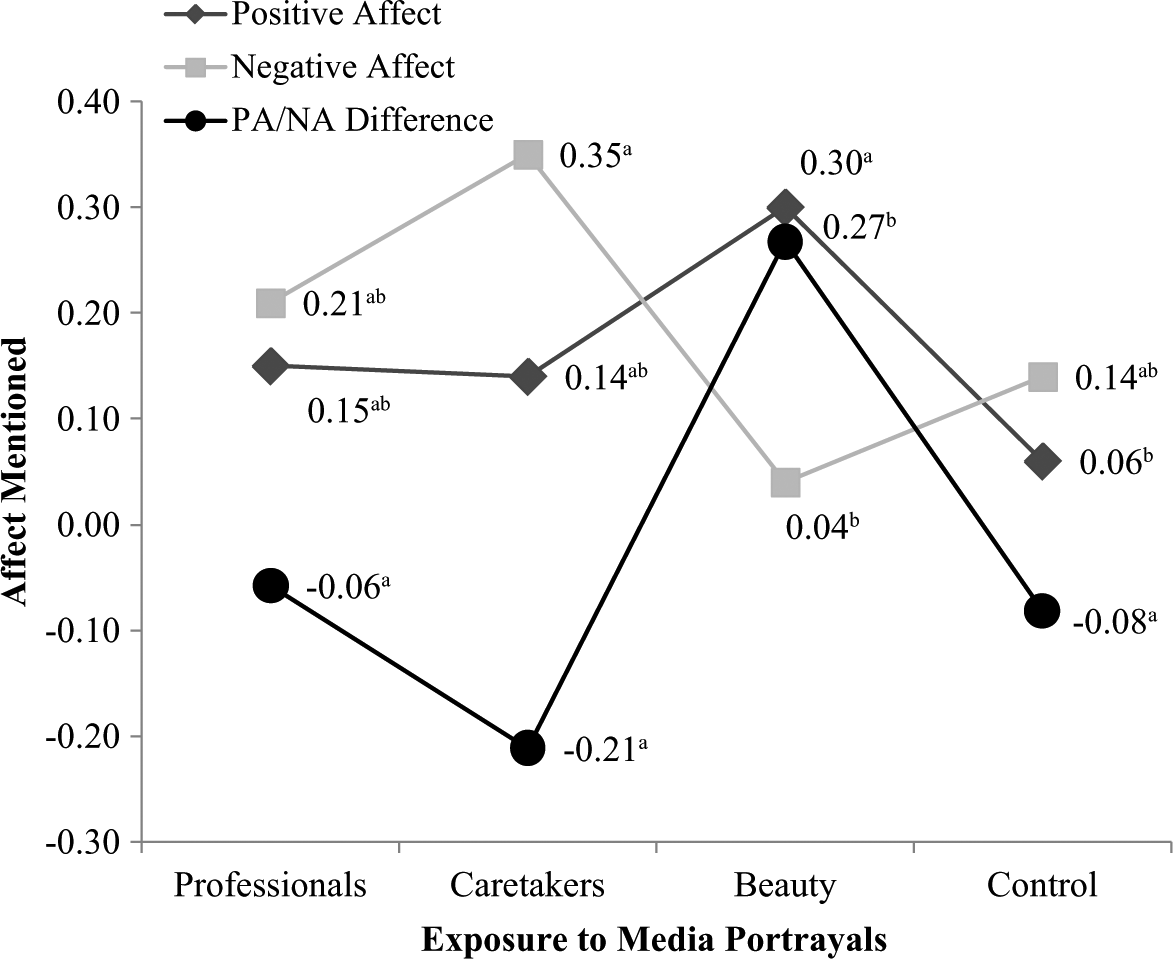
Affect mentioned in context of personal future as a function of prolonged media exposure.
Furthermore, an ANOVA with negative affect related to one’s personal future as dependent variable and the experimental group as between-group factor showed a significant impact of media exposure, F(3, 205) = 4.39, p = .005, partial η2 = .060, because participants in the caretaker portrayals group felt significantly more negatively about their future (M = .35, SD = .62) compared to participants in the beauty ideal portrayals group (M = .04, SD = .19) (p = .003, subsequent multiple tests with Sidak correction). The professional portrayals group (M = .21, SD = .46) and the control group (M = .14, SD = .46) fell in between (see Figure 1).
Lastly, for a straightforward test of H5a/b, an ANOVA with the difference score between positive and negative affect as dependent variable and experimental groups as between-group factor was conducted. A main effect of media exposure type emerged, F(3, 205) = 7.03, p < .001, partial η2 = .093, because the beauty ideal portrayals group expressed significantly more positive affect (M = .27, SD = .59) than all other groups (Mprofessional = –.06, SD = .54, p = .019; Mcaretaker = –.21, SD = .61, p < .001; Mcontrol = –.08, SD = .53, p = .011; subsequent multiple tests with Sidak correction). Thus, H6b was supported.
Valence of Possible Future Selves
The sixth hypothesis examined contrasting propositions derived from social cognitive theory and social comparison theory: Exposure to media portrayals of women as caretakers and/or as professionals induces (a) more hopeful, positive or (b) more negative possible future selves among young women, compared to exposure to media portrayals of female beauty ideals. Accordingly, the valence of possible future selves was examined in another ANOVA with experimental groups as between-group factor. It yielded an impact of exposure, F(3, 200) = 3.96, p = .009, partial η2 = .056, because participants who had viewed beauty ideal portrayals had significantly more positive views of their possible future selves (M = .93, SD = .86) than participants in the professional portrayals group (M = .45, SD = .99) still 3 days after the last exposure (p = .039, subsequent multiple tests with Sidak correction). This provides only partial support for H5b because both the caretaker portrayals group (M = .54, SD = .92) and the control group (M = .91, SD = .78) fell in between. The difference between the professional portrayals group and the control group was marginally significant (p = .067, subsequent multiple tests with Sidak correction). The findings are illustrated in Figure 2.
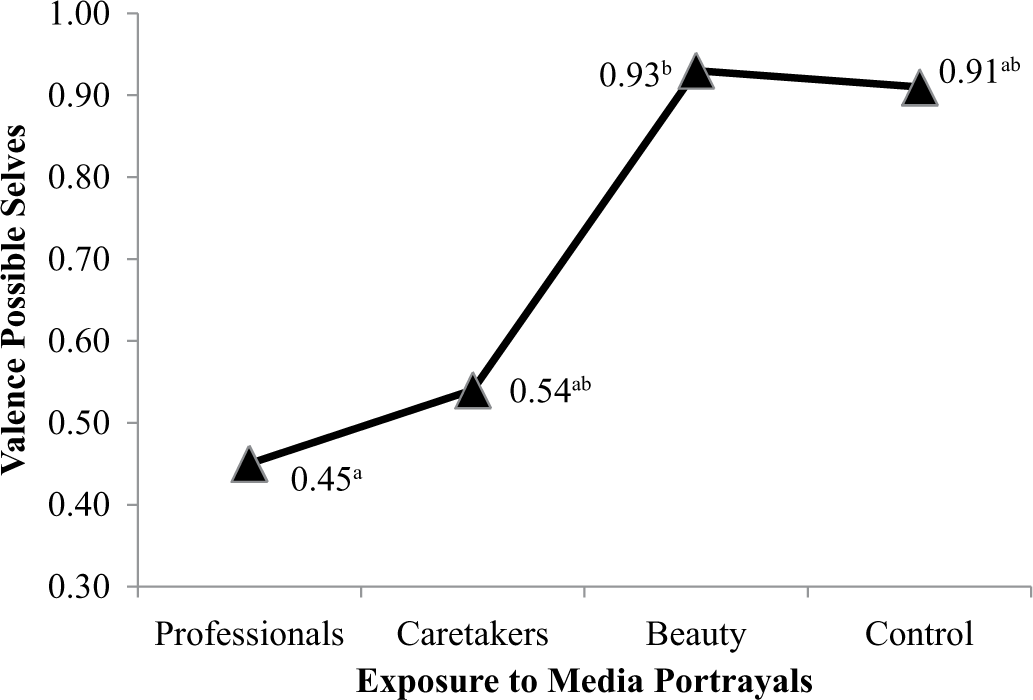
Valence of salient possible selves as a function of prolonged media exposure.
Discussion
The present study demonstrated that prolonged exposure to social roles portrayals in the media affect young adult women regarding their possible future selves. These impacts were not short-lived and emerged 3 days after the last exposure session. When participants were asked about recent thoughts and feelings regarding their future, responses reflected the social role portrayals viewed several days prior. Accordingly, prolonged media exposure to portrayals of women in professionals roles increased concerns about career/academic performance (H1 supported), even though these were very common to begin with; similarly, prolonged exposure to portrayals of female caretakers fostered concerns about close relationships (H2 supported). Furthermore, exposure to these portrayals also led to thoughts about the issue of balancing work and personal life (H4 supported). On the other hand, prolonged exposure to female beauty ideals made future-related concerns about physical appearance more likely (H3 supported), even though these were generally infrequent relative to other concerns.
Further, the findings suggest that social comparison theory is better suited to conceptualize impacts of media portrayals on young women’s possible future selves than social cognitive theory. Of the two competing hypotheses on valence associated with salient possible future selves, H6b received partial support and was derived from social comparison theory. This hypothesis postulated that portrayals of female caretakers and/or professionals induce more fearful, negative thoughts about possible future selves among young women compared to female beauty ideals. The prediction was supported for the comparison between the professional portrayals and the beauty ideal portrayals, but not for the comparison between the caretaker portrayals and the beauty ideal portrayals. However, H5b, also derived from the social comparison framework, predicted that less positive affect related to personal future results from exposure to media portrayals of women as caretakers and as professionals, compared to beauty ideals exposure, and received full support.
The present work shows that the common call for increasing the number of strong female role models in the media (e.g., Covert & Dixon, 2008; Smith & Granados, 2009) is a far cry from what the targeted recipients actually find enjoyable. Our findings align with frameworks on social comparison and possible future selves, which allow for the possibility that even positive media representations can instigate fearful thoughts on possible future selves through upward comparisons. However, notions from social cognitive theory which suggest that positive role models foster role aspirations collide with what we found empirically. Media portrayals that provide women with counter-stereotypical ideas on occupational roles may seem unattainable or very much linked to stress and strain (e.g., Nelson & Burke, 2000). Similarly, caretaker portrayals may be associated with stressful obligations and work/life balance issues (Gordon, Pruchno, Wilson-Genderson, Murphy, & Rose, 2012). The present findings suggest that reinforcement of gender and age appropriate beauty role ideals induces the most agreeable states, even when thinking about one’s future. Interestingly, much of the research on exposure to beauty ideals found that it induces unpleasant states of body dissatisfaction (e.g., Grabe, Ward, & Hyde, 2008). Yet, at the same time, it could distract women from more serious aspects of their life and future which are more complex, are associated with role conflicts, and may seem even less controllable.
Future analyses should determine possible explanations for the affective impacts of media portrayals of social roles by examining processes that occur during prolonged exposure such as similarity perceptions, upward comparisons, or wishful identification. These insights would help to determine what theoretical framework suits best to conceptualize media impacts on possible future selves. Psychological research has shown that adhering to norms for one’s gender and age group induces positive affect (e.g., Good & Sanchez, 2010; Wood, Christensen, Hebl, & Rothberger, 1997)—the present work demonstrates that media exposure to beauty ideal portrayals appears to produce the same pleasant impact among young women. On the other hand, portrayals of female professionals and caretakers instigated more negative affect related to personal future, possibly because professional portrayals are perceived as less appropriate for this gender group and the caretaker portrayals are perceived as less appropriate for this age group. Regarding cognitive processes, it is likely that the exposure increased chronic accessibility of portrayed social roles, which resulted in lingering exposure effects (Busselle & Shrum, 2003).
Beyond further insights into the processes through which media exposure affects possible selves, it would be relevant for future research to examine how the three female role ideals—physical attractiveness, nurturing caregiver, and professional success—influence young women when presented in conjunction instead of isolation, as in the present experimental design. How do women react when presented with all three ideals in combination? Would this very realistic scenario depress women, as the ideals in combination seem unattainable, or give them hopes that they can “have it all?” This research approach may also shed further light on theoretical lens to interpret these media impacts.
In contrast to prior work (e.g., Knobloch-Westerwick & Hoplamazian, 2012; Morgan, 1982), we did not examine selective exposure patterns and instead assigned messages to participants, to disentangle media exposure impacts. However, this work may provide insight into media selection, as the baseline measures for habitual media use indicated that the participants reported to read beauty magazines more frequently, on average, than news/business or cooking/bridal magazines. Given the affective outcome on perceptions of possible future selves, it is likely that beauty magazines are in part selected because they do not make women feel bad about potential future roles. This pattern could result in selective self-socialization in adherence with norms for gender and age groups (Knobloch, Callison, Fritzsche, Chen, & Zillmann, 2005). Another possibility is that the beauty magazines do a better job of portraying ideals as achievable and similar to the self, which results in less self-deflation (Asgari, Dasgupta, & Stout, 2012).
Taken together, media portrayals of social roles relevant to recipients’ lives can induce long-lasting concerns about their possible future selves. Hence, media messages and the way that young women respond to them likely play a relevant role in the slow-going progress toward greater gender equality (United Nations, 2000, 2010). The present findings do not offer straightforward implications on what should change in media portrayals or among media consumers to facilitate greater change toward gender equality. The responses we found may reflect how women feel about their real world perspectives. Indeed, women in the labor force generally receive less financial reward for the same work and are less likely to achieve higher ranks (Haveman & Beresford, 2012), while women’s unpaid work in the home amounts to longer hours than for men (Lachance-Grzela & Bouchard, 2010). On the other hand, women are much applauded for their looks (Fredrickson & Roberts, 1997). As long as these circumstances persist, women are likely to think about future strains when viewing women portrayed in professional or caretaker roles and, on the other hand, about appreciation of their physical appearance when viewing beauty ideal portrayals. If media portrayals were to generally represent women and men more equally in manager and homemaker roles while emphasizing female beauty less, young women may gain a more favorable impression of their future opportunities in these roles. Five days of exposure were apparently not enough to turn the tables in their minds.
Footnotes
Acknowledgements
The authors wish to thank Laura Sharples and Gregory Hoplamazian for their help with compiling the stimuli.
Declaration of Conflicting Interests
The authors declared no potential conflicts of interest with respect to the research, authorship, and/or publication of this article.
Funding
The authors received no financial support for the research, authorship, and/or publication of this article.