







Abstract
As suggested by the common phrase “spoiler alert!” many people avoid spoilers for narrative entertainment. However, recent research has found that exposure to spoilers may actually enhance enjoyment. The present study sought to replicate and extend those findings with a multidimensional approach to enjoyment and by examining choice of spoiled versus unspoiled narratives. Comprehension theories suggest that spoilers should improve media appreciation, whereas excitation-transfer theory suggests that spoilers harm arousal and suspense. Additionally, media users’ conventionally held beliefs imply that respondents should choose unspoiled stories. A within-subjects experiment (N = 412) tested these hypotheses. As expected, unspoiled stories were more fun and suspenseful. Surprisingly, unspoiled stories were also more moving and enjoyable in general. No effect of media choice emerged.
A recent commercial for a U.S. cable company features two neighbors working in their yards. One is grilling meat while using his tablet to watch a live sports game. The other neighbor, who is using his leaf blower, tells the man to please turn his tablet off, as he is using his digital video recorder (DVR) to record the game and would like to watch it later. The neighbor with the tablet ignores this request, and cheers in encouragement as the game nears the end. The leaf-blowing neighbor yells in frustration for the man to turn the game off, and when the tablet-holding neighbor does not respond, turns his leaf blower up to full power, in the hopes of avoiding hearing the game’s outcome. The cable’s signal, however, is so good that the volume from the tablet outstrips the whoosh of the leaf blower, and both neighbors, as well as the audience, hear who wins the game.
This is a familiar example of the frustration that arises for many media users because of the presence of spoilers, premature and undesired information about how a narrative’s arc will conclude. The cable ad also demonstrates the use of strategies for avoiding spoilers, as the neighbor who has elected to time-shift his viewing of the ball game first begs his neighbor to turn off his tablet and then attempts to drown out the sound. Audience members who see this commercial are presumed to relate to the neighbor who does not wish to know the outcome of a game, as they too want to avoid knowing how games, books, films, television shows, and other narratives turn out until they have the chance to consume the whole narrative. Anyone who has spent any time reading about books, movies, or television shows online is familiar with the common courtesy to place a “spoiler alert” warning prior to any spoilers, or perhaps even leave several blank lines before posting the spoiler so people don’t “accidentally” read the outcome of a story. This is a response to the generally accepted belief that spoiling the end of a story ruins the fun for those who have not seen, heard, or read it yet.
Initially, theories of media enjoyment reflected this conventional belief, with researchers such as Zillmann (1980, 1991) arguing that suspense generates enjoyment upon a positive resolution of narrative uncertainty. However, recent studies directly tested the effect of spoilers on narrative enjoyment, and counterintuitively found that an awareness of how stories would turn out increased self-reported enjoyment (Leavitt & Christenfeld, 2011, 2013). In the present study, we aim to add to the growing literature on media enjoyment by attempting to replicate and extend Leavitt and Christenfeld’s findings by using a multidimensional conceptualization of enjoyment. In addition, we assess whether spoilers influence audience preferences (i.e., whether people choose unspoiled over spoiled stories).
We will begin by outlining the nature of enjoyment, and then discuss the potential for spoilers to affect enjoyment. Next, we will present a series of predictions based on a more nuanced conceptualization of enjoyment, and introduce the role of transportation and media choice into the discussion surrounding spoilers. Finally, we will discuss the results of a study that experimentally manipulated spoilers for short stories that were read and selected by participants.
Media Enjoyment
In the field of communication, the nature of media enjoyment has been the subject of energetic theorizing and investigation in recent years. The classic perspective on enjoyment comes from excitation-transfer theory (Zillmann, 1971) and suggests that physiological arousal generated by suspense and narrative uncertainty, coupled with a positive resolution of the uncertainty to which arousal is then misattributed, accounts for the enjoyment of all kinds of entertainment. Indeed, a variety of measures of enjoyment, including ratings, open-ended descriptions, and physiological responses, indicate greater enjoyment for narratives that resolve their suspense, especially when the narrative is more exciting (Zillmann, Hay, & Bryant, 1975).
More recently, media enjoyment has been conceptualized in a greater variety of ways, such as an attitude toward media use with cognitive, affective, and behavioral components (Nabi & Krcmar, 2004), emotions arising from the fortunes of liked and disliked characters (Raney, 2004), or as the satisfaction of intrinsic motivations, such as competence, autonomy, and relatedness (Tamborini, Bowman, Eden, Grizzard, & Organ, 2010). These approaches largely conceptualize enjoyment as a positively valenced, or “fun,” experience in response to media.
In contrast, the work of Oliver and colleagues investigated the enjoyment associated with more serious forms of entertainment. They expanded the understanding of how media entertainment is experienced by positing a multidimensional experience that includes not only enjoyment, but also appreciation. Enjoyment and appreciation are both viewed as forms of entertainment gratification, but according to Oliver and Woolley (2010), whereas enjoyment refers to gratifications best described in terms such as “fun,” or “thrilling,” appreciation centers on a more meaningful, self-reflective media experience. They, thus, equate enjoyment to hedonism (a positive, uplifting experience) and appreciation to eudaimonia (an experience focused on personal growth, reflection, and meaningfulness), and use eudaimonia to explain why people like sad, sober, or contemplative media content. Klimmt (2011) expanded this understanding of appreciation by positing that appreciation needed to be viewed as an audience-based experience. In his argument, he claims that the audience is able to gain a deeper meaning from all kinds of genres, and appreciation thus hinges on individual differences as opposed to genre-specific characteristics.
Oliver and Bartsch (2010) further broke down audience responses to media into dimensions of suspense, fun, and moving/thought-provoking, arguing that moving/thought-provoking responses were essential to appreciation, and that fun and suspense reflect the concept of enjoyment. Moreover, they found that fun and suspense left a more fleeting impression, whereas moving/thought-provoking media had a more enduring impact on audience members, identifying lasting impressions as another component of media appreciation.
In addition to these considerations of multidimensional audience response, it is theorized that media enjoyment is positively impacted by the extent to which a narrative is absorbing, or “transports” the reader into the story (Busselle & Bilandzic, 2009; Green, Brock, & Kaufman, 2004). In short, enjoyment can, according to recent research, no longer be solely viewed as how much people simply “like” media content, as the user experience is far more complex.
Implications of Spoilers for Enjoyment
If the excitation-transfer account of media enjoyment (Zillmann et al., 1975) holds, then the resolution of uncertainty is vital to enjoyment, and exposure to spoilers should hamper audience experience. Likewise, the intuitive, commonsense beliefs evident in many people’s negative attitudes toward spoilers correspond with this account. However, if enjoyment is more multifaceted than just suspense and resolution, it is possible that prior theories about the importance of uncertainty in audience experience are incomplete, and spoilers may increase some forms of enjoyment. Existing studies into spoiler consumption among media users indicate that spoilers may not be necessarily detrimental to enjoyment. A study carried out among the fan community of the television show Lost, for instance, found that whereas some fans rejected spoilers altogether, others viewed spoilers as an interesting and enjoyable facet of the entire media experience (Gray & Mittell, 2007). In addition, Hassoun (2013) argued that spoilers in comics actually serve various functions for the reader, and generally increase the enjoyment readers receive from the text.
Accordingly, Leavitt and Christenfeld (2011) drew from perceptual fluency theory (Reber, Schwarz, & Winkielman, 2004; Winkielman & Cacioppo, 2001) and schema discrepancy theory (MacDowell & Mandler, 1989) to suggest that spoilers may not reduce enjoyment, but could actually enhance it. Each theory provides a rationale for why knowing the outcome of a story can actually increase the positive response to that story: either because a spoiler aids in the ease of processing during reading, or because predictability of the outcome leads to positive affect.
In line with these theories, Leavitt and Christenfeld (2011) found that spoilers, that is, revelations of a narrative’s conclusion, presented in introductory synopses, did not hinder enjoyment of short stories. In fact, the respondents in that study (who read 12 different short stories across three story genres) consistently indicated that they enjoyed stories with spoilers more than those without. A follow-up study (Leavitt & Christenfeld, 2013) investigated the extent to which processing fluency served as an explanatory mechanism. In a series of experiments, they found that processing fluency (the ease with which a reader comprehends a narrative; Reber et al., 2004) mediated the effect of spoilers on enjoyment. Whereas they also considered a deeper appreciation of aesthetic elements and a satisfaction derived from predictable outcomes as rival mechanisms, Leavitt and Christenfeld found that processing fluency was the sole variable able to explain why spoilers improved story enjoyment. They argued that processing fluency helped readers to fully understand the story and that it might “lead to a deeper comprehension of thematic elements” (Leavitt & Christenfeld, 2013, p. 102). It would thus appear that the enjoyment identified by these studies as well as by Gray and Mittell (2007) corresponds to Oliver’s notion of appreciation (Oliver & Bartsch, 2010; Oliver & Woolley, 2010), as increased quality and ease of processing allows the reader or viewer to spend more effort interpreting aspects of the story that are connected to the plot, such as characters’ motivations and setting. It is important to keep in mind, however, that this facilitated processing would not necessarily increase enjoyment attributable to uncertainty and arousal; in fact, the reverse still remains likely.
Multidimensional Measurement of Enjoyment and Spoilers
The present study seeks to elaborate on Leavitt and Christenfeld’s (2011, 2013) research, in particular with regard to the conceptualization of enjoyment. First of all, although those researchers measured enjoyment as affected by spoilers, they used a single-item 10-point scale to do so. This study expects to, first of all, simply replicate Leavitt and Christenfeld’s main finding, but by using a reliable and more comprehensive measure of enjoyment, the audience response scale developed by Oliver and Bartsch (2010).
The limitations surrounding conceptualization in Leavitt and Christenfeld’s (2011) study extend beyond their use of a single-item scale, however. As mentioned above, the concept of enjoyment, or as Oliver and Bartsch (2010) more broadly construe it, media gratification, is a multidimensional construct, perhaps best conceptualized as enjoyment-appreciation. So although Leavitt and Christenfeld found that people enjoyed spoiled stories more than unspoiled stories, they did not consider whether this difference might be the result of a difference in kind of gratification, as opposed to degree of gratification. It is, after all, possible that spoiled and unspoiled stories are both positively received, but in different ways (cf. Brewer, 1996), which were not captured by the single measurement they employed. Therefore, it is probable that whereas an unfamiliar narrative may elicit the uncertainty and emotional arousal that characterizes suspense, more familiar narratives may lead to affective states better characterized as appreciation, a distinction not captured by the 1 through 10 rating (with 1 = lowest rating and 10 = best rating) employed by Leavitt and Christenfeld (2011). In that case, researchers would be premature to conclude that “people are wasting their time avoiding spoilers” (Leavitt & Christenfeld, 2011, p. 1153).
As such, it is necessary to assess audience responses with a range of available measures to capture any differences in the kinds of gratification that spoiled and unspoiled stories provided. In the following paragraphs, we will propose distinct hypotheses drawing from the dimensions of audience response conceptualized by Oliver and Bartsch (2010). These dimensions characterize audience responses as to media entertainment as fun, moving/thought-provoking, lasting impression, and suspense.
From the perspective of processing fluency and comprehension, it could be argued that when people are presented with a spoiler, it facilitates story comprehension, which in turn provides the reader with more capacity to focus on elaborating on the narrative, that is, the “deeper comprehension” that Leavitt and Christenfeld (2013, p. 102) theorized. Readers and viewers would be less focused on divining the outcome, and, thus, better able to reflect on events in light of the ultimate outcome. For example, Knobloch-Westerwick and Keplinger (2008) found that enjoyment of mystery stories was negatively related to plot complexity, which implies that curiosity and uncertainty about a plot outcome is not necessarily a dominant factor in determining story enjoyment, and that perhaps the enjoyment instead comes from what Oliver and Bartsch (2010) dubbed appreciation. In addition to increased elaboration, a familiarity with the story also enhances processing fluency (Reber et al., 2004). This increased elaboration and processing fluency permits the user to engage in more thoughtful reflection on the narrative. The removal of uncertainty could also allow for more attention to details of the story. As Kintsch (1980) stated, When reading a story, an appropriate knowledge structure must be built up to make it interesting. What happens on page 201 of a novel is not necessarily interesting in itself, but it engrosses the reader because the preceding 200 pages have built up an appropriate context. (p. 97)
Likewise, an inverse formulation of that principle would suggest that knowing what happens on page 201 could engross the reader during their reading of pages 1 to 200. This idea is also supported by Hassoun’s (2013) work, which shows that spoilers allow media users room for reflection; that is, knowing the outcome, in his case of a comic book, allowed the readers to focus on other elements of the text. Indeed, Oliver and Bartsch (2010) characterized the appreciation-focused dimensions of enjoyment (whether media is moving/thought-provoking and leaves a lasting impression) as being associated with fluent processing and elaboration, where “deep appreciation of some entertainment offerings should result in greater levels of reflection, deeper levels of processing, and more extensive contemplation—all of which should result in more lasting or enduring responses” (p. 59). Subsequently, we developed the following two hypotheses regarding the two dimensions of audience response that relate to appreciation:
In contrast, given that narrative uncertainty has been argued to heighten the emotional experience (Zillmann, 2006), we expected unspoiled stories to score higher on the fun and suspense dimensions of enjoyment as developed by Oliver and Bartsch (2010). Indeed, mystery stories where readers experienced high levels of uncertainty have been shown to be more enjoyable than those with low uncertainty (Knobloch-Westerwick & Keplinger, 2006). In this way, our predictions depart from those of Leavitt and Christenfeld (2011, 2013). Whereas spoilers are expected to make a narrative more generally enjoyable and moving/thought-provoking, and leaving a lasting impression, unspoiled stories should generate more fun and suspense. These latter two audience responses, while also dimensions of enjoyment, are distinguished by their origins in arousal, rather than reflective elaboration (Bartsch & Oliver, 2011). We, thus, developed the following two hypotheses:
Implications of Spoilers for Transportation
When examining the impact of spoilers on media entertainment, it is important to consider the outcome of transportation as well. Transportation, “[t]he process of becoming fully engaged in the narrative world” (Green et al., 2004, p. 312), can be likened to the notion of “spatial presence” (Wirth et al., 2007), which has been defined as “a sense of being there” (p. 495), with “there” including mediated environments. Transportation, which has been described as a virtual journey into a text, is known to be connected to enjoyment (Green et al., 2004; Hall & Zwarun, 2012), and is also impacted by the prior knowledge made possible through repeated exposure (Reber et al., 2004). Vaughn, Childs, Maschinski, Niño, and Ellsworth (2010) argued that when people are able to easily process a story, they are more likely to experience a feeling of confidence about the narrative, which in turn increases their engagement, or transportation, in the story, and, thus, the gratification gained from the story. As spoilers tell people what to expect, and provide a climactic event or outcome to which they can build and connect their understanding of a story, spoilers should also increase processing fluency, which would in turn impact transportation.
On the other hand, Zillmann (1991) found that a reduction in suspense leads to a decrease in engagement and immersion. Therefore, the reduction in uncertainty implied by a spoiler should instead decrease transportation. Subsequently, two distinct possibilities remain. Given findings that transportation is positively affected by familiarity (Green et al., 2008), perhaps due to processing fluency and greater engagement (Vaughn et al., 2010), then it could be argued that, to the extent that spoilers increase familiarity with the narrative, spoiled stories would be more transporting than nonspoiled stories. On the other hand, if suspense and arousal are vital to transportation (Zillmann, 1991), spoilers would be expected to have a detrimental effect on transportation. Therefore, the following research question is posed:
Implications of Spoilers for Story Choice
Another question left unaddressed by previous research centers around the influence of spoilers on media choice. In other words, if a media user is in the position to choose between different narratives, will knowing the ending to one of the narratives influence their choice, and if so, how?
While spoiled media content might be more enjoyable or appreciated, it is unclear whether people are able to accurately anticipate this improved experience (cf. affective forecasting; Wilson & Gilbert, 2005) when it comes to selecting the books, movies, television shows, and other media content they use in their lives. From the perspective of the uses and gratifications paradigm, media choice is explained by gratifications sought by the media user (Palmgreen & Rayburn, 1985), which are the product of expectations about media content attributes and the evaluations of those expectations. This expectancy-value approach to media choice suggests that the presence of spoilers may lead potential media users to expect less gratification from a spoiled story compared with an unspoiled one. This, in turn, could lead to a bias against the selection of spoiled stories.
If spoilers reduce the likelihood of choice, then this sets a significant boundary on the finding that spoilers seem to boost enjoyment, as uncovered by Leavitt and Christenfeld (2011). The present study will, thus, investigate whether people are more likely to choose to read stories that are spoiled, or stories where the ending is left unrevealed. In keeping with Leavitt and Christenfeld’s findings on the effect of spoilers, we might expect that spoilers will increase preference for these stories. However, given the implications of affective forecasting and gratifications sought, as well as the intuitive belief that spoiled stories are less enjoyable, theory suggests it is more likely that (mistakenly) lowered expectations for enjoyment will lead to a preference for unspoiled stories. This leads to our final hypothesis:
Method
Participants
Participants were recruited from undergraduate courses at a medium-sized historically black university in the southeastern United States. An initial sample of 105 students participated in a pretest. This sample was 64.8% female; 90.2% Black, 1% Hispanic, 5.9% multiracial, and 2.9% other; 81.4% of the respondents were underclassmen, with an average age of 20.28 (SD = 3.46). Given the small effect sizes (ds = .18, .22, .34) reported for enjoyment in Leavitt and Christenfeld (2011), 400 participants were required to achieve .80 statistical power in the present experiment. Subsequently, an experimental sample of 430 participants was recruited. After excluding participants with prior exposure to the stories (n = 18), the experimental sample was 68.7% female and 31.3% male, which reflected the composition of the sample population. With regard to ethnicity, 91.7% were Black, 7% identified as multiracial, and Asians, Hispanics, Native Americans, Pacific Islanders, Whites, and others were represented by less than 1% each. The sample was evenly distributed between freshmen, sophomores, juniors, and seniors, with an average age of 21.68 (SD = 5.11).
Stimuli and Pretest
In order to identify stories for testing the role of spoilers in choice and enjoyment, we collected short stories that were less than 15 pages, had similar Flesch reading ease scores, and contained a narrative arc that could be summarized in either a spoiled or unspoiled manner. Potential stories were not selected to necessarily represent a breadth of genres, but were selected to represent a diversity of author and protagonist ethnicity and gender. The stories used in this study either came from previous narrative enjoyment or transportation research (Green & Brock, 2000; Leavitt & Christenfeld, 2011), from the anthologies Best American Short Stories 2010, Best American Mystery Stories 2007, Best African American Fiction 2009, Best African American Fiction 2010, Black Southern Voices, Memories of Kin, or from online repositories such as www.classicshorts.com, and could all be qualified as literary “ironic-twist stories” (cf. Leavitt & Christenfeld, 2011). A total of 18 potential stories were selected for the choice task, and another nine were selected for the reading task (examining enjoyment-appreciation and transportation). Stories chosen as possibilities for the reading task were those that exhibited more brevity, featured a protagonist in mortal danger, along with a “twist” or “surprise” ending that would be highly impacted by the spoiler (versus the spoiler preview merely appearing to give away more than the unspoiled version), and that had similar Flesch reading ease scores.
For each of these 27 stories, the authors wrote two short summary previews (around 60 to 65 words each) that were as similar as possible except that one was written to spoil the ending, and one was written to leave the ending uncertain. The average length of these previews was 63.39 words (SD = 2.96).
A pretest was conducted to evaluate whether the story previews were perceived as spoiling the ending for each story, to ensure strong and distinct manipulations. Participants were presented with the 27 story previews (in counterbalanced order and with counterbalanced manipulations, to avoid order effects), and asked to rate each preview in terms of perceived spoilage (“I know how the story is going to end,” “The story’s ending is given away by the preview,” “I don’t know how the story will end” [reversed], “The preview tells me what to expect in the story,” “I will be surprised by what happens in the story” [reversed]), using 7-point Likert-type scales (1 = strongly disagree to 7 = strongly agree). These items for perceived spoilage formed a reliable measure (α = .71). The packet concluded with measures of story familiarity and basic demographics. Participants were excluded from analysis if they were previously familiar with the short stories.
Findings from the pretest showed that an effective manipulation was evident for previews written for three of the full stories: The Sniper (by Liam O’Flaherty, 1,122 words, Flesch reading ease = 81.0), Two Were Left (by Hugh B. Cave, 702 words, Flesch reading ease = 86.5), and The Death of a Clerk (by Anton Chekov, 854 words, Flesch reading ease = 71.9). These were selected for the reading task to test enjoyment-appreciation and transportation in the experiment. Another eight stories among those selected for the choice task demonstrated clear manipulations and were chosen for the preview-only test of media choice. The descriptive statistics and t test for each selected story’s manipulation check are presented in Table 1.
Manipulation Check of Selected Story Previews for Choice Task and Reading Task (N = 105).
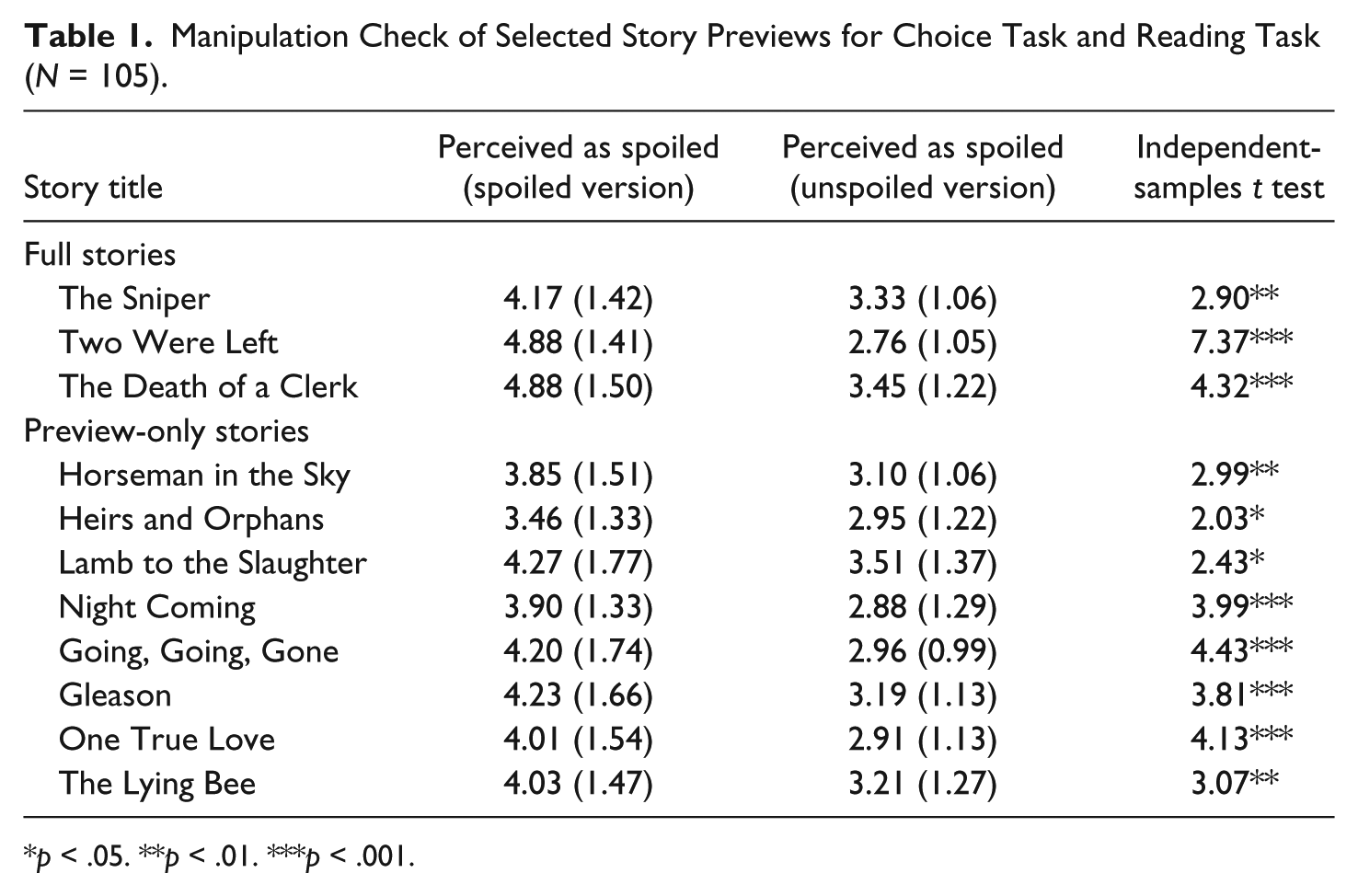
p < .05. **p < .01. ***p < .001.
Experiment and Measures
Participants were recruited from undergraduate courses, and each received a randomly assigned packet of experimental materials after providing informed consent. Each participant completed the study at a private desk in a classroom setting, under the supervision of experimenters.
In the first task, participants were presented with a set of eight short story previews. Under the premise of identifying additional stories for future studies, participants were asked to rate the previews based on how much they would like to read the full story “right now” with a 7-point Likert-type scale (1 = not at all to 7 = very much). The preference for spoiled versus unspoiled stories was computed by taking the mean scores for the spoiled and for the unspoiled stories. The order and manipulations of the previews in this first task were counterbalanced to avoid order effects.
In the second task, for the sake of time and fatigue considerations, participants read only two of the three selected short stories, each of which was preceded by a full-page preview in a larger, 18-point font. This preview was either spoiled or unspoiled. Which two stories they saw was counterbalanced across participants, and every participant saw one spoiled and one unspoiled preview. The order of the stories was also counterbalanced to avoid order effects.
After each story, the respondents were asked to rate the story for enjoyment and transportation. These were measured using the 12-item audience response scale (Oliver & Bartsch, 2010) and the 15-item transportation scale (Green & Brock, 2000). The last four items in the transportation scale were tailored to refer to specific elements of the short story, asking participants whether they visualized the protagonist, antagonist, physical setting, and a secondary character.
The audience response scale as a whole formed a very reliable measure, α = .95, ≥ .96 for each story. Reliability was also found for the audience response subscales of fun (sample item: “It was fun for me to read this story”), α = .83, ≥ .95 for each story; moving/thought-provoking (e.g., “I found this story to be very meaningful”), α = .89, ≥ .86 for each story; lasting impression (e.g., “This story will stick with me for a long time”), α = .89, ≥ .92 for each story; and suspense (e.g., “I was at the edge of my seat while reading this story”), α = .90, ≥ .90 for each story. Each item was measured on a 7-point anchored scale, 1 = strongly disagree to 7 = strongly agree.
Transportation formed a reliable scale, α = .87, ≥ .87 for each story, as did the cognitive subscale (e.g., “I was mentally involved in the narrative while reading it”), α = .86, ≥ .84 for each story, and the imagery subscale (e.g., “While reading the narrative, I had a vivid image of protagonist name”), α = .93, ≥ .92 for each story. However, the affective subscale (e.g., “The narrative affected me emotionally”) was not reliable, α = .36, ≥ .31 for each story. Each transportation item was measured on a 7-point anchored scale, 1 = not at all to 7 = very much.
Additionally, the multidimensionality of enjoyment as measured by the audience response scale was demonstrated using confirmatory factor analysis in Lisrel 8.0. The dimensional structure of transportation was also tested.
For audience response, a one-factor measurement model solution provided mixed results for model fit, following conventional thresholds (i.e., root mean square error of approximation [RMSEA] < .10 and comparative fit index [CFI] > .90), χ2/df = 28.64; RMSEA = .192, 90% confidence interval [CI] = [.184, .200]; CFI = .931. However, a four-factor measurement model that separated the subscales greatly improved the fit, falling just at the RMSEA threshold and increasing the CFI, χ2/df = 9.22; RMSEA = .101, 90% CI = [.093, .110]; CFI = .982. Thus, despite the very high reliability of the audience response scale as a whole, it was evident that it exhibited multidimensionality, and that spoilers might have differential effects, as suggested by H2 to H5.
The transportation scale as a whole exhibited inadequate measurement model fit when using a one-factor solution, χ2/df = 27.53; RMSEA = .203, 90% CI = [.197, .209]; CFI = .813. A 3-factor solution using the dimensions identified by Green and Brock (2000) showed better fit, χ2/df = 12.09; RMSEA = .121, 90% CI = [.111, .132]; CFI = .958. Although the transportation scale has been widely used as a single, unitary construct, confirmatory factor analysis suggested that specific effects on cognitive, affective, and imagery transportation should also be examined.
Across all stories, the full measures of enjoyment and transportation were highly correlated, r = .77, p < .001. The descriptive statistics and zero-order correlations for their subscales are displayed in Table 2. Finally, the study packet also included measures of familiarity for the full stories and the previews from the first task, as well as basic demographics (sex, age, ethnicity, and class rank).
Zero-Order Correlations Between Dimensions of Enjoyment-Appreciation and Transportation.
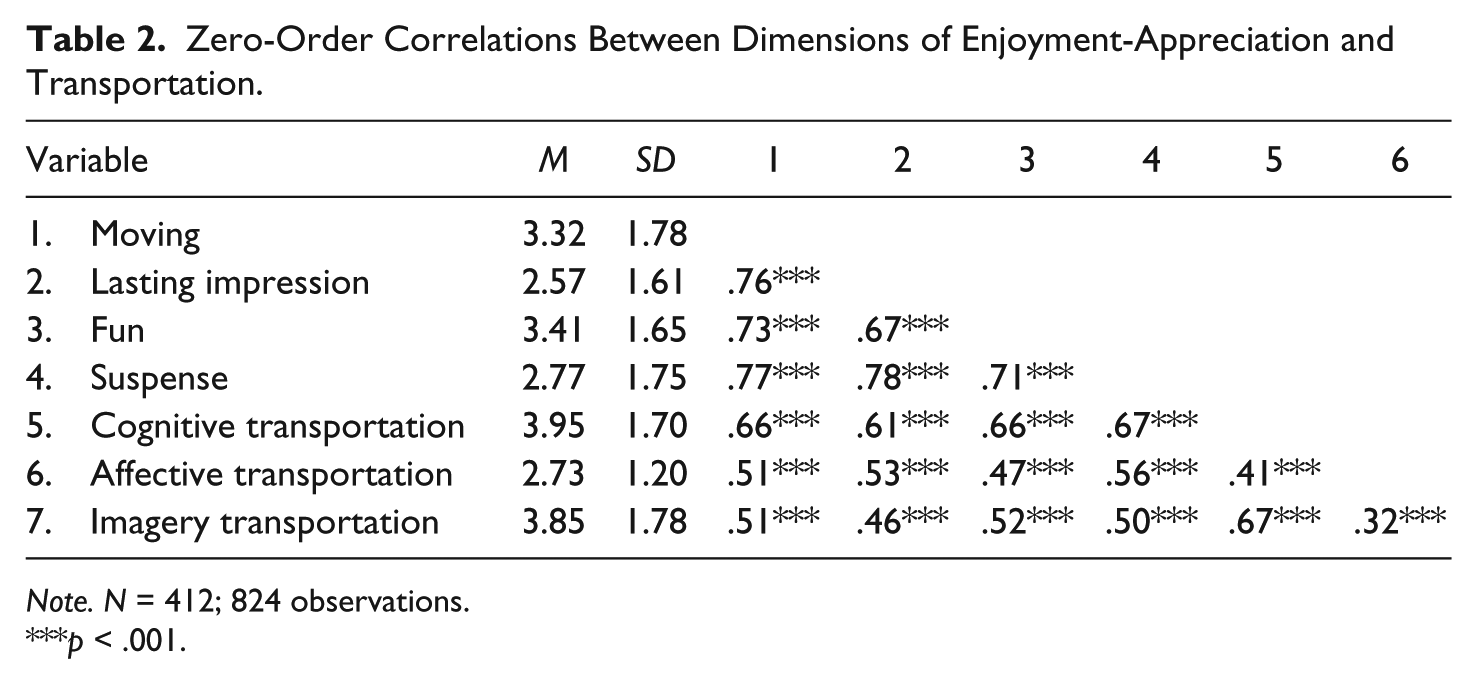
Note. N = 412; 824 observations.
p < .001.
Results
The hypotheses were tested through the use of paired samples t tests used to compare spoiled and unspoiled stories, in a within-subjects design.
The first hypothesis focused on replicating Leavitt and Christenfeld’s finding that participants would report spoiled stories as more enjoyable. The general measure of enjoyment utilized in our study indicated that, contrary to Leavitt and Christenfeld’s findings, unspoiled stories were significantly more enjoyable than spoiled stories, t(410) = −2.29, p = .023, d = .23.
Next, we looked at the impact of spoilers on the different dimensions of appreciation and enjoyment. We tested two hypotheses regarding the impact of spoilers on the appreciation dimensions of audience response. Both hypotheses proposed that respondents would report spoiled stories to be more moving/thought-provoking as well as leave more of a lasting impression. Contrary to our expectations, respondents rated unspoiled stories as more moving/thought-provoking than spoiled stories, t(410) = −2.59, p = .010, d = .16, while we did not find any effect for a story’s lasting impression, t(410) = −1.31, p = .192, d = .07. This finding implies that reading a spoiler may not present an opportunity for extra elaboration, or if it does, this processing does not express itself through a more moving and lasting experience. We will expand on this in our discussion. Moreover, we examined the impact of spoilers on the more hedonistic dimensions of media gratification: fun and suspense. As H4 and H5 predicted, unspoiled stories were rated as marginally more fun than spoiled stories, t(410) = 1.92, p = .067, d = .12, and significantly more suspenseful, t(410) = 2.36, p = .019, d = .15. Thus, the inclusion of a spoiler reduced fun and suspense among the audience.
The study also investigated the impact of spoilers on transportation. Given the equivocal implications of the literature, a research question asked whether spoiled stories would be associated with more or less transportation. Our findings indicated no clear effect on the transportation measure as a whole, as no impact of spoilers was evident, t(411) = 1.27, p = .204, d = .07. However, there was marginal effect of spoilers on the cognitive dimension, where unspoiled stories exhibited marginally more cognitive transportation than spoiled stories, t(410) = 1.84, p = .067, d = .18. There was no effect on the affective dimension of transportation, t(410) = −0.55, p = .581, d = .05, or the imagery dimension, t(410) = 1.08, p = .280, d = .11. It would appear, therefore, that transportation is partially affected by spoilage, an issue we will address further in the discussion.
Finally, we looked at the impact of spoilers of media choice, and hypothesized that participants would be more likely to prefer unspoiled to spoiled stories. Interestingly, our results showed no difference between spoiled and unspoiled stories, t(411) = −0.11, p = .91, d = .01. Participants were just as likely to indicate an immediate interest in reading spoiled stories as unspoiled stories, based on the previews provided. All means for spoiled and unspoiled stories are presented in Figure 1.
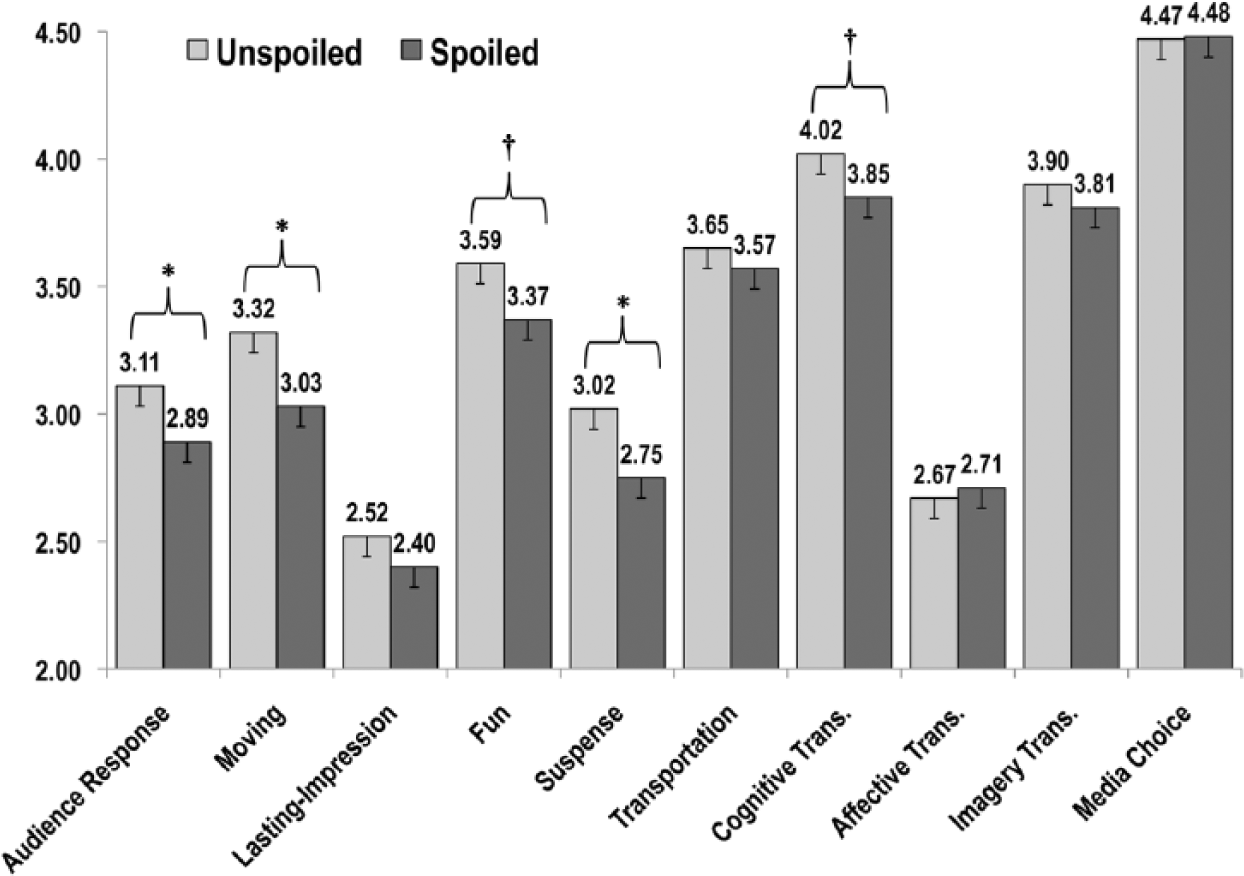
Effects of story spoilers on narrative enjoyment-appreciation, transportation, and choice.
Discussion
The present study tested the impact of spoilers on a multidimensional conceptualization of enjoyment in a within-subjects experimental design. The implications of narrative spoilers for transportation and media choice were also examined. The study’s goal was to replicate and extend prior findings showing a positive effect of spoilers on enjoyment (Leavitt & Christenfeld, 2011, 2013).
Interestingly, the replication hypothesis (H1) was not supported; in fact, unspoiled short stories exhibited a significantly greater level of enjoyment than spoiled stories. This conflicting finding is intriguing, and points to the possible existence of moderating variables, which will be discussed below.
Similarly, the audience response measure of how moving/thought-provoking a story was, an aspect of enjoyment-appreciation expected to account for positive effects of spoilers, contradicted expectations. Instead, unspoiled stories were reported to be significantly more moving, which appears to defy Leavitt and Christenfeld’s (2013) idea that increased processing fluency, facilitated by spoilers, could allow for a deeper appreciation of the story. The other dimension of enjoyment-appreciation expected to be enhanced by spoilers, lasting impression, did not yield a significant difference between spoiled and unspoiled stories. This suggests that whereas spoilers may provide readers with additional information, this extra information does not necessarily translate into a more moving or thought-provoking experience.
On the other hand, it is possible that introducing spoilers allows people to pay attention to details of the story they may have otherwise missed. This means that the readers might experience the story more fully, yet not in a more moving manner as is commonly associated with higher levels of appreciation. Motivation could also play a role in explaining this finding. It is possible that the participants in this study, when they found out the ending before reading the full story, were less motivated to experience and understand the story, and were, as a result, less likely to put a lot of effort into reading and interpreting the narrative, which could result in drawing less appreciation from it. Spoiling a story could result in readers seeing the mental model they created for the story as “complete,” and thus not motivated to further elaborate using what they already knew about the story. This is consistent with what previous research has concluded happens when one reads an unspoiled story and does not know what will happen to the different characters, which leads to a reader being more invested in the story and subsequently experiencing the story as more enjoyable (Raney, 2004; Zillmann, 1991).
Support was obtained for H4 and H5, as unspoiled stories were experienced as significantly more suspenseful (and marginally more fun) than spoiled stories. These results indicate that the uncertainty associated with an unspoiled story does seem to generate more emotional arousal and subsequent enjoyment, which is in line with the expectations generated by excitation-transfer theory. These results also echo Knobloch-Westerwick and Keplinger’s (2006) findings, and underscore the popularly held belief that suspense can be spoiled. These two hypotheses measure the classic understanding of enjoyment, namely as a positive, arousing emotion. This is in contrast to Leavitt and Christenfeld’s (2011) study, whose measure appears to have captured a more cognitive aspect of enjoyment, which could explain why they found spoiled stories to be more enjoyable.
With regard to transportation, no significant effects were evident, but there was a marginally higher level of cognitive transportation into unspoiled stories. The items that measure cognitive transportation focus on the readers’ ability to picture the events and place themselves in the story. The other dimensions identified by Green and Brock (2000) appear to set the bar for affective and imagery transportation very high with items such as “the narrative affected me emotionally,” and “the events in the narrative have changed my life.” The fact that we did not find any differences for affect and imagery could be tied to readers’ baseline involvement with the stories, as well as the respondents’ individual traits. It appears that in order to score high on the affective and imagery dimensions of transportation, one must be very engaged with the story, which might not have been the case with our respondents. They might not have been motivated enough to allow for such intense levels of transportation. Relatively low motivational involvement with the stories may also account for the lack of an effect on the lasting-impression dimension of audience response.
Finally, there was no effect of spoilers on media choice, and H6 was not supported. Spoiled and unspoiled previews were rated as equally appealing for participants who were asked if they would like to read the stories immediately. This finding is interesting, as common sense would dictate (and theory would imply) that people would prefer the unspoiled stories. It would, thus, appear that perhaps people’s expectations of gratifications are based on other aspects of stories than narrative uncertainty. Alternatively, unmeasured moderators such as individual differences might be masking differential effects, as discussed below.
This study’s findings provide consistent insights about spoilers and narrative engagement across a range of measures, yet there are some limitations of the study design that should be acknowledged. One limitation is the use of a handful of stimuli, which restricts the ability to generalize to other stories and narratives. Only two short stories were read by participants, to avoid study fatigue, and stimuli were only included if they demonstrated a successful manipulation in a pretest. The use of a student sample also restricts the ability to generalize, and future research should employ other populations to test narrative enjoyment-appreciation, transportation, and choice. An additional limitation of the present study is that the manipulations of the story previews were only modestly perceived as spoiled (see means in Table 1), perhaps due to the novelty of the stories. Future studies could attempt to select stories that are more intrinsically engaging for the research population, which could, however, pose possible confounds, requiring innovative study designs. One possible solution for future research would be to introduce unspoiled previews for narratives, solicit evaluations from participants, and only then, once familiarity and anticipation have been established, introduce spoilers. The effect of spoilers, independent of other narrative elements, could then be assessed with a repeated measures design. A final limitation is that the selected stories were very similar, which did not allow for the testing of genre as a moderating variable on enjoyment, transportation, or selective exposure.
Although this study’s results are somewhat limited in their generalizability, they do provide interesting findings for theory development in this area and point the way forward for future research. Not only did our investigation show that respondents experienced unspoiled stories as more fun and more suspenseful, as expected, it also found that unspoiled stories were also rated higher in terms of moving the respondents and being enjoyed in general. These results are in contrast to the two prior experimental studies into this topic, and point to the possibility of moderating variables. Given the small effect sizes in both the present and prior study, and the inconsistent direction of effects, there may not be a general, universal effect of spoilers on narrative enjoyment, so it is important to consider other factors that may play a critical role in determining how spoilers affect the entertainment experience, as different people in different situations experience narrative entertainment in different ways.
One set of possible moderating variables to consider are traits. For example, Knobloch-Westerwick and Keplinger (2006) found that self-esteem moderated the effect on enjoyment of correctly guessing “whodunit” in a mystery story. Those with high self-esteem experienced more enjoyment when the story proved them wrong and surprised them with the reveal of the culprit, while those with low self-esteem enjoyed being able to guess the culprit. In the case of spoilers, low self-esteem might enable “knowing how it ends” to be a self-enhancing experience, impacting enjoyment, which could play a factor in our finding that unspoiled stories were perceived as more enjoyable.
Other potential trait differences that could moderate the effects of spoilers include need for closure (Webster & Kruglanski, 1994), need for cognition (Cacioppo & Petty, 1982; Henning & Vorderer, 2001; Knobloch-Westerwick & Keplinger, 2008), need for affect (Bartsch, Appel, & Storch, 2010), sensation seeking (Zuckerman, 2006), and transportability (Dal Cin, Zanna, & Fong, 2004), For example, the predictions of H2 and H3 might be borne out only for those high on need for closure or need for cognition, as those individuals may gain satisfaction from knowing the outcome at the start of a story, or being able to elaborate on how the narrative reaches its outcome. On the other hand, need for cognition may also manifest itself as seeing the narrative as a puzzle, to be solved before the narrative (or a spoiler) reveals its conclusion (cf. Knobloch-Westerwick & Keplinger, 2006), in which case spoilers would be detrimental to appreciation. In contrast, individuals scoring high on need for affect or sensation seeking may place more value on suspense and related aspects of enjoyment, accounting for (or strengthening) the negative effect of spoilers on enjoyment demonstrated in the supported hypotheses H4 and H5. Likewise, trait differences in transportability, as well as other traits such as those described above that might connect transportation more strongly to either cognitive or affective processes for a given individual, could lead to differential effects of spoilers on transportation. All of these individual differences should also have implications for media choice, to the extent that different people value different narrative experiences. Indeed, qualitative investigations indicate that some individuals seek out spoilers and seem to enjoy them, while others avoid them (Gray & Mittell, 2007).
Another set of potentially moderating variables are situational, and address either the nature of the narrative or the motivations of the audience. Responses to spoilers are likely to vary when narratives are serials or franchises versus one-offs, and when they are adaptations (Green et al., 2008), remakes, or based on historical events (e.g., 1997’s Titanic). With regard to motivation, the level of audience involvement, previous experience with a genre or franchise, and the affinity for different genres all may play moderating roles in the impact of spoilers.
In addition, as mentioned above, the present study did not evaluate whether genres moderate the effect of spoilers on enjoyment, given the lack of prior support for this hypothesis (Leavitt & Christenfeld, 2011) and the use of a small set of similar stories. However, it is likely that genre might impact different dimensions of enjoyment and appreciation in unique ways (cf. Oliver & Bartsch, 2010, Study 2). It is conceivable that if processing fluency is the explanatory mechanism underlying our findings, the enjoyment and appreciation of stories might be impacted differently by spoilers when more complex genres and narratives are in question. The present focus on relatively brief short stories with protagonists in peril may account, in part, for why spoilers had generally negative consequences for enjoyment and transportation. Future studies, thus, need to account for the genre as well as the complexity of the narrative as possible moderating variables. Furthermore, the medium could conceivably moderate spoiler effects as well. For example, Green et al. (2008) found that people who first read print, then watched video versions of the same narrative, experienced greater transportation than those who watched then read, or who experienced repeated exposure to the same media (read-read, or watch-watch). Future research might examine how spoilers affect the gratifications gained from narratives in other media, such as television and film, for differences or commonalities with printed media.
The present findings have implications for theories of media entertainment. As predicted by the excitation-transfer theory, spoilers have the potential to harm the enjoyment of narratives, and as such they could interfere with mood management processes (Knobloch-Westerwick, 2006). Media content is often selected for its potential to regulate affective states, relieving stress or frustration with positive and relaxing programs or alleviating boredom through arousal and excitement. The presence of spoilers, however, appears to diminish the capability of media to induce positive emotions, whether hedonic or eudaimonic, and would therefore hinder the ability to manage moods.
Our results also have implications for affective disposition theory (Raney, 2004), which describes how “loving and hating characters” (p. 349) leads to enjoyment as “good guys” get happy endings and “bad guys” get punished (i.e., restorative justice). However, spoilers tend to give away who the winners and losers in a narrative are, and could therefore easily reduce the enjoyment predicted by affective disposition theory, as evidenced by the findings from this study. The argument that spoilers may aid media users in forming the story schema used to better understand characters and their roles (cf. Raney, 2004), which could actually enhance enjoyment, does, according to the current findings, not appear to hold.
Additionally, our findings of greater appreciation for unspoiled stories are especially relevant for self-determination theory accounts of entertainment (e.g., Tamborini et al., 2010). Self-determination theory proposes that enjoyment follows from the satisfaction of intrinsic motivations: competence, autonomy, and relatedness (Ryan & Deci, 2000). If unspoiled stories increase audience gratification by allowing for more thoughtful processing, this could meet competence needs. Similarly, individuals may feel that they have more autonomy in their consumption of narratives when stories are not inadvertently spoiled. While the study of spoilers is new to entertainment research, it is apparent that spoilers do have implications for how narrative media are received and experienced. As such, it is important for entertainment theories to account for factors such as spoilers in which prior knowledge, experiences, and expectations about entertainment content shape the reception process.
While this study did not find any effect of spoilers on selective preference, the implications of the results of this study for selective exposure need to be considered as well. Both mood management and self-determination processes have been shown to drive individuals’ selection of particular mediated messages over other messages (Knobloch & Zillmann, 2002; Reinecke et al., 2012). Considering that individuals’ expectations about media use help to shape their selectivity (Palmgreen & Rayburn, 1985) and that popular lay theories argue that spoilers harm enjoyment, it was surprising that participants did not select unspoiled more than spoiled stories, especially because unspoiled narratives were found to provide more gratifications after reading. Other stimuli and study designs (as suggested above), as well as more sensitive measures of selective exposure, might be better attuned to identifying any selective exposure effects of narrative spoilers. And perhaps, as with enjoyment, appreciation, and transportation, spoiler effects on selective exposure might be contingent on individual differences.
Future research should attempt to address moderating factors such as traits, should attempt to include a wider variety of narratives, and should examine the effect of spoilers on mood management, affective disposition, and self-determination processes, as they relate to both selective exposure and enjoyment phenomena. Subsequent studies could also build on the current study by using measures beyond self-reports for both audience response and media choice. Given that a phenomenon like spoilers is prone to commonsense thinking and lay theories about how audiences are affected, self-reports may reflect these everyday notions more than genuine mental processes (Nisbett & Wilson, 1977). Accordingly, physiological measures can also be used to examine effects on enjoyment and appreciation (e.g., Zillmann et al., 1975). Likewise, unobtrusive measures of selective exposure have been used to provide highly ecologically valid measurements of media choice (Hastall & Knobloch-Westerwick, 2013), compared with the prospective ratings used here. It will also be valuable in the future to directly measure proposed mechanisms such as ease of processing and uncertainty. Thus, although it seems evident that spoilers do affect enjoyment-appreciation and transportation, follow-up studies are needed to more fully and clearly account for their impact on audience responses to entertainment, especially when audiences vary in their needs and expectations.
In conclusion, although spoilers may not always “spoil” as much as one is intuitively led to believe, they can certainly harm the audience’s experience, or at least specific facets of their responses to the narrative. The present results demonstrate that spoilers do not have a universally positive effect on enjoyment and related media gratifications, even if that is a possibility in some circumstances (Leavitt & Christenfeld, 2011, 2013), and that future research into dispositional and situational differences should be able to unravel who is affected in what way by spoilers. Clearly, for some audiences, the production and editing of trailers and promotional materials should aim to minimize spoiling narratives, while programmers who write code that helps fan communities avoid online spoilers (Liebelson, 2013; Nakamura & Komatsu, 2012) are likely providing a useful service. In short, we find that approaching a narrative for the first time, without knowledge of the ending, can, after all, help enhance enjoyment, appreciation, and transportation.
Footnotes
Acknowledgements
The authors would like to thank Janelle Parker and Dahlia Williams for their assistance in data collection.
Declaration of Conflicting Interests
The authors declared no potential conflicts of interest with respect to the research, authorship, and/or publication of this article.
Funding
The authors received no financial support for the research, authorship, and/or publication of this article.