







Abstract
One hundred dyads of low-income, Spanish-speaking mothers and their bilingual children (age = 12-18) who act as language brokers (i.e., culturally/linguistically mediate between their mothers and English-speakers) were surveyed. Multiple goals theory was tested and extended by examining how mother and child perceptions of own and partner interaction goals across language brokering episodes were associated with mother-child relational satisfaction. An actor-partner interdependence model revealed that goals related to face, trust, and ethnic identity were associated with mother and child relational satisfaction. For both mothers and children, perceptions of own and partner goals (i.e., actor effects), and interactions between own reported and partner perceptions of the same goal (i.e., actor-partner effects) linked with mother-child relational satisfaction. Mother and child goal management during language brokering may have broader relational repercussions.
Keywords
The process of immigration into the United States can be difficult and stressful, especially for immigrants who have to adapt to not only a new country and culture but also a new language. As children often acquire English abilities faster than adults (due to enrollment in school), parents with limited or no English proficiency skills often rely on their bilingual children to act as interpreters and translators (De Ment, Buriel, & Villanueva, 2005; Morales & Hanson, 2005). The communicative act of an untrained child or adolescent culturally and linguistically mediating for a family member (most commonly the mother) is termed “language brokering” (Kam & Lazarevic, 2014a). Language brokering occurs when a child helps an adult with written information, or when a child orally mediates between two adults (e.g., mediating communication between a Spanish-speaking mother and an English-speaking doctor), although the current study focuses on the latter. Mothers’ need to interact with English-speakers in a variety of contexts leads children to broker in various settings (e.g., medical, legal, financial, retail, and at school) and from a young age (e.g., age eight or younger) into adulthood (Buriel, Perez, De Ment, Chavez, & Moran, 1998; Morales & Hanson, 2005). Language brokering is a frequent communication act between bilingual children and their monolingual mothers (Chao, 2006; Corona et al., 2012).
Scholars have increasingly noted the importance of the parent-child relationship within brokering interactions, given that parents and children “share” the brokering experience (Corona et al., 2012; Hua & Costigan, 2012; Katz, 2014). Extant research has focused on the mother-child relationship, as children most frequently broker for their mother (Chao, 2006; Niehaus & Kumpiene, 2014), and a positive mother-child relationship is crucial to youth development and adjustment (Davidson & Cardemil, 2009). Brokering is intertwined with parent-child conflict (Trickett & Jones, 2007), power dynamics and authority in parent-child decision making (De Ment et al., 2005), family stress (Kam & Lazarevic, 2014b), and parenting practices (Martinez, McClure, & Eddy, 2009), although contentions about whether brokering associates with desirable or undesirable parent-child relational aspects are mixed. Some scholars claim that brokering interrupts healthy parent-child relationships by linking to inappropriate power distribution and conflict (Trickett & Jones, 2007), and less parental support and parent-child closeness (Oznobishin & Kurman, 2009; Roche, Lambert, Ghazarian, & Little, 2015). Other scholars opine that brokering facilitates mother-child respect (Chao, 2006), enhances parent-child closeness over time (Tilghman-Osborne, Bámaca-Colbert, Witherspoon, Wadsworth, & Hecht, 2015), and helps adolescents develop a sense of self through familial contributions (Corona et al., 2012; Dorner, Orellana, & Li-Grining, 2007). Scholars have recently proposed that parent, child, and brokering scenario dynamics alter the complex relationship between brokering and outcomes (Kam & Lazarevic, 2014b; Roche et al., 2015). Ethnographic studies and theoretical perspectives suggest that parent-child communication during language brokering situations can drive associated language brokering outcomes and parent-child relationship dynamics (Kam & Lazarevic, 2014a; Katz, 2014; Orellana, 2009). Scholars have called for descriptions of parent-child brokering communication and the role of the parent-child relationship in brokering (Corona et al., 2012). The current study seeks to address this call by examining how mother-child communication in language brokering interactions links to mother-child relational satisfaction using multiple goals theory of personal relationships (Caughlin, 2010).
Applying multiple goals theory of personal relationships to a language brokering context has potential for both theoretical and practical implications. The current study provides an empirical test and extension of the theory. The theory proposes that dyads who engage in a frequent type of communication (e.g., mothers and children who broker for the mother) can identify interaction goals that both parties typically pursue in these interactions (Caughlin, 2010). These perceptions of own and other general interaction goals will, over time, influence the relational satisfaction between the dyad. The current study examines both mother and child reports of their own goals during typical language brokering interactions as well as their perceptions of the other party’s goals. Simultaneously examining mother and child self and other perceptions tests theoretical assumptions that have not been previously examined and extends the theory by examining how differing mother and child perceptions might interact in their association with relational satisfaction. Practically, the current study is a preliminary step in exploring how language brokering, mother-child communication, and the mother-child relationship are linked. Understanding how mothers and children attend to and detect goals during language brokering can help identify language brokering communicative practices that may be beneficial or detrimental to the mother-child relationship.
Multiple Goals Theory of Personal Relationships
Multiple goals theory of personal relationships (henceforth shortened to multiple goals theory; Caughlin, 2010) is a meta-theoretical framework that summarizes and extends previous theorizing about message production and interaction goals (e.g., Berger, 1997; Goldsmith, 2004; O’Keefe, 1988; Wilson, 2002; for a review, see Wilson & Feng, 2007). Language brokering communication practices can be examined through an interaction goals framework, which describes how communicators vary on communication effectiveness and appropriateness (Goldsmith, 2004) and how this variation impacts relationships (Caughlin, 2010). Interaction goals are “desired end states” that individuals must “communicate and coordinate with others to achieve” (Wilson, 2002, p. 134). Language brokering is a complex situation in which multiple interaction goals are likely present and may conflict. For example, children brokers may want to attend to both Latino and American cultural norms when speaking to an adult, but these cultural norms may differ. Brokers and mothers who can skillfully accomplish the main interaction goal of creating meaning between the mother and English-speaker while attending to identity and relational needs will be more successful in navigating language brokering interactions (Goldsmith, 2004).
An assumption of interaction goal frameworks is that speakers can identify their conversational goals and that these interaction goals will shape communication (Wilson, 2002). For example, during language brokering, children can identify when they attempt to respect their mother, and children with this goal will likely communicate differently than children not concerned with maternal respect. Relational partners will also infer goals based on communicative discourse (e.g., mothers will assess whether children are attempting to be respectful). Goal pursuit and detection happens simultaneously for both individuals, and dyadic goals, messages, and communication are mutually influential and interdependent (Caughlin, 2010). Thus, multiple goals theory proposes that interactional goals and their impact should be studied at a dyadic level (e.g., mother-child). Individuals attend to and evaluate their own goals when interacting, but also make assumptions about partner goals for the conversation. In other words, children not only think about their own goals but also evaluate the extent to which their mother is pursuing certain goals, such as supporting the child’s efforts. Therefore, perceptions of both own and other goals drive communication satisfaction. Within a language brokering context, four categories of interaction goals are salient: child goals, mother goals, child perceptions of mother goals, and mother perceptions of child goals.
Child and Mother Language Brokering Goals
Social norms dictate that individuals are expected to follow certain interaction goals based on the social context and setting (e.g., children who are rude or disrespectful when language brokering would likely be scolded for lack of social decorum; O’Keefe, 1988). Individuals who are ignorant of, or who choose to ignore, situationally relevant goals are evaluated as less sophisticated communicators (O’Keefe, 1988). A typology of language brokering goals is needed to describe what goals specific to language brokering will be relevant to children (i.e., child goals) and mothers (i.e., mother goals), and how these goals may be perceived by the other (i.e., child perceptions of mother goals, and mother perceptions of child goals). Mother and child goals are proposed based on previous language brokering research (e.g., Kam & Lazarevic, 2014a), an understanding of typically salient goals (i.e., instrumental, identity, and relational; Clark & Delia, 1979), and theory (e.g., politeness theory; Brown & Levinson, 1987).
Five language brokering goals may be salient for the child: respecting the mother, respecting the English-speaker, altering messages, acting American, and acting Latino/a. Children may be expected to attend to issues of face (i.e., a person’s social identity; Brown & Levinson, 1987) and facework (i.e., building up a person’s face) for themselves, their mother, and the English-speaker. Specifically, children may pursue respecting the mother and the English-speaker interaction goals, given the relational norms of Latino/a mother-child relationships and child-adult power dynamics (Chao, 2006; Dixon, Graber, & Brooks-Gunn, 2008). Latino cultural norms dictate that children are expected to treat adults—especially parents and other family members—with respeto, a respectful obedience (Dixon et al., 2008). Mexican American children who brokered more frequently reported greater respect for their mothers (Chao, 2006), indicating that mother-child respect may be particularly salient during language brokering. Relatedly, children may be hesitant to translate messages that could be face-threatening to the mother or English-speaker (Brown & Levinson, 1987). Children may therefore manage face issues for all parties through the goal of altering messages when translating from English to Spanish and vice versa, in order to protect all involved from becoming upset or embarrassed (Orellana, Dorner, & Pulido, 2003). For instance, brokers may choose not to translate hurtful statements about their mother into Spanish (Hall & Sham, 2007), may change their mother’s words when saying them in English to represent her in a more desirable light (Orellana et al., 2003), or may avoid topics that the child feels is inappropriate, such as a son discussing his mother’s sexual history (Green, Free, Bhavnani, & Newman, 2005). In addition, language brokering may juxtapose cultural norms and thus ethnic identities, as brokers have reported experiencing cultural dissonance between how they should act as an American (e.g., assertive) or as a Latino/a (e.g., quiet and respectful; De Ment et al., 2005). Communication accommodation theory (Giles & Ogay, 2006) suggests that children may attempt to align with in- or out-groups by culturally behaving as American, Latino/a, or both. Language brokering may trigger ethnic identification and alignment (Weisskirch, 2005), and children may attend to goals of acting American or acting Latino/a. To examine brokering at the level of the dyad, these goals are reported by the children (i.e., child-reported own goals) and also assessed by the mother (i.e., mother perceptions of child goals).
For mothers, interaction goals may address instrumental issues (i.e., accomplishing the task for which she needed the broker), such as opening a bank account, buying gloves, or obtaining a prescription. Mothers may also attend to their identity as a parent, through the goal of retaining authority and control during language brokering by monitoring the child’s translation. Finally, mothers may attend to the relational goal of providing the child facework and support (Brown & Levinson, 1987; Clark & Delia, 1979). These goals are pursued by the mother (i.e., mother-reported own goals) and perceived by the child (i.e., child perceptions of mother goals).
Multiple Goals Theory Predictions
Language brokering interaction goals can be studied within a single language brokering episode, but multiple goals theory claims that the traditional view of studying goals at the conversational level can be broadened: Interactional goals can be generalized across a cluster of similar situations (e.g., across language brokering interactions; Caughlin, 2010). Individuals who frequently engage in a particular type of interpersonal communication develop perceptions of how the dyad typically interacts and should be able to articulate these patterns through descriptions of habitually pursued own goals and perceptions of partner goals (e.g., Donovan-Kicken & Caughlin, 2010). For language brokering interactions, children’s perceptions of goals during individual brokering episodes should merge into a general expectation of own and mother language brokering goal management. Mothers should have similar overarching goal perceptions. A generalized goal framework is ideal for studying language brokering, as Orellana and colleagues (2003) state that one particular language brokering interaction may not have great consequences for the participants, but that the cumulative effect over time may provide insight into language brokering outcomes.
Caughlin (2010) proposes that perceptions of own and partner goals in a reoccurring situation will influence satisfaction with overall dyadic relational communication. Just as goal management in a specific conversation will influence evaluations of communication appropriateness and satisfaction, perceptions of typical dyadic interaction goals over time will influence dyadic communication satisfaction and therefore relational satisfaction (Caughlin, 2010). For example, a child might perceive that her mother is mainly worried about getting what the mother wants out of language brokering situations, with little regard for how the daughter feels about brokering (e.g., Hastings & Grusec, 1998). Perceptions of these goals for one interaction may not impact the mother-child relationship, but if the daughter perceives that support is a goal her mother commonly ignores, the daughter may have lower relational satisfaction than if she perceived that her mother attempted to encourage and support her during language brokering (Kim, 1994).
Modeling Language Brokering Goals and Relational Satisfaction
Multiple goals theory states that perceptions of own and partner language brokering goals will drive child and mother relational satisfaction, and that interaction goals of one partner will influence and be influenced by the goals of the other (Caughlin, 2010). The actor-partner interdependence model (APIM; Kenny, 1996) accounts for this interdependence between the four categories of goals (child goals, child perceptions of mother goals, mother goals, and mother perceptions of child goals) and mother- and child-reported relational satisfaction. The actor-partner model structure also allows for novel theoretical testing and suggests theoretical expansions. Previous multiple goals research has examined dyadic perceptions and satisfaction in a single interaction (Scott & Caughlin, 2012), and one dyadic partner’s perception of broader interaction goals over time (Donovan-Kicken & Caughlin, 2010). However, generalized interaction goals and relational satisfaction have not been examined for both interaction participants; thus, the current study tests this portion of the theory. The theory is extended by examining partner effects and actor-partner interaction effects, as described below.
When considering multiple goals theory, three types of effects described by Kenny (1996) are relevant. Actor effects are effects between variables reported by one person. According to multiple goals theory, perceptions of one’s own language brokering goal tendencies should be associated with one’s reported relationship satisfaction. Namely, child-reported own language brokering goals will relate to child relational satisfaction, and mother-reported own goals will associate with mother relational satisfaction. For example, children who prioritize respecting their mother as an interaction goal will likely communicate in a more respectful way than children who do not, and over time this respectful communication can facilitate greater relational satisfaction for the child. An individual also evaluates conversational messages and infers a partner’s underlying intentions based on the communicative behaviors; in this way, one’s perceptions of a partner’s interaction goals will drive relational satisfaction with that person. For example, if a mother perceives that her child is not pursuing the goal of respect based on the way the child communicates, the mother may be less satisfied with the mother-child relationship. Thus, mother perceptions of own and child language brokering goal tendencies should associate with the mother’s relational satisfaction with the child, and child perceptions of own and maternal goal tendencies should associate with the child’s relational satisfaction.
Partner effects are when a variable reported by Person A is associated with an outcome of Person B. For language brokering, child perceptions of goals (own and perceptions of mother goals) might be linked with mother-reported relational satisfaction, and mother perceptions of goals (own and perceptions of child goals) might be linked with child-reported relational satisfaction. The presence of partner effects between generalized goals and relational satisfaction is unknown, as these relationships have not been examined in extant research and are not explicitly addressed by multiple goals theory. However, multiple goals assertions suggest that actor effects alone may not fully explain relational satisfaction. Skillful communication that accomplishes multiple goals may not lead to a partner’s recognition of these underlying goals but may still impact relational satisfaction for that person. For example, a child may pursue relevant language brokering goals skillfully, and the mother-child relationship may benefit regardless of whether the mother detects the child’s goals (i.e., child-reported goals may be associated with mother-reported relational satisfaction). Thus, actor effects may not capture all associations between goal perceptions and relational satisfaction. However, given that partner effects are not addressed by multiple goals theory and have not been previously examined, a research question is proposed. All proposed actor and partner effects are shown in Figure 1.
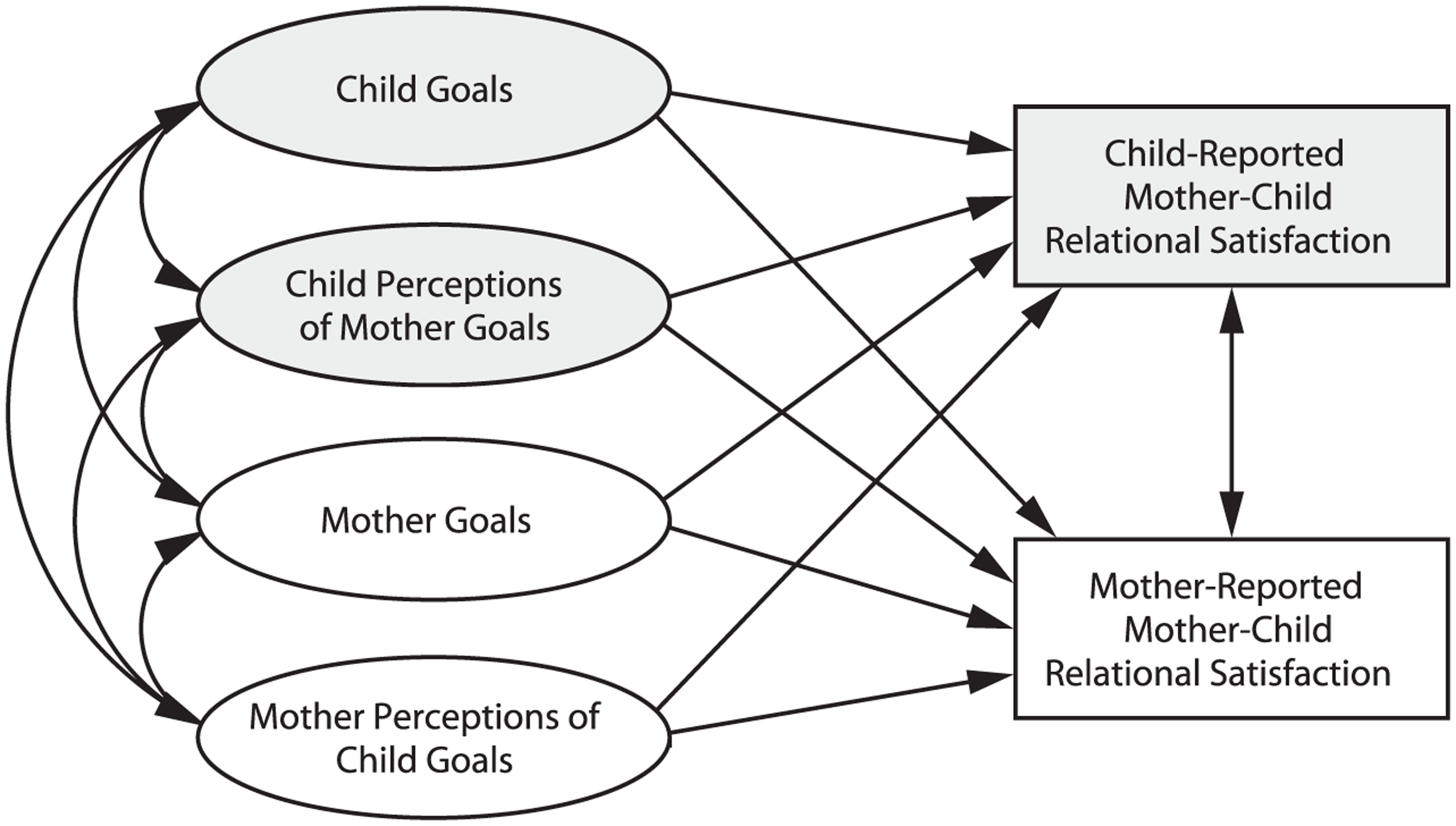
Multiple goals theory using the actor-partner interdependence model.
The actor-partner model also indicates that actor and partner effects might need to be considered simultaneously; actor effects might be moderated by partner effects, creating an actor-partner effect (Cook & Kenny, 2005). Actor-partner effects have not been included in multiple goal theorizing, but align with theoretical reasoning that goals should be studied at the dyadic level and that understanding both parties’ perceptions in tandem is essential to understanding relational dynamics. Specifically, the same goal may be reported and perceived differently by the mother and child, and these differing perspectives may interact in their association with relational satisfaction. Previous research supports that parents and children often perceive the same conversation differently and make differing attributions about conversational behavior (Sillars, Smith, & Koerner, 2010).
Six goal perceptions are reported by both mother and child, and thus, six actor-partner interactions between own reported and other perceived goals are possibly linked to mother and child relational satisfaction. For clarity, each interaction is described and numbered. Four interactions involve child reports and mother perceptions of a child goal: respect the mother, alter messages, act American, and act Latino/a. If a child feels that the goal of respecting the mother is important, but the mother perceives that the child does not rate that goal as important, relational satisfaction might be lower for both parties (Interaction 1: Child Respect Mother Goal × Mother Perception of Child Respect Goal). The child’s goal of altering messages (both when translating from Spanish to English and vice versa) may be positively associated with relational satisfaction, as pursuit of this goal may help to smooth the conversation and reduce potential face threats. However, mother detection of child message alteration may reduce this positive association, as mothers may find this behavior face-threatening and deceitful (Interaction 2: Child Alter Messages Goal × Mother Perception of Child Alter Messages Goal). Acting American is a child goal that may facilitate in-group identification when speaking to the English-speaker (Giles & Ogay, 2006). However, mother-child relational satisfaction may decrease if children align their behavior with American social norms (likely distancing their behavior from Latino/a norms) and mothers do not attribute this behavior to the goal of acting American (Interaction 3: Child Act American Goal × Mother Perception of Child Act American Goal). Finally, the child goal of acting Latino/a may be positively associated with relational satisfaction, as culturally normative communication is expected when children communicate with their mothers (Dixon et al., 2008). Mother perceptions of greater child goal importance may strengthen the positive association (Interaction 4: Child Act Latino/a Goal × Mother Perception of Child Act Latino/a Goal).
Two interactions involve mother-reported goals (instrumental and support) and child perceptions of these goals. The mother’s instrumental goal, which includes accomplishing her primary task and controlling child interpretation, may decrease relational satisfaction as mothers rate the goal as greater in importance. Child perception of mother control may strengthen the negative association; children may perceive control as a lack of trust and may become even more dissatisfied as mothers pursue this goal to a greater extent (Interaction 5: Mother Instrumental Goal × Child Perception of Mother Control Goal). Finally, the expected positive association between mother pursuit of support and relational satisfaction may hinge on child interpretation of this goal (Interaction 6: Mother Support Goal × Child Perception of Mother Support Goal). As child perceptions of the mother support goal decrease, children may interpret maternal supportive behaviors as mocking or insincere, and thus, relational satisfaction on both sides may suffer. However, for children who perceive their mothers intend to provide support, increased goal perceptions may strengthen the positive association between the mother-reported goal and relational satisfaction. Given the lack of previous research on actor-partner effects for a multiple goals framework, the following research question is proposed:
Method
Participants
One hundred mother-child dyads were recruited for the current study, in which the mother primarily spoke Spanish and the child was bilingual in English and Spanish. All children had language brokered for the mother at least once. All families were low-income (at or below 200% of the poverty line).
Child participants were between the ages of 12 and 18 years (M = 14.20, SD = 1.90). Children’s education levels corresponded with their age and ranged from fifth grade to high school graduation (M = 8.49, SD = 2.03). Children were mostly female (females = 58, males = 40, missing = 2) and born in the United States (n = 63). Those not born in the United States (n = 37) had lived in the United States for an average of 9.32 years (SD = 3.32, range = 2-15). The child taking the survey was often the sibling that brokered the most for the mother (n = 80).
Mothers were between 26 and 56 years old (M = 39.38, SD = 6.42) and, on average, were educated up to the eighth grade (ranging from no education to completing college). The majority of mothers were born in Mexico (n = 95), but two were born in the United States, two in Venezuela, and one in the Dominican Republic. Mothers had been in the United States between 4 and 37 years (M = 15.64, SD = 5.96).
Procedures
Two bilingual university extension program employees recruited participants from Lake County, Indiana. Dyads were compensated US$25 for their time. Data collection took place in participants’ homes, and mothers and children were separated when filling out the survey. Children chose whether to take the survey in Spanish or English; only two children chose Spanish. The child survey was written at a Flesch-Kincaid eighth-grade reading level, and a bilingual assistant was present to answer any questions. The mother survey was written in Spanish at an eighth-grade reading level. The bilingual assistant gave mothers the option of having the survey read to them, and many mothers took the survey in this manner.
Measures
Measures not available in Spanish were translated for the current study using standard translation procedures, such as back translation and decentering (Brislin, 1970). Internal reliability statistics for all variables are reported in Table 1. Spanish and English brokering goal measures and all variable correlations are available on the author’s website.
Descriptive Statistics.
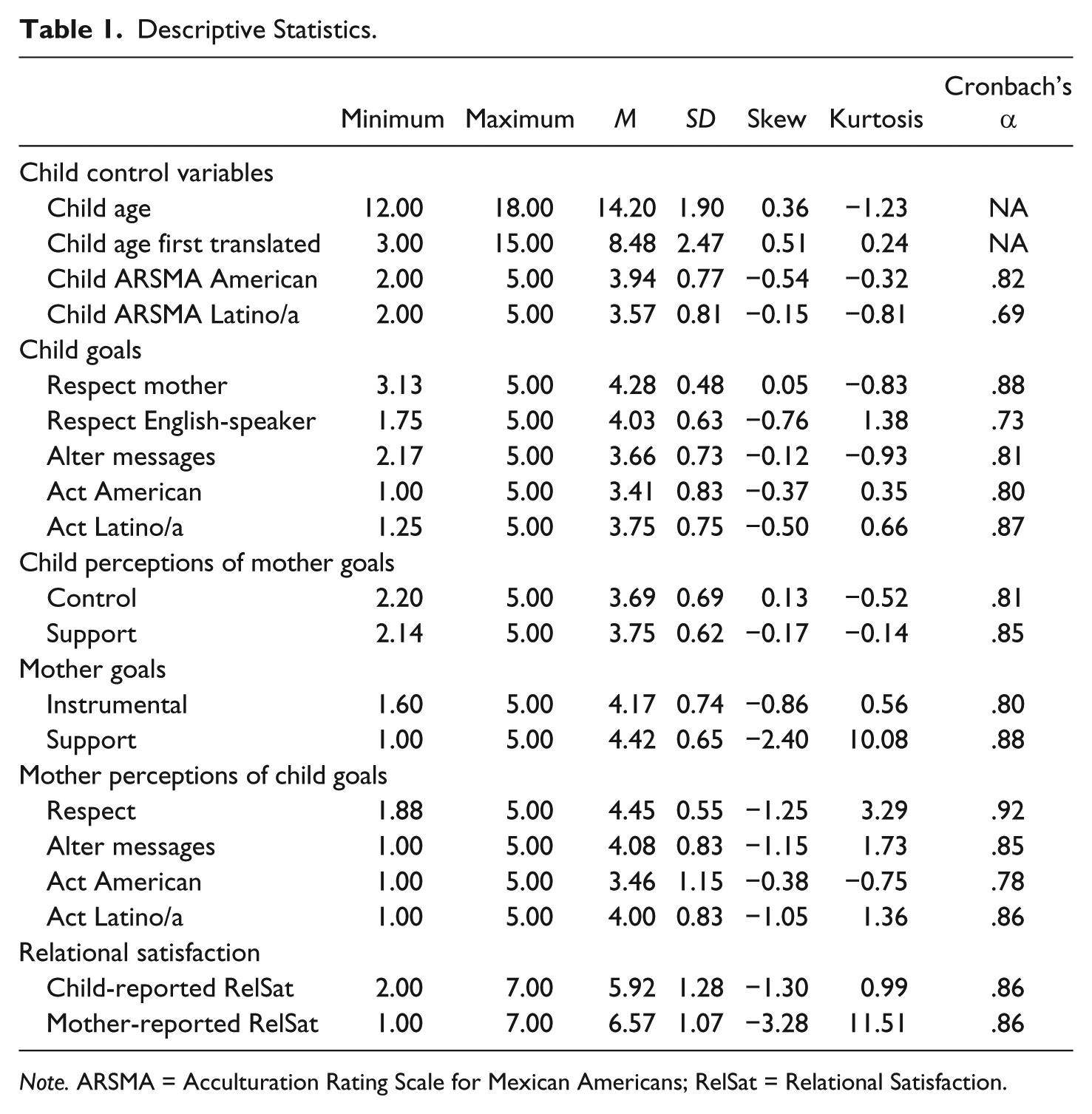
Note. ARSMA = Acculturation Rating Scale for Mexican Americans; RelSat = Relational Satisfaction.
Control variables
Control variables included the child’s age, age first translated, American identification, and Latino/a identification. Six items from the brief Acculturation Rating Scale for Mexican Americans–II (ARSMA-II; Bauman, 2005) assessed children’s “American” cultural identification (e.g., “My thinking is done in the English language”) and six items from the same scale assessed their “Latino/a” identification (e.g., “My thinking is done in the Spanish language”). All 12 items were measured on a 5-point scale (1 = not at all, 5 = almost always).
Language brokering interaction goals
The current data were used to build a typology of language brokering goals. A large pool of items was created, and items were eliminated or modified based on pilot interviews with language brokers, mothers, and academic scholars. Four categories of language brokering interaction goals were measured: child goals (child-reported), child perceptions of mother goals (child-reported), mother goals (mother-reported), and mother perceptions of child goals (mother-reported). A principal-axis exploratory factor analysis with direct oblimin rotation was run for each of the four categories to determine the specific language brokering goal variables. All items were measured on a 5-point scale (1 = strongly disagree, 5 = strongly agree) and loaded above .5 on their respective factors.
Children-reported own language brokering interaction goals factored into five variables: respecting the mother (eight items; for example, “I want to show my mother respect no matter what when I translate,” “I want to be polite in how I talk to my mother when translating”), respecting the English-speaker (four items; for example, “I care about being respectful to the English-speaker when I am translating, even when the English-speaker is being rude”; “It is important to respect the English-speaker when I translate, even if my mother is upset”), altering messages (six items; for example, “If the English-speaker says something that would embarrass my mother, I want to avoid translating that into Spanish”; “I want to change my mother’s words when I say them in English so that they sound better”), acting American (four items; for example, “I want the English-speaker to think that I act like an American when I translate,” “I care about being as American as possible when translating for the English-speaker”), and acting Latino/a (four items; for example, “I want my mother to think that I act like a Hispanic/Latino(a) when I translate,” “I care about being as Hispanic/Latino(a) as possible when translating for my mother”).
When assessing perceptions of partner goals, the exact same items were used with the tense altered to convey perceptions of another’s goals (e.g., “I want to show my mother respect no matter what when I translate” was altered to “My child wants to show me respect no matter what when he or she translates”). Mothers’ perceived child goals factored into four variables: respect (which included both respecting the mother and English-speaker; eight items), altering messages (four items), acting American (three items), and acting Latino/a (four items). Mother perceptions of the child altering messages goal differed slightly from the child-reported goal: The child-reported goal included altering messages from Spanish to English and vice versa, but the mother-perceived goal only included altering messages from Spanish to English.
Mother-reported own language brokering goals factored into two variables: instrumental goal (five items) and support (four items; for example, “It is important that I show support for my child when he or she is translating,” “I care about making my child feel good about himself or herself when he or she is translating”). The instrumental goal included accomplishing the task that required a broker (e.g., “When my child is translating, my main concern is saying what I need to say to the English-speaker”) and controlling the child’s translation (e.g., “I care about my child translating everything that the English-speaker says into Spanish, regardless of whether my child could have just answered in English”). Child perceptions of mother goals also factored into two goals: control (five items; the latter portion of the mother instrumental goal) and support (seven items).
Relational satisfaction
Communication scholars studying the mother-child relationship have adapted the Marital Opinion Questionnaire (MOQ; Schrodt & Afifi, 2007) to assess mother-child relational satisfaction. Ten items were measured on a 7-point semantic differential scale (e.g., 1 = dissatisfied, 7 = satisfied). Both mother and child reported on their mother-child relational satisfaction.
As the scale has not previously been validated in Spanish, a confirmatory factor analysis (CFA) was conducted on the mother-reported 10 items in AMOS 21 (Kenny, Kashy, & Cook, 2006). The CFA for the mother had very poor fit (χ2 = 149.66, p = .00, χ2/df = 4.28, Tucker Lewis index [TLI] = .58, comparative fit index [CFI] = .68, root mean square error of approximation [RMSEA] = .182, RMSEA 90% confidence interval [CI] = [.152, .212]). When examining the standardized factor loadings, only four items loaded above .5 (Items 6, 8, 9, and 10). The model was rerun with the four items and had better fit, although still not within acceptable range (χ2 = 6.29, p = .04, χ2/df = 3.15, TLI = .93, CFI = .98, RMSEA = .147, RMSEA 90% CI = [.023, .284]). Item 9 (easy/difficult) loaded the weakest (at .532; other items loaded from .739 to .957) and the Cronbach’s alpha was noticeably improved if that item was dropped (from .79 to .86). Given that this item has been unreliable in past uses of the scale (J. P. Caughlin, personal communication, April 16, 2013), this item was dropped. Thus, a three-item measure (disappointing/rewarding, empty/full, and dissatisfied/satisfied) was retained.
As the study purpose was to examine both mother and child perceptions of the relationship, the same three items were used for the child’s scale (rather than using the full 10-item scale) so that the Mother-Child Relationship Satisfaction Scale was composed of the same items for both mothers and children. As suggested by Kenny et al. (2006), a CFA of the mother’s three-item scale and the child’s three-item scale (with the two latent variables correlated) was run and demonstrated good fit (χ2 = 10.92, p = .21, χ2/df = 1.37, TLI = .98, CFI = .99, RMSEA = .061, RMSEA 90% CI = [.000, .141]). Standardized loadings for items were above .7.
Results
Missing data were handled with full information maximum likelihood for the structural equation model and with expectation maximization for interaction analyses (Olinsky, Chen, & Harlow, 2003). 1 Several variables had non-normal univariate skew and kurtosis (see Table 1 for descriptive statistics). Transformed variables were computed but produced similar results; thus, the non-transformed variables were retained. Mahalanobis distance was also calculated. With 20 variables in the model, the critical value to determine multivariate outliers was 45.30, with a probability of .001 (Tabachnick & Fidell, 2007). Two multivariate outliers were present (Dyads 19 and 47) and were excluded from the current analysis. The child’s age, age first translated, American identification and Latino/a identification were included as control variables (i.e., the dependent variables were regressed on the control variables, and the control variables were correlated with the goal variables). 2
Actor-Partner Interdependence Model
H1, H2, and Research Question 1 pertained to the actor-partner interdependence model (APIM) and predicted that child perceptions of own and mother language brokering goals, and mother perceptions of own and child language brokering goals would associate with both child-reported and mother-reported mother-child relational satisfaction. The APIM was examined with maximum likelihood structural equation modeling in AMOS 21. Per APIM recommendations (Kenny et al., 2006), all variables were represented as observed (i.e., the model was a path model), all exogenous variables (i.e., goal variables and covariates) were correlated, and the two endogenous variables (i.e., relational satisfaction) were correlated. Thus, the model was just-identified, meaning that goodness-of-fit statistics were not calculated.
For child-reported relational satisfaction, only actor effects were statistically significant (supporting H1). No mother-reported variables were associated with child-reported relational satisfaction (answering Research Question 1). The model explained 41.4% variance in child relational satisfaction. For parsimony, only statistically significant effects are reported in text (all effects reported in Table 2; see Figure 2). Two child-reported own goals were associated with child relational satisfaction. Greater importance of the child altering messages goal positively associated with child relational satisfaction (β = .18, p = .04). In addition, greater importance of the child acting Latino/a goal positively associated with child relational satisfaction (β = .21, p = .04). Two child perceptions of mother goals were also related to child relational satisfaction. Children who perceived that the support goal was more important to their mother reported more relational satisfaction (β = .48, p < .001). Children who perceived that the control goal was more important to their mother reported less relational satisfaction, although this effect only approached statistical significance (β = −.16, p = .07).
APIM Results and Interaction Effects.
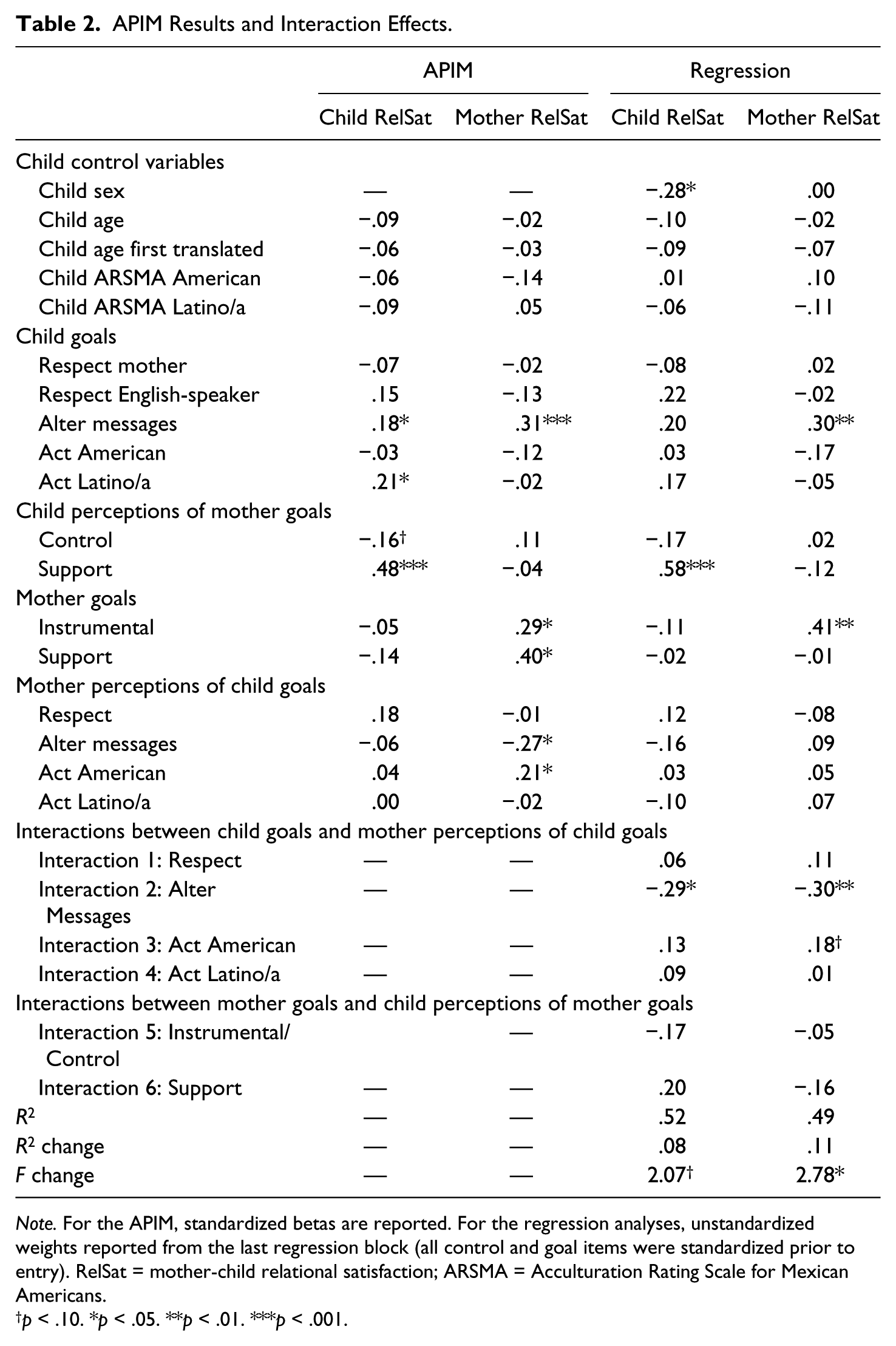
Note. For the APIM, standardized betas are reported. For the regression analyses, unstandardized weights reported from the last regression block (all control and goal items were standardized prior to entry). RelSat = mother-child relational satisfaction; ARSMA = Acculturation Rating Scale for Mexican Americans.
p < .10. *p < .05. **p < .01. ***p < .001.
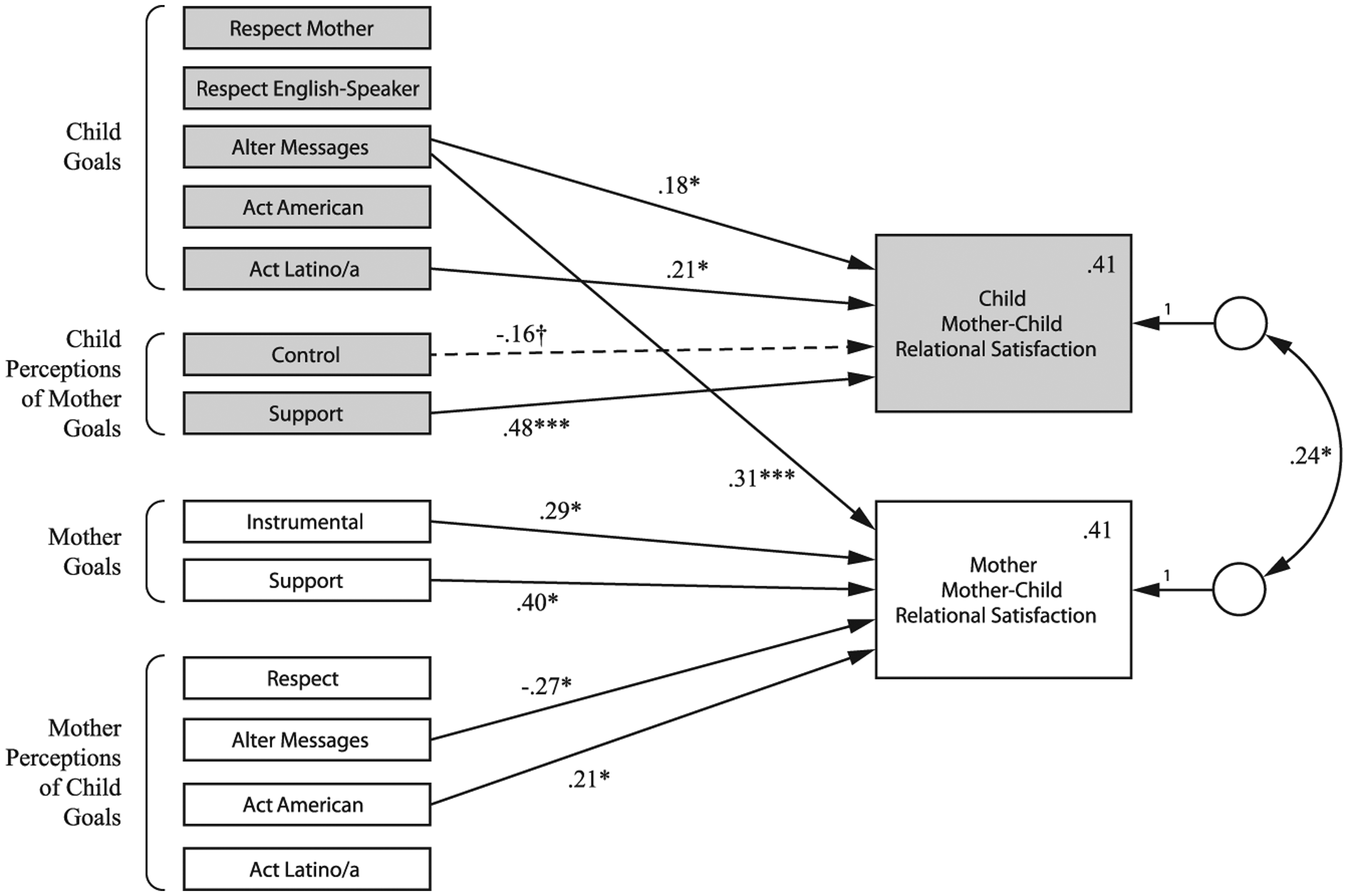
Statistically significant results of the actor-partner interdependence model.
For mother-reported relational satisfaction, both actor (H2) and partner effects (Research Question 1) were statistically significant (i.e., both mother- and child-reported variables linked to mother relational satisfaction). The model explained 41.0% variance in mother relational satisfaction. Two mother-reported own goals were associated with mother relational satisfaction. As mothers placed more importance on their instrumental goal, they were more satisfied with their relationship (β = .29, p = .01). In addition, as mothers rated their support goal as more important, their relational satisfaction increased (β = .40, p = .01). Mother perceptions of child goals were also associated with mother relational satisfaction. As mothers perceived that the child altering message goal had greater importance to the child, mothers decreased in their relational satisfaction (β = −.27, p = .02). As mothers perceived the goal of acting American was more important to their child, they reported higher relational satisfaction (β = .21, p = .03). One partner effect was statistically significant: child-reported alter messages goal importance was positively associated with mother-reported relational satisfaction (β = .31, p < .001). Thus, Research Question 1 was answered: No partner effects were present for the childs’ relational satisfaction, and one partner effect was present for mother relational satisfaction.
Interactions Between Mother and Child Perceptions of Similar Goals
To test the six possible actor-partner interaction effects posited by Research Question 2, two hierarchical regressions were run in SPSS 21: one with the dependent variable of child relational satisfaction and the other with mother relational satisfaction. Both regressions included all endogenous variables used in the APIM (with the addition of child sex) in the first block. The second block included the interactions between the six goals that had actor reports and partner perceptions: the child-reported goals of respect the mother, alter messages, act American, and act Latino/a, and the mother-reported instrumental and support goals. Results of the final hierarchical regression blocks are reported in Table 2. Interactions 1, 4, 5, and 6 were not statistically significant. Interactions 2 and 3 were probed with PROCESS (Model 1; see Hayes, 2013). A simple slopes analysis is reported using the 10th, 25th, 50th, 75th, and 90th percentiles of the moderator. The Johnson-Neyman statistic is also reported, which “demarcate[s] the points along the continuum of M [the moderator] where the conditional effect of X on Y transitions between statistically significant and not significant at the α level significance” (Hayes, 2013, p. 240).
Interaction 2, the interaction between the child-reported alter messages goal and the mother-perceived child alter messages goal, was significantly related to both child relational satisfaction (β = −.24, p = .02) and mother relational satisfaction (β = −.29, p = .01) and added 3.4% and 7.4% explained variance, respectively. For child relational satisfaction, the simple slopes analysis was significant at the 10th and 25th percentiles of mother perceptions of the child goal (t = 2.56, p = .01 and t = 2.17, p = .03, respectively; see Figure 3) but not at the 50th, 75th, and 90th percentiles. The Johnson-Neyman statistic indicated that the interaction was statistically significant when the moderator was at or below 3.87. For the statistically significant simple slopes, the less the mothers perceived this goal to be important to the child, the stronger the positive association was between child-reported importance of altering messages and child relational satisfaction. For mother relational satisfaction, the simple slopes analysis was significant at the 10th (t = 2.87, p = .01), 25th (t = 2.73, p = .01), and 50th (t = 2.37, p = .02) percentiles of mother perceptions of the child goal (see Figure 3) but was not significant at the 75th and 90th percentiles. The Johnson-Neyman statistic indicated that the interaction was statistically significant when the moderator was at or below 4.16. For the statistically significant simple slopes, the less the mothers perceived this goal to be important to the child, the stronger the positive association was between child-reported importance of altering messages and mother relational satisfaction.
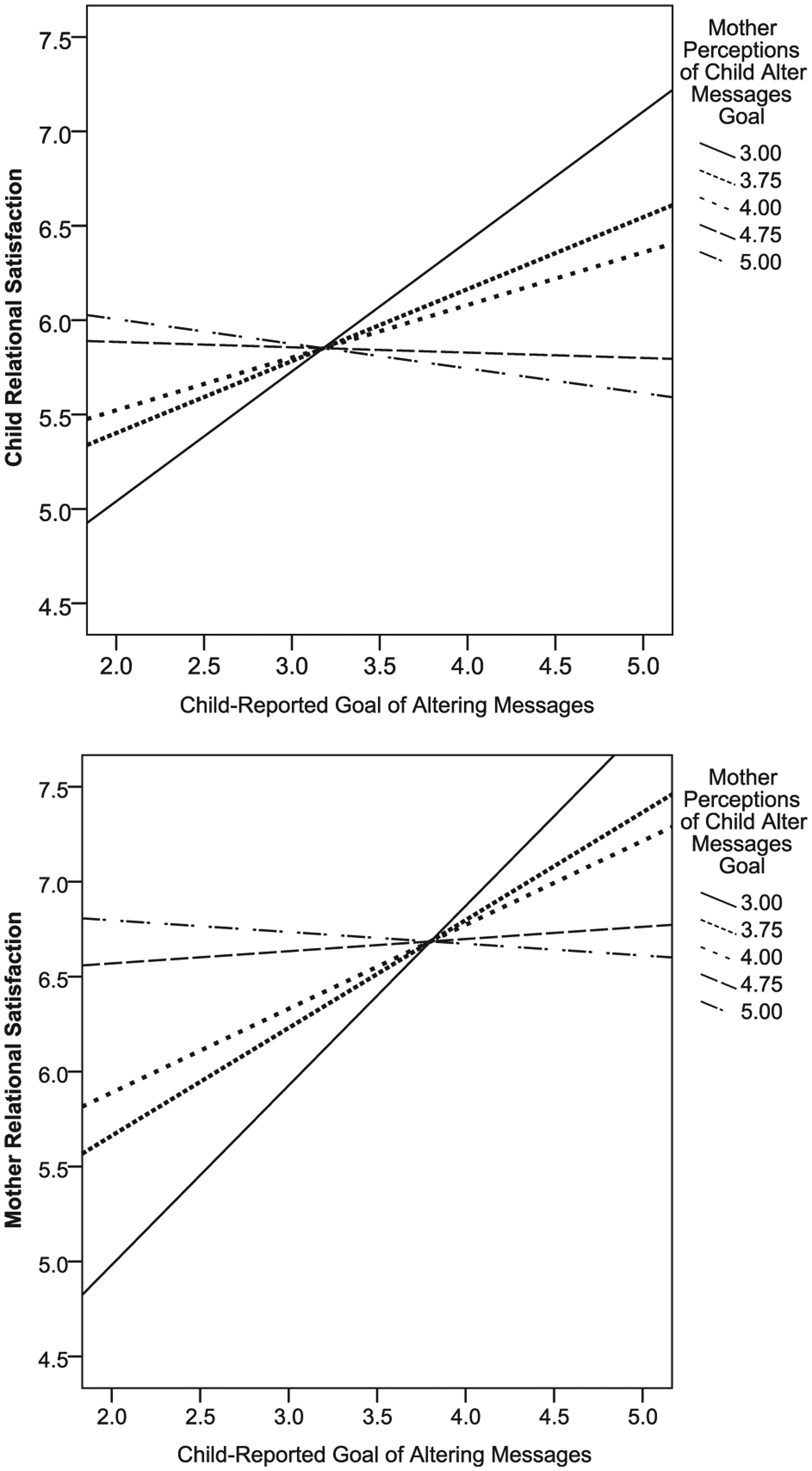
Alter messages goal interactions on child and mother relational satisfaction.
Interaction 3, the interaction between the child-reported own goal of acting American and mother perceptions of this goal was marginally significant for mother relational satisfaction (β = .17, p = .09). The simple slopes analysis was marginally significant at the 10th and 25th percentiles of mother perceptions of the child goal (t = −1.95, p = .055, and t = −1.91, p = .06, respectively) but was not statistically significant at the 50th, 75th, and 90th percentiles. For the marginally significant simple slopes, the less important mothers thought the acting American goal was to the child, the stronger the negative association was between the child-reported importance of acting American and mother relational satisfaction. The Johnson-Neyman statistic was not calculated, as the association between the child-reported goal and mother relational satisfaction did not reach α = .05 significance at any point of the moderator.
Discussion
The current study sought to describe the connection between language brokering and the mother-child relationship. One hundred low-income, predominantly Mexican-heritage mother-child dyads were examined, in which the mother was primarily Spanish-speaking and the bilingual child (age = 12-18) had brokered for the mother at least once. This study served to test and extend multiple goals theory (Caughlin, 2010) and to examine the importance of multiple goals in a language brokering context. Practically, this study suggests ways that mothers and children can alter brokering communication to possibly enhance relational satisfaction.
Overall, the current study supported multiple goal theory predictions that perceptions of language brokering goal tendencies are related to mother-child relational satisfaction for both parties. Multiple goals theory does not currently specify if interaction goal partner and actor-partner effects influence relational satisfaction; the current results indicated that actor effects and actor-partner effects may be more relevant than partner effects in understanding relational satisfaction, at least for mother and child language brokers. Child-reported perceptions of own and mother goals were associated with child relational satisfaction (H1: child actor effects), and mother-reported perceptions of own and child goals were associated with mother relational satisfaction (H2: mother actor effects). With one exception, partner effects were not connected to relational satisfaction for mothers or children (Research Question 1), and the one partner effect was explained through an interaction between actor reports and partner perceptions (i.e., actor-partner effects). Actor-partner effects were associated with both mother and child relational satisfaction (Research Question 2). The specific associations between goals and relational satisfaction are discussed below.
Goal Associations With Relational Satisfaction
Significant actor and actor-partner effects were related to overarching language brokering goal themes of face, ethnic identity, and trust. Children reported on five of their own goals (respecting mother, respecting English-speaker, altering messages, acting American, and acting Latino/a) and two perceptions of the mother’s goals (control and support). Mothers reported on four child goals (respect, alter messages, act American, and act Latino/a) and two own goals (instrumental and support). Of the aforementioned goals, only those related to respecting the mother and English-speaker did not associate with either mother or child relational satisfaction.
Mother support goal
Children’s perception of the mother support goal was the strongest predictor of child relational satisfaction; likewise, mothers’ reported goal of supporting the child was the strongest predictor of mother relational satisfaction. Thus, for both mothers and children, relational satisfaction linked to perceptions that child face and support needs were important to the mother. These findings indicate that mothers have agency in determining relational outcomes of language brokering, and support the theoretical premise that language brokering communication quality (rather than language brokering frequency) may drive relational outcomes (Goldsmith, 2004). Furthermore, language brokering scholars have posited that parental support can drive child psychological adjustment and may moderate language brokering outcomes (Oznobishin & Kurman, 2009). The current results corroborate that decreased parental support is connected to negative repercussions and indicate that mothers can foster a positive communicative environment, and thus desirable outcomes for both mother and child. However, only actor effects were present for both mothers and children, and child perceptions and mother reports of this goal were not correlated in the model (r = .05, p = .63), indicating that children and mothers do not perceive mother support goal importance in similar ways. Thus, mothers may report goal importance and experience higher relational satisfaction, but children will not report higher relational satisfaction unless they agree that the support goal is important to their mother. Parents and children do not always interpret the same conversational behaviors similarly (Sillars et al., 2010); mothers must ensure that supportive behaviors are perceived as such by the child. The lack of an actor-partner interaction effect between these perceptions further underlines that mothers and children perceptions do not interact consistently.
Child alter messages goal
Face issues also played a role in the child’s willingness to translate potentially face-threatening messages, with some children reporting goal importance of altering messages during brokering to avoid face-threat. Actor, partner, and actor-partner interaction effects between alter messages goal perceptions and relational satisfaction were present for children and mothers. Higher child alter messages goal importance linked to both child and mother satisfaction, but mother perceptions of the child goal associated with lower mother satisfaction. The actor-partner interaction (Research Question 2: Interaction 2) indicated that when children rated the alter messages goal as important but mothers rated child importance of this goal as low, both parties had greater relational satisfaction. Children may be happier when they can avoid engaging in face-threatening acts when communicating with the mother. Saying embarrassing, hurtful, or upsetting things to one’s mother may be seen as inappropriate within the mother-child relationship, even if the child is merely translating the words of someone else. Mothers may also experience more positive relational outcomes when these face-threatening translations are avoided. In addition, children who alter the mother’s words when saying them in English may feel that they are presenting their mother more positively (e.g., one language broker noted she was embarrassed about how many questions her mother was asking, so she did not translate the questions; Orellana et al., 2003), and thus feel more positively about the mother-child relationship. However, these positive associations were only observed when mothers did not feel that the alter messages goal was important to the child; in other words, relational satisfaction was higher only when mothers were unaware that children were attempting to mitigate face-threat for the mothers. The avoidance of face-threat through message altering may help both parties to be more satisfied with their relationship, but only when mothers are unaware that message altering is taking place.
Child acting Latino/a and acting American goals
The extent to which children attempted to enact their ethnic identity during language brokering was salient for relational satisfaction, even when controlling for the American and Latino/a acculturation of the child. Children who reported greater importance of the acting Latino/a goal had higher relational satisfaction, perhaps indicating that when children culturally align themselves with their mother, they perceived it to be relationally beneficial. However, the child goal of acting Latino/a was not related to mother satisfaction (for actor or partner effects). This is somewhat surprising, given that communication accommodation theory hypothesizes that aligning with the mother’s cultural in-group should be seen as positive by the mother (Giles & Ogay, 2006).
Instead, mothers’ perceptions that the child was acting American were positively associated with mother relational satisfaction. Research has shown that parents may encourage their child to acculturate so that they can negotiate the culture in which they live (Orellana, 2009); in addition, mothers might perceive this acculturation increases the child’s helpfulness as a broker. However, the actor-partner interaction between the child reports of acting American and the mother perceptions of the child acting American goal indicate that the effect on mother relational satisfaction is more complex (although this interaction was only marginally significant). When children reported that the acting American goal was important but mothers did not recognize the goal importance to the child, greater child goal importance ratings were associated with lower mother relational satisfaction (albeit marginally). One interpretation of this finding is that mothers may misunderstand child behavioral intentions in these circumstances. When children attempt to identify as American, they may be inadvertently distancing themselves from their mothers by following American behavioral norms (i.e., culturally aligning with an out-group; Giles & Ogay, 2006). Mothers who do not recognize the motivation and intent behind the child’s distancing behavior may therefore experience negative relational repercussions. Thus, language brokering situations may make ethnic identities salient in ways that have complex implications for the mother-child relationship.
Theoretically, merging elements of multiple goals theory (Caughlin, 2010) with social identity theory (Tajfel & Turner, 1979) or communication accommodation theory (Giles & Ogay, 2006) extends theoretical predictions and may be particularly salient for language brokering research. Previous research pertaining to interaction goals has focused predominantly on interpersonal identity goals and has not considered how one might attempt to identify with broader groups. Ethnic identity is salient within language brokering circumstances (e.g., Weisskirch, 2005), but other group identifications may also be relevant for brokers (e.g., identifying as an adult) and may surface as relevant goals in non-language brokering contexts.
Mother control goal
Issues of autonomy and trust also linked with relational satisfaction. Children may view mother control of brokering as indicative of a lack of trust in the child, explaining why child perception of this goal was negatively associated with child relational satisfaction. Conversely, mother reports of greater control goal importance (subsumed in the mother’s instrumental goal) positively associated with mother relational satisfaction. Thus, mothers and children interpreted this goal differently and had opposite reactions in how their goal interpretation linked to relational satisfaction. These differing perspectives are consistent with previous research that describes tensions between autonomy and closeness in parents and adolescents (Sillars et al., 2010). Parents may perceive that a behavior serves a positive function, while adolescents view the same behavior as controlling (Sillars et al., 2010).
Child respect goal
The only goal theme that did not have significant associations with mother or child relational satisfaction was related to respect. The child goals of respecting the mother and respecting the English-speaker, and mother perceptions of child respect goal (incorporating both mother and English-speaker) were not associated with the dependent variables in any way (i.e., through actor, partner, or actor-partner effects). Previous studies have linked frequency of language brokering to greater child respect for the mother (Chao, 2006), but similar effects were not present in the current data, even though brokers were fairly attentive to respect goals (i.e., children rated respect goals as the most important in the current study). Additional research is needed to understand the role of respect in language brokering.
Practical Implications
The multiple goals theory findings also have practical implications for language brokering situations. Language brokering is a unique “parenting moment,” providing opportunities for children to take on responsibility, act as adults, and grow in their autonomy, while still having their mothers present. However, the mother-child relationship may suffer if mothers do not respond as supportive parents during these interactions. Moreover, children must share perceptions that the mother is being supportive to positively benefit. The child’s awareness of the need to act appropriately (interpersonally or culturally) when talking to the mother may also be linked to relational outcomes. However, mothers and children often do not have similar perceptions about what is occurring during a language brokering interaction (e.g., in relation to mother support or child acting American goals); therefore, frustration on the part of one party may be misinterpreted and misunderstood from the perspective of the other. Misaligned perceptions about certain topics can be both detrimental (e.g., acting American) and beneficial (e.g., altering messages) to the relationship.
Limitations and Future Directions
The current study has several limitations that must be considered when interpreting the results. First, the sample size is small from a statistical standpoint, even though it contains dyadic data from a hard-to-reach and understudied population. Steps were taken to ensure the analyses were appropriate (e.g., Kaiser-Meyer-Olkin Measure of Sampling Adequacy was above .7 for factor analyses). Second, this study was cross-sectional in nature, meaning that although causality is hypothesized and assumed based on theoretical predictions, the data cannot actually assess causality. However, establishing the association between these variables is an important first step before moving forward with research that involves longitudinal data. Third, the current study generalized interaction goal perceptions across all language brokering contexts. Language brokering occurs in a wide range of locations, and interaction goals of both the broker and mother may fluctuate in importance depending on when the brokering episode is taking place, who the English-speaker is, and in what context the situation is occurring. Furthermore, additional interaction goals apart from those examined here are possible for mothers and children. Future research could build on the current findings by examining language brokering goals and the mother-child relationship longitudinally. Identifying situation-specific brokering goal importance would address how different children select goals for the same situation and how one child may alter goals according to context. Furthermore, goal perceptions for individual situations may not have equal weight when merging into generalized goal perceptions; understanding this summation process would reveal whether certain conversations are more pivotal for generalized goals than others.
Conclusion
Language brokering is a complex, multifaceted phenomenon. The current article takes a first step in describing associations between language brokering communication and the mother-child relationship. Primarily, the findings indicate that mother and child language brokering communication quality can vary and that perceptions of communicative goals during language brokering link to broader mother-child relational perceptions. The implications of these findings echo claims of previous scholars, who state that language brokering communication quality and interaction elements drive desirable and undesirable outcomes, rather than language brokering having uniformly positive or negative implications. The mother-child relationship is central to understanding how children navigate, understand, and grow from language brokering experiences.
Footnotes
Acknowledgements
The author is extremely grateful to Steve Wilson for all his help and guidance, and to John Caughlin, Jake Jensen, Felicia Roberts, Shawn Whiteman, Mitzi Egnatz, and Maria Turpin for their expertise and assistance.
Declaration of Conflicting Interests
The author declared no potential conflicts of interest with respect to the research, authorship, and/or publication of this article.
Funding
The author disclosed receipt of the following financial support for the research, authorship, and/or publication of this article: This research was partially funded by a grant from the Center for Families and the Office of the Vice President for Research at Purdue University.