







Abstract
Mindfulness has emerged as an important factor that assists people in regulating difficult emotions, but it is not yet known whether mindfulness plays a role in supportive communication. The current study examines whether mindfulness facets (describing, observing, nonjudging, aware acting, nonreacting) positively influence self-reported abilities to (a) discern more and less person-centered (PC) supportive messages and (b) facilitate reappraisals via two core cognitive factors, namely, empathy and active listening. College students with little or no meditation experience (N = 183) completed an online survey. Mediation analyses showed that empathy and active listening partially mediated the relationship between two mindfulness facets (describing, observing) and the two perceptual outcome measures (PC message discriminations, facilitating reappraisals) by accounting for 33% and 62% of the variance. Additional structural equation modeling suggested that mindful observing and describing positively predicted empathy and active listening. Both mindful describing and nonjudging also positively predicted facilitating reappraisals. Interestingly, nonjudging negatively predicted empathy and active listening. The results point to mindfulness as an important factor that influences cognitive-affective processes in supportive communication.
Although social support is generally viewed as beneficial for both provider and seeker (Warner, Schuz, Wurm, Ziegelmann, & Tesch-Romer, 2010), providing support can be demanding and emotionally taxing (Strazdins & Broom, 2007). The current study examines whether mindfulness is a metacognitive resource that positively influences (a) motivational and attentional factors, such as active listening and empathy, and (b) two perceived processes relevant to providing support, namely, processing more and less supportive messages, as well as inclinations to help a suffering other work through difficult emotions (i.e., facilitate reappraisals). The effects of mindfulness on processing (and providing) support messages are still understudied, even though evidence points to the benefits of this contemplative capacity on motivations, attentional resources, emotion regulation skills, social skills, and general well-being (Jazaieri et al., 2014; Jones & Hansen, 2014; Shapiro & Jazaieri, 2015).
The Costs of Providing Support
Of all support types (e.g., advice, information, network support), emotional support is particularly beneficial when coping with difficult emotions (Burleson, 2003b; Reblin & Uchino, 2008). However, the beneficial health effects of support seem to be predominantly a function of one’s perceived support (e.g., the support a person thinks he or she has), whereas receiving actual support often has either no or negative psychosocial effects (Bolger, Zuckerman, & Kessler, 2000; Gleason, Iida, Bolger, & Shrout, 2003; McClure et al., 2014). One of the most straightforward answers to this paradox is that it is challenging to provide high-quality support. Indeed, strong empirical evidence generated from conversational data suggests that people in general do not produce high-quality support (High, Oeldorf-Hirsch, & Bellur, 2014; Metts, Backhaus, & Kazoleas, 1995; Vickery et al., 2015) even though extensive research suggests that this kind of support is viewed as most beneficial and effective (High & Dillard, 2012; Jones & Bodie, 2014). In an effort to identify what accounts for high-quality support, the supportive communication literature has identified person centeredness as a particularly beneficial message quality in supportive interactions (High & Solomon, 2014; Jones & Wirtz, 2006). Person-centered (PC) support captures an “awareness of and adaptation to the affective, subjective, and relational aspects of communication contexts” (Burleson, 1987, p. 305).
Support seekers prefer highly person-centered support (e.g., High & Solomon, 2014) and report feeling better after having received it (e.g., Jones & Wirtz, 2006). As noted above, however, they often do not receive it (e.g., High & Steuber, 2014). Recipients also report receiving well-intended, yet unsupportive messages that are inappropriate, untimely, or excessive (High & Steuber, 2014; Ingram, Betz, Mindes, Schmitt, & Smith, 2001; Reblin, Uchino, & Smith, 2010). These findings conjure up a poignant empirical question: If support is such an important coping resource and if people report preferring high quality support, why do supporters not provide this kind of support?
Scholars have identified several factors, such as skill (or lack thereof; Burleson, 1990; Cohen, Sherrod, & Clark, 1986; Samter, 1994), personality (Pasch, Bradbury, & Davila, 1997), and attributional intentions (Jones & Burleson, 1997; MacGeorge, 2001) to explain variabilities in the quality of support that is provided. A somewhat less examined factor concerns the challenging nature of providing support: Managing personal demands, while listening to a suffering person and expressing care and compassion, can be emotionally demanding for the provider (McClure et al., 2014). The costs of providing support have been examined extensively in the literature on empathic fatigue among health professionals (Decety, Yang, & Cheng, 2010; Gleichgerrcht & Decety, 2013, 2014). Recently, Gosnell and Gable (2015) argued that providing support is also stressful for couples because it impedes attentional processes and can lead to ego depletion, the inability to control one’s responses and behaviors in line with what is normatively appropriate for a given context. Across four studies, the researchers found that support providers reported experiencing increased levels of ego depletion.
The potentially ego-depleting nature of support points to yet another important question that is understudied: What factors can encourage a support provider to engage in sensitive emotional support without incurring costs (e.g., stress, judgments of responsibility, negative emotions)? One capacity that has emerged as positively impacting cognitive-affective functioning is mindfulness. At first blush, it seems counterintuitive to propose mindfulness as a panacea because mindfulness stresses present-centered attention to one’s own sensory experiences (Brown & Ryan, 2003; Cardaciotto, Herbert, Forman, Moitra, & Farrow, 2008), rather than the emotional experiences of the other person. However, becoming mindful and accepting of one’s own emotions might actually have salutary effects for attending to the emotional experiences of the other person (Trautwein, Naranjo, & Schmidt, 2014). To further test this claim, the current study examines whether mindfulness positively influences self-reported abilities to (a) discern more and less PC supportive messages and (b) facilitate reappraisals via two core cognitive factors, namely, active listening and empathy. We next present our rationale and the results of a study testing our model.
PC Emotional Support
Because emotional support functions to ameliorate difficult emotions, supportive messages must fulfill two goals: (a) to respond to a distressed person by listening to and expressing empathy toward that person and (b) to facilitate the alleviation of negative emotions experienced by that person (Bodie, Burleson, & Jones, 2012; Jones & Bodie, 2014). The properties of emotional support messages that seem to best fulfill these goals rest on assumptions of more or less PC support. Messages low in person centeredness (LPC) deny or minimize the feelings experienced and expressed by the upset person by criticizing the person, challenging the legitimacy of these feelings, or telling the person how he or she should feel and act. Moderate person-centered (MPC) messages implicitly recognize the upset person’s emotional experiences by offering condolences and sympathy, distracting the other person’s attention away from the stressful events or by offering explanations for what happened (Burleson et al., 2009). High person-centered (HPC) messages explicitly recognize and validate emotions by explicitly articulating them and encouraging the upset person to talk about them. Extensive research shows that HPC messages are viewed as more beneficial compared with LPC and MPC messages (for reviews, see Burleson, 2003a; High & Dillard, 2012). HPC support also might function to facilitate the regulation of upsetting emotions experienced by the support recipient, otherwise called reappraisal. Reappraisal is an emotion regulation (i.e., coping) strategy that encourages the person to change emotions by giving events that lead to upsetting emotions a new or different, more positive meaning (Gross, 2015). HPC support is predicted to assist in this reappraisal process by helping the person reframe the event within the context of the person’s goals, wants, and needs (Burleson & Goldsmith, 1998). HPC support facilitates reappraisals with message devices such as encouraging the seeker to talk about what happened, asking probing questions about the event, or thinking through whether and in what ways the event matters to the person. Whether HPC support does actually facilitate reappraisals, however, is not yet known. To date, only two studies have found some evidence for the links between HPC messages, emotional improvement, and reappraisals (Bodie, Burleson, & Jones, 2012; Jones & Wirtz, 2006). If facilitating reappraisals is a beneficial function of HPC support, then a provider might be inclined to provide messages that accomplish this task, which might make HPC support even more cognitively taxing and ego-depleting.
Research testing variations in PC messages has often utilized a message perception paradigm (see Burleson & MacGeorge, 2002, for an explanation of this and other paradigms), which captures variations in message evaluations. This paradigm requires people to read a hypothetical vignette depicting an upset, close friend and to subsequently evaluate nine preformulated supportive responses (e.g., Burleson et al., 2009). Each message reflects a theoretical level in the PC hierarchical coding scheme which consists of three major levels (high, moderate, low PC), each major message level contains itself three sublevels (Applegate, 1980; Burleson, 1982). To tap individual differences in the way people process messages that differ in person centeredness, Burleson and colleagues have also utilized a message quality discrimination index by computing the difference between low and high PC message evaluations (Bodie et al., 2011; Burleson et al., 2009). The ability to discriminate more and less PC messages plays an important role in the message planning and interpretation process; it is a cognitively challenging task that is more proximal to actual message behavior than, say, being aware of feelings: To formulate meaningful communication, including PC messages, a person has to interpret people, contexts, and relationships in terms of psychologically centered dispositions and attributes (i.e., motivations, goals, feelings, thoughts, personality; Burleson & Caplan, 1998).
Mindfulness
A host of meta-analytic studies document the effects of mindfulness on cognitive and affective functioning (e.g., Eberth & Sedlmeier, 2012; Galante, Galante, Bekkers, & Gallacher, 2014; McCarney, Schulz, & Grey, 2012). Mindfulness training guards against over-engagement with emotions (Jha, Stanley, Kiyonaga, Wong, & Gelfand, 2010; Papies, Pronk, Keesman, & Barsalou, 2015) and can increase self-efficacy while decreasing perceived levels of stress, anxiety (Baer, Carmody, & Hunsinger, 2012), and worry (Jazaieri et al., 2014). Correlational evidence from self-report data also found that dispositional mindfulness is related to forgiveness (Crowley, Manusov, & Harvey-Knowles, 2014), conflict styles (Harvey-Knowles, Manusov, & Crowley, 2015), as well as social encoding and decoding skills (Jones & Hansen, 2014; Manusov, Harvey-Knowles, & Crowley, 2013).
Mindfulness is a training technique and a disposition, which makes it somewhat challenging to explain its mechanisms. Because mindfulness interventions tend to increase mindfulness dispositions, which, in turn, have beneficial psychosocial effects, the apparent conclusion seems to be that the primary mechanism of mindfulness interventions is simply mindfulness itself (Gu, Strauss, Bond, & Cavanagh, 2015; Nyklicek & Kuijpers, 2008). The current understanding, however, is that mindfulness consists of at least two cognitive processes: present-centered attention and emotion acceptance (Brown & Ryan, 2003; Cardaciotto et al., 2008; Ciarrochi & Kashdan, 2013; Hölzel et al., 2011). These two processes are frequently measured with the Five-Facet Mindfulness Questionnaire (FFMQ; Baer, Smith, Hopkins, Krietemeyer, & Toney, 2006). The three FFMQ facets that capture mindful attending include observing (attending to internal and external stimuli), aware acting (attending to one’s actions in real time rather than automatically responding to them), and describing (labeling and expressing experiences). The two FFMQ facets that tab emotion acceptance are nonjudging (taking a nonevaluative stance toward thoughts and emotions) and nonreacting (“letting go” of or decentering from emotions without getting caught up by them). The five facets are usually moderately correlated with one another, and the factor structure of the scale has been corroborated in a series of studies (e.g., Williams, Dalgleish, Karl, & Kuyken, 2014).
The Role of Empathy and Active Listening in the Mindful Support Process
Baumeister and Masicampo (2010) theorized that the benefits of mindfulness directly influence the ability to regulate, control, and manage cognitive-affective resources. In other words, because mindfulness is considered a metacognitive capacity (Papies et al., 2015) which enables present-centered awareness of one’s own sensory experiences, mindfulness is predicted to influence behavioral responses, including supportive messages, indirectly through other cognitive and affective mechanisms. Two core affective and cognitive resources that are influenced by mindfulness and that, in turn, influence PC support are active listening and empathy. Empathy means vicariously feeling with a suffering person (Davis, 1994; Lamm, Batson, & Decety, 2007) and is a fundamental human capacity anchored in evolution (Simpson & Beckes, 2010) that is crucial to socio-psychological functioning (Mikulincer & Shaver, 2005). Empathy also has been strongly associated with prosocial helping behaviors (Eisenberg, 2000; Lebowitz & Dovidio, 2015; Stiff, Dillard, Somera, Kim, & Sleight, 1988).
Several studies have examined connections between empathy and PC. Whereas one study utilizing face-to-face enacted support as part of experimental interactions generated null findings for empathy and PC (Samter & Burleson, 1984), two other studies showed that empathy and PC are connected. Specifically, one study found that empathy predicted the provision of emotional support messages that exhibited higher PC qualities in response to hypothetical scenarios (i.e., written supportive responses; Burleson, 1983). The second study examined evaluations of messages that vary in PC and detected small significant relations between empathy and people’s abilities to discern more and less PC messages from one another (using the nine-level message hierarchy; Burleson & Samter, 1985).
Research testing connections between mindfulness and empathy has found that people who score high on mindfulness also tend to report increased levels of empathy and compassion (Dekeyser, Raes, Leijssen, Leysen, & Dewulf, 2008; Greason & Cashwell, 2009; Shapiro, Brown, Thoresen, & Plante, 2011). The Dekeyser et al. (2008) study found that mindful observing in particular is associated with empathy. Even stronger empirical evidence comes from mindfulness interventions that foster compassion and empathy (Jazaieri et al., 2013; Kemeny et al., 2012; Klimecki, Leiberg, Lamm, & Singer, 2013). Jones and colleagues (2015) randomly assigned participants (N = 171) to daily 15-minute compassion or mindful breathing meditations for 2 weeks and detected significant mean differences for compassion, mindful breathing, and control conditions on empathy, such that people who participated in compassion and mindful breathing reported significantly higher empathy scores than control group participants. Jazaieri and colleagues (2014) utilized a longer mindfulness intervention interval and found increased levels of compassion and decreased levels of worry. In a series of studies, Klimecki and colleagues (Klimecki, Leiberg, Ricard, & Singer, 2014; Klimecki & Singer, 2012) showed that brief mindfulness interventions can offset the negative effects of empathy (e.g., empathic fatigue) by enhancing levels of compassion which seems to activate those brain regions that are associated with nurturing, positive emotional experiences. Mindfulness facets, such as nonreacting and nonjudging might be particularly important for empathy because these two capacities permit distance from difficult emotions, while attending to the suffering other (Wallmark, Safarzadeh, Daukantaite, & Maddux, 2013).
People consistently rate active listening as a crucial factor in supportive interactions (Bodie & Jones, 2012; Bodie, Vickery, & Gearhart, 2013). Active listening consists of (a) cognitive processes, such as attending, understanding, or interpreting messages; (b) affective processes, such as being motivated and energized to attend to another person; and (c) behavioral processes, such as verbally and nonverbally signaling that a message has been received and understood (Gearhart & Bodie, 2011). Bodie (2011) developed the Active-Empathic Listening Scale (AELS), which captures these listening characteristics over the course of three stages: (a) sensing, which means to actively attending to and capturing verbal and nonverbal information; (b) processing, which means to make sense of verbal and nonverbal information, and ultimately synthesize that information into a “narrative whole”; and (c) responding, which includes backchanneling (e.g., head nods) and verbal cues (e.g., asking questions, paraphrasing) to signal that information has been understood (Gearhart & Bodie, 2011, p. 87). Several studies by Bodie and colleagues show that the provision of PC and nonverbally warm and caring support is tightly linked with the extent to which supporters engage in active listening (Bodie & Jones, 2012; Bodie, Jones, Vickery, Hatcher, & Cannava, 2014; Bodie, Vickery, & Gearhart, 2013).
The connection between active listening and PC message evaluations has not yet been directly tested. Ancillary evidence comes from a study by Bodie and colleagues who tested the temporal stability of active listening (Bodie, Gearhart, Denham, & Vickery, 2013). Using hypothetical scenarios that manipulated perceived need for activity and empathy on the part of the listener, highly active listeners (as per AELS scores) tended to differentiate more sharply between low-activity/low-empathy and high-activity/high-empathy scenarios than less active listeners (Bodie, Gearhart, et al., 2013, Study 2). Because this study utilized hypothetical scenarios that require participants to process and interpret complex information about people, emotions, and situational dynamics (much like the PC message paradigm), it is reasonable to assume that highly active listener would indeed be better able to discern high and low PC messages.
Active listening has also not yet been examined in conjunction with mindfulness, even though both share sufficient conceptual space. Both active listening and mindfulness focus on the importance of attention and present orientation (as opposed to rehearsing a response). Because they conceptually overlap, Shapiro and Mariels (2013) suggested that mindful attending, which is captured with the observing, aware acting, and describing facets of the FFMQ, should predict active listening because mindful attention encourages the listener to orient himself or herself to the other person and to stay present. As a metacognitive capacity that distally affects behavior, mindful attention encourages people to recognize not only their own affective state in the present moment, but also orients them to momentary contextual stimuli in a curious, open, and accepting way (Bishop et al., 2004). These mindfulness features should influence active listening, which requires that the person attend to contextual stimuli to understand information and effectively respond to the other person.
The Hypothesized Model
We conceive of mindfulness facets as core cognitive processes that are antecedent to context-dependent cognitive-affective processes, such as empathy, listening, as well as to message evaluations. Specifically, mindfulness exerts its influence on empathy and listening, which in turn predict message planning processes. Mindful attending facets, such as aware acting, observing, and describing, might be particularly predictive of active listening because these facets are closely aligned with the sensing, processing, and responding components that make up listening. In line with evidence presented above, empathy and active listening should also directly influence putative support providers’ abilities to more sensitively discern PC messages and their comfort with facilitating e reappraisals. Whether and in what ways the five mindfulness facets exert their influence on behavioral assessments (e.g., evaluating more and less supportive messages, facilitating reappraisals) via cognitive factors (i.e., empathy and active listening) is unclear. Perhaps mindfulness is not at all related to message evaluations or facilitations and exerts only a direct influence on empathy and active listening. We have, however, argued thus far that mindfulness is a metacognitive factor that precedes other cognitive-affective processes. Consequently, we propose that mindfulness acts as a mediator such that the five mindfulness facets amplify message evaluations and self-reported facilitating reappraisal abilities via empathy and active listening.
In sum, we hypothesized that the five mindfulness facets would positively predict empathy (Hypothesis 1a [H1a]) and active listening (Hypothesis 1b [H1b]). Empathy and active listening, in turn, exert direct positive effects on facilitating reappraisals (Hypothesis 2a [H2a]) and the ability to discriminate more sharply between high and low PC messages (Hypothesis 2b [H2b]). Last, mindfulness facets indirectly influence message evaluations and facilitating reappraisals via empathy and active listening (Hypothesis 3 [H3]).
Method
Participants and Procedures
A total of 183 students (51 women; 128 men; four missing) from undergraduate communication courses at a Midwestern university completed an online survey in exchange for extra-credit. The average age of the participants was 21 years (SD = 3.42; range = 18-51 years). The majority of the sample consisted of White Americans (n = 142), African Americans (n = 11), Asians/Asian Americans (n = 49), and Hispanics (n = 5). Eight participants belonged to other ethnic groups.
Instruments
Mindfulness
Mindfulness was assessed with the 39-item FFMQ (Baer et al., 2006). All items were assessed with 5-point scales. The five FFMQ dimensions include nonreacting (e.g., “I perceive my feelings and emotions without having to react to them”), observing (e.g., “When I’m walking, I deliberately notice the sensations of my body moving”), acting with awareness (e.g., “I find it difficult to stay focused on what’s happening in the present”; reverse coded), describing (e.g., “I’m good at finding the words to describe my feelings”), and nonjudging (e.g., “I tell myself I shouldn’t be feeling the way I’m feeling”; reverse coded). Higher scores for all five facets indicate stronger tendencies for that facet.
Empathy
Empathy was measured with the empathic concern subscale from Davis’ (1994) Interpersonal Reactivity Scale (IRI). The empathic concern subscale consists of seven items (e.g., “I often have tender, concerned feelings for people less fortunate than me”). All items were assessed on 5-point scales (1 = does not describe me very well, 5 = describes me very well). Empathic concern items were internally consistent (α = .84; M = 3.35; SD = .59); high scores on this scale indicate higher levels of empathic concern.
Active-empathic listening
Participants completed the 11-item AELS (e.g., “I assure others that I will remember what they say”) on 5-point scales (1 = never or almost never true, 5 = always or almost always true; Bodie, 2011, Study 1). The sensing, processing, and responding subscales were highly intercorrelated (.63 < r < .68; see also Gearhart & Bodie, 2011). Therefore, we treated the scale as unidimensional and used that scale in all analyses (α = .91; M = 3.35; SD = .59).
Facilitating reappraisals
Facilitating reappraisals was measured with three items from the emotional support subscale of the Interpersonal Competence Questionnaire (ICQ; Buhrmester, Furman, Wittenberg, & Reis, 1988). Items included “Helping a close companion cope with family or roommate problems,” “Helping a close companion work through his or her thoughts and feelings about a major life decision, for example, a career choice,” and “Helping a close companion get to the heart of a problem she or he is experiencing.” The three items were evaluated on 5-point scales (1 = I’m poor at this; I’d feel so uncomfortable and unable to handle this situation, I’d avoid it if possible; 2 = I’m only fair at this; I’d feel uncomfortable and would have lots of difficulty handling this situation; 3 = I’m ok at this; I’d feel somewhat comfortable and would have some difficulty, handling this situation; 4 = I’m good at this; I’d feel quite comfortable and able to handle the situation; 5 = I’m extremely good at this; I’d feel very comfortable and would handle this situation very well). While these three items were not designed to tab facilitating reappraisals per se, they do tap crucial strategies that are theorized to facilitate reappraisals (Burleson & Goldsmith, 1998). Internally consistencies for this scale were acceptable (α = .72; M = 3.81; SD = .70).
PC message evaluations
After reading a hypothetical situation about a good male friend who was upset that he did not receive a prestigious scholarship, participants were asked to evaluate nine reformulated messages that reflect possible comforting responses to the distressed friend. The nine preformulated messages were utilized in past studies (Burleson et al., 2009, Study 1; Burleson, Holmstrom, & Gilstrap, 2005, Study 4). The hypothetical situation identified a male friend only. The nine messages were presented in a fixed random order, and participants evaluated these messages on two semantic differential scales that ranged from 1 (very ineffective, very insensitive) to 5 (very effective, very sensitive). Each PC level (LPC, MPC, HPC) was represented with three messages.
Message ratings tend to be highly intercorrelated (Goldsmith, McDermott, & Alexander, 2000; Jones & Burleson, 1997). A common way to treat these message evaluations is to construct three major PC messages levels across scales (i.e., effectiveness, sensitivity; Jones & Burleson, 1997). To construct LPC, we used effectiveness and sensitivity ratings for the three LPC messages (α = .72; M = 2.36, SD = .64). Similarly, the three HPC messages were combined to form HPC level (α = .73; M = 3.70; SD = .67). MPC scale reliabilities for the three MPC message evaluations were unacceptable (α = .52). Therefore, we selected sensitivity and effectiveness ratings for Message Level 4 only to represent MPC (α = .78; M = 3.51; SD = .98). Notably, MPC message evaluations were not utilized in the PC index described below.
A repeated measures analysis of variance (ANOVA) confirmed that the three message levels varied significantly as a function of PC, F(2,182) = 174.49, p < .001, partial η2 = .66. Follow-up pairwise t tests indicated that LPC messages (M = 2.36, SD = .64) were viewed as less beneficial (i.e., sensitive, effective) than MPC messages, M = 3.51; SD = .98; t(182) = −14.84, p < .001, r2 = .33, and HPC messages, M = 3.70; SD = .67, t(182) = −18.87, p < .001, r2 = .51. MPC and HPC messages also differed from one another on message evaluations, t(182) = −2.31, p < .05, r2 = .01.
We then created a message evaluation discrimination index, henceforth PC index or message discriminations, by subtracting mean LPC from mean HPC message evaluations. The resulting score could range from −4 to 4, but actual scores ranged from −2.00 to 3.50 (M = 1.36; SD = .96; skew = −.53; kurtosis = .47). Only 9.3% of participants had scores below 0; these participants evaluated LPC messages as more sensitive than HPC messages. The vast majority of participants (90.7%) evaluated HPC messages as more sensitive than LPC messages. The higher the score, the greater the discrimination between HPC and LPC message evaluations.
Results
Analysis Plan
After computing correlations to provide preliminary information (see Table 1), hypotheses were tested with structural equation modeling (SEM) procedures, using maximum likelihood (ML) estimation in AMOS 21.0 (Arbuckle, 2012). Model fit was evaluated with conventional cutoff values (in parentheses) for the Tucker–Lewis index (TLI; > .90), the comparative fit index (CFI; > .90), the standardized root mean residual (SRMR; < .08), and the root mean square error of approximation (RMSEA; < .05, for excellent fit and < .08 for good fit with 90% confidence intervals [CIs]; Chen, Curran, Bollen, Kirby, & Paxton, 2008; Hu & Bentler, 1995; Kline, 2015). Although the χ2 statistic is not commonly used anymore to assess model fit, we followed convention and reported it here as well. Because our models were not hierarchically related but differed on the basis of theoretical assumptions, the Δχ2 test should not be used as a test statistic (Kline, 2015). Rather, alternative models are evaluated on the basis of (a) the Akaike information criterion (AIC) with lowest values suggesting preferred fit (Kline, 2015) and (b) TLI and CFI difference tests with values < −.01 suggesting model variance (Cheung & Rensvold, 2002).
Intercorrelations for Variables in the Study.
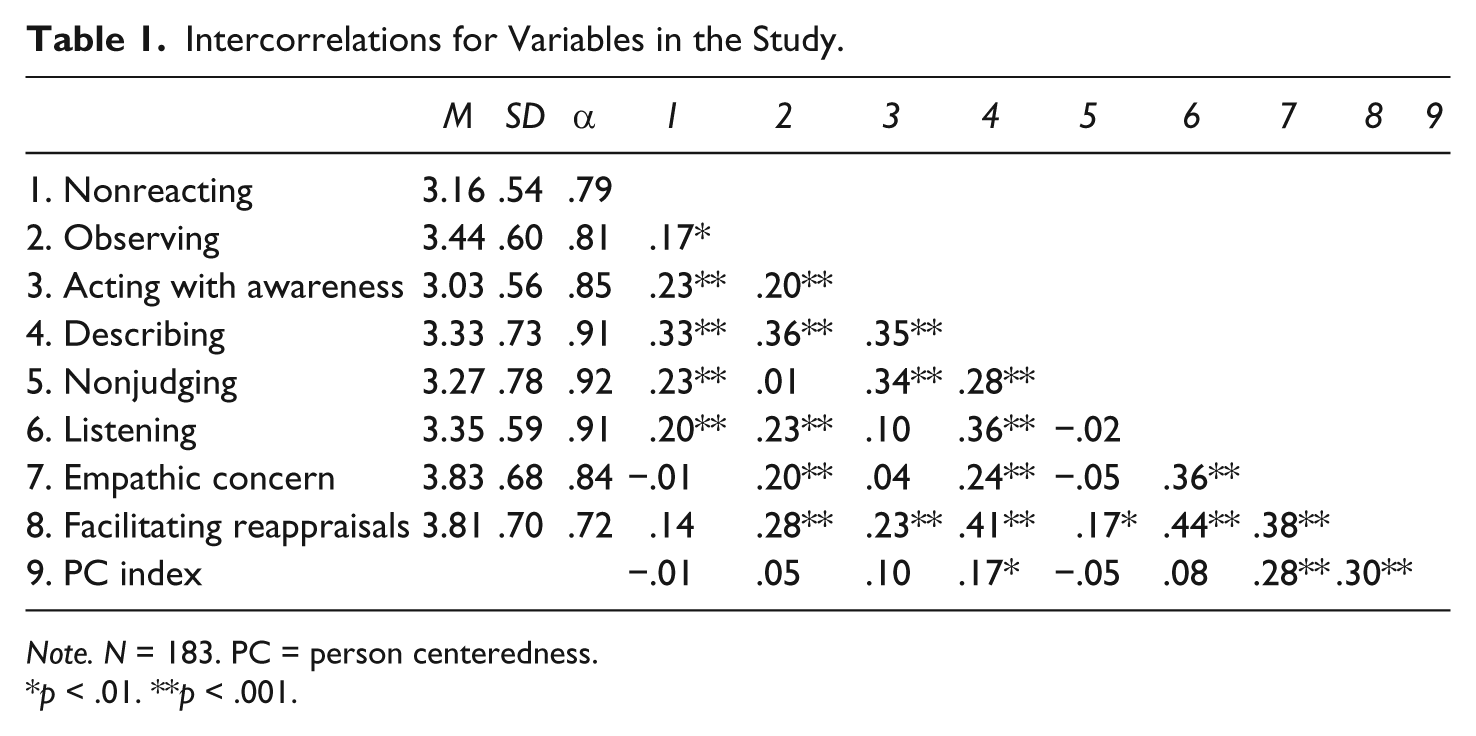
Note. N = 183. PC = person centeredness.
p < .01. **p < .001.
To answer H3, we utilized multiple mediation path analyses with a bootstrapping method (k = 5,000) that is recommended for smaller samples (INDIRECT; Preacher & Hayes, 2008). This SPSS macro estimates direct and indirect effects with multiple mediators simultaneously, and statistical significance is indicated by 95% bias-corrected CIs not crossing zero (Preacher & Hayes, 2008).
Measurement Model
A measurement model featuring the second-order hierarchical FFMQ latent model as well as the latent empathy, listening, and facilitating reappraisal factors suggested reasonable fit for two indices (SRMR, RMSEA), whereas two indices were below what is usually deemed minimally acceptable (TLI, CFI), χ2(1629) = 2572.05; p < .001, TLI = .81, CFI = .82, SRMR = .07, RMSEA = .05 [.05, .06], AIC = 2979.20. We reparameterized the model in two theoretically sound ways. First, in an effort to reduce the number of indicators in relation to our sample size, and following procedures by Baer et al. (2006), we parceled FFMQ indicators (see Little, Cunningham, Shahar, & Widaman, 2002). The resulting second-order hierarchical FFMQ model contained the five first-order latent mindfulness factors, each containing three parcels. Second, we examined modification indices and found that three empathy items contained redundant information (“When I see someone being treated unfairly I sometimes don’t feel very much pity for them,” “Sometimes, I don’t feel very sorry for other people when they are having problems,” “Other people’s misfortunes do not usually concern me a great deal”; all reverse coded). In addition, the second indicator (“Sometimes, I don’t feel very sorry for other people when they are having problems”; reverse coded) featured an unacceptably low factor loading (β = .37). We retained the first empathy indicator only (“When I see someone being treated unfairly I sometimes don’t feel very much pity for them”; reverse coded) because it featured the highest factor loading. We eliminated the other two empathy indicators, which resulted in a revised empathy scale containing five indicators (α = .82). Similarly, two AELS items contained redundant information (“I summarize points of agreement or disagreement when appropriate,” “I keep track of points others make”). According to Bodie (2011), both indicators operationalize processing ability. We retained the first indicator because it featured a higher factor loading and eliminated the second indicator. The revised AELS scale contained 10 items (α = .89). The revised empathy and listening scales were used in all remaining analyses.
The respecified measurement model showed improved model-to-data fit with respect to the TLI and the CFI, whereas the SRMR dropped marginally, yet remained within conventionally acceptable limits; χ2(475) = 717.62; p < .001, TLI = .90, CFI = .91, SRMR = .08, RMSEA = .05 [.04, .06], AIC = 889.62. All factor loadings were acceptable (λs > .40; p < .001). All parcels loaded significantly on their respective first-order facets, which in turn, converged significantly on the overall latent mindfulness factor.
Model comparison
We compared the retained measurement model with two models that each capture different ways with which mindfulness has been tested. Several studies suggest that the FFMQ might be better represented with correlated rather than hierarchical mindfulness facets (Bohlmeijer, ten Klooster, Fledderus, Veehof, & Baer, 2011; Van Dam, Hobkirk, Danoff-Burg, & Earleywine, 2012). Our first alternative model thus estimated correlated mindfulness facets, rather than the hierarchical latent factor structure, while retaining all other latent variables (i.e., empathy, listening, facilitating reappraisal). Second, mindfulness might be equally well-represented with two mindfulness factors, rather than five facets (see Teper & Inzlicht, 2013). The second alternative model thus contained a hierarchical mindfulness factor with two first-order factors, namely, mindful attending and emotion acceptance. The mindful attending factor included all aware acting, observing, and describing parcels, whereas the emotion acceptance factor contained nonreacting and nonjudging parcels. The direct effects of the second-order factor on mindful attending and emotion acceptance were constrained to 1.0 (Kline, 2015).
The correlated model fit the data comparatively well, χ2(471) = 723.19, p < .001, TLI = .897, CFI = .908, SRMR = .06, RMSEA = .05 [.04, .06], AIC = 903.19, whereas the two-factor model generated a statistically poor fit, χ2(488) = 1164.69.77, p < .001, TLI = .73, CFI = .75, SRMR = .06, RMSEA = .09 [.08, .09], AIC = 1310.69. Although the correlated model fit our data, we opted to retain our original measurement model on the basis of the marginally lower AIC for this model. Our predictions are associated with individual mindfulness facets, and the nature of the hierarchical FFMQ structure is of minor importance to our study. However, it is noteworthy that our findings for the correlated model replicate those of Van Dam and colleagues (2012).
Structural Model
The proposed structural model suggested that the five mindfulness facets (i.e., nonreacting, observing, aware acting, describing, and nonjudging) predict empathy and active listening, which in turn predict facilitating reappraisals and the PC index (i.e., the extent to which people discriminate LPC and HPC messages). We also estimated direct effects for the five mindfulness facets on facilitating reappraisals and the PC index. The PC index was modeled as an observed variable, whereas all other variables were latent factors. Residual error terms were permitted to covary with one another (Preacher & Hayes, 2008). Model fit was acceptable, χ2(498) = 732.77, p < .001, TLI = .905, CFI = .916, SRMR = .062, RMSEA = .051 [.042, .058], AIC = 926.77. All standardized residuals were within acceptable limits (< 2.58). Overall, mindfulness facets, as well as empathy and listening accounted for 10.9% of the variance in PC index and 39.5% of the variance in facilitating reappraisals (squared multiple correlations).
Model comparison
Intervention and trait mindfulness studies have variously tested mindfulness as both a mediator and as an antecedent variable. Theoretically, this makes sense. The impact of mindfulness is most frequently studied in experimental mindfulness intervention studies. Training-induced changes in mindfulness likely impact emotions directly (e.g., less anxiety, stress), and these outcomes are likely further mediated by cognitive and affective variables. For example, Caldwell and Shaver (2015) examined whether rumination, suppression, negative emotion, and emotion clarity mediated the relationship between treatment conditions (dummy coded) and mindfulness. Far fewer studies examine dispositional mindfulness, yet these studies also have treated mindfulness as either an antecedent variable or as a mediator. For example, several studies show that emotion (dys)regulation strategies, such as suppression, avoidance, and reappraisals, mediate the relationship between (low) mindfulness and psychological stress variables (e.g., perceived stress, worry, catastrophizing) and well-being (Pepping, Davis, & O’Donovan, 2013, 2015). Yet another dispositional mindfulness study showed that mindfulness mediated the relationship between empathy and forgiveness (Crowley et al., 2014).
We compared our predicted model to one alternative, equally plausible model with active listening and empathy predicting the five mindfulness facets, which, in turn predicted facilitating reappraisals and PC message discriminations. In other words, we tested whether mindfulness is a mediator rather than an antecedent variable. The alternative model showed poorer fit on the basis of the AIC, which was higher for the alternative model, as well as the two statistical difference tests, ΔTLI = .01, ΔCFI = .01; χ2(502) = 765.09, p < .001, TLI = .894, CFI = .905, SRMR = .07, RMSEA = .054 [.046, .060], AIC = 951.09.
Hypotheses
An inspection of the standardized coefficients displayed in Figure 1 showed several interesting results for the direct effects of mindfulness facets on empathy (H1a) and active listening (H1b): Mindful observing predicted both empathy and active listening (β = .27, .20, ps < .01 and .05, respectively), as did describing (empathy, β = .24, p < .05; active listening, β = .35, ps < .001). Interestingly, nonjudging negatively predicted empathy (β = −.25, p < .01) and active listening (β = −.16, p < .05). Thus, H1a and H1b were supported for two facets, but no significant results emerged for aware acting or nonreacting; results contrary to predictions emerged for nonjudging and empathy, as well as active listening. Both empathy and active listening predicted facilitating reappraisals (β = .32, p < .001 for both), yet only empathy positively predicted message discriminations (β = .33, p < .001). Thus, H2a and H2b were mostly supported.
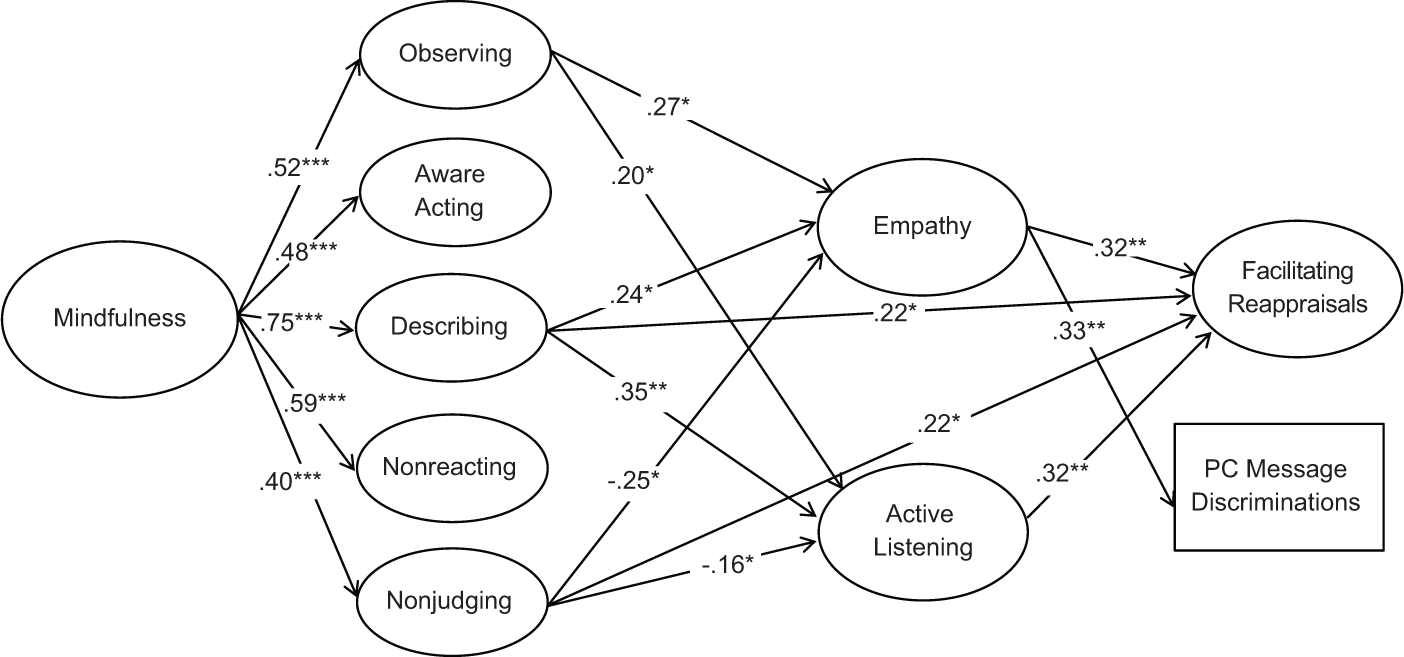
Standardized estimates for the structural model predicting differences in facilitating reappraisals and person-centered message evaluations from empathy, listening, and five mindfulness facets.
Mediation Analyses
The structural model in Figure 1 suggests that observing, describing, and nonjudging exerted indirect effects on facilitating reappraisals and the PC index via both empathy and active listening (H3). To assess the relative strength of the two mediators, we conducted multiple mediation analyses. The indirect effects are featured in Table 2. Notably, all point estimates (PEs) were rather small. Active listening and empathy partially mediated the relationship between two mindfulness facets (describing, observing) and the two outcome measures (PC message discriminations, facilitating reappraisals) by accounting for 33% and 62% of the variance. Nonjudging did not exert a significant indirect effect on either facilitating reappraisals or the PC index.
Indirect Effects of Mindful Observing, Describing, and Nonjudging on Facilitating Reappraisals and Person-Centered Message Evaluations.
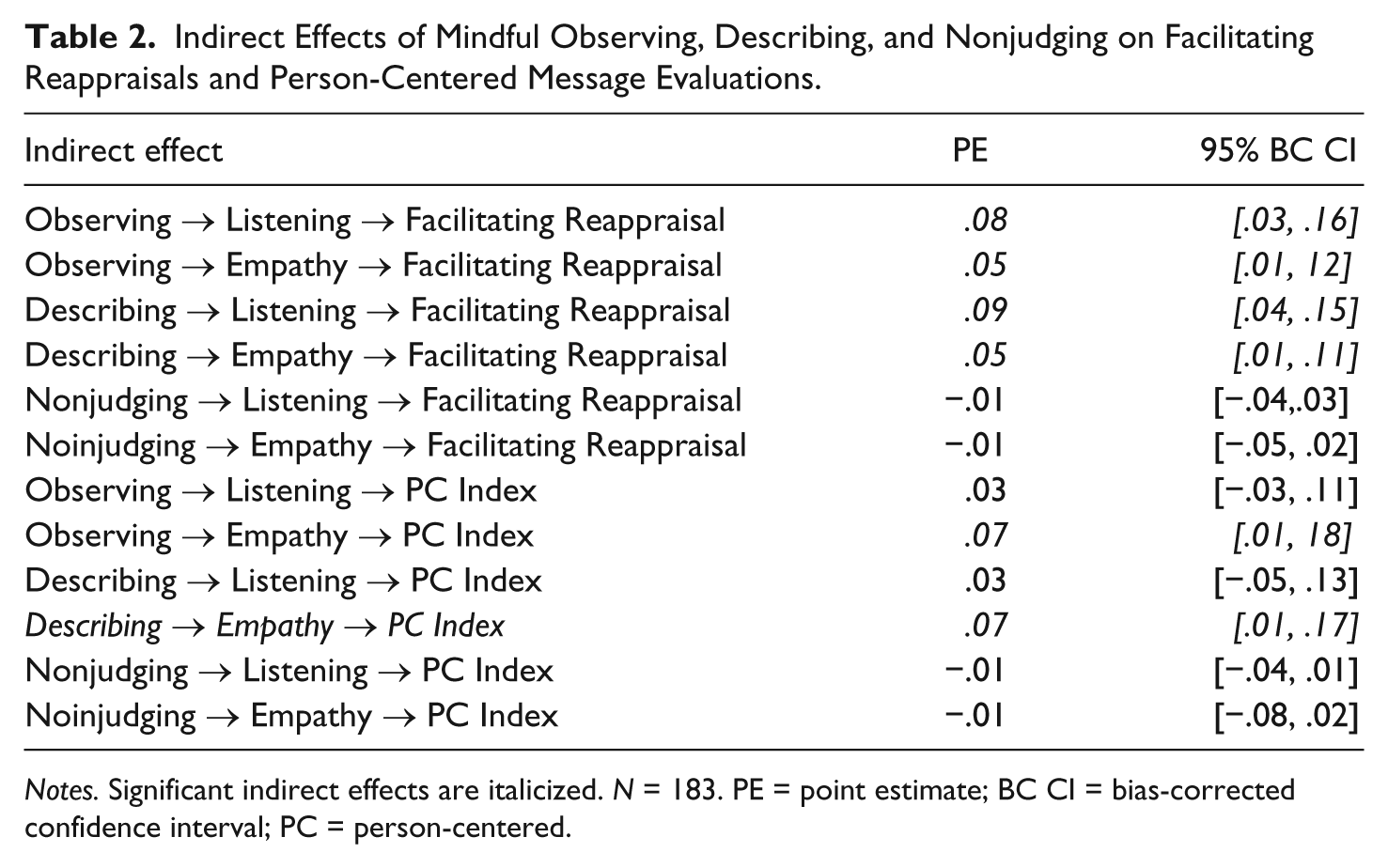
Notes. Significant indirect effects are italicized. N = 183. PE = point estimate; BC CI = bias-corrected confidence interval; PC = person-centered.
Discussion
Both mindfulness and supportive communication are beneficial to health and human functioning. Of course, this fact alone does not justify integrating these two concepts in the study of emotional support. In the current study, we argue that mindfulness might improve the quantity and quality of supportive messages: Providing emotional support can be stressful. Mindfulness might assist putative providers in becoming more aware of and accepting of their own emotional states so that they may be better able to listen to and empathize with the distressed other person. Concretely, we tested a model that suggests mindfulness might exert an indirect, distal effect on perceived message outcomes (i.e., facilitating reappraisals, more and less PC messages) via two core cognitive-affective processes, empathy, and listening. Specifically, a person’s ability to discern more and less PC messages has been found to influence cognitive processing and coping. Similarly, the ability to facilitate reappraisals might play an important role in helping others cope.
Mindfulness and Direct Effects on Empathy, Active Listening, and Perceived Outcomes
Three of the five mindfulness facets, specifically observing, describing, and nonjudging, exerted direct effects on active listening and empathy, whereas both describing and observing directly predicted facilitating reappraisals. No results emerged for nonreacting or aware acting. First, people who scored high on mindful observing and describing also reported increased levels of empathy. These findings essentially replicate past empirical FFMQ research in particular (Dekeyser et al., 2008) and mindfulness research in general (Birnie, Speca, & Carlson, 2010). Second, observing and describing also positively predicted active listening. Notably, our study is the first to document the systematic influence of mindfulness on active listening. Both capacities are as much about the ability to notice situational details as they are about noticing one’s own sensations. Observing and describing one’s own sensations in particular might attune the listener to the situation and the other person, an aspect that plays an important role in supportive listening (Bodie, St. Cyr, Pence, Rold, & Honeycutt, 2012; Bodie, Vickery, & Gearhart, 2013).
An important question that arises from these findings is how and in what ways mindfully attending (i.e., observing, describing) to one’s own sensory experiences and emotions has salutary effects for attending to others experiences, which is what happens when people empathize and actively listen to a distressed other. As noted earlier, it seems that self-focused attention would lead one away from other-focused orientations, such as empathy and listening. The conceptual link between mindful attention and other-oriented motivational factors (i.e., empathy, listening) might be self-compassion, which consists of three components: self-kindness (viz., harsh judgment), a sense of common humanity (viz., feelings of isolation), and mindful accepting (viz., overidentification with adverse and painful thoughts and feelings; Neff, Rude, & Kirkpatrick, 2007). Whether self-compassion is indeed the mechanism that connects mindfulness facets with other-oriented behaviors, such as active listening, needs to be systematically tested. Thus far, self-compassion has been directly linked to empathy (Neff & Pommier, 2013) and healthier close relationships (Neff & Beretvas, 2013). Neff and Beretvas found that the degree to which people are kind to themselves is related to how kind they are to their partner: Increased levels of self-compassion were linked with increased levels of relational satisfaction, partner connectedness, partner acceptance, and the ability to express opinions freely to the partner. Our results corroborate Neff and Beretvas’s (2013) findings in some ways. Presumably, partner connectedness, relational satisfaction, and freely expressing opinions all require active listening (Prager & Buhrmester, 1998).
Our findings also corroborate those of Neff and Beretvas (2013) with respect to facilitating reappraisals. Describing and nonjudging were the only mindfulness facets in our data that directly predicted facilitating reappraisals. People who reported being able to label their own sensations also reported being able to help others work through difficult emotions. Specifically, we assessed facilitating reappraisals with items tapping people’s willingness to cope with problems, to work through thoughts and feelings about a life event, or to help someone “get to the heart of a problem.” Our results suggest that articulating one’s own internal experiences assists individuals in approaching their partner and helping them work through difficult emotions.
Findings associated with nonjudging where unanticipated. The ability to notice and describe one’s emotions and take a nonevaluative stance toward them has emerged as a hallmark benefit of mindfulness training. Our results showed that nonjudging, that is, taking a nonevaluative stance toward one’s emotions, negatively predicted empathy and listening. People who reported being good at letting go of their own emotional experiences and not evaluating them also reported being less empathic and less able to listen well. This is an unexpected finding: Past research has generated significant, positive associations for empathy and observing (Dekeyser et al., 2008), as well as empathy and composite measures of mindfulness which contain nonjudging (Birnie et al., 2010; Greason & Cashwell, 2009; Shapiro et al., 2011). It is doubtful that these findings are artifacts because both empathy and active listening featured negative coefficients. What accounts for these unanticipated results? One explanation might be that our sample consisted of participants with little or no meditation experience and consequently little to no practice in mindfully accepting their own difficult emotions. To be sure, the ability to accept emotions is a capacity that everyone possesses, but several studies have shown that some mindfulness facets, including nonjudging, differently affect meditators and nonmeditators (e.g., Baer et al., 2006; Baer et al., 2008). Close observation of one’s own internal stimuli and self-focused attention tends to be associated with negative psychological outcomes (Farb, Anderson, & Segal, 2012; Lutz, Slagter, Dunne, & Davidson, 2008). Mindfulness training teaches people to observe their cognitions and emotions with an accepting and nonjudging stance; in other words, nonjudging interacts with observing to lead to positive psychological outcomes (Lilja, Lundh, Josefsson, & Falkenstrom, 2013). In fact, it might be that together with nonreacting, nonjudging is more taxing on self-regulatory abilities among nonmeditators, because these two facets focus particularly on letting go of one’s own difficult emotions and on accepting these emotions as impermanent (Baer et al., 2008). Therefore, approaching one’s own emotions in a nonjudging and nonreactive fashion in ways that are beneficial to psychosocial functioning has to be practiced in mindfulness training.
Empathy, Active Listening, and Perceived Outcome Measures
We examined the extent to which people understand and evaluate supportive PC messages that aim to lessen (or potentially exacerbate) adverse emotions. The hallmark characteristic of person centeredness is recognizing and responding to another person’s emotion by either directly acknowledging or validating these emotions (HPC support) or by ignoring or even minimizing them (LPC support). We also examined facilitating reappraisals which tap a supporter’s abilities to help a distressed person work through difficult feelings. Notably, the ability to discriminate more sensitively among PC messages was positively correlated with inclinations to assist others in coping with aversive emotions (r = .30, p < .001). These findings certainly point to the role person centeredness might play in the reappraisal process, an issue that merits further examination.
Results associated with our SEM analyses showed that PC message evaluations were not directly influenced by any of the mindfulness facets. We did not expect they would because mindfulness is a metacognitive factor that ought to exert its effects on behavior via cognitive and motivational mechanism, such as empathy and listening. As expected, empathy and active listening directly predicted facilitating reappraisals. Empathy also predicted people’s tendencies to better discriminate between high and low PC messages. These findings make sense; the ability to understand the emotional experiences of a suffering other person is a necessary predisposition to actually understand how emotions can become all-encompassing realities. Past research has shown that empathy directly influences abilities to process more sensitive PC support messages (Burleson, 1983; Burleson & Samter, 1985).
Indirect Effects of Mindfulness on Perceived Outcome Measures
Our model predicted that mindfulness is antecedent to message processing factors. Specifically, we predicted that mindfulness precedes complex perceptual tasks, such as facilitating reappraisals and evaluating messages, both of which tend to implicate message planning and production processes (Burleson & Planalp, 2000). This is so because to figure out how to respond to others, mindfulness assumes that people need to become aware and accepting of their own thoughts and emotions first (Garland, Hanley, Farb, & Froeliger, 2013). We also predicted that core cognitive processes such as empathy and listening would mediate the relationship between mindfulness and these more advanced perceptual tasks.
Multiple mediation analyses revealed that both empathy and active listening partially mediated the relationship between two mindfulness facets (describing, observing) and the two perceptual outcome measures. Specifically, our results suggested that empathy and listening partially mediated the relationship between mindful describing and observing and facilitating reappraisals. In other words, a provider’s ability to observe and describe his or her own sensations has potentially powerful effects on helping another person work through difficult emotions (i.e., facilitating reappraisals) when the provider can also empathize and actively listen to the other person. Similarly, our multiple mediation analyses show that empathy only partially mediated the describing PC index relationship.
These results point to some intricate dynamics between mindfulness and social-perceptual processes that influence communicative behaviors: Whereas the direct impact and nature of the relationship between mindfulness and complex perceptual processes, such as inclinations to facilitate reappraisals or processing psychologically complex information, are not known, we now have initial empirical evidence documenting the relationship between (a) mindfulness facets and empathy; and (b) empathy, active listening, and PC message evaluations. Our study shows that mindfulness does not directly influence context-dependent perceptual processes (e.g., evaluating specific supportive messages) but does influence complex perceptual tasks via core processes such as empathy and listening. Both of these core processes are conceptually embedded in mindfulness characteristics because both empathy and active listening connect support provider and seeker with one another; how exactly is not yet understood, but this study provides evidence that mindfulness shapes how we think about communication, in this case, supportive messages.
Of course, empathy and active listening were only partial mediators, suggesting that other factors further influence the relationship between mindful functioning and complex perceptual tasks. For example, it might be that one’s ability to encode nonverbal cues is yet another mediating mechanism. To date, only two studies have detected relationships between the five mindfulness facets and encoding as well as decoding abilities (Jones & Hansen, 2014; Manusov et al., 2013).
Limitations and Future Research Directions
Our study has four notable limitations. First, our sample size was somewhat smaller than what is usually recommended for SEM (Kline, 2015). Although not desirable, our sample size reflects what is frequently reported in social psychology and communication journals. Second, we utilized a cross-sectional sample with college students who completed an online survey. Some researchers question the appropriateness of examining mindfulness among college students who are, on average, in their early 20s and who might not yet be able to fully comprehend contemplative states of mind (Grossman, 2011). Notably, the mindfulness literature is replete with studies utilizing nonmeditating students (e.g., Bowlin & Baer, 2012; Eisenlohr-Moul, Walsh, Charnigo, Lynam, & Baer, 2012). In our view, to argue that age interacts with mindful capacities to predict outcomes is close to meaningless because age does not contain cognitive and affective content or meaning; experience does. College students are aware, thinking, and feeling beings who ought to exhibit variability in the psychological construct under study, in our case, mindfulness as much or as little as any other age group.
Third, several limitations pertain to two of our measures. The measure we used to assess facilitating reappraisal does not fully capture discursive dynamics; facilitating reappraisals happens over the course of a conversation, which makes it challenging to measure statically. Future research must address whether and in what ways facilitating reappraisals co-occur with other emotionally supportive functions, such as validating and acknowledging difficult emotions. More specifically, research must address how and in what ways we are to measure facilitating reappraisals over the course of supportive conversations. Also, to assess PC messages, we used a hypothetical scenario design with a male target only. Research utilizing the dual-process framework has integrated sex differences (Burleson et al., 2009), and future research will have to address how and in what ways mindful supportive communication is moderated by sex. Furthermore, asking people to evaluate emotional support messages in response to hypothetical scenarios is a methodology that lacks ecological validity; add to this the fact that the PC message evaluation task is a cognitively challenging task that requires imagining oneself in a hypothetical situation and evaluating preformulated responses to the imagined upset friend in that situation. We certainly would not argue that such a design conjures up real, felt emotions (for a discussion, see Parkinson, 1995, 2011), but this methodology is a useful first methodological step in gathering initial evidence for the impact of mindfulness on supportive message evaluations. To generalize to interactions, more valid methodologies, such as interaction studies, will need to be utilized.
A last limitation concerns the fact that the current study captures perceptual measures only and not behavior (e.g., the kinds of supportive verbal and nonverbal messages support providers actually produce). However, perceptual measures, such as empathy and listening, as well as complex evaluative tasks, such as processing more and less supportive messages and making plans to assist the person in working through difficult emotions, should ultimately directly influence message behaviors. This claim needs to be systematically tested in future research.
Limitations notwithstanding, the current study is among the first to show that mindfulness might assist people in the process of providing support. The current study shows that several mindfulness facets might play a crucial role in the evaluative stages of supportive message planning, but as with any research agenda that is in its early stages, there are many more questions than answers that must be systematically tested. For example, an important test of our claim would be to experimentally examine whether and in what ways mindfulness interventions can indeed circumvent the ego-depleting costs of everyday emotional support. Theoretically, such an experiment would help us understand the received–perceived support paradox we reviewed at the onset of our article: If mindfulness assists people in responding more effectively to distressed others with high quality support, that would have beneficial effects not only for the recipient but also for the provider as well as the interpersonal relationship. Because we usually seek support from those closest to us, the benefits of providing high-quality support as well as the overall tendency to be mindful might likely also have long-term positive consequences for the relational climate. Admittedly, this paints an overly rosy picture of mindfulness as a panacea against poor support; a point that certainly reverberates in the mindfulness literature that have emerged over the past 10 years in the social sciences. We view this as all the more reason to test most rigorously whether mindfulness is “all that it’s cracked up to be.”
Conclusion
The provision of emotional support is an important interpersonal resource. The benefits of mindfulness are also well documented. We do not, however, yet know how mindfulness works in interpersonal communication functions, such as supportive communication demands. This study is among the first to systematically test the impact of mindfulness on several factors that influence the provision of emotional support.
Footnotes
Acknowledgements
We would like to thank Mike E. Roloff for his dedication to the discipline of communication studies.
Authors’ Note
Portions of this article were presented at the Communication and Cognition Division of the 2014 National Communication Association Conference, Chicago, IL. The study was approved by the Institutional Review Board of the University of Minnesota.
Declaration of Conflicting Interests
The authors declared no potential conflicts of interest with respect to the research, authorship, and/or publication of this article.
Funding
The authors received no financial support for the research, authorship, and/or publication of this article.