







Abstract
Few studies focus on how children’s environment affects their ability to cope with contemporary advertising. This study uses multilevel analysis techniques to explore how parents’, classmates’, and teachers’ characteristics influence primary school children’s dispositional advertising literacy, while acknowledging these children’s own individual features. To this end, three surveys were conducted, resulting in four data sets linking information obtained from 9- to 12-year-old children (n = 392), their peer group (children aggregated per class; n = 22), their parents (n = 191), and their teachers (n = 22). The results show that children’s cognitive and attitudinal advertising literacy is to a large extent (12%-13%) determined by class-level processes (especially peers). Children’s moral advertising literacy is primarily an individual matter (1%), albeit greatly influenced by their teachers. In general, parents’ impact is mainly expressed through socioeconomic factors.
Children’s advertising literacy, or their knowledge, abilities, and attitudes regarding advertising, has been investigated primarily by focusing on individual characteristics (see De Jans, Van De Sompel, Hudders, & Cauberghe, 2017), while paying considerably less attention to the child’s environment. There is a lot of research into how parents mediate their children’s relation to advertising, though mostly in the context of traditional ad formats (e.g., Buijzen & Valkenburg, 2005). Recently, many studies have also been testing the effects of advertising-literacy education (e.g., Nelson, 2015), though generally focusing on single and formal educational interventions designed by researchers (del Mar Pàmies, Ryan, & Valverde, 2016). It is not yet known whether teachers themselves make a difference, as they may have a more enduring and implicit impact in children’s daily lives at school.
The least-studied is the influence of peers, presumably because in contrast with adolescents, children are assumed to be more susceptible to parental authority than peer-group expectations (Coleman, 1961). However, children also spend most days at school, in interactions with classmates that undoubtedly involve advertising. Studies have demonstrated that peers are important for how children process ads (e.g., Rozendaal, Slot, van Reijmersdal, & Buijzen, 2013), at least with regard to consumer-related norms and attitudes. A possible transfer of advertising literacy has not yet been considered.
In other words, research is needed about contextual effects on how children cope with advertising. Therefore, the present study explores to what extent and how children’s advertising literacy is shaped by their parents, classmates, and teachers, when considering their own individual characteristics. Nine- to 12-year-olds were selected because their vulnerable yet abled status (John, 1999) calls for insights upon which various ad-literacy interventions can be based.
This article focuses on contemporary advertising, including not only traditional formats (e.g., TV commercials) but also the newer ones that embed advertising in immersive and engaging media content (e.g., advergames). As latter formats are most challenging to the capability and motivation for elaborate processing (Rozendaal, Lapierre, van Reijmersdal, & Buijzen, 2011), they are most likely to impede children’s development of advertising literacy.
Unlike extant research, multilevel techniques are used to allow for simultaneously analyzing group or class level (classmates and teachers) and individual (children and parents) influences, as well as their interactions. In this way, the current study identifies several macro-processes (e.g., a counter-advertising culture) that affect children’s advertising literacy over and above the effects of analogous individual-level variables (e.g., their own advertising judgment). Thus, the article’s conceptual model primarily focuses on contextual influences, and includes only those individual predictors that are meaningful when brought to the level of the group.
Children’s Advertising Literacy for Contemporary Advertising
Advertising literacy is part of media literacy (i.e., the ability to access, analyze, evaluate, create, and act using all forms of communication; National Association for Media Literacy Education [NAMLE], 2010) and is defined as the knowledge and skills needed to recognize advertising and critically reflect on it. The present study focuses on dispositional ad literacy (or the possession of knowledge and abilities related to advertising), as it is prerequisite to situational ad literacy (or the use of relevant mental structures and skills at the moment children are exposed to an ad). Both literacies comprise a cognitive, attitudinal, and moral dimension (Hudders et al., 2017).
Cognitive advertising literacy entails all directly knowledge-related elements, such as the ability to recognize advertising and understand its commercial intent and persuasive tactics (Rozendaal et al., 2011). The present study focuses on children’s recognition as the ultimate precondition for consciously and critically processing advertising (Friestad & Wright, 1994).
Attitudinal advertising literacy has predominantly been defined as holding skeptical or negative attitudes toward advertising (cf. Rozendaal et al., 2011), which may increase the likelihood of resisting ads when recognized as such. Furthermore, as these attitudes were found to channel the impact of children’s ad knowledge on ad effects (De Pauw, Hudders, & Cauberghe, 2018), the present study also examines their possible interactions with cognitive and moral ad literacy—and thus how they relate to the “critical processing” of advertising.
Finally, moral advertising literacy is the ability or readiness to reflect morally on advertising. To process advertising in a well-substantiated and critical manner, it is not only necessary to recognize and understand advertising tactics but also to apply that cognitive information for evaluating these tactics in terms of fairness, respectfulness, and manipulativeness (Friestad & Wright, 1994). This seems especially relevant for children, as they are increasingly confronted with advertising that fits the description of “covert” or “stealth” marketing.
Being exploratory, the present study aims to explain as much variance as possible in these three outcomes by linking them to variables connected to (advertising) literacy in extant literature, both on the individual and class levels. In this way, the analyses arrive at the best-fitting model for each dimension of advertising literacy. Accordingly, these dimensions also are considered as each other’s predictors to gain insight into how they are interrelated.
This procedure allows to answer following research question: To what extent and how is children’s cognitive, attitudinal, and moral advertising literacy influenced by their parents, classmates, and teachers’ characteristics, when considering children’s own individual features? In doing so, it is revealed to what extent the distinct advertising literacy dimensions are subject to contextual influences (that researchers should account for in their analyses) and are determined by specific characteristics of the current selection of primary socializing agents—thereby providing insights that may inform interventions to help children cope with advertising.
Characteristics Related to Advertising Literacy
Individual Child
As the current study primarily focuses on the influence of a child’s environment, upcoming analyses will mainly treat the following individual predictors as control variables:
Socio-demographics: Age, media use, and gender
Many studies show a strong positive correlation between age and advertising literacy (see, for example, John, 1999). Also considered is media use, which reflects children’s exposure to advertising, and therefore the opportunities in which they can develop ad literacy. Further included is children’s gender, which is statistically controlled for in most advertising studies (De Jans et al., 2017).
Cognitive predictor: Ad-format awareness
To be able to recognize, to evaluate affectively and to reflect morally on advertising (formats), awareness is needed first. While this has rarely been assessed for newer formats, there is some evidence that children’s awareness of current marketing tactics is positively related to ad skepticism (Freeman & Shapiro, 2014).
Attitudinal predictors: Ad-format liking and appropriateness evaluation
Considering the entertaining character of contemporary advertising (Wicks, Warren, Fosu, & Wicks, 2009), children liking these formats may also have more positive attitudes toward advertising in general (i.e., less attitudinal advertising literacy). Furthermore, as these immersive formats often render them incapable and unmotivated for elaborate and critical ad processing (Rozendaal et al., 2011), their development of cognitive and moral ad literacy might be hindered. Related, as adults’ perception of the appropriateness of ad formats has been found to channel the expression of ad knowledge (e.g., Wei, Fischer, & Main, 2008), such an evaluation (e.g., as fair or rather manipulative) may also alter children’s formation of advertising literacy in general.
Coping strategies: Compliance versus resistance or scrutiny
Children are generally perceived as prone to comply with advertising and its intended effects (e.g., Nairn & Fine, 2008). Conversely, they are also expected to cope through resistance (e.g., by avoiding ads; see Hudders et al., 2017). However, both strategies are unlikely to nourish children’s ad literacy, as they do not require elaborate ad processing. Nevertheless, children do have the ability to “scrutinize” contemporary ad formats and their tactics (De Pauw, De Wolf, Hudders, & Cauberghe, 2018), which should be more conducive to becoming more adept at recognizing advertising and identifying the commercial cues on which ads may be evaluated morally and affectively.
Being an exploratory study, these categories (socio-demographics, cognitive and attitudinal predictors, and coping strategies) are also extended to the levels of parents, peers, and teachers. Hypotheses are formulated for those variables from which we can expect an effect on children’s advertising literacy, as inferred from extant literature. For the sake of conciseness and exploration, it is not specified which particular literacy dimensions are assumed to be affected.
Parents
Scholars have long been studying “parental advertising mediation,” and demonstrated, for instance, that children are less susceptible to advertising when their parents apply an active mediation style (e.g., by actively explaining the nature of advertising, rather than restricting exposure) and communicate in a concept-oriented manner (e.g., by encouraging negotiation, rather than forcing obedience) (e.g., Buijzen & Valkenburg, 2005). However, most quantitative studies have been focusing on traditional ad formats only. Therefore, the present study investigates whether children’s advertising literacy is influenced by their parents discussing contemporary (thus also including the newer) ad formats, and by their parents’ current levels of ad literacy and related characteristics. It can be assumed that ad-literate parents implicitly transfer these skills to their children, whose consumer socialization may be influenced more through subtle family communication than by deliberate parental educational endeavors (John, 1999).
Additionally, as educational multilevel research has shown that children’s general literacy is strongly associated with socioeconomic status (SES; for example, Hemmerechts, Agirdag, & Kavadias, 2017) and parental involvement (Ma, Shen, Krenn, Hu, & Yuan, 2016), it is tested whether parental educational attainment—as a main indicator of SES (Sirin, 2005)—and family size are also related to children’s advertising literacy. Concerning SES, it is commonly theorized that the more high-ranking children, who enter school with already-developed skills and ingrained attitudes learned at home, enjoy a long-lasting head start over lower SES children (Bourdieu, 1984). Regarding parental involvement, it has long been established that when family size increases, parental resources such as time and energy are diluted, lowering parental involvement per individual child and negatively affecting literacy outcomes (Downey, 1995). Furthermore, it has been raised before that variables such as the number of siblings deserve more attention in advertising studies, as this constitutes a highly relevant context for children’s socialization as consumers (John, 1999). This leads to the following hypotheses:
Peers
Peers play a crucial formative role in children’s consumer behavior (Moschis & Churchill, 1978) and socialization in general (John, 1999), with their influence beginning from early childhood on (McNeal, 1992) and reaching a peak in conformity between the ages of 11 and 13 years (Boush, 2001). More specifically, children increasingly communicate with their peers about ads and the brands and products being promoted, and consider each other’s preferences when making consumer evaluations and decisions (Meyer & Anderson, 2000). Many of them even come to believe that their friendship quality depends on the adherence to certain brands and the possession of products that are popular in their peer group (Banerjee & Dittmar, 2008).
Despite this evidence, and perhaps because of an unceasing assumption that peer-group influence is most prominent among adolescents (Coleman, 1961), few studies have linked such influences to children’s advertising literacy and susceptibility. One study showed that children’s brand recognition for print advertising increases as they attach more importance to possessing the same branded products as their friends (Valkenburg & Buijzen, 2005). Another study demonstrated that children’s desire for products advertised in online social games heightens as they attach more value to the branded products approved by friends (Rozendaal et al., 2013). It may be noted that these studies conceptualize peer influence normatively, as a transfer of attitudes and preferences related to advertised brands and products. It could be argued, however, that children also influence each other by imparting advertising literacy. In particular, educational research has shown that children’s learning-related behaviors and literacy skills are highly similar to those of their peers (Lin, Justice, Paul, & Mashburn, 2016) and that any literacy knowledge they gain in class is consistently refined through peer interaction (Corsaro & Nelson, 2003).
Accordingly, the present study investigates how children are influenced by the levels of ad literacy (and related characteristics) in their class. Additionally, as it has been found repeatedly that children’s learning and literacy outcomes are positively associated with school and classroom SES composition—being a contextual indicator for wealth transcending the individual child’s home resources (Sirin, 2005)—it is tested whether children’s ad literacy is linked with the educational background in class. The following hypotheses are formulated:
Teachers
Recently, many studies have tested the effectiveness of advertising-literacy educational interventions at school, having shown, for instance, that a 3-hour class increases children’s understanding of print ads (Nelson, 2015). However, as such studies usually focus on short-term, researcher-driven training sessions (del Mar Pàmies et al., 2016), it is not yet known whether a difference is made by the teacher an sich—for instance through subtle, day-to-day interactions in which literacy is transferred from teacher to student in a more implicit manner. Latter approach has since decades been common in educational research (Good, 1979), having delivered convincing evidence of stable and long-term effects by teachers on desired pupil outcomes (Kyriakides & Creemers, 2008). Review studies show, for instance, that pupils achieve more when teacher quality is higher in terms of skills and knowledge (Wayne & Youngs, 2003).
Accordingly, the present study explores how children may be influenced by their teachers’ levels of ad literacy (and related characteristics), and the extent to which they discuss new ad formats with their students (cf. parents). Thus, the following hypotheses are proposed:
Figure 1 displays a conceptual model, with an overview of individuals, parents, peers, and teachers’ characteristics explored regarding their relationship with children’s ad literacy.
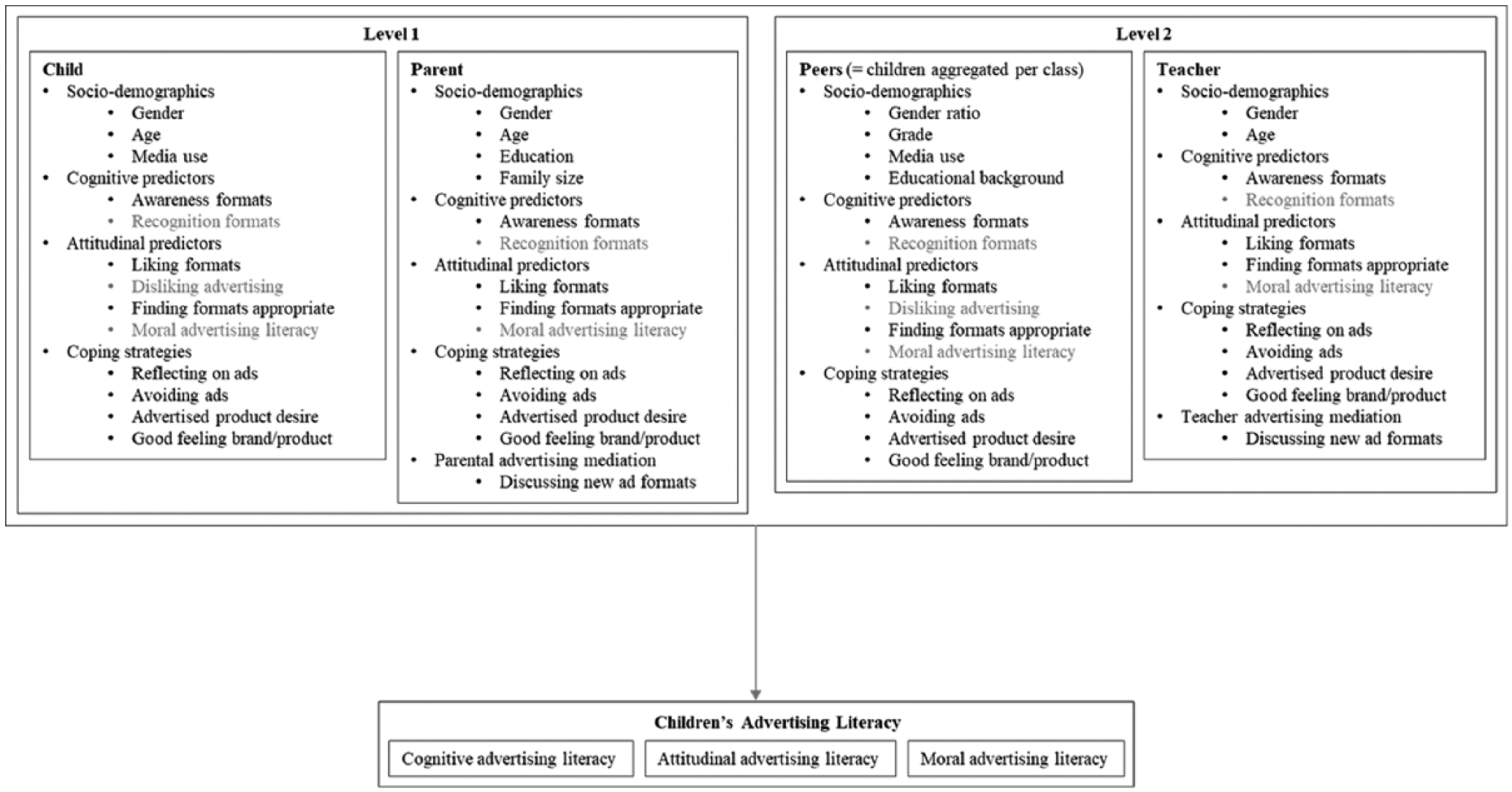
Conceptual model.
Method
Participants
Data were gathered in May 2016 from 12 primary schools in a West-European country as part of a larger program studying children’s risks related to contemporary ad formats. Participation was obtained from 392 children from 11 fourth-grade and 11 sixth-grade classes (43% girls; Mage = 10.26, SD = 1.14), their parents (n = 191 1 ; 78% female; Mage = 40.71, SD = 4.94), and their teachers (n = 22; 91% female; Mage = 39.68, SD = 9.29).
Procedure
Prior to the study, participating schools were given detailed information about the study’s procedures. Ethical approval was obtained from the researchers’ university faculty board, and written, informed consent was obtained from all participating children’s parents or legal guardians. In class, the children were given the option not to participate in the study.
Upon arrival in class, each child received a questionnaire on a tablet device, in which response options were labeled both verbally and nonverbally using visual representations such as emoticons (cf. Mallinckrodt & Mizerski, 2007). The researchers read each question aloud and clarified any question when asked. At the end of the survey, the children received more detailed information about the study, and a small gift to thank them for their participation.
Further, teachers were asked to fill out a similar survey on paper, with comparable questionnaires handed out to the children to take home and have one of their parents fill out. A researcher returned to the schools 2 to 4 weeks later to collect the completed questionnaires.
Variables and Measures
Children’s questionnaire
Several of the measures below are indexes (see Online Appendix A1) composed of items repeated for five contemporary ad formats often aimed at minors, namely TV ads, product placement, advergames, online banners, and pre-roll advertising—each of which was preceded by a brief description within the survey (see Online Appendix A2).
Dependent variables
As currently few adequate instruments exist to measure dispositional advertising literacy (Zarouali et al., in press), the following variables are adapted from existing ways to assess situational ad literacy.
Cognitive ad literacy was operationalized as the self-perceived ability to recognize contemporary ad formats (see Hudders et al., 2017) by asking the children, “How easy do you find it to recognize [format x]?” (1 = very hard; 5 = very easy) (index; M = 3.77, SD = 0.65).
Attitudinal ad literacy was operationalized as disliking advertising in general (cf. Rozendaal, Opree, & Buijzen, 2016) by asking, “How much do you . . .”: “. . . like advertising?” and “. . . find advertising annoying?” (1 = not at all; 5 = very much) (α = 0.71; M = 3.13, SD = 1.09).
Moral ad literacy was operationalized as the frequency of reflection on whether advertising in general is appropriate (see Friestad & Wright, 1994) by asking, “How often do you think about whether advertising . . .”: “. . . is honest?” “. . . is misleading?” and “. . . shows things like they really are?” (1 = never; 5 = very often) (α = 0.73; M = 2.85, SD = 0.96).
Socio-demographics
Children’s background variables include gender (ref. cat.: girl), age (metric, in years), and media use. The latter was measured by asking how many hours a day they watch TV and surf the Internet (in their free time, both during the week and on weekends).
Cognitive predictor
Children’s awareness of advertising formats’ existence 2 (cf. Freeman & Shapiro, 2014) was measured by asking them, “Did you already know that [format x] existed (before we told you this)?” (1 = not at all; 5 = certainly) (index; M = 3.90, SD = 0.70).
Attitudinal predictors
Liking advertising formats 3 was measured by asking participants, “What do you think of [format x]?” The response options were presented using 5-point semantic differentials: “I find [format x] . . .”: “. . . not nice—nice,” “not interesting—interesting,” and “not annoying—annoying” (reverse-scored) (index; M = 2.75, SD = 0.68).
Evaluating ad formats in terms of appropriateness 4 (cf. Wei et al., 2008) was measured using the same question, but with the response options “dishonest—honest” and “wrong—good” (index; M = 3.23, SD = 0.72).
Coping strategies
These were assessed with four separate items (cf. Fransen, Verlegh, Kirmani, & Smit, 2015) by asking, “When you see advertising, how often . . .”: (1) “. . . do you think about that advertising?” (reflecting on ads; M = 2.64,SD = 1.12); (2) “. . . do you try to avoid that advertising?” (avoiding ads; M = 3.39, SD = 1.27); (3) “. . . do you want to have the advertised product?” (advertised product desire; M = 2.49, SD = 1.00); (4) “. . . do you get a good feeling about the advertised brand or product?” (M = 2.44, SD = 1.05) (1 = never; 5 = very often).
Peer influence
This was assessed by aggregating the above individual-level variables to mean scores per class. Also considered was school grade (0 = fourth grade, 1 = sixth grade), and class educational background or the percentage of children with parents who have a master’s degree or higher (0 = below median, 1 = above median), indicating class SES (Sirin, 2005).
Parents and teachers’ questionnaire
This questionnaire resembled the children’s survey, except for the following additional measures:
Socio-demographics
Parents’ educational attainment was assessed by asking them to select their highest degree: none (0.5%), primary education (1.0%), lower secondary education (1.0%), secondary education (33.5%), higher or university education—bachelor’s (41.4%) or master’s/PhD (19.9%). A variable was created separating parents with a master’s degree or higher (scored 1) from the others (scored 0) because this dichotomization proved to be most statistically discriminant in terms of the outcomes. Family size (indicating parental involvement) was measured by asking them how many children they have (M = 2.31, SD = 0.88).
Advertising mediation
The extent to which parents (teachers) engage in discussing contemporary advertising formats with their children (students) was measured by: “How often do you talk with your child (student) about the fact that . . .”: “. . . the news messages or blogs they read are sometimes advertising (native advertising)?” “. . . sometimes brands or products are hidden in TV programs, series, and movies they watch (e.g., product placement)?” “. . . sometimes advertising is present on the websites they surf (e.g., banners)?” “. . . the online games they play are sometimes advertising (e.g., advergames)?” “. . . the advertising they get to see prior to movies on the Internet is sometimes based on their personal online behavior (e.g., YouTube ads)?” (1 = never; 5 = very often; index; parents: M = 2.42, SD = 0.83; teachers: M = 2.80, SD = 0.57; based on Vanwesenbeeck, Walrave, & Ponnet, 2015).
Statistical Analysis
To analyze the above predictors’ effects on advertising literacy, multilevel techniques were used (see Online Appendix A3). Therefore children’s data were linked with parents’ data (on L1 [Level 1], the individual level 5 ) and peers’ and teacher’s data (on L2 [level 2], the group/class level). Next, this integrated data set was explored in three consecutive steps (cf. Gonzalez-Valenzuela, Diaz-Giraldez, & Lopez-Montiel, 2016; see Online Appendix A4), starting with correlation analyses, and ending with the most suitable (i.e., trimmed) multilevel model(s) for each dependent variable, as reported below.
SPSS Statistics 24 was used for the bivariate correlational analyses; MLwiN 2.33 for the multilevel analyses (running random intercept models, with all metric variables grand-mean-centered); and PROCESS 2.15 macro for SPSS (Hayes, 2013) to further explore mediation and interaction effects (i.e., the independent variable’s effects at multiple values of the moderator).
Results
Cognitive Advertising Literacy
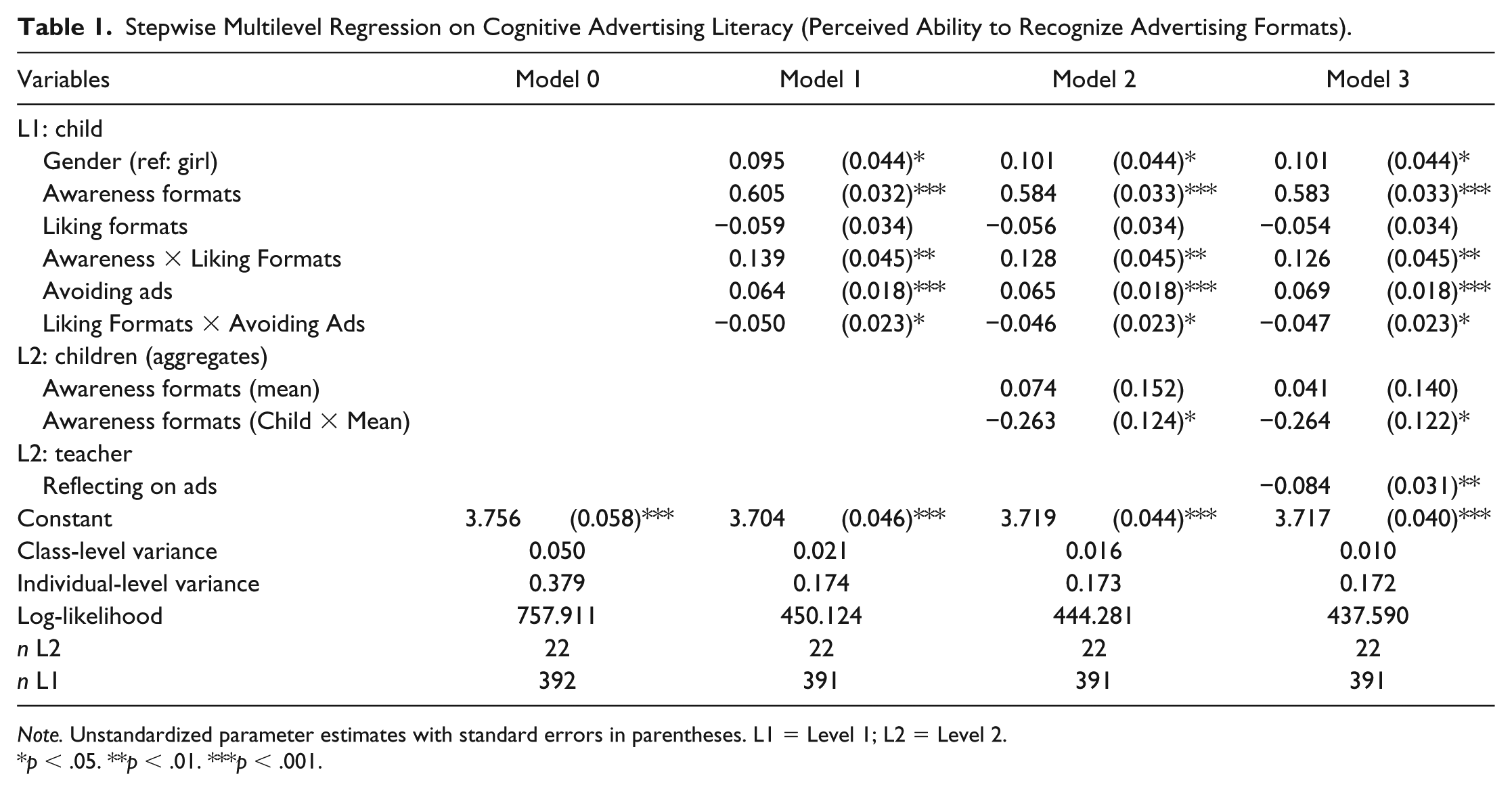
Model 0 demonstrates that 11.9% (
Stepwise Multilevel Regression on Cognitive Advertising Literacy (Perceived Ability to Recognize Advertising Formats).
Note. Unstandardized parameter estimates with standard errors in parentheses. L1 = Level 1; L2 = Level 2.
p < .05. **p < .01. ***p < .001.
In Model 1, the L1 child variables are added, showing that children have more cognitive ad literacy when they are boys, as they are better aware of ad formats’ existence, and more prone to resist ads by avoiding them. Furthermore, interaction effects show that the positive effect of ad-format awareness increases as children like the formats more; and that the liking of formats decreases cognitive ad literacy but only among children who most strongly try to avoid ads.
Model 2 entails the peer variables, and the interaction effect indicates that the individual effect of children’s ad-format awareness on cognitive ad literacy becomes smaller as the awareness in class increases. Moreover, additional mediation analyses show an indirect positive effect from class awareness on cognitive ad literacy through child awareness (see Online Appendix C1). This means H2a is partially supported for the current outcome.
Model 3 finds that teachers’ tendency to reflect on the ads they encounter is negatively related to children’s cognitive ad literacy—thereby rejecting H3b, or at least its direction. Moreover, this final model (relative to the null model) explains 80.0% of the of its L2 variance (between classes; from
Attitudinal Advertising Literacy
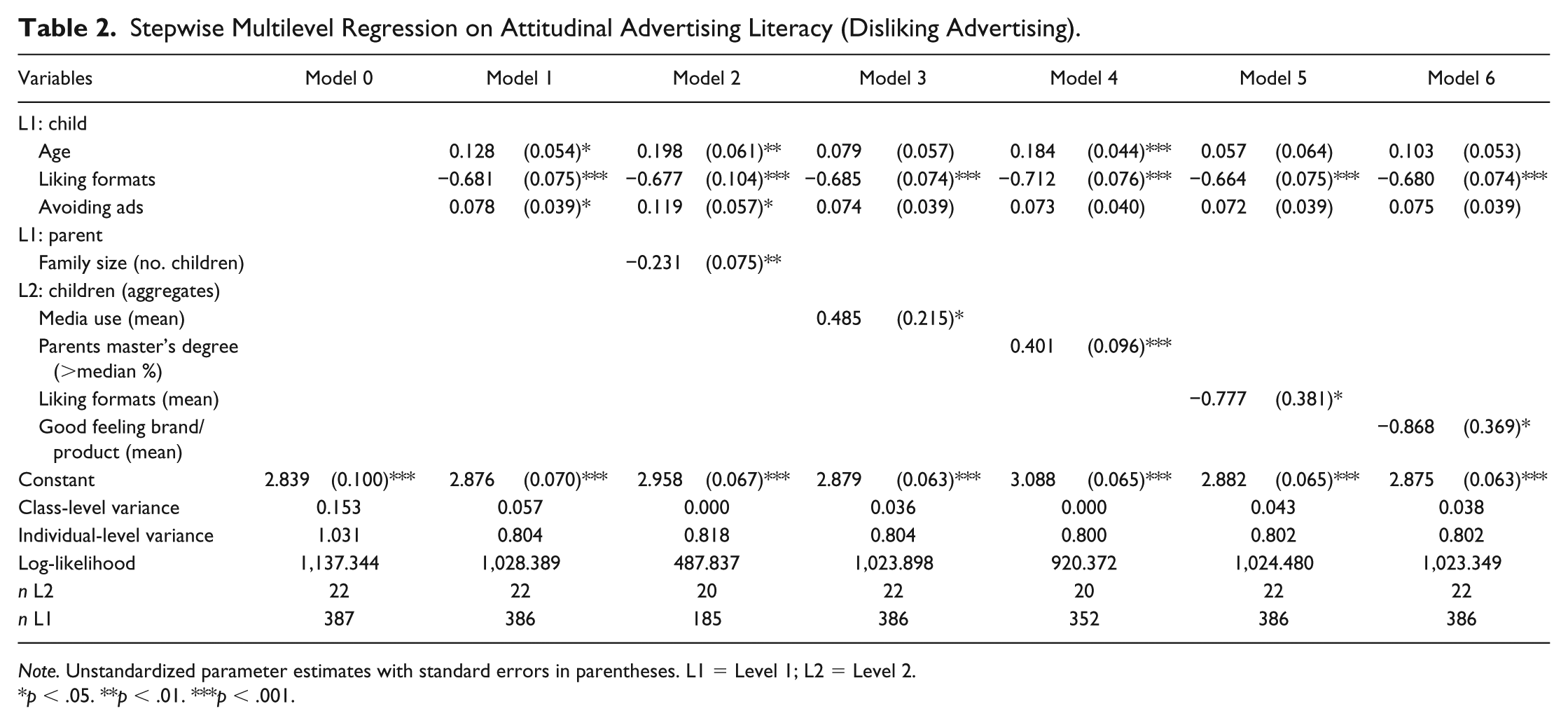
Model 0 shows that 12.9% (
Stepwise Multilevel Regression on Attitudinal Advertising Literacy (Disliking Advertising).
Note. Unstandardized parameter estimates with standard errors in parentheses. L1 = Level 1; L2 = Level 2.
p < .05. **p < .01. ***p < .001.
Model 1 adds the child variables, and shows that children have more attitudinal advertising literacy when they are older, like contemporary formats less, and are more prone to avoiding ads. Model 2 (parent survey) demonstrates that children from larger families score lower in terms of attitudinal ad literacy—confirming H1d for current outcome.
The following models add the peer variables separately, as the many contextual effects found in the preparatory analyses (Online Appendix C2) cannot be inserted simultaneously into one model. Children’s attitudinal ad literacy is positively associated with media-use frequency in the class (Model 3) and the proportion of children from highly educated families in the class (above median—Model 4), and negatively linked to the class’ liking of the formats—over and above the child’s own liking (Model 5) and susceptibility to advertising (i.e., tendency to feel good with advertised brands/products—Model 6). These results support H2.
In their entirety, and when considering effect sizes, corresponding significance levels and log-likelihood decreases, the final models show that children’s attitudinal ad literacy is best predicted by their liking of the contemporary ad formats (individual child), the educational background in class (peers), and family size (parents).
Moral Advertising Literacy
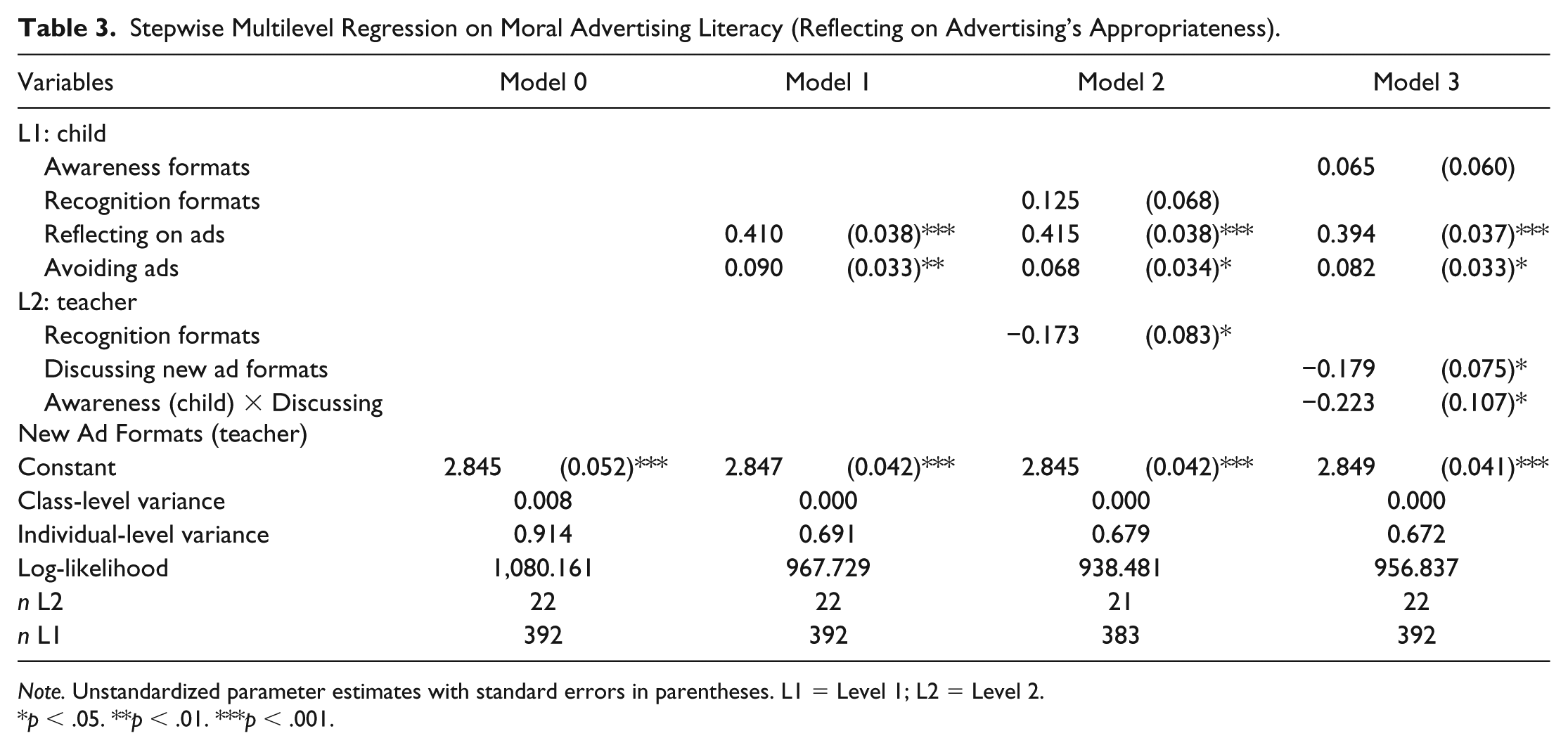
Model 0 reveals that only 0.9% (
Stepwise Multilevel Regression on Moral Advertising Literacy (Reflecting on Advertising’s Appropriateness).
Note. Unstandardized parameter estimates with standard errors in parentheses. L1 = Level 1; L2 = Level 2.
p < .05. **p < .01. ***p < .001.
In Model 1, containing the child variables, it is shown that children have greater moral ad literacy especially when they reflect more frequently on the ads they encounter, but also when they are more prone to avoiding ads—though the latter effect is less prominent.
The subsequent models add the many contextual influences from children’s teachers as found in the preparatory analyses (Online Appendix C3) one by one. Children’s moral ad literacy is higher when their teachers have less cognitive ad literacy (i.e., are less skilled in recognizing contemporary ad formats—Model 2) and when they less frequently discuss contemporary ad formats with their students (Model 3). This implies rejecting the H3 hypotheses for the current outcome, as these point in the opposite direction. The interaction effect also indicates that it is only when teachers talk little about these ad formats in class, that children’s format awareness stimulates their moral ad literacy. Moreover, this model (relative to the null model) explains all of the little L2 variance there was between classes (from
Conclusion and Discussion
This study investigated the extent to which children’s advertising literacy for contemporary advertising can be explained through environmental characteristics, while reckoning with the children’s own features. Multilevel techniques were used to explore both individual and group predictors of ad literacy (and its three dimensions) simultaneously, analyzing data obtained from the children themselves, their parents, classmates, and teachers.
Overall, a relatively high proportion of the variation in cognitive (12%) and attitudinal ad literacy (13%) can be explained at the group level. In other words, great similarities in these outcomes were found among children from the same class. Although this was not the case for moral ad literacy (1%), substantial teacher influences were revealed (see below).
Regarding cognitive ad literacy, peers’ mediating and moderating role was highlighted by finding that the ad-format awareness in class strengthens the child’s own awareness. A child who is more aware of the existence of contemporary formats has a higher level of cognitive ad literacy; however, this positive effect declines (or is supplemented by) the awareness present in the class. Interestingly, yet purely on the individual level, it was also shown that the effect of the child’s awareness on cognitive ad literacy increases as he or she likes the formats more fervently.
Likewise, for attitudinal ad literacy, it was peers who had the strongest group-level influence. In particular, children are more skeptical toward advertising when their classmates use more media, like the contemporary ad formats less, and are less likely to have positive emotions when confronted with advertised brands or products—in other words: when their class is characterized by stronger consumer socialization (due to media experience; see John, 1999) and a counter-advertising culture. Attitudinal ad literacy levels are also higher for children with a lower number of siblings (indicating higher parental involvement) and, most significantly, for children from higher SES classes (as indicated by parental educational attainment).
In general, however, children’s cognitive and attitudinal ad literacy seems hardly affected by parental and teacher ad literacy and mediational efforts. This is different with moral ad literacy, in which the teacher exerts the most determinative contextual influences, with the direction of these effects being quite remarkable. More specifically, children were found to reflect more often on advertising’s appropriateness when their teacher possesses less cognitive ad literacy and engages less in active advertising mediation. Moreover, it is only in the latter condition—when the teacher barely talks with students about contemporary ad formats—that children’s awareness of these formats has a positive effect on their moral ad literacy.
These results may carry several important implications, especially for scholars concerned with theory, methods and conceptualization, but also for practice (e.g., policy bodies and educators interested in developing interventions to stimulate children’s advertising literacy).
Implications
Having established that children’s ad literacy is substantially influenced by socio-contextual factors, it is strongly recommended to acknowledge that children are not independent subjects, but meaningfully nested within classes. Even if the researcher is not interested in the nature of class effects per se, statistical analyses should at least control for the grouped structure of the data (e.g., by adding a dummy variable for each class in a single-level regression analysis). In this way, scholars can guarantee more correct estimates and robust findings, and determine more clearly what are the actual effects of individual, psychological variables.
However, the current study shows that it is worth to focus on the nature of contextual influences, as it has revealed a veritable culture regarding advertising, and ad literacy in particular. More specifically, following the definition of culture, classes are characterized by a common, shared set of meanings, understandings, cognitions, beliefs, and so on (e.g., Van Houtte, 2005) with respect to advertising, that influence the individual members. In fact, ad literacy is affected by various cultures or at least meaningful social units, as constituted by children’s own background, peers, and teachers.
First, it was found that although children’s cognitive ad literacy is primarily determined by their own awareness of contemporary ad formats, this individual effect can be strengthened and even supplemented by the awareness present in class—which attributes an empowering quality to their peer group. As this finding corresponds with educational research showing that children’s formally induced literacy knowledge is practiced and fine-tuned through peer group interaction (Corsaro & Nelson, 2003), future research testing class interventions could take advantage of such macro-processes to stimulate ad-format awareness more effectively.
Furthermore, this finding focuses the attention on the much-underestimated role of awareness, especially in studies investigating children’s ad literacy for the newer, embedded formats. For instance, it is possible that children consciously notice the brands and products placed in an advergame, while not perceiving or labeling this practice as “advertising” (cf. TV commercials). Therefore, it should at least be assessed what children know about the studied ad format; and, when testing sponsorship-disclosure effectiveness, to minimally provide a concise explanation of the format about which the cue is supposed to warn.
Second, the presence and influence of a culture regarding attitudinal ad literacy is the most pronounced, with children being more ad-skeptical when their classmates are less compliant toward advertising. It could be further investigated whether this counter-ad culture is stemming from children’s (consumer) socialization at home, as their attitudes toward advertising are also influenced by family size (indicating parental literacy involvement) and parental educational background (reflecting SES). Specifically, dedicated future studies could measure parental literacy involvement more directly, and SES more comprehensively (see Sirin, 2005). This should allow for testing Bourdieusian theories, for instance by investigating whether possible inequalities in children’s ad literacy are caused by social-class differences in parental ad literacy involvement (cf. Hemmerechts et al., 2017); or whether teacher effects on children’s ad literacy depend on class SES. Subsequently, such research could inform various ad-literacy interventions (e.g., educational sessions and awareness campaigns for parents) about how to reckon with socioeconomic differences between families, classes, and students.
It might be questioned, however, whether these attitudes toward advertising constitute a genuine, unambiguous dimension of ad “literacy”—that is, “attitudinal advertising literacy” (Rozendaal et al., 2011). On one hand, negative attitudes—whether toward advertising in general or specific ad formats, or indicated by resistance strategies—do seem to reflect some form of ad skepticism or vigilance. For instance, it was shown that the child’s general tendency to avoid ads is positively associated with all three dimensions of ad literacy—however, these effects were rather small. On the other hand, a number of interaction and mediation effects suggest that a positive disposition toward advertising can also facilitate elaborate, critical reflection. It was found, for instance, that as the child likes the ad formats more, the effect of ad-format awareness on cognitive ad literacy increases; and that moral ad literacy increases, as liking the formats leads the child to reflect more on ads. In other words, a certain “openness” toward advertising may actually stimulate children’s development of ad literacy, possibly by allowing for opportunities to learn from experience with consciously processing various enactments of ad tactics.
Although these results may appear somewhat paradoxical at first glance, they are compatible with the “double-edged desirability hypothesis” (e.g., Austin, Pinkleton, & Funabiki, 2007). Studies supporting this hypothesis show that people motivated to process a media message analytically may actually come to perceive this message as more desirable, as a result of having more attention for its likable aspects. In the meantime, they will also process these aspects more critically due to a heightened awareness of persuasive intent, which may imply a decreased influence of desirability perceptions on decision-making. Put differently, positive affect toward advertising may not only increase susceptibility to persuasion but also reflect critical thinking. Conversely, it should also be noted that critical thinking does not necessarily excludes persuasion, as people can allow themselves to be persuaded as a result of well-informed evaluation and decision-making. Studies show, for instance, that interventions meant to instill resistance toward deceptive, persuasive messages do lower susceptibility to manipulative ads, but also increase persuasion for ads using legitimate appeals (e.g., Sagarin, Cialdini, Rice, & Serna, 2002). As studies show that ad skepticism involves both logic-based and affective components of critical reflection (e.g., Austin, Muldrow, & Austin, 2016), scholars might reconsider their view of ad literacy as an “affective defense” that indiscriminately generates negative responses to ads.
To conclude for both cognitive and attitudinal ad literacy, this study indicates that peers are most influential in transferring advertising-related cognitions and attitudes. However, dedicated studies are needed to unravel underlying processes, for instance by examining network dynamics within classes. As some peers may exert more influence than others, it could be interesting to reveal responsible characteristics, and to examine whether these influences are caused by specific norms (e.g., descriptive, or rather injunctive norms). Such studies could inform class-based training sessions, especially those led by peers (e.g., Pinkleton, Austin, Cohen, Chen, & Fitzgerald, 2008) or by teachers who make use of interactions among students.
Third, although there seems to be no class culture regarding moral ad literacy—affirming that moral development varies greatly depending on the individual child (see McAlister & Cornwell, 2009)—it appears there is one among teachers. The higher they estimate their skills to recognize contemporary ad formats, and the more they discuss them in class, the less their pupils reflect on advertising’s appropriateness. This could indicate that teachers who are more ad-literate and more involved in children’s coping with advertising are also more protective toward their pupils by portraying advertising in a negative light, thereby encouraging ad resistance, rather than moral reflection. Additionally, it could mean that teachers may not be that knowledgeable about newer ad formats after all. This would correspond with recent (qualitative) studies suggesting that parents’—and, therefore, possibly also teachers’—mediating role may have declined in the current context, as most of them would still primarily focus on traditional ads. More specifically, they would try to lower their children’s susceptibility mainly for TV commercials for unhealthy food, being less aware of the prevalence of similar advertising in online media (Newman & Oates, 2014). The latter is confirmed by recent findings that parents’ own ad literacy for such formats is rather low (Cornish, 2014; Evans & Hoy, 2016). Moreover, this is further corroborated by the current study’s finding that children’s cognitive and attitudinal ad literacy is hardly influenced by parents and teachers’ ad literacy and mediational efforts.
Regarding parents specifically, their background characteristics have much clearer effects, yet the explanation seems all the more subtle. Probably useful here is Bourdieu’s (1984) concept of “habitus,” which is a system of ingrained dispositions, tendencies, or schemes organizing how individuals perceive and approach the external world. It is shared and generationally transferred by people of comparable backgrounds (e.g., in terms of education) and reflects their specific reality as conceived by particular socialization processes, experiences, and opportunities. Just as this concept—or more broadly, cultural capital—is often used to explain cultural patterns in media consumption, and recently also in media literacy (e.g., Buckingham, 2005), future research could do the same for ad literacy, for instance by applying this concept to the transfer of parents and teachers’ attitudes and knowledge onto their children and pupils.
The general lack of (desired) parental and teacher effects found in this study does not imply, however, that mediational and educational actions to stimulate ad literacy are pointless. Rather, it suggests that such interventions need to be designed and continually adapted with the most current insights regarding ad literacy in mind. To start with, it could be derived from the present study that it is essential to increase awareness of contemporary ad formats not only among children but also among their parents and teachers.
Limitations
Prior to conducting this study, several decisions were made, which have their merits, but also imply a number of shortcomings. One choice was to depart from the literature on children’s ad literacy, in which a lack of attention to environmental influences was identified. While this narrow focus may simplify ad scholars’ research agenda, it could also cause them to overlook the overarching field of media literacy. As this field has a long tradition of researching the influences of parents, peers, and class interventions (e.g., Jeong, Cho, & Hwang, 2012; Scull, Kupersmidt, & Erausquin, 2014) on children’s media processing, its many relevant insights should be acknowledged by future ad-literacy studies focusing on a particular source of external influence.
A second decision was to investigate children’s dispositional (or possession of) and not situational (or use of) ad literacy. However, this choice may entail at least three limitations. First, it implies exclusion of some dominant concepts, such as “advertising literacy performance” (Rozendaal et al., 2011)—which is by definition a situational construct, as it pertains to the actual retrieval and application of ad-related knowledge, and should be measured during or after showing specific ads. Second, the current study’s dispositional constructs needed to be assessed using self-perceived measures. This may have been especially problematic with regard to cognitive ad literacy as it was measured by asking children how good they think their ad-recognition skills are, and thus potentially reflected children’s self-esteem and social desirability. Likewise for the related cognitive predictor “ad-format awareness,” of which the items had to be preceded by an explanation of the formats. Therefore, it is important for follow-up studies to also examine situational constructs, which can be assessed more directly. Third, this study’s constructs were directly measured among the actors involved, while research has revealed substantial discord between children and parent reports within the same family (e.g., Fujioka & Austin, 2003, on parental mediation and family communication styles). As this might have led falsely to the conclusion that parental characteristics are of little importance to children’s ad literacy, future work in this area might consider relying on children’s reports about their parents.
A third choice was to use multilevel techniques, primarily to identify group-level effects, while controlling for individual-level variables that are known to be related to ad literacy. However, as these variables also reoccur at the group level, preference was given to those constructs that can be meaningfully aggregated to contextual variables (e.g., individual attitudes to a counter-advertising class culture). Due to the latter requirement, important yet highly individual core developmental predictors of ad literacy, such as Theory of Mind and emotion regulation (e.g., Lapierre, 2015, 2016), were not included in the conceptual model. Conversely, however, future research could certainly include these predictors to reveal their purely individual effects more clearly by controlling for known contextual influences.
Another possible bias concerns the study sample, which might not be representative of the country population of schools. Nevertheless, this is the case for most advertising-literacy research, and it indicates that clear group influences can be detected even in moderately sized samples that are not primarily designed to identify such effects. Future studies that are fully dedicated to unraveling macro-processes concerning ad literacy, however, can be recommended to randomly select schools in multiple stages to ensure the necessary variability in school features that are known to be associated with students’ literacy outcomes. A related issue is the selection of external (f)actors with possible influence on children’s ad literacy. The current article has demonstrated that a substantial portion of the differences between children can only be explained by group-level processes; however, the selected actors (i.e., parents, peers, and teachers) and their characteristics could certainly not fully account for this variation. Therefore, future research could investigate the influence of other candidates, for instance school features (e.g., media infrastructure), using three-level hierarchical regression analyses.
Despite these limitations, this study contributed to extant advertising-literacy research by expanding the classic, primarily individual approach to include relevant social factors. In this way, researchers should be encouraged to enrich the many valuable psychological insights on ad literacy with the social forces that are innate to advertising and obviously cannot be ignored. At the very least, the much-underestimated importance of peers in young children’s lives should be reaffirmed. Furthermore, now that it has been established that children’s dispositional ad literacy is subject to such contextual influences, it seems worthwhile for further research to focus on situational measures—which are perhaps also more directly influenced by core developmental variables. This should allow for investigating whether children actually use the advertising literacy they possess when considering their environment.
Supplemental Material
Online_Appendix_R3 – Supplemental material for Taking Children’s Advertising Literacy to a Higher Level: A Multilevel Analysis Exploring the Influence of Parents, Peers, and Teachers
Supplemental material, Online_Appendix_R3 for Taking Children’s Advertising Literacy to a Higher Level: A Multilevel Analysis Exploring the Influence of Parents, Peers, and Teachers by Pieter De Pauw, Verolien Cauberghe and Liselot Hudders in Communication Research
Footnotes
Acknowledgements
The authors thank Steffi De Jans and Ralf De Wolf for helping with data collection and VLAIO and FWO for funding their research.
Declaration of Conflicting Interests
The authors declared no potential conflicts of interest with respect to the research, authorship, and/or publication of this article.
Funding
The authors disclosed receipt of the following financial support for the research, authorship, and/or publication of this article: This work was supported by VLAIO and FWO under grant numbers 130008 and FWO.3E0.2015.0035.01 respectively.
Notes

Supplemental Material
Supplemental material for this article is available online.
Author Biographies
References
Supplementary Material
Please find the following supplemental material available below.
For Open Access articles published under a Creative Commons License, all supplemental material carries the same license as the article it is associated with.
For non-Open Access articles published, all supplemental material carries a non-exclusive license, and permission requests for re-use of supplemental material or any part of supplemental material shall be sent directly to the copyright owner as specified in the copyright notice associated with the article.
