







Abstract
While numerous studies have demonstrated the difficulty minority opinion holders face when trying to persuade a majority, the present research investigated the conditions under which minority members might second-guess themselves and become advocates for the majority’s position even when they have the best information. In a laboratory experiment, we examined whether the structure of monetary incentives (fixed amount vs. performance-based) and group decision-making procedure (collective decisions vs. group discussion then individual decisions) might mitigate second-guessing by minority members when they initially favor the objectively best choice. Our results indicated that compared with fixed-amount incentives, performance-based incentives increased overall information sharing in collective decision-making groups but not in individual decision-making groups. Second-guessing by minority members was most likely to occur in groups that received performance-based incentives and made decisions individually. As a result of second-guessing, these groups also made poorer decisions.
Inspired by the seminal work of Asch (1952), countless studies have demonstrated the power of majority influence across a wide variety of contexts. Many of these studies use a hidden profile paradigm. Pioneered by Stasser and Titus (1985, 1987), a hidden profile is constructed in a situation in which pieces of information for solving a problem are distributed among individuals in a group. Some information is commonly shared, and some information is uniquely held by individual members. A profile is said to be hidden when the distribution of information is such that the information held by each individual favors a suboptimal decision alternative, but when members’ unique information is combined the optimal choice is revealed.
We situate our study in the hidden profile tradition. In a slightly modified setting, the majority initially favors a suboptimal solution, and the minority with superior (full) information favors the optimal one. That is, the profile is not hidden to one of the group members. For the group to reach the optimal decision, the unique information held only by the minority member has to be integrated with the common information held by everyone. This process is challenging partly because no one is aware of the superiority of minority member’s information. For the group to reach the optimal decision, exchanging and integrating the minority’s information is key. Equally important is for minority members to recognize the superiority of their own information in the process, which could bolster confidence in the validity of their position.
Prior research has demonstrated that except for highly demonstrable tasks (e.g., mathematical problems; see Laughlin & Ellis, 1986), it is difficult for minority opinion holders to persuade a majority (Hollingshead, 1996; Tanford & Penrod, 1984; Van Swol & Seinfeld, 2006). Extending this line of research, the present study focuses on the possibility that minority members might second-guess themselves and become advocates for the majority’s position even when they have the best information.
We define second-guessing in this context as minority members who initially hold the optimal position and later switch to the majority’s suboptimal position. Second-guessing can be demonstrated through the change in minority members’ information sharing and advocacy over the course of group discussion. Such second-guessing is obviously detrimental, because the optimal choice is no longer in the decision set considered and discussed by the group. While communication research has examined argument consistency, a similar concept, studies have generally treated argument consistency as an independent variable using it to establish a communication-outcome link (Bazarova, Walther, & McLeod, 2012; Gebhardt & Meyers, 1995; Meyers, Brashers, & Hanner, 2000; Nemeth, 1982). In contrast, the present study investigates second-guessing as an outcome and the factors that influence it.
In situations in which numerical minorities are unlikely to prevail and tend to second-guess themselves, some might argue that providing performance-based incentives may help. After all, it is common in the workplace to incentivize workers and employees to work harder by providing bonuses in proportion to their measurable performance. We conducted a laboratory experiment to test the effect of performance-based incentives on group decision making and second-guessing. When such incentives are offered, a natural question is how they are offered to individuals. Whether they are offered at the group level (all members receive equal payment based on their collective decision) or at the individual level (members receive different amounts based on their individual decisions) can potentially influence how members perceive their relations and therefore moderate the effect of incentives. Therefore, the experiment follows a 2 × 2 factorial design by varying the Incentive given to participants for their participation (performance-based vs. fixed payment) and the decision-making Procedure (collective decisions vs. individual decisions after group discussion).
Theory and Hypothesis Development
Group Information Sharing
Performance-based incentives can trigger accuracy motivation—motivation to seek an accurate understanding of the issue at hand (Mayseless & Kruglanski, 1987; Scholten, van Knippenberg, Nijstad, & De Dreu, 2007). This can occur for at least two reasons. 1 First, compared with fixed payments, performance-based incentives increase task importance (or stakes, Mayseless & Kruglanski, 1987), because participants’ rewards depend directly on their task performance. And second, the fact that group decisions need to be evaluated externally to compute payments creates accountability (Scholten et al., 2007), that is, an expectation that one’s own actions will be evaluated by “an external audience with the ability to mete out consequences” (Kou & Stewart, 2018, p. 35). Such an expectation has been found to increase effort in information processing (Tetlock, 1983) and to raise the motivation to acquire and process information in general (Liu & McLeod, 2014).
While much prior work on group decision making has demonstrated positive effects of accuracy motivation on raising information sharing and processing, and ultimately group decision quality (see De Dreu, Nijstad, & van Knippenberg, 2008, for a review), almost all of the work has relied on groups making collective decisions such that members most likely perceive their task as purely cooperative. Little work has induced other types of motivations in groups such as individualistic or competitive motives (Wittenbaum, Hollingshead, & Botero, 2004). In particular, the motivated information processing in groups (MIP-G) model proposed by De Dreu et al. (2008) has suggested that the effects of accuracy motivation on group decision making can be quite different depending on participants’ social motivation, that is, whether group members are prosocial (care about joint outcomes) or proself (care about own interests only).
According to MIP-G, groups with prosocially motivated members tend to be cooperative, focusing on reaching an outcome that integrates each individual member’s inputs and interests. They tend to trust one another and see the decision-making task as a collaborative process. In contrast, individuals with proself motivations tend to ignore others’ ideas, distrust one another (De Dreu & Carnevale, 2003), and treat the decision-making task as a “competitive game in which power and personal success are key” (De Dreu et al., 2008, p. 32).
MIP-G suggests that the tendencies caused by different social motivations interact with accuracy motivation. Without accuracy motivation, prosocial or proself motivations by themselves do not increase information sharing or processing among group members. Rather, such groups tend to exhibit inaction and a lack of motivation for opinion change. With high-accuracy motivation, however, the cooperative (or noncooperative) tendencies associated with different social motivations are amplified, leading to different behaviors. Groups with prosocial members will exchange more task-relevant information and will actively integrate individual members’ inputs to reach a valid understanding of the issue and a good decision. In contrast, in groups with proself members, even though members are motivated to seek the correct decision alternative, due to a lack of cooperation, information exchange will be limited.
While social motivations are related to individuals’ inherent social value orientations (McClintock, 1977), they can also be induced by situational factors, such as group or individual-level performance incentives (Deutsch, 1949). According to interdependence theory (Kelley & Thibaut, 1978; Rusbult & Van Lange, 1996), people tend to internalize the externally given task and outcome structures and form their social relationships based on such structures. If a group is tasked with making a collective decision, task interdependence is created among the members because they depend on one another to complete the task (Kelley & Thibaut, 1978). If their payments also depend on their collective decision, outcome interdependence is created because each member’s payment depends on others’ decisions. Both task and outcome interdependence foster a norm of cooperation (Wageman, 1995; Yuan, Fulk, Monge, & Contractor, 2010), and raise group members’ expectations of help from one another (Thomas, 1957).
In contrast, in groups tasked to make separate individual decisions, members experience relatively low task interdependence even though one’s decision quality might be improved if others’ inputs are taken into consideration. To merely complete the task (i.e., report a private choice) one does not have to collaborate with others. Furthermore, there is no outcome interdependence in individual decision groups—one’s own payment is not affected by others’ choices. On balance, we should expect individual decision groups to experience proself (or less prosocial) motivations compared with collective decision groups. And as a result, performance-based incentives are not expected to increase information sharing in individual decision groups.
In sum, we expect decision procedure to interact with performance-based incentives, and we predict performance-based incentives (vs. fixed payments) to have a positive effect on information sharing in collective decision groups. This prediction is consistent with previous findings that high cooperative interdependence led to more information sharing only when accuracy motivation was high and not when it was low (De Dreu, 2007). We hypothesize the following:
We expect the same effects of performance-based incentives to apply to individual majority and minority members. If the entire group is cooperative and motivated to seek the truth, we expect members in both majority and minority positions to be motivated to share and repeat information. Therefore, we hypothesize,
Information seeking
In a group with a majority/minority divide in opinions, members tasked with choosing an optimal alternative (collectively or individually) face a situation that Dewey (1938) would call “indeterminate,” meaning that it is open to inquiry, and “it is open in the sense that its constituents do not hang together” (Dewey 1938, p. 105). Specifically in our case, because the task is an intellective one, there is only one correct answer (Laughlin, 1980). But the group members’ opinions are divided. Inherently, such a situation calls for an inquiry to convert “the elements of the original situation into a unified whole” (Dewey, 1938, p. 104), that is, a determinate state. And an inquiry begins with information seeking, that is, asking questions to elicit information.
We apply the same argument underlying the effects of incentives and decision-making procedure on information sharing to information seeking. Whether group members ask one another information-eliciting questions depends on their accuracy motivation and interdependence. Therefore, we hypothesize the following:
Majority Influence and Minority Second-Guessing
In groups with a majority/minority divide, minority members face strong majority influence. They are generally less confident in their opinions than majority members (Schulz-Hardt, Jochims, & Frey, 2002) and are more open to new information (Van Swol, 2007). They are also subject to strong normative pressure to conform, which makes dissenting uncomfortable (Schachter, 1951). In assessing majority influence, we focus on minority members’ private change of opinion. While public compliance can be either informational or normative, private compliance is likely a reflection of informational influence (Deutsch & Gerard, 1955).
In fixed-payment groups, because accuracy motivation is low, there should be little motivation for attitude change, whether by majority or minority members (De Dreu et al., 2008). In performance-based incentive groups, whether the minority members will be prone to the majority’s informational influence depends on whether the information shared by other members strengthens their belief in their initial correct position. At the outset, all group members are unaware that the minority member has superior information (including the minority member).
If information sharing by all members is sufficient, minority members with an accuracy motivation will discover that they have superior, unique information. If the majority members fully explain the rationale for their choice, the minority may discover that the majority’s arguments are based on facts that the minority member already knows, and that the majority actually has incomplete information. Confidence gained through such a realization can help minority members resist the majority’s influence. Furthermore, high levels of information exchange may implicitly establish a norm of making decisions based on information, rather than normative influence, which would again support the idea that more information sharing leads to less majority influence. 2 Therefore, we expect performance-based incentives to increase information sharing, seeking, and processing in collective decision groups, and these factors will limit the majority’s influence on the minority member.
In contrast, if information sharing among the group members is insufficient, without the opportunity to hear and fully consider all information held by other members, a minority member motivated to resolve their different opinions may wonder if the majority members have superior information, or have simply made a wiser choice based on the same information. Simple heuristics such as “the majority must be right” would be likely invoked. As predicted previously, we expect limited information sharing and information seeking in the Performance-Individual condition. Therefore, we expect the minority member in this condition to be more likely to resort to simple heuristics and switch to the majority’s position. Summarizing, we hypothesize the following:
We expect second-guessing to show the same pattern as majority influence. The more majority influence, the more minority members become likely to second-guess themselves. This can be driven by the desire to reduce one’s discomfort in holding a dissenting opinion (Schachter, 1951) or to gain credibility (Boster, Hunter, & Hale, 1991). As a result, switching to the majority’s position is often done publicly and directly (Martin, Hewstone, Martin, & Gardikiotis, 2008). Therefore, as in H4, we predict more second-guessing by minority members in individual decision groups with performance incentives.
Minority Influence
Minority influence works through a validation process whereby majority members engage in careful examination of the minority’s arguments, which potentially leads to private internalization of the minority position (Moscovici, 1985). That is, a minority member can exert influence primarily by providing information to majority members. In general, more sharing of information, especially unique information, should lead to higher minority influence. Because minority members do not have the advantage of greater numbers, to exert influence in group discussions, they must display consistency and confidence (Lemus, Seibold, Flanagin, & Metzger, 2004; Maass & Clark, 1984; Meyers et al., 2000; Nemeth & Wachtler, 1974). Consistency makes arguments difficult to dismiss without consideration (McPhee, Poole, & Seibold, 1982; Meyers et al., 2000). Second-guessing, then, a direct violation of (intrapersonal) consistency, is a negative indicator of minority influence.
These reasons suggest that performance-based incentives should increase minority influence in collective decision groups, because increased information sharing reduces the likelihood of minority second-guessing. In contrast, we do not expect this effect in individual decision groups which are expected to have low levels of information sharing and high likelihoods of minority second-guessing.
In addition, due to task interdependence, members in collective decision groups are required to consider one another’s arguments to arrive at a consensus, thereby opening the doors for minority influence. In contrast, members in individual decision groups are not required to consider others’ viewpoints to make their private decisions, potentially blocking the pathway through which minority members exert influence on majority members. We hypothesize the following:
Decision Quality
Decision quality is measured by assessing the quality of the group’s aggregated decision. In the collective decision conditions, the group consensus can be directly used to measure group decision quality. In the individual decision conditions, because individuals report their decisions separately, group decisions are computed by taking the means of individual decisions.
In the present decision-making context, because the minority holds superior information, higher minority influence should lead to better decisions. In contrast, higher majority influence should lead to lower quality decisions. As predicted in H4 and H6, in collective decision groups, performance-based incentives increase minority influence but not majority influence. While in theory these conditions should lead to better group decisions, given that much prior research has robustly demonstrated that it is difficult for a single minority member to sway a unanimous majority (Hollingshead, 1996; Tanford & Penrod, 1984; Van Swol & Seinfeld, 2006) unless the correct answer is highly demonstrable, for example, mathematics problems (Laughlin & Ellis, 1986), we expect performance-based incentives to have a nonnegative effect on group decision quality in collective decision groups, rather than a strictly positive one. In contrast, in individual decision groups, performance-based incentives increase majority influence (H4) but not minority influence (H6). Therefore, we expect performance-based incentives to harm decision quality in individual decision groups. We hypothesize the following:
Method
Our experiment followed a 2 × 2 between-subjects factorial design (N = 50) varying Procedure (collective vs. individual decision) and Incentive (performance-based vs. fixed payment), resulting in four conditions: Fixed-Collective (n = 14), Fixed-Individual (n = 11), Performance-Collective (n = 11), and Performance-Individual (n = 14). Each group had four participants. Groups assigned to the collective decision condition were instructed to make a collective decision after a group discussion, whereas groups assigned to the individual decision condition were instructed to make individual decisions after a group discussion. Participants in the fixed-payment groups received either course credit or US$15 for their participation. 3 In the performance-based payment condition, collective decision groups were paid based on the quality of their collective decision, while members in individual decision groups were each paid based on the quality of their individual decisions.
Participants
In total, 316 students were recruited from a U.S. west coast university to participate in a group decision-making experiment. Participants were either enrolled in large undergraduate communication courses or recruited from a campus-wide paid student participant pool. Out of the 308 students whose postexperiment surveys were successfully collected, 4 174 were female and 134 were male. Their ages ranged from 18 to 38 with a mean of 21 and a median of 20. There were 9 African American, 144 Asian, 20 Hispanic, and 113 White participants. The remaining 22 did not disclose their ethnicity.
Task and Performance-Based Incentives
We used the “ACME Investments” task developed by McLeod, Baron, Marti, and Yoon (1997). In this task, the decision is to determine which of three companies, A, B, and C, is the best investment. Company A is the best when all task information is considered. The distribution of members’ private information is structured such that one member receives the full set of 95 pieces of information that clearly favors Company A (some information is uniquely known by this member), but the other three members receive partial information that favors Company B. This case contains 95 information items (34 for Company A, 38 for B, and 23 for C).
For the purpose of this study, it was essential that the case (1) had a demonstrably best answer; and (2) was solvable through communication, absent a majority/minority divide. For (1), this case was extensively tested by McLeod et al. (1997), who reported that, 19 (79%) among the 24 individuals who received full information chose the optimal alternative. Among the 42 who received the partial information, 39 (93%) chose the suboptimal. To ensure that (1) could apply to our participant pool, we ran a full-information control condition in which each member was given full information and was paid a flat fee of US$15. Two groups of four participants were recruited to test this control condition. Before discussion, all eight participants individually chose Company A as the optimal. After the discussion, one group assigned a 90% and the other a 70% probability to Company A. These results showed the case had a demonstrably correct answer.
For (2), we added another control condition: a two-person collective-decision fixed-payment condition. One person was given full information and the other a partial information profile (supporting Company B). 5 Ten sessions were conducted for this condition. In six of these sessions, the groups formed the expected prediscussion preferences (the full-information participant chose A and the other one chose B). 6 In these six groups, after discussion, five assigned the highest probability to Company A and the sixth one chose C. Across all six groups, A received an average probability of 45%, B 36%, and C 19%. These results showed that the case was indeed “solvable” via face-to-face communication, absent a minority/majority divide.
Most prior studies that used performance-based incentives to motivate decision quality used a lump sum reward for correct choices (e.g., Schreiber & Engelmann, 2010). Such a scheme can only elicit discrete rather than continuous beliefs. In this study, we used Proper scoring rules to elicit participants’ probabilistic beliefs (0%~100%). Proper scoring rules use nonlinear scoring functions that ensure decision makers’ gains are maximized if they stated their true opinion. Originating in decision theory, proper scoring rules have been widely applied in fields such as forecasting (Epstein, 1969) and economics (Palfrey & Wang, 2009). It has been consistently demonstrated that college students respond to these rules by revealing their beliefs truthfully (Palfrey & Wang, 2009). Details of these scoring rules are reported in the appendix.
Experimental Procedure
Each session lasted for approximately an hour. After consenting to audiotaping, participants spent 12 minutes reading the case files and reported their company choice (prediscussion preferences). They were explicitly told there was a best investment among the three companies when all information was considered, all information was accurate, and each participant might have different pieces of information. 7 There was no mention that any member’s information might be superior to all others’.
After the experimenter collected all case materials, participants were told that the next step was to discuss and reach a (collective or individual) decision. Before the discussion started, they were given detailed rules on how to report their decisions (i.e., allocating percentages among the three alternatives) and on payment calculation. For fixed-payment groups receiving cash, participants were told they would receive US$15 after they completed the experiment. For fixed-payment groups who received course credit, participants were recruited from classes that offered extra credit for participating in research studies. For performance-based payment groups, all participants were told they would receive a US$5 show-up fee plus a payment based on their decision scores as calculated by the proper scoring rule.
Next, a quiz about the payment rules was administered. All participants in the pilot fixed-payment conditions answered the quiz questions correctly. In the pilot performance-based payment sessions, 81.3% (13 out of 16) of the participants answered all questions correctly. The experimenter explained the correct answer to those who made mistakes individually.
After the quiz, each group spent up to 15 minutes discussing the case and reached a collective (or individual) decision by assigning a probability to each company for its likelihood to be the best investment. Finally, participants in collective decision conditions reported their individual postdiscussion preferences (in percentages, which did not affect their payment). Participants were told that they did not have to report the same probabilities as the group had reported. Participants in the individual decision condition did not report their individual postdiscussion preferences, because their decisions were made individually already.
After completing a postexperiment questionnaire, every participant, except those in the course-credit conditions, received their cash payment in private. The parameters of the proper scoring rule were calibrated such that the payment received by participants in performance-based payment groups would be comparable to the US$15 received by those in the fixed-payment groups. On average, the mean payment in performance-based incentive groups was US$17.59 (SD = 6.47).
Because data collection took place over several months, the correct answer to the case was not revealed to participants. However, participants in the performance-based incentive conditions could potentially reverse-engineer the optimal outcome based on their payments. To prevent this, we added a random component to participants’ payments in the performance-based incentive conditions. There was a 50% chance that their payment would be dependent on the proper scoring rule, and a 50% chance that their payment would be a random number generated between US$0 and US$24. Although the addition of this random payment may have affected participants’ motivation, it likely reduced the likelihood of participants leaking the right answer.
Measurement
In total, we collected data from 89 groups, out of which 50 groups had the expected prediscussion preferences (the participant with full information chose A and the remaining chose either B or C). In the remaining 39 groups, 22 had at least two members choosing A, and 17 had the full-information participant choosing B or C. Because the goal of our study was to examine cases in which minority members with superior information supported the optimal choice prediscussion, unless otherwise noted, we focused our analysis on the 50 groups with expected prediscussion preferences. Out of these, 40 groups had the prediscussion preference composition of one-A-three-B, and the remaining 10 groups had one-A-two-B-one-C.
To measure information sharing and repetition, three independent raters conducted content analyses of the group discussion transcripts for 36 randomly selected sessions. 8 After confirming intercoder reliability was satisfactory (Krippendorff’s α > .80), the remaining 36 sessions were coded by one of the raters. Two other independent coders coded for the information seeking and second-guessing variables.
Information Sharing was measured by five variables, including Discussion Length (measured in seconds) and four variables derived from the discussion transcripts: Total Information (number of information items first mentioned out of a total of 95, Krippendorff’s α = .90), Unique Information (number of unique information items first mentioned out of a total of 29, Krippendorff’s α = .83), Total Repetition (number of times information items were first mentioned or repeated, Krippendorff’s α = .89), Unique Repetition (number of times unique information items were first mentioned or repeated, Krippendorff’s α = .85).
Majority information repetition was measured by two variables, Majority Common Repetition (number of times any majority member first mentioned or repeated a piece of common information, Krippendorff’s α = .71) and Majority Unique Repetition (number of times any majority member repeated a piece of unique information, Krippendorff’s α = .67). Similarly, minority information repetition was measured by Minority Common Repetition (Krippendorff’s α = .89) and Minority Unique Repetition (Krippendorff’s α = .88).
Majority (Minority) Information Seeking was measured by the number of times any majority (minority) member asked a question seeking information from others. To isolate questions seeking specific information, two independent coders examined each question in the transcripts and assigned them into three categories (Krippendorff’s α = .82): preference-seeking (e.g., which company did you pick?), information-seeking (e.g., what was company A’s market share?), and other (e.g., what time is it?). Only the information-seeking questions were counted toward Majority (Minority) Information Seeking. To make the two measures comparable, Majority Information Seeking was divided by three (the number of majority members).
Minority members’ second-guessing behaviors can be reflected in the information items (common vs. unique) they chose to cite, as well as the position they held in their arguments. We call the former Information Second-Guessing and the latter Opinion Second-Guessing.
For a minority member to advocate for Company A, they need to mention and repeat more unique information compared with common information. Conversely, a second-guessing member would repeat more common information than unique information. Therefore Information Second-Guessing measured the fraction of common information items in all the (common and unique) information mentioned or repeated by the minority member.
To examine minority members’ opinion change, we followed prior research by Nemeth (1982) by dividing the discussion in half, because the information exchanged closer to the decision point might have a larger impact on the decision. Based on the two halves of the discussion (based on the number of words in the transcript 9 ), we obtained Information Second-Guessing Early (first half) and Information Second-Guessing Late (second half).
Similarly, Opinion Second-Guessing was measured by two variables (early and late). Opinion Second-Guessing Early (intercoder agreement: 100% 10 ) measured the number of words spoken by the minority member arguing against Company A during the first half of the discussion, and Opinion Second-Guessing Late (intercoder agreement: 100%) did the same for the second half of the discussion.
The coding for Opinion Second-Guessing was as follows. Each argument-relevant speaker turn was first coded as either for or against Company A. Then, to achieve a fine-grained measure, we counted the number of words in the speaker turn as for or against Company A. Opinion Second-Guessing was then computed by dividing the number of words uttered by the minority member against Company A by the total number of words in this participant’s argument-relevant speaker turns. Therefore, both variables ranged from 0 to 1.
Majority Influence measured the difference in minority members’ choice of best company before and after group discussion. Recall that in prediscussion preferences, a single choice of best investment was elicited, whereas in the postdiscussion preferences participants were asked to assign percentages among the three companies. To make these two measurements comparable, for postdiscussion preference we simply picked the company with the highest percentage as the choice of best. After this transformation, Majority Influence was then measured as a binary value indicating whether the minority member switched to either Company B or C post discussion. For Minority Influence, because there were three majority members, it was measured as the fraction of majority members who switched to A post discussion.
Finally, Decision Quality was measured by the probability the group assigned to Company A post discussion. The higher this probability, the better the decision. In collective-decision treatments, this probability was reported by the group. In individual-decision treatments, this probability was the mean probability assigned to Company A among the four team members.
Results
Descriptive Statistics
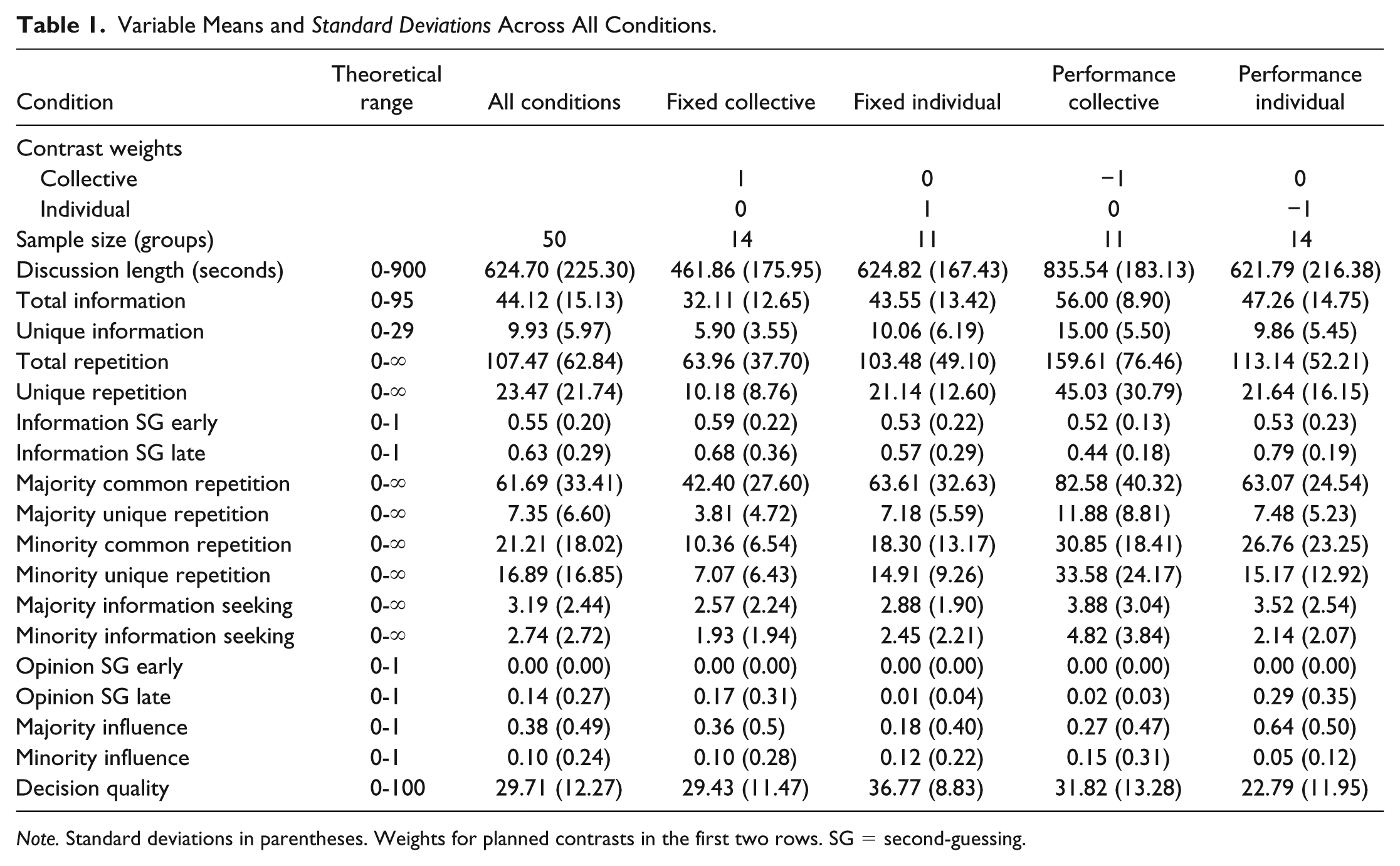
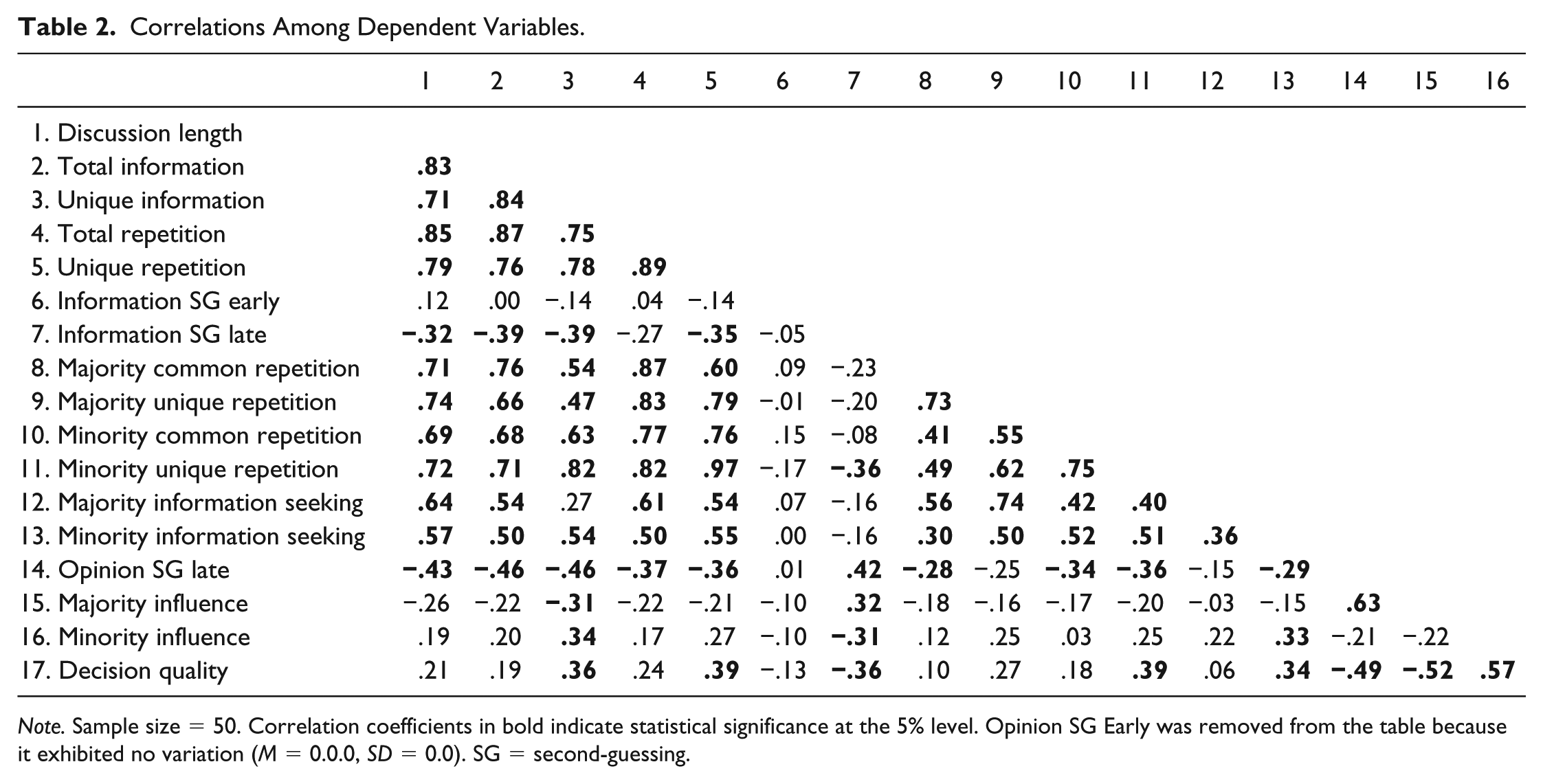
Because our hypotheses were focused on group-level effects, in our analyses, each group was treated as an independent data point. Table 1 summarizes the means and standard deviations across experimental conditions. Table 2 reports correlations among dependent variables.
Variable Means and Standard Deviations Across All Conditions.
Note. Standard deviations in parentheses. Weights for planned contrasts in the first two rows. SG = second-guessing.
Correlations Among Dependent Variables.
Note. Sample size = 50. Correlation coefficients in bold indicate statistical significance at the 5% level. Opinion SG Early was removed from the table because it exhibited no variation (M = 0.0.0, SD = 0.0). SG = second-guessing.
Across all conditions, the mean Decision Quality was 29.71 (SD = 12.27). Because Decision Quality was the percentage probability assigned to Company A (the optimal out of three alternatives), a mean lower than 33.3 (assigning equal probability to all three) suggested it was challenging for groups to arrive at the correct decision.
Hypothesis Tests
Information sharing
H1 proposed an interaction effect and predicted that Performance-Collective groups would share more information than Fixed-Collective groups. Testing this hypothesis required three tests: a multivariate analysis of variance (MANOVA) with all five information-sharing-related dependent variables, five univariate analyses of variance (ANOVAs), and finally for each of the five variables a set of planned contrasts to test hypotheses comparing pairs of treatment groups.
We expected both the MANOVA and ANOVA tests to yield an interaction effect between Incentive and Procedure. The planned contrast analyses were conducted with weight vectors (shown in Table 1) to simultaneously compare the two collective decision groups and the two individual decision groups.
Our results provided support for H1. A MANOVA analysis for all five Information Sharing variables by varying Incentive 11 and Procedure showed a statistically significant main effect of Incentive (F(1, 46) = 3.02, p = .020) and in support of H1, an interaction effect (F(1, 46) = 2.91, p = .024). ANOVA analyses identified the same main effects of Incentive for all five variables: Discussion Length (F1, 46) = 11.74, p = .001, η2 = .17), Total Information (F(1, 46) = 14.95, p < .001, η2 = .21), Unique Information (F(1, 46) = 8.96, p = .004, η2 = .14), Total Repetition (F(1, 46) = 11.54, p = .001, η2 = .18), and Unique Repetition (F(1,46) = 10.71, p = .002, η2 = .17).
In support of H1, univariate ANOVA yielded interaction effects for all five variables: Discussion Length (F(1, 46) = 12.36, p < .001, η2 = .18), Total Information (F(1, 46) = 7.69, p = .008, η2 = .11), Unique Information (F(1, 46) = 9.92, p = .003, η2 = .15), Total Repetition (F(1, 46) = 8.05, p = .007, η2 = .12), and Unique Repetition (F(1, 46) = 10.74, p = .002, η2 = .16).
Finally, planned contrasts showed that performance-based payments significantly increased—sometimes doubled or tripled—information sharing in collective decision groups, but not in individual decision-making groups. Compared with Fixed-Collective groups, Performance-Collective groups had much longer Discussion Length (835.54 vs. 461.86, t(46) = −4.93, p < .001, η2 = .34), more Total Information (56.00 vs. 32.11, t(46) = −4.64, p < .001, η2 = .32), more Unique Information (15.00 vs. 5.90, t(46) = −4.36, p < .001, η2 = .29), more Total Repetition (159.61 vs. 63.96, t(46) = −4.41, p<.001, η2 = .29), and more Unique Repetition (45.03 vs. 10.18, t(46) = −4.71, p < .001, η2 = .32). 12 In contrast, no statistically significant differences between the two individual decision conditions (performance-based vs. fixed payment) for any of the information sharing variables were found.
Information repetition
H2a and H2b each predicted an interaction effect and proposed that both the majority and minority would mention and repeat more common and unique information in the Performance-Collective condition than in the Fixed-Collective condition. A MANOVA with the four dependent variables (Majority Common Repetition, Majority Unique Repetition, Minority Common Repetition, and Minority Unique Repetition) revealed a statistically significant main effect of Incentive (F(1, 46) = 2.99, p = .029) and interaction effect (F(1, 46) = 3.45, p = .016).
Univariate 2 × 2 ANOVA analyses yielded a main effect of Incentive for Majority Common Repetition (F(1, 46) = 5.11, p = .029, η2 = .09), Majority Unique Repetition (F(1, 46) = 5.63, p = .022, η2 = .1), Minority Common Repetition (F(1, 46) = 9.79, p = .003, η2 = .16), and Minority Unique Repetition (F(1, 46) = 9.93, p = .003, η2 = .16).
In support of H2a, an interaction effect was identified for Majority Common Repetition (F(1, 46) = 5.26, p = .026, η2 = .09) and for Majority Unique Repetition (F(1, 46) = 4.94, p = .031, η2 = .09). And for H2b, an interaction effect was identified for Minority Unique Repetition (F(1, 46) = 10.38, p = .002, η2 = .15) but not for Minority Common Repetition (F(1, 46) = 1.61, p = .210), indicating that H2b was partially supported.
Further supporting H2a, planned contrasts revealed that compared with those in Fixed-Collective groups, majority members in Performance-Collective groups repeated more common information (82.58 vs. 42.40 items, t(46) = −3.2, p = .002, η2 = .18) and more unique information (11.88 vs. 3.81, t(46) = −3.26, p = .002, η2 = .19), and no difference was found between the two individual decision-making groups. Similarly, in support of H2b, planned contrasts identified that minority members in the Performance-Collective condition repeated more common (30.85 vs. 10.36, t(46) = −3.06, p = .004, η2 = .17) and unique information (33.58 vs. 7.07, t(46) = −4.6, p < .001, η2 = .31), and that no difference was present between the Fixed- and Performance-individual decision groups. So overall, H2a was fully supported and H2b was partially supported.
Information seeking
We expected an interaction effect and predicted that Performance-Collective groups would exhibit more information-seeking behaviors than Fixed-Collective groups. Our data supported H3b but not H3a. For Minority Information Seeking (H3b), an ANOVA analysis showed an interaction effect of Incentive and Procedure (F(1, 46) = 4.82, p = .033, η2 = .09), and planned contrasts indicated that information seeking was higher in Performance-Collective than in Fixed-Collective groups (4.82 vs. 1.93, t(46) = −2.80, p = .007, η2 = .14). And as predicted, no statistically significant differences were found between the two individual decision conditions.
For H3a (Majority Information Seeking), although the data exhibited the patterns expected (Performance-Collective vs. Fixed-Collective was 3.88 vs. 2.57, t(46) = −1.32, p = .193 and Performance-Individual vs. Fixed-Individual was 3.52 vs. 2.88, t(46) = –.65, p = .518), the results were not statistically significant.
Majority influence
In H4, we proposed an interaction effect and predicted that Performance-Individual groups would show more majority influence than Fixed-Individual groups. Given the binary dependent variable (whether the minority switched from A to B or C), we first conducted a logistic regression before chi-square tests for planned pairwise comparisons.
The analyses yielded support for H4. The logistic regression identified a statistically significant interaction effect of Incentive and Procedure (
Minority second-guessing
H5 again proposed an interaction effect and predicted that Performance-Individual groups would demonstrate higher levels of second-guessing by minority members than Fixed-Individual groups. As previously mentioned, we investigated both Information and Opinion Second-Guessing, and split the discussion into two halves.
As expected, for Information Second-Guessing Early and Opinion Second-Guessing Early, neither the 2 × 2 ANOVA analysis nor the planned contrasts yielded significant effects.
In contrast, examining both Information and Opinion Second-Guessing Late, we found support for H5. In the second half of the discussion, second-guessing by minority members was more likely to occur. For Information Second-Guessing Late, a 2 × 2 ANOVA yielded a statistically significant interaction effect (F(1, 46) = 8.96, p = .004, η2 = .16) and planned contrasts revealed that performance-based incentives both marginally increased Information Second-Guessing Late in the individual decision conditions (.79 vs. .57, t(46) = −2.02, p = .049, η2 = .09) and decreased it in the collective decision conditions (.44 vs. .68, t(46) = 2.22, p = .032, η2 = .08).
Similarly, for Opinion Second-Guessing Late, a 2 × 2 ANOVA revealed a statistically significant interaction effect (F(1, 46) = 9.22, p = .004, η2 = .16), and planned contrasts yielded the results as expected, that is, higher Opinion Second-Guessing Late in the Performance-Individual condition than in the Fixed-Individual condition (.29 vs. .01, t(46) = −2.72, p = .009, η2 = .15), and no significant differences between the two collective decision conditions.
Minority influence
H6 predicted that Incentive and Procedure would interact, and expected Performance-Collective groups to experience more minority influence than Fixed-Collective groups. An ANOVA test yielded no statistically significant results, rejecting H6.
Decision quality
Finally, H7 predicted an interaction effect of Procedure and Incentive and expected Performance-Individual groups to make lower quality decisions than Fixed-Individual groups. The data supported H7. An ANOVA revealed a statistically significant interaction effect (F(1, 46) = 6.22, p = .016, η2 = .11). Planned contrasts identified a statistically significant difference between Performance-Individual and Fixed-Individual groups (22.79 vs. 36.77, t(64) = 3.01, p = .004, η2 =.17), and no statistically significant difference between the two collective decision groups (31.82 vs. 29.43, t(64) = −0.52, p = .609).
As a follow-up analysis, it is useful to distinguish whether the worse decisions made by Performance-Individual groups were purely due to minority members switching their positions, or were also caused by majority members expressing strengthened beliefs in their initial position. Our exploratory analyses of individual participants’ postdiscussion choices revealed it was both.
Comparing the Performance-Individual and Fixed-Individual groups, minority members in Performance-Individual groups assigned lower probability to the optimal alternative (M = 37.79, SD =21.51) than in Fixed-Individual groups (M = 57.45, SD = 16.98), t(23) = 2.56, p = .018. At the same time, majority members in Performance-Individual groups also assigned lower probability to the optimal alternative (M = 17.79, SD = 12.23) than those in Fixed-Individual groups (M = 29.88, SD = 11.69), t(23) = 2.52, p = .020. 13 That is, performance-based incentives not only led to minority members’ caving in to the majority position, but also strengthened the majority’ beliefs in their own initial choice.
Discussion
The present study investigated the effects of performance-based rewards on information sharing, information seeking, influence, second-guessing, and decision making in groups with a majority/minority opinion divide. Before group discussion, the single minority member, who had superior information but was unaware of its superiority, preferred the objectively superior decision alternative while the majority preferred a suboptimal one. Our results showed that depending on whether groups were making collective or individual decisions after discussion, performance-based rewards (vs. fixed payment) had differential effects.
In collective decision groups, providing performance-based monetary rewards increased both common and unique information sharing and repetition by both majority and minority members. Minority members also asked more information-seeking questions. Such a process may have helped minority members validate their initial position and reduce second-guessing even though they were generally unsuccessful in convincing the majority to change.
In contrast, in the individual decision groups, performance-based incentives did not increase information sharing, repetition, or seeking. The lack of information limited minority members’ chances to discover the superiority of their own information and therefore to validate their initial position. As a result, among individual decision groups, performance-based incentives were associated with more minority second-guessing and lower decision quality.
As expected, minority second-guessing was positively correlated with majority influence and negatively correlated with minority influence, indicating that second-guessing minority members were more likely to be influenced by and less likely to influence the majority. Indeed, among the individual decision groups, our follow-up analysis revealed that low decision quality in performance-based incentive groups was not only due to the minority members switching to the suboptimal choice. The majority members also moved further away from the optimal choice by assigning lower probabilities to it.
The study simulates situations in which a single minority opinion holder has superior information and prefers the best solution prior to discussion. Looking at the decision quality means across all conditions, groups generally preferred the superior alternative at or below chance after group discussion. This finding echoes previous research showing it is very difficult for minority members to convince their groups to adopt their opinion even when they have superior information (Hollingshead, 1996; Tanford & Penrod, 1984; Van Swol & Seinfeld, 2006).
We should note that the minority’s difficulty in influencing the majority was not due to the inherent difficulty in communicating the reasoning behind the correct position, because in our control condition with groups of size two, the correct member was able to persuade the incorrect member in five out of six groups. Rather, the difficulty stems from the fact that the single minority member was outnumbered by the three majority members. This finding is in line with prior research demonstrating that with a single minority member facing a unanimous majority, majority influence increases with the size of the majority faction (Asch, 1952; Latané & Wolf, 1981; Tanford & Penrod, 1984; Tindale, Davis, Vollrath, Nagao, & Hinsz, 1990).
Contributions
The main contribution of this study is the identification, explication, and measurement of second-guessing as a possible problem in group decision making. Second-guessing occurs even when members have superior information and especially when they hold a minority as opposed to a majority viewpoint. The study sheds light on how second-guessing might unfold during group discussions and how it might be mitigated. Across all conditions, minority members presented information that supported their (optimal) decision alternative in the first half of group discussions. Second-guessing was more likely to occur in the second half of discussion. Correlation analyses revealed that, across all sessions, second-guessing was reduced as the amount of information discussed and repeated increased, and as the intensity of minority’s information seeking increased. This work extends previous research on the communication patterns of minority members (Van Swol & Carlson, 2017; Van Swol & Seinfeld, 2006).
The results of this study also demonstrate that performance-based incentives affect information sharing and social influence patterns in groups. The implication is that group communication researchers need to carefully consider possible impacts of their compensation method on participants regardless of the study’s objectives. In the present study, compensating participants with a fixed payment (US$15) produced similar outcomes as with course extra credit. 14 However, performance-based incentives and whether they were group or individual-based had significant effects on group communication and outcomes. As such, this study speaks to the call for studying groups driven by various motives in making decisions (e.g., Henningsen & Henningsen, 2004; Van Swol, Malhotra, & Braun, 2012; Wittenbaum et al., 2004) rather than assuming all members are motivated to make the best collective decision.
Limitations and Future Research Directions
The study design had several limitations that affected the generalizability of the findings. First, the group decision task was intellective and had a demonstrably correct solution (Laughlin, 1980). We chose this task to examine communication and influence patterns associated with group decision quality. In many natural groups, group decision tasks are judgmental. Group consensus and buy-in may be more important outcomes than decision quality. It would be useful to explore whether the study’s findings replicate in judgmental group decision tasks. Second, we used a random component in the payment of participants in the performance incentive conditions. While this may have prevented group members from leaking the correct choice to future participants, it likely weakened the effect of performance-based incentives. However, if the random component were removed, it is possible the study results would amplify. And third, although our hypotheses were developed based on social motivations, we did not measure motivations during the experiment. These measurements should be included in future studies.
Obviously, minority members do not always have better information and hold the “more correct” opinion in group decisions. In many situations, the majority faction can have more and better information. Group discussion can lead to desirable outcomes when minority members question their opinions as a result of listening to the majority’s information. However, just as in this study, performance-based group incentives that increase information sharing should also increase the likelihood that minority members will discover they have suboptimal information.
Future research should also investigate the boundary conditions around second-guessing. The second-guessing effect may not be as strong in groups with a minority greater than one person. Moreover, minority members did not know before discussion that they held superior information, which could be varied in future studies. It would also be useful to investigate the conditions under which second-guessing can occur with majority members. Long-term effects, such as a second-guessing minority’s reaction after being informed of the correct answer, are also worth investigating. It would also be useful to measure confidence more directly, as well as participants’ judgments of their own and others’ task-relevant abilities (Bonito, 2006).
Practical Implications
This research has practical implications in the workplace and other contexts where members receive compensation for their participation in groups. Performance-based incentives may have different effects on performance for different kind of decision-making procedures, or for different kinds of tasks. Performance-based group incentives may be especially useful to encourage minority members to share information, express opinions, and resist majority influence. In a relatively limited setting (demonstrable task, majority/minority divide, low monetary stake, and no time pressure), we found evidence that cautions against potential detrimental effects of using performance-based individual incentives to motivate better group decisions. In addition to performance-based group incentives, other organizational design elements may achieve similar effects on instilling accuracy motivation and reducing second-guessing such as an intrinsically interesting task (Mayseless & Kruglanski, 1987) or process accountability (Scholten et al., 2007).
Summary
It is difficult for a group member who holds a minority opinion to prevail in group decision making, even when their information is objectively better. In natural group decision-making situations, members do not always know who has the most important and relevant information. Communication is often necessary to determine what information is available and who has it. In the early stages of group discussion, communication tends to serve an information dissemination function as members share information that supports their opinion. If sufficient information is exchanged, minority members are more likely to discover their superior information. Later in discussion, communication tends to serve a persuasion function as the majority exerts more influence on minority opinion holders. This is when second-guessing by minority members is most likely to occur. Performance-based group incentives can increase information exchange and the likelihood that minority members will resist majority influence. However, increased information exchange did not increase minority influence on the majority.
Supplemental Material
Online_appendix_experimental_instructions__second_guessing – Supplemental material for Second-Guessing in Group Decision Making
Supplemental material, Online_appendix_experimental_instructions__second_guessing for Second-Guessing in Group Decision Making by Lian Jian, Andrea B. Hollingshead and John C. Lin in Communication Research
Footnotes
Appendix
Acknowledgements
The authors thank the two anonymous reviewers for providing helpful comments. Mai-Ly Dinh, Fiona Xiaojun Guo, Shuna Huang, Celine Mingshi Di, YuJin Choi, and Jillian Olivas provided excellent research assistance by recruiting experimental participants, conducting the experimental sessions, transcribing the discussions, and content coding.
Declaration of Conflicting Interests
The authors declared no potential conflicts of interest with respect to the research, authorship, and/or publication of this article.
Funding
The authors disclosed receipt of the following financial support for the research, authorship, and/or publication of this article: This study received financial support from the Annenberg School for Communication, University of Southern California.
Notes
Supplemental Material
Supplemental material for this article is available online.
Author Biographies
References
Supplementary Material
Please find the following supplemental material available below.
For Open Access articles published under a Creative Commons License, all supplemental material carries the same license as the article it is associated with.
For non-Open Access articles published, all supplemental material carries a non-exclusive license, and permission requests for re-use of supplemental material or any part of supplemental material shall be sent directly to the copyright owner as specified in the copyright notice associated with the article.
