







Abstract
The purpose of this study is to test hypotheses regarding the effects of commuting on commuters’ access to community-based communication resources and their level of community engagement. This study is guided by communication infrastructure theory. Online survey interviews were conducted with 1,028 Seoul residents between May 30 and June 17, 2014. We found that (1) commuters showed a higher level of community engagement than noncommuters; (2) among commuters, there was a negative relationship between commuting time and a sense of neighborhood belonging; (3) commuting time showed a positive relationship with access to community-based communication resources (i.e., integrated connectedness to community storytelling network [ICSN]) and community participation; (4) among four place-based identity groups (integrators, home-dominant group, workplace-dominant group, and disconnectors), integrators, who connected to both home and workplace, showed the highest level of ICSN and community engagement; and (5) ICSN mediated between commuting variables and community engagement variables.
In contemporary metropolitan cities, most people work in places that are geographically distant from where they live. Urban sprawl, based on better access to automobiles and public transportation, has accelerated this trend (Humphries, 2001; Putnam, 2000; Thompson, 1982). One of the natural outcomes of the detachment between place of residence and place of work is an increasing number of people who have to commute. Many previous studies have claimed that commuting has detrimental effects on community engagement or community-level social capital (Clerkin, Paarlberg, Christensen, Nesbit, & Tschirhart, 2013; Kang & Kwak, 2003; Shah, McLeod, & Yoon, 2001). Since the late 19th century, urban commuters have been described as having decreasing commitment to their neighborhoods (Balderstone, 2014, p. 142). Commuting, along with the detached attitudes of urban commuters (Simmel, 1903; Weatherford, 1982), has been considered a critical factor in the deterioration of traditional local communities (Putnam, 2000). More recently, however, these pessimistic views have been challenged, especially in contexts outside United States (e.g., Lidström, 2006; Wollebæk & Strømsnes, 2010). These studies suggest that commuting is not necessarily linked to the decline of community engagement in urban neighborhoods.
Communication studies, even those focusing on local community engagement, have paid little attention to commuting. However, commuting should be an important topic in communication studies, either as a cause or as an effect of various communication variables. For example, new information and communication technologies (ICTs) have recently changed the ways individual commuters (especially those using public transportation) access various types of mediated content and communicate with others during their commute. It is thus important to examine how new ICTs have changed the ways in which individuals experience commuting. In such cases, commuting is treated as a dependent variable influenced by media and communication factors. However, commuting also can be approached as an independent variable in media and communication research that attempts to explain how commuting (its quantity, quality, or some other related factors) affects social and communication behaviors of urban commuters in their everyday lives. With rapidly changing urban technologies, including mobile and transportation technologies (e.g., smartphones, Internet of things, self-driving cars, or smart urban infrastructures), commuting will have a significant—positive or negative—impact on commuters’ access to the social and communication resources needed to participate in collective problem-solving processes in places they identify as significant.
This study addresses the latter case—it examines commuting as an independent variable that affects the commuters’ level of access to community-based communication opportunities and their level of engagement in local residential communities. This study is theoretically guided by communication infrastructure theory (CIT) (Kim & Ball-Rokeach, 2006b). One of the core theoretical propositions of CIT is that individuals’ access to community-based communication resources is a key factor in community engagement. CIT also posits that individuals’ access to community-based communication resources (and community engagement) is influenced by various individual-level structural factors, such as years in a neighborhood or homeownership status (Ball-Rokeach, Kim, & Matei, 2001). Commuting can also be an important individual-level structural factor influencing individuals’ access to community-based communication resources and community engagement.
In this study, we define “commuting” generally as the movement between home and workplace on a regular basis (Putnam, 2000; Urry, 2002). We use two contrasting operational definitions of commuting in testing our hypotheses—one defined in terms of quantity and the other in terms of quality. In terms of quantity, we operationally define commuting as time taken for moving between home and workplace. In terms of quality, we define it as a perceived place-based identity between home and workplace.
This inquiry into the effects of commuting (both as time and as place-based identity) on access to community-based communication resources and community engagement in residential neighborhoods was conducted in Seoul, South Korea. As of 2016, Koreans spent an average of 58 minutes per day on traveling to work or study, which is longer than citizens in any other Organisation for Economic Co-Operation and Development (OECD) country (OECD, 2016). In 2012, the percentage of Seoul residents who regularly commuted for work, education, or other reasons was 74.5% (Seoul Statistics, 2015). Other reports have shown that Seoul has a very low social capital and community engagement (OECD, 2015). Are these two factors (high commuter ratio/commuting time and low community engagement) related to each other? As a city with a high level of commuting and a low level of community engagement, Seoul might be an interesting site for the topic of this study.
Commuting and Local Community Engagement: Time Resource–Based Approach and Place Identity–Based Approach
As indicated in the introduction, we approach commuting in two different ways in this study: as time taken for commuting and as perceived place identity between home and workplace. The former is based on a “time resource model” and the latter on a “place identity model.” The time resource model focuses on the fact that individuals have a limited amount of time resources and that time spent commuting decreases time for other activities, including community activities (Verba, Schlozman, & Brady, 1995). The place identity model emphasizes that it is not merely the amount of time but the level of psychological attachment to different places that influences the level of participation in community activities. These two models provide unique approaches to the issue of commuting.
Many previous studies based on a time resource model have suggested negative linear associations between commuting time and community engagement. For example, Putnam reported that every 10 minutes of commuting resulted in a 10% reduction in social connectedness in local communities (Putnam, 2000, p. 204). Similarly, other studies have suggested that long commuting hours lower the sense of community (Clerkin et al., 2013), discourage social trust at the local level (Williamson, 2002), and decrease local participation in sharing, donating, or volunteering (Corporation for National and Community Service & National Conference on Citizenship, 2010).
However, other recent studies, mostly from outside the United States, have reported contrasting effects of commuting time on local engagement. For example, Lidström (2006) found a positive relationship between the length of commuting time and the level of local engagement in Sweden. Wollebæk and Strømsnes (2010) found that Norwegian commuters were substantially more active in participating in local associations than noncommuters. Other studies have observed u-shaped curvilinear relationships between commuting time and community satisfaction (Hansson, Mattisson, Björk, Östergren, & Jakobsson, 2011); this indicates that there might be a negative relationship between the two until commuting time reaches a certain point (e.g., 60 minutes), while the relationship becomes positive thereafter.
The inconsistent findings between commuting time and community engagement may be due to various contextual factors in cities, including, for example, levels of social capital and civic resources, quality of public transportation, level of suburbanization, patterns of land use and zoning, types of occupational distribution, and quality of technological infrastructures. Seoul, the present area of study, has its own unique contextual characteristics—for example, good infrastructures for public transportation and ICTs, and a low level of social capital—compared with other metropolitan cities in North America, Europe, and other Asian countries. Although there have been few previous studies that specifically tested the relationship between commuting time and community engagement in the context of Seoul, as well as conflicting results from previous studies conducted in different places, we hypothesize a negative relationship between commuting time and community engagement in the home neighborhood following a time resource model, mostly based on Verba et al.’s (1995) and Putnam’s (2000) works.
In this study, we include two variables of community engagement as dependent variables of commuting: neighborhood belonging and community participation. Belonging to a residential area is evidenced in everyday exchange behaviors (Ball-Rokeach et al., 2001). This refers to an individual’s ties to or membership in the community, especially in forms of concrete attachment to its interpersonal network (Chavis & Wandersman, 1990; Fischer, 1982; Greenbaum, 1982; McMillan, 1996). The second community engagement variable, community participation, includes community-based civic actions, such as participating in various activities to influence public policy or the electoral process (Hooghe & Stolle, 2003). We predict that commuting time has a negative relationship with neighborhood belonging and community participation in the home neighborhood. Thus,
The place identity model assumes that commuting often affects an individual’s place-based self-concepts (Tajfel, 1978). Based on social identity theory, we may posit that, through place attachment, individuals internalize the social norms of a place and conduct behaviors that express and reproduce such norms. An individual who identifies with a place (e.g., residential neighborhood or neighborhood of worksite) is likely to make cognitive, affective, and behavioral investments in their lives in that place (Blader, 2007; Kelly & Kelly, 1994).
Regarding community engagement in residential neighborhoods, the place identity model emphasizes that what we need to consider as important factors are not just time for commuting but also cognitive, affective, and communicative fragmentation between place of residence and place of work. Putnam (2000) wrote that “it is not simply time spent in the car itself, but also spatial fragmentation between home and workplace that is bad for community life” (pp. 213–214). Similarly, Schaff (1952) suggests that commuters’ “pluralized interest” in residential and job locations leads to the decline of the local community (p. 219).
Commuters’ place-based social identities are constructed primarily based on their connections to two places—home and work (Cuba & Hummon, 1993; Puddifoot, 1996). We can posit at least four different groups based on these connections. The first group of commuters connects significantly to both place of home and place of work. We can call them integrators. The second group connects only to their home places but not to work places (the home-dominant), while the third connects only to where they work, not to where they live (the workplace-dominant). The last group is composed of those who do not use either home places or work places as significant sources of place-based social identity. We refer to this group as the disconnected group. The specific group an individual commuter belongs to does not necessarily correspond to the amount of time spent commuting. Following the general notion of social identity theory (Tajfel, 1978) regarding the relationship between perceived social identity and behavior, we hypothesize that the home-dominant group and the integrator group will each be more likely to show higher level community engagement in the home neighborhood than the workplace-dominant group or the disconnected group. Thus,
Commuting and Community Engagement from a CIT Perspective
CIT explains how community-based communication resources function as critical components of local infrastructure for sustainable place-based urban communities (Ball-Rokeach et al., 2001; Kim & Ball-Rokeach, 2006a, 2006b). Communication infrastructure is defined as the “community storytelling network set in its communication action context” (Kim & Ball-Rokeach, 2006a). Thus, according to CIT, an individual resident’s community engagement is based on his or her connection to community-based communication resources used for “storytelling” in the local community. CIT identifies three types of local agents as those who have potential to function as key community storytellers: community organizations, local media, and residents. If they actively participate in producing and sharing stories relevant to the local community, they become community storytellers. The network formed among them (community storytelling network) is a critical part of local communication infrastructure (Kim & Ball-Rokeach, 2006a). This community storytelling network is embedded in and surrounded by community contexts that can either open or close opportunities for local agents to participate in the community storytelling processes. These community contexts that influence community storytelling are referred to as “communication action contexts” (CACs) in CIT.
One of the primary propositions of CIT is that local neighbors are more likely to recognize their common problems and participate in various activities to solve them when they are connected to the local community storytelling network, which is composed of accessing local community media, participating in community organizations, and talking with others about local neighborhood issues (Ball-Rokeach et al., 2001). If one resident’s connection to a community storyteller (e.g., local community media) encourages his or her connections to other types of community storytellers, CIT explains, there is an integrated connectedness to community storytelling network (ICSN). ICSN is defined as the degree to which individuals are connected to a network of integrated opportunities to participate in storytelling about the local community through their connection to each of the three storytelling agents: interpersonal networks among residents, the local media, and community organizations. (Kim et al., 2015, p. 5)
Those with higher ICSN are more likely to show high levels of community engagement, such as neighborhood belonging, collective efficacy, and community participation (Kang, 2012; Kim & Ball-Rokeach, 2006b; Kim, Ball-Rokeach, Cohen, & Jung, 2002; Kim & Kang, 2010).
Within the CIT framework, we conceptualize commuting as an individual-level structural factor that affects the ways in, and degree to, which individuals experience the communication infrastructure of the local community. Like other individual-level structural factors, such as homeownership or length of residence (Ball-Rokeach et al., 2001), commuting can be a factor that affects the likelihood that individuals have opportunities to connect to the network of community storytellers (i.e., ICSN). As suggested by previous studies based on the time resource–based models, emphasizing time budget pressures induced by commuting (Putnam, 2000; Verba et al., 1995), we hypothesize that commuting time will keep individuals from developing connections to a community storytelling network. That is, we predict that there is a negative association between commuting time and ICSN. Based on an identity-based model, we also hypothesize that place identity affects ICSN. We predict that those who use home places as a source of place-based identity (i.e., the integrated group and home-dominant group) have higher ICSN than those in the workplace-dominant group and disconnected group. Thus,
In the relationships between commuting, ICSN, and community engagement, we can consider two contrasting options regarding the role of ICSN: as mediator or as moderator. First, we hypothesize that ICSN will be a mediator between commuting and community engagement. Less commuting time increases ICSN, and higher ICSN increases community engagement. Similarly, ICSN mediates the relationship between home-related place identity (e.g., home-dominant and integrator) and community engagement. This follows the original CIT model (Ball-Rokeach et al., 2001), suggesting a mediating role of ICSN between structural factors (e.g., homeownership or residential tenure) and neighborhood belonging. Thus,
As alternative hypothetical models, we also propose that ICSN plays a moderating role between commuting and community engagement—that is, that there are interaction effects of commuting and ICSN on community engagement. There are at least two different possible scenarios of interaction: complementing and synergistic. The complementing interaction indicates that ICSN complements the potentially negative impacts of commuting on community engagement in the home neighborhood. In this scenario, the effects of commuting on community engagement decrease among people with high ICSN compared with those with low ICSN. On the other hand, the synergistic interaction suggests that ICSN further facilitates the positive effects of lower commuting time and home-related place identity (home-dominant and integrator) on community engagement. Following this synergistic scenario, unlike the complementing one, we can predict that the effects of commuting on community engagement are greater among people with high ICSN than on those with low ICSN. To confirm which scenario better fits our data, we propose the following research questions:
Method
Data
We conducted an online survey in Seoul between May 30 and June 17, 2014. Survey respondents were recruited from the online panel directory (with about 1,000,000 people) of a private research firm in Seoul. An email invitation was sent to 6,520 potential respondents who were aged between 19 and 69 and resided in Seoul. A stratified sampling procedure was used with three criteria: (1) gender, (2) age (20s, 30s, 40s, and 50s and above), and (3) 25 subdistricts of Seoul (ku). Among the 2,287 invited people who visited the online survey website for the current research, 1,129 completed the survey. The participation rate for this survey was 17.3% (1,129 out of 6,520). In the final sample, 101 respondents were excluded because (1) they did not meet our selection criteria, or (2) their answers were not reliable. Ultimately, a total of 1,028 Seoul residents aged between 20 and 69 and residing in 25 different ku were included in our sample. When compared with the most recent census data (Ministry of the Interior and Safety, 2014), our sample reflects the general Seoul population in terms of gender and age. However, our sample had slightly higher education and income levels on average than the general Seoul population (Seoul Statistics, 2015). The demographic characteristics of the sample are presented in Table 1.
Descriptive Statistics of Demographic and Other Control Variables (N = 1,028).
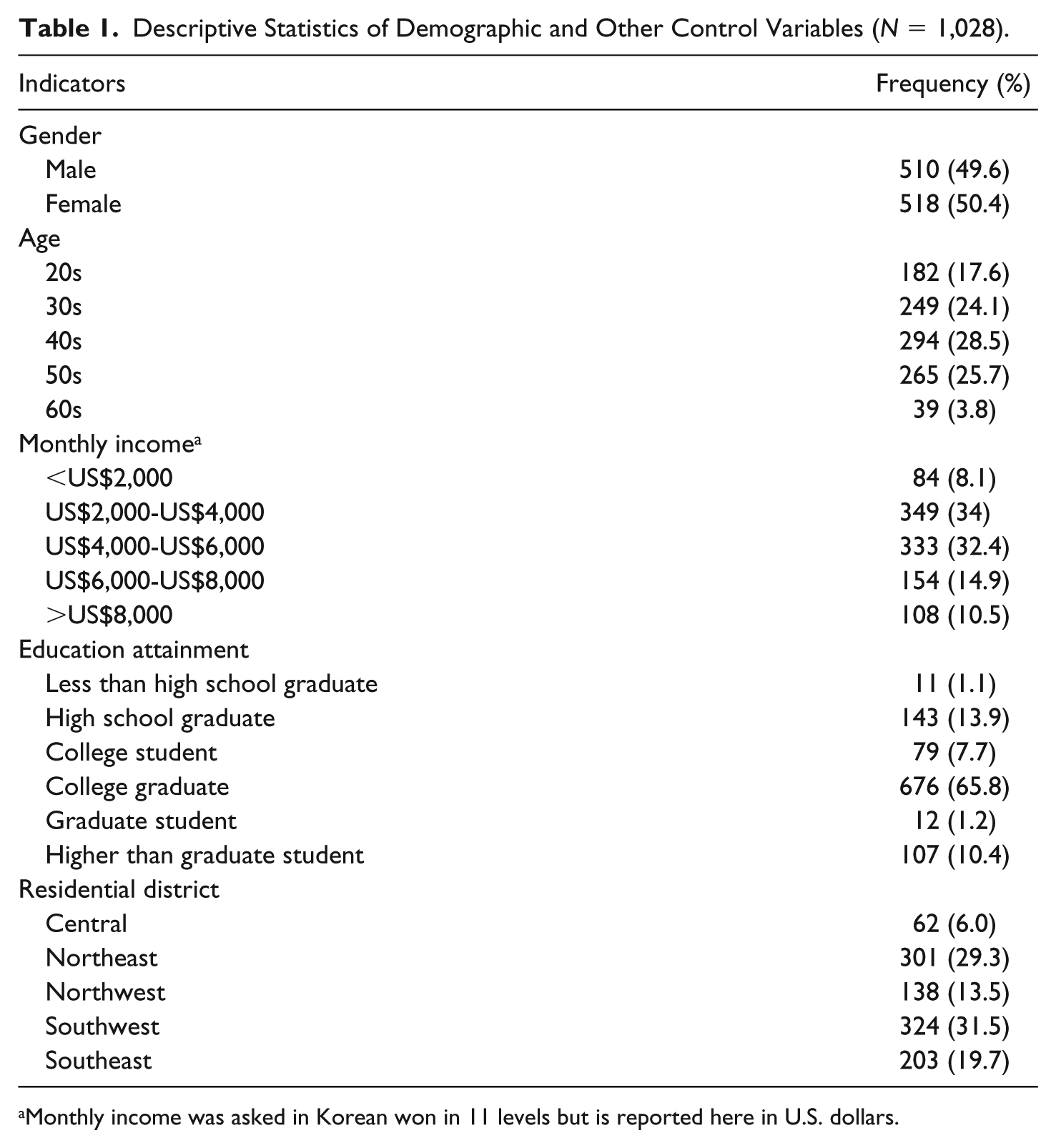
Monthly income was asked in Korean won in 11 levels but is reported here in U.S. dollars.
Independent Variables
Commuting time
Following previous studies (Putnam, 2000; Williamson, 2002), commuting time was measured for both weekdays and weekends as total hours and minutes spent commuting either to a workplace or school and back home. Based on the two values (for weekday and weekend commuting), we came up with an average daily length of commuting time in hours. The respondents were categorized into six groups by 30-minute increments of commuting time: “noncommuters (n = 265),” “less than 30 minutes (n = 60),” “from 30 to 60 minutes (n = 183),” “from 60 to 90 minutes (n = 163),” “from 90 to 120 minutes (n = 149),” and “more than 120 minutes (n = 207).”
Place identity
Place identity was measured for only the commuters (n = 763) in the sample by a three-dimensional measure of the social identification scale (Cameron, 2004; Obst & White, 2007). The scale contains four statements that tap three dimensions of identification: cognitive centrality (e.g., “Being a member of my neighborhood is an important part of my self-image.” and “I often think about my neighborhood.”), in-group affect (e.g., “In general, I’m glad to be a member of my neighborhood.”), and in-group ties (e.g., “I have a lot in common with other neighbors in my neighborhood.”). The same questions were asked about the two locations, home and workplace, and were averaged into two scales: home identification (M = 3.18, SD = 0.73, Cronbach’s α = .83) and workplace identification (M = 3.35, SD = .67, Cronbach’s α = .77), respectively.
Each identification scale was split by the mean scores (median split yielded the same results). They were then combined to form a 2 × 2 matrix of place identities: the integrator (n = 250), home-dominant (n = 89), workplace-dominant (n =135), and disconnected (n = 289). Noncommuters were coded as a separate category and included in the final analysis (n = 265).
ICSN Variables
Connection to local media (LC)
To measure LC within one’s residential neighborhood, respondents answered the question, “How often do you use each of the following media types to get local news and information?” on a 6-point scale ranging from not at all to always. The question was asked for 14 media types, including community radio, neighborhood papers, neighborhood podcast channels, community magazines, regional radio channels, community organization newsletters, neighborhood-based websites, local LISTSERVs, social media pages for the neighborhood, local government websites, local government printed newsletters, mainstream newspapers, network TV channels, and mainstream radio channels. The 14 responses were averaged to form an index of LC (M = 1.42, SD = 0.42, Cronbach’s α = .64 1 ).
Scope of connection to community organization (OC)
The scope of OC within one’s home neighborhood was measured by asking respondents whether they have a membership in each of 11 types of community organizations (e.g., recreational groups, neighborhood meetings, religious organizations) in their own home neighborhoods. The OC score was created by counting the number of local organization types to which one belongs (M = 1.11, SD = 1.36).
Intensity of interpersonal neighborhood storytelling (INS)
The INS within one’s residential neighborhood was measured by a single question, “How often do you talk with your neighbors about neighborhood issues?” (M = 3.27, SD = 1.36), with responses on a 7-point Likert scale (1 = not at all, 7 = always).
ICSN
The previous three variables—LC, OC, and INS—were used to calculate ICSN in one’s residential neighborhood. First, each of the three variables was standardized. The three standardized scores were entered into the following formula of ICSN that Kim and Ball-Rokeach (2006a) proposed in their earlier studies (M = 8.99, SD = 3.01, range = 3.83-15):

Community Engagement Outcomes as Dependent Variables
Neighborhood belonging
To measure neighborhood belonging, we modified a scale of bonding capital in a social network (Williams, 2006). This variable was measured with nine items, including “In my neighborhood, there are people whom I can trust to help solve my problems.” and “When I feel lonely, there are people in my neighborhood I can talk to.” The 5-point Likert scale (1 = not at all true, 5 = definitely true) was used (M = 2.73, SD = 0.69, Cronbach’s α = .92).
Community participation
Community participation was measured by counting the number of local community activities in which a respondent participates within their residential neighborhood (Kim & Ball-Rokeach, 2006b). The list of community activities provided includes “giving campaign money to a local organization,” “contacting a local administration or organization about local problem,” “volunteering in local events,” “cooperating with others to solve a local problem,” and “expressing one’s opinion about a local issue” in the residential neighborhood (range from 0 to 6, M = 1.05, SD = 1.39).
Control Variables
Major demographic variables such as gender, age, income, and education were included as control variables in most of the analyses. One’s residential district is an important CAC variable related to local experience in Seoul, so we also included residential districts (1 = Central city, 2 = Northeast, 3 = Northwest, 4 = Southwest, and 5 = Southeast) as a control variable (see Table 1 for details).
Analyses
To test H1 through H4, we conducted generalized linear models (GLZ) using SPSS 24 to compare commuting groups (the groups based on commuting time and the groups based on place-based identity) in terms of community engagement, after controlling for demographic and residential area variables. Generalized linear model testing allows us to specify the distribution (e.g., normal or Poisson log-linear) and link function (e.g., identity or Log) for our models depending on the types of dependent variables (e.g., linear variable or count variable). For all of the analyses with neighborhood belonging as the dependent variable, we set the GLZ model type as linear to specify normal as the distribution and identity as the link function, as the neighborhood belonging variable shows a normal distribution. For the analyses with community participation as the dependent variable, however, we set the GLZ model type as Poisson log-linear to specify Poisson as the distribution and Log as the link function, as the community participation variable is highly skewed as a count variable. We used the same analyses strategies for RQ1 and RQ2 as well.
We used structural equation modeling (SEM; Jöreskog & Sörbom, 1989) to test the mediation models predicted in H5 and H6. The path model with community participation as a categorical dependent variable was estimated using the weighted least squares estimator offered in Mplus (Muthén & Muthen, 1998), with mean-adjusted standard errors and chi-square tests (Browne, 1984; Muthén, 1998; Wothke, 1993). This procedure allowed us to estimate correct standard errors even when the dependent variable was a categorical variable having a normality problem.
Results
Preliminary Analysis
Table 2 displays zero-order correlations among the variables included in the current study. Preliminary analyses revealed that male, older, more educated, or higher salaried respondents were more likely to engage in their local community, compared with female, younger, less educated, or less salaried ones, respectively. Thus, these four demographic variables (gender, age, education, and income), as well as one CAC factor (residential districts), were included as covariates in all main analyses.
Zero-Order Correlation Matrix of All Predictors and Outcome Variables.
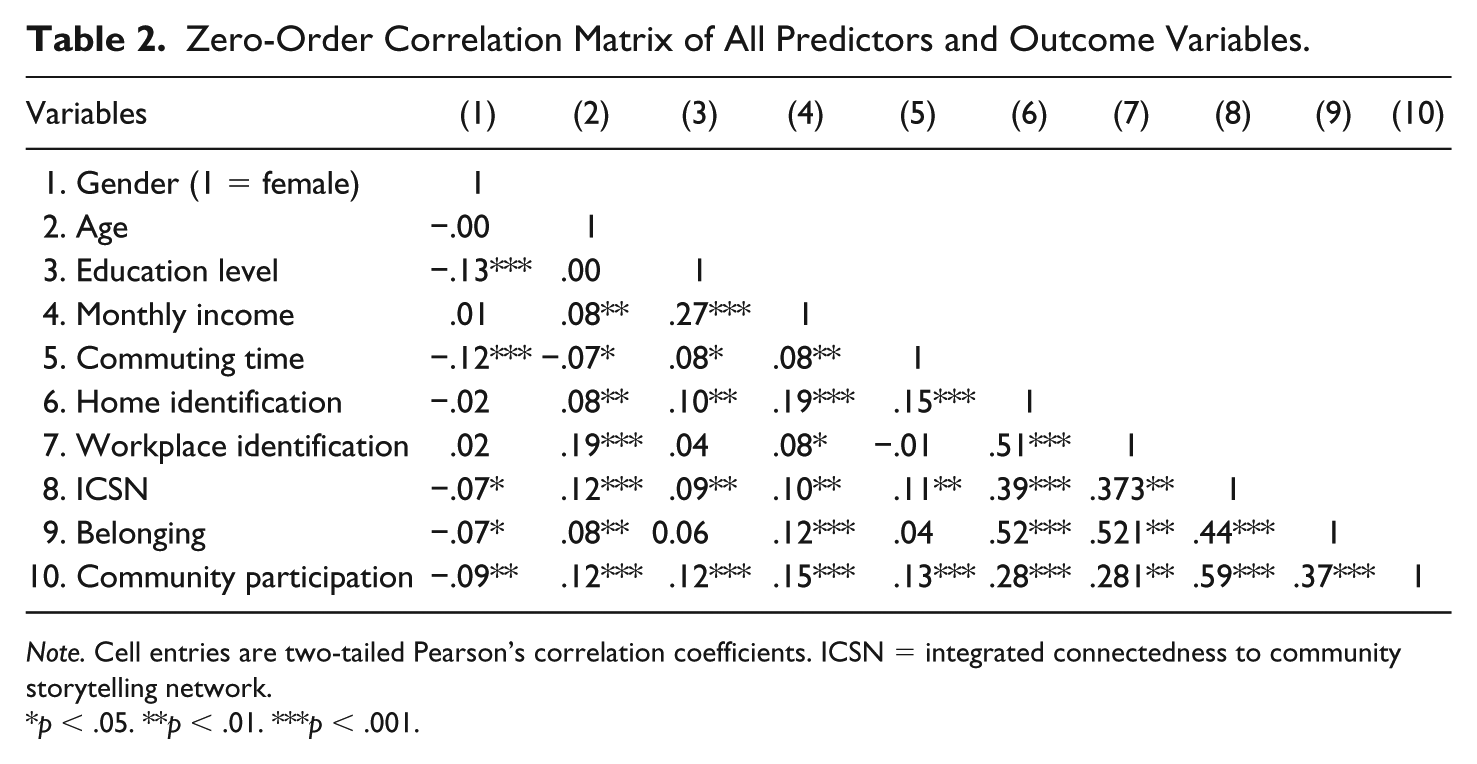
Note. Cell entries are two-tailed Pearson’s correlation coefficients. ICSN = integrated connectedness to community storytelling network.
p < .05. **p < .01. ***p < .001.
Effects of Commuting Time on Community Engagement (H1)
H1 predicted that Seoul residents’ neighborhood belonging (H1-1) and community participation (H1-2) in their home neighborhood would decrease as their commuting time increased. The generalized linear model testing results revealed a significant effect of commuting time on neighborhood belonging, F(5, 1014) = 2.96, p < .05,
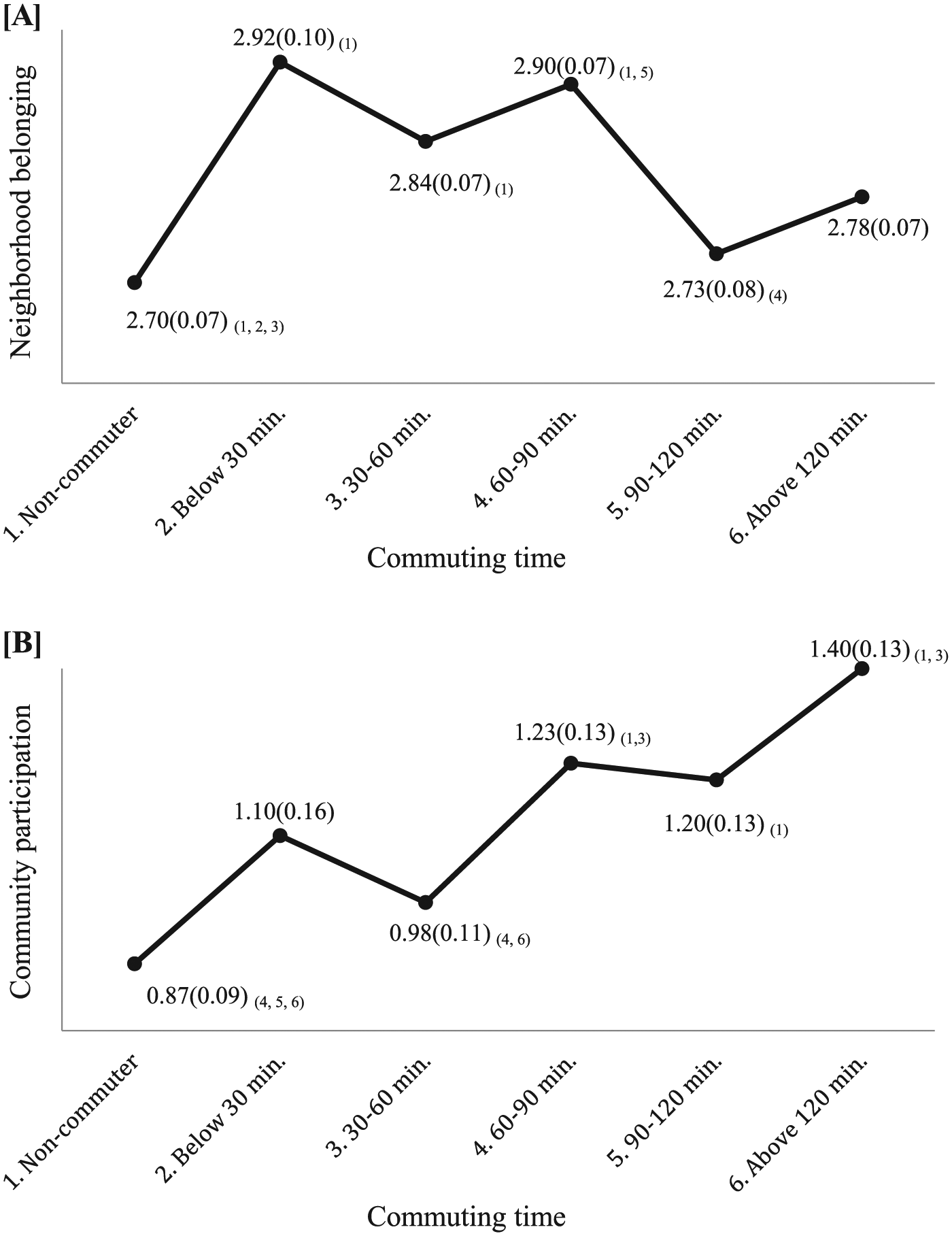
Estimated marginal means of (a) neighborhood belonging and (b) civic participation by commuting.
Contrary to what we expected, the relationship between commuting time and community participation was positive, not negative, F(5, 1014) = 6.60, p < .01,
Effects of Place Identity on Community Engagement (H2)
H2 predicted that home-dominant commuters and integrators would show higher levels of neighborhood belonging (H2-1) and community participation (H2-2) in the home neighborhood than workplace-dominant commuters or disconnected commuters. Our generalized linear model testing results showed that there were significant differences among the four place identity groups and noncommuters in neighborhood belonging, F(4, 1015) = 34.65, p < .001,
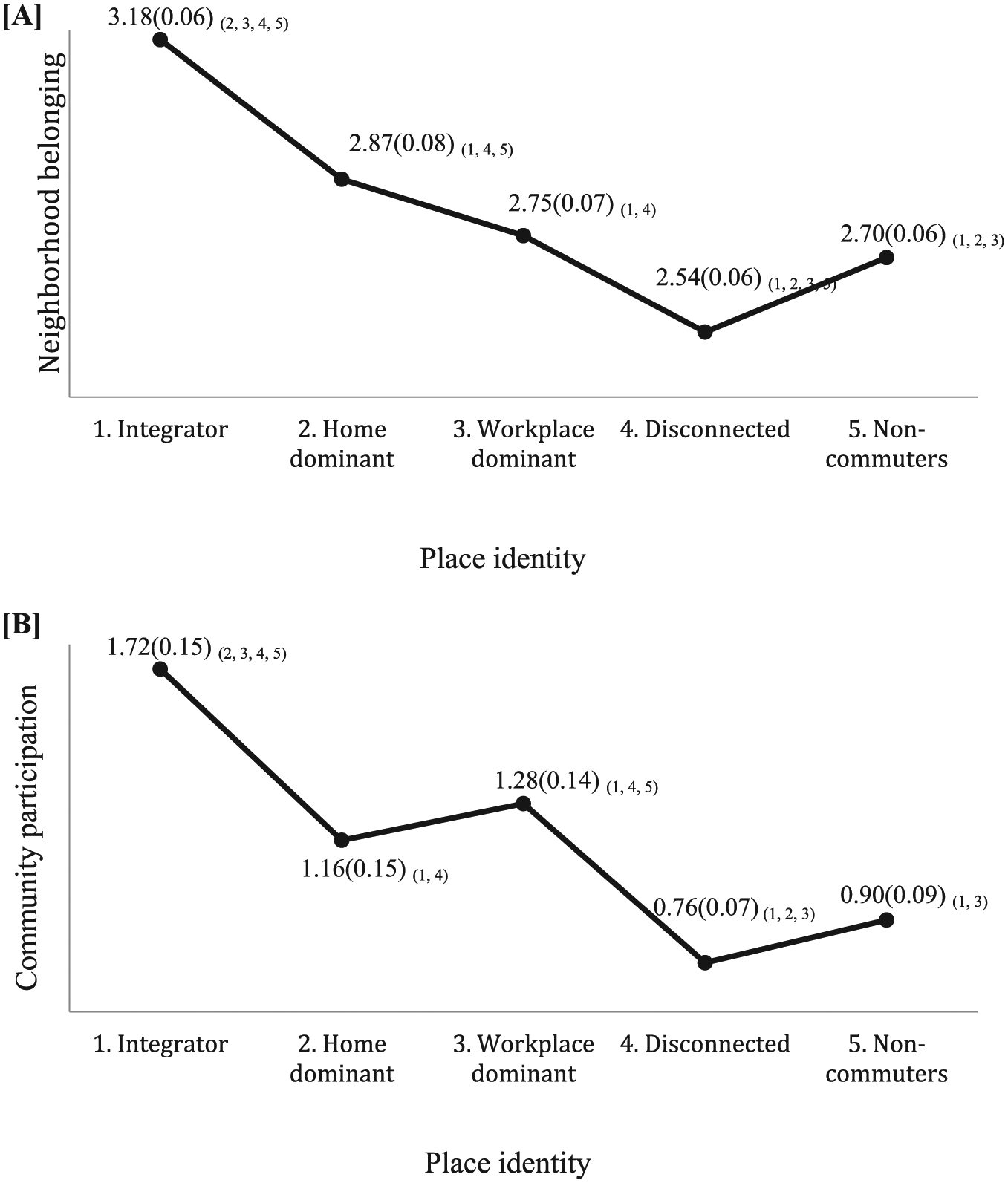
Estimated marginal means of (a) neighborhood belonging and (b) civic participation by place identity.
Effects of Commuting Time and Place Identity on ICSN (H3, H4)
H3 suggests that commuting time is negatively associated with ICSN. Contrary to our prediction, the results showed a positive relationship between commuting time and ICSN, F(5, 1014) = 2.89, p < .05,
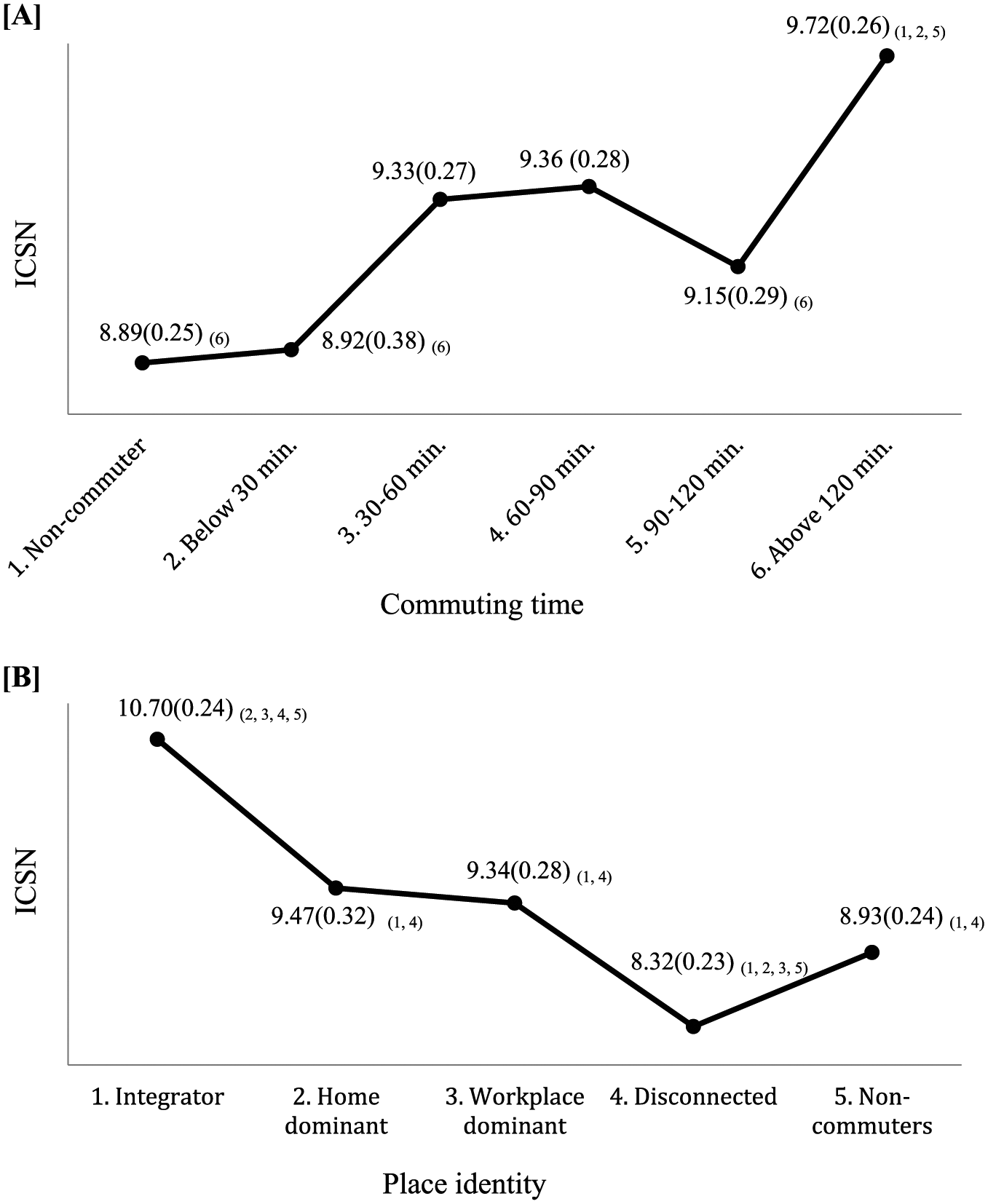
Estimated marginal means of ICSN by (a) commuting time and (b) place identity.
H4 predicted that the integrator group and the home-dominant group would show higher levels of ICSN than other commuter groups. According to generalized linear model testing results, F(4, 1015) = 35.85, p < .001,
Mediating Effects of ICSN on Community Engagement (H5, H6)
H5 and H6 were concerned with the mediation of ICSN between commuting time (or place identity) and community engagement. The path models we tested for these hypotheses had multicategorical independent variables (i.e., commuting time and place identity). Following the suggestion made by Hayes and Preacher (2014) about testing SEM models with multicategorical independent variables, we conducted path analyses using Mplus. We set noncommuters as a reference group for both the models for H5 and H6. H5 predicted that ICSN would mediate between commuting time and neighborhood belonging (H5-1), as well as between commuting time and community participation (H5-2). Regarding H5-1, we found that a full mediation of ICSN occurred among the commuting time group of 2 hours or more and a partial mediation among the group of 60 to 90 minutes (see Table 3A), but no mediation among the other commuting time groups. The two groups (“60-90 minutes” and “2 hours or more”) showed higher level ICSN than noncommuters (reference group), and the higher ICSN of these groups increased neighborhood belonging. Regarding H5-2 about community participation, we found a partial mediation of ICSN among the group of 2 hours or more (Table 3B). This group showed higher level ICSN than noncommuters (reference group), and their higher ICSN increased community participation. Although these results showed the mediating effects of ICSN, the directions of the effects were opposite to those hypothesized, which reflected the results regarding H3.
Estimated Coefficient of the Mediating Effect of ICSN Between Commuting Time and Community Engagement.
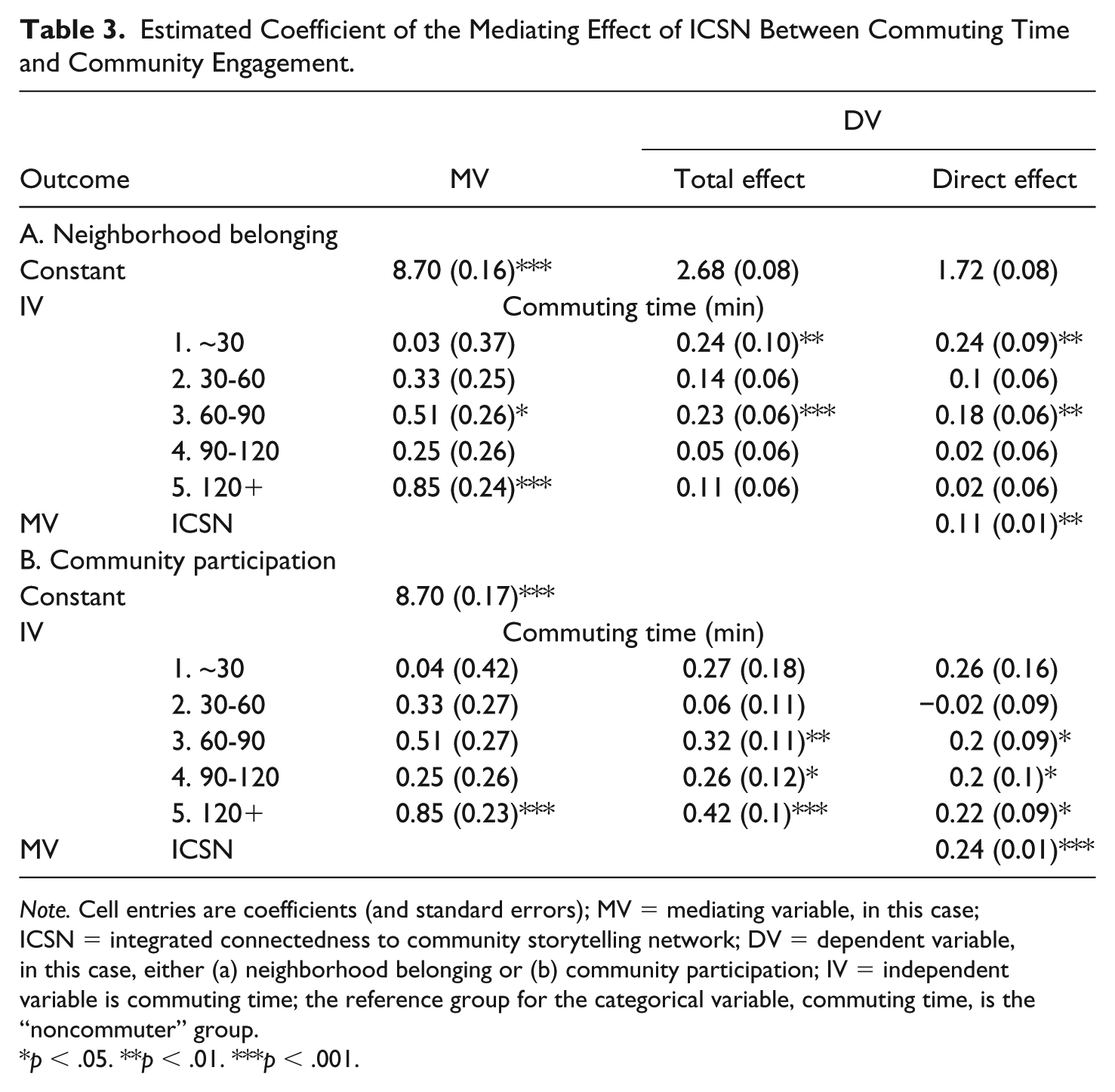
Note. Cell entries are coefficients (and standard errors); MV = mediating variable, in this case; ICSN = integrated connectedness to community storytelling network; DV = dependent variable, in this case, either (a) neighborhood belonging or (b) community participation; IV = independent variable is commuting time; the reference group for the categorical variable, commuting time, is the “noncommuter” group.
p < .05. **p < .01. ***p < .001.
Regarding H6-1, we found that a full mediation of ICSN occurred as hypothesized among the integrated group, but not among the other groups (see Table 4A). The integrated group showed higher level ICSN (B = 1.81, SE = 0.20) than noncommuters (reference group), and the higher ICSN of the integrated group increased neighborhood belonging (B = 0.08, SE = 0.01). The same pattern was found for community participation (see Table 4B). Thus, H6-1 and H6-2 were confirmed only for integrators, but not for the other groups including home-dominant commuters.
Estimated Coefficient of the Mediating Effect of ICSN Between Place Identity and Community Engagement.
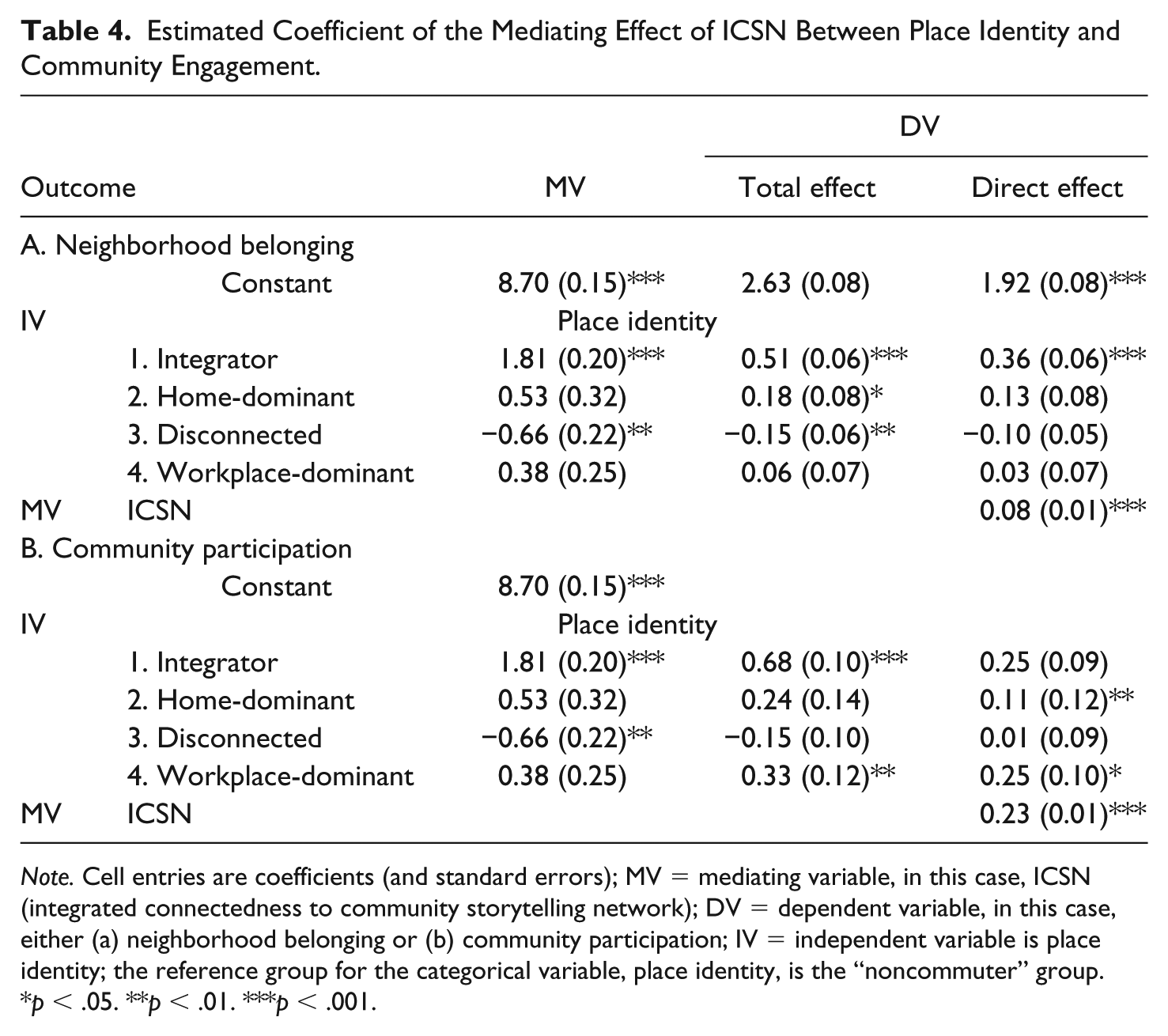
Note. Cell entries are coefficients (and standard errors); MV = mediating variable, in this case, ICSN (integrated connectedness to community storytelling network); DV = dependent variable, in this case, either (a) neighborhood belonging or (b) community participation; IV = independent variable is place identity; the reference group for the categorical variable, place identity, is the “noncommuter” group.
p < .05. **p < .01. ***p < .001.
Moderating Effects of ICSN on Community Engagement (RQ1, RQ2)
We had two sets of research questions (RQ1 and RQ2) regarding whether the influence of commuting on residents’ local community engagement would be moderated by ICSN (high vs. low ICSN). RQ1 was concerned with the interaction effect of commuting time (five levels) and ICSN (two levels) on neighborhood belonging (RQ1-1) and community participation (RQ1-2). RQ2 concerned the interaction effect of place identity (five levels) and ICSN (two levels) on neighborhood belonging (RQ2-1) and community participation (RQ2-2). We did not find any significant interaction effects of ICSN and the two commuting variables on neighborhood engagement variables. Our data do not support moderation effects of ICSN in the relationship between commuting and community engagement.
Discussion
In the present study, we aimed to assess the effects of commuting on community engagement from a communication perspective. We conceptualized commuting in two ways: as time spent commuting and a source of place-based social identity. For commuting time, we compared six groups (from noncommuters to those who spent more than 2 hours commuting, in 30-minute increments); for place-based social identity, we compared five groups (integrator, home-dominant, workplace-dominant, disconnected, and noncommuters). In both cases, we compared the groups in terms of two community engagement variables (neighborhood belonging and community engagement in the home neighborhood) and one communication variable (ICSN) as a potentially crucial mediating and moderating factor in community engagement according to CIT. We tested the mediating and moderating effects of ICSN between one of the two commuting variables (time and place identity) and community engagement.
This study reveals several important findings. First, commuters show higher levels of neighborhood belonging and community participation in the home neighborhood than noncommuters. Staying in a neighborhood as a noncommuter does not automatically provide an opportunity to engage with the local community. Second, we found a negative relationship between commuting time and neighborhood belonging as the time resource model suggested. However, this relationship was not linear: Instead, we found that 90 minutes was a critical divergence point; among commuters, only those who spent more than 90 minutes experienced lower levels of neighborhood belonging. However, even this relationship disappears when ICSN is added to the equation either as a mediator or as a moderator. Third, unlike neighborhood belonging, we found a positive relationship between commuting time and ICSN, and between commuting time and community participation. The positive relationship between commuting time and community participation in the home neighborhood holds even after ICSN is added to the equation. Fourth, among the four place identity groups (integrators, home-dominant, workplace-dominant, and disconnected), integrators, who connect to both the home place and workplace, showed higher level access to community-based communication resources (ICSN) and higher level community engagement (both neighborhood belonging and community participation) in the home neighborhood than other place identity groups, including the home-dominant group. Fifth, we found that ICSN fully mediates between commuting time and community engagement variables (both neighborhood belonging and community participation). Commuting time increases ICSN and ICSN increases community engagement in the home neighborhood. ICSN also mediates between being an integrator and community engagement. Being an integrator increases (significantly more than being a noncommuter) the opportunity to have higher ICSN, and higher ICSN is related to higher level community engagement in the home neighborhood.
There are several points that should be highlighted in the findings reported in this study. First, regarding the positive relationship between commuting time and community engagement in the home neighborhood (especially community participation and ICSN), our results suggest that commuters’ experiences in Seoul are similar to what Lidström (2006) found in Sweden and what Wollebæk and Strømsnes (2010) found in Norway. The Swedish researcher interpreted the positive relationship between commuting time and community engagement as showing a positive spillover effect that might be derived from access to extra-local resources and heightened political motivation. In other words, commuters have better opportunities for exposure and access to various types of civic knowledge, skills, motivations, and resources available outside their residential communities and can bring them back to their own neighborhoods. The difference in the time resource–based model and the outcomes of the European studies (and ours) may result from the difference in research context. The urban centers with high employment and central business sectors in Seoul can be referred to as “an urban village” (Leinberger & Lockwood, 1986). The extra-local trip to those urban centers expands one’s access to economic or cultural resources (e.g., a museum, city hall, or an educational institution), political events (e.g., a national protest over environmental issues or political issues), civic participation experiences, and even weak ties with familiar strangers (Milgram, 1972) on streets or in public transportation. That is, commuting may have positive work-to-home spillover effects, which might be related to methods of commuting. According to a recent report by the Seoul government, more than 62% of commuters in Seoul use public transportation, such as subways and buses (Seoul Statistics, 2015). Only 21% drive to their workplace. This contrasts with cities where a majority of commuters drive alone (e.g., in the United States, about 70% of commuters in major cities drive alone; U.S. Census Bureau, 2015). Having to interact with others while commuting might not only be a cause of sensory overload (Simmel, 1903) but also provide commuters with chances to meet familiar strangers (Milgram, 1972) and build weak bonds with them (Kahneman & Krueger, 2006).
The positive relationship between commuting time and community engagement can be interpreted in a way alternative to the notion of work-to-home spillover effects. The causal direction could be reversed from “commuting → community engagement (e.g., the spillover effect hypothesis described above)” to “community engagement → commuting.” For example, commuters’ investments in and commitments to their home neighborhoods and active community participation based on place investment and commitment would let commuters endure a long commute. In other words, such commitment to the home neighborhood lets commuters stay in their neighborhood even when they have to spend extremely long hours commuting. The cross-sectional data of this study would not let us check the direction of causality between commuting time and community engagement variables beyond just checking their correlations; however, it would be an interesting research topic for future studies.
Second, we tested two different aspects of commuting in this study: commuting time and place-based social identity. We found that commuting as a source of place-based social identity shows much more consistent results than commuting as time. This may be related to recent trends, mostly created by mobile, digital, and networking technologies, which have changed the ways in which commuters experience their commuting time. Thus, the effects of commuting time on community engagement may have become distorted as commuters are able to stay connected to multiple places, including their homes and neighborhoods, during their commuting times. For this reason, using place-based social identity (not using merely a time variable) might be a better way to address issues related to commuting. The commuters we called integrators (those connecting to both home and worksite neighborhoods) consistently showed highest level of ICSN, neighborhood belonging, and community participation in their home neighborhoods.
Third, the findings of this study have important theoretical implications for CIT. Our study findings show, rather surprisingly, that commuting can provide more opportunities to develop higher ICSN in Seoul than not commuting. People who spend longer hours commuting and those who connect to both residential neighborhoods and workplace neighborhoods as sources of place identity (i.e., the integrators) are more likely to have higher ICSN than other groups, including those who identify themselves only based on their residential neighborhoods (i.e., the home-dominant group). These results indicate that connecting to multiple places and spending significant time commuting provide commuters with more opportunities to talk about their residential neighborhoods than just being stuck in one place, such as their home neighborhoods. We can think of some possible reasons for these results, even though these need to be verified through future research. These days, many people are connected to neighborhood stories through mobile channels (blogs, social networking sites [SNSs], online chatting with neighbors, etc.). Commuters (especially those using public transportation) can take advantage of these new media technologies during their long commute times. As indicated earlier in this section, commuters also can bring their motivations, capacities, and materials for producing and sharing local stories from other places, including their workplace neighborhoods. For example, commuters’ experiences talking about various stories related to their workplace neighborhoods (local resource-related issues, policy issues, local politics, etc.) can be appropriated, extended, and recontextualized in the processes of producing, sharing, or using stories about their home neighborhoods.
Fourth, the results of the current study suggest that the effects of commuting on community engagement should be understood in the context of individuals’ connections to community-based communication resources. CIT has been shown to have two different roles in ICSN between structural factors and community engagement: ICSN as mediator or as moderator. In terms of the roles of ICSN between commuting and community engagement, our results suggest that ICSN could work as a mediator, but not as a moderator. Like Ball-Rokeach et al. (2001) demonstrated in the mediating path of [homeownership and residential tenure → ICSN → neighborhood belonging], commuting (especially longer commutes and being an integrator) positively affects ICSN, and ICSN positively affects community engagement. These results indicate that commuting should not necessarily be a detrimental factor in community engagement if it is able to increase individual residents’ connections to community-based communication resources, probably via both online and offline media channels.
Fifth, many of the findings in this study also suggest a need to investigate the integrator group further. They are the people who find their place-based social identities both in their residential areas and in the areas of their workplace. We found that they showed higher level neighborhood belonging, community participation, and ICSN than even those who belong to the home-dominant group or noncommuters. Few studies have paid attention to the people who belong to multiple places and tried to explain the social implications of such dual belongings. Thus, future studies need to examine further who these place-based cosmopolitans are. This will be an important topic as the number of networked commuters is expected to increase.
Sixth, we also need to further understand who noncommuters are. This study shows that noncommuters are least connected to community-based communication resources and show the lowest levels of neighborhood belonging and community participation in the home neighborhood. Even though they physically stay in their neighborhood (or are forced to stay there for economic, health, aging, and other reasons), they are less connected to their neighborhood than commuters. Demographically, in our data, noncommuters are more likely to be female, older, less educated, and have lower income than commuters. Future studies need to figure out who they are, beyond just demographic characteristics, and determine why they do not need to or cannot commute (e.g., whether the noncommuting is related to rocketing housing or rental prices, joblessness, aging, or health) and what can be done to connect noncommuters to their local communities in positive ways.
We should mention some limitations of the present study, which need to be addressed in future research. First, although we suggest a changing commuting experience shaped by new ICTs, we were not able to add these aspects to our analyses in the current study. Future research should develop ways to measure the use of ICTs (e.g., smartphones, social media, and other wearable technologies) during commuting and see how it is related to connections to local communication resources and community engagement. As a related issue, future research needs to be able to address emerging transportation technologies, such as self-driving cars that are expected to function themselves as a new mobile ICT by staying connected on the road. With free hands, free eyes, free attention, and free time in a car, self-driving car users would enjoy expanded access to various media content, information, and communication opportunities. Second, the current study did not take into consideration the differences among various commuting methods as factors in communication behaviors and community engagement. Previous studies (e.g., Mattisson, Håkansson, & Jakobsson, 2015) have found significant differences in social capital between using private cars and public transportation for commuting. Future research needs to systematically compare different means of commuting (private car, public transportation, walking, or biking) as factors in community engagement. In addition, future studies need to address potential impacts of some of the newly emerging alternative means of commuting, such as social or peer-to-peer car sharing, on community engagement. Third, the current study did not consider contextual factors (e.g., CAC factors in CIT) except for a local district identifier (i.e., Ku), while commuting was conceptualized as an individual-level structural factor (not a contextual CAC factor). Future research should design multilevel models by systematically considering several CAC factors (e.g., number of commuters, ease of access to public transportation, area type [residential or commercial], population characteristics, residential stability, social capital, number of community organizations, availability of public spaces, etc. all at the district level) that might influence the relationship between commuting and community engagement. Fourth, although we added residential districts as well as sociodemographic variables for statistical control in our analyses, we were not able to include other potentially important variables, such as years in a neighborhood or homeownership, mainly owing to data limitation. However, we believe missing those variables in the analyses should not significantly affect the results of this study and adding residential district with other sociodemographic variables should be enough for statistical control considering unique aspects of Seoul, such as its high level of geographical inequalities, mostly at the district level and the quite evenly distributed access to well-developed public transportation services regardless of districts. Fifth, this study focused only on community engagement in home neighborhoods. Future studies need to consider effects of commuting (and related variables, such as means of commuting) on commuter’s engagement in other places significant to them, especially their workplace neighborhoods. Finally, the current study was not able to differentiate commuters in terms of job type, worksite situation (e.g., working at one site only, at multiple sites, at telework centers, at home offices, or some combinations of these), or length of work hours. Future research needs to design a study considering these variables, either as main independent variables or as control variables depending on research questions.
Conclusion
We examined commuting as an important urban communication issue in this study. We attempted to show the dynamic interplays of commuting and community-based communication infrastructure as critical factors in community engagement from a CIT perspective. This study suggests that commuting should not necessarily be a detrimental factor in community engagement in urban local communities; instead, it can be a positive factor depending on how commuting is incorporated into urban commuters’ everyday lives. With better understanding of how urban residents experience commuting, especially in the rapidly changing urban ICT environment, scholars, civic organizations, and local governments would be able to develop novel ways to facilitate community engagement among commuters. In particular, we need to have a better understanding of how new ICTs would change urban commuters’ mobility experiences and their connections to local communities.
Footnotes
Declaration of Conflicting Interests
The authors declared no potential conflicts of interest with respect to the research, authorship, and/or publication of this article.
Funding
The authors disclosed receipt of the following financial support for the research, authorship, and/or publication of this article: This work was supported by the Ministory of the Republic of Korea and the National Foundation of Korea (NRF-2016S1A5A2A03927298).