







Abstract
While social media is assumed to exacerbate adolescents’ depressive symptoms, research findings are ambiguous. One way to move the field forward is by looking beyond time spent on social media and considering subjective experiences. The current three-wave longitudinal panel study examines the within- and between-person relations between adolescents’ self-worth dependency on social media feedback and depressive symptoms. About 1,607 adolescents participated in two of the three waves, yet a third had to be excluded due to failing an attention check. Among the analytical sample of 1,032 adolescents, we found that adolescents who derived more of their self-worth from social media feedback were also more depressed, as indicated by a positive correlation at the between-person level. No support was found for within-person associations over time. These results highlight the need to examine effects of subjective experiences with social media by separating within- and between-person dynamics to reach more precise conclusions.
Keywords
Introduction
Concerns about the impact of social media on adolescent psychological well-being are widespread and urgent. Catalyzed by recent decreases in reports of youth well-being over the last decade (Geiger & Davis, 2019), many have argued that the rise of social media platforms are to blame (Twenge, 2020). Indeed, policy conversations about the youth well-being crisis often invariably mention the potential harms of social media. For example, President Biden called for scholars and policymakers to interrogate the role of social media use on adolescent well-being in his 2022 State of the Union (The White House, 2022), a call that was shared in recent statements from the American Surgeon General (Murthy, 2021) and the UNICEF Director (Fore, 2021) to protect youth well-being in our increasingly digital world.
In this context, there is particular concern about the relationship between adolescents’ social media use and depression, a mood disorder that causes persistent feelings of sadness and loss of interest in activities that people once enjoyed (Beck & Alford, 2009). In response, a new wave of research has investigated how the dynamics of youth social media use relate to depressive symptoms (i.e., the set of affective, cognitive, and behavioral experiences associated with depression but do not necessarily indicate the presence of a severe mental illness) by examining how engagement with social media relates to symptoms like feelings of worthlessness, fatigue, and guilt (Ayuso-Mateos et al., 2010).
However, these efforts have produced mixed findings, sparking an ongoing debate about the nature of social media’s potential effect on depressive symptoms. Results from a series of meta-analytic reviews and large-scale, representative studies have challenged whether the empirical evidence supports the often causal claims that social media use increases depressive symptoms among young people (Cunningham et al., 2021; Odgers & Jensen, 2020). A recent longitudinal study following 500 American adolescents over 8 years found that spending more time on social media was not associated with increased symptoms of depression or anxiety, even if they used social media more as they got older (Coyne et al., 2020). These findings are part of a growing body of research indicating that time spent on social media use does not consistently explain variation in youth well-being (Orben et al., 2019). Indeed, meta-analyses of hundreds of studies have found ambiguous effects across the field at large (Hancock et al., 2022; Odgers & Jensen, 2020), with recent literature showing that frequency of social media use is linked to higher levels of well-being for some people and decreased well-being in others (Beyens et al., 2020).
While scholars vary in how they interpret the strength, significance, and implications of identified associations between social media use and psychological well-being (Odgers & Jensen, 2020), several approaches have been proposed to help explicate the small, mixed effects that have been observed. Some have argued that we should go beyond considerations of the amount of time that youth spend with social media and consider the specific aspects of social media use that may affect their well-being (Hancock et al., 2022; Lee & Hancock, 2023). After all, people vary in the platforms they use, the content they see, and the people they connect with—among other differences—that may differentially affect how they feel (Bayer et al., 2020). However, even two adolescents who use the same platform in the same way (i.e., posting a selfie to Instagram) can interpret their social media use in meaningfully different ways that may inform their well-being. Research on individuals’ subjective perceptions of their own social media use reveals that the beliefs, or mindsets, people hold about their own social media use can be consequential to depressive symptoms (Lee & Hancock, 2023). People who viewed themselves as dependent on social media often tended to experience more depressive symptoms than those viewed social media as a tool they can use to pursue meaningful goals (Lee & Hancock, 2023).
In this vein, an adolescent whose self-worth is dependent on social media may be particularly susceptible to its adverse effects on depressive symptoms. Maintaining a sense of self-integrity—a feeling of agency and independence—is essential to well-being, particularly among adolescents who may already be facing questions of self-esteem as part of their coming-of-age (Walton & Wilson, 2018). An adolescent who sees themselves as needing validation from social media may not only hold less agentic views about their social media use, but also more negative views about themselves that may in turn manifest in worse depressive symptoms. For instance, a cross-sectional study conducted by Sabik et al. (2020) found that college women experienced more depressive symptoms when they staked more of their self-worth on their social media interactions, such as the number of likes they received on their posts.
While the existing literature suggests that there may be a between-person association between self-worth dependency on social media feedback and depressive symptoms, these insights do not allow us to draw conclusions on the effects of social media on well-being, as media effects are theorized to take place within individuals (Beyens et al., 2020). Scholars should therefore consider both within-person and between-person processes to be able to draw accurate conclusions on how social media use and subjective perceptions of social media use affects well-being (Valkenburg et al., 2022b).
Building on these approaches, this study will examine how adolescents’ self-worth dependency on social media affects depressive symptoms with a three-wave longitudinal panel study (N = 1,032). This study will add to the literature by investigating for the first time within-person associations in addition to between-person associations, and thus test whether an increase in self-worth dependency on social media feedback is followed by an increase in depressive symptoms over time, and vice versa. We discuss our findings in the context of growing research proposing closer examination of within- and between-person dynamics (Valkenburg et al., 2022b), subjective perceptions of social media (Lee & Hancock, 2023), and the need to clarify the potential for causal connections between social media use and well-being.
Social Media Use and Depressive Symptoms Among Adolescents
Initial inquiries into social media effects presumed that young people who used social media for longer would experience more symptoms of depression, which include changes in affect (i.e., feeling persistently sad or emotionless), cognition (i.e., difficulty making decisions), physiology (i.e., disturbances in sleep and appetite), and behavior (i.e., social withdrawal) (American Psychiatric Association, 2013). While it was initially theorized that these negative effects would take place because spending time on social media would displace opportunities for richer or more meaningful interactions in face-to-face contexts, examinations of large youth panels found little support for this displacement hypothesis (e.g., in the ABCD cohort, Lees et al., 2020). Indeed, one of the strongest points of evidence against the theorized causal connection between social media use and depressive symptoms comes from an 8-year longitudinal study of a large cohort of adolescents. Coyne et al. (2020) found that within-person changes in social media use had no effect on within-person changes in depressive symptoms, indicating that time spent on social media did not exert effects. However, the significant correlations between social media use and depressive symptoms at the between-person level (Coyne et al., 2020) signal that there may be other facets of experiences with social media that are consequential for adolescent well-being.
Notably, several meta-analyses have found that the subjective perceptions people have about their social media use are stronger determinants of depressive symptoms than examinations of the amount or frequency of their use alone (Cunningham et al., 2021; Hancock et al., 2022). Specifically, orientations to social media that frame the user as dependent on social media appear to be linked to depressive symptoms. For example, people who use social media more intensely not only feel a greater sense of emotional attachment to the platforms they use, but also tend to view social media use as an important, integral part of their lives (Ellison et al., 2007), a pattern that tends to be associated with increased depressive symptoms (Roberts & David, 2023), particularly when they stop using it. Furthermore, when a person perceives their own social media use to be more “problematic” or indicative of an underlying addictive tendency than usual, this person may consistently experience more depressive symptoms. Indeed, Cunningham et al. (2021) found perceptions of problematic social media use to explain the most variance in adolescent depressive symptoms. Together, these findings speak to the importance of considering how beliefs about social media use influence individuals’ sense of agency over their lives and actions (Lee & Hancock, 2023): viewing the self as being dependent on social media may undermine well-being by reducing a sense of self-efficacy (Muris, 2002). Given these findings, it is important to complement measures of time spent on social media with additional measures of their subjective experiences with social media, which may inform how adolescents appraise their social media use and relate to their psychological well-being.
Self-Worth Dependency on Social Media Feedback and Depressive Symptoms
One important subjective experience is the extent to which adolescents derive their self-worth from the feedback they receive on their social media posts (Sabik et al., 2020). They are often highly motivated to use social media to connect with peers, stay up to date on their lives, and craft positive self-presentations of themselves through curation of their online profiles and images (Nesi & Prinstein, 2015). Because social media platforms are designed to facilitate social feedback by receiving likes and comments on their posts (Trekels, 2018), they can render reigning peer norms highly visible by providing metrics of social approval (Bayer et al., 2020; Trekels, 2018). When adolescents are exposed to posts which appear to be rewarded by likes and positive comments, they may perceive the content displayed in these posts as ideal and socially endorsed by their peer group (Sherman et al., 2016; Trekels, 2018). Furthermore, the likes and comments they receive from peers on their own posts can be interpreted as a signal of their social status, or whether they fit into their peer group (Sherman et al., 2016). In general, adolescents are sensitive to peer feedback because a main task during this developmental phase is to establish close relationships, and thus feel accepted by their peer group (Brechwald & Prinstein, 2011). As such, adolescents may attach substantial importance to the feedback of peers on social media (Martinez-Pecino & Garcia-Gavilán, 2019).
The theory of self-worth contingencies predicts that, individuals’ self-esteem, defined as the positive and relatively stable evaluation of the self (Valkenburg et al., 2021), depends on their performance in the specific domains on which they have staked their self-esteem (Crocker & Wolfe, 2001). For instance, people may struggle with their self-esteem when their sense of self-worth is based on others’ approval. This approach is problematic because gaining approval from a broad spectrum of people is often challenging, and the absence or ambiguity of feedback can easily be misconstrued as disapproval (Burwell & Shirk, 2006; Crocker & Wolfe, 2001).
An adolescent who values being perceived as socially competent may therefore struggle with self-esteem if they interpret the absence of positive validation as an indicator of their poor social skills, particularly as perceptions of social rejection may undermine psychological well-being (Burwell & Shirk, 2006). It is thus not the objective experience of events (e.g., receiving social feedback), but rather a person’s interpretation of the event in relation to their self-worth contingencies (e.g., deeply caring about the feedback) that shapes self-esteem (Crocker & Wolfe, 2001).
The extent to which an adolescent derived their self-worth from social media may thus affect their experience of depressive symptoms. First, when an adolescent’s self-evaluation relies on peer responses to their social media self-presentation, they may experience a short-lived boost in self-esteem when they receive positive feedback in the form of likes and comments on posts about themselves (Meeus et al., 2019). However, self-related posts do not always elicit positive peer feedback. The curation of social media feeds by algorithms means that users ultimately do not have control over if, or when, they will receive feedback from peers on their posts (Steers, 2016). As a result, they may experience a decrease in self-esteem until the next time they receive positive feedback. The self-esteem of an adolescent who is dependent on social media feedback for validation is thus unstable, making them vulnerable to developing symptoms of depression (Crocker & Wolfe, 2001). Indeed, a daily diary study found that adolescents whose self-worth was dependent on friends’ approval had more fluctuations in their self-esteem, which in turn, predicted depressive symptoms (Cambron et al., 2010).
Second, in an effort to receive more peer approval (Gioia et al., 2023), an adolescent whose self-worth depends on social media feedback may be strategic in how they create and post content to try to leave a positive impression on others (Yau & Reich, 2019). They may strive to convey aspirational lifestyles that emphasize their positive qualities, such as their achievements, social activities, and appearance (Casares & Binkley, 2022; Gioia et al., 2023). The act of presenting the best version of oneself to others is not unique to social media (Goffman, 1959); in both online and offline settings, people strategically convey information about the self to control how others perceive them (Goffman, 1959; Schlenker, 1980). However, social media affords individuals greater control over their self-image (e.g., filtering, posting strategically) and may therefore provoke more intense strategic impression management processes to come across as desirable as possible, relative to offline contexts (Verduyn et al., 2020).
Such positively biased self-presentations may undermine well-being through the promotion of inauthentic self-portrayals (Bailey et al., 2020). Indeed, depressive symptoms are often higher among youth who put more effort into curating their image on social media, but lower among those who chose to present themselves more authentically (Wang et al., 2019). This may be because an adolescent whose self-worth depends strongly on social media feedback, may engage more in inauthentic self-presentation practices to elicit positive peer feedback. They believe that positively biased content is the norm, and that such content is therefore more likely to get validated by their peers (Yau & Reich, 2019). However, issues arise when such positively biased content no longer represents their true selves, leading to an inauthentic portrayal of their life, which can result in increased depressive symptoms (Wang et al., 2019). That is because the posting of inauthentic yet positively biased content may result in an identity discrepancy, making the adolescent aware of the absence of certain positive qualities they may wish to embody, but do not feel they have (Higgins, 1987). In contrast, an adolescent with a strong sense of their own worth outside of peer social media feedback is likely to engage in more authentic self-presentations, which may have positive implications for well-being.
Taken together, an increase in self-worth dependency on social media feedback may predict an increase in depressive symptoms. This occurs firstly through the experience of stronger fluctuations in self-esteem because they attach more importance to an unstable, external source of validation (i.e., peer feedback). Second, it reflects through an increase in posting inauthentic content that highlights the difference between their ideal self, and their actual self. While Sabik et al. (2020) find that female college students with a greater self-worth dependency on social media feedback tend to experience more depressive symptoms in general, the cross-sectional design in their study limited their conclusions at the between-person level (e.g., Sabik et al., 2020). This reveals an association, but does not allow us to examine causal processes regarding the effects of investing more of one’s self-worth into social media feedback. Given that media effects are conventionally theorized as taking place within individuals (Beyens et al., 2020; Valkenburg et al., 2022b), additional research is essential to investigate whether a rise in an adolescent’s reliance on social media feedback for self-worth is subsequently followed by an increase in depressive symptoms, focusing on the within-person level (Coyne et al., 2020). Therefore, the current study will be the first to examine the within-person association between self-worth dependency on social media feedback and depressive symptoms. We hypothesized:
H1: Adolescents’ self-worth dependence on social media feedback at one point in time positively predicts depressive symptoms at a later point in time while controlling for initial levels of depressive symptoms at the within-person level.
Moreover, in addition to this within-person hypothesis, it will be explored whether higher trait-levels of self-worth dependency on social media feedback relate to higher trait-levels of depressive symptoms, which is the between-person association between these two variables.
A Bi-directional Relationship
As outlined above, an increase in self-worth dependency on social media feedback may predict an increase in depressive symptoms among an adolescent over time, yet this within-person association has not been tested in research. However, it is also plausible that an adolescent who feels more depressed than usual will subsequently derive more of their self-worth from social media feedback. Media selection theories such as the selective self-and-affect-management model (SESAM, Knobloch-Westerwick, 2015) suggest that social media experiences may be shaped by personal vulnerabilities, such as depressive symptoms (Vidal et al., 2020). Specifically, a person may select media content to regulate emotions that arise due to salient self-beliefs, such as whether they are comparatively better or worse than those around them (Knobloch-Westerwick, 2015; Luong et al., 2021).
The SESAM model theorizes that when a person experiences an increase in depressive symptoms, this person may then subsequently pay more attention than they normally does to signals of social approval or rejection from social media. That is in an effort to manage the change in their own self-evaluation. More specifically, by eliciting and attaching importance to peer feedback on social media, an adolescent can satisfy their need to obtain more information about themselves, which may either reinforce or change the way they see themselves (Luong et al., 2021). An adolescent that feels more depressed than they normally do, may be more likely to focus later on more on the social feedback they obtain on their posts and to derive more of their self-worth from this feedback, in an effort to manage a poor self-image and the experience of negative affect (Luong et al., 2021).
Longitudinal research with two data waves found that depressive symptoms predicted Instagram posting among adolescents over time (Frison & Eggermont, 2017). The authors suggested that adolescents with higher symptoms of depression may not only post more frequently later in time to promote a positive self-image to their peers, but also in an effort to elicit signals of social support through positive peer feedback in the form of likes and positive comments. These findings align with work that broadly conceptualizes feedback-seeking as a characteristic of adolescents with depressive symptoms (Nesi & Prinstein, 2015). Yet, even though the temporal order between social media use and depressive symptoms can be better fleshed out with a two-wave longitudinal design, this design only allows to infer insights at the between-person level (Mulder & Hamaker, 2021). There is thus some evidence that depressive symptoms may precede self-worth dependency on social media feedback (Frison & Eggermont, 2017). Yet, whether an increase in depressive symptoms is also followed by an increase in self-worth dependency (i.e., the within-person level) remains to be tested. Therefore, the following within-person hypothesis will be investigated in addition to the between-person association between depressive symptoms and self-worth dependency on social media feedback.
H2: Adolescents’ depressive symptoms at one point in time positively predicts self-worth dependence on social media feedback at a later point in time while controlling for initial levels of self-worth dependency on social media feedback at the within-person level.
Considering Gender Differences as a Source of Heterogeneous Social Media Effects
Gender is essential when examining the relationship between adolescent social media use and depressive symptoms. The distinct patterns of socialization of young girls and boys, particularly about their image and appearance, may influence how they each uniquely respond to social media feedback (Afifi, 2007; Bakker et al., 2010). Research revealed that adolescent girls experience more psychological well-being problems related to their social media use than boys (Twenge et al., 2022). This is consistent with the broader gender gap where adolescent girls are at heightened risk for developing depressive symptoms, compared to adolescent boys (McCrae et al., 2017).
More specifically, gender has been shown to moderate the relationship between social media use and depressive symptoms in several studies. For instance, Neira and Barber (2014) found that adolescent girls who used social media tended to have a more depressed mood than adolescent boys, particularly if they invested more of their time and energy into their social media use. In a similar vein, Nesi and Prinstein (2015) found that adolescent girls who sought out more feedback from social media also tended to experience more depressive symptoms. In addition, Heffer et al. (2019) found that depressive symptoms preceded social media use among adolescent girls, and not among boys. Most research thus looked at gender differences in between-person associations in social media use and depressive symptoms. Yet, we examined the moderating role of gender in within-person relations between self-worth dependency on social media feedback and depressive symptoms:
H3: The positive within-person relation between adolescents’ self-worth dependence on social media feedback at one point in time and depressive symptoms at a later point in time controlled for initial levels of depressive symptoms will be stronger for girls than for boys.
H4: The positive within-person relation between adolescents’ depressive symptoms at one point in time and self-worth dependence on social media feedback at a later point in time controlled for initial levels of self-worth dependency on social media feedback will be stronger for girls than for boys.
The Present Study
While scholars have theorized that there might exist within-person associations between self-worth dependency on social media feedback and depressive symptoms, only one study by Sabik et al. (2020) has explicitly looked at these concepts and examined the between-person association between social media feedback as a self-worth contingency domain and depressive symptoms. Their findings indicated that reliance on social media feedback is linked to a more depressed mood among female college students.
The present study builds on prior work by examining this relationship over time, with respect to within-person processes in addition to between-person differences, among an adolescent population including both boys and girls. In addition, we investigate how this specific, subjective experience with social media (i.e., self-worth dependency on social media feedback) relates to depressive symptoms relative to conventional assessments of the amount of time an adolescent spends on social media. We conducted a large-scale, three-wave study of adolescents, which allowed us to disentangle the mechanisms underlying potential causal effects of social media experience on depressive symptoms.
Should we find that self-worth dependency drives depressive symptoms at the within-person level (H1) but depressive symptoms do not influence self-worth dependency (H2), we can understand this as a media effect only process where an adolescent who experiences an increase in relying on social media for their self-worth, also experiences an increase in depressive symptoms over time, yet not the other way around.
However, if we find that depressive symptoms drive self-worth dependency at the within-person level (H2), but no evidence for the reverse relationship (H1), we can interpret this as evidence of a media selection only process wherein an adolescent with an increase in depressive symptoms, attaches more of their self-worth to social media feedback over time in an effort to manage their experiences.
Evidence for a reciprocal relationship between self-worth dependency and depressive symptoms at the within-person level would signal a recursive reinforcement process, where subjective experiences and mental health problems covary over time, indicating that media effects and media selection processes co-exist. Finally, in line with prior work indicating minimal effects of social media use on well-being (Coyne et al., 2020; Orben et al., 2019), it may be possible that these variables are not (reciprocally) related at the within-person level over time.
Method
Sample and Procedure
Through 24 schools in Flanders, the Dutch speaking region in Belgium, we recruited 1,895 adolescents to participate in a three-wave panel study about their social media use and daily life experiences. The first, second, and third waves of the study took place in September to October 2019, January to February 2020, and May to June 2020 respectively. There were approximately 4 months between each measurement occasion, at each school. 1 This time interval was chosen as it was considered during the study design to be the most appropriate interval for investigating intermediate, long-term effects of social media use on adolescent well-being (Course-Choi & Hammond, 2021). Also practical reasons informed this choice, as it allowed us to collect data within one schooling year.
Passive parental consent and active adolescent assent were obtained from all participants. For the first two waves, adolescents completed an online questionnaire during school hours while a researcher was present. Upon completion, they could participate in a lottery for €50 reward cards. For the third wave, adolescents filled in an online questionnaire at home due to the COVID-19 pandemic. All received a €5 reward card for completing the survey in their own time. Ethical approval for this study was obtained from the ethical committee of the KU Leuven (SMEC Review Board) under approval number G-2018 03 1187.
There were 1,895 adolescent respondents who participated in Wave 1 [W1], 1,677 in Wave 2 [W2], and 966 in Wave 3 [W3]. Adolescents were retained in the analyses if they participated in at least two of the three waves, which was the case for 1,607 respondents. Moreover, respondents were excluded if they missed or failed an attention check which was an explicitly instructed response item that had only one correct answer. This resulted in a final analytical sample of 1,032 adolescents (42.2% boys, Mage = 14.55, SD = 1.65). Please see Devos et al. (2023) for more information on the study procedures and more descriptive information regarding the analytical sample.
We explored differences in baseline scores [W1] between adolescents included and excluded (but passed the attention check of the wave in which they participated) from our final analytical sample. A MANOVA analysis demonstrated significant differences between these groups (Wilks’ ʌ = 0.979, F(4,853) = 4.512, p < .01, ηp² = 0.021). Adolescents with higher scores on depressive symptoms (F(1,856) = 5.792, p < .05) and older adolescents (F(1, 856) = 12.896, p < .001) were more likely to have participated in only one of the three waves. Moreover, boys were more likely to have participated in one wave only (χ²(1) = 8.949, p < .01), which has also been reported in previous work (Devos et al., 2023; Schreurs & Vandenbosch, 2022a, 2022b).
Data missingness was explored with Little MCAR’s test. Results showed that data were not missing completely at random (χ2 = 287.902, df = 127, p < .001). To check whether the missing data could be considered missing at random, logistic regression analyses were performed to examine whether the missing data were dependent on known demographics, such as age and gender (Gelman & Hill, 2007). Results (Table 1) showed that older adolescents were more likely to have reported on the self-worth dependency variables at W1 and W2 than younger adolescents. This may be because these questions were positioned near the end of the survey and younger participants may not have completed the items within the scheduled hour. We also found that girls and younger adolescents were more likely to have completed all questions at W3, which may be due to the W3 questionnaire being completed at home instead of at school, which meant girls and younger adolescents were more likely to complete the questionnaire in their free time. To handle these missing data patterns, we used the full information maximum likelihood [FIML] estimator in Mplus.
Logistic Regression Analyses to Explore Missing Data Patterns.
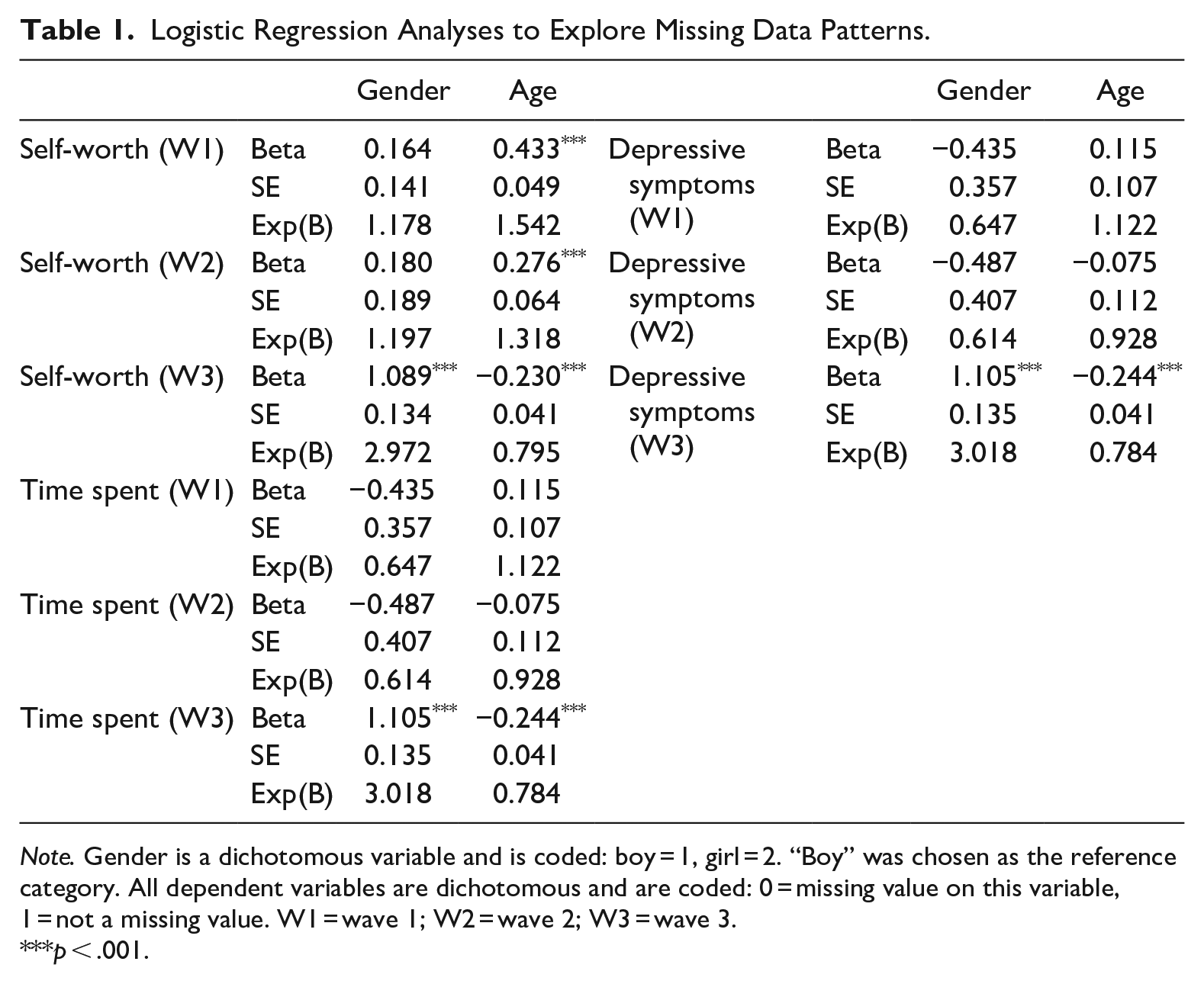
Note. Gender is a dichotomous variable and is coded: boy = 1, girl = 2. “Boy” was chosen as the reference category. All dependent variables are dichotomous and are coded: 0 = missing value on this variable, 1 = not a missing value. W1 = wave 1; W2 = wave 2; W3 = wave 3.
p < .001.
Measures
Demographic Information
Gender was measured such that boys were coded as 1 and girls as 2. Age was calculated by subtracting birth-year from the year in which W1 took place (2019).
Self-Worth Dependency on Social Media Feedback
The self-worth dependency on social media scale (Sabik et al., 2020) was used to assess the extent to which adolescents derived their self-worth from feedback from their friends and followers on social media. The following five items were rated on a 7-point Likert scale ranging from strongly disagree (=1) to strongly agree (=7): (1) My self-esteem depends on how attractive others think pictures of myself are on social media, (2) My self-esteem depends on how others respond to my social media posts, (3) My self-esteem depends on how attractive I think pictures of myself are on social media, (4) I don’t care whether other people respond to my social media posts, and (5) Whether others respond to my social media posts has no effect on what I think about myself.
We explored the factor structure of this scale among an adolescent population with exploratory factor analysis (EFA). Principal axis factoring (PAF) analysis demonstrated a two-factor structure for this scale at W1 (explained variance = 59.984%). Items 1, 2, and 3 form the first factor, the perception that one’s self-worth depends on social media feedback (initial eigenvalue = 2.370, explained variance = 40.217). Item 4 and 5 loaded on a different factor (initial eigenvalue = 1.415, explained variance = 19.767, r = .562, p < .001). Yet, as both item 4 and 5 are negatively-worded, the emergence of this second factor may stem from a methodological artifact rather than a meaningful conceptual difference (van Sonderen et al., 2013). As such, we chose to remove these items from the scale. The remaining items proved to form a reliable scale across waves (ωW1 = 0.818, ωW2 = 0.865, ωW3 = 0.823).
Depressive Symptoms
A 12-item version of the Center for Epidemiologic Studies—Depression scale—was used to assess depressive symptoms in the past week, such as low energy (e.g., “I felt like I was too tired to do things”), negative affect (e.g., “I had crying spells”), and pessimism about the future (e.g., “I don’t feel hopeful about the future”) on a 4-point Likert scale ranging from never/rarely (=1) to always (=4). This scale has been found to be valid and reliable in community samples of adolescents (Poulin et al., 2005). A confirmatory factor analysis (CFA), in which error terms of the same items across the three waves were correlated, confirmed this one-factor structure (χ²(555) = 1869.116, p = 0.000, CFI = 0.903, RMSEA = 0.048, 90% CI = [0.046/0.050], SRMR = 0.050, χ²/df = 3.368). The scale demonstrated good reliability across waves (ωW1 = 0.861, ωW2 = 0.870, ωW3 = 0.878).
Time Spent on Social Media
We also assessed individuals’ time spent on social media for exploratory analyses. Time spent on Facebook, Instagram, TikTok, and Snapchat was measured on a 6-point Likert scale (1 = I do not use, 2 = I use it rarely, 3 = I use it every few weeks, 4 = I use this several times a week, 5 = I use this almost every day, 6 = I use this multiple times a day). Overall time spent on social media was calculated by averaging reported scores across the four different platforms. These four social media platforms were selected because they were the most commonly used by adolescents, our population of interest, at the time of setting up the study (i.e., 2019), (Rideout et al., 2022; Vogels & Gelles-Watnick, 2023), and align with theoretical definitions of social media platforms as having an audience-facing profile, a network of connections, the ability to message others, and a stream of content (Bayer et al., 2020).
Analysis Plan
The hypotheses and analysis plan were pre-registered (https://osf.io/k46x3) (see OSF (https://osf.io/ftwmz/ for data and syntax). Means, standard deviations, zero-order correlations and intra-class correlations [ICC] were calculated. One random intercept cross-lagged panel model [RI-CLPM] (Mulder & Hamaker, 2021) was analyzed with self-worth dependency on social media feedback at W1, W2, W3 and depressive symptoms at W1, W2, W3 as variables in the model.
Mean scores were entered in the model as manifest variables. All manifest variables were regressed on a corresponding latent variable with loadings constrained at 1. Autoregressive, cross-lagged, and concurrent paths were calculated between these latent variables, which represent the within-person part of the model. Random intercept [RI] factors were estimated with the manifest variables at the three time points as indicators, loadings constrained at 1. Then, the error-variances of the manifest variables were constrained at 0 and age was controlled for by modeling predictive pathways to the manifest variables. Afterward, we checked whether the means of the within-person latent variables could be constrained over time to obtain a more parsimonious model. We also investigated whether the variances of the random intercepts significantly differed from 0, indicating stable between-person differences, which makes the RI-CLPM an appropriate analysis technique for our data.
Finally, the moderating role of gender was investigated by conducting a multiple group model. More specifically, the within-person cross-lagged paths and the between-person correlation between the RI’s were constrained to be identical across gender, and this constrained model was compared to an unconstrained model with a χ2 difference test. Model fit was evaluated with the following indices: χ2/df < 3.00, CFI ≥ 0.90, RMSEA ≤ 0.08, 90% CI for RMSEA upper limit ≤ 0.10, and SRMR ≤ 0.09 (Kline, 2005; Little, 2013). We also explored a RI-CLPM with time spent on social media at W1, W2, W3 and depressive symptoms at W1, W2, W3 and looked at the moderating role of gender in this model. Deviations from the pre-registered analysis plan can also be found on OSF and mainly comprise a change in the formulation of the hypotheses, the exploration of the between-person correlation, the multiple group analyses for examining the moderating role of gender, the used measure for time spent and explorative COVID-19 analyses.
Results
Descriptive Statistics
Table 2 shows the means, standard deviations and zero-order correlations. The mean scores on depressive symptoms are at the three waves close to 2, meaning that adolescents on average sometimes felt depressed. For self-worth dependency on social media feedback, the average mean score centers around 3 at the three waves, thus adolescents were on average slightly disagreeing that their self-worth depends on social media feedback. Self-worth dependency on social media feedback correlated positively with depressive symptoms at all waves. Gender correlated with self-worth dependency on social media feedback and depressive symptoms at all waves, in that girls scored higher on these variables. Age correlated negatively with self-worth dependency on social media feedback only at W1, and positively with depressive symptoms at W1 and W3.
Descriptive Statistics and Zero-Order Correlations.
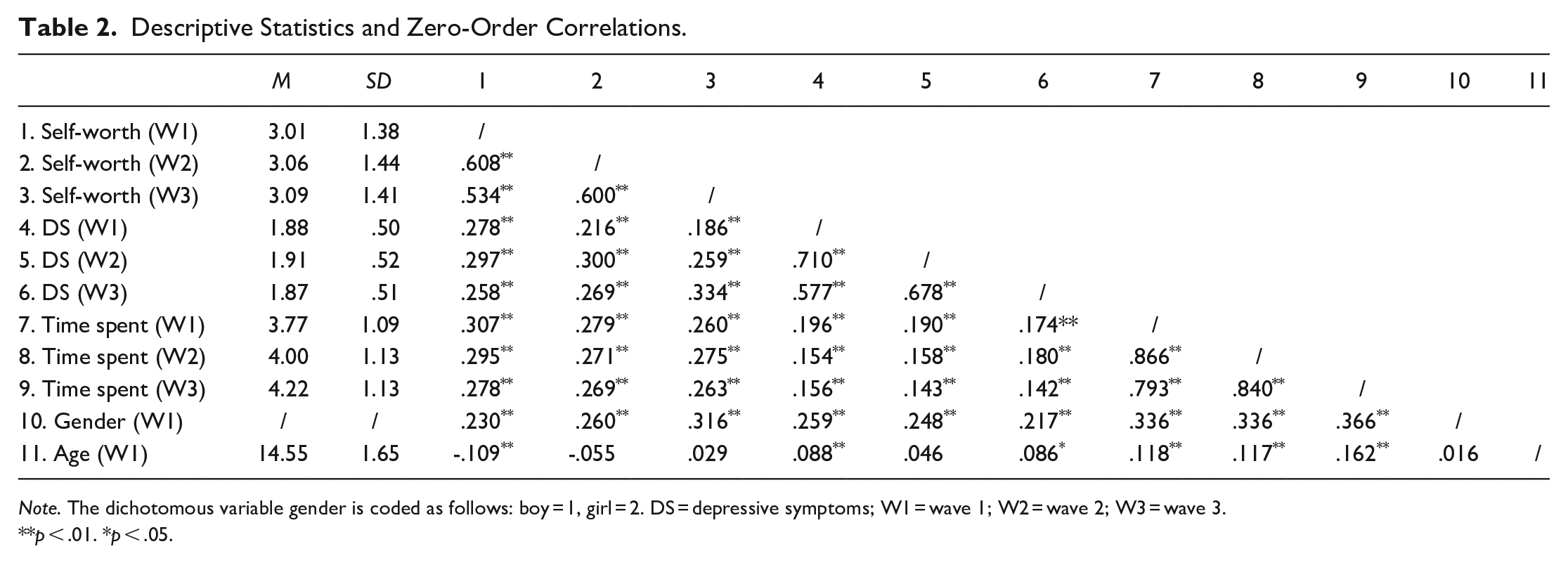
Note. The dichotomous variable gender is coded as follows: boy = 1, girl = 2. DS = depressive symptoms; W1 = wave 1; W2 = wave 2; W3 = wave 3.
p < .01. *p < .05.
Then, we examined the proportions of variance that could be explained by within- and between-person differences with intraclass correlations [ICC]. The ICC was 0.613 for self-worth dependency on social media feedback, indicating that 61.3% of the variance in perceptions of self-worth being dependent on peer social media feedback were from between-person differences whereas the remaining variance can be attributed to within-person differences and error variance. The ICC for depression was 0.683.
Differences in Main Variables Before and After COVID-19 Initiation
Exploratory repeated measures ANOVA’s were conducted to examine differences in the main variables before (W1 and W2) and after (W3) the initiation of the COVID-19 pandemic, only including adolescents who have data on the variables at all three waves in the analyses. For depressive symptoms, the Huynh-Feldt test showed that there were significant differences across the measurement points (F(1.948,1057.724) = 7.273, p < .001). A Bonferroni post-hoc test showed that depressive symptoms at W3 (M = 1.856) were significantly lower than at W1 (M = 1.899) and W2 (M = 1.924). There was no significant difference between W1 and W2. For self-worth dependency on social media feedback, the Huynh-Feldt test showed that there were no significant differences across the measurement points (F(1.965,707.481) = 0.395, p > .05). For time spent on social media, the Huynh-Feldt test showed that there were significant differences across the measurement points (F(1.874, 1,017.651) = 113.922, p < .001). A Bonferroni post-hoc test showed that time spent on social media was significantly higher at W3 (M = 4.225) (after the pandemic outbreak) than at W1 (M = 3.816) and W2 (M = 4.042) (before the pandemic outbreak). Also time spent at W1 and W2 significantly differed from each other.
Random Intercept Cross-Lagged Panel Models
The model had an excellent model fit (χ²(1) = 1.211, p = .271, CFI = 1.00, RMSEA = 0.014, 90% CI = [0.000/0.086], SRMR = 0.007, χ²/df = 1.211). Results from χ² difference tests showed that means could not be constrained over time (χ² unconstrained model = 1.211, df = 1, χ² constrained model = 13.097, df = 5, Δχ²(4) = 11.886, p = .018).
Between-Person Results
We found a significant positive correlation between the random intercepts of the variable for self-worth dependency on social media feedback and depressive symptoms (Table 3). Thus, people who were more dependent on social media feedback for their self-worth at a trait-level also had higher levels of depressive symptoms.
Parameter Estimates.
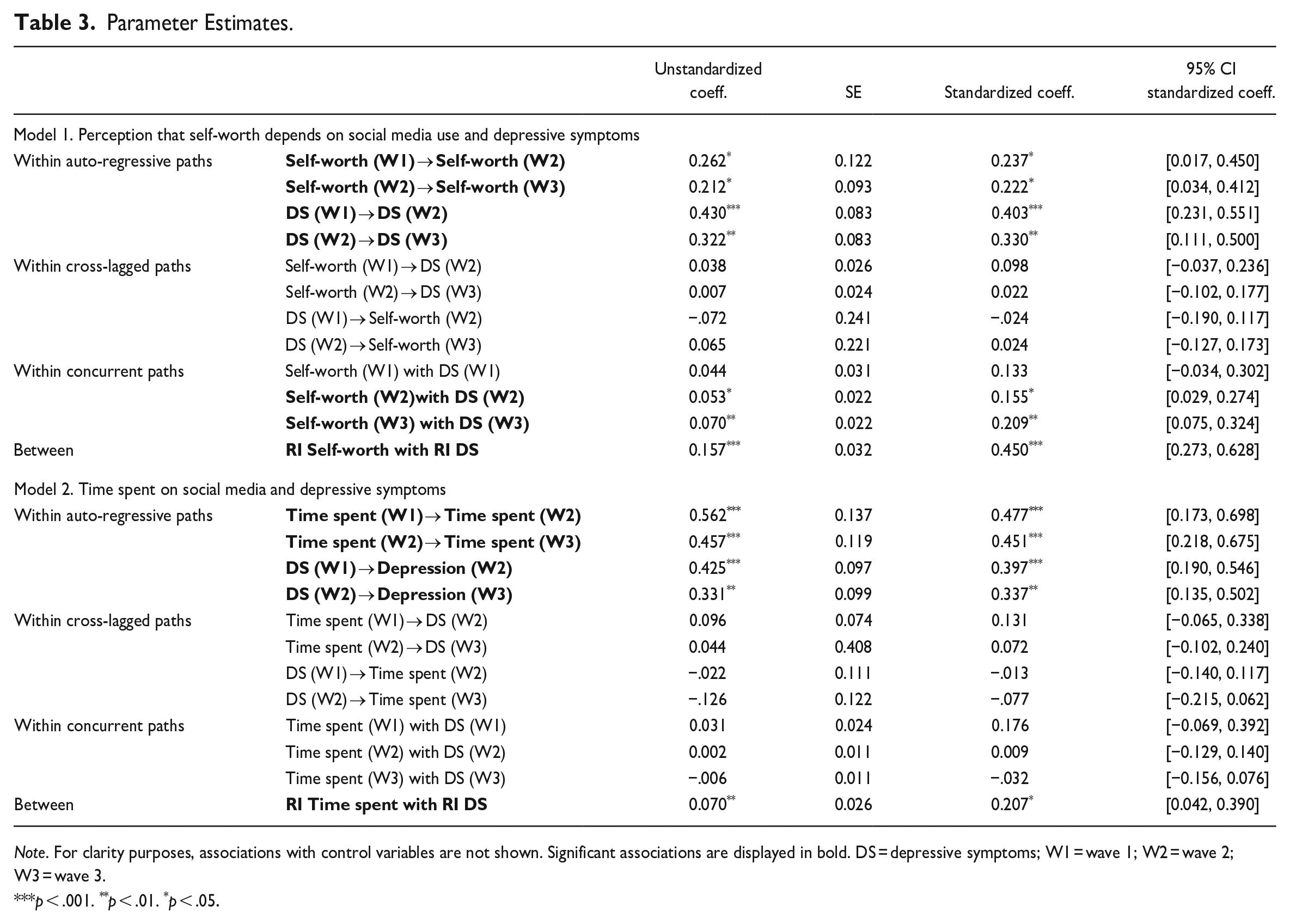
Note. For clarity purposes, associations with control variables are not shown. Significant associations are displayed in bold. DS = depressive symptoms; W1 = wave 1; W2 = wave 2; W3 = wave 3.
p < .001. **p < .01. *p < .05.
Within-Person Results
We next examined parameter estimates of the within-person paths (Table 3). First, all autoregressive paths were significant indicating that there is within-person carry over effect. If an adolescent experiences an increase in self-worth dependency on social media feedback/depressive symptoms at a certain point in time, these levels seem to further increase at a subsequent time point (Mulder & Hamaker, 2021).
None of the cross-lagged paths were significant. This means that when an adolescent became more dependent on social media for their self-worth, this adolescent did not also become more depressed as a result, rejecting H1. There was also no evidence for the reverse effect: when an adolescent experienced an increase in depressive symptoms, the self-worth dependency on social media feedback of this adolescent did not then also increase over time, rejecting H2. Moreover, the concurrent path between self-worth dependency on social media feedback and depressive symptoms at W1 was not significant. Please see the appendix for a visual representation of the model results.
Gender Moderation
To test H3 and H4 regarding the role of gender in these dynamics, we compared a model that constrained the relations to be the same across gender against an unconstrained model. The results of a χ2 difference test showed that the model with the within-person cross-lagged paths and the between-person correlation between the RI’s constrained across gender (χ²(7) = 16.404, p = .022, CFI = .994, RMSEA = .051, 90% CI = [0.018/0.084], SRMR = .034, χ²/df = 2.343) had a significantly worse fit than an unconstrained model (χ²(2) = 3.907, p = .142, CFI = .999, RMSEA = .043, 90% CI = [0.000/0.107], SRMR = .012, χ²/df = 1.954, Δχ²(5) = 2.497, p = .029). Imposing constraints thus did not seem tenable. Using a path-by-path analysis, we calculated difference scores to explore differences between gender groups but did not observe significant results. Therefore, potential gender differences in the model are negligible. H3 and H4 are rejected.
Exploratory Analysis of Time Spent on Social Media and Depressive Symptoms
We conducted an exploratory investigation using a RI-CLPM with time spent on social media at W1, W2, W3 and depressive symptoms at W1, W2, W3 as variables. The model showed an excellent model fit (χ²(5) = 6.466, p = .263, CFI = 1.00, RMSEA = 0.017, 90% CI = [0.000/0.049], SRMR = 0.009, χ²/df = 1.293) and the χ² difference test showed that means were allowed to be constrained over time (χ² unconstrained model = 0.327, df = 1, χ² constrained model = 6.466, df = 5, Δχ²(4) = 6.139, p = .189).
At the between-person level, a significant positive correlation was found between the random intercepts of time spent and depressive symptoms (Table 3). Adolescents who spent more time on Facebook, Instagram, Snapchat and TikTok also reported more depressive symptoms. However, none of the cross-lagged paths at the within-person level between time spent and depressive symptoms were significant, nor the concurrent path at W1 (Table 3), and we did not observe a moderating role of gender (constrained model: χ²(11) = 13.738, p = .248, CFI = 0.999, RMSEA = 0.022, 90% CI = [0.000/0.054], SRMR = 0.019, χ²/df = 1.249; unconstrained model: χ²(6) = 0.90.713, p = .137, CFI = 0.999, RMSEA = 0.035, 90% CI = [0.000/0.073], SRMR = 0.014, χ²/df = 1.619, Δχ²(5) = 4.025, p = .546).
Discussion
The current study investigated the between and within-person associations between self-worth dependency on social media feedback and depressive symptoms among adolescents. A strong correlation was found at the between-person level, indicating that adolescents who perceive their self-worth to be more dependent on social media feedback also have higher trait like symptoms of depression. However, there was no evidence for within-person relations. Our research contributes to the ongoing discussion regarding the relationship between social media use and psychological well-being. It specifically addresses the question of how subjective perceptions of social media use impact depressive symptoms among adolescents while differentiating within- from between-person processes. We discuss these results and their implications for research on the relationship between social media use and adolescents’ well-being in more detail below.
Between-Person Results
We found a positive correlation between self-worth dependency on social media feedback and depressive symptoms at the between-person level. Individuals who derived more of their self-worth from how others perceived them on social media also tended to experience more depressive symptoms. This finding resonates with previous research that found similar relationships yet among young women (Sabik et al., 2020) and research that cross-sectionally linked general social media use, as well as specific efforts to seek feedback through social media, to the experience of depressive symptoms (e.g., Nesi & Prinstein, 2015; Tsitsika et al., 2014). Though these between-person results do not speak to the possible effects of social media use, it is informative as it indicates that adolescents differ in the extent to which they derive their self-worth dependency from social media feedback as well as in depressive symptoms, and that these differences are correlated (Valkenburg et al., 2021).
As there were no effects at the within-person level, third variables likely account for this between-person association (Coyne et al., 2020). For instance, adolescents who experience more depressive symptoms and derive more of their self-worth from social media feedback may have higher trait-levels of depression or lower trait-levels of self-esteem, which both undermine their well-being and cause them to seek social validation from online sources. They may also differ in their desire to be liked or to feel a sense of belonging. People have an intrinsic need to maintain strong, stable interpersonal relationships and to feel accepted by others (Baumeister & Leary, 1995). Walton and Wilson (2018) argue that the need to belong and to feel seen, respected, and valued by others in their lives is a driving psychological need that informs individuals’ thinking, feeling, and behavior. Generally, adolescents who struggle to fulfill these needs may have more depressive symptoms (Steers, 2016).
Also, adolescents can differ in their need for popularity, an internal drive to achieve and sustain a favorable social status, which for some adolescents may be more pivotal than simply being liked (Beyens et al., 2016; Garandeau & Lansu, 2019; Santor et al., 2000). Self-determination theory (Ryan & Deci, 2000) suggests that adolescents may turn to social media to gratify their need to be liked, to belong, and to be popular by looking for positive social feedback from their friends and peers online (Beyens et al., 2016; Steers, 2016). Thus, these unmet social needs could explain why some adolescents experience both more depressive symptoms and are more dependent on social media to determine their self-worth. Crucially, we note that there are many other third variables such as loneliness, internalizing problems and peer attachment that may explain this relationship and future research is needed to further identify these.
Within-Person Results
At the within-person level, part of the variance is explained by within-person carry over effects as the autoregressive paths for the self-worth dependency on social media feedback components as well as for the depressive symptoms components were significant. Yet, none of the cross-lagged paths between self-worth dependency on social media feedback and depressive symptoms later in time, nor the reverse paths between depressive symptoms and self-worth dependency later in time, were significant, rejecting H1 and H2.
The lack of evidence for within-person effects of self-worth dependency on depressive symptoms may result from self-worth dependency representing a narrow set of subjective experiences. Even though adolescents who have a stronger dependency on social media feedback for their self-worth experience in general more depressive symptoms (i.e., between-person), experiencing an increase in self-worth dependency at a certain moment in time may be too specific to truly cause change in depressive symptoms on its own (i.e., within-person). Yet, it may be influential to the extent that it is part of a larger orientation toward social media that is implicated in well-being. As Lee and Hancock (2023) find, having the mindset that one is in control of one’s social media use is a crucial component to positive experiences with social media. While an increase in self-worth dependency alone may not necessarily increase depressive symptoms, it may influence well-being as part of a larger mindset that is fundamentally about the dynamics of power and control between the user and social media use. This remains to be tested though in future research.
Moreover, the overall null effects at the within-person level may speak to the need to observe these media effects at a more granular timescale. For instance, an adolescent who derives their self-worth from peer social media feedback may experience fluctuations in self-esteem over a short time-span (e.g., over the course of hours), as it theoretically follows daily negative and positive experiences with peer feedback (Cambron et al., 2010). As such, increases in depressive symptoms may immediately follow such daily fluctuations in self-esteem (Cambron et al., 2010), but may not be observable in longer term effects that manifest themselves 4 months later, as in this study (Valkenburg et al., 2021).
Conversely, the effects of social media dependency on depressive symptoms may emerge when accumulated over the course of months or years (Schmuck et al., 2023). Depressive symptoms typically develop through a complex interplay of different biological, interpersonal, cognitive, and emotional processes, which all unfold over different timescales. The interaction between specific social media experiences and any combination of stressors may inform depressive symptoms years later (Coyne et al., 2020; Hankin, 2006). For instance, deriving one’s self-worth from social media feedback may not be psychologically consequential after some months, but may erode mental health if maintained over several years - particularly during vulnerable periods of development like adolescence. Indeed, subclinical and clinical depression often develops over the course of years in adolescence and can even span over different developmental phases (Crockett et al., 2020).
Several longitudinal studies have examined the links between social media use and depressive symptoms over brief time-spans (e.g., an experience-sampling study with seven daily reports for 14 consecutive days; Aalbers et al., 2019), as well as long time-spans (e.g., an 8 years longitudinal study with yearly measurements; Coyne et al., 2020), but neither found consistent support for any form of social media effects. However, these studies may have been limited by their reliance on general measures of time spent and passive use instead of more specific social media experiences that are theoretically relevant to depressive symptoms. Therefore, future research is advised to work with measurement burst designs that integrate short and longer time-spans and to apply statistical continuous time modeling techniques (Keijsers & Van Roekel, 2019; Schmuck et al., 2023), as well as to investigate a broader range of experiences with social media. Moreover, as the intraclass correlation shows that some variance in depressive symptoms can be attributed to within-person fluctuations, other factors than social media experiences may account for these fluctuations at a 4 month time lag such as the experience of (subsequently occurring) negative life events which rises dramatically after the age of 13 (Hankin, 2006). Future research can therefore look at which other factors explain within-person changes in depressive symptoms among adolescents at an intermediate time interval.
Gender Differences
We did not find support for a moderating role of gender in the within-person associations between depressive symptoms and self-worth dependency, rejecting both H3 and H4. These null results align with the research of Coyne et al. (2020) who did not find stronger within-person associations between time spent on social media and depressive symptoms for girls, relative to boys. It may be possible that no gender differences were found because the effects of self-worth dependency on social media feedback on depressive symptoms vary from person to person, and thus from boy to boy and from girl to girl (Beyens et al., 2020). The found estimates for the within-person effects are still average effects, and these average effects may not be representative for many of the adolescents in our sample (Masselink et al., 2018). This possible heterogeneity may also explain the overall null results at the within-person level (Beyens et al., 2020). Future research may consider designs that allow for person-specific analyses when investigating subjective experiences on social media use and well-being indicators.
Time Spent on Social Media
Finally, we conducted an exploratory investigation into the between- and within-person associations between time spent and depressive symptoms. Here, a positive significant correlation was found at the between-person level, indicating that adolescents who spent more time on Instagram, Snapchat, TikTok, and Facebook reported more depressive symptoms. However, as the within-person associations were not significant, there was no evidence for an effect of time spent on depressive symptoms, nor of depressive symptoms on time spent. This pattern of results aligns with several recent studies that advanced the social media and well-being field by separating within- from between-person dynamics among adolescents when looking at time spent specifically (e.g., Coyne et al., 2020; Orben et al., 2019).
We note that the size of the standardized between-person correlation between time spent and depressive symptoms (0.21) was smaller than that of self-worth dependency and depressive symptoms (0.45). Yet for both measures, no support was found for within-person processes. It might still be advisable though to adopt measures of subjective experiences of social media use instead of frequency measures as subjective experiences can more reliably be estimated in self-reports. Frequency estimations through self-reports are constrained by inaccurate recall, especially by adolescent users, yet perceptions of use aspects can be reliably measured through self-reports (Verbeij et al., 2021). In studying the relations between social media and well-being indicators, perceived social media use may even be theoretically more interesting than actual frequency of use (Sewall et al., 2020; Verbeij et al., 2021). It thus seems needed to look further at other, more holistic experiences with social media (Lee & Hancock, 2023) to unpack its potential effects on our lives.
Limitations and Future Directions
Our study was limited in several ways that can be addressed through future research. First, we note that the adolescents in our sample were asked to self-report their depressive symptoms. Though this is a common approach to examine mental health indicators among adolescents (Coyne et al., 2020), it may be biased by adolescents being less likely to self-report symptoms of well-being that they consider socially undesirable. Particularly when investigating symptoms that may reach levels of clinical severity (e.g., depression), it may be valuable for future work to combine self-assessment surveys with informant data from adolescents’ parents, teachers, or peers (Haroz et al., 2014).
Moreover, many adolescents were removed from the analytical sample due to a failed or missed attention check. Removing these adolescents increased the quality of the data (Shamon & Berning, 2020), yet it also affected the power of the study. A post hoc power analysis in R showed that this study has a power of .5. This study’s design is already an improvement over much of the other published studies in our field that address the links between social media use and well-being and thereby often uses small samples in cross-sectional or two-wave longitudinal designs among college students or US adolescents (e.g., Hancock et al., 2022; Vidal et al., 2020). We thus believe it is still valuable to report the estimates found in the view of science accumulation as they can serve as a basis for future research. Yet, the results should thus be interpreted with caution due to insufficient power. As the original sample would have resulted in a conventional power level, future research among adolescents in schools should find ways to motivate them better to fill in the questions seriously and with the needed attention.
Furthermore, older adolescents, boys and adolescents with higher levels of depressive symptoms were more likely to have participated in only one of the three waves. This is similar to drop-out patterns in other longitudinal studies among adolescent well-being (e.g., Masselink et al., 2018) and has implications for the generalizability of our findings to these groups of adolescents. Also, missing data patterns in our data were not completely missing at random, but missing at random as these patterns were dependent on known characteristics such as age and gender (Gelman & Hill, 2007). We limited the potential distorting of estimates with the FIML estimator which can very well handle missing data patterns under the missing data at random assumption (Masselink et al., 2018).
Additionally, we note a relatively large attrition from W2 to W3 due to the COVID-19 pandemic. The data collection for Wave 3 took place in June 2020, which was immediately after the first nationally imposed lockdown period in [country]. The timing of this unavoidable event may have impacted the results, as time spent on social media was found in our exploratory analyses to be significantly higher during the third wave whereas depressive symptoms were significantly lower. The latter finding is rather surprising, yet research indicates that adolescent depressive symptoms may particularly have elevated later in the pandemic and not at the beginning (i.e., W3 took place in June 2020, only 3 months after the initiation of the pandemic) (Racine et al., 2021). The observed decrease may even suggest that other factors that are known to typically influence depressive symptoms such as perceived social support (Crockett et al., 2020) were more pronounced during the timing of W3, resulting in lower depressive symptoms than before. As with other longitudinal data impacted by COVID-19, additional research is needed to replicate findings in future work.
Conclusion
This longitudinal study investigated the association between adolescents’ self-worth dependency on social media feedback and their depressive symptoms. We contributed to research on social media effects by complementing examinations of time spent on social media with more granular assessments of individuals’ subjective perceptions of the role that social media plays in their lives, with respect to between- and within-person processes. Our results indicate that people who staked more of their self-worth on the feedback they obtained from their social media self-presentations also tended to be more depressed. While these between-person effects were significant, we did not observe evidence of within-person effects in our study - counter to conventional claims that social media use can exacerbate depressive symptoms. Our findings highlight the need to disentangle between- and within-person dynamics when considering subjective experiences in social media research as it will help to draw more accurate conclusions about the role of social media in adolescents’ lives.
Supplemental Material
sj-docx-1-crx-10.1177_00936502241233787 – Supplemental material for When Adolescents’ Self-Worth Depends on Their Social Media Feedback: A Longitudinal Investigation With Depressive Symptoms
Supplemental material, sj-docx-1-crx-10.1177_00936502241233787 for When Adolescents’ Self-Worth Depends on Their Social Media Feedback: A Longitudinal Investigation With Depressive Symptoms by Lara Schreurs, Angela Y. Lee, Xun “Sunny” Liu and Jeffrey T. Hancock in Communication Research
Footnotes
Declaration of Conflicting Interests
The authors declared no potential conflicts of interest with respect to the research, authorship, and/or publication of this article.
Funding
The authors disclosed receipt of the following financial support for the research, authorship, and/or publication of this article: This work was supported by the Research Foundation Flanders (FWO-Vlaanderen) under Grant 11D3119N and Grant V400122N. Angela Y. Lee is supported by the Stanford Interdisciplinary Graduate Fellowship.

Supplemental Material
Supplemental material for this article is available online.