







Abstract
The relationship between trust in the news media and news use has been studied extensively, yet findings remain inconsistent. We argue that a key source of this inconsistency is the conflation of two distinct forms of media distrust: skepticism and cynicism. Additionally, prior research largely relies on self-reported news use, which is prone to bias. To address both issues, we link survey data with web-tracking data from 739 participants during the 2021 German federal election. We show that skeptics and cynics differ in personality traits, political orientations, and news-use motivations, and – crucially – in their actual news consumption behavior. While skepticism is associated with broader and more intense news exposure, cynicism is linked to lower exposure, particularly to established journalistic mainstream media. These results demonstrate that different forms of media distrust are associated with distinct patterns of news exposure, underscoring the importance of conceptual and behavioral precision in media trust research.
Introduction
The relationship between media trust and media usage is a central topic in contemporary communication research. Yet despite extensive empirical work, there is little consensus on whether media trust is positively or negatively associated with news use, or whether high trust facilitates citizenship or fosters uncritical information acceptance (Fawzi et al., 2021; Hanitzsch et al., 2018).
One source of this ambiguity lies in how news use is measured. Self-reported media use is prone to recall errors, social desirability bias, and misattribution – issues that are particularly pronounced in fragmented, high-choice online news environments (de Vreese & Neijens, 2016; Niederdeppe, 2016; Parry et al., 2021). A second source of inconsistency concerns the conceptualization of media trust and distrust. Measures of media trust are often heterogeneous (Mangold, 2024; Matthes & Kohring, 2003) and frequently used interchangeably with related concepts such as skepticism, distrust, or credibility, thereby obscuring important conceptual distinctions (Fawzi et al., 2021).
Central to this paper is the argument that prevailing approaches conflate fundamentally different forms of media distrust. In particular, they fail to distinguish between reflective skepticism and non-reflective cynicism – two orientations that both imply distrust but rest on different cognitive and motivational foundations. Because these forms of distrust differ in their underlying logic, we expect them to exhibit distinct correlates – such as political interest, personality traits, and news-use motivations – and, most importantly, to be associated with markedly different patterns of news consumption.
Building on this argument, this study makes four contributions. First, we conceptually differentiate media cynicism and media skepticism as distinct forms of media distrust and demonstrate how this distinction matters for news selection in a high-choice digital media environment. Second, by linking survey-based measures of media distrust to passively tracked online news exposure, we move beyond reliance on self-reported behavior and provide behavioral evidence for the consequences of distinct distrust orientations. Third, by situating media skepticism and cynicism within a structured nomological framework – including personality traits, political orientations, and news-use motivations – we shed light on their distinct antecedent profiles and embeddedness within broader psychological and political constellations. Fourth, we contribute to ongoing debates about the normative implications of media (dis)trust by showing that low trust is not uniform in its democratic implications but may reflect qualitatively different orientations toward informational and institutional engagement.
Our empirical focus on online news consumption is theoretically and contextually grounded. Digital environments constitute the primary arena in which selective exposure, cross-cutting encounters, and avoidance can be observed in real time, making them particularly suitable for distinguishing reflective skepticism from rejection-oriented cynicism (Mangold et al., 2024). Moreover, in Germany and most other media systems, hyperpartisan and alternative outlets operate predominantly in the digital sphere, rendering online news use the most relevant domain for assessing distrust-driven selection patterns (Prochazka & Schweiger, 2019; Van Aelst et al., 2017). Accordingly, digital exposure constitutes the substantively appropriate behavioral domain for examining how different forms of distrust translate into observable selection patterns.
Media Trust and Media Distrust
Although definitions of media trust vary, many scholars conceptualize it along lines similar to interpersonal trust: Trust implies that the recipient (the trustor) places reliance on the media (the trustee) under conditions of vulnerability, expecting that media adhere to professional norms and fulfill their societal role responsibly despite the opportunity to mislead or deceive. In this view, trust reflects a forward-looking evaluative expectation regarding competence, integrity, and benevolence (Fawzi et al., 2021; Strömbäck et al., 2020).
Conceptualizations become more ambiguous when attention shifts to the negative side of trust. It remains contested whether media distrust (or mistrust) simply represents the absence of trust or constitutes a distinct construct with its own psychological and motivational foundations. As negative attitudes toward the news media have increasingly attracted scholarly attention, a growing variety of terms has emerged to describe them, reflecting persistent conceptual ambiguity in the field, including skepticism (Tsfati & Cappella, 2005; Tsfati & Peri, 2006), cynicism (Carr et al., 2014), hostile media perceptions (Engelke et al., 2019), or populist portrayals of the media as an “enemy of the people” (Fawzi, 2019).
While these approaches acknowledge that negative orientations toward the media are multifaceted, they often remain conceptually underspecified with regard to the underlying cognitive style and motivational orientation of distrust (Markov & Min, 2022; Quiring et al., 2021; Tsfati & Barnoy, 2025). Consequently, distinct forms of negative evaluation may be conflated, even though they could rest on fundamentally different assumptions about journalistic intentions, information quality, and the openness to revising one’s judgments.
This conflation becomes particularly consequential when examining the relationship between distrust and news use. If distrust reflects scrutiny and epistemic caution, it may be associated with active information seeking and diversified news exposure. If, by contrast, it reflects a generalized rejection of journalistic institutions and closed-minded attribution of hostile motives, it may coincide with selective avoidance of mainstream news. Without distinguishing such orientations, empirical findings on the relationship between media trust and media consumption are likely to remain inconsistent.
For this reason, we argue that a meaningful differentiation between different forms of media distrust is necessary. In the following, we develop a distinction between media skepticism as a reflective and open orientation toward journalistic content and media cynicism as a rejection-oriented and comparatively closed form of distrust.
Media Skepticism and Media Cynicism
Negative orientations toward institutions vary not only in intensity but also in their underlying attributional logic and epistemic style. We analytically distinguish two complementary orientations that jointly structure different forms of media distrust: an evaluative orientation concerning how journalistic actors and institutions are judged, and an epistemic dimension concerning how individuals approach, process, and potentially scrutinize or reject information (from the media). Importantly, these orientations are conceptualized as analytical axes that define distinct configurations of distrust, rather than as directly observable or independently measured dimensions. In line with this conceptualization, we do not treat skepticism and cynicism as opposite ends of a single continuum of media (dis)trust. Rather, we conceptualize them as qualitatively distinct configurations within a broader conceptual space defined by evaluative and epistemic orientations. This positioning contrasts with approaches that locate distrust on a unidimensional continuum ranging from (automatic) trust to generalized mistrust.
Evaluative Orientation: Fallibility Versus Hostile Intent
With regard to evaluative orientation, both skepticism and media cynicism share a critical stance toward the news media, yet they differ fundamentally in the type of negative attribution they involve (Pinkleton et al., 2012). Media skepticism reflects the belief that journalists and media organizations are fallible and may produce inaccurate, incomplete, or biased information (Hanitzsch et al., 2018; Mangold, 2024; Strömbäck et al., 2020). Such doubt concerns competence, reliability, or professional standards, but does not necessarily assume malicious intent. Journalistic actors are perceived as capable of error or structural bias, yet not as normatively corrupt or deliberately deceptive. Media cynicism, by contrast, entails a qualitatively different form of negative evaluation. It is characterized by the attribution of hostile motives: journalists are perceived as manipulative, self-serving, or controlled by powerful elites (Austin & Pinkleton, 1999; Cappella & Jamieson, 1997; Markov & Min, 2022; Pinkleton et al., 2012). In this view, the media are not merely imperfect institutions, but fundamentally untrustworthy actors driven by hidden agendas. Cynical attitudes thus resemble broader traditions of political cynicism that assume normative corruption and strategic deception by elites (Cappella & Jamieson, 1997; Fawzi, 2019). The decisive distinction, therefore, lies not in the strength of criticism, but in its attributional source: human fallibility versus intentional wrongdoing.
Epistemic Orientation: Openness Versus Closure
The second orientation concerns epistemic style – that is, how individuals engage with information and whether their evaluative judgments remain open to revision. Media skepticism is characterized by reflective doubt. Drawing on work linking skepticism to reflective processing and cognitive elaboration (Pinkleton et al., 1998; Tsfati & Barnoy, 2025), we conceptualize it as a reflective institution-oriented form of distrust expressed through active scrutiny and source comparison in the context of media engagement. They scrutinize claims, compare sources, and remain willing to revise their judgments when confronted with new evidence (Pinkleton et al., 1998). Critical evaluation is thus paired with epistemic openness. Media cynicism, in contrast, is marked by epistemic closure. Cynics treat distrust as settled and self-evident. Journalistic intentions are assumed to be corrupt (Markov & Min, 2022; Quiring et al., 2021), rendering further scrutiny unnecessary. This form of distrust resembles what Tsfati and Barnoy (2025) describe as “automatic” orientations – here in its negative variant – characterized by low reflection and rigid attributional patterns.
Taken together, these two orientations delineate a broader conceptual space of media-related orientations in which both positive and negative evaluations can occur at varying levels of reflection (Figure 1). At the positive pole, one could analogously distinguish between automatic trust – high trust combined with low reflection – and reflective trust – high trust following deliberative scrutiny (Tsfati & Barnoy, 2025). The present study focuses specifically on the two distrust-oriented configurations within this space: media skepticism (negative evaluation combined with epistemic openness) and media cynicism (negative evaluation combined with epistemic closure). Both represent forms of distrust, yet they rest on distinct attributional and cognitive foundations. Distinguishing these two orientations provides a more precise conceptual basis for examining their distinct antecedents and behavioral consequences.
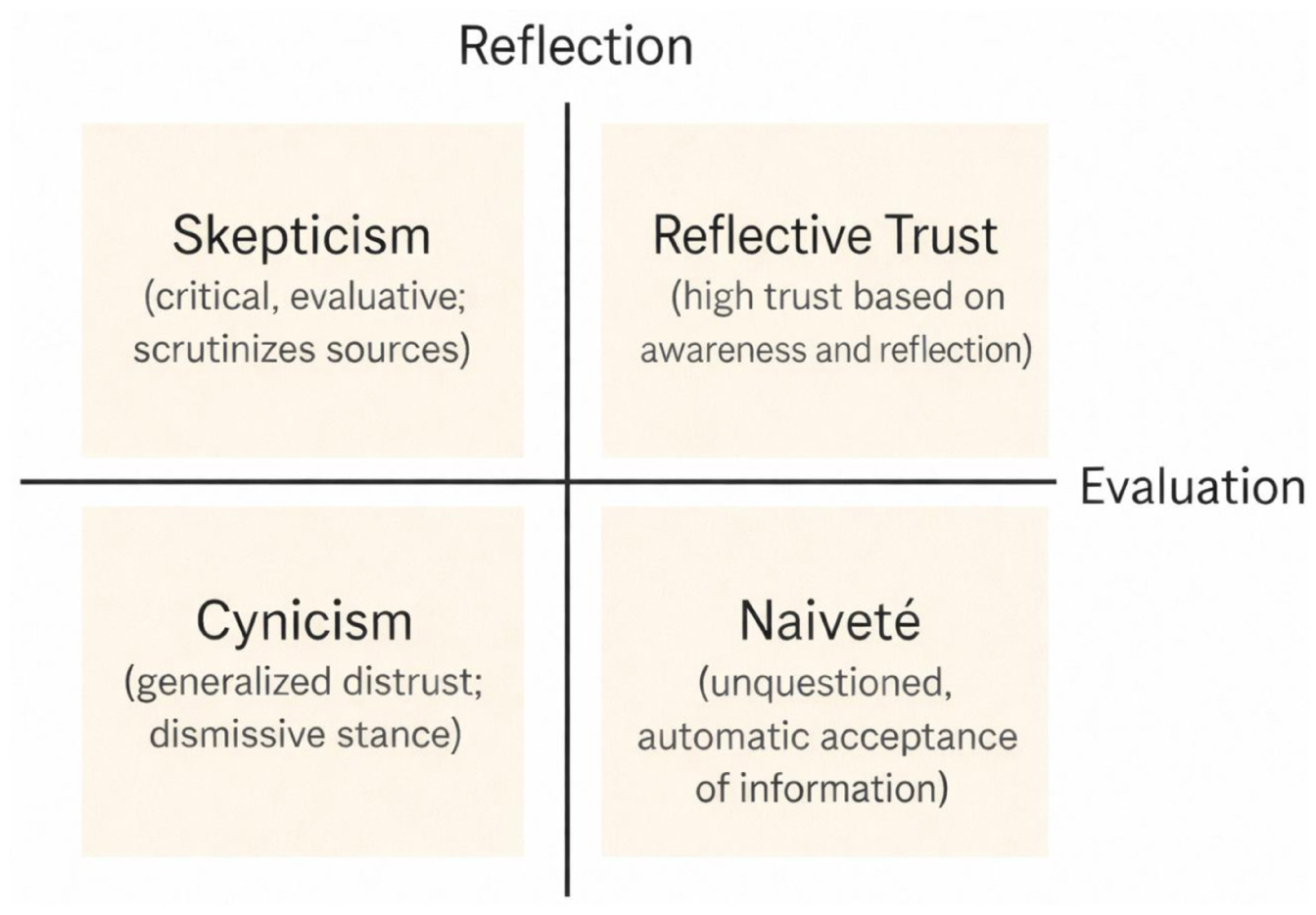
Analytical framework for configurations of media trust and distrust.
Nomological Positioning of Media Skepticism and Media Cynicism
To further substantiate the distinctiveness of media skepticism and media cynicism, we situate both orientations within a broader nomological framework. If these constructs reflect different attributional and epistemic configurations, they should map onto systematically different dispositional, political, and motivational correlates. We therefore examine their associations with generalized media trust, personality traits, political orientations, and news-use motivations. Demonstrating distinct patterns across these domains would support the claim that skepticism and cynicism represent qualitatively different forms of media distrust rather than semantic refinements of a single construct.
Media Cynicism, Media Skepticism, and General Media Trust
Although media skepticism and media cynicism represent distinct configurations of evaluative and epistemic orientations, both reflect negative evaluations of the news media. As such, they should be systematically related to generalized media trust. While prior research has suggested that certain forms of skepticism may correlate positively with trust (e.g., Quiring et al., 2021), such findings often conceptualize skepticism as a balanced or constructive orientation that may coexist with high institutional confidence. In contrast, we define media skepticism as a reflective, yet explicitly distrust-oriented stance grounded in assumptions of fallibility. Cynicism, in contrast, reflects a more attributionally hostile and epistemically closed form of distrust. Despite their structural differences, both orientations entail critical evaluations of journalistic institutions and should therefore be negatively associated with generalized media trust. We therefore expect that:
Personality Traits
If media skepticism and media cynicism reflect distinct epistemic and attributional orientations, these differences should be traceable to stable personality traits. Personality captures enduring patterns of cognitive processing and social attribution.
Among the Big Five traits, openness to experience is particularly relevant. Openness reflects intellectual curiosity and cognitive flexibility (Gosling et al., 2003) and has been linked to deeper information processing and cross-cutting exposure (Gerber et al., 2011; Kim & Kim, 2018). These tendencies align with the reflective and epistemically open profile of media skepticism, whereas lower openness is conceptually closer to the cognitive closure underlying media cynicism (Sibley & Duckitt, 2008). We therefore expect:
In addition to epistemic differences, media cynicism is also characterized by a distinct attributional logic. Whereas skepticism attributes inaccuracies to fallibility or structural constraints, cynicism rests on the assumption of hostile intent. Such hostile and adversarial evaluations are conceptually aligned with personality traits associated with suspicion and threat sensitivity, particularly low Agreeableness and high Neuroticism (Gerber et al., 2011; Pattyn et al., 2012). Agreeableness captures interpersonal trust, empathy, and cooperative orientation, whereas lower agreeableness is associated with distrustful and adversarial perceptions of others (Gerber et al., 2011). Cynical orientations toward the media, which emphasize manipulation and hidden motives, should therefore be negatively related to agreeableness. Neuroticism, in turn, reflects emotional instability and heightened sensitivity to threat. Individuals high in neuroticism are more likely to perceive uncertainty and external actors as threatening, which may reinforce hostile attributions toward institutions, including the news media. We therefore expect:
Political Orientations
Beyond stable personality traits, media skepticism and media cynicism should also be embedded in broader political orientations. Given their distinct evaluative and epistemic structures, skepticism and cynicism should differ systematically in how they relate to political engagement and elite-oriented attitudes. Media skepticism, as a reflective form of distrust, is compatible with continued political engagement. Political interest and internal efficacy capture motivational and cognitive involvement in public affairs and should therefore align positively with skepticism. Media cynicism, by contrast, combines hostile attributions with epistemic closure and may coincide with disengagement and reduced efficacy (Cappella, 2002; Cappella & Jamieson, 1997; Pinkleton et al., 2012). Accordingly, we expect:
In addition to political engagement, skepticism and cynicism should also differ in their relationship to broader evaluations of elites and democratic institutions. Whereas skepticism questions journalistic practices without assuming intentional corruption, cynicism attributes self-serving or manipulative motives to institutional actors. These attributional patterns closely resemble populist worldviews, which emphasize a moral opposition between “corrupt elites” and “the pure people” (Fawzi, 2019; Hanitzsch et al., 2018; Schulz et al., 2018). Media cynicism should therefore be associated with stronger populist attitudes and lower satisfaction with the functioning of democracy. Media skepticism, by contrast, reflects conditional and potentially revisable doubt rather than generalized institutional rejection and should therefore be less strongly related to anti-elite orientations. Accordingly, we expect:
News-Use Motivations
News-use motivations represent more proximal orientations toward information engagement and bridge underlying dispositions and actual exposure behavior. Since media skepticism is characterized by reflective doubt and epistemic openness, it implies continued engagement with political information despite critical evaluation. Skeptical individuals may question journalistic performance, yet they remain motivated to stay informed and to actively seek political news. Such engagement does not imply uncritical acceptance, but rather sustained involvement combined with evaluative scrutiny. Media cynicism, by contrast, reflects epistemic closure and hostile attributions toward journalistic institutions. If news media are perceived as fundamentally manipulative or corrupt, motivation to engage with mainstream political information may decline. Cynical orientations may therefore coincide with greater tendencies toward news avoidance and motivational withdrawal from political coverage.
Behavioral Consequences of Media Skepticism and Media Cynicism
While the preceding sections situated media skepticism and media cynicism within dispositional, political, and motivational domains, the most central contribution of this study lies in examining whether these distinct orientations are reflected in observable patterns of online news exposure. If media skepticism reflects a critical yet epistemically open stance toward journalistic content, it should coincide with continued engagement with news and a broader integration of information sources. Prior research suggests that distrust does not necessarily lead to disengagement and may, under certain conditions, coexist with sustained or even increased exposure (Andersen et al., 2022; Tsfati, 2010; Tsfati & Cappella, 2003). Media cynicism, by contrast, combines hostile attributions toward journalistic actors with epistemic closure, which may correspond to reduced engagement with mainstream journalism and narrower, more selective exposure patterns. Research on news avoidance and selective exposure indicates that alienated or distrustful citizens may reduce their engagement with mainstream political news (Prior, 2007; Skovsgaard & Andersen, 2020).
We examine these expectations across three analytically distinct dimensions of online news exposure: overall exposure volume, the structure of individual news repertoires, and the allocation of exposure across different outlet types. Empirical research on the relationship between media distrust and news use remains inconclusive. While some results suggest that critical orientations toward the media are associated with reduced exposure and narrower repertoires, others point to sustained or even increased engagement under conditions of distrust (e.g., Fawzi et al., 2021; Markov & Min, 2022; Quiring et al., 2021; Tsfati & Barnoy, 2025). Importantly, findings have been shown to vary depending on the specific forms of distrust considered and the types of media examined. As a result, the behavioral implications of media distrust remain difficult to generalize and compare across studies. Distinguishing between different forms of distrust therefore provides a more precise basis for understanding these divergent findings.
The most fundamental behavioral distinction concerns overall exposure to political news. Epistemic openness implies continued engagement with information even under critical evaluation. Skeptics, who question journalistic performance but remain open to revising judgments, should therefore exhibit comparatively higher levels of news exposure. Cynics, in contrast, who attribute hostile motives to journalistic actors and treat distrust as settled, may disengage from mainstream news environments more broadly.
Beyond volume, the structure of individuals’ online news repertoires provides insight into how information is integrated in high-choice environments. Research on digital news repertoires emphasizes that variety and diversity capture distinct aspects of news integration (Fletcher et al., 2023; Scharkow et al., 2020; Schmidt et al., 2024). Repertoire variety reflects the number of distinct news outlets visited, whereas repertoire diversity captures how evenly attention is distributed across these outlets. Epistemic openness suggests consultation of multiple sources and comparison across perspectives, which should be reflected in both greater repertoire breadth and a more balanced distribution of attention. Cynicism, by contrast, may coincide with narrower and more concentrated repertoires consistent with pre-existing hostile attributions.
Beyond structural characteristics of news repertoires, skepticism and cynicism are also expected to differ in how exposure is allocated across types of outlets. Studies have shown that distrust in mainstream journalism is associated with increased use of alternative or counter-establishment sources (Mangold et al., 2024; Tsfati, 2010).
Media cynicism entails hostile attributions toward mainstream journalistic media. If legacy or quality media are perceived as manipulative, biased, or captured by elites, cynical individuals may reduce their exposure to these outlets and redirect attention toward alternative or hyperpartisan sources that are perceived as oppositional. 2 In this sense, exposure to hyperpartisan news among cynics reflects substitution: alternative outlets become comparatively more attractive in light of distrust toward mainstream journalism, whereas exposure to quality news should decrease (Prochazka & Schweiger, 2019; Strömbäck et al., 2020). Media skepticism, by contrast, does not involve wholesale rejection of journalistic institutions. Instead, it reflects a reflective and accuracy-oriented stance toward news content. Skeptics may critically evaluate mainstream journalism while still engaging with it as a central informational reference point. At the same time, epistemic openness and source comparison may increase the likelihood of encountering ideologically diverse or hyperpartisan outlets as part of a broader evaluative repertoire (Mangold & Bachl, 2018; Sui & Pingree, 2022). From this theoretical viewpoint, exposure to hyperpartisan sources reflects monitoring and cross-referencing rather than endorsement, and occurs alongside continued engagement with quality journalism. Accordingly, we expect:
Testing these behavioral expectations requires measures that capture outlet differentiation, repertoire structure, and exposure intensity with sufficient precision. However, the literature demonstrates that self-reported media use correlates only weakly with passively logged behavior (Parry et al., 2021). Survey reports are systematically affected by recall error, social desirability, and limited awareness of fragmented and intermediary-driven exposure, particularly for niche or hyperpartisan sources (Jürgens et al., 2020; Niederdeppe, 2016; Scharkow et al., 2020; Stier et al., 2022). More generally, recent methodological work emphasizes that self-reported and passively tracked measures may capture different dimensions of media exposure and are not directly interchangeable (Neijens et al., 2024). While survey-based measures reflect perceived and remembered exposure, tracking data provide behavioral records that capture routine and less cognitively salient forms of exposure that may not be readily reported in surveys. Moreover, when both media distrust and media use are measured via survey instruments, observed relationships may be inflated or distorted by shared method variance (Podsakoff et al., 2003, 2024). To address these issues, the following study combines survey-based measures of media skepticism and cynicism with passively tracked web-browsing data. By integrating attitudinal and behavioral data, we are able to assess whether reflective and rejection-oriented forms of distrust are systematically aligned with distinct patterns of political online news exposure.
Method
We conducted a study during the 2021 German federal election to investigate media cynicism, media skepticism, and their nomological correlates and relationship with observed media consumption. The study integrated survey data collected during the campaign with passive web tracking of participants’ browsing behavior. Participants were invited to install a browser plug-in on their computers, allowing us to record their website visits over the course of the campaign. The study received IRB approval from the GESIS - Ethics Committee prior to data collection. 3
Procedure
A sample of 739 participants was recruited from the respondent pool of the market research company dynata using population margins representative of the German population. Although quotas approximated population benchmarks, deviations from census margins remain, particularly with respect to lower levels of formal education (see Supplemental Appendix A1). Participants provided informed consent and installed a browser plug-in prior to participation. 4 They received monetary incentives conditional on both survey completion and a minimum of online activity during the tracking period. The study utilized the WebTrack browser plug-in, originally developed by academic scholars (Adam et al., 2025). In addition to recording metadata such as URLs, WebTrack captures HTML content, allowing for a more detailed reconstruction of visited websites and enabling the analysis of dynamic website content (Mangold et al., 2023). The tracking period lasted from August 19 to October 27, 2021. Participants could temporarily pause the tracking tool at any time for privacy reasons. The median number of active tracking days was 61 out of a maximum of 69. In total, the dataset includes 8,356,462 website visits.
The survey component followed a three-wave panel design. Wave 1 was fielded immediately prior to the start of the tracking period and served as the baseline measurement. Wave 2 was conducted during the campaign while tracking was ongoing, and Wave 3 followed shortly after the federal election. Of the initial 739 participants who completed the baseline survey (Wave 1), 478 participated in wave 2 and 431 in wave 3. Unless stated otherwise, all survey measures used in the main analyses were collected in W1, thereby ensuring temporal precedence of attitudinal measures relative to the observed browsing behavior. Media cynicism, media skepticism, and media trust were additionally measured in Waves 2 and 3, allowing us to assess their temporal stability across the campaign period. Because personality traits are theoretically treated as stable background characteristics, they were placed in Wave 2 to reduce respondent burden in the baseline survey and minimize early panel attrition. All attitudinal items were measured on five-point Likert-type scales (see Supplemental Appendix A1, Table S2 for descriptive statistics).
Survey Measures
Standard demographics included gender (45% female participants), age (in years; M = 48.6, SD = 13.6, MIN = 18, MAX = 74), education (coded into a 3-point measure following the country-comparative ISCED scheme; 1 = primary/lower secondary [low], 2 = upper secondary [medium], 3 = tertiary [high]; M = 2.4, SD = 0.7, MIN = 1, MAX = 3) and residence in East/West Germany (23% of the participants are based in Eastern Germany).
Media Skepticism and Media Cynicism: Scale Construction and Conceptual Alignment
Our measures of media cynicism and skepticism were constructed to operationalize the evaluative and epistemic orientations outlined in the theory section. Existing scholarship conceptualizes media skepticism in different ways, including belief-centered and processing-oriented approaches. In this study, we conceptualize media skepticism as a media-specific epistemic stance that becomes visible in how individuals engage with journalistic content, in line with theoretical approaches linking reflective skepticism to reflective information processing.
Media skepticism captures a configuration of negative evaluation with epistemic openness. The three items jointly operationalize both elements of this orientation. They capture reflective processing and source comparison alongside principled critical scrutiny of media performance without attributing malicious intent (“I elaborate intensively about a news story before I accept it”; “When I follow a report in the media, I try to consult other sources if possible”; “It is important that we critically scrutinize media reports”). Together, the items reflect distrust grounded in perceived fallibility and an open, reflective stance toward journalistic content rather than wholesale rejection. The scale demonstrated satisfactory internal consistency across waves (W1: α = .76, M = 3.5; SD = 0.9; W2: α = .77, M = 3.6, SD = 1.0; W3: α = .80, M = 3.6, SD = 1.0).
Media cynicism, by contrast, captures a configuration of negative evaluation combined with epistemic closure and hostile attribution. The items operationalize this orientation by attributing manipulative, deceptive, or self-serving motives to journalistic actors (“The media systematically lie to German society”; “The media want to tell people what to think”; “The media are a mouthpiece for the powerful”). Together, these items reflect distrust grounded in assumptions of intentional wrongdoing or corruption, coupled with a settled and rejection-oriented stance toward journalistic institutions rather than conditional doubt. The scale yielded high internal consistency (W1: α = .87, M = 2.9, SD = 1.0; W2: α = .87, M = 2.5, SD = 1.5; W3: α = .88, M = 2.5, SD = 1.5).
Confirmatory factor analyses supported the two-factor structure distinguishing skepticism and cynicism. Model fit was excellent across waves (W1: CFI = 0.99, TLI = 0.98, RMSEA = 0.05, SRMR = 0.03; W2: CFI = 0.98, TLI = 0.97, RMSEA = 0.07, SRMR = 0.04; W3: CFI = 0.99, TLI = 0.98, RMSEA = 0.06, SRMR = 0.03). All items loaded strongly on their intended latent factors. The latent correlation between cynicism and skepticism was moderate and significant (W1: Φ = .44; W2: Φ = .47; W3: Φ = .46; all p < .01), consistent with the interpretation that both represent distinct configurations within the broader domain of media distrust. Average Variance Extracted (AVE) and Composite Reliability (CR) exceeded recommended thresholds throughout (0.50 and 0.70), supporting convergent validity and reliability. 5 In addition, we compared this specification to a unidimensional one-factor model representing a continuum of media distrust. This alternative model showed substantially poorer fit across all waves (see Supplemental Appendix A8), providing further support for the conceptual distinction between skepticism and cynicism.
Other Survey Measures
Media trust was measured using three items widely employed in national election studies (e.g., ANES, GLES) and derived from established credibility instruments (Gaziano & McGrath, 1986; Mangold, 2024). 6 The items capture perceptions that “[the media] cannot be trusted/report the news fairly/tell the truth.” The scale demonstrated high internal consistency (α = .82). Mean trust levels (M = 2.9, SD = 0.9) were comparatively high, consistent with prior findings for Germany and other Central and Northern European countries (Hanitzsch et al., 2018). Political interest was measured on a 5-point scale (1 = not at all interested, 5 = very interested; M = 3.5, SD = 1.2). Internal political efficacy was assessed with three items ((Beierlein et al., 2014; Kaid et al., 2007); α = .82, M = 2.9, SD = 0.9). Satisfaction with democracy was measured with a single item ranging from 1 (not at all satisfied) to 5 (very satisfied; M = 3.2, SD = 1.1). Populist attitudes were measured using a nine-item scale based on Schulz et al. (2018). The Big Five personality traits were measured in Wave 2 using the 10-item inventory by Gosling et al. (2003). Mean levels were as follows: Openness (M = 3.7, SD = 0.8), Agreeableness (M = 2.8, SD = 0.9), Neuroticism (M = 4.1, SD = 0.8), Extraversion (M = 2.2, SD = 1.0), and Conscientiousness (M = 3.9, SD = 0.7). News seeking and news avoidance were measured using two items (“I am actively seeking political information,” M = 3.5, SD = 1.1; “I am trying to avoid politics as far as possible,” M = 2.2, SD = 1.1). Intentions to stay informed were measured using three items reflecting intrinsic (“to satisfy my thirst for knowledge,” M = 3.5, SD = 1.1) and more extrinsic news use motives (“to have something to talk about with others,” M = 2.9, SD = 1.1; “because it is my civic duty. . .”; M = 3.5, SD = 1.1). The full wording of all survey items is documented in Supplemental Appendix A2.
Web Tracking Measures of Online News Exposure
To ensure a precise identification and categorization of political news exposure in participants’ browsing histories, we followed a three-step approach: (a) identifying news domains; (b) distinguishing political news content from non-political content; and (c) categorizing news sources.
First, we compiled a comprehensive list of 742 news domains, of which 309 were visited at least once by participants (see Supplemental Appendix A3 for the full list of visited domains and their outlet classifications). This list was synthesized from prior tracking studies (e.g., Scharkow et al., 2020; Schmidt et al., 2024; Stier et al., 2022) and supplemented by a manual inspection of the top 1,000 most visited domains in our dataset to ensure coverage and accurate classification. Consistent with previous studies, news website visits accounted for a small fraction of total website visits (1.2%), with participants visiting news sites on average 2.8 news sites per day (SD = 7.2).
Second, to differentiate exposure to public affairs from visits to non-political news (e.g., entertainment, sports, weather), we applied a validated dictionary-based method (F1 = 0.91; see Supplemental Appendix Table S4). Drawing on the core dimensions of polity, policy, and politics, the dictionary identifies political content through keyword detection related to institutions, actors, and policy issues. A website visit was classified as political news exposure only if at least one sentence of the recorded HTML content contained political information. This criterion applied to 71.7% of visits to news domains. This share is somewhat higher than in previous studies reporting shares around 60% (Trilling et al., 2022), likely due to the ongoing German federal election campaign in 2021. Across participants, the average number of political news visits during the tracking period was 70.5 (SD = 195.4). Based on these classifications, we operationalized overall exposure as the total number of political news visits per participant. Repertoire variety was measured as the number of distinct news domains on which political content was encountered (M = 6.1, SD = 8.4; (Scharkow et al., 2020). Repertoire diversity was calculated using Shannon’s H, which captures how evenly visits were distributed across news outlets (M = 1.1, SD = 0.8; (Fletcher et al., 2023; Schmidt et al., 2024).
Finally, to assess allocation across outlet types, we categorized news domains following prior research grouping news websites into six categories: legacy press, public broadcasting, commercial broadcasting, tabloid press, digital-born outlets, and hyperpartisan news (Stier et al., 2020). This classification captures key variations in German news media and enables a stringent assessment of alternative news use by isolating hyperpartisan sources (e.g., Mangold, 2024; Prochazka & Schweiger, 2019). For the main analyses, we followed Fawzi (2019) by merging the legacy press and public broadcasting into a single “quality news” category (53.2% of political news visits; M = 37.5, SD = 116.5), whereas commercial broadcasting, tabloid press, and digital-born outlets were grouped into an “other (mainstream) news” category (44.3%; M = 31.3, SD = 126.6). Hyperpartisan news were treated as a distinct category and accounted for only a small minority of news visits (2.5%; M = 1.7, SD = 15.0), consistent with prior studies (Guess, 2021)
Results
Associations with Media Trust
To evaluate whether media skepticism and media cynicism indeed represent distinct configurations within the broader domain of media distrust, we begin by examining their association with generalized media trust (H1). If both constructs capture negative evaluations of journalism, they should be negatively related to trust, despite differing in their evaluative and epistemic structure. Figure 2 summarizes the zero-order correlations among media cynicism, media skepticism, and media trust scores across all survey waves. In line with H1, both media cynicism and media skepticism are negatively associated with trust in news media in all waves. Notably, these associations are highly stable across waves in both sign and strength. Test-retest correlations reported in Appendix A5 further indicate substantial temporal stability of media cynicism and media skepticism over the observation period. Together, these results suggest that both constructs capture relatively persistent orientations toward the media rather than short-term evaluative reactions.
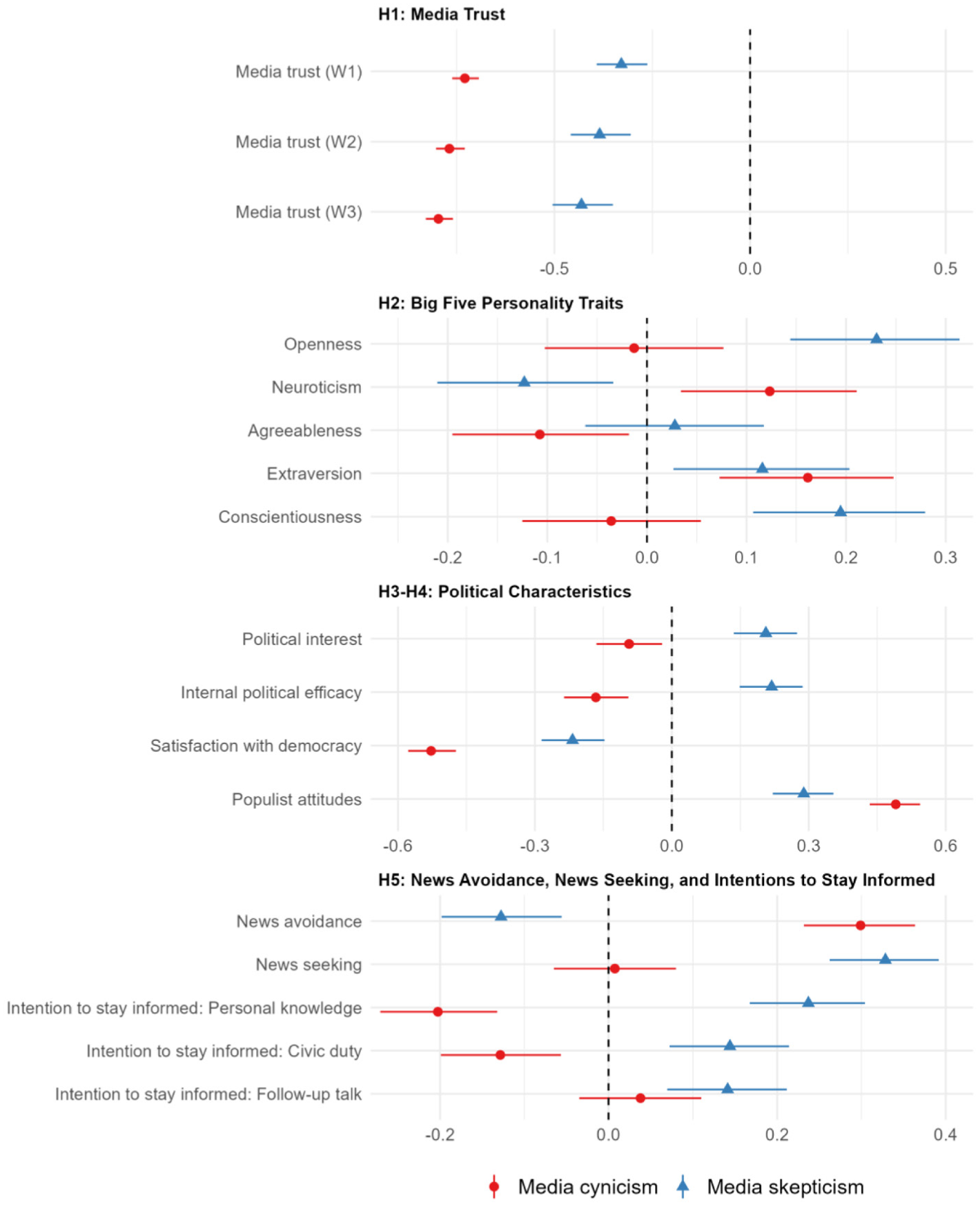
Associations of media cynicism and media skepticism with personality traits, political orientations, and news-use motivations.
Associations with Big Five Personality Traits
Our second set of hypotheses examined the associations between media cynicism, media skepticism, and Big Five personality traits. H2a predicted media cynicism to be negatively associated with Openness, whereas media skepticism was expected to be positively associated with Openness. H2b predicted media cynicism to be positively associated with Neuroticism and negatively associated with Agreeableness. As shown in Figure 2, the results partially support these expectations. Media skepticism is positively associated with Openness, consistent with H2a. In contrast, the association between media cynicism and Openness is not statistically significant. Supporting H2b, media cynicism is positively associated with Neuroticism and negatively associated with Agreeableness. Media skepticism, by contrast, shows a positive association with Conscientiousness. Associations for Extraversion are similar for both media cynicism and skepticism; it is the only Big Five trait that is positively associated with both constructs. Overall, the results indicate that media cynicism and media skepticism are embedded in different personality profiles. Media skepticism is linked to traits associated with cognitive engagement and diligence, whereas media cynicism is more closely linked with traits associated with emotional instability and low interpersonal trust. These distinct patterns further support the conceptual differentiation between reflective and non-reflective forms of media distrust.
Associations with Political Characteristics
Our third set of hypotheses examined the associations between media cynicism, media skepticism, and political characteristics. H3 predicted that media cynicism would be negatively associated with political interest and internal political efficacy, whereas media skepticism would be positively associated with both. H4 predicted media cynicism to be negatively associated with satisfaction with democracy and positively associated with populist attitudes. As shown in Figure 2, the results were largely consistent with these expectations. Media cynicism is negatively associated with both political interest and internal political efficacy, whereas media skepticism had a positive association with both, supporting H3. In addition, media cynicism is negatively associated with satisfaction in democracy and positively associated with populist attitudes, providing support for H4. Although media skepticism is also negatively associated with satisfaction in democracy and positively associated with populist attitudes, these associations are substantially weaker than those observed for media cynicism. Taken together, these results suggest that media cynicism and media skepticism are embedded in distinct political orientations. While both reflect critical stances toward the news media, skepticism is associated with higher levels of political engagement and efficacy, whereas cynicism aligns with political disengagement, institutional dissatisfaction, and populist worldviews.
Associations with News Avoidance, News Seeking, and Intentions to Stay Informed
Our fourth set of hypotheses examined how media cynicism and media skepticism relate to citizens’ motivations and intentions to use news and stay informed or refrain from doing so. In particular, we focused on news avoidance, active news seeking, and intentions to stay informed as central motivational correlates of different forms of media distrust. We expected media cynicism to be associated with higher news avoidance, whereas media skepticism was expected to be positively associated with news seeking and intentions to stay informed (H5). As shown in Figure 2, the results are consistent with these expectations. Media cynicism is positively associated with news avoidance, whereas media skepticism shows a clear positive association with active news seeking. This pattern extends consistently across all three measures capturing intentions to stay informed. Taken together, these findings suggest that, for media skeptics, news use is not merely driven by extrinsic or social expectations. Rather, it reflects an intrinsic motivation to stay informed and engage actively with news content. This pattern aligns with the conceptualization of skepticism as a reflective orientation characterized by deliberate information seeking and scrutiny, in contrast to the withdrawal-oriented motivational profile associated with media cynicism.
Associations with Online News Exposure
The associations between media skepticism and media cynicism and the attitudinal correlates reported above highlight systematic differences between reflective and non-reflective forms of media distrust. To assess whether these differences also translate into actual information behavior, we next examine how media skepticism and media cynicism are associated with passively tracked online news exposure during the election campaign period.
Our final set of hypotheses addressed multiple dimensions of online news use. H6 to H8 predicted that media skepticism would be positively associated with overall higher online news exposure, higher news diet variety, and higher news diet diversity, whereas media cynicism was expected to show negative associations with these outcomes. In addition, H9 and H10 focused on exposure to different types of news sources. Specifically, we expected both skepticism and cynicism to be positively associated with exposure to hyperpartisan news (H9), but only media skepticism to be positively associated with exposure to quality (mainstream) news (H10).
Figure 3 represents the results regarding overall online news exposure and news diet composition. Consistent with H6 to H8, media skepticism is positively associated with the total number of news visits, news diet variety, and news diet diversity. Skeptics therefore not only use more online news but also access a broader set of news websites and distribute their attention more evenly across sources, indicating lower reliance on single outlets. Media cynicism, by contrast, is negatively associated with both the total number of news visits and news diet variety, supporting H6 and H7. The association between media cynicism and news diet diversity is not statistically significant, providing only partial support for H8.
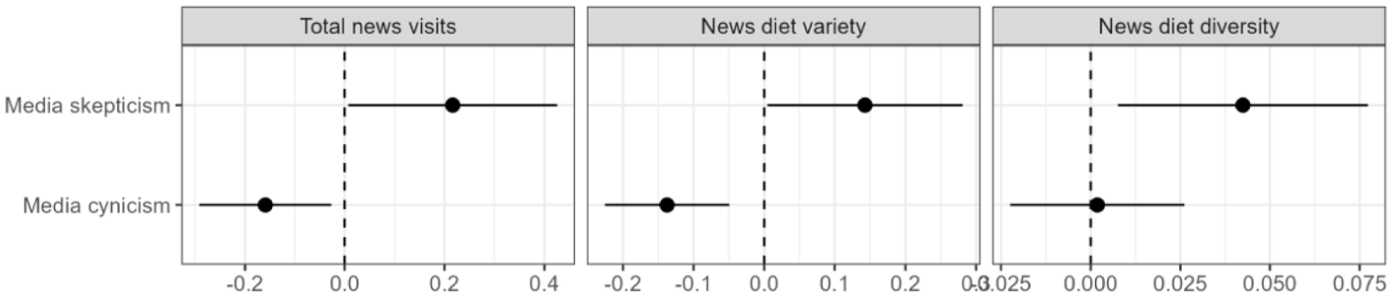
Associations of media cynicism and media skepticism with total online news visits, news diet variety, and news diet diversity.
Figure 4 reports associations between media cynicism, media skepticism, and exposure to different types of news outlets. To isolate relative allocation patterns across outlet types, these models control for individuals’ total online news exposure, ensuring that estimated associations reflect differences in how news exposure is distributed rather than differences in overall news consumption (Stier et al., 2020). In line with H9, both media cynicism and media skepticism are positively associated with exposure to hyperpartisan news. However, consistent with H10, only media skepticism is positively associated with exposure to quality news, whereas media cynicism shows a negative association. This pattern indicates that cynics disproportionately avoid mainstream and quality journalism, while skeptics integrate different types of news sources into broader and more diversified news repertoires.
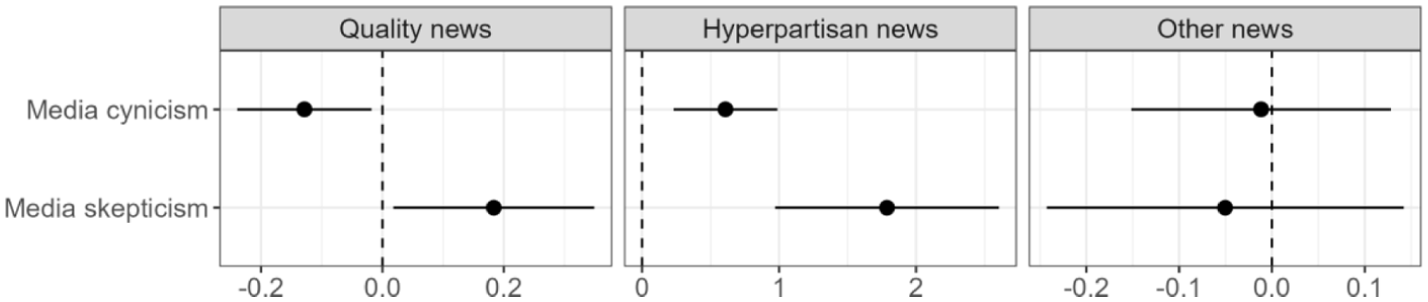
Associations of media cynicism and media skepticism with online exposure to news outlet types.
To contextualize these findings, Figure 5 contrasts the associations observed for media skepticism and media cynicism with those obtained using a traditional, unidimensional measure of (dis-)trust. Among most indicators of news exposure, these associations are weak or non-significant. This comparison illustrates that conventional trust measures obscure meaningful behavioral differences that become only visible when distinct forms of media distrust are analytically separated.
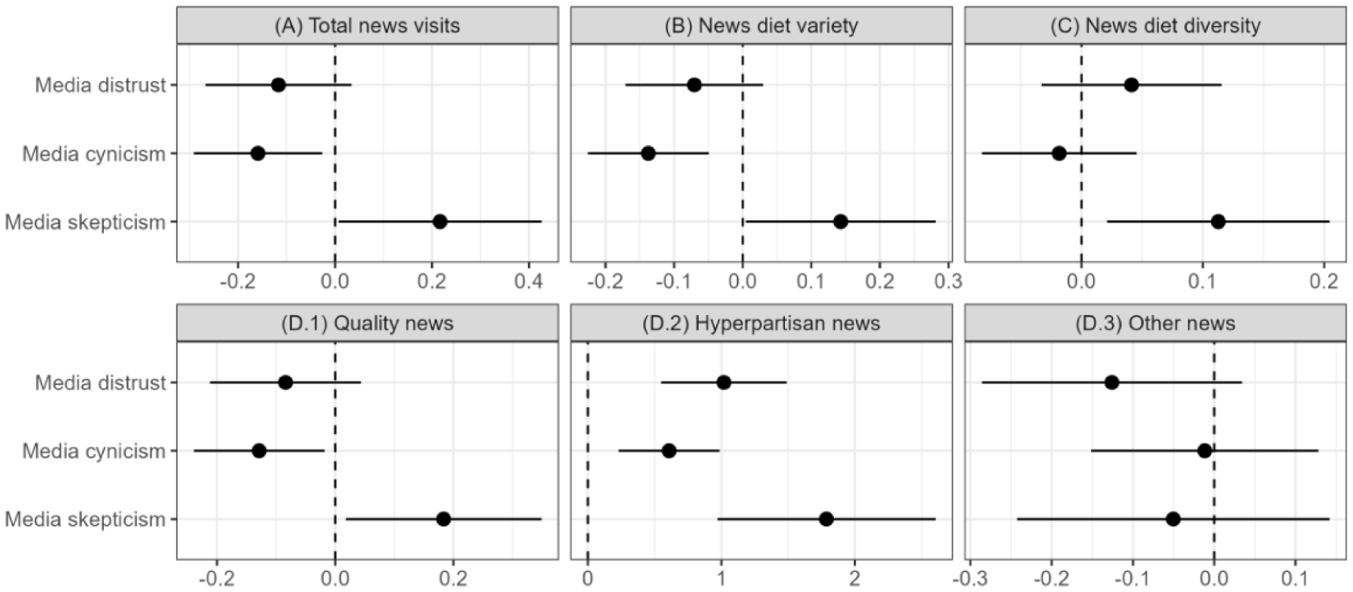
Comparison of traditional media distrust measure with media skepticism and media cynicism in predicting online news exposure.
Finally, Figure 6 situates these associations against the backdrop of absolute exposure levels. Although both cynics and skeptics exhibit relatively higher exposure to hyperpartisan news compared to the modal participant, absolute levels of hyperpartisan news remain low. Differences in news repertoires are therefore primarily driven by higher consumption of quality news among skeptics and particularly low levels of mainstream news use among cynics. These results underscore that exposure to hyperpartisan news cannot be meaningfully interpreted without considering individuals’ broader patterns of news consumption.
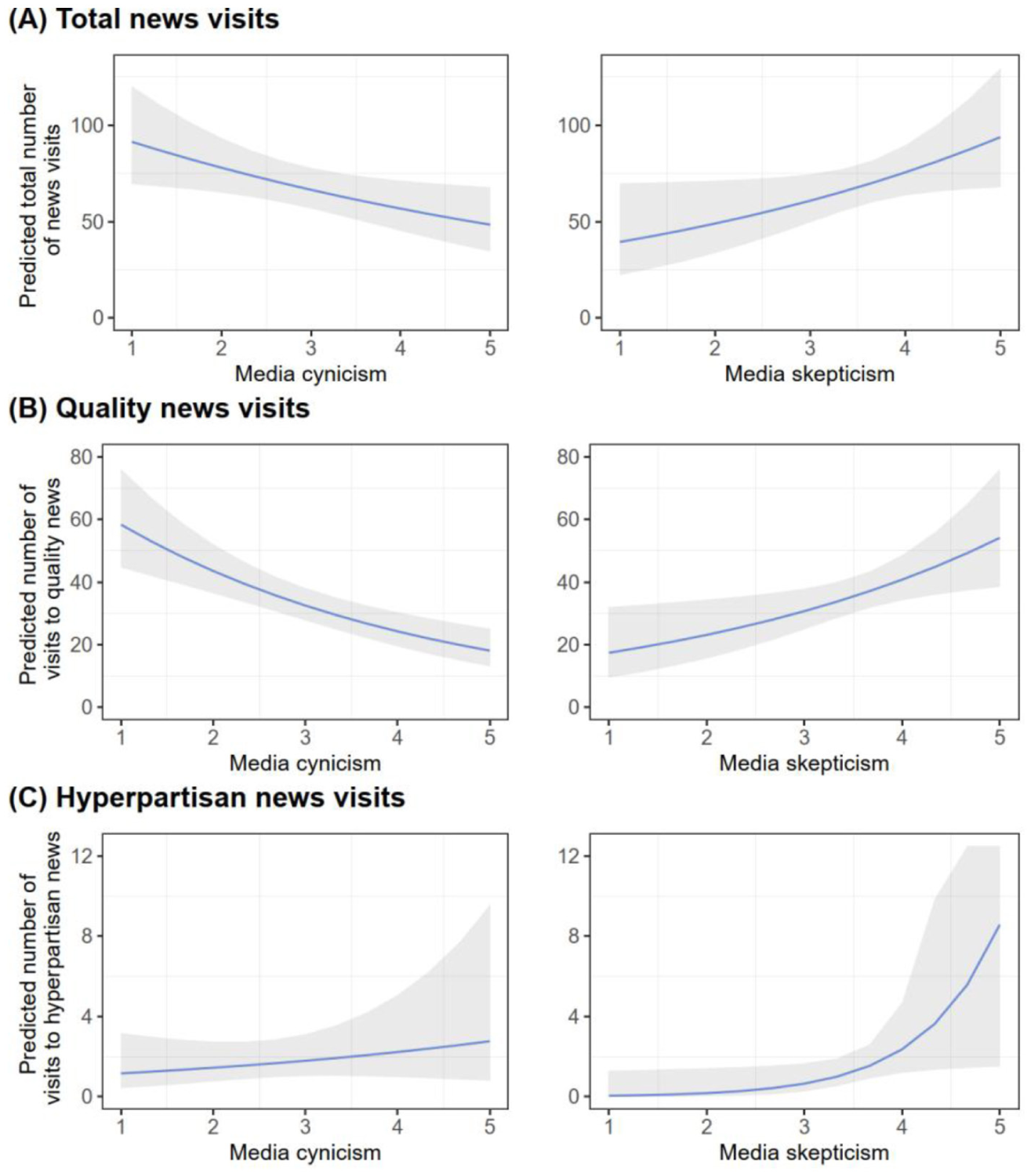
News repertoires of cynics and skeptics.
Discussion
This study set out to clarify the ambiguous relationship between media trust and news use by disentangling two conceptually distinct forms of media distrust: media skepticism and media cynicism. Across a broad range of attitudinal correlates and, crucially, passively measured online news exposure, our findings demonstrate that these two orientations are not only theoretically distinguishable but also behaviorally consequential. While both skepticism and cynicism are associated with lower levels of generalized media trust, they are embedded in systematically different dispositional and political constellations and translate into markedly different patterns of news engagement.
A central implication of these findings concerns the long-standing inconsistency in the literature on media trust and news use. Prior studies have reported positive, negative, or null associations between trust and media consumption, often within similar empirical contexts (Fawzi et al., 2021). Our results suggest that this heterogeneity reflects a conceptual conflation rather than merely contextual variation or measurement error. When skepticism and cynicism are treated as interchangeable manifestations of low trust, their opposing evaluative, motivational, and cognitive underpinnings are overlooked, yielding unstable or contradictory associations with news use. By separating reflective, critical skepticism from non-reflective, rejection-oriented cynicism and linking both to observed behavior, our study helps reconcile these mixed findings.
This interpretation is consistent with, but also extends, prior empirical work. Our findings align with previous research showing that media skepticism is associated with higher levels of news engagement and more diverse repertoires, whereas media cynicism tends to coincide with reduced exposure and narrower patterns of use (e.g., Tsfati & Barnoy, 2025). At the same time, prior studies have often reported more selective or inconsistent associations, including findings that show no systematic relationship between cynicism and news use or a negative relationship between skepticism and hyperpartisan news use (e.g., Markov & Min, 2022; Quiring et al., 2021). By contrast, our results reveal more consistent behavioral differences across multiple dimensions of news exposure. This suggests that previously mixed findings may partly reflect limitations in conceptual differentiation and measurement. Distrust is not unidirectional in its behavioral implications: depending on its epistemic structure, it aligns either with intensive engagement with diverse information sources or with selective withdrawal from journalistic mainstream news.
A related second contribution of our findings is to refine the interpretation of exposure to hyperpartisan news (Mangold, 2024; Stier et al., 2020). Both media skepticism and media cynicism are positively associated with hyperpartisan news exposure. However, these associations unfold within profoundly different repertoire constellations, suggesting distinct informational logics. For skeptics, hyperpartisan exposure occurs within a broader and more diverse news repertoire dominated by quality and mainstream sources. In this configuration, encounters with hyperpartisan content appear embedded in a diversified news diet and may be indicative of monitoring, cross-cutting exposure, and accuracy-oriented comparison rather than ideological alignment. For cynics, by contrast, hyperpartisan exposure occurs against a backdrop of generally low overall news consumption and, in particular, pronounced avoidance of mainstream journalism – consistent with a closed and fundamentally dismissive stance toward established media institutions. In this configuration, hyperpartisan visits form a comparatively larger proportion of a narrower news repertoire. These patterns illustrate that identical behavioral outcomes – such as visiting hyperpartisan news websites – can carry very different substantive meanings dependent on how they are embedded within individuals’ broader exposure structures.
Beyond these behavioral patterns, our findings also speak to theoretical debates about the origins and stability of media distrust. The high temporal stability of both media skepticism and media cynicism suggests that these orientations are not merely short-term reactions to specific media content or campaign dynamics but reflect relatively enduring predispositions. The observed stability is consistent with theoretical perspectives that conceptualize distrust-related orientations as relatively enduring predispositions. It aligns not only with cultural accounts of generalized and political trust (Mishler & Rose, 2001; Sønderskov & Dinesen, 2016; Uslaner, 2002, 2008), but also with approaches describing skepticism and cynicism as comparatively stable cognitive styles (Bensley et al., 2022). Their systematic embedding in broader personality traits, political orientations, and motivational profiles further supports this interpretation. While we refrain from strong causal claims, the observed stability and cross-domain associations of skepticism and cynicism are more compatible with a selection-based interpretation than with short-term media effects. In this view, distrust orientations function as relatively stable lenses that shape how people navigate the news environments. At the same time, this does not imply that such orientations are immutable or independent of media experiences. Rather, our findings suggest that processes of media socialization unfold over longer time horizons than those captured within a single election campaign. Longer-term panel designs will be required to examine reciprocal dynamics more explicitly.
Methodologically, this study underscores the importance of linking attitudinal measures of media (dis-)trust to behavioral data on news consumption. Much prior research relies on survey-based self-reports of media use, which are prone to recall error, social desirability bias, and conceptual overlap with trust-related attitudes (de Vreese & Neijens, 2016; Parry et al., 2021; Stier et al., 2020). When both media trust and media use are measured via self-report, observed associations may partly reflect shared method variance rather than actual exposure behavior. In other words, reported news use and reported distrust may reflect shared response tendencies rather than independently measured attitudes and behaviors. By combining survey data with passively tracked browsing data, our study allows for a more direct assessment of how distinct forms of media distrust correspond to concrete patterns of news exposure, particularly for niche or marginal sources such as hyperpartisan outlets that are especially likely to be underreported in surveys.
More broadly, recent work suggests that self-reported and tracked measures capture different dimensions of media exposure and are not directly interchangeable (Neijens et al., 2024). This may help explain why prior studies have produced inconsistent findings, as behavioral patterns related to habitual engagement or avoidance—particularly in the case of media cynicism—may not be fully captured by self-reports, whereas more reflective forms of engagement may be more readily reported. Consistent with this interpretation, additional analyses reported in Appendix A9 provide further support for the behavioral validity and robustness of our tracking-based measures. Specifically, news seeking is positively associated with exposure, variety, and diversity, whereas news avoidance shows negative associations. The observed relationships between media distrust and exposure remain substantively unchanged when alternative operationalizations of news exposure are applied.
Finally, our findings have implications for normative debates about media trust and democratic citizenship (Fawzi, 2019; Hanitzsch et al., 2018). Much of the literature implicitly treats low media trust as uniformly problematic. The distinction between media skepticism and media cynicism challenges this view. While cynicism is associated with political disengagement, institutional dissatisfaction, and selective withdrawal from mainstream news, skepticism appears compatible with – and even conducive to – political interest, active information seeking, and diversified news exposure. Whether media distrust undermines or supports informed citizenship thus depends less on trust levels per se than on the cognitive and motivational foundations of distrust. Distinguishing skepticism from cynicism therefore provides a conceptually specified and empirically grounded framework for evaluating when critical orientations toward the media constitute a democratic resource and when they signal a risk for democratic discourse.
Limitations and Directions for Future Research
Notwithstanding these contributions, our study has several limitations that open up promising avenues for future research. Since the study relies on non-experimental data, it does not permit strong causal claims about the direction of the relationship between media distrust and news consumption. Although skepticism and cynicism display substantial temporal stability across waves, reciprocal dynamics between media attitudes and media use remain possible (Tsfati et al., 2025). Moreover, the available data structure – including the limited number of repeated behavioral exposure measurements, the predominance of between-person variance, and sample dropout – constrained the feasibility of within-person dynamic modeling. Future research employing longer observation periods, denser behavioral measurements, and larger baseline samples would be better positioned to disentangle selection and reinforcement processes over time. More generally, future research should further examine how alternative conceptualizations and measures of media trust and distrust (Markov & Min, 2022; Quiring et al., 2021; Tsfati & Barnoy, 2025) relate to observed news consumption behavior, ideally by employing designs that move beyond survey self-reports.
Our analytical strategy emphasizes theoretically motivated total associations rather than highly conditional estimates. The models are intentionally parsimonious and focus on the overall alignments between distrust orientations and behavioral patterns. This choice reflects the conceptual architecture of the nomological framework and the substantial empirical intercorrelations among personality traits, political orientations, and motivational dispositions. While more complex multivariate or structural specifications are conceivable, such models would require strong assumptions about isolating independent effects among conceptually and empirically intertwined predictors. Under conditions of substantial overlap, heavily conditioned models risk producing coefficients that are statistically separable but substantively difficult to interpret. Future research may explore alternative modeling strategies under different theoretical premises.
While future methodological work may more directly examine discrepancies between self-reported and passively observed news use across distrust orientation, the present study focuses on behavioral differentiation using individual tracking data. Our tracking data capture desktop and laptop browsing but do not include mobile app-based news use. Although recent evidence suggests substantial consistency in news preferences across devices (Muise et al., 2024), mobile news consumption – particularly via apps and social media platforms – remains an important domain for future research. Importantly, this limitation primarily concerns absolute exposure levels rather than the relative differences between skepticism and cynicism that are central to our argument.
Future research may also move beyond outlet-level exposure toward the systematic integration of content characteristics. Combining tracking data with fine-grained content analyses would allow researchers to examine how variations in tone, framing, and epistemic quality within and across news sources shape the information environments of skeptics and cynics. Such designs could provide a more precise assessment of how distinct distrust orientations structure encounters with political information.
More broadly, future work should integrate contextual and structural factors – including journalistic performance, media system characteristics, and exposure to elite political rhetoric – to examine how distrust orientations interact with their information environments over time. Longer-term longitudinal and cross-national designs would be particularly valuable for disentangling dispositional predispositions from context-sensitive responses. As this study was conducted during the 2021 German federal election within a comparatively high-trust media system, the generalizability of our findings to other media systems remains to be examined.
Supplemental Material
sj-docx-1-crx-10.1177_00936502261458955 – Supplemental material for Two Forms of Media Distrust: Cynicism, Skepticism, and Online News Exposure
Supplemental material, sj-docx-1-crx-10.1177_00936502261458955 for Two Forms of Media Distrust: Cynicism, Skepticism, and Online News Exposure by Lukas P. Otto, Frank Mangold and Michaela Maier in Communication Research
Footnotes

Funding
The authors disclosed receipt of the following financial support for the research, authorship, and/or publication of this article: This work was supported by the German Research Foundation (Deutsche Forschungsgemeinschaft, DFG), project number 456395817, as part of the project “Tracking the effects of negative political communication during election campaigns in on- and offline communication environments.”
Declaration of Conflicting Interests
The authors declared no potential conflicts of interest with respect to the research, authorship, and/or publication of this article.
Supplemental Material
Supplemental material for this article is available online.
Notes
Author Biographies
References
Supplementary Material
Please find the following supplemental material available below.
For Open Access articles published under a Creative Commons License, all supplemental material carries the same license as the article it is associated with.
For non-Open Access articles published, all supplemental material carries a non-exclusive license, and permission requests for re-use of supplemental material or any part of supplemental material shall be sent directly to the copyright owner as specified in the copyright notice associated with the article.
