






Abstract
How people consume information and understand facts is an inherently multilevel problem, but inquiry frequently stops at the individual-level. We highlight how disparities in local newspaper availability across communities influence individuals’ partisan selective exposure and congruent political misperceptions. Using a quasi-experimental design enabling comparisons of individuals living in counties with different local newspaper availability but otherwise matched features, we found that lacking a local newspaper in one’s county is associated with a decrease in national mainstream media use. Moreover, lacking a local newspaper amplifies partisan selective consumption of liberal media, but not conservative media. Beliefs in falsehoods disseminated by elites from both major parties in the U.S. are influenced by selective exposure and amplified by local newspaper context, while liberal media use is more sensitive to the contextual variances in local news environments than conservative media use. Findings from this unique dataset are robust against various tests of confounding effects.
Introduction
The evolution of the information ecology is a critically important factor shaping what people know, what they pay attention to, and how their partisanship can be understood (Stroud 2011). Yet, there remains disagreement on the exact nature of the contemporary information ecology – some raise concerns over partisan echo chambers reinforcing preexisting preferences (Berry & Sobieraj, 2013), while others find thin evidence for audience segmentation and polarizing effects of partisan media (Prior, 2013; Fletcher & Nielsen, 2017). Moreover, much of our understanding of the contemporary information ecology is limited to individuals and how they engage with national news and social media – ignoring the most used and most trusted news that emanates from local sources. Local media’s importance is further amplified by the fact that its (usually) diminishing availability in media markets (Qin, 2024) leaves news consumers without local options to learn about current affairs (Darr et al., 2018).
In order to better understand whether and how the contemporary information ecology forces people apart or drives them together – or something in between – it is critical to properly account for how contextual variances in the news media environment interact with individual partisanship to shape news consumption and political beliefs. Though much of selective exposure and partisan polarization research only considers national news sources, a promising path of scholarship has highlighted how the availability of local news is related to important political outcomes such as split-ticket voting, knowledge, and engagement (Darr et al., 2018, 2021; Hayes & Lawless, 2015). We take this work further, examining how the availability of a local newspaper in one’s community affects individual media diets and how that relationship in turn affects people’s beliefs in false claims made by political elites.
Using a quasi-experimental design that enables us to compare individuals living in counties with different local newspaper availability but otherwise matched features, we find that lacking a local newspaper in one’s county is associated with a decrease, rather than an increase as implied in previous literatures, in national mainstream media use. Additionally, lacking a local newspaper in one’s county amplifies partisan selective consumption of liberal media, but not conservative media, and such effects concentrate among strong partisans. We then show how the associated, contextual increases in partisan selective media use are related to political misperceptions. The findings from the quasi-experiment are robust to a series of tests of confounding effects as well as alternative specifications of the overall health of a local news environment. Our work underscores the necessity to unpack the heterogeneity in the effects of local newspaper context on media diets and political misperceptions and offers implications for understanding the health of the information ecology.
Local Newspaper Contexts and Citizens’ Media Diets
Individuals’ media diets are a function of what they prefer to consume and what is available to them. Contextual variances in media availability impose opportunities and constraints on citizens’ political learning and engagement. While the dramatic growth of social media, online news and cable TV has given rise to ideological niche markets that cut across geographical regions (Stroud, 2011), local newspapers stand as a primary and highly trusted source – providing information about elections and civic affairs unique to one’s local community (Peterson, 2019).
Despite their value, local newspapers have weathered sharply decreased revenue and newsroom employment over the past several decades (Grieco, 2020). They are also harmed by search engine algorithms that systematically send more digital traffic to national outlets (Fischer et al., 2020). Since 2005, the U.S. has lost around 3,500 local newspapers, leaving millions living in so-called “news deserts;” there are currently more than 200 U.S. counties that do not have a local newspaper (Metzger, 2025). About half of U.S. counties comprise what the Local News Initiative calls the “watch list counties” as they have one local newspaper, which is more likely to be a weekly rather than a daily; taken together, 50 million Americans in these counties have “limited or no access” to local newspapers (Metzger, 2025). Consolidation in media ownership is growing as well, as the three largest media conglomerates currently own nearly a thousand newspapers across the country. These owners have a great deal of influence on the content of the local news (Dunaway, 2008), which has seen an increase in coverage of national politics at the expense of local politics (Martin & McCrain, 2019).
Recent scholarship has theorized the consequences of the decline of local newspapers from two major perspectives. The first consequence focuses on political awareness and engagement at the local level, as the mere existence of a local newspaper significantly helps foster an informed citizenry (Snyder & Strömberg, 2010). When local newspaper markets align with congressional districts – a strong predictor of media attention on congressional representatives – citizens are better at naming their representatives (Peterson, 2019). Declining local newspaper coverage also leads to decreased local political participation (Hayes & Lawless, 2015). Moreover, in communities with lower local newspaper readership, individual-level social interaction also has a more muted effect on participation in community affairs (Paek et al., 2005).
Apart from locally oriented outcomes, a second consequence of the decline of local newspapers is the potential ripple effect on citizens’ overall media diets, which subsequently alters the considerations taken into political decision-making. This perspective considers local newspaper context in relation to the explosion of media choices on the national level. In a high-choice environment, it is reasonable to assume that habitual news users will replace the lost local newspaper with other available sources, most of which cover national politics (Darr et al., 2018).
Scholars are concerned that the differences between national and local media will alter the supply of identity heuristics in citizens’ media diets and bias their political judgment in directions favoring partisan polarization. Local media differ from their national counterparts by having more of an orientation toward mutual understanding and community integration. Research suggests that given their geographically dispersed audience, national media focus on deeply polarized, national partisan elites (Wagner & Gruszczynski, 2018). National media tend to be conflict- rather than consensus-oriented and adopt more game frames than local media when covering elections (Dunaway & Lawrence, 2015). Compared to national media, local media devote considerably more attention to local politics, as well as covering (inter)national stories through a localized lens that emphasizes local relevance and interests (Arnold, 2006). National and local media also differ in audience trust. While most Americans express a high level of trust toward their local media, trust toward national media has declined over the last five decades and is increasingly divided along partisan lines (Jurkowitz et al., 2020). Given these differences, when the supply of available choices in the media environment tilts toward national media and against local media, citizens are likely to be exposed to a higher level of partisan heuristics in their media diets.
Developing this line of reasoning, a pioneering study by Darr et al. (2018) suggested that the closure of local newspapers exacerbates mass polarization in voting behaviors. The authors found that compared with otherwise similar counties, counties where a local newspaper had closed in the past three years saw a small but significant decrease in split-ticket voting in presidential and senatorial elections in 2012. Interestingly, local newspaper closure did not influence ballot roll-offs, which led the authors to infer that as citizens substitute local news with national news, increased partisan heuristics from national news is a more plausible explanation than mere informational loss from local news to account for the effect of local newspaper closure on voter polarization. Despite the concerns over the quality of local newspaper content, the “very existence” of local newspapers “acts as a bulwark against the domination of Americans’ news diets by readily-available national alternatives” (Darr et al., 2018, p. 1009). While this evidence is suggestive, it does not reveal the mechanism through which these effects occur. The argument that lacking a local newspaper makes citizens turn to national media is implied but untested in past research. The first aim of this paper is to show how the local newspaper context in which individuals are situated is related to their national media use.
To do this, it is important to first recognize that the umbrella term “national media” carries with it an ambiguity that must be unpacked. Today’s national media environment has seen a dramatic growth in the variety of information sources available. Of particular interest is the growing availability of partisan media – which emphasize offering ideological commentary to interpret news events and stand as a direct counterpoint to mainstream news media that value journalistic norms of fact-based reporting. Although modes of delivery (e.g., print, TV, online) still help structure citizens’ media diets, partisanship has been an increasingly influential factor in mapping people’s media repertoires (Edgerly, 2015).
Notably, there is growing evidence on the distinct characteristics of conservative media. Research on the American news media has observed that there is close integration between liberal (e.g., MSNBC, HuffPost) and mainstream media (e.g., ABC, NBC, CBS) in terms of their media hyperlinks, audience profiles, social media shares, and being on the receiving end of the “fake news” accusation (Benkler et al., 2018; Faris et al., 2020; Wang et al., 2024). On the other hand, there is a distinct and radicalized cluster of conservative media (e.g., Fox News, Breitbart), which form a dense, well-coordinated cluster setting apart from the rest of the media ecosystem (Benkler et al., 2018; Faris et al., 2020). What’s more, liberals and conservatives build their information diets in different ways, with liberals being more likely to use both mainstream and ideological sources while conservatives’ news use, in terms of both its slant and diversity, tend to be more ideologically insulated (Wang et al., 2024). It is imperative to examine how differences in individuals’ local newspaper context affect their consumption of national media with a careful consideration of the differences between mainstream, liberal, and conservative media.
Second, low levels of specificity in how the relationships between local newspaper context and individual media choices are conceptualized can make studies vulnerable to ecological fallacies. There are two possible ways the absence of local newspaper in a community affects individuals’ national media use. It is possible that local newspaper context exerts a positive, main effect on individuals’ use of national media in general. This is a straightforward proposition, as previous research notes that fewer local news outlets in the marketplace leads to less exposure to local news and more consistent exposure to national media (Darr et al., 2018).
However, there is a second possibility – that local newspaper context serves as a moderator that amplifies individuals’ existing media preferences. The theory of selective exposure provides the groundwork for this possibility. While prior scholarship showed that a great deal of media use behavior is habitual or ritualistic (Gerbner et al., 2002), more recent work has demonstrated how people tend to selectively approach like-minded political information and, albeit to a much lesser extent, avoid discrepant political information. While the influence of the Internet on selective exposure and the consequences of selective exposure are subject to rich debates (Prior, 2013), it is clear that selectivity is heavily dependent on the salience of political identity heuristics. Studies have found that priming identity heuristics increases people’s tendency to consume like-minded news (Wojcieszak & Garrett, 2018), and that political identity may be a stronger contributor to selective exposure than source credibility and demographic-based identity (Wojcieszak, 2021).
Of course, people with access to cable television or the Internet can already access more identity-based media choices. So, why might changes to the media environment amplify partisan selective exposure? Two factors that traditionally drive media use are habit and trust. Gerbner et al. (2002) show the ritualistic nature of some media use and Friedland et al. (2022) and recent examinations of media trust across sources (Center for Communication and Civic Renewal, 2025; Pew Research Center, 2025) demonstrate that local news is the most used and most trusted source of news. When local news vanishes, habits are broken and some media users will need to rely on new motivations to lead them to their preferred news sources. Notably, selective exposure motivation also springs from self-concepts, affect, and anticipated message exposure effects – motivations that have been hypothesized to be conditional upon the availability of media stimuli (Knobloch-Westerwick, 2015). Selective exposure to media, as compared with purely information utility seeking, can also vary based upon the likelihood of election results (Knobloch-Westerwick & Kleinman, 2012).
These motivations exist in political and media environments that increasingly focus on national politics (Hopkins, 2018). Moreover, there is evidence that when politically interested people lose access to one news source, they are still motivated to be news users (Darr et al., 2018). Developing the logic of this prior work, we might expect the changing availability of type of news, that is when local newspapers are no longer available, to make it more likely that individuals will turn to national media in systematically different ways; rather than increasing their national media use in general, partisans may follow identity-driven tendencies when making choices in the national media landscape.
As such, we propose two competing hypotheses to examine how local newspaper context shapes individuals’ media diets. The first is the main effect hypothesis.
H1: Lacking a local newspaper in one’s community increases one’s use of national media in general, including (a) liberal, (b) conservative, and (c) mainstream media.
What this means is that in communities with no local newspaper, people consume more national media across the board. Alternatively, we also propose a moderation effect hypothesis.
H2: Local newspaper context amplifies the effect of individuals’ partisanship on selective use of (a) liberal and (b) conservative media.
What this means is that when lacking a local newspaper in one’s community, Republicans would be even less likely to use liberal media and even more likely to use conservative media, while Democrats would be even more likely to use liberal media and even less likely to use conservative media (see also Garrett & Stroud, 2014).
The two competing hypotheses differ not only in technical terms but also in normative implications. Under the main effect hypothesis, people living in news deserts substitute the absence of local newspapers with a wide range of national alternatives and are able to have a relatively diverse media diet at least on the national level. However, under the moderation effect hypothesis, in news deserts, people’s media diet is not only nationalized, but also polarized. In other words, rather than influencing everyone living in a community in the same way, local newspaper context magnifies the influence of one’s existing partisanship and increases partisan selective exposure, which may in turn widen the divide in how people understand politics and learn what is verifiably true.
Finally, as for mainstream media, individual-level evidence on selective exposure to mainstream media is thin. However, as discussed above, there is accumulating evidence on the system-level regarding the affinity between mainstream and liberal media in terms of their overlapping audiences and content (Benkler et al., 2018; Faris et al., 2020). Therefore, we propose a research question asking whether the moderation effect hypothesis applies to mainstream media in the same way as liberal media, such that when lacking a local newspaper in one’s community, Republicans are even less likely to use mainstream media while Democrats are even more likely to use mainstream media (RQ1).
Local Newspaper Contexts and Political Misperceptions
The ripple effects of local newspaper context on how citizens consume media may in turn influence how citizens are (mis)informed about politics. A burgeoning line of research studies misperceptions – defined as beliefs about factual matters that are false or unsubstantiated by best available evidence and expert consensus (Vraga & Bode, 2020). Scholars argue that misperceptions may be even more normatively troubling than ignorance. While ignorance can be viewed in public opinion as statistically random noise, misperceptions may lead to systematic biases in policy preferences that are hard to be canceled out in aggregate (Hochschild & Einstein, 2015). While those who are less sophisticated are often receptive to incongruent messages, those confident in their misperceptions hold on to their beliefs and resist persuasion (Li & Wagner 2020). Research also points out the key role of political elites in disseminating false claims and fostering misperceptions. It is not uncommon for political elites to make false claims that citizens adopt as their own views, trusting claims from their party’s elites (Bisgaard & Slothuus, 2018; Zaller, 1992).
The intertwined relationship among partisanship, local context, and media use explained in the previous section is important for understanding political misperceptions. Partisanship has a central position in the judgment of truthfulness. Partisanship is not merely a running tally of specific political assessments; instead, it is both a psychological and a social connection, where partisans behave more like sports fans than bankers when choosing an investment (Mason, 2015). According to the theory of motivated reasoning, the tension between the accuracy motivation and the directional motivation underlies human reasoning (Kunda, 1990; see also Li, 2025). As the goal to “win” is central to politics, partisans are often driven by directional motivation, seeing supportive information as more compelling and counterarguing with incongruent information (Groenendyk & Krupnikov, 2020). Partisans are susceptible to misperceptions that reflect well on their own party or derogate the opposing party (Jerit & Barabas, 2012).
In addition to partisanship, a growing line of research focuses on partisan media’s role in promoting political misperceptions. Garrett et al. (2016) found that partisan media use increases congruent misperceptions above and beyond the influence of individual partisanship. This is not due to their users’ lack of familiarity with evidence; rather, partisan media users are more likely to misunderstand the evidence or hold on to misperceptions despite knowing the evidence. By making frequent references to party positions and discords (Wagner & Gruszczynski, 2016), partisan media can prime citizens’ partisanship and increase the importance of a partisan heuristic as an information shortcut in citizens’ sense-making. Recent work finds that the use of liberal media and the use of conservative media are both associated with the holding of congruent political beliefs (Hmielowski et al., 2020).
Although individual-level factors like partisanship and partisan media use shape our understanding of political misperceptions, inquiry all too frequently stops at the individual-level – overlooking that the formation of misperceptions is an inherently multilevel problem. A broader line of work on political outcomes including policy evaluations and voting preferences (Darr et al., 2018; Huckfeldt & Sprague, 1987; Van Duyn, 2021; Weatherford, 1983) has suggested that individuals do not receive, process, interpret and incorporate information as independent agents; rather, they are embedded in contexts of information flows influential to how they understand politics. Focusing on misperceptions, our inquiry puts partisanship and media choice in the context of the information affordances in one’s locality and considers how the intricate relationships among individual-level and contextual-level factors affect citizens’ political misperceptions. We have made the case that local newspaper context can influence individuals’ national media choices in two possible ways – either through a main effect, or by moderating the effect of partisanship. Further, we know from past research that both partisanship and media choices have unique contributions to variances in misperceptions. Making the puzzle more complex is that misperceptions may develop from false statements made by elites in both of the major parties in the U.S., making it necessary to test whether the mechanisms proposed work for misperceptions of different party origins. Thus, we propose two competing models in Figure 1.
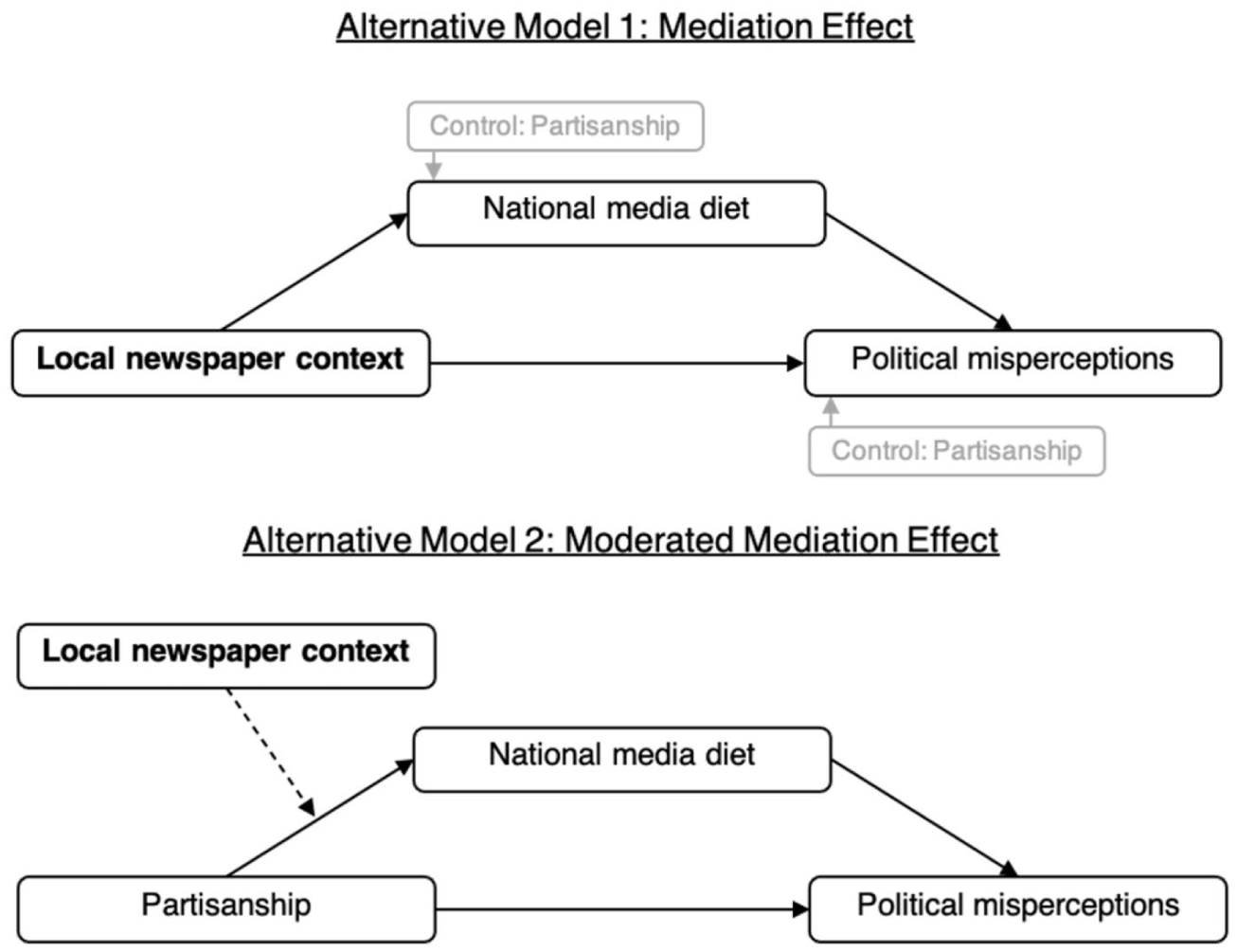
Alternative models on the effects of local newspaper context, partisanship, national media diet, and political misperceptions.
Figure 1’s competing models are parallel to the two competing hypotheses described in the previous section. Along the same line with the main effect hypothesis (H1) on the effect of lacking a local newspaper on national media use, the first model proposes a mediation hypothesis to test whether the effect is in turn transferred to misperceptions.
H3: Lacking a local newspaper in one’s county should (a) increase one’s beliefs in Democratic politicians’ false statements through the indirect effects of increased liberal media use and (b) should also increase one’s beliefs in President Trump’s false statements through the indirect effects of increased conservative media use.
The mediation hypothesis assumes a strong effect: news deserts would make individuals more susceptible to misperceptions across the board.
Again, there is a possibility that the effect of local newspaper context on misperceptions is conditional. Along the same line with H2 on the how lacking a newspaper intensifies the role of partisanship in media diets, the second model argues that the contextually intensified partisan selective exposure, in turn, increase the dose of partisan heuristics people are exposed to and fuel biased reasoning about factual matters as a result. The second model proposes a moderated mediation hypothesis.
H4: The lack of a local newspaper increases beliefs in partisan-congruent false statements through an amplified tendency to selectively use (a) liberal media and (b) conservative media.
What this means is that when living in a county without a local newspaper (as compared to having at least one local newspaper), Republicans should be even more likely to believe in Trump’s false statements (than Democrats), due to the decreased use of liberal media and increased use of conservative media. In parallel, when living in a county without a local newspaper (as compared to having at least one local newspaper), Democrats should be even more likely to believe in Democratic politicians’ false statements (than Republicans), due to the increased use of liberal media and decreased use of conservative media.
Finally, we ask research questions about the role of mainstream media due to a lack of evidence on the link between mainstream media and political misperceptions. Similar to RQ1, we borrow the suggestive evidence on the similarities between liberal and mainstream media and ask whether mainstream media function in the same way as liberal media in the mediation hypothesis (RQ2) or the moderated mediation hypothesis (RQ3).
Method
Data
We used a quasi-experimental design that enabled us to sample adults living in counties with differing local newspaper availability but otherwise similar features. First, to create the groups of counties, we obtained the number of local newspapers in each county from the publicly available database at UNC Center for Innovation and Sustainability in Local Media (Abernathy, 2020) and demographic information for each county from the American Community Survey (United States Census Bureau, 2018). At the time we collected our data in 2020, the most recent data available about news deserts in the United States indicated that there were 204 counties with zero local newspaper, 1,522 counties with one local newspaper, and 1,381 counties with two or more local newspapers in the 50 states and the District of Columbia. These numbers did not change substantially according to the newest report in 2025 (e.g., 212 counties with zero and 1,525 counties with one local newspaper; Metzger, 2025). Following Darr et al.’s (2018) approach to matching, we used a genetic matching algorithm (Ho et al., 2011) to build a sampling frame of counties with zero, one, and two or more local newspapers, but otherwise matched features including population size, median age, median household income, percent of white population, percent of population with at least some college education, percent of households with broadband Internet subscription, longitude and latitude (all standardized mean differences < 0.1, variance ratios < 2 among groups after matching; details in Online Appendix 1). Figure 2 illustrates the distribution of county features before and after matching (for visual clarity, counties with one newspaper and with two or more newspapers are combined into “not news desert”). The matching procedure is the first strategy we used to account for the possibility that the contextual effects could be a result of confounding features of a county other than local newspaper availability. We detail several other strategies that we used to test for the robustness of effects in the section below (see Robustness tests).
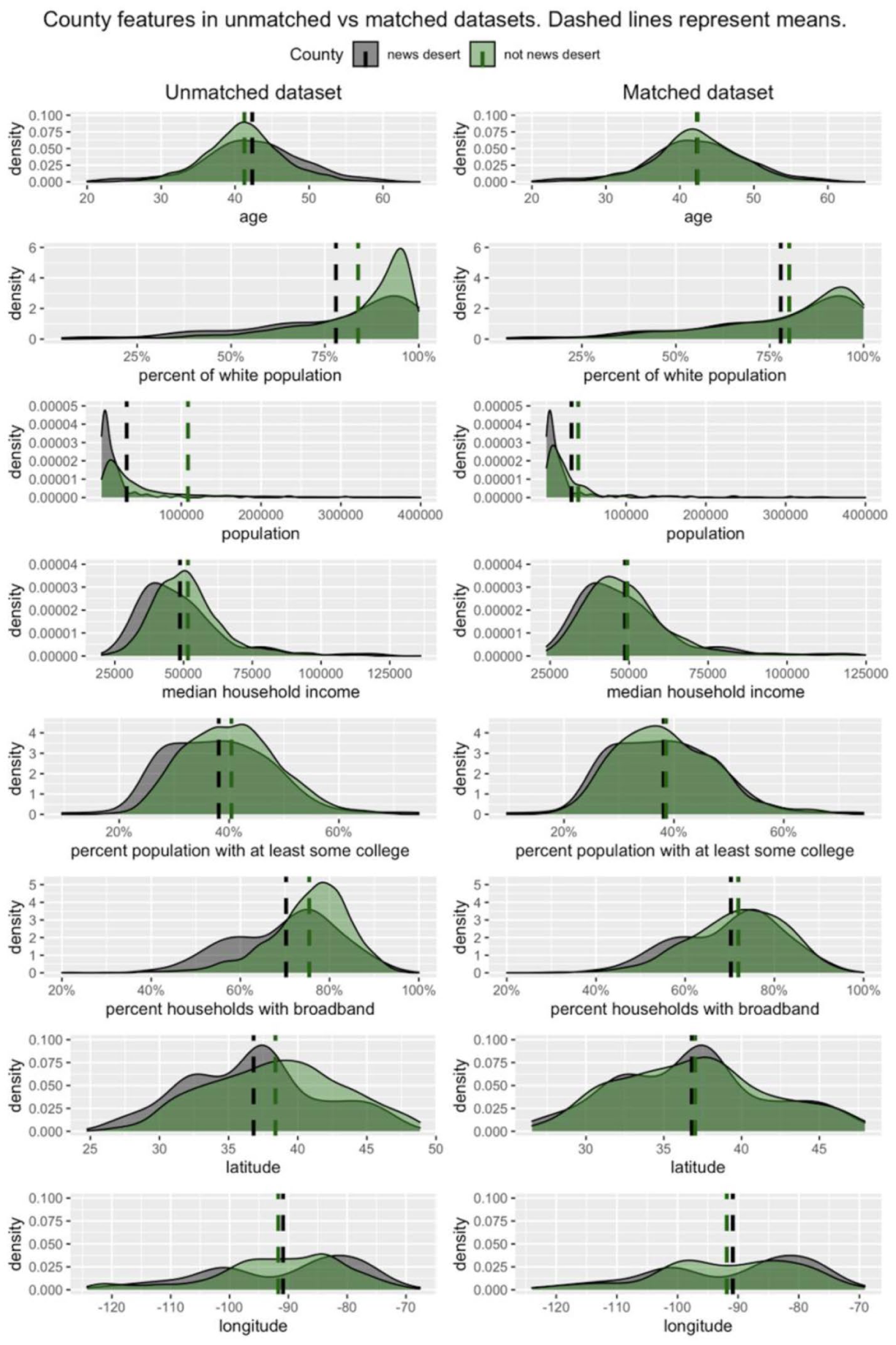
County features in unmatched vs matched datasets.
Using the sampling frame of counties above, we hired LHK Partners, Inc., a national survey firm that has conducted dozens of academic surveys, to administer a web-based survey of adults living in the matched counties. The survey was fielded from April 15th to April 24th, 2020. The survey had an 11.88% response rate. 27 people were dropped from our analysis for straight lining their responses, or for failing attention checks. Not including the 27 people we dropped, 93% of people who started the survey completed it. The quota sampling procedure (based on age and gender) included a strategy that allowed us to compare individual respondents living in counties with zero, one, and two or more newspapers. We attempted to sample equally across these three groups of counties and only retained counties where at least 2 people completed our survey. The data have a two-layer structure: the data contain 2,063 individuals nested within 295 counties in total, with 662 individuals in 92 counties with zero newspaper, 659 individuals in 94 counties with one newspaper, and 742 individuals in 109 counties with two or more newspapers. The counties map across 41 states. The individual characteristics of our sample are broadly comparable to the national adult population, slightly skewing toward older people and women (see Measures). It is worth noting that in data analysis, we combined the counties with one local newspaper and counties with two or more local newspapers; we explain this choice below in Measures.
Robustness Tests: Triangulate Strategies to Reduce Confounding Effects
Here we summarize a number of strategies we used in the design and analysis stage to reduce confounding effects. First, the genetic matching algorithm we used to select counties has the advantage of being nonparametric, which offers a more robust way to take account of confounding variables (county-level population, age, income, race, education, broadband Internet subscription, longitude and latitude) than linear regressions (Ho et al., 2011).
Second, during analysis, we controlled for two additional variables of interest not included in matching: county-level Republican vote share and county-level rurality (Measures).
Third, we also “re-entered” the variables used in matching as control variables in addition to county-level Republican vote share and rurality (same variables used in matching were re-entered with below exceptions: broadband subscription was dropped due to multicollinearity; longitude and latitude was dropped due to lack of theoretical relevance to media use and misperception). These longer models produced the same findings with the more parsimonious models only controlling for county-level Republican vote share and rurality, replicating all effects and their statistical significance. Here, we present the more parsimonious models in the main text and provide the longer version in Online Appendix 5.
Fourth, beyond county-level variables, we also took account of individuals’ partisanship, political interest, age, gender, race, education, and income in all models. Taken together, we supplemented the nonparametric matching technique used for the study design with parametric strategies in the analysis stage where we “re-entered” variables used in the design stage and controlled for additional confounding variables on the county- and individual-level.
Weighting
Besides the aforementioned strategies in the design and analysis stage to reduce confounding effects, we also addressed potential sampling errors by weighting the data based on county-level population characteristics. That is, weights were generated for each individual based on how well they represented their county in terms of five characteristics: age, gender, race, income, and education. We used the raking approach by Pasek (2025) to compute weights. To address data sparsity and improve model convergence, we dichotomized county-level benchmarks (under/over 45 years old, men/women, white/nonwhite, with/without college education, less/more than $75K household income) during raking. Raw weights were trimmed and re-scaled following Carle (2009) to decrease bias in multilevel analyses. All results were replicated across analyses using unweighted and weighted data.
Multilevel Analyses
We used both standard multilevel modeling (MLM) and multilevel structural equation modeling (MSEM) to conduct analyses. We started with standard MLM to test H1, H2 and RQ1. The standard MLM models showed significantly improved model fit compared to OLS counterparts (p < 0.001); the intraclass correlation coefficients ranged from 0.06 to 0.14. For each dependent variable, we started with a random intercept model to test the main effects. Next, we estimated a random slope model to test the cross-level interaction between local newspaper context and partisanship. Group-mean centering was applied to all individual-level predictors.
To formally test H3, H4, RQ2 and RQ3, we conducted MSEM (Asparouhov & Muthén, 2021). MSEM is an advantageous framework to test multilevel relationships when there are (moderated) mediation mechanisms at play (Preacher et al., 2010). Compared to (moderated) mediation tests directly implemented with standard MLM approaches, MSEM offers a more stringent test that un-conflates the within- vs. between-components of predictors measured on the individual level and reduces biases for the indirect effects (Preacher et al., 2010). That is, for a given predictor measured on the individual level (partisanship), MSEM uses latent variables to separate its within-component (partisanship of respondents nested within each county) and between-component (aggregated partisanship across respondents by county).
Measures
Dependent Variables
Media Use
Respondents answered how often in the last week they have used a variety of media content (1 = Never, 5 = Very often). Liberal media use was averaged from uses of “CNN cable news programs (e.g., Anderson Cooper, Wolf Blitzer),” “MSNBC cable news programs (e.g., Rachel Maddow, Chris Hayes),” and “Liberal political blogs (e.g., Daily Kos, Talking Points Memo)” (M = 1.83, SD = 1.04, α = 0.79). Conservative media use was averaged from uses of “FOX cable news programs (e.g., Sean Hannity, Laura Ingraham),” “National conservative talk radio – live radio, podcasts, streaming (e.g., Rush Limbaugh),” and “Conservative political blogs (e.g., Hot Air, Red State)” (M = 1.79, SD = 0.99, α = 0.75). Mainstream media use was averaged from uses of “National nightly news on CBS, ABC, or NBC” and “The Today Show, Good Morning America or CBS This Morning” (M = 2.64, SD = 1.31, α = 0.73).
Political Misperceptions
We constructed a list of 10 statements covered by the three major fact-checking organizations in the U.S. (PolitiFact.com, FactCheck.org, The Washington Post Fact Checker) as their annual selections of “lies of the year” in 2019. Five of them were made by President Trump and five of them were made by Democratic politicians. The list of false statements covered several important issue domains that received heightened attention in 2019, such as the impeachment of President Trump, the economy and trade, tax, gun control and climate change (Online Appendix 2). Respondents were asked to choose from “True” (= 1), “False” (= −1) and “Don’t Know” (= 0) in evaluating each statement; those who chose “True” and “False” were asked a follow-up question on their certainty of their previous evaluation (1 = Very Uncertain, 4 = Very certain). We created an index of misperceptions, where −4 = Very certain that the claim is false, and 4 = Very certain that the claim is true, so that higher values denote the most certain misperceptions (0 = “Don’t know”). We averaged beliefs in false statements made by President Trump (M = 0.07, SD = 1.80, α = 0.72) and by Democratic politicians (M = 0.03, SD = 1.78, α = 0.69).
Independent Variables
County-level: Local Newspaper Context
To simplify the presentation of results and facilitate better interpretation of the effects (including fixed, random, and cross-level interaction effects), this paper treated local newspaper context as a binary variable by combining the counties with one local newspaper and counties with two or more local newspapers and coded them as 0 (i.e., “non-deserts”), and coded counties with no local newspaper as 1 (i.e., “news deserts”). To test the robustness of our results, we also explored four alternative coding strategies for local newspaper context (a total of 24 alternative models). These alternative models produced results similar to findings presented in the main text, although effect size and significance can be sensitive to coding strategies (see Online Appendix 4 and discussion below). In the main text, we present findings with the binary variable for ease of interpretation.
County-level: Control Variables
We obtained county-level Republican vote share in the 2020 U.S. presidential election from the publicly available database at MIT Election Data and Science Lab (2018). For county-level rurality, we used Rural-Urban Continuum Codes obtained from the United States Department of Agriculture Economic Research Service (2013).
Individual-level: Partisanship
We asked respondents to report their partisan identification and recoded the items to a 7-point scale (1 = Strong Democrat, 7 = Strong Republican, M = 4.23, SD = 2.11).
Individual-level: Control Variables
Respondents also reported their political interest (1 = Follow politics hardly at all, 4 = Follow politics most of the time, M = 3.29, SD = 0.90), age (M = 52.02, SD = 16.94), gender (55.12% female), education (5-point scale, M = 3.10, SD = 1.43; 80.85% with at least some college), race (17.30% non-white), and household income (7-point scale, M = 3.26, SD = 1.66; 57% below $75,000).
Results
How Does Local Newspaper Context Affect Partisan Media Use?
Local newspaper context is associated with individuals’ media use in distinct patterns. Living in a county without a newspaper does not have a main effect on liberal media use, rejecting H1a (Table 1, Model 1). Rather, there is a significant cross-level interaction effect, confirming the alternative hypothesis H2a (Table 1, Model 2). Living in a county without a local newspaper amplifies the effect of individual partisanship on liberal media use by 160%. When the individual lives in a non-news desert county, each point increase in identifying as a Republican (Democrat) is associated with a decrease (increase) in the use of liberal media by 0.10 points on a 5-point scale. In contrast, when the individual lives in a news desert county, each point increase in identifying as a Republican (Democrat) is associated with a decrease (increase) in the use of liberal media and by 0.16 points on a 5-point scale. Substantively, this means that in news deserts, the partisan gap in how much people use liberal media is wider than in non-news deserts. Figure 3 (top panel) illustrates this moderation effect of local newspaper context on liberal media use, highlighting that the effect on selective liberal media use is most pronounced among strong partisans as compared to weaker partisans and independents.
Multilevel Models on the Effect of Local Newspaper Context on Liberal Media Use, and the Effect of Liberal Media Use on Misinformation Beliefs.
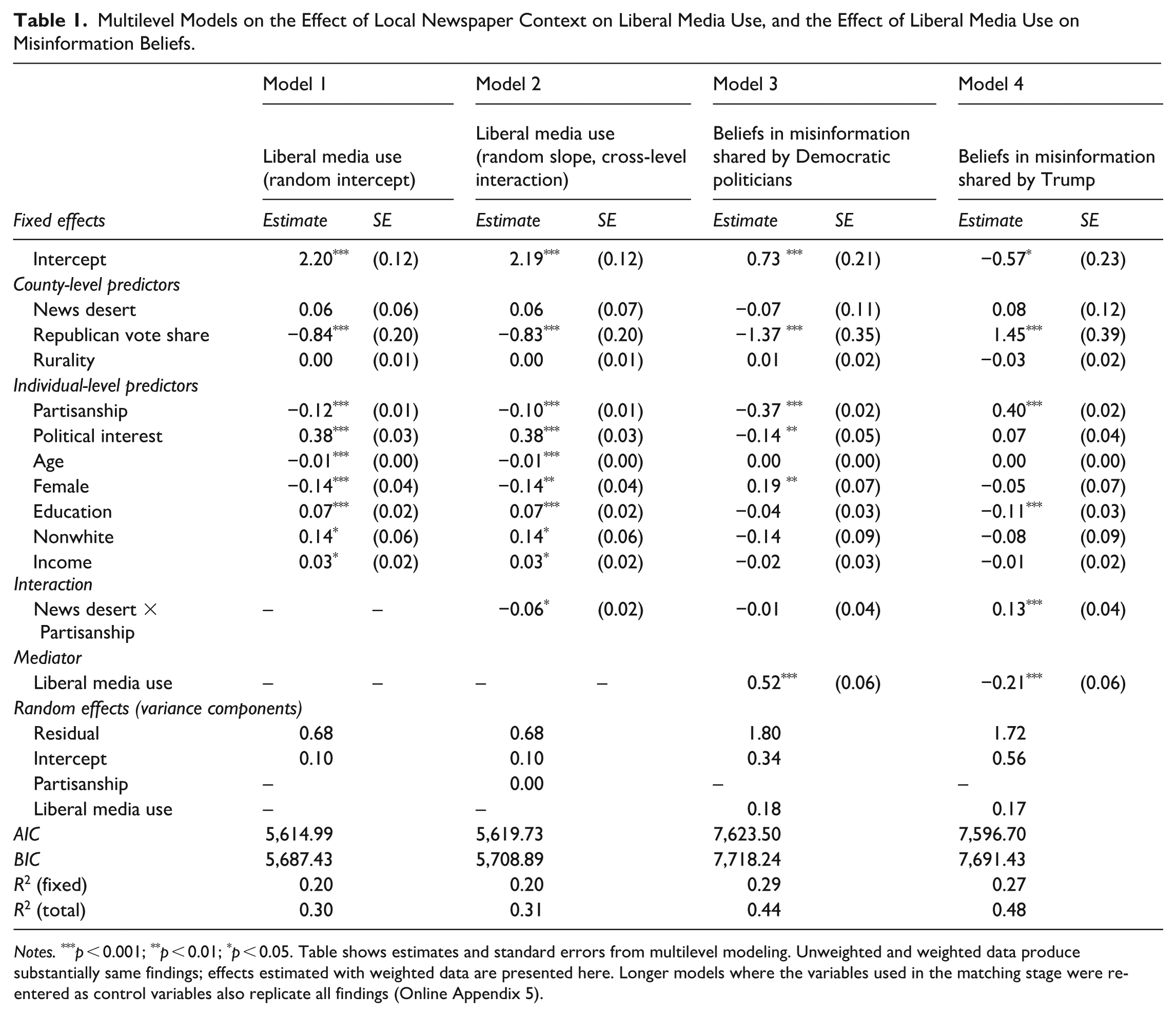
Notes. ***p < 0.001; **p < 0.01; *p < 0.05. Table shows estimates and standard errors from multilevel modeling. Unweighted and weighted data produce substantially same findings; effects estimated with weighted data are presented here. Longer models where the variables used in the matching stage were re-entered as control variables also replicate all findings (Online Appendix 5).
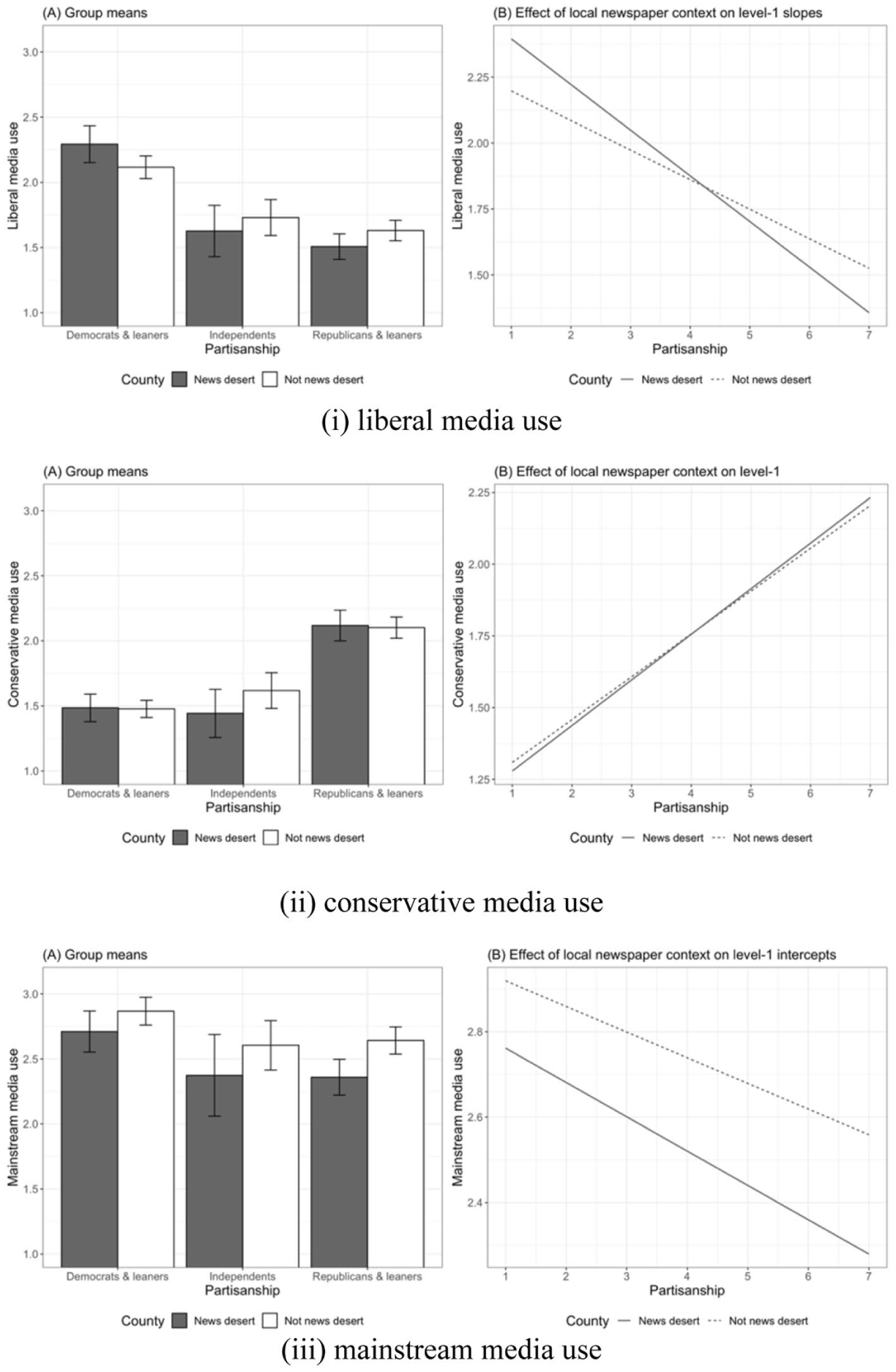
Effects of local newspaper context on media use.
On the other hand, local newspaper context does not affect people’s use of conservative media, either through main effects or moderation effects, rejecting H1b and H2b (Figure 3 middle panel). Instead, individual-level predispositions including political interest, partisanship and gender are the strongest explanatory variables of conservative media use (Online Appendix 3).
Finally, those living in a county without a newspaper are less likely to use mainstream national media by 0.20 point on a 5-point scale, which is in the opposite direction proposed in H1c and offers counterevidence to the expectation in previous literatures that citizens substitute the lost local newspaper with mainstream national media (Table 2, Model 1). Figure 3 (bottom panel) illustrates this main effect of local newspaper context. On the other hand, there is no significant cross-level interaction effect between local newspaper context and individual partisanship in predicting mainstream media use; that is, the moderation hypothesis is confirmed for liberal media use but not for mainstream media use (RQ1; Table 2, Model 2). In other words, in news deserts, individuals across the political spectrum consume mainstream media less frequently than those in non-news deserts.
Multilevel Models on the Effect of Local Newspaper Context on Mainstream Media Use, and the Effect of Mainstream Media Use on Misinformation Beliefs.
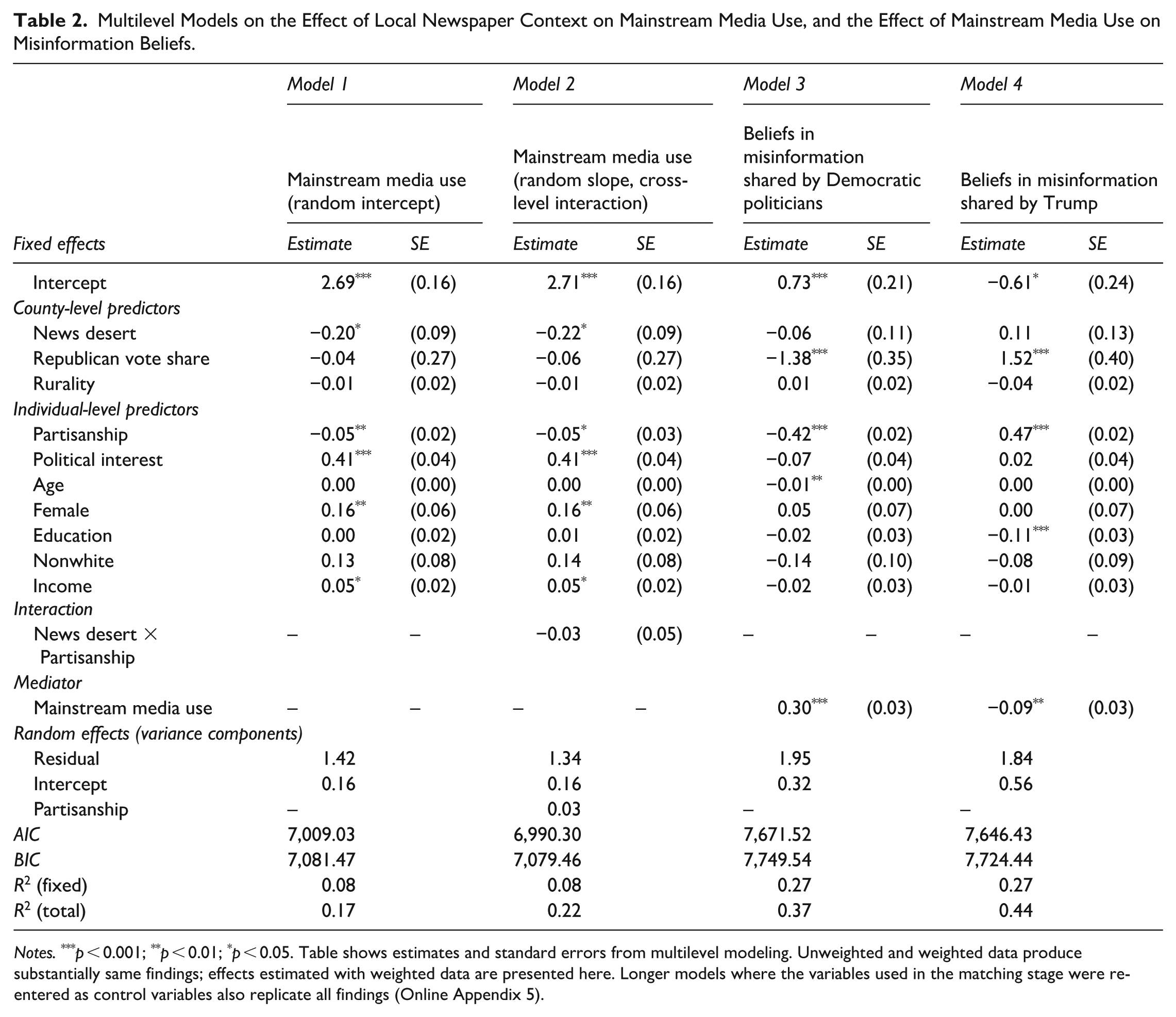
Notes. ***p < 0.001; **p < 0.01; *p < 0.05. Table shows estimates and standard errors from multilevel modeling. Unweighted and weighted data produce substantially same findings; effects estimated with weighted data are presented here. Longer models where the variables used in the matching stage were re-entered as control variables also replicate all findings (Online Appendix 5).
Indirect Effects of Local Newspaper Context on Misperceptions Through Media Use
After showing that people’s local newspaper context influences their use of national mainstream and partisan media sources to different degrees and through different mechanisms, we set out to test that media use variables, as mediators, in turn impact misperceptions. To begin with, we focus on liberal media and mainstream media – the two media use variables that are responsive to variations of local newspaper context. MLM findings show that when taking account of the effects of other county-level and individual-level predictors, each point increase in liberal media use is associated with increased beliefs in false statements made by Democratic politicians by 0.52 points and decreased beliefs in false statements made by President Trump by 0.21 points on a 9-point scale (Table 1, Model 3 & 4). Similarly, each point increase in mainstream media use is associated with increased beliefs in Democratic politicians’ false statements by 0.30 points and decreased beliefs in President Trump’s false statements by 0.09 points on a 9-point scale (Table 2, Model 3 & 4).
We formally tested the (moderated) mediation models in Figure 1 with MSEM. Tables 3 and 4 summarize the MSEM results that took account of county-level and individual-level controls. First, based on our finding that local newspaper context moderates the effect of partisanship on liberal media use, we examined the moderated mediation model: Partisanship (Moderated by local newspaper context) → Liberal media use → Misperceptions. Apart from confirming the MLM findings above for each separate path, we found overall support for the moderated mediation model (Table 3). For both the pathway predicting beliefs in Democratic politicians’ false statements and the pathway predicting beliefs in President Trump’s false statements, we find indirect effects in news deserts as well as non-news deserts.
Summary of Moderated Mediation Models of Local Newspaper Context, Partisanship, Liberal Media Use, and Misinformation Beliefs.
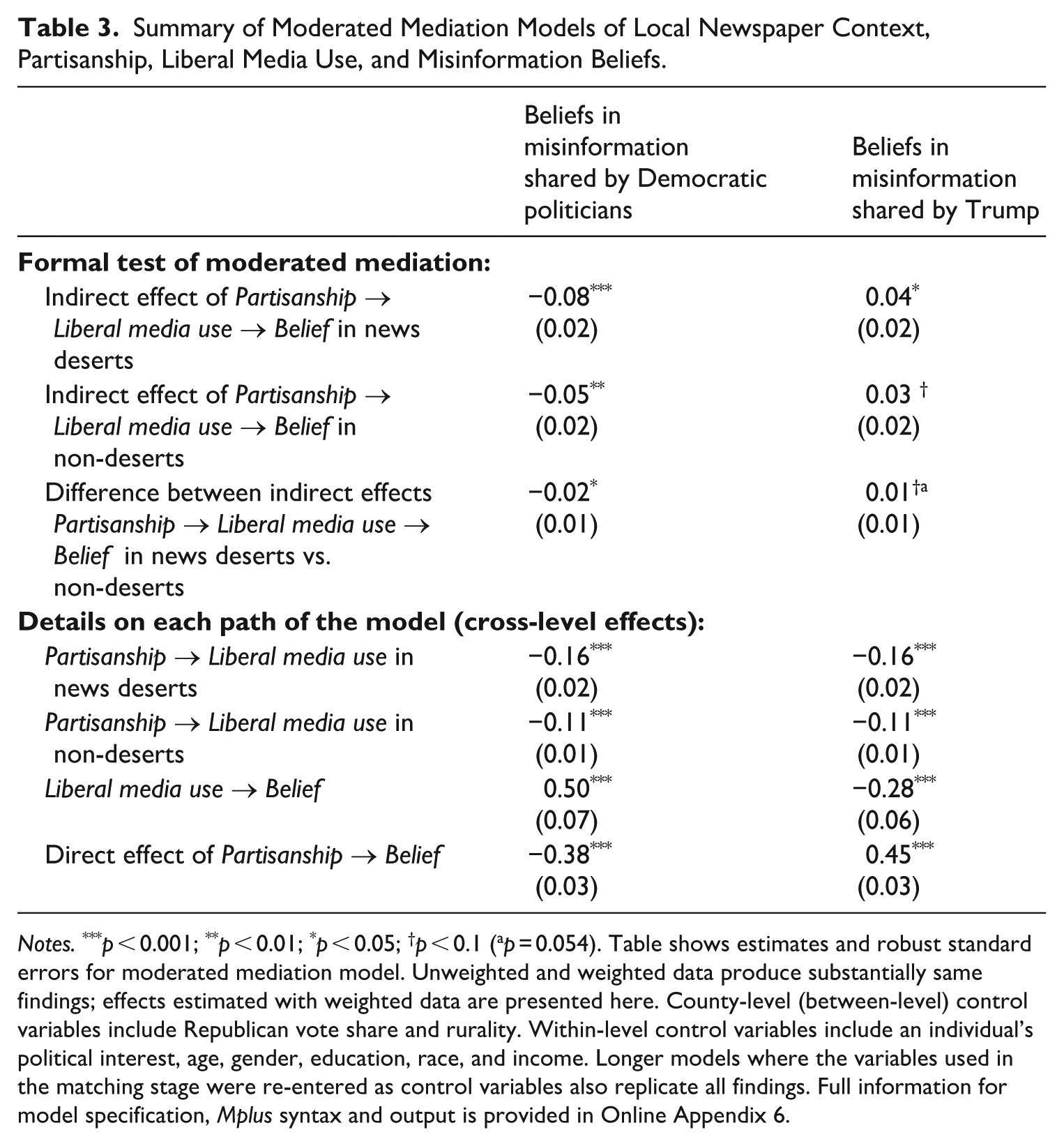
Notes. ***p < 0.001; **p < 0.01; *p < 0.05; †p < 0.1 (ap = 0.054). Table shows estimates and robust standard errors for moderated mediation model. Unweighted and weighted data produce substantially same findings; effects estimated with weighted data are presented here. County-level (between-level) control variables include Republican vote share and rurality. Within-level control variables include an individual’s political interest, age, gender, education, race, and income. Longer models where the variables used in the matching stage were re-entered as control variables also replicate all findings. Full information for model specification, Mplus syntax and output is provided in Online Appendix 6.
Summary of Mediation Models of Local Newspaper Context, Mainstream Media Use, and Misinformation Beliefs.
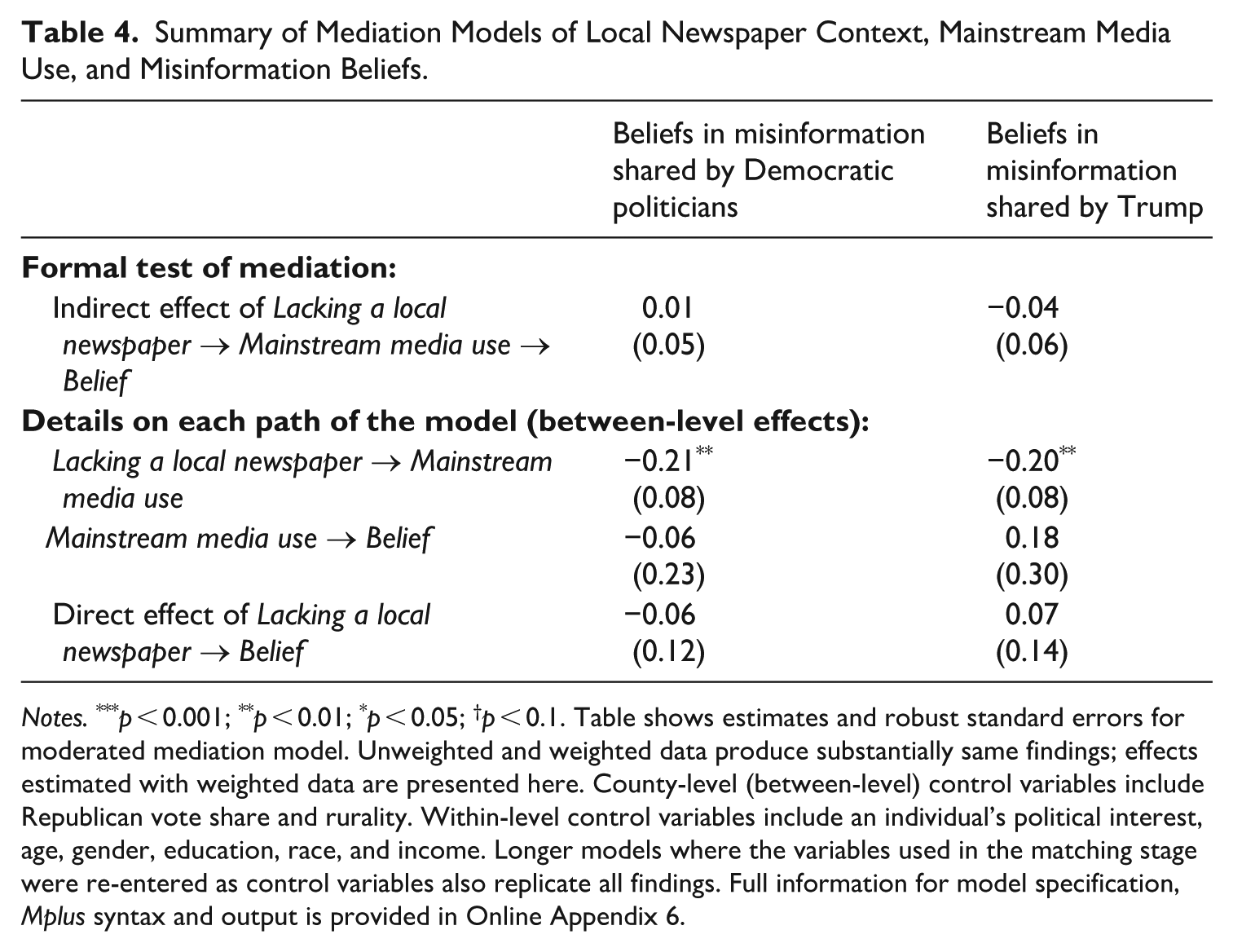
Notes. ***p < 0.001; **p < 0.01; *p < 0.05; †p < 0.1. Table shows estimates and robust standard errors for moderated mediation model. Unweighted and weighted data produce substantially same findings; effects estimated with weighted data are presented here. County-level (between-level) control variables include Republican vote share and rurality. Within-level control variables include an individual’s political interest, age, gender, education, race, and income. Longer models where the variables used in the matching stage were re-entered as control variables also replicate all findings. Full information for model specification, Mplus syntax and output is provided in Online Appendix 6.
Notably, the indirect effects in news deserts are significantly larger in size than the indirect effects in non-news deserts, suggesting that local newspaper context has a moderation effect on the relationship between partisanship, media use, and misperceptions. That is, in counties lacking a local newspaper (as compared to having a local newspaper), individual partisanship becomes a stronger predictor in the adoption of congruent misinformation beliefs (i.e., Republicans are more likely, and Democrats are less likely, to believe in President Trump’s false statements; and Republicans are less likely, and Democrats are more likely, to believe in Democratic politician’s false statements). This effect takes place through the mechanism of amplified partisan selective media use – with Republicans less likely and Democrats more likely to use liberal media. Therefore, H4a is supported.
Next, building off of the main effect of local newspaper context on mainstream media use, we examined the mediation model: Local newspaper context → Mainstream media use → Misperceptions. Table 4 summarizes the test results. Because the independent variable – local newspaper context – only varies on the between-level, this mediation mechanism can be tested on the between-level only (Preacher et al., 2010).
Although lacking a local newspaper in one’s county decreases mainstream media use, mainstream media use fails to predict beliefs in Democratic politicians’ false statements or President Trump’s false statements across counties. The indirect effects of the mediation pathways predicting beliefs in Democratic politicians’ false statements and beliefs in President Trump’s false statements are both indistinguishable from zero. There are also no significant direct effects from local newspaper context to misperceptions. As an exploratory step, we also tested the relationship between mainstream media use and misperceptions on the within-level. Our results show that mainstream media use does contribute to misperceptions on the within-level (Online Appendix 6). In sum, the lack of a local newspaper decreases mainstream media use across counties, but the effect does not extend to the holding of misperceptions – the relationship between mainstream media use and misperceptions only exists when looking at individuals nested within each county but not across counties. These findings point to the differences between the influence of mainstream and liberal media in misperception adoption (RQ2 & RQ3).
As individuals’ use of conservative media is not impacted by local newspaper context, we cannot formally test mediation or moderated mediation model for conservative media. Additional MLM analysis shows that each point increase in conservative media use is associated with increased beliefs in President Trump’s false statements by 0.57 point and decreased beliefs in Democrat’s false statements by 0.23 on a 9-point scale (Online Appendix 3). That is, individuals’ use of conservative media is significantly associated with misperceptions. However, it does not vary as a function of local newspaper context, rejecting both H3b and H4b.
Discussion
This paper demonstrates the important effects that access to local newspapers and individual partisanship have on selective exposure and the holding of misperceptions about important issues. First, we unpacked the heterogeneity in the effects of local newspaper context on individual use of national media that was implied, but untested in past research. The concern that “news deserts” contribute to the nationalization of citizens’ media diet (Darr et al., 2018) is more precisely specified by two important findings from our study. On the one hand, lacking a local newspaper is associated with a decrease, rather than an increase, in one’s mainstream media use. While the direction of causal inference could be arguably reversed, that is, counties with audiences less interested in mainstream news have a higher likelihood to see local newspaper closure, research suggests that the supply side is a stronger predictor than audience demand to explain the decline in local news (Martin & McCrain, 2019; Qin, 2024). Our findings add supporting evidence to the growing concern that broadcast TV cannot fill the void of local newspapers (Abernathy, 2020).
On the other hand, as residents of “news deserts” turn away from national mainstream media, they turn toward national partisan media when local newspapers are no longer available. This is consistent with Ellger et al.’s (2024) evidence from Germany that local news exits lead to more national tabloid paper use. While the U.S. media ecosystem is different from Germany’s, especially with respect to the ideological nature of many news media sources in the U.S., our results similarly show how a lack of local news availability is associated with individuals turning to national media sources that provide very different content – in tone, style, and topic – than local news. This evidence accords to theoretical expectations and empirical demonstrations highlighting the importance of contextual variances in the larger information environment beyond individual preferences. Building on Darr et al.’s (2021) field experiment showing that local newspapers contribute to depolarization when eschewing attention to national politics, we show that when the unique local lens offered by local newspapers disappears, individuals are more vulnerable to partisan selective consumption of news. Notably, this mechanism takes place in an asymmetric way. While the gap in liberal media use widens between partisans living in counties without a local newspaper, conservative media use is unaffected by the contextual variances, consistent with prior evidence that individual preferences for conservative media are more deeply seated (Wang et al., 2024).
Perhaps most importantly, we have revealed a troubling consequence of the changing media diets affected by local newspaper context – intensified endorsements of partisan-congruent misperceptions. This finding highlights the need for a multilevel approach to studying misperceptions, contributing to the line of scholarship on political and information context (Huckfeldt & Sprague, 1987; Van Duyn, 2021; Weatherford, 1983) and especially the burgeoning body of work on local news context (Darr et al., 2018, 2021; Hayes & Lawless, 2015). By putting individual partisanship in context, our findings speak to the recent rethinking of classic motivated reasoning that argues defensive reasoning is not a default in political information processing but is instead induced by contextual motivations (Groenendyk & Krupnikov, 2020). Our MSEM approach also showcased the advantage of specifying relationships on both between- and within-levels of analyses. The finding that the influence of mainstream media on political misperceptions exists within individuals nested in each county but not across counties calls for careful tests of causal relationships when taking a multilevel approach to misperceptions.
By carefully assembling a unique dataset that enables us to consider a wide range of county- and individual-level characteristics, we take a step forward toward a more contextualized and precise approach to studying “news deserts” that Usher (2023) called for. We consider factors including county-level political environment, rurality, age, gender, race, education, income, and geography alongside newspaper availability, providing a more textured, albeit imperfect, approach to “place-based specificity” and revealing a fuller picture “not visible when county types are divided by rural/urban/suburban population metrics” only (Usher, 2023, p.248). The multilevel analyses that compare counties and the individuals within them help us respond to the call for “more research on what is replacing local newspapers and how these replacements, both as used by elites to reach the public and as consumed by the public, might heighten political polarization or cause shifts in political behavior” (Usher, 2023, p.248). We show that when left without access to local newspapers, people in these communities tend to selectively turn to partisan media, but not mainstream media, and that this context-associated selective exposure may widen partisan belief gaps.
That said, we should also consider the fact that the quality of local news varies considerably (Usher, 2023). For example, some local television news, such as those owned by Sinclair Broadcast Group, look more like partisan outlets than traditional local news outlets (Levendusky, 2022; Martin & McCrain, 2019). As such, the term “news deserts” may mask variance in local news quality, even in places without local newspapers. Perhaps future scholarship should focus on information rich vs. information poor local news environments, including broadening the scope to examine the quality of local news that comes from digital and social media and selective information seeking that may take place in local groups (Van Duyn, 2021).
Finally, it is worth noting that the asymmetric effect of news deserts lies in people’s liberal vs. conservative media usage, not in who people are and the substance of their ideological beliefs. Though we observed asymmetrical effects in terms of whether people’s liberal vs. conservative media use is sensitive to local newspaper context, we observed a symmetric pattern in political misperception formation in the sense that misperceptions on both sides of American politics are conditioned, in part, by local newspaper context. That is, the belief gaps between Democrats and Republicans are larger in news deserts, and this effect applies to beliefs in statements shared by elites from both parties. In news deserts (vs. non-deserts), Republicans are more likely, and Democrats are less likely, to believe in President Trump’s false statements; and Democrats are more likely, and Republicans are less likely, to believe in Democratic politicians’ false statements. Additionally, Democratic vs. Republican partisan identities also have comparable, symmetric effect sizes on media use and political misperceptions. The asymmetric pattern, again, lies in which media variable serves as the pathway for the above. Our findings support the mechanism of Partisanship (Moderated by local newspaper context) → Selective liberal media use → Misperceptions for both sides of the aisle, but not Selective conservative media use as the pathway. Although both liberal and conservative media use are associated with misperceptions, it is liberal media use rather than conservative media use that is sensitive to changes in local newspaper context, as conservative media use is driven more by identity factors than contextual factors.
Our study has some important limitations. Our study cannot directly address the content of local newspapers beyond mere presence and its ramifications (Darr et al., 2021). Local newspapers have been valorized, even when praise is not deserved (Usher, 2023). Also, our study is not examining changes in media use, comparing media use pre-and-post-newspaper closure. Our analysis begins in places without local newspapers. Certainly, papers that had been there had closed, but a strength of our analysis lies in comparing places with local papers to similar places without them and controlling for confounding effects as discussed above. Taking together our findings on newspaper availability and Ellger et al.’s (2024) and Darr et al.’s (2018) findings on newspaper closure, future studies might take both factors into account. We also studied a particular kind of political misperception – statements made by national political elites that are verifiably false. Studies of beliefs in low-quality information with various levels of source, ambiguity and salience (Vraga & Bode, 2020) are needed before we can make more general conclusions about how misperceptions and rumors develop as a result of multilevel mechanisms revealed in our study (Starbird et al., 2025).
It is also worthwhile for future research to compare different measures of the overall health of the local news environment. In Online Appendix 4, we report results for four alternative coding strategies that loosen distinctions between counties with zero newspaper and other counties. While these alternative approaches produce largely similar findings, some weakened effects sizes and significance point to the possibility that there is a substantial difference between counties with zero newspaper and other counties. In particular, when liberal media use was a dependent variable, only one of the four alternative specifications replicated. For two models, our news desert explanation was marginally (p < .07, p < .1) significant and for one model it was not significant. Future work might systematically test these alternative coding strategies and pursue designs with increased statistical power to validate the findings reported here.
Bridging the research on the decline of local news, selective exposure, and misperceptions, our inquiry underscored the detrimental consequences of the loss of local newspapers in amplifying identity-congruent biases. While beliefs in falsehood disseminated by elites from both sides are influenced by selective exposure amplified by local newspaper context, liberal media use is more affected by the contextual variances in local news environment than conservative media use. Such (a)symmetries are important for advancing our understanding of today’s political information ecosystem where verifiable truth is contested.
Supplemental Material
sj-docx-1-crx-10.1177_00936502261463581 – Supplemental material for Partisanship in Context: The (A)symmetric Influence of Local Newspaper Availability and Selective Exposure on Political Misperceptions in the U.S.
Supplemental material, sj-docx-1-crx-10.1177_00936502261463581 for Partisanship in Context: The (A)symmetric Influence of Local Newspaper Availability and Selective Exposure on Political Misperceptions in the U.S. by Jianing Li and Michael W. Wagner in Communication Research
Footnotes
Acknowledgements
The authors gratefully acknowledge insightful and helpful comments from Johanna Dunaway, Dhavan V. Shah, Lewis A. Friedland, Katherine J. Cramer, Benjamin Toff, Yingdan Lu, Abby Youran Qin, Jordan Foley, and Jisoo Kim. We greatly acknowledge funding from the John S. And James L. Knight Foundation (AWD-002111) and the William T. Evjue Distinguished Chair for the Wisconsin Idea (GF000020938).

Ethical Considerations
This research is approved by the University of Wisconsin-Madison Institutional Review Board (Study 2020-0397).
Consent to Participate
Requirement to obtain a signed informed consent form has been waived by the relevant Institutional Review Board.
Funding
The authors disclosed receipt of the following financial support for the research, authorship, and/or publication of this article: We greatly acknowledge funding from the John S. And James L. Knight Foundation (AWD-002111) and the William T. Evjue Distinguished Chair for the Wisconsin Idea (GF000020938).
Declaration of Conflicting Interests
The authors declared no potential conflicts of interest with respect to the research, authorship, and/or publication of this article.
Data Availability Statement
The data underlying this article will be shared on reasonable request to the authors.
Supplemental Material
Supplemental material for this article is available online.
Author Biographies
References
Supplementary Material
Please find the following supplemental material available below.
For Open Access articles published under a Creative Commons License, all supplemental material carries the same license as the article it is associated with.
For non-Open Access articles published, all supplemental material carries a non-exclusive license, and permission requests for re-use of supplemental material or any part of supplemental material shall be sent directly to the copyright owner as specified in the copyright notice associated with the article.
