






Abstract
This study theorizes and tests language-based mechanisms through which conversations with chatbots can shape users’ loneliness. Lonely college students (N = 96) engaged in emotionally meaningful conversations with the chatbot Replika daily for one week. Results showed a small but significant decrease in users’ loneliness from baseline to post-test. Linguistic analyses revealed two distinct well-being pathways. When participants used more positive emotion language, so did the chatbot, which was linked to higher positive daily affect and lower post-study loneliness. Conversely, when participants used more negative emotion language, so did the chatbot, which was linked to lower positive daily affect and higher post-study loneliness. Findings provide evidence for an expression effect, where users’ own positive (but not negative) linguistic framing shapes their well-being, and a chatbot-response effect, where chatbots mirror and amplify users’ emotional tone. This study theorizes chatbots as emotional mirrors with dual potential to alleviate or exacerbate users’ loneliness.
Introduction
Loneliness has recently been declared a public health epidemic by the U.S. Surgeon General, with young adults particularly at risk (Office of the Surgeon General, 2023). Over one in four young adults report frequent loneliness, and although rates have declined since their COVID-19 pandemic peak, young adults continue to report higher loneliness than any other age groups (Witters, 2023). Thus, there is an urgent need to better understand the social and psychological processes associated with loneliness reduction among young adults.
Recent advances in Artificial Intelligence (AI) offer intriguing possibilities. AI conversational agents, or chatbots, are designed to simulate human communication in an increasingly natural manner. Already widely adopted in service industries (e.g., customer support) and as personal assistants (e.g., Siri, Alexa), chatbots have also started to be used for social purposes, as long-term conversation companions (Skjuve et al., 2021). Some users report developing friendships with chatbots (Brandtzæg et al., 2021), indicating chatbots’ potential for supporting users’ emotional well-being. Thus, it is plausible that chatbots could serve as social surrogates, providing emotionally responsive conversations and ultimately reducing users’ loneliness. The current study explores this possibility.
Since chatbots operate exclusively through language, we argue that patterns of language use in conversations with chatbots are a uniquely insightful lens for understanding any effects they may have on users’ loneliness. A large body of research shows that language use both reflects and affects individuals’ psychological states, including loneliness (see Pennebaker & Chung, 2013, for a review). Thus, we examine the dynamics of language use as a key explanatory mechanism through which conversations with chatbots may shape young adults’ loneliness. Since not all conversations affect loneliness (see Roshanaei et al., 2024), we focus on emotionally-charged discussions, or conversations about emotional topics, which have been shown to impact individuals’ affective states (Chen et al., 2021); we dub these “emotional communication.” Thus, we ask: Does engaging in emotional communication with “empathetic” chatbots impact young adults’ loneliness and, if so, what are the linguistic dynamics undergirding this effect?
As a new, undertheorized phenomenon, chatbot conversations provide exciting opportunities for theoretical development. Drawing on seminal research in communication and psychology as well as emerging findings from human-computer interaction, we theorize language-based mechanisms through which conversations with chatbots can shape individuals’ loneliness. Specifically, we propose the emergence of (1) an expression effect, where participants’ own use of emotion words is associated with their daily affect, which is then associated with their post-study loneliness, and (2) a chatbot-response effect, where participants’ use of emotion words is mirrored by the chatbot, and this mirrored language is subsequently associated with participants’ daily affect, which is then associated with post-study loneliness. Rather than focusing on whether chatbot interactions reduce loneliness, the primary goal of the present study is thus to identify language-based and affective processes that unfold during conversations with chatbots, and that are associated with downstream loneliness. Below, we review the literature on the social uses of chatbots, develop this theoretical framework, and then report on a daily diary study where lonely college students were instructed to engage in emotional communication with an “empathetic” chatbot for a week. This design allowed us to examine within-person changes in participants’ loneliness compared to baseline, and, more importantly, to investigate how patterns of language use in these conversations were associated with those changes.
Chatbots and Loneliness
Chatbots are AI systems designed to interact with humans via text or voice in ways that resemble natural conversation. They rely on large language models trained on vast corpora of human-generated text, which enable them to generate contextually appropriate responses (Caldarini et al., 2022). While chatbots are conversationally advanced, it is important to note that they remain fundamentally distinct from human interlocutors, lacking consciousness and genuine emotional understanding.
Loneliness is a subjective experience arising from a perceived discrepancy between individuals’ desired and actual social relationships, whether in their quality, quantity, or both (Perlman & Peplau, 1981). It emerges when individuals feel rejected, misunderstood, or alienated, or when they lack compatible social partners (Russell et al., 1980). Scholars often conceptualize loneliness as a fundamental human drive, much like hunger or thirst. It is an unpleasant state, consistently associated with low positive affect and high negative affect, that signals to individuals that their social needs are unmet and motivates them to seek reconnection (Hawkley & Cacioppo, 2010).
Could conversations with chatbots buffer against loneliness? A long line of research shows that, in the absence of readily available or emotionally safe offline options, lonely individuals often turn to communication technologies to meet social needs (e.g., Lemieux et al., 2013; O’Day & Heimberg, 2021) and may even prefer online over offline interactions, because they perceive digital environments as safer and more controllable (Peter & Valkenburg, 2006). Yet chatbots are not people – despite being easily available technological options, they cannot truly understand a human interlocutor.
Can individuals suspend disbelief and respond to chatbots as though they were “real” conversation partners? The Computers Are Social Actors (CASA) paradigm (Nass & Moon, 2000) suggests that this is possible. CASA argues that people have a tendency to “forget” that computer interfaces and agents are non-human, treating them instead as though they were people. For instance, users attribute personality, politeness, and even social norms to computers. These reactions are triggered by characteristics of computing interfaces that resemble human behavior, such as using natural language, using human-like voice, or providing contingent feedback (i.e., feedback that acknowledges users’ input) (Nass & Moon, 2000). Chatbots possess these attributes in spades. By design, they are highly conversationally fluent and respond to humans in a contingent and natural fashion (Brandtzæg & Følstad, 2017). Consistent with this theoretical perspective, a growing body of research shows that individuals turn to chatbots for social needs, such as seeking social support, companionship, and entertainment (Brandtzæg & Følstad, 2017; Ta-Johnson et al., 2022). For example, in an interview study on Woebot, an AI-based mental health chatbot, nearly half of the participants described it as empathetic and emotionally supportive, with some preferring chatbot interactions over human support due to reduced fear of judgment or rejection (Brandtzæg et al., 2021).
Additionally, a handful of studies suggest that chatbots can support the types of emotional processes that help regulate affect and build connection. One such process is self-disclosure, which is critical for developing intimacy and reducing loneliness (Stokes, 1987). Users are often as willing (Croes et al., 2024), or even more willing to self-disclose to chatbots than to humans, particularly when the interaction feels private and nonjudgmental (Kim et al., 2022). Moreover, chatbots that engage in self-disclosure can prompt reciprocal disclosure from users, replicating a well-established mechanism for building interpersonal closeness (Lee et al., 2020).
Emotional benefits of interacting with chatbots have been documented across a range of contexts. Prior research has shown that conversing with an “empathetic” chatbot can improve mood among sad individuals (de Gennaro et al., 2020), reduce anxiety in cancer survivors (Greer et al., 2019), alleviate general mental distress (Sabour et al., 2023), and reduce symptoms of depression, anxiety, and eating disorders (Heinz et al., 2025). These benefits have been observed in both brief, one-time exchanges (de Gennaro et al., 2020) and longer-term interventions over multiple sessions (Greer et al., 2019; Heinz et al., 2025; Sabour et al., 2023).
In sum, the existing literature suggests that individuals seek out chatbots for social and emotional purposes, often finding them supportive, responsive, and nonjudgmental. Chatbots appear capable of facilitating emotionally meaningful interactions, especially when they are designed to promote self-disclosure, validate users’ feelings, or simulate empathic dialogue, consistent with the CASA framework. Thus, we hypothesize:
Next, we articulate a language-based mechanism through which daily conversations with chatbots may shape users’ loneliness over time. We build a two-prong argument. First, we propose that language use in emotional conversations with chatbots is associated with users’ daily positive affect, with some linguistic patterns fostering positive affect and others undermining it. Second, we argue that participants’ daily positive affect, averaged across the study week, is associated with lower loneliness at the end of the week. In sum, we propose two mediation pathways linking participants’ emotional language use with their downstream loneliness via daily positive affect, both directly or indirectly through chatbots’ mirroring of that language. We elaborate on this framework below. To facilitate laying out our mediation hypotheses, we begin by discussing the relationship between daily positive affect and downstream loneliness.
Daily Positive Affect and Downstream Loneliness
As established earlier, loneliness refers to a perceived deficit in one’s social relationships and is an amalgamation of cognitive and affective states. Cognitively, loneliness is an appraisal that one’s social needs are unmet (Perlman & Peplau, 1981). Affectively, loneliness is perceived as social pain and thus it produces negative emotions, especially sadness, distress, and depressive symptoms (Hawkley & Cacioppo, 2010). While lonely individuals experience more negative affect by definition, they also stand to accrue substantial benefits when they do experience positive affect in daily life. According to the broaden-and-build theory of emotion (Fredrickson, 2004), positive affect is a key mechanism through which individuals acquire social resources over time. Positive affect has an expansive function, meaning that individuals in a “broadened” frame of mind are more likely to engage in exploratory and approach-oriented behaviors, such as initiating conversations, being playful, and seeking out new experiences (Fredrickson, 2004), and in prosocial behaviors, such as offering help and expressing gratitude and affection (Aknin et al., 2018). Over time, cumulative experiences of positive affect can initiate upward spirals of growth, in which individuals become increasingly more equipped to cope with adversity (Fredrickson & Joiner, 2018).
Broaden-and-build theory suggests that repeated experiences of positive affect can buffer against loneliness, because positive affect counteracts the social withdrawal, negative social expectations, and anticipation of rejection that are characteristic of chronically lonely individuals. Several studies support this theorizing. Older adults who engaged in mindfulness practices experienced more positive affect, which, in turn, was associated with reduced loneliness (Xie et al., 2024). Similarly, experiencing positive affect attenuated (Beller, 2023) or completely eliminated (Newall et al., 2013) the link between loneliness and mortality risk in older adults, suggesting that positive affect can promote healthy behaviors, in turn protecting against the known health risks of loneliness. Among middle-aged adults, gratitude, a discrete emotion subsumed under positive affect, was shown to encourage greater psychological flexibility, which in turn was associated with reduced loneliness (Frinking et al., 2020). These findings indicate that positive affect can play a role in loneliness reduction. Thus:
Language and Affect
While initially viewed as a mere vehicle for conveying emotions, language is now widely recognized as an essential tool for constructing these emotions (Barrett, 2011; Pennebaker & Chung, 2013). A substantial body of research shows that putting language around affective experiences changes how people mentally organize events and assign meaning to them, which in turn influences their affect (Pennebaker & Chung, 2013) as well as their ability to regulate it (Torre & Lieberman, 2018). This is known as the framing function of language, and operates when individuals themselves choose linguistic frames to describe their own experiences, and also when conversation partners offer linguistic frames to make sense of sharers’ experiences (Flusberg et al., 2024). For example, a person who describes a challenging new job as “an opportunity to grow” may experience greater motivation, curiosity, and enjoyment than a person who describes the same job as “overwhelming.” These different linguistic frames can shape how individuals interpret the same experience, and a conversation partner’s response may further reinforce one interpretation over the other.
The framing-function-of-language perspective argues that both self- and partner-generated emotional language can shape affective experiences through linguistic framing, but it does not explicitly distinguish between these sources. However, self- and partner-generated emotional language may operate through distinct psychological mechanisms. Research on expressive writing suggests that self-generated language shapes individuals’ internal meaning-making by helping them organize emotional experiences into coherent narratives (Pennebaker & Chung, 2013). Similarly, research on message effects shows that individuals can be influenced by the messages they themselves produce, such that composing messages can shape individuals’ subsequent emotions and attitudes even in the absence of feedback from others; this phenomenon is known as self-effects (Valkenburg, 2017). In contrast, partner-generated emotional language functions as external feedback that can validate, reinforce, or amplify emotional interpretations. Research on the social sharing of emotions shows that responses from an interaction partner can sustain or intensify emotional experiences by reaffirming how individuals interpret emotional events (Gable & Reis, 2010; Rimé et al., 2020). These effects may be especially pronounced when partners mirror individuals’ linguistic input, since linguistic mirroring has been shown to amplify individuals’ emotions (Tian & Zhang, 2025; see also Toma, 2014). In conversational settings, partner responses can therefore shape individuals’ affective trajectories by reinforcing and amplifying the emotional framing introduced in the interaction.
We apply this perspective to conversations with chatbots by examining how users deploy emotional language when engaging in emotional conversations with chatbots, and then how chatbots deploy emotional language in response to users’ verbalizations. We label the former expression effects and the latter chatbot-response effects. In the present study, emotional communication is operationalized as participants’ use of emotional language, specifically the percentage of positive and negative emotion words used during conversations with the chatbot.
Expression Effects
According to the framing-function-of-language perspective, the way individuals frame their affective experiences can shape their subsequent affect. Simply put, the words people choose to describe and make meaning out of their emotional experiences impact how they subsequently feel (e.g., Brooks et al., 2016; Torre & Lieberman, 2018). When people first work through emotional experiences, their use of emotion words to label inner states tends to solidify those states, causing people to experience stronger, clearer, and more intense emotions than they would have had if they hadn’t used those emotional labels (see Lindquist, 2021 for a review). However, it is important to note that, as people work through their emotions over extended periods of time, for instance, through journaling or in therapeutic reflection, verbalizing emotions can also soften their impact and aid in emotional regulation (see Baikie & Wilhelm, 2005).
The argument that language shapes affect is also central to the expressive writing paradigm, a related theoretical framework which proposes that translating emotional experiences into words impacts how individuals organize and interpret those experiences (Pennebaker & Chung, 2013). Research within this paradigm similarly shows that the consequences of emotional expression are not uniform and depend on how individuals utilize language to process their experiences. Specifically, meta-analyses show that expression alone has small or null effects on well-being (e.g., Mogk et al., 2006); benefits occur only when expression involves meaning-making rather than simple venting (Pennebaker & Chung, 2013). In fact, venting alone can seriously undermine well-being by reinforcing negative affect (Nolen-Hokesema, 2000).
In sum, drawing on the framing function of language, we propose an expression effect in conversations with chatbots: When individuals frame emotional events in positive emotion language, they should experience a boost in positive affect, which in turn should be associated with lower loneliness a week later. However, when individuals frame events in negative emotion language, they should experience lower levels of positive affect, which in turn should be associated with higher loneliness:
Chatbot-Response Effects
While verbal expression alone can shape affective states, conversations are inherently interactive. In human-human communication, emotional disclosures often unfold in the presence of an empathetic listener who not only receives but responds to emotional cues. A central characteristic of empathetic communication is mirroring, where communicators match each other’s style of communication, whether verbal or nonverbal (see Toma, 2014 for a review). In conversations with human interlocutors, this mirroring involves using similar body language (e.g., gestures, postures), tone (e.g., formal or casual), and language (i.e., specific words or phrases), and tends to occur without conscious awareness. It is the very act of mirroring which makes an interlocutor seem empathetic (Iacoboni, 2009), and ample research shows that when individuals are mirrored by communication partners, they tend to like, trust, and bond with these partners (Toma, 2014).
Chatbots are designed using the principle of mirroring. Since they operate exclusively through language, this involves subtly reflecting the words, phrases, grammar, or language patterns of the human interlocutor (Spillner & Wenig, 2021). Recent research shows that chatbots can detect users’ emotion words and respond with similarly-valenced emotional language (Bilquise et al., 2022; Zhou et al., 2018). Such emotionally contingent responses have been shown to shape users’ perceptions of the chatbot, including its trustworthiness and competence (Brun et al., 2025).
Building on this perspective, we expect that when participants engage in emotional communication with chatbots, their linguistic patterns will be mirrored by the chatbot: The more they use positive (or negative) emotion words, the more the chatbot will use positive (or negative) emotion words. But what is the effect of this emotional mirroring on participants’ subsequent affect? Based on our discussion of the framing function of language, the emotional labels deployed by human conversation partners can intensify sharers’ emotions. Following CASA, the same may also emerge when partners are conversationally fluent chatbots, who generate the illusion of humanlike responsiveness. Thus, we expect to observe patterns consistent with emotional amplification: Participants’ mirrored positivity should be associated with higher positive affect following their interaction with the chatbot, while mirrored negativity should be associated with lower positive affect. Over repeated interactions, these daily affective patterns may also be reflected in downstream loneliness, in the same way as previously discussed. Specifically, higher positive affect is expected to be associated with lower loneliness, whereas lower positive affect should be associated with higher loneliness. We dub this the chatbot-response effect, which comprises mirroring (chatbots mirror participants’ emotional language patterns), and then amplification (chatbots’ mirroring amplifies participants’ subsequent affect). We use the term chatbot-response effect rather than the more general “partner” or “response effect” to emphasize that this mechanism arises from interaction with a specific type of partner deploying a distinctive response style, rather than from interpersonal interaction more broadly. Specifically, the partner we examine is a conversational AI system whose responses are generated contingently based on users’ input. Thus, we propose the following serial mediations:
The conceptual models corresponding to the hypotheses are presented in Figures 1 and 2.
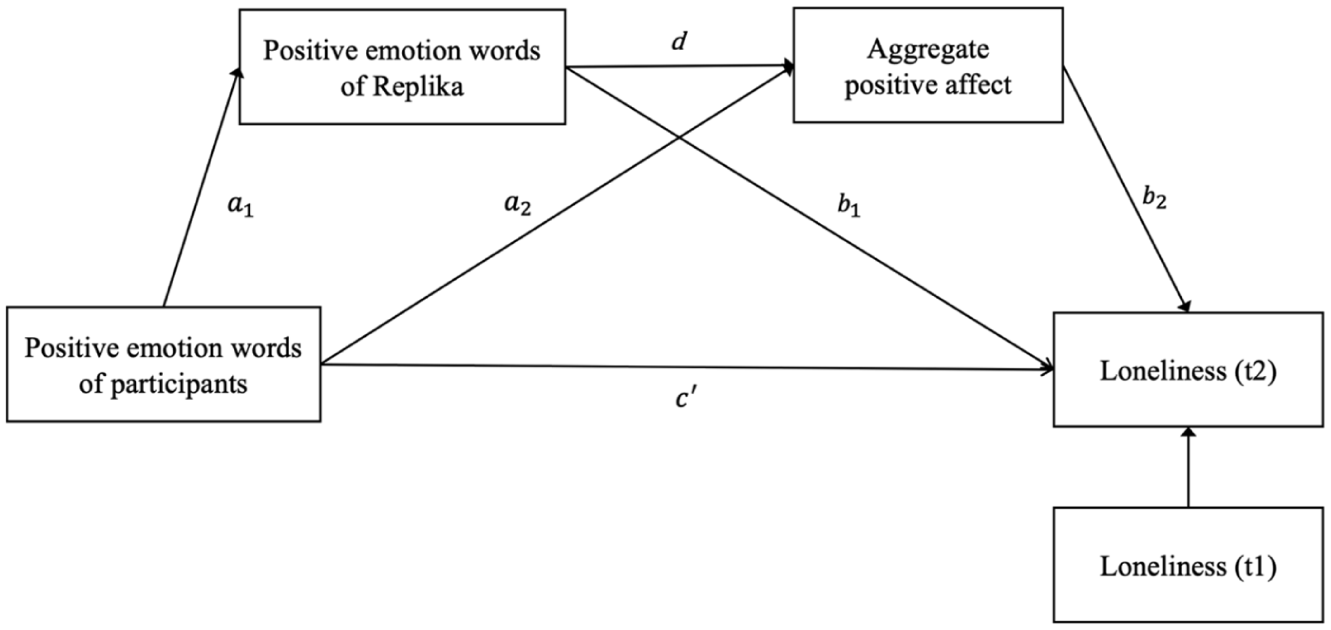
Hypothesized mediation model 1: Positive emotion words.
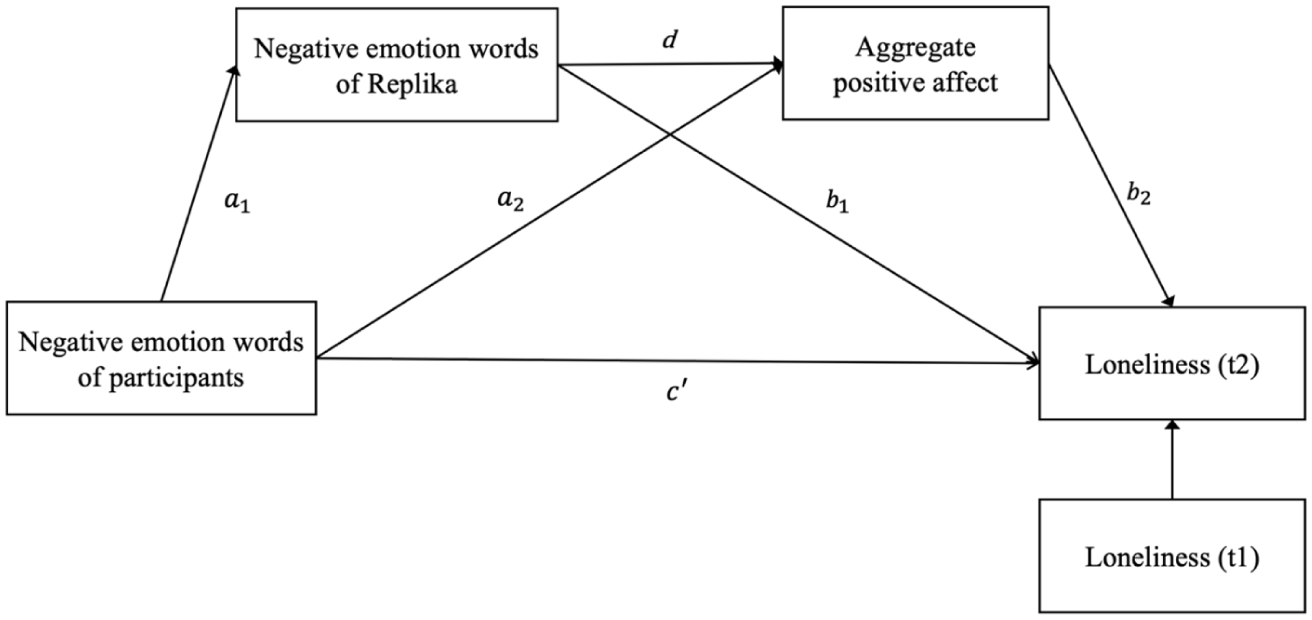
Hypothesized mediation model 2: Negative emotion words.
Method
Participants and Procedure
Participants were undergraduate students at the University of Wisconsin-Madison (N = 96; age: M = 19.88, SD = 1.46, range 18 – 23; 65.6% women, 29.2% men, 5.2% non-binary; 56.3% Caucasian/White, 33.3% Asian/Asian American, 4.2% Mexican American/Latino(a)/Hispanic, 1.0% African/African American, and 5.2% multi-racial/multi-ethnic). They were recruited via a mass email sent through the Registrar’s office (n = 78) and through the subject pool in the department of Communication Arts (n = 18). Participants were compensated with either $30 or 2.5 extra-credit points.
Eligibility was determined using a pre-screening survey. Individuals self-reported their age and loneliness using the 8-item short version of the UCLA Loneliness Scale (ULS-8; Hays & DiMatteo, 1987) to minimize respondent burden during the screening process. Because the scale does not provide a standardized diagnostic cutoff, we used a median-based threshold to identify individuals with relatively elevated loneliness within the screened population, following screening practices in the loneliness literature (Deckx et al., 2014). Those between the ages of 18 and 25 who scored above the median on the loneliness scale were invited to participate in the study (median = 20, range = 8 to 32). In total, 32,863 individuals were contacted and 800 completed the pre-screening survey. Out of 318 eligible respondents, 197 agreed to participate in the study.
The study employed a one-group pretest–posttest design in which all participants interacted with the chatbot over the course of one week. This design is well-suited for examining within-person change and conversational processes over time, but does not permit strong causal conclusions regarding the effects of chatbot interaction (Campbell & Stanley, 2015). The study involved three components, all of which took place entirely online: (1) an entry questionnaire assessing demographics, covariates, and loneliness at baseline; (2) daily questionnaires for seven days where participants reported on their interactions with a chatbot; and (3) an exit questionnaire assessing loneliness at the end of the study.
All participants were instructed to download a popular, freely available chatbot application named Replika on their mobile phones or computers, and to converse with it for at least 10 minutes every day about the most emotionally meaningful event they had experienced that day. Topics could be: something that happened that day, something in the past that affected them that day, or something anticipated in the near future. To increase variability in the topics of discussions, about half of the participants (n = 47) were instructed to discuss positive events and the other half (n = 49) to discuss negative events. This topic assignment was intended to capture a broad range of everyday emotional experiences rather than to test the causal effects of topic valence.
At 7 p.m. every night, participants were emailed a link to a short questionnaire where they reported on their conversation with the chatbot and their subsequent affect. Participants who failed to submit at least five daily surveys were removed from the dataset (n = 75). In addition, the research team checked each participant’s Replika account upon study completion, and data from participants who did not follow instructions were eliminated (n = 26). This included cases in which participants did not spend the required amount of time (i.e., 10 minutes a day) conversing with Replika, or we could not access their accounts and confirm their participation. Independent-samples t-tests comparing excluded and retained participants indicated no significant differences in baseline loneliness, b = −0.02, SE = 0.10, t(120) = −0.21, p = .836, or chatbot familiarity, b = −0.13, SE = 0.20, t(120) = −0.69, p = .494. In addition, a chi-square test indicated no significant difference in gender composition (0 = man/non-binary/other, 1 = woman) between retained and excluded participants,
Upon study completion, chat data from each participant was scraped for linguistic analysis.
Study Context: The Replika Chatbot
Replika is a generative AI chatbot application that uses large language models to personalize the content and tone of responses to fit each user. Replika was released in 2017 and has since become the most popular and highly-rated chatbot in the App Store. Users are allowed to create an avatar for their Replika conversation partner and personalize it to their liking, including choosing a name for it, selecting a gender, and picking out attire and props. In the present study, a Replika account was created for each participant by the research team, so we could monitor their conversations on the app. During the onboarding session, a step-by-step guide was distributed to each participant, which instructed them how to create and customize their avatar and prompted them to practice having conversations with it for at least five minutes before starting the study.
Measures
Descriptive statistics for all variables are reported in Table 1.
Summary of Descriptive Statistics.
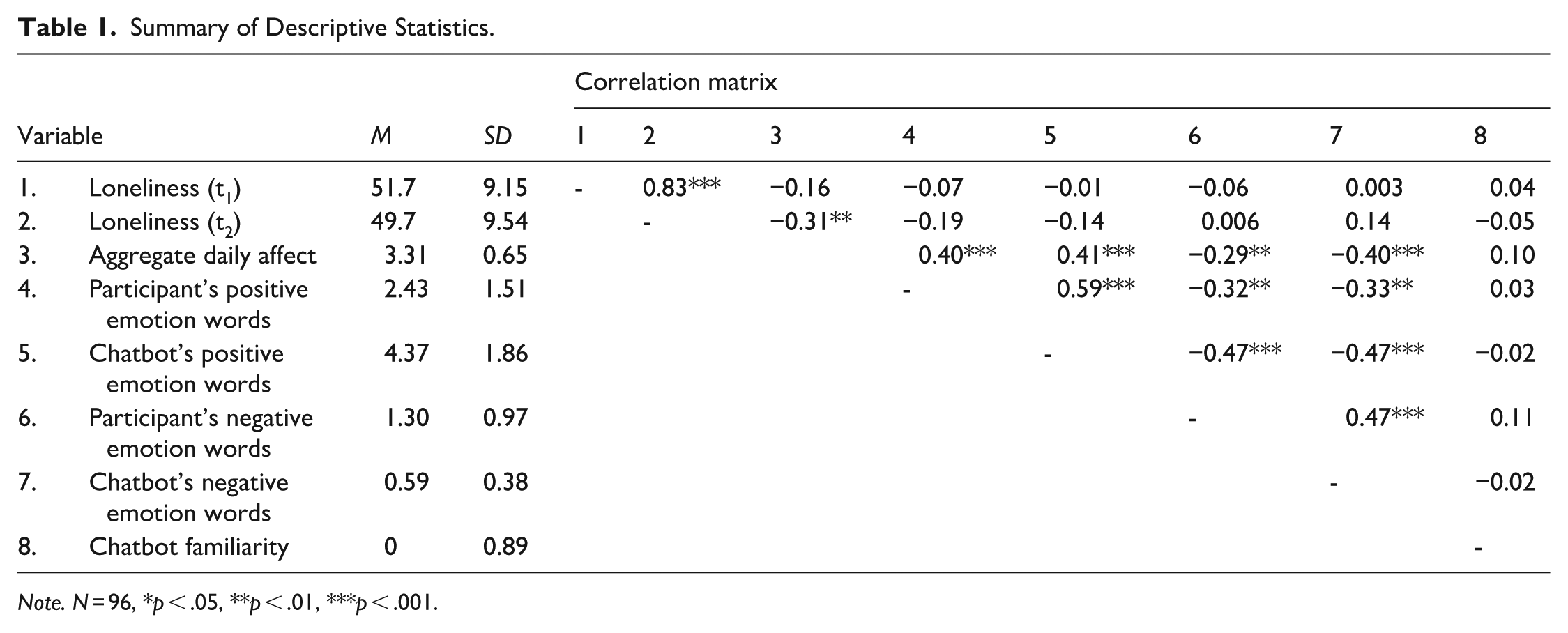
Note. N = 96, *p < .05, **p < .01, ***p < .001.
Loneliness
It was measured at baseline (t1) and then again at the end of the study (t2) with the well-validated Revised UCLA Loneliness Scale (R-UCLA; Russell et al., 1980; 20 items). To allow comparison with prior research using this scale, we used the recommended 4-point anchor points, ranging from 1 – never to 4 – often. Good reliability was achieved (
Affect
Every day, participants rated their affect with a 5-point semantic differential ranging from sad (1) to happy (5), adopted from the Positive and Negative Affect Schedule (PANAS; Watson et al., 1988). Participants were instructed to complete the daily survey immediately after their conversation with the chatbot each evening, and the item asked them to report how they felt immediately after talking to Replika. This simple one-item measure was used in order to decrease participant burden and promote participant retention in the study, given the intensive, week-long data collection process. An aggregate affect score for each participant was calculated by averaging their responses for the entire week of participation. Within-person reliability across the week was good (
Language variables
Each participant’s conversations with Replika were saved in a separate file. Then, participants’ contributions to the conversations were separated from Replika’s, resulting in two files for each participant (one containing their own portion of the conversation, and the other Replika’s). These files were analyzed using the Linguistic Inquiry and Word Count 2022 (LIWC-22) software (Pennebaker et al., 2022), which compares each word in a given text to its 72 linguistic categories, reflecting emotional, cognitive, and structural components of language. For each linguistic category, LIWC produces a numerical output that reflects the percentage of total words in that text that fall into the respective category. LIWC has been robustly validated and utilized in thousands of studies (Boyd et al., 2022).
Due to our focus on emotional language, we focused on LIWC’s “positive emotion” and “negative emotion” categories. The former includes words such as “good,” “love,” “happy,” and “hope,” while the latter includes terms such as “bad,” “hate,” “hurt,” and “tired.” Aggregate scores were calculated by averaging the percentage of positive and negative emotion words, respectively, used by each participant and their Replika, across all their days of participation in the study. This procedure resulted in four scores per participant: the participant’s average percentage of positive emotion words, the participant’s average percentage of negative emotion words, the chatbot’s average percentage of positive emotion words, and the chatbot’s average percentage of negative emotion words.
Covariates
Participants’ gender was included because women are generally more emotionally disclosive than men (Kring & Gordon, 1998). For analysis, gender was dummy coded as 0 = man/non-binary/other and 1 = woman. Chatbot familiarity was also included because it may influence participants’ comfort and engagement with the chatbot. It was assessed using two items: “How familiar are you with chatbots?” (1 = Not at all familiar, 5 = Extremely familiar) and “How frequently do you use chatbots in general?” (1 = Never, 7 = All the time). To place the two items on the same metric, both were standardized prior to analysis. The standardized items showed acceptable reliability (α = .72) and were averaged to form a composite index of chatbot familiarity, with higher scores indicating greater familiarity.
Results
Change in Loneliness
To test H1, which predicts that engaging in emotional communication with a chatbot for a week would be associated with lower loneliness at the end of the week relative to baseline, we estimated an exploratory linear mixed model with time (t1 vs. t2) as a within-subjects factor, and conversation topic (positive vs. negative), chatbot familiarity, and gender as between-subjects factors. A significant main effect of time emerged, b = −2.02, SE = 0.55, t(95) = −3.65, p < .001, indicating that loneliness scores were lower at post-study than at baseline. Conversation topic (b = 0.19, SE = 1.86, t(92) = 0.10, p = .92), chatbot familiarity (b = −0.27, SE = 1.08, t(92) = −0.25, p = .81), and gender (b = −1.75, SE = 1.99, t(92) = −0.88, p = .38) were not significant. A paired-samples t-test confirmed that loneliness scores at t2 (M = 49.70, SD = 9.54) were significantly lower than at t1 (M = 51.70, SD = 9.15), t(95) = −3.65, p < .001, d = −0.22, 95% CI [−0.33, −0.10]. Although the effect size was small, these results were consistent with H1.
Positive Affect and Loneliness
Aggregate daily positive affect, measured on a 5-point scale (1 = sad, 5 = happy), was above the midpoint of the scale (M = 3.31, SD = 0.65), indicating that participants reported, on average, slightly positive affect after interacting with the chatbot across the study period. For descriptive purposes, mean levels of positive affect were 3.59 (SD = 0.68) for participants who had discussed positive events and 3.04 (SD = 0.50) for those who had discussed negative events. To test H2, which posits that higher daily positive affect would be associated with lower loneliness at the end of the week, controlling for baseline loneliness, we conducted a hierarchical regression analysis. Baseline loneliness, gender, and chatbot familiarity were entered in the first step, and participants’ average daily positive affect was added in the second step. The overall model was significant, F(4, 91) = 62.13, p < .001,
Serial Mediation Analyses
To test H3 through H6, two path models were estimated in lavaan (R) with 3000 bootstrapped samples and 95% confidence intervals. Because the above linear mixed model indicated no difference in post-study loneliness between participants who discussed positive and negative events, these participants were pooled. The covariates (gender and chatbot familiarity) were excluded because they were not related to loneliness or daily affect.
Positive and negative emotion word use were negatively correlated for both participants (r = -.32, p = .001) and chatbots (r = -.46, p < .001), indicating a moderate degree of shared variance between the two constructs. Such shared variance can introduce multicollinearity, which may inflate standard errors, distort parameter estimates, reduce statistical power, and make it difficult to isolate each variable’s unique effects. Common strategies for addressing it include removing one of the correlated predictors or combining them into a composite or latent index (Dormann et al., 2013; Kim, 2019). In this study, both positive and negative emotion word use are theoretically indispensable and cannot be removed or combined. Moreover, because these variables capture different aspects of emotional expression (i.e., positive vs. negative framing), including them in a single model would make it difficult to disentangle their unique contributions due to shared variance. Therefore, we estimated two separate mediation models, one for positive emotion words (H3, H5) and one for negative emotion words (H4, H6), to preserve interpretive clarity.
To test H3 and H5, which focus on the expression and the chatbot-response pathways involving positive emotion words, the first model examined whether participants’ use of positive emotion words was associated with the chatbot’s use of positive emotion words, participants’ daily positive affect, and post-study loneliness (see Figure 1). Participants’ use of positive emotion words was entered as the independent variable, the chatbot’s use of positive emotion words as the first mediator, and participants’ positive affect as the second mediator. Loneliness at t2 was the outcome, controlling for loneliness at t1. Conversation topic (positive vs. negative) was entered as a predictor of both participants’ language use and the chatbot’s language use to account for any potential topic-related variance.
The model showed generally acceptable fit:
Participants’ use of positive emotion words was positively associated with the chatbot’s use of positive emotion words, providing evidence of chatbot mirroring. This association was observed after accounting for the assigned conversation topic in the model. Then, the chatbot’s use of positive emotion words was positively associated with participants’ daily positive affect, which in turn was negatively associated with loneliness at t2. The full serial mediation path, linking participants’ use of positive emotion words to post-study loneliness through chatbot mirroring and subsequent positive affect, was also significant, meaning that when participants expressed more positive emotion words during chatbot conversations, the chatbot also used more positive emotion words, which was associated with participants’ higher positive affect and lower loneliness by the end of the week. Thus, these results were consistent with H5. Full parameter estimates and bootstrap confidence intervals are presented in Table 2.
Serial Mediation Model 1: Positive Emotion Words.
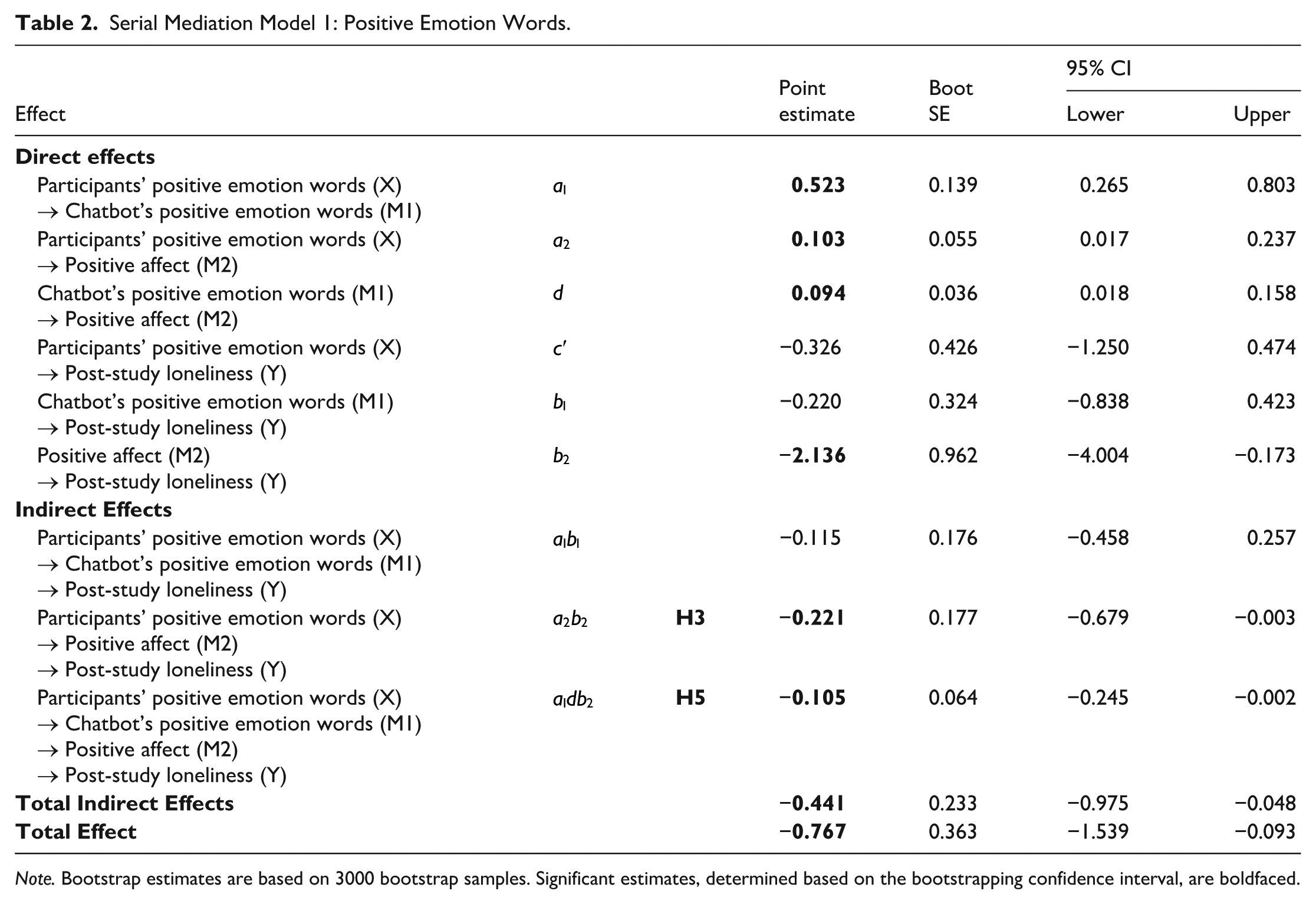
Note. Bootstrap estimates are based on 3000 bootstrap samples. Significant estimates, determined based on the bootstrapping confidence interval, are boldfaced.
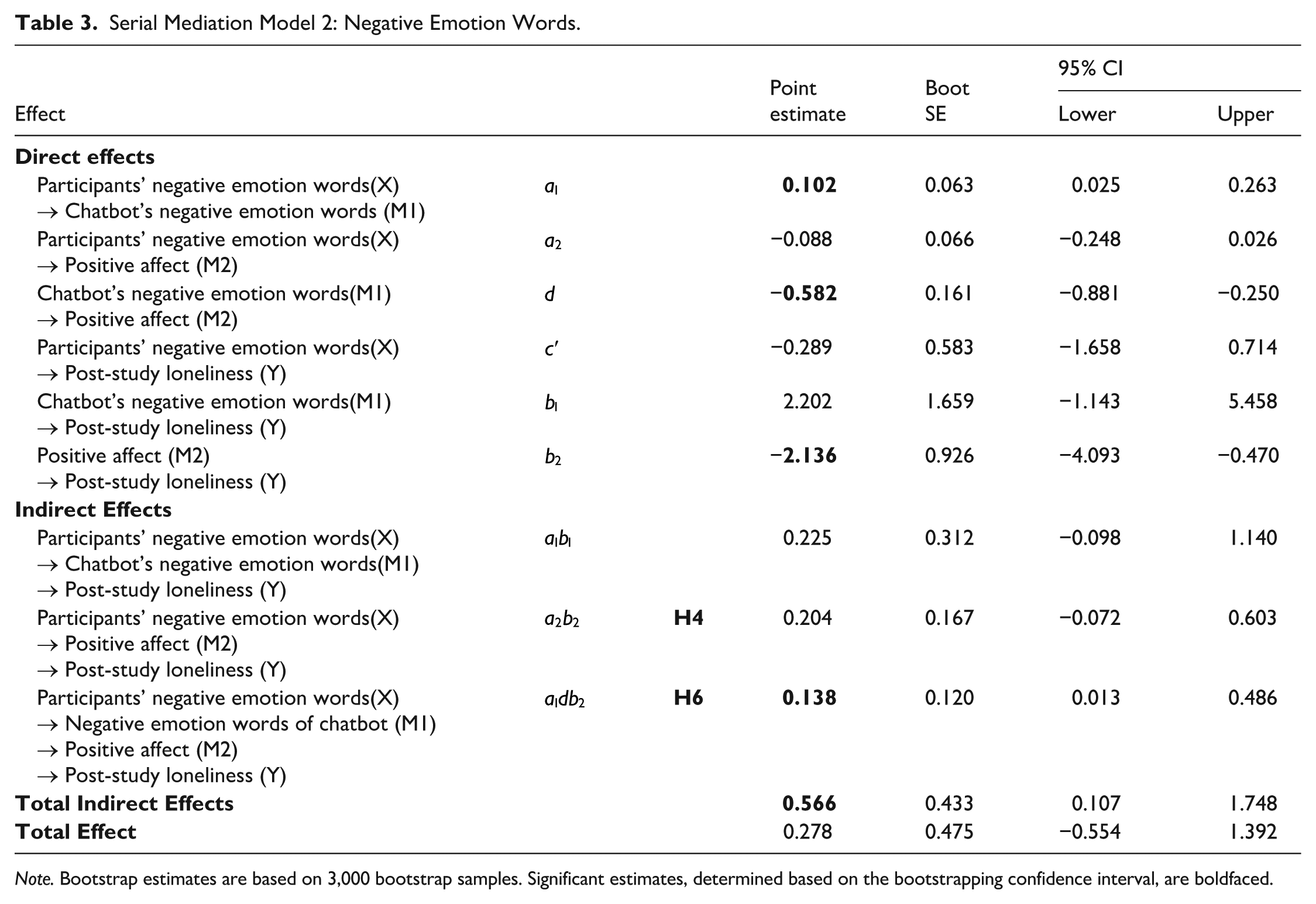
To test H4 and H6, which focus on the expression and the chatbot-response pathways involving negative emotion words, the second model examined whether participants’ use of negative emotion words was associated with the chatbot’s use of negative emotion words, participants’ daily positive affect, and post-study loneliness (see Figure 2). As in the previous model, participants’ use of negative emotion words was entered as the independent variable, the chatbot’s use of negative emotion words as the first mediator, and participants’ positive daily affect as the second mediator. Loneliness at t2 was the outcome, controlling for loneliness at t1. Conversation topic (positive vs. negative) was again modeled as a predictor of both participants’ language use and the chatbot’s language use.
Model fit was generally acceptable,
Serial Mediation Model 2: Negative Emotion Words.
Note. Bootstrap estimates are based on 3,000 bootstrap samples. Significant estimates, determined based on the bootstrapping confidence interval, are boldfaced.
Participants’ use of negative emotion words was positively associated with the chatbot’s use of negative emotion words, providing evidence of chatbot mirroring. This association was significant after accounting for conversation topic. The chatbot’s use of negative emotion words was associated with lower daily positive affect, and daily positive affect was again associated with lower loneliness. The serial indirect effect linking participants’ use of negative emotion words to loneliness through chatbot mirroring and daily positive affect was significant, meaning that participants’ use of negative emotion words was associated with chatbot mirroring, which was linked with lower daily positive affect, and subsequently higher loneliness at the end of the study. Thus, these results were consistent with H6. Notably, the relatively large standard errors and asymmetric confidence intervals reflect a common feature of bootstrapped indirect effects. Because indirect effects are computed as the product of coefficients, their sampling distributions are often non-normal and asymmetric (Hayes, 2017).
Discussion
This daily diary study asked lonely college students to engage in emotional communication with an “empathetic” chatbot for one week. Results indicated that loneliness scores were modestly but significantly lower at the end of the week compared to baseline. Linguistic analyses further revealed that participants’ own use of positive emotion language, whether used to discuss positive or negative events, was indirectly associated with lower loneliness, whereas their use of negative emotion language was indirectly associated with greater loneliness. The chatbot played a key role in these indirect associations, by mirroring participants’ emotional tone and thereby amplifying it: The more participants used positive (or negative) emotion words, the more the chatbot did as well, which in turn was associated with lower (or higher) loneliness. Participants’ affect, or the emotional state they experienced after conversing with chatbots, was also a mediator in these associations. Participants’ positive emotional framing as well as the chatbots’ mirroring of it were associated with higher daily positive affect which, averaged over the course of a week, was associated with lower loneliness. Conversely, participants’ negative emotional framing, when mirrored by the chatbot, was associated with lower daily positive affect and higher loneliness. That is, the use of emotional language was linked to participants’ loneliness at the end of the study through its association with daily affect.
Theoretical Implications
Due to their accessibility, scalability, and low cost, conversational AI tools have been widely proposed as mental health supports. Yet a rapidly accruing body of research shows that chatbot interactions have small and inconsistent effects on well-being (see Abd-Alrazaq et al., 2019; Dong et al., 2025; Li et al., 2025 for reviews), implying that these effects hinge on multiple, underexplored factors. To our knowledge, research to date has not yet provided a cohesive theoretical account of what these factors may be, or of the psychological mechanisms through which chatbot interactions may influence users’ well-being.
We believe that one reason for these mixed findings is that much of the existing literature conceptualizes chatbot engagement as frequency or duration of use. Such approaches obscure the conversational processes through which chatbot interactions may influence users’ affect and well-being. From a communication perspective, chatbot interactions are fundamentally linguistic exchanges, and their psychological consequences are likely to depend not on whether users engage with chatbots per se, but on how emotional meaning is constructed and reinforced within those exchanges. By shifting attention from chatbot use to language-based mechanisms, our study offers a process-oriented account of how conversational AI may shape well-being, and can explain how conversations with AI can produce divergent well-being outcomes depending on conversational dynamics.
Our key contribution lies in developing such a theoretical framework that focuses on conversational dynamics. Because language is the core channel through which users and chatbots connect, we approached it as a natural starting point for our theorizing. Our framework is inspired by the fundamental building blocks of the communication process: messages, senders, and receivers (Berlo, 1960). At the message level, we argued that the patterns of language use in conversations with chatbots are powerful in shaping users’ well-being, drawing on research in psychology that shows language use both reflects and affects individuals’ well-being. Findings from both serial mediation models support this reasoning, suggesting that language use should be carefully considered by future research.
At the sender level, we proposed the existence of expression effects, meaning that individuals’ own messages can be expected to shape their subsequent well-being, above and beyond any effects that the chatbots’ responses might have. In so doing, we drew on the self-effects paradigm, which argues that even in the absence of feedback, the messages individuals compose have a psychological effect on themselves, shifting their self-perceptions, beliefs, attitudes, emotions, and even behaviors (see Valkenburg, 2017 for a review). Given our focus on loneliness, an emotionally-laden state, we focused on individuals’ use of emotion words. We argued that, since language use contributes to the construction of one’s emotional reality, the emotional frames users deploy – either positive or negative – may become self-fulfilling prophecies, shaping well-being outcomes.
As previously described, strong support for expression effects emerged for positive emotion words. Expressing positive emotions may reinforce the underlying positive appraisal of an experience, thereby amplifying positive affect (Gable & Reis, 2010), consistent with the framing-function-of-language perspective. However, participants’ own production of negative emotion words was only linked to their daily affect and subsequent loneliness through the intermediary of the chatbot’s responses; there was no pure expression effect for negative emotions. One possible explanation is that expressing negative emotions primarily serves a processing function. Research on affect labeling shows that putting negative feelings into words can reduce emotional reactivity, including amygdala activation (Torre & Lieberman, 2018). From this perspective, the expression of negative emotions may reflect efforts to cognitively process distressing experiences, rather than immediately intensifying affective states.
Indeed, at the receiver level, we proposed that the chatbot’s responses would play an influential, two-step role in users’ well-being outcomes. First, chatbots would mirror users’ emotional tone, a proposition which received consistent support in the data. Second, we argued that the chatbot’s mirroring of users’ sentiments would amplify those sentiments. This too was consistently supported: When users initiated positive disclosures and the chatbot responded in kind, participants reported higher positive affect and lower loneliness. But when users initiated negative disclosures and the chatbot responded in kind, participants reported lower positive affect and higher loneliness.
Although negative emotional expression alone was not directly associated with affect or loneliness, it was indirectly associated with these variables via chatbot mirroring. This finding aligns with research on co-rumination, the process of repeatedly discussing problems within a dyadic interaction, which has been shown to impede emotional recovery (Rose, 2021). When a chatbot mirrors a user’s negative language, it may create dynamics similar to co-rumination, where validating and reinforcing negative perspectives may backfire. In all, this pattern of findings suggests that expression effects and chatbot-response effects constitute related but distinct pathways through which the framing function of language operates.
These findings are consistent with recent research on AI sycophancy (Cheng et al., 2025; Sharma et al., 2023), which finds that conversational AI tools have a deep-seated tendency to reinforce human users’ input through flattery, agreement, or validation of users’ perspectives, even if in so doing, they sacrifice factual correctness or fail to offer critical (but needed) perspectives. For instance, AI tools may admit mistakes they did not make, offer biased feedback, or mimic users’ errors for the sake of fostering rapport with the users. Our findings extend this literature by suggesting that such reinforcement can shape not only users’ beliefs or judgments, but also their emotional experiences and subjective well-being.
Our theorizing of chatbots as mirrors and amplifiers of users’ emotional states is similar to the “crystal” metaphor which has been recently proposed to describe recommendation algorithms, an adjacent form of AI (Lee et al., 2022). As crystals, recommendation algorithms are argued to both reflect and shape users’ identity, an insight that emerged from deep interviews with TikTok users. Similarly, we find that conversations with chatbots reflect and shape users’ emotionality, thus underscoring the usefulness of theorizing generative AI systems as mirrors and amplifiers – of human emotion, self-perceptions, and potentially even behaviors.
Our study is the first to deploy the broaden-and-build theory of emotion in a conversational AI context. The theory’s key proposition – that positive affect has a cumulative, cascading effect on individuals’ well-being – received support. Additionally, we extended the theory by considering novel sources that promote positive affect. Prior research has shown that positive emotions can arise in contexts such as social interactions, play, accomplishment, and meditation (Fredrickson, 2004), many of which involve effortful or structured activities. Our findings point to an additional, less effortful pathway: The positive feedback offered by an automated computer system also may contribute to well-being spirals.
Finally, it is important to note that, just like prior literature, we found that the reduction in loneliness experienced by participants after interacting with chatbots was small. This should not be surprising. Loneliness and related internalizing problems, such as depression and anxiety, are notoriously difficult to overcome, even with therapeutic help (e.g., Cuijpers et al., 2020). In particular, overcoming loneliness requires the development of high-quality relationships, a time-consuming process. In this light, the subtle improvements in loneliness we observed over the course of one week are encouraging, suggesting that chatbots may have the potential to produce larger shifts with continued use. Future longitudinal studies are needed to test this possibility.
Practical Implications
The mass media is rife with reports of how AI can support individuals’ well-being, such as using AI companions to brighten the mood of patients with dementia (Smith, 2025) or to offer mental health support for youth in underserved areas (Tingley, 2025). In a particularly striking New York Times opinion piece, Harvey Lieberman, a clinical psychologist, wrote about an “experiment” he conducted, where he used ChatGPT as a “thinking partner” every day over several months. He found the process to be therapeutic, with the chatbot functioning like “a mirror and a candle: just enough reflection to recognize myself, just enough light to see where I was headed” (Lieberman, 2025). These anecdotal accounts illustrate the many real-world contexts where conversational AI could have a profound impact on individuals in need. Our results and theorizing provide some guidance for how well-being benefits can be elicited.
We offer two insights for designers aiming to optimize conversational AI tools for well-being. First, mirroring and sycophancy, the default strategies intended to validate users, may not be uniformly desirable. Rather, the effectiveness of mirroring depends on users’ initial emotional expressions. When chatbots detect positive emotions in users’ messages, mirroring can support well-being; thus, chatbots might prompt users to elaborate on positive disclosures. A different approach may be needed when chatbots detect negative emotions, because, as discussed, the amplification of these emotions is linked to decrements in well-being. This finding parallels the harmful effects of co-rumination in human communication, in which conversational partners dwell on problems and negative feelings together, thus worsening those problems (Rose, 2021). Chatbots that simply echo distress without offering new perspectives may inadvertently contribute to keeping users in the same negative emotional loop. Instead, negative affect may be better addressed by strategies suggested by cognitive behavioral therapy, such as interruption or reframing. For example, if a user expresses distress (e.g., “I feel like everything is going wrong”), an interrupting response might gently redirect the interaction (e.g., “That sounds really overwhelming. Before we go further, would you be open to taking a brief pause or shifting focus to a different topic for a moment?”), whereas a reframing response might offer an alternative perspective (e.g., “It sounds really difficult right now, but are there any aspects of the situation that feel more manageable?”).
Second, our findings show that users’ input plays a critical role in activating either well-being or ill-being cascades. Because conversational AI responds contingently, the affective tone of users’ messages shapes the trajectory of the interaction. Thus, design efforts should not only focus on the chatbots’ response strategies to what the users offer them, but also on ways in which the chatbots can shape users’ input. For example, conversational AI might guide users towards expressing their experiences in constructive ways, such as prompting them to think of strengths or moments of gratitude, even when discussing difficulties.
Finally, this study has implications for college counselors, instructors, parents, and others in a position to advise young adults. Our findings suggest that lonely young adults should be discouraged from using chatbots to ruminate about negative emotions. However, lonely young adults may benefit from using chatbots to express positive emotions, much like they would by writing in a journal.
Limitations and Future Directions
This study has several limitations that warrant attention in future research. Our sample size was relatively small due to the data-intensive longitudinal design and the strict inclusion criteria for participants, which limited statistical power. In addition, participants were recruited based on above-median loneliness scores, and the study did not include a control group. Although we accounted for participants’ baseline loneliness in the analyses to examine within-person change associated with sustained chatbot interaction, the absence of a comparison group means we cannot definitively attribute the observed reduction in loneliness to conversations with chatbots alone. In particular, selecting individuals with relatively elevated loneliness increases the likelihood that changes over time may partly reflect regression to the mean (i.e., the tendency for extreme scores to move closer to the average with repeated measurement; Weeks, 2007), rather than the effects of chatbot interaction.
Moreover, the study design does not fully rule out the possibility that factors unrelated to the chatbot interaction influenced participants’ affect and loneliness over time. For example, affective experiences occurring outside the chatbot interaction, as well as the structured nature of the study and repeated researcher contact, may have shaped participants’ responses. Although participants were instructed to report how they felt following their interaction with Replika, it remains possible that these contextual factors contributed to changes in affect and loneliness over time. Future research seeking to establish the causal impact of chatbot interactions on loneliness should incorporate appropriate control conditions or alternative research designs that permit stronger causal inference.
While the strict inclusion criteria served to enhance the study’s internal validity, the nontrivial level of attrition in a week-long daily diary study warrants consideration. Attrition analyses indicated that exclusion was not systematically related to the primary constructs of interest; nonetheless, the sample may overrepresent individuals who were better able to sustain repeated interaction in a time-intensive diary study. Future research should examine whether similar language-based processes emerge among individuals who face greater barriers to sustained participation, for instance, by employing shorter study designs.
Since our study is grounded in broaden-and-build theory, we focused on positive affect as the primary mechanism linking conversations with chatbots to loneliness. However, it is possible that negative affect could also play a meaningful role in this process. To provide a fuller picture of the range of affective responses that are elicited by conversations with chatbots, we hope future research will draw upon theoretical perspectives that center negative affect in individuals’ experiences of loneliness. For instance, attachment (Mikulincer et al., 2021) or evolutionary (Cacioppo et al., 2006) perspectives focus on the negative emotional states that tend to accompany individuals’ experiences of loneliness (e.g., hypervigilance, anxiety).
Relatedly, an important limitation of our study is the coarse measurement of affect, involving a single bipolar item ranging from negative to positive affect. Brief measures of affect are common in daily diary or experience sampling studies where it is important to not overburden participants (e.g., Bolger et al., 2003). However, these measures obscure the possibility that positive and negative affect might be simultaneously elicited by conversations with chatbots. As a result, the present data cannot adjudicate whether participants’ language use is primarily associated with dampened positive affect, heightened negative affect, or operates through both processes simultaneously. Future research should explicitly model positive and negative affect as separate constructs, and, to provide even greater granularity, examine discrete emotions such as distress, anxiety, shame, or guilt that may be particularly relevant to loneliness.
Our analytical approach also has inherent trade-offs. Our decision to aggregate across participants’ daily affect scores allowed us to maintain model parsimony, but it did not account for within-person fluctuations across days. Similarly, our measure of emotional language using LIWC, while a theory-driven choice, did not capture more granular, discrete emotions (e.g., hope, guilt). Future research could use dynamic modeling and more advanced linguistic tools (e.g., sentiment analysis, topic modeling) to capture the nuance and temporal evolution of human-chatbot conversations.
A further limitation stems from our decision to model positive and negative emotion word use in separate mediation analyses. Although conceptually distinct, these dimensions are often correlated in emotionally expressive language, raising concerns about multicollinearity and interpretability when modeled jointly. Addressing the theoretical and statistical challenges of modeling these processes simultaneously falls beyond the scope of the present study.
A key issue to be considered by future research is the psychological mechanism underlying loneliness reduction following conversations with chatbots. Drawing on broaden-and-build theory, we theorized that conversations with chatbots (under specific linguistic conditions) could boost users’ positive affect, which in turn would help them more successfully navigate daily life, for instance, by approaching others or engaging in more social activities; these social activities would then reduce loneliness. These possibilities need to be tested directly by future research. An additional possibility that merits attention is that the observed increase in positive affect arises from bonding with the chatbot itself. Future research should include measures of friendship, closeness, and other anthropomorphic perceptions towards the chatbot.
Finally, while our focus on language yielded informative results, future research should consider a broader set of factors that could affect the extent to which users benefit from chatbot interactions. For instance, environmental factors (e.g., the availability of face-to-face support networks), user characteristics (e.g., social skills, shyness), or broader technological use (e.g., participating in online communities) could also play a role.
Conclusion
This study shows that emotional conversations with “empathetic” chatbots can shape young adults’ affect and loneliness, but in asymmetrical ways: Positive expressions have the potential to spark well-being cycles, whereas negative expressions might backfire. The impact of chatbot interactions seems to hinge on users’ own emotional framing, which the chatbot then reflects and amplifies. The findings highlight the need for developing emotionally intelligent chatbots that respond adaptively to users’ input rather than merely echoing it. As individuals increasingly turn to AI for emotional disclosures, understanding these feedback loops is essential to ensure that AI supports, rather than undermines, users’ well-being.
Footnotes
Acknowledgements
The authors are grateful to Liesel Sharabi for her valuable feedback and to the research assistants in the Social Media Lab at the University of Wisconsin-Madison for their help with data collection.

Ethical Considerations
The research reported here was reviewed by the Internal Review Board at the University of Wisconsin-Madison and received approval by IRB staff reviewer Laura Conger (submission ID number: 2023-0355). All participants provided written informed consent.
Funding
The authors disclosed receipt of the following financial support for the research, authorship, and/or publication of this article: This research was funded by a graduate student research award to Jinyoung Choi from the University of Wisconsin-Madison’s Global Health Institute, and by a Romnes Award from the University of Wisconsin-Madison to Catalina Toma.
Declaration of Conflicting Interests
The authors declared no potential conflicts of interest with respect to the research, authorship, and/or publication of this article.
Data Availability Statement
Data is available upon request.