







Abstract
Using data from samples of randomly selected adults in three major cities in Greece, Russia, and Ukraine, several issues concerning criminal motivation are addressed. First, contrary to assumptions of many control theories, there is evidence of substantial variation in criminal attraction across individuals, with such attraction often being minimal. Second, direct measurement of criminal attraction is strongly associated with property and violent crime projections. Third, although variables from strain and social learning theories help explain criminal motivation, they do not appear sufficient to account for it. Nevertheless, attraction to crime appears to mediate the relationship between strain/prior reinforcement and criminal outcomes. Yet, the results show variations among research sites, thus indicating that the part played by criminal motivation may be somewhat context dependent. Overall, the research suggests the wisdom of further attention to motivation, particularly in improving efforts to explain it, measure it directly, and bring it more prominently into explanatory models.
The notion of criminal motivation, or attraction to misconduct, has been one of the most elusive concepts in criminology, perhaps because its existence or production is often assumed rather than discussed or measured directly (Jacobs & Wright, 1999; Wikström, 2006). As Jacobs and Wright (1999) aptly note, “motivation is criminology’s dirty little secret—manifest yet murky, presupposed but elusive, everywhere and nowhere” (p. 149). The idea that people may be attracted to or impelled toward crime, at least under some conditions, is inherent to virtually all explanations of criminal behavior. Theories differ, however, in the extent to which they acknowledge variations in the degree of attraction to crime and in the extent to which they emphasize motivational factors in their explanations of criminal behavior. Whereas some explanatory accounts, especially control theories, simply take criminal attraction for granted (e.g., Cohen & Felson, 1979; Gibbs, 1975; Gottfredson & Hirschi, 1990; Hirschi, 1969), other theories attempt to identify factors implicated in the production of criminal motivation (e.g., Agnew, 1992; Colvin, 2000; Colvin, Cullen, & Vander Ven, 2002; Gove, 1980; Kaplan, 1980; Tittle, 1995).
Because control theorists de-emphasize motivation, researchers usually ignore it altogether, focusing instead on things that might inhibit the person from expressing those assumed motivations in actual criminal conduct (see Kempf, 1993). Scholars addressing motivational issues (see e.g., tests of general strain theory), on the other hand, typically try to measure the presumed precursors of motivation in order to ascertain if they actually result in the projected criminal outcomes, without attempting to estimate the effects of criminal motivation directly. As a result, little is currently known about the part played by motivation in generating crime. However, indirect evidence from quantitative studies using longitudinal data, as well as qualitative analyses of offenders’ decision making, suggests that cross-individual variability in attraction to crime is common, as is variation within individuals over time (Brezina & Piquero, 2003; Jacobs & Wright, 1999; Katz, 1988; Shover, 1996). A few studies have tried to measure motivation directly (Brezina & Piquero, 2003; Tittle & Botchkovar, 2005), and they have found it to be a potent predictor of criminal conduct in its own right and/or a strong mediator between theorized causal factors and criminal outcomes. However, most evidence concerning criminal attraction is indirect. Moreover, the extant evidence concerning criminal attraction is incomplete because it is derived mainly from U.S.-based, nonrandom, or age-limited samples.
Our contribution to understanding criminal attraction uses a direct measure to investigate the interlinkages of theorized motivational causes, actually measured motivation, and criminal probability as specified in two of the most prominent criminological theories—general strain and social learning. We hope to learn, first, the extent to which criminal attraction varies from individual to individual and across substantially different cultural contexts. Furthermore, we evaluate the accuracy of strain and social learning in their accounts of the origins of criminal motivation and assess the extent to which criminal motivation/attraction actually mediates relationships between the causes and criminal outcomes specified by these two theories.
Criminal Motivation and General Strain Theory
One of the leading contemporary theories that implicates its principal explanatory variable in the production of criminal motivation, which in turn is theorized to generate crime, is general strain theory (GST; Agnew, 1992, 2006). Notably, its author explicitly acknowledges that the theory is built on the assumption that attraction to crime varies across the population and that some individuals may feel more motivated than others to commit acts of crime (Agnew, 1993). GST contends that criminal motivation is a product of exposure to strains (negative treatments and conditions) that “make people feel bad and create pressure for corrective action” (Agnew, 1993; 2006, p. 17). Furthermore, most negative emotions generated by strains, alone or in conjunction with each other, are said to increase perceived attractiveness of crime. Therefore, strains and subsequent negative emotions motivate individuals to commit crime, and that attraction in turn may produce actual unlawful behavior. Although much of the attraction to crime produced by strain is temporary and fleeting, the formation of more enduring, stable attraction to misconduct is possible when exposure to strain is chronic or repeated. Under those conditions, strains “may directly foster the belief that crime is desirable” (Agnew, 2006, p. 47).
Despite GST’s high frequency of citation and enjoyment of wide support for its hypothesized link between strain and crime (e.g., Moon, Morash, McCluskey, & Hwang, 2009; S. W. Baron, 2007; see also Froggio, 2007, for a review), the theorized causal sequence involving criminal motivation as a mediator of the relationships between strain and misconduct has not been investigated directly. It would seem critical to do so because such a sequence is enunciated by the author of the theory. In addition, of potentially greater import, the idea that strain affects crime through the intervening mechanism of criminal motivation clearly differentiates strain theory from control explanations of criminal behavior (Agnew, 1993).
Criminal Motivation and Social Learning Theory
Social learning, which some consider the leading criminological theory (Agnew, 1999; Sampson, 1999), also attempts to identify factors indirectly affecting criminal involvement through enhanced motivation to do so (Akers, 1985, 1998; Bandura, 1977). This explanatory framework, as formulated by Akers, who built on Sutherland’s (1939) original differential association theory, features differential reinforcement—variations in the balance of rewards and punishments attached to behaviors—as a principal variable explaining misconduct (see Akers, 1998). Criminal behavior is theoretically a consequence of learning from experiences of positive rewards and negative costs associated with prior acts. Differential reinforcement may prompt criminal behavior directly or indirectly, through definitions—the individual’s cognitive perceptions—favorable or unfavorable to such behavior. Most relevant for our purposes, differential reinforcement is also postulated to be “a separate source of motivation for behavior” (Akers, 1998, p. 98), making criminal motivation an intervening link between past differential reinforcement and involvement in misbehavior.
Past research has produced much empirical evidence favorable to social learning theory (for reviews, see Akers, 1998, pp. 110-117; Akers & Sellers, 2004, pp. 101-105). Yet, the causal sequences of the theory involving differential reinforcement, criminal motivation, and misconduct have not been fully explored. One exception to the general pattern is the supportive study by Brezina and Piquero (2003) investigating the relationships among social learning variables and measures tapping attractiveness of alcohol and marijuana use among high school students. But, the researchers do not estimate possible mediating effects of attraction on those deviant behaviors. Given that this study and others point to the importance of social learning factors in the etiology of attraction to misconduct, further inquiry into the hypothesized mediated relationship between differential reinforcement and criminal behavior through enhanced criminal motivation is clearly warranted.
Criminal Motivation and Different Cultural Contexts
The countries from which our samples are drawn—Russia, Greece, and Ukraine—represent sufficiently different cultural contexts to pose challenges to assumptions of theoretical generality. As figures presented in Appendix A demonstrate, the three countries differ substantially economically and culturally, with the differences between the two former members of the Soviet Union and Greece being especially dramatic (Central Intelligence Agency, 2008; Council of Europe, 2008; Freedom House, 2007; Transparency International, 2008; United Nations Office on Drugs and Crime, 2008). Greece, a highly modernized country similar in many ways to other Western and Southern European nations, has enjoyed relative political stability and democracy in the most recent decades and has experienced more economic well-being than Ukraine or Russia.
Because of numerous political, economic, and social transformations endured by Ukraine and Russia in the past two decades, both may still be regarded as countries in transition (Antonaccio & Tittle, 2008; Gilinskiy, 2006). In the political sphere, Russia continues to deal with many issues concerning democratic development, whereas Ukraine has to settle numerous political disputes. Furthermore, the traumatizing rapid change from socialism to capitalism in the early 1990s has led to the failure of the system of government-insured benefits and caused widespread financial troubles among many residents of both countries. Without a doubt, that shift has contributed to increased levels of economic inequality and to the worsening of many indicators of quality of life (Foglesong & Solomon, 2001; Gilinskiy, 2006; Kalman, 2002; Passas, 2000; Pridemore, 2002). These dramatic experiences seem to have taken a toll on the morale of the residents of Russia and Ukraine, as they have reported negative behaviors and beliefs (Abbott & Sapsford, 2006; FOM, 2002; Kalman, 2002) that are also verified by the data we collected.
Specifically, we find that the Russian and Ukrainian respondents are more likely to be involved in illegal behaviors, show less endorsement of conventional moral beliefs, and exhibit lower levels of religiosity and social integration than do the Greek respondents (Appendix A). Moreover, Ukraine and Russia suffer from a number of other social problems, including high rates of violence and corruption (Council of Europe, 2008; Transparency International, 2008; United Nations Office on Drugs and Crime, 2008). In sum, the evidence shows that Greece, Ukraine, and Russia appear to represent markedly different socioeconomic environments that may moderate effects of criminal motivation. For instance, we may logically expect that in seemingly more anomic and crime-laden environments of Russia and Ukraine, individuals will experience more chronic or repeated strains and crime-favorable reinforcement and, consequently, will have stronger motivation to commit crime. Moreover, as numerous scholars (e.g., Grasmick & Bursik, 1990; Paternoster & Simpson, 1996; Tittle, 1995; Wikström, 2006) argue, effects of criminal motivation may be counteracted to different degrees by constraints such as moral beliefs and social bonds. As was noted earlier, Russians and Ukrainians in our samples display weaker morality and less social integration and therefore appear to have fewer and weaker constraints than Greeks. Therefore, we may find evidence of contextual conditioning effects and actually uncover higher levels of criminal motivation and more potent effects of motivation on criminal behavior in Russia and Ukraine.
Method
Participants
The data for this study come from household surveys conducted in the fall of 2006 in Greece, Russia, and Ukraine. The three cities in our sample (Athens, Greece; Nizhni Novgorod, Russia; and Lviv, Ukraine) were selected, at least partly, because each is reputed to embody the cultural patterns of its respective country. Each is quite populous and all have exhibited widely publicized actions to preserve their unique national cultural patterns. Athens, Greece’s capital and center of the largest metropolitan area in the country, where approximately half of all the country’s population resides, continues to reflect authentic national Greek culture (Britannica, 2009; Christodoulou, Papadopoulos, Douzenis, & Kanakaris, 2009). Nizhni Novgorod is still thought by many to be one of the most traditionally Russian cities (Kommersant Moscow, 2004; Tittle & Botchkovar, 2005). Finally, Lviv, the largest city in Western Ukraine, is usually identified as the “capital” of that region. Despite various instances of attempted political, economic, and cultural domination by foreign invaders, Lviv has remained the stronghold for true Ukrainian culture (Hrytsak, 2000; Kenney, 2000).
Under our supervision, local professional survey organizations completed face-to-face interviews with 400 randomly selected eligible adults in Athens, 500 in Nizhni Novgorod, and 500 in Lviv. A two-stage sampling design with an initial random selection of street routes followed by the random selection of residences was used. In each selected household, the individual 18 or more years old with a birthday closest to the date of the interview was targeted. Those who could not be interviewed because of unavailability, inability to arrange appointments within allocated call-back limits, or refusal were randomly replaced from an initial oversampled pool. Approximately 70% of the respondents were random replacements, a figure that is only slightly higher than is typical in comparable city surveys in the United States (e.g., Grasmick & Bursik, 1990) and is generally comparable to surveys in other countries (Couper & Leeuw, 2003; Kordos, 2005; Vågerö et al., 2008). To increase rates of disclosure and assure anonymity, sensitive survey questions concerning past and projected misconduct and moral beliefs were answered by respondents in private in a short self-administered questionnaire.
The comparison of several sociodemographic characteristics between the samples and the most recent censuses from the three countries suggests that our samples are generally representative of the areas where the surveys were conducted with minor discrepancies only in two instances, the slightly overrepresented aged in the Greek sample and females in the Ukrainian sample. Yet, age- and gender-specific analyses indicate no substantial departures from the overall patterns of results, and thus no apparent biases in both samples are expected.
Measures
Criminal behavior
We focused on respondents’ self-projections of their likelihood of committing six acts of illegal behavior, three violent and three property crimes (see Appendix B). Because self-reported projections provide for more reasonable assumptions about causal ordering, they have become a frequently used alternative to self-reports of past criminal behavior. In addition, they have proven to be as valid, or sometimes more valid, than self-reports of past misconduct (e.g., Albarracin, Johnson, Fishbein, & Muellerleile, 2001; Green, 1989; Murray & Erickson, 1987; Pogarsky, 2004). Respondents were asked to imagine themselves in a crime-favorable situation in the future and then to estimate in five categories from 1 (absolutely unlikely) to 5 (very likely) the chance they would commit each of the six crimes in question (see Appendix B for exact wording).
Two indices of misconduct, one merging answers about three types of violence (alpha = .74, Greece; .69, Russia; and .84, Ukraine) and one combining responses concerning three levels of property offending (alpha = .91, Greece; .83, Russia; and .91, Ukraine), were constructed by adding raw scores for each item. 1 Natural logarithm transformations were applied to reduce skewness (from a range of 2.0 to 3.9 to a range of 0.7 to 2.8).
Criminal motivation
Though many theorists posit that motivation is important in producing criminal behavior, there is little agreement about its meaning or about how to measure it (Osgood, 1997; Tittle & Botchkovar, 2005). Operationalizations range from indirect measures such as anger/frustration (Agnew, 1993) to immediate situationally motivating factors (Jacobs & Wright, 1999). However, the more common approach and the one that we followed is defining criminal motivation as respondent’s sense that a criminal/deviant act would be “attractive” because it is pleasurable and desirable (Nagin & Paternoster, 1993; Piquero & Tibbetts, 1996; Tittle & Botchkovar, 2005). Moreover, following previous authors (see Tittle, 1995; Tittle & Paternoster, 2000), we distinguished between criminal motivation/attraction and constraint and conceptualize criminal motivation/attraction as a perceived desire to engage in criminal behavior that is independent of any possible constraints on behavior. Thus, we assumed that people who admitted to viewing a given criminal act as attractive would be motivated to commit such an act even though they might not actually do so because of external or internal constraints such as social bonds, risks of punishment, self-control, or morality. 2
Our measure of criminal motivation combined two survey items concerning desirability and attractiveness of specific illegal behavior. In order to establish a proper causal order of the variables and ensure that criminal motivation follows rather than precedes reports of past reinforcement or strain, these questions tapped current cognitive perceptions of attractiveness and desirability of the six acts of misconduct under examination by referring to current time frames such as present point in the life of a respondent and most recent crime-favorable situation (see Appendix B for exact wording). While all items had five original response categories from never to very often, the last three categories were collapsed to reduce skewness of distributions. Because the two indicators were related reasonably well with each other (.5 to .7), we summed them to create indexes of motivation for each of six offenses. The z scores for those indexes in turn were used to construct two additive offense-specific measures of motivation for violence and property offending, with higher scores indicating more criminal motivation.
Strain
To create a measure of general strain we employed several survey items asking respondents about their exposure to the four types of potentially straining experiences and conditions at present, in the past 2 years, and in total prior life (shown in Appendix B, responses were in five categories from 1 = never to 5 = very often). Since GST appears to claim that attractions to crime are especially likely in the context of repeated strains (Agnew, 2006), our measure tried to capture repeated strain by summing z scores for the items reporting potentially straining experiences in all three periods of time. We also conducted alternative analyses with measures of present and past strains. Consistent with the theory’s predictions, the results of these analyses show somewhat stronger effects with the measure of repeated strain. Therefore, we report the results only for this measure.
Crime-favorable reinforcement
We created composite measures of favorable reinforcement for violence and property offending using the items that reflect both direct reinforcement and indirect (or vicarious) reinforcement for misconduct (see Appendix B; all questions use five response options from 1 = never to 5 = very often). Since Akers (1998) argues that the process of reinforcement involves experiences of rewards and costs associated with prior acts, direct reinforcement was tapped by respondents’ experiences with misconduct and its consequences, such as first, punishments following their childhood misconduct and second, benefits of adult involvement in illegal behaviors. To measure the degree of received reinforcement for misbehavior, we multiplied the frequency of the respondent/others’ misbehavior by the magnitude of the consequences for each question.
Past vicarious reinforcement favorable to violent and property offending was tapped by respondents’ reports of their friends’ past involvement in the six acts of misconduct. These questions were also multiplied by the degree to which others were observed by respondents to have been rewarded for involvement in those transgressions. Finally, we incorporated respondents’ perceptions of having received messages from family, friends, or associates endorsing those six illegal acts as additional indicators of vicarious reinforcement.
The resulting two multi-item measures of positive violence and property offending reinforcement consist of 7 multiplicative terms and 3 single-item indicators. They were constructed by adding the z scores for these 10 items. Higher numbers indicate stronger past reinforcement.
Control variables
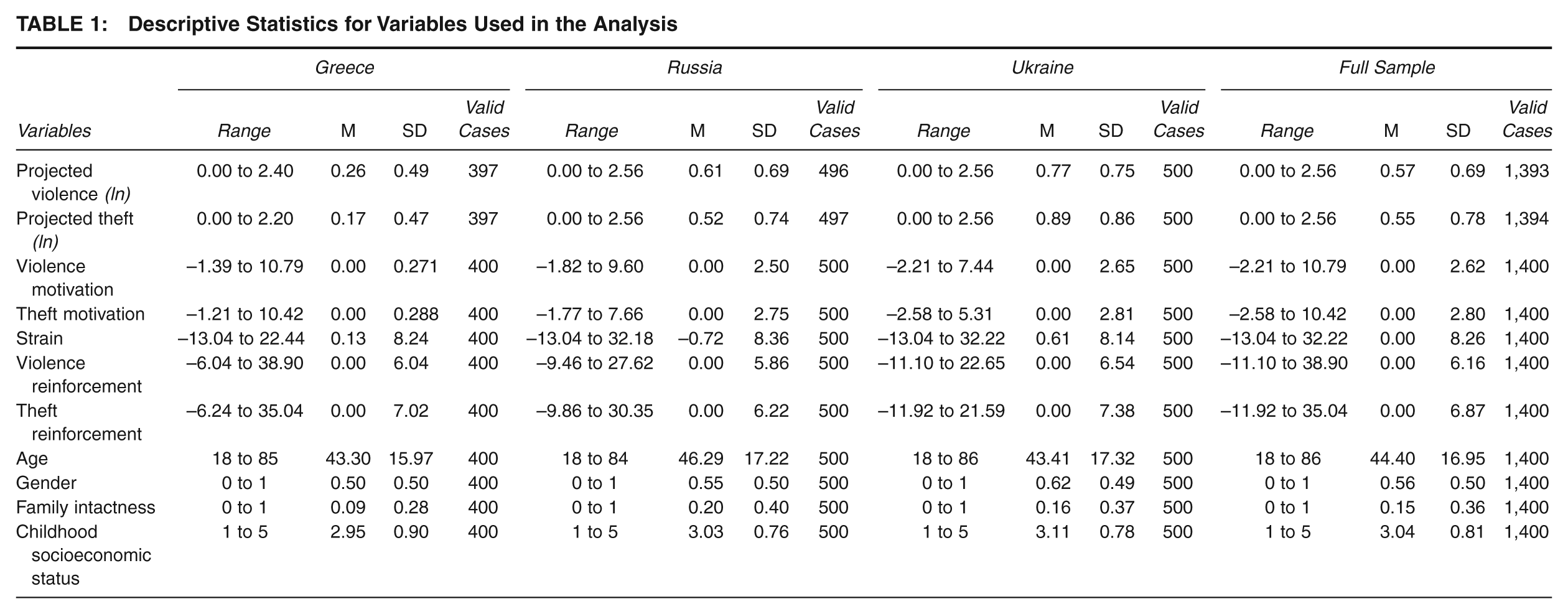
The following four control variables were incorporated into all analyses to account for any antecedent influences on the variables of interest: gender (0 for male and 1 for female), age (the year of birth), family intactness during childhood (0 for living with two biological parents and 1 for all other arrangements), and respondent’s perception of family economic status during childhood (“How would you evaluate the economic status of the family in which you grew up relative to other families in that time?” with five response categories ranging from 1 = very poor to 5 = very good). We also conducted analyses (not shown here) with a measure of current socioeconomic status (SES) as another control variable and obtained similar results. Merged-sample analyses also include dummy variables for Russia and Ukraine with Greece as a base category. Finally, past crime, a variable that is often utilized as a control in analyses of prospective criminal behavior, was incorporated into the measures of crime-favorable reinforcement. Descriptive statistics for these and other variables used in the analyses are shown in Table 1. For any variables in all three samples the rates of missing data are very low (less than 1.5%), and the few missing values for independent and control variable were replaced using the expectation maximization algorithm.
Descriptive Statistics for Variables Used in the Analysis
Analysis
We employed two alternative methods of analyses. First, we used ordinary least squares (OLS) regression with logged dependent variables to estimate all causal sequences. Second, we estimated these models using negative binomial regression that preserves the original, skewed, distributions of dependent variables. Since both methods produced the same substantive findings and we wished to maximize comparability with past research on criminal motivation, we present only the findings from the OLS estimates.
The Preacher-Hayes (Preacher & Hayes, 2008) test was used in testing mediating effects of criminal motivation. It purportedly provides less biased estimates of indirect effects based on bootstrapped confidence intervals. We also conducted formal regression diagnostic tests for all models. Variance inflation factors are all less than 2.7 (well under the 4.00 usually taken as the threshold for serious problems; see Fisher & Mason, 1981), indicating that our results are probably not biased by multicollinearity.
Results
Criminal Motivation
Descriptive statistics for the two measures of criminal motivation shown in Table 1 suggest that the assumptions of motivational theories about criminal attraction may be closer to the truth than the assumptions made by control theories. First, according to these data, criminal attraction is clearly not uniform among individuals and is not generally high. The range of index scores for violence attraction is from a low of −2.21 to a high of 10.79 while the minimum attraction for property crime is −2.58, with a maximum of 10.42. Moreover, 77% of the Greek respondents, 58% of the Russian participants, and 38% of the Ukrainian respondents reported never having an attraction to property crime, while the corresponding figures for violence are 62, 42, and 40 (see the last two rows of Appendix A). Not only does criminal attraction appear to vary substantially among individuals, frequently being absent altogether, but there seem to be clear differences among the samples in the three countries. Overall, Russian and Ukrainian respondents seem to exhibit considerably more attraction than the Greeks to the two types of crime being investigated here. Furthermore, t tests conducted with the raw score measures of criminal motivation confirm that the means of the motivation indices in the Russian and Ukrainian samples are significantly different from those in the Greek sample.
Motivational Factors → Criminal Motivation
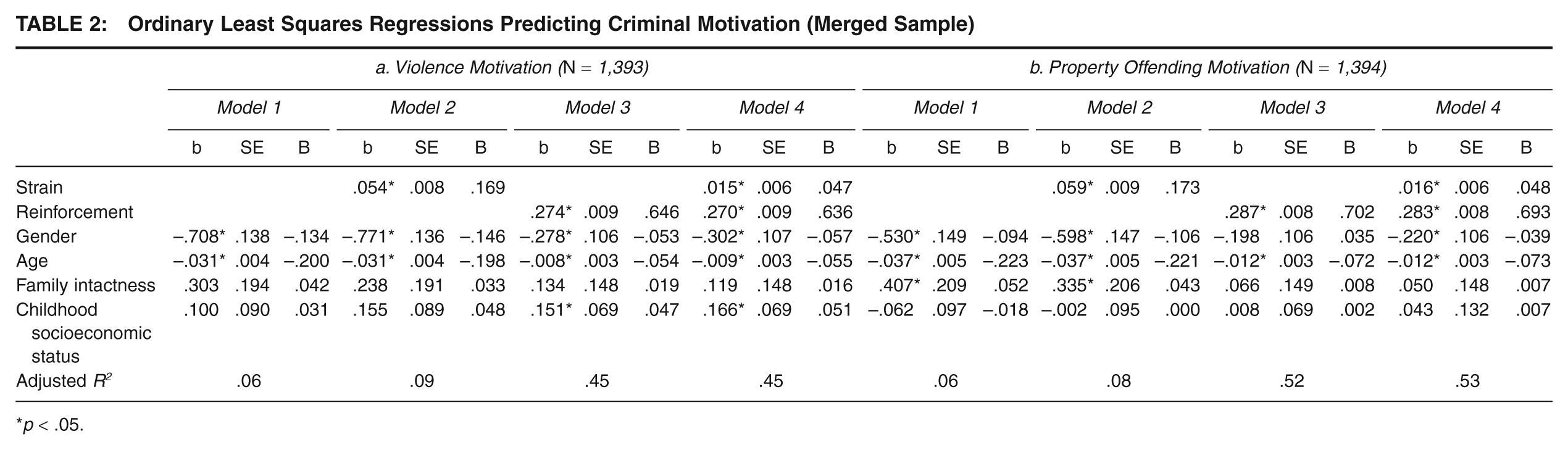
The data strongly support the idea that criminal attraction is highly variable. If the data are correct, a major issue for criminological theory, then, is to explain that variation. Here we consider two theories that feature variables/processes designed to do that. The results in Table 2 (based on the full sample) permit some insight into how well these two theories perform in that respect.
Ordinary Least Squares Regressions Predicting Criminal Motivation (Merged Sample)
p < .05.
The coefficients from Models 2 and 3 show that both strain and reinforcement, respectively, are significantly related to the indices of attraction to violent and property offending, even with gender, age, childhood family intactness, and childhood family SES in the equations. These associations range from moderate for strain (standardized coefficients of .17) to relatively strong for past reinforcement (standardized coefficients .65 and .70). Furthermore, predictions of criminal attraction from both strain and past reinforcement are robust, persisting even when both measures are included in the equations (Model 4). Yet, the predictive coefficients for strain are smaller and somewhat less stable than those of reinforcement. The strain coefficients predicting criminal attraction, though remaining significant, are nevertheless reduced substantially (by approximately 70%) when the measures of reinforcement are included, whereas the coefficients for reinforcement decrease by only about 1% when the strain measure is considered.
Strain and past reinforcement in combination appear to add substantially (increases from 39% to 45%) to the R2 for criminal motivation, above what is provided by the control variables (compare Models 1 with Models 4, differences confirmed by F tests), although most of this additional explanatory power comes from the contribution of prior reinforcement. Furthermore, the dummy variables designating countries in our full sample (not reported) are not significant, suggesting that whatever effects strain and reinforcement have on criminal motivation are not conditioned by the cultural context.
It is noteworthy that two demographic characteristics, age and gender, both significantly predict criminal attraction and continue to do so when other variables, including strain and reinforcement, are included in the equations. Thus, although our results support the two theories’ implications concerning criminal motivation, it seems likely that those two theories do not fully account for attraction to criminal behavior. Since neither sex nor age, in and of itself, can explain anything (see Wikström, 2006), their indicators must conceal other causal processes that might be uncovered using variables from other criminological theories claiming to explain criminal attraction.
Criminal Motivation → Criminal Probability
Furthermore, to investigate the potential effects of criminal motivation on criminal probability, we first examine bivariate correlations (the results not shown and available from the authors upon request). Those figures indicate that attraction to crime is significantly and strongly related to prospective involvement in both violent and property offending (coefficients from .52 for violence in Greece to .77 for property offending in Ukraine). These associations are significant in all three countries, with higher correlations being present in Russia and Ukraine than in Greece. The statistical significance of differences between bivariate correlations is confirmed by Fisher’s test.
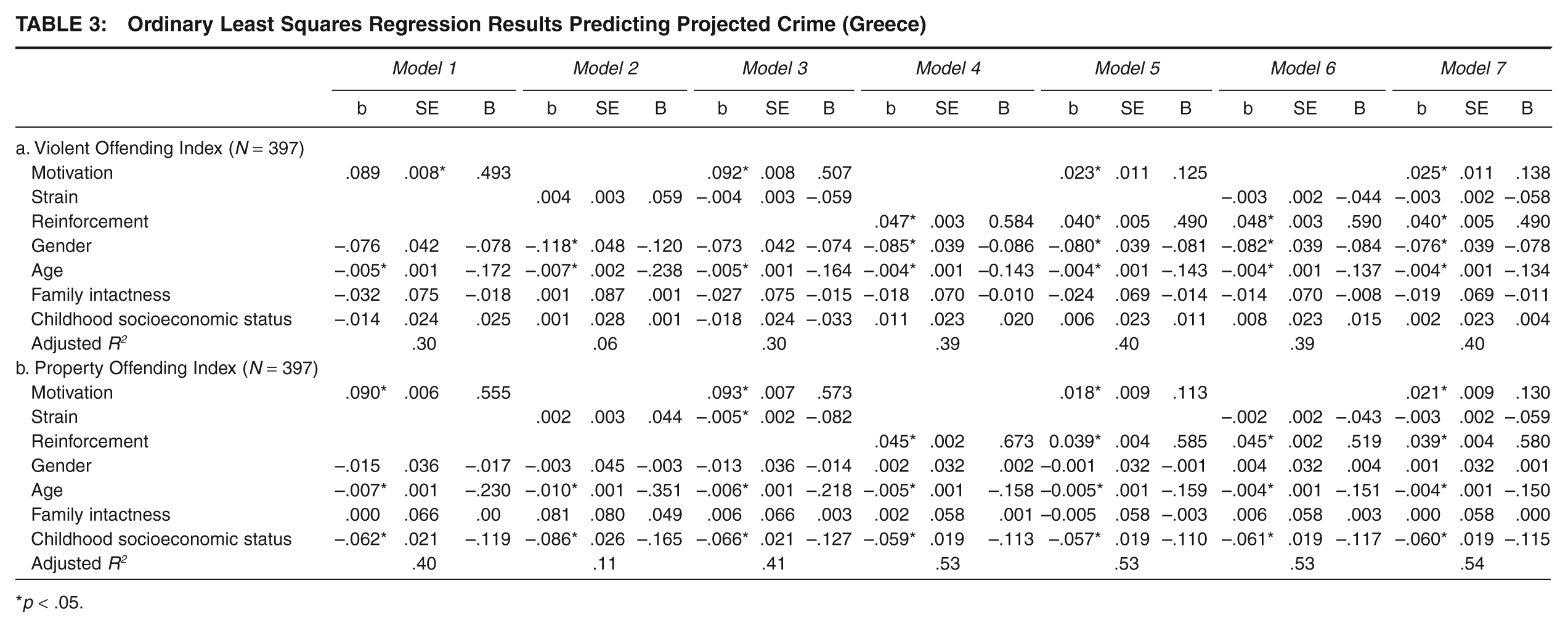
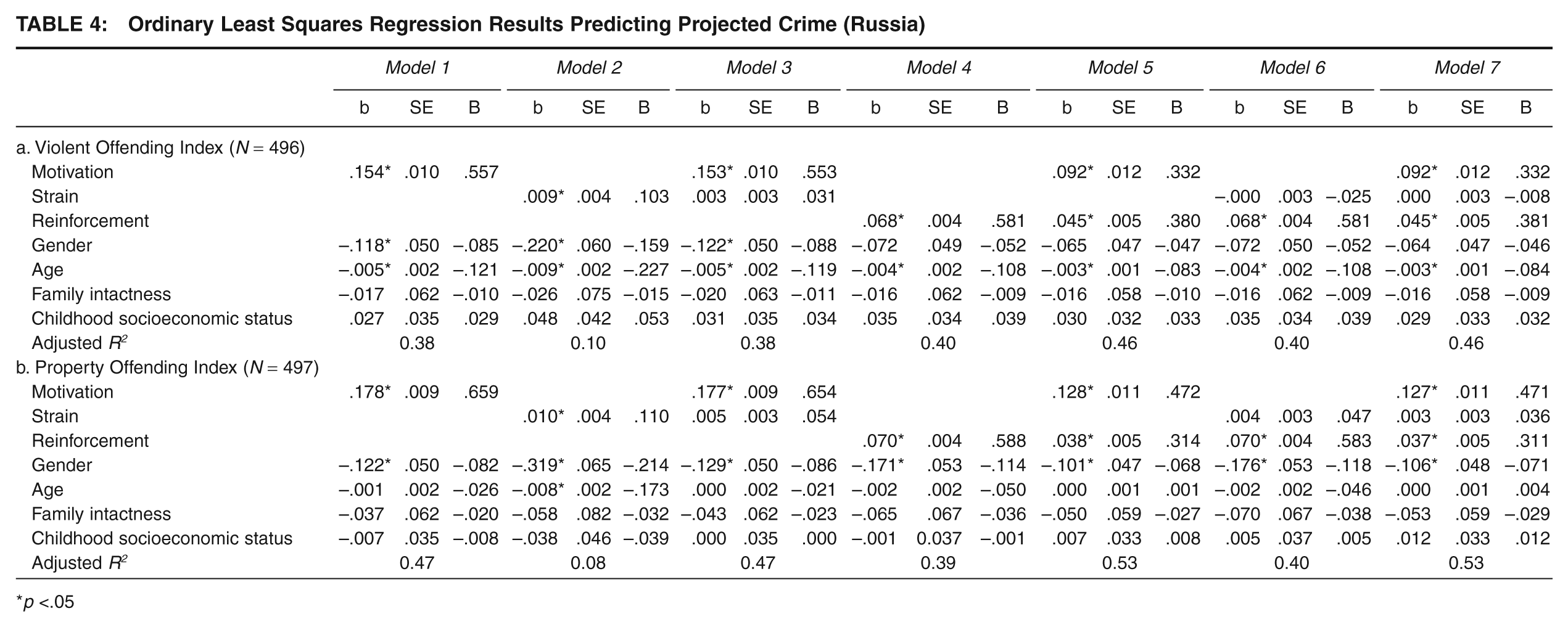
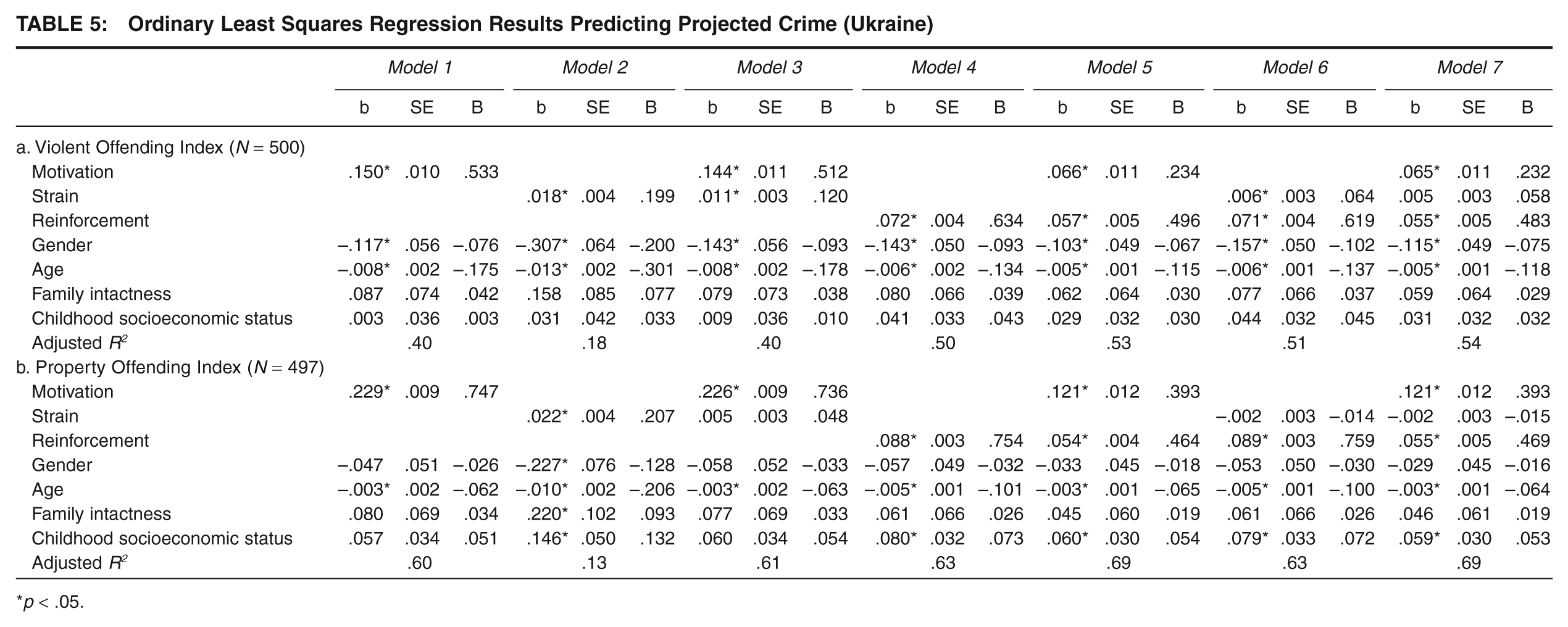
Tables 3 through 5 present regression coefficients concerning the associations between attraction to crime and criminal probability by country (because our findings appear to vary by research sites, as country dummy coefficients are significant in all models). The figures from Model 1 in these tables indicate that, in all instances, criminal motivation is strongly and significantly related to the dependent variables (standardized coefficients ranging from .49 to .75), even with all the control variables included. Thus, it would appear that motivation is an exceptionally important variable in explaining criminal probability in all three settings.
Ordinary Least Squares Regression Results Predicting Projected Crime (Greece)
p < .05.
Ordinary Least Squares Regression Results Predicting Projected Crime (Russia)
p <.05
Ordinary Least Squares Regression Results Predicting Projected Crime (Ukraine)
p < .05.
However, our findings do point toward possible cross-cultural differences in the degree of influence that criminal motivation exercises on the probability of misbehavior. The figures presented in Model 1 in Tables 3 through 5 show that these coefficients are stronger in Russia and Ukraine than in Greece, with all such differences being shown statistically significant using the Paternoster, Brame, Mazerolle, and Piquero (1998) test.
Motivational Factors → Criminal Motivation → Criminal Probability
It remains to be seen, however, whether the measures of criminal motivation mediate associations between various theoretical explanations for criminal behavior and indicators of such criminal probability, as is so often assumed but rarely tested. Relevant coefficients are presented in Tables 3 through 5, Models 2 through 7.
The hypothesis of mediation presupposes (R. M. Baron & Kenny, 1986) the existence of significant relationships between theoretical causes of crime and criminal probability when criminal motivation is not taken into consideration, as well as between motivation and criminal probability, which has already been shown. The presupposition of an association between theorized causal variables and criminal probability is partially supported in the case of strain (Models 2 and 6) and fully supported for reinforcement (Models 4 and 6). In Model 2, which includes all control variables, the strain coefficients significantly predict criminal projections only in Russia and Ukraine, and even then they are very modest relative to other predictors in the model (standardized coefficients range from .10 for violence in Russia to .21 for property offending in Ukraine). With one exception (violence in the Ukrainian sample), these associations are somewhat unreliable, being reduced to nonsignificance by the inclusion of prior reinforcement in the predictive equations (Model 6). Measures of reinforcement, on the other hand, are significantly and strongly associated with projected future violence and property offending in all three countries (standardized coefficients ranging from .58 for violence in Greece to .76 for property offending in Ukraine) and remain so with all control variables as well as the measures of strain included in the equations (Models 4 and 6).
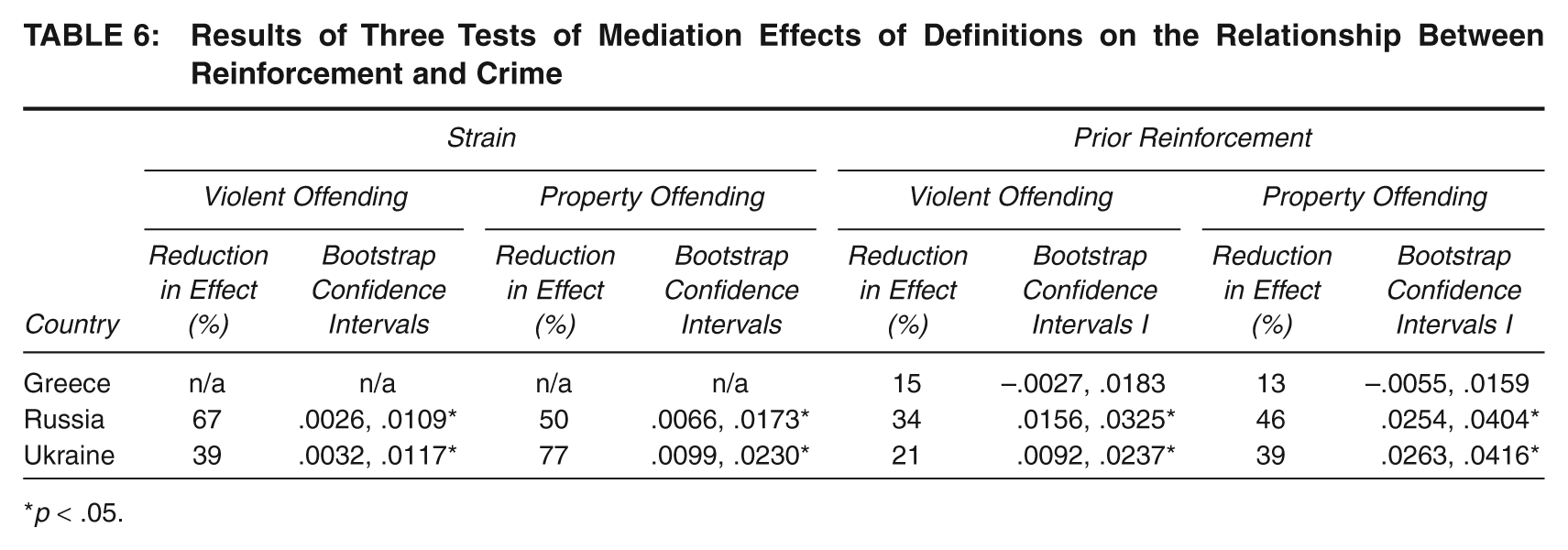
Furthermore, confirming mediation requires that the association observed between a theoretical causal variable like strain or reinforcement and criminal probability be significantly reduced or eliminated when motivation is included in the equation (R. M. Baron & Kenny, 1986). In assessing mediation in strain models, we focus only on the Russian and Ukrainian samples (Models 2 and 3 in Tables 4 and 5) because no stable association between strain and crime was shown in the Greek sample. The figures indicate that in three out of four instances the coefficients for strain predicting violence and property offending are fully mediated by criminal motivation. In the fourth instance, strain predicting projected future violence in the Ukrainian sample, only partial mediation occurs. Overall, the effects of strain on different types of misconduct, though only modest in any case, are nevertheless reduced by 39% to 77% by the inclusion of criminal motivation in the predictive equations, and the results from the Preacher-Hayes (Preacher & Hayes, 2008) statistical procedures confirm the significance of these findings (Table 6).
Results of Three Tests of Mediation Effects of Definitions on the Relationship Between Reinforcement and Crime
p < .05.
While the original associations between reinforcement and criminal projection are substantially larger and more consistent than those for strain, the overall evidence of mediation is somewhat weaker for reinforcement. The figures in Models 4 and 5 in Tables 3 through 5 suggest partial rather than full mediation because all the reinforcement coefficients remain significant and strong even with criminal motivation in the equations. Furthermore, significant meditation effects are present only among the Russian and Ukrainian samples (Table 6).
Discussion
In line with previous, though sparse, research (Brezina & Piquero, 2003; Tittle & Botchkovar, 2005) and challenging some control theories, our results confirm that attraction to crime varies substantially among individuals and across research sites and is often minimal. In addition, they show that criminal motivation strongly predicts violence and property offending in all three of our samples. Thus, there are strong reasons to pay more attention to criminal attraction as a variable and bring its direct measure into studies of criminal behavior.
Criminal attraction is particularly important in the light of the findings suggesting cross-cultural differences in its levels and influences. For instance, the Greek respondents report much lower levels of criminal motivation than do the Russian or Ukrainian interviewees. These discrepancies may be due, at least to some extent, to environmental differences in anomie, the state of normlessness (Durkheim, 1893/1984). The drastic social, economic, and political transformations experienced by Russia and Ukraine may have caused many individuals to experience straining and traumatic events repeatedly as well as to observe and participate in crime-reinforcing incidents. However, the effects of criminal attraction also appear to be greater in Russia and Ukraine, suggesting that theories like strain and social learning that point toward criminal attraction as a key mediator may need some refinement to more effectively specify their scopes.
In addition to widespread anomie, as suggested earlier, the ability of criminal motivation to predict crime in different locales could be linked to the degree of balance between levels of motivation and levels of constraint (Becker, 1968; McCarthy, 2002; Paternoster & Pogarsky, 2009; Tittle, 1995). Greater social integration and stronger moral beliefs in Greece may reduce the overall impact of criminal motivation. And, there are other forces potentially at work. For example, the failure to find stronger effects for individual strain in face of general levels of misery in Russia and Ukraine could be because potentially straining influences that are excessively experienced cease to produce strong straining effects as people become accustomed to it; instead, they generate a more or less constant state of criminal motivation. Similarly, when potentially reinforcing conditions are faced too often, they may lose their immediate criminogenic potency. More theoretical work may be needed before accurate contingencies bearing on sociocultural variations can be articulated and incorporated into major criminological theories.
Furthermore, the failure of our measures of strain and reinforcement to explain all of the variation in individual attraction to crime suggests that criminal motivation may have multiple sources besides those specified in those two theories. Numerous other accounts, such as reactance (Brehm & Brehm, 1981) and coercion, and social support theories (Colvin, 2000; Colvin et al., 2002) may contain potential explanations for criminal motivation. Moreover, some prior studies suggest that biological influences may contribute to increased attraction to crime (Gove & Wilmoth, 1990; Raine, 2002). Finally, regardless of the sources of criminal attraction, our data suggest that it exercises some degree of mediation between strain and reinforcement, at least for the Russian and Ukrainian samples, thus providing some support for causal sequences set forth in strain and reinforcement in general strain and social learning theories. But, since our data do not support a conclusion of mediation by criminal motivation in the sample of Greek respondents, those causal chains may be context dependent.
In sum, our data suggest that scholars would do well to focus more directly on criminal attraction as a potential influence on behavior. Yet, although our research offers unique insights into the role of criminal attraction in explaining criminal behavior, several potential limitations exist. First, our data are subject to the same well-known weaknesses as survey data collected anywhere else, such as potential withholding or exaggeration of information. Second, the measurement of some key variables may be less than ideal. In particular, criminal motivation may be difficult to tap using ordinary survey items, mainly because survey measures cannot take into account situational stimuli. In addition, our measures of strain and reinforcement may not capture all of the elements relevant to each variable, and therefore, their failure to account for all variation in individual attraction to crime may also be attributed limitations in their measurement. Third, there are reasons to be critical of our ability to establish firmly the theorized causal ordering of the variables. With specifically focused question wording, we were able to differentiate retrospective, contemporaneous, and prospective measures of the concepts of interest. Yet, the actual causal ordering of our variables may be different. For example, although some extant longitudinal research suggests otherwise, criminal motivation may be a completely stable construct rooted in early childhood experiences and antecedent to much prior reinforcement and strain exposure. Long-term longitudinal studies with repeated measures may be necessary for strong answers to the questions we are addressing.
Conclusion
This research has been designed to help overcome weaknesses in the research literature concerning criminal motivation. While virtually every theory assumes that criminal attraction, or motivation, is implicated in actual criminal conduct, very few studies attempt direct measurement and assessment of the part it plays. Moreover, theories differ in their assumptions about the distribution and origin of criminal motivation, with some portraying it as ubiquitously strong and inherent and others contending that it is highly variable, depending on various theoretical influences. Finally, ideas about criminal attraction imply that its presence, sources, and effects are universal, although the relevant research is sparse and limited mainly to Western contexts and age-bounded and nonrandom samples.
Our data, drawn from surveys conducted in three different social contexts—major cities in Greece, Russia, and Ukraine—show that criminal attraction, at least as we measure it, is quite variable, both among individuals and across contexts, and contrary to many control theories, it is sometimes extremely low. Furthermore, direct measures of criminal attraction prove to be strong predictors of criminal probability and usually serve as mediators between theoretical variables put forth by prominent theories and criminal probabilities. In addition, the sources of criminal motivation, as implied by the large repertoire of variables from numerous criminological theories designed to account for criminal behavior through their supposed effects on criminal motivation, appear to be broad and varied. Finally, aspects of criminal attraction appear to be somewhat dependent on the social/cultural context.
Overall, then, our data suggest that theorists, especially those in the “control” tradition, need to pay more attention to potential variations in the strength of criminal attraction. In addition, theorists generally need to specify more accurately the sources of criminal motivation, particularly as they might vary among social contexts, and to draw out the likely causal sequences in which it is implicated. Correspondingly, researchers may need to begin measuring criminal attraction directly and bringing it into empirical schemes to more accurately account for misconduct.
Footnotes
Appendix
Survey Items Used for Constructing Crime-Specific Measures of Reinforcement
| Projected Future Violence | Projected Future Property Offending |
|---|---|
| In the future if you are in a situation where you have a strong desire or need and the opportunity to commit each act, what is the chance that you will do so? | |
| 1. Hit another person on purpose in an emotional outburst | 1. Take money or property from others worth less than $5 |
| 2. Physically harm another person on purpose | 2. Take money or property from others worth more than $5 but less than $50 |
| 3. Use violence or threat of violence to accomplish some personal goal | 3. Take money or property from others worth $50 or more. |
| Criminal Motivation | |
| How often at this point in your life, you find yourself needing or wanting to . . . ? | |
| 1. Hit another person on purpose in an emotional outburst | 1. Take money or property from others worth less than $5 |
| 2. Physically harm another person on purpose | 2. Take money or property from others worth more than $5 but less than $50 |
| 3. Use violence or threat of violence to accomplish some personal goal | 3. Take money or property from others worth $50 or more. |
| Think back to the last time you were in a situation in which you could have gotten away with doing it. In that situation, how gratifying or pleasing to you would it have been to . . . | |
| 1. Hit another person on purpose in an emotional outburst | 1. Take money or property from others worth less than $5 |
| 2. Physically harm another person on purpose | 2. Take money or property from others worth more than $5 but less than $50 |
| 3. Use violence or threat of violence to accomplish some personal goal | 3. Take money or property from others worth $50 or more. |
| Strain | |
| How frequently have you experienced it? | |
| 1. You failed to achieve some goal that is important to you (e.g., career achievement or level of income) | |
| 2. You failed to achieve some goal that, because of hard work, an agreement, or principles of justice, you deserve to achieve (e.g., getting a promotion at work or graduating from college) | |
| 3. Bad things happened to you (e.g., being a victim of a crime, becoming seriously ill, or getting in conflict with a friend, partner, or family member) | |
| 4. You did not do as well at things as some other people (e.g., not having gotten what others got or not having performed as well as others) | |
| Past Direct Reinforcement for Violence | Past Direct Reinforcement for Property Offending |
| 1. When you were growing up, before age 8, how often did your caregivers catch you when you did what you now know most people would regard as misbehavior? x When you were growing up, before age 8, how often did your caregivers punish or show disapproval when they caught you engaging in what you now know most people regard as misbehavior? | 1. When you were growing up, before age 8, how often did your caregivers catch you when you did what you now know most people would regard as misbehavior? x When you were growing up, before age 8, how often did your caregivers punish or show disapproval when they caught you engaging in what you now know most people regard as misbehavior? |
| 2. How often did you [do each of the three acts of violence]? x How often did you benefit from [do each of the three acts of violence]? | 2. How often did you [do each of the three acts of property offending] during the past 5 years? x How often did you benefit from [each of them]? |
| Past Vicarious Reinforcement for Violence | Past Vicarious Reinforcement for Property Offending |
| 1. How often have most of your friends [done each of the three acts of violence]? x How often during your lifetime have you observed or heard about people benefitting from having [done each of the three acts of violence]? | 1. How often have most of your friends [done each of the three acts of property offending]? x How often during your lifetime have you observed or heard about people benefitting from having [done each of the three acts of property offending]? |
| 2. How often during your lifetime that family, friends, or associates have indicated that [doing each of the three acts of violence] is morally acceptable? | 2. How often during your lifetime that family, friends, or associates have indicated that [doing each of the three acts of property offending] is acceptable? |

Acknowledgements
We thank the anonymous reviewers and the editor for their insightful comments and suggestions.