







Abstract
The authors replicated Walters and Geyer (2004) by examining how white-collar offenders differ from non-white-collar offenders on criminal thinking and lifestyle criminality. To extend Walters and Geyer’s work, they explored psychopathic characteristics and psychopathology of white-collar offenders compared with non-white-collar offenders. The study sample included 39 white-collar only offenders (offenders who had committed only white-collar crime), 88 white-collar versatile offenders (offenders who previously had committed non-white-collar crime), and 86 non-white-collar offenders incarcerated in a federal prison. Groups were matched on age and ethnicity. Offenders completed self-report measures of criminal thinking, psychopathic traits, and psychopathology. Lifestyle criminality was gathered via file review. Results demonstrated white-collar offenders had lower scores on lifestyle criminality but scored higher on some measures of psychopathology and psychopathic traits compared with non-white-collar offenders. White-collar versatile offenders were highest in criminal thinking. Logistic regression findings demonstrated that white-collar offenders could be distinguished from non-white-collar offenders by substance use.
Bernard Madoff deceived investors out of nearly $65 billion in an elaborate Ponzi scheme (CBC News, 2009). The Enron scandal, led by chief executive Kenneth Lay, cost stockholders $31.8 billion (BBC News, 2006). In fact, it is estimated that the costs of white-collar (WC) crime in the United States may reach as much as $1 trillion annually (Friedrichs, 2007).
Various definitions of WC crime exist in the literature (see Clinard & Quinney, 1973; Sutherland, 1949). A recent review (Ragatz & Fremouw, 2010) of the WC research demonstrated scholars (Benson & Moore, 1992; Daly, 1989; Langton & Piquero, 2007; Poortinga, Lemmen, & Jibson, 2006; Walters & Geyer, 2004; Weisburd, Chayet, & Waring, 1990; Wheeler, Weisburd, Waring, & Bode, 1988) have predominately relied on the definition of WC crime set forth by Wheeler, Weisburd, and Bode (1982), which stated WC crimes are “economic offenses committed through the use of some combination of fraud, deception, or collusion” (p. 642). The definition has been further qualified by requiring that the offense be one of eight types: bank embezzlement, tax fraud, postal fraud, credit fraud, false claims and statements, bribery, securities fraud, or antitrust violations (Wheeler et al., 1982).
Demographic Variables
Scholars have recognized WC offenders are unique from non-white-collar offenders (e.g., drug dealing, theft) on several demographic variables. Wheeler et al. (1988) found federal WC offenders were more likely to be male, Caucasian, older, graduates of high school and college, and less likely to be unemployed compared with non-white-collar (NWC) offenders and community samples. Benson and Moore (1992) demonstrated WC offenders were less likely to have an arrest history, to have previously used drugs or alcohol excessively, and to have demonstrated impaired academic performance than NWC offenders. A more recent study (Poortinga et al., 2006) showed WC offenders were more likely to be employed, have a higher level of education, be Caucasian, have worked in management positions, and have fewer criminal convictions compared with NWC offenders.
Criminal Thinking Patterns
Criminal thinking or attitudes conducive to a criminal lifestyle have been linked to several behavioral outcomes such as treatment completion (Staton-Tindall et al., 2007), treatment effects (Walters, 1995, 2003), recidivism (Walters, 1997, 2005), risk for sexually offending (Walters, Deming, & Elliot, 2009), and participation in disciplinary acts in prison (Walters & Geyer, 2005; Walters & Mandell, 2007). In fact, one study with male federal inmates demonstrated criminal thinking contributed to the prediction of three different types of disciplinary outcomes (i.e., severe, aggressive, total) above what was already accounted for in the model by psychopathy, age, and prior disciplinary acts (Walters & Mandell, 2007). Criminal thinking dimensions have been found to be moderately correlated with a self-report measure of antisocial personality (Morey, 1991, 2003; Walters & Geyer, 2005).
Only one previous study (Walters & Geyer, 2004) investigated criminal thinking patterns unique to WC offenders. In that study, the definition of WC included offenders who had committed the eight crimes (i.e., antitrust offenses, securities and exchange fraud, postal/wire fraud, false claims/statements, credit fraud, bank embezzlement, tax fraud, and bribery) specified by Wheeler et al. (1982) with the addition of two offenses (i.e., health care fraud and counterfeiting). The WC offenders were divided into two groups: 34 male white-collar only offenders (with no criminal history or a history of committing only WC offenses; WCO) and 23 male criminally versatile white-collar offenders (with a criminal history of offenses that were not WC crimes; WCV). A comparison group consisted of 66 male NWC offenders.
Individuals in all three groups completed the Psychological Inventory of Criminal Thinking Styles (PICTS; Walters, 2006, 2010) and the Social Identity as a Criminal Scale (SIC; Cameron, 1999). A modified version (arrest items were eliminated) of the Lifestyle Criminality Screening Form–Revised (LCSF-R; Walters, 1998; Walters, White, & Denney, 1991) was used. Findings indicated that the WCO group was significantly older and had higher educational attainment. Both WC groups were primarily Caucasian. WCO offenders were significantly lower on the PICTS Self-Assertion/Deception (tendency to justify criminal behavior) and the SIC In-Group Ties subscales (individual’s viewpoint of offenders) compared with the other groups. Additionally, the WCV group had a significantly higher score on the SIC Centrality subscale (individual’s believed identity in a group) when contrasted with the other groups. The NWC group scored significantly highest on the LCSF-R, followed by the WCV, and lastly the WCO groups. When controlling for demographics, only the SIC In-Group Ties subscale and the LCSF-R remained significant. In sum, Walters and Geyer found the WCO group was unique from WCV and NWC groups demographically (e.g., older, higher educational level) and were less likely to identify with a criminal lifestyle or attitudes. Interestingly, findings from Walters and Geyer’s (2004) study suggest the PICTS did not distinguish well between WC and NWC offenders; however, these results could be an artifact of focusing just on the PICTS factor scales.
Psychopathic Traits
Babiak (2007) asserted many characteristics of the psychopath may be favorable in the business domain. For instance, self-centeredness might be recognized as having “Self-confidence” or a lack of specified goals might be deemed “Visioning” (Babiak, 2007). Recently, Babiak, Neumann, and Hare (2010) explored the relation between psychopathy and various work performance dimensions in a sample of 203 (77.8% male, 91.1% Caucasian) corporate professionals. Psychopathy scores (as measured by the Psychopathy Checklist–Revised [PCL-R]) were positively correlated with being a successful communicator across several modalities (e.g., writing, presenting), producing and following through with new proposals, and having critical thinking skills. Psychopathy scores were negatively correlated with effectively getting along with employees and managing employees so they work successfully together.
Psychopathy has been found to be predictive of violence recidivism (Porter, Birt, & Boer, 2001; Serin & Amos, 1995), committing disciplinary infractions while incarcerated (Edens, Poythress, Lilienfeld, & Patrick, 2008; Edens, Poythress, Lilienfeld, Patrick, & Test, 2008; Patrick, Edens, Poythress, Lilienfeld, & Benning, 2006), and propensity to recidivate following psychological treatment (Seto & Barbaree, 1999). Hare (1991, 2003) developed the widely used and highly researched instrument for the assessment of psychopathy, the PCL-R. Factor analytic research with the PCL-R has provided the most support for a two-factor model. Factor 1 has been representative of the interpersonal and affective features of psychopathy, with items such as superficial charm, shallow affect, remorselessness, and grandiosity loading on this factor. Factor 2 is composed of the behavioral or antisocial aspects of psychopathy, which includes items such as parasitic lifestyle, lack of responsibility, impulsiveness, and versatility in criminal acts.
In recent years, a self-report measure of psychopathic traits, the Psychopathic Personality Inventory–Revised [PPI-R; Lilienfeld & Widows, 2005]), has been developed. The PPI-R consists of two factors: Fearless Dominance (PPI-I) and Self-Centered Impulsivity (PPI-II; Benning, Patrick, Hicks, Blonigen, & Krueger, 2003; Lilienfeld & Andrews, 1996; Lilienfeld & Widows, 2005; Patrick et al., 2006). The PPI-R has helped to decrease assessment duration (amount of time spent completing and scoring) and has extended the populations (e.g., college students and community samples) that can be sampled (Lilienfeld & Fowler, 2006). The PPI-R (Lilienfeld & Widows, 2005) was modified from its earlier version (Psychopathic Personality Inventory [PPI; Lilienfeld & Andrews, 1996]) by a reduction in the number of questions. (PPI had 187 items, and the PPI-R has 154 items.) The PPI-R is unique from the PCL-R because it does not contain items assessing illegal behaviors, and instead represents a measure devoted to the personality aspects of psychopathy. Research supports this premise, as the PPI correlates more strongly with Factor 1 than Factor 2 of the PCL-R (Poythress, Edens, & Lilienfeld, 1998).
In forensic samples, the relation between the PPI and PCL-R is less clear. In a sample of male offenders, PPI total scores were more strongly and positively correlated with Factor 1 than Factor 2 on the PCL-R (Poythress et al., 1998). Utilizing a young male offender sample, Edens, Poythress, and Lilienfeld (1999) found PPI total scores and PCL-R total scores were related to receiving disciplinary reports for aggression (both verbal and physical). The two-factor structure of the PPI was confirmed in a forensic sample of general population and psychiatric offenders (Patrick et al., 2006). Conversely, a three-factor model was most appropriate with minimum and maximum security state offenders (Neumann, Malterer, & Newman, 2008).
Male offenders’ PPI-II scores correlate strongly and positively with psychopathology measures of the Personality Assessment Inventory (PAI; i.e., Antisocial Features, Aggression, Borderline Features, Anxiety, Anxiety-Related Disorders, Somatic Complaints, Alcohol Problems, Drug Problems, and Suicidal Ideation). PPI-I scores were negatively correlated with PAI Anxiety, Anxiety-Related Disorders, Somatic Complaints, and Alcohol Problems scales. PPI-I scores were positively correlated with the PAI Dominance scale (Patrick et al., 2006). When examining a jail sample, PPI total scores were negatively correlated with empathy. Additionally, results illustrated subscales that make up PPI-II were most strongly correlated with aggression and borderline features (Sandoval, Hancock, Poythress, Edens, & Lilienfeld, 2000). Also, with a predominately male forensic sample, PPI-I scores correlated positively with sensation-seeking (one dimension of impulsivity) whereas PPI-II scores correlated positively with dimensions of impulsivity (i.e., sensation-seeking, lack of premeditation, lack of perseverance, and urgency) and negative emotionality (Ray, Poythress, Weir, & Rickelm, 2009).
As research demonstrates (Benson & Moore, 1992; Poortinga et al., 2006), WC offenders are less likely to have criminal offense histories compared with NWC offenders. Therefore, for this study we elected to use the PPI-R with WC offenders, as it provides a measure of psychopathic traits only and does not take into account past criminal offenses. Furthermore, the PPI-R was ideal for this study because of its brief administration time in comparison with the PCL-R (15–25 min. vs. 90–120 min., respectively). Offenders participating in this study were already completing multiple measures (e.g., PICTS, PAI); therefore, using the PPI-R likely decreased the influence of fatigue during the testing process.
General Psychological Attributes and Psychopathology of WC Criminals
Most studies have compared only the personality characteristics of WC offenders with those of non-criminal WC professionals. For instance, Collins and Schmidt (1993) demonstrated WC offenders were significantly higher in anxiety, involvement in extracurricular activities, and social extraversion than non-criminal WC professionals. In comparison non-criminal WC professionals were significantly elevated in socialization, responsibility, tolerance, and performance compared with WC criminals. Another study (Kolz, 1999) showed that low conscientiousness and low agreeableness predicted admitting to employee theft. In a study by Alalehto (2003), a greater number of WC offenders were described as extroverted (e.g., outgoing, controlling, calculating), less agreeable, and neurotic by colleagues. The non-criminal WC professionals were described as more agreeable and conceited (e.g., diligent, frugal, refined). Blickle, Schlegel, Fassbender, and Klein (2006) found higher hedonism, narcissism, conscientiousness, and lower levels of behavioral self-control predicted WC criminality. Poortinga et al., (2006) showed WC offenders were significantly less likely to meet diagnostic criteria for substance abuse or dependence and to exhibit a depressive disorder than were NWC offenders. In a recent study, Listwan, Piquero, and Van Voorhis (2010) demonstrated that WC offenders high on a neurotic personality dimension were significantly more likely to recidivate.
Existing research demonstrates that WC offenders are unique from non-criminal WC professionals and NWC offenders on several measures of psychopathology. For instance, WC offenders tend to exhibit high levels of depression and anxiety (Alalehto, 2003; Blickle et al., 2006; Collins & Schmidt, 1993; Poortinga et al., 2006). Heightened anxiety or depression could lead to treatment dropout among WC offenders. Anxiety has also been linked to recidivism among WC offenders (Listwan et al., 2010). Further research on the psychopathology of WC offenders could provide insight into variables that impact treatment retention and recidivism risk. Researchers also need to explore criminal thinking and psychopathic traits among WC offenders as these variables have been found to predict treatment dropout and effectiveness (Seto & Barbaree, 1999; Staton-Tindall et al., 2007). Examining psychopathic characteristics, psychopathology, and criminal thinking patterns of WC offenders also furthers our understanding of treatment needs with this population. Lastly, results of this research could advance hiring practices. Specifically, this research could inform employers of traits likely related to workplace criminal behavior and could then assist with development of tools for employee selection.
Current Study
The first purpose of this study was to replicate Walters and Geyer’s (2004) study of WC criminals. In line with Walters and Geyer’s findings, we hypothesized WCO offenders would have a lower Lifestyle Criminality Screening Form (LCSF) total score than WCV and NWC offenders. We also hypothesized WCO offenders would have lower scores on PICTS factor scales. Lastly, we explored whether WCO offenders had significantly different scores than other offenders on PICTS General Criminal Thinking score and eight criminal thinking subscales.
The second purpose was to examine the psychopathic traits of WC offenders. Research has demonstrated WC offenders display several psychopathic traits (i.e., narcissism, hedonism, impulsivity, low conscientiousness, and controlling and calculating in social interactions; Alalehto, 2003; Blickle et al., 2006; Kolz, 1999). Research also suggests WC offenders exhibit various traits (i.e., less criminal versatility, anxiety, depression, fewer difficulties in school, less contact with police as a juvenile, less extensive arrest history, and fewer problems with drugs or alcohol) not suggestive of psychopathy (Alalehto, 2003; Benson & Moore, 1992; Collins & Schmidt, 1993; Poortinga et al., 2006). We hypothesized WCO offenders would exhibit high scores on PPI-R-I (i.e., Fearless Dominance) compared with other offenders because past research showed perceived interpersonal dominance (Patrick et al., 2006)—a trait often exhibited by WC offenders—is associated with this factor. We hypothesized WC offenders would have lower scores on PPI-R-II (i.e., Self-Centered Impulsivity) compared with NWC offenders because PPI-R-II scores positively correlate with antisocial behaviors (e.g., alcohol or drug problems, aggression, number of arrests, problems in school, juvenile record) more frequently exhibited by NWC offenders (Benson & Moore, 1992; Patrick et al., 2006; Poortinga et al., 2006). We also explored differences between the three groups on the PPI-R Coldheartedness factor, subscales, and total score.
The third purpose was to examine the psychopathology of WC offenders. In comparison to NWC criminals, WC criminals have been found less likely to use drugs and alcohol and more inclined to experience depression (Benson & Moore, 1992; Poortinga et al., 2006). When contrasted with non-criminal WC professionals, WC criminals have demonstrated higher anxiety (Alalehto, 2003; Blickle et al., 2006; Collins & Schmidt, 1993). Based on existing research, we hypothesized WCO offenders would be elevated on the PAI depression and anxiety indices (i.e., Anxiety and Anxiety-Related Disorders) compared with WCV and NWC offenders. It was also hypothesized WCO offenders would have lower scores on the PAI substance use scales (i.e., Alcohol Problems and Drug Problems) compared with the other offenders.
Method
Participants
All inmates included in this study were housed in a minimum security federal prison in the eastern United States and had requested to interview for the Residential Drug Abuse Program between the years 2007 and 2010. Individuals were classified as WC if their current charge was one of 10 offenses (bank embezzlement, tax fraud, postal fraud, credit fraud, false claims and statements, bribery, securities fraud, antitrust violations, health care fraud, and counterfeiting). The WC offenders were divided into WCO (white-collar only) and WCV (white-collar versatile) offenders. Of those inmates who interviewed for the Residential Drug Abuse Program, 48 were WCO and 89 were WCV offenders. A control group of 89 NWC offenders was matched to the WC groups on ethnicity and age (see Table 1).
Demographic Characteristics of Study Participants
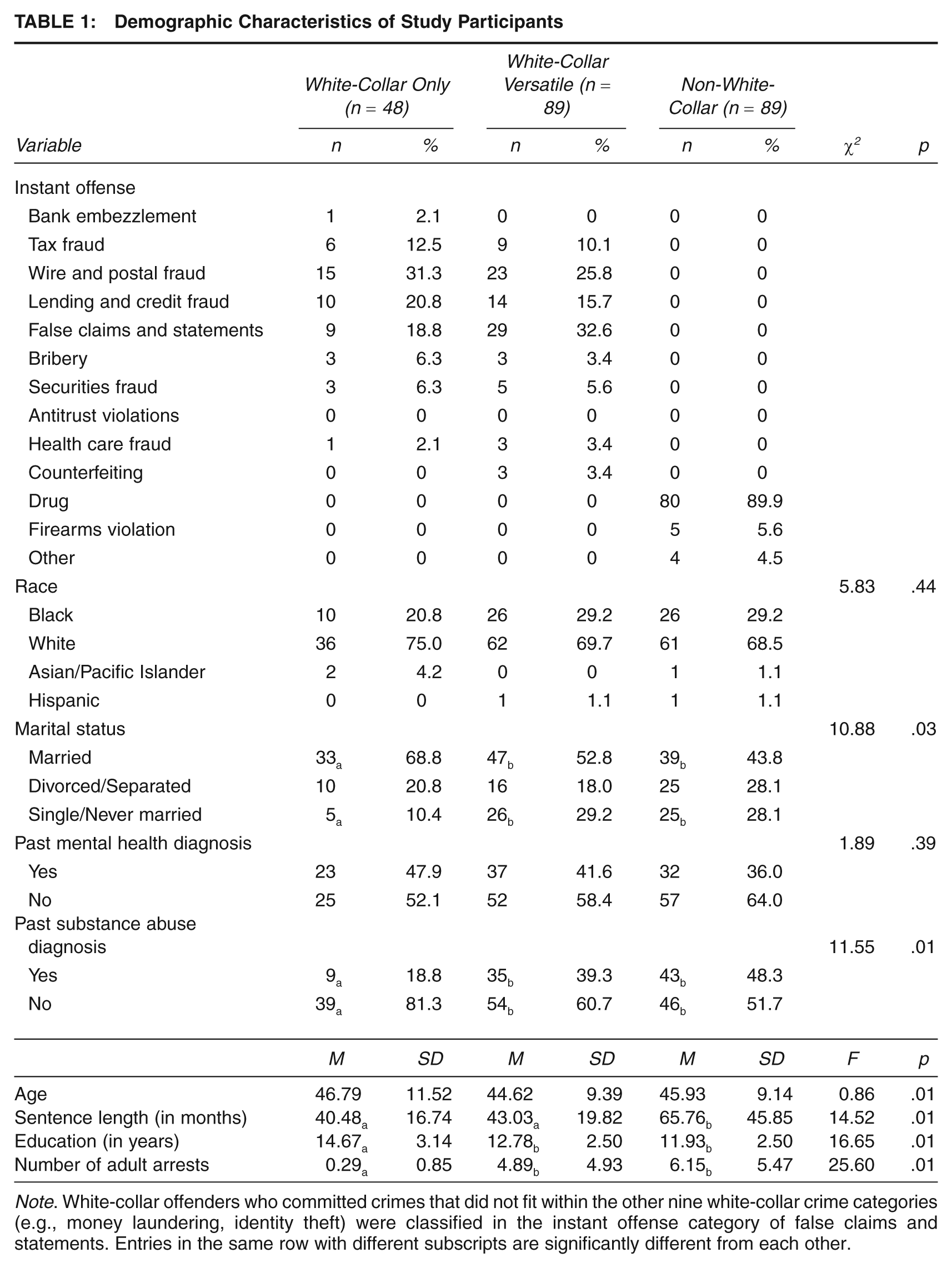
Note. White-collar offenders who committed crimes that did not fit within the other nine white-collar crime categories (e.g., money laundering, identity theft) were classified in the instant offense category of false claims and statements. Entries in the same row with different subscripts are significantly different from each other.
Measures
Demographic variables
All demographic variables were gathered from the Presentence Investigation Reports (PSI, see Table 1). Educational attainment was measured by number of years of school completed. Sentence length included only number of months an individual was incarcerated. Number of arrests was calculated by summing the number of adult arrests and convictions. Arrests and convictions prior to age 18 years and current offenses were not included. To determine interrater reliability, a trained graduate student recoded 13% (n = 30) of the participant cases previously coded by the primary researcher (Kappa statistic [range from .70 to 1.00]).
Psychological Inventory of Criminal Thinking Styles
The PICTS (Walters, 2006, 2010) consists of 80 items that assess attitudes about criminality. All responses are measured on a four-point scale (4 = strongly agree, 3 = agree, 2 = uncertain, 1 = disagree). PICTS protocols with Confusion–Revised (assesses symptom exaggeration, reading problems, or carelessness) T-scores of 95 or greater and/or Defensiveness–Revised (assesses under reporting of symptoms) T-scores of 68 or greater should be considered invalid (see Walters, 2011). The PICTS includes eight thinking style scales: Mollification (blaming outside causes to evade responsibility), Cutoff (eliminating distress with drugs or illegal acts), Entitlement (believing one is unique and deserves special treatment), Power Orientation (preferring to be in control), Sentimentality (believing doing good acts expunges previous antisocial acts), Superoptimism (believing one can escape consequences of illegal actions), Cognitive Indolence (tendency to use cognitive shortcuts when resolving problems), and Discontinuity (proclivity to be distracted and neglect goals). Additionally, the PICTS includes four factor scales (Problem Avoidance [proclivity to avoid problems by engaging in irresponsible acts], Interpersonal Hostility [tendency to become confused because of hostile experiences], Self-Assertion/Deception [tendency to justify criminal behavior], Denial of Harm [proclivity to discount consequences of criminal behaviors]; Walters, 2006; 2010). A General Criminal Thinking score was computed by summing scores for the 64 criminal thinking scale items (see Walters & Schlauch, 2008).
Lifestyles Criminality Screening Form
The LCSF (Walters et al., 1991) measures behavioral components found to be part of the criminal lifestyle. The measure contains 14 items and is completed via a file review. The LCSF consists of four subscales: Irresponsibility (assesses education, employment, and child support compliance), Self-Indulgence (measures drug use, marital history, and presence of tattoos), Interpersonal Intrusiveness (assesses details of current and past offenses), and Social Rule Breaking (assesses previous troublesome school behavior, earliest arrest, and frequency of arrests). Total LCSF scores are calculated by adding together the four subscales. A LCSF score of 10 or higher is indicative of a criminal lifestyle. Walters and Geyer (2004) used a modified version of the LCSF, the LCSF-R, where three items assessing arrest history were removed (i.e., arrests for intrusive crimes, number of past arrests, and age at first arrest). Interrater reliability was calculated for this study (Kappa statistic [range from .65 to 1.00]).
Psychopathic Personality Inventory–Revised
The PPI-R (Lilienfeld & Widows, 2005) consists of 154 items that measure psychopathic personality dimensions. All responses are measured on a four-point scale (1 = false to 4 = true). The eight PPI-R subscales are Social Potency (belief that one can influence others), Fearlessness (tendency to not worry when taking part in risky actions), Stress Immunity (propensity to be devoid of anxiety in situations where others are anxious), Machiavellian Egocentricity (potential to be self-centered and callous in interactions), Impulsive Nonconformity (tendency to exhibit disregard for social rules), Blame Externalization (propensity to blame others or to justify one’s wrongful actions), Carefree Nonplanfulness (tendency to be unconcerned with planning actions), and Coldheartedness (potential to lack remorse and sensitivity). The PPI-R also contains two factor scales (Fearless Dominance [PPI-R-I] and Self-Centered Impulsivity [PPI-R-II]).
Personality Assessment Inventory
The PAI is a 344-item measure of psychopathology. Response options are measured on a four-point scale (totally false, slightly true, mainly true, very true). The PAI consists of 22 scales, which include four validity indices (i.e., Inconsistency [assesses variation in responses to similar items], Infrequency [measures inattentiveness or confusion], Negative Impression [measures symptom exaggeration], and Positive Impression [assesses defensiveness]); 11 psychopathology scales (i.e., Somatic Complaints, Anxiety, Anxiety-Related Disorders, Depression, Mania, Paranoia, Schizophrenia, Borderline Features, Antisocial Features, Alcohol Problems, and Drug Problems); five treatment indices (i.e., Aggression, Suicidal Ideation, Stress, Nonsupport, and Treatment Rejection); and two interpersonal style scales (i.e., Dominance and Warmth). Validity scale scores of 90 or greater suggest assessment findings are uninterruptible (Morey, 1991, 2003).
Procedures
All inmates who had requested to interview for the Residential Drug Abuse Program were asked to complete the PICTS (Walters, 2006, 2010), PPI-R (Lilienfeld & Widows, 2005), and PAI (Morey, 1991). LCSF and demographic information was gathered from PSIs. WC offenders and NWC offenders were matched on age and ethnicity. Institutional Review Board approval was acquired from the primary researcher’s university and the Bureau of Prisons.
Results
Offender Group Comparison for the Demographic Variables
To determine if significant differences existed between offender groups on demographics, chi-square analyses and analyses of variance (ANOVAs) were conducted (see Table 1). Tukey’s tests were used for pairwise comparisons. When the Levene’s test for homogeneity of variance was significant, pairwise comparisons were done using Dunnett’s C tests.
Validity Indices
To eliminate invalid protocols, all inmates with PICTS Confusion–Revised scores of 95 or greater (n = 2), PICTS Defensiveness–Revised scores of 68 or higher (n = 2; see Walters, 2011), PAI Negative Impression Management (NIM) score of 90 or higher (n = 11), and PAI Positive Impression Management (PIM) score of 90 or higher were eliminated (n = 0; see Morey, 2003). A total of 213 offenders were included in subsequent analyses (WCO = 39, WCV = 88, and NWC = 86).
Primary Analyses
LCSF and LCSF-R total scores
Results from a one-way (offender group: WCO, WCV, and NWC) ANOVA evaluating differences on the LCSF total score, showed WCO offenders had significantly lower LCSF total scores in comparison with the other groups. We then investigated differences between groups if LCSF arrest items were removed. A significant main effect demonstrated WCO offenders had significantly lower LCSF-R total scores compared with the other groups (see Table 2).
Mean Scores of Offenders on the Lifestyle Criminality Screening Form and the Psychological Inventory of Criminal Thinking Styles
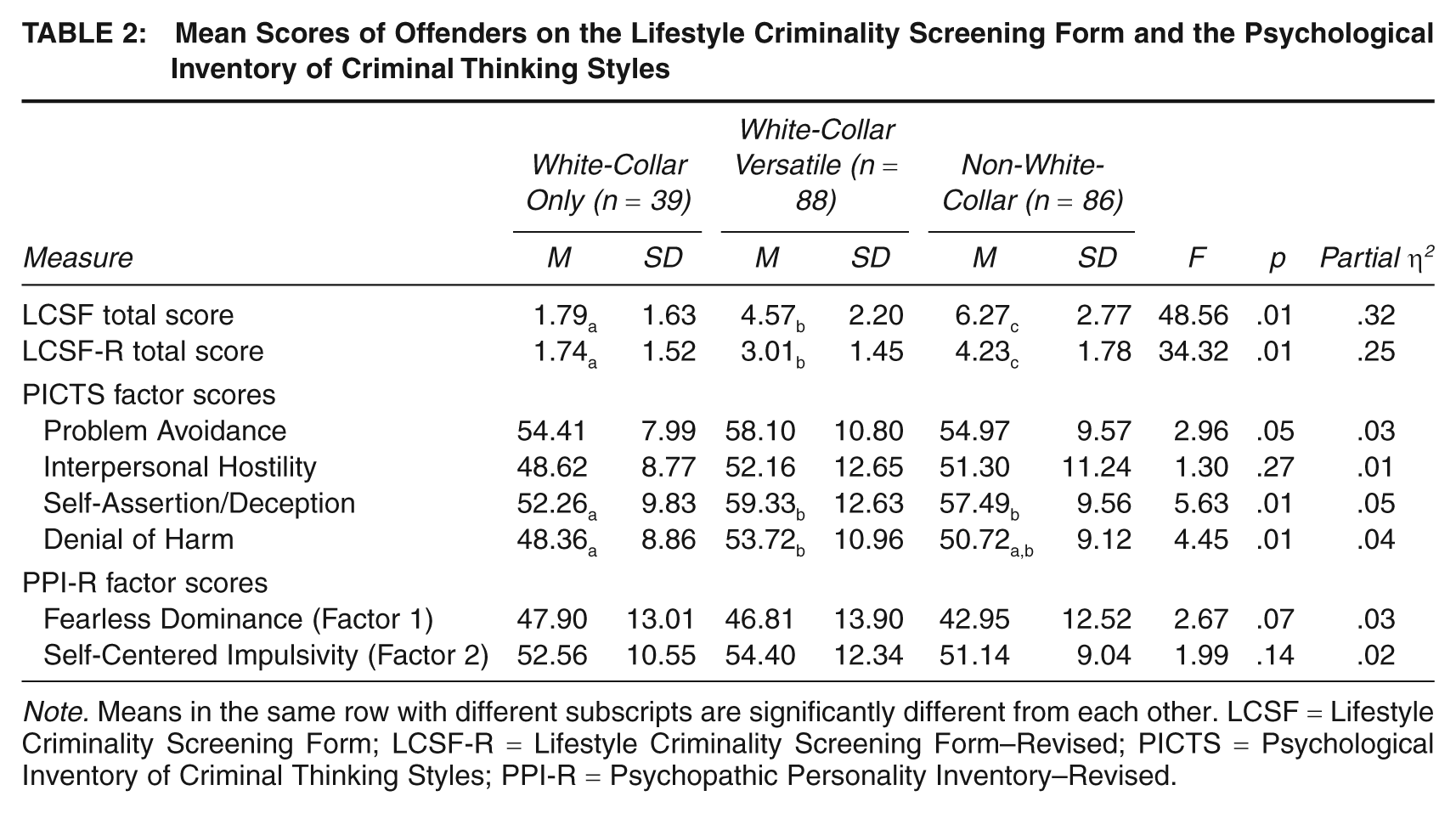
Note. Means in the same row with different subscripts are significantly different from each other. LCSF = Lifestyle Criminality Screening Form; LCSF-R = Lifestyle Criminality Screening Form–Revised; PICTS = Psychological Inventory of Criminal Thinking Styles; PPI-R = Psychopathic Personality Inventory–Revised.
PICTS factor scales
PICTS factor scales were moderately correlated (ranged from .35 to .63); therefore, a one-way (offender group) multivariate analysis of variance (MANOVA) was conducted. Results demonstrated a significant main effect, F(8, 414) = 2.41, p < .02, partial η2 = .05. Univariate follow-ups indicated WCO offenders had significantly lower Self-Assertion/Deception and Denial of Harm factor scores compared with WCV offenders. WCO offenders had significantly lower Self-Assertion/Deception factor scores compared with the NWC group (see Table 2).
PPI-R factor scales
Correlations demonstrated PPI-R factor scales were not significantly correlated (ranged from .05 to .25); therefore, separate ANOVAs were conducted. Bonferroni adjustments were utilized (p < .025). No significant differences were found (see Table 2).
PAI subscales
Separate ANOVAs were conducted because of multicollinearity between PAI Anxiety and Depression scales. Bonferroni adjustments (p < .025) were used when examining PAI anxiety indices. Significant main effects indicated WCV offenders had higher scores on the Anxiety-Related Disorders scale than NWC offenders, WC offenders had higher scores on the Alcohol Problems scale than NWC offenders, and WCO offenders had the lowest scores on the Drug Problems scale compared with the other offenders (see Table 3).
Mean Scores of Offenders on the Personality Assessment Inventory
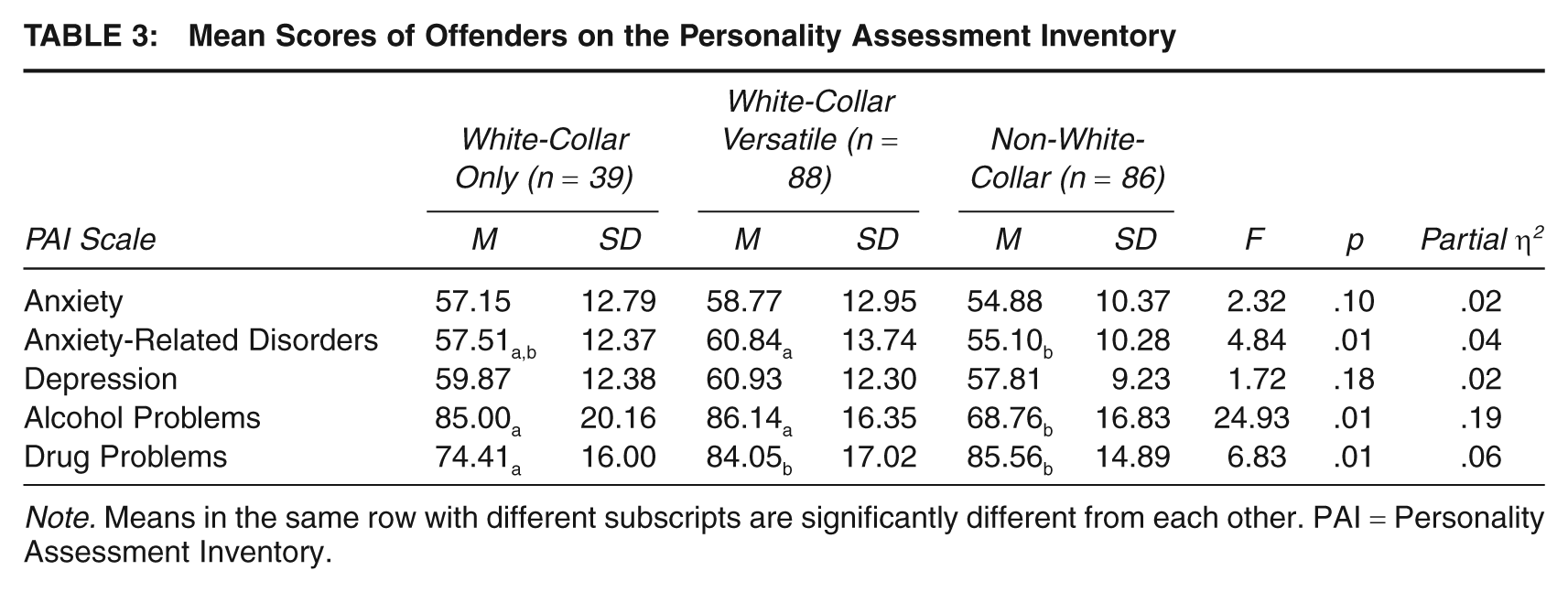
Note. Means in the same row with different subscripts are significantly different from each other. PAI = Personality Assessment Inventory.
Secondary Analyses
The following analyses were considered secondary because they were exploratory.
PICTS Thinking Styles scales and General Thinking Style score
Correlations between the PICTS thinking style scales ranged from .31 to .73 (p < .01). A one-way (offender group) MANOVA with the PICTS thinking style demonstrated a significant multivariate effect existed, F(16, 406) = 2.58, p < .01, partial η2 = .09. Univariate follow-ups showed significant differences on Mollification, Cutoff, Entitlement, Sentimentality, Superoptimism, and Discontinuity (see Table 4); suggesting WCV offenders exhibited higher levels of criminal thinking compared with the other offender groups. A one-way (offender group) ANOVA with the PICTS General Criminal Thinking score, yielded a significant main effect (see Table 4) that indicated WCO offenders were lower in overall criminal thinking compared with WCV offenders.
Mean Scores of Offenders on the Psychological Inventory of Criminal Thinking Styles Subscales and General Criminal Thinking
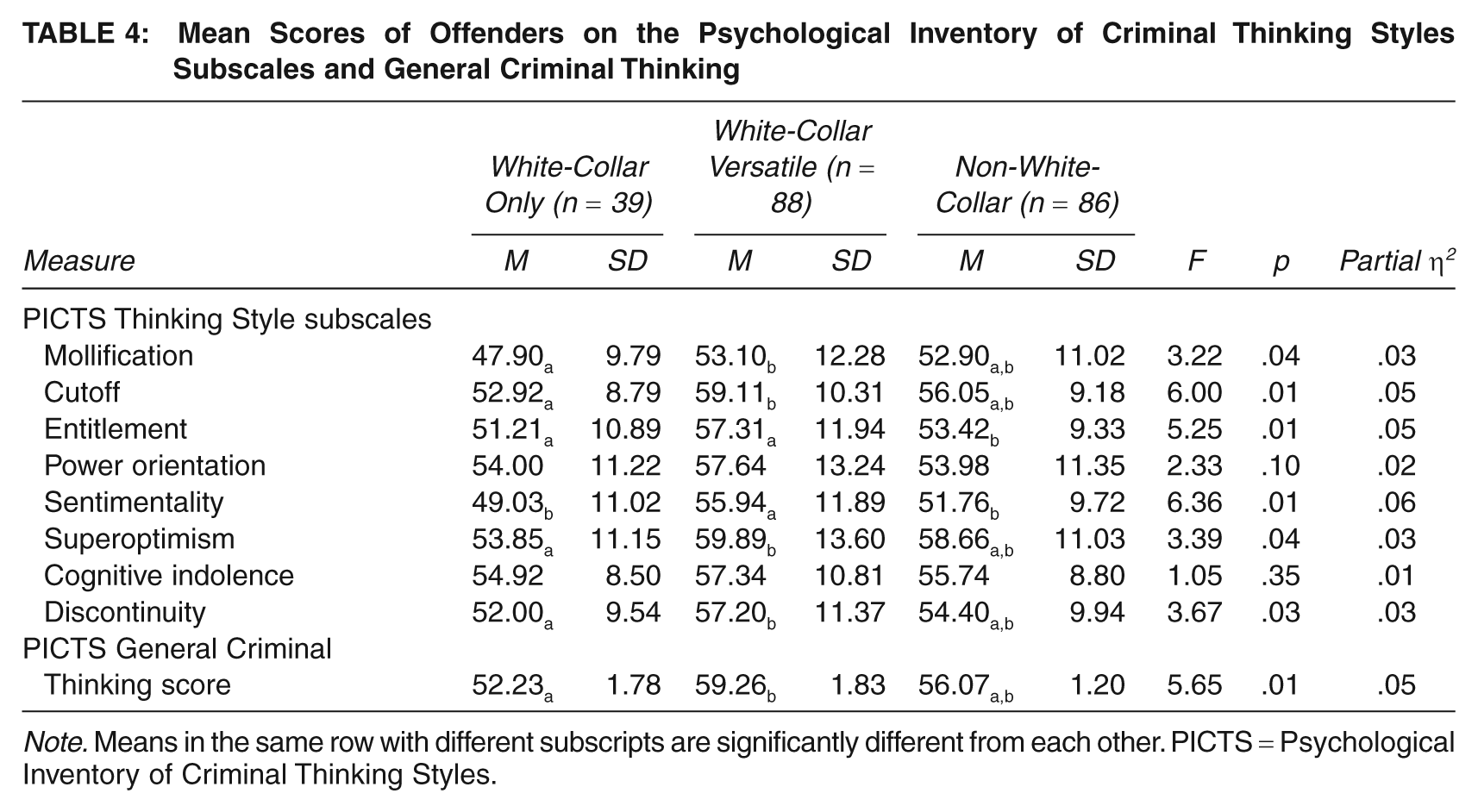
Note. Means in the same row with different subscripts are significantly different from each other. PICTS = Psychological Inventory of Criminal Thinking Styles.
PPI-R subscales, Coldheartedness Factor Scale, and total score
Correlations demonstrated several PPI-R subscales were not correlated (ranged from -.30 to .66); therefore, separate ANOVAs were conducted. Bonferroni adjustments (p < .007) were utilized. Significant main effects showed WCV offenders were higher on Machiavellian Egocentricity than NWC offenders. Also, WC offenders were higher in Social Potency than NWC offenders. No significant differences were found on Coldheartedness or PPI-R total scales (see Table 5).
Mean Scores of Offenders on the Psychopathic Personality Inventory–Revised
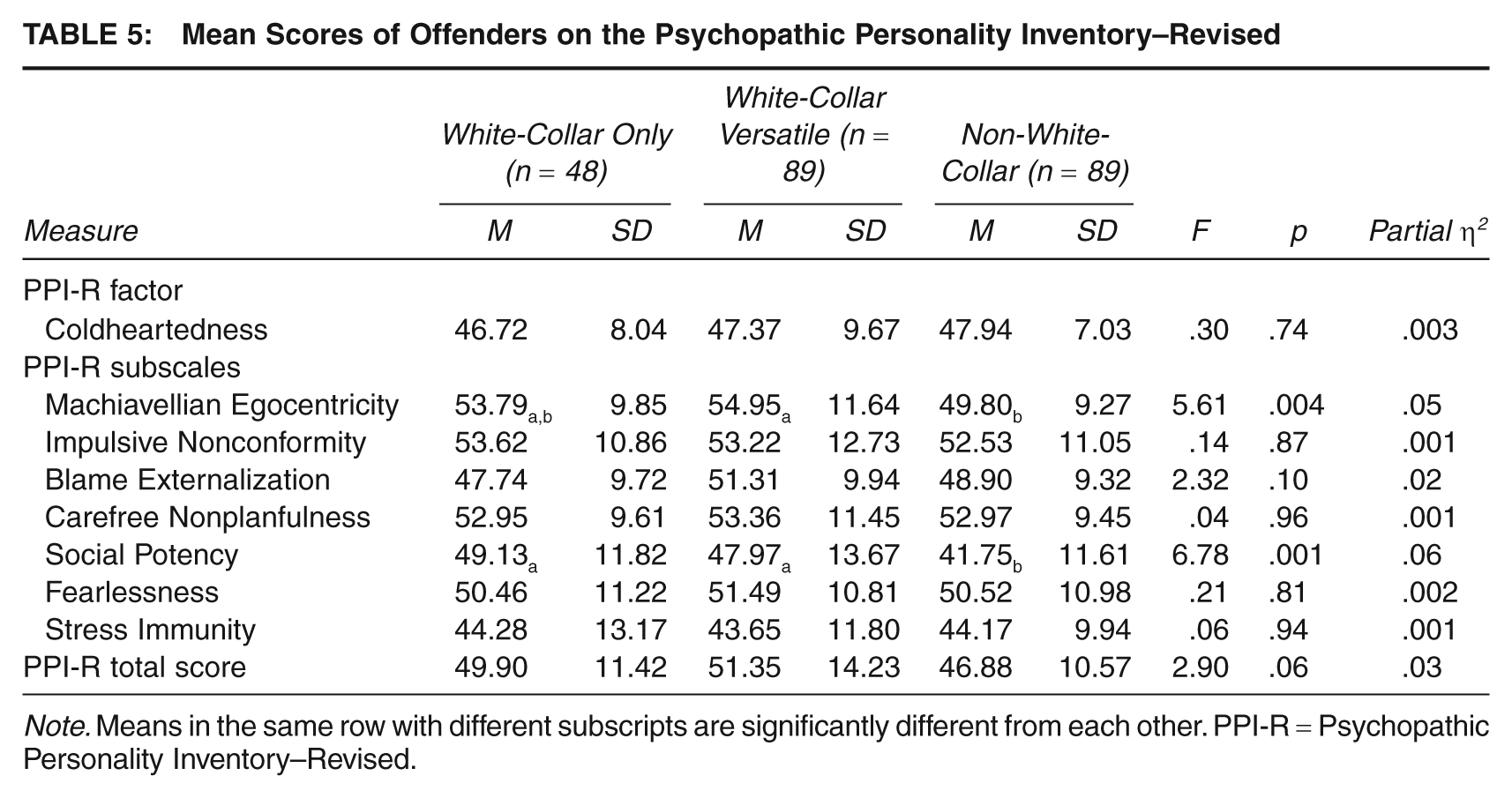
Note. Means in the same row with different subscripts are significantly different from each other. PPI-R = Psychopathic Personality Inventory–Revised.
Using Psychological Variables to Predict White-Collar and Non-White-Collar Status
Correlations were conducted between the PICTS General Criminal Thinking score, PPI-R total score, and five PAI indices. Multicollinearity existed between the PAI Depression, Anxiety, and Anxiety-Related Disorders scales (correlations ranging from .69 to .81); therefore, only the Anxiety-Related Disorders scale was included in subsequent analyses.
A logistic regression analysis was conducted using the Enter method to determine if the predictor variables (PICTS General Criminal Thinking score, PPI-R total score, and PAI scales) could uniquely predict being a WCO offender or WCV offender (0 = WCO, 1 = WCV). The overall model was significant, χ2(5, N = 127) = 13.81, p < .02, Nagelkerke R2 = .15. The PICTS General Criminal Thinking score (β = .06, p < .03) was the only significant predictor. Classification resulted in 10 of 39 WCO offenders (25.6%) placed in the correct category, and 81 of 88 WCV offenders (92.0%) correctly identified. Overall classification rate was 71.1%.
A second logistic regression was conducted using the Enter method to determine the extent the predictor variables could uniquely predict being a WCV offender or NWC offender (0 = WCV, 1 = NWC). The overall model was significant, χ2(5, N = 174) = 49.65, p < .01, Nagelkerke R2 = .33. The PAI Drug Problems scale (β = .03, p < .02) and PAI Alcohol Problems scale (β = -.06, p < .01) were significant predictors. Classification resulted in 66 of the 88 WCV offenders (75.0%) placed in the correct category, and 63 of 86 NWC offenders (73.3%) correctly identified. Overall classification rate was 74.1%.
A third logistic regression was conducted using the Enter method to determine the extent the predictor variables could uniquely predict being a WCO offender or NWC offender (0 = WCO, 1 = NWC). The overall model was significant, χ2(5, N = 125) = 43.31, p < .01, Nagelkerke R2 = .41. The PAI Alcohol Problems scale (β = -.05, p < .01) and PAI Drug Problems scale (β = .06, p < .01) were significant predictors. Classification resulted in 23 of the 39 WCO offenders (59.0%) placed in the correct category, and 86 of 77 NWC offenders (89.5%) correctly identified. Overall classification rate was 80.0%.
Discussion
The purpose of this study was threefold. First, we replicated Walters and Geyer’s (2004) study by utilizing a similar WC offender definition and methodology. Specifically, we investigated whether differences existed between WCO, WCV, and NWC offenders on measures of criminal thinking and criminal lifestyle. Second, we explored whether WC offenders differed from NWC offenders on psychopathic traits. Third, we examined differences between WC and NWC offenders on a measure of psychopathology. Findings gleaned from this study showed WCO offenders had lower levels of criminal thinking and fewer behaviors consistent with a criminal lifestyle compared with other offenders. Furthermore, WC groups scored higher on measures of perceived social influence and alcohol use compared with the NWC group. WCV offenders scored higher on measures of self-centeredness and anxiety compared with NWC offenders. Lastly, NWC offenders had significantly higher scores on a measure of drug use.
In this study, we were able to match WC and NWC offenders on the variables of ethnicity and age. Even with matched samples, several demographic differences remained. WC offenders were significantly more likely to be married than the NWC offenders. WCO offenders had a significantly higher level of educational attainment than WCV and NWC offenders. Additionally, WC offenders were less likely to have a past substance abuse diagnosis. Lastly, WC offenders had fewer past arrests when contrasted with NWC offenders. The demographic differences between WC and NWC offenders in this study resemble previous findings (Benson & Moore, 1992; Poortinga et al., 2006; Walters & Geyer, 2004; Wheeler et al., 1982).
Similar to the Walters and Geyer (2004) study, the LCSF was utilized for this research. Findings demonstrated WCO offenders had significantly lower scores on the LCSF, followed by WCV, and NWC offenders. This finding existed regardless of whether arrest items were excluded from the LCSF, and it replicates Walters and Geyer’s study results.
Understanding criminal thinking is of importance, as such beliefs have been linked to treatment retention (Staton-Tindall et al., 2007), recidivism (Walters, 2005), and perpetration of disciplinary acts in prison (Walters & Geyer, 2005; Walters & Mandell, 2007). For this study, we predicted WC offenders would have lower scores on the PICTS indices compared with NWC offenders. In line with Walters and Geyer’s findings, our results showed WCO offenders were lower on the Self-Assertion/Deception factor compared with the other groups. WCO offenders had significantly lower scores than WCV offenders on the Denial of Harm factor. Walters and Geyer demonstrated a similar finding for the Denial of Harm factor, but their finding did not reach significance.
Novel to this study, we examined how WC offenders differed from NWC offenders on eight PICTS thinking style scales and the General Criminal Thinking scale. Interestingly, findings denoted WCO offenders had the lowest criminal thinking scores, significantly lower on several scales than WCV offenders. WCO offenders differed from NWC offenders by their lower scores on Entitlement. WCV offenders had higher scores on Entitlement and Sentimentality compared with NWC offenders.
Not surprisingly, WCO offenders exhibited fewer criminal attitudes and were also less likely to adhere to a criminal lifestyle. Interestingly, NWC offenders were quite similar to WCO offenders in their level of criminal thinking, yet NWC offenders were significantly more likely to live the criminal lifestyle. The WCV offenders exhibited the most antisocial attitudes, but were significantly less likely to adhere to a criminal lifestyle compared with NWC offenders. This suggests criminal attitudes may contribute to criminal activity, but there are likely other factors that also contribute to an individual’s decision to take part in criminal acts.
As discussed above, WC offenders have been found to be more outgoing, calculating, and controlling in social interactions (Alalehto, 2003; Collins & Schmidt, 1993), which has been linked to higher scores on the PPI-R-I factor (i.e., Fearless Dominance; Patrick et al., 2006); therefore, we suspected WCO offenders would have higher scores on the PPI-R-I factor when compared with NWC offenders. WC offenders are also less likely to have past arrests and endorse past engagement in antisocial acts (Benson & Moore, 1992; Edens, Poythress, Lilienfeld, Patrick, & Test, 2008; Patrick et al., 2006; Poortinga et al., 2006). Therefore it was hypothesized WC offenders would have lower scores on PPI-R-II (i.e., Self-Centered Impulsivity) compared with NWC offenders.
No significant differences between the offender groups were demonstrated for the factor scales. However, exploration of the PPI-R subscales yielded some interesting findings. Both WC groups were found to have significantly higher scores on Social Potency compared with the NWC group. WCV offenders were significantly highest on Machiavellian Egocentricity when contrasted with NWC offenders. Previous research demonstrates WC offenders tend to be more outgoing socially when contrasted with non-criminal WC professionals (Alalehto, 2003; Collins & Schmidt, 1993). This study extends on previous research by demonstrating WC offenders are also more socially outgoing than NWC offenders, as displayed by their high scores on Social Potency. In addition, WC offenders’ high scores on Social Potency provide further information on the function of their social involvement. Specifically, WC offenders are likely to believe they have persuasive influence over others. Previous research shows WC offenders tend to be low in agreeableness (Alalehto, 2003; Kolz, 1999) and high in narcissism (Blickle et al., 2006). Such traits (low agreeableness and high narcissism) could be components reflected in the Machiavellian Egocentricity. High Machiavellian Egocentricity suggests WCV offenders are more likely to appear self-centered and invested in their own needs when interacting with others, which could be perceived as narcissistic behavior. Moreover, when pushing for one’s own interests, others may perceive these individuals as disagreeable.
WC criminals have been found to be less likely to have problems with drugs or alcohol compared with NWC offenders (Benson & Moore, 1992; Poortinga et al., 2006). In addition, WC offenders also exhibit a higher level of depression compared with other offender groups (Poortinga et al., 2006). When contrasted with non-criminal WC professionals, WC criminals have demonstrated elevated anxiety (Alalehto, 2003; Blickle et al., 2006; Collins & Schmidt, 1993). Therefore, we hypothesized WCO offenders would be elevated on PAI depression and anxiety indices and would have lower PAI substance use scale scores compared with all other offenders.
Contrary to what was hypothesized and previous research (Poortinga et al., 2006), no significant differences were found between WC and NWC groups on depression. In regard to anxiety, significant differences were demonstrated for Anxiety-Related Disorders but not the Anxiety scale. Differences between groups remained significant for Anxiety-Related Disorders scale even when Bonferroni adjustments were made for the two PAI anxiety indices. The Anxiety-Related Disorders scale measures symptoms that correspond with anxiety disorders (e.g., phobias, obsessive-compulsive disorder, posttraumatic stress disorder; Morey, 1991, 2003). Means for the WC offender groups on the Anxiety-Related Disorders scale were much higher than the mean for NWC offenders, but significant differences only existed between the WCV and NWC groups. The sample size for the WCO offender group was much smaller (n = 39) than the WCV group (n = 88) or the NWC group (n = 86), limiting the power available to detect findings for the WCO group. The Anxiety-Related Disorders scale is approaching significance for the WCO group, and likely would have been significant with a larger sample.
Findings for the PAI substance use indices showed WC offender groups had significantly higher scores on Alcohol Problems compared with NWC offenders. In addition, WCO offenders had significantly lower scores on Drug Problems compared with NWC and WCV offenders. These findings somewhat contradict past research, demonstrating WC offenders have fewer substance abuse problems than NWC offenders (Benson & Moore, 1992; Poortinga et al., 2006). Interestingly, WC offenders reported substantially more problems with alcohol than NWC offenders, yet substance use information (i.e., previous substance abuse diagnosis) gathered from PSI suggest WC offenders are much less likely to have a history of substance abuse problems.
A series of logistic regressions were conducted to determine if the psychological measures (i.e., PICTS, PPI-R, and PAI) could distinguish WC types from each other and from NWC offenders. When compared with NWC offenders, WC offenders were distinguished by their higher PAI Alcohol Problems score and lower Drug Problems score. The logistic regression model was significant for distinguishing the two WC groups, demonstrating WCV offenders were significantly higher in criminal thinking compared with WCO offenders.
Study Limitations
The WC crime definition utilized in this study was adopted from the Walters and Geyer’s (2004) study. It is interesting to note that some past studies (Benson & Moore, 1992; Wheeler et al., 1988) included individuals convicted of postal fraud in the WC and NWC groups in their studies. Conversely, this study along with several other studies (Benson & Moore, 1992; Collins & Schmidt, 1993; Listwan et al., 2010; Walters & Geyer, 2004; Wheeler et al., 1982; 1988) classified offenders committing postal fraud as WC offenders. One reason for the discrepancy in classifying postal fraud offenders could be because of the nature of the postal fraud offense. Specifically, drug offenders could receive a postal fraud charge if they distribute drugs via the mail. A drug offender receiving a postal fraud conviction may be very different from the postal fraud offender who distributes letters via mail advertising a false investment business to consumers. It appears an offense-based definition of WC crime has limitations. In the future, scholars could work to streamline the definition of WC crime so NWC criminals (e.g., drug offenders who are convicted of postal fraud) are not included in the WC criminal category.
Edwin H. Sutherland first defined white-collar crime as “crime committed by a person of respectability and high social status in the course of his occupation” (Sutherland, 1949, p. 9). The offense-based definition of white-collar crime used in this and other studies does not take into account offender characteristics (i.e., social status), which Sutherland thought were an essential component of white-collar criminality. Future research could use a definition of WC crime that is both offense-based and incorporates offender characteristics (i.e., high social status).
An additional limitation is that the NWC group was primarily composed of drug offenders (89.9%). Therefore, this study may demonstrate only the differences that exist between WC offenders and drug offenders. However, our comparison group is very similar to the NWC offender group (78.8% of the NWC offenders were drug offenders) utilized by Walters and Geyer (2004). For this study, we selected NWC offenders, similarly to how we selected the WC offenders, from a minimum security federal prison, which may be why the comparison group is largely comprised of drug offenders. Future research could examine how WC offenders differ from individuals who commit sex offenses, robbery, murder, or who threaten federal officials. It is likely there may be many more differences between WC offenders and these offenders, as they are usually classified at different security levels, whereas WC offenders are typically classified at a lower security level.
All individuals included in this study completed the psychological measures as part of the interview process for a drug treatment program. Individuals who complete the drug treatment program are eligible for a one-year sentence reduction. The alcohol and drug indices of the PAI may be inaccurate measures of past substance abuse because offenders may be motivated to exaggerate such behaviors to increase their chance of being admitted into the drug program. This could also explain the discrepancy seen in this study between self-reported substance abuse and substance abuse information gathered from the PSI.
Karberg and Mumola (2007) found 45% of federal offenders met diagnostic criteria for drug abuse or dependence. For this study, 48.3% of NWC, 39.3% of WCV, and 18.8% of WCO offenders met criteria for substance abuse or dependence. Although NWC offenders were predominately convicted of a drug offense (89.9%), the rate of substance abuse and dependence found in the NWC sample was not that different from the federal prison population in general. Interestingly, when measuring substance abuse and dependence in this study, we included both illicit drugs and alcohol, whereas Karberg and Mumola looked only at illicit drugs. Even when taking into account both alcohol and illicit drugs, WCO offenders still had substantially lower rates of substance abuse and dependence compared with the overall federal prison population.
However, at the same time, the self-report measures could be more accurate at identifying substance abuse problems, especially problems with alcohol. An individual’s problem with alcohol may go largely unnoticed because it is culturally more acceptable than use of illicit drugs. Other individuals (e.g., family, friends, legal professionals) may be less likely to involuntarily admit or recommend someone for substance abuse treatment if their problem substance is alcohol. Problems with alcohol can also go undetected by legal professionals (e.g., probation officers) because use is not detected in traditional court-ordered drug tests. In addition, the findings in this study for the PAI Alcohol Problems scale were quite substantial, demonstrating a large effect size (partial η2 = .19; see Green & Salkind, 2005). The potential usefulness of self-report measures for detecting problems with alcohol should not be ignored.
The PAI and PICTS contain several measures utilized to assess response validity. We eliminated all individuals found to provide invalid responses according to cut scores for the PAI Negative Impression scale, PICTS Confusion–Revised scale, and the PICTS Defensiveness scale. Nine of 48 WCO offenders, one of 89 WCV offenders, and three of 89 NWC offenders were eliminated. These findings suggest WCO offenders were substantially more likely to exaggerate symptoms of psychopathology compared with WCV and NWC offenders. This could imply WCO offenders may have been attempting to portray themselves as more pathological to increase their chances of being admitted into the Residential Drug Abuse Program. Alternatively, WCO offenders could be exaggerating psychopathology because they may use such symptoms as an excuse or to justify their criminal activity.
Implications and Future Directions
Many findings from this study advance treatment practices with WC offenders. For instance, WC offenders were found to endorse having the belief that they are highly capable of being socially persuasive (Social Potency) and self-centered or callous (Machiavellian Egocentricity). Possessing these traits may lead WC offenders to be more argumentative, which could result in problematic communication. WC offenders in particular could possibly benefit from communication training that specifically targets conflict resolution and empathy.
Moreover, this study shows WC offenders are substantially more likely to misuse alcohol compared with NWC offenders. The question remains: Does the misuse of alcohol come prior to their participation or after they have already been engaging in criminal activity? Either way, it could be that misuse of alcohol might be a way for WC offenders to silence or eliminate their fears of being detected for their criminal behavior. Perhaps employers should consider offering substance abuse programming, as such programs could decrease the likelihood of other criminal acts being committed by employees. Furthermore, this research suggests substance abuse programming should include a component that addresses criminal thinking, as both WC groups demonstrated criminal thinking scores well above the mean T-score of 50 that was demonstrated by the offender normative sample for the PICTS.
In addition, results of this study showed WC offenders were higher in anxiety compared with NWC offenders. Such findings are problematic, as high anxiety has been linked to treatment dropout and recidivism (Listwan et al., 2010). Therefore, appropriate treatment approaches with WC offenders could include anxiety management techniques, such as cognitive restructuring and relaxation strategies. Researchers may want to investigate if including anxiety management strategies in treatment programs for WC offenders actually increases treatment retention.
In this study, the WC offender sample was divided by criminal history. Several significant differences were found on many of the demographic and psychological attributes when comparing the WC offender groups. This suggests WC offenders are a heterogeneous group. Possibly, different treatment approaches may have to be used with subsets of WC offenders. Moreover, there may be a more appropriate way to divide WC offenders so that homogenous groups could be formulated for treatment. For instance, WC offenders with different motives (e.g., greed, fitting in with the corporate culture, paying off personal debts) for committing their crimes may need different treatment approaches.
Footnotes
Acknowledgements
We would like to acknowledge Aaron Metzger, PhD, for his helpful advice and assistance with the logistic regression analyses. The assertions and opinions contained herein are the views of the authors and should not be construed as official or as reflecting the views of the Federal Bureau of Prisons or the United States Department of Justice.