






Abstract
Self-efficacy refers to the belief that one can perform successfully at a given task or endeavor. Previous research indicates that self-efficacy in relation to conventional pursuits (e.g., performance in school) is associated with positive social adjustment. However, the possibility that individuals may develop self-efficacy in relation to nonconventional pursuits—including crime and delinquency—remains largely unexplored. In this study, the authors adopt a multimethod approach to explore (a) offenders’ personal judgments regarding their level of effectiveness or “success” at crime, (b) the factors that contribute to high criminal self-efficacy, and (c) the impact of self-efficacy judgments on offenders’ future intentions. Results of quantitative and qualitative analyses reveal that many offenders maintain a strong sense of criminal efficacy despite past arrests, convictions, and incarceration. Moreover, criminal self-efficacy tends to reduce their intentions to desist from crime. Implications for punishment, deterrence, and criminological theory are discussed.
Self-efficacy refers to the belief that one can perform well at a given task or endeavor—a belief based on judgments that individuals make about their own capabilities (Bandura, 1997). According to self-efficacy theorists, beliefs of personal efficacy are important because they influence the choices that individuals make, the courses of action they pursue, and the level of effort and determination they exert.
To date, researchers have focused mainly on self-efficacy in relation to conventional tasks and pursuits, such as performance in school, prosocial problem solving, and conventional career activities. Typically, studies in this area find that self-efficacy (e.g., the belief that “I can work well in a group” or “I can resist peer pressure to use drugs”) is associated with increased performance and positive social adjustment (e.g., Ahlin, 2010; Allen, Leadbeater, & Aber, 1990; Kuther, 2000; Scherbaum, Cohen-Charash, & Kern, 2006; Sharkey, 2006). Within the offender population, self-efficacy in relation to conventional tasks and pursuits appears to be associated with desistance (e.g., Bahr, Harris, Fisher, & Armstrong, 2010; Maruna, 2001).
The possibility that individuals may develop self-efficacy in relation to nonconventional pursuits—including crime and delinquency—remains largely unexplored, however. One important exception involves research on childhood aggression. Research inspired by the social information processing model (Crick & Dodge, 1994; Dodge, 1986) reveals that self-efficacy for performing aggression (e.g., the belief that it would be “easy” to shove other kids out of the way) is positively associated with aggressive behavior in children (e.g., Camodeca & Goossens, 2005; Perry, Perry, & Rasmussen, 1986; also see Ludwig & Pittman, 1999). This finding is important because it raises the possibility that serious criminal offenders may hold similar efficacy beliefs and that such beliefs may promote crime and violence.
Another important exception involves qualitative studies on criminal decision making. Although self-efficacy has not been a central focus of such research, offenders in these studies routinely make reference to their perceived criminal capabilities (see especially Åkerström, 1985; Geiger & Fischer, 2005; Shover, 1985; Wright, Logie, & Decker, 1995), with some offenders describing criminal or delinquent involvement as their “first successful role” (Shover, 1985, p. 106). Moreover, many offenders express pride for being “skillful and talented” at crime (see Geiger & Fischer, 2005, p. 202; Topalli, 2006).
We believe that further study of criminal self-efficacy is warranted for at least two reasons. First, our understanding of criminal self-efficacy remains limited. Although existing studies shed some light on the beliefs that offenders hold about their criminal capabilities, we have little systematic information about the factors that shape such beliefs or the consequences of such beliefs. For instance, it is possible that criminal self-efficacy may contribute to persistence in crime, helping to explain the high rates of recidivism that currently plague our criminal justice system (Langan & Levin, 2002). As Bandura (1997) observes in relation to conventional careers, it is not so much actual performance but rather people’s beliefs in their own efficacy that influence the courses of action they pursue, the level of determination they “put forth in given endeavors,” and the lengths to which they will “persevere in the face of obstacles and failures” (p. 3). Many highly successful people face ridicule, rejection, and failure early in their careers. Yet they are propelled by an “unshakeable sense of self-efficacy,” or confidence in their ultimate success (Bandura, 1997, pp. 72-75).
Perhaps similar beliefs help to propel criminal careers. Although the long-term negative consequences of a criminal lifestyle have been well documented (Hagan, 1991, 1997; Robins, 1966; Tanner, Davies, & O’Grady, 1999), many offenders persist in crime nonetheless even in the face of serious injury, death, or trouble with the law (DeLisi & Piquero, 2011; Laub & Sampson, 2003). Perhaps they too develop a resilient belief in their capabilities, including confidence in their ultimate success. Thus, a focus on criminal self-efficacy may shed further light on the factors that help to sustain criminal careers.
Second, a detailed examination of criminal self-efficacy may shed light on the rationality of offending behavior. Although the behavior of persistent offenders seems largely unresponsive to punishment and may appear irrational (Brezina, 2002; Moffitt, 1993), efficacy beliefs may influence the meanings that persistent offenders assign to punishments. Instead of responding to initial setbacks with fatalism or defeat, offenders who are high in self-efficacy may view botched crimes, arrest, and even incarceration as “mistakes” to be learned from and as experiences they can draw on to ensure future success (see Shover, 1985). As suggested by Bandura (1982, 1997, 2006), individuals possessing high self-efficacy may behave in ways that simply do not accord with reinforcement theory or strict cost–benefit analysis. Yet in light of self-efficacy theory, their behavior may be comprehensible nonetheless. In other words, a focus on criminal efficacy may help us to understand the “inner logic” that guides offending behavior.
In this study, we adopt a multimethod strategy to conduct an initial exploration of criminal self-efficacy. To our knowledge, this is the first study to focus extensively and systematically on criminal self-efficacy, especially among serious adult offenders. Drawing on existing data from a large survey of prison inmates, we explore (a) offenders’ personal judgments regarding their level of effectiveness or “success” at crime, (b) the factors that contribute to high criminal self-efficacy—despite, in many cases, a history of legal punishment—and (c) the impact of personal efficacy judgments on offenders’ intentions to desist from crime. Although these existing data have certain limitations, they provide a useful starting point for an initial exploration of criminal self-efficacy. To address some of the limitations of these existing data, and to probe criminal self-efficacy more deeply, we supplement our quantitative findings with original data obtained from in-depth interviews with active (noninstitutionalized) street offenders.
We begin by reviewing existing research in this area. We also provide an initial conceptual framework to help guide our understanding of criminal self-efficacy, its possible sources, and potential consequences for offenders’ attitudes and behavior.
The Sources and Consequences of Criminal Self-Efficacy
Before turning to the possible sources of criminal self-efficacy, it is necessary to address certain definitional issues. As stated earlier, self-efficacy refers to the belief that one can perform well at a given task or endeavor. Although self-efficacy “is commonly misconstrued as being concerned solely with specific behaviors in specific situations,” Bandura (1997, p. 49) emphasizes that efficacy beliefs can also be of a more general nature, involving perceived capabilities across a class of performances within the same activity domain (e.g., overall teaching effectiveness; see Raudenbush, Rowan, & Cheong, 1992; Ross, Cousins, & Gadalla, 1996). In the sections below, we view criminal involvement as one such activity domain, and we use the term criminal efficacy to refer to generic criminal capability (later in the article we discuss efficacy beliefs pertaining to specific types of criminal activity).
Unlike some researchers, Bandura (1997) does not conceptualize self-efficacy as a global personality trait or disposition (for an in-depth discussion and comparison of different approaches to self-efficacy, see Pajares, 1997). Rather, self-efficacy is considered domain specific given that human competence tends to be “structured and manifested diversely rather than uniformly” across various activity domains (Bandura, 1997, p. 41). We find Bandura’s conceptualization most useful for the purposes of this study as it allows for offenders to perceive themselves as efficacious at crime but not necessarily at conventional pursuits, such as school. In fact, when offenders describe crime as their first successful role, they imply an inverse relationship between criminal and conventional self-efficacy (see Shover, 1985).
According to research on conventional self-efficacy, individuals rely on several broad sources of information when forming judgments about their capabilities, including “personal mastery experiences” (past performance), vicarious experience (e.g., comparing their own performance to the attainments of others), verbal persuasion (e.g., performance feedback provided by others), and the affective states experienced during task performance. Of these sources of information, personal mastery experiences are believed to be the most important and influential because “they provide the most authentic evidence of whether one can muster whatever it takes to succeed” (Bandura, 1997, p. 80; also see Silver, Mitchell, & Gist, 1995).
Although the sources of criminal self-efficacy have yet to be explored systematically, the extant body of research on offender decision making offers important clues and suggests that, like conventional efficacy, it is formed to a large degree in relation to past performance. In particular, this body of research points to three major indicators of performance that offenders use to gauge their criminal capabilities. These indicators include (a) the attainment of “fast money” through illegal activity, (b) the ability to “beat the system” by evading apprehension and punishment, and (c) the display of criminal skill and expertise (e.g., Åkerström, 1985; Laub & Sampson, 2003; Shover, 1985; Shover & Honaker, 1992). The initial conceptual framework we outline below is organized in terms of these major performance indicators.
Monetary Gain
Money has been described as “one of the few measures of status in the criminal’s world” and thus an important source of prestige for many offenders (Åkerström, 1985, p. 161). This may be especially true for street offenders who pursue cash-intensive lifestyles (e.g., partying, consuming drugs; see Wright & Topalli, in press). The display of large sums of money (and the ability to spend it freely) is one strategy that such offenders use to communicate competence and success (Letkemann, 1973; Shover & Honaker, 1992).
Although many street offenders report minimal earnings from illegal activity—averaging a few hundred dollars per month—and could easily be described as criminal “failures” by observers (Wilson & Abrahamse, 1992), researchers have noted substantial variation among individual offenders in terms of their net monetary returns from crime (McCarthy & Hagan, 2001; Tremblay & Morselli, 2000). Although the typical street offender derives minimal economic rewards from crime (see, e.g., Levitt & Venkatesh, 2000), some individuals appear to reap substantial earnings from their criminal pursuits (thousands of dollars per month), even after adjusting for the costs of crime (Tremblay & Morselli, 2000; also see McCarthy & Hagan, 2001; Shover, 1985). Such variation may be a function of differential criminal opportunities and entrepreneurial abilities (McCarthy & Hagan, 2001; Tremblay & Morselli, 2000). Given the centrality of money in the criminal subculture, it is likely that the substantial illegal income (or the perception thereof) enjoyed by these relatively accomplished offenders contributes to perceptions of competence or success at crime (i.e., criminal self-efficacy).
Tremblay and Morselli (2000) provide initial quantitative evidence of a link between illegal earnings and criminal self-efficacy. Although the link is not the main focus of their study, they observed a positive relationship between illegal income and criminal self-efficacy (perceived success at crime) in a sample of prison inmates (also see Tremblay, Morselli, & Charest, 2007). In the current study, we seek to extend this important line of research by examining other potential sources of criminal self-efficacy, along with illegal income.
Beating the System
In previous research on criminal careers, criminal success has often been equated with illegal earnings (McCarthy & Hagan, 2001; Tremblay & Morselli, 2000; Wilson & Abrahamse, 1992). Income, however, is not the only measure of success within the criminal subculture (and for some offenders, income may not be a motive behind their particular crimes). In addition to monetary gain, many offenders appear to gauge their effectiveness at crime in terms of their ability to “beat the system,” especially the extent to which they have avoided apprehension and punishment in relation to their total criminal activity (Geiger & Fischer, 2005; Shover, 1985).
The belief that one is good at “beating the system” may be rooted, in part, in offenders’ objective experiences with the criminal justice system. Many serious offenders manage to avoid arrest, perhaps because they have adopted effective apprehension avoidance techniques (Dunford & Elliott, 1984; Jacobs, 1996). Moreover, when such offenders are apprehended, they may view their legal troubles as mistakes to be learned from and as temporary interruptions of an otherwise successful criminal career. Despite previous convictions, a drug dealer put it this way: “I got caught and I got punished. But I have all the talent to succeed” (quoted in Geiger & Fischer, 2005, p. 202). Although such attitudes may seem irrational, they are fully consistent with self-efficacy theory. As Bandura (1997) observes, efficacy beliefs can be very resilient:
After a strong sense of efficacy is developed through repeated successes, occasional failures or setbacks are unlikely to undermine belief in one’s capabilities . . . [and] failure can, paradoxically, raise efficacy through belief that better strategies will bring future successes. (p. 82)
Criminal Skill and Expertise
Beyond monetary gain and avoidance of arrest, offenders also appear to gauge their performance at crime in terms of their ability to meet the emotional and technical challenges of crime. In particular, many offenders take pride in their ability to display “guts or nerve,” be “calm or cool” in challenging situations, overcome obstacles and barriers to crime (including various crime control technologies such as locking devices and alarms), plan effective escapes, and, in general, exploit criminal opportunities—skills they generally see as lacking among the nonoffending population (Åkerström, 1985; Geiger & Fischer, 2005; Katz, 1988; Shover, 1985).
Thus, the sheer ability to “pull off” a crime may be an additional source of criminal self-efficacy, especially for offenders whose criminal activity is deliberate and involves planning, special knowledge, or special skills. This may be less true for offenders whose crimes stem from need, desperation, or impulsive behavior (also see Robitaille, 2004).
Before proceeding, it is important to note that although some offenders picture themselves as talented and successful at crime, such perceptions may not be reality based. We address this issue in the following section.
Criminal Self-Efficacy and Cognitive Distortion
Although many offenders express a high level of confidence in their criminal capabilities, some criminologists argue that such confidence is rooted in fantasy and reflects an irrational and self-defeating pattern of “criminal thinking” (Walters, 1990, 2007; also see Shover, 1985). Self-efficacy researchers recognize that judgments of personal efficacy may not accord with objective experience and may be inflated as a way to bolster self-esteem. This inflation can be accomplished in a variety of ways. For instance, the self-judgments of individuals may be inflated by the selective recall of past performance (e.g., remembering successes but forgetting failures).
Regardless of the validity of offenders’ efficacy beliefs, we believe it is important to examine such beliefs. As Tremblay et al. (2007) observe, offenders may sincerely believe in their own self-judgments. As a result, the efficacy beliefs of offenders may have real consequences for decision making and future behavior, even if these beliefs are seriously biased or distorted. Also, by conducting an in-depth examination, it should be possible to determine if offenders’ efficacy beliefs are related systematically to their past experiences with crime (e.g., a low arrest-to-crime ratio). Findings of this nature could help us to better understand the basis for criminal self-efficacy from the offender’s point of view and may suggest strategies for disrupting the development of such beliefs.
The Consequences of Criminal Self-Efficacy
The development of criminal self-efficacy among serious offenders may have significant criminal justice consequences. In comparison to offenders who regard themselves to be less effective, those who see themselves as competent or successful at crime would be expected to maintain a higher level of commitment to illegal pursuits and to persist at crime (all else equal). And to the extent that offenders maintain a belief in their criminal capabilities—despite past arrests and incarceration—we would expect the deterrent power of the criminal justice system to be weakened.
Consistent with expectations, Tremblay et al. (2007) find that perceived success at crime is positively associated with risk-taking behavior in a sample of prison inmates, controlling for age, self-control, previous time spent in prison, and other variables. In the current study, we supplement this important line of research by examining the impact of criminal self-efficacy on future intentions to desist from crime.
Hypotheses
Although highly suggestive, much of the preceding discussion is based on offender accounts drawn from qualitative studies, from studies that were not specifically designed to examine criminal self-efficacy, or from studies that examined select aspects of criminal self-efficacy. To facilitate an initial, systematic exploration of the correlates and consequences of criminal self-efficacy, we derive several testable hypotheses below. Our first three hypotheses focus on the sources of criminal self-efficacy, or the perception that one is effective or successful at crime:
Hypothesis 1: Monetary gain from crime (e.g., total illegal income) is positively associated with criminal self-efficacy.
Hypothesis 2: Among offenders, the avoidance of arrest and punishment (e.g., a low arrest-to-crime ratio) is positively associated with criminal self-efficacy.
Hypothesis 3: The commission of crimes relying on planning or skill is positively associated with criminal self-efficacy.
Our fourth and final hypothesis focuses on the consequences of offenders’ efficacy beliefs:
Hypothesis 4: Among offenders, a high level of criminal self-efficacy discourages behavioral change and increases the likelihood of future offending.
To test these hypotheses, we first analyze quantitative data from a large survey of prison inmates. Data derived from this population allow us to examine efficacy beliefs among offenders who pose a significant threat to public safety and who, by definition, have experienced serious trouble with the law. These quantitative data also allow us to examine the correlates and consequences of criminal self-efficacy while controlling for a range of key variables. Yet although these quantitative analyses will help us to delineate statistical relationships, they do not allow us to explore the cognitive processes that are involved in the construction of criminal self-efficacy. Nor do such analyses allow us to explore the meanings that offenders attach to criminal efficacy or how such meanings affect their decisions to offend.
To facilitate an exploration of these cognitive processes and to enrich our understanding of criminal self-efficacy, we adopted a multimethod strategy that combines the above mentioned quantitative analysis with complementary data from an ongoing ethnographic study of active street offenders. Such multimethod approaches allow researchers to combine the scientific objectivity afforded by quantitative techniques with a rich understanding of context that can be derived only through qualitative interviews (Ragin, Nagel, & White, 2004).
Study 1: Analyses of Survey Data
Quantitative Data
Quantitative data were drawn from a large survey of Nebraska prison inmates conducted by Horney and Marshall (1993). These data are made available by the Inter-University Consortium for Political and Social Research and have been used successfully in past research to examine the correlates of offending (Horney & Marshall, 1992; Horney, Osgood, & Marshall, 1995).
The Nebraska Inmate Survey (NIS) is based on personal interviews conducted with 700 male prisoners who were admitted to the Diagnostic and Evaluation Unit of the Nebraska Department of Corrections. This sample represents 90% of the prisoners who had been admitted to the unit over the course of a 9-month period (spanning the years 1989 and 1990) and 94% of all those who were asked to participate in the survey. The survey respondents were asked questions regarding their past criminal involvement, income generated from crime, experiences with arrest and incarceration, and perceived success at crime.
As stated earlier, these existing data have certain limitations. Although the NIS contains measures that are relevant to this study, it does not contain multiple, detailed measures of criminal self-efficacy or certain other constructs. We are careful to describe the limitations of these measures below. It should also be noted that the Nebraska inmate sample is not representative of offenders in general. It excludes those who are not currently incarcerated, for example.
Nevertheless, we believe data from the NIS can yield useful information on the correlates and consequences of criminal self-efficacy, as they allow for an initial test of the study hypotheses. The results of this initial test can help us to determine if future data collection efforts in this area will be worthwhile. And although the NIS sample is not fully representative of offenders, this sample allows us to concentrate on serious offenders who have had extensive experience with crime and the criminal justice system, allowing for the development of efficacy beliefs in relation to their criminal careers. Furthermore, as described later in the article, we designed the qualitative component of our investigation with these limitations in mind (e.g., the interview component captures nonincarcerated offenders and yields in-depth, open-ended responses to questions about perceived criminal capabilities).
Independent Variables
To permit tests of our first three hypotheses, which focus on the determinants of criminal self-efficacy, we use data from the NIS to construct measures that are designed to index illegal income, arrest-to-crime ratio, and extent of criminal planning.
Illegal income
Following previous research (McCarthy & Hagan, 2001; Morselli & Tremblay, 2004; Tremblay & Morselli, 2000), we used a self-reported measure of criminal earnings to index illegal income. Survey respondents were asked, “In a typical month, during the months when you were doing crimes, how much money did you make from all your crimes?” This question was asked only of respondents who reported one or more “target” crimes during a 3-year “window” period that preceded the arrest responsible for their current incarceration (78% of the total sample). The target crimes—or crimes that were the focus of the survey—included robbery, burglary, theft, forgery, fraud, drug deals, assault, and rape.
Among the inmates responding to this measure, there is considerable variation in the reported amount of income derived from crime. Nearly one quarter of the respondents (24%) report zero income from crime during a typical month; more than half (55%) report earning less than $1,000. However, some of the respondents report earning several thousands of dollars from crime during a typical month.
Following previous research (McCarthy & Hagan, 2001; Morselli & Tremblay, 2004; Tremblay & Morselli, 2000), we transformed the measure by taking the log of illegal income, as it is reasonable to assume that modest differences in income (e.g., a difference of $100) may be highly significant at the lower end of the income distribution but much less so at the highest levels of income. Before computing the log (base 10) of income, it was necessary to make a slight modification to the earnings measure because a sizeable number of respondents report zero earnings from crime, and it is not possible to compute the log of zero. Therefore we substitute log(criminal earnings + 1) for log(criminal earnings). This logarithmic transformation resulted in a slightly stronger correlation between illegal income and criminal self-efficacy.
Arrest ratio
For each respondent, we computed an arrest-to-crime ratio by dividing the respondent’s total number of arrests by the total number of crimes committed. The measures of arrest and crime are both based on self-reports and pertain to the 3-year window period described above. Following a strategy adopted by Horney and Marshall (1992), we constructed a dichotomous variable to represent a low arrest ratio (1 = arrest ratio of .25 or less). In short, respondents who score a 1 on this dummy variable report few arrests relative to the number of crimes they have committed (at least four or more crimes for every arrest). In the multivariate analyses reported below, the component parts of the ratio measure (total number of arrests and total number of crimes) are included as control variables.
Criminal planning
A subset of respondents were asked numerous questions about the extent of their criminal planning (e.g., “worked out a plan for the crime in advance”; “learned about alarms”; obtained “special equipment such as burglary tools”). These criminal planning items should allow us to measure the extent to which the respondents rely on crime-related knowledge and are deliberate in their criminal actions. According to Hypothesis 3, involvement in planned, deliberate offenses—the kind of criminal involvement that tends to rely on knowledge or skill—should be associated with relatively high levels of criminal self-efficacy.
The criminal planning items were administered only to respondents who reported certain target crimes, including robbery, burglary, theft, forgery, fraud, or rape during the 3-year window period (46% of the total sample). These items were not administered to inmates whose self-reported crimes were limited to drug deals or nonsexual assault. With the aid of factor analyses, a scale indexing “criminal planning” was constructed (only those items that loaded onto a single factor with an eigenvalue greater than 1 were included in the scale). Respondents who obtain high scores on the resulting seven-item scale report that, for the commission of their crimes, they frequently “worked out a plan for the crime” in advance, “found places or persons with a lot of money,” “learned about alarms, hours, or money transfers,” “worked out an escape plan in advance,” “got special equipment such as burglary tools,” “lined up a fence or buyer before the crime,” and “used tips to line places up” (Cronbach’s α = .88).
Dependent Variables
Criminal self-efficacy
In the first set of quantitative analyses, which focus on the determinants of criminal efficacy, a measure of criminal self-efficacy serves as the dependent variable. Respondents were asked, “Overall, in the past, how successful do you think you were in doing crime?” Responses to this item (recoded) range from 1 to 4 and include the following response categories: 1 = very unsuccessful, 2 = somewhat unsuccessful, 3 = somewhat successful, and 4 = very successful.
As a measure of criminal self-efficacy, this survey item has certain limitations. For example, it is a single-item measure that taps the respondent’s overall sense of criminal self-efficacy rather than perceptions regarding specific criminal capabilities or types of crime. Nevertheless, for an initial exploration, we believe this measure serves as a suitable proxy for criminal self-efficacy. First, as stated earlier, self-efficacy is not solely concerned with situation-specific behaviors but can also pertain to higher levels of generality, including generic capability or effectiveness within a given activity domain (Bandura, 1997, p. 49). Second, research confirms that such measures of self-efficacy are useful and efficient (Scherbaum et al., 2006). Although less than ideal, simple measures typically predict scores on more detailed instruments (Gibson & Dembo, 1984; Maurer & Andrews, 2000; Ross et al., 1996), and similar single-item measures of perceived success have been used successfully in studies of conventional self-efficacy (e.g., Raudenbush et al., 1992; Ross et al., 1996). Fourth, an identical measure of criminal self-efficacy has been used successfully in previous criminological research (see Tremblay et al., 2007; Tremblay & Morselli, 2000).
Another limitation of our measure of criminal self-efficacy is that it is based on perceptions of past performance. Ideally, such a measure would tap one’s beliefs about current capabilities. The existing measure should still be useful, however. As research on conventional self-efficacy reveals, when people arrive at judgments regarding their current capabilities, they are influenced primarily by their past performance experience: “Performance success heightens self-beliefs of capability; failures create self-doubt which lower self-efficacy” (Silver et al., 1995, p. 291; also see Bandura, 1986; Gist & Mitchell, 1992). Moreover, as described below, we find that our measure of criminal self-efficacy exhibits an effect on future behavioral intentions, despite the fact that it is based on perceptions of past performance.
In addition, we observe that our measure of criminal self-efficacy is correlated in the expected direction with other efficacy-related items in the survey, such as the belief that “crime is the easiest way to get what you want” (r = .19, p < .05) and that part of the fun of crime is “beating the system” (r = .26, p < .05). And it is negatively correlated with respondents’ self-reported intentions to “go straight upon release” from prison (r = –.21, p < .05). These findings increase confidence in the validity of the measure and suggest that personal judgments of criminal efficacy are consequential in terms of criminal motivation. This is a possibility we explore below in more depth.
Future intentions
In a second set of quantitative analyses, a measure of future intentions serves as the dependent variable. Specifically, respondents in the survey were asked the following question: “What do you think the chances are that you will try to make it going straight when you get out [of prison]?” Responses to this item were provided on an 11-point scale, ranging from 0% (no chance) to 100% (completely certain). Although measures of actual recidivism are unavailable, prior research indicates that self-reported intentions to “go straight,” or to continue in crime, predict actual recidivism (Corrado, Cohen, Glackman, & Odgers, 2003; Visher & Courtney, 2007). The use of a future intentions measure should therefore be suitable for an initial examination of criminal self-efficacy and its possible consequences. In the NIS, most of the respondents indicate a 100% chance of trying to “go straight” after release. However, 32% of survey respondents indicate a less-than-certain chance of trying to go straight, ranging from 0% to 90%.
Control variables
In the analyses that focus on the determinants of criminal self-efficacy (tests of Hypotheses 1–3), the following control variables are included: total number of self-reported crimes, total number of arrests, age (in years), race (1 = non-White), education (a 7-point scale that ranges from no schooling to postgraduate study), and marital status (1 = married). In the analyses that focus on the determinants of future intentions (to “go straight”), we include controls for a variety of variables known to be associated with desistance and/or recidivism (Corrado et al., 2003; Visher & Courtney, 2007), including age at first arrest, total number of arrests during the lifetime of the respondent, number of jail terms served, total number of prison terms, and drug problems (1 = prior commitment to a drug or alcohol treatment program), along with age, race, education, and marital status.
Data Analyses
Given limited variation in our dependent measures, we collapsed these measures into dichotomous variables. For the collapsed measure of criminal self-efficacy, 1 = somewhat/very successful at crime, 0 = somewhat/very unsuccessful. For the collapsed measure of future intentions, 1 = 100% chance of trying to “go straight” after release from prison, 0 = less than a 100% chance (following Corrado et al., 2003, p. 192). We then use logistic regression to conduct multivariate analyses. Although ordinary least squares regression analyses produced an essentially identical pattern of results (full set of results available from the first author on request), the nonnormal distributions of our dependent measures technically violate the assumptions of this procedure. With our dependent measures transformed into dichotomous variables, this problem is avoided with the use of logistic regression. The use of logistic regression offers two additional advantages: This procedure does not assume that our independent variables are normally distributed (some have skewed distributions), and it eases the interpretation of the results.
Following the listwise deletion of missing cases, most of the multivariate analyses that follow are based on approximately 500 cases, or roughly 70% of the full sample of inmates. Most of the missing cases are attributable to the measure of illegal income, which was administered only to respondents who reported the commission of one or more target crimes during the window period. (To explore the possible impact of this limitation, we ran supplemental analyses in which we omitted the illegal income variable. When this variable was omitted, the number of valid cases increased, but the substantive results for other key variables remained unchanged [full set of results available from the first author on request].) In the equation that includes the measure of criminal planning, the number of valid cases drops to 298 (recall that this measure was administered to a smaller subsample of the respondents, viz., those who reported the commission of select target crimes).
Results of Study 1
Descriptive statistics
Table 1 presents the distribution of responses to the raw survey item measuring criminal self-efficacy. As seen in Table 1, nearly half (48%) of the survey respondents describe themselves as either “somewhat successful” or “very successful” at crime, even though all of them were incarcerated at the time of the survey and even though many have served multiple terms in jail or prison. Thus, although these inmates are defined by society as failures at crime (Wilson & Abrahamse, 1992), they do not necessarily share this view.
Frequency Distribution of Criminal Self-Efficacy
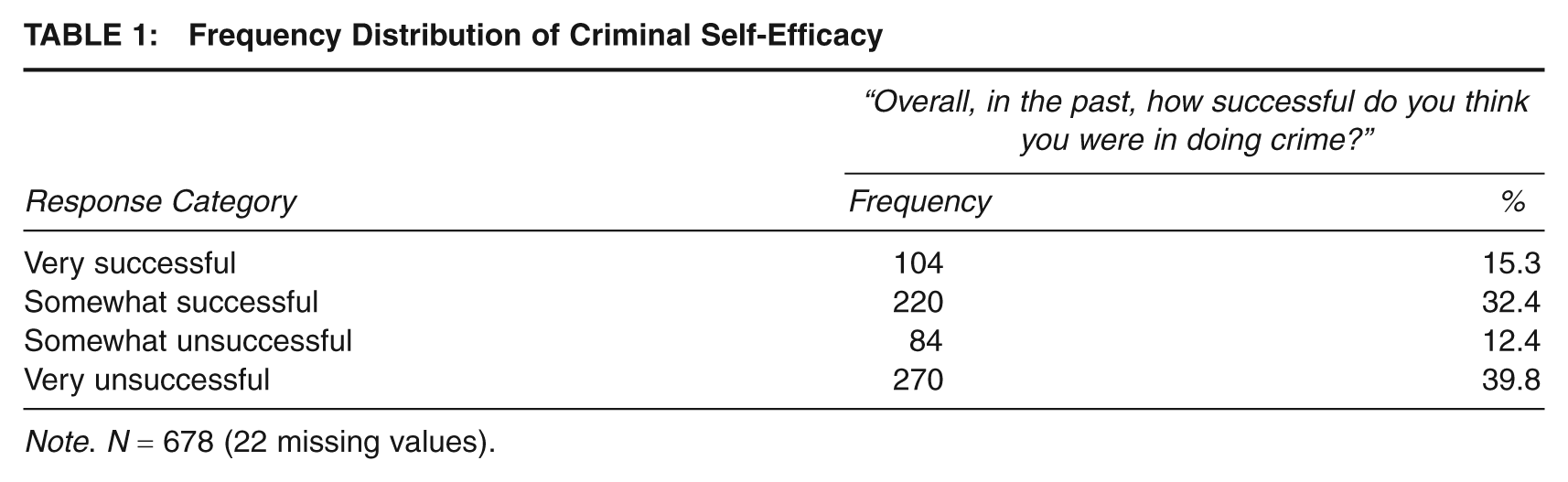
Note. N = 678 (22 missing values).
Predictors of criminal self-efficacy
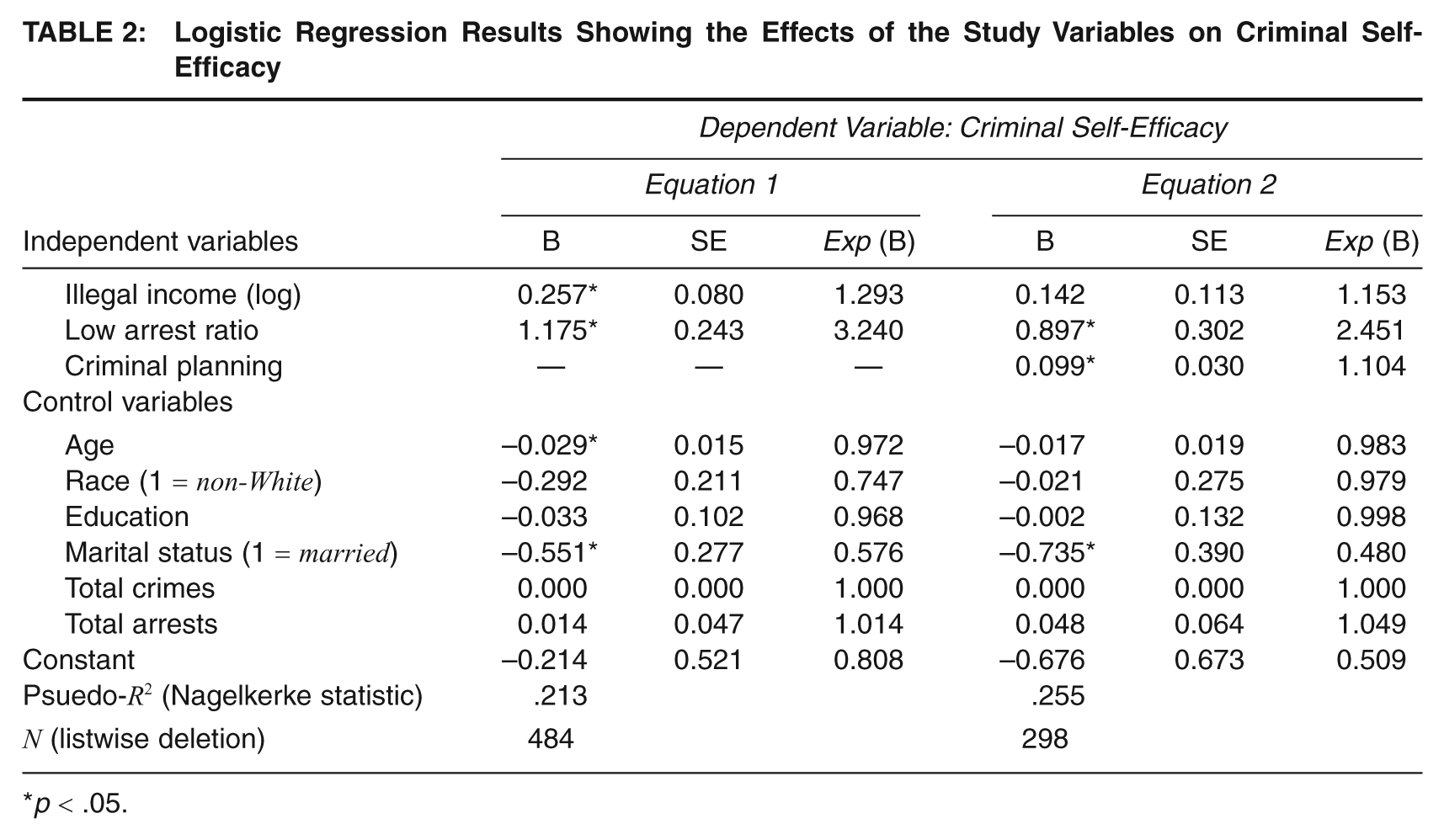
We now turn to the multivariate analyses, which allow us to examine the predictors of criminal self-efficacy within the inmate sample (Hypotheses 1–3). Table 2 presents the effects of various independent variables on the odds of viewing oneself as a “successful” criminal.
Logistic Regression Results Showing the Effects of the Study Variables on Criminal Self-Efficacy
p < .05.
As seen in Table 2, under Equation 1, two of our key independent variables exert significant effects on criminal efficacy, including illegal income and a low arrest ratio. Consistent with previous research (Tremblay et al., 2007), illegal income exhibits a positive effect on criminal efficacy (0.257, p < .05). As illegal income increases, so do the odds of perceiving oneself as a successful criminal, controlling for age, race, and other variables. Illegal income, however, is not the only factor that predicts criminal efficacy. We also observe that a low arrest-to-crime ratio predicts criminal efficacy (1.175, p < .05).
To facilitate the interpretation of these effects, the exponentiated coefficients (Exp[B]) in Table 2 provide the odds ratios associated with the independent variables. For example, the exponentiated coefficient associated with a low arrest ratio is 3.24, indicating that the odds of viewing oneself as successful at crime are 3.24 times (224%) greater among survey respondents who record a low versus high arrest ratio.
Two additional variables are statistically significant in Equation 1: age and marriage. Both factors tend to reduce the odds of perceiving oneself as successful at crime (p < .05). Although this is admittedly a post hoc explanation, it is possible that these factors influence the manner in which offenders come to define success. Perhaps older, married offenders tend to view crime and success as incompatible (also see Laub & Sampson, 2003; Shover, 1985).
Equation 2 in Table 2 allows us to examine the effects of criminal planning on criminal self-efficacy (recall that the criminal planning scale is available only for a subset of the survey respondents, resulting in a smaller number of cases for the analysis; for this reason, we entered criminal planning in a separate equation). As seen in Table 2, criminal planning exerts a significant and positive effect on criminal efficacy (0.099, p < .05). As predicted, when the crimes that offenders pursue involve frequent planning, the odds of viewing oneself as a successful criminal tend to increase. For every unit increase on the criminal planning scale, the odds of perceiving oneself as a successful criminal increase by 1.104 times, or 10.4%.
In Equation 2, we also see that, when criminal planning is added to the equation, a low arrest ratio remains a significant predictor of criminal efficacy, but illegal income and age are no longer statistically significant. In the case of illegal income, the results of supplemental analyses (not shown) reveal that illegal income and criminal planning are moderately correlated (0.37, p < .05); that is, high-income offenders tend to engage in crimes that involve planning. It is possible that illegal income was significant in the previous equation because it was correlated with criminal planning. Perhaps criminal planning is a more direct determinant of perceived criminal efficacy and thus, when entered into the analyses, the effects of illegal income are rendered insignificant. Additional research will be required to confirm this possibility, however.
The impact of criminal self-efficacy on future intentions
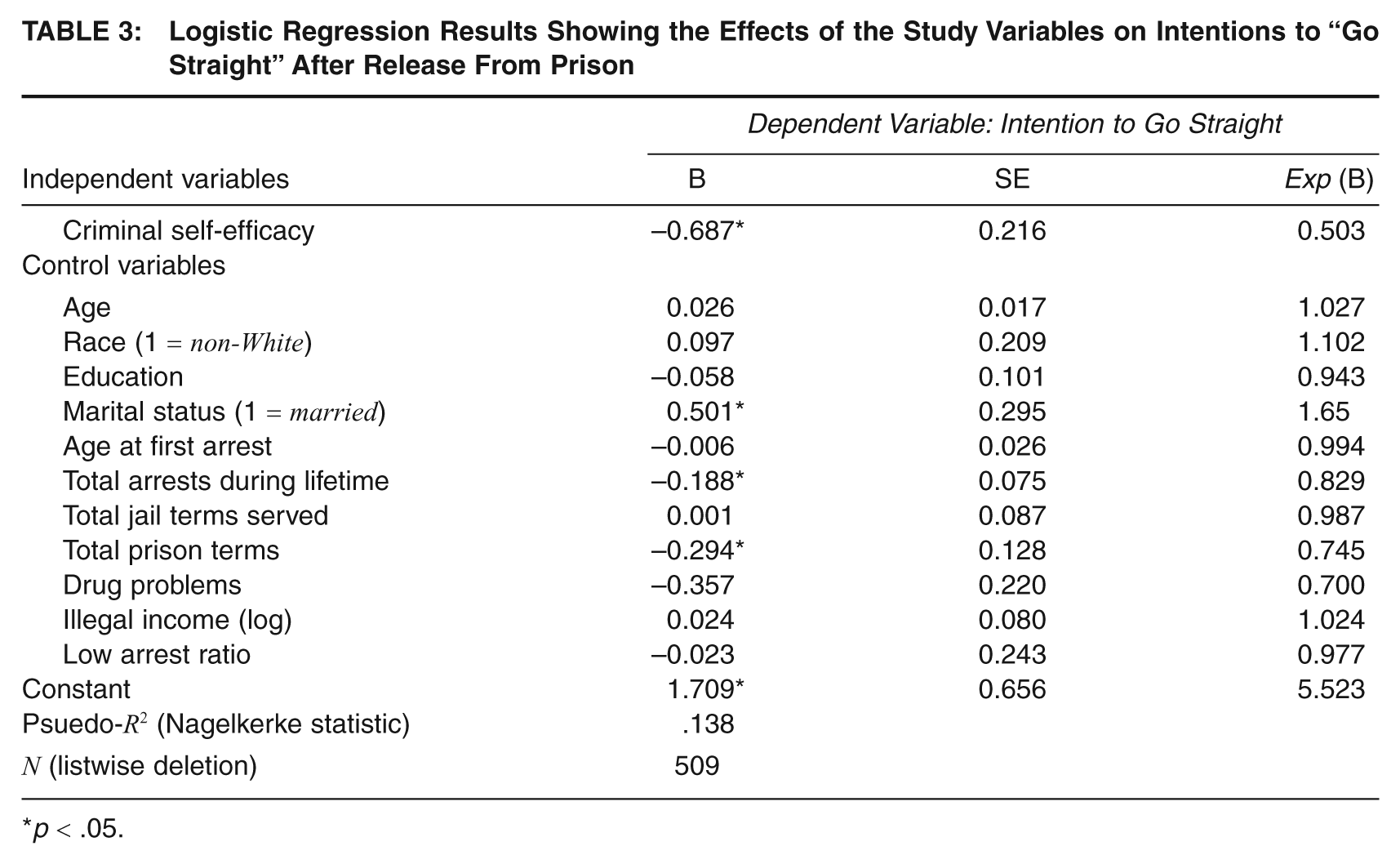
Table 3 presents the effect of criminal self-efficacy on future intentions to “go straight” after release from prison, controlling for other variables. As seen in Table 3, criminal self-efficacy exerts a significant, negative effect on the future intentions variable (–0.687, p < .05). Consistent with Hypothesis 4, the odds of reporting a full intention to “go straight” after release are 0.503 times (49.7%) lower among respondents who describe themselves as successful at crime.
Logistic Regression Results Showing the Effects of the Study Variables on Intentions to “Go Straight” After Release from Prison
p < .05.
Criminal self-efficacy is not the only predictor of future intentions, however. Consistent with prior research, we see that inmates who have an extensive criminal history, with a large number of arrests and multiple prison terms, are also less likely to report intentions to go straight, whereas marriage appears to strengthen such intentions (p < .05).
Study 2: Interviews with Active Street Offenders
Qualitative Data
For the qualitative component of the study, our intent was to interview individuals not currently incarcerated, yet with sufficient offending experience to have developed beliefs about their own criminal efficacy. Thus, we employed an experienced recruiter to identify and locate participants for the study who were actively involved in serious street crime within the past year (the recruiter and study participants were blind to the hypotheses guiding this research). The recruiter concentrated his efforts in an area within the city of Atlanta, Georgia, known as Central West Atlanta (CWA), a community that, historically, has suffered high rates of drug trafficking, serious street crime, and violence. Our recruiter is well acquainted with CWA, and it is typical of the environments that researchers have accessed to explore and understand serious street offending (e.g., Cromwell & Olson, 2004; Hagedorn, 1994; Jacobs, 2006; Miller, 1998; Shover & Henderson, 1995; Topalli, 2005a, 2005b; Wright & Decker, 1997).
The residents in CWA are mostly African American (up to 96% in some neighborhoods), as are our interview participants. Consequently, our sample of street offenders likely overrepresents African Americans and is not fully representative of the overall population of street offenders in Atlanta or other large metropolitan areas. Nevertheless, ecological contexts similar to the one in which our participants operate (a socially and economically distressed community) might be expected to produce similar attitudes and patterns of behavior among members of other races, and among individuals in other large cities (see Bellair & McNulty, 2005; Peeples & Loeber, 1994; Satcher, 2001).
The recruiter received a $50 referral fee per completed interview. The offender interviewees were offered a $50 incentive for their participation in the study. A total of 46 active street offenders were interviewed for this study. All participants remained anonymous; we never asked for their real names and assured them that the interviews were intended solely for research purposes. The in-depth interviews lasted from 45 to 120 minutes and were conducted in a private office located on the campus of a public university in downtown Atlanta (65% of interviews) or on the street in the home territories of offenders (35%). The interviews followed a predetermined Q&A protocol that included questions about criminal self-efficacy but were semistructured and conducted in an informal manner. This approach allowed participants to respond freely and to introduce their own concepts and categories, thereby providing us with a more comprehensive and rich set of data to explore. The electronically recorded interviews were later coded for concepts related to our four hypotheses. This approach has been used successfully in previous ethnographic studies of criminal decision making (e.g., Brezina, Tekin, & Topalli, 2009; Jacobs, Topalli, & Wright, 2000, 2003; Topalli, 2005a, 2005b, 2006; Topalli & Wright, 2004). Moreover, previous research on the quality and veracity of offender self-report data supports the contention that the semistructured interview represents the most efficacious method of obtaining valid information about offending and the psychological processes that govern such behavior (see Huizinga & Elliott, 1986; West & Farrington, 1977; Wright & Bennett, 1990).
Results of Study 2
Prevalence of criminal self-efficacy
In comparison to the prison inmate sample, the prevalence of criminal self-efficacy is even higher among our active street offenders. Of the 46 active offenders that were interviewed about their criminal self-efficacy, the majority (37) described themselves as successful and effective criminals. Presumably, this higher rate of positive evaluations (80%) can be attributed to the fact that, unlike the respondents from the NIS, the interview respondents were noninstitutionalized when we spoke to them. The response of Lay Low was typical:
How good do you think you are (at crime)?
Well, 1 through 10, with 10 being the greatest, I’ll say, uhmm, a 8.
So you think you’ve got room to improve?
Yeah, I feel I can learn more, and figure out more. . . . I feel like there’s always a way around the system.
One advantage of the in-depth interviews is that they shed light on the processes that allow some offenders to maintain a sense of criminal efficacy even in the face of serious trouble with the law. Most of our interview participants described themselves as “good” or successful at crime, even though many confessed to making costly mistakes that resulted in their incarceration. In response to these mistakes, some learned to refine their methods over time to become more effective. Black, an experienced robber, drug dealer, and street game runner, stated the following: “You learn from your mistakes. As I got older and everything, I got better.”
Other offenders narrowed their criminal repertoire over time, pursuing only those crimes at which they were particularly effective. This was the case with Shorty, a 30-year-old robber:
Have you ever been caught by the police?
I’ve been caught with drugs, but not [for] robbing. I got caught with 2 ounces. I did 40 months on a trafficking charge.
Did that make you think twice?
Yeah, about selling dope. Now I just stick to robbing.
Avoiding arrest, illegal income, and criminal planning
After the interview participants had an opportunity to assess their criminal capabilities, we presented a follow-up question: “Why do you think you are good (or not good) at crime?” Their responses frequently echoed our quantitative findings. For example, many of the active street offenders linked their perceived criminal self-efficacy to their ability to avoid apprehension:
I feel like, I’m perfect. I feel [good because] I ain’t never got caught for nothing big. I’m pretty confident.
When you been doin’ it for a long time man, you learn not to get caught. I’ve been arrested, you know what I mean, but I haven’t been arrested for 3 or 4 years now.
Shorty realized that his efficacy in conducting robbery, and avoiding arrest, was tied to his ability to stay sober and alert:
I know how to do robbery. . . . You got to be focused. You don’t need to be on no drugs. . . . That’s why crackheads that rob, they get caught, they’re not focused. They rob somebody or do a rape and they do stupid shit, they leave DNA, they talk. Not me. I know [how] not to get caught. I do what I do and I do it best.
Our street offenders also confirmed the relationship among criminal planning, income, and criminal self-efficacy. D-Rock, a 23-year-old drug dealer and robber, put it like this:
Look . . . I’m good ’cuz I plan and I plan ’cuz I’m good. The more you plan the better you are. It’s not magic man. You got to plan. You got to develop yourself, your skills.
Of particular interest were offenders who did not maintain high self-efficacy with respect to crime, who did not report large sums of money, and who understood implicitly that this was the result of their inability or refusal to plan or develop their skills. Boss, a drug dealer who reluctantly turned to robbery at times when dope dealing was not bringing in enough income, was willing to be honest about his lack of efficacy with respect to robbing people. When asked if he was good at it, he responded,
Nah, because it takes time [to become a professional]. There’s some folks who [know to] sit and wait, if you want some big money like the big man, they sit and lay [wait on an opportunity], they got the lay-on. They will wait for a few weeks before they [commit their crime]. . . . See, I ain’t like that, I’m trying to get it quick. I ain’t trying to go through all that, and to get thirty thousand or fifty thousand [dollars]. I’m just tryin to get some right now for my child, right now. I’m really not the best at it.
The interview material also revealed an aspect of criminal self-efficacy that, to our knowledge, has not been adequately explored in the criminological literature. When judging their own criminal capabilities, some of our participants appeared to factor in their future potential to learn, adapt, and succeed at crime. Much like the persistent thieves interviewed by Shover (1985), the question that seemed most relevant to these participants was not whether they had been successful at crime in the past, or had made mistakes, but whether they could ultimately succeed. As seen below, some of our participants believed that ultimate criminal success was a real possibility given their experience, intelligence, and determination:
A lot of people look at me, or look at criminals, and we’re depicted as dumb folks. . . . But I ain’t no dummy, by far, OK? . . . [And I] dream for that one big score. You never know when you’ll catch that one guy and he’s got a briefcase full of money. . . . For real. These things happen. (Jersey)
Lay Low expressed similar confidence in his continued success at crime, having observed other offenders succeed against the odds. His comments highlight the role of vicarious learning, which Bandura (1997) identifies as one possible source of efficacy-related information:
I know there’s always a way [to succeed at crime]. Let me tell ya, my partner, he told me he was gonna get away. He went in [to rob] a hotel . . . a fucking hotel! You know how many witnesses and cameras and all that [he was up against]!? . . . And he never got caught. (Lay Low)
In short, observing other ordinary offenders succeed at crime provided memorable examples of crime’s potential rewards and simultaneously boosted the confidence of our participants. As Bandura (1997) observes, when people see similar others master an activity, their own efficacy judgments are raised, as they persuade themselves that “they too have the capabilities” (p. 87).
Furthermore, the interview responses suggest that a sense of criminal efficacy may discourage behavioral change and encourage persistence at crime, as our quantitative findings indicate (Hypothesis 4). New York Red, a particularly eloquent 48-year-old robber and hustler, seemed to epitomize this finding:
When I first started out I was reckless. . . . [But] I know what I’m doing [now]. Jail ain’t gonna stop me. I tasted sweet success plenty of times and I’m still here.
Summary and Discussion
Although persistent criminal offenders are frequently viewed as failures, especially if they have served prison time (Wilson & Abrahamse, 1992; also see Hirschi, 1986), offenders do not necessarily share this view. In fact, based on a large survey of prison inmates, we find that nearly half (48%) judge themselves to have been “successful” at crime. Among nonincarcerated offenders, the percentage may be even higher. In our own sample of active street offenders, most (80%) regard themselves as highly effective at crime, despite the fact that many had experienced arrests and convictions and had previously served time. In short, our findings indicate that many offenders maintain a high level of criminal self-efficacy despite serious trouble with the law.
Our findings also help to explain the resilience of offenders’ efficacy beliefs in the face of such trouble. When pressed to explain the reasons for their positive self-judgments, our interview participants highlighted their ability to learn from past mistakes, to refine methods and tactics accordingly, and to become more effective as a result. As predicted by self-efficacy theory, “failure can, paradoxically, raise efficacy through belief that better strategies will bring future successes” (Bandura, 1997, p. 82).
We believe these findings have implications for deterrence. Efficacy beliefs appear to influence the meanings that offenders attach to punishment experiences. Among high-efficacy offenders, it appears that punishment experiences are frequently transformed into perceived opportunities to learn, improve, and become more effective at crime. As a result, the deterrent power of the criminal justice system may be weakened.
To facilitate an exploration of the origins or determinants of offenders’ efficacy beliefs, we proposed a framework highlighting three major indicators of performance that offenders use to gauge their criminal capabilities. These indicators include (a) monetary gain from crime, (b) the ability to evade apprehension and punishment, and (c) the display of criminal skill or expertise. The results of our quantitative and qualitative analyses indicate that each of these factors contributes to criminal self-efficacy, providing initial empirical support for the proposed framework (in the quantitative analyses, the effect of illegal income was not entirely consistent across equations, however). At the same time, the results indicate a need to expand this framework in future research. In the quantitative analyses, there is some evidence that age and ties to conventional institutions (marriage) also influence perceptions of criminal efficacy, perhaps because these factors affect the way that offenders come to define success. Also, based on our interviews with active street offenders, it appears that some offenders are “forward looking” when judging their criminal capabilities. In addition to the performance indicators listed above, which all index past performance, it appears that the efficacy beliefs of some offenders are shaped by perceptions of their future potential for success. Having witnessed similar others succeed at crime, they are persuaded that they too can become successful.
Furthermore, there is room to explore the ecological contexts that provide support for a “successful criminal” identity and related efficacy beliefs. Our theoretical and empirical analyses focused on the level of the individual, but even our individual-level data hint at the role of larger neighborhood-level processes. For instance, some of our interview participants pointed to the criminal success of others in their neighborhood and made specific reference to crime training or mentoring provided by older offenders as they were growing up. We are reminded of the “indigenous illegitimate success-models” described by Cloward and Ohlin (1960, pp. 162-163). These models are said to be highly visible to youth in disadvantaged neighborhoods, given a paucity of conventional success models.
Developing a better understanding of the sources of criminal self-efficacy is important because offenders’ efficacy beliefs may have consequences for their future behavior. Although the available data do not allow us to examine future behavior directly, findings from the inmate survey indicate that criminal self-efficacy tends to weaken intentions to “go straight” after release from prison, and such intentions have been shown to be correlated with actual desistance in past research (Corrado et al., 2003; Visher & Courtney, 2007). Likewise, many of our interview participants expressed intentions to continue in crime, bolstered by confidence in their ability to succeed at crime and motivated by the possibility of greater success in the future.
In terms of future research, the issue of criminal self-efficacy is ripe for further exploration. Although the current study provides an initial test of relevant hypotheses, it has a number of limitations and should be viewed as a starting point for future research. For example, future quantitative studies could improve and expand on the current study by constructing more detailed measures of criminal efficacy, by measuring specific dimensions of criminal efficacy (e.g., effectiveness at particular types of crime), or by examining longitudinal data.
Further research on criminal self-efficacy may be of value given potential implications for crime control policy. For example, our findings indicate that criminal self-efficacy is related in a systematic way to various offender experiences, such as a low arrest-to-crime ratio. If these findings are confirmed in future research, then it may be possible to disrupt the development of criminal self-efficacy by increasing the clearance rate—or the proportion of crimes within a given jurisdiction that result in arrest (for an excellent discussion of police practices and procedures associated with high clearance rates, see Wellford & Cronin, 2000). Our findings also hint at the possibility that ties to conventional institutions, such as marriage or employment, may discourage personal definitions of success that include crime. Although more research is needed on this score, it is possible that efforts designed to strengthen such ties may disrupt perceptions of criminal efficacy (also see Laub & Sampson, 2003).
In addition, research on criminal self-efficacy appears to have implications for prevention. When offenders describe crime as their first successful role (Laub & Sampson, 2003; Roberts, 2003; Shover, 1985), they imply a history of failure and lack of efficacy within conventional institutions. According to prior research, family and school environments that promote positive mastery experiences can help reduce the likelihood of antisocial behavior (Bandura, 1997).
Given the long and successful history of Bandura’s (1997) self-efficacy theory, it is surprising that criminal efficacy has not received more attention from criminologists. Perhaps many criminologists have been reluctant to give serious attention to offenders’ efficacy beliefs because they have assumed that such beliefs amount to little more than exaggerations or distorted criminal thinking. As we have tried to make clear, we have no argument with the position that such beliefs are irrational and destructive, especially in the long run (see Walters, 1990). Yet these beliefs may be consequential nonetheless, with implications for criminological theory and crime control.
Footnotes
Authors’ Note:
Support for this research was provided by Grant 0520092 from the National Science Foundation and by the Georgia State University Research Foundation. We are indebted to Bill McCarthy, Pierre Tremblay, Robert Agnew, and Gregory Brack for their constructive feedback on an earlier draft. We also thank Carlo Morselli for his helpful suggestions.