






Abstract
This study of 179 recently incarcerated male adolescent offenders examined how leaders and followers in juvenile offending differed across offense, demographic, intraindividual, contextual, and social domains, and how leader/follower status affected the association between facility peer misbehavior and youth’s own institutional behavior over the first month of incarceration. Results indicated that leaders were older, more criminally experienced, reported higher levels of contextual risk, yet reported lower feelings of social isolation than followers. For followers, early exposure to facility peer drug sales was especially impactful on their subsequent institutional substance use, while facility peer antisocial behavior was related concurrently to all youth’s institutional antisocial behavior at each week of incarceration. Findings suggest that leaders and followers have distinct correlates and may require differential intervention, and heightened vigilance of facility peer relations is important throughout youth’s transition to juvenile incarceration.
Although it is widely acknowledged that offending during adolescence is likely to occur in the presence of peers (Erickson & Jensen, 1977; Reiss & Farrington, 1991; Shaw & McKay, 1931; Warr, 1996, 2002; Zimring, 1981), there has been increased interest in understanding young offenders’ roles as leaders or followers in group offending (e.g., Reiss, 1988). This distinction between leaders and followers in adolescent offending is important, as research has shown that a small number of high-rate offenders who are identified as criminal recruiters—roughly 4% of antisocial individuals—are responsible for more than two thirds of their co-offenders’ first-time convictions (Reiss & Farrington, 1991). To date, emerging evidence suggests that leaders of crime are older and more criminally experienced than their followers (McGloin & Nguyen, 2012; Reiss & Farrington, 1991; van Mastrigt & Farrington, 2011; Warr, 1996). Yet, less is known if other factors, such as intraindividual risk, contextual risk, and social functioning, may differentiate leaders and followers. Elucidating these potential differences can inform targeted interventions for these youth and is an important area for research. As such, the present study’s first aim is to corroborate and expand upon known correlates of leaders and followers by comparing these youth across demographic, offense, intraindividual, contextual, and social domains.
Although researchers have begun to examine the roles of leaders and followers within community settings, an uncharted area of research is how this peer dynamic operates within an incarceration setting, particularly during youth’s initial entry to incarceration. Transitioning to this all-delinquent peer context has been characterized by increased levels of stress and risk for poor institutional adjustment (Brown & Ireland, 2006; MacKenzie & Goodstein, 1985; Shulman & Cauffman, 2011), and leader/follower status may have important implications for facility adaptation. Specifically, certain youth—such as followers of deviant peers—may be inclined to emulate their incarcerated peers’ delinquent behavior. Indeed, studies find that homogeneous delinquent peer contexts exacerbate deviant behavior, and adolescents alter their deviant behavior to match the behavior of their immediate peers (Dishion, Spracklen, Andrews, & Patterson, 1996; McGloin, 2009). Despite the compelling theoretical and empirical basis for examining leaders’ and followers’ adjustment to juvenile incarceration, studies have yet to explore these peer dynamics. Better understanding of these processes will shed light on how we may ease young offenders’ transition to juvenile incarceration, and if certain youth require closer monitoring from facility personnel. Thus, the second aim of the current study is to examine if and when the association between facility peer misbehavior and youth institutional misconduct is stronger for followers than for leaders during youth’s transition into an incarcerated setting.
Leaders and Followers in Adolescent Offending
Most adolescents commit crimes in groups (Erickson & Jensen, 1977; Reiss & Farrington, 1991; Shaw & McKay, 1931; Warr, 1996, 2002; Zimring, 1981), with some studies estimating that 95% of young offenders commit crimes with others at least once in their criminal careers (Goldweber, Dmitrieva, Cauffman, Piquero, & Steinberg, 2011). Evidence suggests that co-offending peaks during adolescence across a variety of offense types, including property and violent crimes (Stolzenberg & D’Alessio, 2008). Theoretical perspectives have provided complementary mechanisms for this robust finding, such as adolescents’ heightened sensitivity to social reward, desire for thrilling experiences, susceptibility to peer influences, and poor impulse control among peers (Ellis et al., 2012; Steinberg, 2008; Steinberg & Monahan, 2007; Steinberg & Scott, 2003).
Although less of a focus in current theory, it has been posited that within peer offending groups, there are youth who primarily act as leaders and youth who act as followers, although the terminology and operationalization of these two groups have varied from study to study. Reiss (1988) was one of the first to recognize the existence of hierarchical relationships within deviant peer networks, speculating that there are high-rate offenders whom he termed “recruiters” (p. 119) responsible for recruiting less criminally experienced offenders whom he called “joiners” (p. 147) into crime. Indeed, in a longitudinal study of more than 400 boys studied from 10 to 30 years of age, Reiss and Farrington (1991) identified a small percentage of persistent offenders who fit the recruiter profile. These results were replicated in a recent 3-year longitudinal study of more than 60,000 individuals’ official criminal records, such that researchers were able to identify 86 high-rate offending recruiters, characterized by committing crimes with many younger and less delinquent co-offenders (van Mastrigt & Farrington, 2011).
Some researchers have criticized studies that deem individuals as recruiters or joiners based on their offending patterns, as official records do not confirm whether the individual actually led or followed in the criminal act (McGloin & Nguyen, 2012; Warr, 1996). Furthermore, these camps have questioned whether leading and following in co-offending are mutually exclusive roles. To address these limitations of past studies, researchers have asked youth explicitly to report their role in their group offenses, which allows a more accurate assessment of youth’s roles in crime and also, if asked about their roles in all of their offenses, elucidates the stability of instigation and following across different crimes. When using this method of assessing roles in group crime, Warr (1996) found that many young offenders not only acted as both instigators and followers in past group offenses but also found that a single instigator could be identified in the majority of self-reported delinquent acts (90%), and about 18% of youthful offenders were pure instigators during a 3-year span. Using a similar methodology, McGloin and Nguyen (2012) found that instigation did vary across criminal types, but found that the act of instigation was associated with an earlier criminal onset. Further investigations found that chronic offenders were less likely to state that they offended because of their peers, whereas non-chronic offenders were more likely to indicate that they engaged in criminal activity because of their peers’ delinquency (McGloin & Stickle, 2011).
Although the study of leaders and followers of group crime has varied both conceptually and methodologically, there appears to be converging correlates of acting as a leader or follower in criminal activity. In particular, individuals who act as leaders of group crime are older, more criminally experienced, and have an earlier age of criminal onset than followers (McGloin & Nguyen, 2012; Reiss & Farrington, 1991; van Mastrigt & Farrington, 2011; Warr, 1996). Given the compelling evidence that some offenders may act as the catalyst for other susceptible individuals’ criminal involvement, it is surprising that less work has been done to investigate other important factors that may potentially discriminate leaders and followers, such as intraindividual risk, contextual risk, and social functioning.
Theoretically, researchers have drawn parallels between leaders and followers and Moffitt’s (1993) developmental taxonomy, and this comparison may assist researchers in identifying both intraindividual and contextual risk factors associated with leading or following group crime. Moffitt hypothesized two types of offenders, life-course persistent offenders and adolescence-limited offenders, who differ in developmental trajectories of crime and etiological mechanisms into crime. Life-course persistent offenders, whose antisocial behavior starts early and persists into adulthood, are described as criminal role models for their adolescent peers. The underlying risk factors linked to this pattern of criminal behavior include cognitive deficits and contextual risk (e.g., poor parenting, chaotic home environments). However, adolescence-limited offenders, whose antisocial behavior starts and ends in adolescence, are described as imitators of life-course offenders. Affiliation with deviant peers is the key risk factor for adolescence-limited offending, while the roots of life-course persistent offending stem from early neurological risk and contextual adversity.
The different mechanisms underlying antisocial behavior among life-course persistent offenders and adolescence-limited offenders may be similar to the correlates specific to leading and following adolescent group offending (McGloin & Nguyen, 2012; van Mastrigt & Farrington, 2011). Although Moffitt does not directly comment on life-course persistent youth’s propensity to instigate crime, life-course persistent offenders are likely to be similar to leaders in their ability to initiate group offending. Thus, we suspect that leaders will have similar predispositions toward crime rooted in intraindividual and contextual risk. Similar to adolescence-limited antisocial youth, followers’ misconduct may be driven predominantly by peer deviancy rather than predisposed tendency toward crime. In sum, in comparison with followers, leaders are likely to possess higher risk for problem behavior in domains beyond the peer domain (e.g., intraindividual, contextual). It is important to note that the analogy between life-course persistent offenders/adolescence-limited offenders and leaders/followers in group offending is not completely parallel, as youth may not always act as leaders or followers when engaging in crime during adolescence (Warr, 1996). Still, Moffitt’s dual taxonomy provides insight regarding factors related to youth who predominantly lead or follow their delinquent peers.
In addition to intraindividual and contextual risk factors, social functioning, conceptualized in the present study as youth’s sociability, feelings of social isolation, and peer warmth and acceptance, may be another factor that discriminates leaders and followers. Specifically, leaders may possess better social skills than followers, and instigating crime could be a mechanism for maintaining peer prominence (Miller-Johnson & Constanzo, 2004). Although a positive association between problem behavior and social prominence seems counterintuitive, Miller-Johnson and Constanzo (2004) suggested that peer processes operate differently for low socioeconomic status youth (who are overrepresented in the juvenile justice system). That is, deviant and aggressive behaviors may be viewed as a sign of maturity and a source of status within these contexts. It is also posited that youth from low-income neighborhoods will have a higher proportion of antisocial youth within their peer networks, and greater proximity to other delinquent youth may mediate the adaptation of antisocial values (Haynie, 2002). Taken together, youth who coordinate group crime in impoverished contexts may be youth who are the most prominent and socially skilled within their peer networks. For instance, a study investigating correlates of peer popularity in urban youth found that aggressive and disruptive behaviors were associated with higher levels of peer popularity (Luthar & McMahon, 1996). Moreover, leaders in adolescent group crime are reported to be emotionally close with other members of the delinquent group (Warr, 1996). However, youth imitation of serious antisocial behavior may be a marker of troubles in social functioning, specifically feelings of isolation from peers. Indeed, youth who demonstrate higher susceptibility to peer influences are less likely to maintain stable friendships (Allen, Porter, & McFarland, 2006). Thus, followers may engage in adolescent antisocial behavior as a means to gain acceptance from peers, which previously eluded them.
Juvenile Incarceration Settings
A possible consequence of engaging in crime during adolescence is juvenile incarceration, and youth are subject to further maladaptive socialization by delinquent facility peers. Aggregation of delinquent youth has been found to yield iatrogenic effects, particularly in interventions that bring together all antisocial youth (Dishion, McCord, & Poulin, 1999). Three relevant perspectives—deviancy training, balance theory, and differential association—offer clarity to this observation. Deviancy training suggests that delinquent youth selectively attend to antisocial talk, thus reinforcing antisocial values and perpetuating deviant behavior (Dishion et al., 1996). Relatedly, balance theory posits that individuals seek to establish social congruence with others, and in the context of delinquency, youth recalibrate their deviancy to match the behavior of their immediate peers (Heider, 1946, 1958; McGloin, 2009). Finally, differential association hypothesizes that the proportion of delinquent peers within a youth’s social network is the most robust predictor of the target subject’s delinquency (Haynie, 2002; Sutherland, 1947). Taken together, exposure to more delinquent peers is likely to exacerbate youth’s deviant behavior. Indeed, iatrogenic effects are heightened in homogeneous intervention groups with antisocial only youth, in comparison with mixed groups of low/high problem behavior youth (Ang & Hughes, 2002; Feldman, Caplinger, & Wodarski, 1983).
Delinquent socialization is likely magnified in juvenile incarceration settings—where all youth are antisocial. Evidence has supported this contention. Klein (1986) randomly allocated arrested youth to one of three interventions: referral to juvenile court, referral to social services (without court), or release without any official intervention. Youth without any intervention had the lowest number of official re-arrests. Moreover, a study of low-income boys found that contact with the juvenile justice system greatly increased the likelihood of continued criminal involvement in the adult justice system (Gatti, Tremblay, & Vitaro, 2009). Given how influential peers are during adolescence (Steinberg & Monahan, 2007), and that adolescent group offenders engage in problem behavior with delinquent peers, aggregation of deviant youth is of serious concern for leaders’ and followers’ behavioral adjustment while incarcerated.
Research has asserted that delinquent peer aggregation is a risk factor for escalation in problem behavior, but it stands to reason that there are individual differences in youth’s vulnerability to deviant peer socialization. Studies have identified factors that may strengthen the association between peer delinquency and youth misconduct. Youth whose antisocial behavior begins in adolescence (as we may expect of followers) are more susceptible to deviant peer influences than youth with early onset of conduct problems (as we may expect of leaders; Tremblay, Masse, Vitaro, & Dobkin, 1995). We suggest that acting as a follower in comparison with a leader may also increase youth’s misbehavior in the context of peer deviancy. To date, however, we do not know how being a leader or a follower may affect behavioral outcomes during incarceration. In the interest of facilitating positive transitions to juvenile incarceration, while also promoting safety of youth and staff, the next logical step is to examine how these peer dynamics operate within the context of juvenile incarceration.
The Present Study
The current study aims to progress the field’s understanding of leaders and followers in adolescent offending. To develop our understanding of these group dynamics, the present analyses rely on a unique sample of recently incarcerated male juveniles who played either the leader or follower in their committing group offense. Two main research aims guide our investigation. First, the current study expands upon previous investigations by comparing leaders and followers across demographic, offense, intraindividual, contextual, and social domains. We hypothesized that, in comparison with followers, leaders would be older, report greater involvement in the justice system, possess higher intraindividual and contextual risk for problem behavior, yet display higher social functioning. Second, the present analyses elucidate leaders’ and followers’ behavioral adjustment in an atypical socialization context, juvenile incarceration, where youth are housed with delinquent peers. Specifically, the current study tests if and when leader/follower status moderates the association between facility peer misconduct and youth’s institutional misbehavior (i.e., substance use and antisocial behavior) during the transition to incarceration (i.e., during the first month of incarceration). Assuming that the key risk factor for followers’ problem behavior is association with deviant peers, we predicted that the association between facility peer misconduct and youth misbehavior would be stronger for followers than leaders.
Method
Participants
The present study selected a subsample of 179 recently incarcerated male offenders whose committing offense was committed with a group (vs. alone) from a larger study of 373 male juvenile offenders incarcerated in the California Department of Juvenile Justice correctional reception facility (ages 14-17 years; M = 16.49, SD = 0.74). The majority of minors (72.1%) in the current study were convicted of a violent offense (e.g., 32.4% robbery, 18.4% aggravated assault, 4.5% attempted murder, and 2.2% murder). The analytic sample was ethnically diverse (50.8% Hispanic, 30.2% Black, 6.7% White, and 12.3% other or mixed race) and was representative of incarcerated youth in Southern California (Snyder & Sickmund, 2006). Of youthful offenders whose committing offense was a group offense, 109 reported they were the leaders in their committing offense and 70 reported they were followers in the crime. Thirty-nine youth did not report whether they were a leader or a follower in their committing group offense and subsequently were not used in the current study. Youth included in the analyses did not differ from excluded youth by race, χ2(3) = 2.44, p = .49, age, t(216) = −0.63, p = .53; number of prior arrests, t(216) = −1.25, p = .21; or by the severity of their committing offense, χ2(1) = 0.98, p = .32.
Procedure
Researchers contacted the secure facility daily to determine whether new youth had been admitted (i.e., youth who were recently incarcerated either for the first time or for a new offense) between the ages of 14 and 17 years. Research staff approached newly incarcerated youth and reviewed the nature of the study, informed them that their participation was entirely voluntary, and that any information youth provided would be kept confidential (participant responses were protected by a Certificate of Confidentiality obtained from the Department of Health and Human Services). Confidentiality would be broken only if the youth indicated they posed a danger to themselves or others, or if they reported that they were being abused. Both parent consent and adolescent assent were required to participate. Parents were contacted via telephone, and the consenting process was audiotaped. Ninety-seven percent of contacted parents consented for their adolescents to join the study. Among the adolescents approached, 95.5% assented to participate.
Following the consent and assent process, a total of four weekly interviews were completed over the first month of incarceration. Youth participated in a baseline interview within 48 hr of their arrival and completed weekly follow-up interviews at Week 2, Week 3, and Week 4. To minimize comprehension issues of survey questions, all questionnaires were read aloud by a research assistant. The baseline interview took a total of approximately 2 hr, and the follow-up interviews lasted about 1.5 hr. Questionnaires asked about youth’s behavior, emotions, and experiences prior to (i.e., retrospectively) and during incarceration. Research assistants provided youth with snacks at the end of each interview for participating in the study. All data were analyzed at the level of the week or at the month level, aggregating across Weeks 2 through 4 in the facility.
Measures
Outcome Variables
Institutional substance use: Self-report
Youth reported at Weeks 2, 3, and 4 whether or not they had used substances (alcohol, marijuana, inhalants, or other drugs such as non-prescribed prescription medications) in the facility in the past week, and if so, how often (open ended). We utilized youth’s frequency scores (i.e., how many times they used substances in the past week) and averaged these frequency scores across all substances at Weeks 2, 3, and 4, and also computed a month-level aggregate score (i.e., sum of scores from Weeks 2-4). Past research studies have supported the validity and temporal consistency of adolescent self-reported substance use as a measure of actual behavior (e.g., Oetting & Beauvais, 1990; Winters, Stinchfield, Henly, & Schwartz, 1990).
Institutional antisocial behavior: Self-report
Using a modified version of the Self-Report of Offending (Huizinga, Esbensen, & Weiher, 1991), youth reported the number of times they had engaged in six types of antisocial behavior (i.e., chased someone and planned to seriously hurt them; beat/mugged/or seriously threatened another person; attacked someone with a knife, box cutter, or bat; stole someone else’s things; took someone else’s things by force; purposely destroyed/damaged property that did not belong to them) within the institution at Weeks 2, 3, and 4 (e.g., “How often in the past week have you chased someone where you planned to seriously hurt them?”). We calculated mean frequency scores across all antisocial behaviors at Weeks 2, 3, and 4, and also computed a month-level aggregate score (i.e., sum of scores from Weeks 2 to 4).
Intraindividual risk factors
We assessed two intraindividual risk factors that (a) are markers of cognitive deficits and (b) have shown robust links to problem behavior: psychopathic traits (assessed at Week 3) and attention problems (assessed at baseline).
Psychopathic traits were assessed using the three subscales of the Youth Psychopathic Traits Inventory (Andershed, Gustafson, Kerr, & Stattin, 2002). The Interpersonal subscale was comprised of the Dishonest Charm (five items; for example, “I have the ability to con people by using my charm and smile”), Grandiosity (five items; for example, “I’m better than everyone on almost everything”), Lying (five items; for example, “Sometimes I lie for no reason, other than because it’s fun”), and Manipulation (five items; for example, “I can make people believe almost anything”) subscales. The Affective subscale consisted of the Callousness (five items; for example, “I think crying is a sign of weakness, even if no one sees you”), Unemotional (five items; for example, “I usually feel calm when other people are scared”), and Remorselessness (five items; for example, “To feel guilt and regret when you have done something wrong is a waste of time”) subscales. Finally, the Lifestyle scale was made up of the Impulsiveness (five items; for example, “I consider myself a pretty impulsive person”), Irresponsibility (five items; for example, “I have often been late to work or classes in school”), and Thrill-Seeking (five items; for example, “I like to be where exciting things happen”) subscales. Responses were on a 4-point scale, ranging from does not apply at all to applies very well. Items were summed together to create each subscale. All three subscales had good reliability, ranging from α = .73 to α = .86. The subscales were moderately correlated: Interpersonal/Affective, r = .37, p < .001; Interpersonal/Lifestyle, r = .47, p < .001; and Affective/Lifestyle, r = .47, p < .001.
Attention problems were measured using the nine-item Attention Problems subscale of the Child Behavior Checklist (Achenbach, 1991; for example, “I feel confused or in a fog”; “I have trouble concentrating or paying attention”). Youth responded on a 3-point scale ranging from not true to very true or often true. Items were summed together, and the measure had adequate internal consistency (α = .71).
Contextual risk factors
We identified three familial risk factors, parental warmth (negatively associated), parental hostility, and family criminality (all assessed at Week 2), and a broad contextual risk factor, stressful life events (assessed at Week 3), which were likely related to problem behavior.
Parental warmth was assessed using the Parental Warmth and Acceptance scale (Greenberger & Chen, 1996). The measure included eight statements (e.g., “My parents really understand me”; “My parents enjoy spending time with me”), with a 6-point response scale ranging from strongly disagree to strongly agree. Responses were averaged together, with higher scores indicative of greater warmth and acceptance from parents. The measure showed adequate reliability in the analytic sample (α = .72).
Parental hostility was assessed using the 12-item Parent Hostility scale (Conger, Ge, Elder, Lorenz, & Simons, 1994). Questions began with the stem, “When you and your parents have spent time talking or doing things together, how often did your parents . . .” and items included “Get so mad at you that they broke or threw things?” and “Insult or swear at you?” Participants responded on a 4-point scale from never to always. Higher scores indicated higher levels of parent hostility. The scale had good internal consistency (α = .86). Parental warmth and acceptance was negatively correlated with parental hostility at r = −.47, p < .001.
To assess family criminality, we asked youth if any members of their family had ever been incarcerated. Because family criminality was a binary variable, we calculated the percentage of youth that had reported a family member had been incarcerated.
Stressful life events were assessed using the Adolescent Perceived Events Scale (Compas, Davis, Forsythe, & Wagner, 1987). Participants were read a list of 32 negative events (e.g., witnessed a family member being injured or killed, experienced death of a friend, witnessed violence between parents), and asked if these events had ever happened in their lives. Youth responded either yes or no to each of the items, and items were summed together to create a stressful live events variable.
Social functioning
Youth’s social functioning was assessed across three domains: self-reported sociability (assessed at Week 4), social isolation (assessed at baseline), and peer warmth and acceptance (assessed at Week 2).
To assess sociability, adolescents completed the International Personality Item Pool (IPIP) Emotional Intelligence measure (Barchard, 2003; Goldberg et al., 2006; for example, “I am skilled in handling social situations” and “I talk to a lot of different people at parties”). Answers were on a 5-point scale ranging from very inaccurate to very accurate. All questions were averaged together, with higher scores indicating greater sociability. The measure had good reliability (α = .75).
Social isolation was assessed using the 20-item University of California, Los Angeles Loneliness Scale (Russell, Peplau, & Ferguson, 1978; for example, “I do not feel alone [reverse coded]” and “I feel in tune with the people around me [reverse coded]”). Participants responded with a 4-point response scale ranging from I never feel this way to I often feel this way. Items were averaged together, with higher scores indicating higher feelings of social isolation. The measure demonstrated good reliability in the sample (α = .83).
Peer warmth and acceptance was assessed using a modified version of the Parental Warmth and Acceptance scale (Greenberger & Chen, 1996). Adolescents were asked eight questions regarding their peer relationships (e.g., “My friends really understand me” and “I know that my friends will be there for me if I need them”), with answers from strongly disagree to strongly agree. Scores were averaged together, with higher scores representing higher levels of peer warmth and acceptance. The measure showed adequate reliability (α = .69). We found moderate correlations among these three scales: Sociability/Social Isolation: r = −.39, p < .001; Sociability/Peer Warmth and Acceptance: r = .20, p < .05; and Social Isolation/Peer Warmth and Acceptance: r = −.32, p < .001.
Independent Variables
Leader/follower status
First, youth were asked if their committing offense was committed alone (i.e., solo committing offense) or with others (i.e., group committing offense). Adolescent offenders who reported a group committing offense were asked if they were the leader or follower of the crime. Leader/follower status was dummy coded, with followers serving as the reference group. There have been various methods in identifying leaders and followers of group crime, but we decided to use youth’s self-assessments for two reasons. First, we used self-reports because of its prior use in a seminal study of adolescent group offending dynamics (Warr, 1996). Second, we find that having youth report their roles in adolescent offending is a preferred technique to inferring these roles from court data, where there are no clear indications regarding who was the instigator (McGloin & Nguyen, 2012; van Mastrigt & Farrington, 2011).
Facility peer misbehavior
Facility peer drug sales
Adolescents were asked if their incarcerated peers sold drugs in the facility at each week. A dichotomous variable was created for Weeks 2, 3, and 4, where a “0” indicated that their facility friends did not sell drugs, and a “1” reflected that their peers did sell drugs that week. To create a continuous month-level assessment of facility peer drug sales, scores from Weeks 2 to 4 were summed together.
Facility peer antisocial behavior
An adapted version of Self-Report of Offending (Huizinga et al., 1991), which contained the same six antisocial behavior items as the youth’s assessment, was used to measure facility peer institutional antisocial behavior (e.g., “How often in the past week have any of your ‘friends’ here chased someone where you thought they would seriously hurt someone?”). Youth reported the number of times their facility peers engaged in each behavior, and an average frequency score was calculated across all six antisocial behaviors for Weeks 2, 3, and 4. Weeks 2 to 4 facility peer antisocial behavior frequency scores were aggregated together to create a month-level score. Higher scores indicated higher levels of self-reported facility peer antisocial behavior.
Control Variables
Based on past research, a number of control variables were used in all analyses.
Demographics
Youth reported their age (years) and race/ethnicity. Youth were grouped into one of four categories of race/ethnicity: White, Black, Hispanic, and Other/missing. Race/ethnicity was dummy coded, with White youth serving as the reference group.
Severity of committing offense
The violent nature of the youth’s committing offense was determined using official facility records. Violent offenses included all person committing offenses: murder, attempted murder, sex crimes, manslaughter, aggravated assault, carjacking, robbery, attempted robbery, kidnapping, and battery. These violent crimes were coded as “1.” Non-violent crimes, coded as “0,” were comprised of burglary, theft, drug crimes, conspiracy, and property crimes.
Offending history
Official arrest history
Arrest records were obtained through police reports, court documents, and probation reports from the Department of Juvenile Justice. A count of the number of prior arrests was used to represent arrest history. Of the analytic sample, 81.6% of youth had official reports regarding their arrest histories. Missing official arrest histories were supplemented with youth’s self-report of their previous arrests, and self-report of prior arrests was significantly correlated with official arrest records at r = .38, p < .001. One youth’s self-report of his arrest history was identified as an outlier and was truncated to 3 standard deviations above the 5% trimmed mean.
Drug use (prior to incarceration)
Prior drug use was assessed using the same measure of substance use while incarcerated. Participants were asked about the frequency of their drug use (i.e., alcohol, marijuana, inhalants, or other non-prescribed drugs) in the past 6 months. A mean frequency score was calculated across all substances, and higher scores indicated higher levels of drug use frequency prior to admittance. Drug use prior to incarceration was used as a covariate for institutional drug use analyses but not for institutional antisocial behavior models.
Antisocial behavior (prior to incarceration)
Prior antisocial behavior was assessed using the same six antisocial behavior items that were asked while incarcerated (Huizinga et al., 1991), but youth were asked if they had engaged in these behaviors in the past 6 months. A variety score was calculated based on a count of the types of behaviors youth had engaged in during this period, with higher scores reflecting greater versatility of antisocial behavior in the past 6 months. Antisocial behavior prior to incarceration was used as a covariate for institutional antisocial behavior analyses but not for institutional substance use analyses.
Peer misbehavior (prior to incarceration)
Peer drug sales (prior to incarceration)
An item asking youth “Have your friends (outside) ever sold drugs?” assessed outside peer drug sales prior to incarceration. Youth who reported yes were coded as “1,” and youth who responded that their peers had not sold drugs previously were given a “0.” This control variable was only included in the institutional substance use analyses.
Peer antisocial behavior (prior to incarceration)
Adolescents reported if their friends on the outside had ever participated in seven antisocial acts (e.g., got in physical fights with people, stole money or things worth US$5 or more, and carried a weapon). The peer antisocial behavior variable was created to control for selecting facility peers who engaged in antisocial behavior, and thus, only antisocial behaviors were included (i.e., outside peer drug use was not included). We summed the seven antisocial acts, with higher scores representing greater variety of outside peer antisocial behaviors. This control variable was only included in the institutional antisocial behavior analyses.
Time incarcerated
At each interview, time incarcerated was assessed by the number of days that had passed since the youth had arrived at the facility. There was some variation in the time youth had been incarcerated at each interview (Week 2: M = 9 days, SD = 5; Week 3: M = 16 days, SD = 3; Week 4 [and Month 1]: M = 23 days, SD = 3).
Plan of Analyses
Analyses were conducted using SPSS version 21 and Mplus version 6.11. First, using SPSS, we used t tests and chi-square tests to examine differences between leaders and followers across demographic, offense, intraindividual, contextual, and social functioning domains.
Before testing our hypotheses with Mplus regarding the association between facility peer misconduct and leaders’ and followers’ institutional misbehavior, we completed our data set using the imputation software, Norm version 2.03. Forty data sets were imputed (Graham, 2012) to supplement missing data (ranging from 0% to 22.3% on any given variable) on all model variables, continuous and categorical (with the exception of the leader/follower variable).
Due to high surveillance within the facility setting and the restrictive nature that characterizes juvenile incarceration centers, the rates of institutional misbehavior were relatively low. As such, the incidents of institutional misbehavior, which were count data, had heteroskedastic error terms, were positively skewed, and were overdispersed (i.e., all of the outcome variables’ variances were greater than their respective means). Although the data were positively skewed, institutional substance use and offending were still existent; 43.6% of the adolescents reported using substances and 49.2% reported antisocial behavior during the first month of incarceration at least once. Taken together, these conditions required negative binomial regression with log link, which allows modeling of overdispersed count data (Hilbe, 2011), and has become the preferred method for analyzing count data in correctional settings (e.g., Bechtold & Cauffman, 2014; DeLisi et al., 2010; Walters, 2007). These regressions model the natural log of the outcome variable, and we exponentiated the coefficients to present interpretable odds ratios. We modeled covariates, main effects of interest (i.e., leader/follower status and facility peer drug sales or facility peer antisocial behavior), and an interaction term between leader/follower status and facility peer misconduct. All models included the covariates of race/ethnicity, age, severity of the committing offense, prior arrests, and the number of days the youth had been incarcerated.
Each negative binomial regression model also included covariates relevant to the outcome variable and the predictor variable of interest to account for tendencies toward misbehavior and youth’s facility peer selection. For example, we controlled for substance use and peer drug sales prior to incarceration when predicting institutional substance use from facility peer drug sales. In week-level analyses beyond Week 2, we included facility peer misbehavior from the previous week(s), to disentangle concurrent versus residual effects of facility experiences on youth behavior. For instance, when predicting Week 4 institutional antisocial behavior, we included Week 2 and Week 3, in addition to Week 4, facility peer antisocial behavior.
Results
Do Leaders and Followers Differ?
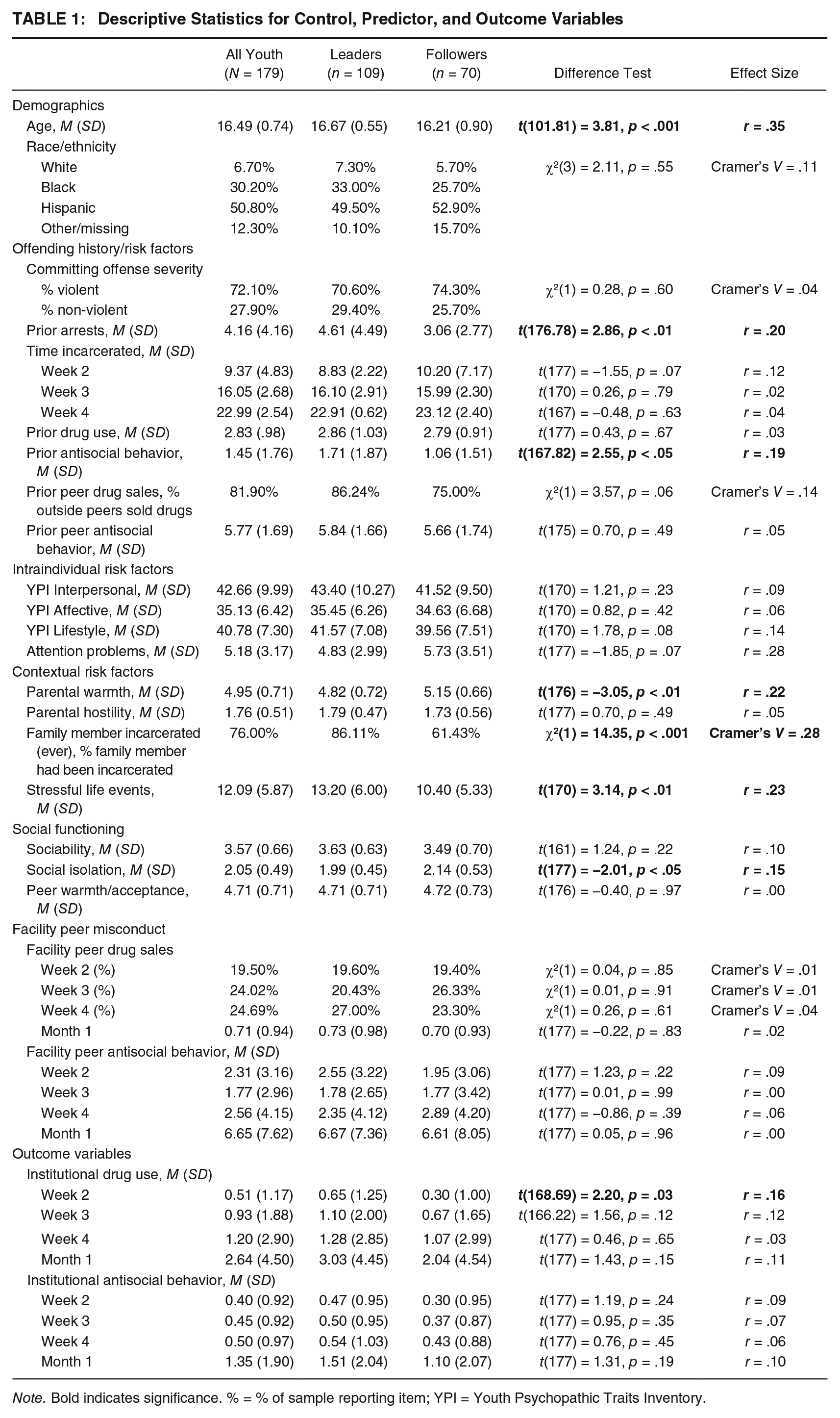
Table 1 presents descriptive information and comparisons of leaders and followers on demographic, offending history, intraindividual risk factors, contextual risk factors, and social functioning.
Descriptive Statistics for Control, Predictor, and Outcome Variables
Note. Bold indicates significance. % = % of sample reporting item; YPI = Youth Psychopathic Traits Inventory.
Demographics
The t tests indicated that leaders were, on average, older than followers by a few months. We observed no racial/ethnic differences between the two groups of youth.
Offending History and Related Risk Factors
Official arrest records indicated that leaders had more prior arrests than followers. Leaders had, on average, 1.5 more prior arrests than followers, although both groups of youth demonstrated high previous arrest rates (leaders had 4.6 prior arrests, followers had three prior arrests on average). Similarly, leaders reported a greater variety of antisocial behaviors during the past 6 months in comparison with followers.
Intraindividual Risk Factors
Leaders and followers demonstrated the same level of intraindividual functioning. In other words, leaders and followers did not differ in psychopathic traits or attention problems.
Contextual Risk Factors
Leaders reported lower levels of parental warmth and acceptance, and reported that a family member had been arrested or incarcerated more than followers. We did not find any differences in leaders’ and followers’ reports of parental hostility. Leaders reported that, on average, they had experienced three more stressful life events than followers.
Social Functioning
Followers reported higher feelings of social isolation than leaders, but there were no mean-level differences between leaders and followers in self-reported sociability or peer warmth and acceptance.
Taken cumulatively, leaders were older, had greater involvement in the justice system, had higher familial risk for behavior problems, experienced more stressful life events, and reported lower feelings of social isolation than followers.
Does Leader/Follower Status Moderate the Association between Facility Peer Misbehavior and Youth Institutional Misconduct?
Institutional Substance Use
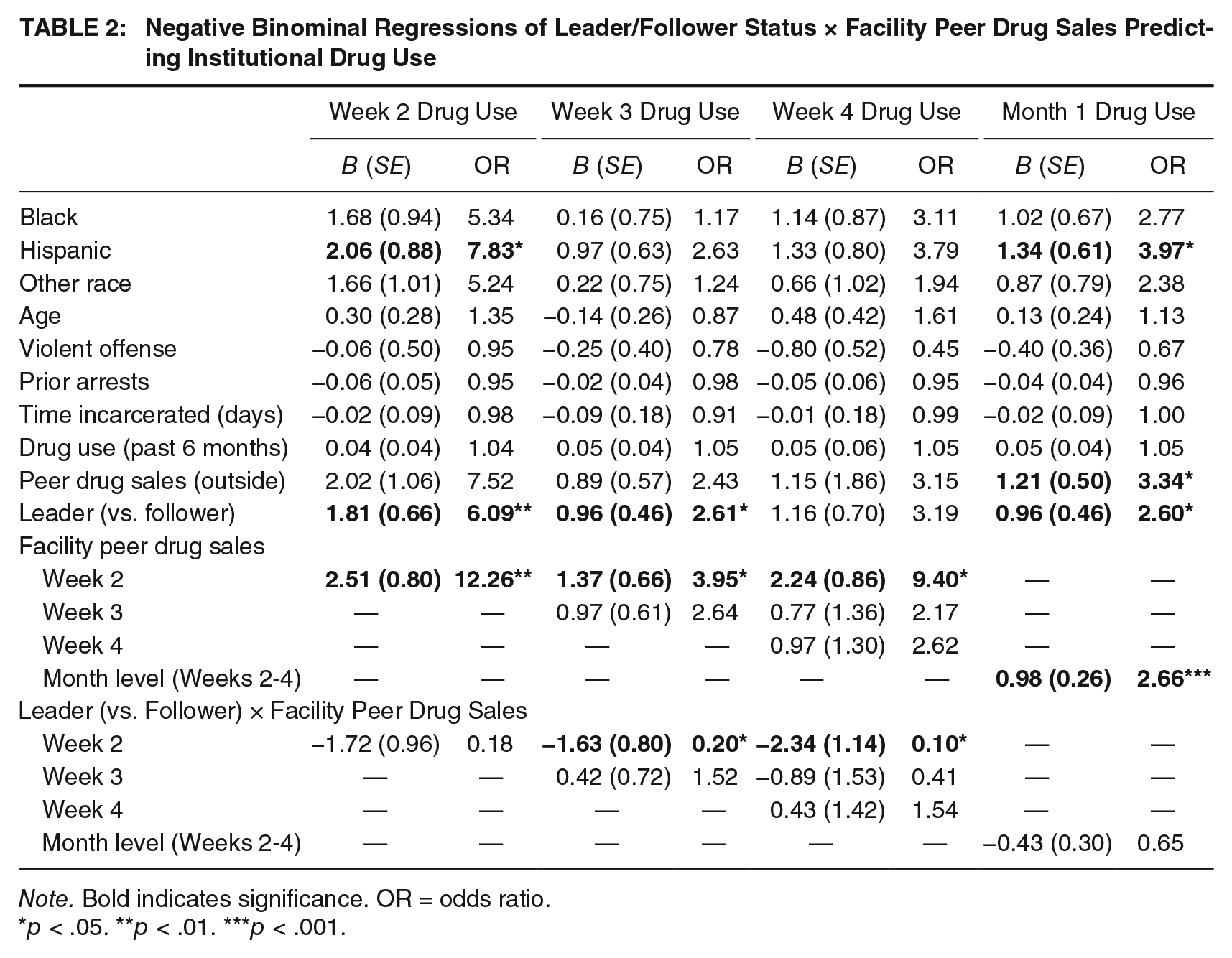
Table 2 presents the results of regression models examining the associations between facility peer drug sales, leader/follower status, and institutional substance use at Weeks 2, 3, 4, and Month 1 of incarceration. In general, institutional substance use was low, but still prevalent, with 43.6% of the youth reporting substance use at some point during their first month of incarceration. Peer drug sales prior to incarceration, acting as a leader (vs. a follower), and being of Hispanic ethnicity were positively associated with institutional substance use. Age, severity of the committing offense, prior arrests, time incarcerated, and prior substance use were unrelated to using substances in the facility.
Negative Binominal Regressions of Leader/Follower Status × Facility Peer Drug Sales Predicting Institutional Drug Use
Note. Bold indicates significance. OR = odds ratio.
p < .05. **p < .01. ***p < .001.
Across all week-level outcome variables (substance use at Weeks 2, 3, and 4), Week 2 facility peer drug sales predicted both concurrent and subsequent facility substance use. Intuitively, facility peer drug sales aggregated across the first month also predicted increases in month-level institutional drug use. Results indicated that initial exposure to facility peer drugs was the most robust predictor of youth drug use in the facility. However, Week 2 facility peer drug sales were especially influential on followers’ but not leaders’ institutional drug use at Week 3 (see Figure 1), and these differences became even more pronounced at Week 4 (see Figure 2). That is, youth who were followers in their committing group offense were more likely than youth who were leaders to report increased drug use at Weeks 3 and 4 in the context of early exposure to facility peer drug sales.
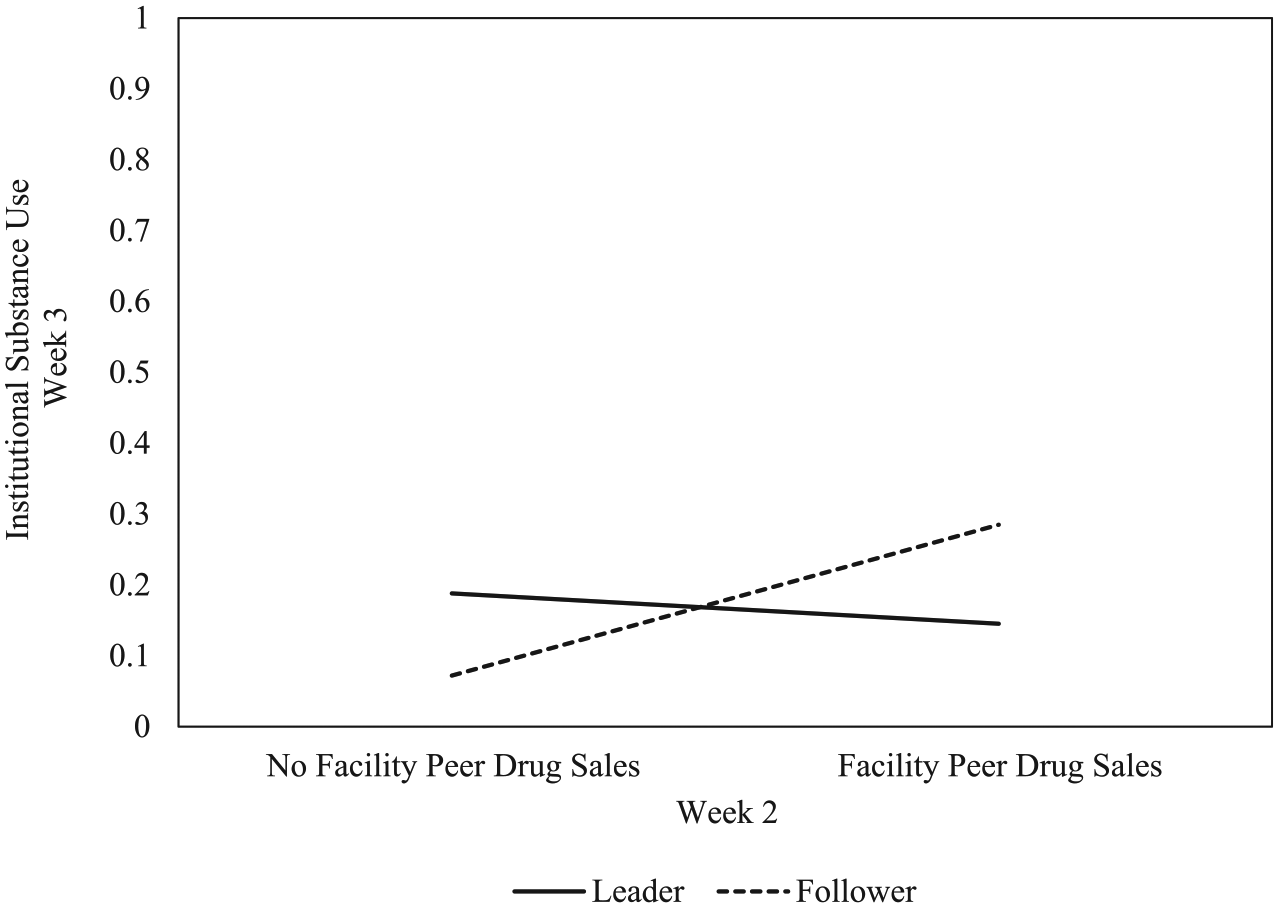
Institutional Substance Use (Week 3) Predicted by Leader/Follower Status and Facility Peer Drug Sales (Week 2)
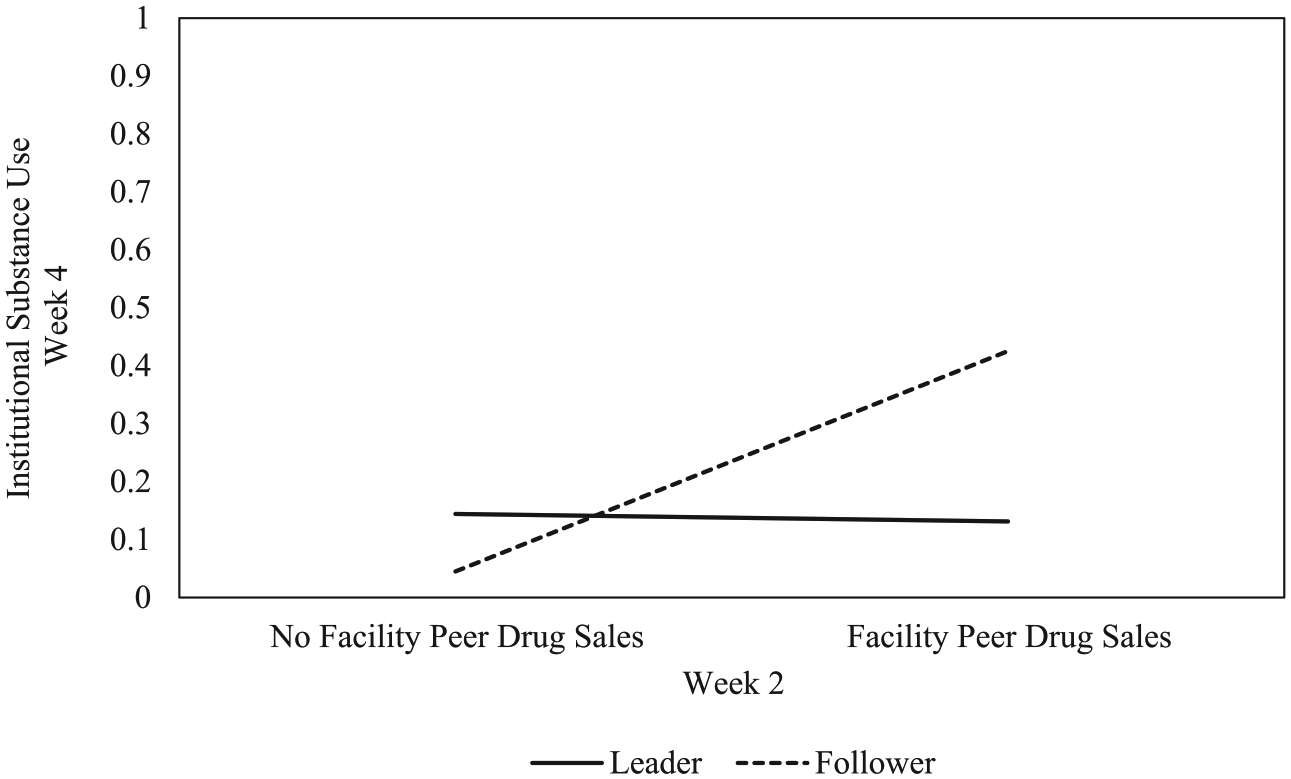
Institutional Substance Use (Week 4) Predicted by Leader/Follower Status and Facility Peer Drug Sales (Week 2)
Institutional Antisocial Behavior
Table 3 presents the results of negative binomial regression models examining the associations between facility peer antisocial behavior, leader/follower status, and institutional antisocial behavior at Weeks 2, 3, 4, and Month 1 of incarceration. Antisocial behavior was low but still existent within the facility, with 49.2% of youth reporting antisocial behavior at least once during the first month of incarceration. Greater variety of antisocial behaviors during the past 6 months predicted higher levels of institutional antisocial behavior. Race/ethnicity, age, severity of the committing offense, prior arrests, time incarcerated, and outside peer antisocial behavior were not related to institutional antisocial behavior.
Negative Binominal Regressions of Leader/Follower Status × Facility Peer ASB Predicting Institutional ASB
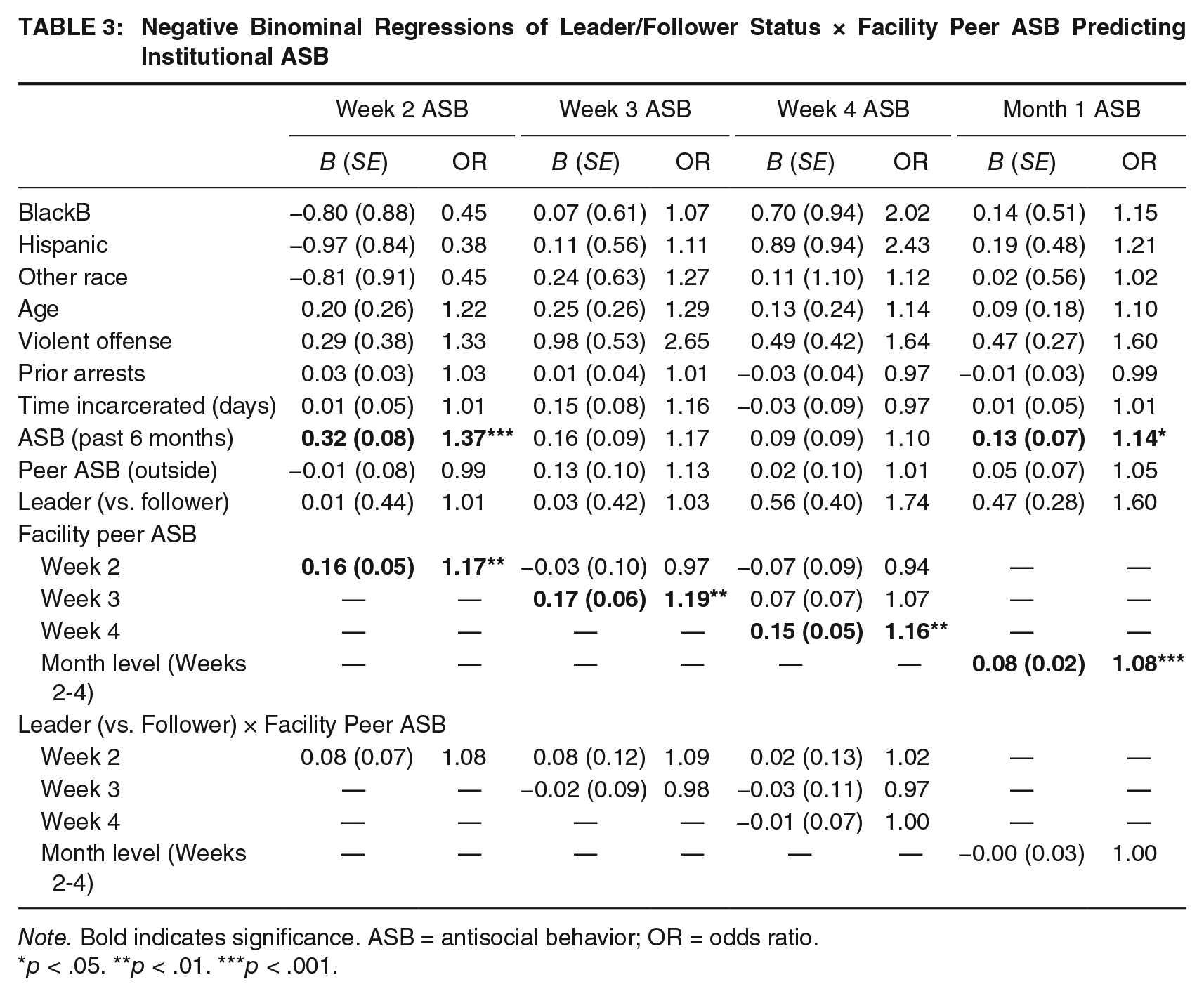
Note. Bold indicates significance. ASB = antisocial behavior; OR = odds ratio.
p < .05. **p < .01. ***p < .001.
The results indicated that facility peer antisocial behavior concurrently predicted higher antisocial behavior across Weeks 2 to 4 and at the month level. There were no interactions between leader/follower status and facility peer antisocial behavior when predicting youth institutional antisocial behavior. Essentially, facility peer antisocial behavior was a risk factor for all youth’s antisocial behavior in the facility during each week of incarceration.
Discussion
Over two decades ago, Reiss (1988) recognized the existence of leaders and followers within criminal networks, and emerging evidence suggests that leaders and followers may be distinguishable types of offenders. The present study corroborated past findings that leaders are older and more criminally experienced than followers, and significantly expanded upon them, revealing that leaders experienced greater contextual adversity (i.e., familial risk factors and stressful life events) but lower feelings of social isolation in comparison with followers. Moreover, the current results indicated that exposure to facility peer antisocial behavior predicted increased institutional antisocial behavior among all young offenders at each week incarcerated. However, in the realm of institutional substance use, acting as a follower amplified the impacts of early exposure to facility peer drug sales. Taken as a whole, leader/follower status may be an important factor to consider to provide effective treatment and to facilitate youth’s transitions to an incarceration context with all deviant peers.
An especially interesting finding from the present study was that the timing of facility peer drug sales and antisocial behavior mattered differently for youth’s institutional misbehavior. In the realm of substance use, early exposure to facility peer drug sales was detrimental for followers’ subsequent drug use in the institution but not for leaders’. In addition to followers’ susceptibility to peer influence (e.g., target youth may be buying drugs from facility peers while incarcerated), another potential explanation for this finding is that early access to substances may facilitate followers’ dependence on substances to cope with stress of transitioning to incarceration. Indeed, given that followers are less criminally experienced than leaders, it is not surprising that when asked at baseline how afraid they were to come to the facility, followers’ ratings of fear were significantly higher than leaders’ ratings, t(177) = 3.09, p < .01.
In the case of antisocial behavior, current levels of facility peer’s antisocial behavior were the most important predictors of all youth’s antisocial behavior in the facility. This finding supports previous research that finds that judicial intervention in adolescence inadvertently increases problem behavior by inducing youth involvement in delinquent peer groups (Bernburg, Krohn, & Rivera, 2006). Deviancy training, differential association, and balance theories all support the notion that immediate peers’ antisocial tendencies and behavior are strongly influential on youth’s own antisocial behavior. Moreover, to the extent to which high levels of stressful life events affect individuals’ stress responses (e.g., Horowitz, 1986), another potential mechanism may be that leaders’ (who reported 13 stressful life events) and followers’ (who reported 10 stressful life events) startle response to perceived threat may be heightened when exposed to delinquent peers each week. Cumulatively, both sets of findings suggest that staff must be attentive to facility peer relations during youth’s entire transition to incarceration and must keep a particularly watchful eye on youth who have been followers in their crimes.
Followers were expected to exhibit more problem behavior than leaders in the context of both facility peer drug sales and antisocial behavior, but this hypothesis was not supported in the realm of facility peer antisocial behavior. Instead, we found that all youth were at increased risk of institutional antisocial behavior when associating with peers who engaged in antisocial behavior. Although this finding seems to suggest that leaders and followers are similarly susceptible to facility peer antisocial behavior, we caution that the data did not specify the youth’s role in their institutional misconduct. Unlike our investigation of facility peer drug sales in which we can infer that facility peers who were selling drugs were initiating drug involvement, we are unable to disentangle youth’s role in institutional antisocial behavior. In other words, leaders and followers are offending more in the context of facility peer antisocial behavior, but it may be that leaders are initiating group antisocial behavior and followers may still be imitating peer misbehavior. Regardless of youth’s roles in institutional antisocial behavior, this finding suggests that deviant peer aggregation is a risk factor for increased antisocial behavior among group offenders in incarceration settings.
Theoretical extensions of Moffitt’s taxonomy of offending suggest that leaders, similar to life-course persistent offenders, are likely to have greater intraindividual and contextual risk for problem behavior, while followers’ problem behavior, similar to adolescence-limited offenders, is related to deviant peer affiliation. In general, our findings lend some support to Moffitt’s (1993) developmental taxonomy. Consistent with previous findings, we observed that leaders were older, had a higher number of prior arrests, and reported greater versatility of lifetime antisocial behavior in comparison with followers (McGloin & Nguyen, 2012; van Mastrigt & Farrington, 2011; Warr, 1996). Similar to contextual adversity predicting life-course persistent offender status (Moffitt & Caspi, 2001), lower levels of parental warmth, higher rates of familial incarceration, and more experiences of stressful life events were observed among leaders in comparison with followers. On the contrary, our prediction that deficits in cognitive abilities and higher levels of psychopathy would be related to leader status was not supported, perhaps indicative of the fact that while youth might be a leader for committing one offense, they may not be leaders in all offenses. It is possible that a category of exclusively criminal leaders would map more readily onto Moffitt’s conceptualization of a life-course persistent offender. Nevertheless, we do find overall evidence that leaders appear to have higher levels of contextual risk consistent with the etiological mechanisms of a life-course persistent offender. Given that adolescent-limited and persistent offenders’ delinquent peer association is posited to be comparable in adolescence, we find greater support for Moffitt’s theoretical taxonomy mapping onto leader/follower status from our finding that leaders and followers report similar levels of deviant peer affiliation.
One important finding from the current study is that followers report greater feelings of social isolation during the initial periods of incarceration in comparison with leaders but not lower levels of sociability nor peer warmth and acceptance. This perhaps reflects greater difficulty adjusting to juvenile incarceration rather than poorer social functioning. In other words, followers’ social functioning deficits may be an artifact of the stress from recent incarceration, particularly if followers are less criminally experienced and thus less accustomed to incarceration contexts. Given that youth involved in the justice system are at an increased risk for mental health issues, and that the stress of incarceration has been found to exacerbate these mental health problems (Grisso, 2004; Toch, 1977; Zamble & Porporino, 1988), it is particularly important to identify youth who are vulnerable to internalizing problems early in the incarceration period. Loneliness, compounded with the stress of an all-delinquent peer context, may make it especially important to keep a watchful eye on followers to ease their transition. It is important to note that social functioning variables were assessed at different times during incarceration (social isolation at baseline, sociability at Week 2, and peer warmth and acceptance at Week 4), and youth’s functioning may be influenced by the time spent locked up. However, it is logical to assume that social isolation is more likely to be affected by incarceration status than sociability and peer warmth and acceptance. Indeed, sociability has been found to be relatively stable across adolescence and adulthood in adjudicated men (Morizot & Le Blanc, 2003). Furthermore, our measure of peer warmth and acceptance may be more reflective of peer relationships on the outside or at least consistent with peer relationships on the outside.
While the present study was concerned with how being a leader or follower of group crime was associated with institutional misconduct, we also find it important to comment on other youth characteristics that were and were not predictive of youth’s institutional misbehavior. First, we found it interesting that the effect of leader/follower status on youth’s institutional drug use was strong initially at Week 2 but waned over youth’s incarceration transition. Furthermore, it was notable that outside peer drug sales were not significantly associated with youth institutional drug use, with the exception of Month 1 drug use. It is likely that the Week 2 and Week 3 effects of leader/follower status were driving the main effect on the entire month, and that the effect of outside peer drug sales was too weak to predict any single week of institutional drug use but emerged for the entire month. In a similar way, we found that peer antisocial behavior prior to incarceration was not related to youth’s institutional antisocial behavior. Taken together, this suggests that youth’s immediate peer context may be the strongest predictor of youth’s own misbehavior. Indeed, this maps on to the theoretical perspectives mentioned previously, specifically that youth’s immediate peers provide reinforcement for delinquent behavior (Dishion et al., 1996; McGloin, 2009). Second, prior substance use was not predictive of institutional drug use. It is possible that youth with severe substance abuse problems were identified at their initial entry to incarceration, and consequently received facility services. Indeed, we found that past substance use was positively associated with the number of facility services youth received during the second week of incarceration, r = .15, p < .05. Finally, while a previous investigation of incarcerated juveniles found that younger youth and Black youth (in comparison with youth of other race) engaged in higher levels of institutional misconduct over a 24-month incarceration period, we did not find evidence in the present study for these associations (DeLisi et al., 2010). These non-findings may be due to our restricted age range (14-17 vs. 12-20 years), shorter study period (1 vs. 24 months), and different racial reference group (White vs. Other race). Given that DeLisi et al.’s (2010) sample was drawn from the same institution as the present study’s group of offenders, it is possible that these effects may appear if a wider age range of youth were included and were followed over a longer period of time.
As a whole, the observed differences between leaders and followers have important implications for the risk and needs assessments of serious juvenile offenders who commit crimes in groups. Practitioners should consider that youth who report being leaders of group crime may lack positive, supportive familial bonds that are important for decreasing continued antisocial behavior (Henggeler, Melton, Smith, Schoenwald, & Hanley, 1993). Therefore, to improve the behavioral outcomes of leaders, it may be especially important to engage leaders’ families in treatment, as well as connect youth to other caring, supportive, perhaps non-familial adults. Followers, on the contrary, may need to be monitored for developing internalizing symptoms and taught positive coping skills during the transition to incarceration. Indeed, in addition to followers reporting higher levels of social isolation than leaders at baseline, data revealed that more followers were above the clinical cutoff for depression (assessed by the Center for Epidemiologic Studies Depression Scale), χ2(1) = 4.72, p < .05, supporting the notion that followers are at risk for internalizing problems. Taken together, while both leaders and followers are at risk for continued maladaptive behavior in multiple domains, professionals in the justice system may wish to draw their attention to the most salient issues that are associated with these criminal roles.
Among the strengths of this study were its prospective nature, the variety of measures available to investigate characteristics related to acting as a leader or follower, and our ability to control for selection effects. More specifically, our week-by-week assessments allowed us not only to infer the impacts of peer behavior in incarceration settings but also to examine how timing of exposure to facility peers factors into predicting institutional behavior. Thus, the design of the study allowed us to make inferences concerning when incarceration experiences are most influential during the transition to a juvenile incarceration facility. In addition, the study assessed youth across multiple domains, allowing us to test a variety of correlates of acting as a leader or follower. This allowed the current study to significantly expand upon the previously tested factors of demographics and offense characteristics. With respect to selection effects, we made sure to control rigorously for factors that may be related to our outcome of interest, institutional misbehavior. In addition to controlling for demographic characteristics and previous juvenile justice involvement, we included controls that measured the independent variable (i.e., peer antisocial behavior) and the dependent variable (i.e., antisocial behavior) prior to incarceration. By controlling for these factors, we are confident that we found meaningful effects of facility peer misbehavior on youth’s institutional misconduct.
Despite our study’s core strengths, there were some limitations. First, we were unable to determine the stability of leading or following adolescent group crime. Our data only allowed us to examine differences in correlates and institutional adjustment among youth who acted as a leader or follower in one group offense. Interestingly, however, when asked if youth commit more crimes with others or alone, leaders reported committing more crimes alone on average, while followers reported committing more crimes with others, χ2(1) = 8.10, p < .01, suggesting that followers’ criminal activity may, indeed, be more peer driven across offenses. Another important limitation of our leader/follower measure to consider was that social desirability bias might influence youth to report that they were leaders rather than followers. However, we found no mean differences in leaders’ and followers’ self-reported grandiosity, t(170) = 1.60, p = .11, suggesting that, at least for this study, a grandiose sense of self was not driving youth’s self-reported roles as a leader or follower in their committing offense. Furthermore, our results were able to replicate previous findings (McGloin & Nguyen, 2012; van Mastrigt & Farrington, 2011; Warr, 1996), suggesting that even one measure of leader/follower status can offer insight into the correlates and consequences of acting as a leader or follower during group offending. Still, future studies may wish to reference youth’s full official and self-reported criminal history with respect to their roles in adolescent offending, or examine the action of instigation or following rather than the trait of being a leader or follower.
A second limitation of the current investigation was the study’s sample characteristics, particularly that the modest size, inclusion of only male offenders, and makeup of predominantly serious juvenile offenders (e.g., 72.0% of committing offenses were violent offenses, 83.2% of young offenders had been arrested prior to the study) may limit the generalizability of our findings. However, we suspect that our findings, particularly the correlates of leading and following group crime, may be corroborated in samples of female offenders, given that life-course persistent antisocial females are characterized by greater contextual risk (like leaders) in comparison with adolescent-limited antisocial females (like followers; Odgers et al., 2008). It also stands to reason that our findings, which were derived from a sample of predominantly violent offenders, may map on to samples of non-violent offenders, given that violent and property co-offending follow similar developmental trajectories (Stolzenberg & D’Alessio, 2008). Still, it is important for future research to examine these specific research questions among lower level and female offenders to ensure that the study’s pattern of findings is consistent across a variety of youth involved in the justice system.
A third limitation to the present study was that all of our measures were self-report assessments, with the exception of youth’s prior arrest history and the violent offending history. We acknowledge the limitations of the facility peer misbehavior and institutional misconduct variables in particular. With respect to peer deviancy, researchers have cautioned that adolescents misinterpret the level of their peers’ delinquency, with some individuals overestimating and others underestimating their friends’ deviant behavior (Young, Barnes, Meldrum, & Weerman, 2011). However, perceptions of peer delinquency have been found to be more strongly related to youth delinquency than objective measures (e.g., peers report on their own delinquency; Weerman & Smeenk, 2005), and it may matter more what youth believe to be true about their peers’ delinquency rather than what is true. Regarding youth’s own delinquency, it is possible that youth do not fully disclose their misbehavior, and some researchers argue that youth may have trouble reporting on the frequency of their behaviors accurately. Still, we have confidence in our youth delinquency variables given that they were reported within a week of their occurrence. Furthermore, official reports are typically correlated with youth reports and may even underestimate youth misbehavior (i.e., official records are only when youth get caught; Brame, Fagan, Piquero, Schubert, & Steinberg, 2004). In addition, institutional drug use is likely to be more covert than youth antisocial behavior (i.e., fighting), and thus less probable to be reported in official records. In sum, although future studies may wish to include multiple informants in their designs, we are confident that our measures allowed for an accurate examination of peer processes within juvenile incarceration settings.
Finally, although we found that followers have lower risk for behavioral problems, followers’ level of risk for misconduct is relative to leaders. It is important to consider that followers still had high rates of familial incarceration and previous involvement in the juvenile justice system. Thus, assuming that followers have no risk for continued adolescent offending net of deviant peers would be unwise. Future studies may wish to include a normative group of adolescents to determine the level of risk among adolescent group offenders in comparison with typically developing youth.
We highlight three points from this investigation. To intervene with serious group antisocial behavior, we suggest that practitioners consider the differential correlates that are associated with leading or following adolescent group crime, particularly leaders’ lack of positive familial bonds and followers’ risk for internalizing symptoms. Second, followers may be particularly vulnerable to certain types of facility peer misbehavior, and these peer interactions may be especially impactful at followers’ arrival to juvenile incarceration. Finally, although youth imitators of crime may be especially susceptible to the forces of deviant peer socialization, we caution peer aggregation of all youthful offenders who commit crimes in groups and suggest heightened vigilance of peer interactions during young offenders’ time in confinement.
Footnotes
Funding for this study was provided to Elizabeth Cauffman, PhD, from the National Institute of Mental Health (K01MH01791-01A1) and from the Center for Evidence-Based Corrections at the University of California, Irvine.