







Abstract
For a sample of 396 women on probation and parole, this article presents the results of qualitative analysis that shows the nature of violence for a subgroup of 75 women who were convicted of a violent act. For the full sample of 396, the article also presents results of quantitative analyses that identify correlates of violent behavior. Women’s violent acts were most often assaults on people who were not intimate partners. Second and third most common violent acts were for assaults of an intimate partner and robbery, respectively. Quantitative analysis revealed that history of adult abuse and anger predicted violence. The effect of abuse on violent behavior was partially mediated by anger. Intercorrelations between anger, mental health problems, histories of being abused, and current substance abuse suggest the efficacy of assessing these attributes so that programming can provide individualized interventions that address co-occurring problems.
Recent growth in the proportion of women incarcerated for a violent offense (e.g., assault, robbery, homicide), now nearly 40% of women prisoners (Carson, 2015), has increased research interest in that population (Coid, Kahtan, Gault, & Jarman, 2000; Kubiak, Kim, Fedock, & Bybee, 2013; Pollock, Mullings, & Crouch, 2006). In contrast, little is known about the prevalence and type of violence committed by the much larger group of women sentenced to probation (Kaeble, Glaze, Tsoutis, & Minton, 2015), or by women released from prison to parole. Probation and parole agents and treatment program staff who serve this population would benefit from increased knowledge of whether their clients engage in violence and, if yes, its nature and correlates. This information can suggest appropriate programs for referrals and will add to descriptive and theoretically relevant literatures on women and crime.
Although not specific to violence of women in community supervision populations, research on general population, birth cohort, and prison samples identifies predictors of women’s violent behavior, including childhood and adult victimization histories, substance use, anger, posttraumatic stress disorder (PTSD), depression and anxiety, and other types of mental illness (Kearney, Wechsler, Kaur, & Lemos-Miller, 2010; Kessler, Sonnega, Bromet, Hughes, & Nelson, 1995; Kiser, Heston, Millsap, & Pruitt, 1991; Nicholls, Cruise, Greig, & Hinz, 2015; Ozer, Best, Lipsey, & Weiss, 2003). Some research using an alternative theoretical framework has identified distorted thinking as contributing to violence (e.g., Walters & Cohen, 2016). Taking yet another perspective, a few studies identify neighborhood crime and disorganization as conducive to women’s use of violence to signal they will fight back against others or because violence is normalized in such settings (e.g., Brunson & Stewart, 2006; Silver, 2001). A goal of the present study is to examine whether these types of background, psychosocial, and contextual variables are associated with violent behavior for women on probation and parole, in particular, women who have substance abuse involvement. Substance-involved women are of particular interest because they constitute the majority of women who are in conflict with the law (Daly, 1994; Morash, 2010; Mumola & Karberg, 2006).
The literature review that follows first describes what is known about the nature of violence by women. Then, it presents research evidence of individual characteristics and neighborhood contexts associated with women’s violence in both correctional and general population studies. We also present findings from studies of women’s violence during incarceration. Due to the unique circumstances of prison (e.g., McCorkle, Miethe, & Drass, 1995; McGuire, 2006; Shaw, 1999; Steiner & Wooldredge, 2009; Useem & Piehl, 2006), findings about violence in prison may not fully generalize to community settings; still, they may provide some insights into violence by women on probation and parole.
The Nature of Violence by Women
Few studies have described the range of violent acts and related motivations for samples of women offenders. As one exception, interviews with 205 women in a Minneapolis detention facility elicited qualitative accounts of 106 violent crimes (Kruttschnitt & Carbone-Lopez, 2006). Contradicting a common assumption that much of women’s violence is self-defense directed at an abusive intimate partner, study participants in the detention sample described a wide range of reasons for violence. Nonintimate partner incidents were responses to perceived disrespect, efforts to obtain restitution or compensation for a perceived wrong, and self-defense. Other violence occurred during crimes committed to obtain valuables or money. In a study of New York City women who had committed a violent street crime, Sommers and Baskin (1993) similarly found from interviews, reviews of official criminal history records, and observations that the women’s motivations varied and included self-defense and efforts to protect public self-concepts as “tough.” Finally, a survey of 866 women incarcerated in U.S. state prisons in 2004 showed that most violent offense convictions involved harm to a relative or intimate partner, women rarely used weapons, and when they did, it was often in self-defense (Willison, 2016). The small number of studies demonstrates that research has not adequately explored the nature and range of violent actions for samples of women who are supervised in the community. The studies also demonstrate that women in various criminal justice settings (e.g., detention, prison) report different types of violence, and that different data sources provide alternative insights into women’s violence.
Explanations of Women’s Violence
In the present research, three theoretical explanations guide the choice of potential predictors of women’s violence. First, one explanation identifies early childhood trauma as promoting mental health disorders, substance abuse, and anger, which in turn lead to violence (Herman, 1997; Kubiak et al., 2013). This explanation is consistent with the high degree of co-occurrence of histories of childhood and adult abuse, PTSD, substance abuse disorders, and other mental health problems among women who have broken the law (McDaniels-Wilson & Belknap, 2008; McHugo et al., 2005; Messina & Grella, 2006; Sacks, 2004; Salina, Lesondak, Razzano, & Weilbaecher, 2007; Scott, Dennis, & Lurigio, 2015; Thomas, 2005). The trauma/anger-centered explanation is relevant to practice, because it identifies the need for assessments and interventions that address trauma and anger among women who have committed violent acts (Covington, 2013; Eamon, Manchua, & Reddon, 2002; Kubiak, Fedock, Tillander, Kim, & Bybee, 2014; National Institute of Corrections, 2013; Van Voorhis, Bauman, & Brushett, 2012, 2013). Yet, many assessment tools and programs pay little or no attention to women’s anger and its relationship to their traumatic or violence-ridden life histories (Fedock, 2015; Tripodi, Bledsoe, Kim, & Bender, 2011).
A second explanation is that a pattern of distorted thinking (often called thinking errors or antisocial attitudes) accounts for violence (Walters & Cohen, 2016). Examples of distorted thinking include justification and rationalization of illegal behavior and minimization of the offender’s behavior and harm to victims. The distorted thinking explanation is also relevant to practice, because it is the basis for widespread use of programs aimed at correcting offenders’ criminal thinking (National Institute of Corrections, 2014).
A third explanation identifies high-crime neighborhood contexts as a cause of women’s violence (Baskin & Sommers, 1998; Brunson & Stewart, 2006). This ecological approach has received limited attention in the literature and in practical application. Because many women on probation and parole live in high-crime areas (Cobbina, Morash, Kashy, & Smith, 2014), this potential influence should be examined in research and, if predictive, addressed in practice.
Next, we present the empirical support for the above-noted explanations of women’s violence. Many studies considered just one link in a chain of theorized influences, so we organize this review according to the major links. The research evidence was the basis for our expectation that at the start of community supervision, compared with other women, those who engage in violence have more serious histories of abuse and current mental illness and substance use, and higher levels of anger and antisocial attitude. We also expected that compared with other women supervised in the community, those with antisocial attitudes and who lived in high-crime neighborhoods would have more evidence of using violence.
Abuse History and Violence
Research on both women in prison and prospective studies of individuals maltreated as children support a link between childhood abuse and women’s violence. For incarcerated women in several states (Texas, Michigan, and Oklahoma), histories of childhood and adult victimization were related to their violence in the community (Byrd & Davis, 2009; McClellan, Farabee, & Crouch, 1997; Rivera, Kubiak, & Bybee, 2014). Also, women in federal prison in 1991 and 1997 with more serious abuse histories acted more violently than others while they were incarcerated (Steiner & Wooldredge, 2009).
In prospective research, Widom (1989) found that individuals with court findings of child abuse or neglect (CAN) were more likely than other adults to be convicted for a violent crime. Additional research (four interviews 22-30 years after the court case plus arrest data) with the same participants revealed that, net of the effects of control variables (i.e., parental substance use and arrest, childhood poverty, and ethnicity), adult women in the CAN group were at significantly higher risk of both substance abuse disorders and arrests for violent crimes (Widom, 2014; Widom & White, 1997). For women (and men) who had lived with an intimate partner, CAN predicted violence against the partner (White & Widom, 2003; also see Hendy et al., 2003; Millett, Kohl, Jonson-Reid, Drake, & Petra, 2013). Finally, a secondary analysis of the data found a stronger relationship between CAN and arrests for violence for women than men (Makarios, 2007). Thus, the connection of abuse history to later violence appears to be especially well documented and strong for women.
Additional Negative Effects of Child and Adult Abuse
Co-occurrence of women’s violence with substance abuse, anger, and mental illness may result because these characteristics also stem from child abuse. Briere and Jordan (2009) summarized several studies showing that child maltreatment is followed by undesirable cognitive effects (e.g., self-blame, preoccupation with danger), mood disturbances (especially anxiety and depression), identity disturbances, and chronic difficulties relating to other people (e.g., distrust). These findings agree with an earlier meta-analysis of 38 studies of the relationship between child sexual abuse and adult women’s psychological problems (Neumann, Houskamp, Pollock, & Briere, 1996), studies linking child abuse to PTSD that persists into adulthood (Kearney et al., 2010; Kessler et al., 1995; Kiser et al., 1991; Ozer et al., 2003; Widom, 1999), and a mixed-gender population survey (Springer, Sheridan, Kuo, & Carnes, 2007). Especially in combination with child abuse, abuse and victimization during adulthood appear to promote mental illness and substance abuse (De Bellis, 2012; Kendler et al., 2000; McClellan et al., 1997; Schuck & Widom, 2001; Swan, Gambone, Fields, Sullivan, & Snow, 2005; Wilson & Widom, 2009).
Mental Illness and Violence
Mental illness, including substance abuse disorders, is associated with women’s violence. Multiple studies (Dutton, Hohnecker, Halle, & Burghardt, 1994; Leisring, Dowd, & Rosenbaum, 2003; Sullivan, Meese, Swan, Mazure, & Snow, 2005) find that women who act aggressively against an intimate partner have high rates of substance abuse disorder, PTSD, and other mental illnesses. Widom and colleagues’ research (Widom, 2014; Widom & Czaja, 2012) confirms that especially for women, CAN is followed by PTSD and internalizing disorders (e.g., anxiety, depression), which predict violence. The co-occurrence of substance abuse and other mental health disorders further increases risk of violence committed in the community (Monahan et al., 2001; Steadman et al., 1998) and in prison (Martin, Eljdupovic, McKenzie, & Colman, 2015).
Anger and Violence
Verona and Carbonell (2000) concluded from a literature review that women’s violence typically involves angry aggression, whereas men’s violence is often instrumental (e.g., to gain valuables [as in a robbery]) or to exert control. A causal sequence that links abuse to anger, and then anger to violence is supported by research on college students (Kendra, Bell, & Guimond, 2012; Taft, Schumm, Orazem, Meis, & Pinto, 2010), adult women (Swan et al., 2005; Widom, 2014), and war veterans (McFall, Fontana, Raskind, & Rosenheck, 1999; Orcutt, King, & King, 2003). The finding of the link of anger to violence across very different samples provides strong evidence for a persistent association. In one study, women’s suppressed anger fully mediated the effect of childhood abuse on the use of violence against an intimate partner (Maneta, Cohen, Schulz, & Waldinger, 2012). White and Widom (2003) similarly found that anger (along with antisocial personality disorder and alcohol problems) mediated the connection of CAN to women’s violence against an intimate partner. Supporting these findings, Verona and Carbonell’s (2000) study of incarcerated women showed that compared with repeatedly violent women and women with no record of violence, those who had committed one very serious violent act scored much higher on a measure of repressed anger. In sum, research repeatedly demonstrates that anger has a role in promoting some women’s violence. Anger may even explain why abuse history is related to violence, because abuse history leads to difficulty regulating emotions such as anger (Briere, Hodges, & Godbout, 2010; Cloitre, Miranda, Stovall-McClough, & Han, 2005; Maughan & Cicchetti, 2002), and this disrregulation leads to the use of violence (Berthelot et al., 2014; Murdoch, Vess, & Ward, 2012).
Antisocial Attitudes and Illegal Behavior
Apart from the above reviewed literature, research identifies antisocial attitudes and beliefs and related thinking styles as risks of criminal behavior (Andrews et al., 2012; Rettinger & Andrews, 2010; Walters, 2016). Most of this research concentrates on illegal behavior in general rather than women’s violence in particular. Some studies specifically find that antisocial attitudes predict women’s recidivism (Andrews et al., 2012; Palmer, Hatcher, McGuire, & Hollin, 2015; Palmer & Hollin, 2007; Rettinger & Andrews, 2010; Walters & Cohen, 2016; Walters & Elliott, 1999) and various mental health problems (Scott et al., 2015). However, contradictory research finds no connection of women’s criminal attitudes to their recidivism or documents women offenders’ low incidence of antisocial attitudes (Reisig, Holtfreter, & Morash, 2006; Rettinger & Andrews, 2010; Van Voorhis, Wright, Salisbury, & Bauman, 2010). The inconsistency creates a need to further investigate the connection between antisocial attitudes and violence by women on probation and parole.
Neighborhood Crime and Violence
A few studies find that high-crime, disorganized neighborhoods promote women’s violence. A series of analyses summarized by Silver (2001) showed that after controlling for drug abuse, anger, and mental illness symptoms, neighborhood disorganization predicted the use of violence in the year after women (and men) were released from psychiatric hospitals. Although women were less violent than men, those in highly disorganized areas exhibited more violence than men in better-off neighborhoods (Silver, Mulvey, & Monahan, 1999). Data analyses for community samples also document that girls and women in high-crime areas use violence to reduce their risk of victimization or to fight back when they are victimized (Brooks-Gunn, Duncan, Klebanov, & Sealand, 1993; Brunson & Stewart, 2006; Ingoldsby & Shaw, 2002; N. Jones, 2010; Molnar, Browne, Cerda, & Buka, 2005; Ness, 2004). Sommers and Baskin (1997; Baskin & Sommers, 1998; also see Cobbina, Like-Haislip, & Miller, 2010; Miller & Mullins, 2006) provided complementary evidence for the finding that New York City women with histories of violence were influenced by living in neighborhoods where violence was a way of life, and where some people made a rational decision to routinely use violence in their interactions with others. Despite these findings, research has rarely considered neighborhood context simultaneously with individual risk factors as an influence on women’s violence.
Research Questions
For a sample of women on probation and parole, our aim is to describe the nature of violence and to identify the characteristics of the women who use violence. Prior studies have found differences between one-time and repeatedly violent women (Bell, 2004; Kubiak et al., 2013; Mahoney & Karatzias, 2012; Pollock et al., 2006; Verona & Carbonell, 2000); thus, we compare women with zero, one, and multiple indicators of violence. We also examine our measure of violence as a quantitative variable in which higher numbers indicate stronger indication of violence. We addressed one research question with qualitative analysis of the violent incidents the women described in their accounts of the crimes that led to their current convictions:
Quantitative analyses were used to address the following four questions:
We expect that child and adult abuse history, substance abuse, depression/anxiety, anger, paranoia and hallucination symptoms, PTSD, and high-crime neighborhoods will be characteristic of women with high indications of violence. We also investigate the connection of antisocial attitudes to women’s violence.
Method
Data
Data are from a longitudinal study of 402 women on probation (n = 305) or parole (n = 97). The analyses used data collected in two face-to-face interviews conducted between 2011 through 2013 and from official court data on convictions for violent acts. The qualitative data were collected at the first interview at the start of women’s terms of probation or parole, and those data included women’s descriptions of details of the offense resulting in probation or parole. The quantitative data were from the face-to-face interviews and from official court data on convictions.
Sample
The data are from a study designed to provide information on a large contemporary sample of women on probation and parole. It was restricted to substance-involved women, who constitute the most typical subgroup of women offenders (Daly, 1994; Mumola & Karberg, 2006). Although this aspect of homogeneity of the sample limits generalizability of the findings to other groups (e.g., women with no substance use), it does reduce some variability in responses which, along with the relatively large sample size, allows us to identify small to moderate effects.
In 2011, one of the authors first recruited 73 probation and parole agents from 16 Michigan counties within 1½-hr driving distance from the project office. These counties, where 68.5% of the 2011 state population lived, include the two largest cities in the state and a mix of smaller cities, suburbs, and rural areas. In Michigan, agents specialize in working with women. Parole agents were oversampled so a variety of women would be included in the sample. The final sample of women offenders included 25% on parole. According to Kaeble and Bonczar (2016), of women supervised in the community, just 10% are on parole. 1 The overrepresentation of women on parole in the present sample provided an adequate number for the generation of descriptive statistics for both women on parole and for those on probation.
In a second step, an author met with each agent to list 846 eligible clients. Eligibility required starting supervision approximately 3 months prior to the first interview, a history or current indication of substance misuse, and a current felony conviction. Staff employed and trained by the research project explained human subjects’ rights and protections and enrolled participants. Probation and parole agents assisted by introducing women to on-site interviewers, giving women contact information for the study, or obtaining permission to share women’s contact information with research staff.
Not all 846 eligible women took part because research staff were not on site when they reported and they neither responded to flyers nor gave supervising agents permission to share contact information. Participants and nonparticipants did not differ significantly in official records of substance use, violations in 18 months, and convictions in the year after supervision started. Nonparticipants were slightly but significantly more often incarcerated at the end of 1 year.
Participant Characteristics
Because a purpose of this article is to inform probation and parole officers of violence-related characteristics of the women they supervise, we describe the characteristics of women on probation and parole separately when there are statistically significant differences. Six women (2.2%) had missing data for the present analysis, so we describe the remaining 396 women. Women on probation (301, 76.0%) and those on parole (95, 24.0%) did not differ in racial/ethnic identification, with 46.2% (183) describing themselves as White, 33.3% (132) as Black, and 19.2% (76) as Hispanic, Native American, or multiracial. Five women did not specify a racial/ethnic group identification. At the start of supervision, significantly more of the women on parole reported annual income of less than US$10,000 (97.8%, 91 on parole, and 81.1%, 231 on probation, χ2 = 15.68, df = 1, p < .001). Women on parole were significantly more likely to have a current conviction for a violent offense (27.4%, 26 of those on parole vs. 16.6%, 50 of those on probation, χ2 = 5.39, df = 1, p = .020). Table 1 presents additional comparisons. As would be expected, women on parole were on average older and had more prior convictions, including more for violent crimes. Only one variable hypothesized to be related to violence was significantly different for probationers and parolees, and that was anger and hostility, which was higher for women on probation.
Characteristics of Participants on Probation Versus Parole
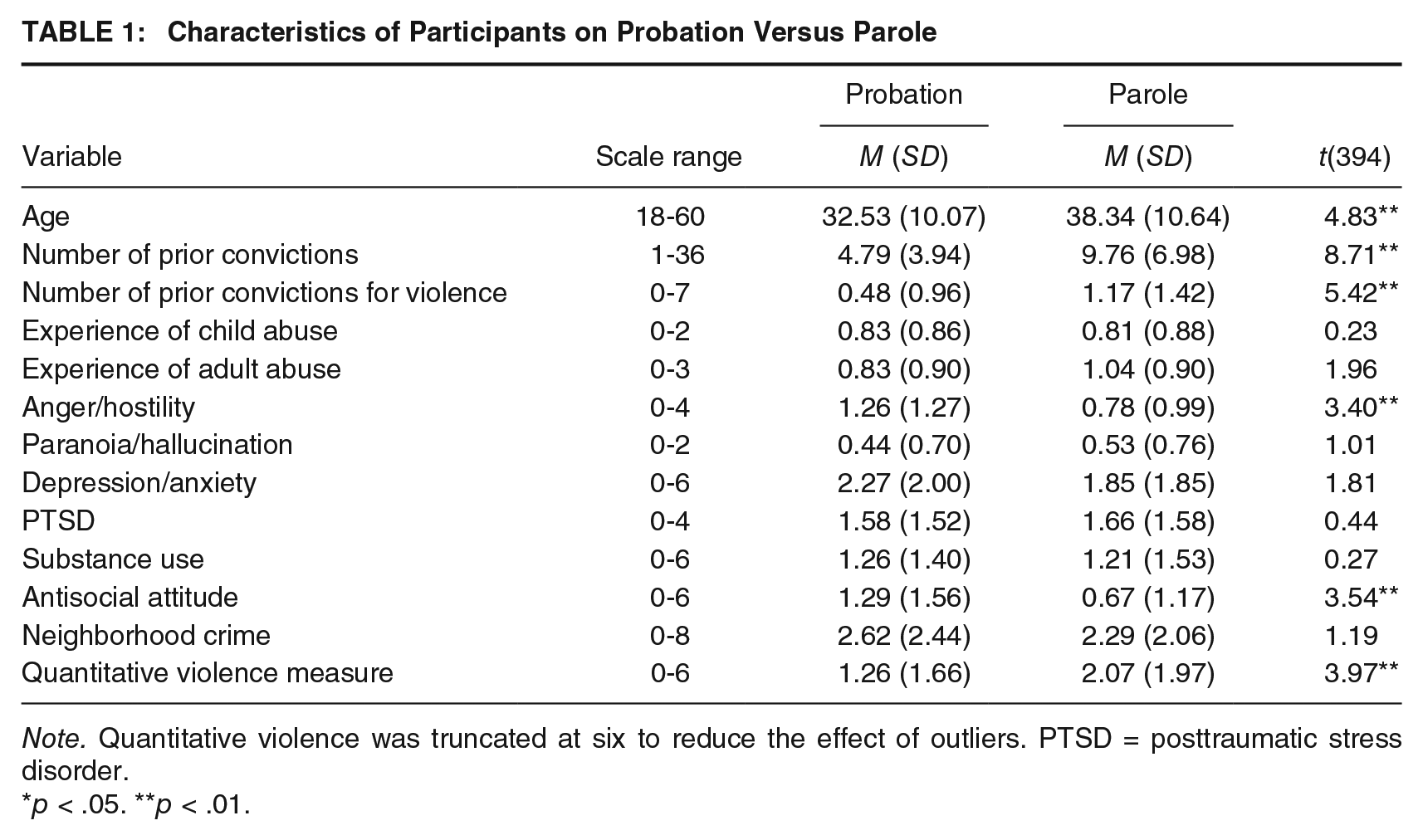
Note. Quantitative violence was truncated at six to reduce the effect of outliers. PTSD = posttraumatic stress disorder.
p < .05. **p < .01.
Procedure
The Michigan State University Institutional Review Board (IRB) approved all protocols. Trained interviewers carried out face-to-face interviews with each woman starting approximately 3 months after the beginning of supervision and then 6 months later (referred to as the first and second interview). Interviews took place at private locations convenient to participants, including offices at reporting centers and quiet areas in coffee shops. Incentives were gift cards for US$30 for the first interview and US$75 for the second interview. Responses to open-ended questions were audio recorded with permission and transcribed so they could be analyzed in NVIVO software. Responses to closed-ended questions were entered directly into a computer. At the first interview, interviewers administered the Women’s Risk/Needs Assessment (WRNA; Van Voorhis, Salisbury, Wright, & Bauman, 2007; Van Voorhis et al., 2010), which elicits a detailed description of the current offense and assesses several recidivism risks. Also at the first interview, the interviewer asked questions about neighborhood crime and at both interviews, questions about hitting or hurting someone in the past 3 years or since the first interview. In addition to interviews, a state database provided information on the crimes for prior convictions.
Measures
Qualitative Description of Women’s Violence
Study participants responded to open-ended WRNA questions about the nature and circumstances of their current conviction. Questions were about the offense leading to the conviction, events leading to the arrest, and whether anyone was hurt. The first two authors reviewed these responses and independently coded them as indicating a violent or a nonviolent act, discussed the codes, and resolved the few differences. Seventy-five women in total described a violent offense. Because women only provided a description of the crime resulting in the current conviction, not all women with official or self-report data indicating violence described an incident. Two authors categorized the 75 descriptions as one of the following: physical assault of a person other than an intimate partner, physical assault of an intimate partner, robbery, causing death or injury due to driving while impaired, homicide, and other. They also coded three common themes in the data: whether the assault was of a police officer, whether an assault was in self-defense, and whether women indicated that robberies were due to drug addiction. Cohen’s kappa (Cohen, 1960) was used to assess intercoder reliability with two coders for 25 cases (k = .932).
Women’s Violence
Because official records of arrests and convictions omit uncaught violence, we follow the recommendation of other researchers, to differentiate women on a combination of self-report and official measures of violence (Byrd & Davis, 2009; Kubiak et al., 2013; Pollock et al., 2006). The number of indicators of violence was the sum of the number of prior convictions for violence, the number of new convictions for violence in 36 months after the first interview, the current offense being violent, affirmative answers to four questions about prior violent offenses, and hitting or hurting other people. The sum of the indicators of violent acts ranged from 0 to 22. However, we found that the distribution of this variable was highly skewed such that for scores of 0 through 5, there were at least 22 women for each score, but there were only eight women with scores of 6, two women with 7s, four women with 8s, two women with 10s, and one woman with 22. To reduce the impact of outliers, we, therefore, truncated the distribution at six so that any woman with a violence score six or above was assigned a 6 on our quantitative violence variable. As shown in Table 1, women on parole had more evidence of violence than women on probation. Finally, because some past research has treated this type of composite score of violence as a categorical variable, we also followed the practice of prior studies that compared women with zero, one, and two or more indicators of violence (Bell, 2004; Kubiak et al., 2013; Mahoney & Karatzias, 2012; Pollock et al., 2006; Verona & Carbonell, 2000).
Variables Hypothesized to be Related to Violence
Several measures were adapted from the WRNA that was developed and validated by Van Voorhis (2012) to predict women offenders’ recidivism. To identify risks of women’s recidivism, Van Voorhis (2012) first drew on prior research on women offenders and focus groups with women offenders and correctional staff to draft an initial instrument. Her research team went through multiple rounds of multisite data collection, validation, and instrument redesign to refine the measures that are related to women’s recidivism. For the present study, during the first interview, trained interviewers administered the WRNA. Ranges for each measure are included in Table 1.
As part of the WRNA, interviewers asked women whether they had experienced childhood physical abuse and childhood sexual abuse, and the affirmative responses were summed (the correlation between the two items was r = .54). 2 Questions elicited similar yes/no information about sexual, physical, and stalking abuse as an adult, and affirmative responses were summed (Cronbach’s alpha = .52, average interitem correlation = .25). Anger is a count of affirmative answers to four items, such as “Would you describe yourself as having a strong temper?” and “Do you have trouble controlling your temper when you get upset?” (Cronbach’s alpha = .65, average interitem correlation = .35). PTSD symptoms is a count of affirmative responses to four yes/no questions about a disturbing incident (e.g., “In the past month, have you had nightmares about it or thought about it when you did not want to?” and “In the past month, were you constantly on guard, watchful, or easily startled?”; Cronbach’s alpha = .73, average interitem correlation = .40). Women with no recollection of a disturbing incident received a score of zero. The scales to measure current depression/anxiety symptoms are based on six yes/no questions such as, “Have you ever experienced problems concentrating or staying focused?” and “Are you currently having trouble sleeping because you are too worried about things” (Cronbach’s alpha = .77, average interitem correlation = .36). The two questions about hallucinations and paranoia are “Have you been having many thoughts that others are out to harm you?” and “Have you been seeing things or hearing voices that are not really present?” (r = .28). For substance abuse history (seven items), interviewers asked for yes/no responses to such questions as “Has drug use ever resulted in financial problems for you?” and “Do you currently have any feelings that you need to use drugs first thing in the morning?” (Cronbach’s alpha = .90, average interitem correlation = .53).
To obtain a measure of antisocial attitudes, after the interview ended, the interviewer rated women as yes or no on six dimensions that reflected antisocial attitude, for example, “offender attributes offense to others, codefendants, victims or others are blamed” and “offender displays no remorse for the present offense (other than remorse for being apprehended)” (Cronbach’s alpha = .73, average interitem correlation = .31). For all the just-described WRNA scales, we followed the WRNA procedure for combining items.
Finally, a scale measuring danger in their neighborhood was created for the present study (Cobbina et al., 2014). For this measure, affirmative answers were summed for eight questions about neighborhood crime, for example, “Do you hear gun shots in your neighborhood?” and “Is there violence in your neighborhood?” (Cronbach’s alpha = .85, average interitem correlation = .40).
Analytic Strategy
An inductive qualitative approach (Patton, 2002) was used to generate a description of the types of violence the women described when they responded to questions about their current offense. Recurring themes in women’s accounts also were identified and coded. The initial quantitative analyses examined mean differences on background, psychosocial, and contextual variables as a function of the three-level measure of violence (zero indicators, one indicator, or more than one indicator). Discovery of significant differences on main effects were followed by post hoc Tukey tests. We then used two strategies to identify unique predictors of violence. First, we conducted an ordered logistic regression using SAS (Version 9.4) to predict inclusion in one of the three categories of violence groups. Next, we used a standard multiple regression to predict the quantitative violence variable. In both analyses, we included age and a dummy variable contrasting Black women to others as control variables. We also conducted two sets of mediation analyses. In the first set, we used MPLUS (Version 7.0; Muthén & Muthén, 1998-2010) to examine the extent to which the link between categories of violence and adult abuse was mediated by anger, controlling for the other predictors in the model. In the second, we used the SPSS macro written by Preacher and Hayes (2008) to test for the same mediation effects using the quantitative measure of violence.
Results
Qualitative Results
The 49 violent crimes described by women on probation differed from the 26 described by women on parole. For women on probation, 61.2% (n = 30/49) of incidents were assaults of someone other than an intimate partner, but for women on parole, this proportion was lower (30.8%, n = 8/26). Conversely, for women on probation, few (6.1%, n = 3/49) incidents were robberies, but 42.3% (n = 11/26) of women on parole described a robbery incident.
The most common type of violence (38 of the 75 incidents) was an assault during a physical fight with one or more people other than an intimate partner. Nine of the 38 women attacked a police officer who was trying to apprehend them, five attacked a relative who was not an intimate partner, and the remainder assaulted an acquaintance, neighbor, or stranger. For example, one woman assaulted a police officer in response to being “tasered,” and another attacked an officer because she felt the officer had no reason to tell her to exit her car and put her hands behind her back. One woman explained that when an officer told her to move her car, but then blocked her with his car, she became angry and purposely crashed her car into his car while he was still in it. The reasons for other fights that women reported varied widely, and include a person stealing from them, touching or trying to arrest their children, and attempts to break up fights between other people. Women assaulted others to protect themselves or others, out of anger, and to right a perceived injustice.
The next most common acts of violence were assaults against former and current intimate partners. Nine of the 17 women with this type of violence explicitly stated they were fighting back after being assaulted. For example, one woman said that after her boyfriend “shaked me up,” she hit him on the head with “some clippers.” Some women, however, did not act in self-defense. One explained that after bystanders broke up a fight between her and a boyfriend in a parking lot, she later returned with a knife and stabbed her boyfriend in the chest, almost killing him. Another was angry at a boyfriend who had shoved her down a flight of stairs, so she later broke into a house, stole a handgun, and went to the boyfriend’s house and shot him. Again, self-defense and anger were common in women’s accounts of violence against an intimate partner. The final common type of women’s violence was robbery (14 women), usually committed with other people, but in one case through a single-person carjacking. A typical description is, My friend seen somebody who seen a person cash in a nice amount of money. And we had a gun and I got out of the car and I told the female, just waved the gun and told her to give me her purse and she did and we left.
Another said, “I was on drugs when I committed my crime. I was going through a lot of things, and before I did my crime, I had got robbed. So, I decided to rob somebody else.” Seven of the 14 women who committed robbery stated that they needed the money for drugs during a period of heavy use.
The remaining six descriptions of violent offenses were uncommon. Three women who drove while drinking caused another person’s death or severe injury. One woman said that during an episode when she blacked out because she was schizophrenic, she severely injured her child. Another was convicted of child endangerment because a child was in the car when she was in possession of a gun she thought she might need for protection in her neighborhood. The final woman tracked down the perpetrator who raped her and shot and killed him.
Quantitative Results
Table 2 presents the means, standard deviations, and F tests comparing women with no, one, and multiple violence indicators. As shown in the table, there were significant mean differences on six of the nine variables, but none was between the one and two or more indicator groups. Women with zero violence indicators were lower than those with multiple indicators on child abuse history and substance abuse. Women with zero violence indicators were significantly lower than those with one or multiple indicators on adult abuse, anger, and PTSD. Women with zero violence indication also were lower than those with one indicator on depression/anxiety. Psychosis symptoms, antisocial attitudes, and living in a dangerous neighborhood did not differ across the groups varying in number of violence indicators.
Means, Standard Deviations, and ANOVA F Tests Testing Whether Women in the Three Categories of Violence Differ on Background, Psychosocial, and Contextual Variables
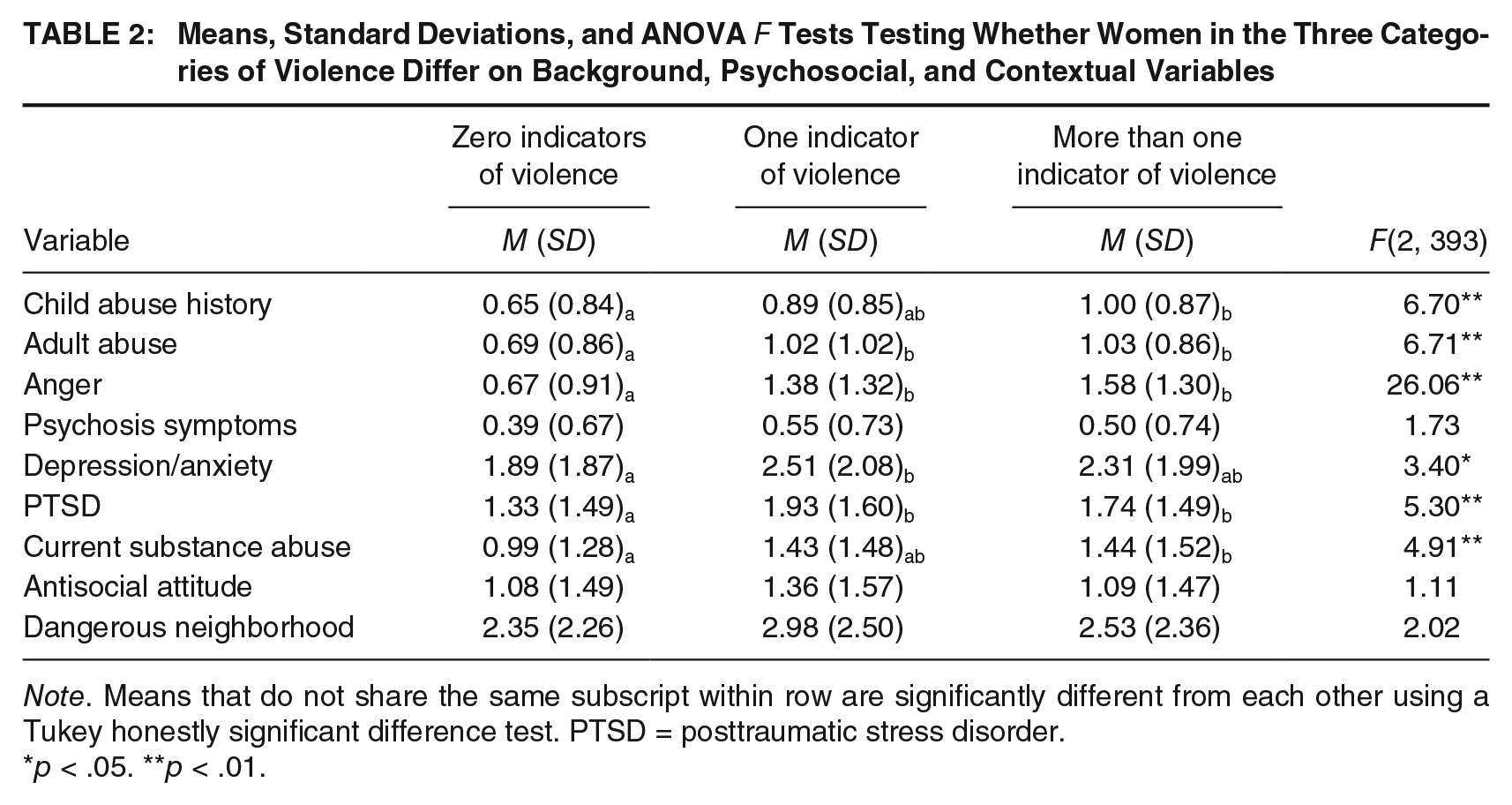
Note. Means that do not share the same subscript within row are significantly different from each other using a Tukey honestly significant difference test. PTSD = posttraumatic stress disorder.
p < .05. **p < .01.
Table 3 presents the zero-order correlations among the background, psychosocial, and contextual variables. Child abuse history was moderately positively associated with experience of adult abuse, anger, psychosis symptoms, depression/anxiety, PTSD, substance abuse, and living in a dangerous neighborhood. The psychosocial variables—adult abuse, anger, psychosis symptoms, depression/anxiety, PTSD, and current substance abuse—were all moderately, positively intercorrelated with each other as well. In contrast, antisocial attitudes were not associated with any other psychosocial variables; there was, however, modest correlation with dangerous neighborhood. In addition, age had a small positive correlation with adult abuse and psychosis symptoms, and a small negative association with anger. Finally, the correlations between the quantitative violence measure and the other scales were consistent with the mean differences from Table 2 for experience of child abuse, adult abuse, anger, and current substance abuse. However, unlike the categorical violence results, the correlations between this violence measure and anxiety/depression and PTSD did not attain statistical significance.
Zero-Order Correlations Among the Predictors and Between the Predictors and the Three-Level Indicator of Violence (
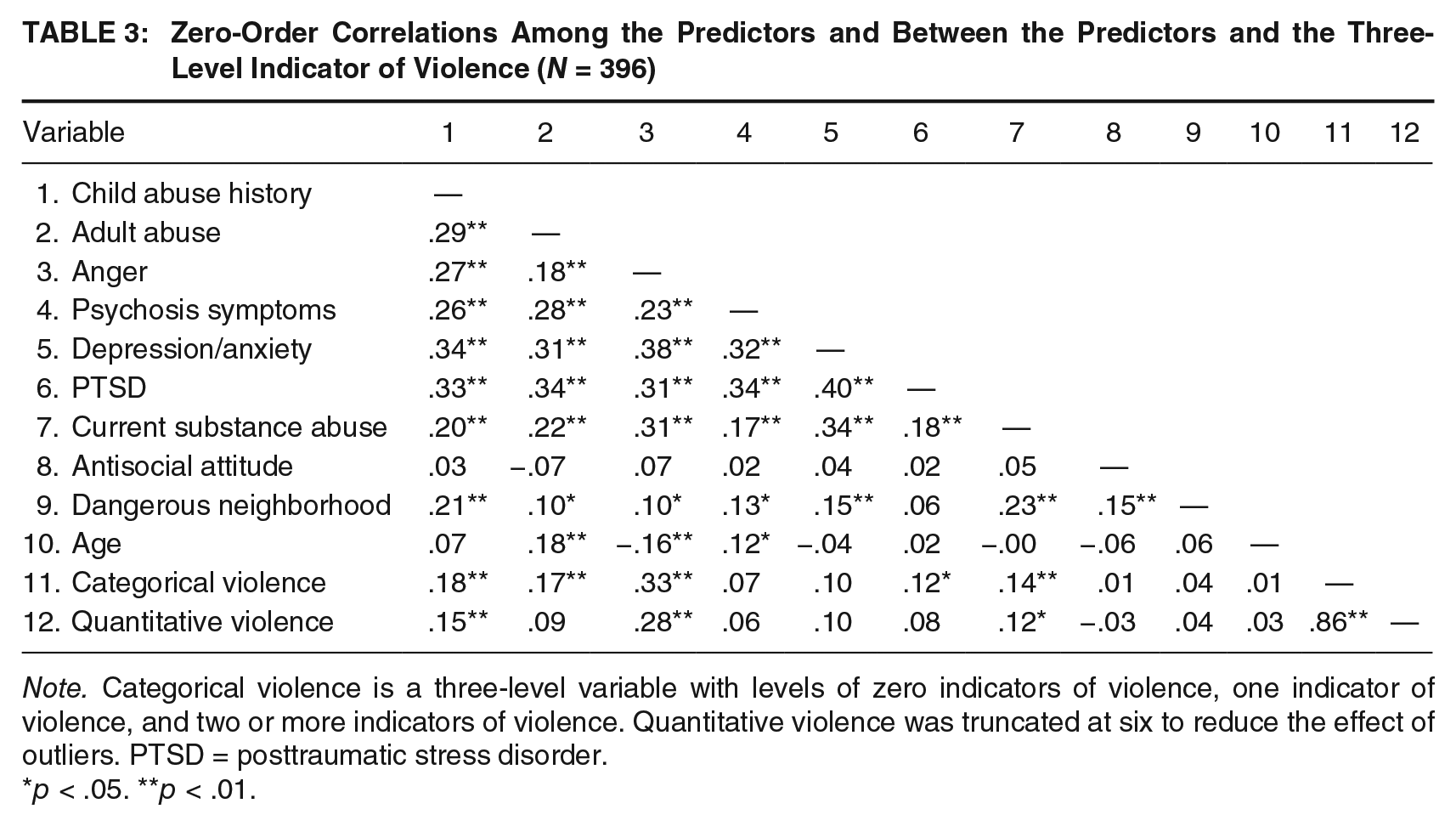
Note. Categorical violence is a three-level variable with levels of zero indicators of violence, one indicator of violence, and two or more indicators of violence. Quantitative violence was truncated at six to reduce the effect of outliers. PTSD = posttraumatic stress disorder.
p < .05. **p < .01.
A likelihood-ratio test showed that there was insufficient variability between the agents to favor a multilevel model, so a standard ordered logistic regression was conducted. Table 4 presents the results of the ordered logistic regression predicting the three-level violence variable as a function of background, psychosocial, and contextual variables. The Brant test of the proportional odds assumption indicated that the data do not violate this assumption. A likelihood-ratio test indicated that the full model fit significantly better than an intercept-only model with χ2 = 55.93, df = 11, p < .001.
Results of Ordered Logistic Regression Predicting the Categorical Violence Variable and Standard Regression Predicting the Quantitative Violence Variable Truncated at Six
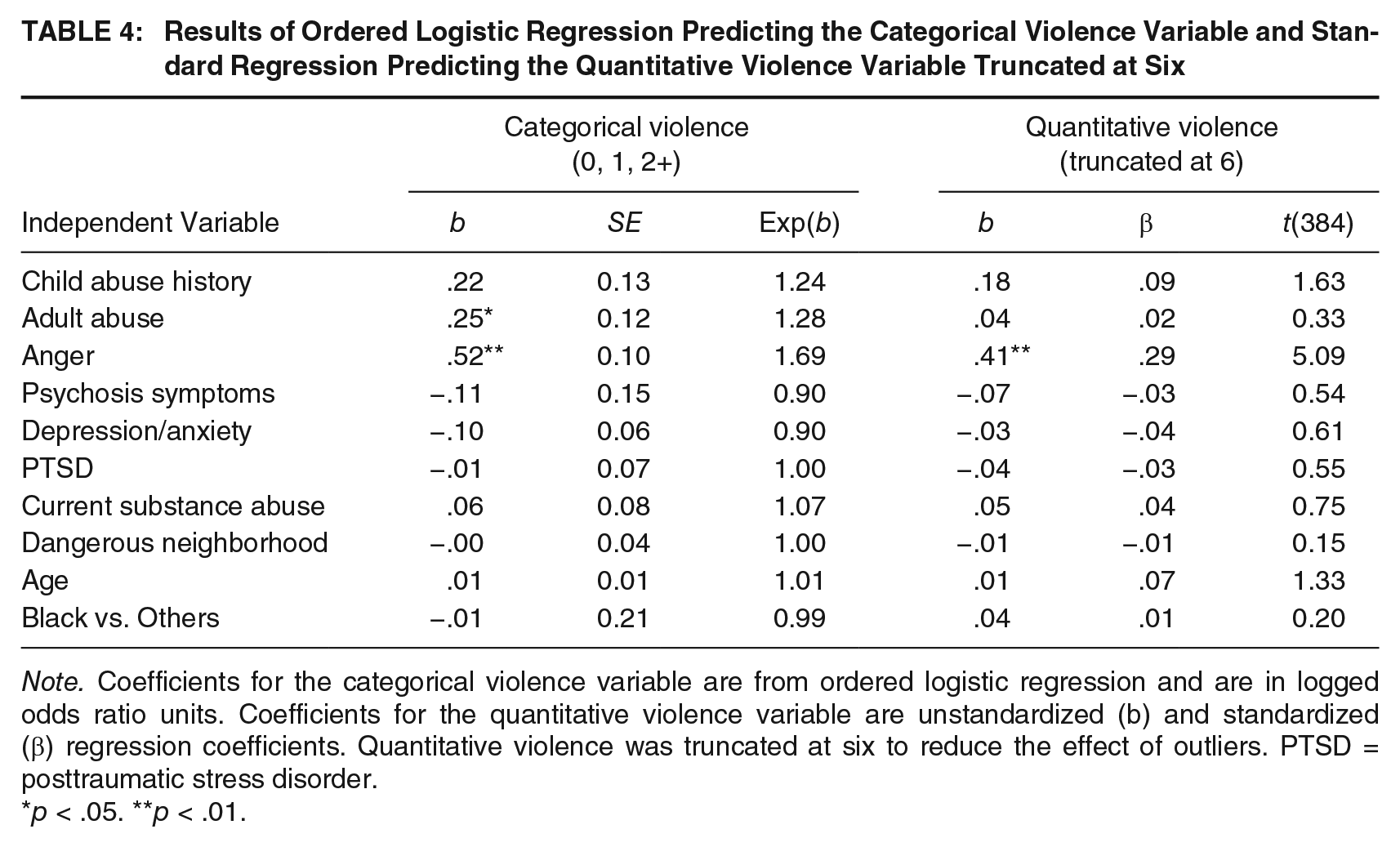
Note. Coefficients for the categorical violence variable are from ordered logistic regression and are in logged odds ratio units. Coefficients for the quantitative violence variable are unstandardized (b) and standardized (β) regression coefficients. Quantitative violence was truncated at six to reduce the effect of outliers. PTSD = posttraumatic stress disorder.
p < .05. **p < .01.
As can be seen in the table, only adult abuse and anger significantly predicted level of the categorical indicator of violence after controlling for other hypothesized predictors and the control variables, race and age. For a one-unit increase in the measure for adult abuse, the odds that the woman shows evidence of some violence is 28% higher. For example, a woman with a high score on adult abuse (e.g., a score of 2) would be 56% more likely to show some violent behavior as compared with a woman with no indication of adult abuse (i.e., a score of 0). For a one-unit increase on the scale that measures anger, the odds are 69% higher for being in a violence category.
We ran parallel analyses predicting the quantitative violence measure. As with the categorical variable, a multilevel model indicated there was no evidence of agent effects (intraclass correlation coefficient [ICC] = .067, Wald Z = 1.50, p = .133). Thus, we used standard multiple regression for this analysis. As shown in Table 4, only anger significantly predicted violence over and above the other variables in the model. Thus, in this case, controlling for anger and the other variables, adult abuse was not a significant predictor of violence.
Finally, we conducted a mediation analysis to examine the extent to which the link between indicators of violence and the experience of adult abuse was mediated by anger, controlling for the other predictors in the model. The mediational model assessing whether the link between adult abuse and categories of violence was mediated by anger showed evidence of mediation. The indirect effect of adult abuse on violence via anger was b = .124, SE = 0.042, p = .003, 95% confidence interval (CI) = [0.057, 0.219]. Fifty percent of the effect of adult abuse on violence could be explained by anger. We used the same mediation model to predict the quantitative measure of violence. When adult abuse was treated as the initial variable, there was no evidence of mediation by the variable, anger, b = .004, SE = 0.030, 95% CI = [0.056, 0.067].
Discussion and Conclusion
In line with prior research (Kruttschnitt & Carbone-Lopez, 2006; Murdoch et al., 2012; Sommers & Baskin, 1993), women’s detailed descriptions of violent acts varied widely, and they included expressions of anger, self-defense, and instrumental robberies. Also consistent with prior studies, in some cases, women acted violently to take rectifying perceived injustices and disrespectful treatment into their own hands (Suter, Byrne, Byrne, Howells, & Day, 2002). The present study findings agree with official statistics showing that women’s violence is disproportionately the commission of assaults during fights, but includes a wide range of acts, including some that are life threatening (Federal Bureau of Investigation, 2014; Koons-Witt & Schram, 2003). Different from women incarcerated with life sentences, the community supervision sample did not have a high proportion of women with records of homicide, which is more common for incarcerated women who often are ineligle for community supervision (Fedock, 2015). Despite differences in the severity of violence by women incarcerated for life and those in our sample of women who were supervised in the community, findings about the interconnections of abuse, anger, and violence were essentially the same, suggesting a similar dynamic leading to various sorts of violence by women.
Significant results for the experience of adult abuse were unclear because only the three-level categorical violence variable was associated with this type of abuse. The small inconsistencies in findings as a function of how violence was operationalized clearly shows that more psychometric research is needed to understand the underlying structure of measures of women’s use of violence.
The connection between child abuse and women’s use of violence was not significant. This finding contradicts theories that explain women’s violence as the result of childhood abuse that leads to anger and difficulties regulating anger, which in turn creates a tendency to use violence to respond to attacks, threats to identity, perceived injustices, and other problematic situations (Briere et al., 2010; Cloitre et al., 2005; Herman, 1997; Maughan & Cicchetti, 2002; Murdoch et al., 2012). It may be that the effects of childhood abuse on the use of violence weaken over time, and thus, they are not significant in a study of adults.
We found no connection between antisocial attitudes and women’s violence. Perhaps the measure used in the present study inadequately reflects the multidimensional construct identified in the psychological literature (Walters & Cohen, 2016; Walters & Elliott, 1999). Measurement deficits may be related to gender. A study of male and female probationers (Vaske, Gehring, & Lovins, 2017) found that the gender groups were generally similar in the co-occurrence of different thinking errors related to criminality, but there were some gender differences. Also, men and women differed in their agreement with the specific items that reflected their thinking errors, even when they were similar in assessed level of criminal thinking. In the present study, there may be another problem with measurement of criminal thinking. Correctional staff typically administer the WRNA Antisocial Beliefs measure, but in the present research, interviewers trained by a co–principal investigator (PI) who attended a WRNA-sponsored workshop administered it. Future research should use more direct measures taken from the study participants and alternative assessment tools (e.g., see Walters & Cohen, 2016) to confirm or disconfirm the present findings. Moreover, it would be important to understand psychometric properties of measures as they pertain to women, and to choose those that most accurately capture women’s criminal thinking.
Neighborhood crime also was unrelated to violence. Possibly the one-time measure of high-crime neighborhood is insufficient, because women move between neighborhoods with different crime levels. However, this explanation is unlikely, because parolees tend to live in high-crime neighborhoods before and after incarceration (LaVigne, Visher, & Castro, 2004), and analysis of the present study data shows that in the 6 months following the initial interview, less than 10 women moved to lower crime neighborhoods. Moreover, the women’s poverty and housing discrimination for those who are minorities would seem to limit moves to lower crime areas (Krivo, Peterson, Rizzo, & Reynolds, 1998). More plausible, women who are under supervision use effective strategies to avoid being drawn into violent behavior by the conditions in high-crime neighborhoods, even though these strategies may have negative effects by limiting their social networks and mobility (Cobbina et al., 2014).
A limitation of the current research is that it did not consider the connection of indicators of psychopathology or personality disorders to women’s violence. For prison samples, callous and antisocial psychopathic traits predict women’s violent misconducts during incarceration (Thomson, Towl, & Centifanti, 2016). Also, a comprehensive review (Nicholls et al., 2015) concluded that although very few women offenders are diagnosed with psychopathology and personality disorders, these diagnoses are related to women’s violence. However, the authors of this review go on to emphasize the crucial need for research and data analysis to untangle such diagnoses from the effects of prior victimization. Moreover, other research (Weizmann-Henelius, Virkkunen, Gammelgard, Eronen, & Potkonen, 2015) found that some psychopathology measures do not predict whether women in prison commit violence after release. This is an area for future research that needs to be carried out in a rigorous way to avoid an overly simplistic inference about one-trait causation of women’s violence.
As already noted, another limitation is that the study findings would not apply to women who commit violence against children, intimate partners, or others, but who are not substance involved. These groups certainly deserve study, and they have received attention in the literature (e.g., Browne, 1987; A. Jones, 2009; Richie, 1996). As in all research, it was necessary to balance having a sample of an adequately sized group of women, so that we could detect statistical effects against including multiple groups to allow broader generalizability of findings.
In conclusion, the present study extends understanding of the nature and the correlates of women’s violence for a previously unstudied sample of women who are supervised in the community. A higher proportion of women on parole than on probation had a current conviction for a violent act, but many women on probation also engaged in violence. For women with a current violence conviction, these actions varied in the type of crime and occurred for a variety of reasons, though as in prior research, assault was common. Agreeing with prior recommendations that anger should be assessed in samples of women on probation and parole (Van Voorhis, Salisbury, Bauman, Holsinger, & Wright, 2007), in both the qualitative and quantitative data, anger stood out as a factor that was associated with violence. Moreover, analyses showed that anger mediated the effect of prior abuse on violence.
The intercorrelations among anger, violence, abuse history, mental illness, and substance abuse support prior conclusions that effective programming for women offenders, including those who engage in violence, must address a wide variety of needs rather than just one particular need, such as anger or anger management (Covington, Burke, Keaton, & Norcott, 2008; Gobeil, Blanchette, & Stewart, 2016; Linehan, Bohus, & Lynch, 2007; Palmer et al., 2015; Sacks, 2004; Sacks, McKendrick, & Hamilton, 2012; Saxena, Grella, & Messina, 2016; Saxena, Messina, & Grella, 2014). Yet, a recent review of programs for women in correctional settings revealed that none of them focused heavily on anger, though apart from this review, there are some assessments and descriptions of programs that do attend to women’s anger in a holistic way (Eamon et al., 2002; Fedock, 2015; Kubiak et al., 2014; Tripodi et al., 2011). Our findings suggest that for women at all stages of justice system processing, anger and potentially related abuse histories and mental health problems should be assessed and, if appropriate, emphasized in correctional programming and through referrals. Women engage in a wide variety of types of violence for varying reasons, and they have different needs that should be considered in assessment and in the individualization of programming made available to them.
Footnotes
This article is based on work supported by the National Science Foundation under Grant No. 1126162 and by a Strategic Partnership grant from the Michigan State University Foundation.