







Abstract
Research suggests that ratings of interpersonal behaviors during semi-structured interviews provide valid ratings of the interpersonal component of psychopathy. Prior research suggests that Interpersonal Measure of Psychopathy (IM-P) ratings are underlain by three correlated dimensions: Dominance, Grandiosity, and Boundary Violations. We examined the construct validity of the factors in a sample of 1,243 male jail inmates. Regressions indicated distinct relationships between the three IM-P factor scores and clinically relevant external correlates, after controlling for Psychopathy Checklist–Revised (PCL-R) Factor Two (F2) scores. Dominance was uniquely associated with cocaine and alcohol dependence. Grandiosity demonstrated a pattern of unique positive relationships with intelligence and achievement and negative relationships with negative emotionality suggestive of the nomological network identified for boldness. Boundary Violations was the only factor uniquely associated with three distinct measures of criminal conduct. This pattern of results suggests that each IM-P factor may reflect a distinct facet of the interpersonal component of psychopathy.
Keywords
Anomalous interpersonal behavior has always figured prominently in descriptions of psychopathy (Pinel, 1801). Hervey Cleckley (1941) highlighted the unusual, often charming, and sometimes disturbing interpersonal behavior of psychopathic individuals in his book, The Mask of Sanity. Although the term interpersonal can be used to simply denote all behaviors that occur between people, the interpersonal dimension of psychopathy refers to a specific cluster of dispositions associated with a lack of mutuality and the exercise of deception and arrogance with the goal of controlling others. For example, in the Psychopathy Checklist–Revised (PCL-R; Hare, 2003), the interpersonal facet consists of items assessing impression management, egocentricity and arrogance, attempts to con or manipulate others, and frequent, diverse forms of deception.
Most contemporary models of psychopathy distinguish interpersonal traits from other components of psychopathy, and items assessing these interpersonal traits are featured in most clinical measures of the syndrome, in self-report measures such as the Psychopathic Personality Inventory (PPI; Lilienfeld & Widows, 2005) and the Youth Psychopathic Traits Inventory (YPI; Andershed, Kerr, Stattin, & Levander, 2002), and parent and teacher measures such as the Antisocial Processes Screening Device (APSD; Frick & Hare, 2001). Moreover, studies suggest that the interpersonal features of psychopathy, like the affective features, are relatively specific to the syndrome of psychopathy, whereas the lifestyle and antisocial components of psychopathy are associated with externalizing psychopathology, evident in many clinical disorders (Hare & Neumann, 2008; Patrick, Hicks, Krueger, & Lang, 2005). A similar distinction was made in early models of the internal structure of clinical measures of psychopathy, which combined scores on what are now called the interpersonal and the affective facets as Factor One (F1) and combined scores on what are now called the lifestyle and the antisocial facets as Factor Two (F2); in these accounts, F1 was considered more specific to psychopathy, whereas F2 was considered somewhat more general to a variety of syndromes associated with antisocial behavior (Harpur, Hare, & Hakstian, 1989). Similarly, Cooke and Michie (2001) suggested that a specific focus on the interpersonal and affective features—or what they described as the personality pathology components of psychopathy—was integral to understanding and eventually modifying the antisocial behavioral problems associated with psychopathy.
The interpersonal features of psychopathy are also associated with several important correlates of psychopathy. For example, interpersonal features are associated with instrumental aggression (Vitacco, Neumann, Caldwell, Leistico, & Van Rybroek, 2006; Walsh, Swogger, & Kosson, 2009), consistent with perspectives emphasizing the roles of narcissism, power, and control in psychopaths’ interactions with others (Declercq, Willemsen, Audenaert, & Verhaeghe, 2012). Evidence also suggests the interpersonal features are associated with post-offense outcomes, including bargaining for lower sentences and successful appeals to higher courts (Häkkänen-Nyholm & Hare, 2009). In addition, whereas most forms of substance abuse and dependence are primarily related to the antisocial lifestyle features of psychopathy, scores on the interpersonal dimension are uniquely associated with cocaine dependence (Brieman, Kosson, Cope, & Kiehl, 2017). Finally, although total scores on psychopathy measures are generally independent of intelligence, some studies have reported unique positive relationships between interpersonal features of psychopathy and intelligence scores (Vitacco, Neumann, & Jackson, 2005; Vitacco, Neumann, & Wodushek, 2008).
In addition, recent studies suggest unique associations between interpersonal features of psychopathy and some environmental factors. Notably, Edens, Skopp, and Cahill (2008) reported youth with higher scores on the interpersonal facet of the Psychopathy Checklist: Youth Version (PCL: YV; Forth, Kosson, & Hare, 2003) who reported experiencing greater parental harshness and inconsistency exhibited more severe conduct problems than those who reported experiencing less problematic parenting. These findings contrast with evidence that affective features of psychopathy are often associated with reduced responsiveness to environmental factors (Oxford, Cavell, & Hughes, 2003), including parenting interventions (Hawes & Dadds, 2005). More recently, Caldwell (2011) suggested interpersonal features of psychopathy play a critical role in the treatment of youth with psychopathic traits. In this study, interpersonal facet scores predicted poorer institutional behavior at the start of treatment, but also predicted greater improvement in such behavior over the course of treatment. In addition, treatment reduced the linkage between institutional and community violence and interpersonal facet scores. Finally, Salekin, Tippey, and Allen (2012) reported that scores on the interpersonal facet, but not on other facets of psychopathy on the APSD, were reduced by an intervention designed to increase motivation for treatment as well as consideration for and tolerance of others, an index of treatment amenability.
These same interpersonal features have also been linked to anomalies in brain structure and to differences in the activation of specific brain regions. Interpersonal facet scores are associated with reduced gray matter in several areas (Glenn, Raine, Yaralian, & Yang, 2010; Yang et al., 2005) and reduced white matter density in the uncinate fasciculus (Wolf et al., 2015). Moreover, they are uniquely related to reduced perfusion of frontal and temporal areas (Soderstrom et al., 2002) and predict reduced activation during moral processing in several brain areas considered important for such reasoning (Glenn, Raine, & Schug, 2009). Because clinical assessments of psychopathy require the integration of information across multiple sources and domains, and interview measures (such as the PCL-R) require substantial training and access to collateral sources (e.g., institutional files), researchers have begun to examine whether features of psychopathy can be identified through direct behavioral observation. The Interpersonal Measure of Psychopathy (IM-P; Kosson, Steuerwald, Forth, & Kirkhart, 1997) was developed to assess specific interpersonal features of psychopathy manifested during interviews. The IM-P was originally designed to be completed following a semi-structured interview with a participant that might be administered as part of a clinical assessment using measures such as the PCL-R. However, unlike the PCL-R, the IM-P requires no integration of information across domains. Rather, observers simply estimate the frequency of specific behaviors in interpersonal interactions that transpire based on the degree to which they are characteristic of the rater’s observations or interactions with a participant during the interview. As a result, there is no need to obtain collateral information or for extensive training of raters to use the IM-P (Kosson et al., 1997).
Previous studies have demonstrated that IM-P scores are internally consistent, yield high interrater agreement, and display a pattern of correlations suggesting they validly assess core affective and interpersonal features of psychopathy. For example, Kosson and colleagues (1997) reported that, in a sample of inmates, IM-P scores correlated about twice as highly with PCL-R F1 scores (r = .62, p ⩽ .001) as with PCL-R F2 scores (r = .31, p ⩽ .01), a statistically significant difference later replicated in independent samples of college students and adult inmates (Kosson et al., 1997, Study 2; Zolondek, Lilienfeld, Patrick, & Fowler, 2006). Such findings are important because few criteria correlate more highly with indices of affective and interpersonal features than with lifestyle and antisocial features of the disorder. 1 Notably, education, socioeconomic status (SES), criminal charges, substance abuse and dependence, and childhood maltreatment all correlate more highly with scores on F2, the antisocial lifestyle factor, than with scores on F1, the affective and interpersonal factor (Poythress, Skeem, & Lilienfeld, 2006).
In fact, even unique correlations with affective and interpersonal traits, after controlling for F2 scores, are relatively unusual. When unique correlations involving F1 are significant only after removing the substantial shared variance between F1 and F2 (i.e., 25%-30% of the variance in F1 scores), their interpretation is somewhat ambiguous (Lynam, Hoyle, & Newman, 2006). However, the similarity of the zero-order correlations between IM-P and F1 scores (.59) and partial correlations after controlling for F2 scores (.56; Zolondek et al., 2006) demonstrates that this relationship is not a function of the shared variance between F1 and F2. Moreover, the correlation between IM-P and F1 scores is at least as strong as the correlation between F1 and F2 scores, despite the fact that F1 and F2 scores reflect the same method of measurement, whereas IM-P scores and F1 scores do not. At the same time, the finding that IM-P and F1 scores shared 34% of their variance suggests that, although moderately related, the IM-P and F1 are not interchangeable measures of the interpersonal dimension of psychopathy.
Correlations with personality and demographic indices also suggest a specific pattern of associations. Prior research has reported that IM-P scores are positively correlated with age and achievement, as well as antisocial behavior (Vitacco & Kosson, 2010; Zolondek et al., 2006). Among undergraduates, IM-P scores predicted observer ratings of interpersonal dominance better than self-reported dominance (Kosson et al., 1997). Similarly, Zolondek et al. (2006) reported that those who scored higher on the IM-P were less likely to be classified as unassured or submissive and were more likely to exhibit dominance. In addition, IM-P scores correlated positively with self-reported dominance and self-assurance, but negatively with self-reported fear, anxiety, shyness, and socialization scores. Although IM-P scores predicted self-reported fear, anxiety, and scores on some personality traits even after controlling for PCL-R total scores, there were few unique correlations with self-report scores after controlling for F1 ratings. In addition, most correlations with self-report scores in this study were modest, consistent with Kosson et al.’s (1997) report of stronger associations between IM-P scores and observer ratings than between IM-P scores and self-ratings.
Subsequent studies have shown that IM-P scores contribute to the identification of subtypes of offenders who appear to meet criteria for primary psychopathy. Although studies using different methods to identify subtypes of psychopathic offenders have yielded divergent findings, several studies which have included both measures related to and measures unrelated to psychopathic traits have suggested that IM-P scores help identify a cluster of individuals characterized by high scores on the interpersonal and affective features of psychopathy and whose criminal records indicated more charges for violent offenses than those of offenders in other groups (Swogger & Kosson, 2007; Vassileva, Kosson, Abramowitz, & Conrod, 2005). These studies also identified another subtype of offenders, secondary psychopaths, who scored as highly as primary psychopaths on the lifestyle and antisocial features of psychopathy, but were characterized by greater anxiety and more severe problems with alcohol and other drugs. Although secondary psychopaths were also characterized by elevated IM-P scores, their IM-P scores were significantly lower than the IM-P scores of primary psychopaths.
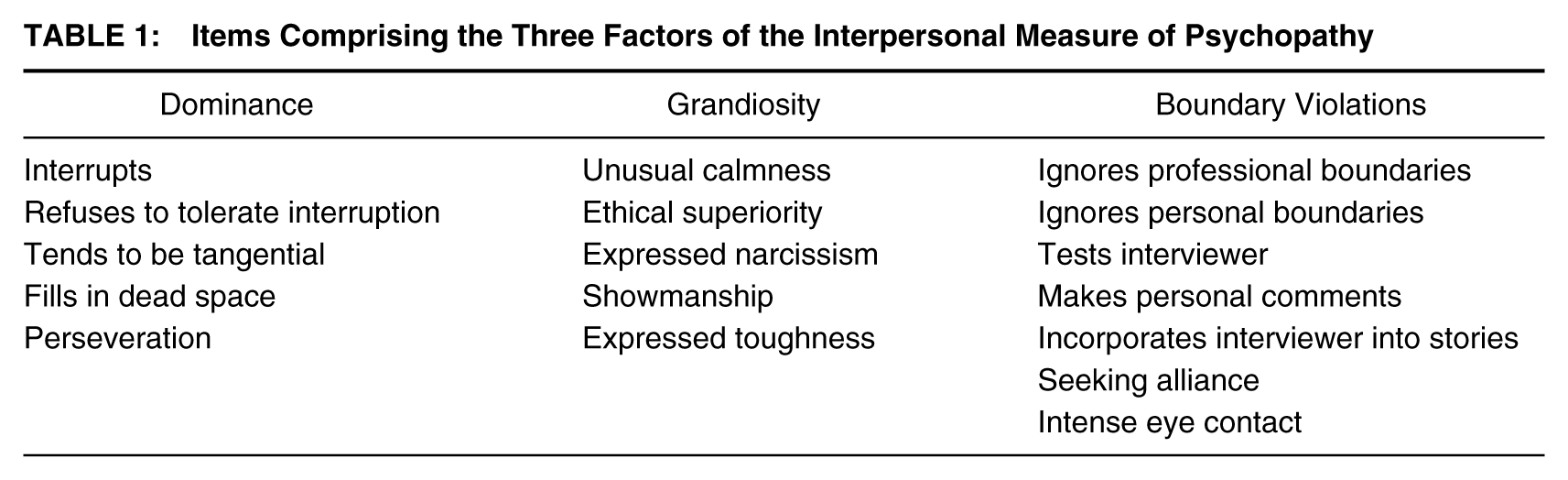
Vitacco and Kosson (2010) identified a three-factor structure to explain the pattern of covariance among 17 of the 21 IM-P items using exploratory factor analyses. Subsequent confirmatory factor analyses demonstrated that the three-factor model provided a good fit in an independent sample. Scores on the three factors were moderately correlated with one another (.43-.50). Based on the content of items loading on each dimension, the factors were labeled Dominance, Grandiosity, and Boundary Violations, consistent with items reflecting attempts to dominate the interview, attempts to present oneself as unique or superior, and behavior suggesting a lack of respect for boundaries, respectively. See Table 1 for a listing of the 17 final items loading on each factor. However, because this study examined only a small number of external criteria, it did not demonstrate that each of the IM-P factors is characterized by a unique pattern of correlations or that IM-P factor scores are associated with criteria after controlling for PCL-R factor scores. This study aims to correct that weakness by examining the relationship of IM-P factors with multiple external correlates. In this way, we attempt to further validate the factor structure of the IM-P by proposing and examining differential relationships between the IM-P factors and various proposed external correlates and thereby relating these factors to current theory and research addressing relationships between psychopathy and important criminal justice criteria.
Items Comprising the Three Factors of the Interpersonal Measure of Psychopathy
Current Study
The primary aim of the current study was to systematically examine the construct validity of the three-factor model of the IM-P to further our understanding of the practical utility of this measure. We examined zero-order correlations between scores on the three IM-P factors and scores on constructs clinically relevant to psychopathy. We also conducted multiple regression analyses to assess whether IM-P factor scores were uniquely associated with scores on criterion variables after controlling for scores on PCL-R F2 and after controlling for scores on the other IM-P factors. If the three IM-P factors truly reflect separable, albeit correlated, features of psychopathy, then scores on these factors ought to demonstrate relatively distinctive patterns of correlations with external criteria.
Based on evidence that IM-P scores should correlate with age, education, achievement, antisocial behavior, and low levels of fear and anxiety (Kosson et al., 1997; Vitacco & Kosson, 2010; Zolondek et al., 2006), we hypothesized that scores on one or more IM-P factors would correlate with indices of these constructs. Similarly, given prior evidence that PCL-R interpersonal facet scores correlate with instrumental violence and cocaine dependence symptoms, we hypothesized that one or more IM-P factor scores would correlate with scores on indices of these sorts of problematic behaviors.
In addition, based on limited prior evidence linking dominance, but not social potency to age (e.g., Roberts, Walton, & Viechtbauer, 2006) and linking dominance to social rank and SES (Rivers & Josephs, 2010), we hypothesized stronger correlations between Dominance scores and age and SES compared with the other IM-P factors. Given limited prior findings linking dominance to reduced neuroticism (Johnson, Leedom, & Muhtadie, 2012), we hypothesized Dominance scores would be the most negatively correlated with indices of negative affectivity (NA). Finally, given that the items comprising the Boundary Violations factor suggested a willingness to violate societal expectations, we hypothesized stronger associations between Boundary Violations and inappropriate attention to experimenters than for the other IM-P factor scores.
Method
Participants and Procedures
The full sample was composed of 1,243 male inmates at a county jail in Illinois. 2 However, sample sizes were smaller in regression analyses because, as noted below, PCL-R ratings were only available for 1052 participants. Participants ranged in age from 17 to 47 years (M = 26.28 years, SD = 6.71 years). They were identified primarily as African American (45.7%) or European American (46.3%), with 6.7% identifying as Latino and 1.3% as “Other.” Participants with estimated IQ scores below 70 were excluded from all analyses except for analyses of interrater agreement. All participants providing informed consent completed a semi-structured interview designed to permit assessment of psychopathy and antisocial personality disorder (APD), and available files were also reviewed. Most participants also completed interviews assessing substance misuse.
Interpersonal Measure of Psychopathy (IM-P)
The IM-P is a 21-item measure of specific, observable behaviors theoretically and clinically related to psychopathy that may occur during a semi-structured interview (Kosson et al., 1997). Scores on each item range from 0 to 3 to indicate the frequency and intensity with which each interpersonal feature or disposition characterized the individual’s demeanor and behavior during the interaction. Following completion of PCL-R ratings, IM-P items were scored based on whether specific nonverbal or verbal behaviors were observed within the interpersonal context and the frequency with which they occurred or extent to which they typified the interaction. The ratings were based on a semi-structured interview used to assess psychopathy and APD. Following the completion of PCL-R ratings, raters scored the IM-P. The number of participants available for interrater agreement on the IM-P factors varied from 241 to 257.
Vitacco and Kosson (2010) provided preliminary evidence for the validity of the factor scores. Although all three IM-P factor scores correlated with all PCL-R facet scores, all three factor scores correlated more highly with PCL-R interpersonal facet scores than with scores on other PCL-R facets. In the current study, IM-P factor scores were obtained by summing the scores on the 17 items that comprised the three factors identified by Vitacco and Kosson (2010). Although Vitacco and Kosson had rescored 3s as 2s prior to data analyses to avoid the possibility that low base rates for items scored 3 could skew the confirmatory factor analysis, a simple summing of item scores was used here to provide a method easier for other investigators to use. 3 The three IM-P factor scores were prorated according to methods suggested by Vitacco and Kosson. Mean scores for the three factors (before transformation) were as follows: Dominance, M = 2.05, SD = 2.34, n = 1,240; Grandiosity, M = 2.91, SD = 2.61, n = 1,232; and Boundary Violations, M = 1.81, SD = 2.46, n = 1,225.
External Criterion Measures
To facilitate organization, measures of constructs used for validation were categorized into five domains: PCL-R measures of psychopathy, demographic indices, NA, antisocial behavior, and interpersonal behavior.
PCL-R Factor and Facet Scores
In the two-factor model of psychopathy, F1 represents the interpersonal and affective features of psychopathy, and F2 represents the social deviance aspects of psychopathy. In the four-facet model, the four facets reflect the interpersonal, affective, and irresponsible lifestyle features and early, persistent, and versatile antisocial behaviors. The factor and facet scores are based on an integration of information obtained from interview, behavioral observation, and file material about behavior in a variety of domains, including school history, work history, family history, friendships and romantic relationships, hobbies, antisocial behavior, and affective experiences. Prior studies have reported adequate internal consistency and interrater agreement for both PCL-R factor and facet scores and a pattern of unique correlates (Hare, 2003; Harpur et al., 1989). In the current study, PCL-R and IM-P scores were obtained from the same raters who conducted and/or observed semi-structured interviews and institutional file reviews. Because it was not possible to confirm the use of file information in completing PCL-R assessments for some participants, those participants were excluded from analyses including any PCL-R ratings; consequently, only 1052 participants were included in analyses that included PCL-R scores.
Demographics
We examined correlations between IM-P factor scores and measures of age, intelligence, achievement, education, and SES. Estimates of IQ were obtained using the Shipley Institute of Living Scale–Revised (SILS-R; Zachary, 1986), a widely used brief intelligence screening test (Bowers & Pantle, 1998), which provides IQ estimates that correlate highly with the Wechsler Adult Intelligence Scale–Revised (WAIS-R) and the Wechsler Adult Intelligence Scale–Third Edition (WAIS-III; Spinks et al., 2009) IQ scores. The achievement scores utilized were participants’ standard scores on the reading subtest of the Wide Range Achievement Test–4 (WRAT-4; Wilkinson & Robertson, 2006). SES was assessed using the Hollingshead Index of Social Position (Hollingshead & Redlich, 1958). A composite score was computed for each participant based on the interviewer’s classifications of the participant’s occupations and education. Higher scores indicate lower SES. Although the Hollingshead measure of SES is sometimes criticized as outdated, it remains the most widely used measure of SES (Suzuki & Patricoski, 2013).
Negative Affectivity
Scores on measures of neuroticism, anxiety, and depression were obtained. Neuroticism was assessed using the associated subscale of the NEO Five Factor Inventory (NEO-FFI; Costa & McCrae, 1992), a reliable and valid measure of individual differences in the personality dimension of neuroticism (Costa & McCrae, 1992; Robins, Fraley, Roberts, & Trzesniewski, 2001). Proneness to negative affect and current depressive symptoms were assessed using the Welsh Anxiety Inventory (WAI; Welsh, 1956) and Beck Depression Inventory (BDI-IA; Beck, Steer, Ball, & Ranieri, 1996), respectively. The reliability and validity of scores on these measures is well documented (see, for example, Beck et al., 1996; Greene, 1999; Watson & Clark, 1984); in the current sample, alpha for the NEO-FFI Neuroticism Scale was .79.
Substance Dependence
Indices of substance dependence were analyzed for cocaine, alcohol, cannabis, and opioids using the substance use disorders module of the Structured Clinical Interview for the Diagnostic and Statistical Manual of Mental Disorders (4th ed.; SCID-I; First, Spitzer, Gibbon, & Williams, 1995). Prior studies with the SCID-I have demonstrated good overall interrater agreement, as well as good reliability and validity for dimensional ratings of substance use disorders (Kranzler, Kadden, Babor, Tennen, & Rounsaville, 1996; Walsh, Allen, & Kosson, 2007; Zanarini et al., 2000). In the current sample, interviewers’ ratings of the number of drug dependence criteria met were analyzed.
Antisocial Behavior
Several indices of criminal behavior were evaluated. Participants’ past aggressive actions were coded for instrumentality versus reactivity of aggression using the Aggressive Incident Coding Sheet (AICS; Cornell et al., 1996) based on responses to the questions, “What is the worst injury you have ever caused to someone?” and “What made you do that?” An index of criminal versatility was calculated by tallying the number of different categories of offenses participants were either officially charged with or had admitted committing. This tabulation was carried out routinely following the PCL-R interview and file review and covered antisocial acts ranging from murder to major violations of conditional release. Calculations of the number of violent and nonviolent offenses were based on descriptions of prior offenses reported during interviews and reviews of institutional files. Offenses involving aggressive physical contact with another person (e.g., sexual offense, robbery, murder, kidnapping, assault) or noncontact violence (e.g., weapons) were coded as violent, whereas offenses of a noncontact, nonviolent nature (e.g., theft, fraud, statutory violations, and revocation of conditional release) were coded as nonviolent. The number of conduct disorder (CD) symptoms, presence versus absence of CD diagnosis, number of adult APD symptoms, and presence versus absence of APD diagnosis were completed using a checklist of DSM-IV CD and APD criteria and guidelines for diagnosis and information obtained from the same interview and file review process.
Interpersonal Behavior
Because of a prior report that higher psychopathy scores in male inmates were associated with increased off-task attention to female experimenters (Kosson & Newman, 1986), a form used to track such extraneous attention was developed and utilized for the current study. Ratings were made by researchers based on how much attention participants paid to an experimenter while they were completing a laboratory task requiring them to attend to experimental stimuli on a computer screen. This rating scale ranged from 1 (no comments) to 6 (attention usually off-task). This index was of interest because psychopathy has been associated with interpersonal behavior that violates social norms. In addition, because experimenters were blind to IM-P and PCL-R scores and administered behavioral tasks on a separate day from (usually within a few weeks of) psychopathy assessments, this index provided information about the relationship between IM-P factor scores and interpersonal behavior in a different situation than that in which the IM-P was completed.
Data Analysis
Preliminary Analyses
In the current sample, all three subscales yielded evidence of acceptable internal consistency (αs = .73, .72, and .74 for Dominance, Grandiosity, and Boundary Violations, respectively). Interrater agreement for the factors was also acceptable. (One-way random single-score intraclass correlation coefficients ranged from .68 for Dominance [N = 257], to .71 and .72 for Grandiosity and Boundary Violations [N = 248 and 241, respectively].) However, factor scores evidenced significant skewness. For Dominance (M = 1.10, SD = 0.92) and Grandiosity (M = 1.46, SD = 0.89) scores, square-root transformations were sufficient to correct skewness. For Boundary Violations, only inverse transformation was sufficient to correct skewness (M = −0.59, SD = 0.34). 4 Therefore, transformed factor scores were used for principal analyses.
To address skewed distributions, square root transformations were used on PCL-R F2, affective facet, and antisocial facet scores, and on SES, WAI, BDI, alcohol dependence, cannabis dependence, and number of CD symptoms. In addition, the numbers of violent and nonviolent charges were subjected to logarithmic transformations, and inverse transformations were used on age, instrumentality of aggression, cocaine and opioid dependence scores, and attention to experimenter. For several variables (PCL-R F2, WAI) instrumentality rating, number of CD symptoms, number of violent charges, cocaine and opioid dependence scores, SES, and attention to experimenter, the transformations that most reduced skewness were employed, but these transformations were not sufficient to reduce skewness to nonsignificant levels. For PCL-R lifestyle facet scores, all transformations exacerbated skewness, so no transformation was used. Because the chief impact of skewness is likely to be a reduction in statistical power and given that sample sizes were relatively large for most criteria examined, the skewness was not considered problematic (see, for example, R. L. Fowler, 1987; Winer, Brown, & Michels, 1991). Nevertheless, the pattern of significant relationships with transformed scores was the same as the pattern obtained with untransformed scores in most cases, and the few exceptions are noted below.
Primary Analyses
Zero-order correlations between IM-P factor scores and criterion indices were computed, and z-tests for the significance of differences between dependent correlations were conducted (Ramseyer, 1979). Multiple regressions tested whether the three IM-P factor scores contributed uniquely to the prediction of each criterion (in Step 2) after controlling for scores on F2 in Step 1, by entering all three IM-P factor scores simultaneously in Step 2. 5 Finally, we tested the predictive utility of IM-P scores after controlling for both PCL-R F1 and F2 scores. For the sake of space, we report and discuss only notable differences between these analyses and those controlling only for F2. For dichotomous criterion variables (i.e., presence of CD diagnosis and presence of APD diagnosis), logistic regression was utilized in a parallel manner. Given the large number of correlations examined in this study, a 2-tailed alpha level of .01 was adopted for all analyses.
Data analytic procedures were modified slightly for analyses in which PCL-R scores served as criteria. When a PCL-R factor score served as the criterion variable, the other PCL-R factor score was entered (in Step 1) first, and the relevant IM-P factor score was entered second (in Step 2). When a PCL-R facet score served as the criterion, scores on the other three PCL-R facet scores were entered on the first step to examine whether IM-P factor scores were uniquely associated with scores on each PCL-R facet.
Results
Assumptions and Interrelationships Among IM-P Factor Scores
As expected, Dominance and Grandiosity scores were positively correlated with one another (r = 0.52, p < .001), as were Dominance and Boundary Violations (r = 0.48, p < .001) and Grandiosity and Boundary Violations (r = 0.47, p < .001) scores. To facilitate exposition, construct validity analyses are summarized within categories.
Relationships With PCL-R Factor and Facet Scores
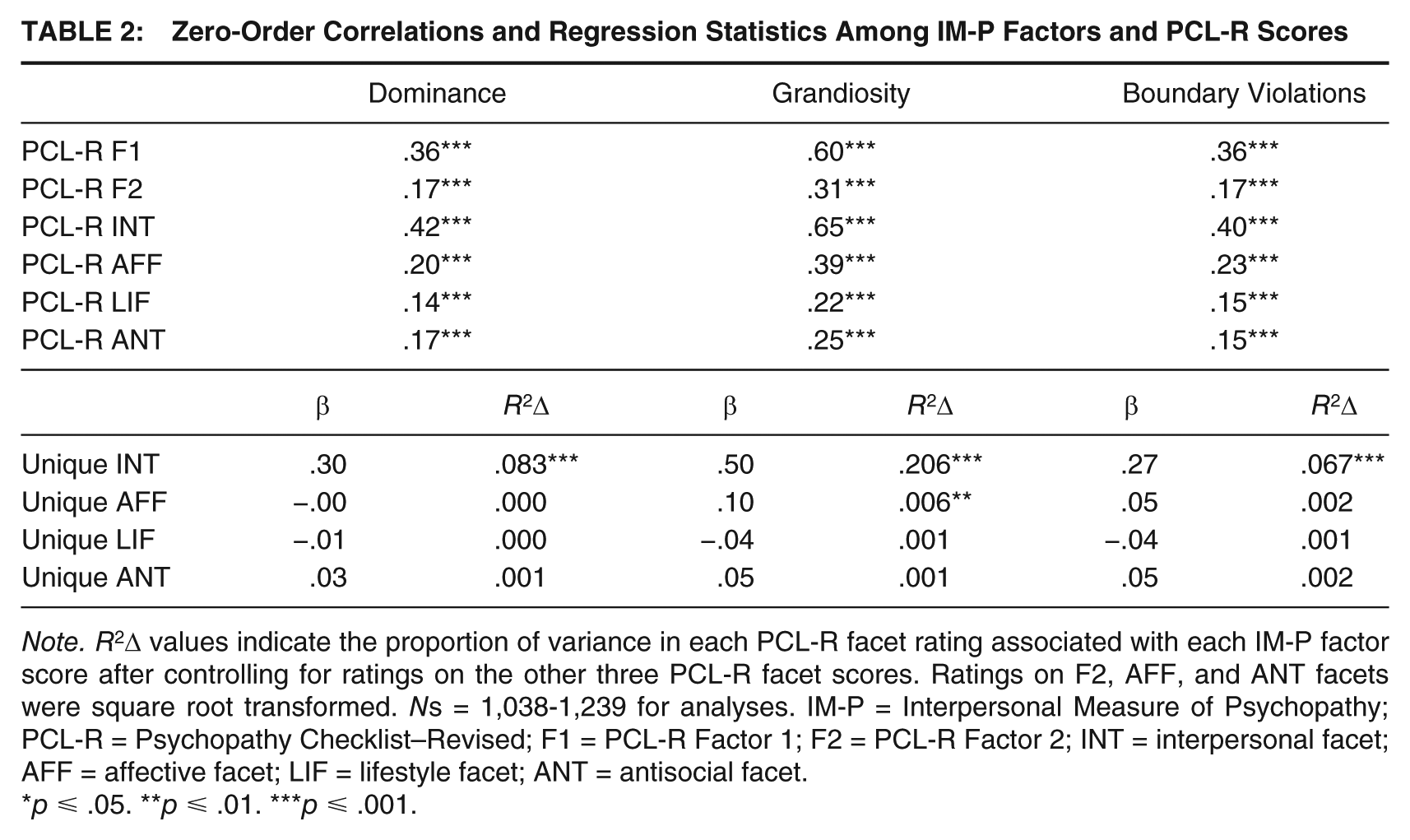
Consistent with previous research on IM-P total scores, all three IM-P factor scores were significantly more positively correlated with PCL-R F1 than with PCL-R F2 scores, as confirmed by z tests (see Table 2). Furthermore, regressions indicated that, after controlling for F2, each IM-P factor score was uniquely associated with F1 scores. These results also show that Grandiosity scores account for substantially more unique variance in F1 scores than do Dominance or Boundary Violations scores. In contrast, none of the IM-P factor scores was uniquely associated with F2 scores after controlling for F1 scores (Dominance: β = −.00, R2Δ = .000, p = .97; Grandiosity: β = .06, R2Δ = .002, p = .08; Boundary Violations: β = .01, R2Δ = .000, p = .76).
Zero-Order Correlations and Regression Statistics Among IM-P Factors and PCL-R Scores
Note. R2Δ values indicate the proportion of variance in each PCL-R facet rating associated with each IM-P factor score after controlling for ratings on the other three PCL-R facet scores. Ratings on F2, AFF, and ANT facets were square root transformed. Ns = 1,038-1,239 for analyses. IM-P = Interpersonal Measure of Psychopathy; PCL-R = Psychopathy Checklist–Revised; F1 = PCL-R Factor 1; F2 = PCL-R Factor 2; INT = interpersonal facet; AFF = affective facet; LIF = lifestyle facet; ANT = antisocial facet.
p ⩽ .05. **p ⩽ .01. ***p ⩽ .001.
In addition, consistent with prior reports of stronger zero-order correlations between IM-P factor scores and scores on the interpersonal facet than scores on other PCL-R facets, regressions showed that, after controlling for the affective, lifestyle, and antisocial facet scores, all three IM-P factor scores exhibited significant positive correlations with scores on the interpersonal facet of the PCL-R. See Table 2 for regression statistics for these analyses. After controlling for interpersonal, lifestyle, and antisocial PCL-R facet scores, Grandiosity scores were also positively associated with affective facet scores. However, none of the IM-P factor scores was related to PCL-R lifestyle or antisocial facet scores after controlling for the other three PCL-R facet scores.
To examine whether any of the IM-P factor scores were uniquely related to PCL-R facet scores, we also conducted analyses in which each PCL-R facet rating was regressed on all three IM-P factor scores. These analyses showed that each of the IM-P factor scores was uniquely related to PCL-R interpersonal facet ratings (Dominance: β = .30, Grandiosity: β = .50, and Boundary Violations: β = .27, all ps < .001) and that Grandiosity scores were uniquely related to affective facet ratings (Dominance: β = −.00, Grandiosity: β = .10, p < .01, and Boundary Violations: β = .05). In contrast, only Grandiosity scores were uniquely related to ratings on the lifestyle and antisocial facets (for Grandiosity: βs = .24, .25, ps < .001, for Dominance: βs < .05, ps > .30, for Boundary Violations: βs < .05, ps > .15).
Relationships with Demographic Indices
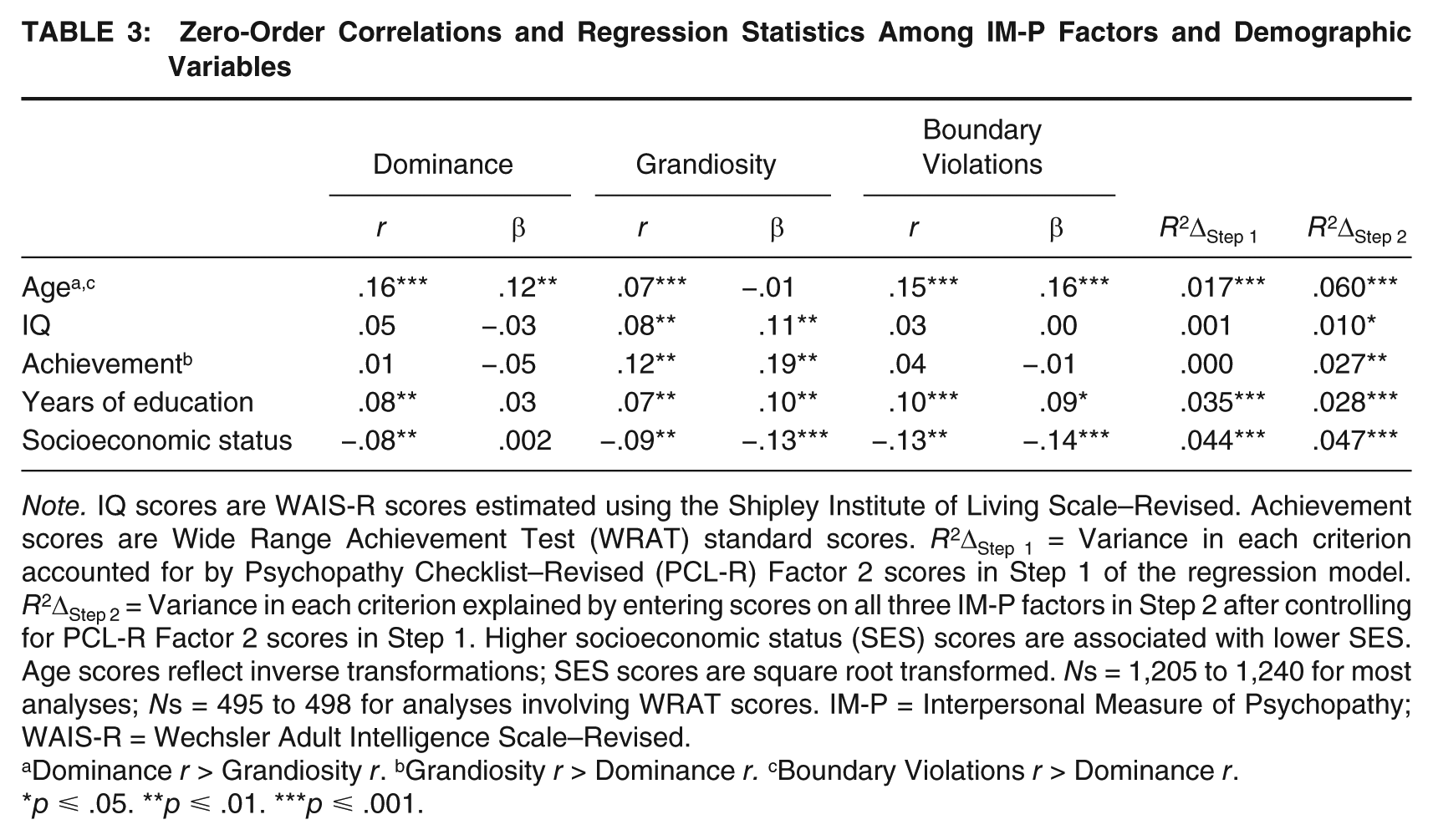
Correlation and regression statistics involving demographic variables are summarized in Table 3. Zero-order correlations indicated expected relationships with several demographic factors, and many of these relationships remained significant after controlling for F2. Consistent with prior findings (Kosson et al., 1997; Zolondek et al., 2006), there were small or small-to-moderate positive zero-order relationships between all three IM-P factor scores and age, and after controlling for ratings on F2 and on the other IM-P factors, there were unique positive relationships between Dominance and Boundary Violations scores and age (see Table 3).
Zero-Order Correlations and Regression Statistics Among IM-P Factors and Demographic Variables
Note. IQ scores are WAIS-R scores estimated using the Shipley Institute of Living Scale–Revised. Achievement scores are Wide Range Achievement Test (WRAT) standard scores. R2ΔStep 1 = Variance in each criterion accounted for by Psychopathy Checklist–Revised (PCL-R) Factor 2 scores in Step 1 of the regression model. R2ΔStep 2 = Variance in each criterion explained by entering scores on all three IM-P factors in Step 2 after controlling for PCL-R Factor 2 scores in Step 1. Higher socioeconomic status (SES) scores are associated with lower SES. Age scores reflect inverse transformations; SES scores are square root transformed. Ns = 1,205 to 1,240 for most analyses; Ns = 495 to 498 for analyses involving WRAT scores. IM-P = Interpersonal Measure of Psychopathy; WAIS-R = Wechsler Adult Intelligence Scale–Revised.
Dominance r > Grandiosity r. bGrandiosity r > Dominance r. cBoundary Violations r > Dominance r.
p ⩽ .05. **p ⩽ .01. ***p ⩽ .001.
Partly consistent with Vitacco and Kosson’s (2010) findings, Grandiosity scores demonstrated a small unique positive association with IQ scores after controlling for PCL-R F2 scores and scores on the other IM-P factor scores. Similarly, Grandiosity scores correlated uniquely and positively with achievement scores. All three IM-P scores were positively associated with years of education, and the relationship for Grandiosity remained significant in regressions. Furthermore, there were small, but significant relationships between all three IM-P factor scores and higher SES (as indicated by lower scores on the Hollingshead Index), and for Grandiosity and Boundary Violations, controlling for PCL-R F2 and other IM-P factor scores did not eliminate these relationships. We note that when regressions were conducted with untransformed scores, only Dominance scores proved uniquely related to age (β = .13, p = .001), the unique relationship between Boundary Violations and SES was no longer significant (β = −.08, p = .05), and the overall contribution of the IM-P factors in the second step was significant in the regression addressing relationships with estimated IQ scores. 6
Relationships with Negative Affectivity Indices
There was a small-to-moderate negative relationship between Grandiosity scores and neuroticism scores, r = −.17, p = .004, which remained significant after controlling for PCL-R F2 scores and scores on the other IM-P factors (see Supplemental Table S1, available in the online version of this article). Similarly, after controlling for F2 and Dominance and Boundary Violations scores, Grandiosity scores demonstrated unique negative relationships with NA and BDI scores. In contrast, Dominance scores were uniquely positively associated with NA scores. The only change in analyses with untransformed scores was that the unique relationship between Grandiosity and BDI scores was no longer significant (β = −.18, p = .04).
Relationships with Substance Dependence
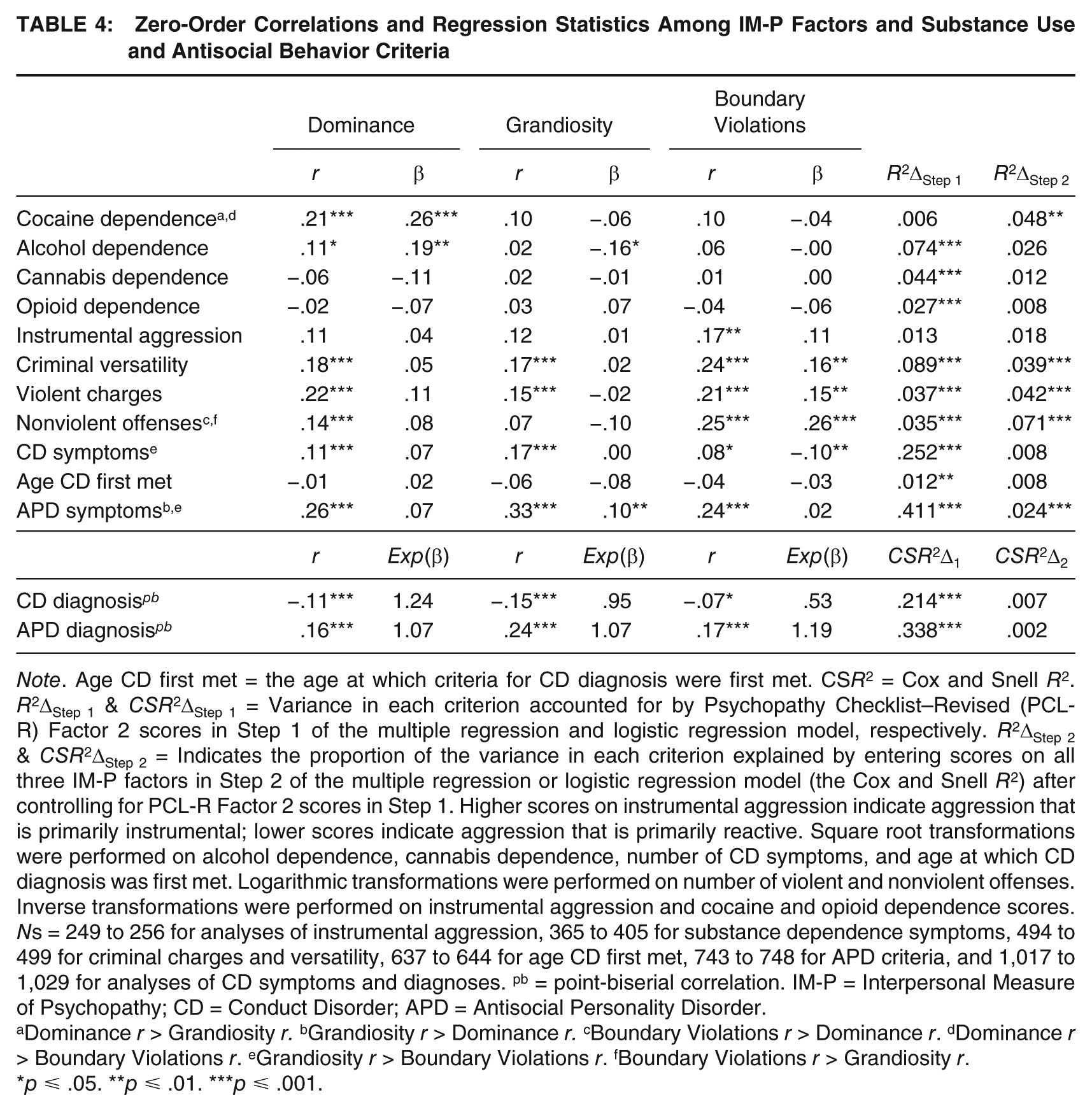
Consistent with prior links between the interpersonal facet of the PCL-R and cocaine dependence, in the current study, Dominance scores were correlated with cocaine dependence (a small-to-moderate relationship). Dominance scores continued to demonstrate a unique relationship with cocaine dependence even after controlling for F2 scores and scores on the other IM-P factors. In addition, Dominance scores were uniquely and positively related to symptoms of alcohol dependence, a relationship that was not evident at the zero-order level. However, none of the associations between IM-P factor scores and symptoms of dependence on other substances proved significant using transformed scores. When analyses were repeated for untransformed scores, one additional negative relationship between Grandiosity scores and alcohol dependence symptoms emerged, β = −.27, p = .003. See Table 4 for zero-order correlation and regression statistics among IM-P factor scores and scores on substance dependence variables.
Zero-Order Correlations and Regression Statistics Among IM-P Factors and Substance Use and Antisocial Behavior Criteria
Note. Age CD first met = the age at which criteria for CD diagnosis were first met. CSR2 = Cox and Snell R2. R2ΔStep 1 & CSR2ΔStep 1 = Variance in each criterion accounted for by Psychopathy Checklist–Revised (PCL-R) Factor 2 scores in Step 1 of the multiple regression and logistic regression model, respectively. R2ΔStep 2 & CSR2ΔStep 2 = Indicates the proportion of the variance in each criterion explained by entering scores on all three IM-P factors in Step 2 of the multiple regression or logistic regression model (the Cox and Snell R2) after controlling for PCL-R Factor 2 scores in Step 1. Higher scores on instrumental aggression indicate aggression that is primarily instrumental; lower scores indicate aggression that is primarily reactive. Square root transformations were performed on alcohol dependence, cannabis dependence, number of CD symptoms, and age at which CD diagnosis was first met. Logarithmic transformations were performed on number of violent and nonviolent offenses. Inverse transformations were performed on instrumental aggression and cocaine and opioid dependence scores. Ns = 249 to 256 for analyses of instrumental aggression, 365 to 405 for substance dependence symptoms, 494 to 499 for criminal charges and versatility, 637 to 644 for age CD first met, 743 to 748 for APD criteria, and 1,017 to 1,029 for analyses of CD symptoms and diagnoses. pb = point-biserial correlation. IM-P = Interpersonal Measure of Psychopathy; CD = Conduct Disorder; APD = Antisocial Personality Disorder.
Dominance r > Grandiosity r. bGrandiosity r > Dominance r. cBoundary Violations r > Dominance r. dDominance r > Boundary Violations r. eGrandiosity r > Boundary Violations r. fBoundary Violations r > Grandiosity r.
p ⩽ .05. **p ⩽ .01. ***p ⩽ .001.
Relationships with Antisocial Behavior
As indicated in Table 4, there were small-to-moderate zero-order relationships for all three IM-P factor scores with multiple indices related to antisocial behavior. Scores on all three factors were associated with indices of criminal versatility and violent charges, and scores on Dominance and Boundary Violations were associated with the number of nonviolent offenses. In addition, Boundary Violations scores were positively associated with ratings of instrumentality of aggression; however, none of the IM-P factors were uniquely associated with instrumental violence. Only Boundary Violations scores were uniquely related to the number of violent charges. Similarly, only Boundary Violations scores were uniquely related to the number of nonviolent charges and ratings of criminal versatility. With untransformed variables, Boundary Violations scores were no longer uniquely associated with violent or nonviolent offenses at the alpha level of .01 (βs = .09 and .07, ps = .26 and .38, respectively).
There were also significant zero-order associations between all IM-P factor scores and various criteria associated with CD or APD symptoms. However, after controlling for F2 scores and scores on the other IM-P factors, the only unique relationships that emerged were a positive association between Grandiosity scores and the number of APD symptoms and a negative association between Boundary Violations scores and the number of CD symptoms. The latter association was not significant in analyses with untransformed scores (β = −.06, p = .12).
Relationships with Interpersonal Behavior
Finally, with regard to ratings of off-task attention to the experimenter while participants were completing a laboratory measure of perception, only the association with Dominance scores achieved significance at an alpha level of .01 (Dominance: r = .18, p = .005; Grandiosity: r = .10, p = .13; Boundary Violations: r = .15, p = .027). None of these associations remained significant in primary analyses after controlling for F2 scores and scores on the other IM-P factors at the alpha level of .01 (∆R2 for Step 2 = .036, p = .04, all βs < .12, all ps > .10). However, analyses using untransformed variables yielded a significant increment for Step 2 and a unique positive relationship only for Boundary Violations (ΔR2 for Step 2 = .118, p < .001, Boundary Violations β = .32, p < .001, both other βs < .06, ps > .40).
Discussion
This study evaluated the relationships of IM-P factor scores with a wide variety of external correlates previously linked to the interpersonal component of psychopathy. The results add to the validation of the IM-P by demonstrating that interpersonal behaviors exhibited during clinical interviews are associated with a variety of clinically relevant behaviors outside of the interview situation that are consistent with prior research and conceptualizations of the core features of psychopathy. In addition, current results provide evidence that each of the IM-P factors exhibits a somewhat distinctive pattern of correlates, which helps make sense out of the relatively diverse criteria associated with ratings on the interpersonal facet of the PCL-R. In addition, the study provides substantial evidence that IM-P factor scores provide unique information even after controlling for ratings on PCL-R F2. As a result, the current study expands our understanding of the nomological network associated with the interpersonal features of psychopathy.
Current analyses showed that, after controlling for ratings on PCL-R F2 factor or on the other three facets, all three IM-P factor scores continued to exhibit associations with ratings on PCL-R F1 and on the interpersonal facet, demonstrating that these relationships are not attributable to the variance shared between F1 and F2. Moreover, Grandiosity demonstrated a unique association with ratings on the PCL-R affective facet, indicating that this relationship extends beyond the variance shared between the IM-P factor and PCL-R interpersonal facet scores. In contrast, relationships between IM-P factor scores and ratings on F2 (and on the lifestyle and antisocial facets) appear to reflect primarily the variance shared between the two PCL-R factors. This pattern of findings provides evidence that the IM-P factors are not measures of the broad-based construct of psychopathy; they appear to reflect a subset of psychopathic traits closely aligned with the core interpersonal—and, to an extent, the affective—features of psychopathy.
Consistent with prior findings for the interpersonal component of psychopathy (e.g., Kosson et al., 1997; Vitacco et al., 2005; Vitacco et al., 2008), all of the IM-P factor scores were associated with some indices of adaptive success (in education and SES). Because scores on some of these criterion variables were related to all three IM-P factor scores, it is probable that these findings are related more broadly to the larger interpersonal dimension of psychopathy rather than to only one of the specific components of the IM-P. However, the pattern of findings was also somewhat distinctive for each of the three factors. Whereas both Dominance and Boundary Violations were uniquely associated with age, this was the only unique relationship with demographic factors evident for Dominance. Boundary Violations were also uniquely related to SES. However, Grandiosity scores exhibited a more consistent link to positive adjustment and were the only component of the IM-P associated with higher intelligence or better achievement.
Boundary Violations scores demonstrated unique relationships with several indices of antisocial behavior, including violent and nonviolent offenses and criminal versatility. This pattern of findings suggests the Boundary Violations component of the IM-P is associated with a willingness to engage in a variety of antisocial behaviors and is not simply a measure of willingness to violate expected interpersonal norms. Boundary Violations scores were the only IM-P factor scores uniquely associated with more than one antisocial behavior criterion. Therefore, these findings suggest the possibility that previously reported mixed relationships between the PCL-R interpersonal facet and antisocial behavior (e.g., Kosson et al., 1997) may partly reflect the fact that only one subcomponent of the interpersonal domain is broadly relevant to criminal conduct. Moreover, it is remarkable that violations of implicit rules during an interview were postdictive of any indices of real-world criminal conduct as assessed by official charges. One important direction for future research is to examine whether Boundary Violations scores are also predictive of future criminal conduct.
As was the case for Boundary Violations scores, Grandiosity scores were uniquely associated with scores on the interpersonal facet of PCL-R assessed psychopathy. Although not examined statistically, the partial correlations between Grandiosity and ratings on the interpersonal facet accounted for a substantially greater proportion of the variance in interpersonal facet ratings (22%) than the partial correlations for Dominance and Boundary Violations (roughly 8.5% and 6%, respectively; see Table 2). At the same time, Grandiosity scores were also uniquely correlated with affective facet scores and were the only IM-P factor scores to correlate significantly with lifestyle and antisocial facet scores after controlling for the other IM-P factor scores. This pattern of findings suggests that Grandiosity scores are both more strongly related to the interpersonal facet of the PCL-R and overlap more with other facets of psychopathy than the other components of the IM-P. In short, Grandiosity scores may correlate more closely with PCL-R ratings in general than do the other components of the IM-P.
However, the pattern of relationships for Grandiosity extends substantially beyond PCL-R ratings. Grandiosity was uniquely associated with lower neuroticism levels (and lower NA and depression scores), which is consistent with the notion that it is more relevant than the other IM-P factor scores to affective features of psychopathy. In contrast to the other IM-P dimensions, it was the only dimension associated with the positive attributes of higher intelligence and achievement. Also in contrast to Dominance and Boundary Violations, Grandiosity scores exhibited no unique relationships with indices of criminal or antisocial behavior with the exception of number of adult APD symptoms. Although the unique correlation with APD may partly reflect the larger correlations between Grandiosity and ratings on the lifestyle and antisocial facets of the PCL-R, the pattern of correlates for this factor is otherwise somewhat reminiscent of recent conceptualizations of a boldness dimension described by Patrick and colleagues in the triarchic model of psychopathy (Patrick, Fowles, & Krueger, 2009). Boldness is said to describe “a phenotypic style entailing a capacity to remain calm and focused in situations involving pressure or threat, an ability to recover quickly from stressful events, high self-assurance, and social efficacy, and a tolerance for unfamiliarity and danger” (Patrick et al., 2009, p. 926). This characterization fits with comments by Patrick et al. that boldness is less closely associated with criminal and other antisocial behaviors than other components of psychopathy. Yet, the unique relationship with APD symptoms suggests that Grandiosity is related to this personality disorder even after removing its shared variance with PCL-R F2 and other IM-P scores. In addition, these findings suggest that prior research linking the interpersonal facet of psychopathy to higher intelligence and other adaptive factors could be explained by an underlying grandiosity subcomponent not easily isolated in the PCL-R alone, but more easily identified with other measures (including the IM-P and the Triarchic Psychopathy Measure). Overall, this study and further research on the IM-P factors (specifically Grandiosity) and their correlates may contribute to the controversy surrounding the concept of boldness and its relationship to psychopathy, specifically whether it is an essential component of the construct (see Lilienfeld et al., 2012; Lynam & Miller, 2012; Miller & Lynam, 2012). Although not a primary aim of this study, the pattern of relationships we report between IM-P factor scores and NA and externalizing variables may contribute to this discussion of boldness and fearless dominance in psychopathy.
Integrating across domains, the pattern of findings for Dominance scores, including unique positive relationships with cocaine and alcohol dependence, proneness to NA, and age, suggests that the correlates of Dominance are quite distinct from those of the other IM-P factors and not entirely consistent with any simple perspective on psychopathy. However, the finding that Dominance scores were the only IM-P factor scores uniquely associated with cocaine dependence symptoms fits with prior research on the interpersonal facet of psychopathy (Walsh et al., 2007), a finding that has been replicated in two independent samples (Brieman et al., 2017). In conjunction with the current finding that, after controlling for F1 and the other IM-P factor scores, Dominance scores were uniquely associated with ratings on the interpersonal facet but no other component of psychopathy, the pattern of findings is consistent with a connection between interpersonal features of psychopathy and cocaine use and with the perspective that some of the core components of psychopathy are more associated with deviance than with criminal behavior. We believe additional research is warranted to further clarify the nature of the construct identified by this set of interpersonal behaviors.
Furthermore, although these criterion variables differ substantially, these relationships provide a preliminary basis for relating some of these findings to prior psychopathy findings. First, relationships between psychopathy and NA have been controversial. Although Cleckley had proposed that psychopathic individuals might be characterized by an absence of neuroticism, most prior studies of the PCL-R (and even the PCL-R factors and facets) have failed to reveal negative zero-order correlations with indices of NA, although several studies have reported positive correlations between Factor 2 ratings and NA scores. In addition, several studies have reported negative partial correlations between Factor 1 ratings (and indices of callous-unemotional traits in youth) after controlling for Factor 2 ratings (or indices of conduct problems in youth; e.g., Hicks & Patrick, 2006). Current findings suggest that prior inconsistent findings for Factor 1 may partly reflect the distinct unique relationships between subcomponents of the interpersonal dimension of psychopathy and indices of negative emotion: whereas Dominance correlates positively with NA scores, Grandiosity correlates negatively with NA scores in the current sample. Of course, firm conclusions await additional evidence on the robustness of these relationships.
The results of this study have direct implications for the criminal justice system, including the management and treatment of offenders. In particular, Boundary Violations exhibited unique associations with criteria for violent and nonviolent crimes and criminal versatility. These findings suggest that specific aspects of the interpersonal component of psychopathy may help account for distinct ways in which psychopathic individuals break the law. In contrast, Grandiosity was less related to charges for criminal conduct and uniquely associated with intellectual functioning and academic achievement but retained a unique relationship with adult APD symptoms. Consistent with emerging models of psychopathy such as the triarchic model (Patrick et al., 2009), the assessment of more narrow-band interpersonal constructs such as Dominance and Boundary Violations may prove useful in understanding psychopathy’s relationship with distinct aspects of the violation of societal norms (e.g., substance abuse versus crime) that are not easily detected from broader conceptualizations of the structure of psychopathy. Moreover, because psychopathic offenders differ in the specific constellation of traits they exhibit, these narrower dispositions may ultimately prove useful in assessing risk for violence and recidivism. Although additional research is necessary to understand the complex patterns of associations for Grandiosity scores, the relationships in the current study suggest the possibility that Grandiosity and boldness merit additional study as possible correlates of successful psychopathy.
The current study demonstrates the utility of the three-factor model of the IM-P. However, there are several limitations that must be considered when interpreting the results. First, this was a cross-sectional study of male jail detainees. It is necessary that the results of the study are cross-validated with forensic samples, community-based samples, and samples of females before we can be assured that the relationships observed here are robust and generalizable. Future research is also needed to evaluate the longitudinal stability of the IM-P and its ability to predict meaningful external correlates over time.
Second, although studies like the current one suggest that more attention should be invested in identifying and understanding the interpersonal behaviors of psychopaths, the interpersonal features of psychopathy have received substantially less attention than their affective counterparts. Consequently, there are more unanswered questions concerning the correlates of the interpersonal features of psychopathy than might be expected given its widespread acceptance as one of the core dimensions of psychopathy. Despite the large number of criteria examined in this study and the evidence for distinct correlates for each of the three factors, some of the relationships we examined between IM-P factor scores and indices of clinically relevant constructs have not previously been examined. As a result, the current study provides only preliminary guidelines for expanding the nomological network associated with the interpersonal component of psychopathy.
Third, despite using an alpha level of .01 to assess statistical significance, we conducted a large number of analyses. Furthermore, when using untransformed scores, there was a somewhat different pattern of relationships between Boundary Violations and charges for both violent and nonviolent offenses in that they were no longer significantly related at the alpha level of .01. That is, we lost predictive power with these two variables. The relationship between Boundary Violations scores and external correlates is certainly an area of need for future exploration. Generally, to ensure that the relationships reported here are robust, it is important to examine their replicability in independent samples. Although we contend that the distinctive pattern of relationships—rather than a focus on significance alone—is what is most important when attempting to evaluate the construct validity of a measure’s proposed factor model, it remains important to further examine the constructs measured by the three factors of the IM-P to refine our understanding of their shared and unique nature.
Finally, the fact that the same rater scored both the PCL-R and IM-P makes it possible that, in some cases, the same information contributed to both PCL-R and IM-P ratings. Although the focus of IM-P items on concrete interpersonal interactions and overt behaviors reduces the likelihood of such overlap, the use of independent raters (as in some prior studies) would provide additional confidence that overlapping information did not contribute to the relationships between IM-P factor and PCL-R facet scores. Even so, it appears clear that the use of the same raters for the PCL-R and IM-P cannot explain correlations between IM-P factor scores and charges for criminal behavior or performance on self-report questionnaires or intelligence tests.
These limitations notwithstanding, current evidence regarding the nomological network surrounding the IM-P and its factor scores suggests that the IM-P has the potential to be extremely useful for both researchers and clinicians. First, the IM-P does not require expert raters or substantial training for completion, nor does it require a great deal of time. It can be completed as a supplement to a semi-structured interview, commonly utilized in the admission or intake process at many sites where a brief rating of psychopathic traits might be of interest for research or clinical purposes. Moreover, expanding the methodological repertoire available for measuring psychopathic traits is a valuable pursuit in our understanding of the psychopathy construct and its reliability and validity. Finally, the IM-P is unique in its focus on idiosyncratic behaviors exhibited during a relatively brief interaction. That is, part of the importance of the IM-P stems from the fact that, to paraphrase K. A. Fowler, Lilienfeld, and Patrick (2009), behavior is of paramount importance, a statement that appears particularly true in the study of psychopathy, where interpersonal manifestations of the syndrome are so salient.
Supplemental Material
CJB786759_Supplemental_Material – Supplemental material for Construct Validity of the Three-Factor Model of the Interpersonal Measure of Psychopathy
Supplemental material, CJB786759_Supplemental_Material for Construct Validity of the Three-Factor Model of the Interpersonal Measure of Psychopathy by Sarah L. Hampton, Michael J. Vitacco and David S. Kosson in Criminal Justice and Behavior
Footnotes
Authors’ Note:
The research and preparation of this article were supported in part by Grant MH57714 from the National Institute of Mental Health to David S. Kosson. We wish to thank David Wathen, Patrick Firman, Larry Lesza, Jennifer Witherspoon, Rick Riddle, G. Mark McCorley, and the staff of the Lake County Jail for their consistent support of the research reported here. We also thank Rosemarie Gray, Frank Kuzmickus, Robert Verborg, and the staff of the Nineteenth Judicial Circuit Adult Probation Services for additional assistance. Finally, we thank Carolyn Abramowitz, Michael Brook, Nick Doninger, Diane Goldstein, Seoni Llanes, Nastassia R. Riser, Elizabeth Sullivan, Marc Swogger, Zachary Walsh, and Amy Zalke for their assistance in interviewing inmates.
Notes

References
Supplementary Material
Please find the following supplemental material available below.
For Open Access articles published under a Creative Commons License, all supplemental material carries the same license as the article it is associated with.
For non-Open Access articles published, all supplemental material carries a non-exclusive license, and permission requests for re-use of supplemental material or any part of supplemental material shall be sent directly to the copyright owner as specified in the copyright notice associated with the article.
