







Abstract
The purpose of this study is to further the understanding of the hardships faced by formerly incarcerated individuals by investigating the association between prior incarceration and postrelease food insecurity. Drawing on data from the National Longitudinal Study of Adolescent to Adult Health (Add Health), our findings demonstrate that a history of incarceration is associated with an increased likelihood of experiencing food insecurity. This association is found to partially operate through household income, depressive symptoms, marital status, and social isolation. Given the importance of food insecurity in predicting future health outcomes and nutritional behavior, food insecurity may be an important factor in driving health disparities among formerly incarcerated persons.
Keywords
Introduction
Each year, about 600,000 individuals are released from prisons and millions cycle in and out of local jails in the United States (Carson, 2018; Zeng, 2018). The high incarceration rate has resulted in a sizable population of formerly incarcerated individuals transitioning from custodial confinement to life in residential communities, many of whom are concentrated in impoverished areas with limited resources (Sampson & Loeffler, 2010).
The large number of formerly incarcerated individuals reentering society has sparked interest among social scientists and policy makers regarding the challenges to successful reintegration, including the establishment of a conventional lifestyle and meeting basic material needs, such as access to food (Harding, Wyse, Dobson, & Morenoff, 2014; Western, Braga, Davis, & Sirois, 2015). Extant literature on the consequences of incarceration has indicated that serving time behind bars is a stressful and stigmatizing experience that impedes successful reintegration by eroding human and social capital, generating legal restrictions, and contributing to physical and psychological health problems (Travis, Western, & Redburn, 2014).
Despite increased attention to the deleterious effects of incarceration on postrelease hardships (Harding et al., 2014; Travis et al., 2014; Western et al., 2015), few studies to date have considered the link between incarceration and nutritional outcomes (Porter, 2014; Testa, 2019). Still, there is no prior research on the relationship between incarceration and postrelease food insecurity among formerly incarcerated individuals. This is a notable limitation as food insecurity (i.e., the lack of access to adequate food) is “an especially acute and severe form of deprivation that is distinct from other indicators of economic insecurity or hardship” (Turney, 2015, p. 336), and “to go without sufficient food is the most basic critical hardship” (Boushey, Brocht, Gundersen, & Bernstein, 2001, p. 32). Moreover, formerly incarcerated individuals may be at an increased risk of food insecurity, as several consequences of incarceration are also risk factors for food insecurity, including economic deprivation, limitations to physical functioning, depressive symptoms, and disrupted social integration (Gundersen & Ziliak, 2018).
The current study extends prior literature on the consequences of incarceration by investigating two research questions: First, what is the relationship between prior incarceration and postrelease food insecurity? Second, to what extent do postincarceration outcomes related to income, physical disability, depressive symptoms, and social integration explain the association between incarceration and food insecurity?
Background
Incarceration and Health
A long line of research has documented the consequences of incarceration for health and well-being. In general, this body of research has found that both current and formerly incarcerated individuals tend to exhibit poorer health than those in the general population (Fahmy & Wallace, 2018; Massoglia & Pridemore, 2015; Wildeman & Wang, 2017). Specifically, a series of studies have found associations between incarceration history and a range of adverse health outcomes, including an increased risk of infectious and stress-related illnesses (Massoglia, 2008), severe functional limitations (Schnittker & John, 2007), premature mortality (Binswanger et al., 2007), and the onset or worsening of psychological health problems such as depression (Porter & DeMarco, 2019; Porter & Novisky, 2017). In short, the accumulated body of evidence has revealed that “incarceration has strongly harmful effects on the health of prisoners over their life course” (Wildeman & Wang, 2017, p. 1467).
Despite advancements made in this area, substantially less is known about the mechanisms that may underlie the association between incarceration and adverse health outcomes. For instance, Massoglia and Pridemore (2015) stated that research on incarceration and health has “done a better job showing that incarceration matters rather than why incarceration matters” (p. 303, emphasis in original). Although some research has investigated potential factors that mediate the association between incarceration and health (Massoglia & Pridemore, 2015), few scholars have raised the possibility that poor nutrition could be a catalyst of worsening health among formerly incarcerated individuals (Porter, 2014; Testa, 2019).
Food Insecurity
Food insecurity is defined by the United States Department of Agriculture (USDA) as having limited access to adequate food (Coleman-Jensen, Rabbit, Gregory, & Singh, 2017; Ma et al., 2016). As of 2016, approximately 41 million persons (12.9%) were food insecure at some point during the year (Coleman-Jensen et al., 2017). Food insecurity is considered a major public health crisis in the United States, as it is associated with wide-ranging consequences for nutrition, health, and development, and results in billions of dollars spent annually on food assistance programs (Gundersen & Ziliak, 2018). Since the 1960s, a series of food assistance programs have been established with the goal of alleviating food insecurity. At present, the four largest programs—Supplemental Nutrition Assistance Program (SNAP), Supplemental Nutrition Program for Women, Infants, and Children (WIC), National School Lunch Program (NSLP), and School Breakfast Program (SBP)—have a combined annual budget of nearly US$100 billion (Gundersen & Ziliak, 2018).
Given the importance of food insecurity for health and well-being, an extensive literature has emerged assessing the consequences of food insecurity. A number of studies have indicated that food insecure households exhibit lower quality nutritional intake. Research by Bhattacharya, Currie, and Haider (2004) revealed that food insecure adults have less healthy diets, as indicated by lower scores on the USDA’s Healthy Eating Index (HEI). Other research has shown that food insecurity is related to deficiencies in crucial nutrients such as protein, vitamin A, vitamin B-6, iron, and magnesium (Kirkpatrick & Tarasuk, 2008; Park & Eicher-Miller, 2014).
Food insecurity is also associated with increased risk for medical conditions and chronic diseases such as diabetes, hypertension, oral health problems, stroke, cancer, asthma, arthritis, and kidney disease (Gundersen & Ziliak, 2015; Laraia, 2013). Food insecure individuals also report lower health functioning, poor overall health, have restricted daily activity (Vozoris & Tarasuk, 2003), and are at an elevated risk for premature mortality (Gundersen et al., 2016). There is also evidence for adverse psychological health outcomes associated with food insecurity. Vozoris and Tarasuk (2003) found that women experiencing food insecurity were about 3 times more likely to experience major depression than those who reported being food secure. This research is consistent with other studies revealing a heightened risk of psychological health problems, including depression, among individuals residing in food insecure households (Whitaker, Phillips, & Orzol, 2006).
Incarceration and Food Insecurity
Only a few studies have considered the connection between incarceration and food insecurity. Wang and colleagues’ (2013) pilot study on food insecurity and HIV risk behaviors used a convenience sample of 110 individuals who were affiliated with a community-based civil rights organization and were released from prison in the prior year. The findings revealed very high rates of food insecurity among formerly incarcerated individuals, as 91% of respondents reported being food insecure. However, because of the convenience sampling through the community-based program and restricting the sample to individuals released from prison in the prior year, the sample was not representative of formerly incarcerated individuals and therefore is limited in its generalizability (Wang et al., 2013, p. 120).
The majority of extant research has focused on the association between parental incarceration and the food insecurity of children. Using data from the Fragile Families and Child Well-Being Study (FFCWS), Turney (2015) found that paternal incarceration is associated with an increased risk of food insecurity among 5-year-old children. However, this association holds only among children who lived with their biological father prior to his incarceration. Cox and Wallace (2016) also used the FFCWS and found that parental incarceration corresponded to approximately a four percentage point increase in the risk of food insecurity among households with children. Using data from the National Longitudinal Study of Adolescent to Adult Health, Hagan and Foster (2015) found individuals who had a father or mother previously incarcerated were at an increased risk of experiencing food insecurity in young adulthood. Finally, Jackson and Vaughn (2017a) employed data from the Early Childhood Longitudinal Study–Birth Cohort (ECLS-B) and found that parental involvement with the criminal justice system (including arrest, conviction, or incarceration) was associated with significantly higher odds of food insecurity among households with children.
A series of recent qualitative and ethnographic studies have provided evidence that formerly incarcerated individuals face difficulties in meeting basic material needs, including minimal food needs. Harding and colleagues (2014), for instance, found that the majority of formerly incarcerated individuals in Michigan struggled to meet even the most basic needs, such as shelter and food. Research by Western and colleagues (2015) has revealed that formerly incarcerated individuals in Boston have experienced a number of stressors and hardships during reintegration and have often lacked the ability to meet basic needs. Both studies note that formerly incarcerated individuals often relied heavily on family members and romantic partners or public assistance programs to obtain basic material needs, including a place to sleep or a meal. Similarly, Fader’s (2013) ethnography of young men transitioning from incarceration to the community in Philadelphia has documented a pattern of difficulties making sufficient wages and often relying on romantic partners as a means of survival.
Given the strong association between incarceration and material hardship, and research detecting a link between parental incarceration and food insecurity among children, we hypothesize that the following:
Why Incarceration Might Increase Food Insecurity?
Although individuals entering into prisons and jails exhibit a number of markers of disadvantage including low levels of human, financial, and social capital, serving time behind bars can alter one’s life course and exacerbate disadvantage (Travis et al., 2014). Incarceration may serve as an event that elevates the risk of food insecurity by (a) reducing income, (b) contributing to physical disability, (c) worsening psychological well-being, and (d) disrupting social integration.
Income
Research has indicated that low-income households experience constraints on how to allocate income for essential goods, including basic food needs (Noonan, Corman, & Reichman, 2016). Income is consistently the strongest predictor of experiencing food insecurity; even after accounting for other household and individual characteristics, households with lower levels of income have been found to be at an increased risk for food insecurity (Coleman-Jensen et al., 2017; Gundersen & Ziliak, 2018). As most incarcerated individuals are economically disadvantaged prior to incarceration and continue to earn low wages and face unstable employment opportunities following release (Pager, 2003), formerly incarcerated individuals may be particularly prone to food insecurity as a result of these financial challenges. Similarly, other elements related to incarceration, such as monetary sanctions, might increase the risk of food insecurity by contributing to economic instability. As A. Harris, Evans, and Beckett (2010) proposed, “legal debt substantially reduces household income and compels people living on very tight budgets to choose between food, medicine, rent, child support, and legal debt” (p. 1786). Accordingly, we hypothesize that the following:
Additional Risk Factors for Food Insecurity
Although it is not surprising that food insecurity is inversely associated with income, a sizable number of poor households are food secure and a considerable number of nonpoor households are food insecure (Coleman-Jensen et al., 2017; Gundersen & Ziliak, 2018). This pattern implies that food insecurity “is related, yet distinct from poverty” (Ribar & Hamrick, 2003, p. 21). Focusing solely on income, therefore, does not account for other factors that influence the likelihood of experiencing food insecurity. For example, factors such as physical disability, psychological well-being, and social integration are all collateral consequences of incarceration that can increase the likelihood of becoming food insecure independent of income levels (Gundersen & Ziliak, 2015, 2018).
Physical Disability
Net of economic resources, households with a disabled person are more likely to be food insecure (Balistreri, 2012; Huang, Guo, & Kim, 2010). There are a number of reasons why disability of a household member may be related to the onset or worsening of food insecurity. First, physical disability can contribute to financial hardship by reducing labor market participation (Kreider & Pepper, 2007). Second, aside from reducing income, disability can constrain financial resources by increasing medical expenditures. In support of this point, Huang and colleagues (2010) have found that physical disability of the head of a household is positively associated with food insecurity and that increased health expenditures mediate this relationship. Third, disability can also affect the ability to obtain food by limiting a person’s capability to walk or drive to food retailers (Gundersen & Ziliak, 2018). Limited mobility associated with disability can increase food insecurity, as some research finds difficulty accessing food retailers is associated with a higher likelihood of food insecurity (Garasky, Morton, & Greder, 2006; Ma et al., 2016; Pérez, Roncarolo, & Potvin, 2017). As previous research has detected an increased risk of disability following release from incarceration (Schnittker & John, 2007), we propose the following:
Depression
Prior research has revealed an association between psychological well-being and the likelihood of food insecurity (Gundersen & Ziliak, 2015; Noonan et al., 2016). While stress related to food insecurity can lead to psychological health problems, declines in psychological well-being can lead to an increased risk of food insecurity as well. In particular, depression can increase the risk of food insecurity through two primary mechanisms. First, depression may increase financial strain by reducing labor market participation (Heflin, Corcoran, & Siefert, 2007; Huang et al., 2010). For instance, individuals are more likely to miss work and work fewer productive hours each week when they are suffering from depressive symptoms (Adler et al., 2006; Stewart, Ricci, Chee, Hahn, & Morganstein, 2003). Second, experiencing depressive symptoms can reduce the ability to strategically manage finite resources. Depressive symptoms can lead to a diminished capacity to think about the future in a positive way and interfere with decision-making capabilities (O’Connor, Connery, & Cheyne, 2010), which can create challenges managing a monthly food budget (Heflin et al., 2007). Given that previous work has revealed an association between prior incarceration and depressive symptoms following release from incarceration (Porter & DeMarco, 2019; Porter & Novisky, 2017), we hypothesize that the following:
Social Integration
Social integration can be protective against food insecurity by providing support networks to obtain food directly or resources needed to secure food. Ethnographic research demonstrates individuals facing material hardship often rely on social support to meet basic daily needs (Desmond, 2012). In regard to food insecurity, research has suggested that individuals who feel they can rely on help from others are less likely to become food insecure (Martin, Rogers, Cook, & Joseph, 2004; Tarasuk, 2001). For instance, Martin and colleagues (2004) found that knowing and trusting neighbors can facilitate networks that reduce food insecurity by providing crucial support such as the borrowing of food in times of need, as well as loaning of a car, money, or child care services to enable families to obtain food. Similarly, a study by Tarasuk (2001) indicated that individuals who report feeling more socially isolated are at an increased risk of food insecurity.
Incarceration can negatively affect social integration by removing individuals from families and communities and weakening social interactions among residents (Clear, 2007). Moreover, incarceration can damage social integration by reducing the likelihood of marriage (Huebner, 2005) and increasing the likelihood of divorce (Siennick, Stewart, & Staff, 2014). The fracturing of social relationships is a particularly salient consequence of incarceration that can have important implications for food insecurity, as formerly incarcerated individuals often rely on instrumental and emotional support from family members, friends, and romantic partners to avoid material hardship (Fader, 2013; Harding et al., 2014; Western et al., 2015). Accordingly, we propose that the following:
Method
Data
For the current study, we conducted a cross-sectional analysis using data from Waves I and IV from the National Longitudinal Study of Adolescent to Adult Health (Add Health), a nationally representative survey of adolescents enrolled in Grades 7 to 12 in the United States during the 1993-1994 academic year. At Wave I of the study, 90,000 students from 132 schools were surveyed. Following the initial survey, approximately 20,000 individuals were selected for in-home interviews. To date, three in-home interviews have been conducted since the initial survey: Wave II was administered in 1996, Wave III was conducted in 2001-2002, and Wave IV data were collected in 2008. At Wave IV, respondents were between 24 and 34 years old (K. M. Harris et al., 2009). Data on key variables including food insecurity, incarceration history, and the mediators were measured at Wave IV, and Wave I data were used to account for a several baseline control variables.
Add Health data are particularly well suited for this study for several reasons. First, Add Health is the only available dataset that includes items measuring both food insecurity and prior incarceration in adulthood. Second, Add Health is a nationally representative sample of individuals in the age range that is most prone to incarceration (i.e., adolescence to early adulthood). Therefore, these data cover a more diverse set of respondents compared with previous research in this area that uses convenience sampling (Wang et al., 2013) or surveys of respondents from economically disadvantaged backgrounds, such as Fragile Families (Cox & Wallace, 2016; Turney, 2015). Finally, the Add Health data contain a rich set of economic, social, psychological, health, and nutritional measures over multiple points in time.
Dependent Variable
Food insecurity is a binary indicator measured at the Wave IV interview. Respondents answered yes or no to the question: “In the past 12 months, was there a time when (you/your household) (were/was) worried whether food would run out before you would get money to buy more?” The wording of this question is from the first item of the USDA Household Food Security Survey Module (Coleman-Jensen et al., 2017). While the USDA uses an 18-question survey to measure food insecurity, prior research finds that the single-item question is a valid proxy for the presence of food insecurity (Pan, Sherry, Njai, & Blanck, 2012). In addition, prior research using Add Health data has used this item as a proxy for food insecurity (Gooding, Walls, & Richmond, 2012; Hagan & Foster, 2015; Testa & Jackson, 2019).
Independent Variable
Prior incarceration is measured by the following question asked at Wave IV: “Have you ever spent time in jail, prison, juvenile detention center, or other correctional facility?” The response was coded as a binary indicator, where a value of 1 indicates a respondent had been previously incarcerated and 0 represents respondents with no history of incarceration. To increase the reliability of responses, sensitive questions, including incarceration history, were answered using computer-assisted and audio computer–assisted self-interview technology (CASI; K. M. Harris et al., 2009).
Control Variables
The current study controlled for several characteristics that may confound the relationship between incarceration and the outcomes of interest. Demographic controls included age, race/ethnicity, and sex. Age measures of the respondents’ age in years at Wave IV. Race/ethnicity was coded as a series of dichotomous measures indicating whether the respondent identified as White (reference), Black, Hispanic, or other race. Sex was coded as a binary indicator with males coded as 1 and females as 0.
In addition, we controlled for a series of measures related to the respondents’ sociodemographic background and prior behavior that may be related to incarceration and food insecurity status. Child in home is a binary variable which indicated whether a respondent had a child residing in their household at Wave IV. High school degree is a binary variable indicating whether or not the respondent completed high school by Wave IV. Hard drug use is a dichotomous measure indicating whether the respondent reported using any drugs besides marijuana at the Wave I interview. Prior depressive symptoms is a scale measured at Wave I, which summed responses to 11 items capturing depressive symptoms. Respondents were asked on a scale of 0 to 3 how often they experienced each of the following during the prior 7 days: being bothered by things that don’t usually bother you, not feeling like eating, appetite was poor, could not shake off the blues, feel like you were as good as other people (reverse coded), felt depressed, felt too tired to do things, felt hopeful (reverse coded), felt like a failure, enjoyed life (reverse coded), felt sad, felt life was not worth living (α = .82). Fatalism is a 5-point scale that measured a respondent’s perceived likelihood of living to age 35 at Wave I (almost no chance, some chance, a 50-50 chance, a good chance, almost certain). Fatalism was included as a control variable as prior research has suggested fatalistic attitudes may be related to poor health, health-related behaviors, and socioeconomic outcomes (Porter, 2014). Food stamps in adolescence is a dichotomous indicator of whether a respondent’s household received food stamps in the month prior to the interview at Wave I. A binary variable is also included that indicated whether a respondent had missing information about receiving food stamps at Wave I. 1
Mediating Variables
Adjusted Household Income
Adjusted household income was measured by adjusting income for the number of people living in a household. At Wave IV, respondents were asked what the total household income was (including both legal and nonlegal sources) before taxes and deductions. Income was reported in US$5,000 intervals and ranged from less than US$5,000 to US$150,000 or more. We used the mid-point of each response and generated a continuous measure of income (Gooding et al., 2012). Next, household income was adjusted for the number of people living in the home using the equivalence of scale method (Short, Garner, Johnson, & Doyle, 1999), where adjusted household income = household income / (household size) × N, where N = 0.5. Adjusted household income was log-transformed to account for the positive skew. 2
Physical Disability
Physical disability was measured using a binary indicator coded as 1 if a respondent suffered any serious injuries in the previous year, including broken bones, cuts or lacerations, burns, torn muscles, tendons or ligaments, or other injuries that interfered with the ability to perform daily tasks. In addition, respondents who reported being unable to work because of a temporary or permanent disability were coded as being disabled.
Current Depressive Symptoms
Current depressive symptoms were measured at Wave IV using items from the Centers for Epidemiologic Studies–Depression Scale (CES-D). Respondents were asked in the previous 7 days, how often they experienced the 10 depressive symptoms such as feeling depressed, being too tired to do things, feeling sad, and having trouble focusing (α = .84). These items were summed on a scale ranging from 0 to 30 (Porter & Novisky, 2017).
Social Integration
Social integration was measured using the following variables: married and perceived isolation (Porter & Novisky, 2017). Married is a binary indicator if the respondent was married at Wave IV. Perceived isolation was measured using the following item: “how often do you feel isolated from others?” The responses were coded on a scale ranging from never, rarely, sometimes, or often. While these two items do not cover all facets of social integration, these measures captured two theoretically important aspects, as prior research has found formerly incarcerated individuals often rely on spouses and romantic partners to meet basic material needs (Fader, 2013; Harding et al., 2014; Western et al., 2015), and that perceptions of social isolation have been found to be associated with food insecurity (Tarasuk, 2001).
Analytic Strategy
This study used multivariate logistic regression analysis, controlling for key characteristics related to incarceration and food insecurity. Model 1 is a bivariate model that predicts food insecurity using prior incarceration. Model 2 added the slate of control variables. Model 3 added the mediating variables. All estimates used survey weights to account for the multistage cluster design of the Add Health survey. To examine indirect effects of incarceration on food insecurity, we used KHB mediation analysis for nonlinear models (Karlson, Holm, & Breen, 2012). In nonlinear models, comparing the change in coefficients across models is challenging because there is a rescaling of the model that occurs whenever a mediator that has an independent effect on the dependent variable is added to a model, whether or not an individual mediator is correlated with other independent variables in the model. The KHB method resolves this issue by adjusting for rescaling that occurs when additional variables are included in a model and enables a decomposition of the indirect effects of mediator variables.
Results
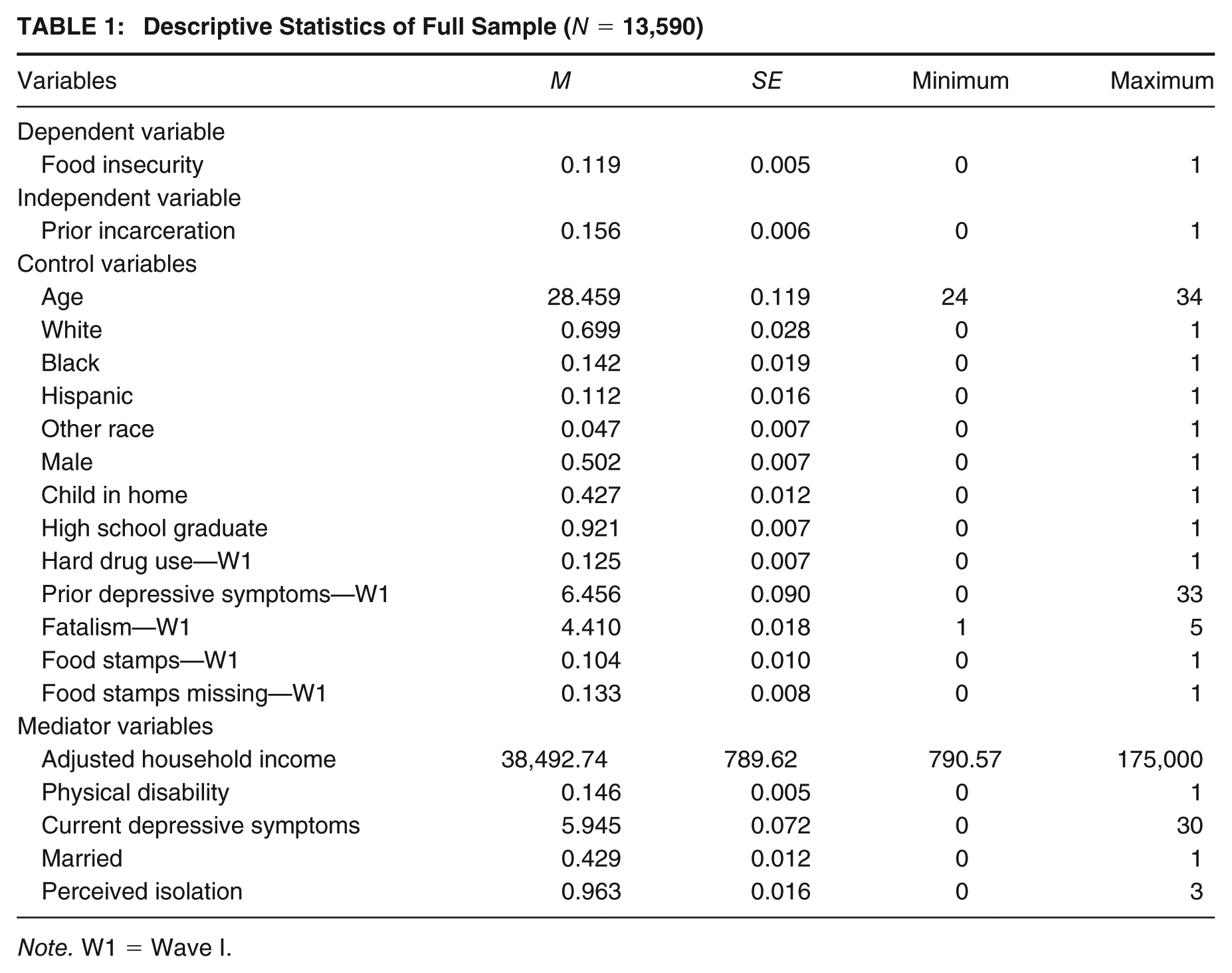
Table 1 provides the descriptive statistics for the analytic sample. At Wave IV, the sample is 28 years old on average. Half the sample is male. The sample is mostly White (69.9%). About 14.2% are Black, 11.2% Hispanic, and 4.7% identify as other race/ethnicity. In total, 15.6% of the sample had been incarcerated by Wave IV and 11.9% of the sample reported experiencing food insecurity in the previous year.
Descriptive Statistics of Full Sample (N = 13,590)
Note. W1 = Wave I.
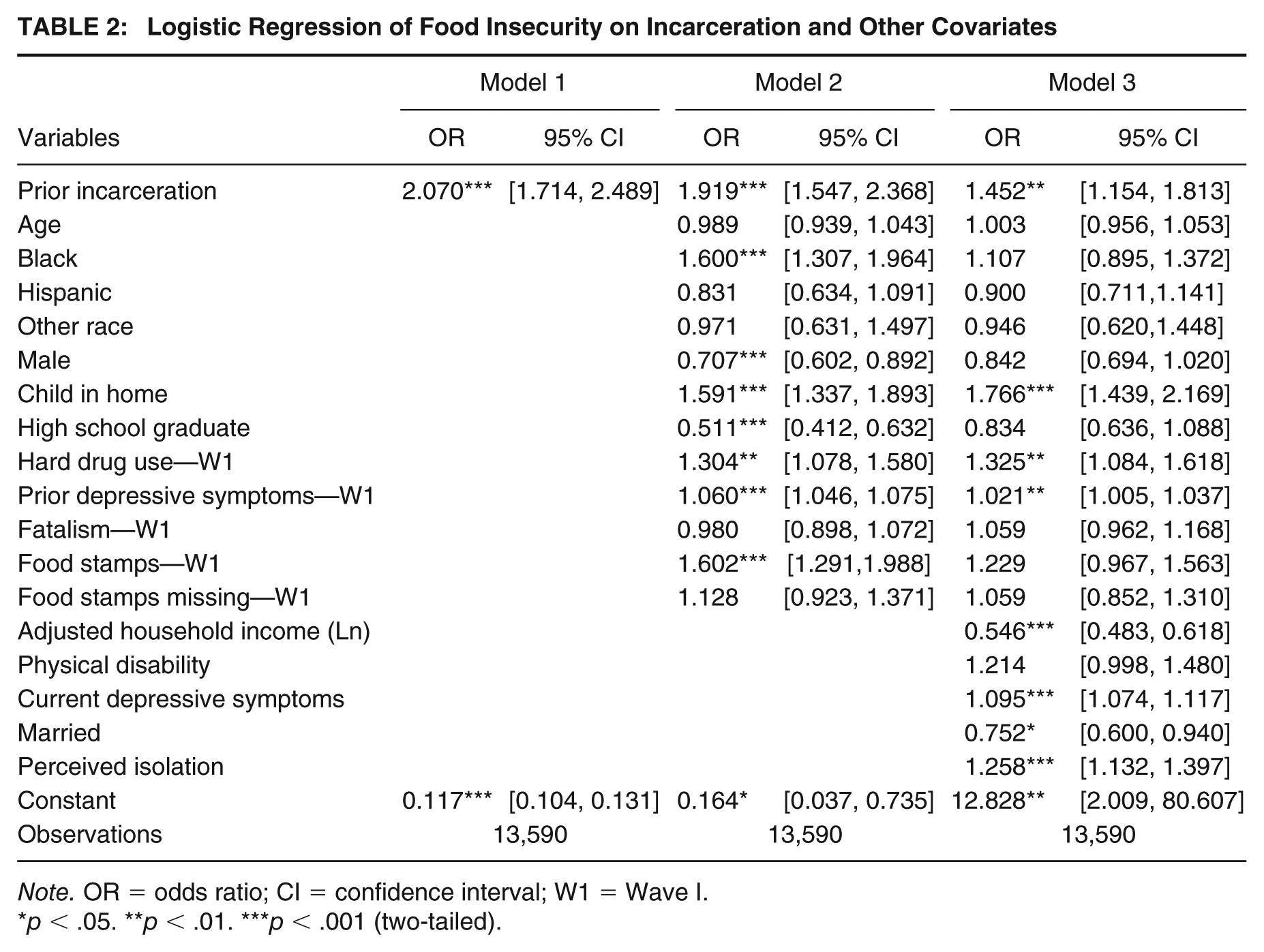
Table 2 presents the odds ratios (ORs) and 95% confidence intervals (CIs) from the logistic regression models in which food insecurity was regressed on incarceration and other covariates. The results from the bivariate regression presented in Model 1 demonstrate that formerly incarcerated individuals are more than twice as likely than those who have not been incarcerated to report food insecurity (OR = 2.070; 95% CI = [1.714, 2.489]). Expressed as predicted probabilities, 19.5% of formerly incarcerated individuals are predicted to be food insecure compared with 10.4% of respondents who were not previously incarcerated.
Logistic Regression of Food Insecurity on Incarceration and Other Covariates
Note. OR = odds ratio; CI = confidence interval; W1 = Wave I.
p < .05. **p < .01. ***p < .001 (two-tailed).
Following the inclusion of the control variables in Model 2, the association between prior incarceration and food insecurity remained positive and statistically significant (OR = 1.919, 95% CI = [1.547, 2.368]). Several control variables emerged as significant predictors of food insecurity. Black respondents had higher odds of food insecurity and male respondents were less likely than females to be food insecure. 3 Having a child in the home increased the odds of food insecurity. Similarly, using hard drugs, having depressive symptoms, and receiving food stamps during adolescence were associated with a higher likelihood of food insecurity in early adulthood. Having graduated high school reduced the odds of food insecurity.
Model 3 added the set of mediators. After the inclusion of the mediators, prior incarceration retained a significant association with food insecurity (OR = 1.452, 95% CI = [1.154, 1.813]), but the magnitude of the relationship was reduced by 46%. Perceived social isolation and depressive symptoms had a positive and statistically significant association with food insecurity, whereas being married and adjusted household income had a negative association with food insecurity.
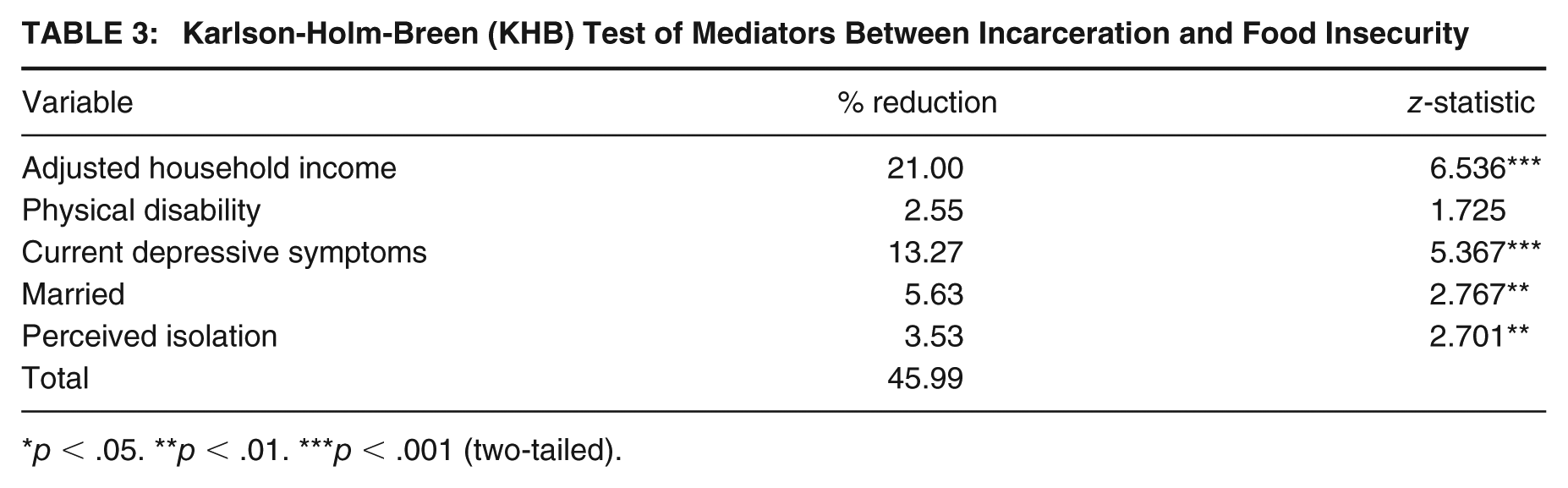
The results from the KHB mediation analysis are presented in Table 3. The association between incarceration and food insecurity was found to operate through several of the mediators included in the analysis. In support of Hypothesis 2a, adjusted household income reduced the association between incarceration and food insecurity by approximately 21% (z-statistic = 6.536, p < .001). In contrast to Hypothesis 2b, physical disability did not significantly mediate the association between incarceration and food insecurity. Hypothesis 2c was supported as depressive symptoms reduced the association between incarceration on food insecurity by 13.27% (z-statistic = 5.367, p < .001). In support of Hypothesis 2d, perceived social isolation led to a 3.53% reduction (z-statistic = 2.701, p = .007) and being married reduced the association between incarceration and food insecurity by 5.63% (z-statistic = 2.767, p = .006). In sum, the association between incarceration and food insecurity partially operates through household income, depressive symptoms, perceived isolation, and marriage. 4
Karlson-Holm-Breen (KHB) Test of Mediators Between Incarceration and Food Insecurity
p < .05. **p < .01. ***p < .001 (two-tailed).
Discussion
Despite advancements in research on the consequences of incarceration, there is limited attention to the association between incarceration and postrelease nutritional hardship. In aiming to fill this gap, the current study investigated whether formerly incarcerated individuals are more likely to experience food insecurity than those who have not been incarcerated. In support of our hypothesis, we found that formerly incarcerated individuals have an increased risk of food insecurity, even after accounting for several factors that are both consequences of incarceration and risk factors for food insecurity.
This finding has a number of implications for criminological inquiry. First, scholars have argued that understanding successful reentry goes beyond recidivism to include whether formerly incarcerated individuals can meet basic material needs (Harding et al., 2014; Western et al., 2015). For instance, Harding and colleagues (2014) noted that a “key determinant of whether returning prisoners are able to establish conventional lifestyles is meeting basic material needs” (p. 442). Western and colleagues (2015) also emphasized this point, noting that “successful transition from prison involves attaining a basic level of material and social wellbeing consistent with community membership” (p. 1515). The results of the present study suggest that many formerly incarcerated individuals may be failing to meet a key benchmark of attaining a basic level of material and social well-being. Notably, food insecurity among formerly incarcerated individuals is not only a marker of the challenges individuals will continue to face after release from a correctional facility, but also a risk factor that may contribute to poor health and difficulties with successful community reintegration.
A growing body of research has indicated that time incarcerated carries a number of adverse consequences for health and well-being, including lower quality nutrition and dietary behaviors, worsened physical health, and diminished psychological well-being (Fahmy & Wallace, 2018; Massoglia & Pridemore, 2015; Porter, 2014; Wildeman & Wang, 2017). A separate area of research has pointed to food insecurity as a detriment to physical and psychological health (Gundersen & Ziliak, 2015). Accordingly, the results of this study suggest that food insecurity may have negative ramifications for dietary behavior, physical health, and psychological well-being among formerly incarcerated persons. Therefore, our results point to the possibility that food insecurity—and the associated nutritional problems that stem from food insecurity—may partially underlie the association between incarceration and poor health. If such is the case, a number of important implications for criminal justice and health policy would follow, as food insecurity and nutrient deficiencies are recognized as “preventable threats to the health and wellbeing of US citizens and residents” (Holben, 2006, p. 446). Given that food insecurity is a modifiable risk factors for poor health, we contend that well-reasoned, targeted interventions hold the potential to simultaneously reduce food insecurity and improve health and well-being of formerly incarcerated individuals and members of their household. Future research that examines food insecurity as a key mediator linking incarceration to poor health can further buttress the need for such targeted interventions.
Finally, a series of recent studies have indicated that food insecurity during childhood contributes to impulse control deficits, misconduct, violence, and delinquent behavior at later life stages (Jackson, Newsome, Vaughn, & Johnson, 2018; Jackson & Vaughn, 2017b; Vaughn, Salas-Wright, Naeger, Huang, & Piquero, 2016). To the extent that food insecurity exerts similar criminogenic effects on formerly incarcerated individuals, this line of research may have important implications for understanding recidivism. New pathways linking crime across generations may also emerge from this line of inquiry, as food insecurity among formerly incarcerated parents may place children at greater risk of delinquency (Jackson et al., 2018).
The second research question aimed to assess whether the relationship between incarceration and food insecurity partially operates indirectly through a series of factors that are both consequences of incarceration and risk factors for food insecurity. In support of Hypothesis 2a, household income significantly reduced the association between incarceration and food insecurity. This finding is consistent with prior literature that demonstrates food insecurity is largely a reflection of economic hardship (Gundersen & Ziliak, 2018). Financial challenges are an especially relevant risk factor, given that a long line of literature has suggested that prior incarceration can exacerbate economic hardship by reducing employment opportunities (Pager, 2003) and generating legal debt (A. Harris et al., 2010).
In contrast, our results did not yield support for Hypothesis 2b, as physical disability did not significantly reduce the association between incarceration and food insecurity. As older adults are more likely to miss work because of disability (Besen, Young, & Pransky, 2015), it is possible that physical disability was less relevant for food insecurity, given the relatively young age of the sample. Future research should investigate whether any functional limitations among formerly incarcerated individuals contribute to food insecurity among samples comprised of older respondents. This may be an especially important research question given that food insecurity poses unique risks to older adults (Gundersen & Ziliak, 2015) and the incarcerated population is growing older (Porter, Bushway, Tsao, & Smith, 2016). In addition, there are important elements of household disability that could not be measured, such as whether the primary earner in the household had become disabled, or if a household member had a cognitive or physical disability (Gundersen, Kreider, & Pepper, 2018). Future research that includes more detailed information on which household members are disabled and the nature of the disability would be beneficial in further elucidating the link between incarceration, disability, and food insecurity status.
In support of Hypothesis 2c, depressive symptoms significantly attenuated the association between incarceration and food insecurity. Understanding the relationship between depression and food insecurity is complex, as food insecurity often co-occurs with depressive symptoms (Whitaker et al., 2006). One possibility is that experiencing food insecurity can lead to emotional distress because of constant worrying about where to obtain future meals (Whitaker et al., 2006). Alternatively, experiencing depression might increase the likelihood of becoming food insecure by reducing labor market participation, interfering with decision-making capabilities, and limiting the coping skills needed to manage limited resources. The finding that depressive symptoms partially underlie the association between incarceration and food insecurity is particularly relevant as past research has suggested that the “psychological effects of incarceration, working in tandem with barriers to reentry, present former inmates with dilemmas that are difficult to resolve” (Schnittker, 2014, p. 123). Thus, our results suggest formerly incarcerated individuals may be at a heightened risk for food insecurity partially because diminished psychological well-being can make coping with challenges related to reentry more onerous. Still, as depressive symptoms and food insecurity were measured concurrently in Add Health, it is not possible to assess whether changes in depression over time influence food insecurity status. Future research using data that includes measures of both food insecurity and depressive symptoms at multiple time points should further investigate this complex association.
Both perceived isolation and marriage partially attenuated the association between incarceration and food insecurity, providing support for Hypothesis 2d. The finding that our indicators of social integration partially mediated the association between incarceration and food insecurity is consistent with prior studies that have pointed to weak social integration as a potent risk factor for food insecurity (Martin et al., 2004; Tarasuk, 2001). This is a notable finding, considering that serving time behind bars creates difficulties for maintaining relationships with family, friends, and romantic partners (Clear, 2007; Hickert, Tahamont, & Bushway, 2018; Huebner, 2005). After release, formerly incarcerated individuals may carry stigma related to incarceration, which can result in exclusion from social groups and disrupt access to certain institutions that are important for formulating bonds with others (Brayne, 2014), including marriage (Huebner, 2005). These reductions in social integration can contribute to food insecurity by diminishing crucial social support networks.
Despite the contribution of the present study to the literature, it is not without limitations. First, our results may be subject to residual confounding. Although Add Health provides a rich set of variables that capture relevant background characteristics, certain relevant factors could not be taken into account, such as preexisting food insecurity status prior to incarceration. Second, as with other research using Add Health data, the binary measure of incarceration overlooks potentially important information on whether an individual was incarcerated in jail, state or federal prison, or some other type of correctional facility (Brayne, 2014; Porter, 2014; Porter & Novisky, 2017; Siennick et al., 2014; Testa, 2019). Moreover, detailed information on experiences while incarcerated are also unavailable. In regard to the measure of food insecurity, the current study is only able to draw from one question of a more detailed multi-item survey that is used by the USDA to measure food insecurity. Although past research has used this single item to classify respondents as food insecure (Gooding et al., 2012; Hagan & Foster, 2015; Pan et al., 2012; Testa & Jackson, 2019), relying on a single item has limitations. For example, this procedure prevents the ability to capture heterogeneity within levels of food insecurity, such as cases where respondents report very low food security (where household members reported experiencing hunger because they could not afford to purchase food). Future research should investigate the association between incarceration and food insecurity using alternative data sources that contain multiple items from the full USDA Food Security Survey Module. Using a multi-item food insecurity inventory will enable researchers to look beyond whether formerly incarcerated individuals are at risk of food insecurity and instead examine heterogeneity among food insecure persons. 5 Finally, several mediator variables were measured concurrently with food insecurity at Wave IV in the Add Health Study. Although these items were measured after incarceration took place, it remains possible that any effect attributed to these mediators may be the result of preexisting differences and any mediation effects cannot be definitively labeled as causal. Future research should assess the association between incarceration and food insecurity using alternative sources of data that include these relevant measures at multiple time points.
We conclude with a discussion about the policy implications of our findings. As the results suggest that financial hardship is strongly related to food insecurity, policy solutions focusing on expanding labor market opportunities for formerly incarcerated individuals and members of their household may be beneficial in alleviating nutritional hardship. For example, expanding job training or work programs among incarcerated individuals that enhance employment opportunities could be a useful strategy. In addition, correctional agencies and offender reentry organizations could offer a list of food providers including inexpensive grocery stores, soup kitchens, and food banks to help alleviate food insecurity upon reentry. Prior to release from a correctional facility, criminal justice agencies can also provide individuals with information on how to apply for public assistance benefits, as well as obtain proper identification that is needed to file applications for public assistance programs (La Vigne, 2008). Expanding access to public assistance programs for formerly incarcerated individuals may be a beneficial policy, as food insecurity can be caused by sudden shocks to income or unexpected loss in wages (Gundersen & Gruber, 2001), which formerly incarcerated individuals are especially likely to experience (Pager, 2003). Iceland and Bauman (2007) have noted that “because food insecurity is sensitive to shorter-term income flows, a program such as food stamps, which in essence is meant to increase income through near-cash transfers in a particular time period, is indeed appropriate” (p. 391). Recent research has also suggested that increasing the benefits provided through the SNAP can alleviate food insecurity in the United States. Gunderson and colleagues (2018) have found that increasing SNAP benefits by only US$42 per week can potentially reduce food insecurity by 62%. Thus, aside from expanding access to public assistance benefits, an alternative policy initiative to reduce food insecurity might entail increasing the total amount of benefits formerly incarcerated individuals receive.
Food insecurity among formerly incarcerated individuals could also be reduced through educational programs. The USDA Expanded Food and Nutrition Education Program (EFNEP) is a nutritional education program targeted at low-income populations. At present, the EFNEP partners with 76 land-grant universities to provide educational training on how to improve diet quality and extend resources for purchasing food. Past evaluations have shown the program to be effective in improving overall diet quality and reducing food insecurity (USDA, 2018). Correctional institutions could implement a similar educational program as a means of preparing individuals for community reintegration and reducing the likelihood of postrelease food insecurity. Finally, mobile feeding programs can be expanded as a means to reduce food insecurity among formerly incarcerated individuals. The purpose of mobile feeding programs is to bring food to individuals, rather than require individuals to travel to food retailers to access food. This program can be particularly beneficial among formerly incarcerated individuals, as it reduces the need for individuals to travel through areas that may be prone to crime and violence to access food (Jackson et al., 2018). Moreover, it is possible that increasing organizational resources can be beneficial for reducing recidivism (Hipp, Petersilia, & Turner, 2010; Wallace, 2015; Wo, Hipp, & Boessen, 2016), such as increasing the availability of food within communities to which formerly incarcerated individuals are returning (Testa, 2019).
In conclusion, the present study expanded upon extant scholarship concerning the hardships faced by formerly incarcerated individuals. In doing so, this study integrated public health research on food insecurity with criminological literature on the consequences of incarceration. Uniting these two literatures represents an important, transdisciplinary endeavor aimed at promoting health equity and possibly preventing future crime among justice-involved populations (Jackson & Vaughn, 2018). In light of the known consequences of food insecurity for individual physical, mental, and behavioral health (Gundersen & Ziliak, 2015; Laraia, 2013), we contend that alleviating food insecurity among formerly incarcerated individuals will likely improve health, reduce stressors faced during the community reintegration process, promote health equity, and even reduce collateral consequences among this vulnerable population (Jackson & Vaughn, 2018).
Footnotes
Authors’ Note:
Special thanks are due to Lauren Porter, Jean McGloin, Brian Johnson, James Lynch, and Elaine Anderson who offered helpful comments on early versions of this project. The authors would also like to thank the anonymous reviewers and editors for helpful comments. This research uses data from Add Health, a program project directed by Kathleen Mullan Harris and designed by J. Richard Udry, Peter S. Bearman, and Kathleen Mullan Harris at the University of North Carolina at Chapel Hill, and funded by grant P01-HD31921 from the Eunice Kennedy Shriver National Institute of Child Health and Human Development, with cooperative funding from 23 other federal agencies and foundations. Special acknowledgment is due Ronald R. Rindfuss and Barbara Entwisle for assistance in the original design. Information on how to obtain the Add Health data files is available on the Add Health website ( ). No direct support was received from grant P01-HD31921 for this analysis.