







Abstract
Impulsivity seems closely related to both narcissism and spitefulness as a potential common pathway by which these pathological personality traits lead to violence. We administered the Aggression Questionnaire (AQ), the Pathological Narcissism Inventory, the Spitefulness Scale, and the Impulsive Behavior Scale Short Form to a sample of individuals convicted of violent offenses (n = 182) and a sample of community participants (n = 203). Hierarchical regression analysis of the convicted sample showed that spitefulness predicted AQ scores positively and significantly beyond the roles of both pathological narcissism and impulsivity. Finally, mediation analyses showed that impulsivity partially mediated the relationships between aggression and both grandiose narcissism and spitefulness. Our results support the hypothesis that spitefulness plays an important role in the prediction of aggressiveness. Finally, impulsivity seems to be a central common variable that explains the relationship between pathological personality traits and aggressive behavior among individuals convicted of violent offenses.
Incidence of aggressive behavior is a primary social problem all over the world (De Boer, 2018). Aggressive behavior can be defined as any action performed with the purpose of harming another individual (Anderson & Bushman, 2002). Aggression seems to be related to a shared set of ecological, developmental, and personal risk factors (Boxer, 2007).
Aggressive behavior is the product of multiple individual factors that interact with each other (Velotti, Garofalo, D’Aguanno, et al., 2016) alongside precipitating situational factors (Huesmann, 2018; Velotti, Garofalo, Bottazzi, Caretti, 2017). However, a complete understanding of aggressiveness is far from achieved. Research directed its attention toward some promising constructs, such as mentalization (Fonagy, 2003; Velotti, Garofalo, Dimaggio, & Fonagy, 2018) and emotion regulation (Centifanti, Kimonis, Frick, & Aucoin, 2013; Garofalo, Neumann, & Velotti, 2018; Velotti et al., 2017). One key emotion regulation facet is the difficulty of controlling urgent behavior when distressed (Gratz & Roemer, 2004), which can lead to impulsive acts. Impulsiveness is a temperament-based personality feature undermining self-regulation, from fast and poorly planned responses that are difficult to inhibit to inclination toward sensation seeking and risk taking (Whiteside & Lynam, 2001). Extreme levels of impulsivity are known to be related to a wide range of issues that can include delinquency and interpersonal violence (Sharma, Markon, & Clark, 2014).
The association between violence and impulsiveness is well documented across the literature (Garofalo, Velotti, & Zavattini, 2017; Gilbert & Daffern, 2010; Kuin, Masthoff, Kramer, & Scherder, 2015; Sharma et al., 2014; Velotti, Garofalo, Petrocchi, et al., 2016). In addition, impulse-control difficulties are assumed to be an important risk factor for violent behavior (Garofalo et al., 2017; Henry, Caspi, Moffitt, & Silva, 1996). However, the nature of the linking mechanisms remains unclear. What has been recently emerging is the idea that impulsiveness might be especially effective in predicting aggression when associated with some personality traits (Larson, Vaughn, Salas-Wright, & Delisi, 2015; Nestor, 2002).
In this article, we focus on some of the personal features that show great potential to explain aggression. To begin with, we introduce the first of the personality features examined in this study—pathological narcissism (PN)—and analyze its relationship with aggression in view of the body of literature concerning this topic. We then illustrate the deep link among those three variables. Finally, we add to this complex picture the potential role-played by another callous-unemotional personality trait—spitefulness—and show how it might be an important piece of the puzzle as a close relation to PN, impulsivity, and aggression.
PN and Aggression
Some personality disorders (PDs) have been considered as risk factors for violent behavior (Duggan & Howard, 2009; Fountoulakis, Leucht, & Kaprinis, 2008) and recidivism (Jamieson & Taylor, 2004). It is still unclear whether aggression results from a broader personality pathology or rather from specific personality traits that are shared by different PDs (Dunne, Gilbert, & Daffern, 2018). PN, which is being characterized by disturbed relationships, emotional dysregulation, and self-esteem deficits (Ronningstam, 2005), shows a large association with aggressiveness as demonstrated by its high rates of prevalence within offender populations (Coid, 2002). Core features of PN are a positively biased sense of importance and entitlement, a self-image of being more valuable than other people, and a lack of empathy (Cain, Pincus, & Ansell, 2008; Ronningstam, 2005). PN is linked with aggressive behavior through one of its clinical features, that is, a sensitivity to provocations, seen as potential threats to one’s own egotism (Baumeister, Bushman, & Campbell, 2000; Bettencourt, Talley, Benjamin, & Valentine, 2006).
In an attempt to explain the association between aggression and PN, scholars have long focused on the notions of unstable self-esteem and threatened egotism (Baumeister et al., 2000; Lambe, Hamilton-Giachritsis, Garner, & Walker, 2018; Lowenstein, Purvis, & Rose, 2016; Rasmussen, 2016; Salmivalli, 2001). According to the threatened-ego hypothesis, interpersonal rejection or provocation threatens the vulnerable self-esteem of narcissistic individuals and elicits unpleasant emotions, such as shame and anger, from which they want to escape. That position was confirmed by studies that explored the relationship between PN and provoked aggression (Bobadilla, Wampler, & Taylor, 2012; Li et al., 2016; Sandstrom & Herlan, 2007). However, it has been noted that the strength of such association varied across studies (Rasmussen, 2016), evidencing the need to further investigate the relationships between aggression and PN. Indeed, several authors found that individuals with PN behave aggressively even without the occurrence of a provocation (Law & Falkenbach, 2018). Consequently, the contributions of other factors should be considered.
Moreover, these studies refer to narcissism as a unitary construct, whereas current literature assumes the existence of two separate, albeit related, facets of PN. Grandiose narcissism (GN) and vulnerable narcissism (VN) share basic features, such as preoccupation with oneself, disregard for others, and absorption with one’s own needs (Wink, 1991). However, exploitative tendencies, a sense of entitlement, exhibitionism, and an excessively positive self-image characterize the former; whereas in the latter, such fantasies of superiority remain unconscious and participants appear hypersensitive, anxious, shy, and unconfident, with a sense of self-worth that is contingent upon the recognition of others (Miller et al., 2011; Pincus et al., 2009). Some research explored the distinct contributions of GN and VN, showing different patterns of results concerning their capacity to predict aggression (Barry, McDougall, Anderson, & Bindon, 2018; Hart, Adams, & Tortoriello, 2017; Knight, Dahlen, Bullock-Yowell, & Madson, 2018; Krizan & Johar, 2015; Lobbestael, Baumeister, Fiebig, & Eckel, 2014; Schoenleber, Sadeh, & Verona, 2011). Based on our knowledge, every study that employed a measure of VN, or VN’s feature such as contingent self-esteem, has identified the role of VN.
The part played by grandiosity is more controversial, with some authors reporting it as linked with both reactive and proactive aggressions (Lobbestael et al., 2014), whereas others linked it either with reactive aggression (Hart et al., 2017) or with proactive aggression alone (Schoenleber et al., 2011). In one case, GN even emerged as a negative predictor of both reactive and proactive aggressions (Knight et al., 2018). Inconsistency in results may depend on the wide variety of research designs and sample types used (e.g., college students vs. forensic participants), as well as the multiple ways in which the variables are defined and measured. It is also worth noting that many of them rely on a dichotomous notion of aggression that some suggest forsaking (Bushman & Anderson, 2001). Those mixed findings surely denote a need to further explore the role of grandiosity in predicting violence.
Some authors proposed that the link between GN and violence might be understood in view of some of its clinical features. Grandiose narcissists, as hedonically oriented (Zajenkowski, Witowska, Maciantowicz, & Malesza, 2016) tend to be impulsive, as recently confirmed at both self-reported (Zeigler-Hill & Vonk, 2015) and behavioral levels (Malesza & Kaczmarek, 2018). In other words, research suggests that impulsive features are a central variable to examine in studies investigating the relationship between PN and aggression.
PN, Impulsivity, and Aggression
Actually, the idea that some personality traits might interact with impulsiveness in the expression of violent behavior is not new (Nestor, 2002). Yet, to date, only a handful of studies have empirically explored the contribution of impulsivity to the association between narcissistic traits and aggressiveness. Individuals with high narcissism and low self-control come out as particularly prone to be aggressive (Larson et al., 2015). One possible explanation is that narcissists lose control of their behavior and become aggressive when they feel an increased irritation because of scarce frustration tolerance together with poor impulse control capacities (Baumeister et al., 2000; Fossati et al., 2007; Nestor, 2002).
These findings are coherent with the descriptions of narcissistic individuals as overwhelmed by impulses they fail to contain (Vazire & Funder, 2006) and with visions of aggressive behavior as driven by poor self-restraint capacities (Gilbert & Daffern, 2010). Nevertheless, agreement regarding the complex relationships among PN, impulsivity, and violence has yet to be reached. Some authors suggest that impulsiveness partially accounts for the association between narcissism and aggressive behavior (Vazire & Funder, 2006). Other researchers sustain that empirical work does not support that hypothesis (Miller et al., 2009) despite highlighting some critical points, such as narrow versus broad conceptualizations of impulsivity. Certainly, further investigation is needed. Moreover, PN often co-occurs with other personality traits that are, in turn, associated with violence (Miller & Campbell, 2008), and it has been recently argued that spitefulness might be included among them.
The Role of Spitefulness
Actually, evidences suggest that differences in spitefulness levels may play an important role in violence (Marcus, Zeigler-Hill, Mercer, & Norris, 2014). Given that “spiteful behavior may often result from a tendency to externalize and a desire to punish others for their perceived transgressions” (Marcus et al., 2014, p. 3), one can expect it to be linked with aggression. Spiteful individuals are characterized by the tendency to prioritize damaging others, even if that means damaging themselves (Moyer et al., 2017). They show low levels of theory of mind, moral values, and remorse (Ewing, Zeigler-Hill, & Vonk, 2016; Marcus et al., 2014; Zeigler-Hill, Noser, Roof, Vonk, & Marcus, 2015) as well as an instrumental use of self-punishment (Marcus et al., 2014; Shabad, 2000). This makes spitefulness quite likely to be related to anger, hostility, and aggressive behavior.
Moreover, intriguing pieces of evidence suggest that PN may be associated with a proneness to damage oneself to harm others. For instance, studies highlight that individuals with PN are significantly more likely to die by suicide compared with individuals without PN (Heisel, Links, Conn, Van Reekum, & Flett, 2007; Links, Gould, & Ratnayake, 2003). The fact that, among this population, suicide attempts may be a response to a perceived narcissistic injury (Perry, 1989) could explain this behavior. It has also been suggested that suicidal behavior in individuals with PN could be an extreme revengeful action against narcissistic damage (Sher, 2016), that is, against others. Recently, this tendency was defined as an undesirable personality trait leading to risk taking just to cause pain to others (Marcus et al., 2014), which represents a core feature of spiteful behavior. Despite these promising premises suggesting a quota of spitefulness among individuals with PN as well as the decisive role of impulsivity, literature about this topic is incredibly scarce.
Given the lack of empirical data in building the Spitefulness Scale (SS), Marcus et al. (2014) based their hypotheses about possible patterns of correlation between spitefulness and other personality traits on theoretical speculation and clinical observations available in the literature (e.g., Gottlieb, 2004; Shabad, 2000), assuming that spitefulness would be positively associated with measures of narcissism, impulsivity, and aggression. Results were mainly in the hypothesized direction, with spitefulness related to PN especially in the exploitative dimension and aggressive behavior, although its link with impulsive traits was not as strong. Nevertheless, it has been argued that the increased impulsivity of spiteful individuals (Jonason & Krause, 2013) can make them more vulnerable to experiencing aggressiveness because impulsivity is one of the consistent predictors of aggressive tendencies (Bakhshani, 2014; Garofalo et al., 2017; Soloff, White, & Diwadkar, 2014). Based on our research, only two empirical studies have attempted to explore further the relation between spitefulness and impulsiveness, and both ended up attesting its existence (Rodgers & Dahling, 2018; Zeigler-Hill & Vonk, 2015). However, their samples were composed of college students; thus, some important limitations should be taken into account when generalizing such findings to other groups of individuals, such as adult or clinical populations.
In summary, what emerges from the literature review is a complex picture that has to be further investigated. Impulsiveness comes out as one of the most important risk factors for self- and other-directed aggression; still, there is a need to understand the pathways by which it exerts its influence. A particularly promising line of exploration is to consider the joint effect of impulsive behavior and pathological personality traits. Among the latter, narcissism has largely been studied because of its close relationship with aggressiveness. Especially when considering the faceted nature of PN, impulsivity appears to be a potential mediator in the association between GN and violent behavior. Impulsive features also characterize spitefulness, another undesirable personality trait that shows important links with aggression and has the potential to contribute to its explanation.
The Current Study
In view of the above information, we sought to enhance knowledge about the personal features that may lead to violence by examining the mechanisms that link aggression with PN and considering the contribution of the understudied but intriguing construct that is spitefulness. We aim to clarify the controversial role of narcissistic dimensions in predicting aggressive behavior, specifically filling the gap of empirical data concerning the joint contribution of narcissism and impulsiveness. We wanted to further explore the part played by impulsivity in the expression of violence, testing its mediating role in the relationship between both PN and spitefulness. In doing so, we aim to increase the theoretical understanding of the joint contribution of narcissism, spitefulness, and impulsivity in aggression. Second, we focused on the role of impulsivity. We hypothesized that it would mediate the link between narcissism and spitefulness and aggressiveness.
Method
Participants
In the present study, we compared two different groups drawn from the adult Italian population (total sample N = 385). The offender sample was composed of 182 individuals convicted of violent offenses (91.24% males; Mage = 38.67 years, SD = 11.98 years), who were serving sentences in Northern and Central Italian prisons. In Italy, individuals convicted of violent offenses are convicted of crimes involving aggression toward humans, such as homicide, maltreatment, domestic abuse, or rape. The control sample involved 203 community participants (84.24% males; Mage = 37.12 years, SD = 13.41 years) recruited in the Liguria region using the purposive sampling technique. Specifically, undergraduate students were asked to administer the questionnaire to five relatives or friends. As most of the incarcerated people recruited were males, students were instructed to preferentially recruit males (no more than one woman was to be recruited for every four men). In the personal information questionnaire, community participants were asked to report previous convictions or psychiatric diagnoses. The screening procedure resulted in inclusion of all participants. An independent samples t test for equality of means revealed no statistically significant difference between groups in terms of age (p = .183).
Procedure
All the potential participants were adequately instructed about the purposes of the research and the confidential treatment of the data. They were asked to sign an informed consent so they would become part of the study if they were willing to do so. All participants were informed that they could withdraw their voluntary presence at any time; incarcerated participants were given the additional assurance that no disciplinary repercussions would occur. Then, the self-reported questionnaire was administered individually under the supervision of a clinical psychologist or an undergraduate student. No compensation was provided to participate in the study. Each procedure was performed in agreement with the American Psychological Association’s guidelines and was formally approved by the Italian Ministry of Justice.
Measures
Aggressiveness
Aggressiveness was evaluated by means of the Aggression Questionnaire (AQ; Buss & Perry, 1992; Italian version in Fossati, Maffei, Acquarini, & Di Ceglie, 2003), a widely used self-report instrument to measure one’s proneness to aggression. The AQ contains 29 items consisting of brief assertions that participants must rate, indicating how much the sentences can be considered characteristic of themselves on a Likert-type scale ranging from 1 (extremely uncharacteristic of me) to 5 (extremely characteristic of me). The four subscales composing the questionnaire (Physical Aggression, Verbal Aggression, Anger, Hostility) can be used alone or combined together to obtain an overall aggression score (α = .89), where a major score indicates a higher level of trait aggressiveness.
PN
We used the Pathological Narcissism Inventory (PNI; Pincus et al., 2009; Italian version in Fossati, Feeney, Pincus, Borroni, & Maffei, 2015) to assess the levels of pathologically narcissistic personality traits. This self-report questionnaire is composed of 52 items, and participants were asked to indicate the extent to which those statements describe themselves, answering on a Likert-type scale ranging from 1 (it does not describe me at all) to 6 (it describes me perfectly). The instrument allows for the discovery of information concerning two main facets of narcissism, GN and VN, which, respectively, result from the sum of the scores obtained on the following subscales: Exploitativeness, Self-Sacrificing Self-Enhancement, Grandiose Fantasy, and Entitlement Rage for the Grandiosity dimension; and Contingent Self-Esteem, Hiding the Self, and Devaluing for the Vulnerability dimension. In our study, the instrument confirmed its good psychometric proprieties with Cronbach’s alpha coefficients of .86 for the Grandiosity dimension and .93 for the Vulnerability dimension. Also, indexes of statistical consistency were good for all subscales (>.75) with the exception of the Exploitativeness subscale (α = .67).
Spitefulness
Trait spitefulness was measured using the SS (Marcus et al., 2014; Italian version in Rogier, Roberti, Garofalo, & Velotti, in press), a quite recent self-report questionnaire that evaluates the tendency to expose oneself to a loss to cause pain to someone else. Fourteen items composed the SS consisting of assertions to which participants grade their agreement on a Likert-type scale ranging from 1 (strongly disagree) to 5 (strongly agree). Our research endorsed the instrument’s good reliability, showing a Cronbach’s alpha of .84.
Impulsivity
To assess trait impulsivity, we employed the Impulsive Behavior Scale Short Form (UPPS-P; Whiteside & Lynam, 2001; Italian version in D’Orta et al., 2015). The 20-item version of this self-report instrument consists of sentences that participants rate indicating the extent to which they agree with each statement on a Likert-type scale ranging from 1 (strongly agree) to 5 (strongly disagree). The UPPS-P is composed of five subscales corresponding to many dimensions of impulsivity. The Negative Urgency and Positive Urgency measure proneness to act rashly under the influence of either negative or positive emotional states. The Sensation Seeking subscale evaluates the tendency of the participant to seek high levels of excitement or thrills. Finally, the Lack of Perseverance and Lack of Premeditation subscales are more cognitive in their nature, assessing a difficulty to persevere in difficult or boring tasks and a deficit in the capacity to plan consequences of behavior. In the present study, the instrument demonstrated a good internal consistency, with Cronbach’s alphas of .83 for the total score and equal to or greater than .70 for every subscale.
Results
Differences Between Groups
The community and incarcerated participants differed statistically in gender (p = .019); hence, we kept the effect of this variable constant while repeating all succeeding analyses, and results remained, in essence, unaltered. First, we explored whether the two groups differed in their aggression and spitefulness levels throughout an analysis of variance (ANOVA). Results, as shown in Table 1, indicated that individuals convicted of violent offenses were more aggressive and more spiteful than community participants.
Analyses of Variance, Controlling for Gender, Comparing Means of the Offenders and Community Groups on Aggression and Spitefulness Measures, Scores of Pathological Narcissism, and Impulsivity Levels
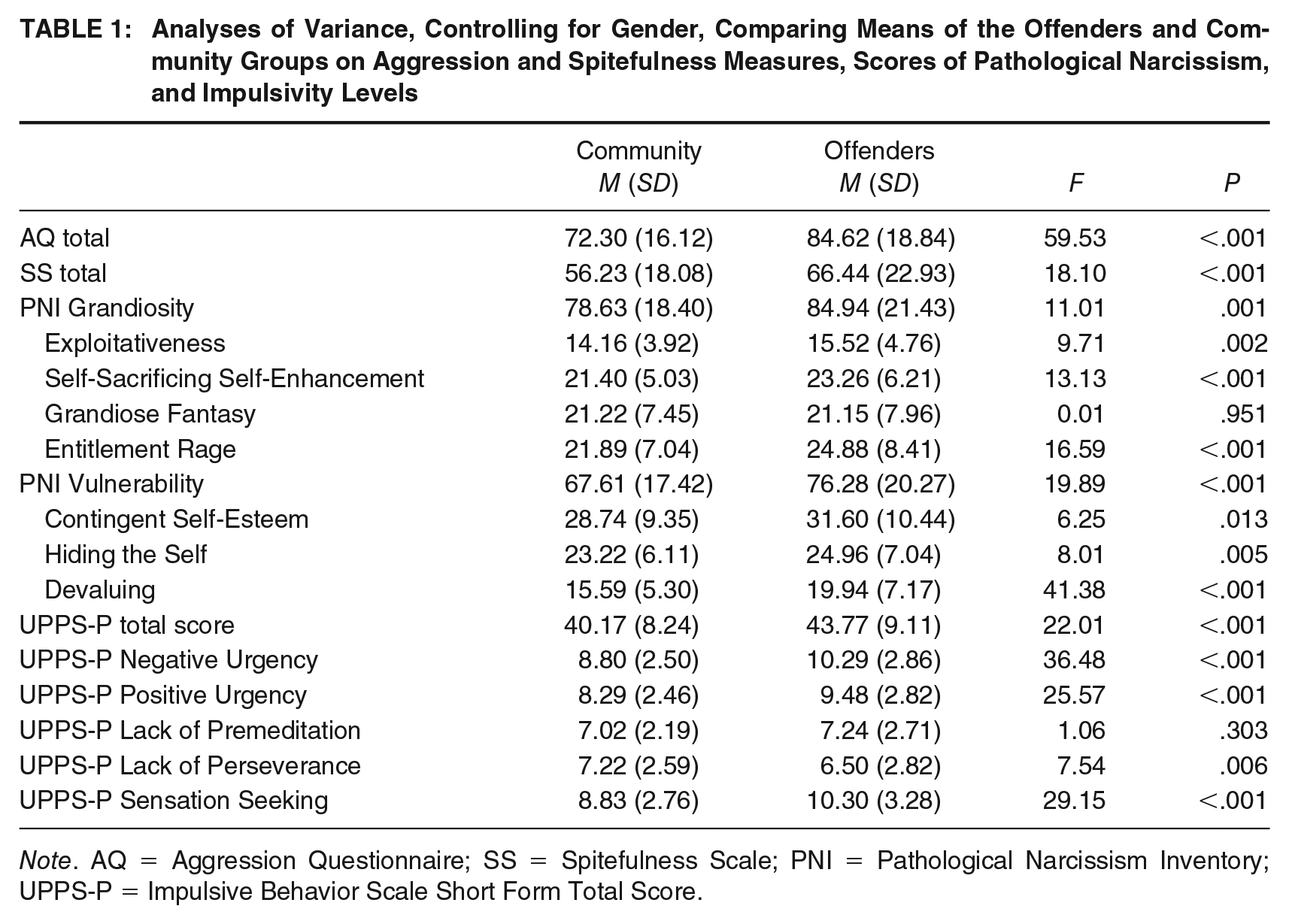
Note. AQ = Aggression Questionnaire; SS = Spitefulness Scale; PNI = Pathological Narcissism Inventory; UPPS-P = Impulsive Behavior Scale Short Form Total Score.
Then, we tested the hypothesis that offenders would score higher than the community sample using a multivariate analysis of covariance (MANCOVA) controlling for gender. As Pillai’s criteria reached statistical significance, F(9, 384) = 7.78, p < .001, indicating a significant main effect, we performed post hoc analyses to investigate the differences in each dimension using the Bonferroni correction for multiple comparisons. As displayed in Table 1, offenders exhibited higher levels of pathological personality traits compared with the community sample except on the Grandiose Fantasy subscale.
Finally, we explored the differences between groups on the impulsivity measures by performing a MANCOVA, controlling for gender. As Pillai’s criteria reached statistical significance, F(5, 421) = 13, p < .001, indicating a significant main effect, we performed post hoc analyses to investigate the differences in each dimension using the Bonferroni correction for multiple comparisons. Data (illustrated in Table 1) showed that offenders scored higher on all impulsivity measures except for the Lack of Premeditation subscale.
PN, Spitefulness, and Impulsivity
To investigate the relationships between GN and VN, spitefulness, impulsivity, and aggression, we carried out partial correlation analyses controlling for age and gender in the two samples taken separately (Table 2). The correlation matrix shows that, in both samples, all study variables were widely interconnected, as AQ, PNI Grandiosity, PNI Vulnerability, and both SS and UPPS-P, total scores were positively and significantly correlated with each other. In particular, the aggression dimension shows a relationship with all other study variables that is moderate in strength, with correlation coefficients ranging from .44 (VN) to .33 (spitefulness) among offenders and from .43 (spitefulness) to .52 (impulsivity) among community participants.
Partial Correlations Between Aggression, Pathological Narcissism, Spitefulness, and Impulsivity, Controlling for Age and Gender
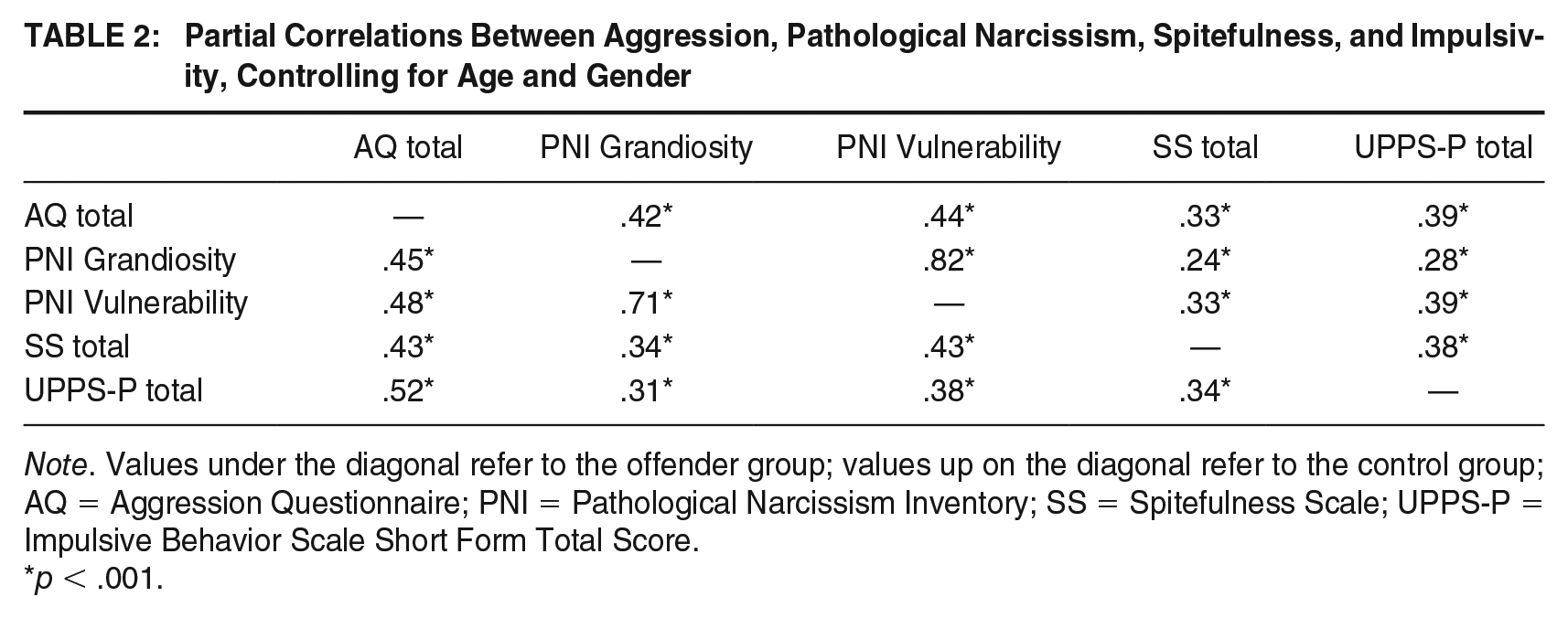
Note. Values under the diagonal refer to the offender group; values up on the diagonal refer to the control group; AQ = Aggression Questionnaire; PNI = Pathological Narcissism Inventory; SS = Spitefulness Scale; UPPS-P = Impulsive Behavior Scale Short Form Total Score.
p < .001.
Planning to perform hierarchical regression analyses, we ensured that assumptions were met in both samples taken separately. No outliers were found; variables showed homoscedasticity and normal distribution. Moreover, collinearity statistics indicated a satisfying variance inflation factor (VIF) index (VIF < 10). So we performed two hierarchical multiple linear regression analyses (one for each group) to test which study variable predicted AQ, entering age and gender in Model 1, PNI Grandiosity and Vulnerability in Model 2, UPPS-P Total in Model 3, and Spitefulness in the final model. The results shown in Table 3 indicated that among the community participants, PN (f2 = 0.32) and impulsivity (f2 = 0.14) additionally explained variance in aggression scores above the role of control variables. Moreover, beyond the roles of PN and impulsivity, the SS appeared to significantly and additionally explain the aggression levels (f2 = 0.03). Similarly, results displayed in Table 4 indicate that among the offenders, PN (f2 = 0.24) and impulsivity (f2 = 0.06) appeared to incrementally predict aggression levels beyond the role of covariates. Again, spitefulness was an incremental predictor of aggression levels beyond the role of PN and impulsivity (f2 = 0.02).
Hierarchical Multiple Regression Analysis Predicting Aggression From Pathological Narcissism, Impulsivity, and Spitefulness, Controlling for Age and Gender, in the Sample of Community Participants
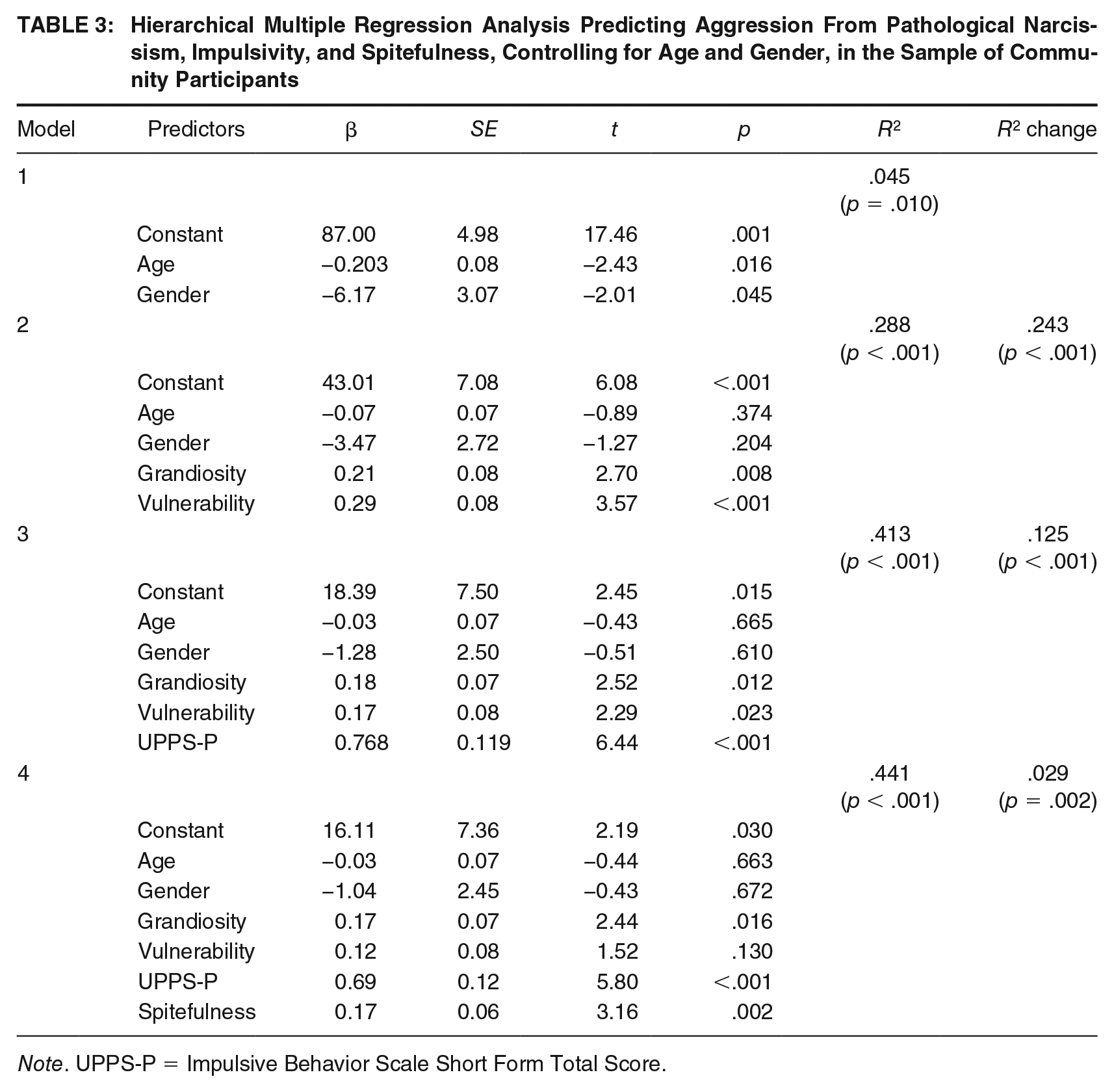
Note. UPPS-P = Impulsive Behavior Scale Short Form Total Score.
Hierarchical Multiple Regression Analysis Predicting Aggression From Pathological Narcissism, Impulsivity, and Spitefulness, Controlling for Age and Gender, in the Sample of Violent Offenders
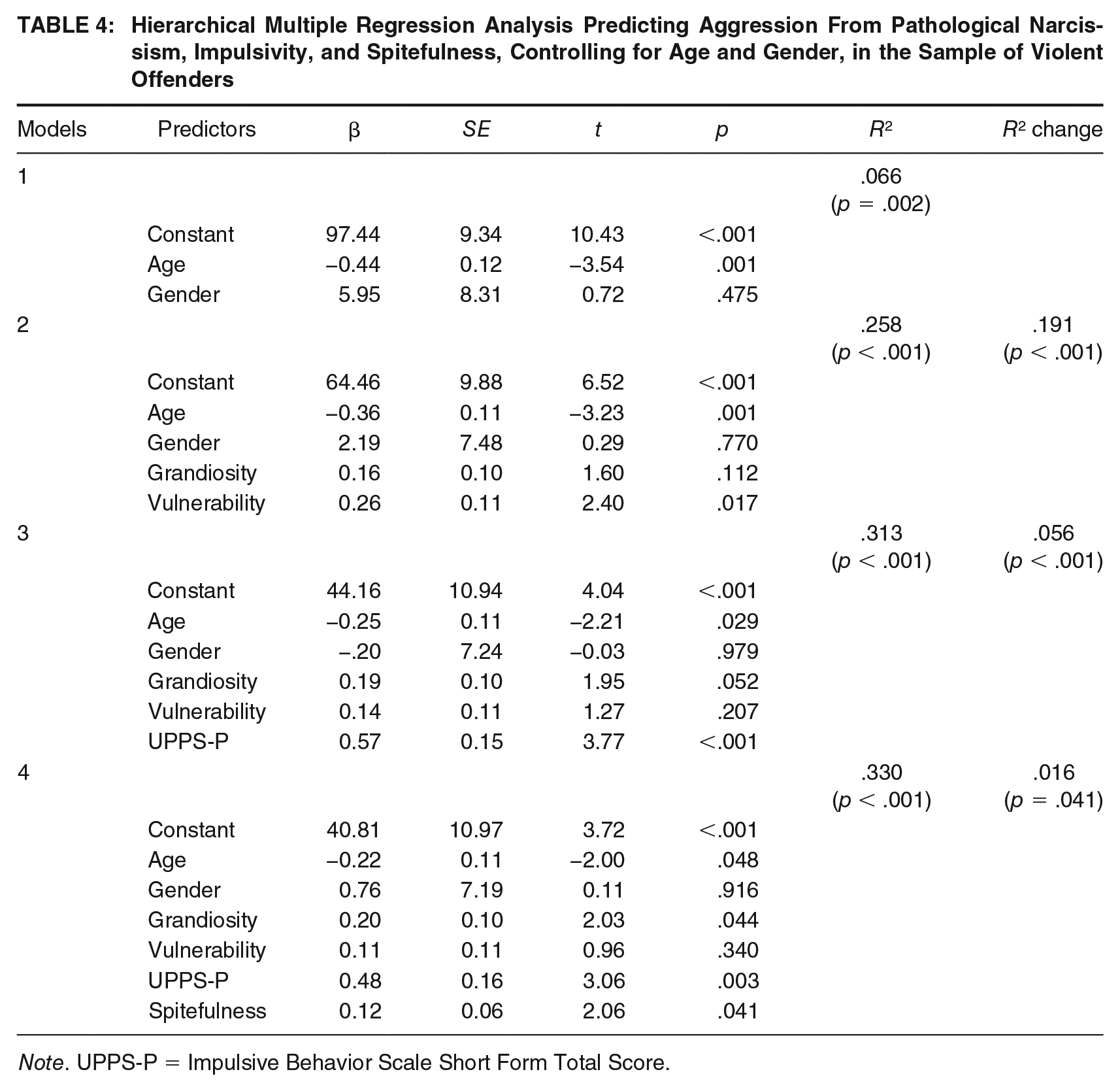
Note. UPPS-P = Impulsive Behavior Scale Short Form Total Score.
The Mediating Role of Impulsivity
Finally, to verify the hypothetical role impulsivity played in explaining the association between pathological personality traits and aggressiveness, we carried out a mediation analysis to test the mediating role of this variable in the relationships between GN, spitefulness, and aggression (Table 5). As VN did not result as a significant predictor of AQ scores when controlling for both GN and spitefulness, it was not inserted as an independent variable in the mediational model. Following Baron and Kenny’s (1986) recommendations, we ensured the following findings: both Grandiosity and SS significantly predicted AQ scores (Step 1), Grandiosity and SS significantly predicted UPPS-P scores (Step 2), and UPPS-P scores incrementally predicted AQ scores with respect to the quote of variance already explained by Grandiosity and SS (Step 3). Finally, results of the mediation analysis (Step 4) indicated that both Grandiosity and SS direct and indirect effects turned significant, showing that impulsivity partially mediates the relationships of aggression to both GN (RM = .15) and spitefulness (RM = .50). The full model is summed up in Figure 1. Holding the effect of age and gender constant, impulsivity emerges as a significant, albeit partial, mediator of the association between aggression and both GN and spitefulness; and, GN and spitefulness also show a direct effect on aggression, alongside their indirect effect through impulsivity.
Mediation Analysis Testing the Mediating Role of Impulsivity in the Relationship Between Aggression and Both Grandiose Narcissism and Spitefulness
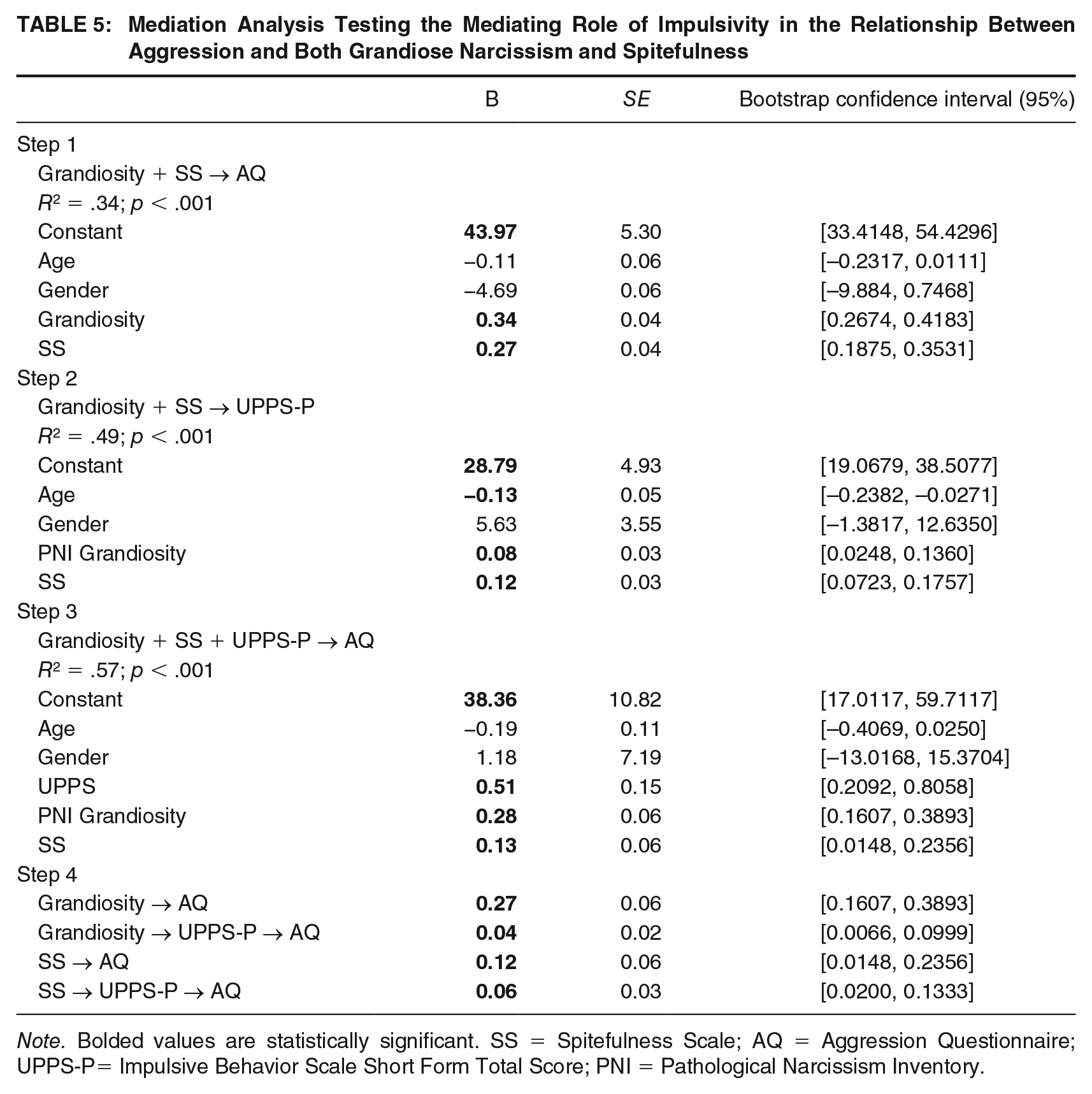
Note. Bolded values are statistically significant. SS = Spitefulness Scale; AQ = Aggression Questionnaire; UPPS-P= Impulsive Behavior Scale Short Form Total Score; PNI = Pathological Narcissism Inventory.
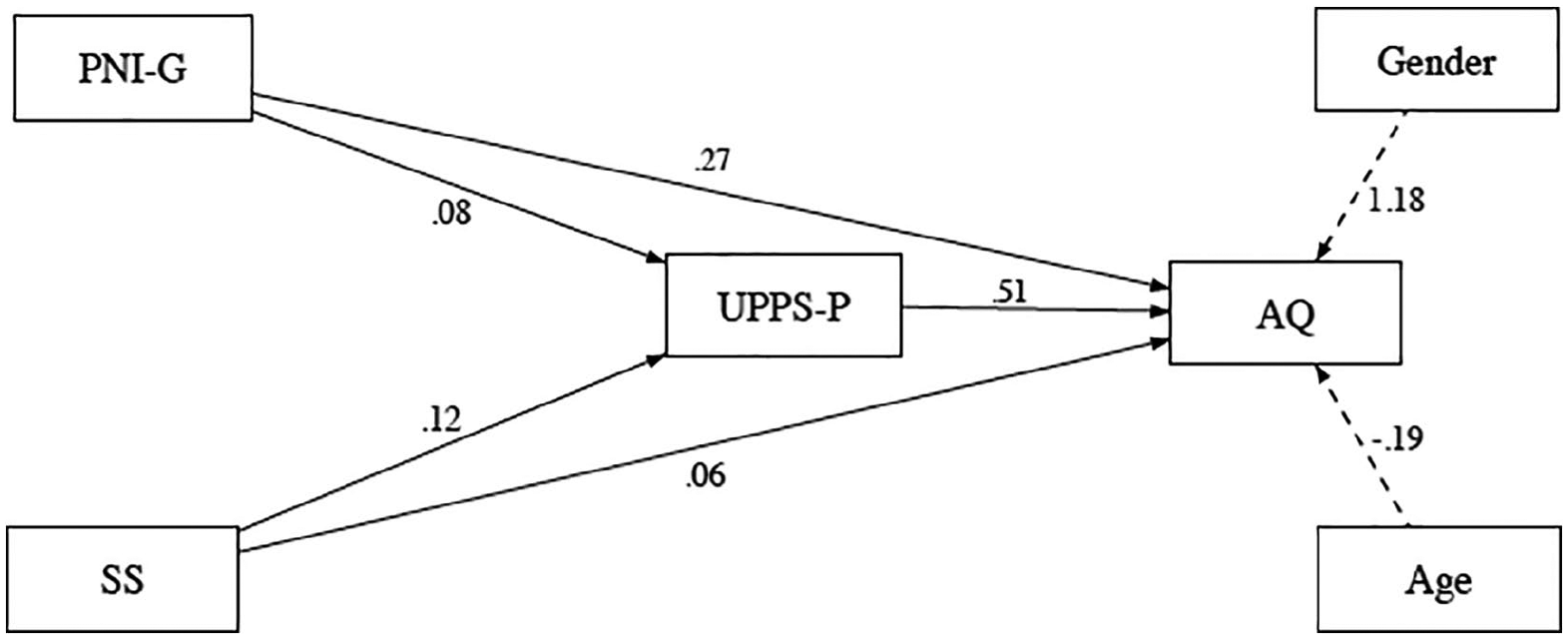
An illustration of the proposed mediation model in the sample of violent offenders.
Discussion
This study aims to better define the interplay between PN and impulsivity in predicting aggressiveness, also considering the role of spitefulness. Although the existence of a correlation between those variables is generally acknowledged, the role of narcissistic dimensions—grandiose and vulnerable—is still open to question, as is the part played by impulsivity. Despite some suggestions about its potential mediating role, empirical work regarding the joint effect of PN and impulsiveness on aggression is still scarce.
First, we found that individuals convicted of violent offenses showed higher levels of aggressiveness, as well as greater degrees of additional maladaptive traits, such as PN, spitefulness, and impulsivity, compared with the community participants. This suggests that the variables examined in the study are particularly relevant when exploring the specificities of the offender population. Moreover, all variables appear to be largely associated with each other within both offender and community samples, indicating the presence of a complex interplay between variables investigated in the study.
Results then showed, in line with previous research (see Lambe et al., 2018), the contribution of PN—grandiose and vulnerable—and impulsivity to the explanation of aggression. Also, when controlling for impulsivity proneness, the vulnerable dimension of PN was no longer a significant predictor of aggression levels in the sample of individuals convicted of violent offenses. Despite this dimension appearing significantly correlated with aggression scores, indicating the need to address this issue in the clinical assessment and treatment of individuals convicted of violent offenses, results of hierarchical regression suggest that its role may remain secondary when controlling for the impulsive component and the grandiose facet of narcissism. Indeed, our results suggest that in aggressive individuals with both vulnerable and grandiose narcissistic traits, intervention should primarily focus on the grandiose ones as well as on the potential presence of impulsive features. Similarly, future studies may want to further explore the role-played by the relationship between VN and impulsivity in predicting subclinical levels of aggression among community individuals.
Furthermore, we found that spitefulness might play an important part in aggressive behavior. We strengthened prior knowledge of the relationship between impulsivity and spite (Rodgers & Dahling, 2018; Zeigler-Hill & Vonk, 2015) and extended what was found among college students to the offender sample (Marcus et al., 2014). Our results are in line with a conceptualization of spiteful behavior as the outcome of a peculiar will to punish others, externalizing the desire with aggressive acts and without adequate foresight (Moyer et al., 2017; Rodgers & Dahling, 2018).
In addition, results evidenced that impulsivity was a significant mediator of the relationship between aggression levels, and both spitefulness and GN. However, impulsivity was found to mediate this relationship only partially. This suggests that the pathway by which pathological personality leads to aggressiveness is only partially explained by impulsivity tendencies. Still, it is possible that an individual who is prone to spitefulness may be especially impaired in his or her capacity to plan personally aversive consequences of aggressive actions.
Our results are in line with previous work (Vazire & Funder, 2006), finding that impulsivity partially accounts for the relation between narcissism and aggression. Instead, they are in contrast with Miller et al.’s (2009) study, which failed to observe a mediating effect of impulsive behavior in the association between PN and aggressiveness. However, Miller and colleagues based their hypotheses on a narrow conceptualization of impulsivity that mainly refers to lack of forethought, whereas current literature supports a five-factor model of this construct (Whiteside & Lynam, 2001). The evidence suggests that impulsivity dimensions such as sensation seeking and urgency are more likely to intervene in the association between narcissism and aggression (Centifanti et al., 2013; Fossati et al., 2007; Lynam & Miller, 2004; Vaughn, DeLisi, Beaver, Wright, & Howard, 2007). The tendency to act rashly under the influence of negative emotional states, such as shame, may drive individuals with grandiose narcissistic personality traits to attack others. Participants with an elevated sense of entitlement are more often liable to feel unfairly treated and to have their expectations outraged (Reidy, Zeichner, Foster, & Martinez, 2008). What appears in narcissists as a particular sensitivity to negative cues might reflect an inability to go behind what is directly perceived and see what “threatening others” have in their minds (Fonagy, 2003).
Our study has the merit of extending previous findings concerning normal population to an offender sample, helping to fill the paucity of research involving a class of participants who are difficult to reach. Nonetheless, some important limitations have to be discussed. The sample was composed of men for the most part. Thus, confirmatory studies are needed to investigate whether these patterns of association between variables hold among female offenders. Self-report measures’ intrinsic limitations were, in this case, worsened by sample ethnic composition: A high percentage of participants came from other countries (mainly Eastern Europe and Northern Africa), and we cannot exclude the possibility that using instruments of the Italian version did not cause some linguistic biases. Other variables known for their links with violence might have intervened in the present study because we did not control for, for example, psychopathy or antisocial PD, which are frequent among incarcerated people; likewise, no information was collected about ongoing psychopharmaceutical assumptions that may have altered the participants’ responses. Finally, in this first study testing impulsivity’s mediating role in the prediction of aggression with a focus on narcissism’s grandiose dimension—and introducing a novel construct such as spitefulness—we chose to concentrate our analyses only on the total scores. A more nuanced approach could, however, have helped to clarify whether some facets of impulsiveness have a stronger voice than others in such an association.
Testing the hypothetical mediating role of impulsivity in the relation between pathological personality traits and aggression was one of the present article’s purposes: Results returned it as not only partly confirmed but also showed that GN and spitefulness maintain a direct association with aggressive behavior, indicating that the contributions of other aspects of the personality configuration should be considered. Moreover, the effect sizes observed in our study suggest that impulsivity is only one of a potentially wide range of variables accounting for the relationship between aggression and both GN and spitefulness. For instance, low levels of theory of mind characterize spiteful individuals (Ewing et al., 2016). Therefore, it is possible that lack of mentalization interacts with poor self-control skills in the association between pathological personality traits and aggression. Future empirical studies should address the potential mediating role of such variables. Furthermore, other aspects of emotional regulation difficulties might show an effect beyond, or in conjunction with, impulsivity. As some authors noticed, aggressive acts cannot be considered as a mere issue of underregulation of feelings such as anger. The tendency to overregulate may lead to violence as well by increasing physiological arousal and negative affect and, at the same time, by decreasing decision-making capacities and behavioral inhibition (Roberton, Daffern, & Bucks, 2012). The contribution of emotional dysregulation, at both the general and faceted levels, is another open question for forthcoming research aiming to reveal the mechanisms that link aggressive behavior and pathological personality traits.
Taken altogether, our findings confirm the importance of considering multiple interacting factors in the explanation of aggressive behavior. We aim to shed light on some of them, proving that personality features such as GN and spitefulness play a meaningful part in violent manifestation and that their contribution is partially mediated by impulsivity levels. As we await research that will disclose additional intervening elements, our results suggest that impulsivity represents one of the variables to consider when assessing the risk of aggression and planning treatment for its reduction, particularly in the presence of narcissistic features (Larson et al., 2015). Stable personality traits, such as narcissistic or spiteful ones, may be difficult to target. A focus on the undesired behavioral outcome (i.e., aggression) through the aid of some related and more amendable features (e.g., impulsivity) could be a useful approach to reducing the expression of violence. Treatment could also benefit from implementing an explicit assessment of impulsive traits, because these have been highlighted as important factors in the risk of recidivism of individuals convicted of violent offenses (Kuin et al., 2015). Programs might be more effective if offenders follow preliminary training aimed at improving behavioral inhibition capacities and long-term consequence evaluation; for example, programs that build skills to increase abilities in mentalization, linking emotions to behavioral inclinations (Velotti et al., 2018). Future research should still examine the construct of impulsivity in the offender context and include a measure of mentalizing abilities.
