






Abstract
Young transgender women aged 16–29 years experience high rates of carceral involvement, warranting greater inclusion of this community within decarceration research and practice. The present study investigates patterns of violence, exclusion, resilience, and arrest among a sample of 298 transgender women aged 16–29 years in Chicago, Illinois, and Boston, MA. Women in the sample reported high rates of arrest, violence, and exclusion. Latent class analysis (LCA) was used to identify classes with similar response patterns to items assessing violence, exclusion, resilience, and arrest. A three-class model was selected to best represent the data, including: (a) “High Violence and Exclusion/High Arrest”; (b) “Low Arrest”; and (c) “Moderate Violence and Exclusion/High Arrest.” Race and perceived gender expression significantly predicted class membership. Findings illustrate the heterogeneity of young transgender women’s experiences, suggesting that a variety of tailored decarceration program and policy interventions are required to meet the differing needs of young transgender women.
Introduction
The American Academy of Social Work Welfare and Research Academy identified addressing mass incarceration as one of 12 “Grand Challenges” for social work practitioners and researchers (Pettus-Davis & Epperson, 2015). In a working paper, Pettus-Davis and Epperson (2015) outline an agenda to drastically reduce the number of people involved in the criminal legal system. This “Smart Decarceration” initiative includes continued development of evidence-based structural and behavioral interventions to interrupt pathways leading to criminal legal system involvement. As noted by Covington and Bloom (2003), Daly and Chesney-Lind (1988), Salisbury and Van Voorhis (2009), and other scholars, to date, much of the research investigating patterns of life experiences and criminal legal system involvement has focused on the experiences of cisgender men. Cisgender refers to individuals whose gender identity aligns with sex assigned at birth (American Psychological Association [APA], 2015). A growing body of research indicates that cisgender women experience distinct trajectories leading to criminal legal system involvement, necessitating different prevention programs than those designed for cisgender men (Daly, 1994; DeHart, 2018; Richie, 1996). Substantially less research has focused on transgender individuals, or individuals whose gender identity does not align with sex assigned at birth (APA, 2015).
While little attention has been paid to transgender women’s trajectories into the criminal legal system, a growing body of research documents high rates of criminal legal system involvement, including police contact, arrest, and incarceration, among this community (James et al., 2016; Reisner et al., 2014). Prisons and jails typically do not collect data regarding transgender identity (Reisner et al., 2014). Thus, estimates of criminal legal system involvement among transgender individuals come from community-based surveys, including the 2011 National Transgender Discrimination Survey (NTDS) which reported lifetime incarceration rates of 16% among transgender adult respondents (Grant et al., 2011). By contrast, 6.6% of the U.S. population is likely to be incarcerated at some point in their life time (Bonczar, 2003). Moreover, transgender women of color experience higher rates of criminal legal system involvement than their White peers. According to the 2016 NTDS, which only assessed arrest within the last year, 2% of all transgender women respondents had been arrested within the last year, yet 6% of Black transgender women and 6% of American Indian transgender women reported an arrest within the last year (James et al., 2016). As noted by many scholars, these disproportionately high rates reflect the historical legacy of gendered and racialized bias within the criminal legal system (Kaeble & Glaze, 2016; The Sentencing Project, 2017).
Nascent research with transgender women aged 16–29 years indicates that this group may experience particularly high rates of criminal legal system involvement when compared with transgender and cisgender adults (Garofalo et al., 2012). In a study conducted in Chicago among transgender women below the age of 24 years, 67% reported ever having been arrested and 37% reported being previously incarcerated (Garofalo et al., 2012). These disproportionate rates are likely tied to high rates of unemployment, family rejection, violence and victimization, and police bias, all of which are factors of high risk for young transgender women (James et al., 2016; Reisner et al., 2014; Wilson et al., 2009). Emerging adulthood, the stage of life from late teens to mid- to late-20s (Arnett et al., 2014), represents a critical developmental period during which life experiences shape future social, economic, and health outcomes (Arnett et al., 2014). Emerging adults are also most likely to come into contact with legal authorities (Fagan & Tyler, 2005). Accordingly, a large body of research focuses on the factors that predict future carceral involvement (Shader, 2001), and factors that promote resilience, or experiences that interrupt the trajectory from risk to arrest (Agnew, 2006; Snyder et al., 2016). Despite high rates of criminal legal system involvement among young transgender women, few studies have examined co-occurring patterns of interpersonal violence, structural and social exclusion, resilience, and arrest. Understanding these distinct patterns is a necessary first step to designing comprehensive decarceration and prevention programs that are inclusive of young transgender women (Hereth & Bouris, 2020). The present study seeks to address this gap using latent class analysis (LCA) to examine patterns of life experiences and arrest among a sample of transgender women aged 16–29 years.
Literature Review
Researchers and practitioners developed several frameworks for examining and conceptualizing the ways in which life experiences contribute to involvement in the criminal legal system. One such framework is the Risk–Needs–Responsivity (RNR) model (Bonta & Andrews, 2007), which focuses on identifying individual risk factors for criminal legal system involvement and opportunities for intervention to prevent further involvement. To date, much of the research to develop and test the RNR and other frameworks was conducted among cisgender young men (Hannah-Moffat, 2009). By contrast, “gender responsive” and feminist criminology frameworks examine multi-level factors that shape cisgender women’s experiences within the criminal legal system (Brennan et al., 2012; Chesney-Lind, 1989). Utilizing gender responsive and feminist frameworks, scholars find that cisgender women with a history of arrest or incarceration are more likely than cisgender men to have experienced forms of marginalization that may contribute to criminal legal system involvement, including homelessness (Daly, 1994; Fedock et al., 2013), substance use (Fedock et al., 2013), trauma (Fedock et al., 2013; Richie, 1996), and mental illness (Daly, 1994; Fedock et al., 2013). Feminist criminologists argue that women’s engagement in criminalized behaviors must be understood within a broader context of discrimination, violence, and structural exclusion (Chesney-Lind, 1989). Attending to the ways in which interpersonal violence, social and structural exclusion, and arrest intersect, Richie (1996) developed the concept of “gender entrapment,” stating that Black women are left “with no good, safe way to avoid the problematic social circumstances that they find themselves in, unable to change their social position, and ultimately blamed for both” (p. 3). The work of these scholars indicates the importance of considering multi-level factors shaping arrest and incarceration.
This study extends gender responsive and feminist frameworks developed among cisgender women to young transgender women, considering their distinct experiences. Gender responsive and feminist frameworks are well-suited for examining transgender women’s experiences within the carceral system because of their inclusion of multi-level factors, including violence and social and structural exclusion, all of which are prevalent among transgender women (Garofalo et al., 2012; James et al., 2016; Wilson et al., 2009). Informed by gender responsive and feminist criminology research, this study considers patterns that fall under three, multi-level domains of life experiences: interpersonal violence, structural exclusion, and social exclusion. In addition, several forms of resilience are included in the analysis. Variables were classified into these domains to facilitate presentation of findings, however, many variables overlap and could fall into two or more domains.
Interpersonal Violence
Research among cisgender women involved in the criminal legal system indicates that this population experiences high rates of gender-based violence, including childhood abuse and intimate partner violence (IPV) (Daly, 1994; DeHart, 2018; Richie, 1996). Feminist criminologists argue that these experiences can form direct and indirect pathways into the criminal legal system for cisgender women (Chesney-Lind, 1989). For example, violence can form a direct path when women kill or harm a partner who has been abusive as an act of self-defense (Richie, 1996). Indirect pathways include cases of young women running away from home to escape childhood abuse, and, in turn, being arrested for criminalized survival, such as squatting in an abandoned building or panhandling (Chesney-Lind, 1989). These factors also are likely to be important for young transgender women, who experience high rates of interpersonal violence (Garthe et al., 2018; James et al., 2016; Reisner et al., 2014). For example, 54% of respondents in the NTDS reported experiencing IPV (James et al., 2016). Prior research also indicates that transgender youth experience higher rates of child abuse than their cisgender peers (Grossman & D’Augelli, 2007; Irvine & Canfield, 2015). While the criminal legal system can intervene to stop interpersonal violence, survivors who hold marginalized identities, including women of color and transgender women, may experience additional discrimination or violence when engaging police or other criminal legal system actors (Richie, 2012; Ritchie, 2017). This is another example of the ways in which interpersonal violence can serve as an indirect route into the criminal legal system. While associations between interpersonal violence and arrest are not well-examined among transgender women to date, according to the 2015 NTDS, 57% of transgender respondents indicated that they would be uncomfortable or very uncomfortable asking for help from the police when they needed it (James et al., 2016).
Structural Exclusion
Structural exclusion refers to the ways in which individuals are excluded from institutions and systems, including education, housing and other social services, and employment (Young, 2004). Research suggests that structural exclusion among cisgender women may contribute to engagement in criminalized activities to survive, including sex work and homelessness (Chesney-Lind, 1989; Daly, 1994; Richie, 1996). Transgender women experience distinct forms of gender-based structural exclusion that may be associated with criminal legal system involvement. For example, young transgender women experience numerous barriers to employment, and report high rates of engagement in sex work to earn money to meet basic needs (James et al., 2016; Wilson et al., 2009). Transgender individuals are also at high risk of experiencing homelessness, often as a result of family rejection (James et al., 2016).
Schools are another site of structural exclusion for many transgender youth. The pathway from school to the criminal legal system, referred to as the school-to-prison pipeline (Wald & Losen, 2003), is well-documented among cisgender youth, particularly cisgender youth of color. This trajectory is not well-researched among transgender youth, yet research indicates that experiences of transphobic harassment and discrimination in schools are common (McGuire et al., 2010), creating a particularly harsh climate that is likely to contribute to school discipline and push out. Upon leaving school due to bullying or discrimination, lesbian, gay, and bisexual (LGB) youth are more likely to be charged with truancy than are their heterosexual peers (Irvine & Canfield, 2015).
Involvement in the child welfare system is associated with criminal legal system involvement (Huang et al., 2012; Ryan et al., 2008). Child welfare system involvement may form an indirect path into the criminal legal system. For example, youth in the foster care system experience higher rates of homelessness, which, in turn, may lead to arrest or criminalized survival (Fowler et al., 2017). Aspects of the child welfare system may also put youth involved in the foster care system into direct contact with the criminal legal system, such as group home policies that require calling the police on youth for rule infractions (Ryan et al., 2008). Lesbian, gay, bisexual, transgender, and queer (LGBTQ) youth are particularly at risk of becoming multisystem involved (i.e., involved in both the child welfare and juvenile justice systems) as they are already overrepresented within the child welfare system (Irvine & Canfield, 2015).
Social Exclusion
This study considered the role of bias and discrimination against transgender women as a particular risk factor for criminal legal system involvement. Social exclusion includes overt and subtle forms of discrimination, bias, and unfair treatment (Link & Phelan, 2001; Young, 2004). Discrimination against transgender identities has been codified into law, for example, through laws that criminalized wearing clothing items of the “opposite” gender (Mogul et al., 2011). Many of these laws have been repealed, yet their impact on perceptions of transgender individuals as deviant continues (Mogul et al., 2011).
Social exclusion can also indirectly contribute to criminal legal system involvement through, for example, family rejection. Of respondents to the NTDS who are out to their immediate family, 26% reported that a family member stopped speaking to them or ended their relationship because of their gender identity (James et al., 2016). Transgender youth are more likely to report running away from home due to conflict with their parents prior to becoming involved in the juvenile justice system (Irvine & Canfield, 2015). Family rejection is associated with living in poverty, engaging in sex work, and experiencing homelessness (James et al., 2016), which, as previously discussed, can also put individuals at greater risk for criminal legal system involvement. Transgender individuals also experience rejection by coworkers, neighbors, and community members (James et al., 2016).
Resilience-Related Factors
While young transgender women face multiple forms of exclusion and harm, resilience-related factors may protect young transgender women from criminal legal system involvement. Resilience factors disrupt trajectories into the criminal legal system, helping to explain differing carceral outcomes among youth who are exposed to similar risk factors (Agnew, 2006; Snyder et al., 2016). In this study, we categorized several positive life experiences within the resilience-related domain: (a) employment, (b) social support, and (c) gender-specific reorientation and coping efforts. By increasing social capital and institutional ties, employment promotes resilience and reduces contact with the criminal legal system (Sampson & Laub, 1993; Wright & Cullen, 2004). Employment can protect transgender individuals from engaging in criminalized behaviors to survive (James et al., 2016). Yet, transgender individuals experience high rates of unemployment, with 16% reporting losing a job due to gender identity or presentation (James et al., 2016).
Hirschi (1969) theorized that weak or broken social bonds contribute to youth and young adults engaging in criminalized behaviors. Empirical research suggests that social support prevents youth and young adults who have been exposed to criminal legal system risk factors from future involvement in the criminal legal system (Huang et al., 2012; Ryan et al., 2008; Sampson & Laub, 1993). Many transgender women lack social support due to family rejection, discrimination, and isolation (Budge et al., 2013). Among transgender persons, adults who report higher levels of social support from family of origin, chosen family, or friends were less likely to report criminal legal system involvement (Grant et al., 2011). Resilience-based coping strategies, including making behavioral changes to deal with stressors and seeking emotional support from friends, family, or a therapist, are associated with decreased involvement in the criminal legal system (Agnew, 2006). In the face of transgender-specific stress and discrimination, coping strategies such as attending support groups and accessing therapy have been found to improve mental health and well-being among transgender individuals (Budge et al., 2013).
Current Study
The first aim of the study was to examine criminal legal involvement histories in a sample of 298 young transgender women recruited for Project LifeSkills, a National Institutes of Health (NIH)-funded study conducted at Lurie Children’s Hospital in Chicago, IL and the Fenway Institute in Boston, MA. The second aim was to identify patterns of interpersonal violence, social exclusion, structural exclusion, resilience, and arrest among the sample using LCA. In addition, sociodemographic characteristics associated with the likelihood of being in one class relative to another were compared.
LCA is a method for classifying individuals into two or more groups based on their patterns of responses to measures assessing predictor variables (McCutcheon, 1987). LCA is a person-centered analysis, rather than a variable-centered analysis, such as regression analysis or structural equation modeling, allowing for the classification of individuals to classes (Muthén & Muthén, 2000). This analytic approach estimates groups of women who may experience unique combinations of violence, exclusion, resilience, as well as arrest. LCA can be a useful method for examining criminal legal system involvement because it allows for the identification of discrete subgroups and trajectories within a sample (Eggleston et al., 2004; Nagin, 2004). Among the first studies examining patterns of life experiences and arrest among young transgender women, this analysis is exploratory in nature and can inform the direction of future research with transgender communities. In an exploratory LCA, the number of classes and their sizes are not known a priori (McCutcheon, 1987).
Method
The study described herein utilized secondary data from Project LifeSkills, a randomized controlled trial of an HIV-prevention intervention with young transgender women (for details, see Garofalo et al., 2018). While the original study was designed to test an intervention, utilizing data from Project LifeSkills, one of the largest samples of young transgender women, provides a unique opportunity to examine criminal legal system involvement and inform future research. LCA was used to examine patterns of experiences related to interpersonal violence, structural and social exclusion, resilience, and arrest.
Participants
Participants were recruited to Project LifeSkills between 2012 and 2015 primarily by staff members who were members of the transgender community. Staff recruited participants at events, bars, and venues in Chicago and Boston by providing information about the study, sharing printed materials, and directing interested participants to call the study phone number to be screened. Staff also conducted online recruitment via Facebook, Twitter, dating applications, chat groups, listservs, and by posting ads on sites where transgender women advertise sex work and escort services.
Eligibility requirements for the original Project LifeSkills study included: (a) identifying as a transgender woman, on the male-to-female spectrum, or as transfeminine; (b) being between the ages of 16 and 29 years, inclusive; and (c) being sexually active and reporting at least one sexual risk factor in the last 4 months (i.e., unprotected anal or vaginal sex, engaging in sex work, having more than one sexual partner, or receiving an HIV or sexually transmitted infection [STI] diagnosis). Eligibility in the original study included sexual risk because the primary aim was to test an HIV-prevention and sexual risk intervention. Potential participants were screened in person or via telephone to determine eligibility.
Design
Women enrolled in Project LifeSkills completed an electronic self-administered baseline survey and completed follow-up surveys, HIV testing, and STI screening 4, 8, and 12 months later. Project LifeSkills participants were randomly assigned to either participate in the group-based intervention or a control group. The study described herein utilizes data from all enrolled participants, controlling for condition assignment. Of enrolled participants, 78.2% were assigned to a study condition. Retention at 4 months was 68.5%, 67.5% at 8 months, and 67.1% at 12 months. Participants were compensated US$25 at baseline and US$50 at each follow-up visit for their time and travel. Project LifeSkillls investigators established the schedule of study measures with the goal of keeping surveys to an equivalent length across all time points and limiting survey length to 2 hr. As a result, several measures utilized in the study described herein assessing lifetime experiences (i.e., interpersonal violence measures) were assessed at the 4-month follow-up but not at baseline. Thus, the study utilized measures collected at baseline and 4-month follow-up visits as class indicators and covariates. History of arrest was assessed at all four waves. Arrest and other key variables were assessed as dichotomous variables. To facilitate visual comparison, continuous variables were dichotomized to above or below the median (Mumford et al., 2016; Van Gaalen & Dykstra, 2006). As an exploratory study, this visualization helps identify heterogeneity within the sample. Sample demographics for indicators and covariates are listed in Table 1. Approval for Project LifeSkills was granted by the Institutional Review Boards (IRBs) at Lurie Children’s Hospital and the Fenway Institute. All participants provided written consent for participation. A waiver of parental permission was granted by the IRBs for the participation of minors on the basis that requesting parental permission for participation in a study for transgender youth would prohibit participation by young women who were not out, not supported, or not in contact with their parents or legal guardians.
Sample Demographics for Latent Class Indicators (N = 298), Project LifeSkills, 2012–2015

Criminal legal system involvement measures
Arrest
At baseline, participants were asked whether they had ever been arrested by the police (0 = No, 1 = Yes). At each follow-up survey, participants were asked whether they had been arrested since their last visit. Making use of longitudinal arrest data, participants who reported ever being arrested at baseline or at any follow-up visit were classified as having a history of arrest (0 = No, 1 = Yes). Verifying self-reported arrests was not feasible as many transgender individuals’ legal names do not match their preferred names, and to be culturally responsive Project LifeSkills staff collected preferred names only. Arrest was included as a variable in LCA models.
Charge at last arrest
Participants who had ever been arrested at baseline were then asked what they were charged with the last time they were arrested. Responses included answers such as “theft” or “prostitution.” Responses were grouped into violent or nonviolent offenses based on classifications created by the Bureau of Justice Statistics (Morgan & Kena, 2016). Charge at last arrest was examined along with other variables to describe criminal legal system histories of transgender women.
Incarceration experiences
At baseline and follow-ups, participants were asked whether they had ever or since their last visit been in jail, juvenile detention, or both. Participants who reported ever being incarcerated at baseline or at any follow-up visit were classified as having a history of incarceration (0 = No, 1 = Yes). Participants who had been in jail/juvenile detention at baseline were asked to indicate with which population they were placed the last time they were arrested. Response options were men, women, or other. Those who indicated “other” were asked to write in the area of the detention facility to which they were assigned. Responses included answers such as “in isolation” or “in a special transgender unit.” Incarceration experiences were examined along with other variables to describe criminal legal system histories of young transgender women.
Interpersonal violence measures
Victimization
Victimization was assessed on the 4-month follow-up survey by a modified version of Pilkington and D’Augelli’s (1995) Victimization Scale, which was originally created to assess victimization among gay and lesbian individuals. The 10-item survey measured lifetime experiences of various forms of verbal, physical, and sexual harassment and violence due to their transgender identity. Individual item responses ranged from 1 (Never) to 4 (More than twice). Scores were summed (α = .825) and coded as “greater experiences of victimization” (1) for a score above the median and as “fewer experiences of victimization” (0) for a score below the median.
IPV
IPV, broadly defined as violence perpetrated by anyone with whom one has or had a sexual or intimate relationship (World Health Organization, 2013) was measured at the 4-month follow-up with a five-item scale developed for the Transgender Youth Research Project (Wilson et al., 2009) that assessed lifetime experiences of emotional, physical, and sexual abuse by a sexual partner. Response categories ranged from 1 (Never) to 4 (Many times). Scores were summed (α = .882) and coded as 1 for an endorsement of 2–4 on any of the five items, and 0 for never experiencing any of the forms of IPV.
Child mistreatment or abuse
Child abuse was measured at the 4-month follow-up by three questions adapted from the Conflict Tactics Scale (Straus & Gelles, 1990). The items asked women to indicate how often they experienced emotional, physical, or sexual abuse by a parent or adult caregiver before their 18th birthday. Responses range from 0 (Never) to 5 (More than 10 times). A dichotomous indicator was coded 1 for “greater experiences of child mistreatment and abuse” if the sum score was above the median and 0 for “fewer experiences of child mistreatment and abuse” if the sum score was below the median.
Structural exclusion measures
Separate yes/no questions on the baseline survey assessed whether participants ever dropped out of school, been a ward of the court/state, ever experienced homelessness, or ever engaged in sex work (0 = No, 1 = Yes).
Social exclusion measures
Day-to-day unfair treatment
Seven items from Essed’s (1991) Unfair Treatment measure included in the 4-month follow-up survey were used to assess how often, over the course of their lifetime, participants had experienced bias and discrimination. Responses ranged from 1 (Never) to 6 (All the time). Scores were summed (α =.903) and coded as “greater experiences of day-to-day unfair treatment” (0) for a score above the median and “fewer experiences of day-to-day unfair treatment” (1) otherwise.
Transgender stress
Eleven items from the Transgender Stress measure were used to measure conflicts with others caused by women’s transgender identity. The Transgender Stress measure was created for a pilot study testing the LifeSkills intervention (Garofalo et al., 2012) and assessed at 4 months. Participants indicated whether or not (0 = No, 1 = Yes) in the last 4 months they had arguments or trouble with parents, other family members, friends, customer service, health care providers, coworkers, or transportation because of their transgender identity. Scores were summed (α = .835) and coded as “one or more stressors” (1) and “no reported stressors” (0).
Resilience measures
Employment
Employment was assessed at baseline with a single question. Responses included 0 (Unemployed), 1 (Part-time employed), and 2 (Full-time employed). A dichotomous variable was coded for 0 (Unemployed) and 1 (Employed full- or part-time).
Social support
Social support was assessed at baseline with six items extracted from the Medical Outcomes Study Modified Social Support Survey (Sherbourne & Stewart, 1991) measuring how often over the last 4 months women had someone to provide various forms of material and emotional support. Responses range from 1 (None of the time) to 5 (All of the time). The scores were summed (α = .950) and coded as “greater social support” (1) if above the median and “less social support” (0) otherwise.
Coping and gender reorientation efforts
Six items comprising this subscale of the Transgender Adaptation and Integration Measure (Sjoberg et al., 2006) were used to assess coping and gender reorientation at baseline, including whether participants accessed gender-affirming health and mental health care. Responses range from 0 (Never) to 3 (Frequently). The scores were summed (α = .764) and coded as “greater effort” (1) if above the median or “less effort” (0) if below the median.
Sociodemographic characteristics and covariates
Sociodemographic characteristics
Measures of sociodemographics assessed at baseline include age (in years), race/ethnicity (Black/African American, White, Latina, other race/ethnicity), site (Chicago or Boston), and randomization condition (intervention, time-matched control, or standard of care). Dichotomous indicators were created for categorical and continuous variables; age was recoded as 0 (below the median [23.3]) or 1 (above the median). Race was recoded as 0 (Non-Black) and 1 (Black). Randomization was recoded as 0 (Not assigned to intervention) and 1 (Assigned to intervention).
HIV serostatus
HIV status was assessed at both baseline and 4 months. Participants who did not know their status or who tested negative the last time they were tested at both baseline and 4 months using the OraQuick rapid HIV test (mouth swab), with a confirmatory HIV test performed at each site according to their local protocol. Those who self-reported that they were HIV-positive signed a medical release for researchers to obtain confirmation of HIV-positive status from their medical provider. HIV status with responses 0 (HIV-negative) and 1 (HIV-positive) was included as a covariate in the LCA model.
Transgender history
Created and used in a pilot study testing the LifeSkills intervention (Garofalo et al., 2012), this six-item measure was assessed at baseline. This measure helps account for differing life experiences based upon respondent’s gender identity development. Items assessed at what age women began identifying as female, telling others about being transgender, and dressing as female in private and public. A dichotomous variable was created for each item, with 0 for responses below the median of each item and 1 for responses above the median. The scores were summed (α = .576) and coded as “began coming out and transition process earlier” (0) if below the median and “began coming out and transition process later” (1) otherwise.
Perceived gender expression
Individuals who express their gender outside of what is typically considered the norm are at heightened risk for criminal legal system involvement (Mogul et al., 2011; Ritchie, 2017). As such, two items from a measure developed by Wylie et al. (2010) were administered at the 4 month follow-up. Participants were asked to describe how they and others view their mannerisms and appearance/dress. Response ranged from 1 (Very feminine) to 7 (Very masculine). Responses were averaged and used to create a dichotomous variable with 0 (Very feminine) and 1 (Not very feminine).
Procedure
SPSS 23.0 (IBM Corp., 2015) was used for data management, creation of variables, and descriptive statistics. Mean differences, chi-square tests for association, and correlations were examined to assess relationships between all variables. LCA was conducted using Mplus 8.0 (Muthén & Muthén, 2017) to identify a meaningful number of classes of young transgender women with similar response patterns to items addressing interpersonal violence, structural exclusion, social exclusion, resilience, and arrest. The analytic plan is depicted in Figure 1.
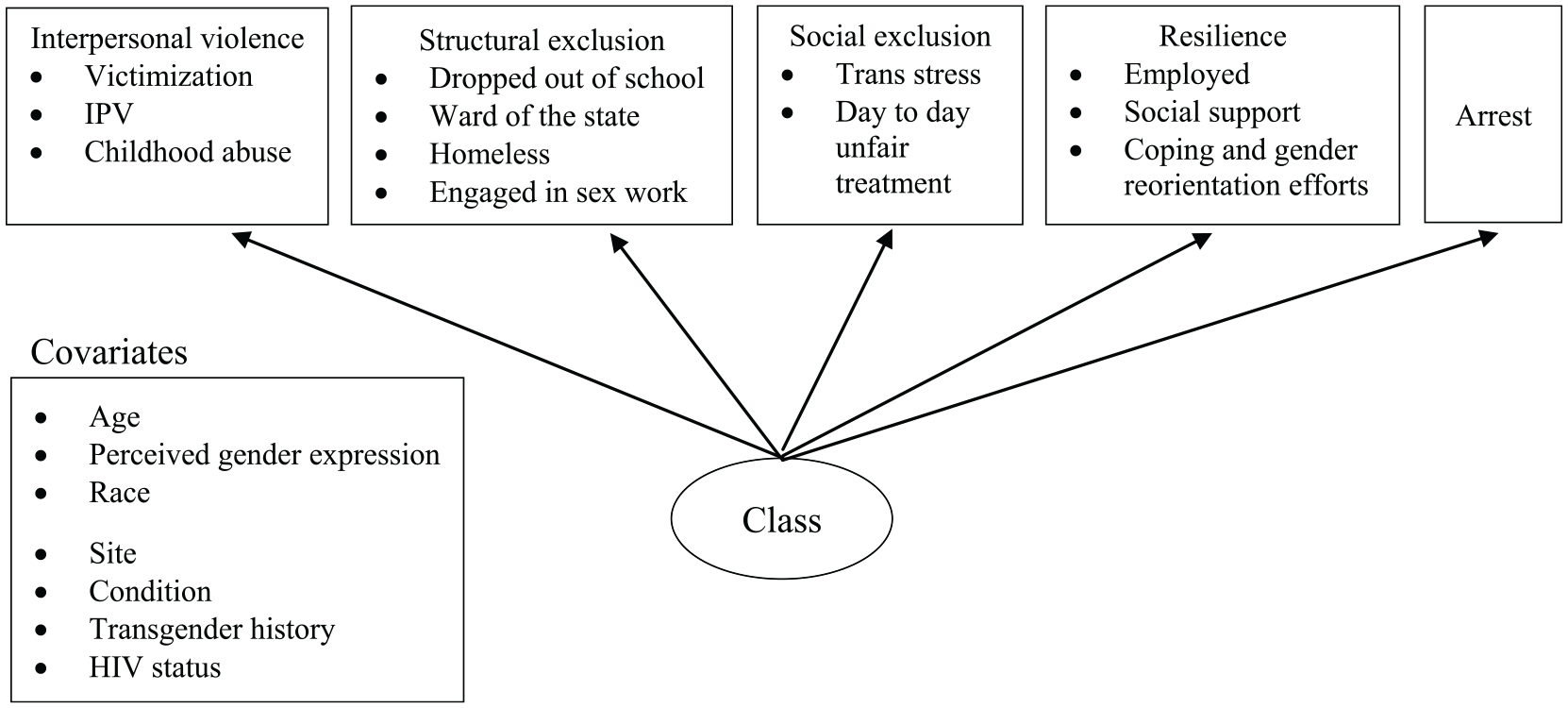
Latent Class Analytic Model
LCA is conducted by fitting a series of models to indicator variables. Models with differing numbers of classes were fit and compared, beginning with one class to test the null hypothesis and continuing up to a six-class model. Statistical tests and theory are used to compare models and determine the optimal number of classes. Maximum likelihood is used to identify parameter estimates most consistent with the observed data. Maximum likelihood is converted to the log likelihood and compared across one through six-class models (McCutcheon, 1987). Akaike’s Information Criterion (AIC), Bayesian Information Criteria (BIC), and the sample-size adjusted Bayesian Information Criteria (ssBIC) were used to compare fit across models with different numbers of classes, with smaller AIC, BIC, and ssBIC values indicating better fitting models (Nylund et al., 2007). The BIC has been found to perform the best of the Information Criterion (ICs) (Nylund et al., 2007). Entropy with values approaching one indicate a clearer delineation of classes (Celeux & Soromenho, 1996). The Lo–Mendell–Rubin likelihood ratio test (LMR-LRT) was used to test whether adding an additional class significantly improves model fit, with nonsignificant values indicating that an additional class does not provide a better fit (Nylund et al., 2007). Model selection was also determined by reviewing the average latent class probabilities (ACPs), size and theoretical contributions of each class (Masyn, 2013). Due to sample attrition, there is some missingness on indicators assessed at the 4-month survey, and on arrest, which was assessed across all four time points. Partial missing data were accounted for by using full information maximum likelihood (FIML) (Arbuckle, 1996; Schafer & Graham, 2002).
After determining the optimal number of classes, associations between covariates (i.e., age, perceived gender expression, and race) and class membership were examined. Covariates were added following Vermunt’s (2010) three-step approach using the R3STEP. Vermunt (2010) proposed the three-step approach to address classification error issues not well accounted for by other approaches that use assigned class membership as an observed nominal variable in multinomial logistic regression.
Results
Criminal Legal System Involvement Histories
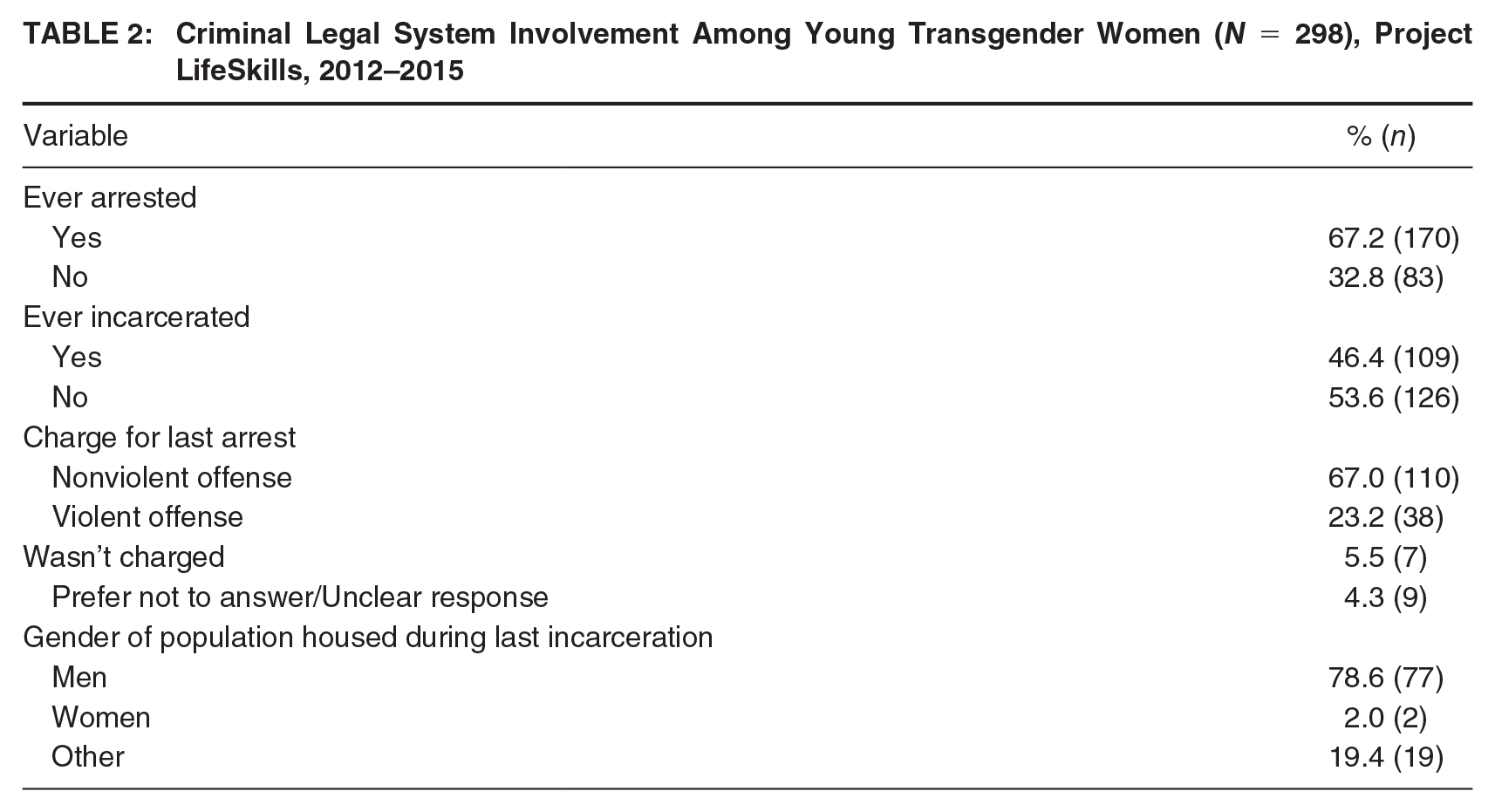
Criminal legal system involvement histories, including charge at last arrest and incarceration experiences, were examined and are depicted in Table 2. Over two thirds (67.2%) of the sample reported being arrested at any point prior to or during the study period. Of those who were arrested and wrote in a response to the question regarding their charge at last arrest, 23.2% were charged with a violent offense, 67.0% charged with a nonviolent offense, 5.5% were not charged, and 4.3% preferred not to answer or wrote in a response that was unclear or incomplete. Of those who reported a nonviolent offense, the most commonly written in response (32.7% of responses) was a property crime (i.e., theft, burglary), and the second common was sex work or prostitution (18.2%). At baseline, 32.9% of women reported having ever spent time in jail or juvenile detention, and the majority (78.6%) were housed with men.
Criminal Legal System Involvement Among Young Transgender Women (N = 298), Project LifeSkills, 2012–2015
LCA
Fit indices for models of varying numbers of classes are presented in Table 3. Moving from the two-class to the three-class model, the BIC and ssBIC decreased and the LMR-LRT was significant at the p < .05 level. Moving from the three- to four-class model, the AIC and ssBIC decreased, but the LMR-LRT was not significant and the ACPs decreased. The BIC has proven to be a consistent indicator of classes (Nylund et al., 2007), thus a three-class model was selected (log-likelihood [LL] = −1,996.07[41], BIC = 4,225.72) to best represent the data. These classes represent women with similar patterns to responses related to interpersonal violence, structural exclusion, social exclusion, resilience, and arrest: (a) a “High Violence and Exclusion/High Arrest” class (n = 87, 29.2% of the sample), (b) a “Low Arrest” class (n = 93, 31.2% of the sample), and (c) a “Moderate Violence and Exclusion/High Arrest” class (n = 118, 39.6% of the sample). Probabilities reported below indicate the likelihood of members of this class experiencing the form of violence, structural or social exclusion, resilience, or arrest.
Latent Class Analytic Enumeration
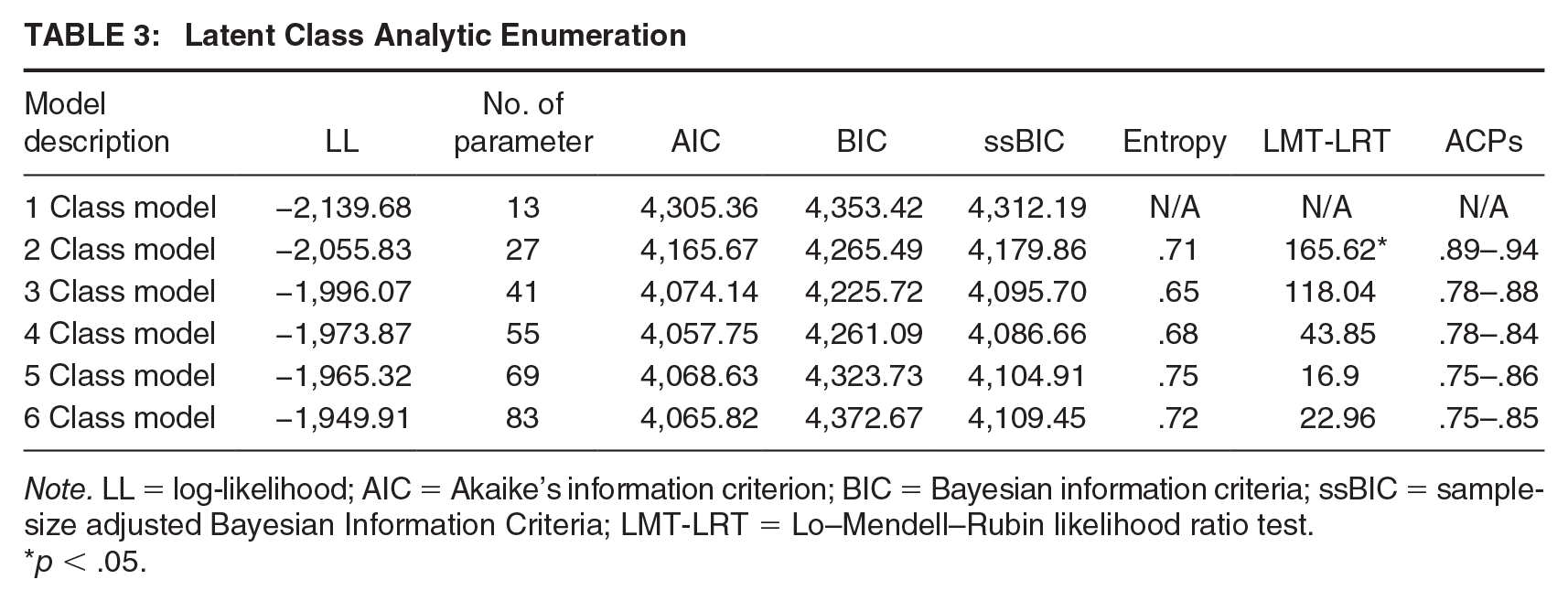
Note. LL = log-likelihood; AIC = Akaike’s information criterion; BIC = Bayesian information criteria; ssBIC = sample-size adjusted Bayesian Information Criteria; LMT-LRT = Lo–Mendell–Rubin likelihood ratio test.
p < .05.
High Violence and Exclusion/High Arrest
The “High Violence and Exclusion/High Arrest” class indicated high probabilities of interpersonal violence, including victimization (87.7%), IPV (73.2%), and child abuse (79.3%) when compared with the other two classes. In terms of structural exclusion, this class had some low or moderate probabilities of some factors, for example, dropping out of school (43.3%) and being a ward of the state (22.3%), but high probabilities of homelessness (70.7%) and sex work (59.2%). This class also experienced high levels of social exclusion, including trans stress (89.4%) and unfair treatment (82.7%). This class also had the lowest probabilities of endorsing measures related to resilience, including employment (21.1%), social support (35.1%), and coping (56.6%). This class also had a high probability of being arrested (89.6%).
Low arrest
Probabilities of interpersonal violence, including victimization (44.1%), IPV (45.8%), and child abuse (52.2%), among the “Low Arrest” class were moderate when compared with the other two classes. The “Low Arrest” class is notable for the lowest probabilities of structural exclusion, including dropping out of school (14.8%), being a ward of the court or state (4.9%), homelessness (7.2%), and engagement in sex work (12.2%). Related to social exclusion, this class indicated moderate probabilities of endorsing items related to transgender-related stress (63.8%) and day-to-day unfair treatment (54.3%). The “Low Arrest” class had the highest resilience probabilities, including employment (44.8%), social support (59.1%), and coping (55.6%). This class had the lowest probability of being arrested (11.3%).
Moderate Violence and Exclusion/High Arrest
The “Moderate Violence and Exclusion/High Arrest” class had the lowest probabilities of interpersonal violence, including victimization (15.4%), IPV (13.8%), and child abuse (20.5%). Probabilities of endorsing structural exclusion measures were similar to those of the High Violence and Exclusion/High Arrest, including dropping out of school (50.0%), being a ward of the state (34.7%), homelessness (67.1%), and engagement in sex work (72.9%). The “Moderate Violence and Exclusion/High Arrest” class had low probabilities of social exclusion, including trans stress (20.6%) and day-to-day unfair treatment (24.5%). In terms of resilience, this class had the lowest probability of employment (14.0%) and coping (43.7%) and moderate social support (49.3%). This class also had a high probability of arrest (85.3%). Classes are depicted in Figure 2.

Three Class Model Describing Risk, Resilience, and Arrest Classes
The overall model controlled for site, intervention assignment, age, perceived gender identity, transgender history, race, and HIV status (i.e., by including them as auxiliary variables). Table 4 presents the effect of age, race, and perceived gender identity on the log odds of being in either of the “High Arrest” classes using the “Low Arrest” class as a reference. Odds ratios (ORs) and significance level are reported in the table, with an OR of greater than one indicating increasing log odds of being assigned to a given class when compared with the “Low Arrest” class. Young transgender women who indicated a less feminine gender expression were less likely to be in the “Moderate Violence and Exclusion/High Arrest” class (OR = .26, p = .02, 95% CI [.09, .78]) than the “Low Arrest” class. In addition, women who identified as Black had over 4 times greater odds of being in the “Moderate Violence and Exclusion/High Arrest” than the “Low Arrest” class (OR = 4.03, p = .01, 95% CI [1.38, 11.72]).
Multivariable Model of Predictors of Three Classes; Low Arrest (Class 2) as Reference

Note. The reference category age is 16–23 years; reference for race is non-Black; reference for perceived gender expression is very feminine.
Discussion
Using data from one of the largest samples of young transgender women, the study described herein fills critical gaps in the literature regarding transgender women’s experiences within the criminal legal system. The aims of this study were to describe criminal legal system involvement among a sample of young transgender women and to investigate patterns of violence, structural and social exclusion, resilience, and arrest. With regards to criminal legal involvement histories, women in this sample reported high levels of arrest and incarceration, and the majority were charged with nonviolent offenses when they were last arrested. Of those who had been incarcerated, most women were housed with men, increasing the risk of experiencing violence and victimization by other inmates and guards (Grant et al., 2011; James et al., 2016). Overall, women in the sample reported high levels of violence and marginalization, including homelessness and engagement in sex work. These findings contribute to the growing body of research documenting multiple forms of victimization and marginalization among members of this community (Grant et al., 2011; James et al., 2016; Wilson et al., 2009).
Using LCA, a three-class model reflecting participants with similar response patterns to items addressing interpersonal violence, social exclusion, structural exclusion, resilience, and arrest was selected to best fit the data. These findings suggest several ways in which young transgender women’s experiences align with and depart from those of cisgender women within the criminal legal system. Like cisgender women, transgender women’s experiences are multi-leveled, yet these experiences differ across classes. Over two thirds of the sample fell into one of the two “High Arrest” classes. High and moderate levels of structural exclusion among the two “High Arrest” classes suggest that young transgender women experience a similar form of “gender entrapment” described by Richie (1996).
Transgender women in this sample reported high levels of interpersonal violence, consistent with findings among cisgender women (Daly, 1994; DeHart, 2018; Richie, 1996). Experiences of interpersonal violence among transgender women are underexamined in the literature, but these findings suggest links between childhood abuse, IPV, and transgender-related victimization. Patterns of interpersonal violence differed across the three classes. This finding indicates that for some young transgender women, structural exclusion factors may be more significant drivers of carceral involvement. The study described herein finds similar patterns of high IPV and child abuse and high arrest among the “High Violence and Exclusion/High Arrest” class. In addition, this study adds measures capturing experiences of transgender-related victimization and identifies a similar pattern of high victimization and high arrest among the “High Violence and Exclusion/High Arrest” class. Taken together, these findings suggest that some transgender women with a history of criminal legal system involvement have also experienced multiple forms of violence across the life course. Recognizing the links between interpersonal violence and criminal legal system involvement among cisgender women, researchers and practitioners are beginning to develop trauma-informed interventions and programs (Kubiak et al., 2011). These findings indicate that some transgender women within the criminal legal system may also need trauma-informed interventions, and that these should be expanded to address forms of transgender-related victimization.
Transgender women’s gender presentation distinguished class membership. Participants who indicated that their gender presentation was perceived as less feminine were at reduced odds of being in the Moderate Violence and Exclusion/High Arrest when compared with the “Low Arrest” class. One explanation is that individuals with a less feminine gender presentation may be perceived as young men, providing some protection from transphobic discrimination. By contrast, when stopped by police, transgender women with a feminine gender presentation but identification documents that list their gender marker as male or include a man’s name may experience heightened harassment and questioning by police (Grant et al., 2011). Additional research is needed to examine the ways in which gender presentation and gender nonconformity impact criminal legal system involvement among young transgender women.
Black transgender women were more likely to be in the “Moderate Violence and Exclusion/High Arrest” when compared with the “Low Arrest” class. Participants in the “Low Arrest” class had lower probabilities of structural exclusion (i.e., being a ward of the court/state, dropping out of school, homelessness, and engagement in sex work). These findings are consistent with empirical literature documenting racial disparities within the criminal legal system and associations between exclusion from institutions, poverty, and arrest among people of color (Kaeble & Glaze, 2016; Richie, 1996; Ritchie, 2017; The Sentencing Project, 2017). Future research can expand upon these findings by examining the interplay between forms of structural exclusion, social exclusion, and carceral involvement among Black transgender women.
Data for this secondary analysis were obtained from Project LifeSkills, a randomized controlled trial of an HIV prevention intervention and one of the largest samples of young transgender women. While the size of the sample offers unique opportunities for examining patterns of violence, exclusion, resilience, and arrest, the present study is not without its limitations. To be eligible for participation in the parent study, women needed to report sexual risk behavior, limiting the generalizability of these findings to the broader population of young transgender women. The use of self-report data could impact recall and social desirability bias. Scheduling of survey items across waves and data missingness also pose limitations. Data were collected across four waves; with the exception of arrest, variables used in this analysis were collected at baseline and at 4 months. Due to sample attrition, there is some missingness on 4-month variables, which was accounted for using FIML (Arbuckle, 1996; Schafer & Graham, 2002). Measures used in Project LifeSkills have been used in prior research, yet some have not been validated for transgender women. Future research should include validation of measures for this population. We grouped variables into four domains—interpersonal violence, structural exclusion, social exclusion, and resilience—to structure the presentation of findings, yet most variables could fall into two or more categories. For example, this study included social support as a form of resilience, yet social bonds may also expose individuals to criminalized behaviors and increase risk of arrest (Bonta & Andrews, 2007). Future research should further explore the intersections of these domains. Several key variables, including arrest, were assessed as dichotomous variables to facilitate visual comparison (Mumford et al., 2016; Van Gaalen & Dykstra, 2006). Additional research is necessary to explore variation and nuance related to the factors examined in this study. Arrest was measured as having ever been arrested prior to or during the study. Thus, causality cannot be determined using these data. Indeed, many of the life experiences examined in the study described herein may be both a cause and an effect of arrest. As an exploratory study of patterns of life experiences and arrest among transgender women, the study can inform future research identifying factors associated with arrest and pathways into the criminal legal system for transgender women.
Implications for Future Smart Decarceration Research and Practice
Understanding young transgender women’s trajectories into the criminal legal system is necessary to inform decarceration and prevention interventions. This study begins to fill this gap by expanding upon the existing gender responsive frameworks and empirical research among transgender youth and young adults to enhance understanding of transgender women’s experiences within the criminal legal system. Social workers are well-suited to interrupt and address carceral involvement among transgender individuals. Patterns of life experiences examined in this study correspond with many areas of social work practice, including housing and employment programs, schools, the child welfare system, and support services for survivors of violence. Social workers in these settings should ensure that these programs are inclusive of and accessible to transgender women. Future research can expand upon these findings by exploring barriers to accessing these and other supportive services.
While transgender women have received little attention within Smart Decarceration research and practice to date, Smart Decarceration’s focus on both structural and behavioral interventions offers a framework for addressing multi-level factors contributing to carceral involvement among transgender women. This study identified several patterns of life experiences distinct to young transgender women, illustrating the heterogeneity of transgender individual’s experiences of interpersonal violence, social and structural exclusion, and arrest. These findings suggest that “one size fits all” decarceration and arrest prevention interventions may not meet the differing needs of transgender women; instead, a variety of tailored programs and policy interventions are required. At the micro level, these interventions could include transgender-affirming trauma-informed programming for women who have survived interpersonal violence. Policy-level interventions such as decriminalizing sex work may also help to prevent transgender women from entering the criminal legal system. Findings also indicate a need for macro interventions to interrupt patterns of structural exclusion, including homelessness, school push out, child welfare system involvement, and arrest. These findings suggest that risk assessments and behavioral interventions that focus on individual-level factors are not sufficient to prevent and reduce arrest among young transgender women, adding further support to calls from scholars for structural-level interventions (Hannah-Moffat, 2009).
Among the first studies to examine patterns of violence, exclusion, resilience, and arrest among young transgender women, the present study can inform additional research in this area. In particular, future studies should examine the temporal ordering of patterns examined in this study to identify associations between life experiences and carceral involvement and to identify pathways leading toward arrest. As rates of interpersonal violence varied across the three classes, future research should expand upon these findings by examining the role of interpersonal violence in shaping carceral involvement.
Footnotes
Authors’ Note:
The authors wish to thank the participants of Project LifeSkills for sharing their experiences. Project LifeSkills was supported by the National Institute of Mental Health (NIMH) of the National Institutes of Health (R01MH094323).
