







Abstract
Youth involved with the juvenile justice system are not exempt from experiencing identity-related turmoil that is common during adolescence. Parents’ responses may exacerbate or mitigate this turmoil and, in turn, youth problem behaviors. Thus, this study investigated identity distress as a mediator of the relationship between parental response to adolescents’ distress and their problem behaviors among 113 detained males aged 12 to 18 (Mage = 15.3, SD = 1.44) in Connecticut, USA. Participants completed measures of identity distress, parental response to their developmental distress, and multiple problem behaviors. A latent mediation model indicated that a supportive parental response was directly associated with decreased problem behaviors, whereas an avoidant parental response was indirectly associated with increased problem behaviors through increased identity distress. Developmentally salient identity-related distress of juveniles and the corresponding response of their parents are important to consider in understanding youth externalizing problem behaviors within the juvenile justice system.
Keywords
The U.S. juvenile justice system is considered the largest in the world (Grigorenko et al., 2019). Despite the decrease in juvenile crime in the United States since the 2000s (Puzzanchera, 2020), this system remains a major context impacting the development of many youth. In 2017, more than 43,000 juveniles were held in over 1,700 residential placement facilities, 84.8% of which were male, with a vast majority aged 14 to 17 (Sickmund et al., 2019). Nevertheless, extensive reviews and large-scale empirical studies have shown that juvenile incarceration is often linked to poor developmental outcomes and an increased likelihood of subsequent criminal behavior (e.g., Lambie & Randell, 2013). These poor outcomes suggest that incarceration fails to meet the developmental and criminogenic needs of justice-involved youth (Lambie & Randell, 2013). This calls for a better understanding and consideration of these needs (Steinberg et al., 2004). In addition, incarceration, like other forms of institutionalization, may lead to the youth further disengaging from parental involvement. This poses an additional challenge as parental involvement has been shown to be crucial in helping youth desisting from crime (Burke et al., 2014; Walker et al., 2015).
The literature on juvenile delinquency has rarely addressed the developmental needs of incarcerated juveniles (Barbot & Hunter, 2012). Concurrently, young people charged with crimes are overlooked in the normative adolescent development literature (Knight et al., 2009). One exception, touted adolescence-limited delinquency, refers to a group of juveniles for whom the onset of problem behaviors coincides with the onset of adolescence (Moffitt, 1993). The developmental mechanism underlying this distinctive pathway to juvenile delinquency has been viewed as an exaggeration of developmentally normative adolescent rebellion (Moffitt, 1993). Indeed, delinquency may be a byproduct of the individuation process whereby adolescents affirm their maturity through behaviors that reflect independence such as (minor) delinquent acts (Dijkstra et al., 2015; Levey et al., 2019). This individuation process is also marked by an increased reliance on peers and distancing from parents (Hadiwijaya et al., 2017). The process occurs during a time in which parental monitoring and support remain essential in both preventing adolescents’ problem behaviors (Hoeve et al., 2009; Pinquart, 2017) and addressing their internal turmoil (Barbot, Heinz, & Luthar, 2014).
Based on these considerations, in this study, we argue that beyond the “typical” adolescent rebellion, identity-related distress that is developmentally salient in adolescence also contributes to problem behaviors among juvenile justice-involved youth. In addition, we situate the supportive versus dismissive response of parents in addressing their adolescent’s distress as a factor that may exacerbate or mitigate identity-related distress and, in turn, problem behaviors. In other words, we sought to examine the indirect relationship between parental support and youth problem behaviors (through adolescent identity distress) as a pathway to juvenile problem behaviors. The associations between parenting and problem behaviors in adolescence have generally been conceptualized as direct relationships (Hoeve et al., 2009; Pinquart, 2017) with limited considerations of individual-level factors and resources that mitigate these relationships. Elucidating the complex relationships among these factors is needed so they can be directly targeted in future rehabilitation and intervention programs for justice-involved youth in the United States and beyond. Furthermore, understanding the way parents may contribute to increased or decreased identity distress for those youth could offer important strategies to involve parents in such rehabilitation efforts. This is an often challenging, yet, crucial endeavor for successful juvenile justice services (Burke et al., 2014; Walker et al., 2015).
Identity and Juvenile Delinquency
There is a tradition of sociological and ethnographic work focused on the identity experience of inmates and other institutionalized individuals (e.g., Goffman, 1968). In essence, this tradition suggests that the adaptation to confinement in a correctional facility is marked by processes of identity negotiation that both challenge professed prior identities and construct alternative future identity possibilities (Abrams & Hyun, 2009). This is consistent with a more recent line of work focused on criminal identity, often conceptualized as a critical driver of criminal participation (Bachman et al., 2015; Paternoster & Bushway, 2009; Paternoster et al., 2016; Veysey & Rivera, 2017). Reciprocally, an identity change could represent an important causal mechanism of desistance (Paternoster et al., 2016). Indeed, “to the degree that the cessation of criminal/delinquent behavior often occurs in tandem with the assumption of roles and role-related behaviors, perception of self (i.e., identity) is also likely to change” (Veysey & Rivera, 2017, p. 1250). This could have important implications for the creation of interventions that focus on promoting identity development in youth involved in the juvenile justice system (Frick, 2012). For example, considering positive possible selves could provide adolescents with motivational resources that divert them from delinquent activity (Oyserman & Markus, 1990).
Although this line of work is fruitful both theoretically and practically, it has mainly focused on criminal or offender identity, and the shift from this identity (i.e., the specific role-identity associated with juvenile delinquency) as a pathway to desistance (Paternoster & Bushway, 2009; Paternoster et al., 2016). However, it would be incomplete to solely define juveniles who engage in delinquent acts by this very specific aspect of identity. Developmentally normative processes of identity formation salient during adolescent years such as individuation or identity exploration could also account for these maladaptive behaviors (Barbot & Hunter, 2012; Hatano et al., 2020; Mercer et al., 2017; Steinberg et al., 2004).
Conceptualizing Identity Distress as a Determinant of Problem Behaviors
Prevailing models of juvenile delinquency have highlighted the interaction between multiple factors that contribute to the onset, development, and persistence of—or desistance from—problem behaviors in adolescence (e.g., Hein et al., 2017). These factors include adverse developmental experiences such as histories of maltreatment (e.g., Meldrum et al., 2020), poor social-decision making (Barbot et al., 2012), and maladaptive parenting practices (Hoeve et al., 2009; Rolan & Marceau, 2018). There are also more contingent factors such as adolescent day-to-day worries (Arbel et al., 2018). Identity formation could also bring about a great deal of distress during adolescence (Hernandez et al., 2006). Indeed, identity distress 1 results from the uncertainty over a range of issues related to questioning who one is and wants to be (Berman & Weems, 2018).
Distress over identity-related issues during adolescence is expected given that identity formation is a central developmental task of this time period (Berman et al., 2006). More severe forms of distress have been observed in research investigating the clinical presentation of juveniles charged with a crime. These often highlight identity confusion, disturbance, or dissociation (e.g., Taylor et al., 2006) resulting from early-onset or extended trauma that is commonly experienced by prisoners (McNair et al., 2019). Pronounced forms of such internalized distress can disrupt normal functioning and have been related to other internalizing (Samuolis & Griffin, 2014; Westen et al., 2011) and externalizing symptoms 2 (Hernandez et al., 2006). In sum, although it has never been explicitly conceptualized as such, the developmental task of identity formation in adolescence may be a source of distress (within both normative and “at-risk” contexts; Westen et al., 2011). In turn, this could be associated with an increased risk for a range of problem behaviors, law-breaking behaviors, and involvement with the juvenile justice system (Barbot & Hunter, 2012; Crocetti et al., 2013; Haeffel et al., 2017).
The Role of Parenting Practices
Although it is difficult to portray normative relational patterns and socialization between parents and adolescents, the family environment is undoubtedly a pivotal developmental context in the lives of adolescents in the United States and worldwide (Smetana & Rote, 2019). Although generally studied separately, the family environment is a critical correlate of both adolescent identity distress and problem behavior in various youth populations (e.g., Hadiwijaya et al., 2017). In particular, research has focused on the role of parenting practices and their relationships to problem behaviors (Dimler et al., 2017; Hoeve et al., 2009; Pinquart, 2017; Rolan & Marceau, 2018). Generally, it is established that parental monitoring is most associated with reduced problem behaviors (Hinnant et al., 2015; Hoeve et al., 2009), whereas dimensions of parental support and warmth are more closely related to reduced internalized distress (e.g., Fletcher et al., 2004). Nonetheless, parental support and warmth have also been associated with reduced externalizing behaviors (Morrison et al., 2019; Weitkamp & Seiffge-Krenke, 2019). For example, in a sample of 753 adolescents from high-risk communities, Bendezú et al. (2018) found specific features of conversation with adolescents regarding daily activities to be the strongest, negative predictor of their delinquency. In a longitudinal study involving almost 15,000 youth, an “adolescence-peaked” trajectory of antisocial behaviors was associated with lower supportive parenting (Morrison et al., 2019). In contrast, harsh punishment has been related to increased problem behaviors and oppositional defiant disorder (Roubinov et al., 2020). A study among 317 first-time juveniles and their mothers (Cavanagh & Cauffman, 2017) revealed that an initial, positive mother–son relationship reduced reoffending. On the contrary, decreased maternal warmth was associated with increased offending behaviors over time. This is consistent with findings showing a reciprocal relationship between parental monitoring and adolescent delinquency (Barbot, Crossman, et al., 2014; Hein et al., 2018).
Together, there is considerable research on the associations between parenting and externalizing problems, and, taken independently, between identity development and externalizing problems (e.g., Berman et al., 2006; Crocetti et al., 2013; Mercer et al., 2017). However, little is known about the direct and indirect associations among these constructs (i.e., parental support, identity distress, and problem behaviors). In particular, there is limited research on youth at heightened risk for problem behaviors including those involved with the juvenile justice system (Cavanagh & Cauffman, 2017). Moreover, there have been few studies on how parents can provide support in helping their adolescents address identity-related developmental challenges. This is a critical question to investigate, in particular with respect to desistance from antisocial activity (Mulvey et al., 2004).
Present Study
To address the aforementioned gaps in the literature, we hypothesize that identity distress (typical in both “normative” and “at-risk” adolescent development; Westen et al., 2011) may account for the relationship between parental support (e.g., response to adolescents’ distress) and externalizing problems of youth involved in the juvenile justice system. To our knowledge, this indirect association has not been tested, in particular among youth involved with the juvenile justice system who often grow up in challenging circumstances and are at heightened risk for externalizing problems (Haeffel et al., 2017; Hein et al., 2017). Because dimensions of supportive parenting have been linked to reduced adolescent internalized distress (Fletcher et al., 2004), it is likely that a supportive parental response may be particularly important to help adolescents cope with identity-related distress, in turn preventing problem behaviors. Conversely, lack of parental support (or even a harsh or avoidant response) may result in increased identity distress and subsequent problem behaviors.
This study examined these overlooked hypotheses among a sample of detained adolescent boys. The goal of the study was to illuminate the extent to which their identity-related distress and perceived parental response (or lack thereof) account for their self-reported problem behaviors. Examining the mediating role of identity distress in the relation between parental response and problem behavior is important as it could provide a new line of interpretation regarding the relationship between parental support and adolescents’ reduced problem behaviors (Dimler et al., 2017; Morrison et al., 2019; Weitkamp & Seiffge-Krenke, 2019). Specifically, it could clarify and strengthen the underlying mechanisms of effective family-based treatments targeting the reduction of adolescents’ problem behaviors (Celinska et al., 2013) and recidivism (Mulder et al., 2011). Finally, discerning the relations between parental support, identity-related distress, and problem behaviors among youth involved in the juvenile justice system can aid in creating new approaches to improve parental involvement in juvenile justice services (Burke et al., 2014; Walker et al., 2015).
Method
Participants
This study involved 113 adolescent males detained in a juvenile detention facility in an urban, socioeconomically disadvantaged neighborhood in Connecticut (CT), USA. Their age ranged from 12 to 18 years old (Mage = 15.35, SDage = 1.44), and they were predominantly from African American (38.1%), Hispanic or Latino (23.9%), or Caucasian (20.4%) descents (with 14.9% from mixed/other backgrounds, and 2.7% unreported racial and ethnic background). These demographics closely match those of the total population of juveniles admitted to detention in CT during the data collection years (2014–2016) with respect to age, racial, and ethnic background (State of Connecticut, 2016). A large portion of the participants (57.5%) reported living with their mother only, 20.4% reported living with both their parents, 4.4% with their father only, and 17.7% in other arrangements (e.g., foster home). The study was approved by Internal Review Boards from Yale University (HSC Protocol #1203009872) and State of Connecticut, Judicial Branch, Court Support Service Division (Protocol #0097). Per Institutional Review Board (IRB) protocols, information on the length of detention and criminal records of the participants were not available to the researchers to guarantee participants’ anonymity. However, related work based on the records of all juveniles involved in the juvenile justice system in CT between 2006 and 2012 (Hein et al., 2017) suggest that among all offenses committed by males, crimes against public order accounted for 26.9% of all offenses, followed by property offenses (25.5%), violent offenses (i.e., crimes against persons; 19.1%), status offenses (18.4%), and drug law violations (10.1%). Public records (Connecticut Juvenile Training School Advisory Board, 2016) indicate that most CT incarcerated boys at the time of the data collection had behavioral disorders (91%), substance disorders (69%), as well as neuro-developmental disorders (62%). The average length of stay in the juvenile detention center during the study period was 16.98 days (State of Connecticut, 2016).
Measures
Descriptive statistics and internal consistency estimates of the scale scores gathered in this study are presented in Table 1. As shown, measures included self-reported scales for:
Descriptive Statistics and Correlations of the Main Study Variables
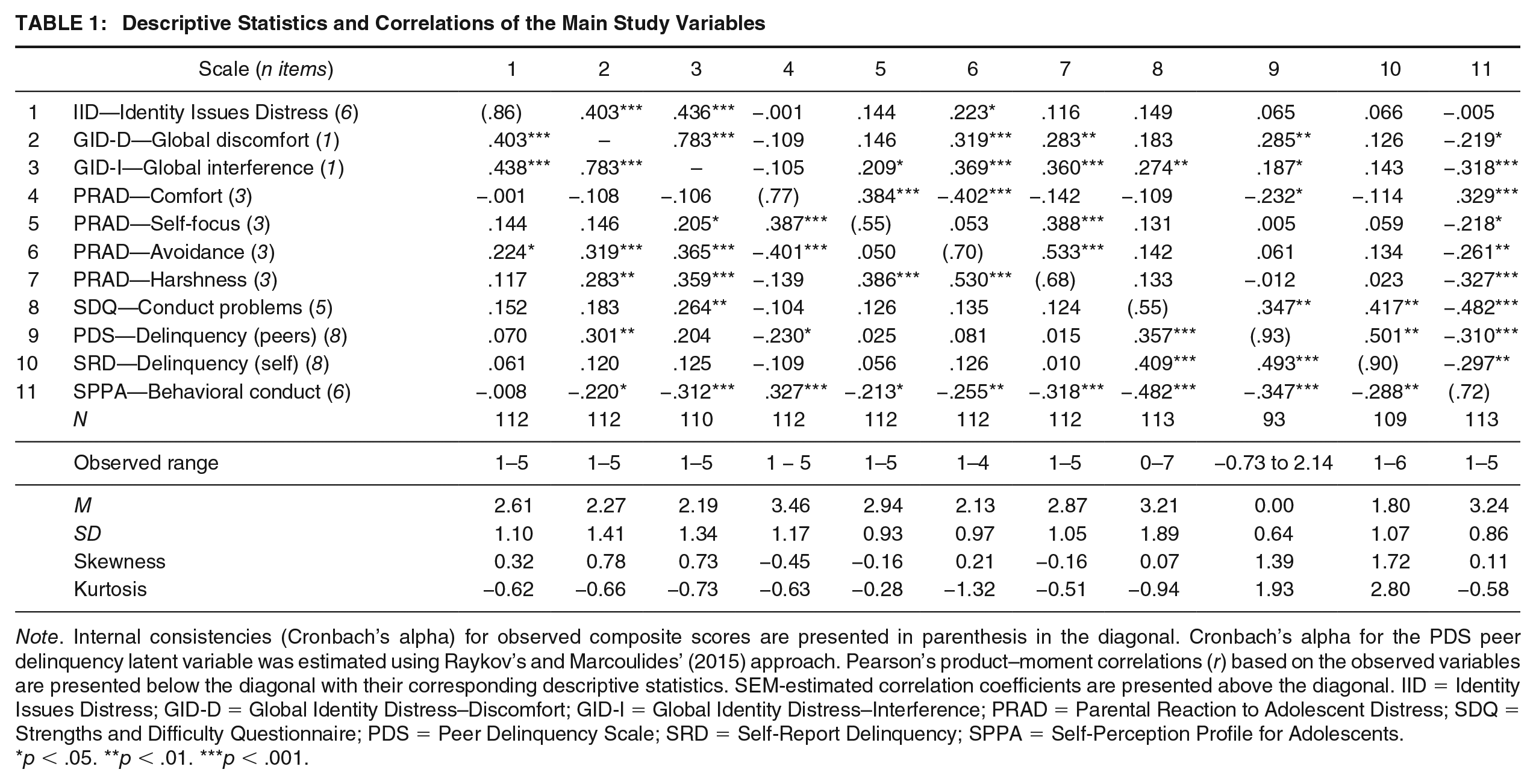
Note. Internal consistencies (Cronbach’s alpha) for observed composite scores are presented in parenthesis in the diagonal. Cronbach’s alpha for the PDS peer delinquency latent variable was estimated using Raykov’s and Marcoulides’ (2015) approach. Pearson’s product–moment correlations (r) based on the observed variables are presented below the diagonal with their corresponding descriptive statistics. SEM-estimated correlation coefficients are presented above the diagonal. IID = Identity Issues Distress; GID-D = Global Identity Distress–Discomfort; GID-I = Global Identity Distress–Interference; PRAD = Parental Reaction to Adolescent Distress; SDQ = Strengths and Difficulty Questionnaire; PDS = Peer Delinquency Scale; SRD = Self-Report Delinquency; SPPA = Self-Perception Profile for Adolescents.
p < .05. **p < .01. ***p < .001.
Parental Response
The Parental Reaction to Adolescent Distress (PRAD; Barbot, Heinz, & Luthar, 2014) was used to measure the juveniles’ perception of parental support in reaction to their challenges and distress. This brief, 12-item questionnaire rated on 5-point Likert-type scale measures four typical parental reactions to the prompt “When I have a problem, my parents . . . ”: (a) Comfort (warm, comforting response; for example, “ . . . put their own needs aside and truly listen to me.”; α = .77); (b) Self-focus (parents emphasize their own discomfort and difficulties; for example, “ . . . worry to a point where I have to console them.”; α = .55); (c) Avoidance (dismissive response; for example, “ . . . tell me to go talk to someone else.”; α = .70); and (d) Harshness (critical, disdaining, or punitive response; for example, “ . . . blame me for my part in the problem.,” α = .68). The PRAD has shown robust psychometric properties despite the concision of the scales (Barbot, Heinz & Luthar, 2014).
Identity Distress
The Identity Distress Survey (IDS; Berman et al., 2004) is an eight-item measure rated using a 5-point Likert-type scale. It assesses (a) domain-specific distress associated with unresolved identity issues in interpersonal and ideological areas of identity development (e.g., long-term goals, friendships), rated on six items using a 5-point Likert-type scale (α = .86); (b) the overall level of discomfort experienced over these identity-related issues; (c) the overall degree of interference with daily living that these issues caused; and (d) the duration of distress associated with these issues. The IDS has shown evidence of robust psychometric properties and close alignment with the former Diagnostic and Statistical Manual of Mental Disorders (4th ed.; DSM-IV; American Psychiatric Association, 1994) classification of Identity Disorder (Berman et al., 2004; Wiley & Berman, 2013). In line with past research (Hernandez et al., 2006), an Identity Issues Distress (IID) score was computed by aggregating the six domain-specific distress items whereas the Global Identity Distress (GID) items were used as separate indicators of Discomfort (GID-D; the global level of discomfort experienced over these issues) and Interference (GID-I; the degree of interference with daily-living that they caused), respectively (see the “Analytic Strategy” section).
Problem Behaviors Indicators
As recently recommended in the literature, latent variable (LV) modeling was used to capture a comprehensive problem behavior construct (Latendresse et al., 2017; Tung & Lee, 2018) based on four indicators. They included the following:
The Self-Report Delinquency–Problem Behavior Frequency Scale (SRD-PBF; Multisite Violence Prevention Project, 2004) adapted from Jessor and Jessor (1977). It is used to measure delinquent behaviors ranging from cheating on a test to stealing or damaging properties. The scale includes eight items asking how many times the respondent has engaged in delinquent behaviors in the last 30 days (α = .90). Each item is rated on a 6-point frequency scale ranging from 1 (0 counts) to 6 (20 counts or more).
The Peer Delinquency Scale (PDS; Multisite Violence Prevention Project, 2004) is parallel to the SRD-PBF scale, but in reference to the number of peers displaying delinquent behavior. This indicator was included to tap into association with deviant peers, which is a relevant correlate of self-report delinquency (e.g., Price et al., 2019); similar to the SRD-PBF scale, items were rated on a 6-point Likert-type scale, here ranging from 1 (None of them) to 5 (All of them) with an option of 0 (I don’t know). 3 Internal consistency estimated using Raykov’s and Marcoulides’ (2015) approach yielded high scale reliability (Cronbach’s α = .93).
The five-item Conduct Problems Scale of the Strengths and Difficulty Questionnaire (SDQ; Goodman, 2001) was used to tap specifically into aggressive and rule-breaking behaviors (e.g., getting into fights, stealing, getting very angry; α = .55). The SDQ is a widely used behavioral screening measure that has been shown to be valid in its self-report version for adolescents (Goodman et al., 1998).
The Behavioral Conduct Scale from Harter’s (1988) Self-Perception Profile for Adolescents (SPPA). This six-item scale rated on a 5-point Likert-type agreement scale measures the degree to which one behaves in an adaptive way and avoids problem behaviors (e.g., “I usually act the way I am supposed to”; α = .72). The scale has shown evidence of discriminant validity and acceptable internal consistency among well-adjusted adolescents versus students with behavioral disorders (Harter et al., 1998).
Procedure
Upon admission to the juvenile detention facility, the program officer responsible for admission presented the study and invited the juvenile to participate. Juveniles interested in participating provided their assent. A parental permission form was mailed to their parents or guardian and included a stamped return envelope Those participants for whom the signed parental/guardian permission form was returned 4 were then invited to meet in a 1-hr testing session in small groups of two to five participants. This occurred in the presence of an IRB-approved research staff member and a detention facility employee. After completion of the measures, a US$5 gift card was placed with the participants’ personal effect as a token of appreciation for their participation.
Analytic Strategy
After scores and their internal consistencies were computed and missing data patterns analyzed, Bayesian multiple imputations were conducted to obtain 50 complete datasets using 10,000 Markov Chain Monte Carlo observations to treat missing values (using a model incorporating all study variables). Missing data were imputed to maximize the sample size and statistical power for the latent mediation model and to obtain unbiased parameter estimates. Descriptive statistics and intercorrelations between study variables were then analyzed. The hypothesized model of the relationship between parental response and youth problem behaviors (as mediated by the youths’ identity distress) was then tested in the structural equation modeling (SEM) framework. As illustrated in Figure 1, the four PRAD parental response variables were modeled as manifest exogenous variables to examine the unique association between each aspect of parental response with identity distress and problem behaviors. Problem behaviors were modeled as an LV based on the four corresponding indicators selected in this study. Similarly, identity distress was modeled as a latent mediation variable using the three indicators derived from the IDS. All model parameters were estimated using maximum likelihood and 50,000 nonsymmetric bootstrap draws confidence intervals.
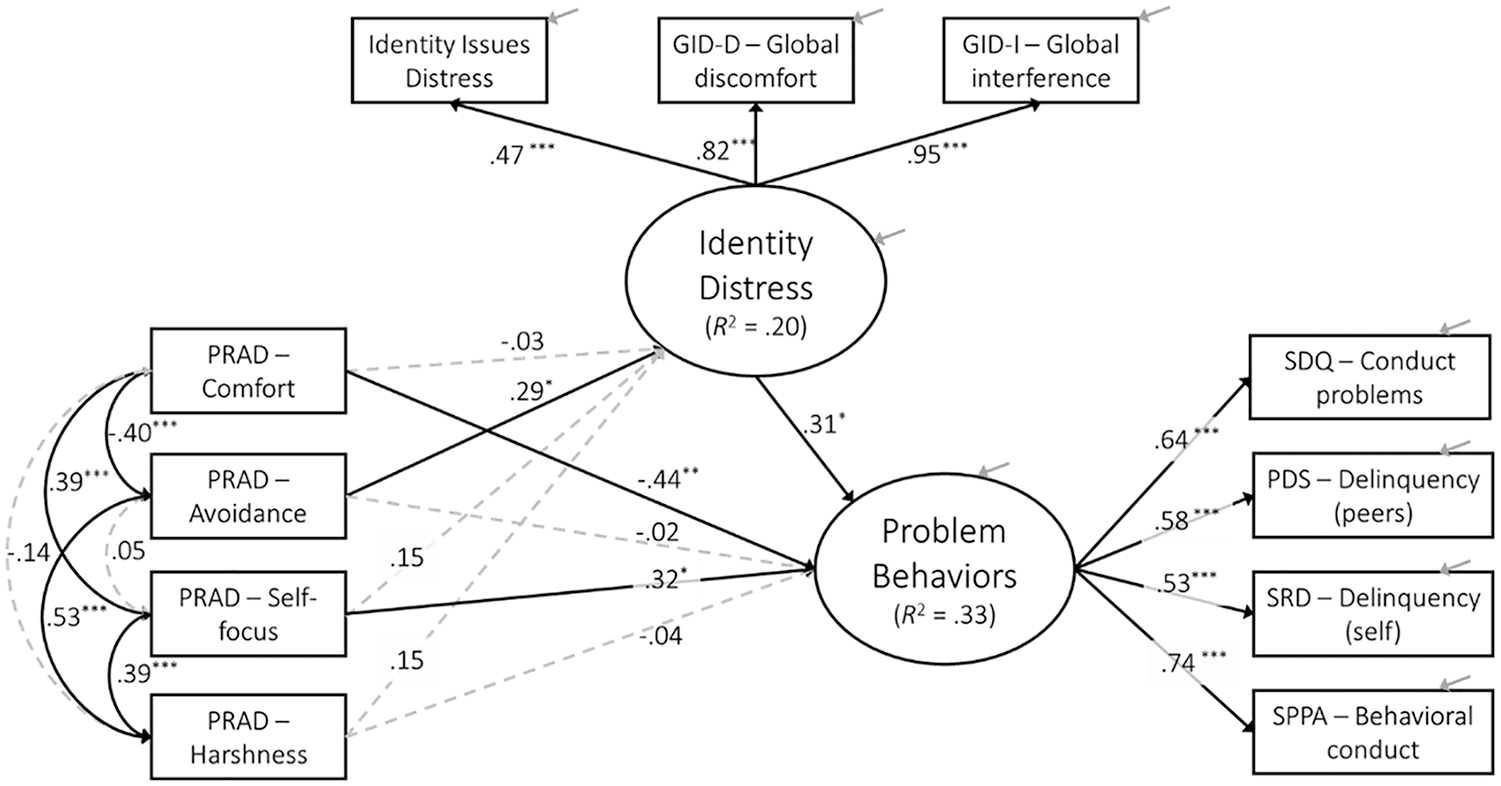
Path Diagram of the Latent Mediation Model of Parental Response, Identity Distress, and Problem Behaviors
Results
Preliminary Analyses
Missing data across all study variables were minimal, averaging 2.7% and ranging from 0% to 17.7% (for PDS Peer Delinquency). The higher rate of missing data for the PDS is due to 20 individuals who answered “I don’t know” (in reference to their friends’ delinquent behaviors) across all PDS items, which was treated as missing. The pattern of missing data was completely random (Little’s MCAR: χ²[df] = 50.93[51], p = .477), supporting the imputation of missing values for further analyses. Table 1 presents the internal consistencies, descriptive statistics, and zero-order correlations for both the original data, as well as the SEM-estimated correlations. As shown, internal consistencies for all measures in this study were acceptable expect for the PRAD Self-focus and the SDQ conduct problems scale which both yielded low internal consistency. This was consistent with previous research with similar study samples (e.g., .47 in a group of Dutch detained male adolescents; Colins et al., 2013, and .54 in a sample of Norwegian adolescents, Van Roy et al., 2008). Low internal consistency of the SDQ conduct problems scale has been attributed to the low number of items, and relatively low base rate behaviors (e.g., stealing) (Muris et al., 2003).
Latent Mediation Model
The tested latent mediation model (Figure 1) yielded satisfactory goodness of fit to the observed data (χ2 [df = 33] = 43.36, p = .107, comparative fit index [CFI] = 0.971, root mean square error of approximation [RMSEA] = 0.053, 95% confidence interval [CI] = [0.000, 0.092], standardized root mean residual [SRMR] = 0.050) given notably, the nonsignificant χ2, the CFI > 0.95, and the RMSEA around 0.05 (Kline, 2015). The modeled LVs showed sizable loadings for both the identity distress variables (ranging from 0.47 to 0.95) and problem behaviors indicators (ranging from 0.53 for SRD-PBF self-reported delinquency scale to 0.72 for SPPA-behavioral conduct). Table 2 displays the estimates for all tested path parameters in the model and their confidence interval (Figure 1 displays the standardized values of both the structural paths and the LV loadings). As shown, the Identity Distress LV was sizably associated with the Problem Behavior LV (β = .314, 95% CI = [0.070, 0.561], p = .013).
Regression Estimates for the Mediation Model (N = 113)
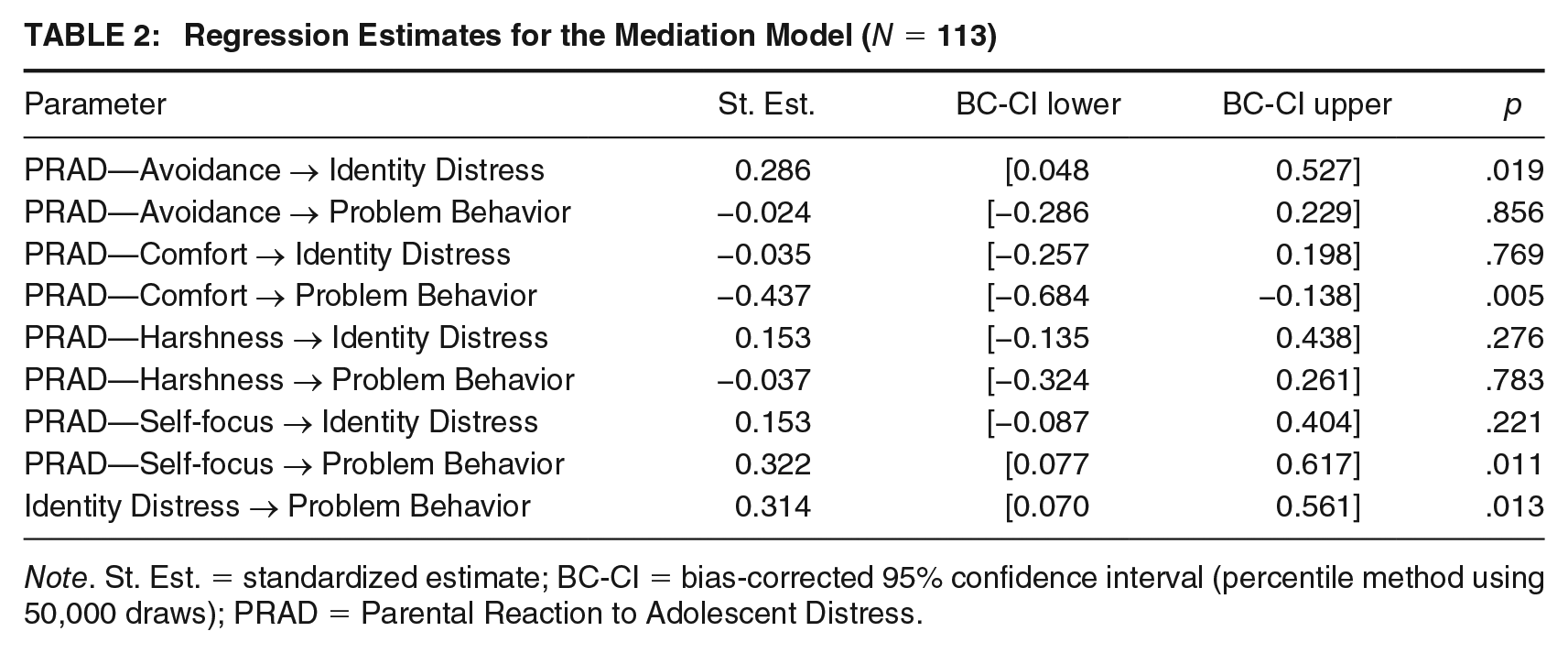
Note. St. Est. = standardized estimate; BC-CI = bias-corrected 95% confidence interval (percentile method using 50,000 draws); PRAD = Parental Reaction to Adolescent Distress.
Each parental response variable showed distinct patterns of association with both the Identity Distress and Problem Behaviors LVs. First, Harshness was the only parental response nonsignificantly related to both Identity Distress (β = .153, 95% CI = [−0.135, 0.438], p = .276) and Problem Behavior LVs (β = −.037, 95% CI = [−0.324, 0.261], p = .783). Second, Avoidance was the only parental response dimension that was significantly related to Identity Distress (β = .286, 95% CI = [0.048, 0.527], p = .019), but not related to Problem Behaviors (β = −.024, 95% CI = [−0.286, 0.229], p = .856). Finally, Comforting and Self-focus parental responses were both directly related to Problem Behaviors (β = −.437, 95% CI = [−0.684, −0.138], p = .005, and β = .322, 95% CI = [0.077, 0.617], p = .011, respectively), but not significantly related to Identity Distress (β = −.035, 95% CI = [−0.257, 0.198], p = .769, and β = .153, 95% CI = [−0.087, 0.404], p = .221, respectively).
With respect to the indirect effects of the parental response variables on the Problem Behavior LV via Identity Distress LV, only the standardized point estimate of the indirect effect of Parental Avoidance was statistically significant (β = .09, 95% CI = [0.016, 0.242], p = .013). The combined effect of all parental response dimensions on Identity Distress was moderate (R2 = .204, 95% CI = [0.058, 0.344], p = .001). In turn, the combined effect of all parental response variables and Identity Distress on Problem Behaviors was large (R2 = .325, 95% CI = [0.093, 0.484], p = .002). The strongest predictors were a Comforting parental response (associated with decreased problem behaviors), Self-focused response (associated with increased problem behaviors), and Avoidant response (indirectly associated with increased problem behaviors via increased Identity Distress).
Discussion
Much research has investigated the determinants of problem behaviors in adolescence, with a focus on parenting factors (e.g., Dimler et al., 2017; Hoeve et al., 2009; Pinquart, 2017; Rolan & Marceau, 2018). However, few studies situate these behaviors in the developmental context in which they occur, that is, adolescence—a stressful developmental period in which identity-related challenges and distress are prevalent (Barbot & Hunter, 2012; Cavanagh & Cauffman, 2017; Crocetti et al., 2013). Furthermore, the (limited) literature on the relationship between identity and delinquency has mainly focused on normative samples with low base rates of behavior problems (e.g., Crocetti et al., 2013; Mercer et al., 2017). Adding to this literature and integrating disparate lines of research and conceptualization, this study examined identity distress as a mediator of the relationship between parenting and problem behaviors among 113 juvenile justice-involved boys. After discussing the main study findings in light of theoretical expectations and past research, limitations, implications, and future directions will be outlined.
Situating Identity Distress in the Parenting–Delinquency Relationship
The main study findings indicated that (a) identity distress was sizably associated with problem behaviors and (b) an avoidant parental response was moderately associated with identity distress while other forms of parental response were weakly related to identity distress. Moreover, (c) a comforting parental response was strongly and directly associated with reduced problem behaviors whereas a self-focused parental response was directly associated with increased problem behaviors with effects of moderate magnitude. Avoidant or harsh responses were not directly related to problem behaviors. However, (d) due to the effect of an avoidant parental response on identity-related distress, this type of response was indirectly associated with increased problem behaviors. Together, this study revealed that identity distress and four dimensions of parenting accounted for 33% of the variance in a problem behavior LV. This variable captured aspects of youths’ violent and nonviolent delinquency, rule-breaking behaviors, as well as associations with deviant peers.
The relationship between identity distress and problem behaviors is consistent with both theoretical considerations (Barbot & Hunter, 2012) and empirical findings among well-adjusted (Berman & Weems, 2018; Crocetti et al., 2013; Dimler et al., 2017) as well as at-risk adolescents (Hernandez et al., 2006). It also aligns with an increasingly evident relationship between both contingent (Arbel et al., 2018; Berman et al., 2006) and more chronic (Zandstra et al., 2018) stressors and problem behaviors. This study also indicated that the lack of direct parental response (i.e., a dismissive or avoidant response) to the juvenile’s concerns was most related to adolescent’s distress, compared to either a “positive” (i.e., comforting) or “negative” (i.e., punitive or self-focused) parental response. This finding reinforces the idea that despite a socio-normative shift to reliance on peers during adolescence (Hadiwijaya et al., 2017; Levey et al., 2019), youths still seek responses from their parents in times of distress. In addition, a dismissive parental attitude may further add to the adolescent’s identity-related challenges (Barbot, Heinz, & Luthar, 2014).
Regarding the relationships between parental response and adolescents’ externalizing problems, this study indicated that a supportive response was most associated with reduced problem behaviors, whereas a self-focused response was associated with increased problem behaviors. While the first association is consistent with established findings in the literature (e.g., Morrison et al., 2019; Weitkamp & Seiffge-Krenke, 2019), only limited research to date has reported on the impact of a self-focused parental response on adolescents’ externalizing problems. This type of self-involved response (i.e., the parents emphasize their own distress instead of addressing their child’s distress) may translate into either or both (a) a lack of parental monitoring, or (b) some degree of parental stress, both of which represent risks for the adolescent’s problem behavior (Hinnant et al., 2015). Relatedly, contrasting with past research (Hinnant et al., 2015; Hoeve et al., 2009), a harsh parental response to adolescents’ distress was not associated with any measured outcomes (identity distress or problem behaviors). By accounting for multiple forms of parental responses in a multivariate fashion, this study isolated the unique effect of each form of parental response over and above the effect of the other forms. Hence, it is possible that the contribution of harsh parental responses may not be as large as initially conceptualized when accounting simultaneously for—and distinguishing it more precisely from—other negative forms of parental response (i.e., self-focused and avoidant).
Finally, although of a small magnitude, this study illuminated a mediated relationship of the avoidant parental response on problem behaviors via increased identity distress. Beyond the effect of an avoidant response on identity distress as outlined above, this finding partly supports a developmental need for the parent’s appraisal during periods of identity formation (Matsueda, 1992). This may not be adequately addressed if parents show avoidant behavior that ultimately contributes to negative self-appraisal and problem behaviors.
Limitations
Before discussing the implications of these findings, several limitations of this study should be acknowledged. First, although the study was based on a sample of juveniles in detention (a rare research setting with a hard-to-reach population), it was a rather small sample size and limited to only males. Furthermore, to guarantee the anonymity of responses, participants were not followed up longitudinally, limiting the results to cross-sectional (and therefore not directional) inferences. Another limitation pertains to the reliance on self-reports to measure the main study constructs. While self-reports may be adequate to assess identity distress (which is primarily covert and not readily observable by others) or perceived parenting (Dimler et al., 2017), the use of self-reports to assess problem behavior bears certain challenges (e.g., social desirability, underreporting of certain behaviors). These were presumably minimized by the use of multiple indicators of problem behaviors. Finally, the parent–adolescent relationship among detained youth is not generalizable to all youth growing up in the United States. An unknown proportion of justice-involved youth may also be involved with child protection services as a result of complex patterns of conflict with their caregivers, household adversity, and maltreatment (Baidawi, 2020).
Implications
Despite these limitations, the study’s implications regarding juvenile justice policy and practice are manifold. First, before involvement with the juvenile justice system, prevention and intervention efforts with high-risk youth and their families could aim at empowering parents to respond adequately to their child’s identity-related distress rather than focusing solely on behavioral monitoring (Hoeve et al., 2009; Pinquart, 2017). For instance, it could consist of promoting a comforting and engaged parental response that validates their child’s feelings during episodes of distress rather than dismissing or avoiding the interaction with their child. This could be particularly relevant for incarcerated parents who are often found to use harsh discipline and are overrepresented among youth with heightened externalizing behaviors (Kjellstrand et al., 2018).
Second, during the involvement with the juvenile justice system and particularly during episodes of incarceration in secure residential settings, activities that promote youths’ identity formation may be encouraged beyond the crucial involvement of parents that is not always possible (Burke et al., 2014; Walker et al., 2015). In that regard, creativity-based interventions aimed at supporting identity formation processes may be particularly relevant (Barbot et al., 2020; Barbot & Heuser, 2017). Based on an analysis of creative writing productions of incarcerated youth in the United States, Christianakis and Mora (2018) showed how youth creatively constructed their past, present, and future identities. Hence, such creative activities may support youth in processing the incarceration experience while reflecting more positively on their sense of self and prerelease expectations. More broadly, building on the youth “internal” resources is essential given the known barriers of involving families in the rehabilitation process (Burke et al., 2014).
Finally, this study pinpoints important directions regarding the role of the family and identity support in post-release services and supervision. Specifically, it underscores the importance of promoting identity formation (e.g., as part of professional mentorship) and providing support to family members in taking active roles in the identity development of the adolescent. This corroborates a recent review of research on desistance-focused treatment and programming for juvenile offender reintegration (Menon & Cheung, 2018). This review identified the need to develop a positive identity as one of the top assets that help adolescents reintegrate back to the community. This converges with recent calls to increase researchers–practitioners partnership in addressing the complex intra- and interpersonal challenges faced by youth returning from the juvenile justice system (Snodgrass Rangel et al., 2020).
Conclusion
The study presented here highlighted the importance of re-situating the role of identity-related challenges when considering externalized problem behaviors among juvenile justice-involved adolescents. Appropriate parental response to adolescents’ identity-related distress may represent an important factor to reduce problem behaviors. Conversely, an inappropriate parental response may increase problem behaviors in adolescents while also increasing identity-related distress. This in turn can exacerbate problem behaviors. Important directions were suggested for future juvenile justice prevention and intervention programs: (a) targeting identity development as an internal resource to support juvenile justice-involved youth and (b) encouraging parents not only in their monitoring role but also their supporting role as their adolescents navigate identity-related challenges.
Footnotes
Authors’ Note:
We thank all youth and their parents for participating in this study, Kristen Piering, Baruch Wolhendler, and Mathiew Berler for help with data collection, and Rihab Mahmood for editorial assistance. We are indebted to the staff at the Connecticut Judicial Branch, Court Support Services Division, for their support of our project at the detention facility. This research was partly supported by the Spencer Foundation (Grant #201200103, PI: Baptiste Barbot).
