







Abstract
Individuals who sexually offend are commonly misunderstood as being high risk. According to the risk–need–responsivity (RNR) principles, treatment and supervision levels should be determined by actuarial risk for the best outcomes. To date, no studies have examined these principles with individuals on supervision for a sexual offense. This study applies the RNR principles to a sample of 133 men and women serving probated sentences for a sexual offense and mandated to specialized treatment. Results indicate low-risk individuals convicted of a sexual offense were more likely to be compliant with probation and treatment than moderate-risk individuals. An analysis of risk level and supervision overrides (N = 75) provides support for the prediction that low-risk individuals supervised at high levels may be more likely to have compliance problems. Results suggest similar outcomes when violating the risk principle for individuals who have sexually offended to the findings among general justice-involved people.
In 2002, during the United States Supreme Court case McKune v. Lile, Justice Anthony Kennedy spoke in a plurality opinion stating, “sexual offenders have a frightening and high risk of recidivism.” In addition claiming, “the rate of recidivism of untreated offenders has been estimated to be as high as 80%” (Ellman & Ellman, 2015, p. 495; McKune v. Lile, 2002). These false beliefs are not only held by the U.S. Supreme Court, but also common among the general public. In a survey administered by Levenson et al. (2007), community members in Florida estimated the rate of recidivism for individuals who have sexually offended to be around 75%. Furthermore, respondents demonstrated another myth among this population, indicating they are all high risk. Most participants (76.3%) not only believed all individuals who have sexually offended should be subject to community notification policies, almost half also stated they would support “sex offender policies even if there was no scientific evidence showing that they reduce sexual abuse” (Levenson et al., 2007, p. 146).
A possible explanation for this false assumption is the interchangeable usage of the concepts of risk and seriousness (Lowenkamp & Latessa, 2004). Although there is no refuting the seriousness of a sexual offense, relative risk of reoffending is a discrete matter. The concept of risk is commonly perceived as being correlated with the seriousness of an offense when in reality both concepts are separate continuums. Thus, an individual may have committed a petty crime, but their risk for reoffending is high. In contrast, individuals who sexually offend have committed a serious crime, yet their risk for sexually recidivating may be low. In many cases, rates of sexual reoffending are low; on average, sexual recidivism is 5% to 15% for males (Alper & Durose, 2019; Gannon et al., 2019; Hanson & Bussiere, 1998; Hanson et al., 2014; Hanson & Morton-Bourgon, 2005; Schmucker & Losel, 2015; Zgoba et al., 2018) and 1% to 3% for females (Cortoni et al., 2010; H. A. Miller & Marshall, 2019; Sandler & Freeman, 2009). Risk of sexual reoffending also varies depending on risk level. For example, among males convicted of a sexual offense and scoring in the low-risk range on an actuarial assessment, risk of sexual recidivism ranges from 1% to 5% across a 10-year span (Hanson et al., 2014). In addition, individuals scoring in the high-risk range upon release from custody have a sexual recidivism rate of 28.8% upon release, but the likelihood decreases over time (Hanson et al., 2014).
When predicting risk for recidivism, sexual recidivism becomes the main focal point with individuals who have sexually offended once (Wormith et al., 2012). General recidivism, however, is significantly more common, with rates ranging from 33.2% to 49.6% (Alper & Durose, 2019; Hanson & Morton-Bourgon, 2009; Wormith et al., 2012). The value of general risk assessment instruments and application with individuals who sexually offend has been debated (Wormith et al., 2012). Given the higher likelihood of general recidivism compared with sexual recidivism, ignoring general criminogenic needs may be problematic. In 2012, Wormith et al. examined the role of a general risk assessment (LS/CMI) among individuals convicted of a sexual offense and found significant predictive utility for this group.
Despite the higher rates of general recidivism and the support for general risk assessments among individuals who sexually offend, trained public officials, such as supervision officers, commonly fail to accurately apply general risk and needs assessments to case management or supervision decisions (Bonta et al., 2008; J. Miller & Maloney, 2013; Viglione, 2019; Viglione et al., 2015; Wormith et al., 2012). For example, Viglione (2019) examined the implementation of evidence-based practices and the risk–need–responsivity (RNR) principles by interviewing probation officers. If officers believed a supervisee was “too risky,” they were less likely to implement evidence-based practices. Individuals who sexually offend were commonly considered to fall within a specialized “high risk” group. As a consequence, few probation officers were willing to supervise these individuals at low-intensity supervision levels and regularly treated this group as all high risk, despite general actuarial risk assessments indicating low levels of risk (Viglione, 2019). Correspondingly, Wormith et al. (2012) found that overrides occurred more frequently among individuals convicted of a sexual offense compared with individuals convicted of a nonsexual offense. Overrides were predominately used to move an individual to a higher risk level than originally assigned (Wormith et al., 2012). Upon comparing the predictive validity of the override risk with the actuarial risk, Wormith et al. (2012) found predictability was weakened through the use of professional judgment overrides. In combination with prior research, it is apparent that accurately applying risk level to supervision intensity is imperative (Lowenkamp & Latessa, 2004). Improper supervision intensity violates the RNR framework, which may produce adverse effects (Lowenkamp & Latessa, 2004).
The current study examined the application of the RNR risk principle to the supervision and treatment compliance of a sample of probated individuals who have sexually offended. Although the RNR principles have been well established as an effective framework in the rehabilitation of general justice-involved individuals, there is an absence of research examining the principles among probated individuals who have sexually offended. Therefore, the current study examined whether there are differences in compliance across risk levels for individuals on community supervision for a sexual offense and assessed whether violating the risk principle influences changes in compliance.
The RNR Principles
Originally articulated in 1990 with continued support in recent research, the RNR principles often guide the assessment, supervision, and treatment of general justice-involved individuals (Andrews & Bonta, 2010, 2017; Andrews et al., 1990; Bonta & Andrews, 2007; Smith et al., 2009). The objective of the RNR framework is to assist correctional intervention of criminal behavior by using a valid risk tool, having the ability to identify dynamic risk factors to address in rehabilitation, and provide tailored treatment and supervision plans. According to the risk principle, the results from a validated risk assessment should have a direct relationship with the level, or amount, of treatment and supervision provided to each individual. As a general risk assessment provides identification of person-specific risk factors, the needs principle states the importance of targeting person-specific dynamic and criminogenic factors. The third principle, responsivity, states intervention is significantly more effective if responsive to an individual’s risks, needs, abilities, and other attributes.
Meta-analyses have examined the utility of the risk principle (Lowenkamp & Latessa, 2004). Lowenkamp and Latessa (2004) published a summary of seven meta-analyses that examined the risk principle among juvenile and adult males and females within correctional- and school-based intervention treatment programs. In approximately 800 studies, effect sizes for reducing recidivism were 2 to 6 times higher when a program adhered to the risk principle (Lowenkamp & Latessa, 2004). In addition, Lowenkamp and Latessa (2002) and Lowenkamp et al. (2006) present two examinations of the risk principle in application to treatment and supervision level. Specifically, in community-based correctional settings, Lowenkamp and Latessa (2002) observed 13,221 individuals over a 2-year period. The results suggested reduced rates of recidivism for high-risk individuals in a majority of programs while increasing the failure rate for low-risk individuals (Lowenkamp & Latessa, 2002). Lowenkamp and Latessa (2004) stated, “the best illustration of the risk principle” is to examine the most effective programs for high-risk individuals (p. 6). The programs with the greatest effect on high-risk individuals, reducing recidivism by over 30%, in turn increased the risk of recidivism when applied to low-risk individuals (Lowenkamp & Latessa, 2002).
In addition to the risk principle, treatment success depends on adherence to the need and responsivity principles. Andrews and Bonta (2010) demonstrate the importance of all three RNR principles across 80 empirical studies. Findings from their meta-analysis revealed increases in mean effect sizes of recidivism rates with the additional adherence to each principle. In particular, when no principles were present, the mean effect size was −.02. When one principle was adhered to, the mean effect size increased to .02. When two or three principles were followed, the mean effect size increased to .18 and .26, respectively. Support for the RNR principles was consistent across community and correctional settings, as well as across youth, females, and minorities (Andrews & Bonta, 2010).
Empirical evaluation of the RNR principles and general offending has predominately been focused on treatment effects and less among community supervision. Researchers, however, have examined the effectiveness of several RNR-based community supervision initiatives. These programs emphasize the importance of all three principles, including the responsivity principle that occurs between the supervising officer and probationer. RNR programs such as Strategic Training Initiative in Community Supervision (STICS), the Effective Practices in Community Supervision Model (EPICS), and the Staff Training Aimed at Reducing Re-arrest (STARR) have been evaluated on reduction of general recidivism (Bonta et al., 2010; Latessa, Smith et al., 2013; Robinson et al., 2011). Programs like STICS, EPICS, and STARR focus on the risk principle with directed efforts toward higher risk individuals (Latessa, Smith et al., 2013). Specifically, these programs attempt to recruit individuals who have a general actuarial risk score of moderate or high risk (Latessa, Smith et al., 2013; Robinson et al., 2011). STICS, EPICS, and STARR focus on the need principle by using dynamic and criminogenic risk factors (Latessa, Smith et al., 2013). Staff is trained to identify the criminogenic needs of their clients (Bonta et al., 2011). Through identifying needs, the responsivity principle can then be addressed by focusing on individualized learning styles of clients and effective community supervision techniques (Latessa, Smith et al., 2013). In addition, officers learn prosocial engagement with clients and focus on skill development such as active listening, effective use of authority, effective disapproval, effective reinforcement, effective punishment, problem-solving, reviewing the cognitive model, and others (Bonta et al., 2011; Robinson et al., 2011). When community supervisors follow the RNR framework, empirical evidence shows reductions in general recidivism among individuals (Bonta et al., 2011; Bourgon & Gutierrez, 2012; Robinson et al., 2011). Although the responsivity principle can be difficult to assess, it is apparent the relationship between supervising officer and their clients plays a significant role in probationer success.
Finally, the lesser known fourth principle of the RNR framework includes the discretion of professionals to override the risk level assigned by actuarial assessment (Andrews et al., 1990). Andrews et al. (1990) emphasized that correctional professionals are ultimately responsible for processing and responding to the risk and needs of an individual. Risk assessments are at an aggregate level and consequently cannot account for individual-level factors (Latessa et al., 2017). Therefore, when deemed necessary, professionals may override the assessment instruments (Andrews et al., 1990; Latessa et al., 2017). Overrides, nevertheless, should be used sparingly and be subject to “systematic monitoring” (Andrews et al., 1990; Latessa et al., 2017).
Application of the RNR to Individuals Who Have Sexually Offended
Treatment
Research has demonstrated the RNR principles are an effective framework in the rehabilitation of general justice-involved individuals. Application to individuals who have sexually offended, however, is inadequate. The most comprehensive examination of applying the RNR principles to individuals who sexually offend is a meta-analysis by Hanson et al. (2009). When assessing 23 studies, sexual recidivism was significantly reduced when individuals underwent treatment. Moreover, when the principles of RNR were applied to the treatment programs, recidivism rates were improved even further compared with programs in nonadherence to the framework. Programs that adhered to all three principles and targeted high-risk individuals experienced the highest impact at reducing sexual recidivism (Hanson et al., 2009). Hanson et al. (2009) additionally reported noticeable reductions should not be expected among low-risk individuals due to already low sexual recidivism base rates.
Similarly, Smid et al. (2016) and Olver et al. (2020) examined the sexual and violent recidivism rates of male participants who were incarcerated for committing a sexual offense. Both studies compared a sexual offense treatment program with a control group of individuals receiving no treatment. Smid et al. (2016) found treated moderate-high and high-risk individuals (n = 90) recidivated at significantly lower levels than the untreated comparison group (n = 176). In agreement with Hanson et al. (2009), Smid et al. (2016) found low-moderate and low-risk individuals among both groups did not significantly differ in recidivism rates. Olver et al. (2020), however, discovered both in a standardized treatment program implemented across facilities (n = 625) and a specialized program operating in a single prison (n = 579), sexual and violent recidivism rates were significantly lower for those in treatment compared with the nontreatment group (n = 107), regardless of risk. Aligning with prior research, the largest reductions in risk for recidivism were among the medium- and high-risk subgroups (Olver et al., 2020).
Lovins et al. (2009) compared two treatment groups of individuals who have sexually offended on the effects for general recidivism and community supervision. One was a low-intensity supervision group (released directly on parole, n = 238) and the other was a high-intensity residential treatment program for individuals on parole referred to a halfway house to undergo treatment (n = 110). When examining the treatment effect on recidivism based on risk level, the high-intensity treatment was most effective for high-risk individuals, while low-risk individuals had better results when placed in the low-intensity treatment. Specifically, high-risk individuals who completed the intensive treatment program were 2 times less likely to be re-incarcerated compared with those released directly into the community. Furthermore, low-risk individuals who were released into the community without intensive treatment were 27% less likely to be re-incarcerated compared with those who underwent treatment. If a low-risk individual participated in high-intensive treatment, their risk for recidivism increased (Lovins et al., 2009). Together, research indicates the risk principle is a foundational component for reducing sexual and general recidivism among individuals who sexually offend (Hanson et al., 2009; Lovins et al., 2009; Olver et al., 2020; Smid et al., 2016).
Current Study
Due to the low rates of general and sexual recidivism among individuals who sexually offend, other measures of success, such as probation and treatment compliance, are important outcomes when examining the application of the RNR principles. Supervision programs that adhere to the RNR principles such as STICS, EPICS, and STARR have not been applied to the specialized group of individuals who have sexually offended. In addition, no studies have examined the application of the RNR principles to individuals on community supervision for a sexual offense. Therefore, the current study focuses directly on the risk principle and the frequent oversupervision of individuals who have sexually offended (Viglione, 2019; Wormith et al., 2012). Using a sample of probated individuals, the analyses examine these hypotheses:
Method
Participants and Procedure
Following approval from the university’s Institutional Review Board (IRB), a comprehensive list of all people being supervised for a sexual offense was obtained by the adult county community supervision office. All participants were supervised through the same county adult probation office in a suburban southern city. The original sample contained all individuals who began supervision for a sexual offense between the years of 2014 and 2018. In total, 209 individuals were obtained. As the agency was beginning to employ the use of a new risk assessment instrument in 2014, some individuals were not assessed with the new measure and therefore removed from analyses, resulting in a sample of 134 individuals. Only one probationer was assessed as high risk and was ultimately removed from the final sample (Sample 1, N = 133). Descriptive statistics, general risk assessment scores, and compliance information were collected via an online database system. The majority of Sample 1 was male, White, and non-Hispanic (see Table 1). Female participants were determined to have equivalent score distributions compared with male participants on all variables and therefore included in the final sample. In relation to risk level determined by the community supervision office’s general risk assessment measure, the majority of the sample were low risk (57.1%), with the remaining individuals assessed as low-moderate or moderate risk (34.6% and 8.3%, respectively). To complete this analysis, low-moderate and moderate-risk individuals were collapsed into one category of moderate risk (42.9%).
Participant Demographics and Descriptive Statistics
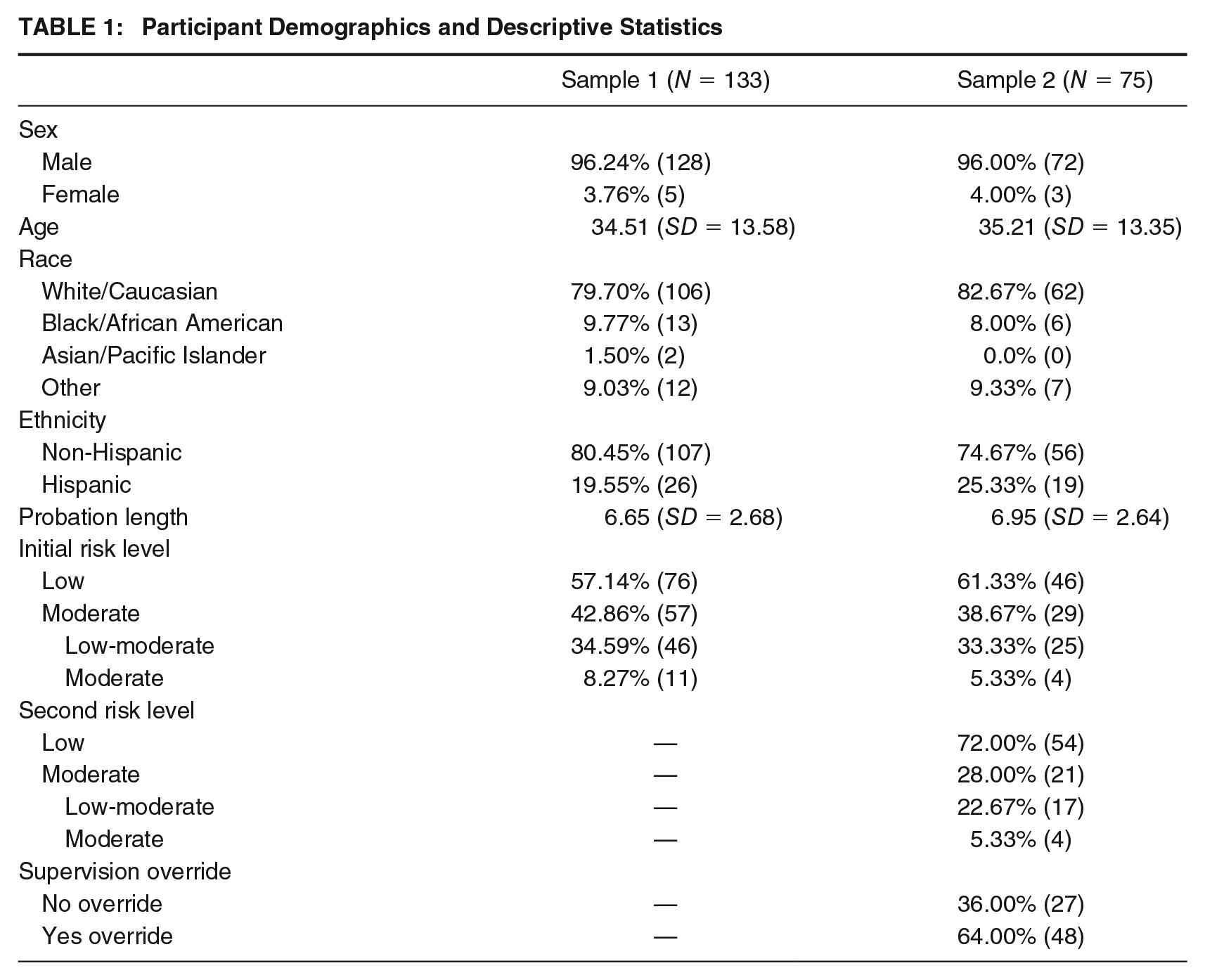
To address the second and third hypotheses, a subsample (Sample 2) was generated to include individuals on community supervision who had a second general risk assessment after 1 year of beginning on probation and receiving treatment (N = 75). Parallel to Sample 1, Sample 2 is predominately male, White, and non-Hispanic (see Table 1). During the initial general risk assessment, 61.3% of Sample 2 were classified as low risk, whereas the remaining 38.7% were moderate risk (33.4% low-moderate and 5.3% moderate). The distribution of the second risk assessment varied slightly in relation to the initial risk assessment, with low, low-moderate, and moderate risk being 72.0%, 22.7%, and 5.3%, respectively. Overall, the majority of participants had static risk levels from the initial to the second assessment. Individuals were then separated into two groups: those who experienced an override during the second assessment and those who did not. In other words, those who were supervised according to their actuarial general risk assessment, thus undergoing supervision that adheres to the RNR principles, were separated from those who continued to be oversupervised. This resulted in an override predictor group of 48 individuals or 64.0% of the sample. The remaining 36.0% (27 individuals) were not overridden and were moved to their appropriate supervision intensity levels.
Measures
General Risk Assessment
The Texas Risk Assessment System (TRAS) is a system derived from the Ohio Risk Assessment System (ORAS). The ORAS is an established risk assessment instrument used as a way to assist in identifying general risk level and criminogenic needs of individuals (Latessa et al., 2017). This assessment was developed in 2006 by the University of Cincinnati Corrections Institute (UCCI) in partnership with the Ohio Consortium of Crime Science (OCCS) and the Ohio Department of Rehabilitation and Corrections (ODRC; Latessa et al., 2009, 2016, 2017). The TRAS is the Texas version of the Community Supervision Tool (CST) of the ORAS. Based on intensive exploration of potential risk factors among individuals, seven domains, namely, criminal history; education, employment, and financial situation; family and social support; neighborhood problems; substance abuse; peer associations; and antisocial attitudes and behavioral problems, are included in the CST and TRAS (Latessa et al., 2016, 2017).
The CST research has provided validation evidence in the prediction of general recidivism, as well as demonstrating predictive validity compared with alternative assessments (Latessa et al., 2009, 2017). In addition, the CST has been implemented in several states outside Ohio, including Texas (Latessa, Lovins et al., 2013; Latessa et al., 2017; Lovins et al., 2018). The CST and the TRAS, however, have not been validated among the specialized population of individuals who have been convicted of a sexual offense. In addition, neither assessment has been evaluated on the predictability of supervision and treatment compliance among individuals. Although the TRAS was not developed to assess risk for sexual recidivism, or to use specifically with individuals who have sexually offended, the community supervision agency in the current study developed a general policy to use the TRAS to assess for general recidivism risk of all individuals on supervision, regardless of index offense type. The decision to use the TRAS with individuals who sexually offend was informed by the literature reporting that this population is more likely to recidivate with a general offense than a sexual offense. The agency receives a completed Static-99R on a few of the clients from court officers that have scored the tool for the state registry. Among the current sample, 78 of 133 subjects had their Static-99R score on file, with all but one indicating “very low risk” or “below average risk.” Similar to Wormith et al. (2012), the officers do not use the Static-99R scores in their risk assessment for supervision intensity (R. Ramirez, personal communication, February 1, 2021), as it is the agency’s policy to use the TRAS for all supervisees.
In the current study, Hypothesis 1 uses the TRAS to assess individual compliance in relation to an assigned actuarial risk level. Within the current study, participants were assessed by supervision officers, using the TRAS, upon intake and every subsequent 12 months. Information is obtained by the supervising officer using official records, individual interviews, and collateral sources to obtain an accurate scoring of the TRAS (Texas Risk Assessment System Participant Manual; University of Cincinnati and Texas Department of Criminal Justice, 2014). A low risk is classified as a score of 0 to 7, low-moderate is 8 to 15, moderate is 16 to 23, and high is a score of 24 or higher. For the current sample, the internal consistency of the TRAS was adequate (Cronbach’s α = .65) for the seven scales.
Supervision Level and Overrides
In the supervision agency used in the current study, an individual’s risk score from the TRAS determines the level of supervision an individual will receive. A high-risk individual will have more supervision requirements compared with moderate- or low-risk individuals assigned to low-intensity supervision. For example, if an individual is identified as low risk, they may only have to report to their supervising officer every other month. A high-risk individual, however, would have to report to their supervising officer biweekly. Moreover, as discussed above, an officer has the discretion to override an individual’s risk to a high- (or low-) supervision level. In other words, if an individual’s score is low risk on the TRAS but is deemed by the supervising officer to need more supervision, they may override this individual to a high-intensity supervision level. All individuals included in this sample are overridden to a high-intensity level of supervision during their first year of probation. 1 Therefore, Hypotheses 2 and 3 examine the TRAS administered 12 months after the general intake assessment and compare individuals who remained overridden with individuals who were placed in a supervision level according to their TRAS score.
Supervision Compliance
Despite the intended use of the TRAS as a measurement of general recidivism, probation compliance was our preferred outcome measure for two reasons. First, as previously discussed, general and sexual recidivism rates among individuals who sexually offend are low; therefore, examining probation compliance may be an additional measure of success/failure using a general risk assessment. Second, the sample comes from a probation office in which general risk determines supervision intensity, emphasizing the importance of accurately assessing the probability of compliance among risk-level groups. Thus, results may be helpful to officers in their supervision of similar individuals.
Supervision compliance was operationalized using four variables: number of failed polygraphs, number of positive urinalyses (UAs), total amount of delinquent fees, and termination due to incarceration. Number of failed polygraphs, for both samples, ranged from zero to four with an average of 0.78 (s = 1.06) failed polygraphs. Some of the individuals within our sample did not have any polygraphs administered at the time of data collection, most due to transferring from another county where polygraph administration was not a part of their probated sentence requirements; 32 participants (24%) in Sample 1 and eight (11%) in Sample 2 had no polygraph results. The number of positive UAs among both samples ranged from zero to seven with a mean of 0.64 (s = 1.23) positive UAs. Delinquent fees were conceptualized as any fee or fine amount that is past due. The total delinquent amount is a summation of all fines or fees (rounded to the nearest dollar amount) currently considered “delinquent.” Among the participants, the minimal amount was US$0, whereas the maximum was US$3,270. Overall, this measure was highly skewed (4.339) and was therefore coded dichotomously as no delinquent fees (0) or delinquent fees (1). Termination due to incarceration is scored a 1 if an individual’s probation was revoked because he or she was incarcerated for either probation violations or a new offense. Specifically, of the 21 terminations, 10 individuals were terminated because of their supervision violations, two individuals had absconded, and nine people were terminated from supervision because they committed a new offense. 2 This variable is dichotomized as no (0) or yes (1). Last, a measure for overall supervision compliance was created by combining dichotomous representations for all four variables. 3 This resulted in an overall noncompliance score that ranged from zero to four. The lower the score, the more compliant an individual is.
Treatment Compliance
In addition to supervision compliance, treatment compliance was also measured. Individuals on community supervision for a sexual offense within this study’s agency require successful completion of specialized treatment. Each individual mandated for treatment is referred to a treatment provider within their county. In the state of Texas, each treatment provider must be licensed as a general mental health professional and hold an additional license to assess and treat individuals with a sexual offense. Each individual on supervision is mandated to complete a multiphased treatment program consisting of several components commonly found in specialized programs for individuals who have sexually offended. Examples of common component areas include changing cognitive distortions around sexual offending behaviors, sexual behavior regulation, changing sexually deviant interests, developing empathy for others, and responsibility taking. In the current study, compliance with the Sex Offender Treatment Program (SOTP) was measured using three variables: treatment attendance, presenting homework assigned, and an overall progress score, over 6 months. Not all individuals assigned to probation supervision for a sexual offense were mandated to participate in the SOTP due to their particular offense type or prior treatment completion. Therefore, not all individuals included in the supervision analysis were retained for the treatment measurements. Specifically, 55 individuals from Sample 1 and 16 individuals in Sample 2 were not in an SOTP; a total of 78 individuals were retained from Sample 1, whereas 59 individuals were retained for Sample 2.
Treatment attendance is measured by the percentage of hours attended out of possible number of hours to attend within a 6-month period. The range for participant attendance in both samples was 50% to 100%, with an average of approximately 95% for both (SD = 8.5%). Due to being skewed (/2.87), treatment attendance was dichotomized into less than 100% (0) and 100% (1) for the analysis. Presenting homework was measured by the number of times homework was presented out of the number of opportunities to present homework within a 6-month period. For all samples, the minimum percentage was 0 with a maximum of 100%. The average percentage of presenting homework was 43.83% (SD = 28.99%) for Sample 1, and for Sample 2, the mean was 42.99% (SD = 29.21%). Overall progress was calculated by taking an average of treatment progression scores over a 6-month span. Each treatment progress score was obtained from therapist ratings on monthly progress reports to the community supervision officers. The higher the progress score, the more improvement is being made within the SOTP. Progress scores can range from 1 to 5, where higher scores indicate more treatment progression and lower scores represent less treatment progress. All sample participants had overall progress scores ranging from 1.33 to 4.17. For Sample 1, a mean overall progress score was 2.65 (SD = 0.55), whereas the mean score for Sample 2 was 2.59 (SD = 0.53). Similar to supervision compliance, an overall treatment compliance score was created by combining the three measures. 4 This score ranged from zero to three with a higher score representing more treatment compliance.
Results
General Actuarial Risk Level and Compliance
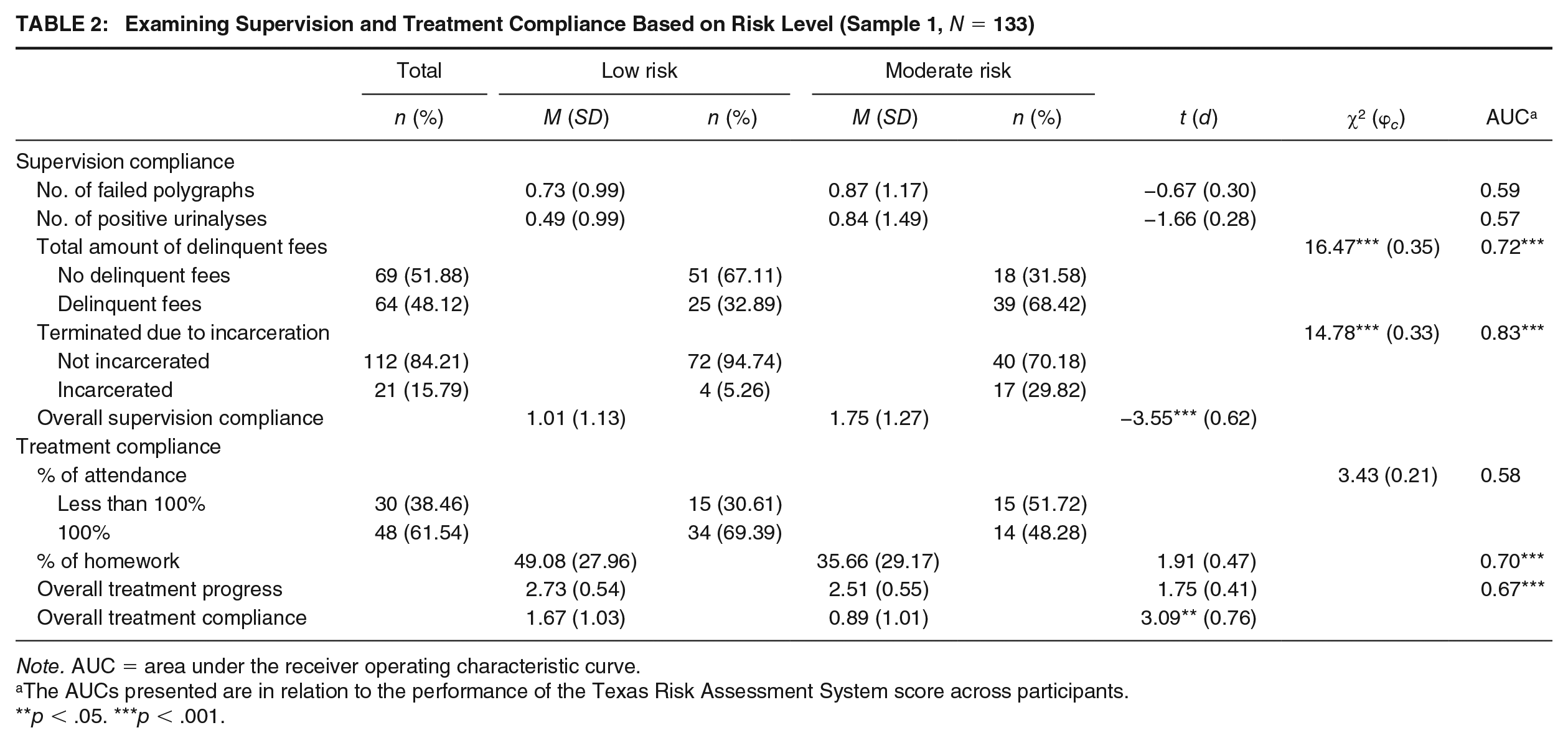
Hypothesis 1 predicts individuals assessed at a low-risk level during the intake general risk assessment will be more supervision and treatment compliant compared with individuals assigned to a moderate-risk level. Supervision compliance was operationalized using four outcome measures: failed polygraphs, positive drug tests, delinquent fees, and termination due to incarceration, along with a combined measure of overall supervision compliance. The majority of participants had zero failed polygraphs (56%), zero positive UA results (65%), no delinquent fees (52%), and no termination due to incarceration (84%; see Table 2). A series of chi-square tests of independence, independent-samples t tests, and effect sizes were calculated to compare supervision compliance among low-risk and moderate-risk individuals. Effect sizes are reported in accordance to Cohen’s (1988) interpretation with Cohen’s d effect sizes ranging from small (0.20), medium (0.50), and large (0.80) effects and Cramer’s V effect sizes ranging from small (.10), medium (.30), and large (.50) effects. As can be seen in Table 2, two of the four measures of supervision compliance were statistically significant, with three of the four variables showing small to medium effect sizes. Statistically, there were no differences across the risk-level groups for failed polygraphs and positive UAs, but number of positive UAs did produce a small effect. Moderate-risk individuals were significantly more likely to be delinquent on fee payments and to be terminated from supervision due to probation violations or a new offense. The relationship between delinquent fees and level of risk produced a medium effect size, with 68% of the moderate-risk individuals having delinquent fees compared with 32% of the low-risk group. In addition, the low-risk group had four individuals (5%) who were terminated from community supervision compared with 17 (30%) of the moderate-risk individuals (see Table 2). The relationship between termination due to incarceration and risk level also resulted in a medium effect size. Finally, overall supervision compliance was statistically significant with the low-risk group being more supervision compliant overall compared with the moderate-risk group. The relationship between overall supervision compliance and level of risk produced a medium effect size.
Examining Supervision and Treatment Compliance Based on Risk Level (Sample 1, N = 133)
Note. AUC = area under the receiver operating characteristic curve.
The AUCs presented are in relation to the performance of the Texas Risk Assessment System score across participants.
p < .05. ***p < .001.
Analogous to the prediction of supervision compliance across risk level, it was hypothesized high-risk individuals would be less treatment compliant compared with low-risk individuals. Treatment compliance was measured using treatment attendance, homework presented, and overall treatment progress. Similar to supervision compliance, a scale, combining the three measurements, was used to measure overall treatment compliance. A chi-square test of independence and independent-sample t tests were conducted. Although all three variables, individually, did not reach statistical significance, percentage of treatment attendance, percentage of homework presented, and overall treatment progress scores were found to have small to medium effect sizes. These results indicate that there does seem to be some differences in the treatment compliance variables across risk level. In addition, the overall treatment compliance score was statistically significant across groups and produced a medium effect size; the low-risk group had an average score of 1.67 (s = 1.03), whereas the moderate-risk group had a mean of 0.89 (1.01). In sum, the low-risk group was overall significantly more treatment compliant than the moderate group.
Area under the receiver operating characteristic curves (AUCs) were also calculated to estimate the predictive validity of the TRAS across the compliance variables. For these analyses, all outcome variables were used in dichotomized forms. For reference, an AUC of 0.56 is considered small, 0.64 is medium, and large AUC is 0.71 (Rice & Harris, 2005). Overall, the scores produced AUCs ranging from 0.57 to 0.83 among the compliance variables (see Table 2), with the TRAS accounting for the most variance in prediction of supervision termination due to incarceration for a new offense or probation violations.
Supervision Overrides and Compliance
In accordance with past literature suggesting the risk level of individuals who sexually offend are commonly overridden due to their perceived elevated risk, we projected the majority would be overridden to a high-supervision level. As predicted, most individuals in the sample were overridden to be supervised at a higher intensity than what their actuarial testing indicated (64%; see Table 1). After 1 year of high-intensity supervision (which is standard for the specialized caseload of individuals with a sexual offense during their first supervision year), the majority of the sample scored in the low range on the general actuarial measure (TRAS), but the officers commonly overrode the score continuing higher levels of supervision.
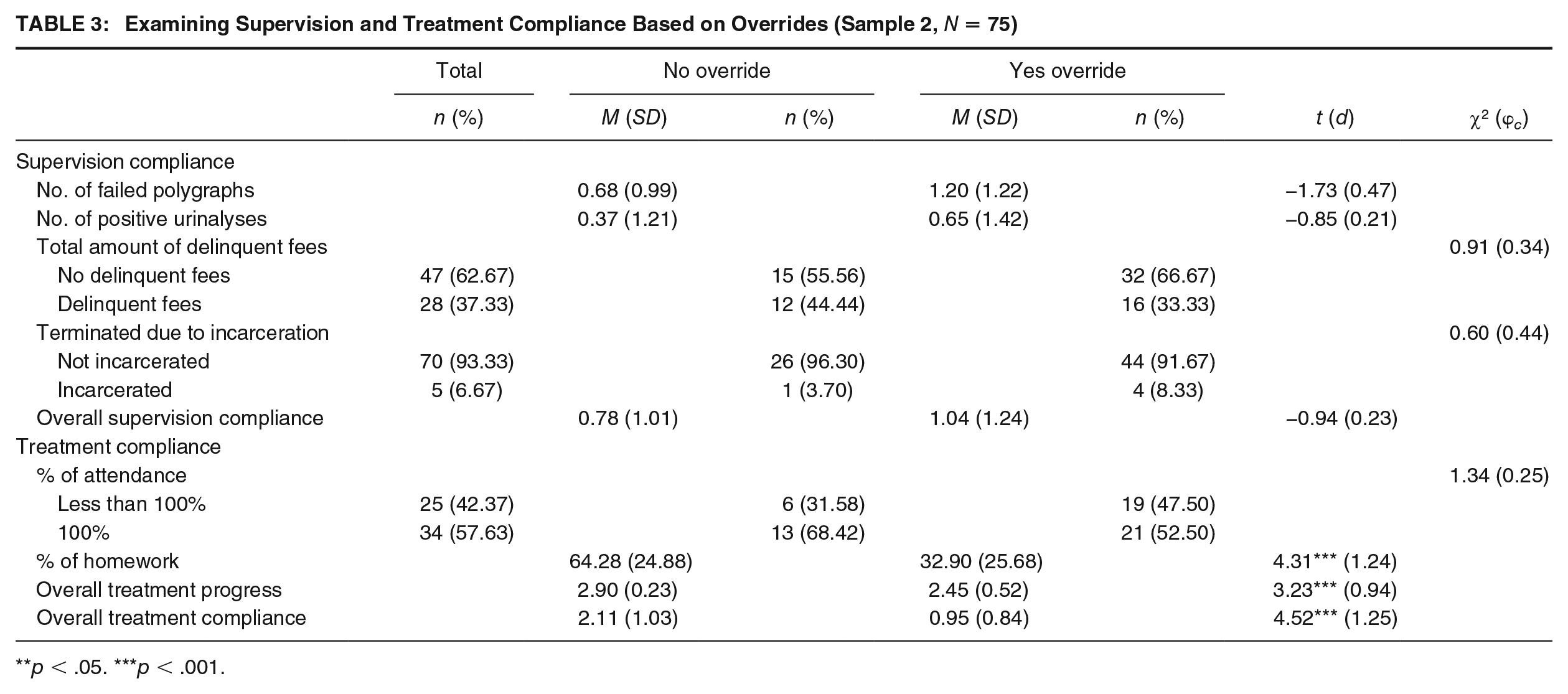
As the RNR principles would suggest, we predicted that individuals serving a probated sentence for a sexual offense and supervised at a higher level than actuarial testing indicates will be less compliant than individuals supervised at the appropriate level. For Hypothesis 3, variable measurement remained consistent with the analysis for Hypothesis 1. Sample 2 was used to compare individuals whose general actuarial risk level was overridden to supervise them at a higher intensity with those individuals who did not experience an override. In general, a large proportion had zero failed polygraph (41%) and the majority had zero positive UAs (75%), no delinquent fees (63%), and no termination due to incarceration (93%; see Table 3). All four variables measuring supervision compliance and the overall supervision compliance measure were not statistically significant across groups. However, small to medium effect sizes were found for all the supervision compliance variables. Small effects were found for positive UAs and overall supervision compliance, whereas medium effect sizes were found for number of failed polygraphs and delinquent fees across the override and nonoverride groups. In addition, a large effect was found among termination due to incarceration across the groups, with the override group seeing four individuals incarcerated compared with one individual in the no-override group (see Table 3).
Examining Supervision and Treatment Compliance Based on Overrides (Sample 2, N = 75)
p < .05. ***p < .001.
It was also predicted that individuals who were oversupervised would be less compliant in treatment than individuals who were supervised at appropriate levels. Table 2 reports the results comparing the override with the nonoverride groups on the variables of treatment attendance, homework presented, overall treatment progress, and overall treatment compliance. Percentage of treatment attendance was not statistically significant across override groups but produced a medium effect size. Percentage of homework presented was statistically significant and produced a large effect size, with the no-override group having higher proportions of presenting homework during treatment compared with the override group. The overall treatment progress score was statistically significant across override groups and produced a large effect size, with the no-override average of 2.90 (s = 0.23) and the override average of 2.45 (s = 0.52). Finally, the overall treatment compliance scale was statistically significant across the override groups and produced a large effect size. The no-override group was more treatment compliant than the override group.
Discussion
The risk principle of the RNR framework states that individuals should receive treatment and supervision equivalent to the risk level assigned by an actuarial assessment. Adherence to the RNR principles allows for the most effective individual and resource outcomes. Nonadherence to the model can result in ineffective or adverse outcomes, including increasing recidivism rates. Prior research has predominately evaluated the RNR framework’s applicability to general justice-involved individuals, while little research has investigated the application of this framework with individuals on community supervision for a sexual offense. This lack of attention is of primary concern due to the perceived high-risk homogeneity among individuals who have sexually offended. Consequently, jurisdictions commonly supervise this group under specialized, high-intensity caseloads though significant research has reported low general and sexual recidivism rates (Alper & Durose, 2019; Hanson & Bussiere, 1998; Hanson et al., 2014; Hanson & Morton-Bourgon, 2005; Viglione, 2019; Zgoba et al., 2018). Thus, using a general risk assessment, the current study examined compliance across risk levels among individuals who have sexually offended, the rate of overrides, and the possible impact of treatment and supervision compliance if individuals are oversupervised.
General Risk and Compliance
First, we hypothesized risk and compliance results would match prior research with general justice-involved individuals; individuals serving a probated sentence for a sexual offense, who were assessed at a low-risk level during the intake actuarial general risk assessment, would be more supervision and treatment compliant as compared with individuals assigned to a moderate-risk level. Actuarial general risk assessments are most commonly used to determine an individual’s risk for general recidivism but are also used to assign a supervision level. Thus, individuals deemed riskier and as having more criminogenic needs (i.e., moderate risk) should be less supervision and treatment compliant compared with low-risk individuals. Our findings generally supported this hypothesis, with the low-risk individuals significantly more compliant with supervision and treatment overall, and less likely to be incarcerated for supervision violations or a new offense. In addition, the relationship between several of the supervision and treatment compliance outcomes and risk level produced medium effect sizes, adding additional support to the first hypothesis. The only outcome variables that demonstrated little change across risk level were failed polygraphs, positive UAs, and treatment attendance.
Although polygraph examinations are not routinely used with other justice-involved groups, or allowed in most decision-making arenas (e.g., courtroom), they are often used as another supervision tool with individuals on community supervision for a sexual offense. The majority of individuals serving a probated sentence for a sexual offense are required to complete monitoring or maintenance polygraph examinations annually or biannually, to help the officers determine whether they are following their probation stipulations (Grubin et al., 2019; Rosky, 2013). The current results showed low- and moderate-risk individuals who sexually offend appear to have similar rates of failed polygraphs while on supervision and suggest that failing and/or passing polygraph tests may not be a good indicator of compliance. The real measurement of utility, however, is whether administering polygraph testing decreases the likelihood of reoffending among individuals. That is, administering polygraphs should theoretically deter individuals who have sexually offended from committing future crimes because they believe they would be caught if tested. Despite minimal and conflicting research, the polygraph’s utility as a deterrent has weak validity (see McGrath et al., 2007; Rosky, 2013) and is costly for each individual on supervision for a sexual offense (Patrick et al., 2000).
The second supervision outcome variable that did not show differences across risk level was positive drug tests. Community supervision agencies utilize drug tests as a way to monitor rule compliance as individuals on supervision are not allowed to use any substances, including alcohol. In the current sample, comparing failed drug tests across risk level or override status produced no statistically significant differences and small effect sizes. These results indicate failing a drug test may not be a good indicator of risk level overall and may not be an effective way to manage individuals on supervision for a sexual offense. When examining the substance use domain of the TRAS, almost all participants (92.5%) were assessed to be low risk for substance abuse problems. Thus, the insignificant UAs result is notable and, if further research supports these findings, could spur questions as to whether UAs are a proper measurement of supervision compliance for individuals who are on probation for a sexual offense.
The last variable that demonstrated a small effect across risk level was treatment attendance. This result was not surprising, however, as the majority of individuals on supervision for a sexual offense are mandated to attend treatment and did so. Our results indicated 62% of the sample attended treatment 100% of the time. Treatment attendance alone may not be a good indicator of compliance for individuals mandated to attend. Many of the other treatment compliance variables were only significant at the .10 level, such as percentage of homework completed across possible sessions and treatment progress, these variables still showed moderate effects across risk levels. In addition, the combination of all the treatment compliance variables produced significant differences across risk level and a large effect size.
The overall results comparing supervision and treatment compliance with individuals serving a probated sentence for a sexual offense suggest an individual’s assessed general risk score predicts compliance in addition to possible recidivism. These results are consistent with the prior research comparing risk levels and outcomes among general justice-involved individuals (Bonta et al., 2010; Latessa, Smith et al., 2013; Robinson et al., 2011). If future research, with larger samples, corroborates these findings, community supervision agencies may want to closely follow general actuarial risk scores to determine level and type of care with individuals who have sexually offended in an effort to increase compliance and successful completion of probated sentences.
Overrides and Compliance
After examining whether risk level makes a difference in compliance for individuals supervised for a probated sentence for a sexual offense, we hypothesized the majority of individuals in the sample would be overridden to a higher supervision level than their actuarial general risk assessment indicated. This re-assignment of supervision intensity occurred at the second-year mark of their sentence, when policy dictates that supervision level is to be moved to the actuarially assessed level. The descriptive statistics in Table 1 supported the second hypothesis: 64% of individuals continued to receive an override to a higher supervision level than their general actuarial testing indicated during their second probation year. These results align with prior research (Viglione, 2019; Wormith et al., 2012) that found only a small proportion of probation officers were willing to supervise individuals who have sexually offended according to their actuarial risk. Instead, most were overridden to high risk and were therefore supervised at a high intensity. Prior research on supervision and treatment of general justice-involved individuals has consistently indicated that nonadherence to the RNR model can create adverse outcomes, such as higher levels of noncompliance and recidivism (Lowenkamp & Latessa, 2002, 2004; Lowenkamp et al., 2006). In addition, when examining predictive validity, override scores are shown to be less accurate than actuarial scores (Wormith et al., 2012). Therefore, our results showing that all participants were overridden to high intensity during the first year of supervision and a large proportion continued to be overridden the following year is cause for concern. Agency policies that allow officers to override actuarial risk scores warrant ongoing assessment to determine whether decisions for supervision level are appropriate and not creating undue negative outcomes for low-risk individuals on supervision for a sexual offense.
Supervision training programs such as EPICS, STICS, and STARR for general justice-involved individuals focus predominately on high-risk individuals. These programs do this in adherence to the RNR model and because it has been shown to be effective. Based on prior research, it was expected that a probationer’s compliance and risk for recidivism among our sample is not improved or is potentially worsened by an override (Lowenkamp & Latessa, 2002, 2004; Lowenkamp et al., 2006). Our third hypothesis thus assessed the potential effects of nonadherence to the risk principle through supervision overrides. Specifically, we hypothesized low-risk individuals who sustained an override to maintain moderate- to high-intensity supervision during the second general risk assessment would be less supervision and treatment compliant as compared with individuals who did not receive an override during the second general risk assessment. Although none of the supervision compliance measures were statistically significant across override groups, the relationship between the override groups and measures of failed polygraphs, delinquent fees, and termination due to incarceration produced medium effect sizes. These results indicate there is potentially an important relationship between supervision compliance and being oversupervised, with individuals being oversupervised demonstrating more problems with compliance. Further research with larger group samples is warranted to validate these findings.
For treatment compliance, two of three outcome measures, as well as overall treatment compliance were significant across override groups, indicating oversupervision may be related to treatment compliance and progress. The percentage of homework presented, overall treatment progress, and the overall treatment compliance measures are significantly higher for the nonoverride group. In addition, these three measures produced large effect sizes in their relationship with supervision overrides. Given these findings, our third hypothesis was supported. Even marginal results suggesting higher supervision and treatment compliance among nonoverridden individuals compared with those who experienced an override could indicate adverse outcomes produced by nonadherence to the risk principle (Lowenkamp & Latessa, 2004). Furthermore, among the override group, four individuals were terminated from probation due to incarceration in comparison with only one individual in the nonoverride group. As a result, our findings provide support for potentially adverse outcomes as a result of overrides. Alternatively, the overridden group may in fact be warranted if the individuals are actually high risk for noncompliance, creating justification for more intensive supervision. Prior support, however, indicates the predictive validity of recidivism among overrides is less accurate than among actuarial scores; thus, the same may be true for probation compliance (Wormith et al., 2012).
Policy Implications
Implementation of programs that may prevent the potential disadvantageous outcomes caused by oversupervision of individuals on probation for a sexual offense includes programs such as STICS, EPICS, and STARR. Each of these training programs has displayed an effective application of the RNR model, focusing on higher risk individuals, criminogenic needs, and supervision officer training. General justice-involved individuals appear to be more compliant and recidivate less when these RNR model programs are implemented; the same may be true of individuals who sexually offend. As such, community supervision departments and researchers should examine possible training programs, agency policy, and their effects on individuals who have committed a sexual offense. While agencies are attempting to gain more compliance and reduce the likelihood of recidivism with oversupervision policies, they may actually be producing an opposite effect. In addition, the predictive validity of recidivism, and potentially compliance, diminishes when a professional judgment override is used (Wormith et al., 2012).
Limitations
The current study is not without limitations. The greatest limitation is the small sample size, especially in the examination comparing override groups. However, effect size results show the relationship between risk level and outcome variables, as well as between override status and compliance is important and worthy of additional study. In addition, there was a large proportion of true zeros among the sample, further limiting the statistical capabilities. Future studies should attempt to replicate these results with a larger sample and more advanced statistical models. Another limitation concerns the fact that this analysis only examined the RNR risk principle in relation to supervision and the overall effects on supervision and treatment compliance. Treatment adherence to the RNR principles, such as duration and intensity, was not explored. Therefore, further analysis should be done to examine the effects of treatment adherence to the RNR principles on supervision and treatment compliance. Last, the current study examined only general recidivism, not sexual recidivism among individuals who have sexually offended. In agreement with prior discussion, however, general risk assessments combined with sexual offender risk assessment instruments, such as the Static-99R or the STABLE-2007, have the potential to provide a more comprehensive and accurate assessment of risk among individuals who commit sexual offenses (Wormith et al., 2012).
Conclusion
Adherence to the RNR framework is an essential component to the supervision and treatment success of general justice-involved individuals. Although additional research is warranted, the current findings suggest individuals who have sexually offended respond similarly, and also stand to benefit from the RNR framework. Inaccurately applying the RNR framework has shown to produce adverse effects, including increasing recidivism rates. Currently, individuals who sexually offend are commonly viewed as a homogeneous group of high-risk individuals and are supervised at high-intensity levels. In reality, individuals who sexually offend vary in risk level, with the majority of the group scoring in the low-risk range for recidivism. Thus, to maximize the benefit of corrections and minimize negative outcomes, the supervision level and treatment intensity employed among individuals who have sexually offended should correspond to the appropriate risk level.
Footnotes
Acknowledgements
The authors would like to thank Abigail Eck for her contribution to the data collection process.
