






Abstract
Several brief screening measures for youth risk to reoffend have been developed; however, these measures have been tested primarily in high-income English-speaking countries and their predictive validity is limited. A recent study proposed a screening strategy using a combination of seven items from the Youth Level of Service/Case Management Inventory (YLS/CMI). Predictive validity for this strategy was better than that reported in studies of previously developed screening tools. In the current study, the predictive validity of this strategy was examined across samples of justice-involved youth from two countries: Canada (N = 196) and Portugal (N = 2,348). The full version of the YLS/CMI was completed and recidivism data were collected over a 2-year period. Results support the predictive validity of this strategy, with area under the curve (AUC) values (.69–.74) very similar to those found in the full version in each country, both in the full samples, and for both genders.
Introduction
The Youth Level of Service/Case Management Inventory (YLS/CMI; Hoge & Andrews, 2002) is one of the most widely implemented and investigated fourth-generation risk assessment tools (Viljoen et al., 2020). This assessment tool is based on the principles of the General Personality and Cognitive Social Psychological Theory (Andrews et al., 2011). According to this theoretical approach, criminal actions result from a complex and dynamic interaction between individual predispositions and the way youth environmental influences (e.g., family, peers, and community) respond to (reward or punish) criminal actions. Thus, it is argued that the assessment of multiple environmental and attitudinal/temperamental factors at a given time is the best way to predict and to intervene to prevent recidivism through the identification of criminogenic need factors or targets of treatment (Bonta & Andrews, 2017). These factors may be regarded as risk factors, or criminogenic needs (strong and direct predictors of later offending), or as strengths or protective factors (variables that reduce the likelihood of offending among individuals exposed to risk factors; Farrington et al., 2016).
The YLS/CMI comprises eight empirically derived domains assessing a variety of risk and strength/protective factors. The “Big Four” most important domains are Antisocial Attitudes, Antisocial Friendships, an Antisocial Personality Pattern, and History of Previous Offenses. These factors are followed by four additional criminogenic need domains, including Family Circumstances, Education and Employment, Substance Abuse, and Leisure and Recreation (Campbell et al., 2018). Research investigating the accuracy of the YLS/CMI in predicting risk for reoffense has consistently demonstrated a significant and positive relationship between scores on the YLS/CMI and likelihood of reoffending (e.g., Scott et al., 2019; Villanueva et al., 2019a). It is considered one of the best options for assessing the risk of recidivism among justice-involved youth (Olver et al., 2014).
Despite its usefulness in predicting reoffense among youth, limitations or challenges have been highlighted, including its length and the slightly lower predictive accuracy of the tool for risk to reoffend for female youth and cultural/ethnic minorities (Pusch & Holtfreter, 2018; Schmidt et al., 2011; Shepherd et al., 2015). In addition, at some stages of the judicial process, such as times of urgent decision-making (e.g., bail) or during extraordinary periods (weekends and vacations), when there is a need to evaluate a large number of young people or when resources are limited, professionals may need to quickly assess risk of recidivism to make judicious, informed decisions in a timely manner.
The Predictive Ability of YLS/CMI Screening Versions
The primacy of the YLS/CMI in the field as a valid risk assessment tool makes it a sensible choice for the development of shortened versions. The original authors of the YLS/CMI, Hoge and Andrews (2009), created a screening version known as the YLS-SV. This version contains eight items, one item representing each of the eight YLS domains. Moderate area under the curve (AUC) values for general recidivism for the total sample and male justice-involved youth, and slightly lower values for female youth (.64, .65, and .59, respectively), were reported for this screening version (Chu et al., 2014). Another shortened version of the YLS/CMI was developed by Campbell et al. (2014), which included 10 items representing four of the eight subscales: Education/Employment, Peers, Leisure, and Personality. Although this screener significantly predicted 2-year recidivism with a predictive validity very close to the values found in the YLS/CMI full version, the levels of predictive ability were lower than hoped for in both versions (AUC = .64 and .63, respectively).
In addition to limited research on the overall predictive accuracy of these short versions of the YLS/CMI, there is almost no work on the use of these tools with female youth or with ethnic or cultural minorities. Moreover, despite their importance in the prediction of reoffense and interventions related to criminogenic needs, they do not screen for protective factors that may impact the risk of recidivism (Rogers, 2000). In addition, these shortened versions of the YLS/CMI were developed in English-speaking Western industrialized countries.
Recently, Villanueva et al. (2020) reported a combination of seven items from the YLS/CMI full version that, together, may work as a better screening strategy than the previously proposed shortened versions. The screening strategy was developed in a Spanish sample of approximately 400 justice-involved youths. All 42 risk factors and the seven protective factors were assessed in the YLS/CMI full version and were individually evaluated in terms of their ability to predict recidivism using a 2-year follow-up period. Individual risk and protective factors were analyzed using unadjusted odds ratio (OR). Risk and protective factors with large effect sizes were selected for inclusion together in a logistic regression (Ferguson, 2009).
The final model resulted in seven items selected from the YLS/CMI full version, with a large independent ability to predict recidivism among justice-involved youth. The 7-item score was calculated by subtracting the score for the strength item from the total of the risk items. Villanueva et al. (2020) found that the total 7-item score was significantly related to reoffense, yielding AUC values of .83 for the overall sample of youth and .79 for youth from ethnic minorities. These seven items, which cover content from five of the eight YLS/CMI domains, were empirically determined as the items with the strongest unique relationship to recidivism among the 42 risk items and seven strength items that compose the YLS/CMI. The final seven items included items related to the presence of psychopathic traits (e.g., callous, inadequate guilt feelings, lack of self-control), as well as a set of items related to risk/ the lack of protective role models and institutions across family, school, and peer contexts. All seven items are included in any YLS/CMI version (see Tables 1 and 2 in the Results section for the specific items). As a set, these items are characterized by several strengths, including their dynamic nature, the inclusion of a protective item, and a minimal cross-cultural influence (Villanueva et al., 2020). In addition, they are clearly consistent with the same underlying theoretical principles that make up the YLS/CMI, such that criminal actions are the result of the dynamic interaction between factors that predispose individuals to antisocial actions and environmental factors that promote or deter those same antisocial tendencies.
Prevalence of Risk/Protective Factors and Unadjusted Odds Ratios for Youth Recidivism
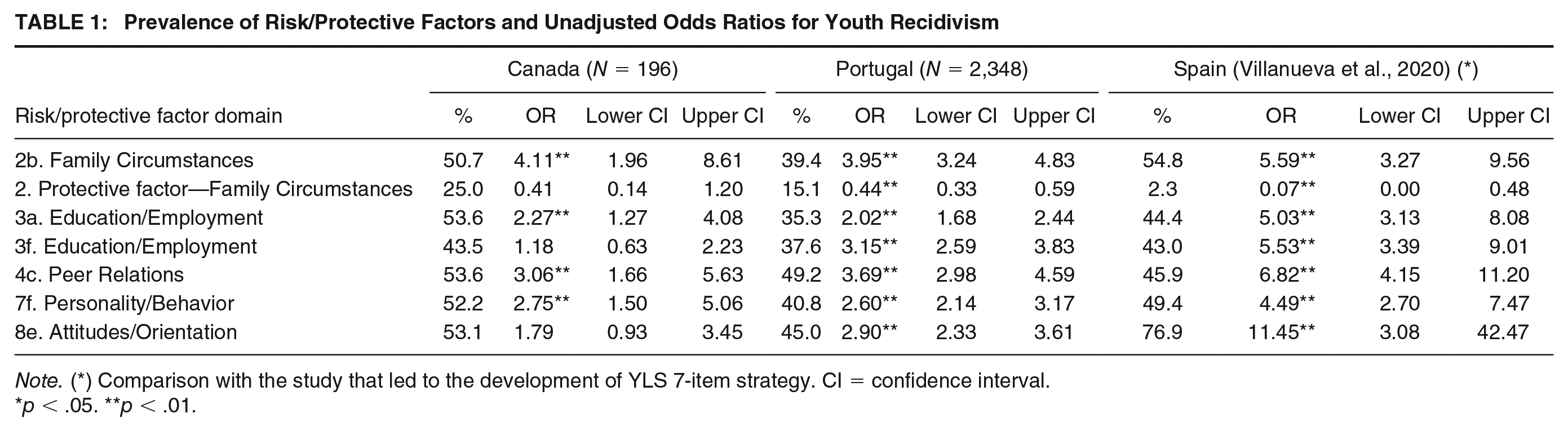
Note. (*) Comparison with the study that led to the development of YLS 7-item strategy. CI = confidence interval.
p < .05. **p < .01.
Logistic Regressions—Recidivism Predicted by the Items in the 7-Item Combination of the YLS/CMI in the Canadian, Portuguese, and Spanish Samples

Note. (*) Comparison with the study that led to the development of YLS/CMI 7-item combination. YLS/CMI = Youth Level of Service/Case Management Inventory; CI = confidence interval; AUC = area under the curve.
p < .05. **p < .01
While the results of this one study appear promising in the search for a useful screening strategy, additional research is needed to replicate these results, both in the Spanish legal and cultural context, as well in the context of other countries. Shepherd and Lewis-Fernandez (2016) suggest that culture can shape the risk assessment process. In fact, it is still a controversial question whether the use of risk assessment tools may exacerbate cultural and ethnic disparities (Viljoen et al., 2019). Accordingly, the validation of recidivism assessment tools across countries is needed to advance our knowledge about the universality of some risk factors.
Cultural Context of Risk in Canada, Portugal, and Spain
This study aims to test the predictive validity of this 7-item screening strategy across samples from two countries—Canada and Portugal—and to compare the results with those of the Villanueva et al. (2020) study. While there may be similarities among these three countries, there are also strong differences regarding cultural nuances and youth legal systems. For example, in regard to cultural differences, these three countries show different levels in the collectivism versus individualism dimension (Hofstede et al., 2010; Minkov, 2018). On a continuum, Portugal is the most collectivistic of the three countries, followed by Spain, and then Canada (Hofstede, 1980; Minkov & Hofstede, 2011). In collectivistic societies, the essential task is to belong—to fit in; there is a greater connection with social context, and relationships with others define the self and social responsibility. Therefore, in these cultures, the value of family, peers, and other life contexts may become especially influential, either buffering the impact of risk factors or exacerbating vulnerability among its members. In contrast, in individualistic societies, the focus is on autonomy and self-fulfillment.
There are also significant legal differences between these three countries, not only regarding the type of crimes committed by young people but also the severity of sentences given. For example, while Spain is marked by a toughening of juvenile justice laws, Portugal and Canada are still far from a “punitive turn” (Cartuyvels & Bailleau, 2010). More legal differences emerge regarding the minimum age for a youth to be intervened by a justice system (12 years old for Canada and Portugal, and 14 for Spain; Cuervo & Villanueva, 2015), as well as associated labeling effects (Basto-Pereira et al., 2018). Finally, language differences exist between the countries. Therefore, item bias may be present, for example, if items are not properly translated or if they have ambiguous connotations (Schmidt et al., 2020). In addition, Canada is the only English-speaking country in this study, which is also where the original YLS/CMI was developed.
These and other factors may shape the importance of each predictor across these countries (Muncie, 2001). However, there is some evidence that the specific combination of these seven items may be less affected by cultural issues than previous screening versions (see Villanueva et al., 2020). For example, alcohol abuse (one of the YLS/CMI domains not represented in the 7-item screening strategy) is not a risk factor for recidivism among Muslim populations in Spain, as shown in the work by Villanueva et al. (2019b). Another advantage of this screening strategy is that it evaluates only modifiable (dynamic) risk and protective factors, which are possible to change and less affected by jurisdictional and cultural factors.
Purpose of the Present Study
The objective of this study was to test the ability of the YLS/CMI 7-item screening strategy developed in Spain (Villanueva et al., 2020) to predict recidivism in male and female justice-involved youth in Portugal and Canada, using a 2-year follow-up period. We expect this work will contribute to creating a better strategy for screening that is less vulnerable to gender and cultural differences than other strategies and with a superior predictive ability.
Method
Participants
The study involves samples of justice-involved youth from two countries: Canada (N = 196) and Portugal (N = 2,348). The Canadian sample was composed of community-sentenced youth, 175 male (89.3%) and 21 female (10.7%) participants, whose YLS/CMI was completed by clinicians at a mental health clinic for sentencing purposes between 2008 and 2014. Youth were 12 to 19 years old when assessed (Mage = 16.5; SD = 1.4); 113 (67.3%) were Caucasian and 55 (32.7%) were other race/ethnicities, primarily Black and East Asian. Recidivism was assessed following a fixed 2-year follow-up period.
The Portuguese sample was composed of 1,980 male (84.3%) and 368 female justice-involved youths (15.6%) residing in the community who ranged in age from 12 to 21 years when assessed (Mage = 15.52; SD = 1.27). In Portugal, data related to ethnicity are not available due to Portuguese law and regulations to protect sensitive data; however, 91.5% were of Portuguese nationality. Risk assessments were conducted by the technical team from all local offices of the juvenile offender directorate of the General Direction of Rehabilitation and Prison Services in Portugal from 2010 to 2011. Convictions were searched and recorded 2 years after youth’s assessment.
Measures
YLS/CMI
The YLS/CMI is a tool for evaluating a youth’s risk to reoffend (Hoge & Andrews, 2002). It consists of 42 risk items falling within eight domains: Prior and Current Offenses/Adjudications (five items), Family Circumstances/Parenting (six items), Education/Employment (seven items), Peer Relations (four items), Substance Abuse (five items), Leisure/Recreation (three items), Personality/Behavior (seven items), and Attitudes/Orientation (five items). The sum of the 42 items, with each item scored as either present (1) or absent (0), provides a total risk score for each youth. This total score provides a recidivism risk level: low (0–8), moderate (9–22), high (23–32), and very high (33–42). The instrument is completed by professionals such as probation officers, judicial agents, clinicians, or researchers, who are trained to assess risk using the YLS/CMI. In this task, they use data from different information sources, including interviews with youth and their families, previous court records, and information from other social or academic centers. The YLS/CMI also allows for the assessment of strengths (protective factors) to be recorded across the seven dynamic risk domains (excluding the eighth domain of Criminal History). Strength/protective factors are considered to be not merely the absence of risk in a domain, but the explicit presence of a positive circumstance.
The translation process to Portuguese language was based on Beaton et al.’s (2002) guidelines. The process began with a request to the test publisher: Multi Health Systems, Inc (MHS). The specific guidelines were independent translation by three experts, back-translation by two independent experts, sending the translation and back-translation versions to MHS, receiving authorization from the trial version, and adoption of final version of the translation/backtranslation, updated by MHS recommendations (YLS/CMI, Portuguese translation by Fonseca et al. (2010)). This final version of the translation was approved and authorized by MHS (Pimentel et al., 2017). Research using the YLS/CMI full version highlights satisfactory psychometric properties in Portugal (Pimentel et al., 2017; Pimentel & Quintas, 2015) and Canada (Hoge & Andrews, 2002).
Recidivism
Youth recidivism was measured as any new conviction from the date of each youth’s risk assessment. Data from youth who had committed more than one offense in the follow-up period were transformed into a dichotomous variable: recidivist/nonrecidivist. Given that the objective was to assess general recidivism, justice-involved youth were not included/excluded according to the type of crime; thus, both samples are composed of youth with different levels and types of convictions, from those occasionally committing minor crimes, such as shoplifting, to those persistently committing serious crimes, such as homicide or sexual assaults.
Procedure and Data Analysis
Assessments with the YLS/CMI were carried out in clinics or judicial facilities. After the 2-year follow-up period, information about new reoffenses was extracted from national criminal record databases. Authorization to use the YLS/CMI was obtained from MHS, the copyright owner, in Portugal and Canada. Other legal and ethical local authorizations were also granted in all jurisdictions. Given that the data were collected independently and during different time periods, all authors followed common rules and procedures for data analysis. The first two authors contacted eight researchers with YLS/CMI samples and a similar follow-up period of recidivism. The two teams who agreed to join the study (Portugal and Canada) were sent specific guidelines to carry out this study in each country.
Statistical analyses were carried out using SPSS, Version 26.0. First, for each of the seven YLS/CMI items, we computed the proportion of recidivists for whom the item was endorsed and conducted logistic regressions to assess univariate associations between each item and recidivism. Next, the seven items were entered simultaneously into a logistic regression, with recidivism as the outcome variable. In addition, receiver operating characteristic (ROC) analyses using the 7-item combination were conducted to examine the ability of the model to correctly classify individuals. Analyses were conducted separately for male and female participants in each country. Z tests were used to compare the predictive ability between the 7-item strategy and the full-length YLS/CMI in each country. In addition, the 7-item combination predictive ability was compared with previous YLS/CMI shortened forms using the data provided in published articles. Within-samples z test comparisons between ROC curves were carried out. Between-samples z test comparisons were conducted using the z = (AUC1 − AUC2)/√(SE12 + SE22) formula implemented in an excel sheet. A description of the formulas and methodology behind z tests statistics for AUC comparisons within and between samples are detailed in Hanley and McNeil (1982, 1983).
Results
A Univariate Analysis of Risk and Strength/Protective Factors Across Countries
Of the seven YLS/CMI items evaluated, four had statistically significant associations with recidivism in both countries (see Table 1); the Protective factor (2), Education/Employment domain (3f), and Attitudes/Orientation domain (8e) items were not statistically significant in Canada. However, all seven items had ORs in the predicted direction analyzed (OR < 1 for strength/protective factors and OR > 1 for risk factors).
Dynamic Predictors of Recidivism Among Justice-Involved Youth From Canada and Portugal
Table 2 presents the logistic regression results (using one-tailed tests because of directional predictions) for Canada and Portugal. Two items were significant individual predictors of recidivism for both countries: the Peers Item 4c and the Personality/Behavior Item 7f. The full model for Canada, χ2(7) = 28.96, p < .001, correctly classified 65.5% of the cases, and the Portuguese full model, χ2(7) = 308.91, p < .001, correctly classified 75% of the cases. As shown in Table 2, the AUC statistic was significant in both the Canadian and Portuguese samples, indicating that the model classified the sample significantly better than by chance. The probability that a randomly selected recidivist would obtain a higher score than a randomly selected nonrecidivist was 73% in the Portuguese sample, which is considered a large effect (Rice & Harris, 2005), and 69% in the Canadian sample, which is considered a moderate effect (Rice & Harris, 2005).
Predictive Ability of the 7-Item Strategy and the Full Version of the YLS/CMI: A Cross-National and Cross Gender Comparison
Table 3 shows the ability of the 7-item combination and the YLS/CMI full version to predict recidivism across gender and across countries. Recall that the 7-item score is calculated by counting each risk factor as one positive unit and the protective factor as a one negative unit, yielding a final score that can range from −1 to 6. The standard method, which includes only risk items, was used to score the YLS/CMI full 42-item version. As shown in Table 3, the AUCs for the 7-item screening strategy in the Canadian and Portuguese samples ranged from .69 to .74; all were statistically significant.
Area Under the ROC Curve (AUC) for the 7-Item Combination and the Total YLS/CMI Scores

Note. (*) Comparison with the study that led to the development of YLS/CMI 7-item combination. ROC = receiver operating characteristic; AUC = area under the curve; YLS/CMI = Youth Level of Service/Case Management Inventory; CI = confidence interval.
p < .05. **p < .01.
Table 4 presents the predictive ability comparisons between the AUCs for the YLS/CMI 7-item strategy and the full version in each country (within-samples comparisons), between the AUCs for different national samples, and between the AUCs for the YLS/CMI 7-item combination and other published shortened versions. In terms of within-country comparisons, in the Portuguese and Canadian samples, the 7-item strategy had poorer predictive ability than the full version of the YLS/CMI (except for the female subgroup comparison in the Canadian sample). This contrasts with the finding in the Spanish sample (on which the 7-item combination was originally developed); in that sample, the YLS/CMI 7-item combination had better predictive ability than the full version of the YLS/CMI (Villanueva et al., 2020).
Within-Samples Comparisons of AUCs for the 7-Item Strategy and the Full Version of the YLS/CMI, Between-Countries Comparisons of AUCs for the 7-Item Strategy, and Comparisons of the AUCs for 7-Item Strategy With Published Screening Versions of the YLS/CMI

Note. The 10-Item Brief Screener AUCs are those provided from the scale construction sample (see Campbell et al., 2014). AUC = area under the curve; YLS/CMI = Youth Level of Service/Case Management Inventory.
With respect to between-countries comparisons, the 7-item strategy in the (original) Spanish sample had better predictive ability than in the Portuguese and Canadian samples for the total samples and for males; there were no statistically significant between-countries differences in the female subgroup (see Table 4). The AUCs for the 7-item strategy in the Portuguese and Canadian samples did not differ significantly from one another.
The 7-item strategy was also compared with data provided for two previously published screening versions of the YLS/CMI: the 10-Item Brief Screener (Campbell et al., 2014), which included a sample of justice-involved youth from the United States and a 2-year recidivism follow-up, and the YLS/CMI-SV screener (Chu et al., 2014), which included a sample of justice-involved youth from Singapore and an approximately 5-year recidivism follow-up. As shown in Table 4, the AUCs for the 7-item strategy in the Portuguese and Spanish total samples and male subgroups were significantly higher than both of these previously published screeners. However, there was no significant difference in the AUCs between the 7-item strategy in the Canadian sample and these two other YLS/CMI screeners.
Discussion
The objective of this study was to test the predictive validity of a particular combination of risk and strength/protective factors of the YLS/CMI in different cultural backgrounds, comparing them with previous results obtained from a Spanish sample of justice-involved youth. This study suggests this specific combination of seven items, representing approximately 14% of the items assessed in the full version, was a good predictor of youth recidivism in samples from three different countries despite cultural, linguistic, geographic, and legal differences between these countries. The fact that measures of predictive validity (AUCs) were attenuated in the current Portuguese and Canadian samples (compared with the Spanish sample, on which the 7-item strategy was developed) is not surprising given that fit indices tend to fall in cross-validation studies (e.g., Mossman, 1993). However, these differences may also reflect cultural differences, such as the level of collectivism in each country (e.g., Hofstede et al., 2010; Minkov, 2018), as well as the specific legal context, including youth criminal justice policies that soften or exacerbate labeling effects following first contact with the justice system.
There was variability in the predictive accuracy of the 7-item screening strategy in relation to the full YLS/CMI across different subsamples; the full version predicted reoffense substantially better than the 7-item screening strategy in Canada and Portugal but not as well as the 7-item strategy in Spain. Overall, however, these results across countries and subsamples demonstrated the feasibility of the screening strategy, showing better predictive accuracy in the Portuguese and Spanish samples compared with other shortened versions studied to date (Campbell et al., 2014; Chu et al., 2014). Finally, this screening strategy seemed to be particularly promising among female justice-involved youth.
It is likely that one of the reasons for the promising levels of predictive ability across both countries and across male and female youth is related to the content of the seven items included in this screening strategy. First, items from three of the “Big Four” domains (Peers, Personality, and Attitudes) are represented among the seven included items, along with items from two of the remaining four domains (Family and Education). In contrast to previous screening versions (e.g., Campbell et al., 2014), strength/protective factors were also included in this combination. In addition, each one of the seven items is dynamic in nature and therefore can be directly targeted for change, allowing for this 7-item combination to capture changes in criminogenic needs across time (Clarke et al., 2017). Moreover, this particular combination of items excludes some items more likely to be affected by cultural issues. For instance, the Criminal History domain (which had no items included in the 7-item combination) has previously failed to predict recidivism in non-Anglophone countries (Cuervo & Villanueva, 2015; Takahashi et al., 2013). In addition, other domains that failed to predict—or more weakly predicted—recidivism outside samples of White male justice-involved youth in Anglophone countries were also excluded, including the domains of Leisure Time and Substance Abuse (Lockwood et al., 2018; Schmidt et al., 2018; Villanueva et al., 2019b).
As noted, the predictors included in this 7-item combination are consistent with the General Personality and Cognitive Social Psychological Theory, the same theory that guided the construction of the YLS/CMI. The risk and strength/protective factors in this 7-item combination are consistent with the perspective that youth recidivism results from the interaction between antisocial factors related to the individual (e.g., lack of self-control, lack of feelings of guilt) and multisystem factors that impact on youth (e.g., presence of peers as positive role models, family as positive role model), not only through rewards and costs of offending behavior, but also for teaching legal and ethical alternatives to achieve one’s goals (Andrews et al., 2011). We also highlight the multiple links between the key elements of the theory of psychopathy (DeLisi, 2009) and the items that comprise this particular 7-item combination; examples include risk factors related to lack of self-control or the lack of appropriate empathy and guilt feelings. In addition, this screening strategy shows important similarities with other recent theoretical approaches acknowledged as a key feature in most important theories of crime (Farrington & McGee, 2017; Sampson & Laub, 2005).
Limitations and Future Research Directions
The predictive ability of this 7-item combination across countries is a promising start to establishing a valid strategy that can be used across jurisdictions for screening youth who may be at high risk to continue their engagement in antisocial activities. However, we must be cautious about the possible use of this combination of items to make serious judicial decisions such as custody decisions. This combination is best regarded as a screening approach in urgent situations rather than a comprehensive measure of risk. Therefore, an extensive and comprehensive assessment in subsequent phases of the legal process may be a mandatory exercise of professional responsibility. Furthermore, the YLS/CMI is designed as a case management tool as well as a risk prediction tool. Where it is to be used as an aid in case management and planning, the whole instrument should be employed; only that will provide a firm basis for case management.
Some limitations in the current study are worth mentioning and addressing in future studies. First, the predictive validity of this 7-item combination still needs to be tested among non-Western countries (Takahashi et al., 2013). Second, there is a need to test the predictive validity of this screening strategy in racial and ethnic minorities across different countries. Third, this study only tested the predictive validity of this screening strategy; therefore, future studies should address different aspects of validity and reliability (e.g., interrater reliability). Moreover, additional studies should include extra information about the reoffending act/s, such as the frequency (continuous measure of recidivism) and time to reoffense (allowing automatic control for follow-up), but also the severity of reoffending (permitting the analysis of criminal trajectories). Finally, additional studies should test the predictive validity of risk and strength/protective factors using as outcome other indicators of criminal recidivism, such as self-reported offending, which may contribute to a more fulsome picture of criminal behavior (Piquero et al., 2007).
A reliable and valid brief measure recidivism risk that is applicable to youth in various national and cultural contexts has been recognized as an important need in the field of correctional psychology. The 7-item combination may be a promising screening strategy to contribute to future research on this topic as well as a useful tool for practitioners in this field.
Footnotes
Authors’ Note:
We are truly grateful for the reviewers’ valuable comments and suggestions.
