







Abstract
The purpose of this study was to determine whether a change in school grades could serve as a turning point for delinquency, and whether it did so by forming a reciprocal relationship with a change in moral agency. Separate samples of 3,558 (2,829 males, 729 females) and 3,559 (2,811 males, 748 females) low-to-moderate risk justice-involved youth from the same data set served as participants in this study. Cross-lagging school grades and moral agency, while controlling for prior levels of all predictor and outcome variables, two four-variable pathways were tested (grades → moral agency → grades → recidivism; moral agency → grades → moral agency → recidivism). There were significant indirect effects in both pathways across samples, although none of the four direct effects were significant. These findings support the notion that small changes in behavior (grades) and cognition (moral agency) produce a chain reaction capable of predicting desistance from crime.
Laub and Sampson (2003) view turning points as life events capable of producing desistance through their ability to alter crime trajectories. For the purposes of this article, desistance is defined as the process of ceasing engagement in criminal activities in someone with prior involvement in significant criminality. In explaining the overall process by which turning points lead to desistance, the two scholars emphasize three causal elements or factors: informal social control, structured routine activities, and human agency. Informal social control engenders desistance by providing the individual with a stake in conformity and increased social capital through relationships that support conventionality. Structured routine activities encourage desistance by organizing a person’s daily routine around productive activity, thereby leaving less time for unstructured socializing with antisocial friends and associates. Human agency is the third causal factor in Laub and Sampson’s age-graded model; this element facilitates desistance by emphasizing informed decision-making, purposeful action, and responsible living. These three factors, in combination, lead to turning points which serve as the principal sources of crime desistance, according to Laub and Sampson.
Turning Points and Desistance
While a stable marriage, steady employment, and military service are not the only events capable of serving as turning points for desistance, they are the ones highlighted in Sampson and Laub’s (1993) original publication on turning points and in a more recent paper on the subject written by these same two individuals (Sampson & Laub, 2016). Studies exploring the relationship between these specific turning points and desistance, however, have produced mixed results. In a review of 58 studies on the relationship between marriage and crime, Skardhamar et al. (2015) discovered that, despite finding an association between marriage and crime, particularly when relationship quality was rated as good, there were no studies that showed a direct causal connection between the two variables unbiased by selection factors. More recently, Thomas and colleagues (2023) determined that marriage/cohabitation was unrelated to within-person change in offending. With respect to employment, Skardhamar and Savolainen (2014) identified a small group of offenders who became employed during an active phase of their criminal career and experienced substantial reductions in criminal offending as a result, although this accounted for less than 2% of participants. Further analysis led the authors to conclude that employment should be construed a consequence rather than a cause of desistance. Thomas et al. (2023) also examined the connection between employment and desistance and obtained inconclusive results. In a study on military service and criminal justice involvement, Teachman and Tedrow (2016) determined that nonviolent crime, but not violent crime, decreased following a person’s entry into the military.
Turning points other than marriage, employment, and military service have also been examined in studies on desistance, some of which have produced mixed results. Using data from the Pathways to Desistance study, Walters (2018) determined that college attendance served as a turning point for crime desistance in some late adolescent youth. Kirk (2012) likewise discovered that a change in residence served as a turning point, as indicated by a drop in offending for several newly released prisoners forced to relocate as a result of Hurricane Katrina. Studies on the effect of becoming a parent, on the other hand, have produced mostly negative results for the turning point hypothesis. Wojciechowski (2021), who also used data from the Pathways to Desistance study, found that becoming a father in adolescence served as a turning point for crime deceleration in some male members of the Pathways study but that having multiple children led to crime acceleration. A decade earlier, Corman et al. (2011) explored the relationship between fathering a child with severe health problems and subsequent offending and discovered that fatherhood status under these conditions led to increased rather than decreased levels of subsequent offending. These results, taken as a whole, suggest that the major environmental events viewed by Laub and Sampson (2003) and others as turning points for desistance do not always lead to desistance and can, under some circumstances, lead to increased rather than decreased future offending.
An Alternate View of Turning Points
To appreciate the role of turning points in the desistance process and determine the events and experiences that warrant elevation to turning point status, we must consider several factors not ordinarily addressed by traditional turning point theory. One factor is the nature of the events or experiences referred to as turning points. As previously stated, Laub and Sampson (2003) focused on major life events in conceptualizing the turning point component of their age-graded theory of crime. There is no consistent body of evidence, however, showing that turning points must be major life events to stimulate desistance. As the mixed results of previous studies indicate, major life events do not necessarily lead to a change in a person’s propensity for crime. By the same token, there is evidence that small changes over the life course can sometimes lead to desistance. Walters (2023), for instance, determined that seriously delinquent youth exposed to a greater number of brief counseling services displayed lower levels of subsequent offending and higher levels of desistance than youth exposed to a fewer number of brief counseling services. Hence, a series of small steps, all, or some of which could be considered promotive factors as envisioned by Farrington et al. (2016), may be just as capable of promoting desistance as a single major life event.
The next question that requires an answer is what aspect or aspects of a life event or experience determine whether or not it will lead to desistance and thus qualify as a turning point. To address this question, we turn to Walters’ (2022) social-cognitive-developmental theory of crime. According to Walters, desistance is a function of environmental change and competency development. Environmental change (marriage or job) encourages desistance by creating routine activities (time spent with spouse or on job) incompatible with crime (Laub & Sampson, 2003) and reinforcement contingencies that support prosocial behavior (Chancellor et al., 2018). Competency building, on the other hand, facilitates desistance by providing the individual with the skills necessary to alter their self-view, change their behavior, and achieve success in conventional society (Giordano, 2022). From the perspective of social-cognitive-developmental theory, a turning point is an event or experience that changes the person’s environment, builds competencies, or both. Walk et al. (2021) found that employment-linked skills obtained through educational programming enhanced occupational outcomes and reduced recidivism in a group of Israeli prisoners. It could be argued that educational programming served as a turning point in this study because it both built competencies (employment-linked skills) and changed environments (made the work environment more rewarding for the offender).
Walters (2022) postulates that, to serve as a turning point, an event or experience, whether large or small, must not only change the environment, build competencies (cognitive or behavioral), or both, but must also inspire a change in cognition (perceptions, thoughts, and attitudes that are broader and less specific than competencies). This model further postulates that without a change in cognition, the event or experience will not stimulate desistance, which is one reason why marriage, employment, and military service do not always serve as turning points. The cognitive changes that play a key role in the deterrence process, according to social-cognitive-developmental theory, are human agency and identity transformation. Human agency is the self-generated influence people have over their own thoughts and actions through the reciprocal interaction of person, behavior, and environment (Bandura, 1989). Social-cognitive-developmental theory stresses two aspects of human agency in its views on desistance and change—moral agency and cognitive agency—both of which serve as foils for criminal thought processes. Cognitive agency played a central role in the Walters (2023) investigation, whereas moral agency is emphasized in the current study. A third cognitive element with relevance to desistance is a change in identity as reflected in Maruna’s (2001) concept of redemption scripts and Paternoster and Bushway’s (2009) views on identity transformation and crime desistance.
One might ask how a small change in thought or action could lead to a large change in a youth’s propensity to commit crime. One answer is reciprocal determinism, which entails linking person factors, environmental influences, and behavior in a causal network of give-and-take (Bandura, 1986). This may explain how small changes in attitudes, beliefs, and behaviors can, on occasion, produce large effects such as desistance in someone with a history of chronic offending. Hence, the dynamic interaction of person (cognitive), environmental, and behavioral factors may, over time, amplify initially small effects through a process of reciprocal determinism. In the previously mentioned Walters (2023) investigation, a youth’s likelihood of desisting increased with the number of different types of counseling services they received. This suggests that multiple small changes in routine activities may have produced an additive effect that led to crime desistance. In the current study, an attempt was made to evaluate the possibility that small changes, besides producing an additive or summative effect, can also promote desistance by stimulating reciprocal effects, in this case between a turning point (based on a change in environment or competency) and one or more cognitive elements (human agency or identity transformation).
What needs to be understood about turning points, the environmental changes and competencies to which they give rise, and such cognitive facilitators as human agency and identity transformation is that together they form a process, and that it is this process that is responsible for crime desistance. According to social-cognitive-developmental theory, as the parts of the process begin to increase, so too does the likelihood of avoiding future legal entanglements. One part of the process is usually insufficient to bring about a meaningful change in behavior, which is why getting a job or entering into marriage often does not lead to desistance. In explaining the change process, it is important to realize that the four main components of the social-cognitive-developmental model—social variables, cognitive factors, developmental trends, and criminality—are considered to be reciprocally related, such that social events are both a cause and an effect of cognition, in that they shape cognition but are then interpreted through a cognitive-perceptual lens (Walters, 2023). For this reason, reciprocity or bidirectionality of associations is a key feature of social-cognitive-developmental theory and will serve as the focus of investigation in the present study.
A Change in Grades as a Turning Point for School-Aged Youth
The turning point selected for analysis in this study was a change in school grades over the past 6 months. This variable was selected because it is a relatively small event compared to getting married, finding a career, or serving in the military that could potentially alter a person’s environment or build their competencies. School grades, however, depend on a number of inter-related behaviors. To get good grades in school, one must attend school on a regular basis, pay close attention in class, follow instructions, be free of serious learning deficits and behavioral problems, avoid regular use of substances, eschew delinquent peer associations, enjoy a positive and supportive relationship with one or more parenting figures, complete homework assignments, study for exams, and interact appropriately with fellow students. The absence of any one of these factors could lead to poor grades. As such, school grades can be viewed as a proxy for broader social, cognitive, or behavioral developments. To rule out some of these alternate explanations for grades as a turning point, a series of control factors were included in the present study, among them, school attendance and conduct, friend delinquency, problems within the family, parental control, and substance use. Even after controlling for these factors, however, there is still the possibility that a change in grades may have been a proxy for other cognitive, behavioral, or social influences.
The Present Study
The purpose of this study was to determine whether a reciprocal effect between a behavior conceived as more mundane than those normally identified as turning points (i.e., improved school grades) and a cognitive pattern of increased moral agency had an inhibitory effect on future recidivism. Basic demographic variables, peer delinquency, family factors, school attendance/conduct, and substance use, all assessed at Time 1, served as control variables and prior measures of grades, moral agency, and offending were included in a multi-equation model in an effort to ensure that a change in each variable was assessed. The model used to test a social-cognitive-developmental interpretation of turning points as a series of reciprocal effects capable of promoting desistance provided only a partial test of the overall theory. Specifically, the current study held that a putative turning point (improved grades) would enter into a reciprocal relationship with a broad cognitive construct (moral agency) and that chains of these two variables would predict desistance (i.e., no recidivism).
There were three hypotheses tested in this study:
Method
Participants
Participants were 7,117 low-to-moderate risk justice-involved youth who completed a Florida Department of Juvenile Justice (FDJJ) community placement after being adjudicated delinquent sometime between July 1, 2015, and June 30, 2018 (Wolff, 2020). The community placements were mostly in the form of probation supervision, diversion, day treatment, and intensive family therapy coupled with probation. The average age of participants at the time they entered community placement was 15.73 years (SD = 1.37, range = 9.20–21.43) and nearly four out of five participants were male (79.2% male and 20.8% female). The racial/ethnic breakdown of the overall sample was 54.8% Black, 30.7% White, and 14.6% Hispanic. Given the size of the sample and an opportunity to cross-validate initial findings, the sample was randomly divided into two equally sized subsamples (n = 3,558 and 3,559) which were then analyzed separately.
Measures
Variables used in this study came directly from the FDJJ Juvenile Justice Information System (JJIS) which provides complete demographic, offense, juvenile justice placement, and risk/need assessment (C-PACT) data on all youth referred for placement in the state of Florida. The C-PACT is a semi-structured interview performed by a bachelor’s level research assistant trained in the use of this procedure. Most of the information in the C-PACT is based on youth self-report, although evaluators frequently attempted to corroborate youth self-report by consulting parents/guardians, child welfare workers, and teachers/school counselors and officials. Listed below are the different variables included in this study.
School Grades
A participant’s academic performance in the form of school grades over the past 6 months was evaluated using the following 5-point scale: 1 = some D’s but mostly F’s, 2 = mostly C’s and D’s, with some F’s, 3 = mostly B’s and C’s, 4 = mostly A’s and B’s, and 5 = honor student with mostly A’s. The measure was based on the C-PACT self-report with corroboration from school officials whenever possible. Raters used the following four-step procedure in assessing school grades: (1) Ask the youth and family about the youth’s average academic performance in the most recent term; (2) In the best case scenario, these reports should be confirmed through school records either by a report card supplied by the youth or parent or by speaking to the school directly; (3) If you are unable to obtain school records, you must rely on information provided by the youth or parent; and (4) For students who do not receive letter grades, apply above average/average/below average criteria. According to the FDJJ, “we strongly push for school information not to be based solely on self-report. At a bare minimum, they (the rater) should confirm with the parent/guardian” (K. Wolff, personal communication, August 18, 2023).
In the current study, school grades served as both an independent and mediating variable. Changes in grades were obtained by controlling for one or more estimates of prior academic performance rather than using change scores, which usually have more error and less reliability than the measures upon which they are based (Deeks et al., 2011). In addition, the goal of this study was to account for multiple prior measures of school grades rather than just one as would be the case if change scores were employed. Change scores were nonetheless calculated for the purpose of determining how much change occurred between assessments. Combining the two samples and assessing change in school grades from Time 1 to Time 2, Time 2 to Time 3, and Time 3 to Time 4 revealed that 88.6%, 88.6%, and 88.8% of participants, respectively, changed no more than one point on this 5-point scale. The fact that school grades for the vast majority of participants changed only slightly from one time period to the next supports the notion that these changes were, for the most part, small.
Moral Agency
Moral agency, defined as the ability to make moral decisions based on commonly held beliefs about right and wrong, was assessed with a four-item scale: law abidingness, responsibility, minimal belief in yelling and verbal aggression to resolve conflict, and minimal belief in fighting and physical aggression to resolve conflict. In an attempt to determine whether this scale was assessing a bipolar construct—with moral agency at one end (Black, 2016) and moral neutralization (Ribeaud & Eisner, 2010) at the other—a procedure described by Farrington et al. (2016) was used to test scale linearity and the promotive/risk status of higher and lower scores on this measure. The results, as outlined in Table 1, revealed that when the four Time 4 items were used to predict recidivism, the measure displayed a strong linear trend (Cochran-Armitage linear trend test) with odds ratios that suggested it could serve as a promotive factor (moral agency) at the high end of the scale and as a risk factor (moral neutralization) at the low end of the scale. High scores on this scale served as the operational definition of moral agency in this study.
Moral Agency and Neutralization as Promotive and Risk Factors for Delinquency
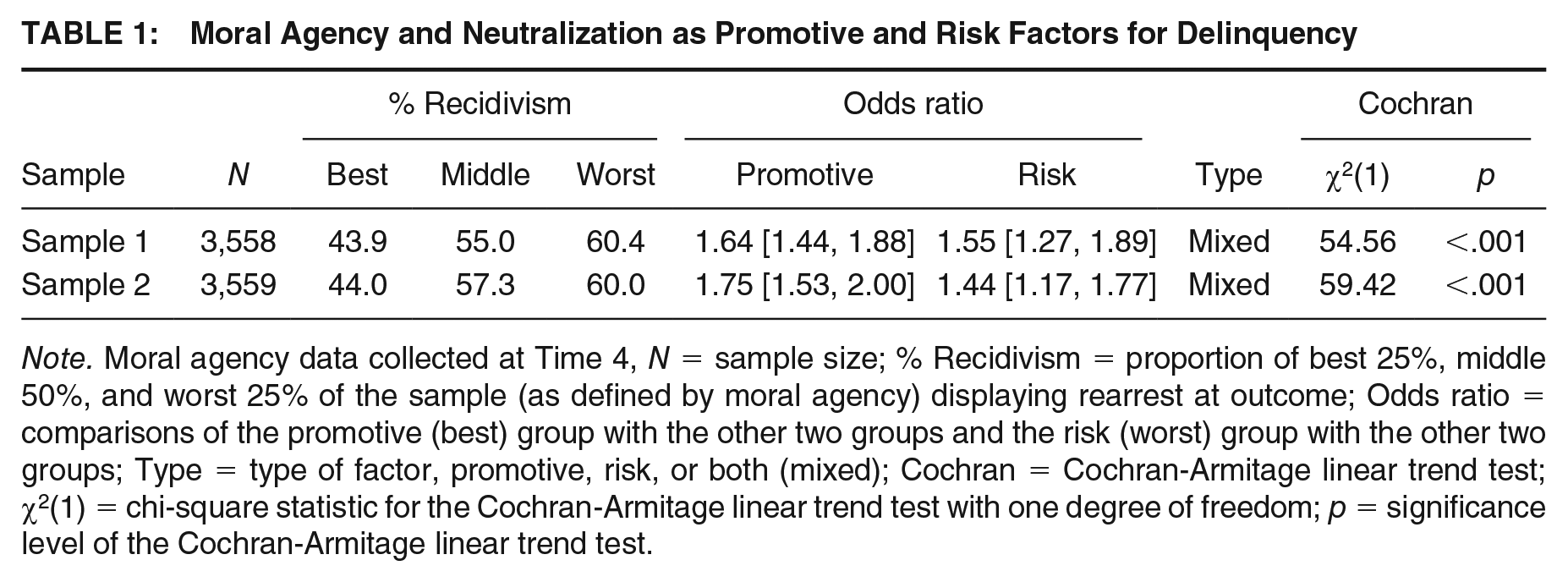
Note. Moral agency data collected at Time 4, N = sample size; % Recidivism = proportion of best 25%, middle 50%, and worst 25% of the sample (as defined by moral agency) displaying rearrest at outcome; Odds ratio = comparisons of the promotive (best) group with the other two groups and the risk (worst) group with the other two groups; Type = type of factor, promotive, risk, or both (mixed); Cochran = Cochran-Armitage linear trend test; χ2(1) = chi-square statistic for the Cochran-Armitage linear trend test with one degree of freedom; p = significance level of the Cochran-Armitage linear trend test.
Each item on the moral agency scale was assessed with a 3-point scale: law abidingness (1 = does not believe or is hostile to conventional values, 2 = believes conventional values sometimes apply, 3 = abides by conventional values), responsibility (1 = accepts or is proud of antisocial behavior, 2 = minimizes, denies, justifies, excuses antisocial behavior or blames others, 3 = accepts responsibility for antisocial behavior), minimal belief in yelling and verbal aggression to resolve conflict (1 = believes verbal aggression is often appropriate, 2 = believes verbal aggression is sometimes appropriate, 3 = believes verbal aggression is rarely appropriate), and minimal belief in fighting and physical aggression to resolve conflict (1 = believes physical aggression is often appropriate, 2 = believes physical aggression is sometimes appropriate, 3 = believes physical aggression is rarely or never appropriate). The scale displayed adequate internal consistency across all the four time periods (α = .74–.76) and concurrent validity in the form of moderately strong negative correlations between moral agency and school conduct problems (r = −.32 to −.30), school attendance problems (r = −.28 to −.25), friend delinquency (r = −.27 to −.22), and drug use and related problems (r = −.28 to −.24).
Recidivism
The dependent variable in this study was a dichotomous measure of rearrest recidivism (1 = yes, 0 = no) within the 365-day follow-up period directly following the youth’s release from community placement. This particular measure was not based on youth self-report but on official records maintained by the FDJJ and adult correctional agencies in Florida.
Control Variables
There were 12 control variables included in this study. Each variable was based on a single item, with all variables assessed at Time 1. Four of the variables were demographic in nature: age at time of admission to community placement (in years), sex (1 = male, 0 = female), and race/ethnicity, which was broken down into two dummy variables, Black and Hispanic, with White as the reference group.
A 4-point rating scale was used to assess friend delinquency (0 = exclusively prosocial friends, 1 = no consistent friends, 2 = mix of prosocial and antisocial friends, 3 = exclusively antisocial/gang member friends), and a series of 3-point items were used to assess the home environment: family incarceration (0 = no jail or imprisonment history in family, 1 = one family member incarcerated, 2 = multiple family members incarcerated), family problems (0 = no history of family problems in the household, 1 = family problems in one domain, 2 = family problems in multiple domains), and level of parental authority and control (1 = youth usually obeys and follows rules, 2 = youth sometimes obeys or obeys some rules, 3 = youth consistently disobeys and/or is hostile),
There were two school-related items among the control variables: school conduct (1 = calls to police, 2 = probation calls to parents, 3 = problems reported to teachers, 4 = no problems in school conduct, 5 =received recognition for good behavior) and school attendance (1 = habitual truant, 2 = some full-day unexcused absences, 3 = some partial-day unexcused absences, 4 = no unexcused absences, 5 = good attendance with few absences). Finally, there were two substance-related control variables: alcohol use (0 = no use, 1 = uses alcohol, 2 = use causes issues) and drug use (0 = no use, 1 = uses drugs, 2 = use causes issues).
Precursor Measures
Because the focus of this study was on changes in variable status leading to changes in outcome, all independent, mediating, and outcome variables were assessed with at least one prior estimate of the variable controlled. For example, the Time 2 school grades variable was assessed as a predictor of Time 3 moral agency controlling for both Time 1 grades and Time 1 moral agency. Because a prior measure of recidivism was unavailable to serve as a precursor measure, Time 1 items assessing prior adjudicated felonies and secure detention placements, both of which were measured with the same 4-point scale (1 = none, 2 = one, 3 = two, 4 = three or more), served as precursors to recidivism in this study. Time 2 and 3 estimates of adjudicated felonies and secure detention placements were not included in the analyses because in nearly all cases they were identical to the Time 1 estimates and produced extreme multicollinearity.
Research Design and Procedure
The research design for this study comprised a fixed-sample panel longitudinal model spread across five time periods, the first four of which were 180 days in length and the last of which spanned 365 days. There were three steps to the procedure. For Step 1, changes in grades and moral agency at Time 2 predicted moral agency and grades at Time 3 (controlling for Time 1 measures of each). At Step 2, changes in moral agency and grades at Time 3 predicted grades and moral agency at Time 4 (controlling for Time 1 and Time 2 measures of each). In Step 3, changes in grades and moral agency at Time 4 (controlling for Time 1, Time 2, and Time 3 measures of each) predicted recidivism (controlling for Time 1 prior felonies and secure detention placements). In an effort to avoid confounding and collider effect biases and influences (Greenland, 2003), all control and most precursor measures were assessed at Time 1, before the independent variables at Time 2. The independent variables appeared at Time 2, the first-stage mediators at Time 3, the second-stage mediators at Time 4, and the dependent variable, recidivism, at Time 5. This study tested two principal pathways: grades 2 → moral agency 3 → grades 4 → recidivism; moral agency 2 → grades 3 → moral agency 4 → recidivism. This study had no missing data.
Statistical Analyses
The statistical model used in this study was a path analysis with two serial mediators. The a (independent variable → first-stage mediator) and d (first-stage mediator → second-stage mediator) paths were modeled with standard multiple regression, whereas the b path (second-stage mediator → dependent variable) was modeled with logistic regression. Using a maximum likelihood estimator, computations consisted of 5,000 bias-corrected bootstrapped repetitions. Preacher and Selig’s (2012) Monte Carlo Method for Assessing Mediation (MCMAM) made it possible to calculate 95% confidence intervals for the total indirect effect. A confidence interval that does not include zero is significant. Sensitivity testing was performed with Kenny’s (2013) “failsafe ef” procedure, (rmy.x) × (sdm.x) × (sdy.x)/(sdm) × (sdy). The coefficient produced by the “failsafe ef” indicates how strongly an unobserved covariate confounder would need to correlate with the second and third variables in a chain to completely eliminate the coefficient on the d and b paths of a significant indirect effect with two serial mediators. The possibility of endogenous selection bias or a collider effect (Elwert & Winship, 2014) was evaluated by recalculating each regression analysis without precursor measures for the outcome variables. Descriptive and multicollinearity statistics were computed with SPSS Version 26 (IBM Corporation, 2019), while the regression analyses were performed with MPlus 8.3 (Muthén & Muthén, 1998/2017).
Results
Table 2 provides descriptive statistics for all 23 variables included in this study. A review of the results outlined in this table demonstrates that there were only minimal differences between the two samples on the 23 variables. The zero-order Pearson Product Moment correlations for the a and d paths of the grades-recidivism and agency-recidivism pathways for each sample (i.e., School Grades 2 → Moral Agency 3; Moral Agency 3 → School Grades 4; Moral Agency 2 → School Grades 3; School Grades 3 → Moral Agency 4) ranged from .13 to .19 (p < .001) and the zero-order point-biserial correlations for the b path of the grades-recidivism and agency-recidivism pathways for each sample (School Grades 4 → Recidivism; Moral Agency 4 → Recidivism) ranged from −.10 to −.07 (p < .001).
Descriptive Statistics for the 23 Variables Across the Two Samples
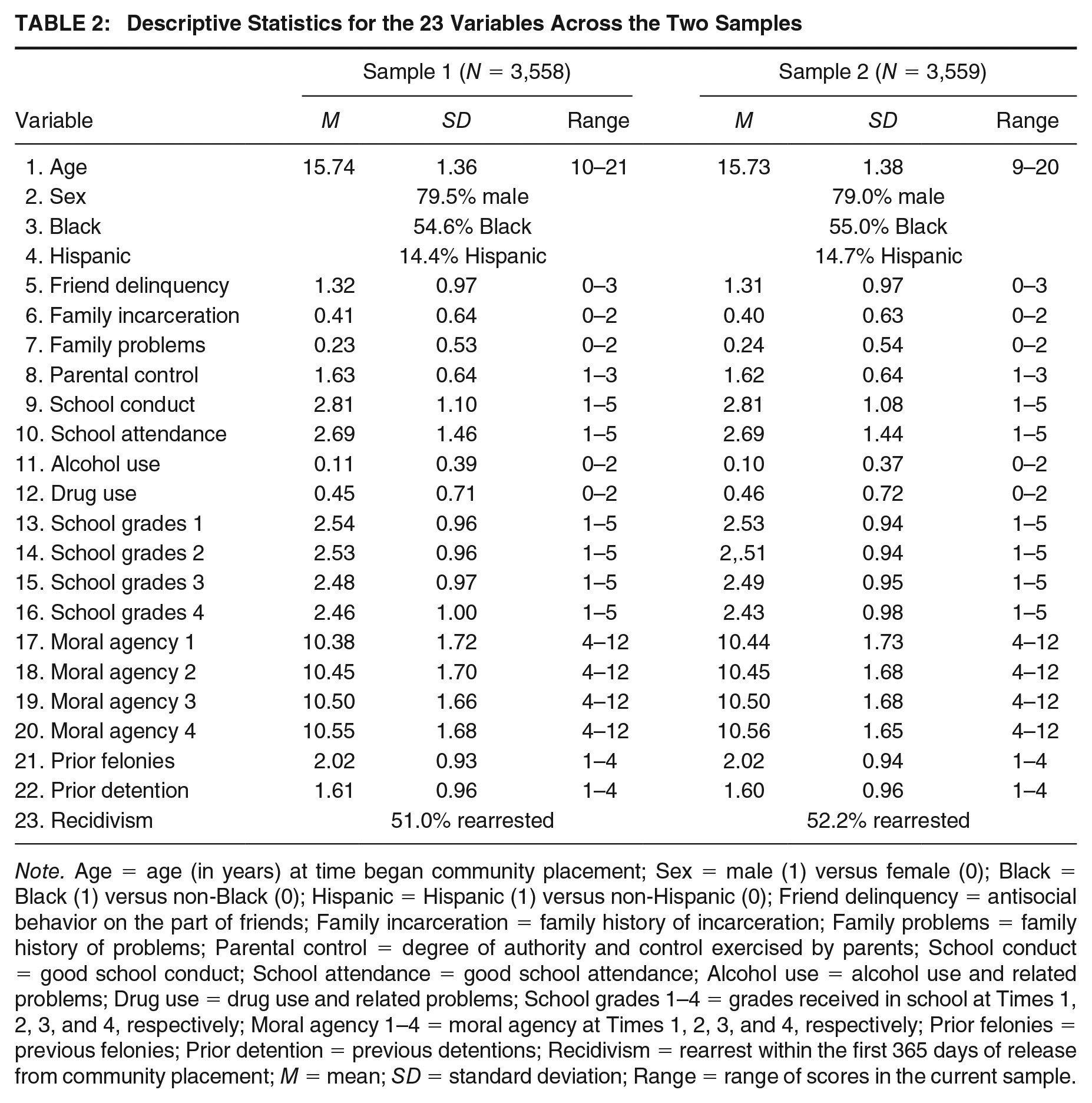
Note. Age = age (in years) at time began community placement; Sex = male (1) versus female (0); Black = Black (1) versus non-Black (0); Hispanic = Hispanic (1) versus non-Hispanic (0); Friend delinquency = antisocial behavior on the part of friends; Family incarceration = family history of incarceration; Family problems = family history of problems; Parental control = degree of authority and control exercised by parents; School conduct = good school conduct; School attendance = good school attendance; Alcohol use = alcohol use and related problems; Drug use = drug use and related problems; School grades 1–4 = grades received in school at Times 1, 2, 3, and 4, respectively; Moral agency 1–4 = moral agency at Times 1, 2, 3, and 4, respectively; Prior felonies = previous felonies; Prior detention = previous detentions; Recidivism = rearrest within the first 365 days of release from community placement; M = mean; SD = standard deviation; Range = range of scores in the current sample.
Collinearity diagnostics uncovered no evidence of multicollinearity in either Sample 1 (tolerance = .353–.963; variance inflation factor = 1.038–2.830) or Sample 2 (tolerance = .382–.964; variance inflation factor = 1.038–2.617). A five-equation path analysis using data from Sample 1 produced significant individual path coefficients linking grades 2 to moral 3, moral 3 to grades 4, grades 4 to recidivism, moral 2 to grades 3, grades 3 to moral 4, and moral 4 to recidivism (see Figure 1 and left-hand column of Table 3). The total indirect effects for both pathways were also significant (see top half of Table 4). The same six individual paths (see Figure 1 and right-hand column of Table 3) and both total indirect effects (see bottom half of Table 4) were significant for Sample 2 as well.
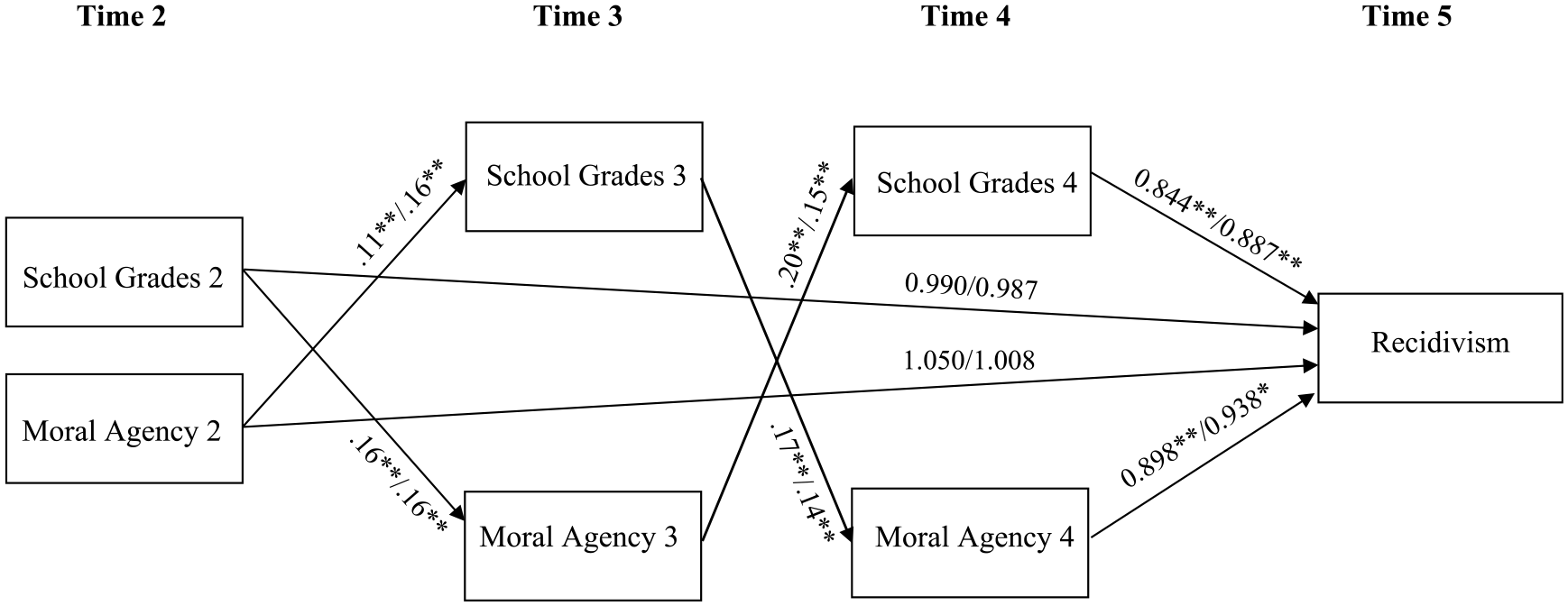
The Direct and Indirect Effects of School Grades 2 and Moral Agency 2 on Recidivism at Time 5
Path Analyses for Moral Agency, School Grades, and Recidivism Outcomes Across the Two Samples
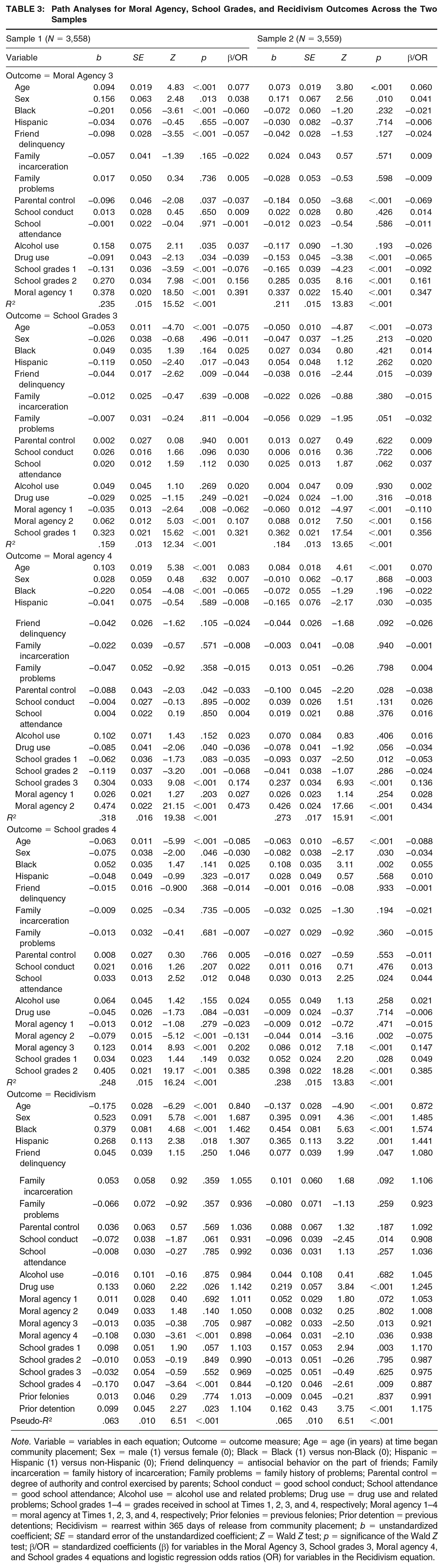
Note. Variable = variables in each equation; Outcome = outcome measure; Age = age (in years) at time began community placement; Sex = male (1) versus female (0); Black = Black (1) versus non-Black (0); Hispanic = Hispanic (1) versus non-Hispanic (0); Friend delinquency = antisocial behavior on the part of friends; Family incarceration = family history of incarceration; Family problems = family history of problems; Parental control = degree of authority and control exercised by parents; School conduct = good school conduct; School attendance = good school attendance; Alcohol use = alcohol use and related problems; Drug use = drug use and related problems; School grades 1–4 = grades received in school at Times 1, 2, 3, and 4, respectively; Moral agency 1–4 = moral agency at Times 1, 2, 3, and 4, respectively; Prior felonies = previous felonies; Prior detention = previous detentions; Recidivism = rearrest within 365 days of release from community placement; b = unstandardized coefficient; SE = standard error of the unstandardized coefficient; Z = Wald Z test; p = significance of the Wald Z test; β/OR = standardized coefficients (β) for variables in the Moral Agency 3, School grades 3, Moral agency 4, and School grades 4 equations and logistic regression odds ratios (OR) for variables in the Recidivism equation.
Indirect Effects for Pathways Running From Grades to Recidivism and From Moral Agency to Recidivism in the Two Samples
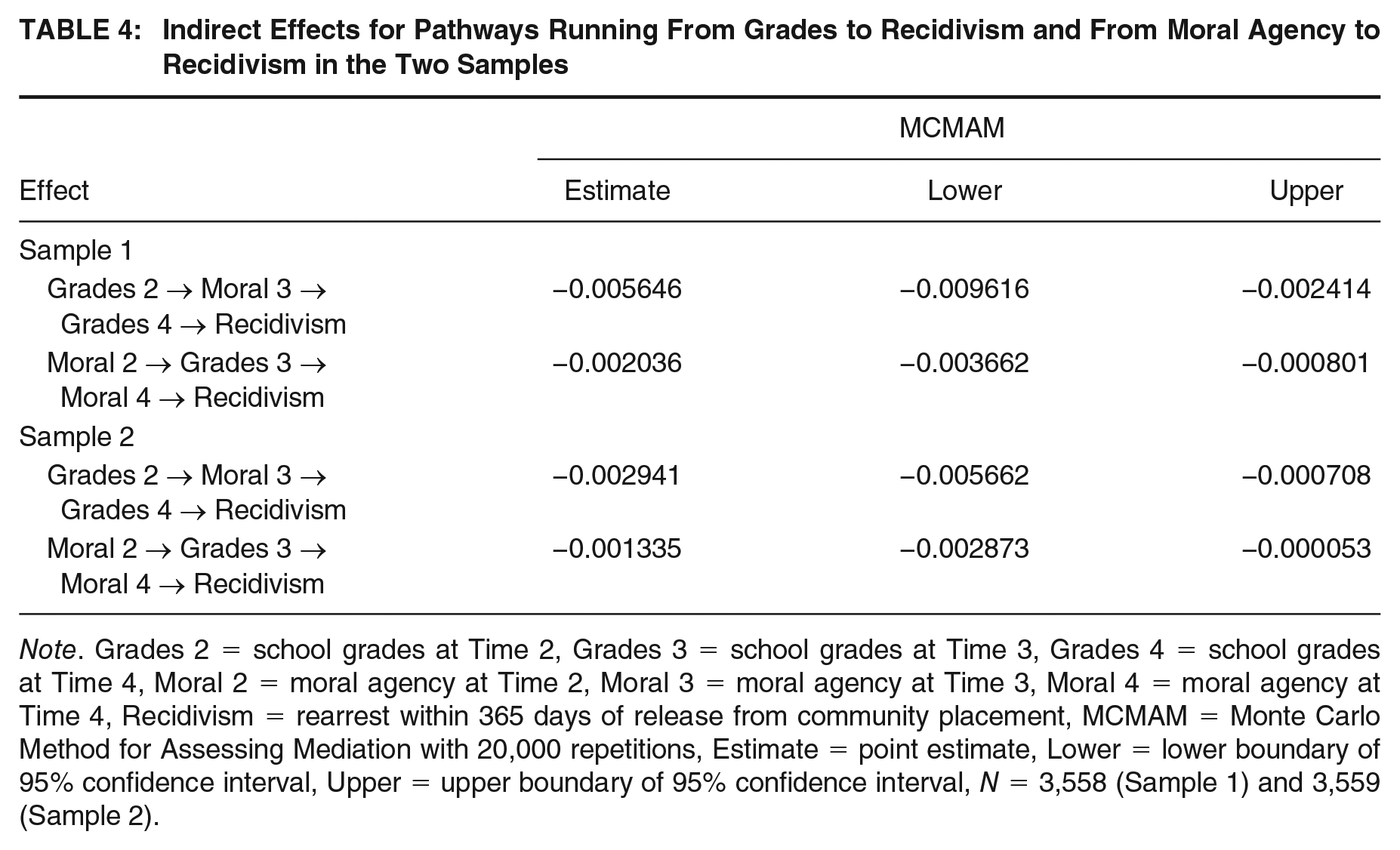
Note. Grades 2 = school grades at Time 2, Grades 3 = school grades at Time 3, Grades 4 = school grades at Time 4, Moral 2 = moral agency at Time 2, Moral 3 = moral agency at Time 3, Moral 4 = moral agency at Time 4, Recidivism = rearrest within 365 days of release from community placement, MCMAM = Monte Carlo Method for Assessing Mediation with 20,000 repetitions, Estimate = point estimate, Lower = lower boundary of 95% confidence interval, Upper = upper boundary of 95% confidence interval, N = 3,558 (Sample 1) and 3,559 (Sample 2).
Table 5 provides a summary of the sensitivity testing results using the “failsafe ef.” The results reflect how strongly a covariate confounder would need to correlate with the second and third variables in a chain, controlling for the first and second variables in the case of the third variable. These results demonstrate that the path coefficients were modestly robust to the effects of omitted variable bias. Endogenous selection bias was evaluated by removing the precursor measures for each outcome variable and redoing the analysis. Because the coefficients increased or remained largely unchanged, these results failed to support endogenous selection bias as an alternate explanation for the results. Individual path coefficients and total indirect effects also changed very little when all control variables were removed from the analysis.
Results From the “Failsafe ef” for Each Pair of Three-Variable Chains Embedded Within a Four-Variable Pathway
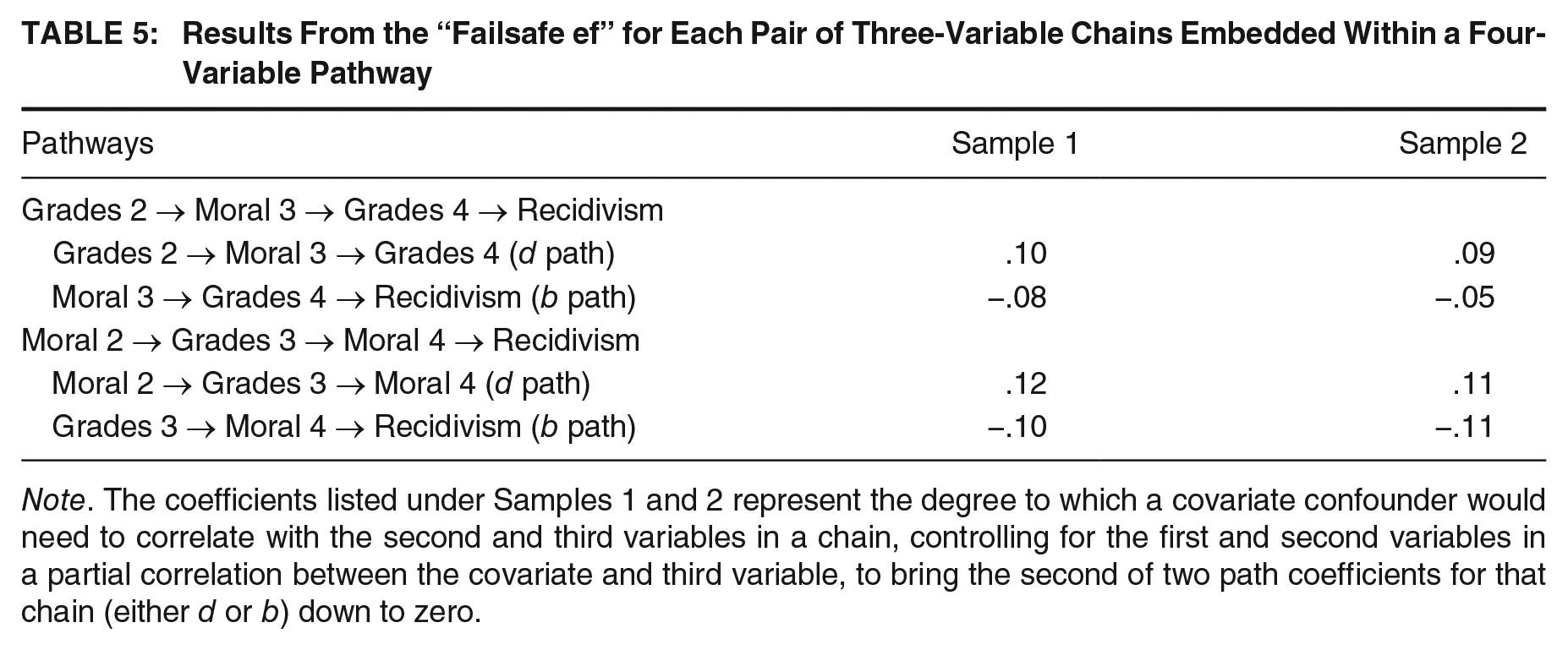
Note. The coefficients listed under Samples 1 and 2 represent the degree to which a covariate confounder would need to correlate with the second and third variables in a chain, controlling for the first and second variables in a partial correlation between the covariate and third variable, to bring the second of two path coefficients for that chain (either d or b) down to zero.
Discussion
The hypotheses tested in this study held that a putative turning point (change in school grades) and a cognitive factor (change in moral agency) would enter into a reciprocal relationship, a relationship that would negatively predict future recidivism in a large group of low-to-moderate risk justice-involved youth randomly divided into two equally sized samples. Significant effects were obtained for both pathways and in both samples. In the end, two four-variable dual-mediator pathways produced 12 out of 12 significant path coefficients and 4 out of 4 significant total indirect effects. On the other hand, none of the four direct effects were significant, indicating that significance was restricted to relatively short time intervals (i.e., 6 months as opposed to 18 months). These results offer support for the notion that small, seemingly mundane, changes in the environment, minor alterations in competencies, or both, which then lead to an increase in school grades, can stimulate desistance by entering into a series of bidirectional associations with moral agency. The reciprocal nature of this relationship may have been what gave these variables the power to transform a small change into a moderate effect. Thus, as indicated by the earlier Walters (2023) investigation, change need not be monumental to bring about desistance, it must simply be capable of stimulating a change in cognition, in this case moral agency, although in this case a change in moral agency also produced a change in school grades.
Strengths and Weaknesses
This study comes with both strengths and weaknesses. Among the strengths is the fact that the sample was large enough to be subdivided into two equal halves which then allowed for cross-validation of initial findings. Second, the database used in this study contained a wide variety of risk and needs factors, most of which served as independent, mediating, or control variables. Third, there were no missing data because of the completeness of the C-PACT procedure. Fourth, although much of the data were based on youth self-report, some variables, like grades, received corroboration from parents or official sources, and others, like recidivism, were based entirely on official data. The recidivism outcome, in fact, is both a strength and a weakness. It is a strength to the extent that it was based on official records rather than offender self-report, the latter of which tends to be weighted toward less serious crimes. It is a weakness to the extent that it did not account for criminality that did not lead to an official arrest. Also, given that it was assessed as a dichotomy (one or more rearrests vs. no rearrests), the recidivism measure did not account for the frequency or severity of rearrest. A further limitation of this study is the fact that many of the variables were single-item measures. This made assessing these measures’ internal consistency impossible and introduced potential bias into the analysis with the inclusion of single-item variables that a participant may have misunderstood. It also illustrates the limitations of working with an existing data set that was not specifically designed to answer the research questions posed by the current study. Finally, the path effects were small to modest, as evidenced by “failsafe ef” values of .05 to .12, β coefficients of .11 to .20, and logistic regression odds ratios of 0.844 to 0.938, although to expect anything more given the number of precursor measures for both the predictor and outcome variables and fact that small effects were anticipated could be considered unrealistic.
Theoretical and Research Implications
There are at least two theoretical implications that can be drawn from these results. The first is that a small change in behavior or cognition can potentially trigger a larger change in behavior over time. In the previous Walters (2023) investigation, exposure to counseling services, many of which were brief, produced a unidirectional effect that ran from perceived certainty of punishment to cognitive agency to decreased recidivism in high-risk justice-involved youth. In the current study, relatively small improvements in grades and moral agency generated a bidirectional or reciprocal relationship that reduced the likelihood of future recidivism in low-to-moderate risk justice-involved youth. These results provide support for Bandura’s (1986) reciprocal determinism concept in which small initial changes in the person (cognitive), environment, or behavior tend to accumulate, thus culminating in larger and more dramatic and noticeable changes over time. The current findings are also congruent with the assertion, central to social-cognitive-developmental theory, the model upon which current study was, in part, based, that turning points are most apt to lead to change when accompanied by a corresponding change in cognition (Walters, 2022).
Revising turning point theory to acknowledge that small changes can be just as important as major life events in stimulating desistance is an implication the present study holds for Laub and Sampson’s (2003) age-graded theory of crime. It could be argued that the theory needs to be adjusted to take into account the fact that it may not be the size of the event or the magnitude of the experience that defines it as a turning point but whether the event or experience stimulates the cognitive factors found in the Walters (2023) study and current investigation: specifically, perceived certainty of punishment and cognitive agency in the former and moral agency in the latter. There could be several different ways to chronicle these effects. In the Walters (2023) investigation, for instance, the effect registered as the sum of interventions leading to desistance, similar to how risk factors accumulate additively (Bonta & Andrews, 2017), whereas in the current study it was the reciprocal relationship that developed between the turning point (change in school grades) and cognition (moral agency) that was significant. There is at least one other way small events may become amplified over time and lead to desistance and that would be through interaction or moderation, such as when small events interact with cognitive factors to produce an effect greater than the sum of the two individual effects.
Practical and Policy Implications
A practical implication of these results is that because desistance can be achieved in the absence of major life events, there is no need to wait for such events to materialize before embarking on a program of change. Small changes like participation in multiple short-term interventions (Walters, 2023) or improved school grades, whether the effect is specific to school grades or a proxy for some other variable (current study), may be just as effective as marriage and employment in achieving the long-range goal of desistance particularly if a change in cognition accompanies the turning point. This is not to suggest that school grades are easily improved or that the grade-delinquency relationship is not supported by other factors. In the current study, attempts were made to control for variables that might confound the grade-delinquency relationship (e.g., school attendance, family support, peer delinquency, substance use), but other relevant variables (e.g., persistence, work ethic) could not be ruled out because they were not part of the database. These issues aside, it was the reciprocal relationship that formed between a turning point (improved grades) and cognition (moral agency) that led to reduced recidivism over time because a change in moral agency or school grades from Time 1 to Time 2 did not directly predict recidivism at Time 5. These results support Bandura’s (1986) conceptualization of reciprocal determinism and suggest that cognition, a person variable, and behavior, in the form of improved school grades, enhance one another’s effect on recidivism. This may also explain why cognitive behavior therapy continues to produce some of the best results for justice-involved youth and adults (Feucht & Holt, 2016; Landenberger & Lipsey, 2005).
It should also be noted that the peer and parental/family factors that served as control variables in the current investigation did not normally correlate with the mediating and outcome variables in the multiple regression analysis. This may have had something to do with the fact that participants in both samples were of low-to-moderate risk rather than high-risk. Had a higher risk sample been employed, it is likely that participants would have produced more pathological scores on some of these measures which perhaps would have correlated better with the mediating and outcome variables. Lower scores on some of these measures also indicate that programming may not be as effective as it would be with a higher risk sample (Bonta & Andrews, 2017). There are interventions, however, that have been found effective with low-to-moderate risk individuals, such as those who served as participants in the current study. These include diversion programs (Wilson et al., 2018), community service (Koops-Geuze & Weerman, 2023), and various forms of evidence-based primary prevention (Hahn et al., 2007). According to the results of the current investigation, efforts to increase moral agency may also be effective in reducing the odds of recidivism in low-to-moderate risk justice-involved youth. Among the types of interventions that could be effective in enhancing youth moral agency are restorative justice conferences (Wood, 2020) and youth empowerment programs (Ruhr & Fowler, 2022); first, by emphasizing responsibility and accountability in the former, and second, by developing competencies and other life skills in the latter. Another benefit of a reciprocal model is that it provides additional targets for intervention, so that if pursuing one target (school grades) proves unsuccessful, treatment can shift to an alternate but interrelated second target (moral agency).
Directions for Future Research
As reconceptualized by social-cognitive-developmental theory, turning points are events and experiences that facilitate desistance, but primarily when they lead to a change in the environment, a rise in competencies, or both. In the present study, improved grades may have done both (i.e., led to improved academic competencies and altered the child’s school environment), although data required to test this assumption were unavailable. Future research needs to look deeper into this issue. The next step in the process, according to social-cognitive-developmental theory, is for the turning point to stimulate a change in cognition (i.e., alter the individual’s thinking or attitude in some way). In the current study, the turning point (improved grades) and cognition (increased moral agency) were bidirectionally related such that a change in one led to a change in the other. Whether the effect is unidirectional, as it was in the Walters (2023) investigation, or bidirectional, as it was in the current study, it should be understood that relatively small events and experiences can lead to significant changes in behavior, such as reduced recidivism and desistance. It is possible that these changes in thought and action bring about changes in routine activities (Osgood et al., 1996), value-based decision-making (Berkman, 2018), and goal prioritization (Conner et al., 2022) that then became self-reinforcing over time (Skinner, 1974), but again, these are assumptions that require testing and verification.
Conclusion
In a partial test of the social-cognitive-developmental interpretation of turning points, the current study disclosed the presence of a reciprocal or chaining effect between a putative turning point (change in school grades) and a cognitive variable (moral agency). The results showed that these reciprocal effects achieved a significant indirect effect that predicted the absence of subsequent recidivism over a 365-day period, even though the direct effect from the first variable in the chain (i.e., school grades 2 or moral agency 2) to recidivism was nonsignificant. Implementing controls for delinquent peer associations, family functioning, parental supervision, school attendance, and other variables that school grades could have served as a proxy for, did not change the results. On the basis of these findings, it can be assumed that improved school grades, whether they are conceptualized as turning points or promotive factors, or proxies for other variables, entered into a reciprocal relationship with the cognitive variable of moral agency which, in turn, reduced the odds of future recidivism.
