







Abstract
Prior studies document the complexity of hate crime determination by police. The likelihood of criminal justice intervention into cases of hate crime is influenced by several factors including the situational, officer, agency, and structural. While most work focuses on the hate crimes clearance via arrest and federal reporting compliance, there is limited attention on earlier points of police discretion in potential hate crime cases. To add, most scholarship has been focused on between-agency behavior while ignoring internal organizational processes that may influence hate crime police response. We employed a multilevel analysis of crime incidents from the Los Angeles Police Department to clarify the predictors of hate crime case funneling, focusing on the likelihood of official classification as well as police arrest. Our findings suggest some degree of neighborhood clustering and that police intervention into hate crime is constrained by a host of situational, organizational, and other environmental factors.
Introduction
Police behavior varies by ecological context (Simes et al., 2023), with space and territory influencing response types. Research shows police are generally less vigorous in responding to hate crimes (Han & Son, 2024; Lantz et al., 2019; Lyons & Roberts, 2014). While the likelihood of hate crime police intervention depends on various situational factors, how ecological context shapes this process is less understood. Since bias crimes (e.g., anti-race, sexuality, religion) are shaped by community characteristics, police responses likely vary by context as well. Some studies are inconclusive on whether space influences hate crime intervention (Holder & Ledford, 2024; M. S. Wilson & Ruback, 2003), but they focus on limited areas and primarily on arrests, neglecting other aspects like investigation and classification. We address this gap by analyzing multilevel hate crime data from Los Angeles to explore the factors influencing classification and arrest.
Hate Crime Criminal Justice Processing
Foundational to considering the role of police response to hate crime is the 1990 Hate Crime Statistics Act, which mandated the collection of data on hate crime at the national level via the Uniform Crime Reporting (UCR) program. Gathered from local law enforcement agencies on a quarterly basis, the Federal Bureau of Investigation (FBI), administers of the UCR, define any hate crime as an “offense against a person or property in whole or in part by an offender’s bias” based on select categories like race, religion, or sexuality. Relying on voluntary reporting from local, state, and special (e.g., university) agencies, hate crime from the UCR is considered a flawed source in which to understand the state of hate crime in the United States. This is primarily due to the convergence of two primary factors: cleavages in agency hate crime response and lack of victim reporting.
In fact, UCR hate crime data suffers from the same set of problems associated with UCR crime data more generally (see Barnett-Ryan, 2007) but is especially implicated by cross-agency differences in policy and protocol for investigating and reporting hate crime. Compared with the National Crime Victimization Survey (NCVS), hate crime counts from the UCR are severely lower than reported by victims nationwide, undercounting the true of occurrence of hate crime by the hundreds of thousands (Holder, 2024; Kena & Thompson, 2021). The reason for this “dark figure” of hate crime is attributed to the general (lack of) agency participation in UCR hate crime reporting. In 2019, for instance, only 13.9% of the more than 15,000 agencies that participate in the UCR reported at least one hate crime, and upward to 80% of all agencies report zero hate crimes annually (Kaplan, 2021). The sources of agency zero reporting and general police intervention have been extensively studied, with agencies being the “law in-between” between formalized policy and its application (Grattet & Jenness, 2005; Jenness & Grattet, 2005).
To start, the determination that a crime qualifies as bias-motivated is a matter of responding officer discretion. Although the process of hate crime investigation varies by state and agency policy, the low-level response to hate crime represents a complicated process, and case idiosyncrasies can present a daunting task to the official determination of “hate” (Bell, 2002; Boyd et al., 1996; Martin, 1995, 1996). Studies have shown that those who commit potential hate crimes may have an unclear bias that does not coincide with the victim’s perceptions, and actors may be secondarily motivated by their own bias or prejudice. Compared with “general” crimes, hate crimes often share corresponding situational correlates (see Messner et al., 2004), and at the aggregate level, hate crimes overlap with other forms of offending in terms of their demographic and structural predictors (Gladfelter et al., 2017; Grattet, 2009; Holder et al., 2024; Lyons, 2007; C. E. Mills, 2020a, 2020b, 2021). Accordingly, while hate crime certainly does represent a unique form of criminality, at least in socio-legal terms, its manifestation into clear-cut instances of “hate” is contested.
The ability to recognize a hate crime is influenced by situational factors and implicit biases. Officers often rely on stereotypical crime patterns due to high discretion and workloads (Boyd et al., 1996; Lantz et al., 2019). Judges also use extralegal factors as cognitive shortcuts to supplement their “focal concerns” of offending person culpability, community protection, and practical constraints (Steffensmeier et al., 1998). Experimental studies show that both crime-specific characteristics and the identities of those involved shape hate crime categorization and sentencing decisions. Factors like the seriousness of the offense or the presence of racial slurs are key, but characteristics of the victim and responsible offending party often play an equally or more influential role (Erentzen et al., 2021; Gerstenfeld, 2003; Lyons, 2006, 2008; Marcus-Newhall et al., 2002; Miller, 2001; Rayburn et al., 2003; Saucier et al., 2008, 2010; Zhang, 2023).
Most of this research converges on a critical finding: Cases involving White offending persons and nonwhite victims, particularly Black victims, are far more likely to be perceived as “real” hate crimes compared with other pairings of the victim and party responsible for the offense. This suggests that cultural stereotypes and societal perceptions play a central role in constructing the idea of a “typical” hate crime. Crimes seen as more severe, particularly those involving a stereotypical hate crime dyad, are more likely to be regarded as authentic hate crimes. However, the role of one’s ecological context has limited empirical attention with respect to the classification of hate crime including official sanctions like arrest. While a handful of studies demonstrate that within-agency factors are determinative of official variations in hate crime response (e.g., Boyd et al., 1996; Martin, 1995, 1996), greater specification is needed to incorporate a more multilevel approach to this issue. As such, we turn toward considering the role of space and policing and its potential in affecting the likelihood of law enforcement intervention into cases of bias crime.
Incorporating Space Into Police Intervention
Beyond individual officer decisions to invoke the formal criminal legal process, socio-ecological factors significantly impact police behavior, influencing both the organizational structure of departments and officers’ discretionary decisions (Simes et al., 2023; Terrill & Reisig, 2003). Early ethnographic works show that policing varies across geographic boundaries, with attitudes and “working rules” shaping decision-making (Black, 1980; Manning, 1977; Muir, 1977). Space and place are central to strategies like order maintenance policing, which aligns with Broken Windows theory, arguing that police in “high crime” areas should focus on curbing disorder to reestablish informal social control (J. Q. Wilson & Kelling, 1982). Technological advancements have enabled strategies like “hotspots” policing, which effectively reduce crime at various geographic levels (Braga et al., 2019; Telep et al., 2014).
To explain ecological variations in policing, researchers primarily focus on a community’s structural and demographic features and their relationship with officer perceptions of the citizenry. For example, Klinger (1997) argues the extent to which officers exercise their discretion to arrest (“vigor”) is associated with the level of crime in a given area. More specifically, Klinger argues vigor is comprised of two prevailing factors: The crime, or “deviance,” level in a community and officer workload. Officers’ understanding of the status quo in a neighborhood is influenced by such perceived deviance and workload, which ultimately informs whether they believe crime victims “deserve” a piece of the limited resources police have (i.e., arresting the perpetrator).
Tests of Klinger’s framework have yielded little support. For example, Sobol (2010a) found officers self-reported higher levels of cynicism when working in cities with higher violent crime. Such dispositions may not be associated with inaction, however, as later findings indicated that the propensity to make an arrest (i.e., vigor) was higher in districts with more crime (Sobol, 2010b). Furthermore, studies employing the actual rate of police arrest—rather than arrest intentions—at varying levels of analysis (e.g., neighborhood, block group) have found vigor increases alongside crime rates, which is antithetical to Klinger’s ecological propositions (Phillips et al., 2015; Sobol et al., 2013; see although, Taniguchi & Salvatore, 2018).
The demographic makeup of a community can also influence policing. Group conflict models like Liska and Chamlin’s (1984) theory of benign neglect and Blalock’s (1967) racial threat theory suggest that non-White communities, with less sociopolitical power, often have their needs ignored by the state, making police resources less likely to address hate crimes in diverse areas. The racial threat framework examines how formal social control is applied to minority groups perceived as “threatening” to the dominant system, often evaluated through policing and punishment related to demographic shifts, racial employment rates, or non-White political presence (Beck, 2019; Eitle et al., 2002; Eitle & Monahan, 2009; Novak & Chamlin, 2012; Parker et al., 2005). Both frameworks offer insights into how community demographics influence police resource mobilization for hate crimes. While a city’s crime rate is a key factor in police intensity, studies show that police resource allocation is also linked to the racial composition of a city, with non-White and economically disadvantaged individuals being more susceptible to police actions like stops, arrests, and use of force (Edwards et al., 2019; Gelman et al., 2007; Paoline et al., 2018). Similar to agency hate crime reporting challenges, many studies focus on city-level policing variations, potentially missing ecological nuances. Research, mainly in New York, has examined police outcomes such as stops, arrests, and use of force but often lacks the granularity needed for comprehensive analysis (Beck, 2019; Levchak, 2017; Omori et al., 2024).
Finally, discussions about the spatial distribution of policing and social control often focus on the social conditions in different areas that contribute to varying crime levels across neighborhoods. For instance, social disorganization theory and theories of concentrated disadvantage explore how aggressive policing is linked to communities facing significant structural challenges. These theories help us understand how underlying social issues can create environments where crime is more likely to occur and where more police resources may be necessary (Parker et al., 2005; Sobol et al., 2013; Terrill & Reisig, 2003). Logically, communities facing greater disadvantages tend to experience higher crime rates, which often leads to more intense policing. However, this cycle can also damage relationships between the police and the community. When residents feel mistrust and cynicism toward law enforcement and other legal institutions, it can create a rift that complicates police citizen efforts to co-produce public safety (Kirk & Matsuda, 2011; Sampson & Bartusch, 1998; Tyler, 2006).
Research on criminal justice agency involvement in reported hate crime cases predominantly focuses on the extent to which these agencies report bias crimes to the UCR. Given that numerous agencies report zero hate crimes annually, successfully documenting even one incident is a significant achievement for police departments. McVeigh et al. (2003) liken this success to a “successful social movement,” highlighting that reporting rates tend to be higher in racially diverse counties, particularly those with active civil rights organizations. Conversely, King (2007) found that agencies in predominantly Black counties exhibited lower reporting rates, which he argues supports the tenets of racial threat theory. Viewing this issue through a historical comparative lens, King et al. (2009) revealed that a county’s demographic composition and previous instances of lynching were inconsistent predictors of contemporary reporting practices.
J. M. Mills et al. (2024) extend this discussion by identifying “ceremonious compliance” as a third form of agency behavior, where police departments submit zero reports over extended periods without ever recording the presence of bias crime in their jurisdiction. Their findings underscore how political and historical contexts shape reporting practices, further revealing that Republican-leaning areas and counties with a pronounced history of racial antagonism are more likely to adopt this reporting strategy relative to “true compliance,” or the agency behavior of recording the presence of hate crime. Finally, state-level policies mandating hate crime reporting can significantly influence agencies’ participation in the UCR (Scheuerman et al., 2020; Stacey, 2015). Only one study has explored ecological variation in hate crime policing beyond reporting. M. S. Wilson and Ruback (2003) found that hate crime law enforcement is more influenced by situational factors than spatial ones. However, the application of these findings to the ecological component of hate crime policing outside agency reporting remains mostly limited (Boyd et al., 1996; Holder & Ledford, 2024; Martin, 1995, 1996; M. S. Wilson & Ruback, 2003).
Beyond the need for applications outside agency reporting, greater specificity is needed to further explore the ecological context of hate crime policing. That is, most work focuses on variations in agency hate crime reporting and criminal justice responses at the city or county level, potentially obscuring the unique dynamics of hate crime policing within smaller units like neighborhoods or precincts. A single-city study design can facilitate a more nuanced understanding of the dynamics at meso-level units, allowing for a detailed examination of how incidents are addressed within local frameworks. In addition, focusing on a specific research setting can help mitigate biases in national hate crime statistics, where differences in policing may be influenced by unobserved agency-level factors (e.g., Grattet, 2009; Lyons, 2007; C. E. Mills, 2020b). Up to this point, however, most single city/agency studies have been qualitative in nature, necessitating further work to investigate general intra-agency hate crime categorization patterns if any exist (Boyd et al., 1996; Martin, 1996). Accordingly, our analysis aims to provide substantive contributions to the existing scholarship on factors that may contribute to formal legal involvement in cases of bias crime.
Data and Methods
Data for this project was drawn from a combination of open data files available from the City of Los Angeles (see data.lacity.org) as well as demographic and other structural measures from the U.S. Census. First, crime data was accessed via the LA Open Data portal and downloaded from two separate crime incident databases including the “Crime Data from 2010 to 2019” file and the “Crime Data from 2020 to Present” file (Los Angeles Police Department [LAPD], 2019, 2020). Each incident contains pertinent information for this study including the data in which the incident was recorded, the responding LAPD Community Police Station (or Areas), offense severity, victim characteristics, and modus operandi codes. Importantly, each incident includes the geographic coordinates rounded to the nearest hundred block, and all incidents were placed into Census tracts for the City of Los Angeles using the 2018-2022 Census American Community Survey 5-year estimates shapefile. The analysis was restricted to recorded criminal incidents between 2018 and 2023 (n = 1,041,270) between 1,196 Census tracts, constituting neighborhoods in LA.
As with any study on hate crime, data quality is the forefront of its limitations. Overall, there is hesitation in using police-reported hate crime incidents to draw inferences on the nature of bias crime and the roots of its occurrence and incidence. As the literature review has previously discussed, hate crime data are more so a reflection of the processes involved with official intervention. For this reason, many have empirically assessed the factors that contribute to the policing of hate crime, and these studies demonstrate that official intervention is constrained by several internal and external factors distinct to the agency (Grattet & Jenness, 2005; Holder & Ledford, 2024; Jenness & Grattet, 2005; King, 2007; King et al., 2009; McVeigh et al., 2003; J. M. Mills et al., 2024; M. S. Wilson & Ruback, 2003). This study is aligned with this vein of scholarship, attempting to better clarify components of police input into cases of hate crime through a multilevel approach.
Fortunately, the LAPD has been a consistent reporter of hate over the past three decades. The LAPD’s response to hate crime is outlined in the department manual via the Reporting Incidents Motivated by Hate or Prejudice section, which provides a detailed outline of investigating potential cases of hate crime and official recording and classification. The policy demands that responding officers not only investigate the potential hate crime but also notify the watch commander of the Area as well as the Department Operations Center and Communications Division to document the notified incident. Initial investigations are conducted by assigned field units, with Area supervisors and watch commanders being active in the investigation, the latter being a “Hate Crime Coordinator” that oversees the entirety of the hate crime investigation and recording process. During the investigation, responding officers can designate the event, via the MO codes, as either a hate incident, which are biased incidents with unclear criminal motives or not considered to be crimes, or hate crimes, which are those incidents in which the investigation suggests are factually criminal incidents “rooted in bias” and are then later reported to the FBI’s UCR program. 1
Level 1 Variables
We used a mixed effects generalized linear model (see below), clustering incident-level data and information (Level 1) into their respective Level 2 units, that is, the Census tract in which they occurred. The first Level 1 outcome variable is hate incident, a dummy variable (1 = hate incident, 0 = no hate incident) that indicates whether the LAPD designated the incident as essentially being a non-criminal act directed against a person’s real or perceived social identity that may include epithets, distribution of hate material in public places, or displays of hate material on personal property. The second outcome variable is hate crime, also a binary variable that indicates whether the incident was formally categorized as a hate crime (1 = hate crime 0 = no hate crime) given the aforementioned investigatory process. Finally, we restrict the sample to only official hate crimes and determine the likelihood of police clearance via arrest, a binary variable indicating an arrest was recorded for a given incident (1 = arrest, 0 = no arrest).
We also included a set of incident-level case characteristics that are known to influence not only perceptions of hate crime but also the likelihood of arrest, more generally. First, index is dummy variable indicating the case seriousness, i.e., whether the crime was a Part 1 index crime (1 = index crime, 0 = non-index crime). Hateful language is also included to control for evidence available to the case, a binary variable measuring the presence of reported slurs or other hateful verbiage reported by the victim (1 = hateful language, 0 = no hateful language). Victim characteristics were finally included such as the victim’s race (non-White as the reference category) and gender (man as reference category), as such characteristics are known to be correlated with the construction of “real” or “stereotypical” hate crimes (Lantz et al., 2019).
Yearly fixed effects are also included as a Level 1 control variable, with 2018 as the reference year. Hate crime and police response are not static, with both being sensitive to temporality and time-sensitive events (e.g., Dugan & Chenoweth, 2020; Grattet & Jenness, 2008; King & Sutton, 2013; Lyons & Roberts, 2014), and official police intervention should likewise be constrained to such timing. A final variable entered as a Level 1 fixed effect is the Community Police Station, or Area, in which the incident originated and the police station that handled the event to assess potential workgroup differences in classification likelihoods. If the spatial contribution to police intervention is meaningful, we would expect the neighborhood effects to be diminished by the inclusion of these fixed effects, with some prior work supportive of this argument (Boyd et al., 1996; Holder & Ledford, 2024; M. S. Wilson & Ruback, 2003). While other agencies (e.g., New York or Chicago) tend to centralize the hate crime investigation process, LAPD (n.d.) policy is more so decentralized with assigned hate crime investigators within each of the 21 area stations.
Level 2 Variables
Our Level 2 variables were drawn from the aforementioned ecological perspectives of crime and policing, specifically focusing on factors generally correlated with hate crime criminal justice outcomes (King, 2007; King et al., 2009; McVeigh et al., 2003; J. M. Mills et al., 2024). Given that prior scholarship is mostly convergent on the role of preexisting levels of crime in determining spatial variations in police behavior, we included a violent crime rate continuous measure of a tract’s rate (per 100,000 residents) of Part I reported offenses. We also introduced three measures related to spatial theories of social control such as group threat and social disorganization. We first control for residential demographics, including the racial composition of percent Black, percent Hispanic, and percent Asian. 2 Next, concentrated disadvantage is a standardized summated index of each Census tract that includes the percentage of single-parent households with children under the age of 18, percentage of households on public assistance, percentage of households in poverty, the unemployment rate, and the reciprocal median income.
Finally, residential instability combines the percentage tract renter-households with the percentage of residents who moved in the past year. We also include a measure of neighborhood immigrant concentration through a percent foreign-born variable, or those residents born outside of the United States, as well as an educational measure through percent some college, which is the percentage of residents (above the age 25) with at least some college experience or higher. A neighborhood indicator variable measuring the presence of community civil rights organizations is included via the unified business master file from the National Center for Charitable Statistics (NCCS, 2005); organizations with recognized employee identification numbers between 2018 and 2023 are included and are limited to nonprofits recognized as civil rights organizations by the National Taxonomy of Exempt Entities classification scheme (Lecy, 2024; McVeigh et al., 2003; J. M. Mills et al., 2024). We finally controlled for the tract’s population through a logged population variable.
Plan of Analysis
Understanding the contextual nature of bias crime police intervention at the incident level requires an analytical strategy than can determine the simultaneous influence of situational and ecological factors. A common strategy for assessing official forms of intervention (e.g., arrest, prosecution, conviction, etc.) are multilevel linear models that cluster Level 1 outcomes and other salient information into Level 2 classifications (Vogel & Messner, 2024). Because of the dichotomous nature of our dependent variables, we estimated a series of mixed effects logistic regression models that cluster the likelihood of police intervention into Census tracts. These models include a random error term that partitions the variance within and between units of analysis, allowing not only for the calculation of the intraclass correlation coefficient (the percent of variance due to Level 2 clustering) but also addresses the potential of biased standard error estimates than can arise when using standard generalized linear modeling with nested data (Snijders & Bosker, 2012). 3
Results
Sample descriptive statistics are provided in Table 1. Among all recorded criminal incidents from 2018 to 2023, only a fraction were recorded as hate incidents or hate crimes by the LAPD. In fact, less than 1% were labeled as hate incidents, and about 3% (n = 2,842) of these incidents were categorized as hate crimes. Among hate crime incidents only, nearly a quarter of them (M = .2157) were cleared through arrest, the others not ending an any recorded arrest. 4 It is important to note, at least for our multivariate models, that our consideration of hate crime arrest and the likelihood that an incident is labeled as a “hate crime” rather than “hate incident” is restricted to a subsample of hate crimes (n = 2,842) and hate incidents (n = 3,041), respectively. Thus, the clearance rate in Table 1 (i.e., arrest) is only for cases classified as being a hate crime by the LAPD to identify salient predictors of hate crime police response along the criminal case funnel as cases move from being classified as a hate incident, hate crime, and, ultimately, an arrest.
Descriptive Statistics
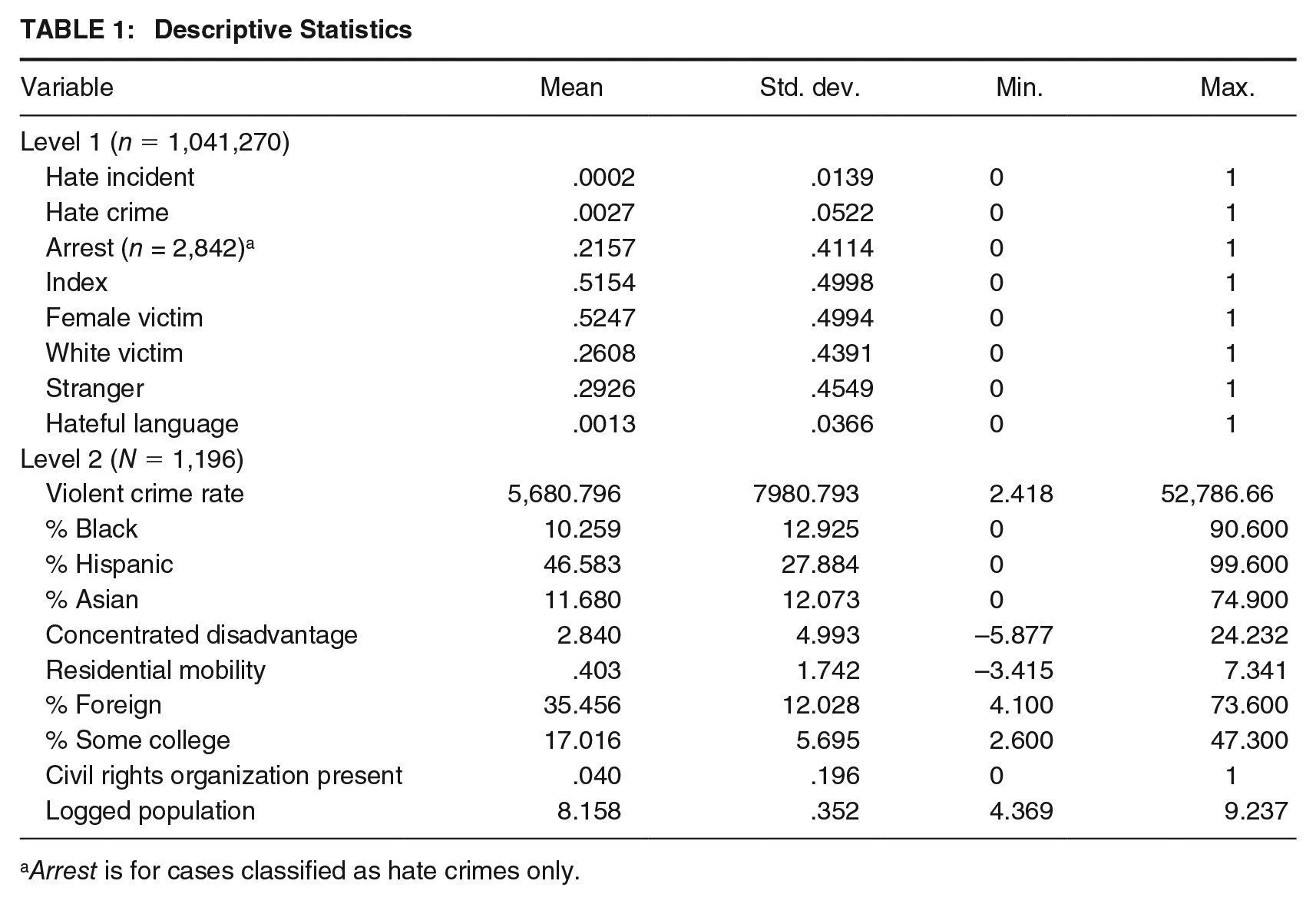
Arrest is for cases classified as hate crimes only.
Multivariate results are presented in Table 2. Prior to calculating the full contextual model, each specified outcome variable was included in an intercept-only, or fully unconditional, model to determine whether levels of police intervention were significantly associated with changes across neighborhoods and the degree of level two clustering. In other words, the fully unconditional models, as determined by the likelihood-ratio test compared with standard logit models, establish whether police classification and arrest are dependent on situational factors and the specific neighborhood in which it occurs. Preliminary unconditional models showed statistically significant model fit relative to standard logit models, necessitating the usage of nested modeling; the results have been omitted from the primary analysis but are available upon request.
Multivariate Mixed Logit Model Results
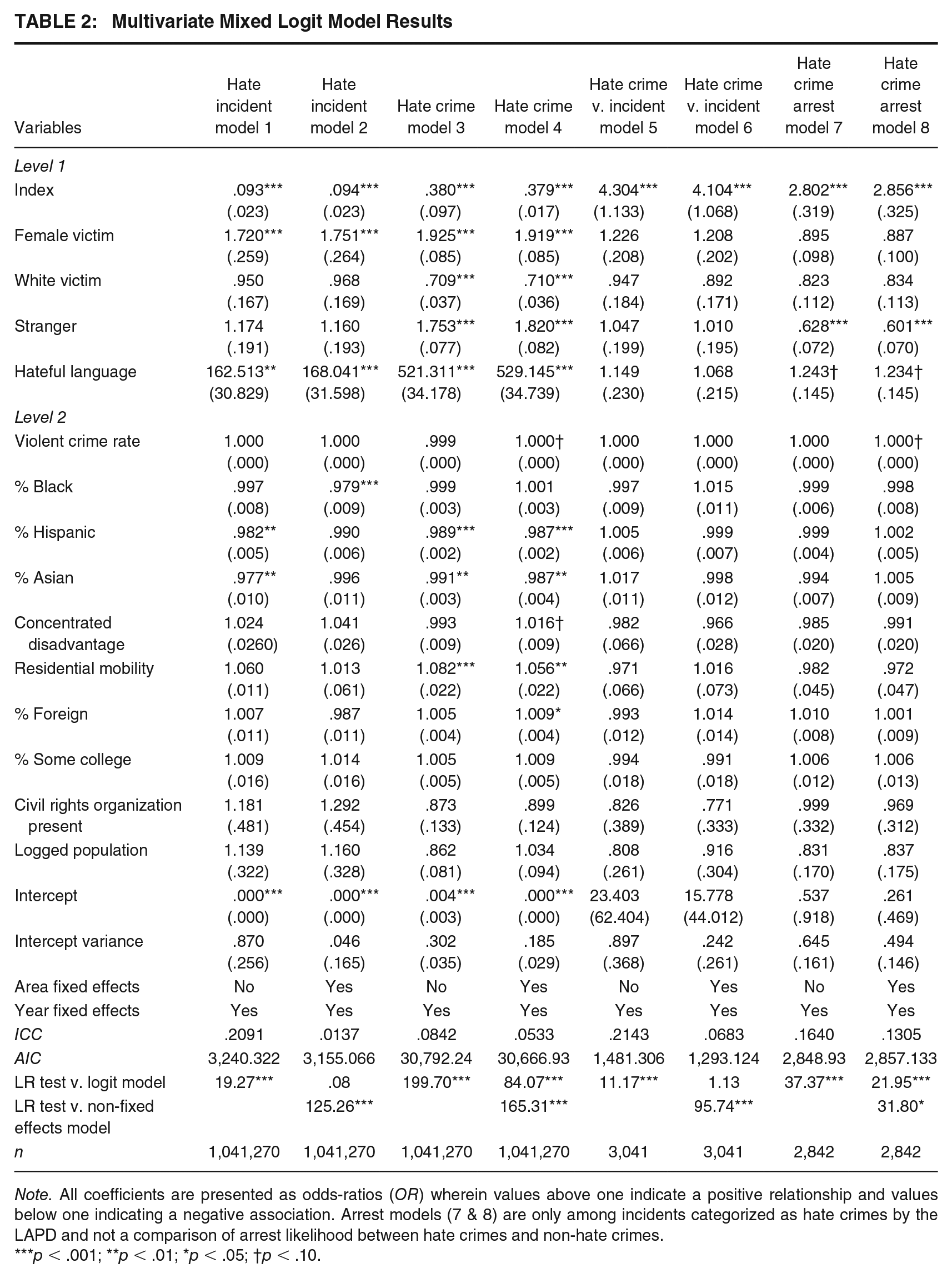
Note. All coefficients are presented as odds-ratios (OR) wherein values above one indicate a positive relationship and values below one indicating a negative association. Arrest models (7 & 8) are only among incidents categorized as hate crimes by the LAPD and not a comparison of arrest likelihood between hate crimes and non-hate crimes.
p < .001; **p < .01; *p < .05; †p < .10.
Turning to these multivariate results, wherein the likelihood of an incident being classified as a hate incident or crime is regressed upon situational and neighborhood factors, several variables were statistically significant. First, the ratio of explained variance in the outcome measure at the tract level is sizable, with roughly 20 percent of the variability in hate incident being attributable to neighborhood clustering (ICC = .2091). 5 While the bulk of variance is nonetheless due to the characteristics of the incident, the salience of situational factors in official intervention into potential cases of hate crime is established in the literature. On the other hand, official recording of hate crime is less influenced by neighborhood factors, evidenced not only by the relatively smaller tract variance but also in the minor conditional intra-class correlation coefficient (ICC) of .0842. Nonetheless, the model fit for Model 3 compared to a standard logit model is statistically significant (χ² = 199.70; p < .001), and the same is true for the likelihood of arrest for hate crimes in Model 7 (χ² = 37.37; p < .001), with a comparatively larger percent of explainable variance at the tract level (ICC = .1640). In predicting the likelihood of a classified hate crime relative to hate incident in Model 5, a sufficient degree of variance clustering was likewise present (χ² = 11.17; p < .001), with 21.43 percent of the variability in the outcome being explained at the tract level (ICC = .2143).
However, when including the fixed effects of the Community Police Station, Area, in which the event was reported, the spatial effects were somewhat diminished across models. This is evident by the general reductions in the intercept variances between each model as well as attendant reduced intercept variances when the Area fixed effects are included in the full model, thus affecting the estimated ICCs for each model. Furthermore, likelihood-ratio (LR) tests of nested model fit between models, those with Area fixed effects and those without, showed a statistically significant improvement in model fit when Community Police Stations were considered. While some models, overall, retained their statistically significant model fit versus a standard logit model (e.g., Models 4 and 8), the clustering effect into Level 2 units, that is, Census tracts, are attenuated when considering spatio-organizational factors.
Turning to the model predictions, the role of case seriousness was negatively correlated with hate incident (odds ratio [OR] = .093; p < .001) and hate crime (OR = .380; p < .001), but positively associated with the likelihood of arrest for hate crimes (OR = 2.802; p < .001). Among hate crimes, Part I offenses were nearly three times more likely to be cleared via arrest than Part II offenses. Still, police in the sample were more than four times more likely to consider an event as hate crime rather than an incident if the incident was serious (OR = 4.304; p < .001).
Victim characteristics were also predictive of official intervention although with mixed effects across models. In cases where a woman was a victim, police were more likely to classify the incident as being either a hate incident (OR = 1.720; p < .001) or hate crime (OR = 1.925; p < .001), but with no statistically significant relationship with arrest. The race of the victim was only significantly correlated with cases being classified as a hate crime, with a reduced probability of classification in cases with a White victim (OR = .709; p < .001). Whether the incident involved known parties increased the probability of an incident being labeled as hate crime by police (OR = 1.753; p < .001) but was associated with a reduced likelihood of arrest in hate crime cases (OR = .628; p < .001). Finally, the reported usage of biased language was strongly associated with the incident being officially classified as a hate incident (OR = 162.513; p < .001) or hate crime (OR = 521.311; p < .001) but not arrest. These extremely large effect sizes are probably attributable to issues in separation in the logit model wherein categories, while not completely separated, are nearly mutually exclusive. Accordingly, while these large estimates probably retain some kernel of truth, the strength of the relationship should be considered with caution.
Considering the conditional neighborhood effects, there is less consistency across models, especially when including the fixed effects for the Community Police Station that processed the incident. Although not entirely consistent, we see that police are often less likely to classify a case as either a hate incident or a hate crime given the racial composition of the reporting neighborhood. Without considering Area fixed effects, police are less likely to officially designate a case as a hate incident in more Hispanic (OR = .982; p = .001) or Asian (OR = .977; p = .020) neighborhoods. Yet, once the model is constrained by these fixed organizational features (Model 2), these relationships are no longer statistically significant, and it is neighborhoods with a greater share of Black residents that see a reduced probability of hate incident classification (OR = .979; p < .001).
For hate crime designation, on the other hand, the relationship between official criminal classification was retained when also including the Area fixed effects for Hispanic (OR = .987; p < .001) and Asian (OR = .987; p = .001) communities. Other additional structural features of the neighborhood are also significant predictors of hate crime classification. Cases occurring in neighborhoods featuring greater residential transiency were more likely to be considered as a hate crime by the LAPD in this sample, net of cross-Area fixed effects (OR = 1.056; p = .008). In this model (Model 4), the percentage of the foreign-born residents was also a statistically significant predictor of improved odds of hate crime, though with a generally weaker strength of association (OR = 1.009; p = .026). Importantly, none of these neighborhood features were statistically associated with the likelihood of hate crime arrest nor the probability that a case is classified as a hate crime but not hate incident.
Discussion and Conclusion
Space is a salient feature of the criminal justice system, and policing is unevenly distributed across geographies. Given this, prior scholarship on policing has worked to identify the community and working conditions that constrain and influence different styles of policing (Simes et al., 2023). Many studies of this type are multilevel, exploring the ways in which individual outcomes vary across contextual dimensions. However, scholarship remains limited on how space influences variations in police approaches to hate crime, and most studies are focused on the factors between agencies rather than within that contribute to the variability in hate crime classification and reporting (King, 2007; Lantz et al., 2019; Lyons & Roberts, 2014; Martin, 1995; J. M. Mills et al., 2024). Prior work sheds light on the potential of intra-agency characteristics as part of the larger process of hate crime mismeasurement at a national scale (Boyd et al., 1996; Holder & Ledford, 2024; Martin, 1995, 1996). To approach this gap in the literature, we conducted a multilevel analysis of varying police responses to reported hate crime in Los Angeles, clustering case outcomes (i.e., classification and arrest) into neighborhoods.
In doing so, we assessed the probability of differential police intervention into potential hate crime cases, ranging from official “hate crime” labeling to the likelihood of arrest. Nesting incidents and their situational correlates into City of LA neighborhoods, we found the likelihood of these case outcomes were mostly varied across neighborhoods, but that the bulk of explainable variance was attributable to a host of situational factors or other unidentified factors. Generally, neighborhood clustering explained anywhere from 3% to 20% of the variation in case outcomes such as official classification or arrest, but this figure declined when including fixed organizational measures of the LAPD.
More specifically, when we controlled for the local Community Police Station that responded to and adjudicated the incident, the effect of incident clustering was mostly attenuated. Not only was this evidenced by a statistically significant improved model fit with multilevel models with included fixed effects, but the drop in explainable variance at the neighborhood level when these same factors were included. Accordingly, findings from this study further demonstrate the situational and organizational factors that are influential in hate crime case processing, especially for stages of case processing requiring a greater degree of official resources and intervention, i.e., arrest. This work aligns, then, with previous findings that police maintain a strong degree of legality and alignment with black-letter law when responding to hate crimes, which may also represent what King and Kutateladze (2023) refer to as “evidentiary inflation.”
We found that more serious cases (Part I offenses) were less likely to be recorded as hate crimes or incidents but had higher odds of arrest for hate crimes—nearly three times more likely. Other incident factors also influenced police response. Police were more likely to classify incidents as hate crimes if the victim was a woman or if the person who committed the offense used hateful language, although White victims were 30% less likely to have their incidents classified as hate crimes. Incidents involving a stranger were more likely to be classified as hate crimes but less likely to lead to arrest, counter to expectations on constructing “real” hate crimes. However, this overlaps with one other known study that showed that close relational distance between the victim and party that committed the offense was correlated with reporting a hate crime but also negatively associated with arrest (Lantz et al., 2019). It may be the case that while the “image of the stranger” contributes hate crime official classification, the degree of relational distance between parties makes it difficult for police to identify potential offending parties to the conflict and make follow-up arrests for the criminal aspect of the incident. Finally, reported hateful language by the person(s) who committed the hate offense strongly predicted hate crime classification, aligning with previous research that also shows how slurs affect perceptions of hate crime (Lyons, 2008; Saucier et al., 2008, 2010; Zhang, 2023). Practically, the presence of hateful messages should greatly assist in the work of the responding and investigating officers in classifying the incident, especially given the difficult task that is categorizing incidents, criminal or not, as bias motivated.
Our study examined the contextual nature of police response to hate crime incidents. Model fit statistics showed significant neighborhood variation in hate crime classification and arrest likelihood, with internal departmental factors reducing some clustering but with remaining significant neighborhood features. Neighborhood racial composition influenced classification: Racially diverse and Black communities were less likely to see incidents categorized as hate crimes, while areas with more Asian or Hispanic residents had reduced odds of incidents being labeled as hate crimes. This aligns with research suggesting reduced social control in non-white communities (King, 2007; King et al., 2009; Liska & Chamlin, 1984; J. M. Mills et al., 2024). Residential mobility rates predicted better odds of hate crime classification but not other stages of the criminal justice process. Hate crimes often occur in socially disorganized areas (Gladfelter et al., 2017; Grattet, 2009; Holder et al., 2024; Lyons, 2007; C. E. Mills, 2020), reflecting actual occurrences rather than differential police detection. A key limitation is that our data cannot determine the “right” decision by the LAPD, potentially reflecting true hate crime occurrences rather than officer and departmental discretion and bias. Researchers should develop novel data-collecting techniques to uncover cases that should have been labeled as hate crimes but were decided otherwise.
This study explores how situational and environmental factors affect the policing of hate crime but cannot speak to potentially salient organizational factors that produce variation in hate crime data. A more robust analysis would include intra-agency factors like officer and suspect characteristics, workgroup dynamics, and intra-agency policies. While we controlled for some organizational constraints using LAPD Community Police Station fixed effects, this does not capture all within-agency variables. Our study is limited to Los Angeles, and while findings may extend to other locales, the mechanisms within the LAPD may not apply elsewhere. Nonetheless, our findings show variability within an agency, highlighting the need for broader studies across different agencies and locales, including comprehensive ecological and organizational measures.
To conclude, future studies should partition the variability of hate crime classification between the “true” sources of occurrence, emphasizing crime-generating mechanisms, and to what degree is a reflection of inter-officer or agency policy. Given that official hate crime data, or those derived from voluntary police reporting, is usually considered to be a reflection of agency and organizational behavior rather than factual occurrence of hate crime across the United States, it stands to reason that differences in agency reporting behaviors can be partially linked to their response to criminal incidents and the classification process. Identifying and studying this crime data funnel may allow researchers to clarify other potential sources of hate crime mismeasurement and endogenous and exogenous sources of crime measurement within and between agencies.
