







Abstract
Research highlights the role of misdemeanors in expanding the reach of the U.S. criminal legal system. However, less is known about the implications of criminalizing traffic offenses. This study investigates the consequences of categorizing traffic violations as criminal in Georgia and the legal financial obligations imposed by courts. We triangulate data from 60 interviews and 120 hr of court observations across six jurisdictions in Georgia using a two-phased inductive-deductive coding approach. We find that Georgia’s misdemeanor traffic courts rely heavily on probation as a payment mechanism, often imposing additional fees and prolonged surveillance on individuals unable to pay fines upfront. This system amplifies financial burdens, increases incarceration risks, and varies significantly across jurisdictions, functioning as a net-widening tool that deepens individuals’ entanglement with the criminal legal system. We recommend restructuring “pay-only” probation and echo calls for more robust procedures to assess individuals’ capacity to pay.
Keywords
Introduction
About 13.2 million misdemeanor cases are filed annually in the United States (Stevenson & Mayson, 2018), and about 7% of the population, roughly 34 million people, report having had a police-initiated traffic stop (Tapp & Davis, 2022). While research overwhelmingly focuses on the effect of felony convictions, there is a notable lack of research on misdemeanor offenses in criminal courts, which, for most individuals, is their only interaction with the criminal justice system (Natapoff, 2015). Monetary sanctions are the most common punishment imposed on individuals who encounter the U.S. criminal justice system, typically accompanying other penalties such as community service, probation, and incarceration (Bannon et al., 2010; Harris, 2016; O’Malley, 2009). This can have serious consequences, as monetary sanctions are often a key condition of supervision (Martin et al., 2018).
In Georgia, all traffic offenses are classified as misdemeanors, except for seatbelt violations and parking. In 2023, approximately 1.1 million traffic cases were filed in the criminal courts across Georgia, excluding serious traffic offenses (Judicial Council of Georgia, Administrative Office of the Courts, 2024). That same year, Georgia had the highest rate of people under community supervision, with 4,399 individuals per 100,000 adults on felony or misdemeanor probation (Kaeble, 2024). Given its widespread nature, the misdemeanor probation system plays a crucial role in monitoring and collecting legal financial obligations (Harris et al., 2017; Shannon, 2020). This is notable because although individuals typically enter the court system for minor offenses such as traffic violations, the total costs imposed can be substantial and often surpass those of felony probation (Huebner & Shannon, 2022).
While research has considered the consequences of the misdemeanor system, there is a notable gap in the literature regarding the criminalization of traffic offenses as a net-widening tool within the criminal justice system. Georgia provides an ideal case to analyze because traffic offenses are criminalized and pay-only probation is used to handle the incremental repayment of LFOs. The pay-only probation system enables unconstitutional practices and unjust punishment, prioritizing profit over rehabilitation (Bellacicco, 2013). This highlights not only the prevalence of a modern-day debtors’ prison but also the widespread issue of what we are calling “debtors’ probation.” The current study examines the net-widening impact of misdemeanor traffic offenses in municipal, probate, and state courts across Georgia, revealing extensive variation in LFOs assessed per person and collection practices. It also explores how misdemeanor probation supervision, particularly Georgia’s “pay-only” probation policy and debtors’ probation practice, contributes to higher LFO amounts (O.C.G.A. 42-8-103).
The Growth in Community Supervision Across the United States
Probation supervision has become more punitive over time and is considered a significant contributor to mass incarceration through the excessive use of probation revocations (Phelps, 2020; Roth et al., 2021). In 2019, the number of people on probation was nearly 1.5 million, higher than the total number in jails and prisons combined (Roth et al., 2021). Community corrections serve as a net-widening tool, diverting cases from legal financial obligations and other non-supervisory punishments (Aebi et al., 2015; Phelps, 2013, 2017). Probation, specifically, is viewed as a front-end net-widening tool that expands the system’s reach through intermediate sanctions (Tonry & Lynch, 1996). Community supervision further expands this reach by increasing the likelihood of incarceration through intensified monitoring (Phelps, 2013, 2017; Tonry & Lynch, 1996). As a result, probation amplifies punishment for lower-level offenses, even in cases where long-term incarceration was never a likely outcome (Phelps, 2013).
The Role of Fines and Fees in Net-Widening
Along with community supervision, monetary sanctions became a common practice in the criminal justice system (Garland, 2001). Monetary sanctions, also known as legal financial obligations (LFOs), are penalties imposed by the court system, including fines, fees, and restitution. Like community supervision, monetary sanctions were originally introduced as an alternative to incarceration but have since expanded to encompass nearly all criminal and traffic cases, often alongside other penalties (Bannon et al., 2010; Beckett & Harris, 2011). For example, probation conditions typically require LFO payment in addition to other requirements such as avoiding drug use and maintaining employment (Bannon et al., 2010; Phelps, 2020).
Monetary sanctions are often perceived as less-restrictive resolutions, yet they impose a financial burden on individuals and trap them in a cycle of poverty (Harris, 2016; Martin et al., 2018; Pleggenkuhle, 2018). Individuals with outstanding criminal debt from felony and non-felony offenses encounter numerous penalties that disrupt their economic and social well-being (Martin et al., 2018). Several state laws permit the suspension of driver’s licenses for unpaid legal financial obligations (Harris et al., 2017). Unpaid debt can also negatively affect credit scores, trigger wage garnishment, result in the intercepted of tax refunds (Bannon et al., 2010) as well as lead to revocation of parole or probation (Harris, 2016).
Traffic Misdemeanors and LFOs in Georgia
Traffic violations are the most common cases in the court system (Stevenson & Mayson, 2018), and the most frequent point of contact between citizens and the criminal legal system (Davis et al., 2018). While most U.S. states treat minor traffic violations such as non-criminal driving violations, equipment infractions, or administrative regulations as civil offenses, 17 states, including Georgia, classify these violations as misdemeanors (Gartenberg, 2023). Epp and colleagues (2014) explain that criminalized traffic stops are a uniquely coercive feature of American life and can prompt a cascade of social and legal consequences. These practices disproportionately target people of color, who are more likely to face subsequent criminal legal sanctions (Baumgartner et al., 2018). In Georgia, most traffic offenses are classified as misdemeanors, punishable through fines, probation, or up to 12 months of jail time. Judges can impose additional penalties, including reexamination by the Department of Driver Services, defensive driving courses, or specific probation conditions (O.C.G.A. 17-10-3d).
In 2018, nearly 40% of the state’s 430,000 probationers served sentences for misdemeanors or traffic fines (Khalfani, 2021). While fines and fees are common outcomes, Georgia’s probation system uniquely oversees and enforces these financial obligations, contributing to the state’s high probation rate (Harris et al., 2017; Shannon, 2020). A unique aspect of Georgia’s legal system is “pay-only probation” (O.C.G.A. 42-8-103), which subjects individuals to supervision solely due to their inability to pay fines immediately. Although pay-only probation does not include standard supervision conditions, individuals are still required to report to a probation officer and make payments toward their fines and fees. Reforms in 2015 capped supervision fees at 3 months and allowed conversion to community service, though fees can be reinstated to monitor compliance (Georgia House Bill 837, 2014). In addition, Georgia prohibited state agencies from supervising misdemeanor probationers, delegating this task to private companies (Harris et al., 2017; Huebner & Shannon, 2022). Private probation companies play a central role in the monitoring process and enforce LFOs despite laws prohibiting extended probation solely for nonpayment (Harris et al., 2017). As such, it is imperative that oversight be implemented and private entities be evaluated (Latessa & Lovins, 2019; Montes & Mears, 2019).
Privatizing probation services in Georgia highlights concerns over monetary sanctions as a compliance measure. Judges may impose consecutive sentences, extending probation for those unable to pay fines, creating a cycle of supervision and debt (Huebner & Shannon, 2022). The “pay-only probation” structure often results in additional fees and prolonged financial obligations for those unable to pay upfront, further entrenching low-income individuals in the legal system. More recently, scholars have considered the collateral consequences of monetary sanctions and how legal debt disproportionately affects low-income individuals (Harris, 2016). However, less focus has been placed on using probation to extend the payment of legal financial obligations over a certain period, and there has been limited research on the role of traffic offenses in contributing to net-widening within the criminal justice system. Georgia’s use of criminalized traffic offenses and “pay-only probation” exemplifies a system where probation extends the collection of legal debts rather than addressing underlying inequities.
Data and Methods
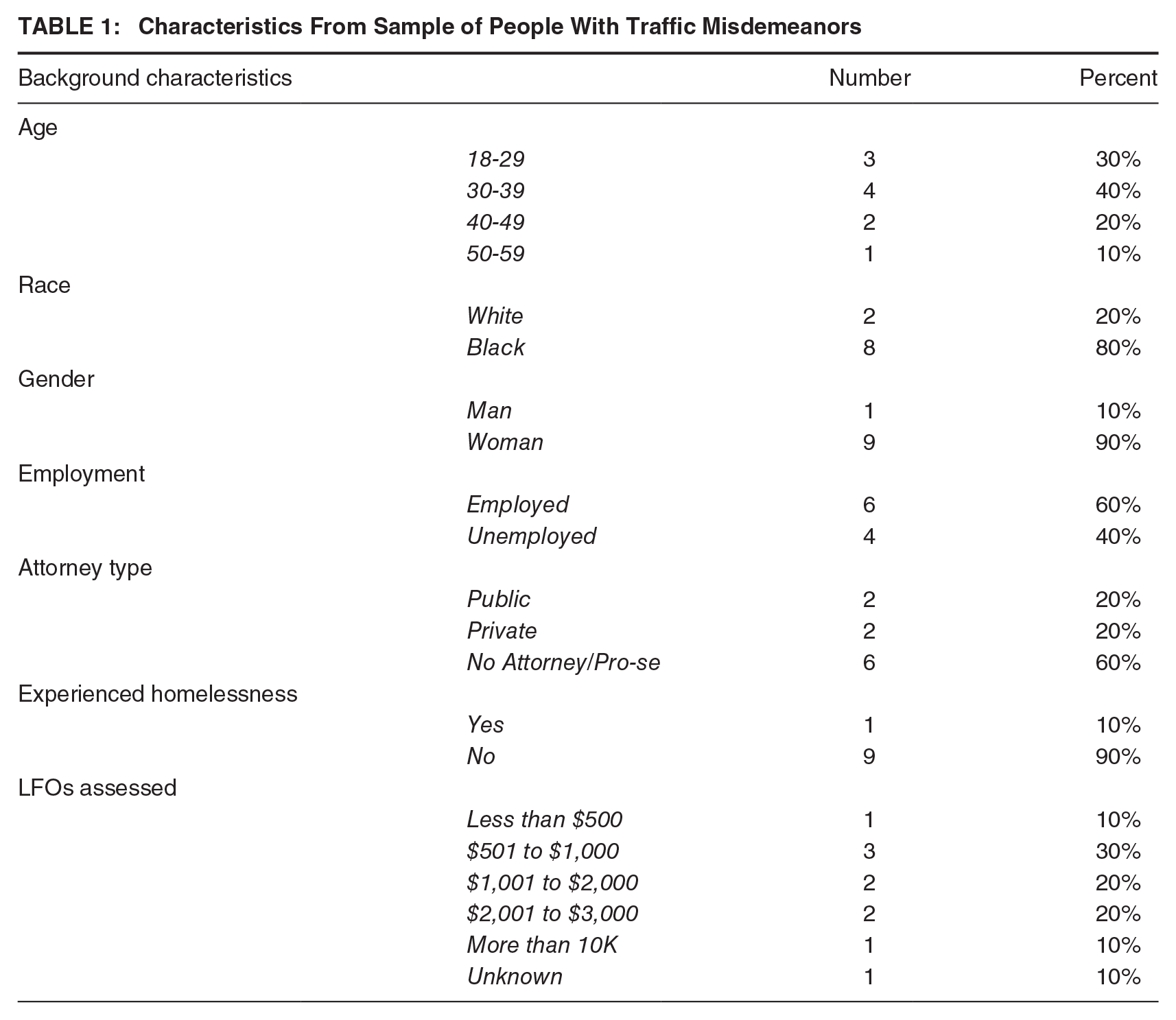
The current study triangulates data from interviews with people who owe criminal legal debt, interviews with system actors, and observational field notes from state, probate, and municipal courts across six sites in Georgia. We collected these data from 2016 to 2018. 1 First, we draw on about 120 hr of ethnographic fieldwork to identify how traffic convictions lead to probation supervision and how this supervision is connected to LFO sentences. In addition, the field notes were used to detect how increased surveillance leads to higher LFOs assessed per person. Second, we include data from semi-structured interviews with 50 system actors across six jurisdictions in Georgia, including 10 defense attorneys, six prosecutors, 16 judges, seven court clerks, and 11 probation officers. Third, we draw on interviews with 10 people in Georgia who owe criminal legal debt from traffic offenses to examine how these convictions increase probation involvement and result is more LFOs assessed. 2 The traffic offense convictions for people who owe criminal legal debt occurred between 2013 and 2017 across five different court jurisdictions in Georgia. LFOs owed ranged from below $500 to more than $10,000. The sample of people with traffic offenses was predominantly female (90%), identified as Black (70%), and 60% were employed at the time of conviction. Sixty percent had no attorney representation or represented themselves during criminal traffic court proceedings. See Table 1 below for more data on the sample.
Characteristics From Sample of People With Traffic Misdemeanors
All interviews were transcribed, and all analysis and coding of interview transcripts and field notes were conducted using NVivo software. The coding for this study was completed in two phases. Phase 1 of the coding was conducted with the larger monetary sanctions team and included researchers from all sites developing inductive and deductive codes following modified grounded theory (Lofland et al., 2006). This coding phase eventually resulted in a broad codebook. Phase 2 of the coding process involved a subsequent analysis of a subset of the broader codes from Phase 1 for all field notes, interviews with system actors in Georgia, and interviews with a sample of people who owe criminal legal debt with only traffic offense convictions. These codes include but are not limited to “Court Processes,” “Consequences for Non-payment,” “Assessing Ability to Pay,” “Payment Plans,” “Indigency,” and “DUI and Traffic Offenses.” We utilized both convergent and holistic triangulation (Turner et al., 2017) by carefully integrating findings from interviews with system-involved people, interviews with system actors, and ethnographic court observation fieldwork to leverage the strengths of each form of data and provide a more nuanced and comprehensive understanding of how Georgia law, which criminalizes traffic offenses, operates as a net-widening tool. By integrating the findings from all three forms of data, we identified convergence and divergence in the data to enhance the robustness of the study’s findings (Turner et al., 2017). Through the triangulation process, the current study identifies two trajectories for individuals in Georgia convicted of traffic offenses, shown in Figure 1. We identify two processes for why individual contact with probation leads to higher amounts of LFOs assessed per person: (1) increased costs as a result of being placed on misdemeanor probation supervision (e.g., paying monthly supervision fees) and (2) increased surveillance (e.g., debtors are sentenced to more time on probation to pay their LFOs, resulting in more time being watched and a higher likelihood of being caught failing to comply with probation conditions, which in turn leads to the imposition of additional LFOs).
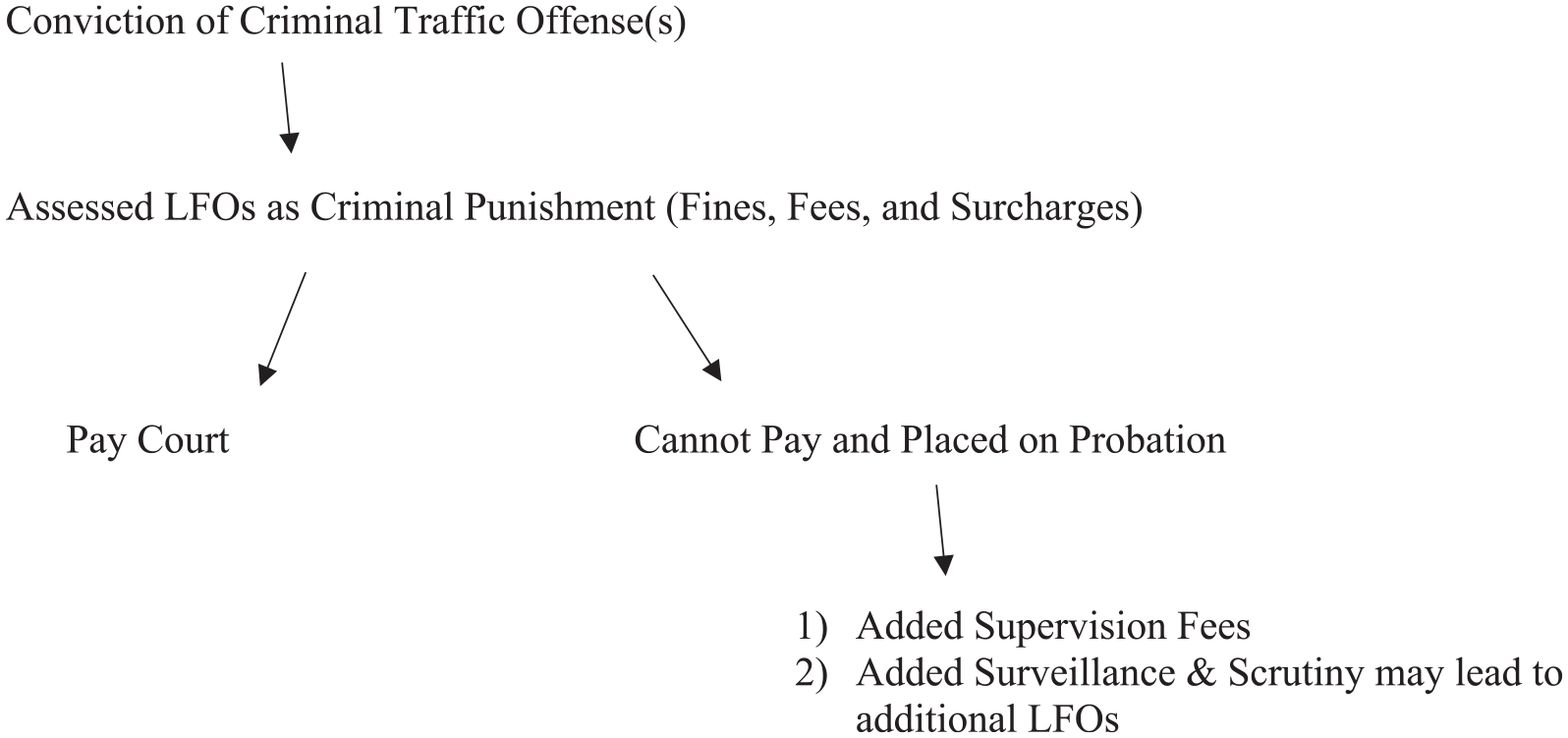
The Two Trajectories for People Convicted of Traffic Misdemeanors
Findings
Our findings highlight how Georgia’s misdemeanor traffic courts impose significant financial and legal burdens, particularly on those unable to pay fines immediately. Defendants unable to pay upfront are placed on debtors’ probation, incurring additional fees and deeper legal entanglement. Fast-paced court proceedings often overlook defendants’ ability to pay, while probation escalates both financial obligations and legal exposure. Fine amounts, probation fees, and practices vary widely by jurisdiction, compounding these burdens. Some system actors use discretion to reduce costs, but economically disadvantaged individuals remain disproportionately affected. Many are unaware of the serious consequences tied to traffic citations and the requirement to pay in full at the hearing to avoid further system involvement. In the following sections, we investigate the net-widening role of this system, detailing how pay-only probation operates, its consequences, and how local discretion shapes its use.
The Typical Pay-Only Probation Court Process: “Can You Pay Today?”
The field notes described Capitol Heights courtrooms as processing centers rushing through traffic cases. Observers described the setting as a fast-paced pleading, with the judge executing rulings and the clerk processing payments. In a Capitol Heights courtroom, a judge noted the 500 cases assigned to her docket that week. In response to a private attorney requesting a jury trial after initially waiving that right, another judge remarked that he handles about 800 cases per week, which is about 300,000 cases a year. He emphasized that, given this volume, cases could not be brought back on the calendar.
Every person that the judge spoke to in the courtroom was asked, “Can you pay today?” This was followed by either a “yes” or “no” response from defendants, ultimately defining their level of association with the criminal court system. Judges ensured that defendants knew the various methods of payment that they could provide to the court. During a court observation, the judge began by announcing that additional fees and surcharges would be added to the final amounts assessed. She then directed individuals to the cashier’s location for payment and informed them that the court accepts Visa, Mastercard, American Express, cash, or check.
Another unique attribute of categorizing traffic offenses as misdemeanors is the failure to appear (FTA) charge which gets added when an individual misses their court hearing. In one case where the judge issued a failure to appear charge of $100, the defendant explained that he misread his ticket and came to the court two days later. The judge responded, “Too bad you were late, learn to read the ticket.” It was common to see an FTA charge of $100 added to the amount owed to the court. In one instance, everyone on the docket had an FTA for an old ticket. A court observer noted, “The young woman I was waiting with told me that they had been calling up old tickets from years past, even back to 2004.” This practice appeared aimed at generating revenue by reopening previously resolved cases. People faced disparate trajectories based on their ability to pay fines and surcharges immediately: those who paid promptly had brief legal interactions, while those who could not faced more obligations and surveillance through debtors’ probation.
How and for What Pay-Only Probation Is Used: “Seems Like a Silly Thing to Go on Probation for Speeding”
A common practice across Georgia courts involved using pay-only probation to allow defendants to make payments toward their legal debt over time. A judge in Capitol Heights explained the process of pay-only probation as outlined in the statute: We have pay only probation and we used to have, when we reset the case, some people call it time to pay, where they come back. Pay only probation puts them in the probation system. If they don’t pay within 90 days, it converts to regular probation, or it could convert to community service too.
Pay-only probation provides defendants with a payment plan option. However, the use of probation can be net-widening, as inability to pay can lead individuals to supervised probation, exposing them to additional penalties.
Judges rarely assessed defendants’ ability to pay, instead defaulting to pay-only probation as a routine, unquestioned path. In a Capitol Heights case, a defendant was charged with failure to stop at a stop light and was assessed a $175 fine plus court costs. The judge stated, “he needs probation to pay,” and sentenced him to 12 months on probation without offering an alternative. As cases moved quickly, judges relied on established courtroom patterns to make their rulings. In some instances, judges automatically assumed that individuals could not pay. In one case, involving an older Black male charged with seatbelt and insurance violations, the fine amounted to $250 plus surcharges, fees, and the FTA. The judge appeared to assume the defendant could not pay, placing him on probation without mentioning the final amount owed. In another case involving a young Black male with multiple charges totaling $415, the judge seemed surprised when the defendant said he could pay the full amount that day.
The process of private probation was opaque, with individuals often unaware of their conditions. In an interview with a Black female defendant in Capitol Heights who had a traffic ticket of unknown origin, the woman described what she was told by her probation officer:
Well the first 30 days of being on probation, there will not be a fee if I pay it all off. But after 30 days, there will be a probationary fee tacked on as well as every 30 days. So I have from the 21st of April up to May 21st to pay everything off to not have to assess the probationary fee as well.
Did they tell you how much that would be?
No, I don’t remember what it was. I think it’s like $32 for the probation fees.
The defendant was assessed $406 and was expected to pay a minimum of $107 per month. She was told, however, that she could pay whatever she could to avoid being in violation of her probation. She also mentioned that the total amount was broken down to $200 for the ticket, $50 for the public defender, and the remaining balance for the surcharges. The judge did not explain this breakdown to her; instead, it was her probation officer who clarified the amount.
Furthermore, in an interview with a Latina defendant in Elmwood County, she stated that her first traffic offense involved four charges, including following too closely, no insurance, expired tags, and no license on her person. She described that she was sentenced to probation, and after the probation officer considered her monthly income, she was expected to pay $200 every month. In her interview, she discussed that she was unfamiliar with the probation process, and at one point, she was almost in violation of her probation due to not reporting on time.
Okay. With it being my first time, I thought I just had to check in because when I paid, and so I went in there to pay my first month, after . . . She never mentioned in our initial meeting that I’d have to come in every single week, so I finally came to pay, and she was like, “Hey, you’re already violating your probation.” I was like, “Excuse me?” And she was like, “Yeah, you’re violating your probation.” I said, “How?” She’s like, “You have to report every week.” And so I told her, “I’m sorry I didn’t know that.”
An attorney did not represent this defendant, and she did not fully understand the court process. After pleading guilty to all four charges, she was sentenced to 1 year of probation, with no option to terminate it upon full payment.
Another aspect of the private probation system is the supervision fees, which are often undisclosed unless requested and can be substantial depending on the length of probation. In an interview with a White female defendant in Northfield County, she discussed the payments that she was expected to pay. She estimated she paid “some months about $25, some months $50” toward her fines but paid “$43 a month” for supervision fees. In this case, the defendant’s probation fees exceeded the amount owed for her legal financial obligations. In addition, she was expected to make the probation fee payments separately via money order, as the probation company did not accept checks. This process created an added barrier for clients, forcing them to manage multiple payment formats for the same agency. See Table 2 below for a comparison of fees by jurisdiction and private probation companies.
Supervision Fee Differences by Jurisdiction and Private Probation Companies
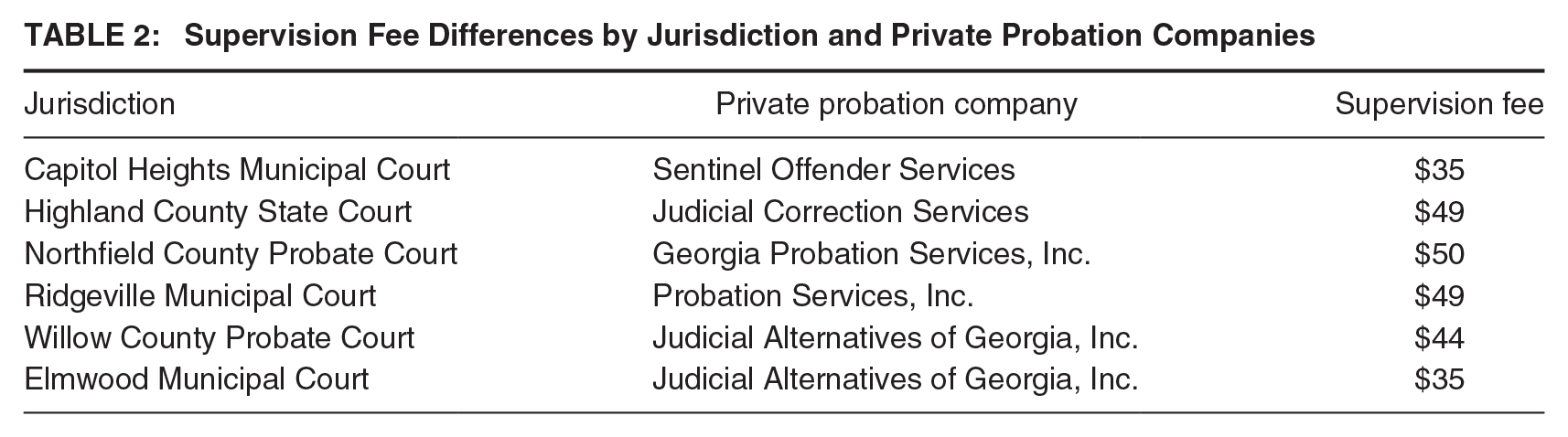
Previous research notes that supervision fee amounts are not publicly disclosed as there are several private probation companies across the state (Huebner & Shannon, 2022). Using court observations from six jurisdictions, we compiled a table of supervision fees and noted five different probation companies operating across these courts. There were jurisdictional differences in the monthly supervision fees individuals were required to pay, with fees varying between city and county courts within the same jurisdiction. Capitol Heights Municipal Court and Highland County State Court were contracted to two different private probation companies. The supervision fees were highest in Northfield County Probate Court at $50 and were lowest in Elmwood Municipal Court and Capitol Heights Municipal Court. Although Elmwood Municipal Court and Willow County Probate Court were under contract with the same private probation company, the supervision fees between both reflected a difference of $9.
Consequences of Pay-Only Probation: From Debtors’ Probation to Prison
The court’s reliance on the debtors’ probation system exacerbated debtor’s financial burdens. Defendants unable to pay faced the original fines, added probation fees, and surcharges. One defendant on misdemeanor probation for traffic offenses reported that a minor fine escalated to nearly $1,000 due to a probation-related costs. Judges also went out of their way to warn defendants about probation costs during court. In one case, the defendant was placed on probation with a fine of $500 for driving without a valid license and $250 for driving without valid insurance. The judge stated, “I’ll place you on probation, pay off as fast as you can so it’ll be cheaper.” In another case, an attorney advised a defendant about the incurred costs of probation as she stated, “You don’t want to pay any more than you have to.” She told the defendant she would save more money if the probation were completed as soon as possible.
Aside from paying more than the original fees, defendants on pay-only probation faced further criminal justice entanglement. In one case, a defendant was behind on payments by $340. When the defendant could only pay $300 by Friday, the judge revoked the pay-only probation for regular probation. The judge stated, “I don’t want to set him up for failure.” This practice would allow the defendant to pay the $300 and give him 60 days to pay his arrears. Defendants also faced incarceration for unpaid legal debt and failure to report. In one case, a defendant who missed three check-ins and had not paid for the original charge of driving with a suspended vehicle registration said she could pay $200 by Friday; the judge warned her that she would face 10 days in jail if she failed to do so. In another case observed, the judge revoked probation for a defendant with multiple traffic offenses: A young white male was placed on probation in May of 2015 for reckless driving, improper lane change, and illegal tag. His probation expires in May 2020, and his total fine is $1,527. He is behind on his probation fees by $245 and he has failed to report. . . . The judge finds that he violated his probation by failing to report, pay, and to complete community service hours in lieu of payment. He revokes the 20 days and requires the defendant to do no less than 30 hours of community service per month. (Ridgeville Municipal Court)
This example demonstrates the lingering effects of a traffic stop. On the probation side, additional charges are incurred if individuals are late on their payments. In an interview with a Black woman in Capitol Heights, the woman discussed the consequences that she faced for not paying her debt on time. She explained the late charge “was maybe like $10 or something. I forgot what he said, but we just said if I don’t make a payment by this time, then I can get arrested or something.” She explained that, despite being threatened with jail time twice, work obligations prevented her from performing community service, resulting in her having to pay late fees and serve time in jail for failing to pay her legal financial obligations on time. In another interview, a Black woman in Elmwood said she spent four nights in jail after missing two court appearances for a no-insurance charge. She stated that she forgot to go the second time because she was working two jobs at the time and was penalized with jail time.
Discretionary Practices in Municipal Courts
Occasionally, judges employed discretionary measures to mitigate the harshness of standard legal penalties. For example, some allowed for a short grace period for payment around the holidays or reduced probation supervision periods. This was a more common practice in courtrooms located in rural areas compared to busier courtrooms. This was seen in Elmwood Municipal Court, where the judge ordered the fine to be paid later due to the defendant’s inability to pay that same day. In one case, she told the defendant to pay by January 11 because “It’s Christmas time.” In this county, defendants unable to pay in full on the same day are generally sentenced to 12 months probation. However, this judge allowed defendants a grace period to pay at a later date without going on probation. In the following court observation, a judge in Ridgeville County asked defendants about their ability to pay and the time they needed to pay: The next case is for a young Latino male, he has reviewed his rights form and has no questions. He waives his rights to enter a plea. The defendant is 20 years old and is charged with failing to move over for an emergency vehicle. He enters a guilty plea and signs the electric pad. The defendant has had previous citations for speeding and reckless driving. The defendant is sentenced to pay a reduced fine of $400 from $504, he cannot pay today. The judge asks, “what time frame do you need?” He says 2 weeks but the judge says he will extend it to 4 weeks. The judge puts the defendant on the calendar for April 19th but if he pays before that he doesn’t have to come back to court.
This judge allowed defendants extra time to pay their court fees through a workaround.
Judges and attorneys pointed out the systemic inclination to levy high fines and fees, which are disproportionate to the misdemeanor offenses. Judges critiqued this practice for its ineffectiveness in serving justice and its excessive burden on financially vulnerable populations. Although fines are generally standardized, we found that many judges would discuss how they exercise discretion based on defendants’ circumstances. In an interview with a Capitol Heights judge he explained, So, in my courtroom, I have for traffic offenses just general fines for the most part that I assess for most people. But, once they come and speak, if they enter their plea, I then ask them if there’s anything they need to tell me.
Some judges offered community service conversions as an alternative for defendants unable to pay, allowing them to perform community service, or a combination of service and partial payment. In an interview with a judge in Ridgeville, he emphasized payment flexibility, stating, “If it’s a situation where it’s obvious to me that this person’s going to need two months to pay $129, then the first thing I’m going to say is why don’t we convert this to community service hours.” This approach reflected an effort to balance accountability with empathy for the economic situations of defendants. While defendants may choose community service, failure to complete it can result in probation revocation and potentially jail. As one judge warned, if a defendant cannot complete community service or pay, they would have to serve jail time.
A program used in Capitol Heights courtrooms was the Teens Learning Control (TLC) program, giving youth 4 months to complete it to avoid traffic convictions. However, judges warned that failure to complete the program could result in fines up to $1,000 and up to 12 months in jail. A judge said, “You won’t have to concern yourself with fines, you will however have to bring a toothbrush with you.” Some jurisdictions also offer pre-trial intervention for traffic offenses to avoid a conviction, but program fees created additional barriers. When defendants tried to have these fees waived, they often encountered administrative delays: When you go to the prosecutor and you say, “I want the fee waived,” the prosecutor will act like, “Oh yeah, sure we can do that.” Well, then it’s like pulling teeth to actually get it done administratively. They like drag their feet, and drag their feet, and we’ve had very little success.
System actors noted the lack of infrastructure for partial payments, forcing reliance on probation services that profit from managing them. In an interview with a judge in Elmwood, he outlined how probation officers manage defendants’ payment schedules: If there’s someone who warrants probation under those circumstances, then it’s a situation where if they don’t pay, probation will determine and bring them back. Most of the time, probation’s not gonna bring them back just for the money aspect of it.
As this example demonstrates, probation determines the consequences of nonpayment. One Capitol Heights public defender described, So historically, if you can’t pay upfront, you have to get put on probation, because the court doesn’t have an office that accepts periodic payments. They’re not set up for it, they didn’t want to be set up for it. They could have easily been set up for it, but they just never have.
In contrast, a judge in Ridgeville Municipal Court explained that individuals on pre-trial diversion can make interest-free, incremental payments in person; however, online payments are unavailable, and balances must be confirmed at the court office.
Discretion can also lead to negative outcomes for defendants based on specific circumstances. According to a public defense attorney in Capitol Heights, when asked if there are ever any differences in the amounts people are fined, she told us: We have never actually analyzed it, but it also comes from anecdotal evidence where you’ll [see] public defenders coming back from court saying, “I can’t believe that judge. He had a white guy in front of him and he gave him the $50 fine, my clients’ charge was the exact same thing, he comes a few cases after that case and the judge imposes a $250 fine. I don’t know the difference.” Those kinds of conversations are routine.
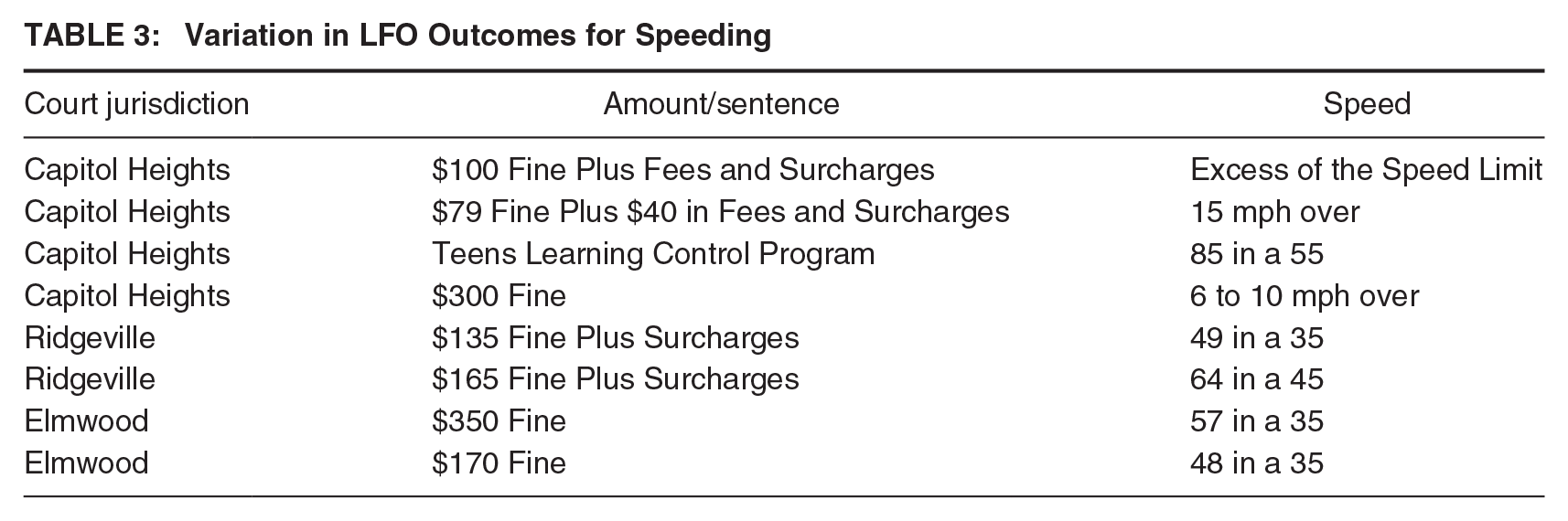
Our ethnographic fieldwork revealed variations in penalties for the same offense. The amount owed for a speeding charge differed by how fast the person was driving over the limit, by jurisdiction, and by the judge. We found fine amounts ranged from $79 to $350. In one Capitol City court, a middle-aged Black man pleaded no contest to speeding and improper lane change. His speeding fine was $300, with an added $100 FTA fee. The improper lane change charge was $150, with an FTA fee, bringing his total to approximately $650, which he could not pay. The judge told him, “You’ll be placed on probation, until you can pay it off through them.” See Table 3 below for a description of the variation in LFO outcomes for speeding across jurisdictions.
Variation in LFO Outcomes for Speeding
Through our interviews with system actors, we learned that there were calls to decriminalize minor traffic offenses, reserving criminal penalties for what system actors deemed more serious violations, like DUIs and reckless driving. A Capitol Heights defense attorney suggested that removing minor traffic infractions from the courts could ease caseloads and improve outcomes for low-risk defendants. He said, “decriminalize all traffic all those except those that harm people, the DUIs, and the reckless driving, and the habitual speeder; people who just don’t care about the law or anyone else’s safety.” The attorney also warned that this shift would require careful policy development to ensure public safety. Similarly, a judge in Elmwood recommended that traffic offenses be reclassified, viewing them as minor infractions, “Let’s pull traffic out. Now, when you pull traffic out, you know, it’s misdemeanors. No big deal, right?”
These findings underscore individuals’ dual trajectories in the Georgia misdemeanor justice system, exposing a stark divide based on financial capability. Debtors’ probation is not merely a payment plan option; it imposes significant risks, especially for indigent populations. This system not only perpetuates inequality but also increases the likelihood of ongoing legal and financial burdens for the less affluent, potentially trapping them in a cycle of surveillance and punishment that does little to serve the principles of justice or rehabilitation.
Discussion and Policy Recommendations
This study identifies how traffic offense criminalization leads to more LFOs assessed. First, we argue that as state traffic offenses move from violations to misdemeanor criminal offenses, more people will encounter misdemeanor probation due to their inability to pay. This process is an example of net-widening—bringing more people under the control of state supervision and punishment. Specific laws in Georgia, such as Pay-Only Probation (O.C.G.A. 42-8-103), allow this net-widening process to occur. We see misdemeanor supervision utilized as a “payment plan” for individuals who cannot pay their fines and fees at their hearings. Second, we argue that as more people have contact with pay-only probation, the quantity of LFOs assessed per individual increases. When individuals are convicted of traffic offenses and placed on probation, they may accrue higher fees. Being placed on misdemeanor probation also leads to increased surveillance, scrutiny, and further entrenchment in the cycle of poverty that would not occur if an individual could pay without being placed on probation.
We triangulated data from interviews with people who owe criminal legal debt, interviews with system actors, and observational field notes in Georgia. We demonstrated how fines and fees imposed for traffic offenses contribute to the ever-growing net-widening issue common to probation (Phelps, 2013, 2017). The courts we observed prioritized speed of case processing, which could prompt additional criminal legal entanglement through warrants and prolonged surveillance. Our participants were repeatedly made to return to court (see also Martin et al., 2022) and sentenced to private probation to monitor their compliance. Individuals were incarcerated because of the potential for warrants and the common lack of financial means to pay the sanctions. Importantly, we find incarceration is used in lieu of other alternative payment methods, lending credence to the position that constitutional violations are at play. Every state and the federal system prohibit individuals from being incarcerated if they do not have the financial means to pay (Sobol, 2016; see also H.R.279; Tate v. Short, 401 U.S. 395 [1971]). Furthermore, Bearden v. Georgia (461 U.S. 660 [1983]) mandates that courts must assess an individual’s ability to pay before incarcerating them for willful nonpayment. Other discretionary alternatives to paying LFOs were infrequent and unpredictable. System actors critiqued this method’s inequities and attributed the lack of appropriate alternatives to probation services as a systemic issue. In consequence, we recommend the state decriminalize minor traffic offenses and treat them as civil infractions to ease court burdens and mitigate economic and racial disparities.
We also contribute to the scholarship that calls for reducing fines and fees (see, for example, Friedman et al., 2022). We argue traffic violations should not constitute misdemeanors for three reasons. First, the lack of consistency in applying these penalties across states can contribute to a lack of perceived fairness and justice. Only 17 states consider some traffic offenses misdemeanors (Gartenberg, 2023). This inconsistency raises questions about the purposes of these types of sanctions and how they might affect individuals’ views of the criminal legal system. Relatedly, the discretion used to impose these fines and fees, penalties for nonpayment, and alternatives to LFOs can contribute to disparities within the criminal legal system. For example, judges impose grace periods, reduce fines and fees, impose programming or community service, and/or incarceration to collect. Prior research demonstrates that LFOs disproportionately affect communities of color and families (see Boches et al., 2022; Pacewicz & Robinson, 2021). We highlight some of the nuances embedded in this research by showing that LFOs can be pathways to additional criminal legal involvement through pay-only probation. Our participants also underscore the finding that LFOs constitute double punishment (Pattillo & Kirk, 2020). Because our participants did not have the financial means to pay their LFOs, this prolonged their criminal legal involvement, compounded the inequalities they already faced.
Legal financial obligations (LFOs) vary between states and across jurisdictions within the same state, leading to disparate financial burdens for individuals based solely on where they are charged or convicted (Harris, 2016; Martin et al., 2018). Similar findings were found in research, specifically on traffic tickets (Makowsky & Stratmann, 2009). When looking specifically at traffic misdemeanors across our sites in Georgia, there are significant differences in the amounts of money people are assessed for driving on a suspended license (Table 2). Small municipalities are often linked to predatory policing and aggressive imposition of LFOs (Giuffre & Huebner, 2023; Rios, 2019), which may explain some differences among study sites. Black suburban communities often have limited revenue streams to draw upon, making the LFO collection particularly aggressive, disproportionately affecting Black residents (Pacewicz & Robinson, 2021). The variation in the amount assessed can lead to different trajectories for individuals, adding a level of disadvantage solely based upon the location where defendants are sentenced. We argue that policymakers should consider adopting a statewide LFO cap and eliminating LFOs for indigent defendants. Courts are mandated to assess the ability to pay before incarcerating someone for “willful nonpayment” per Bearden, yet the ability to pay proceedings would likely benefit courts before finding “willful” non-payers. We contend that assessing the ability to pay before sentencing an individual to pay-only probation would eliminate some of the burden on courts who may not be able to collect “blood from stones” (see also Martin, 2020a, 2020b; Martin et al., 2017). Incorporating the ability to pay proceedings before sentencing may help reduce some disparities we observed concerning access to counsel.
While our study provides important insights into the criminalization of traffic offenses and use of debtors’ probation in Georgia, future research should examine other states that criminalize traffic offenses but use alternative enforcement mechanisms rather than probation, allowing for comparative analysis of the impacts of different systems on individuals. Due to the larger study from which our sample of interviews were selected (Harris et al., 2022), we have a small and homogeneous sample of people who owe LFO debt due to traffic offenses. Future qualitative research should recruit a larger and more demographically diverse sample of individuals who owe traffic-related LFOs. Quantitative research on case-specific characteristics would provide a greater picture of the nature of the persons affected by this phenomenon.
In sum, we recommend that the “debtors’ probation” system be abolished and the purpose of privatized probation be called into question. Despite litigation that prohibits private probation companies in Georgia from extending supervision terms past the initial sentence length ordered by the court (see Harris et al., 2019 for discussion), we found that pay-only probation routinely imposed additional fees, prolonged surveillance, and contributed to incarceration for inability to pay (see also Huebner & Shannon, 2022). Although we may not be able to completely eliminate LFOs given the funding structure of courts and municipalities that would need to be altered (Friedman et al., 2022; Huebner & Giuffre, 2022), eliminating pay-only probation would be a step forward to reduce the inequitable outcomes of LFOs for those who cannot pay.
While incorporating additional oversight may appear a reasonable check on private probation and, by extension pay-only probation (Latessa & Lovins, 2019), there is little evidence that existing oversight bodies in Georgia have increased procedural justice or equity (Huebner & Shannon, 2022). Recent legal challenges underscore our recommendations regarding the use of private probation. Private probation companies in Georgia, particularly Sentinel Offender Services, are alleged to participate in unconstitutional practices (see see Luse v. Sentinel Offender Service, 2014; McGee v. Sentinel Offender Services, 2013). However, in 2016, the Georgia Supreme Court ruled that using private probation services does not inherently violate state laws or constitutional rights, allowing local governments to continue contracting with private companies for probation services (Anderson v. Sentinel Offender Services).
Conclusion
Our study highlights how the criminalization of traffic offenses leads to financial and legal burdens on individuals in Georgia, particularly impacting those unable to pay fines immediately. The stark variability in fines and probation fees across jurisdictions underscores the inconsistency and arbitrariness of these practices, while the privatization of misdemeanor probation introduces additional layers of financial exploitation and systemic inequity. We call for significant reforms, including decriminalizing minor traffic offenses, assessing the ability to pay before sentencing, standardizing legal financial obligation practices, and abolishing debtors’ probation systems. Reevaluating and ultimately transitioning away from debtors’ probation practices would be a critical step toward prioritizing justice over revenue (Martin, 2023).
Footnotes
Authors’ Note:
This research was funded by a grant from Arnold Ventures to the University of Washington (Alexes Harris, principal investigator). Partial support for this research came from a Eunice Kennedy Shriver National Institute of Child Health and Human Development research infrastructure grant (P2C HD042828) to the Center for Studies in Demography and Ecology at the University of Washington. The authors thank the faculty and graduate student collaborators of the Multi-State Study of Monetary Sanctions for their intellectual contributions to the project.
