







Abstract
Prosecutors, as elected officials, are theoretically responsive to public opinion. Evidence suggests that messaging interventions may impact support for justice system reform. However, despite lengthy and racially disparate criminal sentences in the United States and empirical evidence demonstrating the ability of social norms messaging to shift public opinion, the impact of these interventions on attitudes toward sentencing reform has not been tested. In this paper, we test the impact of a social norms message—namely that most Californians believe the justice system to be biased against Black Americans—via a survey experiment of 2,517 Californians on their attitudes toward Second Look (SL) sentencing and Prosecutor-Initiated Resentencing (PIR). Though directionally, we see causal increases in support for SL & PIR, this effect is not statistically significant overall. However, supplementary analyses suggest that exposure to this social norm significantly increased support for SL & PIR among Californian Republicans.
Introduction
Generations of mass incarceration in the United States have resulted in excessively long criminal sentences, which disproportionately burden marginalized communities (Wu, 2023), particularly Black and Indigenous populations (Durante, 2021; Enders et al., 2019). Scholars and activists have long observed that criminal sentence lengths in the United States are lengthier, relative to other industrialized countries, and that lengthier sentences fall disproportionately on racial minorities (Tonry, 2012). Crucially, harsh sentencing practices also have failed to consistently yield their purported benefits: extant literature suggests that long sentences do not significantly enhance community safety nor decrease reoffending rates (Durose, 2019). Given the limited community safety benefit and the toll of incarceration on those exposed, their families, and communities more broadly (Massoglia, 2008; Ramezani et al., 2022), scholars and policymakers have pursued alternative mechanisms across justice partners (e.g., prosecutors, courts, and correctional agencies) to address the impacts of punitive sentencing.
One recently explored policy solution has been Second Look (SL) sentencing, or legal pathways that provide the opportunity for retroactive adjustments of individuals’ sentences (Feldman, 2024). SL mechanisms are different across jurisdictions and may be initiated by myriad system actors, including prosecutors, but also judges, correctional departments, and sentenced persons (Bird et al., 2023; Harrington, 2024; Ouellet et al., 2026). SL policies acknowledge that sentences imposed by earlier legal frameworks, political environments, or prosecutorial norms may no longer mirror current understandings of justice, equity, and public safety (Leipold, 2019). When SL adjustments are initiated by prosecutors—the criminal justice system actors who have historically played a major role in handing down excessively long and racially disparate sentences—these adjustments are categorized as Prosecutor-Initiated Resentencing (PIR; Pfaff, 2017; Starr & Rehavi, 2013). PIR allows criminal cases to be suggested for resentencing by the county’s district attorney (DA) office that initially prosecuted the case. In California, this had led to the release of more than 600 individuals in less than 6 years (Blout, 2025).
In addition, PIR has the potential to reduce racial disparities in prisons, as a larger share of Black, Indigenous, and other people of color (BIPOC) are eligible for resentencing compared to White individuals, mostly because of disparate system involvement imposed upon BIPOC (Tonozzi, 2022). California passed PIR legislation in 2018, with supporters arguing that resentencing, when appropriate, would not only combat racial disparities but also strengthen public safety (For the People, 2024). While PIR is, of course, not a complete remedy for ending mass incarceration in the United States (Fleming, 2019), its ability to retroactively adjust sentences may make it a powerful policy lever for mitigating disparities. For instance, Proposition 47 in California, which had previously redefined some felonies as misdemeanors, had positive equity implications, reducing racial disparities in conviction and incarceration (MacDonald & Raphael, 2020). Still, relying on prosecutors to implement resentencing has the potential to limit the accessibility of efforts to reduce racial bias (Harrington, 2024). Prosecutors exercise discretion when determining whether to engage in PIR, and their political and organizational incentives play a major role in shaping how, and for whom, PIR is implemented (Goldstein, 2024; Harrington, 2024). As elected officials, decisions to initiate resentencing efforts may be swayed by public support, or (perceived) lack thereof (Blout, 2025).
Thus, understanding the extent to which there is public support for PIR is crucial, given the highly political nature of prosecution, such that even perceptions of crime could be related to support for (re)election (Pickett, 2019). Evidence, coinciding with theory on responsiveness to public perception, suggests that prosecutors do change their behavior to better align with public opinion (Nelson, 2014). Thus, DAs may be hesitant to engage in PIR if there are concerns over the potential for recidivism, as public perceptions of prosecutors’ ability to control system outcomes may mean threats to future campaigns (Gordon & Huber, 2009). Furthermore, crime-focused media coverage and publicly salient messaging about crime may contribute to a belief that there is worry about crime among the public, especially for those with weakly informed priors on how the system operates (Baranauskas & Drakulich, 2018; Pickett et al., 2015; Schultz & Tabanico, 2009). Existing research shows that framing and messaging interventions can bolster support for reformative policies in the justice system (Bandara et al., 2020; Gottlieb, 2017; Harney, 2023). However, research has not investigated whether messaging regarding a social norms message of public understanding of racial discrimination in the justice system would analogously engender support for less punitive sentencing policies, such as SL and PIR.
In this paper, we detail the findings from a survey of 2,517 Californians on their attitudes toward SL sentencing and PIR. To examine the causal effects of social norms messaging, we embed a survey experiment to test the impact of a social norm. This message presented real survey data indicating that a majority of Californians—and a majority of residents in specific regions of California—believe that the criminal justice system is biased against Black Americans. Specifically, we focus on California for several reasons. First, we could reliably present the results from the survey, which demonstrated that a majority of Californians believed the justice system to be biased against Black Americans. Crucially, this statement also held for every region of California (i.e., Bay Area, Los Angeles, the Central Valley, the Inland Empire, and Orange County/San Diego). In other words, not only was this true among residents of the state broadly, but also among residents of each California region. Thus, the social norms message could be broadly and ethically applied, regardless of where in California a participant resides. Given this access to reliable survey data to be able to effectively and accurately create this social norms-based message, and given its wide applicability across regions, California was an ideal and feasible setting for this study.
We proceed by discussing the literature review—namely, summarizing the theory and evidence behind social norms and their effects on attitudes and behavior, as well as a deeper discussion of the historical and social context of criminal justice system change and prosecutorial reform, specifically. Next, we discuss the data collection process, pre-registration of our hypotheses, and the analytical methods utilized to analyze data from this survey experiment. Subsequently, we provide both descriptive and experimental results, including supplementary results that provide an exploratory analysis of heterogeneity in the effect of the social norms message by partisanship. Finally, we conclude this paper with a discussion of the results within the context of pre-existing literature, the policy implications from this work, and suggestions for future research that can build upon this study (and its limitations).
Literature Review
Social Norms
The concept of social norms—defined as “the informal rules that govern behavior in groups and societies” (Bicchieri et al., 2011, p. 1)—has been extensively studied across multiple disciplines, including psychology and sociology, as well as economics, political science, and public administration (Kahneman & Miller, 1986; Ostrom, 2014). Social norms are often disseminated through messaging, such as advertising campaigns and formalized governmental mechanisms (Abrahamse & Steg, 2013). While the interdisciplinary nature of social norms research has led to heterogeneous theoretical developments, a broad consensus has emerged regarding the mechanisms through which norms influence behavior, namely through external pressures and internal cognitive shifts (Gross & Vostroknutov, 2022; Legros & Cislaghi, 2020).
Individuals may conform to social norms when the perceived costs of noncompliance are sufficiently high (Young, 2015). For instance, in the case of littering, individuals may comply with anti-littering norms due to economic penalties (Mahmoud et al., 2014), reputational risks associated with social disapproval (Bell & Cox, 2015), or emotional consequences, such as guilt (Morris et al., 2015). Even in the absence of explicit sanctions, individuals may still adhere to norms that align with their personal values, such as fairness, despite the lack of immediate punitive consequences. As Bicchieri and Xiao (2009) observe, norm compliance can persist, regardless of whether any repercussions are salient for those who may potentially deviate from norms.
Individuals do not conform indiscriminately; rather, social norms’ influence depends on several factors, including personal beliefs, the strength and salience of the norm, the identity of the referent group, and the set of individuals whose behavior or attitudes define the norm (Bicchieri et al., 2011). Although the concept of referent groups has been applied inconsistently across strands of the social norms literature, it is generally understood as the group whose behavior is under consideration or whose approval carries normative weight (Legros & Cislaghi, 2020). Within referent groups, the norm target refers to individuals directly subject to the norm (Legros & Cislaghi, 2020). Social norms interventions have employed a range of norm targets, including family members, peers, colleagues, and community members. Evidence suggests that more proximal referent groups exert a stronger normative influence than those less proximal (Çoker et al., 2022). Accordingly, in designing the experimental prompt for this study, rather than presenting all Californians as a monolithic norm target, the message was refined to highlight regional consensus across California. Specifically, the statement was framed to emphasize that this belief holds not only at the state level but also across distinct geographic regions, including the Bay Area, Los Angeles, the Central Valley, the Inland Empire, and Orange County/San Diego.
Historical and Social Context for a Race-Based Social Norms Message
Racial inequalities in the U.S. carceral system are deeply rooted in the nation’s history, with contemporary justice system inequities tracing back to the era of slavery. Even after the abolition of slavery, the justice system quickly adapted to preserve racial and economic subjugation through mechanisms such as convict leasing, which effectively re-enslaved Black individuals under the guise of criminal punishment (Chennault & Sbicca, 2023). Empirical research supports the enduring effects of these historical structures: states with larger enslaved populations before abolition, as well as those with significant migration patterns from the South, experienced greater expansions in incarceration rates during the era of mass incarceration (Duxbury, 2024). These findings underscore the extent to which systemic disparities are actively maintained through institutional mechanisms (Wacquant, 2000). Empirical data bear out these structural continuities: for every White individual incarcerated in the United States, 4.8 Black individuals are imprisoned (Nellis, 2021).
Beyond incarceration, racial disparities pervade the justice system more broadly, as Black, Latinx, and Indigenous Americans are disproportionately subjected to police violence, harsher sentencing, and systemic criminalization (Durante, 2021; Enders et al., 2019; Franklin, 2013). While these structural inequities persist, public awareness and acknowledgment of systemic racial bias in the justice system remain inconsistent. A substantial majority of Americans—approximately 81% of likely voters—support justice system reform (Currie & Towns, 2024). A smaller percentage recognize racial biases embedded within the system: approximately 65% say that Black Americans are treated less fairly than White Americans by the criminal justice system (Horowitz et al., 2019). This gap in public perception is shaped by broader psychological and ideological processes, particularly system justification theory, which posits that individuals have a psychological tendency to defend and legitimize existing social structures, even when these structures produce inequitable outcomes (Jost & Banaji, 1994). Rather than attributing systemic disparities to structural injustice, many Americans instead adopt dispositional explanations that attribute criminal justice outcomes to individual failings—such as moral deficiency or lack of personal responsibility—rather than to institutionalized racism (Acharya et al., 2018). This ideological framework reinforces racialized associations between Blackness and criminality, further obscuring the systemic roots of racial disparities (Beckett & Evans, 2016).
However, despite the persistence of system-justifying narratives, there is also a well-established and socially reinforced norm against racism in contemporary U.S. society. Overt expressions of racial bias are widely condemned in public discourse, and social desirability concerns often lead individuals to distance themselves from racist attitudes and behaviors (Norton et al., 2006). This prevailing social norm provides a strategic foundation for interventions aimed at increasing public support for racial equity in the justice system. Social norms messaging is particularly effective when it targets areas where individuals already hold implicit or explicit concerns but may lack social reinforcement to translate those concerns into action (Bicchieri et al., 2023). Given that most Americans acknowledge racial bias in the criminal justice system (Horowitz et al., 2019), this presents an opportune context for leveraging social norms messaging to mobilize greater public support for reform.
By strategically framing racial equity as a prevailing social norm, interventions can tap into existing anti-racist commitments and increase the salience of racial justice concerns in policy discourse. The use of racial bias as a focal point in social norms messaging thus aligns with both empirical evidence and psychological theory, reinforcing public accountability for systemic reform and fostering broader support for efforts to mitigate racial disparities in the justice system.
Prosecutorial Responsiveness and Attitudes Toward Second Look
In theory, prosecutors in the United States should be responsive to public opinion, given their elected status, an institutional feature that distinguishes the United States from most other legal systems globally (Tonry, 2012). Thus, understanding the level of public support for PIR/SL—and the effect of social norms messaging on support for PIR/SL—could be crucial information for prosecutors (i.e., increased support among their constituents may help reduce their risk in engaging in PIR, thereby increasing its presence as an SL reform option in the state) Simultaneously, due to the limited transparency surrounding prosecutorial performance and the operations of DA offices, scholars have questioned whether prosecutorial elections can depart from the reproduction of a punitive status quo (Barkow, 2020). Scholars have emphasized that these elections often feature candidates’ “tough on crime” platforms, thereby exacerbating the punitive nature of the justice system (Sklansky, 2018). Conversely, while extant literature suggests that public opinion may be particularly influential at the local level, its precise impact on prosecutorial policies remains uncertain (Nelson, 2014). Although empirical research on prosecutorial decision-making and behavior remains relatively sparse compared to other criminal justice system actors, existing evidence suggests that prosecutors are indeed responsive to political influences, including federal-level pressures (Boldt & Boyd, 2018) and state-level constraints imposed by government officials seeking to curb progressive prosecutorial initiatives (Goldstein, 2024). Outside of public opinion, there is evidence that prosecutors shift their decision-making such that their “success” (i.e., convictions in court, specifically through jury trials) increases ahead of reelection (Bandyopadhyay & McCannon, 2014). Within the current literature on implementation of PIR and SL policies, challenges arise in gathering support and willingness to engage among prosecutors, suggesting that while it may be one viable route for resentencing, it should not be the only one (Blout, 2025; Harrington, 2024).
A comprehensive understanding of the local political landscape is therefore essential for assessing the viability of SL reforms and broader progressive prosecutorial policies. These policies, as defined by Singh and Khan (2021), emphasize “truth-telling about systemic racism, shrinking mass criminalization, addressing root causes of crime, and bringing the criminal legal system in line with basic notions of justice and humanity” (p. 476). While research on public attitudes toward SL reforms remains nascent, preliminary evidence indicates that opposition to such policies may be relatively limited (Berryessa, 2022; Hannan et al., 2023). Moreover, support for SL policies extends to individuals convicted of both violent and non-violent offenses, though notable demographic disparities exist, and attitudes toward SL vary significantly by gender, age, and race (Berryessa, 2022). Consistent with broader literature on the relationship between racial attitudes and system reform (Drakulich et al., 2021; Drakulich & Denver, 2022), Black Americans express significantly greater support for SL policies than White Americans (Berryessa, 2022). Regarding partisan divides, existing studies suggest that support for SL is not statistically distinguishable between major political affiliations; however, Republicans tend to express relatively lower support on average (Berryessa, 2022; Hannan et al., 2023).
In the context of this study, California has historically played a pivotal role in shaping national trends in criminal justice reform, including amplifying the potential benefits of implementing PIR (Blout, 2025) and other SL policies. However, recent shifts in the political climate have led to the resurgence of more punitive approaches. This shift is exemplified by the passage of Proposition 36 in 2024, which significantly increased penalties for drug- and theft-related offenses (Matthews, 2022; Mihalovich, 2024). While empirical research on public attitudes toward (PIR) remains underdeveloped, this study aims to evaluate both general support for SL reforms and attitudes toward PIR. Given the implications of prosecutorial responsiveness to public opinion, understanding these attitudes is critical for assessing the role of prosecutors in advancing—or resisting—justice system reform (Singh & Khan, 2021; Sklansky, 2018).
Data and Methods
The primary purpose of this study was to understand the impact of a social norms message, highlighting that a majority of Californians believe the criminal justice system is biased against Black Americans (Public Policy Institute of California [PPIC], 2022). Specifically, we test the impact of a social norms message, relative to information alone, where both treatment and control groups receive summary statistics on the disparity in incarceration rate between Black and White Californians. The primary outcomes of interest in relation to the impact of the social norms message are support for SL/PIR, as well as support for SL/PIR as a mechanism for addressing racial disparities in incarceration. In line with theoretical expectations, we hypothesize that exposure to the social norm would allow participants to reframe the information they were presented with (i.e., a racial disparity) in the social context (i.e., their community’s acknowledgment that this disparity is informed by bias within the system), thereby increasing support for system reform. More commonly, extant evidence explores the influence of racial priming literature, finding the potential for reduced agreement with supporting policy change that benefits Black communities among White individuals (Wozniak, 2020), while criminology and political science literatures have documented the empirical link between racial attitudes and support for punitive justice system policies (Cullen et al., 2021). While the descriptive text does not explicitly state that PIR/SL may address racial disparities, both the treatment and control texts utilize what criminological literature would call a “racial prime,” in that both groups are presented with information on the magnitude of the disparity in system exposure imposed on Black Americans. Again, what we are specifically testing is the effect of a social norm, rather than a racial prime.
To test this hypothesis, we conducted an online survey experiment via Prolific, a crowd-sourcing research platform, in August of 2024. Research suggests that rates of passing attention checks and following instructions are greater for Prolific than for other survey platforms (Douglas et al., 2023). This study was approved by Colorado State University’s Institutional Review Board, ID #5954. The survey was conducted via the Qualtrics platform with 3,000 respondents and took approximately 5 min to complete. All respondents who completed the survey were paid $1.00 (a pay rate of about $12/hour). After providing consent, participants were presented with validation questions to verify that they were based in California. In line with the Prolific user policy, these questions were asked in the same language as they are proposed by the platform to validate the Prolific pre-screener questions. Responses were also dropped based on a secondary attention check, which was not used to eject participants from the survey but was used as an exclusion criterion. Duplicate responses, automatically detected bots, and respondents that failed attention checks were dropped, yielding a final, analytical sample size of 2,517.
Before being presented with their randomly assigned condition’s stimulus, participants were presented with descriptive information that gave them context about AB 2942, defining both PIR and SL (i.e., PIR as a type of SL sentencing option, but one of many). Specifically, the text in this section reads as follows:
In 2018, a California legislative bill introduced prosecutor-initiated resentencing, which is a process that allows county prosecutors to look back at criminal cases that had been sentenced in their office. This allows prosecutors to revise sentences that are out of line with current norms (i.e., reducing sentences that now would be considered too long based on their office’s current standards.) This is a form of “Second Look” policies which are becoming more common in the United States. Specifically, these policies allow for sentences to be revised after the fact in order to reduce prison populations and mitigate mass incarceration.
Then, all participants were presented with their randomly assigned condition (i.e., either the treatment or control text). The treatment condition involved both an informational treatment on the racial disparity in incarceration rates in California and a social norms message that the majority of Californians believe that the criminal justice system is biased against Black Americans. This message went on to include a sentence that verified that this statement was true for each region of California included within the survey from which these data were gathered (PPIC, 2022): the Central Valley, Inland Empire, Los Angeles, Orange County/San Diego, and the San Francisco Bay Area. The control condition included only the information prompt.
The informational component—provided to both groups—read as follows:
Black Californians are incarcerated at a rate more than 7 times higher than that of White Californians. For every 100,000 Black Californians, more than 1,000 are incarcerated in California state prisons, compared to about 140 in every 100,000 White Californians. (From the California Department of Corrections & Rehabilitation and the U.S. Census)
The additional social norms component provided only to the treatment group read as follows:
According to an April 2022 survey, a majority of California residents believe that the criminal justice system is biased against Black Americans. This is also true within the Central Valley, Inland Empire, Los Angeles, Orange County & San Diego, and San Francisco Bay Area of California. (Public Policy Institute of California, 2022)
Outcome Measures
There were two primary outcomes of interest. The first outcome is a seven-item index of support for SL and PIR sentencing. Each item is measured with a 7-point Likert-type scale, and the index is an average of scores. The Cronbach’s alpha for these seven items is 0.887, suggesting strong internal consistency. The second outcome of interest is an index of only four of these seven items, namely those explicitly related to support for SL/PIR as an avenue for addressing racial disparities in incarceration. Among these four items, the Cronbach’s alpha reliability coefficient was .890, again suggesting strong internal consistency. The full survey is provided via the OSF link where the study was pre-registered. The OSF project name, where the full survey draft can be located (i.e., within the pre-analysis plan), is “Understanding attitudes towards prosecutor-initiated resentencing/second look policy.” See the Supplemental Appendices (available in the online version of this article) for a direct link to the project page, which includes the survey itself as well as the pre-analysis plan and pre-registration. For both aforementioned indices, higher scores indicate greater support for SL/PIR.
Results
Sample Descriptives and Associations
Of the 2,517 participants, approximately 47.9% identified as men, 48.3% as women, and less than 2% each as non-binary, another gender/preferred not to state their gender. Most participants identified as White (51.1%), 28.4% identified as Asian, 19.9% identified as Latinx, 9.4% identified as Black, and less than 2% identified as Native Hawaiian, Other Pacific Islander, preferred not to state their racial or ethnic identity, or identified as another race. A slight majority identified as Democrats (53.1%), with 27.0% as Independents and 13.2% as Republicans. Approximately three in five participants (60.8%) indicated that they completed a 4-year degree or higher level of education. On average, participants were 36.0 years old. Compared with California Census data, those identifying as only Asian (23%) were more common in this sample relative to the Census (17.0%), and those identifying as White alone (40.7%) were considerably less common in this sample (Census’ figure of 69.8%; U.S. Census Bureau, 2025). Specific to education, given this was a Prolific-based sample, it is also unsurprising that the survey sample had a considerably higher proportion of participants with at least a high school education (99%), compared with the Census’ report of 85% (Krupnikov & Levine, 2014; U.S. Census Bureau, 2025).
Descriptively, support for PIR is high. Table 1 below displays the mean and standard deviation of each individual question that comprises the primary outcome indices constructed for testing the impact of social norms messaging on support for SL/PIR and SL/PIR as an avenue for reducing racial disparities. The average participant agreed with almost all statements related to PIR, most especially about the need for SL policies to create a more equitable justice system. The statement that tended to be met with disagreement was that harsh sentences are not necessary for public safety (i.e., after reverse-coding, this was moderately disagreed with). Collectively, however, support for SL and PIR is overall quite strong, suggesting that there is considerable public support for such progressive prosecution practices, including that these practices can (and should) be targeted to reduce racial disparities in incarceration rates.
Summary Statistics of Individual PIR Items
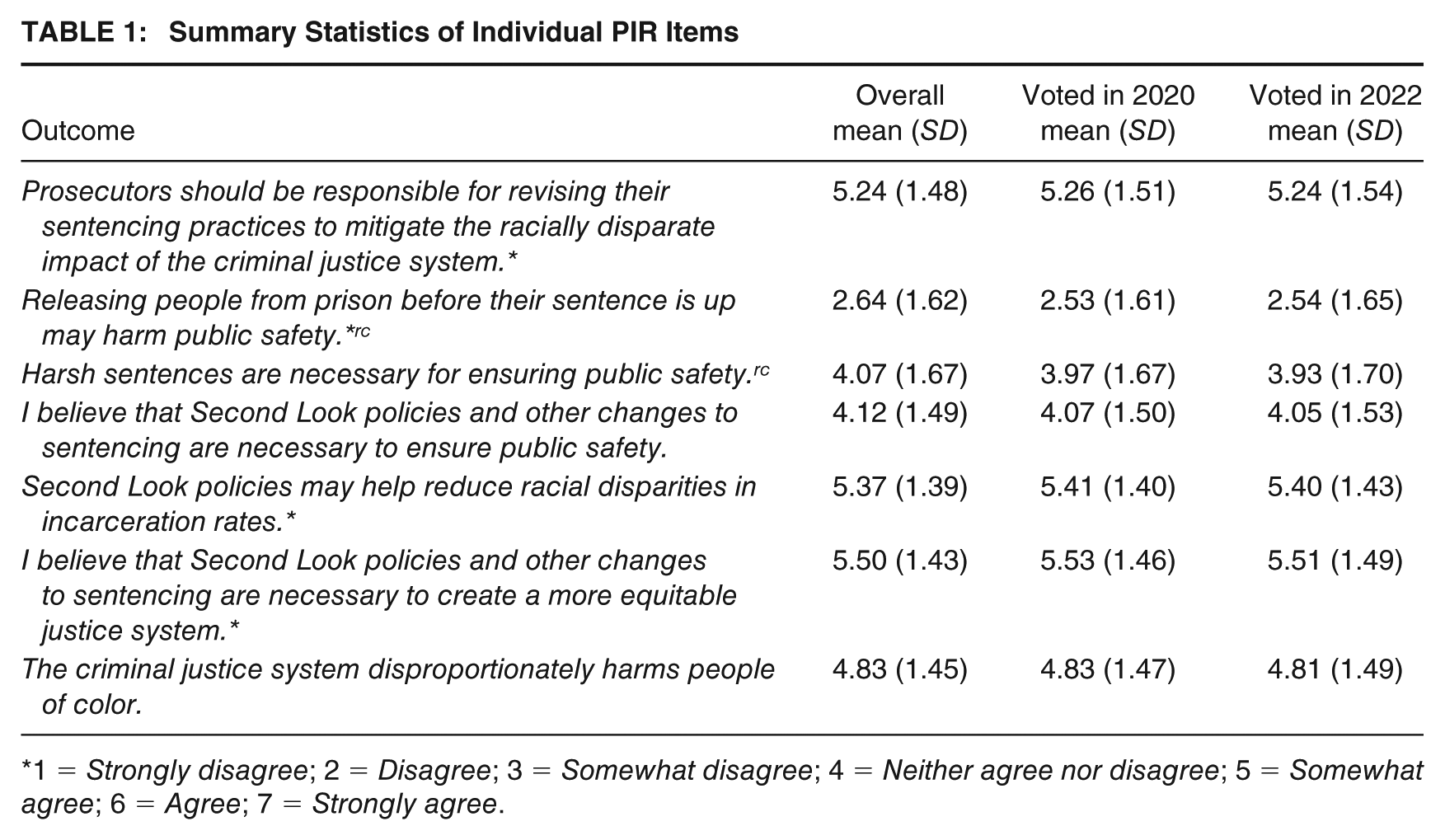
1 = Strongly disagree; 2 = Disagree; 3 = Somewhat disagree; 4 = Neither agree nor disagree; 5 = Somewhat agree; 6 = Agree; 7 = Strongly agree.
Experimental Results
Table 2 includes balance checks, demonstrating no evidence of failed randomization.
Balance Checks
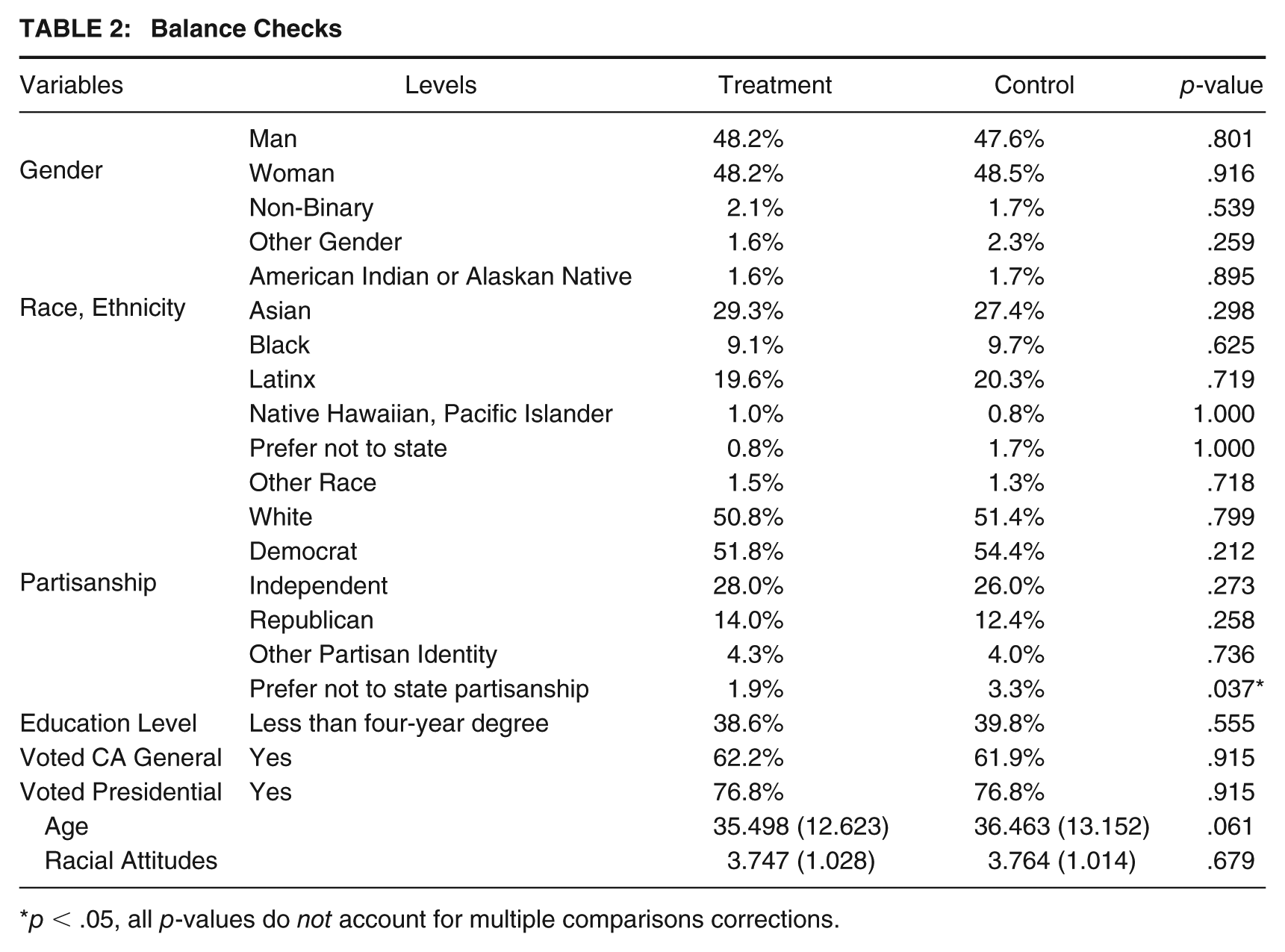
p < .05, all p-values do not account for multiple comparisons corrections.
Chi-square tests of independence were used for all covariates except age and racial attitudes, both of which were tested using heteroskedasticity-robust least squares models. While the p-value of the balance check for age was significant, this p-value is reported without adjusting for multiple comparisons. Because this would no longer hold after multiple comparisons, balance checks appear to be held. Our covariate-adjusted models are those that were specified as the primary models in our pre-registered pre-analysis plan, specifically including socio-demographic factors, as well as the pre-treatment racial attitudes index. In compliance with the identified final models specified in the pre-analysis plan and pre-registration, and to improve the precision of estimating the average treatment effect (ATE), all tables include both the treatment indicator-only models and models with covariates and county fixed effects.
Overall, we do not find evidence that social norms messaging significantly increased support for SL/PIR and SL/PIR as an avenue for addressing racial disparities in incarceration across our full sample. However, we do see that, at least directionally, the ATE estimates were all positive. Table 3 below reports the summarized results from our least squares models with heteroskedasticity robust (HC3) standard errors for two models (treatment-indicator only and treatment with full controls) across two outcomes (our overall index for support of SL/PIR and the index specific to SL/PIR as a potential way to address/acknowledgment of racial disparities in incarceration rates.) All outcomes have been standardized, such that interpretation of the ATE estimates in the coefficients row can be in the form of standard deviation units.
Results from Testing Primary and Exploratory Hypotheses (in SD Units)
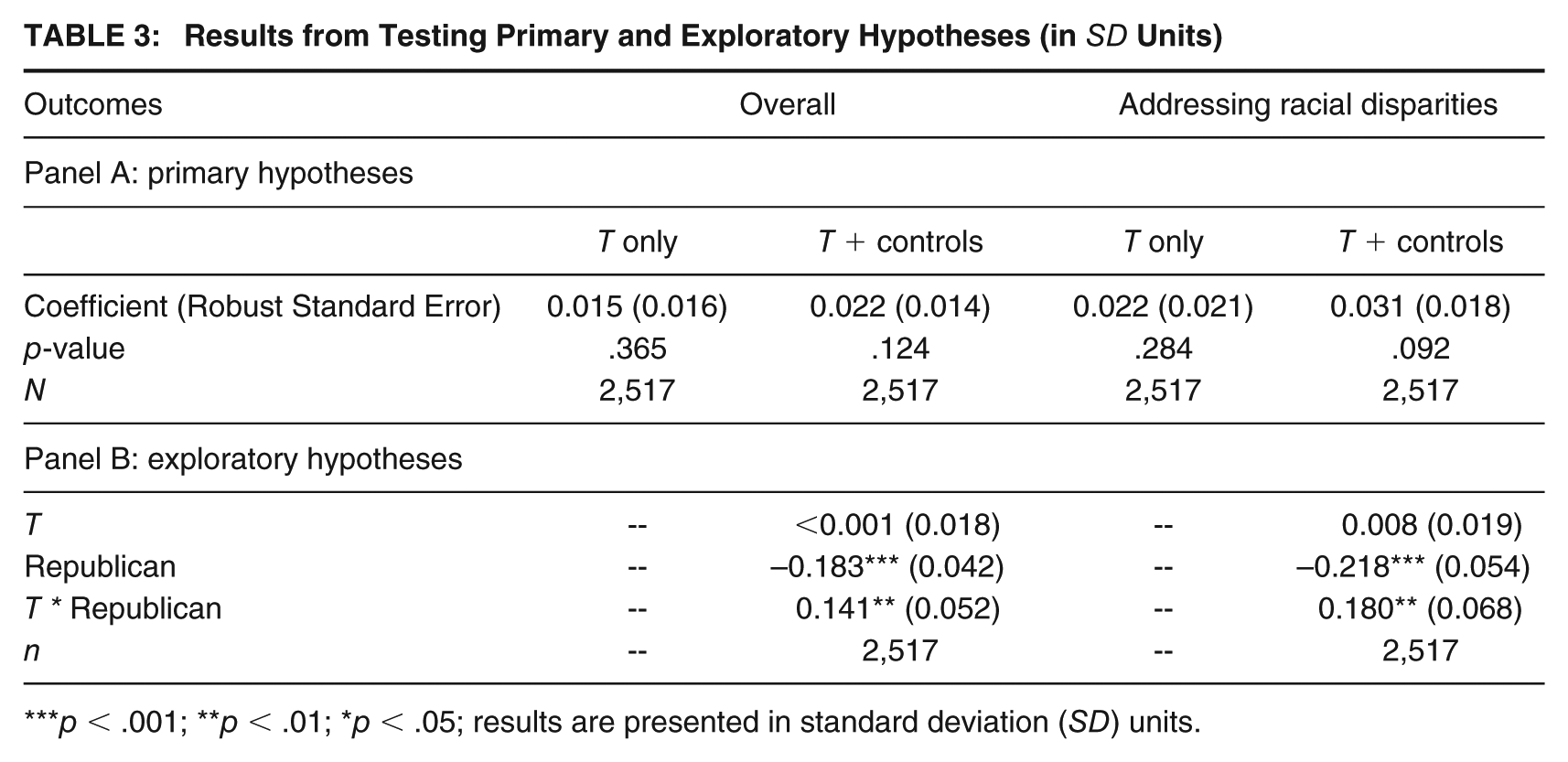
p < .001; **p < .01; *p < .05; results are presented in standard deviation (SD) units.
Analyses of Treatment Effect Heterogeneity
Exploring treatment effect heterogeneity, we specified in the pre-analysis plan several factors that may potentially explain variation in the ATE, including whether participants lived in a majority-Democrat County, the participants’ racial and/or ethnic identity, and racial attitudes. Analyses of treatment effect heterogeneity by these factors did not yield any statistically significant differences. However, additional analyses were performed by partisan identification of participants (i.e., rather than in the county in which they are located), and results from these models have been presented in Table 3. The coefficients and heteroskedasticity-robust standard errors are reported for the treatment indicator, Republican indicator, and their interaction, though all models reported also include all other previous covariates and county fixed-effects as controls, as well as the full interaction effects for partisanship.
Figure 1 presents estimates of the conditional average treatment effects (CATEs) for each item included in the SL/PIR index by partisanship. Notably, most of the CATEs for Republicans are positive (with the exception of the reverse-coded items that early releases may harm public safety and harsh sentences may harm public safety, though these are only slightly less than zero) In fact, the two statistically significant items are those related to support for addressing racial disparities through SL and PIR, specifically, that prosecutors should take responsibility for addressing racial disparities in incarceration rates and SL may be the avenue to accomplish this.
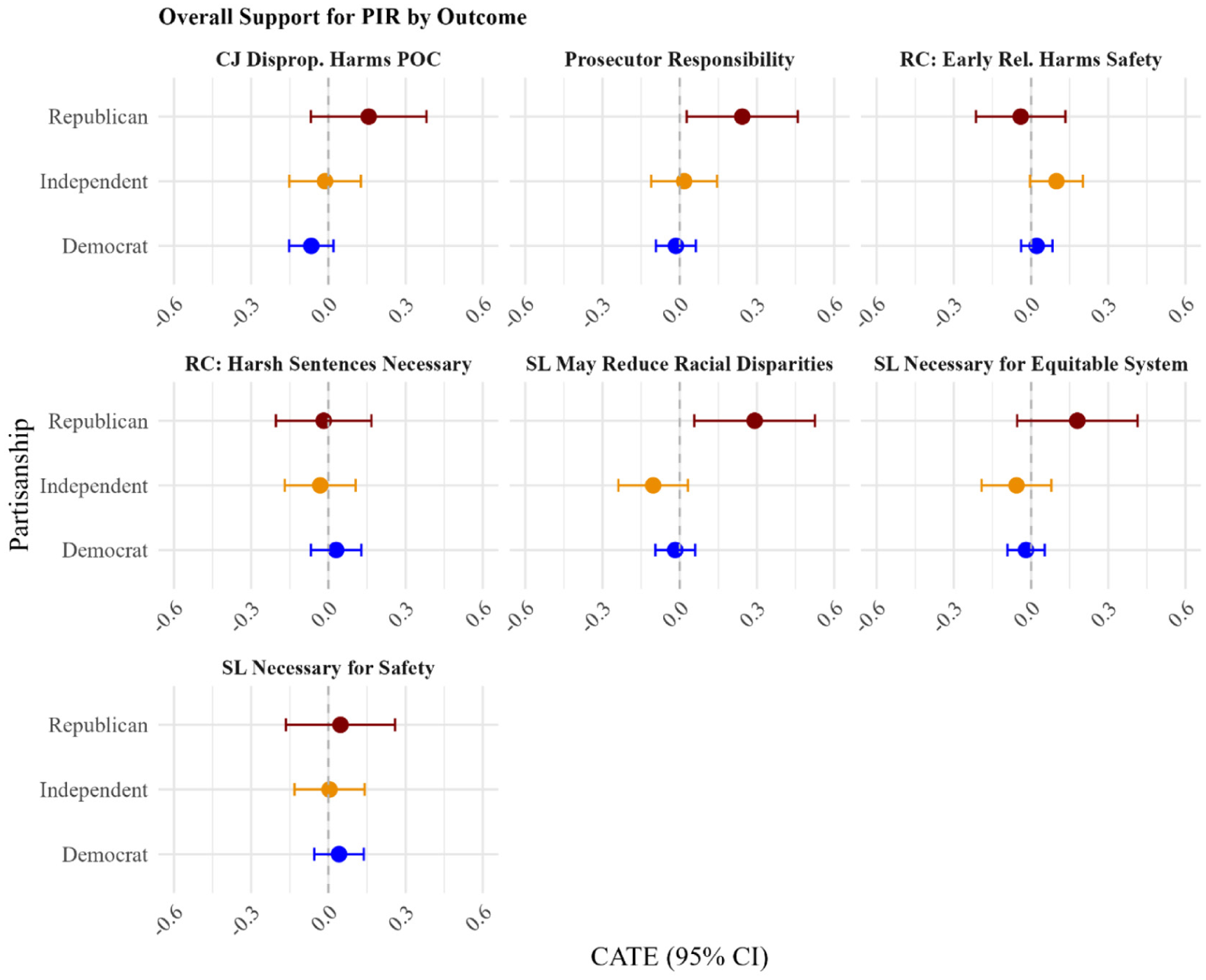
CATEs for Primary Outcomes by Partisanship (SD Units)
Thus, our results suggest that Republicans may have been significantly impacted by the social norms message, indicating that most of their regional peers believe that the system is biased against Black Americans. For Republicans, this message causally increased support for SL and PIR as policy levers to help mitigate racial disparities.
Discussion
This research contributes to a growing body of literature evaluating the influence that social norms messaging can have on public opinion, particularly on issues that implicate race and inequality. Like other authors, we find high levels of support for SL sentencing (Berryessa, 2022; Hannan et al., 2023), including those who report recent voting in presidential and midterm elections. While previous work has not found significant partisan variation in support, we do find such differences (Berryessa, 2022; Hannan et al., 2023). One potential contributor to our findings may be the size of our sample, which is somewhat larger than prior studies (i.e., previous studies may have been underpowered to detect statistically significant partisan differences). However, it is also possible that partisan differences are greater in California than in other states. Although our survey experiment does not demonstrate a significant effect of exposure to the social norms message across the full sample of Californian participants, we do find a significant, positive conditional average treatment effect (CATE) among California Republicans. It is quite likely that part of why this did not demonstrate sizable and statistically significant changes in the overall California sample was the already strong overall support. In addition, for every individual question on support for PIR/SL, Democrats, on average, had conditional means that were 1.1 points or greater than those of Republicans, as measured on the 7-point Likert-type scale (the greatest difference being, on average, 2.3 points, specifically for the question related to early releases’ potential contributions to public safety). Thus, the smaller CATE for Democrats and its lack of significance are in part due to the already strong support and potential prior awareness of this social norm among party members.
In addition, given our survey experiment involved either information alone or information with a social norms addition, we cannot rule out that the information treatment did not dampen support, producing a backfire effect, as has been found in previous evaluations of informational messages about crime (Shi, 2021). Again, while we cannot rule this out, we do not believe it’s particularly likely, as the information that was made salient was racial disparities in incarceration, rather than factual information about point-in-time prevalence of crime in California. Although small, the CATEs among Republicans were significant for both the full outcome index and the subset of racial-disparity-focused questions. If social norms interventions have the potential to help mitigate partisan gaps in support for progressive prosecutorial policy, is there promise for increased bipartisan movement on broader progressive public safety legislation? Our results highlight a promising avenue for future work.
Policy Implications
While social norms messaging has a robust empirical basis, this study fails to find an overall effect, likely in no small part due to the already robust support, on average, for PIR. For example, across the California sample, approximately three-quarters of participants agreed that prosecutors should be responsible for addressing racially disparate sentencing impacts, 80% agreed that SL policies may help address racial disparities, and 81% agreed that SL is necessary to create a more equitable justice system. Such considerable support offers an empirical counterpoint to prosecutors’ potential concerns over risk and public backlash. In addition, as exploratory analyses found a significant effect of PIR among California Republicans, there is still potential promise in utilizing social norms messaging in the context of prosecutors’ implementation of PIR. Since prosecutors are elected officials and often respond based on public opinion (Hessick & Morse, 2023; Nelson, 2014; Tonry, 2012), social norms messaging—especially when delivered in low-cost and light-touch interventions—may be useful in helping expand the set of policy options prosecutors deem as politically viable. Namely, social norms will be unlikely to backfire among those who already support these initiatives while bolstering support among those who are marginal, helping bridge partisan divides.
Relatedly, researchers across disciplines have long used descriptive and injunctive norms to better understand how individuals behave under certain conditions. A descriptive norm exists when someone is choosing how to behave under a certain scenario, essentially conditional only on empirical expectations, while an injunctive norm exists when a behavior is contingent on normative expectations, essentially based on the thought of how others think one should act (Fieldhouse & Cutts, 2020). These frameworks are relevant when considering the power of social norm messaging to influence public opinion and, in return, the uptake of policy reformation from prosecutors.
If stakeholders—judges, prosecutors, victims, families of incarcerated people, and others—see PIR transparently used in other jurisdictions, including those in Republican-leaning counties (descriptive norm) and if public officials voice their support of PIR (injunctive norm), it may create a domino effect. The publication of information related to the processing of PIR cases may create a sense of acceptance or normalcy. This would allow stakeholders to position PIR as an accepted and effective method, providing a transparent approach that would create space to reduce hesitation among broader stakeholders. The presentation of PIR as both publicly endorsed and common may increase prosecutor implementation, and when reaching a “critical mass” among prosecutors in the state, could help establish a new norm.
Polling data has the power to help policymakers understand how injunctive norms are changing in real time. While Democrats generally show stronger support for sentencing policy and racial equity, there is evidence that conservative voters can be receptive to PIR when presented with certain community safety messaging (Hannan et al., 2023). If voters, especially in Republican-leaning jurisdictions, indicate increased support for SL policies, elected officials might become more supportive of advocating for PIR. This reiterates the importance of those who may reside in the “margins” of polling data and the influence social norms messaging can have on making policy change. Research supports the idea that injunctive norms can influence how individuals respond to surveys (Fieldhouse & Cutts, 2020) and that state representatives may believe their constituents support conservative policies more than they do, which may be a function of limited updating of legislators’ priors (Broockman & Skovron, 2018).
Conclusion
Our results show high overall support for SL and PIR in California, with promise of social-norms-related messaging to improve support among Republicans. However, as with all empirical work, there are some limitations to this inquiry. First, this study is not precisely representative of California. Our sample has a disproportionately higher percentage of representation among individuals identifying as Asian, as well as those with a high school education, and a lower percentage of those identifying as White alone (U.S. Census Bureau, 2025). Thus, results could vary in replications that aim to conduct further survey experimental work or more externally valid field experimental work in California. In addition, the questions utilized aim to gauge general support for and SL/PIR and acknowledgment of its potential contributions to both public safety and mitigation of racial disparities in the system. Although our findings are specific to public opinion outcomes and not voting behavior, we have measured political attitudes that are frequently on the California ballot in the form of ballot initiatives or prosecutorial and judicial races. We also cannot be certain that the region-specific treatment message made a difference compared to a California-wide treatment message, although the social norms literature suggests this would be the case.
PIR has the potential to reduce incarceration rates and disparities in California. While the direct results of social norms messaging on PIR are not statistically significant, considerable support for PIR suggests that more county prosecutorial offices may be able to adopt PIR without significant voter backlash. Public opinion among those most predisposed to dislike this policy may be malleable and influenced by social norms messaging, pointing to the possibility of bridging partisan divides, which is crucial to fostering a more equitable justice system.
Furthermore, these findings suggest the value of tailoring social norms messaging to different audiences. While bipartisan support has historically been the precedent for social justice reform, the motivations to engage in or support such reforms vary considerably. Strategic interventions designed to resonate with different ideological views may increase the efficacy of advocacy efforts. As is to be expected, the value of a social norms message depends on respondent’s current beliefs and norms. Addressing racial disparities in incarceration rates has long been a priority among Democratic candidates for office, but less so among Republicans. These results highlight the importance of leveraging more targeted social norms interventions, namely those that may have the capacity to bolster support for mitigating racial inequality among Republicans specifically. While costly, future empirical endeavors could be greatly expanded by developing more robust polling, representative at lower-than-national levels, which gauges individuals’ beliefs about the justice system, its practices, and other policy-relevant topics. This could subsequently allow us to test messages targeted at different partisan groups or political ideologies with norms specific to that targeted group to see which are most effective.
Ultimately, PIR shows potential promise to combat racial disparities within the criminal justice system. In California and the United States more broadly (Berryessa, 2022; Hannan et al., 2023), there is considerable support for SL policies. Of course, there are certainly barriers and potential for policy feedback effects, especially in California’s current context. Namely, how do we bridge the disconnect between people voting based on frustrations with the property crime and ensuring progressive prosecution and sentencing reform can continue? Results from California’s 2024 election suggest that the political momentum has swung the pendulum back into a more punitive-oriented sentencing policy through increasing punishments on lower-level theft offenses (Mihalovich, 2024). Still, recent evidence suggests that policy options are more complex than a one-dimensional measure of punitive-to-progressive (Yogev, 2026). A secondary evidence base on communication of policy changes should help elected officials who hope to convince their constituencies that these reforms are worth the effort: for themselves and those they represent.
Overall, leveraging social norms messaging may help shift the calculus for prosecutors in regard to the “costs” of engaging in progressive prosecution initiatives, such as PIR, potentially bolstering sustained take-up of system reforms. This, in turn, may help establish PIR and other initiatives as the new status, bolstering its ability to serve as an effective mechanism to address decades of overly punitive sentencing practices and bridge partisan divides. SL policies—and other activities within our justice system—do not exist in a vacuum. Adjusting our prosecutorial status quo policies may be crucial to fostering better system outcomes, allowing prosecutors to be truly responsive to the communities they serve.
Supplemental Material
sj-docx-1-cjb-10.1177_00938548261451889 – Supplemental material for Public opinion and prosecutor-initiated resentencing in California: Can a racial equity norms message increase support?
Supplemental material, sj-docx-1-cjb-10.1177_00938548261451889 for Public opinion and prosecutor-initiated resentencing in California: Can a racial equity norms message increase support? by Jessie Harney and Lauren Woods in Criminal Justice and Behavior
Footnotes
Authors’ Note:
The authors declare that they have no known competing financial interests, personal relationships, or any other conflicts of interest that could have appeared to influence the work reported in this paper. The authors have no funding sources to report.

References
Supplementary Material
Please find the following supplemental material available below.
For Open Access articles published under a Creative Commons License, all supplemental material carries the same license as the article it is associated with.
For non-Open Access articles published, all supplemental material carries a non-exclusive license, and permission requests for re-use of supplemental material or any part of supplemental material shall be sent directly to the copyright owner as specified in the copyright notice associated with the article.
