






Abstract
This study examines the role of differential reinforcement (DR)—a primary mechanism of social learning theory (SLT)—within intimate family and friendship networks and its impact on recidivism. We hypothesize that kin-based DR is more consequential than friends, and that its influence has a more significant impact on men that are more deeply embedded in the correctional system. To test this, we utilized a life history calendar approach administered to a sample of 249 formerly incarcerated men in Ohio, linked with administrative records to track recidivism over a 3-year follow-up period. Cox regression models reveal a potent conditional effect: direct and anticipated reinforcement from kin networks (though not from non-kin peers) more than tripled the hazard of recidivism among individuals with one or more prior incarcerations, providing conditional support for SLT. We suggest that reentry policies should prioritize family-focused interventions to mitigate these deep-seated social influences.
Reentry research consistently identifies antisocial role models as a primary driver of recidivism (Gendreau et al., 1996). However, existing studies focusing on peer groups have faced criticism (Sampson, 1999), leading to a scholarly consensus that research on social learning theory (SLT) should prioritize differential reinforcement (DR)—the process by which individuals weigh the perceived rewards and punishments of a behavior as they consider future actions (Akers, 1998). Despite this need, the process remains understudied among justice-involved adults. While hundreds of thousands of adults are released from prison annually with non-trivial rates of recidivism (Durose et al., 2014), research on DR remains disproportionately focused on adolescent peer groups (Wojciechowski, 2026). Consequently, we lack a clear understanding of how DR affects justice-involved adults.
We propose two hypotheses regarding contexts that may shape DR and its consequences. First, the social landscape of reentry often necessitates a reliance on kin-based networks. Research indicates that returning citizens frequently decouple from former friends, relying instead on kinship ties for material and emotional support (Völker et al., 2016). While families are traditionally framed as protective anchors essential for successful reintegration (Naser & Visher, 2006), in some cases they may concurrently serve as primary conduits for antisocial influence—a nuance that remains empirically neglected in the literature (Mowen & Boman, 2018). This shift suggests that for many adults, the most important source of DR may not be peers, but family members—some of whom may reward or normalize criminal behavior, thereby reinforcing a trajectory of recidivism.
Second, the reinforcement mechanisms driving behavior are likely distinct for individuals with one or more prior incarcerations (what we refer to as “correctional embeddedness”). We hypothesize that correctional embeddedness may reshape responses to DR relative to those exiting prison for the first time. Individuals with one or more prior prison spells are subject to an enhanced process, where prolonged exposure to criminal norms may shift the reinforcement balance; antisocial actions are increasingly rewarded with social status, while the threat of further incarceration loses its deterrent power (Clemmer, 1940; Lösel, 2012; Wheeler, 1961). As well, the impact of one or more prior prison terms often leads to pro-social erosion; as individuals become distanced from traditional adult social bonds like stable employment and relationships, the relative weight of criminal reinforcement increases, making recidivism a more rational choice within their social context (Walters, 2003).
This study situates the DR hypothesis within the frameworks of reentry of formerly incarcerated individuals and correctional embeddedness. Leveraging a unique survey of 249 incarcerated individuals, we utilize egocentric data (which depicts a social network from the perspective of a single individual, referred to as ego) regarding the influence of kin and non-kin alters (the individuals identified by ego as part of their network). We construct measures of both “direct” and “anticipated” reinforcement, and we evaluate whether reinforcement within these intimate social networks raises the risk of “new crime” recidivism after release, independent of established covariates. Crucially, we examine whether these associations operate differently for individuals who have served one or more prior prison terms. We hypothesize that correctional embeddedness serves as a potent conditioning variable, heightening an individual’s receptivity to antisocial reinforcement.
Our findings offer two primary contributions to the SLT and DR literature. First, we provide empirical evidence for direct reinforcement—a core mechanism of SLT that is frequently theorized but rarely measured within adult populations. Second, by isolating the role of kin-based DR and its interaction with correctional embeddedness, we identify a specific pathway through which recidivism risk is amplified. By demonstrating that kin-based DR operates as a more potent driver of behavior for those with more extensive carceral histories, this study shifts the focus from generalized social influences toward the nuanced intersection of kin dynamics and correctional embeddedness.
Background
Theory
This study is anchored in SLT, which extends Sutherland’s (1947) differential association theory (DAT). DAT posits that criminal attitudes and techniques are acquired through social interaction within intimate personal groups—primarily family and peers. The probability of criminal involvement increases when an individual is exposed to an excess of definitions favorable to law violation (Akers et al., 1979). SLT advances this framework by specifying behavioral mechanisms of operant conditioning (Burgess & Akers, 1966). While behavior may be initiated through observation (Bandura, 1986), it is sustained or extinguished through DR—the process by which behavior is shaped by its perceived or actual rewards and punishments. DR operates through direct experience (e.g., encouragement, tangible rewards) and anticipated outcomes (e.g., expected approval) (Akers, 1985, 1998). This process is guided by discriminative stimuli—social and environmental cues that signal the consequences of a specific act. However, meta-analytic evidence suggests that empirical support for DR is less robust than for its predecessor’s core constructs (Pratt et al., 2010).
Prior Research
Extensive literature supports the SLT perspective (Akers, 1998), yet criticisms remain. A primary critique centers on selection effects—“birds of a feather flocking together”—where delinquency-prone individuals seek similar peers rather than undergoing a direct learning process (Matsueda & Anderson, 1998). To more clearly distinguish between social learning and selection, Rebellon (2006) and Brauer (2009) advocate focusing on DR, the key operant conditioning mechanism proposed by SLT.
Despite its theoretical importance, DR is studied less frequently than broader delinquent peer associations (Brauer & Tittle, 2012); moreover, findings are mixed (Pratt et al., 2010). We believe, however, that the issue is not the unimportance of DR, but the failure to consider the context of DR. Rebellon (2006), for example, reports effects for “vicarious” (i.e., anticipated) reinforcement but not for direct reinforcement—yet this cross-sectional approach lacked temporal priority, omitted kin networks and individual sensitivity, and did not investigate conditional effects. Brauer (2009) reports between-individual results suggesting that DR matters, with reinforcement from highly valued parents and friends more predictive than that from less significant figures. However, within-individual longitudinal models failed to support SLT’s core hypotheses and did not account for the direct reinforcement or conditional effects examined here. More recently, Wojciechowski (2026) identified high-DR trajectories among adjudicated juveniles in the Pathways to Desistance study but did not examine the link to subsequent delinquency. Again, however, conditional effects were not examined. Thus, while the literature on DR so far reports relatively mixed and unsupportive findings, we believe it is premature to conclude that DR is not as consequential as SLT expects.
The Current Study
The Relative Salience of Kin Versus Peer Reinforcement
A critical theoretical question that has yet to be explored is whether the impact of criminal reinforcement varies based on its social source. Specifically, is DR derived from familial (kin) networks more salient than that received from friends (peers)? While a vast literature emphasizes the role of peer associations in delinquency (e.g., Akers, 1998), there are compelling theoretical grounds to suggest that kin influence is also highly consequential. Families typically serve as the primary providers of essential resources, including housing, food, transportation, and employment leads (Visher & Travis, 2003). This high level of resource dependency increases the salience of familial approval or disapproval (Berg & Huebner, 2011). Within this context, reinforcement becomes a powerful lever: an individual who receives DR from family members may feel compelled to comply out of fear of risking the withdrawal of foundational support. In contrast, peer networks rarely provide the same depth of survival-based resources, making their reinforcement less structurally consequential.
The importance of kin is further amplified by the shifting composition of social networks during incarceration. Although pre-prison networks often include a mix of peers and family, friendship ties frequently succumb to social capital decay due to the barriers of distance, cost, and restricted communication (de Cuyper et al., 2013; Rose & Clear, 1998). Kinship ties, by contrast, tend to be more durable and require less active maintenance to survive a prison spell (i.e., a single, continuous period of incarceration). These network shifts are particularly pronounced among individuals serving prison sentences, for whom decaying peer relationships are difficult to resuscitate (Völker et al., 2016). Consequently, family often becomes the default support network, not necessarily because they are always pro-social, but because they are capable of providing necessary levels of support such as food and shelter.
The Conditional Effect of Pre-Prison Differential Reinforcement
A secondary, yet neglected, issue in social learning research is whether DR impacts all individuals uniformly. We hypothesize that the experience of prior prison spells functions as a critical moderator, enhancing the long-term potency of antisocial reinforcement received from kin. More specifically, we argue that correctional embeddedness—which we define as the cumulative psychological and structural impact of repeated transitions through the carceral system—conditions how individuals process and internalize the criminal expectations shared by family members.
The first component of this mechanism is the normalization of repeated imprisonment. For individuals with prior prison spells, the reinforcements received from kin throughout the period preceding their incarceration are not filtered through a lens of deterrence. Instead, because these individuals have already been “prisonized” (Clemmer, 1940), they have likely developed a cognitive framework where incarceration is a normalized occupational hazard rather than a transformative crisis (Haney, 2001; Walters, 2003).
Consequently, when kin provide direct or anticipated reinforcement for crime before an individual is incarcerated, there is a greater likelihood of internalizing the message as a long-term cognitive baseline. This means that by the time the transition into prison occurs, it is not a rupture of their life in the community, but a continuation of it; some individuals view the antisocial validation as a confirmation of a persistent criminal identity that they have already reconciled with their carceral history (Walters, 2003). For these embedded individuals, DR is the culmination of a sustained incubation period, serving as a script that stabilizes their antisocial identity, anchored in the normative expectations of their family.
The second component involves pro-social erosion and the narrowing of social capital, which grants kin a greater influence over the individual’s future. Cumulative periods of incarceration result in the severing of ties to the conventional world, such as stable employment and pro-social institutional belonging (Laub & Sampson, 2006; Völker et al., 2016). For those with multiple prior spells, the stigma of a “returning citizen” is compounded, leaving them with fewer resources outside of their immediate kin (Pager, 2003).
During the period on the street preceding prison, which is a period of reentry for those with prior prison spells, the weight of this reinforcement grows as other institutional ties continue to fray. When individuals eventually enter prison, the cumulative reinforcement received from their family may carry a heavy weight because the family represents their only surviving social safety net. In this context of extreme marginalization, conforming to the criminal expectations nurtured during the pre-prison period becomes a path of least resistance for the post-release period (Visher & Travis, 2003). Because stigma has already severely limited legal opportunities, the individual will tend to view these sustained kin reinforcements more as an obligatory contract. Rejecting these influences could mean forfeiting the material lifeline they have cultivated during their time in the community.
Thus, for the correctionally embedded, DR measured at the point of prison entry represents a powerful blueprint that may have been reinforced and solidified over a longer period. While individuals in prison for the first time may be more likely to use their time in prison to reflect on and potentially reject antisocial influences (see Harding et al., 2018), those that have been to prison one or more times often enter the facility with pro-criminal reinforcements already locked in. This could create a rehabilitative shield; the individual enters prison insulated from the state’s attempts at intervention by a foundation of kin-validated antisocial influence. Under these conditions, the DR of crime from trusted kin becomes a more potent driver of recidivism.
Hypotheses
The foregoing discussion leads to a set of four hypotheses that guide our analysis:
Data and Methods
Sample
This study utilizes a dataset of 250 formerly incarcerated men to examine the relationship between DR and recidivism. One individual was still in prison at the time recidivism data was being collected, reducing the analysis sample to 249. We employ a life history calendar (LHC) approach supplemented with official administrative and recidivism data. An LHC is a retrospective data collection method (i.e., a self-report survey) designed to map out the timing and sequence of significant life events across multiple domains of a person’s life (Freedman et al., 1988). This longitudinal approach allows for a granular reconstruction of participants’ social environments and behavioral choices during an 18-month window prior to their incarceration. These pre-prison months, which exclude months spent incarcerated or in drug treatment, are referred to below as “street months.”
One advantage of the dataset is the egocentric network module. Participants identified up to five individuals (alters) most significant to them and then asked a series of questions about each of those individuals, including direct and anticipated reinforcement. To our knowledge, this is the only dataset that utilizes an egocentric network to collect DR indicators in a correctional population. While the sample is robust, we acknowledge reduced power in specific conditional analyses. For instance, while 57 participants reported direct reinforcement for crime, disaggregating this by both prior incarceration and relationship type (kin vs. non-kin) results in smaller cell sizes (n = 12 and n = 13, respectively). Although we would prefer greater cell sizes, the sample size is still sufficient to conduct meaningful analysis. Moreover, the DR measures in this dataset provide a unique opportunity to explore SLT processes longitudinally.
Sampling Strategy
The sampling frame included men (18–32 at intake) admitted to the Ohio Department of Rehabilitation and Correction (ODRC) (2005–2007) in the past 6 months to capture the peak of the age–crime curve (Hirschi & Gottfredson, 1983). Individuals identified by ODRC as suffering from serious mental illness (e.g., schizophrenia) were excluded. Recruitment from four minimum and medium security facilities ensured broad representativeness: 70% of Ohio’s incarcerated population are housed in minimum and medium security facilities. We used a consecutive sampling strategy to select potential participants from the sampling frame beginning with those most recently admitted to prison. The final sample (53% participation rate) showed no significant differences from non-participants in race, age, or prior incarceration (Sutton et al., 2011). Approximately 35% of the sample was incarcerated for a violent offense, 24% for property crimes, 29% for drug-related offenses, and 12% for other violations. Data was complete; rare missing values were imputed via stochastic regression (Rubin, 1987).
Structured, 60- to 90-min interviews were conducted in semi-private settings with Institutional Review Board (IRB) approval and an NIH Certificate of Confidentiality. Using an LHC, we mapped 18 pre-prison “street-months” (excluding months incarcerated or in treatment) using residential changes and holidays as anchors.
Procedures
Data collection was a multistage process involving group recruitment and individual structured interviews.
Recruitment and Consent: Potential participants identified via the sampling strategy described above were issued passes to semi-private settings (e.g., classrooms, chapel, visiting rooms) as soon as possible after they had arrived at their specific correctional facility. The PI (i.e., the first author) or project staff explained the study’s focus on life circumstances and criminal involvement. Participation was completely voluntary. If the individual agreed, they were scheduled for an interview. The study was approved by our University’s IRB. To mitigate social desirability bias and safety concerns, researchers obtained a Certificate of Confidentiality from the National Institutes of Health, ensuring responses were protected from legal subpoena. The data was stored on a password-protected network drive.
The LHC: Two interviewers were present for most interviews. All interviews were structured, interviewer administered, and self-reported by the participants. They averaged 60 to 90 min (the interviews were not recorded). Respondents first identified the month of their “instant offense” arrest, designated as month 18. The LHC then spanned 18 months retrospectively. To facilitate recall and anchor temporal accuracy, researchers first mapped events such as residential changes, birthdays, and seasonal holidays.
Network Mapping: Within this anchored timeframe, participants completed the egocentric (i.e., participant) network module. They identified key alters (i.e., kin/family or friends) and specified whether those individuals provided direct or anticipated reinforcement for criminal activity. This captured behavior in the participants’ natural social settings before they were influenced by their current incarceration.
Recidivism Linkage: Following the baseline interview, each participant was tracked via official ODRC records for a 3-year post-release follow-up period from their release date to determine the hazard of recidivism.
Reliability and validity: A subset of the participants (n = 110) was re-interviewed approximately 3 weeks later to assess test–retest reliability (see Sutton et al., 2011) focusing on whether subjects accurately recalled the specific months they committed crimes across two separate interviews (the initial “test” and a “retest” approximately 3 weeks later). The authors employed tabular analysis to calculate Gamma and Kappa coefficients, adopting thresholds of .7 and .6, respectively, to indicate substantial agreement. A two-level “coefficient as outcome” hierarchical model was employed to assess whether the relationship between the test and the retest varied across person-level indicators, including interviewer effects, socio-demographics of the participant, memory decay, and the lag in time between the test and retest. Tabular analysis showed 84% agreement between the initial test and retest, with high values of Gamma (.914) and Kappa (.709) well above the acceptable thresholds. The HLM results indicated that criminal activity reported in the initial test was a strong predictor of the retest responses. Results indicated that there were no significant differences in reliability across interviewers. The only factor that significantly undermined reliability was the lag in days between the initial interview and the retest; as the time between tests increased, reliability decreased. Furthermore, findings revealed that the self-reports aligned closely with official prison records, indicating that individuals are generally honest and accurate historians of their own criminal and incarceration histories, demonstrating concurrent validity. Sutton et al. (2011) conclude that the LEC method yields reliable and valid self-reports of criminal behavior from incarcerated individuals (also see Bellair & Sutton, 2017).
Dependent Variable
As described above, recidivism is measured using official administrative data from the Ohio Department of Rehabilitation and Correction’s Departmental Offender Tracking System (DOTS). This provides a 3-year follow-up window based on each participant’s specific date of release. The analysis employs two critical measures. First, we calculate a binary variable, new crime (coded one), which captures whether the individual returns to prison as the result of a conviction and new felony sentence within the 3-year window (zero otherwise). Second, we calculate days (survival time), which captures the number of days elapsed from release until re-incarceration (date of return to ODRC custody).
Independent Variables
The core of the inquiry is the measurement of DR of intimate social ties using an egocentric network module. This module focuses exclusively on up to five individuals who were considered “most important” to the participant during the pre-prison calendar period, an intentional focus that captures the network alters who exert the greatest behavioral influence (Merluzzi & Burt, 2013; Sutherland, 1939). The limit of five alters is a standard methodological choice in egocentric research—most notably used in the General Social Survey (GSS)—to capture the core of an individual’s social environment where the most significant influence occurs (Bellair et al., 2018; Cornwell et al., 2009). About 23% of the individuals nominated by participants were below the age of 16. They were excluded from calculation of the network measures as they are presumed not to be sources of criminal reinforcement. There were no other exclusions.
This allowed for construction of separate measures for adult kin (family) and adult non-kin (peers) networks. Two distinct forms of DR predicted by SLT are measured. Direct reinforcement is a dummy variable assessing active encouragement and is coded as one (zero otherwise) if any alter explicitly encourages the participant to commit an illegal act. Anticipated reinforcement is also a dummy variable coded one if the participant believed that committing a crime would cause an alter to “think more highly of them or trust them more.” We calculated both measures separately for the overall network and then isolated the effects for kin and non-kin components, allowing us to determine which source drives the highest risk of recidivism. Our measures assume that if direct or anticipated DR occurs immediately prior to the current prison spell, it can have long-standing consequences for individuals when they exit prison, irrespective of the post-prison context. However, we acknowledge that the post-prison context is also quite important.
While we acknowledge the potential for projection bias in perceptual measures, it is also the case that from an SLT perspective, it is the individual’s perception of social reinforcement that most directly influences their decision-making process (Akers, 1998; Young et al., 2014). If an individual believes their family will think more highly of them or trust them more, that belief functions as a reality regardless of the family’s actual stance. It also bears mentioning that when a participant is asked whether their kin encouraged them to commit crime, they don’t have to guess. The participant knows whether it happened because they heard it directly from the family member. In addition, as the results will show, the anticipated reinforcement measures perform empirically similar to the direct reinforcement measures in the conditional analysis, bolstering confidence in both measures.
We hypothesize that an individual’s embeddedness in the correctional system is not merely a risk factor, but a conditioning variable that enhances vulnerability to antisocial cues. Prior prison is a dummy variable indicating whether the participant had previously served one or more state prison sentences (coded one, zero otherwise) prior to the current sentence. We test whether the reinforcement mechanisms driving behavior are distinct for individuals with prior prison sentences relative to those exiting prison for the first time.
Controls
To isolate the effect of DR and to guard against model misspecification, we include several controls identified in the literature, whose exclusion could potentially bias the findings. Age reflects age at intake (Hirschi & Gottfredson, 1983); Race is a dummy for non-white respondents (Sampson & Wilson, 1995). Neighborhood Disadvantage is a weighted principal component analysis (PCA) composite score (M = 0, SD = 1) combining poverty, unemployment, and female-headed households (alpha = .7; Cronbach, 1951; Harman, 1976; Jolliffe, 2002). Low Self-Control (Gottfredson & Hirschi, 1990) is a dummy variable for the upper quartile of a scale (alpha = .6) with six items capturing disregard of long-term consequences, losing temper easily, need for excitement, impulsivity, and hyperactivity. Employment Consistency (Kolbeck et al., 2022, 2024; Sampson & Laub, 1993) reflects the percentage of street months employed. Depression/Anxiety is a self-report dummy variable for pre-prison symptoms (Bronson & Berzofsky, 2017). Hard Drug Use (Bellair et al., 2018) averages monthly pre-prison use of heroin, opioids, meth, cocaine, and hallucinogens. Sentence Length reflects the number of days served during the focal spell (Carson, 2020). Finally, Differential Association (Sutherland, 1947) is a weighted PCA composite of six items reflecting alters’ criminal histories (ever arrest, gang, or prison) and crime opportunities (alpha = .73; Cronbach, 1951).
Analytic Strategy
Our analysis employs descriptive statistics and event history analysis. Because our objective is to model the elapsed time until re-incarceration—a continuous time measurement—traditional logistic regression is inappropriate. We instead employ the Cox (proportional hazards) regression model (i.e., event history analysis). This approach is optimal because it accounts for censoring (participants that do not recidivate within the 3-year window but may have after) and is designed to fit a wide range of failure distributions without requiring strong assumptions about the distributional form.
The Cox model predicts the hazard rate of re-incarceration due to a new felony conviction, effectively estimating the risk of failure post-release. The model takes the following functional form: h(t) = h0(t) + exp(bx). In this expression, h(t) is the hazard (i.e., failure) rate, ho(t) is the baseline hazard rate (which is not estimated in this nonparametric approach), and bx reflects the regression coefficients. The results presented are derived from the exponentiated regression coefficients (exp(bx)), which are converted directly into hazard ratios (HRs). An HR greater than 1.0 indicates an increased risk of recidivism, while an HR less than 1.0 indicates a reduced risk. Crucially, to test our primary hypotheses (H3 and H4), we incorporate interaction terms between our key DR measures (kin direct, kin anticipated) and the prior prison conditioning variable.
Importantly, diagnostics based on scaled Schoenfeld residuals (Schoenfeld, 1982) provided no indication that the cox model proportional hazards assumption was violated. Neither the global test nor the covariate tests approached statistical significance, implying that the estimated effects remain stable over the observation period. In line with established diagnostic procedures, we also inspected plots of the scaled Schoenfeld residuals against time and found no systematic departures from proportionality (Grambsch & Therneau, 1994). Taken together, these results support the adequacy of the Cox specification.
In Tables 2 and 3, Model 1 establishes the baseline effect of individual controls and prior prison history. Models 2 and 3 introduce the primary independent variable (Direct or Anticipated reinforcement) and tests its interaction with Prior Prison. Models 4 and 5 isolate reinforcement coming specifically from Kin (family) and tests if having a prior prison record changes how family influence affects recidivism. Models 6 and 7 isolate reinforcement from non-kin (peers/associates) and tests the interaction with Prior Prison. This sequence of equations allows us to determine whether correctional embeddedness significantly enhances the criminogenic effect of DR, isolating the specific subgroups most susceptible to criminal influence.
Results
Descriptive Statistics
The descriptive characteristics of the sample are summarized in Table 1. The data reveal that approximately one-third of the participants were convicted of a new felony and returned to prison within the 3-year follow-up period. The average participant survived approximately 871.3 days (2.4 years) before the study’s observation period ended. The average survival time for individuals that were returned to prison for a new crime conviction was substantially shorter, at 550 days (or about 1.5 years) (not shown). These figures reflect about a 12% higher rate of new crime recidivism relative to the universe of ODRC releases (ODRC, 2021), which is expected because individuals convicted of lower-level felony offenses (i.e., with shorter sentences) have higher rates of recidivism relative to individuals serving longer sentences (Antenangeli & Durose, 2021; Council of State Governments Justice Center (CSG), 2018).
Descriptive Statistics
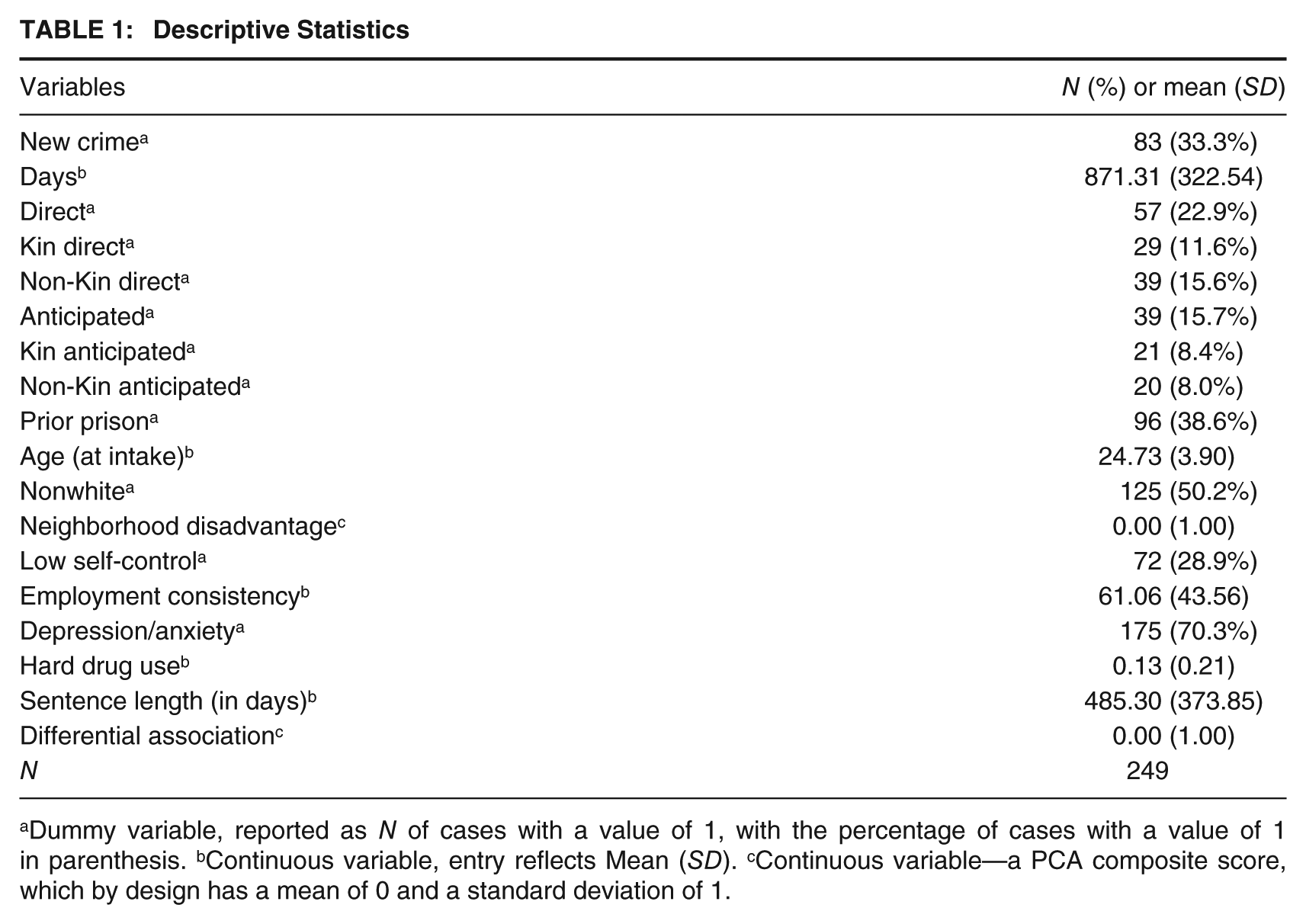
Dummy variable, reported as N of cases with a value of 1, with the percentage of cases with a value of 1 in parenthesis. bContinuous variable, entry reflects Mean (SD). cContinuous variable—a PCA composite score, which by design has a mean of 0 and a standard deviation of 1.
The data provide insight into the prevalence of the DR mechanisms central to this study. While most participants are not exposed to network alters that actively encourage crime, the level of reinforcement is still considerable: slightly more than one in five participants (22.9%) received direct reinforcement (e.g., encouragement) from their intimate network to commit a crime. The reader should note that the frequencies for the overall network measures are smaller than the sum of the kin and non-kin frequencies because some individuals are exposed to both types of reinforcement. When we disaggregate the overall measure, the data suggest a slight predominance of peer influence, with 15.6% reporting direct non-kin reinforcement compared to 11.6% reporting direct kin reinforcement. A smaller, but not trivial number of participants anticipated reinforcement from their intimate network: 15.7% perceived that at least one member of their network would think more highly of them or trust them more if they committed a crime. When disaggregated, about 8% reported that they anticipated reinforcement from either their kin (8.4%) or non-kin networks (8.0%). With respect to our conditioning variable, prior prison, 38.6% of the sample had served at least one previous state prison spell, establishing a robust basis for testing our conditional hypotheses regarding correctional embeddedness.
Turning to the control variables, the average participant was just under 25 years old at intake. As well, the racial composition of the sample roughly approximates the Ohio prison population, which is roughly 50% White and 50% non-White. The mean value of the neighborhood disadvantage scale is 0, which occurs when each of the component indicators are at their mean, reflecting that the typical participant in the study resides in a more average as opposed to high disadvantage neighborhood. Participants with a score closer to 1 or −1, in contrast, are exposed to the highest or lowest levels of disadvantage relative to other participants in the sample.
About 29% of individuals scored in the upper quartile of the low self-control scale, putting them at higher risk of criminal involvement according to the general theory of crime (Gottfredson & Hirschi, 1990). Furthermore, a high proportion of the sample reports on mental health issues, with about 70% self-reporting symptoms of depression, anxiety, or both during the pre-prison period. In terms of social bonds, the average individual worked during about 61% of the months in the calendar period. Use of hard drugs was relatively rare during the calendar period, with the typical participants averaging use of fewer than one of the hard drugs (non-marijuana) included in the scale. The participants served an average of 485 days (1.3 years) in prison on their current sentence. Finally, the differential association factor scale, with a mean of 0, indicates that the typical participant has an average level of exposure to alters with a criminal history and who provide criminal opportunities. Individuals with a value closer to 1 or −1 on the scale are exposed to a greater or lower than average proportion of alters.
Cox Models of Recidivism on Direct Reinforcement
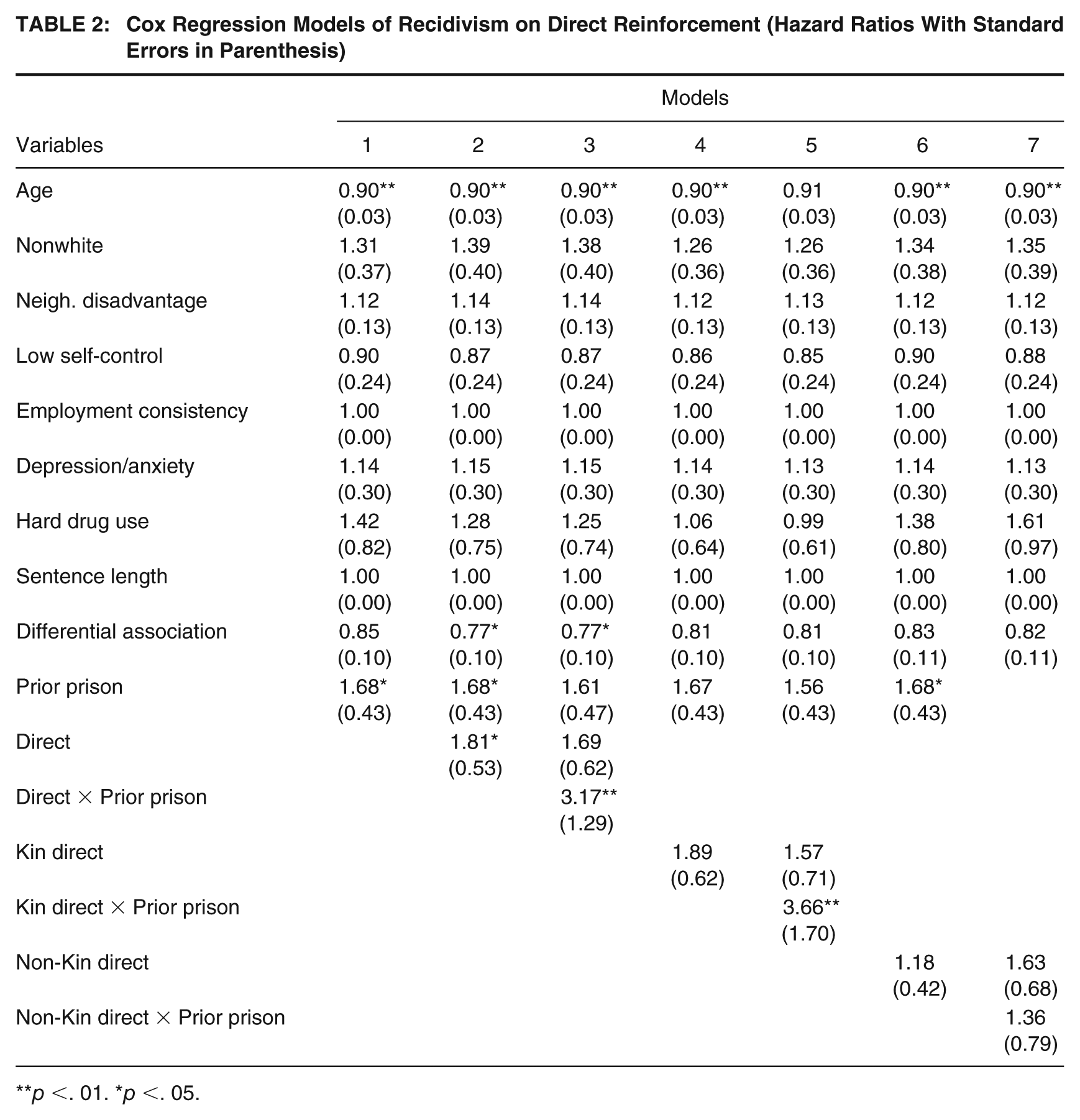
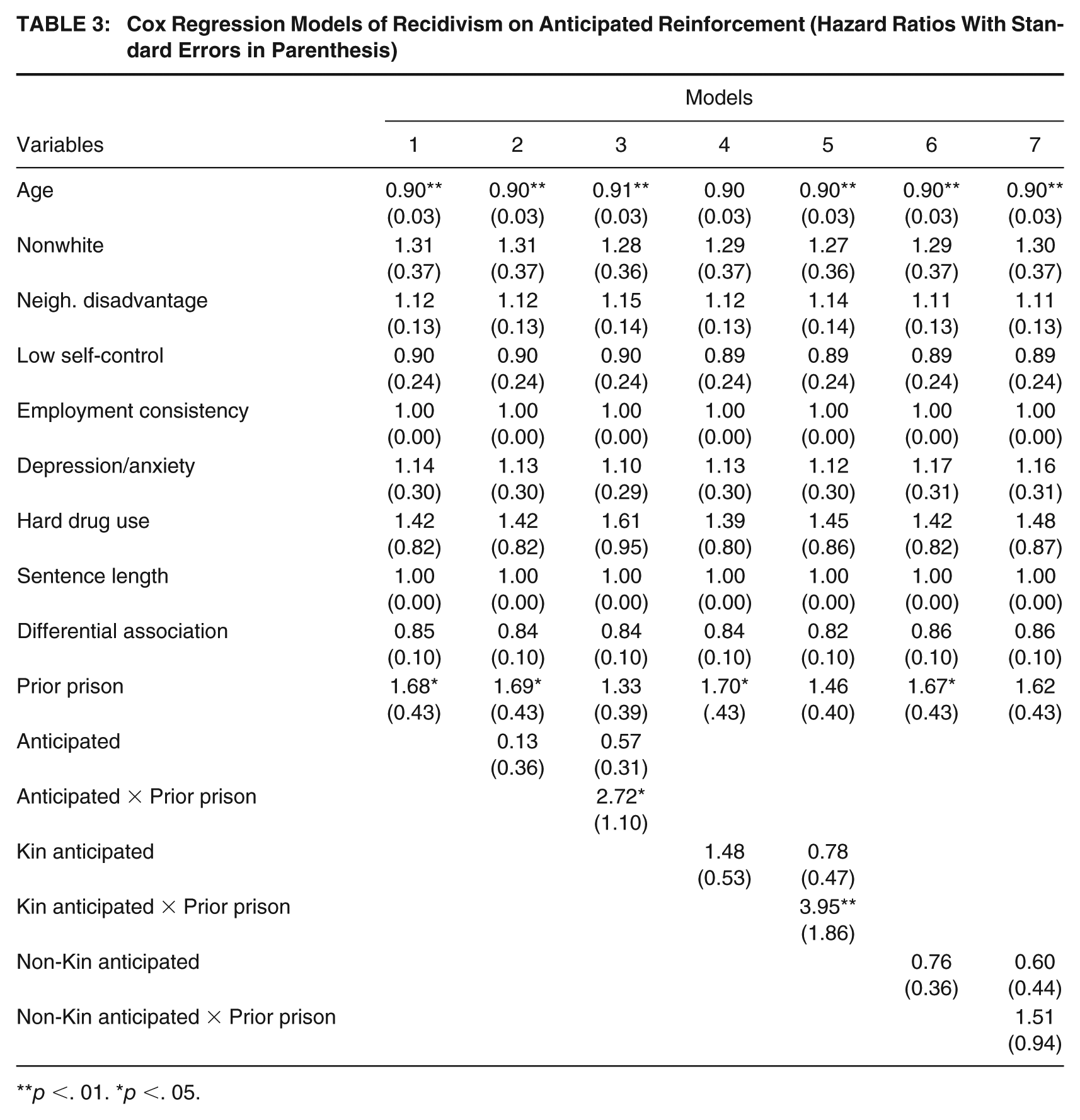
Proportional hazard models of recidivism on DR processes are presented in Tables 2 (direct) and 3 (anticipated), with HRs and standard errors (in parenthesis) depicted. In both tables, Model 1 is a baseline equation that presents estimates of the relationships between a prior prison spell, control variables, and recidivism (i.e., estimates presented in Model 1 are equivalent across Tables). In Model 2, direct or anticipated reinforcement in the entire network is entered into the equation, followed by Model 3, which includes an interaction effect between prior prison and either direct or anticipated reinforcement. Models 4 and 5 follow the logic of Models 2 and 3 but include either direct or anticipated reinforcement in the kin network. Models 6 and 7 similarly follow the same logic but include either direct or anticipated reinforcement in the non-kin network.
Cox Regression Models of Recidivism on Direct Reinforcement (Hazard Ratios With Standard Errors in Parenthesis)
**p <. 01. *p <. 05.
Cox Regression Models of Recidivism on Anticipated Reinforcement (Hazard Ratios With Standard Errors in Parenthesis)
**p <. 01. *p <. 05.
Model 1 of Table 2 indicates that two factors are of importance in understanding new crime recidivism. First, age is central—for every additional year of age, participants’ likelihood of recidivating decline by about 10% (i.e., [1 – .90] × 100). Second, individuals who have served at least one or more prior prison spell are 68% more likely to return to prison for a new crime conviction relative to those in prison for the first time. None of the remaining estimates in the model are significantly different from zero.
In Model 2, direct reinforcement to commit crime among the entire network is entered into the model, revealing that alter encouragement increases the likelihood of recidivism by 81%. Interestingly, differential association, while not significant in Model 1, becomes significant in Model 2. This finding is particularly interesting because it suggests a highly counter-intuitive role for criminal associations when examined in conjunction with active encouragement to commit crime. The substance of DAT posits that criminal behavior is learned through association with intimate personal groups. Consequently, antisocial role models are typically recognized as a fundamental precursor of recidivism. However, when direct reinforcement (active encouragement to commit crime from the intimate network) is brought into the statistical model and held constant, and in contrast to the expectations of DAT, having criminally involved alters is associated with a 23% decline in the likelihood of recidivism. It is important to note that the finding is not the result of collinearity, with VIF’s in the range of 1 to 2, well below the value of 4 that has been suggested as a conservative threshold (Bachman & Paternoster, 2016).
Model 3 takes the first step toward addressing the conditional effect of direct reinforcement. The findings are supportive, indicating that direct reinforcement to commit crime in a participant’s entire intimate network more than triples the odds of recidivism among those with a prior prison spell. Chen et al. (2010) characterize effect sizes as small when they are between 1.5 and 2, moderate when they are between 2.5 and 3, and large when greater than 4, suggesting that the effect size here of 3.2 is slightly above moderate. Yet it is unclear whether this effect is being driven by kin, non-kin, or both, to which we now turn.
Models 4 to 7 partition the entire network into its kin and non-kin components. Model 4 addresses whether direct reinforcement to commit crime in a participant’s kin network increases the risk of recidivism, indicating that there is no direct effect. Model 5, in contrast, indicates a significant interaction effect—direct reinforcement to commit crime in the kin network increases the odds of recidivism by just over 3.6 times among participants who have been to prison prior to their most recent spell. Models 6 and 7 address non-kin direct reinforcement. The results indicate no evidence of a direct effect (Model 6) or a conditional effect (Model 7) of direct reinforcement from non-kin. Taken together, the findings provide evidence of the importance of kin networks among those with prior prison spells.
Cox Models of Recidivism on Anticipated Reinforcement
Table 3 repeats the sequencing of equations in Table 2 but shifts the focus to the consequences of anticipation that alters will think more highly or trust the participant more if they commit crime. Recall that Model 1 is a baseline model that is reproduced in both tables for ease of comparison. Model 2 reveals that anticipated reinforcement in the participant’s entire network does not exert a direct effect on the risk of recidivism. Model 3, however, indicates that anticipated reinforcement does exert a significant effect among individuals with one or more prior prison spells. Models 4 to 7 decompose that relationship into its kin and non-kin components. Model 4 reveals no evidence of a direct effect of anticipated reinforcement among kin, but Model 5 reveals, similar to the findings with regard to direct reinforcement, that anticipated reinforcement among kin increases the risk of recidivism by a factor of 3.95 among participants that have previously been to prison (relative to those that have not), an effect size that is slightly below the large range. Models 6 and 7 provide additional evidence that anticipated reinforcement in the non-kin network is less influential relative to kin.
Taking the evidence in Tables 2 and 3 together, we find mixed support for our hypotheses. While there is a significant general effect of direct reinforcement on the probability of returning to prison, the main effect of anticipated reinforcement is statistically non-significant. Consequently, we reject H1 because the reinforcement effect is not universal across both direct and anticipated types for the general population. Furthermore, we reject H2 as the analysis shows that reinforcement from the kin network does not exert a significant influence on recidivism independent of an individual’s prior prison history. However, we cannot reject H3, because receiving DR (both direct and anticipated) significantly increases the likelihood of returning to prison specifically among individuals who have served prior prison terms. Finally, we also cannot reject H4; the results demonstrate a robust interaction effect where reinforcement from the kin network significantly predicts recidivism for those with a prior prison history, a pattern that holds for both direct and anticipated reinforcement.
Discussion
This study offers clarification to both SLT and the literature on reentry of formerly incarcerated individuals by isolating the source and conditions under which criminal social influence exerts an influence. We find that the effect of DR is not a generalized risk but a highly focused risk that is amplified by an individual’s prior involvement in the correctional system. Our results offer conditional support for SLT, highlighting a specific and problematic pathway to reoffending. Findings demonstrate that DR is conditional on the source of reinforcement and the individual’s correctional embeddedness.
Our analysis reveals that reinforcement from the non-kin (peer) network has no statistically significant effect on the hazard of recidivism across any model. Instead, the danger is entirely concentrated within kinship ties. This aligns with reentry research arguing that ties shift after release; pre-prison friendships often decay, leaving kinship ties as the primary, durable, and most salient support system. Because returning citizens rely heavily on family for fundamental resources, such as housing, food, and transport (Visher & Travis, 2003), approval or disapproval from kin becomes acutely consequential, making this source of reinforcement more salient than peer influence.
Second, the effect is entirely contingent on prior imprisonment. The risk posed by kin is only realized for men with one or more prior prison spells. For this subgroup, both direct and anticipated reinforcement from family members increases the hazard of recidivism by over three times. This significant interaction confirms our hypothesis that correctional embeddedness is a potent conditioning variable. Repeat exposure to prison fosters institutionalization (Goffman, 1961; Haney, 2001) and may lead to desensitization to punishment (Maruna, 2001). Furthermore, these individuals face the most severe structural barriers and stigma (Pager, 2003), which limits their access to pro-social networks and alternatives (Rose & Clear, 1998). This lack of pro-social alternatives amplifies the receptivity and vulnerability of individuals embedded in the correctional system to the DR of criminal patterns from their kin.
Finally, although not directly related to our emphasis on DR, there is an unexpected inverse relationship between differential associations and the likelihood of recidivism. It may be that once the active encouragement of criminal behavior (direct reinforcement) is accounted for, differential association with family members that have a criminal history can play a protective role. This nuance challenges the simple notion that all associations with individuals with criminal histories lead to greater risk of reoffending. For returning citizens, this may reflect a more complex social dynamic. It is not uncommon for individuals coming out of prison to have family members who have also been in trouble. Such family members, despite their own criminal histories, do not necessarily encourage their newly returned loved one to commit new crimes, and indeed, may instead provide a supportive, non-criminogenic environment, possibly even trying to keep their returning loved one out of trouble.
Policy Implications
Our findings suggest a shift in reentry policy toward targeted, family-based interventions. The fact that direct and anticipated kin reinforcement increases the hazard of new crime recidivism by a factor of over three among individuals previously imprisoned one or more times is an actionable point of intervention. First, public policy must recognize that family, while often a protective anchor, can also be a powerful, criminogenic force for some men that are embedded in the correctional system. Interventions must move beyond individual-level programming to require robust screening of familial risk prior to release. Second, resources must be disproportionately allocated to kin-targeted interventions for individuals with at least one prior prison spell and families with criminal history. Simply providing job training, for instance, is insufficient if the primary social reward system they return to is actively encouraging crime.
These programs must focus on family members, those who provide both reinforcement and vital resources, to help them recognize and convert criminogenic reinforcement into pro-social support, a model that has shown promise in previous research (Berg & Huebner, 2011). An example of such a program is multi-systemic family therapy, which is an intensive, home-based intervention designed for individuals with serious behavioral or legal issues. This insight shifts the theoretical focus toward the presence of antisocial family relationships combined with recognition of correctional embeddedness in shaping the likelihood of recidivism. Screening of the home environment is a component of screening tools such as LS/CMI (Level of Service/Case Management Inventory), COMPAS (Correctional Offender Management Profiling for Alternative Sanctions), and ORAS (Ohio Risk Assessment System), for instance. However, although these screening tools are widely embraced by correctional agencies, they only include an item or two inquiring about criminal influence among the family or spouse for the purpose of determining supervision risk.
Providing housing alternatives to individuals that would like a clean start and avoid family involvement is complicated and costly. Yet risk screening tools to assess whether the family is dependent on illicit income sources, has active substance abuse issues, gang affiliations, or a history of instability could potentially improve recidivism outcomes for chronic recidivists. If a home is deemed problematic, the state could reprioritize funding streams and provide subsidies for transitional housing to prevent the individual from having to choose between homelessness and a high-risk home. However, the foregoing policy recommendations are not without risk. Even a family that encourages an individual to engage in crime can provide food and shelter and prevent an individual from falling into homelessness.
Limitations and Conclusion
We acknowledge the limitations imposed by small cell sizes for estimating interaction effects, and we acknowledge that more study is needed. However, there are virtues of the analysis that should not be dismissed. First, we offer a longitudinal assessment of SLT and DR, which is rare and needed. Second, our egocentric network module, with its focus on DR, is an approach that has not (to our knowledge) been utilized in recidivism studies. Prior research shows that egocentric variables are reliable when naming core ties such as close family and best friends (e.g., Hogan et al., 2020; Marsden, 1990), and that while the exact list of names might change slightly over time, the aggregate structural measures (like the proportion of kin) remain remarkably stable (e.g., Burt, 1984).
Some may also argue that the study design, wherein we measure DR at the point of prison admission rather than after release, is a limitation: without measurement of DR after release, we can’t be sure that the pre-prison DR is still operative in the post-prison period. However, as the literature cited in the previous paragraph illustrates, the structure of kin networks is typically stable over time. Moreover, by measuring DR at prison admission, we are able to show that pre-prison DR matters for those with prior incarceration histories irrespective of what kind of unmeasured reinforcement they might receive after prison.
Overall, our findings highlight a specific, problematic pathway to reoffending: For men with a history of imprisonment, criminogenic reinforcement from family members, rather than non-kin peers, is a powerful driver of recidivism. However, more research is needed to determine whether the findings can be replicated in other states, and whether they are generalizable to females, and to higher security participants. Ultimately, this research provides evidence to consider revision of reentry policy, suggesting more attention is needed with respect to the screening of familial risk and the integration of family-focused interventions to supplement traditional individual-level programming.
Footnotes
Authors’ Note:
The authors gratefully acknowledge the support of award #1459214 from the National Science Foundation and seed grants from The Ohio State University Department of Sociology and Criminal Justice Research Center. We also thank the reviewers and editors for insightful comments on previous drafts.
