







Abstract

Drawn to this book by its title, The Olympic Games and the Environment, I was keen to learn about John Karamichas’ decade-long research on the environmental impacts and greening of the Games. Once reading, I was then surprised to encounter first nearly a hundred pages before getting to the core of this volume’s primary contributions on this interesting topic. Along the way, I discovered that this really is two books in one: an extended introduction to and review of the field of environmental sociology; and a comparative analysis of the “greening” of the Olympic Games, drawing on that scholarship. A more fully accurate, if old-fashioned, title for this timely and topical volume might have been: An Introduction to Environmental Sociology and Its Application to an Analysis of the Greening of the Olympic Games.
Much of the first half or so of the book reviews sociological scholarship on the emergence of global environmental concern: the place of the natural environment in general sociological theory; and theories of socio-environmental change, in particular the relatively new, European-originated theories of reflexive modernization and ecological modernization. Karamichas, a sociologist at Queen’s University, Belfast, brings a thoughtful, well-informed, continental perspective to this review. One possibly hidden value of his volume, then, is that it could be used as a supplemental textbook for upper-division or graduate courses in environmental sociology, the sociology of sport, the sociology of social change, contemporary social theory, or organizational sociology.
But what has been going on with the Olympics, their environmental impacts, and the International Olympic Committee’s efforts to address these issues, which have surfaced over the last couple of decades? Karamichas and others have described the contemporary Olympics as “mega-events”: media-refracted and -driven, global sport-entertainment spectacles; billion-dollar undertakings, with opportunities and risks for organizers, city hosts, sponsors, and developers, alike. Given the Games’ substantial scope, ecological footprint, and media exposure, they have been subject to growing criticism and protest among social, environmental, and other groups in host countries and cities. The highly visible International Olympic Committee (IOC) has been subject to lobbying from and partnerships with a wide variety of states, businesses, cities, citizens’ organizations, and others around the world. What are the connections between global sports, media-driven entertainment, international diplomacy, and environmental change? Have the Games become an instrument of environmental transformation, not only of host cities, but of the host nations and beyond? Such questions and dynamics are the ultimate focus, and value, of this volume.
This monograph builds on Karamichas’ earlier collection, Olympic Games, Mega-Events and Civil Societies (with Graeme Hayes, eds., 2012), also published by Palgrave Macmillan. In the present volume, Karamichas deftly recounts the history of rising environmental concern within the Olympic movement, from the 1970s to today, and very nicely reviews the environmental history of the 2000 Sydney, 2004 Athens, and 2008 Beijing Games. The penultimate chapter, written even as the 2012 London Games were unfolding, discusses environmental prospects for that event. From Martin Jänicke and Helmut Weidner’s path-breaking studies on political (institutional ecological) modernization, Karamichas draws a useful framework for comparative analysis of the Games’ impacts on the environmental transformation of host cities/ nations.
Karamichas understandably finds it difficult to isolate long-term, domestic impacts of the “greening” of the Olympic Games from other factors, including especially changes of government/party/leadership, and economic/business cycles. Along the way, he marshals considerable evidence strongly suggesting that environmental concern has been institutionalized within the Olympics “movement”—into the IOC, its charter, and into the bidding, planning, and preparation process for individual games. But has that institutionalization of environmental concern within the Olympics movement over the last two decades made a difference? Not only in the short run, in terms of the “greening” of particular games, but also in the long run, for the host country and beyond? These are the $64,000 questions.
Karamichas crystallizes his empirical findings in a series of three tables (Tables 7.1, 7.2, and 8.3) in the latter chapters of the book. There, he uses a three-point graphic scale (smiley-face, flat-face, or frowning-face) to suggest positive change, no change, or worsening conditions, respectively. While very interesting, I found these tables difficult to read and interpret. I wished, further, that Karamichas had assembled in the conclusion a comprehensive, integrated table comparing side-by-side the social and environmental impacts of the four Games subject to his analysis. While carrying out this review I went back through the evidence Karamichas presents, substituting a five-point (+2, +1, 0, -1, -2) scale, representing substantial progress, some progress, no significant change, some regress, substantial regress. The results are presented in Table 1 (below).
Reinterpetation of Karamichas’ findings (2013, pp. 142, 167, 192)
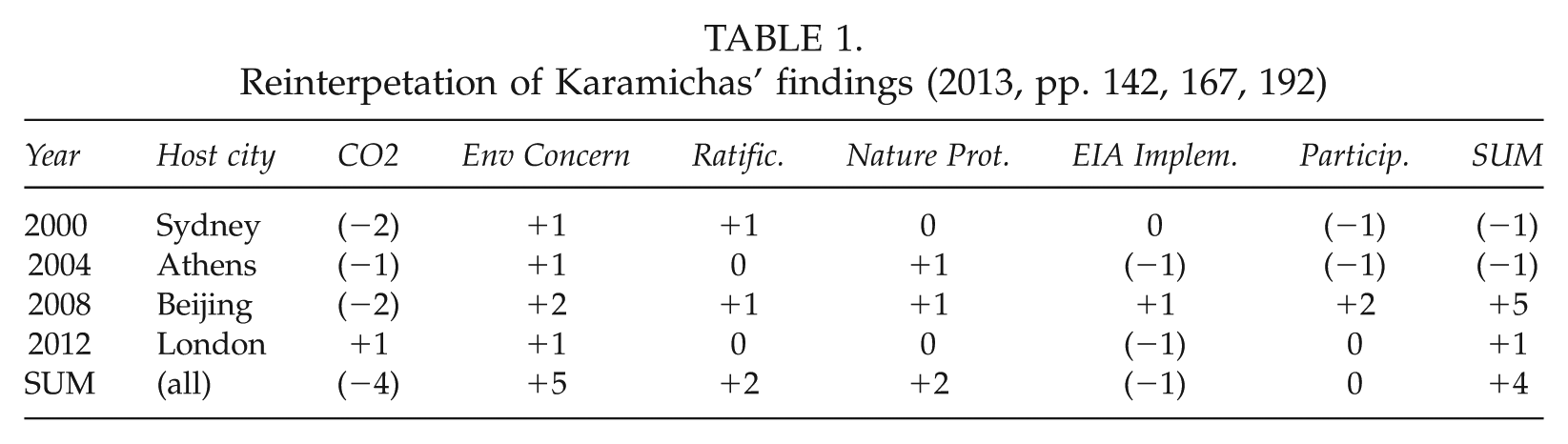
I should emphasize (and apologize to John Karamichas) that what is presented in Table 1 reflects my (re)interpretation of his data. Crystallized in this one figure, I find it easier to contemplate his overall findings, however. Key findings suggested to me include: steady to strong environmental concern by citizens of all four host nations; some evidence of the Games’ positive contributions to the institutionalization of environmental concern in host nations; and evidence that implementation of comprehensive Environmental Impact Assessments for the Games has been weak at most sites, as has the institutionalization of citizen participation in decision-making and planning for the Games. The 2008 Beijing Games, held at the outset of the recent global Great Recession and hosted by a highlycentralized, rising nation determined to make a positive global impression, including with respect to the environment, seem to be the highlight of the four Games that Karamichas examined. The 2012 London Games, unfolding as Karamichas was writing his text, were significantly impacted by the sustained global financial crisis and affected as well by a significant change of government in the host country.
Two-books-in-one and understated in its conclusions, this volume’s strength and contributions are in its thoughtful analytical framework, carefully developed, structured, and laid out; and solid description and documentary evidence. Through his careful comparative, historical study of the most recent summer Olympic Games, Karamichas helps us understand that international environmental policies, institutions, and frameworks are necessary but insufficient ingredients for institutional environmental transformation. Environmental policies and actions must be implemented “on the ground” in various locations. There, local conditions are critical, variable, and subject to a variety of political, economic and social pressures. Karamichas’ story of the ups and downs of the “greening” of the IOC and the Olympic Games is fascinating and told eloquently in this richly detailed and theoretically informed volume.