






Abstract
An examination of gender mainstreaming in the Latin American development policy of the European Union through quantitative and qualitative analysis of policy programming documents suggests that the transformative potential of this approach has been neglected. The language used in the documents is more the typical “Women in Development” language than one that reflects the inclusion of both women and men in the planning for the achievement of gender equality. Exclusion of women’s organizations from the drafting process and the gap between civil society’s and the European Union’s framings of gender (in)equality in Latin America may be responsible for this situation.
Un análisis de gender mainstreaming en la política de desarrollo de América Latina de la Unión Europea basado en el análisis cuantitativo y cualitativo de los documentos de programación de la política sugiere que el potencial transformador de este enfoque ha sido abandonado. El lenguaje utilizado en los documentos es más típico del lenguaje de “Mujeres en Desarrollo” que uno que aspira a la inclusión de mujeres y hombres en la planificación para el logro de la igualdad de género. La exclusión de las organizaciones de mujeres en el proceso de redacción y la brecha entre los encuadros de la sociedad civil y de la Unión Europea de la (des) igualdad en América Latina pueden ser responsables por esta situación.
The first references to women’s rights in the European Union (EU)’s Latin American development policy can be found in the 1992 regulation governing cooperation with the countries of Asia and Latin America, which stated that programs should not have “detrimental effects on the position and role of women” and allowed for the creation of specific projects for women (European Council, 1992: Article 5). This so-called Women in Development paradigm addressed the exclusion of women from the development process by creating specific projects for women and was included in several development agreements signed with individual Latin American countries and subregions (Angulo and Freres, 2006). The underlying rationale was that women could make a contribution to development (for example, through access to work, training, or microcredit) “instead of being left to use their time ‘unproductively’” (Moser, 1993). The paradigm was criticized as an “add women and stir” approach by feminist scholars, who pointed out that its narrow focus on women was ineffective because it ignored the underlying societal problem of unequal gender relations (Moser, 1993; Subrahmanian, 2007).
After the 1995 United Nations (UN) Beijing Conference, the international community replaced the Women in Development paradigm with a Gender and Development paradigm and embraced “gender mainstreaming” as “the fundamental GAD buzzword” (Subrahmanian, 2007: 112). The new paradigm focused on gender without displacing women as the central subject by recognizing that improving women’s status required analysis of the relations between women and men. Gender mainstreaming broadened the scope from women in isolation to gender equality and social justice. The ultimate aim became “transforming gender relations,” and the approach stressed “the shared responsibility of women and men in removing imbalances in society” (Council of Europe, 1998: 14, 18). 1
Since 1995 the EU has adopted a range of high-level policy documents 2 confirming that gender must be included in all areas of development and all programs and projects at the regional and country levels. The commitment to gender mainstreaming was written into the 1997 EU Treaty as “The Community shall aim to eliminate inequalities, and to promote equality, between men and women” (European Union, 1997: Article 2). Gender mainstreaming was taken up at the EU–Latin America and Caribbean Summit in Rio in 1999, and one of the final declarations was that “the gender aspect will be taken into account as a basis for all co-operation programmes” (EU–Latin America and Caribbean Summit, 1999: Article 4). This strong commitment to mainstreaming gender somehow evaporated in the 2002–2006 regional strategy paper for Latin America; although it said that women (among other groups) should be given priority in promoting social integration, it did not include gender-equality goals (European Commission, 2002a). Later on, however, in the regional strategy paper for 2007–2013, the centrality of gender mainstreaming reappeared in the assertion that “monitoring indicators will be systematically included in programmes” to ensure that a gender perspective is taken into account (European Commission, 2007a: 18).
The question arises whether the EU has lived up to its promises. In this article I want to examine through quantitative and qualitative analyses of policy planning documents from 2002 and 2007 the extent to which a gender-mainstreaming strategy has been integrated into the planning phase of EU aid to Latin America. Rather than reviewing the progress of gender mainstreaming in policy making and implementation in general, I will assess the changes in the terminology of and the participants in the planning process and comment on the implications of these changes or lack of them. While it is of course not the case that, when gender is integrated into the planning process, this automatically translates into the realization of goals, careful study of planning documents is necessary to establish whether “policy shifts have been made operational in such a way that significant impact in the field may be indeed expected” and “to identify factors that can help explain the degree of impact found in future studies” (Holvoet, 2006: 9). My quantitative analysis of policy documents evaluates whether a change has taken place in the formal aspects of EU development policy with regard to gender equality. Next, a qualitative, critical-frame analysis identifies gender mainstreaming in the same policy documents and contrasts the results with those from documents of Latin American civil society organizations. To begin, the next section describes the data set and clarifies how the transformative potential of gender mainstreaming will be measured.
Measuring Gender Mainstreaming
After the Beijing Conference in 1995, the Council of Europe set up a Group of Specialists to develop guidelines for implementing gender mainstreaming. Widely used by European policy makers, nongovernmental organizations (NGOs), and researchers, the Council of Europe’s definition of gender mainstreaming is to date the most influential definition in the European context (Verloo, 2005a; Walby, 2005a): “Gender mainstreaming is the (re)organisation, improvement, development and evaluation of policy processes, so that a gender equality perspective is incorporated in all policies at all levels and at all stages, by the actors normally involved in policy-making”(Council of Europe, 1998: 13). The definition reflects the objective of integrating gender equality into all policy routines (Mukhopadhyay, 2007), although the ultimate aim is “transforming gender relations” (Council of Europe, 1998: 14). Gender mainstreaming as a transformative strategy is the long-term agenda for tackling the deeply rooted societal norms and practices within which inequalities are embedded. In contrast, the integrationist approach addresses gender issues within existing development policy paradigms and bureaucratic institutions (Beveridge and Nott, 2002; Jahan, 1995; Subrahmanian, 2007) and reduces gender mainstreaming to “a way of more effectively achieving existing policy goals” (Walby, 2005a: 323). A transformative agenda implies not only “the transformation and reorientation of existing policy paradigms” (Walby, 2005a: 323) but also “efforts to create constituencies that demand change” (Mukhopadhyay, 2007: 137). This condition is reflected in Naila Kabeer’s (2005: 15) idea of transformative agency, which entails the “greater ability on the part of poor women to question, analyse and act on the structures of patriarchal constraint in their lives.” Mukhopadhyay (2007) shows that mainstreaming gender without including women’s voices leaves the prevailing unequal power relations intact. Therefore, gender mainstreaming as a transformative strategy involves the naming and challenging of existing gender and power relations through policy interventions in which formerly disempowered women and their organizations participate in questioning, analyzing, and acting upon the gendered world. A prerequisite to transforming the development agenda is therefore ensuring that the women who are affected by development interventions have a voice in “[shaping] the objectives, priorities and strategies of development” (Jahan, 1995: 127).
The Data Set
To detect whether the policy commitments are being translated into practice, I analyzed country strategy papers (CSPs) and national indicative programmes (NIPs) for their inclusion of gender equality. CSPs and NIPs are bilateral agreements between the European Union and the government of the partner country and are the main building blocks of gender mainstreaming in development practice (Painter and Ulmer, 2002: 4). A CSP sketches the situation of a country, gives an overview of development aid from the EU and other donors, and establishes the development priorities for tackling the country’s problems. The NIP makes the priorities of the CSP’s response strategy operational by outlining the specific development programs in selected focal and nonfocal sectors and adding timetables, budgets, and measurement indicators. In theory, the drafting process of these agreements is initiated in the respective countries. The National Authorizing Office (the unit dealing with the planning of EU aid, mostly located in the Ministry of Finance or the Ministry of Economic Affairs and Planning), along with the EU delegation, draws up a first draft of the CSP, including an indication of the priorities for EU action in the country. This draft is then presented to the European Union (usually the country desk officer in Brussels), who produces a second draft, which is in turn circulated to the National Authorizing Office for another round of consultations. Once redrafted, the CSP is sent back to the Union for adoption. In principle, civil society representatives should be involved in this process (European Commission, 2001a; 2002b; European Union, 2006).
I have analyzed the CSPs and NIPs 3 of 16 Latin American countries (Bolivia, Brazil, Chile, Colombia, Costa Rica, Ecuador, El Salvador, Guatemala, Honduras, Mexico, Nicaragua, Panama, Paraguay, Peru, Uruguay, and Venezuela) 4 on the inclusion of gender equality. To detect possible progress over time, I compare the first-generation CSPs and NIPs (2002–2006) from these 16 countries with the second-generation CSPs and NIPs (2007–2013), which makes a total set of 32 CSPs and NIPs.
The Method
The research involved quantitative and qualitative analyses of the gender-mainstreaming approach in the Latin American CSPs and NIPs in an attempt to ascertain whether the approach entails “a broader and more comprehensive definition of gender equality” (Council of Europe, 1998: 14). The quantitative analysis starts with a word count, which indicates the extent to which the focus of the discourse has changed from women to gender relations. When a transformative approach is in place, the numbers of references to women and to men will be equal. An imbalance may indicate that one sex is taken as the norm and the other is considered a problem. I have counted references that relate exclusively to women (including women, woman, girl, mother, and female), exclusively to men (including men, man, boy, father, and male) and to both sexes equally (including gender and sex).
Secondly, I have examined the extent to which gender issues are incorporated into the different parts of the CSP and the NIP. According to EU’s own standards, the planning documents should contain “a strong gender analysis and country profile [and] the integration of gender issues in the political and policy dialogue” and should address “equality and women’s empowerment” (European Commission, 2008: 8). The texts were scanned for references linked to gender (in)equality. 5
Obviously, to make the commitment credible the budget should systematically address gender equality (Beetham, 2010; Elson and Sharp, 2010). A scoring system was developed to estimate the percentage of the budget that was gender-mainstreamed. The scores ranged from “not mentioned at all” (no gender mainstreaming) to “a one-sentence reference to gender equality” (gender mainstreaming possible), “two to three concrete references to gender equality in the objectives or expected results” (gender mainstreaming likely), and “four or more concrete references to gender equality in the objectives or expected results” (gender mainstreaming very likely) to “gender is integrated in one or more performance indicators” (gender mainstreaming achieved). Since every NIP has a set of performance indicators linked to the sector’s goals by which to monitor and evaluate the success of the development program, the inclusion of gender indicators corresponds to having the development objectives linked to gender equality in practice. For example, an NIP with the focal sector “Justice” and the objective of reforming the justice system may have “perception of the credibility of the judicial system” as one of its indicators. If this indicator is disaggregated by gender or if it contains a specific indicator linked to gender (for example, “number of gender-based violence cases resolved”), it corresponds to having the development objectives linked to gender equality in practice. These gender indicators may be broken down by sex (for example, school enrollment rate for girls and for boys) or specific indicators of steps in the direction of gender equality (for example, a decrease in gender-based-violence). Since gender indicators constitute a critical link between policy aspirations and policy practice (Beetham, 2010; Walby, 2005b), I regard the use of such indicators as the most definite sign of formal gender mainstreaming in the planning phase. In summary, I consider a policy to be formally gender-mainstreamed if the numbers of specific references to women and men are equal (language), if gender is part of all planning phases (format), and if gender issues and gender indicators are included in all budgetary sectors (budget). I consider such a formal policy change a necessary but not a sufficient step to a transformative approach.
In the qualitative analysis I examine the same set of CSPs and NIPs along with 60 documents from Latin American organizations working on gender equality in the region. 6 The comparative analysis reveals multiple interpretations of policy problems while addressing the exclusion and dominance inherent in policy making (Verloo, 2005b). Analyzing the views of relevant civil society actors on gender equality thus not only allows the detection of possible silences in the CSPs and NIPs but also helps determine whether the approach gives “attention to the substantive objectives of the women’s movement” (Jahan, 1995: 127). Critical-frame analysis, a methodology that builds on social movement theory (Verloo, 2005b) and assumes that policy documents contain a diagnosis and a prognosis of the issue at stake, is applied to the documents to determine who is deemed to have the problem, who has caused it, and who is responsible for solving it (Lombardo and Meier, 2008). For example, who has the problem of “domestic violence”? Men, women, or society? The answer to this question has implications for the kind of solution that will be designed. If women have the problem, a solution could be to build more safe houses. If men have the problem, a solution could be to provide therapy for perpetrators. If society has the problem, the solution could be to alter the broader societal structures and mechanisms that cause violence against women (such as the higher poverty rate of women, the unequal division of care work, and harmful media images of women and men). First I examine which gender issues are identified as problems and solutions in the CSPs and NIPs. Then I establish what issues are left out by contrasting the gender (in)equality frames in the policy documents with those in the texts from the Latin American women’s organizations. Next I examine to what extent the problems and solutions are gendered, what roles are attributed to both men and women, and to what extent gender stereotypes are challenged or reproduced. I also examine who has a voice in identifying problems and solutions and who is being talked about in an attempt to identify which actors are included and excluded in the planning process (Lombardo and Meier, 2008). I consider policies to be genuinely gender-mainstreamed and thus potentially transformative when the problems and solutions concerning gender (in)equality are framed in a way that involves both men and women and when the planning process includes voices from Latin American civil society.
Is the language gender-mainstreamed?
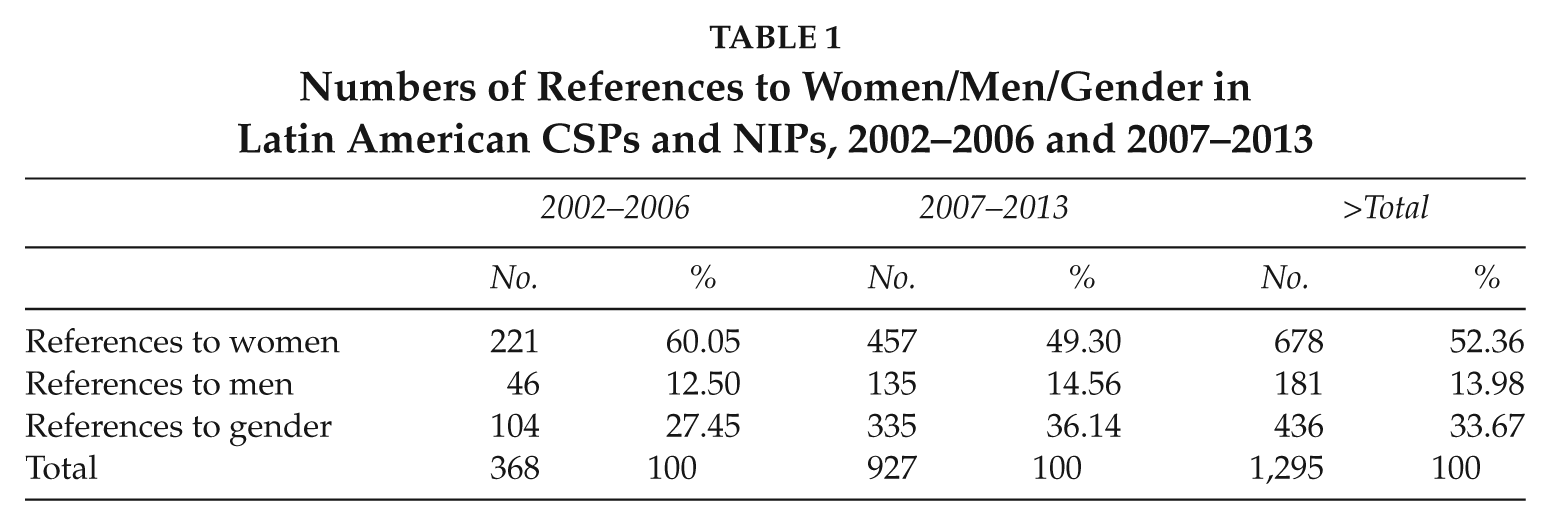
In all of the CSPs and NIPs, references to women are much more common than references to men (Table 1). References to the two sexes in relation to each other are much more common than explicit references to men but much less common than references to women. Given the overrepresentation of references to women, the language used in the CSPs and NIPs cannot be considered gender-mainstreaming. However, between the first-generation CSPs and NIPs and the second-generation ones there is a reduction of the gender imbalance. The percentage of references to women has decreased and the percentage of references to men (slightly) increased along with the percentage of references to the two sexes in relation to each other. Thus gender-mainstreaming language is increasingly being used in these policy documents.
Numbers of References to Women/Men/Gender in Latin American CSPs and NIPs, 2002–2006 and 2007–2013
Is gender incorporated into both analysis and strategy?
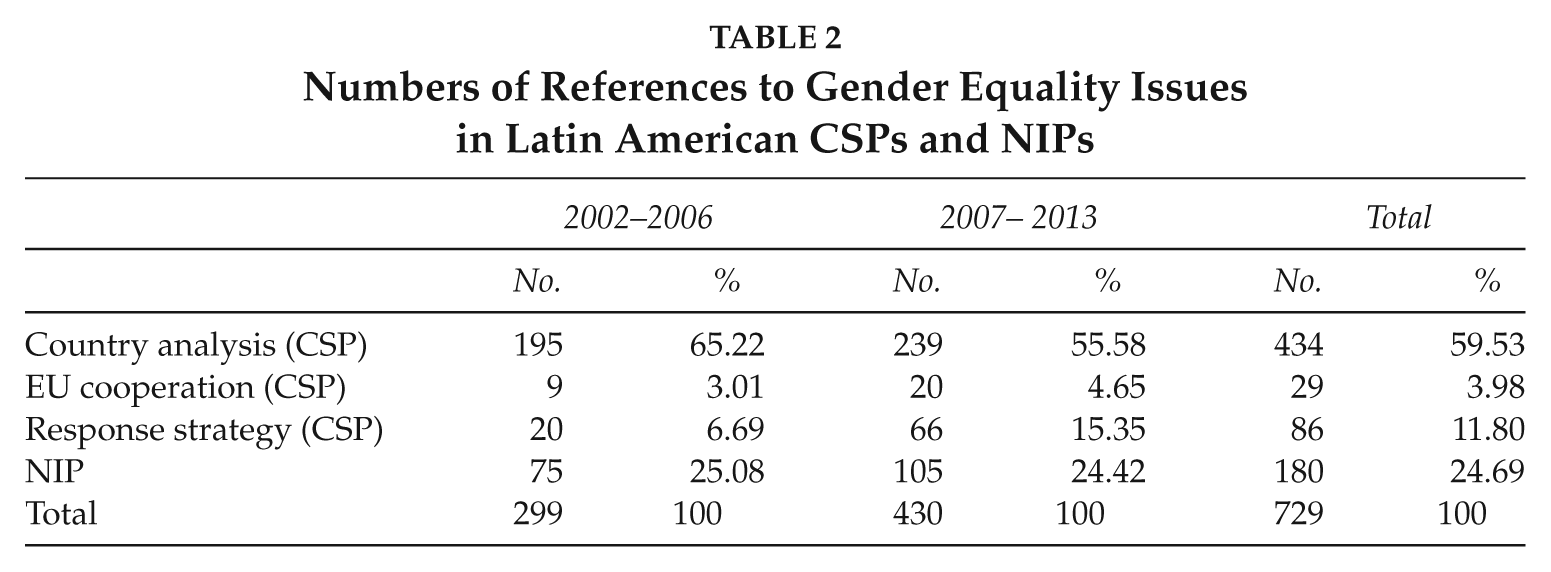
Gender equality issues are found in every part of the CSP (country analysis, overview of cooperation, and response strategy) and in the NIP (Table 2). While the country analysis has the most, comparison of the two generations shows an increase in all parts, indicating a positive evolution over time. Gender equality is becoming integrated into the CSP’s overview of EU cooperation and the response strategy. While the percentage of gender equality issues in the NIPs did not increase, the positioning of these issues improved. In the first-generation documents 6 out of 16 NIPs include gender in a brief chapter on cross-cutting issues separate from the important chapters on the focal and nonfocal sectors in which concrete actions, budgets, and indicators are mentioned. For example, in the Colombian NIP for 2002–2006 gender is dealt with in a three-sentence chapter on several cross-cutting issues at the end of the NIP. Gender is mentioned just once among other issues with no specification of how it will be included in practice: “The impact on the environment, gender and respect for cultural diversity (and especially the rights of indigenous people) will be mainstreamed into the actions included in this strategy” (European Commission, 2002c: 28). The second-generation NIPs also contain this kind of superficial integration of gender equality, but it is less frequent. Only one NIP has a general “tick-the-box” section on cross-cutting issues apart from the substantial sections on the focal and nonfocal sectors. In general, gender is better integrated into these NIPs. Although gender is still mainly confined to the descriptive and analytical parts of the CSPs, there is evidence of an increased inclusion of gender equality issues in all planning chapters (both descriptive and action-related).
Numbers of References to Gender Equality Issues in Latin American CSPs and NIPs
Budget
The NIP budgets reviewed came to 1,436.9 million euros for 2002–2006 and 1,541 million euros for 2007–2013. For the first-generation NIPs, up to 53 percent of this total reviewed budget was not gender-mainstreamed at all (Table 3). This means that gender was not mentioned once in the objectives or expected results of the budgetary sectors, so it is to be expected that this share of the budget was not gender-mainstreamed in practice. For 2007–2013 the percentage of the budget that is not gender-mainstreamed is about 10 percent less than in the first-generation NIPs. This leaves 43.41 percent of the budget that is not gender-mainstreamed. The 10 percent improvement implies that gender equality is becoming more important in planning.
Gender Inclusiveness of Development Aid (million euros and percentage of total budget)
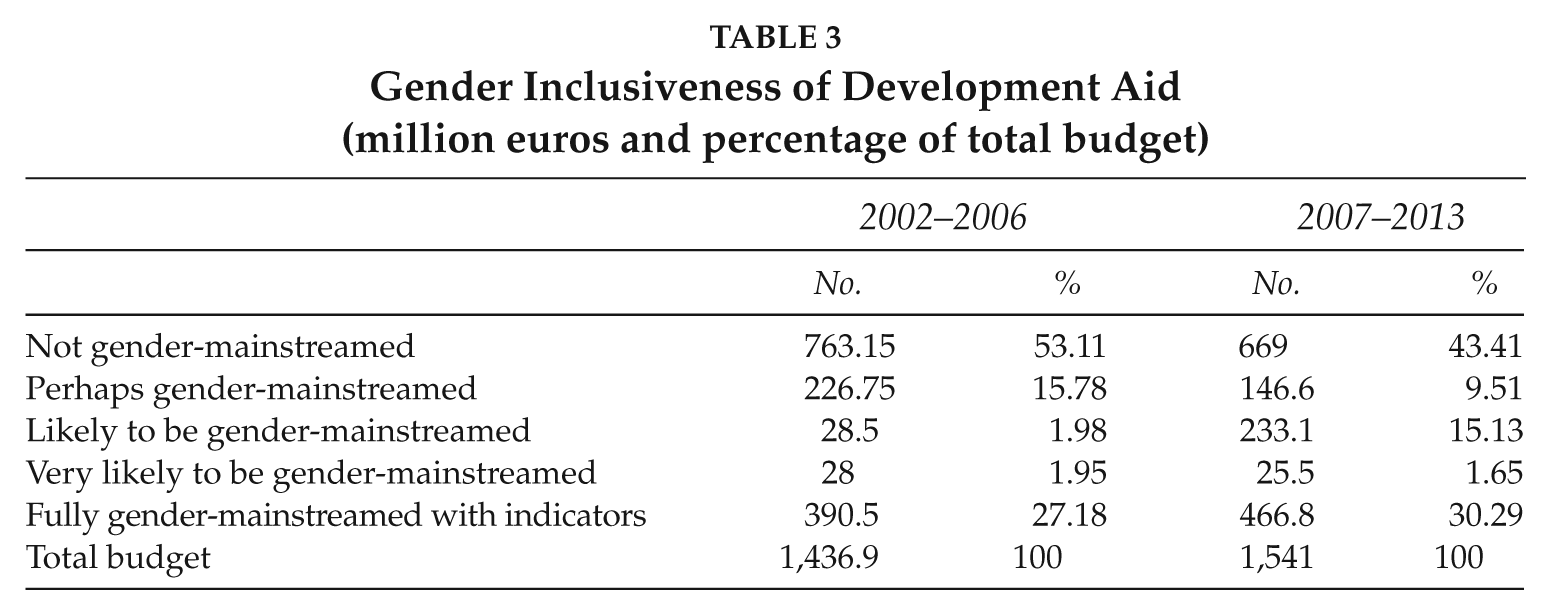
For about 16 percent of the budget for 2002–2006, the NIPs mention gender just once or include gender as a standard phrase. It is possible that this part of the budget will be gender-mainstreamed in the implementation phase but unlikely. However, this percentage of the budget is only 9.51 in the 2007–2013 NIPs. About 2 percent of the budget does specify gender mainstreaming (with up to three gender references). Here it is likely that gender will be mainstreamed in the implementation phase. It is this category that has made the biggest jump in the second generation, from 2 to 15 percent. Another 2 percent of the budget specifies this even more extensively (with four or more references), and for this category it is very likely that gender will be mainstreamed in development practice even though gender is not included in the measurement indicators. The part of the budget that is fully gender-mainstreamed through the use of gender indicators slightly increases. Thus gender is gradually becoming more visible in the budgetary sectors of aid planning, although a significant gap remains.
How is gender framed?
In-depth analysis of CSPs and NIPs reveals that gender inequality in the Latin American country diagnoses is mainly attributed to domestic violence, unemployment, limited access to jobs, low female participation in the workforce, and income disparities between men and women. Also important but less frequently mentioned are unequal access to education, gender imbalances in decision making, the greater chance of poverty for women, and maternal mortality. The solutions put forward in the response strategies and in the NIPs are less varied than the problems. The three most frequently mentioned solutions for gender inequality are access to education, employment, and maternal and reproductive health. In the policy documents education is mainly framed as a tool for development and a preparation for the labor market. In general, education is not framed as a basic human right or as a tool for bringing gender equality into the domestic sphere. For example, in the Ecuadorian NIP the main objective with regard to education is “to train a competitive labor force directed at the country’s productive needs and with a foothold in the market” (European Commission, 2007b: 34). The aid program also stresses the importance of technical and vocational education for girls and young women. Gender equality is not a goal in itself. Other gender policies could be seen as supporting this dominant economic frame. For example, reproductive health assistance allows women to control their fertility and be more active in the labor market, and in the Colombian CSP violence against women is considered a situation that “entails high economic costs for the country” (European Commission, 2007c: 12).
Comparison of the EU’s main solutions for gender equality—education, employment, and maternal and reproductive health—with the views of civil society actors reveals that the latter frame these topics differently. Reproductive health is a major concern for civil society actors, but their focus is not on maternal health but on sexual and reproductive rights. Furthermore, civil society representatives frame employment more broadly than access to education and work, stressing that “the evolution and growth of women’s participation in employment has not gone hand in hand with greater economic autonomy” (CLADEM, 2005a: 2). Other important employment-related concerns raised in the civil society texts are the quality of work (REMTE et al., 2003), sexual harassment at work (Red Mujer y Hábitat, 2006), child care and maternity leave (CLADEM, 2005a), vertical and horizontal gender segregation (CLADEM, 2005b), and social security protection (REMTE et al., 2003). Education is also framed in a different way, emphasizing the right to education (REMTE et al., 2003) or conceptualizing it as a tool for emancipation. The Comité Latinoamericano y del Caribe para la Defensa de los Derechos de la Mujer (CLADEM, 2005b), for instance, stresses the need for education that is free of discriminatory stereotypes, and the Red Mujer y Hábitat (2006: 45) says that education, especially for boys and young men, should be “aimed at achieving fairer relations between genders, respect for women’s autonomy, and the nonviolent resolution of conflicts.”
Compared with civil society’s views, the EU’s conception of gender equality is thus rather limited. However, there is some improvement over time. Among the new gender issues raised are access to land for women (in the CSPs for Honduras, Colombia, and Ecuador, 2007), the effects of gangs on young women both as members and as victims (in the NIP for Honduras, 2007), the high proportion of women working in the informal sector (in the CSPs for Nicaragua and Honduras, 2007) and the gender imbalance in provision of unemployment insurance (in the CSP for Ecuador, 2007). The framing of gender equality in the outlining of solutions has also improved. Whereas the first-generation NIPs contained almost no solutions other than access to education, employment, and maternal and reproductive health, the second-generation NIPs include the strengthening of the indigenous women’s rights protectorate in Guatemala, access to land in Honduras, and gender equality as an integral part of schoolbooks in Paraguay.
Nonetheless, several silences remain in the CSPs and NIPs. Important forgotten issues are the rights of remunerated domestic workers (REMTE et al., 2003), agricultural workers, housewives, women with disabilities, and sex workers (Red Feminista, 2002), the right to safety and to the “egalitarian use of the city by both men and women” (Red Mujer y Hábitat, 2006: 7), the sexual and reproductive rights of lesbian women and of homosexual, bisexual, transgender, and intersex people in general (CLADEM et al., 2006), sexist mass media coverage of violence against women, reinforcing stereotypes “that men are inherently violent and women are passive and submissive” (Red Feminista, 2002: 1), globalization as a force stimulating and restricting gender equality (CLADEM et al., 2006), and the double discrimination against migrant, displaced, or refugee women (CLADEM, 2005a).
How are roles gendered?
For both generations of CSPs and NIPs, women are much more present in the diagnosis of a country’s problems than they are in the outlining of solutions, where their situation is problematized without being a priority. Men’s situation is almost never problematized. With the single exception of the Guatemalan CSP for 2007, where it is said that “political decision-making is dominated by non-indigenous males” (European Commission, 2007e: 2–8), the CSPs do not mention men as problem holders in this area. Several CSPs talk about the underrepresentation of women in politics, but not a word is said about the overrepresentation of men there. Structures of power that hamper equal participation such as all-male political networks (Lombardo et al., 2007) or deeply entrenched stereotypes about “good politics” as a male enterprise are not revealed. Only in discussions of domestic violence are men sometimes problematized, being conceptualized as perpetrators but never as possible victims. The violent behavior of men is sometimes linked with alcohol abuse and poverty. This approach is explicitly criticized by Red Mujer y Hábitat (2006: 45): “Traditional standards of masculinity [associated with] aggressiveness and authoritarianism must be deconstructed, as must arguments used to justify violence exercised by men that suggest alcoholism or male unemployment, among others, as causes of such violence.” Most EU analyses of domestic violence simply leave men out of the picture. Domestic violence becomes a women’s problem. For example, in the Peruvian CSP for 2002 it is said in a subsection on “vulnerable groups” that “on top of economic and health disadvantages, women also suffer from high levels of domestic violence” (European Commission, 2002d: 14). Women are problematized as suffering victims, and men are left out of consideration.
Women are often referred to as vulnerable, often next to a list of other groups that are deemed vulnerable such as children, people with disabilities, indigenous people and the elderly (in the CSPs for Mexico, Guatemala, Colombia, Bolivia, and Chile for 2002 and in the CSPs for Mexico, Chile, El Salvador, and Honduras for 2007) or as requiring “special attention” (European Commission, 2007f: 19) or even as being among the “weaker sections of society” (European Commission, 2001b: 5). This conceptualization of women as vulnerable victims approaches the objectification of “Third World women” criticized by Chandra Mohanty (1991). There is no evolution in this conceptualization between the first- and second-generation policy documents. However, language that empowers is important. As Naila Kabeer (2005) argues, empowerment is rooted not only in the way people see themselves—their sense of self-worth—but also in the way they are seen by those around them, including (inter)national policy makers. Talking about women as vulnerable victims or capable agents thus plays its part in disempowering or empowering them. Comparing the language used in the CSPs and NIPs with the language used in civil society’s documents reveals that civil society’s language is more empowering, attributing subject status to women. Civil society representatives talk about women’s organizations organizing and protesting (Red Feminista, 2002), women making autonomous decisions about their reproductive lives (CLADEM, 2005b), and the important social role of the feminist movement and feminist women (REMTE et al., 2003).
Not only are women seen as the main problem holders in the country analyses but also they are made responsible for the solutions in the NIPs, where men are completely absent. Women have to catch up with an implicit male norm and are made solely responsible for doing so. By contrast, civil society texts do integrate men into the analysis of and the solutions for gender equality. The Red Feminista Latinoamericana y del Caribe contra la Violencia Doméstica y Sexual (2002: 7–8) discusses the “Men, Democracy, and Masculinity Program,” emphasizing that men “can change the mentalities and attitudes of women and men by speaking out” in opposition to violence against women in private, professional, and institutional contexts and to “the unequal burden of unpaid and undervalued domestic work and child rearing.” The Red Mujer y Hábitat (2006: 45) talks about “public campaigns aimed at transforming preconditions about what it is to be a man” and about education with regard to paternity. Civil society texts consequently examine and challenge norms of masculinity and femininity and promote a “complex view of gender . . . overcoming the reductionist perspective that situates it as a binary opposition between men and women” (CLADEM et al., 2006: 8).
Analysis of the gendered division of unpaid care work (household tasks and care for family members) is almost completely absent from the CSPs’ diagnoses and the NIPs’ prognoses. 7 This is notable because it is widely recognized that “the gender power imbalance and women’s subordination spring from the sexual division of labor between productive (paid) and reproductive (unpaid) work” (Elson, 1994; Moser, 1993; United Nations, 2007: 51). This neglect of women’s and men’s unequal time burdens severely limits the scope for solutions, since unpaid work is at the core of the gender issues examined. Domestic violence, women’s access to (full-time) jobs and education, the low female participation rate in paid labor, the severe disparity in income between men and women, high levels of female poverty, and gender imbalances in decision making all have direct or indirect links with the gendered division of care work. In the policy documents these links remain invisible, and the silence on this topic perpetuates men’s and women’s unequal roles in care work. Gender roles are not challenged, and the status quo is confirmed. By contrast, gender inequality in unpaid care work is a major concern in several civil society texts (CLADEM, 2005a; 2005b; CLADEM et al., 2006; Red Feminista, 2002; REMTE et al., 2003).
Who has a say?
A prerequisite to transforming the development agenda is giving the women who are affected by development interventions a voice. With regard to the inclusion of women’s organizations, an imbalance reveals the limited character of the gender-mainstreaming approach employed. Only a few references to governments’ cooperating with women’s organizations are found, and there are no references revealing direct contacts of the EU delegation with women’s organizations during the drafting process. Only the Paraguayan CSP for 2007 mentions that gender issues were discussed with civil society during the drafting process. Furthermore, although numerous references to the importance of including civil society are found in the CSPs, references to feminist or women’s organizations are few. References to Latin American feminist organizations are absent from all the documents examined except for one reference in the 2002 Bolivian CSP to the “active feminist movement” (European Commission, 2002d: 12). Given the significance of Latin American feminist organizations, it is surprising that “feminist” or “feminism” occurs only once in some 1,500 pages of policy documents. In contrast, “feminist”/“feminism” appears 66 times in the 177 pages of civil society text analyzed. Latin American feminist organizations are silenced and marginalized in EU Latin American policy documents. Women’s organizations are slightly better represented; references are found in the Guatemalan and Chilean CSPs for 2002, the Colombian and the Ecuadorian CSPs for 2007, and the annex of the Honduran CSP for 2007.
Furthermore, the sources cited on gender equality issues are predominantly UN, World Bank, or government publications. National women’s organizations are not given a voice in providing information on gender inequality in their countries. The exclusion from the CSP drafting process of organizations working on gender equality and the silence about their existence and importance, combined with the almost exclusive use of institutional sources, indicates that the approach to gender equality in EU Latin American development aid is nonparticipatory. This observation applies to both first- and second-generation CSPs and NIPs. Although the EU has made several high-level commitments to a gender-mainstreaming approach that is more participatory (European Commission, 2007g; 2010), these commitments remain rhetorical.
Conclusion
This article has analyzed gender mainstreaming in the planning of EU development aid to Latin America for the period 2002 to 2013 in an effort to evaluate the transformative potential of the approach in the planning phase. I proposed to consider policies at least formally gender-mainstreamed and thus potentially transformative if there were equal numbers of references to women and men, if gender were part of all policy planning stages, and if gender issues and indicators were included in every sector of the budget. I would consider policies substantially gender-mainstreamed in the planning phase and thus potentially transformative in practice when the problems and solutions concerning gender (in)equality were framed in a way that reflected the voices of civil society organizations working on gender equality, included them in the drafting process, and involved both men and women equally.
The quantitative analysis revealed that the language used in the planning documents is more the typical Women in Development language than a language that involves both women and men in the analysis of and the development of solutions for gender inequality. Gender issues are mainly incorporated into the descriptive and analytical parts of the policy documents and not mainstreamed at all in much of the budget. Although over time the language, format, and budget become more mainstreamed, the overall picture is that gender is not formally mainstreamed. The qualitative analysis reveals that the gender-mainstreaming approach employed is conservative in nature (Debusscher, 2011). The solutions for gender equality are more limited than the problems put forward, and they are often framed instrumentally in terms of reducing poverty or stimulating the economy. In this sense, gender mainstreaming in EU Latin American development aid policy fits the early Women in Development paradigm, which focused on women only and perceived women as “an untapped resource who can provide an economic contribution to development” (Moser, 1993: 2). Gender equality is sold as a way of achieving existing goals. Although this instrumental approach is less likely to be rejected by the variety of institutional actors, it is not a substantial one (Walby, 2005a). The instrumental focus can be partly explained by the fact that the EU’s gender policies have been focused exclusively on internal market issues, competitiveness, and the creation of economic growth (Lombardo and Meier, 2008). The framing of gender issues in EU Latin American development aid is similar to and influenced by the internal EU agenda (Debusscher, 2011).
Furthermore, conceptions of masculinity and femininity and the gendered division of care work are not questioned in policy texts. Women are consistently singled out and referred to as vulnerable, and they end up being considered solely responsible for the gender inequality problem. In general, men are the implicit norm and women are the problem holders who have to catch up with that norm. Beyond this, women are mentioned more in relation to problems than in relation to solutions, and the set of problems that is linked to women is much more varied than the set of solutions offered.
Lastly, the approach is scarcely participatory, since there is little room for the objectives and voices of Latin American women’s organizations. Not only have women’s organizations been excluded from the drafting process but there is a significant gap between civil society’s and the EU’s frames on gender (in)equality in Latin America. The neglect of civil society organizations has implications for the quality of gender mainstreaming in the CSPs and NIPs. Whereas the EU’s view of gender equality is limited to a few topics (access to education, jobs, and maternal health) and has an instrumental slant, civil society’s views are rights-based and holistic, focusing on multiple topics and solutions. The civil society texts examined also tend to frame the EU’s main topics in a more transformative way, with the aim of challenging gender relations and power structures.
In the CSPs and NIPs, conceptions of gender (in)equality are limited and risk losing touch with the lives and experiences of the stakeholders. The failure of EU actors to include Latin American organizations working on gender equality in the consultation process undermines the transformative potential of the gender-mainstreaming approach in two respects. It is detrimental to empowerment (Verloo, 2005a) and harmful in that what shows up as a “problem” or a “solution” for policy makers is limited by their institutional culture. Clearly, this restricts the scope of policy making and the allocation of resources (Beveridge and Nott, 2002).
Comparing the documents from the two time periods reveals a somewhat broader EU framing of gender equality over time, although gendered roles and norms remain mostly unchallenged. The approach to gender (in)equality in EU–Latin American development cooperation has not accomplished the shift to a transformative gender-mainstreaming strategy. The analysis has exposed a narrow and conservative agenda. The more transformative issues that are put forward by civil society organizations, such as a radical questioning of masculinities and femininities, do not fit within the EU’s dominant development paradigm, which is focused on the economy and poverty reduction. The gender-mainstreaming approach employed thus confirms the existing hierarchy of dominant and alternative development paradigms, state and nonstate actors, and, ultimately, men and women.
Footnotes
Notes
Petra Debusscher is a Research Foundation Flanders postdoctoral fellow in the Department of Political Sciences at Ghent University.