






Abstract
The production of biofuels in Mexico is a fledging project. Lack of planning, the obstacles presented by PEMEX, and the resistance of small farmers have limited their production. Even at this stage, however, some of its effects are increasingly clear: its socio-environmental violence affects the natural resources of peasants and indigenous communities. In addition, Mexico’s trade relationship with the United States, characterized by strong dependency, has affected its food sovereignty in that corn imports have become more expensive because of the increase in U.S. production of corn-derived ethanol.
La producción de agrocombustibles en México es un proyecto incipiente. La falta de planeación, los obstáculos por parte de PEMEX, así como la resistencia por parte de los campesinos han limitado su producción. Sin embargo, aún en esta fase incipiente se per-ciben claramente algunos de sus efectos, los cuales consideramos como violencia socio-ambiental, ya que en principio atentan contra los recursos naturales de territorios campesinos e indígenas. Por otro lado, la relación comercial de México con Estados Unidos, caracterizada por una fuerte dependencia, ha incidido en la soberanía alimentaria del primero, ya que las importaciones de maíz se han encarecido debido al incremento de la producción de etanol a partir de este cereal en la nación vecina.
In the global struggle over oil, a new strategy to create alternative sources of energy has arisen in the main oil-importing countries. Biofuels are part of this strategy. This article analyzes the process by which Mexico has entered this new area of accumulation, which is characterized by predatory social and environmental practices that especially affect small farmers. The production of biofuels is a fledging project in Mexico. Although incentives are offered for the production of “green fuels,” in practice few of the projects have been successful. A law for the promotion and development of biofuels was passed in February 2008, and there are business groups interested in biofuel production, but delays in implementation of the law and a boycott of biofuels on the part of PEMEX have resulted in several failures. In this article we shall examine this new alternative in the context of the new forms of accumulation built upon dispossession and socio-environmental violence.
Biofuels: New Agro-Food Regime, New Territoriality
Various writers have interpreted the expansion of capital as a process characterized by violence. In Marx’s (1973) writings, primitive accumulation, the starting point of the capitalist regime, is seen as an unfinished process brought about through dispossession by violence (conquest, slavery, plunder, and murder). Other writers, such as Rosa Luxemburg and Hannah Arendt, working from a traditional or a new interpretation of the Marxist framework, placed the mechanisms of plunder, dispossession, and violence in the context of the debate over capitalist accumulation. Luxemburg (1967) said that the natural economy—that of peasants with communal ownership of the land—was in ongoing resistance to capitalist dispossession. Arendt argued that the need for capitalist expansion led to a permanent primitive accumulation characterized by plundering of other regions—geographical expansion dominated by the use of violence. Projects such as neo-extractivist development, the construction of dams, the cultivation of transgenic crops, the expansion of the housing sector, and the production of biofuels fit into an accumulation phase characterized by the violent dispossession of peasants. This process not only transforms the landscape but uses its resources in an indiscriminate, intensive, predatory, and violent manner.
David Harvey (2004) argues that the current stage of capitalism is characterized by predatory accumulation. Although he stresses financial capital, he also points to new mechanisms of accumulation by dispossession such as intellectual property, patenting and licensing of genetic materials, and the pillage of natural resources. The momentum given to biofuel production by the developed countries in recent years follows from the renewed spatiality of capital in the context of globalization. It depends upon the transfer of technology and financial resources and its social and environmental costs. The various capitals involved have influenced the reorganization of land, positioning themselves in a hegemonic way as new actors in the struggle over the agricultural spaces of disadvantaged nations. The geospatialization of the “green” energy strategy of Europe, the United States, and even countries like Colombia and Brazil has brought about a new phase of land concentration and a scenario of renewed conflict. The intense demand for land caused by the crops associated with biofuels has disrupted social reproduction, creating new kinds of socio-environmental violence.
In speaking of socio-environmental violence, we agree with Joseph Nevins’s (2003: 677) observation that violence should be understood not only in terms of physical brutality but also in terms of indirect action and social structures that cause harm. The modality of predatory accumulation in which we have framed biofuels would fit this definition. Nevins speaks of “environmental violence,” but we call it “socio-environmental” to highlight its social component. Criticizing the truth commissions created so that countries that had suffered violent conflicts could find justice, he argues that in the best of cases these processes have produced very little justice and are limited to individual injuries. They neglect the degree to which violence takes indirect and structural forms and, we would add, creates inequitable social relations. According to Nevins, this is the case with the struggle over natural resources, which often leads to socio-environmental violence. At the same time, he examines how these forms of violence generate and reproduce colonial relations in the countries of the so-called Third World. In this particular case, we believe that the global project of biofuels amounts to socio-environmental violence by taking land away from small farmers and food production for the benefit of a powerful group of developed countries that want to reduce their dependency on fossil fuels. Its expansion involves the violence generated by the struggle for the control and distribution of environmental resources (specifically the fight over land and the destruction of biodiverse ecosystems). The institutionalization of this expansion denies basic human rights such as food, shelter, clothing, and medical care.
In an article on Tanzania, Neumann (2001) describes how peasants are being violently expelled from their lands and denied access to resources that are vital to their way of life such as pastures for their cattle and hunting grounds while the state administers lucrative national parks for tourists. He distinguishes three forms of violence in these cases: displacement of populations for the sake of conservation, increased vulnerability to environmental risks such as damage to crops, deaths from attacks by wild animals, and drought, and attacks on individuals for entering the parks clandestinely to graze their cattle or hunt. Similarly, in Guatemala, Brazil, and Colombia the increase in biofuels production has involved the violent dispossession of indigenous and peasant communities (Alonso, Gamboa, and Mingorrio, 2010; Houtart, 2011; McMichael, 2010; Teixeira, 2010). In early 2011, for example, the Guatemalan police, army, and security guard expelled 800 families from the 14 communities that they had established since 2008 on unproductive land belonging to the Chabil Utzaj family (Houtart, 2011), and all these countries have experienced unprecedented deforestation. Further, in addition to involving contract work under semislavery conditions, increasing mechanization of sugarcane cultivation has reduced employment in this sector. The proposals for biofuel production in Mexico have all been predatory on the environment and detrimental to food sovereignty. Because of the country’s food dependency on the United States, the latter’s allocation of increasing volumes of its corn production to the production of ethanol has reduced the amount of corn available for import and made it more expensive.
Harvey (2007) argues that capital in crisis has found a “spatial solution” in the expansion of investment into new territories to increase profits and reduce risks. People who work, inhabitants of the land targeted for investment, and nature are directly affected and sacrificed in this spiral of accumulation (Equipo CEDINS, 2012). Socio-environmental violence is an instrument of the new processes of territorial domination, the new energy geopolitics, and what has been called neocolonialism. The costs of this accumulation by dispossession are precisely the plundering and monopolization of natural resources, dispossession, forced displacement, land concentration, and technological dependency.
Socio-environmental violence has begun to be addressed from a legal point of view. According to Iglesias (2003), this type of violence exerts strong pressure on the liberal legal framework 1 and allows conservative positions to gain ground. For her the problem with the liberal framework is that it does not contemplate ways to stop environmental violence without interfering with individual freedoms. The pioneering Ecuadorean legislation with regard to the rights of nature acknowledges that the liberal framework is too human-centric and fails to consider the planet’s other life forms. This legislation is encountering problems in its implementation as the government promotes environmentally predatory energy projects such as mining and oil production in areas with high biodiversity and abundant water. It does, however, set a precedent in seeking to achieve the goal of sumak kawsay (“living well” in Quichwa), living in harmony and balance with nature.
Ecological damage does not happen in isolation from society, and the rights of social actors who are not involved in the promotion of these new energy sources (including their right to food) are being violated. Furthermore, the use and enjoyment of natural resources by the peasants who live on the land that is being absorbed by the expansion of these new crops are seriously affected. The irruption of biofuels in the global market has profound implications for the energy and agro-food sectors. It is defining a new territoriality with the appropriation of resources by capital in the context of the creation of a new agro-food regime. In this article we will call these fuels “agrofuels” because, while it is technologically feasible to obtain energy from various sources of biomass, these new fuels (basically ethanol and biodiesel) are derived from agricultural crops. Calling them “biofuels” gives a “green” varnish to a new modality of agrarian capitalism, food for fuel (McMichael, 2010). This “green” label is being challenged; agrofuels are highly inefficient sources of energy, requiring large amounts of land to make a significant contribution to the world’s energy supply (White and Dasgupta, 2010: 595). A second generation of biofuels made from lignocellulosic residues is expected, but the technology is not yet ready.
What McMichael (2010) calls “the agrofuel project” is a response to the energy and climate crisis and an expression of the degree to which capitalism externalizes its costs. A new relationship between the agricultural and energy sectors is being established (A. González and Massieu, 2009) in which agricultural and communal lands are increasingly being used to produce fuel. The externalization of costs occurs because, in the promotion of fuel production on agricultural land that could be used for food or in areas that are being deforested, the social and ecological impacts are obscured by the notion of “price.” “Assigning a price to biophysical processes (as ‘natural resources’) objectifies them and conceals their socio-ecological relations. . . . The social and ecological consequences of converting farm land and forest into a new profit frontier are hidden behind a facade of market environmentalism” (McMichael, 2010: 609). According to McMichael, the agrofuel race can be understood as “the ultimate demystification of capitalism’s subjection of food to the commodity form: deepening the abstraction of food through its conversion to fuel at the continuing expense of the environment.” This abstraction leads us to think of the new regime as a manifestation of Harvey’s concept of accumulation by dispossession or the new primitive accumulation, based on the commodification and predation of natural resources. In the agrofuels case the socio-environmental cost lies in the attack on food sovereignty and sustainability.
White and Dasgupta (2010) contend that there is nothing new in the expansion of agrofuels—that this is the way capitalism traditionally functions in agriculture. We believe, in contrast, that the production of agrofuels generates qualitative changes in the energy-foods relationship and represents a new threat to food sovereignty and sustainability in the context of a generalized global food crisis. We also believe that it constitutes a new form of colonial exploitation in which the natural resources of the peripheral countries are exploited to satisfy the energy needs of the central countries and local elites. According to the Gallagher report (cited in McMichael, 2010), the pro-agrofuels discourse maintains that their production is a solution to the problems of rural development, ecological deterioration, and poverty. In fact, however, the planting of crops to produce these new fuels increases deforestation, and there are doubts as to whether they truly solve the problems of climate change. Finally, many commentators question their energy efficiency, pointing out that the energy needed to produce them on agricultural land appears to exceed the energy obtained from them.
Notwithstanding all the above, agrofuels are experiencing significant growth at the very moment that the Kyoto Protocol has established the reduction of carbon dioxide emissions as a top global priority. As a result, they are frequently presented as a way of solving the emissions problem and the key to sustainability, considering that in the future oil will be more expensive, scarce, and difficult to obtain. According to the Alianza Global para la Bioenergía, by 2023 20 percent of global energy demand will be satisfied by biofuels (Alonso, Gamboa, and Mingorrio, 2010: 2). What is rarely challenged is the fact that the way of life promoted by Western modernity 2 involves unlimited consumption of energy and that if most of the world’s population were to reach that level we would need the resources of more than one planet. In addition, environmental damage is often evident only over the long term, and many actors share responsibility for it, making it difficult to judge those responsible within a liberal framework that privileges individual freedom. That being said, faced with the evident global ecological crisis that is putting life on the planet at risk, demands and proposals are mounting for a new type of justice that can penalize socio-environmental violence. This trend is reflected by the above-mentioned acknowledgment of the rights of nature in the Ecuadorean constitution (Fundación Pachamama, 2008). 3
Agrofuels and the Dispute over Energy Sources
Oil has become a bone of contention. The history of many countries is tied to the availability or shortage of this energy source. In the frenzied search for it, wars have been fought and many countries have come under the control of U.S. foreign policy. The most recent crises of world economies are tied to the prices of fossil fuels and financial speculation, which have generated far-reaching processes of economic restructuring that have significantly affected the poorest countries. Conflict over oil is also the backbone of many of the most recent geopolitical crises, some of which have resulted in wars (e.g., Iraq and Afghanistan). A significant factor in this situation is the increasing dependency on imported oil of the United States, which consumes a fourth of the world’s supply and has only 3 percent of known reserves. While in 1970 the country was fully self-sufficient, in 2007 it had to import 75 percent of its consumption. In 2004 some of the 48 oil-producing countries reduced their production, among them Norway (–7 percent), Britain (–10 percent), Mexico, and Oman (Houtart, 2011: 308) The energy crisis, brought on by unsustainable consumption patterns, the gradual exhaustion of fossil fuels, and the consequent rise in cost of and speculation in these fuels (Bartra, 2010), has led the United States and Europe to redesign their energy policies with the goal of replacing fossil fuels with renewable energy sources, including agrofuels. 4 Guided by a series of fiscal programs to stimulate their production, they have accelerated the production of these new energy sources, promoted under the “green” label, overlooking the pressing need to reduce oil dependency in the medium term.
Our world devours energy. The consumption of energy is closely tied to so-called Western modernity. Oil is considered the principal raw material that made possible the dominant technoeconomic paradigm of the twentieth century (Pérez, 2004). The increase in worldwide energy consumption between 2004 and 2030 is expected to be 57 percent, and this raises a growing concern to find alternative energy sources. 5
Natural gas seems to be one of the most important sources of energy for the future, with consumption expected to increase by 2.3 percent annually until 2025. Oil consumption is expected to increase by 1.9 percent a year and coal by 2 percent a year during the same period. In 2004 the member countries of the Organization for Economic Cooperation and Development (OECD) consumed 50 percent of the world’s gas supply, while the nonmember countries in Eastern Europe and Euro-Asia consumed 25 percent and the rest of the world the remainder. Natural gas reserves are estimated at 6,183 trillion cubic feet, distributed mostly in the Middle East and Euro-Asia (Energías Renovables, 2006).
Coal, one of the most polluting sources of energy, will be the fastest-growing, with an increase in consumption of 74 percent (from 114.4 to 199 trillion BTU) between 2004 and 2030. Most of this increase will take place in non-OECD countries, since the developed countries are replacing coal with gas and renewable sources of energy. 6
Nuclear energy is likely to become a more important alternative source in the future. Despite the Fukushima disaster of 2011, the 2010 U.S. Energy Report (IEA, 2010) predicts an annual growth rate of 1.3 percent between 2004 and 2030. Renewable energy sources will benefit from the high prices of oil and their appeal as supposedly clean sources, with an expected annual growth rate of 1.7 percent for the same period. The International Energy Agency estimates for 2020 that 9.5 percent of the total consumption of renewable energy sources will be supplied by biomass and organic wastes (in which presumably we could include agrofuels), while the most important of these sources will be hydroelectric (63.4 percent of the total supply) and wind (20.3 percent). Solar and geothermic energy are expected to contribute less than biomass and organic wastes. With respect to projected total energy consumption for 2035 (with the current policies in place), the same source states that energy from biomass and organic waste will account for 9.35 percent, after coal (29.2 percent), oil (27.8 percent), and gas (22.3 percent) (IEA, 2014).
At the same time, inequity in the world distribution of energy is evident: while the United States, Canada, Europe, Japan, India, and increasingly China are consuming increasing amounts of energy, the peripheral countries (in Latin America, Africa, and Asia) have a much lower level of energy consumption. However, the IEA forecasts that by 2035 non-OECD countries will account for the majority (51.1 percent) of the global demand for oil, with the OECD countries accounting for the second-largest share (36.7 percent). Of the non-OECD countries, China accounts for 15.3 percent of the total demand and India for 7.3 percent. The remaining 28.5 percent corresponds to other Asian countries. In Latin America, Brazil will be the major consumer of oil, accounting for 2.6 percent of global demand, while the rest of the region will account for 3.6 percent (IEA, 2014).
Agrofuels: Myths and Facts
Some people argue that agrofuels production will dampen the impact of the greenhouse effect, create jobs, and reduce dependence on oil. It has been documented, however, that agrofuels have a direct impact on the land dedicated to food crops, require the intensive use of agrochemicals, generate new components of pollution in the fermentation and distillation processes, and release carbon dioxide and nitrogen oxides. The overwhelming evidence is that their promotion has contributed to the rise in food prices, the reduction of land for food crops, and the transformation of the eating patterns of families that now depend on daily wage labor in the areas where their production has been heavily promoted. In Guatemala, for example, there is debate about what to do with the residue left from alcohol distillation, which in small quantities could be used as fertilizer but whose current 10 million liters a day have a significant environmental impact.
Furthermore, ever since the emergence and promotion of agrofuels as a renewable energy alternative, their energy efficiency has been disputed. Those in favor of these new sources have argued that they could help to mitigate climate change, with lower greenhouse gas emissions than fossil fuels. It is argued that their consumption releases less carbon dioxide into the atmosphere than fossil fuels—agrodiesel 60 percent less and ethanol 70 percent less (Houtart, 2011: 103). The bias here, however, consists in ignoring the energy consumed in their production, in which more greenhouse gases may be produced than with the production of traditional fuels. The ethanol production process, characterized by intensive monoculture, requires agricultural inputs and machinery and transport to processing plants (R. González and Chauvet, 2008: 54–55).
It has been estimated that in a scenario in which 25 percent of motor fuels comes from biofuels, the increase in the use of fertilizers would be 40 percent. Thus, the savings in the reduction of greenhouse gases from the use of ethanol for transport would be offset by the gases generated by nitrogenous fertilizers. Biofuel energy efficiency has been called into question, since rapeseed and ethanol release between 50 and 70 percent more gases into the atmosphere, respectively. Another source reports that a ton of palm oil produces 33 tons of carbon dioxide—10 times more than oil (McMichael, 2010: 610). Besides the deforestation and the destruction of biodiversity involved, the production of every 5 tons of agrodiesel from oil palm generates 40 tons of solid wastes, which are frequently burned and in the process emit large amounts of carbon dioxide into the atmosphere (Houtart, 2011: 138). In view of these facts, the question is whether agrofuels are really the solution to the problem of oil scarcity.
The discourse associated with the promotion of ethanol production in the United States, involving environment and energy benefits and rural development (Duffield, Xiarchos, and Halbrook, 2008), has permeated the promotion of these new energy sources in other countries, including Mexico. The environmental benefits, however, are severely called into question by the ecological costs of the destruction of large areas of rain forest in order to plant these crops. With respect to rural development, the dispossession and violence that have accompanied the planting of these crops in countries such as Guatemala and Brazil (Acuña and Massieu, 2012) and the threat that their expansion poses to the food sovereignty of countries such as Mexico challenge these alleged benefits. In the case of the European Union, the discourse considers the revitalization of ethanol production a benefit for its producers, but that expansion has received such strong government support in the form of tax incentives that Duffield, Xiarchos, and Halbrook (2008) wonder if it will continue in their absence. However, communications and transport in North America are predominantly by air and ground (Carmona, 2012) and take the most energy, and therefore ethanol will probably come to replace oil, at least in part, as the latter becomes unaffordable. We can envisage a future for America in which the two strongest ethanol producers, the United States and Brazil, will achieve a hegemonic position as energy suppliers.
Agrofuels and the Food Crisis in Mexico
In recent years there has been a surge of investment in Latin America to boost the production of crops that are needed for the production of agrofuels. While the Food and Agriculture Organization and the Economic Commission for Latin America and the Caribbean consider Brazil, Argentina, Peru, Colombia, Bolivia, Uruguay, and Paraguay the countries with the highest potential for this activity, agrofuels have also been promoted in Mexico. Mexico’s 2008 biofuels law is intended to promote energy diversification and sustainable development as conditions that will guarantee public support for the development of rural Mexico (Gamboa, 2009). Although it prohibits the use of corn to make ethanol whenever there is no surplus for domestic consumption, the rules for identifying surpluses have not yet been published. Its goal was to reduce by 2012 up to 5.4 percent of oil consumption for transport by constructing 22 plants and producing 3 million liters of ethanol per year. The government’s national development plan called for replacing 10 percent of the energy derived from hydrocarbons with energy from renewable energy sources by 2012.
Projects for agrofuel production in Mexico have focused mainly on the production of biodiesel from the oil of the African palm and jatropha. The states judged to have the greatest potential for the cultivation of African palm are Chiapas, Campeche, Guerrero, Michoacán, Oaxaca, Quintana Roo, Tabasco, and Veracruz. In the case of ethanol, all the evidence suggests that, because of its productivity compared with sugarcane, corn is the better alternative (CEDRSSA, n.d.). 7 Several projects have been launched to produce ethanol from corn and biodiesel from jatropha. Other ambitious projects propose to produce ethanol from salicornia and blue-green algae in Sonora (Antal, 2012: 10).
In June 2007 President Felipe Calderón inaugurated the first ethanol plant, owned by the Mexican company Destilmex, which was to begin operating in May 2008 and to convert 290,000 tons of white corn into 30 million gallons of ethanol for export to the United States. In 2007 another factory, owned by Mex Starch, was built in Los Mochis with the capacity to process 50,000 tons of corn, and a project proposed for Guamúchil was expected to process 150,000 tons. According to Jorge Kondo, then secretary of agriculture for the state of Sinaloa, all these projects taken together would consume the state’s surplus of white corn, which amounted to 1.5–2 million tons (Rudiño, 2007: 5). The project was controversial from the beginning because it used white corn, the main food staple in the country and one that was in short supply. It closed down in 2011, partly because of the prohibition of using white corn under conditions of scarcity and the fact that sorghum, which might have been an alternative, could not be expected to survive the state’s frosts. (In the winter of 2010 an unexpected mass of polar air coming from the United States wiped out Sinaloa’s corn crops, destroying 400,000 hectares and damaging 600,000 [La Jornada del Campo, January 21, 2012]. Only 461,000 tons were obtained of the 4,668,000 anticipated (El Economista, February 15, 2011].) Other reasons for the plant closure offered by Eduardo de la Vega, president of Destilmex, were the lack of an internal market for the biofuel because of PEMEX’s efforts to delay the bidding, restrictions on the use of inputs, and the desire of the company’s Spanish creditors to have the facilities moved to another part of the country (Cámara Nacional del Maíz Industrializado, 2011).
A project in Valle Hermoso, Tamaulipas, for producing agrofuel from sorghum is being promoted by Biomex Sapi, of the Pert Saque industrial group, which is dedicated to energy management, and Bioenergéticos Mexicanos, a group made up of sorghum farmers in the region. Again, the project is being promoted in terms of job creation, reduction of dependence on gasoline, and the use as the main input of sorghum—of which, it should be pointed out, Mexico has to import around 30 percent of its consumption. This initiative also includes the production of ethanol from sugarcane. In December 2012 César Pereda, president of the Asociación Nacional de Biocombustibles, announced that the plant would be functioning in a year and a half. Among the virtues of the fuel, he mentioned that it would reduce the pollution caused by gasoline by 10 percent.
Other projects are being promoted for the production of biodiesel from ja-tropha and higuerilla (castor oil plant) in the southeastern region of the country. These are plants endemic to Chiapas and are not food crops; in fact, jatropha is considered an invasive plant and is used to make fences (Ovando et al., 2013). Its production in the Soconusco region of Chiapas presents many challenges: lack of expertise among prospective producers, little local research on biofuels, limited investigation of local bioenergetic resources, and the absence of policies for stimulating biofuel production. In addition, there is no technical work on how to separate the seed from the fruit, extract the oil, and process it into biodiesel; everything has to be done from scratch. One of the first steps should be more research and the creation of a germplasm bank that would allow the selection of varieties with a high oil yield. Jatropha seeds imported from India have not yielded the expected results (Antal, 2012: 9). The state government built a plant for biodiesel production in Puerto Chiapas that to date remains unused and promised to fuel a plane with imported biofuel by 2011. A group of UNAM researchers has since pointed out that this would have been impossible because the plants need five years to attain their full growth (Reforma, October 29, 2012). The government also tried to produce biodiesel from used kitchen oil from restaurants, but this proved very complicated and costly and the project ended in failure.
Southeastern Mexico (Chiapas, Yucatán, Campeche, and Tabasco) has more experience in the production of palm oil. From 1995 to 2001, the cultivated area for the African palm increased by more than 1,000 percent and production by 213 percent, while the average yield per hectare fell by 20 percent. In that same period, consumption of palm oil (mainly by the candy and cake industry) increased by 198 percent, and this triggered an increase of 185 percent in the import of this oil (Castro, 2009). In contrast to other Latin American countries such as Brazil and Guatemala, Mexico has to import palm oil while still being a major oil producer. It imports 1 percent of the world’s palm oil supply (Castro, 2009: 2).
Palm plantations generate at most 50 workdays per hectare per year. In 2002–2003, a period of losses caused by hurricanes, the producers of African palm obtained only 10.5 percent of the sale price if the product was used to produce palm oil (Castro, 2009: 4). In other words, in contrast with the clear plundering of the land that has characterized agrofuel production in other Latin American countries, the expansion of the African palm in Mexico has involved exploitation of the direct producers on their own land through contract farming, whereby the company provides financing, technical assistance, and inputs and purchases the crop. Although for some producers this is a good option because it guarantees the marketing of the product, it generally creates heavy dependence on the company, turning farmers into employees on their own land. The federal and state governments have adopted a more aggressive strategy for expanding the cultivation of African palm as a strategic monocrop for the country, and the local government has pointed to the possibility of cultivating land devastated by unproductive activities like livestock production, the production of oxygen, job creation, the creation of greenbelts to protect the biodiversity of the rain forest and reserves for different ecosystems, erosion prevention, and land and watershed recovery for moisture retention (Castro, 2009). There are nine palm oil extraction plants in the four states, six of them in Chiapas. Seven are privately owned, one is a cooperative, and one is of mixed (public-private) ownership. Although many of the current plantations are producing, the extraction plants are still working far below their installed capacity. So far the product is basically used as vegetable fat, and most of it is sent to the Marinela plant in Guadalajara (Ávila, 2011).
Mexico has been experiencing a food crisis since 2006, with a dramatic increase in food prices at the international level, shortages, and malnutrition in the most vulnerable groups. According to the Food and Agriculture Organization (2012), food prices in early 2008 were 40 percent above their 2007 level and 76 percent above their level in 2006. Between December 2010 and March 2011, according to Robert Zoellick, president of the World Bank, they increased by 37 percent, more than double the price in Brazil and Argentina (La Jornada, April 15, 2011). The main reasons for these increases include the increase in energy and fertilizer costs linked to the price of oil, the increase in demand for food from countries such as China and India, low food reserves, financial speculation, and the decline in production due to bad weather, and the increase in the cultivation of crops used as raw materials for agrofuel production (Bartra, 2010).
Against this backdrop, it is fair to ask how the increasing production of corn-derived ethanol in the United States has affected the food crisis in Mexico. The starting point for this inquiry is 1994, when, in the framework of the North American Free Trade Agreement, the basic grain market in Mexico was liberalized. From 1994 to 2011, corn imports to satisfy national demand increased from 7 to 34 percent, 8 evidence of the heavy dependence on the neighboring country and of the food vulnerability that links ethanol production to corn imports. 9 Only 10 years ago the United States used 5 percent of its corn crop for ethanol production, while in 2011 it used 40 percent. We can clearly see a correlation between this exponential growth, high food prices, and the food crisis. A report by Actionaid (2012) for 2003–2011 indicates that the expansion of ethanol production in the United States costs Mexico US$3.2 billion, while financial speculation added US$1.4 billion to the import cost for corn. The negative balances of trade in agriculture between 2000 and 2011 are listed in Table 1.
Balances of Trade in Agriculture (US$ millions), 2000–2011
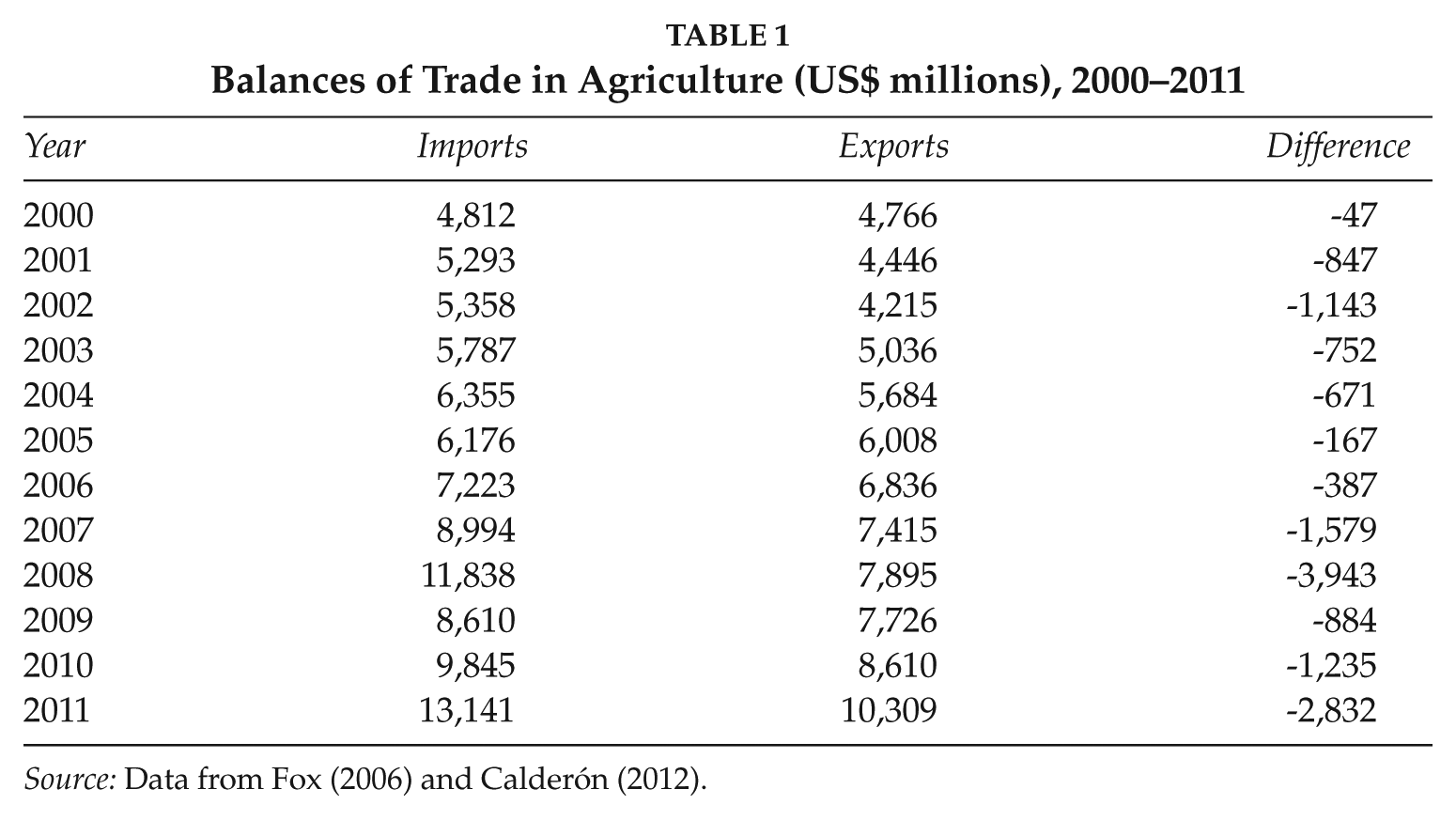
Source: Data from Fox (2006) and Calderón (2012).
The effect of the production of agrofuels from basic grains on the food supply is another expression of socio-environmental violence. According to the National Survey on Health and Nutrition, 4 million households (16 million Mexicans) at some point went hungry and one day did not have anything to eat (Proceso, December 19, 2012). The food crisis of the past years has brought us hunger. There is no better evidence of violence.
Conclusions
Examination of agrofuels production in Mexico must start with the understanding that these are emerging projects and that the cultivation of the crops needed for them is not yet widely practiced. The country continues to bet on oil as its main energy source but at the discursive level promotes so-called biofuels, and there are business groups interested in their production. Therefore, there are still no clear effects, although we are beginning to witness the replacement of forests and land dedicated to the cultivation of food crops or livestock production with plantations of jatropha and African palm. This is a clear threat to the country’s food sovereignty. Palm production has increased in Chiapas through contract farming, which generates technological and managerial dependence of the producer on the contracting company and loss of autonomy. The cultivation of crops for agrofuel production is an obstacle to progress toward sustainable agriculture in that more carbon dioxide is discharged into the atmosphere in its production than in the production of fossil fuels, and in the case of biodiesel the African palm plantations are stimulating deforestation. In addition, the crops used for ethanol production (e.g., corn, sorghum, and sugarcane) require the intensive use of agrochemicals that contaminate and impoverish water and soil and are a health risk.
While there is business interest in this emerging market and a favorable legal framework and support from federal and some state governments are in place, the initiative has not been consolidated, and what we have are failed local projects. In the case of Destilmex, the failure was due both to the prohibition on using corn for ethanol production and to the frosts in Sinaloa in 2010, which ruined the corn and sorghum crops. It remains to be seen whether the project of ethanol production from sorghum in Tamaulipas will succeed. As long as Mexico has oil reserves, it will be difficult for renewable energy projects to receive any support. Government support has not gone beyond the discursive level, and PEMEX, the national oil company, has deliberately obstructed the production of agrofuels.
A new regime is taking shape that involves a new socially and environmentally predatory link between the energy sector and agriculture. The high socio-ecological cost generated by its progress is a manifestation of accumulation by dispossession—the violent seizure of new territories, job instability, and the overexploitation of labor and natural resources. All this perpetuates an exclusionary model, since the benefits are concentrated in a few powerful business groups that ignore the social and environmental costs, especially the threat to food sovereignty—and all this to sustain the energy consumption of a minority.
Violence is also expressed through control mechanisms in the food market. Business initiatives such as sorghum cultivation in Tamaulipas conceal strategies for controlling farmers’ crops and impose prices on a crop that is used as balanced feed for cattle. The strategy of the companies linked to this sector is to purchase land in expansion zones in order to incorporate small and medium-sized producers into a contract farming scheme. Either through land purchase or through this framework, the green fuel boom is exerting heavy pressure on the land. Crop lands are gradually being transformed into the green deserts of monocrops.
Agrofuels are the expression of a new process of accumulation harbored by mechanisms of territorial domination, since, as Alberto Alonso (2009) points out, besides land these monocrops need water and the occasional but predictable availability of labor. Big capital has moved into highly susceptible territories, incorporating historically disputed natural resources on the way. For peasant communities that live in daily resistance, the arrival of agrofuels may seem like a new way of living, but ultimately it will prove to have been a mirage.
Footnotes
Notes
Yolanda Cristina Massieu Trigo and Blanca Olivia Acuña Rodarte are professors and researchers in the Department of Social Relations and the Postgraduate Program in Rural Development of the Universidad Autónoma Metropolitana–Xochimilco. Luis Alberto Hernández is a translator in the Philadelphia area.