






Abstract
Villa Portales is an icon of modern architecture and urban planning of the 1950s and 1960s in Santiago de Chile. It embodies the political and institutional project of the time, which sought to respond to the need to establish a balance—although tenuous—in a fragile and strained economic and political system. This fact is crucial to understanding its socio-spatial objective, the administrative model it employed, and especially the crisis it has endured. The testimony of current Villa Portales dwellers points to a deterioration of its residents’ quality of life beginning in the 1980s with the changes in the role of the state introduced by the military dictatorship, the privatization of public services, and the termination of the Caja de Previsión de Empleados Particulares (Private Employees’ Pension Fund). Despite all this, the community was able to make this space a place of resistance and new meaning based on the sense of belonging arising from its architecture and its history.
Villa Portales es un ícono de la arquitectura moderna y de la planificación urbana de los años 50 y 60 en Santiago de Chile. Encarna el proyecto político e institucional de su tiempo, que trataba de responder a la necesidad de establecer un equilibrio—aunque fuera tenue — en un sistema económico y político frágil y al límite de sus capacidades. Esto es crucial si queremos entender su objetivo socio-espacial, el modelo administrativo que usó y, especialmente, la crisis que experimentó. El testimonio de los residentes actuales de Villa Portales señala un deterioro en la calidad de vida que comenzó en los 80 con los cambios en el rol del estado implantados por la dictadura militar, la privatización de los servicios públicos y la terminación de la Caja de Previsión de Empleados Particulares. A pesar de esto, la comunidad fue capaz de convertir este espacio en un lugar de resistencia con nuevos significados gracias al sentido de pertenencia que surge de su arquitectura y su historia.
The Portales Neighborhood Unit, or Villa Portales, a component of Santiago’s urban metropolitan expansion that breaks with the traditional architecture of the city’s center and that of the 1940s suburbs, is often considered a landmark in modern architecture and urban planning in Chile. Built at the height of the import-substitution-industrialization model, it is associated with a reorganization of ad hoc state institutions that attempted to link salaried work, public services, and retirement funds. The present article contributes to an understanding of the changes that have taken place in the social and spatial project that the complex has represented throughout its 50-year history based on the opinions and life experiences of its residents. Its inhabitability and the cultural meaning of its architecture are central concepts for reconsidering its social significance, keeping in mind that, as the architect Alfonso Raposo (2012: 2–5) points out, the Villa Portales architectural project was based not on social requirements generated by the life experiences of the residents but on a formal program.
Today Villa Portales exhibits significant deterioration in its appearance and physical aspects but is still a source of pride and recognition for its inhabitants. As a residential unit of the mid-twentieth-century development project, it reflects the public policy concerns for the quality of life and urban development of that era. In contrast to the real estate development promoted by the ensuing neoliberal policies, which through subsidies delegated social housing production to a real estate market based on land markets, deregulation, and maximum short-term profit, Villa Portales was conceived “in and for” the city. In its construction, the institutions in charge took into account “the fact that this property constitutes the only large parcel located near the center of the city close to an array of services” (Braun, 1962: 36). A significant portion of the changes in it can be attributed to the historical and political circumstances of the social environment, but its recognition by its residents is proof of the validity and soundness of the work and the social project it embodied.
Research Method
Many essays have been written celebrating Villa Portales as a signature example of modern architecture in Chile (Bonomo, 2009; Braun, 1962; Château, 2000; Duque, 2014; Eliash and Moreno, 1989; Moscoso, 1968; Raposo, 2012). Our investigation, in contrast, is framed in terms of a dwelling that, over time, shapes a way of being and a presence in the city. Architecture, urban planning, and anthropology are in dialogue throughout the research and contribute to the development of concepts and tools. Thus, on the one hand, the investigation examines the secondary information on the context: research, press archives, censuses, documents, newsletters, photographs, and blueprints. On the other, it compiles accounts of the lives and genealogies of the neighbors and initial families. The biographical accounts allow us to recover residents’ experiences and perceptions concerning the transformations of the buildings and public space and their identification with the place, their everyday relations, and their social and political ties to Chilean society. They also allow us to understand how, over the years, identities have been built in close dialogue with their habitat and how that influences the course of neighborhood life and the structure itself. Ethnographic work involving observation and description allows us to record daily and festive life on the grounds, in community offices, gardens, and businesses. These descriptions are enriched with tales and photographs provided by the neighbors during gatherings for conversation and collective writing.
Understanding Villa Portales
Understanding Villa Portales means, among other things, placing oneself in the 1950s, when the Latin American countries, each in its own way, were in the midst of urban concentration and transformation of their institutions and productive forces. In Chile urbanization began early on (in 1880) and accelerated in the 1930s, with the effects of the global depression and the saltpeter crisis. The decline in exports had created a great influx of unemployed workers to the cities and the formation of an urban proletariat, increasing diversification of the social structure of cities, and the strengthening of union and political organizing activity. In an effort to meet the growing social demands with diminished economic capacity, the state sought a consensus project in “measures aimed at increasing internal demand and protecting industrial activity from outside competition” (Geisse, 1983: 128). Thus the system of public services and social protection was launched. This model, which aimed to free countries from foreign economic dependence, was inspired by the public policies and social and cultural influences of the postwar European and U.S. societies. During the 1950s these influences promised a middle-class society achieved through universal access to education and salaried work. Linked to this promise was a spatial project that was at once its support and its reflection: modern architecture and urban planning. Thus the great residential complexes constituted a representative piece of this consensus project and the promise of a new kind of social life.
Chile already had the institutional framework to take on such challenges, with qualified professionals to shape them and a construction industry capable of delivering. The population was concentrated in the large cities. Between 1930 and 1952, Santiago doubled its population, from 696,200 to 1,436,500. To cope with the accelerated growth, the state encouraged the production of public and private housing. However, the diversification of the social structure of cities and the formation of an urban proletariat called for housing policies of different types for salaried and for unsalaried workers—policies for dealing with land seizures led by slum dwellers, on the one hand, and the growing demand for collective housing by workers and public- and private-sector employees, on the other.
In 1943, with the goal of incorporating into the construction of affordable housing the contributions toward housing withheld from salaries by retirement plans, the Popular Housing Fund created in 1936 was reorganized (Bravo, 1959) and placed under the Ministry of Labor (MINVU, 2004). In 1948 the Pereira Act provided tax incentives for the construction of affordable housing and the creation of construction companies. Massive housing for salaried workers in the 1950s used trade associations such as the retirement funds that had been financing and building housing for public- and private-sector employees for years through ad hoc construction companies associated with them. In parallel fashion, in 1953, during the administration of Carlos Ibañez del Campo, the first housing plan and the Corporación de la Vivienda (Housing Corporation—CORVI) were created under the Ministry of Public Works, which was responsible for running, urbanizing, restructuring, remodeling, and reconstructing neighborhoods and sectors (MINVU, 2004).
The history of Villa Portales began in 1954, when the Universidad de Chile decided to sell the property on which its school of veterinary sciences and agronomy was located to the Caja de Empleados Particulares (Private Employees’ Pension Fund). In April 13, 1955, the Pension Fund engaged three affordable-housing construction companies to build the first phase of the complex between 1958 and 1964, during the government of Jorge Alessandri. From then on, the high-rise “housing unit” would be a reference for the massive projects that, as of 1959, became part of a new generation of collective housing.
The administration of Eduardo Frei Montalva (1964–1970) gave new impetus to this policy with the promise to build 360,000 homes by the end of his term (MINVU, 2004). This is how the CORVI, which until then had focused on social housing production, took control of the retirement funds’ real estate projects and began to build housing for the middle-income strata. The technical department of the Pension Fund was transferred to the CORVI, although it maintained its autonomy to carry out projects. The second phase of construction of Villa Portales was begun, under the stewardship of the CORVI, between 1964 and 1968 (Bonomo, 2009). Beyond the design and construction of the Villa Portales residential complex, the Pension Fund was in charge of its administration until 1980, and its role is essential background for understanding some of the project’s social determinants. Part of the social consensus that the state needed to meet the demands and pressures of organized workers rested upon the pension funds of private and public employees. This model would change dramatically with the pension reform of 1980.
Since its creation in 1925, the Pension Fund had had the power to raise individual retirement funds by collecting taxes and voluntary contributions from employees and employers. These funds were earmarked for the payment of social benefits such as unemployment assistance, disability, retirement, widowhood, and orphan’s pensions, as well as administrative expenses. Since 1952 the law had allowed these funds to invest the surpluses of those benefits in (1) the construction of individual or collective housing for their depositors, (2) granting loans with mortgage guarantees to their depositors for the acquisition or construction of homes, (3) acquiring or constructing their own institutional buildings, and (4) granting assistance loans to their depositors. Thus they could buy property, urbanize and build housing on it, and become managers of real estate projects. With this authority they could set out to resolve what the Fund’s newsletter once called “the most serious problem affecting the private employee: housing.”
Nevertheless, beginning in the late 1960s the sectors linked to big capital, politically and economically weakened by the social achievements that limited their ability to accumulate, began to lose interest in the state benefactor model, which in its criollo version provided public services for the purpose of maintaining the delicate balance of social consensus necessary to keep the nation’s industry running. The political and military mobilization that led to the 1973 coup d’état paved the way for financialization and the opening of the economy to international exchange, the state’s retreat in the face of market principles, and the privatization of public services. Sweeping changes in the institutional system began that would lead, among other things, to the creation in 1980 of a system of private pension fund administrators and the dismantling of the institutions that until then had connected the provision of housing with the social security of salaried workers (Cortés, 2010), among them the Private Employees’ Pension Fund.
In order to obtain housing built by the Pension Fund one had to be a “private employee.” According to Article 2 of the Labor Code in force in 1959, this meant “anyone who provides paid services to an employer by contract and whose work consists mainly of intellectual rather than physical efforts.” For the provision of services the Fund relied on a series of private law institutions, among them a medical service, an insurance company, and 13 affordable-housing construction companies. Among the goals established for the creation of these construction companies were cost reductions through economies of scale in the purchase of construction materials, increasing speed and efficiency, and better-quality buildings. The Fund financed and administered the real estate operation, and the companies built the projects designed by their architects. According to the Pereira Act, the houses or apartment buildings constructed were to be transferred to the Fund and its affiliates during or after construction.
Villa Portales as an Autonomous Unit in the City
A “neighborhood unit” like Villa Portales is relatively independent of its surroundings, located within walking distance of the rest of the city but differing from it in its form and structure. It includes “all public interest services and the conditions necessary for the comfort and appropriate development of the average family within the vicinity of its home” (Clarence Perry, quoted in Bonomo, 2009: 50), provides an opportunity for identification and internal integration, and is distinctive in relation to its surroundings. “The idea of the Villa was something like the concept of self-contained neighborhood . . . that had stores on each block so that people did not have to go too far to obtain basic items” (25-year-old woman, interview, Santiago, 2011). This autonomy within the traditional city, associated with remarkable architectural quality in both its modern plastic arts and its materiality, helped create a sense of belonging among its residents.
Social Agitation and Common Areas (1955–1970)
The 1950s and 1960s were times of debate and agitation that reflected the profound political and social transformations that were brewing in Chilean society. They were years of political and organizational commitment, popular advancement, neighborhood councils, the first land takeovers, the World Cup, and television. They were times of participation in political parties and social and grassroots organizations, and they fostered the emergence of a middle class that envisioned improvement in its living conditions under the social protection system begun several decades earlier. The inauguration of Villa Portales was marked by the sign of a country that was awakening to political commitment (68-year-old man, interview, Santiago, 2011): My parents must have come in late 1963; they were times of great political upheaval, a lot of political agitation. To my parents the Villa represented a dream, social ascent, because we used to live pretty overcrowded. I was 18 years old, studying journalism, and very concerned about political commitment. I was a member of the Christian Democratic Youth, with idealism, a sense of dedication, with the intensity experienced by the young. You cannot imagine the emotional weight, the ethical commitment that existed at that time—mistaken or not, there was great commitment. They were times of political confrontation. In 1964 Frei overwhelmingly won over Salvador Allende—one “the revolution in freedom” and the other “the socialist revolution.” Frei Montalva won with the support of the United States, and there was a whole conspiracy against Allende. Many of us who supported Frei Montalva at that time, young patriots, were naïve. We were innocent doves who didn’t know about those things, and we supported him with all our hearts.
Frei Montalva’s proposal was for a change in social structures, but although he presented himself as a revolutionary his proposal was only to include social achievements in the existing economic and institutional model without questioning its foundations. With the passage of the Neighborhood Councils Act in 1968, the Mothers’ Committees were legalized and community organizations multiplied. This, along with the agrarian reform project, was reflective of agitation and change but at the same time a commitment to the existing institutional framework.
The early memories of the residents of Villa Portales confirm that sacrifices and desires for a better life took shape in this place. Being so different from their places of origin, Villa Portales and its gardens represented all they could wish for as a way of life in the city. The architecture was solid, modern, elegant (according to some), with ample gardens and bounteous trees. It was an island arising in the center of the city, providing its residents the necessary elements to continue their projects for progress and social consolidation. It was above all proof that the welfare model (or the promise of one) represented in this case by the Private Employees’ Pension Fund protected and recognized them—with their repair services, gardening, administration, security, and doctor’s office—and looked out for the realization of their families’ dreams. The Fund administered not only the public spaces but also the neighborhood facilities (Ríos, 1959; Rodríguez and Russo, 1956; Urrejola, 1964). It was an institution that projected its services from a central authority into the neighborhood. In addition to administrative personnel, in 1968 Villa Portales had about 140 workers, among them gardeners, doormen, cleaning staff, plumbers, and carpenters. Administrative costs were financed by the maintenance fees deducted directly from the salaries of the homeowners.
Accounts of this first encounter with Villa Portales are full of images and allegories: “It was beautiful; it was the most gorgeous thing that existed; everything well-planned, one of the best ideas; like an elf’s villa, out of a fairy tale; the villa was a marvel; beautiful and strange” (collective interview, Santiago, 2011) (Figure 1). When it began, the Villa Portales project housed 1,869 families in 1,500 apartments and 360 houses covering 19 housing blocks and 14 courtyards, respectively. All of the heads of families were members of the Private Employees’ Pension Fund. They were workers of various kinds, independent or salaried, in small or large companies, in business or industry, with representatives of very different professions or trades (drivers, tailors, technical workers, salespersons, accountants, warehouse directors, and administrative personnel) living in the same block or courtyard. There were also people with occupations that seem to have disappeared today, such as lithographers, telegraph operators, and cinematographers. Many were employees of big companies such as the airline LAN Chile, Philips, Chilectra, Telephone Company of Chile, and even the Pension Fund itself. In the accounts of the first residents job and trade were structuring elements of identity (40-year-old woman, interview, Santiago, 2011): My father was—and I say it with great respect and affection—a low-level employee, self-taught, which is a very important thing, and it’s not common today. Today you want to plant a potato and you have to have diploma to plant a potato. But he was a man who was largely self-taught, in both his profession as a radio technician and later in television. He was a refined man. My father ended up working at Philips Chilena, but before that he was a small business employee —they were called “radio technicians” in that remote era when radios were repaired.
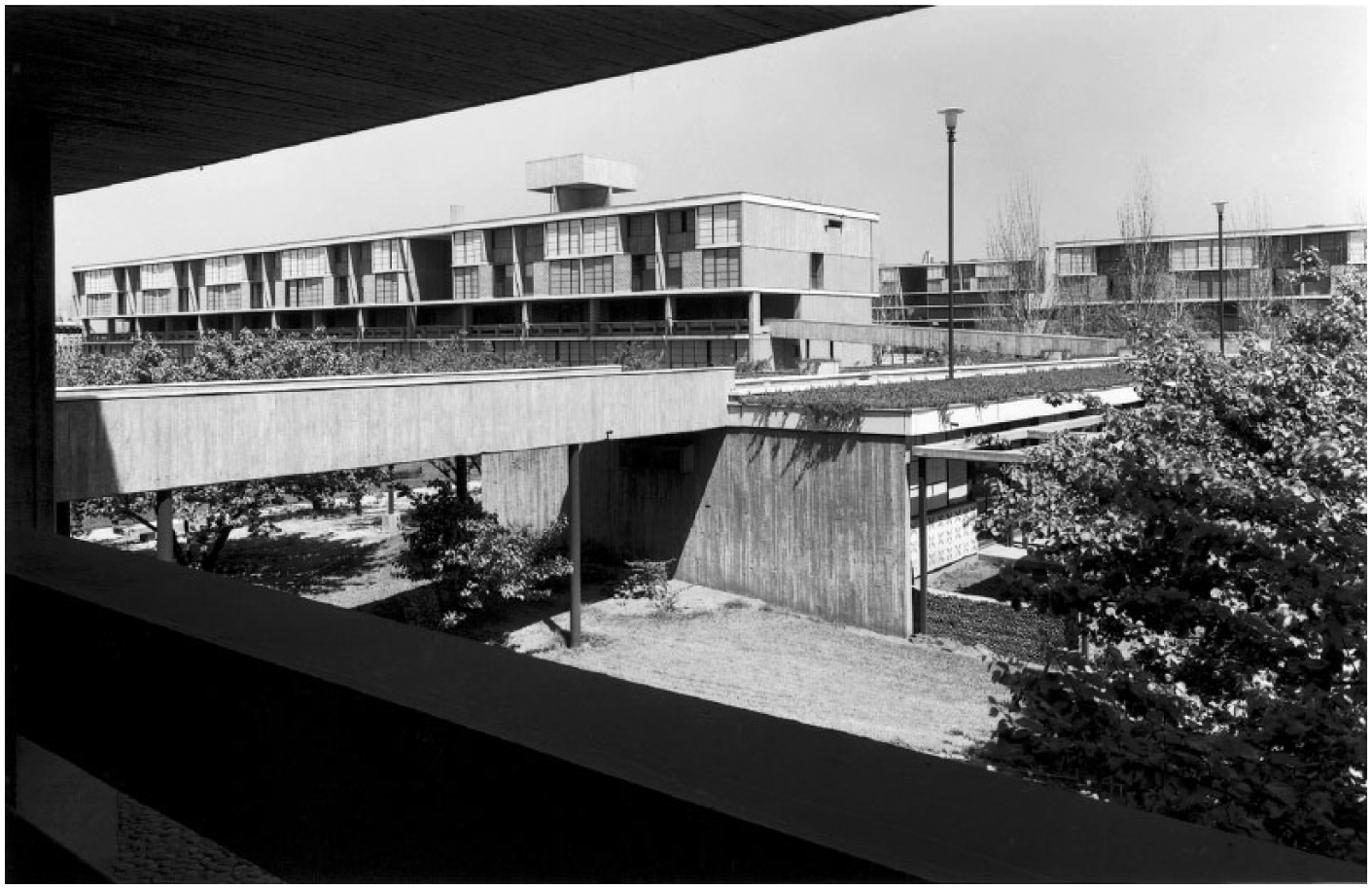
Villa Portales in the 1960s. (Photo Archivo de Originales FADEU, Pontificia Universidad Católica de Chile, Fondo Documental René Combeau T.)
The first residents came from various parts of Santiago, mostly from old downtown neighborhoods—neighborhoods with big adobe houses with large, dark rooms, interior patios, and adjoining façades. The Pension Fund prioritized big families—families of seven or ten were common in Villa Portales. In spite of that, the couples were relatively young. Many of the families were made up of a housewife mother and a worker father, but there were also women who had just joined the working world.
Unidad Popular, Gardens, and Politics (1970–1973)
At the end of the 1960s, speech and action were radicalized. Politics became the referent that united or divided people, and Villa Portales was not immune from this. In the framework of the presidential campaign, the Villa was visited by candidates Salvador Allende, a socialist, and Radomiro Tomic, a Christian Democrat (39-year-old man, interview, Santiago, 2011): In 1969 you could see a break. It was clear that they saw that an Unidad Popular government was possible. In the ¡Quiubo Vecino! there were people who spoke against one or the other, discrediting them. Next door was the theater of the Universidad Técnica, so some meetings were held there; popular artists with protest songs started to appear. Around the country, not just in the Villa, you could feel a sense of change, of aspiration. It was a discourse that didn’t belong to the Villa. It ran through the Villa, the news, the papers, and television. In the neighborhood council meetings the most fiery speeches were made—“Oh, this one is UP!”, “No, this one’s a reactionary!” Labeling people started separating us, but I don’t think it was just in the Villa. I think it was beyond that, all over the country.
The Mothers’ Centers organized a public event for Salvador Allende as part of his presidential campaign. On September 4, 1970, he was elected president. The Unidad Popular’s term is remembered in the Villa as a time of tension among neighbors. They recall that political stances became more radical; rationing and food supply problems began to diminish the neighborhood’s conviviality. However, despite the political polarization of the country, it was precisely in those years that collective and volunteer work was organized. Men and women with different political positions and especially Communist youth designed and built their green areas. Despite ideological differences, Villa Portales continued to be the friendly space they had come to years ago (Figure 2).
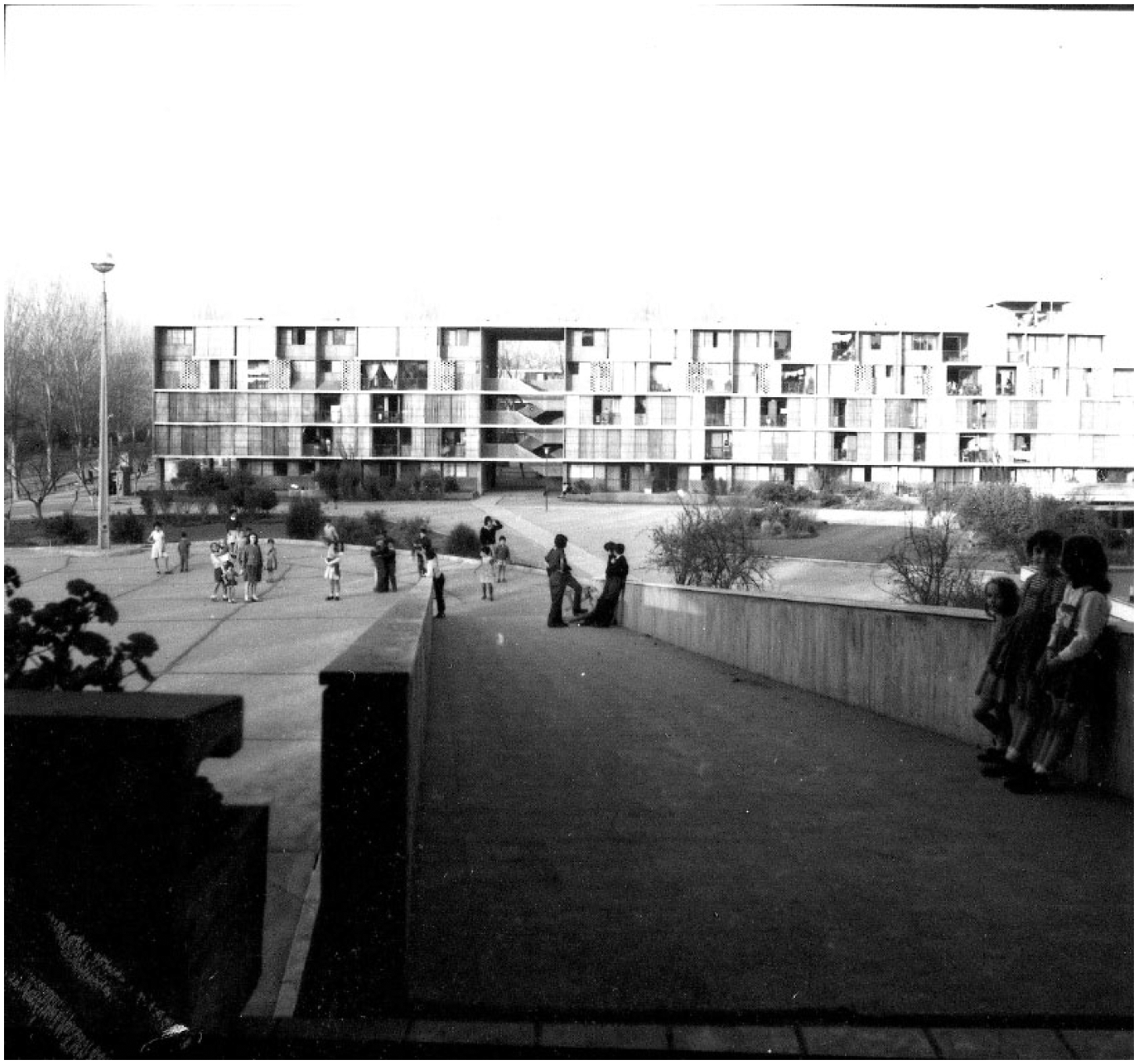
The walkways on planted roofs that connected the parts of the complex on the second level, places emblematic of social encounters that persist in the collective memory. (Photo Archive de Originales FADEU, Pontificia Universidad Católica de Chile, Fondo Documental René Combeau T.)
At 11 p.m. on July 8, 1971, a 7.7-magnitude earthquake rocked Chile’s central region. The impact on Villa Portales’s architecture was like an omen. As people look back today, for many residents it was a warning of the collapse of the habitational and social project: “That’s where the Villa’s misfortune began, because that quake was huge. It was very strong. It was in July, very strong, at night, and the next day, seeing the water glasses shattered . . . I think it was eerie seeing that, because it was a collapse that showed that nothing would ever be the same” (48-year-old man, interview, Santiago, 2011).
Dictatorship, Fear, and Confinement (1973–1989)
The September 11, 1973, coup d’état not only ended the socialist project but also fractured Chilean society and all the historical accounts constructed up till then (Garcés, 2003; Salazar and Pinto, 2002). Freedoms were abolished and community meetings were repressed, and there was impoverishment and massive unemployment. The future for those families, for whom a good quality of life had seemed to be within reach, became a desperate attempt not to fall into poverty and to protect themselves from repression. For more than 16 years, the coup and state terrorism created a crisis of their dreams and projects. Along with their aspirations for social mobility, they lost the sense of belonging to the nation’s society. Fear, shame and confinement slowly did their job and immobilized them for many years (53-year-old man, interview, Santiago, 2011): They raided all our homes. We had to watch the soldiers come inside. They were very rude. They broke windows, broke them with their shotguns. . . . So we were marked. As a teenager you couldn’t go out because there was a curfew. If you went out (if your parents gave you permission) you had to stay out. Sometimes my older brothers and I went out to parties together because all of us cousins would get together. . . . We got together to play guitar, but the military always restricted us. We were always afraid. Our adolescence wasn’t like that of kids today. We were always afraid because you could stay for an hour and if they saw a lot of people, especially with ponchos, you were a Communist. So all that helped us begin to fight so that this whole system of repression would end.
After the military coup, nothing was the same. The Universidad Técnica next door was shelled and machine-gunned on September 11. In the Villa, residents were terrified and silent spectators of the violence being imposed on the country (65-year-old man, interview, Santiago, 2012):
1
The coup d’état marked the Villa. It was a total disaster. There was complete enmity. We didn’t greet each other anymore. The neighbors would close themselves in. There was no more communication. It was no longer the same after the coup. After that it wasn’t the same anymore. I describe this as a disorienting process, because among neighbors, in a community, if there is unity, understanding, politeness in coexistence, you achieve many things. Even without going to the authorities, you resolve the little things as neighbors. That’s one of the basic things that should exist—understanding between neighbors, helping one another—but that no longer existed. The coup caused that, a total lack of friendship. Before, we knew people had certain political and religious creeds; we all worked together for something that was for everyone. That was gone, and we no longer looked at each other with trust but rather with suspicion. It was gone.
Residents pointed fingers at each other and made accusations. Doors of houses and apartments that used to be open were now locked. The walkways that joined the blocks were closed. Children did not go out to play; no one came to the gatherings scheduled, and soccer matches were cancelled. Layoffs began to spread. People still speak of “hunger dressed in a suit.” By dressing well residents were making a desperate attempt to conceal and resist their impoverishment. The privatization and individualism so dear to the neoliberal model began to be part of their lives.
During the 1980s Chilean society witnessed a set of structural reforms implemented in successive waves: the opening of the economy to foreign trade, the imposition of a new labor code, the privatization of social security, the creation of institutions that provided health care, and the entry of the market into education. In 1980 the new pension system was created, and with it the employee funds and their services closed (64-year-old man, interview, Santiago, 2012): In 1981 the AFP [Administradores de Fondos de Pensiones] law was passed, and anyone who didn’t make the change was intimidated: “If you don’t switch, you’ll be left out.” So, scared and uninformed about the issues because it was something new, what did we do? We switched. Then all the funds were merged with the INP [Instituto de Normalización Previsional]. Today many people are still in the INP, and they are better off than those in the AFP. There are people in the Villa who get extremely small pensions.
With the change in pension systems the dependent administration system of the Private Employees’ Pension Fund went into crisis. In 1979 the Fund handed over the administration of Villa Portales to the oversight council made up of representatives of each block.
2
Responsibility for maintaining those huge structures and public spaces remained with the impoverished and weakened community itself. Despite the goodwill, lack of experience, the scale of the residential complex, and the lack of resources created unfavorable conditions for self-management. This slowly led to a lack of motivation to participate and a steady weakening of the feeling of ownership of the common areas (61-year-old woman, interview, Santiago, 2011): That’s where the mess of not paying the water bill started, the water to all the buildings getting turned off, and so some buildings began to handle their own administration. Since it was run by administrators who were not administrators— because you need to have studied administration to do it well—they started to do things badly and began to split up. Then people started administering their own buildings. When my mother was administering the Fund, I don’t remember her having to go pay the water bill; I think they deducted it from her pay or something like that. But that came later when she no longer managed the Fund. That’s when we started with the mess of having to pay the water bill, and people weren’t used to that.
The retirement system on which Villa Portales was based suffered a breakdown of founding principles: the stable work of its assignees became tenuous, the model of social security was privatized, the social status of the private employee lost relevance as a category of identity, neighborhood projects tended to blend together in poverty, and joint administration disappeared. 2
In the 1980s, violence was a daily reality. For a long time the neighbors were central figures or spectators of the protests that today are part of the memory of an era.
3
In them, the architecture provided a unifying scenario in the elevated walkways that were called “bridges” (70-year-old woman, interview, Santiago, 2011): Here protests were organized. It was all over, Villa Portales stood out. Inside the apartments they banged pots and pans; that used to thunder. There were vigils on the bridges. The electricity was turned off, and the kids would gather there. They had piles of rocks. They were local people but a lot of students, and they knew we would receive them. If a kid came running, we’d open our doors; no one would even think of leaving a kid out in the street. Looking back, I think they felt really protected by us.
Along with the commitment to the struggle to topple the regime and bring back democracy, the protests were experienced as a risky and dangerous activity but playful at the same time. There was a certain amount of freedom and joy in that confrontation, whose backdrop was the conviction of a community that protected its people and the students who took refuge there. That is how the neighbors remembered it.
The protests were part of a broader social movement. In the Villa there were several parties. Political participation formed a network at the local and national levels in which the Villa had its representatives. Politics were linked to community work, a form of political action that combined social, cultural, and political work with coordinating protests (48-year-old man, interview, Santiago, 2012): The MDP was the Movimiento Democrático Popular. It emerged under the auspices of the Church, because the Church protected what was related to the social movements. So the MDP must have started in 1980. We used to go to the Padre Hurtado church to the community meetings. There we talked about how to “bust the dictatorship’s ass.” There was no talk of weapons there but rather of turning over garbage cans. Pinochet wanted to show a clean country; we showed that we were pigs and overturned garbage cans. And later, here in the Villa in the 1980s, I was in the Church and we created support groups when trade unionists held hunger strikes. They weren’t even trade unionists, because at that time there was no talk about unions. So we began to work in support of the hunger strikes, work with people much poorer than we were, build houses, do a lot of volunteer work. And that started the political work in the Villa, because most of the political leaders, one way or another, were rooted in the Christian community.
Until well into the 1980s, the Church, still under the authority of Cardinal Raúl Silva Henríquez, played a key role in protecting residents from the violence of the dictatorship and in support of the protests. Although the Catholic community was always important in Villa Portales, during the 1980s its central role increased. Apartment 305, the residence of Jesuit priests, became a refuge, a place of welcome and protection for the community—“a mobile parish,” the locals said. The arduous solidarity work carried out there was strongly defended by the Church against the pressures of the military government and the fears and prejudices of the Villaportalina community itself. With the support of a series of priests who passed through Villa Portales in that period, 4 the Christian communities started children’s soup kitchens and the consumer group Comprando Juntos (Buying Together). Toward the end of the decade, under the leadership of Juan Francisco Fresno, the Church changed course to focus on pastoral care and abandoned these tasks in both the Villa and the rest of the country. Even so, in shantytowns such as La Legua, La Victoria, José María Caro, and Villa Francia the priests continued with their workers’ vocation and adherence to liberation theology.
Memory and Heritage (1990–2000)
At the end of the 1980s, the end of the dictatorship was on the horizon and with it the end of an era of repression. Nevertheless, the neoliberal model and the institutional framework that protected it remained and were strengthened in the following period called the “transition to democracy” (52-year-old man, interview, Santiago, 2011): Then when democracy came, we said, “Phew!” but in exhaustion. . . . As neighbors we stopped doing lots of things, stopped being a force, because in the time of the military government—no matter where, in the office, at work, at school—you didn’t know who you were talking to. You didn’t know if the one you were talking to was really who he said he was or if he was a snitch. And here it was the same. During the “Yes and No” elections,
5
here it was a party. There was a spirit of joy. People greeted each other enthusiastically: “Hoolaa!” “Salud!” “Salud, tía,” the embrace, the smile was a “Thank God it’s all going to be over.” That’s how it was. There was nothing special. It was joy. The next day, a little braver in the streets, an atmosphere of happiness, everyone celebrating—“We won!”
The 1990s in the Villa began with enthusiasm. Residents felt a need to recover what had been lost. They were confident that things would change, and protests slacked off.
However, as the years went by the families were different. They were smaller, and they were poorer. While the 1982 census (INE, 1982) tallied a total of 1,919 families and 8,290 inhabitants, the 2002 census reported 1,878 families and 6,020 inhabitants. While in 1982 the homes were basically nuclear (48.8 percent) and extended (29.2 percent), in 2002 both had diminished, the nuclear to 42.7 percent and the extended to 23.2 percent, and single-parent homes had significantly increased (from 5.1 to 17.3 percent). And while in 1982 couples with children represented 67 percent of the population, by 2002 they had dropped to 57 percent. Even so, Villa Portales was still inhabited basically by its owners (1982, 68 % 2002, 62 percent). Twenty-three percent of heads of households had lived there since the beginning, 38 percent for more than 10 years and only 28 percent for 4 years or less. More recent studies (OSUAH and MINVU, 2007) indicate that only 18 percent of residents are over 60 years of age, 61 percent between 19 and 59, and 21 percent under 18. Household heads who have completed high school have increased from 28.8 percent to 39.6 percent.
In the late 1990s organizing reemerged. In the face of proposed laws that sought to encourage real estate investment in the Villa properties, a social organization coordinating body called Defensa de Villa Portales was created. There was a concern for taking control of land owned in common and defending the neighborhood from real estate pressure. Given the deterioration of the common areas, the organizations worked to restore them. However, as the fear of crime grew in the city and the country, corridors and stairways remained closed, fences were placed around the grounds next to the houses and the first-floor apartments, and transit around the Villa began to be restricted. While some common areas had earlier been fenced in to guarantee the care of the gardens, now the motives were fear of robbery and begging and the neglect of public spaces. “We had to rely on the fences,” the residents point out (Figure 3).
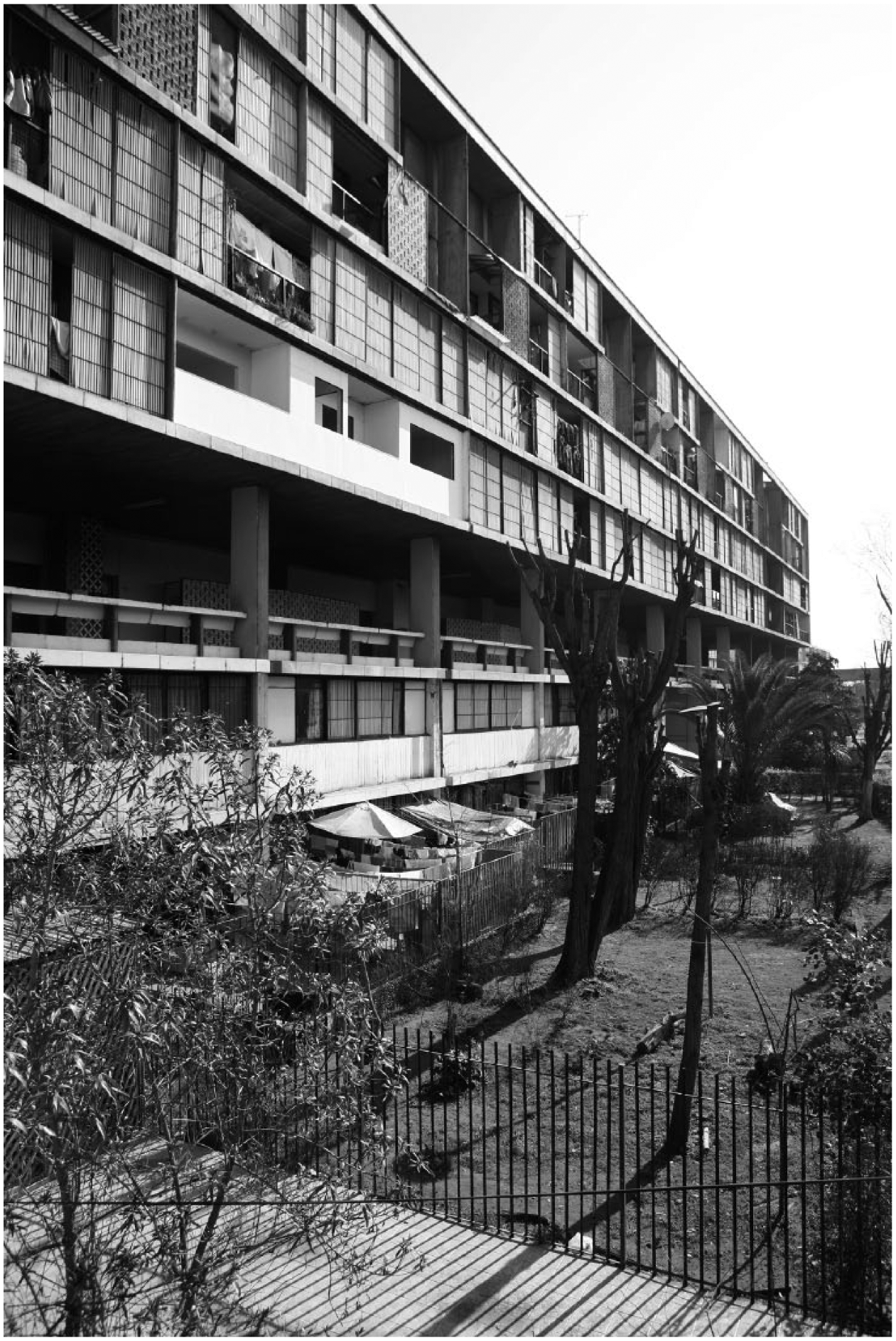
Villa Portales in 2007, with the walkways closed, the common areas appropriated by the residents on the ground floor, and the architecture deteriorating. (Photo Gregorio Papic, project FONDECYT 1095083)
The indiscriminate use of fences has created a new landscape and today is the source of conflict between neighbors because they correspond to different interests. In some cases they are defended as the only way to maintain the green areas and gardens and to avoid neglect and crime on the ground level. In others they are a response to the need for safety expressed by elderly residents. But there is also improper use of common areas for private ends, and this creates tension and contributes to the deterioration of everyday relations. “I think that [the Villa] has changed in the sense that people relate less. Only certain people continue to relate to each other. There isn’t as much dialogue as before. For example, before, with a neighbor you trusted, you went over and walked into his house. There were closer relations” (32-year-old man, interview, Santiago, 2012). Still, 98 percent of the residents say that they talk and share with their neighbors, mostly in the kiosks, stores (61 percent), and courtyards (30 percent) (OSUAH and MINVU, 2007).
The decision to build a large-scale residential complex a short distance from the center of town on premises near the Quinta Normal, one of the city’s landmark parks, had in itself been a challenge to the continuity with the traditional city. Villa Portales was built, as some of its residents recall, as an “island of modernity within the existing city,” a project that joined in the state’s progressive discourse and the promises of social integration that underpinned the fragile political consensus of the time. Inspired by the principles of modern architecture and under the influence of the modern movement and Le Corbusier himself on the Chilean architects of the time but mindful of and sensitive to local conditions, the project’s authors, Bresciani, Valdés, Castillo, and Huidobro, developed an urban and architectural proposal that was radically different from anything known in Santiago and in Chile up till then. Later on, what was a proposal and a wager was translated into a totally new way of living. On the city level, the idea was to insert the Villa into a larger urban planning context, building it in such a way that its green spaces would be an extension of the Quinta Normal Park and linked with the Universidad Técnica del Estado (now the Universidad de Santiago) ( Chile Construye, 1961 ).
The features of the complex’s architectural design left a mark on the collective memory of the residents as part of a unique and shared experience. First, there was the layout of the building clusters, which allowed one to be recognized as a neighbor at different levels of sociability through a series of combinations. In close proximity, one- or two-story single-family housing clusters were located around courtyards. At the intermediate level, they were framed by four-story blocks, and these blocks constituted larger units organized around the great, green pivotal points and an esplanade designed to hold sports, educational, and worship facilities and a commercial mall that would ultimately form a unit encased in blocks of greater height, on the scale of the complex. Then there were the green spaces that organized the continuities from the micro-scale of the garden and the courtyards to the macro-block. Third, there were the walkways, which were organized on two levels. On the ground level they led into the green areas, where the passerby had contact with the first floor, containing houses and apartments, through courtyards and gardens. On the upper level, a network of walkways that used the slope to connect the buildings on the third floor linked the complex’s buildings. It also allowed for the necessary distance to have a mirror image of the city—to enjoy the unity of the complex and its parks immersed in the traditional city and in the surrounding scenery and at the same time see the two as different. Vehicular traffic was kept to the perimeter of the complex, and only one street completely crossed the property to provide access to the esplanade. Some secondary paths allowed access only to parking lots. A fourth distinctive feature was the monumental architecture and the use of façade materials, elevated walkways, and stairwells that framed views of the city and marked the transition from it. Its inhabitants have acknowledged these features of the complex’s design and its social meaning over the years (54-year-old woman, 68-year-old man, interviews, Santiago, 2011): The Villa has a meaning; it was built with meaning. The significance was that the neighbors would run into each other, that they would greet one another. That’s the reason for the long corridors open to the outside. That’s why we have terraces without gratings. . . . The fact that the Villa, . . . the blocs and the houses simulate streets, blocks, and having a large courtyard for everyone was so that the neighbors would talk to each other, would communicate. Then it was a pretty good complex, according to the former neighbors; it was symbolic . . . that it was here in Santiago; it was a new concept. There were apartments, there were houses, and inside the apartments there were courtyards. It was a new concept in Chile. The concept of placing a square or courtyard amidst residential groups did not exist. . . . And the original project had bridges over the houses of the Villa—the walkways. There are photos of that on the Internet.
All the same, Villa Portales was an unfinished project. With the transfer of responsibilities from the Private Employees’ Pension Fund to the CORVI, the building planned for the central esplanade to hold community services such as the kindergarten, the sports fields, the civic center, and the main square were never constructed.
Today the heritage significance that Villa Portales has acquired in the eyes of the state and its cultural managers opens up different and often contradictory perspectives. The proprietary discourses view it with new concerns often alien to the history of its inhabitants. For many residents the scholarly value of its architecture is confirmation that the project was a trailblazer. For others, the discourse and the heritage politics are a slap in the face considering the evident deterioration and neglect of the place and intensify the perception of an aborted project. For the organized residents the heritage proposals of Villa Portales arouse fear for its future. The shadow of gentrification, the real estate companies ready to pounce, and the municipal government’s growing interest in densifying its central esplanade make one regard them with a certain skepticism and suspicion. Nevertheless, the heritage discourse reaffirms for all that they live in a privileged place that they need to protect. From this perspective, the idea of cultural heritage comes as a call for a more active exercise of empowerment and territorial identity in light of the actions of public and private agents. These are the paradoxes of recognition as cultural heritage.
By Way of Conclusion: The Power of Inhabiting
In this article we have attempted to link the analysis of an emblematic residential project in our country—not only its urban planning and architectural approach but also the sociopolitical project that it embodied—with the memory and experiences of its residents over 50 years to shed light on the mark left on this project and its central figures by the sociopolitical and economic changes of our recent history. It is therefore in terms of a tripartite relationship between the social and spatial project, the residents’ life experiences, and the sociopolitical context that has determined the course of its history and future (Raposo, 2012: 22) that the reality of this neighborhood can be understood. This story can only be told through multiple voices, where the design itself is interpreted from a multiplicity of memories in which converge, political, architectural, everyday, institutional, civic issues perform neighborhood identities. Consideration of these multiple dimensions allows us to comprehend the various aspects of inhabiting that contextualize and fit the place in different ways over time.
One conclusion of this research speaks to the perception of a loss of control that seeps into neighborhood relations and therefore into decisions with regard to the place—a loss of the power of inhabiting, the exercise of sovereignty in the space. This was a sovereignty built on the basis of the worthiness of work (employee status) and the right exercised by salary and shared efforts and benefits (the withholding of a percentage of the contributions for housing payments and the administration of the complex); a meaningful sovereignty built on the basis of a unique identity that comes from inhabiting an unprecedented project, which changed one’s life and possessed a distinctive label in the city; a sovereignty exercised because of the project’s location, between the university and the park, in the center of town and distinct from the traditional city; and, above all, a sovereignty built on the everyday experience of coexisting in this unique place. Three turning points had diminished this power over the place: (1) 1973, the military coup, repression, and the Villa in a state of siege, with the resulting internal dismantling of neighborhood relations, distrust, and the steady abandonment of the public areas, and repression and fear that lasted until the late 1980s; (2) 1981, the end of administration by the Private Employees’ Pension Fund, the deterioration of the public areas, economic crisis, impoverishment, and the individual appropriation of common areas; (3) 1993, the administrative transfer of the neighborhood unit from the municipality of Santiago—the richest township in resources and closest symbolically to the original project—to the municipality of Estación Central, which meant the loss of the connection with its communal area of belonging and a cut in the subsidy for watering the public areas, which solidified the appropriation by residents of the communal green areas next to their homes.
Ever since 1973, with the loss of sociability and relationships of trust, there has been a progressive loss of identity and of the principles of singularity that linked the founding residents of the site. However, even with a weakened community the centralized administration was still able to provide assurances of coexistence. It was in the 1980s, with the incursion of neoliberal measures into the social security system, that Villa Portales saw the breakdown of the sovereignty of the community. The privatization of the system of pension funds administration and the closing of its institutions reduced the opportunities for the community to take the future of its habitat into its own hands. This surely constitutes the great divide of the Villaportalinos; the accounts indicate as much.
In two decades, the model of Villa Portales administration was abandoned and management was delegated to its owners without considering the strategies that would allow them to do so. Despite the organizational efforts of residents, the results were inadequate. Notwithstanding the diversification of the spatial and social levels at which the complex was organized, the community did not manage to appropriate them either in matters of administration or in everyday practices. Identity, which is central to this space as a place laden with meaning, suffers as the years go by. The perception of the dirtiness, neglect, and deterioration of the public areas and buildings is evidence of this. In response, individual strategies abound without achieving satisfactory results for the community and often causing tension in the coexistence of neighbors.
Bewildered by their inability to create the conditions for self-management, residents withdraw their identification with the Villa overall, struggle with its enormous size, and build manageable intermediate spaces. A key point that all politics should examine carefully is the strategies developed by the residents to arrange for living spaces within what is seen from outside as a deteriorated, neglected, and unsafe universe. The ethnographies suggest the existence of organizational micro-strategies and refurbishing of the space that manage to give shape and structure to the relations between the public, the collective, and the private recreating identity on the social and spatial micro-level of proximity, to the point that residents say that they do not feel unsafe in the Villa. Many of the gardens carved out of the common area are a desperate attempt, especially by women, to create a place that is beautiful and cared-for.
The problems of Villa Portales are far from being exclusively its own. The difficulties experienced there speak to the need to recover or rebuild ties of belonging and recognition with the state and with society overall—acknowledgment of its history, its heritage value, and the deep-rootedness of its inhabitants beyond the exercise of control and urban and architectural regulation that, along with the tenuous “participatory” programs promoted by the state, simply distract and harm its residents. Ultimately, restoring Villa Portales is much more than a salvage exercise; it is a restoration to its dedicated middle-class people of the recognition and standing they deserve in a society and a city that have for decades forgotten them.
Footnotes
Notes
Rosanna Forray is an architect and an associate professor in the School of Architecture at the Pontificia Universidad Católica de Chile. Francisca Márquez is a tenured professor in the Anthropology Department of the Universidad Alberto Hurtado. This article highlights the results of FONDECYT Project No. 1050031, “Comunidad e identidad urbana: Historias de barrios del Gran Santiago: 1950–2000,” directed by the authors, and the research project “Identidad y patrimonio local: Unidad Vecinal Portales, Santiago,” conducted by R. Forray, F. Márquez, C. Sepúlveda, and N. Astaburuaga for the Ministerio de Vivienda y Urbanismo in 2010. Victoria J. Furio is a translator living in New York City.
References
Supplementary Material
Please find the following supplemental material available below.
For Open Access articles published under a Creative Commons License, all supplemental material carries the same license as the article it is associated with.
For non-Open Access articles published, all supplemental material carries a non-exclusive license, and permission requests for re-use of supplemental material or any part of supplemental material shall be sent directly to the copyright owner as specified in the copyright notice associated with the article.
