






Abstract
From the 1930s until the early 1970s, national industrialization programs in Latin America were part of an effort to introduce social policies that broadened the national market, indirectly creating employment opportunities. Yet, Celso Furtado and other structuralists found the pattern of investment in Latin America predetermined by the unequal composition of aggregate demand, skewed toward the landholding-industrial-financial elite and newly emerged professional strata, leading to constricted employment. In reaction to the inclusive policies urged by the structuralists, insurgent neoliberal policies created a new climate of hostility toward unions and indifference to employment. Neoliberal doctrines deconstructed labor’s eminence, forcing flexibility and precariousness while labor laws and unions were conjured as market distortions. Social neoliberalist, neostructuralist, and neodevelopmentalist regimes arose in the early twenty-first century as a reaction to the failure of neoliberalism to create growth and employment security. These temporary regimes have focused largely on income transfer policies, deploying economic surpluses arising from reprimarization as serendipitous exogenous forces generated export income windfalls from the commodities boom. Fundamental issues such as the pervasiveness of informal work, the recent introduction of flexible employment regimes, and deunionization have not been addressed.
Desde la década de 1930 hasta principios de la década de 1970, los programas nacionales de industrialización en América Latina fueron parte de un proyecto para introducir políticas sociales que ampliaran el mercado nacional, generando indirectamente oportunidades de empleo. Sin embargo, Celso Furtado y otros estructuralistas notaron que el patrón de inversión en América Latina estaba predeterminado por la composición desigual de la demanda agregada y favorecía a la élite terrateniente-industrial-financiera y los estratos profesionales recién surgidos, todo lo cual restringía el empleo. En respuesta a las políticas inclusivas instadas por los estructuralistas, las políticas neoliberales emergentes tomaron una postura hostil hacia los sindicatos y trataron la cuestión del empleo con indiferencia. Las doctrinas neoliberales deconstruyeron la eminencia del trabajo, dando lugar a la flexibilidad y la precariedad, mientras que las leyes laborales y los sindicatos se presentaron como distorsiones del mercado. Los regímenes sociales neoliberales, neoestructuralistas y neodesarrollistas surgieron a principios del siglo XXI en reacción al fracaso del neoliberalismo para generar crecimiento y seguridad laboral. Estos regímenes temporales se han centrado en gran medida en las políticas de transferencia de ingresos, utilizando superávits económicos derivados de la reprimarización, ya que fuerzas exógenas coyunturales inesperadas generaron ingresos extraordinarios a raíz del boom de los productos básicos. Sin embargo, no se han abordado cuestiones fundamentales como la omnipresencia del trabajo informal, la reciente introducción de regímenes flexibles de empleo y la destrucción de los sindicatos.
The importance of the informal sector will define the degree of underdevelopment or relative backwardness of each region.
The theoretical framework of institutional political economy undergirding the analysis of this article is based in the apostasies of the Latin American structuralists (particularly Celso Furtado, Ánibal Pinto, and Osvaldo Sunkel), the heretical perspectives of Thorstein Veblen, the trenchant insights of Paul Baran, and the innovative work of Alice Amsden. 1 Historical contextualization, inductive method, and contingent conceptualizations, rather than the received abstract universalism modeled by neoclassical economists, are core elements of this framework. The early developmentalists (Ragnar Nurkse, Albert Hirschman, Paul Rosenstein-Rodan, and, to a degree, Arthur Lewis) advanced theoretical hypotheses regarding the centrality of labor in underdeveloped nations that have shaped the analysis presented here. In the following sections the theoretical amalgam derived from these many influences is both conditioning and implicit.
By 1950, throughout most of Latin America, the era of state-led national development policy was reaching a point of consolidation. Implementation of this selective-industrialization-promotion paradigm from 1929 through the 1940s was a long, contested exercise, as the case of Mexico demonstrated (Gauss, 2010). Basic new institutional structures such as Nacional Financiera (Arès, 2007), the powerful state investment bank that spearheaded the national industrialization project, centralized social and economic forces, thereby reducing regional power structures: the revolutionary goal of national regeneration was consolidated through radical initiatives such as the pursuit of land reform and the nationalization of Mexico’s vast oil reserves in 1938. Given the historical context in which the new paradigm emerged, the vast, multifaceted nature of this transformation inevitably resulted in relegating employment policy to a second-order (or lower) consideration. 2 Building a viable state apparatus—orchestrating policies to induce, promote, and coordinate a deepening of industrial capacity geared to the internal market and cope with and diminish the hegemonic political-economic power lodged in the archaic agrarian sector—demanded daunting first-order efforts. Thus employment policies were overshadowed.
As the state-led era began in the 1930s, labor structures (scarcity vs. surplus) were heterogeneous across Latin America. Furthermore, within nations, heterogeneous modes of production were ubiquitous, making any attempt at building a national labor policy extremely complex. An important part of the legacy structure, in particular with regard to employment policy, was the long, dark shadow cast by predatory colonial elites, most particularly their open contempt for instrumental (rather than ceremonial) values (Adelman, 1999; Bush, 1994; Stern, 1999; Stein and Stein, 1970). The agro-mineral-financial elite disdained labor (while leisure was the prime signifier of elite status); physical laborers and small cultivators were regarded with particular contempt (Carmagnani, 1976; Dealy, 1992: 114; Harrison, 1997: 24; Keene and Hayes, 2009: 4; Rangel, 1997: 193; Wiarda, 2001: 206). Glade (1969: 128, 573), for example, noted “the high cultural value placed on the avoidance of gainful employment” and the “powerful prejudice against manual labor” as institutional features arising from the colonial era. Favoritism via familial or political connections—options available only to a small, privileged minority—could provide some social mobility; relentless toil could not.
As a path-dependent phenomenon, this disdain for physical labor conditioned Latin America’s conceptualization of the industrialization process throughout the twentieth century. A constant lacuna with respect to technological learning prevented the development of technological autonomy and fostered dependence on technologies imported from labor-scarce (or expensive-labor) nations, where substitution of capital for labor was a priority (Carmagnani, 1984: 106; Moguillansky, 2006, Street, 1981).
Commencing with the state-led era, corporatist structures were frequently deployed, creating a substantial niche for organized labor, which flourished until the dawning moments of neoliberalism. Corporatist labor structures were built upon two elements: a deep state-labor alliance and a divide-to-rule principle to keep workers, small cultivators, and landless peasants from uniting in an autonomous power bloc. These structures allowed policy makers and power coalitions propelling state-led industrialization policies to relegate labor policy to the level of a second-order condition without (usually) facing path-altering tensions. Bonapartist Argentina—grappling with the policies, legacies, and tensions of Peronism—was an important exception (Sikkink, 1991: 106–121).
Full employment was not, then, a formative policy-making idea in Latin America during the state-led era. Confronting underdevelopment, as Celso Furtado (1963: 534–535) argued, required a cluster of structural changes far beyond those contemplated by Keynesian economists who prioritized full employment. Full employment or employment policy was notably absent from his list: [We must] create conditions for fast and effective change in the country’s archaic agrarian structure. . . . We have to tread boldly the path of constitutional change which will permit agrarian reform and a radical change of government administration of the fiscal system and the banking structure.We have to subordinate state action to a clear definition of the aims of economic and social development. . . . We must have legal statutes to subordinate the action of foreign capital to the aims of economic development and to the requirements of political independence. . . . And above all we must have a plan for economic and social development compatible with our own possibilities and in conformity with the aspirations of the people.
During Latin America’s “golden age” of state-led developmentalist policies, from 1945 to 1980, real annual growth of the gross domestic product (GDP) averaged 5.6 percent, with manufacturing—at 6.8 percent—leading the process (Kahn and Blankenburg, 2009: 356). From 1950 to 1973 labor productivity rose faster in Argentina, Brazil, Colombia, Mexico, and Peru than it did in the United States (and this during its “golden age” [Castaldi et al., 2009: 44]). Undeniably, policy initiatives formulated by the structuralist economists at the UN’s Economic Commission for Latin America and the Caribbean (ECLAC) provided a theoretical framework that promoted a new institutional alignment wherein large state-owned development banks channeled credits to strategic industrial sectors (often partially or wholly state-owned) that were promoted in order to create dynamic and cumulative processes of industrialization-led economic growth. Inextricably tied to these policies were those that promoted social development via mass public education, viable public health systems, limited public housing projects, public transportation, and subsidies and price controls for basic necessities. The structuralists (such as Furtado) argued that the fundamental structural parameters of the Latin American economies would have to be altered; and they were.
However, in the late 1960s a commonplace (but bogus) criticism emerged and eventually became hegemonic: that Latin America’s version of state-led development had become “exhausted.” Lost in the discussion was the fact that it was not state-led developmentalist policies that were exhausted—as several Asian nations have demonstrated—but (in general) Latin America’s version of state-led policies that had encountered structural difficulties (Hira, 2007). Burdened by (1) a risk-averse, rentier business elite, (2) state formations that lacked sufficient autonomy and embeddedness, (3) technological stasis, and (4) a heavy-handed, past-bound landowning aristocracy, Latin America never took the steps necessary to revive and reinvigorate its structuralist policies. One of these steps would have been the creation of a viable national employment policy and the identification of such a policy as a first-order condition for the revival of state-led development. However, as Bergquist (1986: 3) argued, in the context of the slowdown faced by the structuralists, The working class was . . . manifestly at the very center of the crisis of postwar Latin American economic and political development. Yet so broad was the consensus over the relative unimportance and the conservative nature of organized labor among scholars of Latin America that for a long time they focused their efforts to explain what was happening everywhere but on the working class. Outstanding contributions examined the economic imperatives of “deepening” capitalist industrialization, and stressed the role models of middle-class and technocratic groups. Other scholars explored the dynamics of corporativism and the state, or sought explanations of the crisis in the cultural and institutional legacy of Iberian colonialism. These contributions were important, and the best of them recognized the significance of organized labor to their analysis. None of them, however, focused attention theoretically and empirically on labor itself.
National policies that pivoted on the question of employment were dismissed as “populist” (Frenkel, 2007: 4). Likewise, from the late 1950s onward, with increasing frequency, Latin American nations endured bouts of austerity imposed by the International Monetary Fund (IMF). Famously, the IMF used a one-size-fits-all model of “adjustment” that required massive devaluations while holding the nominal wage rate constant—forcing the real wage rate down. The essence of the austerity programs was to constrict aggregate demand, pushing down the rate of inflation while cheapening export prices through devaluations. In theory, employment lost from the constriction of the domestic market would be more than compensated for by through a burst of exports that required even more workers. In fact, while the IMF adjustment programs did raise exports somewhat, employment opportunities declined, along with real wages, in an interacting spiral.
It may be that the entrenched ideological presuppositions of the positivists, Social Darwinists, and economic liberals that determined the parameters of national policy during the Second Industrial Revolution (1870–1913) were forced underground during the initial economic burst arising from state-led industrialization for a few decades after World War II, but this did not mean that, universally, the Latin American elite had undergone a major perceptual transformation. The business cadres—those that could profitably bring assets they had accumulated in the preceding stage of commodity export-led development into the new postwar setting of industrialization and those that learned how to use the levers of power and opportunity as the new model congealed—were generally not embedded in the state-led process/paradigm. As Amsden (2001) argued, structures of reciprocity between business cadres who gained from state-led policies and the state that created and promoted those policies were essential components of the relative success of Asian late-industrializers. In Latin America, however, states lacked the sophistication, the vision, and the leverage to create and build upon structures of reciprocity. Elements of its business elite (with some interesting exceptions) were able to successfully operate in the milieu of state-led industrialization and simultaneously maintain an essentially rentier posture vis-à-vis state policy. As long as capital’s share of national income was large and growing at the same rate as the economy, they could be vigorous “sunshine” allies of the national development project.
Left out of this “accord” was a policy of full employment and employment more generally that would by definition eventually tighten a slack and segmented national labor market and squeeze capital’s share of national income. The prevailing economic ideology argued that such a shift would ignite inflation. Given pervasive oligopolistic/oligopsonistic structures of production and exchange, tightening of the labor market would tend to push up producer prices as organized capital sought strategies to maintain its privileged and dominant portion of national income. Operating through the corporatist structures of the state-labor alliance (via its organized power to set national policy through peak business organizations), the industrial oligarchs were generally successful in forestalling the emergence of a viable national employment policy (Schneider, 2004). In undertaking such efforts they allied themselves with financial, trade, and agrarian-based blocs of capital whose ideological affinities rarely diverged from those formed by their liberal predecessors in the late nineteenth century.
In the 1980s a new structure of accumulation rapidly emerged in the aftermath of the political and/or economic ruptures that first swept the Southern Cone nations by 1976 or before. The new paradigm of export-led growth, however, did not gain any traction until the onset of the commodities boom beginning in 2002. While the oil industry’s reckoning was forestalled until mid-2014, this boom had ended for other commodities by 2012 as inevitable global overproduction brought prices crashing down.
Thus, the progress made between 2002 and 2014 on a variety of socioeconomic indicators, such as the decline in poverty and indigence and the relatively respectable increases in per capita income for South American nations, has been demonstrated by recent events to be unsustainable without structural changes that would (1) diversify exports, (2) confront massive inequalities in the distribution of income, wealth, and landholding, (3) promote high-value-added activities, and (4) involve national employment policies designed to address informal labor. Latin America has once again reached a turning point. Because of the end of the commodities boom, unemployment averages 8 percent of the labor force (9.8 percent for women), more than one-third above the 2014 rate, while the number of workers subsisting under conditions of informality has risen to 134 million, or 47 percent of the labor force (ILO, 2016a).
Neoliberal Depredation: Regressive Restructuring
Neoliberalism burst into full bloom with the coup in Chile in 1973. It has, however, been traced back to the 1950s, when the Mont Pèlerin Society became preoccupied with the rising threat posed by developmentalism to their efforts to establish the intellectual hegemony of the precept that a viable “free” society could exist only with private ownership of the means of production and distribution and unregulated markets as the organizing nucleus. Here one finds P. T. Bauer’s 1958 assertion that the problems of developing nations can largely be reduced to their willingness to “interfere” with a unregulated labor market through the imposition of minimum wages and acceptance of collective bargaining (Plehwe, 2009: 265–266). Holding wages above their “equilibrium” or “market clearing” level, according to Bauer, led to “contrived scarcity” in the application of labor to the production process, thereby reducing potential economic growth while making the economy less flexible (Plehwe, 2009: 266).
In postcoup Chile the Mont Pèlerin Society, now led by its Arnold Harberger-Milton Friedman faction, would have carte blanche to launch a draconian frontal attack on organized labor and the regulated labor market (Fischer, 2009; Winn, 2004b: 125–163). The best policy for labor was no national labor policy whatsoever: assuming that workers were free to either sell their labor or withhold it from the market, employers would freely engage them through a process that assumed the equivalence of market power between buyers and sellers of labor. The Harberger-Friedman faction (and Chile’s “Chicago Boys”) claimed that full employment would be achieved through the automatic organizational forces of an unrestrained labor market, with all the remaining unemployed having “freely” chosen leisure over work. Formed in the 1978–1981 period, the new labor policy—one of the “seven modernizations”—was “intended to definitively shift the balance of power in labor relations in favor of business and to weaken the workers and unions that formed the central political base of the Left” (Winn, 2004a: 31). When measured unemployment exceeded 30 percent of the labor force in 1982, the Harberger-Friedman faction remained unfazed, but social forces that eventually undermined the military dictatorship commenced to crystallize (Klubock, 2004: 230). Frequently held up as a shining example of a neoliberal success and providing a viable model for Latin America to follow, Chile’s strategy on careful analysis revealed the scope of neoliberal failure (Cypher, 2005).
Mexico’s much larger neoliberal failure was more easily analyzed (Cypher, 2001; 2005). The final nail in the neoliberal coffin was driven by the spectacular late 2001 collapse of the Argentine economy. Touted continually through the 1990s as the IMF’s exemplar of neoliberal success (even as the poverty rate soared from 21.6 percent in 1994 to 29.4 percent in 1998 while wages for the unskilled fell below their 1990 level and deindustrialization proceeded), the outsized last-ditch efforts by the Fund to rescue its favorite ultimately were to no avail (Blustein, 2005: 35–36, 202).
The Chicago School has systematically failed to acknowledge the model’s “ontological failure . . . [which is] the failure of economics to interrogate the very epistemic premises on which the discipline is founded” (Liu, 2016); whatever may be the evidence in opposition to their economic policies and theories, this evidence has not revealed to them the faulty premises and methods behind their decontextualized championing of socially unconstrained market forces” (Freedman, 2008: 8–69; Mirowski, 2013: 69, 106, 226–227). However, the cumulative change in the UN’s Historical Standard of Living Index (combining per capita income, literacy rate, and life expectancy) for the 1980–2000 period was nearly insignificant—about 0.5 percent per year, on average, for Brazil, Chile, Colombia, and Mexico (Table 1). Leaving aside the troubled case of Argentina, in Brazil the per decade rate of increase in the HSLI from 1940 to 1980 was approximately 33.3 percent but an insignificant 3.4 percent from 1980 to 2000 as haltingly applied neoliberal policies adversely impacted the population. Far from being exhausted, state-led developmentalist policies actually accelerated in the 1970s, leaving the per decade average from 1940 to 1980 at the level achieved in the 1940–1970 period (both because the military government supported state-led—and debt-led—growth and because the HSLI excludes political structures). For Mexico, extending the calculation through 1980 shows that the rate of per decade improvement in the HSLI slowed by an insignificant 5.6 percent.
Cumulative Increase of the UN’s Historical Standard of Living Index for the Six Largest Latin American Economies, 1940–2000
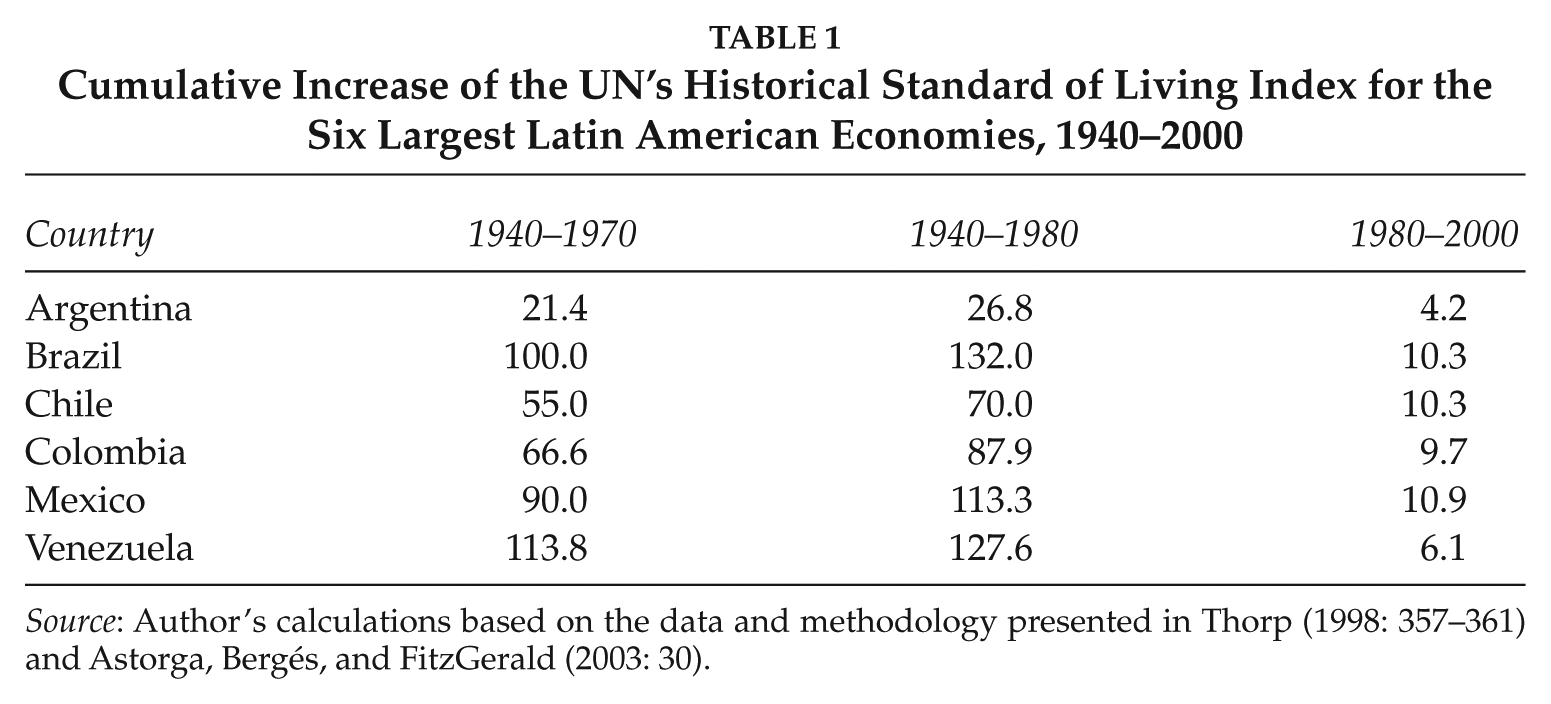
Source: Author’s calculations based on the data and methodology presented in Thorp (1998: 357–361) and Astorga, Bergés, and FitzGerald (2003: 30).
Life After Death: The Rise and Scope of Social Neoliberalism
In the high neoliberal era the neoliberal model, despite being given the widest latitude possible, the virtually unlimited support of the international financial institutions (particularly the World Bank in the case of Mexico and the IMF in the case of Argentina), and ample time to demonstrate its capacities, registered spectacular failures in the case of Argentina and Mexico and a more subtle failure in Chile (Blustein, 2005; Cypher, 2001; 2004; 2005). Nonetheless, while demonstrably a dead doctrine, neoliberalism has lived on—sometimes vigorously—in what has become known as its “zombie phase” (Mirowski, 2013: 14; Peck, 2010). As Peck (2012: 277) has argued, neoliberalism is not a constant, defined doctrine but an evolving doctrine marked by a dynamic of “fail-and-flail forward.” With core ideas that are essentially fantastical (such as an unregulated market economy that will yield a social optimum), as Polanyi (1957 [1944]) argued long ago, neoliberalism is destined to fail, but as it does so it “fails forward” rather than falling back (or down) as one might anticipate. A crisis, then, is merely a moment for readjustment and production of another facet of the doctrine. In the case of Latin America this has taken the form of what has been termed “10 + 1.” The “10” refers to the decalogue of market-centered policies encapsulated as the Washington Consensus of the 1980s. As these 10 prescriptive elements were introduced with few or negative results, the Washington Consensus failed forward, now claiming that “second-stage structural adjustments” would lead directly to the free-market utopia (Cypher, 1997). As further signs of dystopia emerged, particularly when the Argentine economy began to shudder and shake around 2000, the 10 + 1 strategy emerged.
This strategy insists on the relevance of both the original decalogue and the second-stage structural adjustments, adding now social neoliberalism—the rapid creation of a sizable program of market-friendly and market-enabling forms of social spending. At the core of this doctrine we find an attempt to address the largest single failure of the earlier neoliberal stages—the consolidation of the informal sector as a societal reaction to the complete absence of any policy to address the spectacular rise in labor conditions of informality, marginality, and precariousness. The data for the informal sector (Figure 1) are sketchy, especially before 1995, when estimates were occasional rather than annual and were based on a small sample of nations. During the developmentalist period, 1950–1970, structuralists failed to address the issue of employment policy, and their reliance on a Lewis-style theory of sectoral transition (Agriculture → Industry) nearly functioned—the rapidly expanding industrial sector nearly “absorbed” the “surplus” labor expelled from the agricultural sector. However, the informal sector then doubled, to 24 percent of the labor force in 1980. By 1990 it had nearly doubled again, to 45.7 percent. These were the critical years of transformation of prevailing labor relations—workers enmeshed in paternalistic/authoritarian agrarian labor structures declined as a share of the labor force. This transition was made worse as rapid labor force growth (which was also present in 1950–1970) exceeded the absorption capacity of a rising industrial sector.
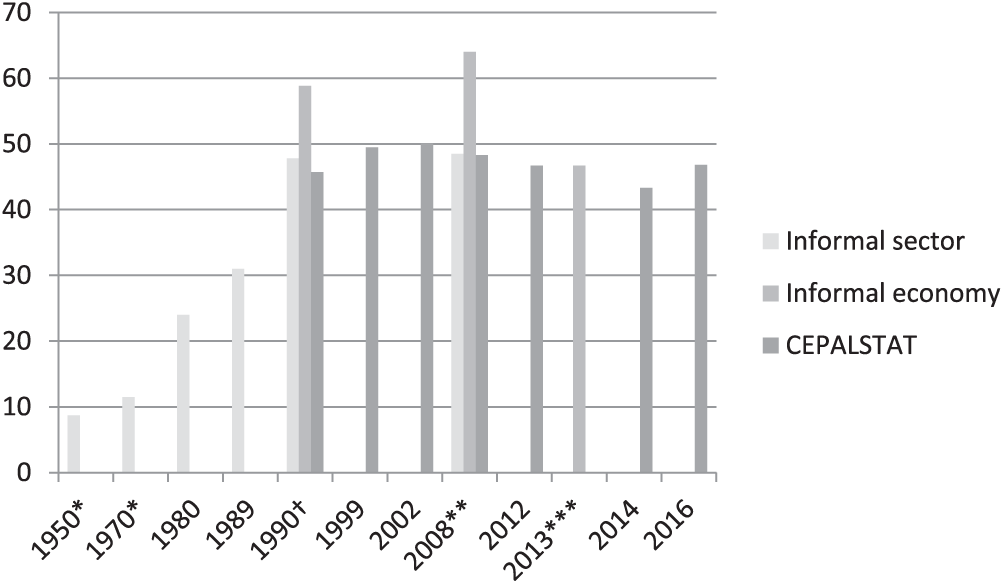
Latin America’s informal sector and informal economy (% of labor force),1980 and 1989 (Infante and Klein, 1995: 318),1990 and 2008 (Tokman, 2011: 776), 1950 and 1970 (Thorp, 1998: 173), 2013 (ILO, 2014: 11), and 2012, 2014, and 2016 (CEPALSTAT, 2016) (*informal sector as % of urban employment + agriculture sector; † informal sector as % of urban employment using ILO 2003 definition, 13 nations; ** informal sector as % of urban employment using ILO 2003 definition, 13 nations; *** informal sector as % of urban employment using ILO 2013 definition in conjunction with new household survey data, 14 nations).
There is, clearly, a strong relationship between the onset of neoliberalism in 1973 and the ensuing rapid rise in the informal sector. Tokman (2011: 776) introduced another measure, termed the “informal economy,” offering two reference points, 1990 with 59 percent of the workforce and 2008 with 64 percent. The informal economy measures the informal sector plus those in the formal sector termed “precarious workers” because they are subcontracted into this sector or somehow otherwise affiliated but lack a formal labor contract and/or benefits (such as health or retirement insurance). The ILO and the ECLAC, using household survey data, recently attempted to define “informal employment” as all nonagricultural informal work—the total number of informal workers in the household sector, the informal sector, and the formal sector (via subcontracting, outsourcing, temporary employment, etc.) (ILO, 2014).
Active Labor Market Policies
Another gambit, frequently led by private sector interests but strongly backed by the international financial institutions, has been to foster what are termed “active labor market policies” to reduce unemployment and the size of the informal sector. Active labor market policies consist of public sector workfare programs—conditional cash transfers based on participation in labor training programs in basic and semiskilled areas and/or labor information programs (ILO, 2016b: 45). These programs are designed to be directly responsive to the labor force needs of the private sector—one example being Peru’s Pro-Joven program for below-poverty-line households (ELLA, 2013: 5). Increasingly for the small number of workers receiving unemployment benefits, payment is conditioned upon participation in such programs. Utilized since the 1990s, they are based on the fallacies of supply-side economics: it is assumed that the unemployment/subemployment situation is not structural but merely a matter of market failure that can be remediated by (1) removing whatever barriers exist to the acquisition of timely information regarding employment, (2) lowering the costs to firms searching for employees, (3) creating public sector entities that interview, test, and screen job applicants for the private sector, (4) developing policies and programs to lower labor turnover or volatility (5) developing retraining programs as workforce requirements in the private sector change because of sector shifts and/or deindustrialization, and (6) addressing issues of labor market discrimination based on gender and/or ethnicity (ELLA, 2013: 2; ILO, 2016b: 55–60). The amount of funding for the implementation of active labor market policies throughout Latin America has ranged from minuscule to nearly nonexistent (in the case of Mexico, 0.02 percent of GDP in 2009). A comprehensive study conducted by the International Labor Organization (ILO) concluded that there was insufficient information available to understand the nature and scope of these programs or gauge their qualitative and quantitative impact on employment (ILO, 2016b: 70). Nonetheless, in 2016 the ILO declared such programs “a central pillar of social and labor market policies” throughout Latin America (MercoPress, 2016).
Social Neoliberalism
On the whole, sometimes with a nudge from the Inter-American Development Bank and/or the World Bank, neoliberals ensconced in commodious think tanks and those operating the levers of power in the many neoliberal Latin American governments of the twenty-first century have made a 180-degree turn, adopting the fail-forward strategy of social neoliberalism. Since neoliberalism has never been, in fact, a rigid doctrine—in spite of the impression erroneously created by the Washington Consensus decalogue—the arrival of social neoliberalism is not novel but necessary (Peck, 2012: 1–38; Puello-Socarrás and Gunturiz, 2013).
Social neoliberalism attempts to transform the underlying tension between the extreme laissez-faire nature of the economic structure and the employment/survival requirements of the majority through maintenance of the existing economic structure and provision of more socioeconomic security for the most vulnerable—particularly those of employment age who would be most capable of politically resisting the depredations of neoliberalism. This policy turn was largely funded with royalties and tax revenues arising from expanded exports of primary products, especially minerals and petrochemicals, which created a new stream of state funds during the era of reprimarization (2002 to mid-2014, when oil prices peaked). The new focus replaced the strategies of the 1950s–1970s when pensions, disability pay, severance packages, and related measures were key elements of national labor policy.
The approach of the international financial institutions has been to use the powerful instruments at their disposal—including the construction and reconstruction of ideological hegemony regarding the “correct” policies for economic development—in their lending, consultations, and formative seminars for high and intermediate Latin American policy-making cadres. Puello-Socarrás and Gunturiz (2013: 42) note that the problems addressed by social neoliberalism are multiple, including the need for medical insurance, assistance programs and (noncontributory) pensions for the aged, unemployment insurance and placement assistance for the unemployed, work-conditioned social assistance programs, conditional cash transfers, and micro-financing (Puello-Socarrás and Gunturiz, 2013: 42).
Since there is a strong correspondence between the informal economy and poverty, these programs are often incorrectly viewed as antipoverty programs. The international financial institutions have been forced to address poverty because of its centrality to the Millennial Development Goals program begun in 2000, but social neoliberalism is not designed to address poverty per se. Poverty, sensu stricto, can be addressed merely by pushing a certain percentage of the population above the US$1.25 a day purchasing power parity line. The objective of social neoliberalism is to maintain the neoliberal unregulated market-driven economy, particularly in the context of a labor market that is now to an extreme degree informal. Indeed, somewhat inconclusively, neoliberal governments have alternated between promoting aggressive derogation of the labor laws formed during the state-led development period and slowing or abandoning such efforts in order to sidestep the controversies that have ensued as occupational insecurity has risen (Murillo, Ronconi, and Schrank, 2011).
Except when dealing directly with the young and the aged, the objective of social neoliberalism has been to enhance the assets of informal sector workers—such as through schooling, retraining, or better health—on the assumption that they will then be able to obtain higher-income employment or pursue direct informal activities as “business” operatives. (A small portion of the vast informal sector consists of independent contractors and consultants receiving moderate to above-average incomes. Social neoliberalism is not directed at this stratum.) Thus the informal economy—now encompassing roughly half of all labor activities—is considered a fait accompli, part of the structure of the economy. Only its inefficiencies are to be addressed, primarily through programs that offer cash assistance upon compliance with stated objectives such as the participation of children in vaccination programs, preschool programs, and school. Likewise, unemployed workers may receive some assistance if conditions, such as retraining, are met. However, a significant component of social neoliberalism consists of efforts to construct new institutions and a new (individualist) “culture” of labor. Employed workers are to be induced to pay for collective unemployment insurance, perhaps receiving some benefit in the future. Similarly, indigence among the aged is to be combated by vastly expanding social insurance programs. Here the objective is that low-income workers will build up individual retirement accounts—sometimes backed by eligibility for a noncontributory stipend should the future payout fall below a given level.
The existence of a conditional cash transfer program is not, of course, prima facie evidence of a neoliberal regime. Rather, as Amsden frequently argued, reciprocity has been a major feature of state-led development programs. Normally, an economic benefit is granted by the state to promote prioritized industrial activities and the recipient firms in this sector are thereby induced to meet some performance requirement(s) to avoid paying a penalty. In theory, conditional cash transfers operate within the same framework; the only distinction is that the recipient of the economic benefit is a household rather than a firm. However, regarding labor activities, the goal of a nation using conditional cash transfers may be the opposite. Neoliberal policy makers seek to preserve the informal sector while merely increasing its supposed “efficiency.” In this setting, labor is merely a commodity like any other. Organized labor, minimum wages, overtime legislation, seniority rules, etc., are all seen as impediments to the informal sector’s efficient operation. According to the Walrasian interpretation, the labor market must “clear” at some (extremely low) wage. This means that unemployment and underemployment cannot exist if the labor market is efficient.
To date, the most ambitious ideological effort to articulate this core aspect of social neoliberalism is the World Bank’s From Right to Reality: Incentives, Labor Markets, and the Challenge of Universal Social Protection in Latin America and the Caribbean (World Bank, 2012a). Immediately, the Manichean rhetorical divide is drawn: either embrace “reality” and forsake the ILO’s idea that decent labor is a right or succumb to dysfunctional, “populist” designs (38): The framework developed in this study . . . makes explicit the objective of promoting human capital to increase individuals’ earnings capacity, reduce their exposure to risk, and help them to manage idiosyncratic risks. The goal is to give low-income individuals an incentive to invest in their own human capital and promote the productive use of this human capital, for instance, by facilitating their access to jobs.
The primary rationalization for adopting this strategy is that it will reduce long-term public expenditures on social programs. The labor market, in this account, is delinked from the idea of a right to work, and outlays on social programs have no social content—they are merely another constraint to be minimized by streamlining the labor market. In the World Bank’s Walrasian model of Latin American economies aggregate demand plays no role; all the emphasis is on simultaneously lowering labor costs and creating incentives to change the way that individuals search for employment.
3
Unemployment and underemployment, as structural conditions, are simply assumed not to exist (58): CCTs [conditional cash transfers] seek to enhance human capital outcomes. They will continue to play a key role in overcoming the liquidity constraints faced by the poor while promoting investments in human capital. Problems of poverty can also be addressed through more employment opportunities, which could be created by improving labor laws [and] lowering labor costs (by reducing payroll taxes). . . . Such changes, however, can take a long time to materialize. In the short and medium term, policies and programs should facilitate labor force mobility, increase the employability of unskilled workers who are already in the market, help new entrants acquire more and better skills, and reduce job search constraints to improve the match between the available supply of and demand for skills.
While unemployment and underemployment are assumed not to exist in adequately flexible labor markets (what might be termed “unemployment” being understood as only “frictional”—in theory an irreducible, largely voluntary job-search outcome of a dynamic labor market), such markets can be subjected to exogenous shocks from external crises. In such a conjuncture the World Bank is willing to (very hesitantly) endorse so-called workfare programs—massive, public-funded employment programs, while arguing (2012a: 34, 35) that Wages should be kept as low as is legally feasible to allow the programs to assist the largest possible number of beneficiaries and to provide incentives for workers to accept jobs elsewhere. Also, as a general rule, the programs should be scaled back when unemployment levels recover. In some instances, public works programs can also be implemented in conjunction with training opportunities and active labor market programs to help beneficiaries find permanent employment. . . . Wages often are set too high. Ideally, workfare programs should pay wages that are lower than the market wage, to ensure self-selection of poor beneficiaries and to avoid distorting labor market incentives. But because of legal requirements or political economy factors, workfare wages sometimes are set above the (informal sector) market wage for unskilled labor, which is normally below the legal minimum wage.
With regard to public works programs, conditional cash transfers, and other forms of assistance for workers, the World Bank worries that, despite their positive effects, they could “undermine incentives to work, displace people from the formal sector, and lead to welfare dependency” (World Bank, 2012a: 34) Thus it opposes minimum wages because the “market wage”—given the underlying (but ignored) state of underdevelopment—is “normally” below the minimum wage. How low is the “minimum wage”? No discussion is offered on this point. What is the principle behind the concept of the “minimum wage”? Again, no discussion is offered on this point. What of the use of the word “right” in the title, particularly as something in the past? The ILO, facing 180 degrees opposite to the World Bank, has summed up its position on labor rights and the informal economy as follows: (1) International labor standards can be effective in extending social justice to workers in the informal sector and (2) these workers have a right to work under conditions that meet minimal international labor standards such as freedom of association and access to occupational safety and health and vocational training. The objective is to “formalize” the informal economy rather than “adjust” to it as if it were a given. In doing so labor policy facilitates economic and social development (ILO, 2002: 39–54).
Neostructuralism and Neodevelopmentalism
In the 1990s a substantial number of Latin American nations changed course, recognizing after the “lost decade” of the 1980s and the “lost half-decade” of the 1990s the combination of coercion and consent resulting in their abandonment of state-led developmentalism for Washington Consensus neoliberalism had been a costly error. Not surprisingly, the first to do so was the nation that had most unconditionally embraced neoliberalism for the longest time. Chile’s break, however, has been a tortuous half-way rupture. Neostructuralists approach the question of national development in terms of successful integration into the international economy; hence the export-led model based on comparative advantage, devoid of any coherent national development policy—the essentially passive nineteenth-century liberal “development” strategy of the neoliberals would be displaced through an active export-promotion policy, an industrial policy for the export sector. Thus, “productive development policies, in addition to social pacts and explicit initiative to sustain social cohesion, must become part of an integrated menu of development policies” (Leiva, 2008: xx). This includes programs to promote and subsidize technical innovation, foster strategic alliances with transnational firms, and facilitate increases in the value-added content of exports. As Leiva (xxi) notes, “The main characteristic of the neostructuralist policy framework, then, is the active promotion of new forms of social coordination beyond those offered by market forces alone.” Leiva emphasizes the timorousness of neostructuralism, a pale shadow of the structuralists’ development agenda. Neostructuralists avoid a political economy analysis of the asymmetries of power relationships and conflicts; they have not engaged in vigorous analysis of many structural features that, presumably, would have drawn in the structuralists, such as the rise of informality and the increasing precariousness of the labor force (xxx).
In Brazil, from 2002 to 2015, a more assertive “neodevelopmentalist” policy emerged (Bresser-Pereira, 2011; Cypher, 2014). The political economy of neodevelopmentalism rested on (1) an active industrial policy, (2) the prioritization of long-term production-based development projects, (3) “competitiveness” strategies to accelerate manufacturing exports and strengthen the national industrial base similar to those of the neostructuralists, (4) a major initiative to strengthen the National System of Innovation through the expansion of state-supported programs to foster technological learning and diffusion, (5) and a massive infusion of funds allowing the Banco Nacional de Desenvolvimento, the state-owned development bank (with assets equal to those of the World Bank), to promote a vast array of long-term public, private, and mixed (public-private) projects. The leading sector of Brazil’s neodevelopmentalist project was understood to be the petroleum industry, where the state was determined to capture and internalize the massive potential externalities of broad-based industrialization while thrusting into high-value-added activities, as noted by Paz (2014: 505): Information published by Petrobras in its 2011–2015 business plan notes some trends that should be highlighted. First, the plan announces an increase in sector investment unprecedented in the company’s history. Second, it states that the largest increase in investments will be in E&P [exploration and production], which will concentrate 57 percent of the total (US$127.5 billion). However, this does not mean that the total amount of budgeted investment in refining is negligible. Instead, the plan foresees a total investment of US$70.6 billion aimed at increasing refining capacity (up to a total 3 million barrels per day) to meet the expected growth in demand. Some of these investments were initiated in years past (mainly since 2007) but are suffering delays in their implementation.
Petrobras, the state-owned oil company, then had over 700 projects under way: the state-led effort in the oil sector was designed to pursue dynamic potential forward and backward linkage effects as originally stressed by Hirschman (1958). Neodevelopmentalism went well beyond Keynesian-style policies to promote aggregate demand growth, full employment, and income redistribution, with its lead project centered on the massive conditional cash transfer program Bolsa Família, reaching 26 percent of Brazil’s population in 2014 (Pereira, 2015: 1682). In fact, it was centered on the sphere of production. Until 2015, policy increasingly shifted from a “demand focus”—transfers to the poor, higher minimum wages, full-employment policies, etc.—to a “supply focus” designed to both promote necessary long-term investment and massively lower the costs of production. However, Brazil’s neodevelopmentalist strategy quickly became, by mid-2015, extremely fragile for a variety of reasons, including allegations of widespread corruption in Petrobras’s contracting process, which created a legitimation crisis early in the second term (2015–2018) of the Rousseff government; a steep decline in petroleum prices (from mid-2014 through mid-2016); the onset of a continuing recession beginning in 2014; and willingness to embrace aspects of IMF austerity doctrine regarding the supposed benefits of large-scale fiscal cuts that undercut aggregate demand (including an estimated decline of US$23 billion, or roughly 1 percent of GDP, in public sector expenditures for mid-2015 to mid-2016).
In mid-2016 the Rousseff government was supplanted by pseudo-legalistic legerdemain. Of particular significance, the former central banker Henrique Meirelles—an individual known to be ideologically “more Friedman than Milton Freidman”—was appointed secretary of the Treasury. As President Michel Temer’s economic policy czar, he energetically moved to implement the private sector plan “A Bridge to the Future” to annihilate the neodevelopmentalist project in favor of a zombie neoliberal agenda wherein “the state should transfer to the private sector all possible infrastructure components” while engaging in a frontal attack on the social wage in all its dimensions (Branco, 2016: 1). Temer’s first national budget cut an average of 30 percent (in inflation-adjusted terms) from all social programs, with a draconian 57 percent cut in the massive housing program (Costa, 2016).
Meanwhile, in Argentina, long operating in a gray area between neodevelopmentalism and neostructuralism, the Kirchner-Fernández legacy was abandoned in favor of the ultra-rightist Macri government in late 2015. By 2016, then, only a vulnerable wisp of neodevelopmentalism remained in Latin America—particularly in Ecuador.
Regarding the labor market, Chile’s model illustrates the general policy hesitancy of neostructuralism. There “left” governments increase labor law protections for both formal and informal sector workers. By 2004, “42 percent of the economically active population was potentially covered by unemployment insurance” (Cook and Bazler, 2013: 11). However, “throughout the 2000s, the number of workers on [precarious, short-term] contracts increased, and even before the financial crisis fully hit the region, 37 percent of workers earned no more than 1.5 times the monthly minimum wage.” Union density went down from 21.2 percent in 1991 to 14.8 percent in 2008, and “the number of workers covered by collective bargaining agreements . . . fell from 7.6 percent in 1990 to 5.9 percent in 2009” (13, 60).
Chile’s important but limited accomplishments once stood in stark contrast to those of Brazil, where the organizing concepts of the neodevelopmentalist model were based on social rather than individualistic considerations (Cook and Bazler, 2013: 16, 18, italics added): Formal sector employment grew every year between 2003 and 2009. Employment grew by 56 percent between 1998 and 2007. . . . Other indicators of increased formal employment also showed gains during [President] Lula’s tenure. For example, the percentage of workers who contributed to social security increased from 61.2 percent in 2003 to 65.8 percent in 2008. Informal employment decreased as the number of workers involved in own-account work and those without an official “work book” (carteira registrada) declined. Open unemployment also fell consistently throughout Lula’s two administrations. . . . Unionization rates in Brazil increased steadily during the 2000s. From 15.9 percent in 1998 the percentage of the workforce in unions climbed to 17.7 percent in 2003 and to 18.4 percent in 2005. An analysis of data from household surveys confirms this trend, reflecting a net increase in union membership of 53.4 percent between 1992 and 2008.
This brief account of the intertwining of Brazil’s development and labor market policies demonstrates the empirical falsehood of the passive and fatalistic nihilism carefully cultivated by the World Bank (2012a) through its flagship document on the assumed inevitability of conditions of informality and precariousness.
In Argentina as well, labor policy had recently been creative and socially supportive, yielding the following results (Cook and Bazler, 2013: 26, 27): The number of collective bargaining agreements tripled between 2003 and 2008, and the percentage of the formal workforce covered by collective bargaining agreements increased. . . . 87.5 percent of all registered wage employees in the private sector were covered by collective bargaining agreements in 2010. . . . The Argentine government also successfully expanded formal-sector employment. Between 2003 and 2005 the rate of growth of employment covered by collective agreements (an indicator of formal employment) was 10 percent annually, followed by an 8 percent annual growth rate in 2006 and 2007. In 2011 unemployment fell to 7.3 percent from a high of 21.5 percent during the crisis in 2002.
Yet, by late 2016, inspired by Ayn Rand, Macri’s government had imposed across-the-board austerity measures designed to frontally attack organized labor’s power and destroy the social wage nurtured by the Kirchner governments (Ramírez, 2016). The poverty rate soared—from 22 percent of the population under the poverty line in November 2015 to 35 percent nine months later (Calloni, 2016: 30).
A typology of the major economies of Latin America (excluding Venezuela, which is best typified as an example of populism and therefore beyond the scope of this research) in terms of their general national development policies (neoliberal, neostructuralist, and neodevelopmentalist) reveals the relationships between substantial increases in social programs and political economy regimes (Table 2). All nations have engaged in substantial increases in social programs in relation to GDP (with social assistance and social security outlays rising the fastest). As anticipated by the World Bank, “good” neoliberal regimes have sought to minimize increases in social programs, ostensibly to prevent undermining Hayekian “incentives.”
Social Expenditures (% GDP), Selected Latin American Nations, 1995–2010
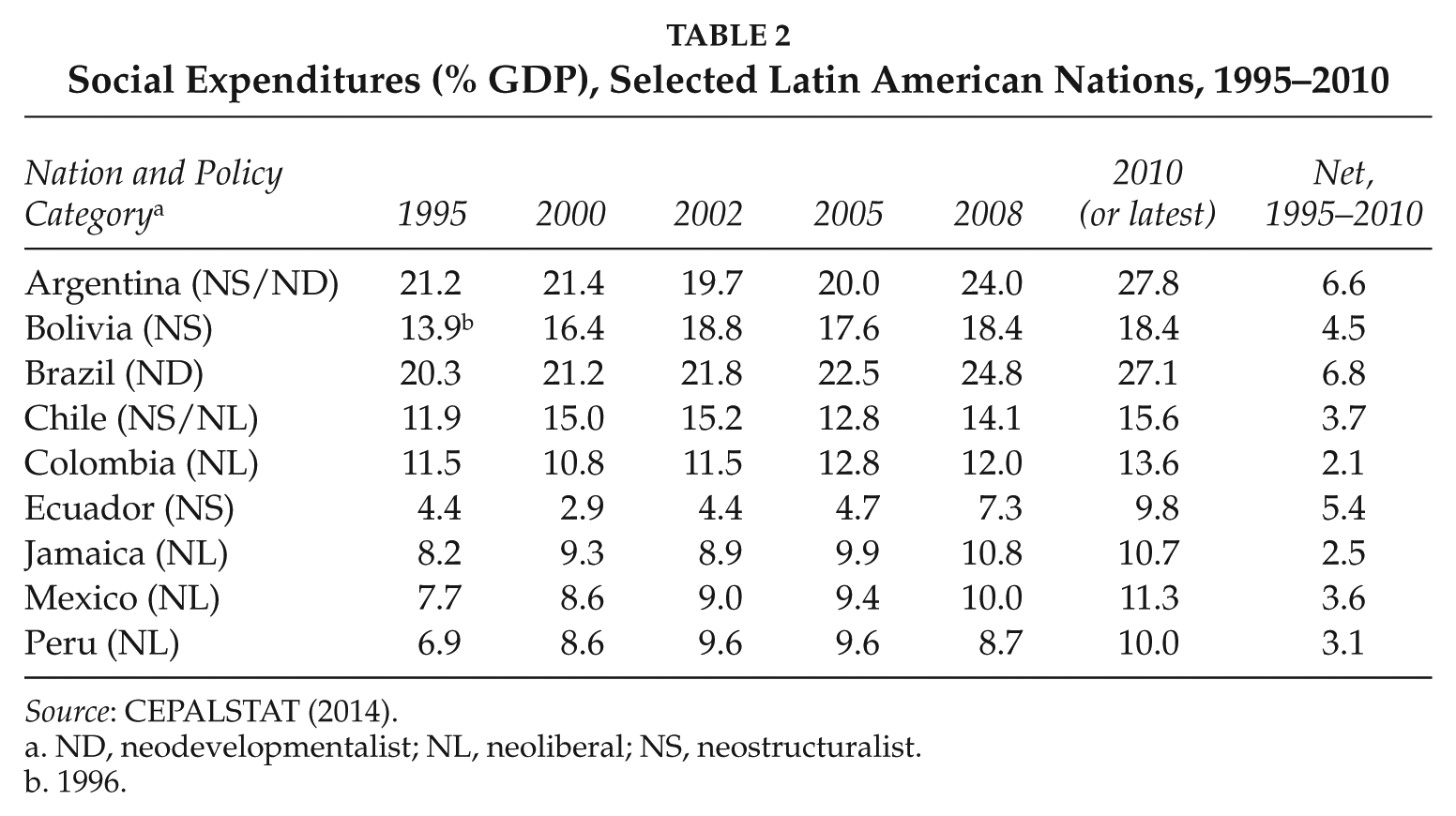
Source: CEPALSTAT (2014).
ND, neodevelopmentalist; NL, neoliberal; NS, neostructuralist.
1996.
The changes in the informal sector and the unemployment rate from 1995 through 2012 largely repeat this pattern (Table 3). Brazil reduced its informal sector at the most rapid rate, while Argentina—which registered a relatively small informal sector—showed the largest decrease in unemployment. Bolivia’s neostructuralist project had addressed some zombie neoliberal problems, with an impressive decline in the informal sector. The “nothing can be done except to adjust to a bad situation” meme as presented by the World Bank’s From Right to Reality once again demonstrated that it was the World Bank and not renascent developmentalism—even in its truncated neostructuralist form—that has stood outside of reality.
Informal Sector as Percentage of Total Employment and Change in Unemployment Level, Selected Latin American Nations, 1995–2012
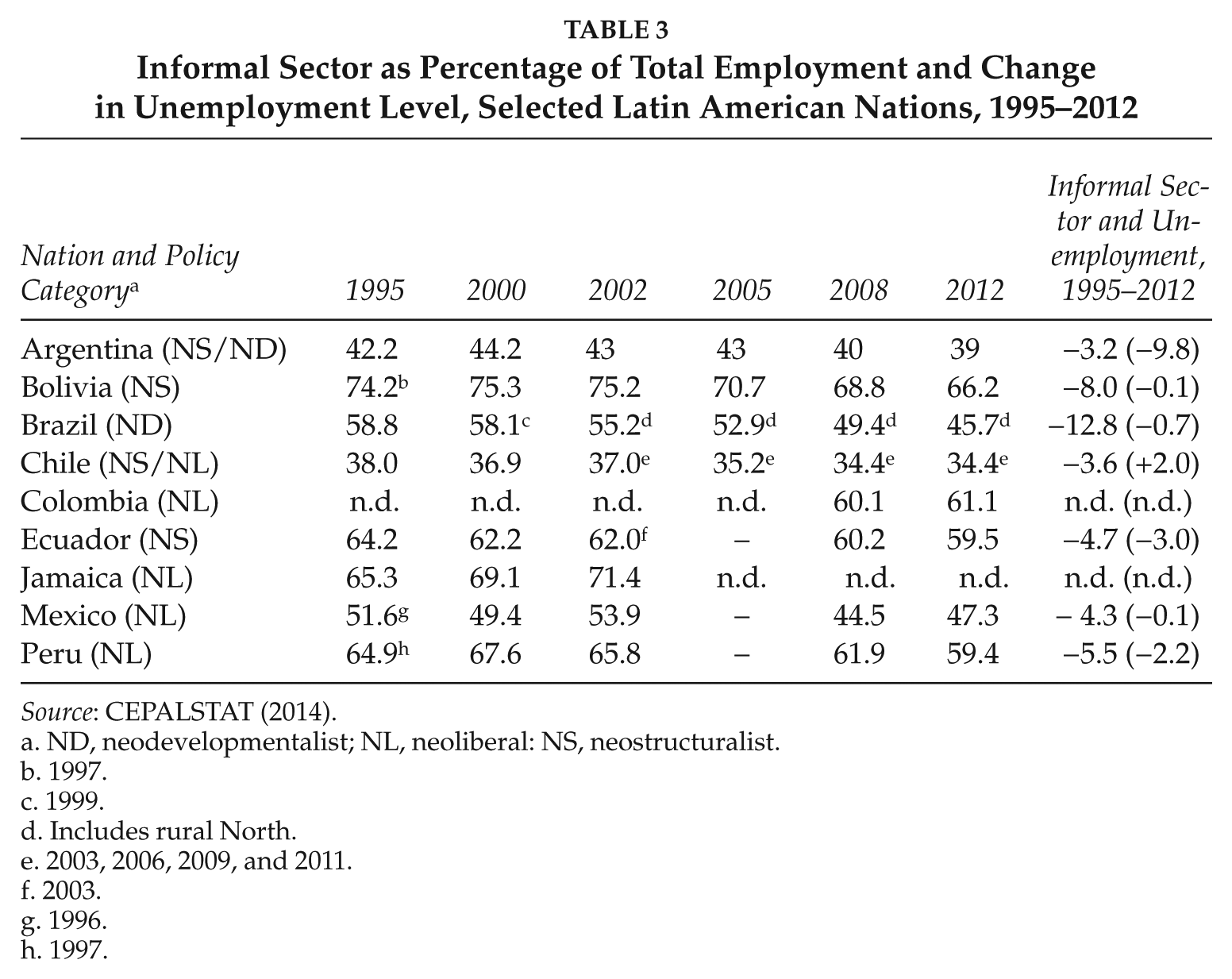
Source: CEPALSTAT (2014). a. ND, neodevelopmentalist; NL, neoliberal: NS, neostructuralist.
1997.
1999.
Includes rural North.
2003, 2006, 2009, and 2011.
2003.
1996.
1997.
Concluding Comments
State-led development policies in Latin America have been repeatedly dismissed as examples of at best misplaced populism that yielded little more than divisiveness. Empirical data, including the HSLI, demonstrate that the state-led era generated substantial—in fact unprecedented—social returns. HSLI data and other material and analyses presented in this paper demonstrate that the high neoliberal era (1980–2000) yielded virtually no forward movement on developmental issues. From 2002 to 2012 Latin America experienced a reversal of fortunes due to the commodity boom (Cypher, 2010), but this boom hardly affected Mexico and explains virtually none of its pathetic macroeconomic performance in those years (Cypher, 2011). The boom recreated many of the vulnerabilities arising from external market dependence that the state-led developmental policies sought to transcend. Progress made since 2002 on a variety of socioeconomic indicators is unsustainable without significant structural changes, and only Brazil and, to a lesser degree, Argentina sought to make these changes. They both faced deindustrialization due to the cross-currents unleashed by the China-led commodities boom and eventually embraced zombie neoliberalism, with Brazil shedding more than 1.5 million jobs in 2015 and GDP continuing to fall in 2016, indicating that the rising trend in unemployment will endure for some time. The forward momentum in social indicators noted by the multilateral institutions—with the percentage of poor workers (those receiving less than US$3.1 per day) declining from 17.8 percent of the labor force in 2000 to 8.2 percent in 2015 and the number of near-poor workers (receiving US$3.1–$5 per day) from 16.2 percent to 9.7 percent in those years—has ended (ILO, 2016b: 28). In 2015 the unemployment rate rose sharply in Argentina, Brazil, and Colombia, signaling that the data for the 2000–2015 period are no longer representative. Unemployment in Latin America stood at 8 percent in 2016, with female unemployment at 9.8 percent and youth unemployment at 18.3 percent (ILO, 2016a). The decline noted in the number of informal sector workers commencing in 2002 has also ended, with 46.8 percent in this category by 2016 (ILO, 2016a; 2016b: 27). UN’s 2016 Regional Human Development Program Report for Latin America and the Caribbean found that one-third of those who had escaped the poverty category in the 2003–2013 period (25–30 million vulnerable people) were at risk of “falling back into income poverty in coming years” (UNDP, 2016: 79).
Social neoliberalism is designed to facilitate accommodation to a majority-marginalized, precarious labor force and to facilitate the social reproduction of the majority-informal labor force through minimal social expenditures carefully sculpted to divide the labor force and impose individualistic mores and values while destroying concepts of labor rights and labor legislation in any form.
Unanticipated strong shifts toward neostructuralism and neodevelopmentalism emerged and grew stronger between 2003 and 2015. As one might expect on the basis of knowledge of state-led developmentalist policies in the past, the neodevelopmentalist policies applied in Brazil generated Latin America’s greatest strides toward what Furtado once termed “authentic development” (even as neoliberal nations moved in the opposite direction). From the outset, when the export-led model of the nineteenth century was abandoned for a variety of developmentalist projects that centered on industrialization and the internal market in the 1930s, Latin America has increasingly suffered from the fact that labor market policy became a first-order consideration only after the arrival of social neoliberalism. This shift in emphasis, however, was designed to spearhead a regressive restructuring of the labor market. To the degree to which social neoliberalism achieves one of its objectives—making the labor market a first-order consideration—the impressive ability of neoliberalism for reinvention through the process of failing forward has been demonstrated.
Footnotes
Notes
James M. Cypher is a research professor (economics) in the doctoral program in development studies of the Universidad Autónoma de Zacatecas.