





Abstract
New Left regimes have been underpinned by a reliance both on labor and nontraditional social groups and on capital interests related to the primary commodity sector, and the state has played an important overseer role in these relationships. These states have attempted to accommodate all these groups by pursuing incompatible populist and pragmatic policies. Study of the particular configuration of these regimes is important because they have become simultaneously more inclusive and closed off, generating heightened social fragmentation. Divisions among the left, the hardening of the right, and economic frailty render these governments unstable.
Los regímenes de Nueva Izquierda se han fundamentado por una dependencia tanto de los trabajadores y grupos sociales no tradicionales como de los intereses del capital relacionados con el sector de los productos primarios, y el Estado ha desempeñado un importante papel de supervisor en estas relaciones. Estos estados han intentado acomodar a todos estos grupos persiguiendo políticas populistas y pragmáticas incompatibles. El estudio de la configuración particular de estos regímenes es importante porque se han vuelto simultáneamente más inclusivos y cerrados, generando una mayor fragmentación social. Las divisiones en la izquierda, el endurecimiento de la derecha y la fragilidad económica hacen que estos gobiernos sean inestables.
Keywords
The rise of the New Left—or post-neoliberalism—in the Americas since the 1990s has generated much discussion. Clearly, with the election of various progressive governments in countries such as Chile, Brazil, Ecuador, and Bolivia, Latin American politics has experienced a significant shift. Does this shift represent a return of structuralist thought, in which governments sought to correct structural imbalances by undertaking import-substitution industrialization (Leiva, 2008), or the continuation of neoliberal policies in a new guise? What are the implications for politics, the economy, and society in general? These questions become even more urgent in the context of debates over the future of the left in Latin America. While initially discussion centered around whether Latin America had reached the end of this progressive cycle (see Aharonian, 2015; Gudynas, 2015; Karg, 2015; Modonesi, 2015; Reverón, 2015; Zibechi, 2015), by early 2017, after the impeachment of Brazil’s Dilma Rousseff in 2016 and the electoral victory of Mauricio Macri in Argentina in 2015, the debate seemed largely settled. The central concern is what happens now that the model appears exhausted. The 14 presidential elections in the region between November 2017 and November 2019 will provide an important signal of the extent of polarization, the persuasive power of populism and antiestablishment politics, and the institutional strength of evangelicals. Understanding the crisis and especially the prospects for leftist governance, however, will require a fuller understanding of these regimes.
In this article I consider what political economies underpin the New Left regimes and how state-society dynamics have shifted in Latin America as a result. In agreement with other scholars (see Bebbington and Bebbington, 2011; Gudynas, 2010; Petras and Veltmeyer, 2014b; Rosales, 2013), I show that extractivism and reliance on primary commodities more generally form the economic basis of New Left regimes. While this represents an obvious continuity with other periods in Latin America’s history, I argue that there is a significant break with regard to the New Left governments’ formulation of objectives and policies and that they play a more interventionist role in the economy in keeping with their alliances with labor and social movements.
My objective is to examine what the social and economic interdependencies characterizing the post-neoliberal model mean for capital, state, and society interests. I identify key changes marking this period: the state’s more direct role in resource acquisition, greater social inclusion as a result of extended social welfare programs, the exclusion of communities negatively impacted by resource extraction, the increased influence of extractive capital, and the rise of China as a central partner. I argue that the pursuit of more “pragmatic” polices to win over certain business sectors has been incompatible with the pursuit of more “populist” policies designed to incorporate previously marginalized groups. While I approach this phenomenon as applicable to New Left regimes as a whole, I also discuss differences among these regimes such as the state’s aggressive action toward indigenous communities in Bolivia and Ecuador as a result of the coupling of nationalist ideology with extraction. These characteristics have given rise to a number of frailties including misguided economic policies, the creation of divisions among the left, and a potential hardening of the right. Of particular importance, New Left governments have seen a breakdown in their support from many groups, including those once counted as their supporters, and heightened conflict within communities. Right-wing forces, for their part, have moved in several directions, from the use of institutional mechanisms to mobilizational tactics and even “hard” and “soft” coups (Cannon, 2016). These outcomes are a product of the particular configuration of interests driving New Left governments and demonstrate the inadequacy of class conciliatory policies over the long term.
In the following section, I present a brief overview of New Left regimes and establish the framework for explaining the configuration of interests that has underpinned them. I go on to analyze the interactions between the state and labor and between the state and capital in order to shed light on the exclusions and inclusions marking the New Left project. In charting patterns of resource dependency across these regimes, I attempt to provide insights into the way various interests have shifted as a result of the combined pursuit of pragmatic and populist policies and where major differences have emerged. I also examine the political changes that this dominant political economy has produced. New Left governments have become, in the words of Gudynas (2012, quoted in Webber, 2015: 162), “compensatory states,” where the use of resource rents to fund social programs bestows legitimacy on extractive activity. Beyond identifying conflicts within communities and between communities and the state, I address tensions and the “coincidence” of interests (Petras and Veltmeyer, 2014a) between the state and capital.
New Left Politics in Latin America
The election of leftist leaders in the twenty-first century led to a discussion over what types of forces the region was witnessing and why they had emerged. Undoubtedly there were both continuities and ruptures with the neoliberal period. The New Left governments are defined by their concern for equity and social welfare (Riggirozzi and Tussie, 2012). As Levitsky and Roberts (2011) point out, they include actors with a primary objective of reducing inequalities in order to extend social citizenship to previously marginalized groups. In short, at the core of these governments’ policies is the belief that the market should not be left to itself and that the state has a crucial role to play in regulating the economy, increasing political participation, and distributing economic benefits (Macdonald and Ruckert, 2009). This conceptualization of state functions stands in stark contrast to neoliberal prescriptions that sought a reduction in the state’s role by cutting back on social services (Sunkel and Zuleta, 1990). At the same time, however, New Left governments have not distanced themselves from market-oriented, export-led growth models (Riggirozzi and Tussie, 2012).
While many of the implications of this shift will be detailed below, it is worth noting some of the critiques of reforms or the lack thereof that have emerged. Several writers (Bebbington and Bebbington, 2011; Rosales, 2013) have described the centrality of natural resource extraction as both an economic and a political tool and argued that dependence on revenues in a context of favorable commodity prices is what sustains projects for increasing social welfare. In other words, the dilemma of the “new extractivism” is that the state plays a greater role but the negative effects—especially environmental and social—are the same; at the same time, extractivism might be viewed as a more legitimate practice given that its benefits are being redistributed (Gudynas, 2010). The model faces many challenges, including divided opinions among local actors as to the benefits versus the costs of extraction, especially with regard to environmental damage and social dislocation (Bebbington and Bebbington, 2011; Rosales, 2013). New Left regimes may be more inclusive in some ways, but they also generate new or perpetuate existing exclusions. The rest of the article seeks to follow Frieden and Martin (2003: 126) in their proposed steps for analyzing the domestic politics of international economic policy. 1 For them, this analysis has three main steps: specifying the economic interests at stake, characterizing the organization of these interests, and investigating the way interests are mediated through political institutions. Throughout, scholars need to recognize that the dynamics are in flux as interests change and their organization varies with the issue. Fundamentally, the electoral successes of the New Left regimes signal a change not simply in who is at the helm of policy making but in which groups are represented (Mattes, Leeds, and Carroll, 2015). The nature of this new configuration may of course facilitate policy change (Mattes, Leeds, and Carroll, 2015), but the appearance of continuity cannot be assumed to indicate that the basis of support has also remained static. Apparent continuities in economic policy between neoliberal and post-neoliberal governments may mask important shifts in the underlying structure of interests, and this has a number of consequences for the potential cleavages between groups and the environment in which policy will be made. Moreover, that these configurations are dynamic also means that shifts may occur long before electoral changes are registered (Modonesi, 2015). Finally, this type of approach becomes particularly insistent in the context of welfare-type regimes, where there is a tendency to see policies as primarily benefiting the working class or as a product of the decimation of right-wing parties rather than examining the state’s class makeup (Therborn, 1984). The following discussion introduces the particular relationships between the state and labor that characterize the New Left, paying close attention to the way labor interacts with the state.
State, Labor, and Beyond
Latin America’s New Left regimes are generally positioned as representing the triumph of the working class and the poor over neoliberal policies of previous regimes that had benefited transnational capital. Have New Left governments managed to enact an inclusive and participatory politics as a result? The New Left came to power on the basis of broad social organizing and has implemented significant changes in support of these social groups, but these governments have tended to maintain overarching central control, limiting their experimentation with more participatory models.
The election of New Left governments is seen as the product of the failure of neoliberalism in the region, with various social groups protesting against this failure. The Bolivarian movement was first, representing a coalition expressing discontent with puntofijismo and efforts to implement orthodox neoliberal reforms. Organized labor’s role in the coming-to-power of the left was crucial. For instance, both former president Lula da Silva (Lula) of Brazil and Evo Morales of Bolivia had been union leaders. Interestingly, while union organizing was essential for electoral victories in the first place, Galvão’s (2014) analysis of the Brazilian case suggests that the conditions these governments put in place actually reinforced labor power by, for example, expanding ways to collaborate with the state.
As a result, Latin American countries have seen important changes across the institution of labor: the regulation of labor relations, unemployment protections, and labor market policies (Weller, 2009). Regional unemployment began to decline in 2004, with the employment rate increasing from 52.6 percent in 2003 to 54.7 percent in 2007 (Weller, 2009). Other improved indicators include an expansion of formal employment and a decline in poverty levels (Weller, 2009: 22). Across the region, examples of increased state involvement in labor institutions abound: in Venezuela, the steel company Sidor was nationalized when collective bargaining became highly conflictual (Ellner, 2013b), and in Argentina and Venezuela measures were taken to prevent layoffs during economic crises (Weller, 2009). These relationships are not without their tensions, however. Some labor leaders in Venezuela claim that there has been some government resistance to unions and the Chavista movement more broadly (Ellner, 2013b).
Labor groups have represented an important source of support for the left in power, but its social base has not been confined to unions or other traditional groups. For a number of reasons, such as the increasing informalization of labor markets as a result of neoliberal market reforms (see Handlin, 2012; Handlin and Collier, 2011), the relationships between political parties and labor groups have declined in importance while the influence of popular associations of various types has risen. Indeed, Petras (2009) argues that organized urban unions and students played a “secondary role” in mobilizations that led to the emergence of center-left regimes. Examining data from Brazil, Chile, Uruguay, and Venezuela, Handlin and Collier (2011) find that except in Uruguay 2 supporters of the left were not any likelier to participate in unions than others. Thus the warning of scholars like Brand and Sekler (2009) against the narrowness of a class-based analysis is important, as there is a danger of ignoring the contributions of social movements and civil society organizations in bringing about political change. It is equally important that class not be allowed to overshadow factors and identities such as indigeneity, particularly in countries such as Bolivia and Ecuador (Blanco and Grier, 2013). Yet, while the point is well taken, a class-based analysis can still be illuminating provided that it is open to the different forms that this may take. Indeed, the piqueteros in Argentina are a group whose identity includes the intersection of various factors, since they not only mobilized against unemployment but also interrogated broader social relations (Brand and Sekler, 2009). In these ways, the experiences of New Left regimes have a broader base than the more traditional state-labor relations associated with welfare states.
Latin American experiences also demonstrate similar patterns in terms of political elites’ enacting change from above. The New Left governments have used the state for distributive and redistributive purposes. Examples range from conditional cash transfer programs (such as the Bolsa Familia [Family Grant] in Brazil and the Programa Familias [Families’ Program] in Argentina) to raising the minimum wage and strengthening labor rights (Brazil, Argentina) and improving access to basic needs like water (Bolivia, Uruguay) (Macdonald and Ruckert, 2009; Yates and Bakker, 2014). The enactment of such policies is often based on the preservation of the more traditional, clientelist forms in which the state relates to its citizenry. In the case of social investment, Handl and Spronk (2015) describe how these programs, found across the political spectrum, which give mothers cash support when they fulfill certain conditions, had the negative effect of an increased disciplining of the poor. Moreover, rather than empowering women they continue to promote conservative ideas of women (as possessing a one-dimensional identity of “mother”) and even link poverty to women’s not performing their maternal duties such as taking children to medical appointments. Nevertheless, given the historical patterns of limited coverage of labor institutions across Latin America (Weller, 2009), their expansion has been significant.
More participatory experiments have also been attempted and would suggest a more fundamental break from state-directed labor regulation and redistributive processes. Programs along these lines include participatory budgeting in Brazil and Venezuela’s community councils, which attempt to enhance democracy at the local level by facilitating more inclusive forms of decision making (Yates and Bakker, 2014). Yet the effects of these projects are contradictory. The community councils are governed by citizen assemblies and bring together other social groups. Working directly with the executive, they constitute a primary channel for government funding to the local level. As Meltzer (2009) notes, however, this focus on participation has occurred with the strengthening of executive power, which has cemented concerns that limitations on democracy are actually increasing. Indeed, the government’s broad objective of institutionalization with popular participation can be conflictual, and achieving some sort of synthesis is, as Ellner (2013a) argues, highly complicated. The state may also remain selective about where it encourages greater participation; certain factions of Chávez’s regime opposed co-management in “strategic” industries such as oil 3 (Spronk, 2013).
The differences between top-down and participatory experiments are part of a more fundamental divide among the New Left states. Who exactly are grouped together and according to what criteria have, however, remained contentious since Castañeda’s (2006) polemical distinction between “good,” social democratic states and “bad,” populist ones. For instance, Levitsky and Roberts (2011) have put forward a typology of governing left parties by combining two dimensions: the parties’ level of institutionalization and the locus of political organization (whether authority is dispersed or concentrated [12–13]). They contend that different combinations of these dimensions lead to various basic types of policy orientations. Toward democracy, for instance, the tendency has been either liberal democratic (effectively institutionalized pluralism) or plebiscitarian, appealing directly to the populace in the absence of mediating institutions. Cameron (2009) posits that variation can be explained by the conditions under which the left came to power, such as different experiences with democratization or with neoliberal experiments. Efforts to distinguish between the regimes have often focused on their political components, and further discussion of their economic models is required (Rosales, 2013). Labor’s relations with states have been defining of the New Left moment, but, as stated above, support has not been limited to traditional unionism. Regardless of their form, these actors have not prevented the state from maintaining overarching control.
State-Capital Relations and the “New Extractivism”
There is a striking absence of studies of the role of private sector groups in post-neoliberal transformations (Wolff, 2016, is an important exception). Here I explore the following question: What have these electoral changes meant for the private sector and for state-capital relations? The economic basis of these regimes in the primary commodity sector has meant greater state involvement and seen governments assert some autonomy in their relations with extractive elites. The identities of these actors have also changed, particularly with the emergence of China and other nontraditional states.
Rosales (2013) argues that there has yet to be a comprehensive political economic analysis of New Left governments. Extending his argument beyond Venezuela, Ecuador, and Bolivia, we can see that New Left regimes more generally rely on compromises between government and influential private sector actors, especially those from the extractive and primary commodity sectors. Addressing this synergy is significant as a starting point not only for underlining the historical specificity of the political economy that sustains the New Left but also for understanding the increasing instability of these governments. I show here that dependency on natural resources is a commonality across these regimes, demonstrating continuity with neoliberalism (and earlier periods). The emphasis in the final section is on understanding the potential downfall and legacies of these regime as a result of the combination of pragmatic and populist policies, with economic policy limiting advances made in the realm of social policy.
Rosales (2013) demonstrates that natural resource extraction has been central to post-neoliberal projects. In Ecuador, Correa sought to strengthen national control over oil, including through reform of the Hydrocarbons Law in 2007 in order to allow for partial nationalizations. Although these processes have been more pronounced in particular cases and therefore have drawn more attention, the centrality of resource extraction appears common across the New Left. Nem Singh’s (2014) analysis of Chile and Brazil displays a number of parallels to events in Bolivia, Ecuador, and Venezuela. While careful to distinguish between Chile’s and Brazil’s current experiences and experiments with neoliberal reforms, he demonstrates that both countries have balanced market-friendly policies with state intervention in oil (Brazil) and copper (Chile). In Chile, this balancing attempt has taken the form of efforts to attract more foreign investment without losing the state’s control over mining through the Corporación Nacional del Cobre de Chile (Chilean National Copper Corporation—CODELCO) that is apparent in Bachelet’s call for the removal of ministers from CODELCO’s board of directors. Moreover, these governments have not simply persisted in extraction but overseen its expansion, even in the cases of Ecuador, Bolivia, and Venezuela (Wood, 2010). Ecuador, for example, is expanding open-pit mining in the Andes.
Without question, the level of state involvement differs across these cases, with the state acting more hesitantly in Brazil and Chile than in Venezuela, Ecuador, and Bolivia (where it expropriated formerly privately owned extractive operations). The variations in the way extraction is managed are related to the governments’ political projects. As Rosales (2013) has argued, the extractive sector has been particularly central to the New Left projects because social mobilizations to demand an end to neoliberalism were so focused on issues related to the governance of resources. As a result, national control over resources such as gas and water became defining of the political imaginary.
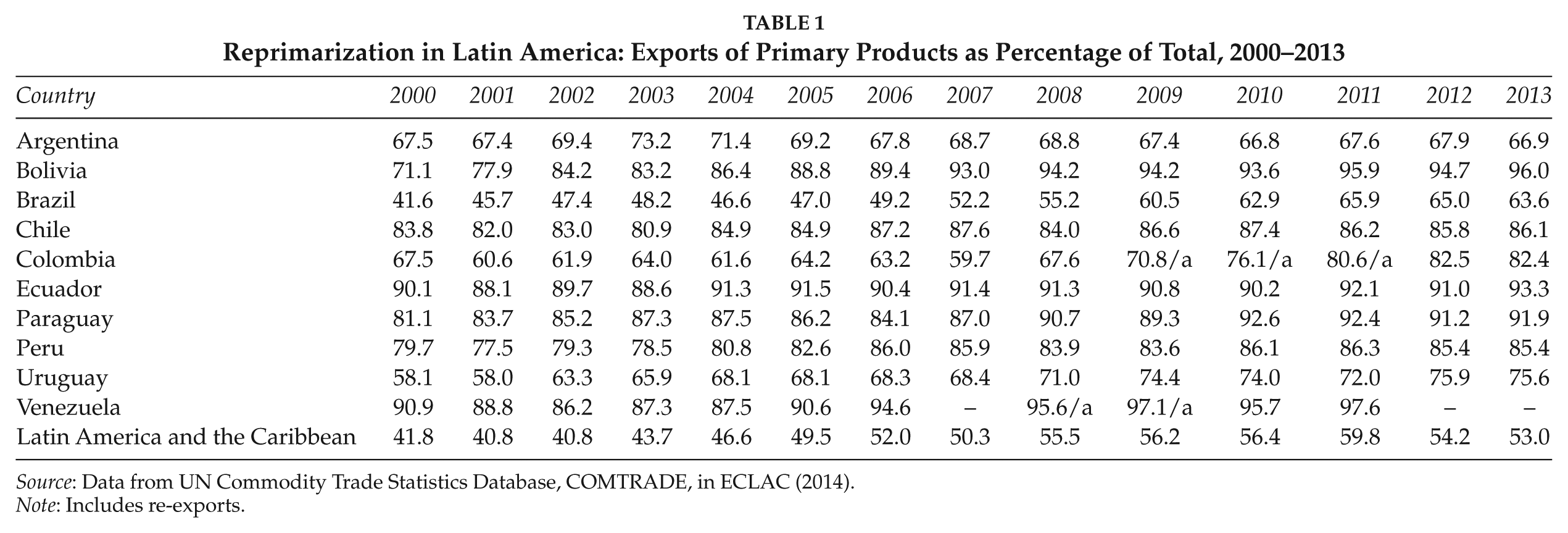
Extraction is part of a more general “reprimarization of the economy” based on reliance on agro-mineral exports (Petras and Veltmeyer, 2012). Indeed, Petras (2009) argues that this dependence has been a commonality across Latin American countries since 2003. In Argentina, for instance, although the currency was kept undervalued to promote exports in manufacturing and move away from a reliance on agro-exports (Wylde, 2012, cited in Toral, 2015), actions such as the lowering of taxes for the exporting elite consolidated their hold (Petras, 2009). Data from the Economic Commission for Latin American and the Caribbean (Table 1) provide an overview of these trends. While some countries’ shares increased only minimally (Chile and Ecuador) or slightly decreased (Argentina), between 2000 and 2013 the share of total exports represented by primary products increased by 24.9 percent in Bolivia (to a staggering total of 96 percent), 22 percent in Brazil, and 17.5 percent in Uruguay. Crucially, a significant portion of the foreign direct investment, 43 percent, entering the region has been directed to the natural resources sector (Nem Singh, 2014). China’s increased participation partly explains these trends, as its regional strategy has involved investment mainly in hydrocarbons 4 (Nem Singh, 2014). Latin America and the Caribbean became the second-largest destination of Chinese direct investment between 2000 and 2011, with the natural resources sector—hydrocarbons, copper, iron ore, and agriculture—making up over 90 percent of the investments (Kotschwar, 2014: 212). Webber (2015) attributes the relative resilience of certain countries to the global financial crisis to China’s role as a primary trading partner.
Reprimarization in Latin America: Exports of Primary Products as Percentage of Total, 2000–2013
Source: Data from UN Commodity Trade Statistics Database, COMTRADE, in ECLAC (2014).
Note: Includes re-exports.
Shifting relationships between types of capital differentiate New Left governments from post-neoliberal ones. In relation to foreign capital, Latin American states have asserted a degree of autonomy. Examples include Bolivia’s 2005 decree on hydrocarbon nationalization (Rosales, 2013), Chávez’s rejection of an open-door policy toward foreign capital, represented by the Alianza Bolivariana para los Pueblos de Nuestra América (Bolivarian Alliance for the Peoples of Our America—ALBA) (Russell, 2007), and Brazil’s call for broader South-South ties as a way to transform unequal economic relations with the West (Almeida, 2007).The extent to which this plays out in practice has varied dramatically between states (see Rosales, 2013; Stallings and Peres, 2011; and Ellner, 2013c). While Chile’s modifications of its corporate tax laws still favor foreign direct investment, Ecuador’s tax equity law gave the government 99 percent control over investments in oil and gas (Yates and Bakker, 2014). Again, the particular hold that resources have in terms of the nationalist projects of the Venezuelan, Bolivian, and Ecuadorean states as opposed to other New Left regimes is related to previous neoliberal experiences and the demands of the social movements that brought these governments to power. Not surprisingly, strong nationalist discourses have accompanied the emphasis on extraction (Rosales, 2013).
The weight of the natural resources sector in New Left regimes raises a number of conceptual challenges for understanding the organization of interests that underpin them. Sader’s (2011) account of transformations in Latin America makes significant strides in identifying the social forces that have underpinned changing power relations. Describing the “crisis of hegemony,” he traces the way governments prioritizing social policy were able to defeat those following the delegitimized neoliberal model in part because the right was particularly weak. Rather than approaching the influence of an extractive elite as reflecting the continuity of interests from the neoliberal period despite the ascendancy to power of the New Left, an effective starting point would be to examine the role they play in the neodevelopmentalist political economy of these regimes. Attention to the way the role of extraction has shifted and in particular the way extractive elites relate to the state may help reveal the workings of the particular formations driving the New Left.
Moreover, distinguishing between groups of actors—the state, domestic capital, foreign capital—becomes much more complex as boundaries shift. For Wylde (2012, cited in Toral, 2015), the understandings of state-society relationships found, for instance, in the developmental-school literature view bureaucratic action as apolitical. The increased presence of state-owned enterprises is one indication of the way the designation of these categories becomes problematic. A report from the World Bank (2014) notes that these enterprises are in many cases strategic actors in the economy and often dominate in sectors such as petroleum or electricity that are considered critical. For example, 63 of Brazil’s 147 state-owned enterprises are in the oil and natural gas sector. Ellner’s (2013b) description of expropriations in Venezuela also emphasizes the ambiguous results such changes may have for different groups, especially by distinguishing between shorter- and longer-term impacts. While immediately the cost of compensation to foreign investors cuts into social spending, for instance, over time there is the possibility of working-class gains as government attention shifts to production (Ellner, 2013b).
Yet the orientation of the New Left in power favors international capital as much as it contests it. As a result of the dynamic of export orientation, the government is focused on export expansion as a way of becoming integrated into the global neoliberal economy (Leiva, 2008). The continuance of this orientation makes reliance on and even expansion of extractive activity—becoming merely the latest form of “extractive imperialism” in the region—extremely likely. In their book on “the new extractivism” 5 Petras and Veltmeyer (2014a) point to a “coincidence” of interests between global capital and Latin American states in search of increased resource rents. Notably, this is also the case with the more “radical” states that have identified resource management as intrinsic to nationalist projects. In Bolivia, for example, most mines are still transnationally owned and operated, with the state simply increasing its share of revenue (Webber, 2013). The context has also changed as domestic elites are more internationalized (Sader, 2011), and as a result the boundaries between these groups are not clear-cut.
Still, the international context has also changed over the course of the past decade, especially with the growing weight of China. In comparison with the investment trends referenced earlier, China’s trade with the region exhibits similar patterns; Latin American exports to China grew at a rate of almost 23 percent annually over the 2005 to 2009 period, benefiting partners like Venezuela, Chile, and Bolivia, which can supply key commodities (Kotschwar, 2014: 205–206). Nevertheless, the same resource dependency that helped the region largely avoid the effects of the financial crisis (Webber, 2015) can also spell disaster when commodity prices fall (Zibechi, 2015). Since research and media often sensationalize China’s role in the global economy, it is important to identify where investment converges with global trends (Gonzalez-Vicente, 2012), especially Latin America’s long-standing provision of resources. In other words, it is tempting and certainly not completely inaccurate to read the Chinese relationship as simply another stage in Latin America’s dependency in the global economy.
Yet the Chinese presence does present specific political and economic challenges and opportunities for New Left hosts, largely because of the intertwining of investment and trade strategies with other forms of cooperation. Chinese–Latin American relations are one part of China’s broader commitment to South-South cooperation, which involves the forging of closer relations in a number of areas, from development finance to trade, as a way of achieving mutual benefit and development (Harris and Arias, 2016). Possible benefits include infrastructure development, the absence of which has long been considered a barrier to regional development (Kotschwar, 2014). In addition to a series of commitments made in the energy and natural resources sector following President Xi Jinping’s bilateral visits in 2014, for example, China created a fund of US$20 billion that is dedicated to financing infrastructure projects (ECLAC, 2014).
More generally, China’s political significance for the region is that it represents a symbolic counterweight to U.S. hegemony, which has obvious resonance with these regimes’ desire to distance themselves from neoliberal principles and their backers. China has forged stronger relationships with states that it perceives as left or center-left (Harris and Arias, 2016). In practice, the counterweight has not fully materialized. While Harris and Arias contend that the relationship with China helped the region avoid recession because it signified a healthy diversification of trade and investment (adding China to its traditional relations), it nevertheless did not manage to pull the region away from dependency on primary products. Beyond the obvious economic impacts of this dependency, Rosales (2016) shows that the decline in demand further entrenched Venezuela’s dependency on oil exports. In the face of Venezuela’s dependency on oil and oil rents to fuel its development model, China’s role as a creditor meant that further loans required in the context of the economic crisis were conditioned on continued extraction. Despite representing a move toward diversifying bilateral relations, the Venezuelan case shows that China’s multiple intersecting roles may very likely lead to intensified resource extraction (Rosales, 2016).
The centrality of natural resources for New Left regimes raises conceptual questions about the way interests are organized in these states. These governments have adopted some nationalist measures, although by no means have they disrupted global capital’s influence. At the same time, the internal-external dynamics have also changed as a result of China’s increased foothold in Latin America. In the next section, I draw out the interdependencies in these changing social and economic conditions, arguing that the combined pursuit of pragmatic economic policy and populist social policy has fractured social support.
The Frailities of the New Left
Some of the frailties of the New Left model arise from the fact that the particular configuration of interests that underlies these regimes incentivized the pursuit of incompatible policies. The choices of these governments have divided the left, and from this fragmentation and the space given to extractive elites potential space for a hardened right has emerged. There are also instances in which national particularities can be expected to produce distinct outcomes.
It is not surprising that New Left regimes took advantage of the boom in commodity prices. The fact, however, that social initiatives are embedded in the consolidation and extension of natural resource dependence means that shifts in the latter inevitably impact the former. In short, if these social initiatives are not accompanied by durable changes in the productive sector, any change in economic fortunes must mean that redistributive programs can no longer continue at the same funding levels. Commodity price downturns harm the very raison d’être of these governments. Webber (2015) argues that the decline of commodity prices could be expected to bring to the surface class conflicts previously minimized by government transfers and that polarization was a likely result. In fact, today the fortunes of the countries of Latin America and the Caribbean have essentially reversed as Central America, the Caribbean, and Mexico benefit from recovery in the United States while growth in Argentina, Brazil, and Venezuela, in particular, remains weak or nonexistent (IMF, 2015). Reliance on China as a creditor may also sustain this problematic economic model, as the case of Venezuela demonstrates (Rosales, 2016).
Fragmentation has occurred among the left as the very groups that carried the New Left regimes to power have increasingly mobilized against them. Unsurprisingly, the coming to power of post-neoliberal governments has not resolved the question of representation of the left. Indeed, as the previous discussion of the decentering of labor indicates, the heterogeneity of the Latin American populace is perhaps more apparent than ever as different visions of development are promoted among both the elite and the nonelite (Ellner, 2013a; 2013b). In Brazil, for instance, the Movimento dos Trabalhadores Sem Terra (Landless Workers’ Movement—MST) has distanced itself from the Partido dos Trabalhadores (Workers’ Party—PT) government. As I have argued elsewhere (Pickup, 2014), the political economy in which the MST confronts the state has not changed dramatically between the PT government and the previous centrist Partido Social Democrática Brasileira (Social Democratic Party of Brazil—PSDB) government headed by Fernando Henrique Cardoso. Indeed, the Brazilian election in 2014 dramatically illustrated the fault lines in Brazilian society, with other left (and right) parties and citizens confronting the PT in power (Santana and Tavares, 2014). During impeachment proceedings against Dilma Rousseff, many individuals and groups found themselves in the difficult situation of wanting to protest the impeachment (or coup) without necessarily demonstrating their support for Dilma or the PT (see M. Rossi, 2016). Similar conflicts are visible elsewhere, such as in Ecuador, where Rafael Correa has clashed with indigenous groups previously supportive of his election that are now disillusioned with and strongly critical of his government (Becker, 2013; Ciccariello-Maher, 2013; Ellner, 2013a).
In states that have championed resource nationalism as fundamental to the New Left project, conflicts with and within the indigenous population have been particularly intense. In Bolivia, there has been a divide between indigenous groups in the lowlands, who tend to oppose exploitation, and those in the highlands, who are swayed by the increased benefits derived from it (Rosales, 2013). The New Left’s coupling of modernity and nationalism is complicated by indigenous conceptions of development. Especially in the cases of Ecuador and Bolivia, the governments have engaged with critiques of development that emerge from alternative conceptions such as buen vivir (living well) (Rosales, 2013). Bolivia’s 2008 constitution recognizes “plurinationalism,” which represents the coming together of sovereignty and indigenous self-determination and helps establish the possibility for transforming the state. However, such a conceptualization also conflicts with other, often conservative interpretations of autonomy such as the one in which sovereignty is territorialized and in the process racialized (Gustafson, 2009). Furthermore, these legal or normative changes may not result in concrete actions that increase indigenous autonomy. Perreault (2015) argues that in the case of Bolivia the public consultation processes guaranteed by the constitution have actually served to depoliticize social relations, reproducing historical patterns of exclusion.
Beyond the environmental and social destruction wrought by intensified extraction, the emphasis on it shifts state attention away from manufacturing and in the process generates resistance from business and labor. Indeed, another aspect of foreign investment in and trade of the region’s primary commodities is an influx of manufactured goods from China. While this overreliance may be exaggerated—estimates are that imports remain below 20 percent (Harris and Arias, 2016)—the perception has been of deindustrialization. Almost 70 percent of the trade-remedy measures that Latin American countries imposed during the 2007 to 2013 period were against China (Kotschwar, 2014). Lula, who had promised to recognize China as a “market economy” during a state visit in 2004, faced resistance from the Federação das Industrias do Estado de São Paulo (Federation of Industries of the State of São Paulo—FIESP) and the Confederação Nacional da Industria (National Confederation of Industry—CNI), particularly over the issue of “dumping” (Cardoso, 2013; Nicacio, 2016). Unions in mining and other extractive sectors have also voiced their opposition to the development model.
More generally, while the New Left in power has enacted important labor reforms, these have had their limitations. Bolivia and Brazil, the two countries with former union leaders as presidents, saw increased dissent from their own base. In Bolivia the Workers’ Central called a general strike in reaction to the government’s announcement of a 5 percent increase in the minimum wage, which it considered insufficient (BBC, 2010). Nor has there been consensus among leftists with regard to labor reforms. Ellner’s (2013b) examination of the diverse priorities of the Chavista movement, for example, describes skeptics concerning the role of organized labor who prefer that public works projects be performed by community members. Such cases highlight the fact that labor politics has been a state-led process (Handlin, 2012). Modonesi (2015) points to increasingly militant grassroots organizations but doubts that they are poised to become a political alternative to either the New Left regimes or the reemerging right-wing forces.
The current frailty of New Left projects is much more understandable in light of these shifting relationships between state, capital, and civil society. It takes several forms. On a social level, references to challenges to the Brazilian and Ecuadorian regimes are symptomatic of broader social fractures. A central difficulty is how unprecedented gains arising from New Left regimes such as increased redistribution or political participation confront other, harmful effects, especially the environmental and social costs of extraction and monocropping. Furthermore, in these “compensatory states” the fact that benefits are linked with cash transfer programs gives extraction itself newfound legitimacy (Dangl, 2014; Gudynas, 2012, cited in Webber, 2015: 162). Veltmeyer (2014) has suggested that there is limited evidence that resource rents are actually being used for this purpose, but the idea that an active state is able to extend social welfare because of resource-fueled growth cannot be easily discarded. While this dependency can reproduce historical exclusions, including continued conflict with groups hurt by declines in manufacturing (as argued above), the kinds of divides generated by resource dependency also generate more intracommunity conflict. Describing extraction in Peru and situations in which localities share many of the gains, Bebbington and Bebbington (2011) remind us that these conflicts are rooted in society rather than occurring between the government and local groups. Recognition of the compensatory function of natural resource dependency is an important contribution to identifying the interests at stake in post-neoliberal configurations and explaining why divisions have emerged between the state and the very groups that brought them to power.
It is necessary to complement the description of these dynamics with further analyses of capital’s interests and the state’s particular role as promoter of capital. Electoral outcomes in favor of the left enhanced the influence of labor and other nontraditional social actors, but private interests, especially in the natural resources sector, remained significant. Unquestionably, the nature of extractive and primary commodity capital did not remain the same as states became simultaneously more interventionist and more dependent on natural resources and as China played an increasingly important role in regional and global economies. Several aspects of these dynamics merit discussion.
First, unprecedented interventions in social policy have resulted in dramatic reductions of inequality, with the UN’s Economic Commission for Latin America and the Caribbean noting that it is on the decline, with the share of the top 10 percent reduced in 16 of 18 countries (ECLAC, 2013, cited in Therborn, 2016). Cannon’s (2016) research on elite perceptions in four Latin American countries—including Argentina, Chile, and Venezuela—finds that views on market strategy and the role of the state have not shifted with these developments. For instance, Mauricio Macri’s victory in Argentina involved promises to move away from Cristina Fernández de Kirchner’s populist policies and toward economic liberalization. While the limitations of social programs and dominant economic policies have prompted criticism from many supporters, they were nevertheless radical enough to contradict conservative preferences.
At the same time, the interests of capital and the state overlap in direct and indirect ways. In more direct terms, the state takes on functions that are typically found in the private sector. In state-owned-enterprise-type arrangements the objectives and behavior of these enterprises are influenced directly by the state, indirectly by society, and also by the private interests involved. In general, the state-owned-enterprise model may present a dilemma between profit-making impulses, which are usually associated with the private sector, and the public role of ensuring that gains do not come at the expense of society. In short, they are almost inevitably plagued by conflicts of interest. Radon and Thaler (2005) argue that internal tensions are much more likely in state-owned enterprises in the natural resource sector, especially given their relative importance to public budgets and their “psychological” significance in representing the triumph of national control in such strategic sectors. This conflict helps to explain why governments have acted so aggressively in their pursuit of extractive activities, turning against some of the very communities that helped them gain power. In Ecuador, for instance, following the approval of a new mining law in 2008, Correa argued that the social movements protesting it were “promoting an uprising against the mining companies. . . . With the law in hand we will not allow these abuses, we cannot allow uprisings, which block paths, threaten private property, and impede the development of a legal activity, mining” (quoted in Burbach, n.d.). The compensatory function of extraction to which writers like Bebbington and Bebbington (2011) have pointed thus risks aggravating these tendencies as profit making aligns with what are at least short-term public benefits.
While this overlap of the state’s role with profit-making activities is a challenge for New Left regimes, even state-owned-enterprise arrangements do not necessarily mean that the state is simply absorbing the role of capital. Rather, private stakeholders remain separate entities at the same time that these arrangements bring them benefits—for example, expectations that the state as a partner will lift regulatory barriers (Radon and Thaler, 2005). In their study of an unnamed state-owned enterprise in Brazil, Bin and Castor (2007) describe the intersections between rational and political processes of decision making around budget questions, quoting an executive who confirms that decisions were strongly influenced by both the government and affiliated businesses. In general, these arrangements require strong accountability mechanisms so that developmentalist functions can be ensured (Carrillo, 2014). Brazil’s Car Wash corruption scandal, in which politicians of all stripes are accused of collaborating with Petrobras’s contractors to divert funding, represents a worst-case scenario of political interference combined with a lack of public oversight. These risks are not inevitable but represent some of the vulnerabilities that can arise because of overlap between a state’s traditional functions and its new responsibilities.
The expansion of extraction and export of other primary commodities and their subsequent legitimation because of associated social functions augment the power of private sector actors. In his article on business-state relations in Bolivia and Ecuador, Wolff (2016) discusses how the dynamics of this relation changed across the presidencies of Morales and Correa. Arguing that they became less conflictual over time, he shows how cooperative changes emerged as a result of a resurgence of “instrumental power” whereby business forms direct relationships with policy makers. He also charts differences between the two countries, drawing attention to the combination of confrontation and rapprochement in Ecuador. The same level of confrontation with business elites did not occur in post-neoliberal regimes such as Brazil and Chile.
Agribusiness interests in Brazil are a good example of the increase in the influence of capital over time. Arguing that capital investments were central to increases in productivity, Abbade (2014) finds this productivity a major contributor to increased gross domestic product (GDP) between 1975 and 2010; estimated at 23 percent of GDP in 2015, it was expected to remain relatively stable despite the recent economic slump (Globo Rural, 2015). Lending patterns for Brazil’s Banco Nacional de Desenvolvimento Econômico e Social (National Bank for Economic and Social Development—BNDES) show that support since 2003 has been offered mainly in such traditional sectors as mining, soy, sugar, and petroleum, further solidifying the sector’s economic significance (Carrillo, 2014). Hopewell’s (2014) comparison of contemporary state-business relations in Brazil demonstrates that the strength of the agribusiness sector fundamentally transformed its relationship with the state. Offering examples from negotiations over trade policy, she argues that this relationship has only increased in intensity. Sauer (2017) likewise describes how land reform efforts became increasingly limited during PT administrations as sectors of the agribusiness elite used legislative vehicles such as the Joint Parliamentary Commission for Land Investigation of 2003–2005. Beyond the political influence that these actors have gained from their increased economic weight, the presence of growth alongside expanded welfare policies also helps to forge a consensus, albeit riddled with contradictions, around the agribusiness model (Hopewell, 2014). Beyond land reform, resource dependency places limits on what inclusive policies can be pursued. Lula’s decision to keep the interest rate high, for instance, also meant that servicing of Brazil’s debt became an even larger burden, taking funds away from social spending (Neto and Vernengo, 2007). In addition to the election of more far-right candidates in Brazil’s 2014 election, the so-called Bancada Ruralista (Rural Caucus) picked up seats in Congress, with over half of federal deputies, 124 (24 percent) of them newly elected, linked to the agribusiness sector (Marcel, 2014). The private sector dimension of the social-economic link between extraction and redistribution has not been fully explored but has particular resonance for understanding social fracturing within communities and the New Left’s loss of support from multiple groups.
Above all, the general political economy that has underpinned New Left states reveals its potential for crisis. The stepping up of state involvement in the economy has concentrated power at the top despite some participatory experiments. This concentration leads to governments making divisive decisions about what is strategically apt, as in the case of the proposed highway construction in the Isiboro Sécure National Park and Indigenous Territory in Bolivia that indigenous communities are resisting (Webber, 2015). The nationalist and developmentalist discourses of those promoting such actions exacerbate conflicts, especially in Ecuador and Bolivia. Morales’s own indictment of critics of oil as also opposing programs like Juancito Pinto captures this dynamic. The compensatory nature of these regimes means both that states can minimize dissent and that they can further expand and entrench their economic models. The state’s heightened role in the economy complicates this dynamic as state and capital interests become more intertwined, and the state may act against long-term societal interests. At the same time, the right has gained momentum. Examples include extra-paramilitary coups in Honduras and Paraguay (Webber, 2015) and the 2016 impeachment of Dilma Rousseff.
Whose interests states will represent as social and economic crises escalate will be a good indication of the particular weight held by different segments of support for these regimes. In Brazil at least, the decision to implement austerity measures—from salary adjustments in the public sector to eliminating 10 of 39 ministries (Wroclavsky, 2015)—exists in a context where promoters are not simply making technical arguments, as P. Rossi (2015) argues, but using austerity to support the objective of limiting state social programs. This is not to say that, since the more radical characteristics of these regimes have all but disappeared, we are left with little more than neoliberal continuity; instead, it is only by distinguishing the salient features of the post-neoliberal model that it is possible to understand the particular nature of the crisis that is being generated—including reactions from the right as well as the left, divisions among the left, and an unstable economic model susceptible to external changes in fortune. The types of effects that a crisis might have in the short-to-long term are unknown, but it is likely that the right will emerge with even more authority, at least in the short term.
Conclusion
This article has sought to examine the shifts in state-society dynamics that appear to reproduce aspects of previous political economies, such as reliance on natural resources, while introducing new dimensions, especially increased economic and social regulation. In particular, my contention is that the continuation and intensification of extraction and the export of primary commodities under the control of these regimes combines with the social basis of political support to produce particular frailties. Nevertheless, the balance is not a static one but is constantly being reconfigured because of economic and social welfare decisions.
While overlap with other forms of political economy in Latin America is often apparent, it is important to study the new regimes’ particular configuration rather than to present any continuity as simply the entrenchment of an economic model that exists in tension with new configurations. Examining what social and economic interdependencies mean for capital, state, and society interests, I argue that New Left governments have pursued incompatible objectives through conflicting pragmatic and populist policies. These policies are thus not simply inherently inadequate but also incoherent, with economic reliance on primary commodities undermining the potential benefits of policies intended to include previously marginalized citizens. Rather than class cohesion, the outcome has been further fragmentation, in part as a result of manufacturing decline. In the short term, these regimes have become more inclusive as gains were redistributed but simultaneously more closed off, particularly to communities vulnerable to the devastation of extraction. The tragic irony is that these were groups in part responsible for the New Left’s rise to power. Furthermore, the focus on primary commodities has opened space for the continued influence of extractive elites. With a newfound social legitimacy because of the social functions made possible by growth in the natural resource sector, capital is positioned to assume ever greater political weight (see Gómez Bruera, 2015). Yet, these dynamics have also shifted in significant ways as the state itself has become involved more directly at the same time that alternative partners such as China have gained influence. The result has been heightened intracommunity conflict and a fracturing of the regimes’ political support. This analysis strongly suggests that more pragmatic policies, which may be appealing in the short term, may be unsustainable over time.
While the aim of this study is to contribute to our understanding of change and continuity in the region, it risks glossing over important nuances in each national experience. Case studies of specific countries would be an important next step toward understanding the nature of the change that has occurred in twenty-first-century Latin America. One key question would be the relationship between extractive and agribusiness elites and financial or manufacturing elites. In Brazil, for instance, continued financialization, visible in high interest rates, has been central to maintaining the dominance of agribusiness elites (Sader, 2011). In short, in order to understand the significance of current crises, we need to explain the underlying politico-economic model and how it relates to the social changes that these regimes have generated.
Footnotes
Notes
Megan Pickup is an independent researcher in Ottawa, Canada.