






Abstract
The Trade Union Confederation of the Americas is analytically interesting because international trade unions have promoted the framework of a “just transition” to protect workers’ rights during the shift to sustainable energy and the response to climate change and because the confederation has undertaken something of a “Latin-Americanization” of the just-transition notion that is nurtured by the environmental/territorial turn of social struggles on the continent. The current convergence between unions and social movements (peasant, feminist, environmentalist) has contributed to an important renewal of the union movement in Latin American environmental matters.
La Confederación Sindical de las Américas reviste interés analítico porque las organizaciones sindicales internacionales promovieron una “transición justa” para resituar y visibilizar a los trabajadores en las negociaciones multilaterales del clima y procesos de transición energética y porque la confederación ha emprendido una “latinoamericanización” de la noción de la “transición justa” nutrida de un giro eco-territorial de las luchas sociales en el continente. El actual proceso de convergencia entre sindicatos y movimientos sociales (campesinos, feministas, ambientalistas) ha contribuido a una importante renovación de la narrativa del movimiento sindical en materia medioambiental en América Latina.
Keywords
In recent years, Latin American unionism has articulated new demands linked to environmental struggles. In a regional context marked by a critical stance toward neoliberalism and the progressive and popular orientation adopted by various national governments, 1 a certain consensus has solidified among different social and political sectors that the climate crisis and our current intensive and predatory use of natural resources is significantly affecting socio-environmental conditions, the reproduction of life, and, ultimately, the workforce. From this perspective, nature is being appropriated by capitalism to guarantee the material, social, and cultural reproduction of classes and social groups, but the unlimited, unequal, and asymmetric nature of these processes has had globally devastating effects on people and the environment. Although unions have been reluctant to incorporate socio-environmental issues into their agendas, workers have begun to take a different political position. Although it is still rare, a socio-environmental turn can be observed in union action, mainly in organizations with international and regional representation.
Since the middle of the past decade, the Trade Union Confederation of the Americas (hereafter TUCA), a regional division of the International Trade Union Confederation (hereafter ITUC), has promoted the concept of a “just transition” to reinstate workers as relevant in the multilateral negotiations regarding the climate crisis and the transition to sustainable energy. The application of this notion to the problems of Latin American societies has given rise to a Latin-Americanization of the just transition.
This process, in which the environmental demands of the ITUC and the TUCA converge, is closely linked to the alliances built by the regional union organization because of its leading role in a dynamic of continental articulation with social movements traditionally involved in antiglobalization actions, movements, and protests such as the Coordinadora Latinoamericana de Organizacions del Campo–Vía Campesina, REDES (Network of Social Ecology)–Friends of the Earth Latin America, the World Women’s March, and Jubilee South. As a result, the TUCA has modified its discourse on social issues to incorporate an environmental agenda.The purpose of this paper is to contribute to an ongoing debate by addressing the actions and narratives of regional union organizations not only in terms of the contradictions inherent in the capital-labor conflict but also in terms of those pertaining to the socio-environmental and territorial dimensions of the conditions of working-class reproduction.
We employ qualitative and sociopolitical approaches to social research; this paper is the result of a combination of information-gathering techniques including a dozen interviews with leaders of the TUCA, representatives of allied social movements, and key informants carried out during 2016 and empirical data collected at various events convened by the TUCA between 2013 and 2017. We analyzed materials and documents produced by the TUCA, the ITUC, and regional social movements and systematized and analyzed the communications issued by various news media and official information sources. First we will briefly describe the case study (see Anigstein, 2016; 2017) and then introduce some conceptual debates regarding the relationship between unionism, socio-environmental issues, and the environmental/territorial turn of collective action in Latin America. Next we will address the notions of just transition and climate justice. Finally, we will reflect on the Latin American reinterpretation of the just transition from the end of the past decade to the 2015 Paris agreement.
Since that agreement, environmental issues have been visibly eclipsed on the regional union agenda. Given the conservative turn in labor and regional integration policies after 2015, with the electoral triumph of a conservative alliance in Argentina and the coup d’état in Brazil, demands have focused on the defense of democracy and human rights and criticism of neoliberalism. Environmental concerns have been reduced to a kind of litany in relation to the other problems addressed by local and regional labor movements in the new political context.
The Case
The TUCA, a regional affiliate of the ITUC 2 covering North America, Central America, the Caribbean, and South America, comprises 57 national union centrals from 23 countries and more than 50 million workers. Because it groups national union centrals that, in turn, group unions by branch or company in all sectors of activity, its membership is heterogeneous, bringing together urban and rural workers from both the public and the private sectors and workers in industry and services. It developed as an alternative to neoliberal globalization in the particularly favorable context produced by almost a decade of economic growth and the decrease of unemployment and poverty in several countries of the region. Created in 2008 in the framework of a long-term, multidimensional international crisis, it emerged as a sociopolitical actor in accordance with the guidelines promoted by the progressive and leftist Latin American governments then in power. Its action strategy was not limited to the economic-corporate claims of traditional unionism. On the contrary, there was a call for self-reform 3 that prioritized the democratization and unity of the union movement, a decision to intervene actively in the sociopolitical field without losing autonomy, and the construction of a wide range of alliances with social movements (peasant, environmentalist, feminist). This is key to understanding both its discourse and its political proposals and actions.
The TUCA’s broad representation must be considered in relation to its vast territorial scope and the radical heterogeneity arising, on the one hand, from the various productive matrices, labor markets, and sizes of national economies across the continent and, on the other hand, the diverse organizational and ideological traditions that affect its internal dynamics. Its status as an international organization sets limits on its actions and impact among the group of workers it formally represents.
Unions and Socio-Environmental Demands
The labor movement has characteristically oriented its actions toward the defense of the social and economic rights of workers within the framework of productive capitalist relations. However, the spread of the consumer society in the twentieth century has been accompanied not only by the expansion of job opportunities but also by workers’ increased access to goods and services. As Unceta (2009) observes, the legacy of classical thought has been taken up in the following century and a productivist perspective on growth and social welfare predominates. During the last decades of the twentieth and the early twenty-first century, this productivist perspective, embodied in discourse and economic and political practice, gave rise to a series of socio-environmental critiques regarding its effects.
The emergence and consolidation of environmental movements must be understood within this framework. Along with student, feminist, or pacifist movements, it has contributed new modes of action and understanding of the social factor in political, cultural, and symbolic terms (Svampa, 2016). On an international level, the environmental movement gained momentum following the creation of a specific space for intergovernmental negotiations, enabling the spread of new demands and narratives. Among them we can highlight the movement for environmental justice that emerged in the 1980s in the United States against polluting facilities—in particular, waste treatment plants located in poor neighborhoods inhabited by African American and Latino populations (Borras, 2016; Martinez Alier, 2015).
The concept of environmental justice was internationalized in terms of “climate justice” and became relevant as a response by Southern nations and their civil societies to the stance taken by the major powers discussing climate change. For those who understood poverty as the main environmental problem, it provided a critical alternative to the dominant approach of the “green economy” (see Herrán, 2012). In other words, the idea of climate justice replaced the distributive dimension and directly linked the climate crisis to social justice by focusing on the causes of climate change and the required systemic transformations, thus establishing the need for criteria of justice that addressed the distribution of the world’s resources (Borras, 2016).
Interestingly, the international union movement’s incorporation of climate justice demands came much later, as the participation of labor organizations in formal negotiations and international environmental collective action was consolidated. In our opinion, this is related to the conflictive character of relations between the union and environmental movements in the developed countries. Recio (2015) and others argue that while unions are committed to economic growth and base their disputes on the distributive arena of income, the environmental movement has called attention to the natural limits on the expansion of productive activity. The disagreements between unionism and environmentalism have been further fed by a social situation in which the majority of the population does not control the mechanisms by which jobs can be adjusted to actual needs, and therefore environmental demands are seen as restrictions on production that lead to employment problems. One way of approaching this problem is fundamentally related to the relationship between health, the environment, and working conditions in the workplace. As Serrano (2013) argues, occupational health is the closest meeting point between unionism and environmentalism, and unions’ environmental agendas have encountered difficulties and disagreements with the environmental movement.
Contemporary union organizations are subject to a set of contradictions that condition and reorganize their struggles. Immersed as these organizations are in the second contradiction of capital as posited by O’Connor’s (2001) ecological Marxism, 4 conflicts over the exploitation and appropriation of the fruits of labor perforce dominate their confrontational spectrum. However, the exploitation and increasing appropriation of natural resources by capital has pernicious effects on the conditions of production that affect workers and their social reproduction as collective actors. In addition to the classic distributive conflicts, Martinez Alier (2008) pinpoints growing distributive conflicts linked to extraction, transportation of raw materials, and local/regional pollution that exacerbate the unequal and asymmetric relations between dominant and subaltern sectors across territories and communities.
However, this matter cannot be approached in a simple fashion by the unionized world. In the productivist worldview of development, nature is seen as a resource, a commodity, a productive input, and a job provider. Extremes in the dominant discourse create problematic dichotomies in which the rights of nature are diametrically opposed to labor rights. The goods of nature are transformed to satisfy human needs, even though in the process workers contradictorily recreate the possibility that, while capital is reproducing its domination, the living conditions of subaltern groups will be affected.
That said, union actors of various organizational levels have become more committed to socio-environmental issues in recent decades. As analyzed by Snell and Fairbrother (2010), confederations such as the ITUC and the international union federations known as global unions have spoken out about the pernicious effects of climate change in several international forums. And although unions have a strained relation with the incorporation of environmental issues on the one hand and the reproduction of material interests and resources on the other, they have taken a privileged role as environmental actors in pursuit of decent jobs that incorporate this issue into their agenda.
In the case of Latin America, as Svampa (2016) points out, the environmental issue has undergone a resignification that has given rise to a diverse set of socio-territorial movements directing their demands toward private actors and the state. This was the stance adopted by the TUCA with regard to environmental issues. Socio-territorial issues entered its agenda in the framework of a new internationalist paradigm based on the principles of union self-reform and the implementation of sociopolitical unionism (Anigstein, 2016). In this regard, the TUCA was heavily influenced by the bonds it established with the socio-environmental movements of the region.
The Confluence of Just Transition and Climate Justice
Strictly speaking, although in an incipient way and without important results, the union movement has been involved in debates about climate change for at least two decades. In Europe, energy transition programs immediately attracted the unions’ attention. The initial concern revolved around the future of jobs and workers in the economic activities targeted by transition policies. What at first concerned only unions in industrialized European nations soon spread across the agendas of the global union movement. In other words, the workers of the North, most likely because of their historical hegemony in the international union movement, introduced to unionism the climate crisis and its potential solutions, addressed from a labor perspective.
Environmental concerns and demands were adapted to the terms of the debate in the world’s most industrialized nations and multilateral organizations with a union presence. Unions demanded a role in the energy transition and argued that it should not take place at the expense of workers currently employed in the sectors that need to be converted (the coal, oil, and nuclear energy industries, among others). The European experience was transferred to a global action platform, and the unions demanded a role in the annual Conferences of Parties of the United Nations Framework Convention on Climate Change to voice their demands. At the same time, the merging of international organizations during the first decade of this century contributed to a more homogeneous presence. Even the ITUC (created in 2006) managed to obtain formal participation in the 2008 climate negotiations, along with the rest of civil society organizations with which it carried out joint actions and stances, but it also worked on the margins by participating in alternative events, countersummits, and mobilizations that questioned the intentions and results of the annual conferences (Table 1).
Union Participation in Climate Change Conferences, 2008–2015
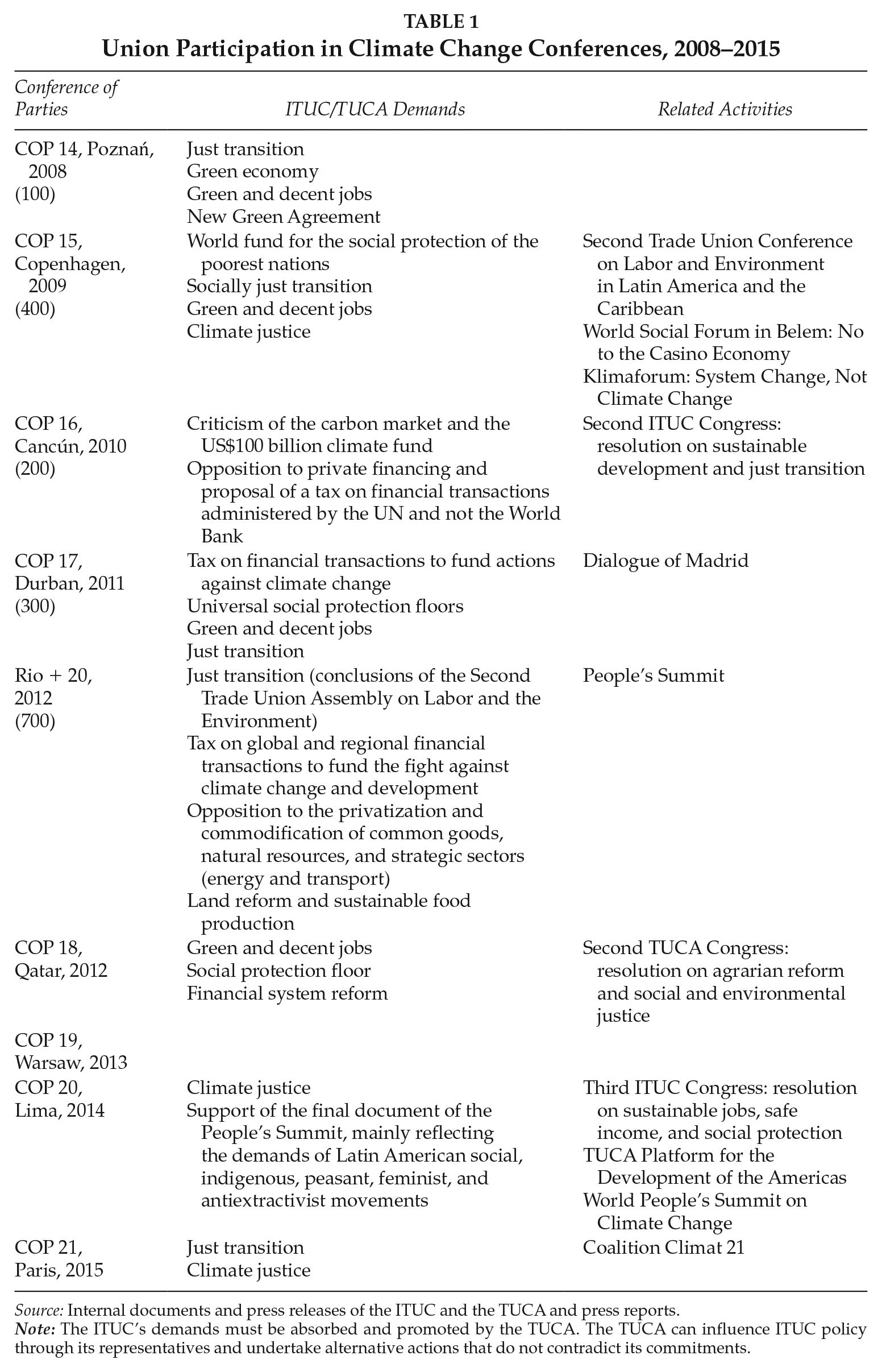
Source: Internal documents and press releases of the ITUC and the TUCA and press reports.
Meanwhile, in other regions of the world, environmental struggles took on very different characteristics. The effects of climate change significantly increased in territories that had played little or no role in its anthropogenic causes. Desertification, island disappearance, and epidemics have affected large populations in countries where access to energy for most people is not guaranteed (Maffei and Llanos, 2010).
New social movements emerged in answer to new demands. The concept of environmental and/or climate justice that posits shared but differentiated responsibilities 5 became part of the transition debate in the multilateral forums and alternative spaces promoted by these movements. The global stage generated two categories that managed to penetrate the walls behind which the world’s great powers meet: climate justice and just transition. The first arises from the right to development of the impoverished populations of the North as well as most of the global South. The second originates in the labor movement and is linked to the capital-labor contradiction. Both concepts, whose initial formulations were directly linked to social and class struggles, were retranslated into the language of global institutionality.
The actors embodying these new demands proved doubly capable: part of social and political movements that questioned the paradigm of the green economy and offering themselves as an alternative, they also translated these new demands in terms of the global social dialogue within the framework of the United Nations system, managing to incorporate them (albeit subordinately and with difficulty) into the debates that mainly faced governments and large transnational corporations.
On a global level, the ITUC has incorporated the climate issue into its demands, and its main action strategy has been institutional in nature. It has sought alliances with social democratic parties, business and religious organizations, and nongovernmental organizations (NGOs). The notion of a “just transition” can be traced to the documents of the Canadian unions that, by the end of the 1990s, had defined it as a way to reconcile access to decent jobs with environmental protection. Its inclusion in the ITUC’s proactive environmental agenda sought support in international meetings on climate change (Gouverneur and Netzer, 2014).
The just transition has also been viewed as an empty signifier that encompasses the partly conflictive socio-environmental strategies employed by international unions that converge around a general commitment to addressing climate change. The notion combines the classic demands of the international union movement, bound to the principle of social justice and decent employment, with a renewed concern for the effects of climate change as defined by the multilateral organizations (Felli, 2014). The ITUC and the global unions have been the main force behind what Felli terms a deliberative strategy, part of the paradigm of environmental modernization (a transition to a green economy that is environmentally, economically, and socially sustainable) and is closely linked to the notion of green jobs 6 defended by multilateral organizations such as the International Labor Organization and the United Nations Environment Program. Within this paradigm the just transition is reduced to demanding union participation in the debates regarding strategies to combat climate change and attributes the power of transformation to the will of politicians. Thus, in the framework of the deliberative strategy, the programmatic elaboration around climate change is dictated by the times and terms of negotiations, conferences, and international summits. According to Maité Llanos, head of the TUCA Working and Environment Group from 2008 to 2010 and currently assistant director of the ITUC (interview, August 2017), the notion of a just transition was necessary for international unionism to take a corporate stance in the international negotiations regarding climate change and thus obtain financial resources and influence on national policies.
For the ITUC, a just transition means guaranteeing that transformations meant to reduce carbon emissions will take workers into consideration so that they do not end up as the people most affected. In accordance with the guidelines published on the official website of the world confederation, unions therefore seek a central role in both the design and the monitoring of transition policies that can generate and maintain decent jobs. The proposal includes (1) stimulating significant investment in “green” jobs and fostering more environment-friendly workplaces, (2) conducting research and early assessments on the transition’s effects on jobs, (3) active participation and consultation of unions, employers, and communities affected by the change, and (4) promoting social protection plans and action with regard to the labor market to assist the most vulnerable sectors. 7
Although an ITUC delegation of some 100 unionists participated in a United Nations Conference of Parties (COP) on climate change for the first time in Poznań in 2008, the confederation’s participation in COP 15 (in Copenhagen in 2009) was much more significant. That summit, however, failed to achieve the expected binding agreements, and tensions were created by the exclusion of civil society representatives from the conference room. In spite of this, the ITUC welcomed the acknowledgment of union presence in the inclusion of a just transition on the agenda. That year union participation was even more significant in a massive alternative mobilization known as the Klimaforum that attracted more than 100,000. Union involvement in the countersummit at the World Social Forum in Belem, with a delegation of more than 400, was reflected in the final declaration, which pointed to the need to move toward a just transition employing a model that guaranteed the right to life and dignity of all peoples.
The demands raised by the ITUC in Copenhagen were a little broader than those of 2008. Along with the concept of a socially just transition and green and decent jobs, the idea of a global fund for the social protection of the poorest countries (driven by the Latin American unionists and supported by the environmental movements) was broached for the first time. A year later, at COP 16 in Cancún, the call for such a fund was accompanied by stern critiques of the carbon market and included a proposal for public financing via the creation of a tax on financial transactions administered by the UN without the interference of financial organizations such as the World Bank. Subsequent COPs led to increasing rapprochement with social movements and NGOs committed to the principle of shared but differentiated responsibilities; the influence of Latin American unionists also increased. In fact, a TUCA event on social and climate justice organized during summit activities stands out. 8
Another milestone was the unprecedented introduction of the fight against climate change into the resolutions of the second ITUC Congress held in June 2010. Ever since then, international unionism has shown more interest in environmental issues. The ITUC has prioritized its alliances with important NGOs with a transnational presence (e.g., Oxfam and Friends of the Earth) and even with business organizations. The TUCA, in its turn, has strengthened its ties with popular movements with a regional presence.
Since 2013, ITUC has addressed climate justice and the just transition as priorities. This organization’s achievements up to 2015, under a fledging Paris agreement, reflect the success of the deliberative strategy: (1) the just transition was included in the official negotiation texts (though merely in an expository way); (2) there was a strong confluence with the agendas of NGOs linked to the just transition and climate justice causes; and (3) the International Labor Organization adopted and defined the concept of a just transition.
A Latin American Perspective
For its part, Latin American unionism, especially the TUCA in coordination with the Brazilian centrals and other social movements, played a leading role in the countersummit and the 2012 mobilizations held in Rio de Janeiro. After Copenhagen, the UN Conference on Sustainable Development (known as Rio + 20) was a second milestone in the global movement against climate change despite the failure of the official negotiations. In contrast to what had happened in 2009, the demands of Rio + 20 were strongly influenced by the new discourses based on the environmental/territorial turn of continental struggles on the continent, and this was reflected in the final document. 9 Various testimonies also emphasize that the summit constituted a watershed regarding the articulation between peasant, feminist, environmentalist, and unionist movements. The countersummit held alongside the official meeting encouraged a new approach involving CLOC-Vía Campesina, the World Women’s March, Jubilee South, and REDES–Friends of the Earth Latin America. For the peasant movement, this was a strategic alliance that linked the demands of the whole working class, both urban and rural. Environmentalists called it “walking together,” and the popular feminism of the World March emphasized the multiple character (feminist-, class-, race-based) of continental women’s struggles. 10 The same can be said regarding the People’s Summit in Lima, held within the framework of COP 20 in 2014. For Latin American unionism, Rio + 20 was a turning point in relation to socio-environmental debates, as it managed to put specific regional problems—including labor ones—on the agenda. 11
Juan José Gorriti, leader of the General Confederation of Workers of Peru (interview, December 2014), which had a strong presence both in the COP 20 countersummit and in the massive mobilization, reflected on the relationship between the unions and the environmental movement as follows: It is our first priority to place climate change on the permanent agenda of the union movement. The second is to articulate our struggles with those of indigenous peoples, and not only with indigenous peoples but with all those sectors that are fighting for change . . . for what our indigenous comrades call “living well,” for food sovereignty, and for respect for and care of nature. I think that the union movement has an interesting, important role there.
We cannot lose sight of the fact that, in contrast to the central countries, Latin America does not significantly contribute to greenhouse gas emissions but the consequences of climate change are already having a powerful impact on the region. As Maffei and Llanos (2010) point out, the change in rainfall patterns and the melting of glaciers will affect water availability for human consumption, agricultural irrigation, and hydroelectric energy generation. Diseases such as dengue and malaria will become a long-term risk. Savannahization of the Amazon region and desertification of semiarid regions are also to be expected, and jobs in the fishing, tourism, and agricultural sectors will be substantially impacted by this process. At the same time, as is pointed out by Honty and Gudynas (2014), the increase in reserves of unconventional gas and oil resources complicates the mid- and long-term scenarios: “third-generation” extractivist processes such as open-pit mining, oil drilling in the Amazon, and the expansion of monocultures have spread across the region in recent decades, and countries such as Colombia and Argentina are engaged in “fourth-generation” extractivism linked to the production of unconventional hydrocarbons via fracking.
In this context, the environmental demands of the TUCA include guidelines that introduce nuances and resignify the global approach promoted by the ITUC. In accordance with the orientation of the higher-level organization, the TUCA adopted the concept of the just transition immediately after its creation (Maffei and Llanos, 2010). The Second Trade Union Conference on Labor and Environment in Latin America and the Caribbean, convened by the TUCA in 2009, established some fundamentals regarding efforts to address climate change in conjunction with demands centered on inequality and social injustice. 12 With this new approach, the organization maintains that addressing climate change means acknowledging the deep crisis that Latin American countries have undergone in the past three decades as a result of neoliberal policies involving the free movement of capital, trade liberalization, labor flexibility, and loss of state sovereignty. It has been proposed that free-trade agreements be reviewed, requiring the developed countries to reduce pollution, transfer clean technologies to Southern nations to promote environmentally sustainable production, and limit deforestation linked to monocultures and the use of agrotoxins.
A few months later, in April 2010, the World People’s Summit on Climate Change and the Rights of Mother Earth was held in Cochabamba, Bolivia. Convened by Evo Morales after the failure of Copenhagen, it attracted more than 30,000 activists from around the world. Although the union movement did not participate, its relevance cannot be ignored when we look at the global repercussions and the growing continental interest in environmental issues. The proposals of indigenous peoples met with an audience, and the importance of indigenous movements in Latin America was made visible. The meeting propelled debates around notions such as Mother Earth, living well, and new modes of relationship between humanity and nature as opposed to the commodification of life (Antentas and Vivas, 2010).
Meanwhile, the TUCA put the debate on development models at the center of its sociopolitical action strategy. As one of the resolutions of its Second Congress, held in Santiago in 2012, it laid out the need for the construction of an alternative development program capable of synthesizing the transformation-related aspirations and goals of all the organizations involved. It argued that this alternative should be the result of democratic discussion and proposed a way of achieving this. Meetings were scheduled over the span of a year and attracted broad participation from affiliated union centrals and allied social movements and NGOs; they also included rounds of regular consultations with all affiliates to be addressed by the governing bodies (the board of directors and the secretariat). Allied organizations and movements were asked to get involved in the debate. From the start, the program was intended to address four dimensions: political, economic, social, and environmental. The result was the Platform for the Development of the Americas. 13 A people-created and people-geared development strategy, it was proposed as an alternative to the current multiple crises experienced by continental capitalist societies, which involve finances, social protection systems, labor and care tasks, migration, climate, energy sources, and food. Its content attempts to prefigure paths of transition toward a sustainable model.
The fundamental point of this document is that resolving the global crisis requires a structural response including both unions and popular movements. Market-based solutions have failed, and states must regain control over the economy and rebuild their capacity to meet social needs. The TUCA’s environmental plan demands a just transition and environmental justice consistent with the demands of indigenous peoples and the environmental movement: defense and preservation of common goods, the right to water, energy sovereignty with a sustainable matrix, and a new paradigm of production, distribution, and consumption that is sustainable. It is the product of a heterogeneous union movement that represents the diversity of labor groups in the region. It brings together a variety of union traditions and leaderships of varying origins and trajectories in an interpretation and articulation of demands that responds to regional issues of social and labor integration—broad informal sectors, distinctive modes of self-employment, and variations between countries in rates of unionization and formalization of urban labor relations.
For the TUCA, an alternative development program for environmental justice must recognize the asymmetries between social classes and countries in the global North and South that lead to a development model with unequal effects depending on the population. It will require acknowledging the greater responsibility of certain nations regarding environmental damage and the need for financial support for just transition processes meant to ensure equal access to common goods—biodiversity, water, seeds, forests, energy, knowledge, and nature and green spaces. The right to self-determination regarding these common goods is another important factor, along with the repudiation of open-air mega-mining projects, the right to water, and the need to build a sustainable energy matrix, given the crisis brought about by climate change and the depletion of conventional energy resources. It questions the use of polluting extraction techniques of unconventional hydrocarbons under the pretext of addressing energy needs and encourages the production of renewable energy.
In short, the just transition nourished and enriched by the TUCA has been declared a priority of unionism and is now common among its international bodies. The latter’s adoption of the notion has been in part a political strategy in an international context in which European and North American unions have more power than Southern ones. The active and sovereign role of the state in the distribution of wealth and issues of development, environmental justice, and the integration of peoples into this process is considered an indispensable condition.
The TUCA participated in the various ITUC delegations to the COPs as a regional subsidiary. Nuanced differences between the global representation made hegemonic by European unionism and that of the Latin American delegations cannot be detected from the documents and bulletins issued by the ITUC, which are the product of delicate negotiations and reflect both consensus and internal tensions, but they do surface in interviews and in observations of the debate. The Latin American perspective was revealed when the official negotiations took place in countries in the region, when hosting the meeting called for greater Latin American participation in organization, logistics, attendance, political assets (alliances and networks with other movements), and mobilization capacity. In these cases, the demands voiced by the union movement and their participation in collective actions were not exactly in line with the stances it adopted when the negotiations took place in other latitudes.
Additionally, an analysis of TUCA sources and the testimonies of leaders, advisers, and representatives of allied organizations shows that the just transition and the environmental demands of unionism in the region have undergone changes that ultimately resulted in some changes in the program of the world organization. In effect, the Rio + 20 and Lima summits constituted two milestones in this regard, although the great movement unleashed around the failure of the Copenhagen 2009 negotiations was a turning point that marked a five-year period of increasing mobilization in which notions linked to particular Latin American movements acquired enough prominence to penetrate to some degree the environmental agenda of global unionism and the environmental movement.
Open Conclusions
Since 2008, there has been a socio-environmental shift in the demands of the regional union movement. As a result of its alliances with other regional social movements, the TUCA has mobilized a new narrative that prioritizes the factors that O’Connor (2001), from an environmental Marxist perspective, has associated with the second contradiction of capital. The climate crisis has called into question the reproduction of the conditions for exploitation and alienation that are characteristic of capitalist development.
In this scheme, the focus on green jobs that was part of the environmental discourse of European unionism toward the end of the past decade clashed with productive matrices and labor markets alien to the realities of the developed countries. Indeed, the TUCA leaders and technicians addressing climate change reformulated their stance as their interaction with other regional social movements increased. The rapprochement with Latin American peasant, feminist, and environmental movements revealed problems and challenges not included in the United Nations agenda. The production of agrofuels and large hydroelectric projects, for example, forced them to rethink the sustainability of some renewable energy sources in the region given the way they affect local communities (e.g., indigenous and peasant communities, family farming, artisanal fishing). Their negative effects include displacement or forced migration, superexplotation of labor, the destruction of local economies, markets, and jobs, state and parastatal repression, and increasing poverty and social inequality.
An aspect of the situation that has gone unreviewed here and undoubtedly calls for future inquiry is the relationship between the regional environmental demands of the TUCA and those of local unions. It is possible to hypothesize that this relationship is very complex and that the issues adopted by supranational unionism will collide with local union actions regarding the conditions of reproduction. Natural resources are, after all, goods appropriable by capital and made ready for exploitation by labor. An example of this is the position taken by several national unions with regard to extractivism and the neodesarrollista perspective of various progressive Latin American governments, which has generated tensions within the TUCA. These have been resolved on the expository level, but consensus is precarious given the emphasis of development models on natural resource exploitation and these nations’ incorporation into the world economy as producers and exporters of raw materials.
The complex hemispheric situation that opened up with the neoconservative turn following the triumphs of Macri in Argentina in 2015, Piñeira in Chile in 2017, and Duque in Colombia in 2018 and the coups in Paraguay in 2012 and Brazil in 2016 has put unions and social movements on alert. Likewise, the offensive carried out by the large transnational corporations and the government of the United States has led to bilateral free-trade agreements that affect the continent’s emerging economies and threaten to dismantle and transform regional integration processes, both recent (UNASUR, ALBA) and already consolidated (MERCOSUR). Facing this new continental scenario, the social movements and the regional union movement are developing a strategy that Rafael Freire (a member of the TUCA secretariat) has called “programmatic resistance.” 14 This concept involves the identification of two moments: capital’s offensive and the change in the correlation of social forces that inspires resistance and collective action and a retrospective moment that refers to the social achievements and organization and politicization processes among the working class and the popular sectors throughout the 2002–2015 cycle.
Research is needed on the way social alliances between regional unionism and the environmental/territorial movements in the region are nurtured, disrupted, or strengthened and whether the socio-environmental agenda promoted by the TUCA will continue to be of importance during the new neoliberal political cycle that several Latin American nations have entered since 2015. In this context, an area of hemispheric convergence is currently being developed the main referent of which is the experience of the Continental Social Alliance, which led the campaign against the Free Trade Area of the Americas and participated in popular resistance against neoliberalism in Latin America. The articulation that began at the countersummit of Rio + 20 was replicated at the People’s Summit in Lima, when the TUCA joined the liaison group together with other social movements (CLOC–Vía Campesina, the World Women’s March, Friends of the Earth Latin America and the Caribbean, the Grupo Carta de Belém, Jubilee South, and the Bolivian Platform against Climate Change) to stage a massive mobilization on the crisis of civilization, global warming and climate change, and agriculture and food sovereignty. This new area of regional articulation was strengthened by the celebration of the Day of Continental Struggle on November 4, 2016, and the Continental Day for Democracy and against Neoliberalism in Montevideo in November of 2017. The latter assembled representatives of union centrals across the continent (Argentina’s Central de Trabajadores de la Argentina, Brazil’s Central Única dos Trabalhadores, and Uruguay’s Plenario Intersindical de Trabajadores–Convención Nacional de Trabajadores stood out for their numbers) and activists from various social movements. As a result of these joint actions, the convergence of the union movement, the peasant-indigenous movement, and the feminist and environmental groups continued its consolidation.
Supplemental Material
DS_10.1177_0094582X19868179 – Supplemental material for Union Actors and Socio-environmental Problems: The Trade Union Confederation of the Americas
Supplemental material, DS_10.1177_0094582X19868179 for Union Actors and Socio-environmental Problems: The Trade Union Confederation of the Americas by Cecilia Anigstein and Gabriela Wyczykier in Latin American Perspectives
Footnotes
Notes
Cecilia Anigstein is an Argentine sociologist and a researcher and teacher at the General Sarmiento National University. Gabriela Wyczykier, also an Argentine sociologist, is a researcher at the Argentina’s National Council of Scientific and Technical Research and teacher at the General Sarmiento National University. Mariana Ortega Breña is a translator based in Mexico City. Preliminary results of this research were presented at the Thirty-first Congress of the Latin American Studies Association in Uruguay in 2017 under the title “Sindicalismo y luchas medioambientales: la transición justa en clave latinoamericana.”
References
Supplementary Material
Please find the following supplemental material available below.
For Open Access articles published under a Creative Commons License, all supplemental material carries the same license as the article it is associated with.
For non-Open Access articles published, all supplemental material carries a non-exclusive license, and permission requests for re-use of supplemental material or any part of supplemental material shall be sent directly to the copyright owner as specified in the copyright notice associated with the article.
