






Abstract
Involvement in transnational organizations is an understudied aspect of next-generation transnationalism, the cross-border connections maintained by individuals born and/or raised in countries of settlement. Exploration of institutional accessibility—the existence or nonexistence of barriers to next-generation inclusion—across a nonrepresentative sample of Mexican and Salvadoran transnational political and philanthropic groups operating in California and Washington, DC, shows how it can facilitate next-generation involvement in cross-border organizations. Accessibility is judged in terms of four main indicators: resource constraints, outreach strategies, involvement in U.S. political arenas, and pervasive institutional cultures.
La participación en organizaciones transnacionales es un aspecto poco estudiado del transnacionalismo de la próxima generación, las conexiones transfronterizas mantenidas por individuos nacidos y / o criados en países de asentamiento. La exploración de la accesibilidad institucional—la existencia o inexistencia de barreras para la inclusión de la próxima generación—a través de una muestra no representativa de grupos políticos y filantrópicos transnacionales mexicanos y salvadoreños que operan en California y Washington, DC, muestra cómo puede facilitar la participación de la próxima generación en organizaciones transfronterizas. La accesibilidad se juzga en términos de cuatro indicadores principales: limitaciones de recursos, estrategias de publicidad y reclutamiento, participación en los ámbitos políticos de los EE. UU. y culturas institucionales generalizadas.
Studies that examine the transnational connections of the next generation—individuals born and/or raised in countries of settlement—are few, and those that exist tend to focus on emotional states, identification and a sense of belonging, or more routine activities such as trips to the country of origin (Gowricharn, 2009; Levitt, 2002; Wolf, 1997). In response, this paper explores the factors that may help to facilitate next-generation contributions to transnational political and philanthropic organizations—a form of cross-border connection that I have called “next-generation institutional transnationalism” (Durrell, 2014). Elsewhere I have examined the influence of parental transmission on the emergence of next-generation transnational political and philanthropic actors (Durrell, 2017), building on previous studies suggesting that household dynamics are a major cause of transnationalism among the children of immigrants (Fouron and Glick-Schiller, 2002; Levitt and Waters, 2002; Rumbaut, 2002; Soehl and Waldinger, 2012). I have also examined the role of negative incorporation as a facilitator of next-generation transnationalism (Durrell, 2019). This paper explores the influence of institutional context. It analyzes organizational accessibility—the existence or nonexistence of barriers to next-generation inclusion—in a nonrepresentative sample of Mexican and Salvadoran transnational organizations operating in California and Washington, DC (Table 1). Accessibility is judged in terms of resource constraints, outreach strategies, involvement in U.S. political arenas, and pervasive institutional cultures.
Transnational Organizations Sampled
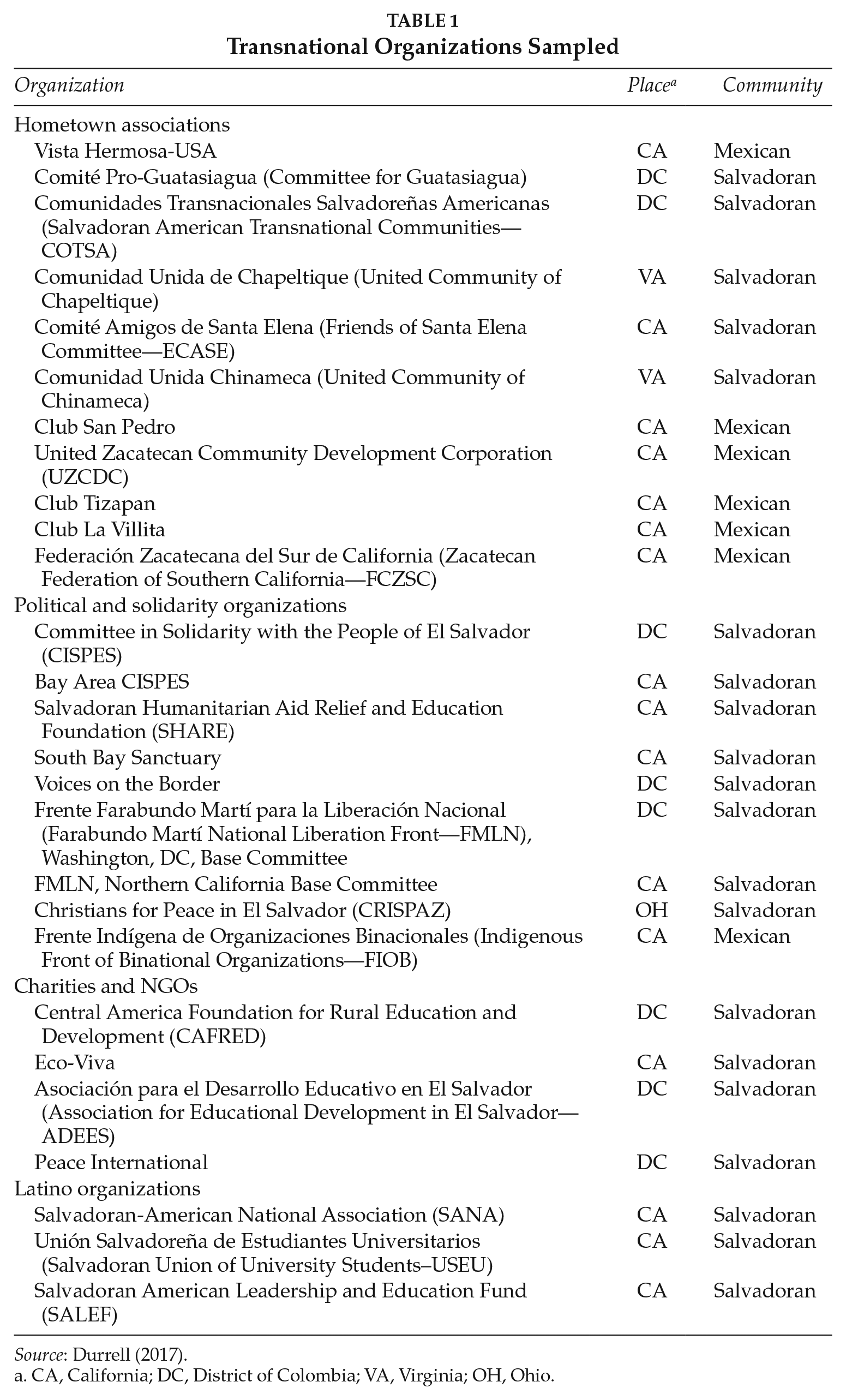
Source: Durrell (2017).
CA, California; DC, District of Colombia; VA, Virginia; OH, Ohio.
The findings will help to deepen our understanding of the way in which context can shape next-generation institutional transnationalism and inform debates surrounding the long-term sustainability of migrant-led transnational organizations: whether the next generation can provide new blood to take the political and philanthropic legacies of transnational organizations forward (Jones-Correa, 2005; Kasinitz et al., 2002; Rumbaut, 2002) or help to relieve some of the well-documented capacity constraints that many transnational organizations endure (Bada, 2003; Orozco, 2006; Orozco and Lapointe, 2004; Portes, Escobar, and Walton-Radford, 2005). Securing long-term sustainability and remaining relevant and effective are challenges not confined to migrant-led organizations, and the paper therefore refers to the extensive literature on organizational sociology to gain additional insights from other institutional contexts.
The Mexican and Salvadoran communities offer extremely useful case studies. The close ties that bind Mexico and El Salvador to the United States have generated a dense, vibrant, and extensive network of transnational organizations, which circulate significant social, economic, and political capital between home and host settings (Baker-Cristales, 2004; Goldring, 2002; Orozco, 2006; Orozco and Lapointe, 2004; Perla, 2008a; 2008b; M. P. Smith and Bakker, 2008; Stephen, 2013). There are an estimated 11.4 million Mexicans (Gonzalez-Barrera and Lopez, 2013) and 1.4 million Salvadorans (Cohn, Passel, and Gonzalez-Barrera, 2017) residing in the United States, and these large immigrant populations generate significant economic impacts in Mexico and El Salvador. Mexicans in the United States, for instance, sent remittances worth an estimated US$28,630,000,000 in 2017, and their Salvadoran counterparts sent an estimated US$5,012,000,000 (Orozco, 2018).
In order to explore the organizational contexts that could potentially facilitate and sustain next-generation institutional transnationalism, semi structured interviews were held with two sample groups, leaders and next-generation members of transnational organizations, over a period of a year (April 2010–May 2011). Respondents were identified via organizations and contacts in both communities, ensuring multiple entry points. The “snowballing” methodology was then used to reach additional interviewees. In all, 55 interviews were conducted: 27 with leaders and 28 with next-generation members. The leaders were mostly first-generation Mexican and Salvadoran immigrants to the United States. Most next-generation members (20) were born in the United States, and most tended to be socially mobile: they had relatively high educational attainment rates and, with the exception of one individual, were either pursuing or had pursued higher education. Half of the respondents were students, and more were employed in professional than in nonprofessional jobs. Female respondents outnumbered males by 20 to 8, and the average age of the contributor sample was 27 years.
Initially, the study focused on hometown associations. However, time constraints and a slow response rate forced me to include alternative philanthropic and political organizations. The sample also included three organizations focused on issues affecting Salvadoran communities in the United States, referred to here as Latino organizations, because they had cross-border agendas—delegations, lobbying efforts, and projects in El Salvador—significant enough to categorize them as transnational. One organization located outside the two main study areas, in Ohio, Christians for Peace in El Salvador (CRISPAZ), was included because it had played a prominent role in transnational political arenas.
Understanding Next-Generation Transnationalism
Transnational migration (Basch, Glick-Schiller, and Szanton-Blanc, 1994; Glick-Schiller, Basch, and Szanton-Blanc, 1992) was conceptualized to describe the situation of the increasing number of migrants who were exploiting advances in transport and communications to maintain links between their places of settlement and origin. Although the concept’s value as an analytical tool was subsequently undermined by studies that applied the “transnational” label too liberally, these excesses provoked a useful debate that helped develop tighter definitions better able to stand up to analytical scrutiny. Portes, Guarnizo, and Landolt (1999), for instance, confined the concept to economic, political, and sociocultural activities that required regular and sustained cross-border movement. Portes (2003) emphasized the grassroots nature of migrant transnationalism, but this was challenged by evidence that transnational activities may also be initiated by governments (Goldring, 2002; Waldinger, 2014). Attempts to quantify transnational practices tend to agree that only a minority of migrants participate regularly, although events such as natural disasters or economic and political crises may increase the numbers involved (Guarnizo, 2003; Guarnizo, Portes, and Haller, 2003; Portes, 2003).
The literature documents diverse examples of transnational practices. Examples of economic transnationalism include transnational entrepreneurship (Guarnizo, 2003), the small-scale community development projects initiated by transnational philanthropic groups such as hometown associations (Goldring, 2002; Guarnizo, Portes, and Haller, 2003; Koopmans and Statham, 2003), and the often unintended economic consequences of living across borders such as tourism and consuming home-country goods and services (Guarnizo, Portes, and Haller, 2003; Orozco, 2005). Political transnationalism includes the indirect activities of ethnic lobbyists who try to influence U.S. policy toward their country of origin (Shain, 1999) and more direct political involvement. The transnational political networks established by Mexican and Salvadoran migrants include the coalition of religious and leftist political organizations that opposed El Salvador’s military government in the 1980s and channeled financial and symbolic support to the insurgent Frente Farabundo Martí para la Liberación Nacional (Farabundo Martí National Liberation Front—FMLN) (Baker-Cristales, 2004; Perla, 2008a; 2008b); the Mexican migrants campaigning for electoral reforms, the expatriate vote, and political office in Mexico (Bakker and Smith, 2005; M. P. Smith and Bakker, 2008); the translocal political activities of hometown associations that engage with municipal, state, and regional authorities, using their economic clout to gain important concessions and rights (Baubock, 2007; Goldring, 2002; Iskander, 2005); and the political organizations established by indigenous Oaxacan migrants in California that supported large social protests in Oaxaca, pushed for social and political reforms, and helped mobilize support against the governor, Ulises Ruiz Ortiz, who had previously repressed activists and was eventually removed from power in 2010 (Stephen, 2013). While some have perceived transnational migrants as a new elite seeking incorporation into existing power structures (Itzigsohn, 2000), others recognize their potential as a new political force that tackles corruption and campaigns for democratic reforms (Guarnizo, Portes, and Haller, 2003; Portes, Guarnizo, and Landolt, 1999; Shain, 1999). Any effects, however, are likely to depend on the context. Bakker and Smith (2005) have suggested that a status-quo-versus-democracy dichotomy should instead be perceived as a continuum of potential outcomes.
The literature discussed so far tends to be about first-generation immigrants. There is much less research and theorizing about their offspring—the next generation—and whether their relations with the country of origin are maintained, neglected, or utilized only periodically. It is widely assumed that the transnational ties of individuals born and/or brought up in the United States are weaker, less substantive, and sustained by small minorities (Kasinitz et al., 2002; Levitt and Waters, 2002; Rumbaut, 2002). Next-generation transnationalism is also most often considered an emotional orientation—identification with and a sense of belonging to an ancestral country—or an activity that conforms to noninstitutional behaviors such as trips “home” (Falicov, 2005; Gowricharn, 2009; Levitt, 2002; Wolf, 1997). Most studies either neglect to analyze next-generation institutional transnationalism or assume that this demographic group will avoid involvement in transnational organizations (Jones-Correa, 2005; Rumbaut, 2002). This assumption fails to consider evidence that next-generation individuals, albeit minorities, are in fact contributing to transnational organizations (Kasinitz et al., 2002; R. C. Smith, 2002; 2006; M. P. Smith and Bakker, 2008). R. C. Smith (2002; 2006) investigated a New York–based second-generation philanthropic organization with roots in a small town in the Mexican state of Puebla; Levitt (2002) captured some limited involvement in transnational community development projects; and Kasinitz et al. (2002) uncovered evidence of next-generation involvement in transnational political organizations, suggesting that a small minority could play an important role by reinforcing transnational networks and maintaining them for occasional use by the majority in response to a crisis.
The limited focus on next-generation institutional transnationalism limits our understanding of the factors that give rise to it. Although the maintenance of transnational ties has been explained as a consequence of parental transmission and an upbringing in immigrant households where the influence of the country of origin prevails (Levitt and Waters, 2002; R. C. Smith, 2002; 2006; Soehl and Waldinger, 2012), these studies tend to focus on noninstitutionalized variants of next-generation transnationalism. Those that do analyze next-generation institutional transnationalism are limited in scope. Levitt (2002) has suggested that expansive transnational groups are capable of involving the next generation, implying outward-oriented organizations that actively seek to recruit this demographic group, but this is as far as the analysis goes. R. C. Smith’s (2002; 2006) long-term study of a transnational Mexican community in New York City reveals a first-generation-dominated hometown association that was unable to include the next generation—a result of its perceived hierarchical structure, proximity to corrupt Mexican politicians, and machismo-dominated culture. However, this single case study does not reveal how alternative organizational structures could shape next-generation experiences or how different pervasive institutional cultures might encourage participation.
Other studies consider organizational characteristics in the context of development potential, focusing on hometown associations and identifying negative traits such as their voluntary nature, limited expertise, hierarchical tendencies, and failure to manage projects effectively (Orozco and Lapointe, 2004; Portes, Escobar, and Walton-Radford, 2005; Waldinger, Popkin, and Magana, 2008). Although not principally concerned with outreach and inclusion, these studies could help us to perceive the limitations that migrant-led transnational organizations often endure and how they may undermine efforts to attract new members, including the next generation. Our understanding could also be informed by the extensive literature on organizational sociology, which may help to identify conducive or restrictive organizational structures, leadership models, and modes of operation.
Early studies perceived organizational development from one of two perspectives. A “rational-systems” perspective suggested that organizations were created to fulfill specific goals and their behaviors could be understood as an outcome of the planned actions of their members (March and Simon, 1958; Simon, 1945; Taylor, 1911; Weber, 1947). An alternative “natural- systems” perspective viewed organizations as less mechanistic and planned, driven primarily by a need to survive and endure, which caused goals to shift over time (Mayo, 1945; Michels, 1949). Understood as organic entities, organizations were perceived as the outcome of interactive relationships between planned formal structures and the needs and motivations of members (Litterer, 1963) and relational power dynamics that depended on compromise (Barnard, 1938; Cartwright, 1965; Selznick, 1949). A subsequent “open-systems” perspective emphasized how organizations navigated and interacted with their environments and how those environments shaped institutional evolution (Galbraith, 1973; Katz and Kahn, 1966; Lawrence and Lorsch, 1967; Thompson, 1967). This perspective incorporated several theoretical strands. Contingency theory argued that organizations best-suited to their environments were most likely to perform effectively (Galbraith, 1973; Lawrence and Lorsch, 1967; Scott, 1981; Zald and Ash, 1966). Zald and Ash, for instance, argued that organizations exist in a shifting environment that requires flexibility and adaptation. Survival and expansion, they suggested, is partly dependent on a social movement’s continued relevance, and since societal trends are never static, institutional goals must be adapted to this shifting context.
The open-systems perspective also incorporated resource-dependency theory, in which managers seek ways of controlling not only the structures of an organization but also its environment in an effort to reduce dependency and secure power advantages (Katz and Kahn, 1966; Pfeffer and Salancik, 1978); network theory, in which organizational structures and behaviors may be influenced by an institution’s position within a network of relations (Burt, 1980; Laumann and Knoke, 1987; Mizruchi, 1982; Powell, Koput, and Smith-Doerr, 1996); and institutional theory, in which organizations have to consider not only their technical but also their institutional environments, including regulations and social and cultural norms (DiMaggio and Powell, 1983; Meyer and Rowan, 1977; Meyer and Scott, 1983).
Additional theorization has reflected on the facts that institutional boundaries are becoming more flexible and open (Harrison, 1994), that externalization is becoming more common as institutions contract-out some of their functions, and that hierarchical structures are becoming more decentralized and horizontal (Scott, 2004). Thinking about leadership has shifted from envisioning a top-down power dynamic exercised by individuals who possess certain skills and personality traits (Avolio and Gardner, 2005; Bass, 1985) to alternative models that accept top-down conceptions of power but emphasize teamwork, democracy, and flatter hierarchies (Collinson, 2011; Raelin, 2003). A more radical approach, critical leadership studies, rejects top-down conceptions entirely and instead argues that leadership is a shared process that develops from the dynamic interaction of multiple organizational actors who together create the values that drive institutional actions (Alvesson and Sveningsson, 2003; Fairhurst and Grant, 2010).
Institutional Context and Next-Generation Institutional Transnationalism
With the exception of one organization, next-generation individuals were involved in the activities of every sampled group. However, while some organizations delegated only minor responsibilities to their next-generation members, others appeared to be cultivating a small cohort of next-generation leaders. Individuals in the first group contributed less frequently, had less influence over decision making, and tended to perform only supportive roles (assisting in campaigns, attending meetings, or occasionally donating money).
To explore the institutional context, four main organizational characteristics were examined: resource constraints, outreach strategies, involvement in U.S. political arenas, and pervasive institutional cultures. The leaders of 11 organizations complained that their efforts to attract and incorporate new members were held back by limited financial and human capacity. This was particularly evident with hometown associations and federations, which rely on the voluntary efforts of a limited number of committed first-generation immigrants. While these organizations may have recognized the importance of reaching out to the next generation, they faced time constraints and tended to prioritize other activities. Martin Martinez, executive director of a San Francisco–based hometown association, the Comité Amigos de Santa Elena (Friends of Santa Elena Committee), complained about the lack of time while emphasizing the sacrifices members were already making (interview, Oakland, CA, June 1, 2010): We are always thinking and we never do anything about it [reaching out to the second generation]. And the reason I think is that nobody has the time to do this. I mean we spend a lot of time doing what we are doing. . . . I [have been doing this] for 20 years. . . . I have managed to continue but by working for free, but even not just free. . . . I mean I spend a lot of money on this. . . . Driving [my] car, gasoline, time . . . this is a big thing.
However, resource constraints were not uniform across the sample, and some organizations had been able to use human capital and other resources to enhance their accessibility. A minority could also rely on paid staff. These characteristics were mostly evident in Salvadoran solidarity and political organizations. Salvadoran organizations like the Committee in Solidarity with the People of El Salvador (CISPES) also benefited from the experience of veteran activists who had initiated transnational solidarity campaigns in the 1980s and had previously been involved in student movements, revolutionary groups, and unions in El Salvador (Burgess, 2012; Chinchilla, Hamilton, and Loucky, 2009; Perla, 2008b; Perla and Coutin, 2009). The Oaxaca-focused Frente Indígena de Organizaciones Binacionales (Indigenous Front of Binational Organizations—FIOB) also benefited from the inclusion of experienced unionists who had campaigned for worker rights on both sides of the U.S.-Mexico border (Fox and Rivera-Salgado, 2004; Stephen, 2013).
Salvadoran organizations recognized, however, that veteran activists were aging or moving on to new issues, and they perceived the next generation as a natural constituency that could reenergize them. The Salvadoran Humanitarian Aid Relief and Education Foundation (SHARE) had witnessed declining support in recent years and as a result was keen to recruit young U.S.-born and/or U.S.-raised Salvadorans to replace those leaving the movement. According to Jose Artiga, its executive director (interview, Washington, DC, April 21, 2010), It is very important that we see them [the next generation] as the future of the organization. I would say that we can clearly see a decline of the North American Anglo support, and this is normal because they have been doing it for 30 years, so someone that came out of the Vietnam War and then joined the Central American solidarity movement in the 1980s . . . thirty years later that person is way into his seventies and eighties. All the others are switching to other issues. . . . There might be an attrition of that community, and so we see the Salvadoran community as one that is emerging, vibrant, and one that we would like to work with.
The potential of the next generation was recognized by most transnational leaders, and none communicated any resistance to its involvement. Aware of the limitations their organizations suffered, some perceived next-generation inclusion as a potential means of easing constraints: these members were often perceived as better-educated, with the skills to improve organizational effectiveness in areas such as fundraising, project implementation, and the use of technology. Beyond an expressed commitment to next-generation outreach, 13 organizations had designed activities or programs targeting this demographic group, including cultural workshops and delegations. Reflecting evidence gathered elsewhere (M. P. Smith and Bakker, 2008), hometown association members were bringing their children up as binational citizens, encouraging their retention of Spanish, taking them to Mexico or El Salvador frequently, and urging them to pursue Mexican and Salvadoran cultural practices. Soccer tournaments and higher-education scholarship programs also helped embed next-generation individuals in hometown association social networks where their future involvement could deepen.
Some organizations directly exposed the next generation to the challenges they were trying to address, and a small number had attempted this in more formal and coordinated ways. CISPES organized its first specifically next-generation delegation, Radical Roots, in the summer of 2010. The delegation was instigated and managed by U.S.-born Salvadorans, and a significant amount of time was devoted to exploring youth issues. The FMLN’s Los Angeles chapter established FMLN Juventud, a youth wing of the party. Although the group operated under the supervision of senior party members, it gave next-generation Salvadoran-Americans the opportunity to organize on their own terms and discuss issues directly relevant to them. It also helped ease some of the tensions that emerged between first-generation immigrants and U.S.-born members. Ernie Zavaleta, a next-generation board member, explained the decision to establish FMLN Juventud (interview by phone, Washington, DC, May 3, 2011): So it was a separate organization in the sense that . . . we function almost autonomously, but it is still within the FMLN so everything was in contact, in coordination. . . . Now the thing is that the first generation has—and I am being very honest right now—they haven’t transcended a particular model of doing things, and sometimes that model is inadequate for this time . . . and apart from the generational differences the interests that we have here as a generation are very different, and they can’t identify with what the youth think is an effective way of organizing.
Thus the evidence suggests that some transnational organizations are responding to an important shift in their immediate environments, adopting behaviors stressed by proponents of the open-systems perspective (Katz and Kahn, 1966; Lawrence and Lorsch, 1967; Thompson, 1967) such as flexibility and adaptation to new challenges and opportunities. Investment in outreach and the development of programs targeting the next generation appear to be deliberate strategies designed to enhance accessibility, remain relevant, and secure long-term sustainability, helping organizations to change as their traditional support erodes.
Accessibility may also be enhanced by an additional shift—to an interest in U.S. politics (Jones-Correa, 2005; Rivera-Salgado, Bada, and Escala-Rabadán, 2005; M. P. Smith and Bakker, 2008). Twenty of the transnational organizations in the sample had campaigned for comprehensive immigration reform, and 15 had advocated for the passage of the DREAM (Development, Relief, and Education for Minors) Act, which at the time of research proposed to allow undocumented students to pay in-state fees for higher education. Activities involved lobbying political representatives and mobilizing members to attend demonstrations. Arguably, binational agendas may facilitate next-generation involvement in transnational organizations, since issues affecting communities in the United States may resonate more strongly with individuals who have been largely socialized there. Whereas hometown association activities in a distant or unfamiliar town may seem remote or irrelevant, the organization’s integration work and its campaigns around issues such as immigration reform may seem more pertinent. Binational agendas may also offer the next generation a chance to exercise its influence and use its knowledge of the U.S. political system. While this may of course be true of many first-generation activists, next-generation individuals may be an asset in organizations with large numbers of undocumented immigrants or members who are not English-proficient and have little knowledge of or ability to participate in the U.S. political process.
Despite the commitment to next-generation involvement, however, a number of leaders suggested that organizational cultures, overwhelmingly drawn from the country of origin, may have deterred individuals socialized in the United States. One of the barriers to access was language: even though next-generation individuals could speak Spanish well, their preference for English could limit their attendance or participation at meetings. There were also instances in which generational differences—of perception, expectation, and experience—created tensions between first- and next-generation members. According to Salvador Henriquez-Cordon, the regional coordinator of the FMLN in Northern California (interview, San Francisco, November 20, 2010), his organization had found it difficult to retain next-generation members because they became frustrated with the group’s “Salvadoran” traits: I personally have always been interested in keeping them so I talk to them a lot . . . and they say that we older people are kind of boring in our meetings. But that is important because they really wanted to come to our meetings, but they stopped.
Why would they be bored?
Well, the language, for one thing. . . . Most of the young people’s primary language is English, and we always hold our meetings in Spanish. So just keeping that level of attention to understand and follow everything is draining. And there was some skepticism—I would say a lot of skepticism—in young people about the way we operate. We are very idiosyncratic and very Salvadoran. Our meetings are long, we are not punctual, and we tend to speak for an hour even to make one statement. . . . They are used to the United States way: you come to the meeting, you get to the point, and in an hour you have everything resolved.
The effects of generational differences, however, were not uniform across the sample. In organizations with a more diverse composition there was less emphasis on the exclusive use of Spanish and the influence of first-generation immigrants was not so pronounced. The fact that individual members were drawn from different communities meant that they were more receptive to diverse viewpoints. Two next-generation individuals indicated that their participation was more appreciated in CISPES than in the FMLN, for instance. One of these individuals, Rosa Lozarno, the daughter of a leading transnational FMLN activist (interview, Hyattsville, MD, September 7, 2010), explained: I think that CISPES provided me a little more autonomy from my parents. I mean, my mum is coordinator for the FMLN DC Chapter, and so within that committee I’m always going to be “Sonia’s daughter.” And CISPES provided an alternative to that. I think it was a broader space where I could meet other Salvadorans who were born here to work on the same issues but from a different perspective.
I asked whether, as a Salvadoran born and raised in the United States, she had found it easier to interact with members in CISPES. She declined to say yes but did indicate a different dynamic that could potentially limit next-generation contributions to the FMLN: “I think that because I am a younger generation—and in the FMLN you have people who were militants and veterans of the war—my interactions with them are very hierarchical, and in CISPES it’s not like that.”
Hierarchical tendencies were noted elsewhere. A perceived lack of maturity excluded some next-generation members from certain activities. Their more limited financial resources also meant that in some organizations they had not been able to participate in important tasks such as project oversight or government relations, which involve frequent travel to Mexico or El Salvador, often at great personal expense. A conversation with one transnational leader, Jorge Rosales (interview, Emeryville, CA, November 11, 2010), was indicative of this. He mentioned a young female member born in the United States who sometimes sat on the board of the hometown association he managed, Club Vista Hermosa, and helped with the organization of beauty pageants—an important source of funding for many hometown associations. I asked whether there was an expectation that she would continue to contribute and perhaps move up within the association or the federation it belonged to. He answered affirmatively but qualified his answer: Yes, but I don’t know about the level of [government relations], because when you go there you have to know a lot of stuff. You have to know all the programs plus how you’re going to do it—everything. It is too time-consuming.
You would also have to have a lot of contacts, right?
Yes.
Government contacts and contacts within other federations?
Yes. At this level, we know the president of Mexico personally, and we know all the government from Jalisco. Sometimes they invite us and say, “We will meet you tomorrow.” Well, it’s too soon . . . but they say “The president is going to be there,” and so it’s, like, “OK.”
During another part of the interview Jorge was not speaking specifically about the next generation but did imply that new members had to learn how to operate within the federation before assuming greater responsibilities: I have been following this for seven years already, and I have seen younger guys moving up to become presidents of their clubs, which is good, but sometimes those kids, we have to teach them. . . . They have so much stamina, and they’re moving fast and want to do things their own way. And we say, “You have to calm down. . . . With these people [government officials] you have to be like this” . . . and “Be careful what you’re saying. Whatever you’re saying, be loud and clear but watch what you’re saying. If you’re saying the right thing, then they will respect you, but if you try to put them down, don’t even try that because [no-one] will react to that.”
These quotations reveal close relations with the upper echelons of the Mexican political class and a tendency to adopt nonconfrontational positions when dealing with politicians, suggesting a clientelist or subordinate relationship like those identified in previous studies of hometown associations (for example, Goldring, 2002; Itzigsohn, 2000). Potentially, this relationship could be a further barrier to the inclusion of next-generation individuals, who may be perceived as unfamiliar with the inner workings and norms of the Mexican political system. A reluctance to allow younger members to assume positions of greater responsibility, pervasive cultural systems that appear resistant to change, and an elite that governs in a top-down manner reflect the observations of Waldinger, Popkin, and Magana (2008) and Landolt (2008), who documented Salvadoran hometown associations that were relatively closed groups with hierarchical structures that tended to limit inclusion and concentrate power.
In other organizations leadership and decision making were more democratic, interactive, and inclusive (Alvesson and Sveningsson, 2003; Collinson, 2011; Fairhurst and Grant, 2010; Raelin, 2003; Scott, 2004). In CISPES, next-generation members could raise their voices in a receptive environment, debate, and challenge existing practices. For instance, the Radical Roots delegation came about because two next-generation members challenged the existing delegations and campaigned instead for delegations that reflected their immediate interests and needs. The request initiated an internal debate that reflected an emerging realization that the organization had to do more to reach out to the next generation, and the organization moved to make the delegation a reality. This more open and responsive environment evolved despite the organization’s having been subjected to clandestine surveillance during the Reagan administration by the FBI, which suspected it of being a foreign agent (U.S. Senate Select Committee on Intelligence, 1989). A commitment to democracy and inclusion, however, appeared to override any inclination to organize more cautiously.
Summary
This paper has explored the institutional context of next-generation institutional transnationalism across a sample of Salvadoran and Mexican cross-border organizations. With reference to the extensive literature on organizational sociology and the concept of accessibility, it has attempted to identify the institutional contexts that may facilitate next-generation contributions to transnational organizations. While every organization in the sample had an interest in next-generation inclusion, accessibility varied greatly: some organizations were resource-poor and could not invest in outreach, and some had pervasive organizational cultures that excluded next-generation individuals; still others were more democratic and inclusive, having the resources and the commitment to develop relatively sophisticated outreach strategies. Within the more inclusive organizations it was possible to see the emergence of a small cohort of next-generation leaders. The findings shed light on a form of cross-border activity that rarely features in the literature and support the argument developed in previous studies that context is an important influence on the emergence of next-generation transnationalism and its continued evolution.
The concept of accessibility can help us to consider how organizational context may influence the transformative potential of next-generation transnationalism. Actions enacted through less accessible organizations such as hometown associations, given their tendency to delegate less important responsibilities, are likely to be less transformative than those enacted through more accessible organizations, in which next-generation individuals can exercise greater responsibility and apply their skills, knowledge, and competences with fewer restrictions. Accessibility can also inform debates surrounding the long-term sustainability of transnational organizations. By revealing the conditions under which next-generation institutional transnationalism could survive, evolve, and even flourish, this paper challenges studies that suggest that transnationalism and migrant-led cross-border organizations are unlikely to survive beyond the immigrant first generation (Jones-Correa, 2005; Rumbaut, 2002). Organizations could of course rely on new arrivals to replenish their numbers, but, given the social status and educational profiles of most Mexican and Salvadoran migrants, many could struggle to manage organizations effectively in a new environment and may opt to expend time and resources establishing themselves in the United States instead. At a time of rising hostility toward immigrant communities, individuals with a precarious legal status may also want to avoid the more visible manifestations of transnationalism such as involvement in transnational organizations.
Finally, the evolution of next-generation institutional transnationalism will depend on more than just institutional context, since one must also consider the national contexts that transnational organizations and actors navigate: the laws and regulations of nation-states and consistency with political and philanthropic actors in the country of origin. By defining legal rights, nation-states can influence the ease with which transnational activists or organizations can operate (Menjivar, 2002): their ability to travel freely, for instance, or participate in political processes and activities. Actors in the country of origin can also create openings to initiate transnationalism or obstruct cross-border engagements if migrants are perceived as a threat. Research for this study coincided with FMLN efforts to transform Salvadoran society after the party’s victory in the 2009 presidential elections, and its educational, health, labor, and constitutional reforms had a galvanizing effect on next-generation individuals involved in sympathetic left-wing organizations such as CISPES. However, gains for the right-wing Alianza Republicana Nacionalista (Nationalist Republican Alliance—ARENA) in the 2018 nationwide legislative and municipal elections and victory for the center-right Gran Alianza por la Unidad Nacional (Grand Alliance for National Unity—GANA) in the February 2019 presidential election could limit transnational mobilization, given the previously antagonistic relationship between right-wing parties and migrant-led organizations in the United States, which are perceived as mostly left-wing and supportive of the FMLN (Baker-Cristales, 2004). Recent political developments in Mexico suggest the possibility of alternative scenarios as President Andrés Manuel López Obrador seeks to redefine U.S.-Mexico relations. It will be interesting to see whether a populist leader in Mexico City, a common foe in the White House, and a hostile environment toward immigrants in the United States can generate new transnational alliances and opportunities for the Mexican next generation.
Footnotes
Jack Durrell is a New York-based researcher and writer who graduated with a Ph.D. from King’s College London in 2015.