






Abstract
This article analyzes the dilemmas faced by peasant movements in Brazil during the “progressive governments” and the return of the right to power. To this end, it analyzes the case of the Landless Rural Workers Movement (MST) in two scenarios of recent political history. The first is that of the progressive governments, characterized by a simultaneous opening of public space and public policies to popular movements, although at the same time and contradictorily, also to the private sector linked to financial and transnational capital. The second scenario is that of the rise of the far right to power, first through a parliamentary coup d’état, and then by an electoral process.
O artigo analisa os dilemas enfrentados pelos movimentos camponeses no Brasil durante os “governos progressistas” e no retorno das direitas ao poder. Para tanto, se analisa o caso do Movimento dos Trabalhadores Rurais Sem Terra (MST) em dois cenários da história política recente: o primeiro, no marco dos governos progressistas, caracterizado por uma abertura do espaço público, no campo das políticas públicas, aos movimentos populares, ainda que ao mesmo tempo e de maneira contraditória, também ao setor privado vinculado ao capital financeiro e transnacional. O segundo cenário é o da ascensão, mediante um golpe de Estado parlamentário, seguido de processo eleitoral, da direita ao poder.
With the advent of the twenty-first century, Latin America entered a new period in the struggle for democracy and for alternative social projects. In regional geopolitics, two major groups of hegemonic dispute by leftist popular movements emerged: the Alianza Bolivariana para los Pueblos de Nuestra América (Bolivarian Alliance for the Peoples of Our America—ALBA), whose political vanguard was represented by Cuba, Nicaragua, Venezuela, Bolivia, and Ecuador—countries that proposed a radicalization of social and political-economic change in the transition to socialism, with the refounding of the state and greater popular participation—and the group of the “progressive cycle,” Brazil, Argentina, Chile, Paraguay, and Uruguay, which proposed a sort of state capitalism with social-democratic tendencies and some degree of redistribution of wealth. In both groups the dispute over hegemony was conducted through institutional means, and popular movements played a central role in the pressure for a popular democracy. The formation of an institutional left bloc seemed favorable to a refounding of the state and the strengthening of regional political hegemony and to dialogue with the political platform of the ALBA and Mercosur, especially in the establishment of international cooperation based on sociocultural integration and political-economic relationships between Latin American and Caribbean countries. There was also a geopolitical reorganization of the region in the discussion of projects aimed at national-popular sovereignty in the face of U.S. imperialist domination and its impact on the militarization of countries such as Mexico and Colombia, as a strategy for regional control.
However, after the first decade of the twenty-first century the weaknesses of the political postulates of a refounding of the state were evident in the perspective of a popular project and the political game of the leftist bloc. The countries of the progressive left and of members of the core of the ALBA such as Bolivia and Ecuador in fact promoted neoliberal policies and reconfigurations of the pattern of capital accumulation by dispossession or plunder (Harvey, 2004), culminating in a new cycle of dependent capitalist development in the region, characterized as the “era of financial servitude” (Oliveira, Braga, and Rizek, 2010). This was a consequence of the organic, structural crisis of capitalism on a global scale and the need for a new expansion cycle for investment of the surplus of accumulated capital. In this scenario, it was up to the state to regulate the articulated processes of accumulation by plunder through agribusiness, mineral and water extraction, and wind power, among other things. At the same time, the political coup in Honduras in 2009 inaugurated the use in the Americas of the U.S. tactic hybrid warfare (Korybko, 2018), with the objective of blocking the advance of the institutional left bloc, especially the Bolivarian nucleus, to regain political hegemony in the region. Tactics were deployed for the return of right-wing movements to power, with coups in Paraguay (in 2012) and Brazil (in 2016) and attempts in Venezuela and Nicaragua.
Although the popular bloc advanced with regard to a political agenda for the expansion of social rights in this period, it is worth asking to what extent a profound transformation has been consolidated in Latin American nation-states in the sense of breaking with the historical hegemony of the agrarian oligarchies and the dependency of the economy and confronting the patterns of accumulation of transnational capital that threaten the sovereignty and territories of rural people. Did they manage to refound the state, establishing a new institutionality through radical political, economic, and cultural reform that incorporated the demands of popular organizations into the core of democracy? The turn to the right in Latin America reveals the loss of hegemony and political leadership of the progressive left, which in fact is following the trend of the left around the world. The return of right-wing movements also took place via the electoral route: Maurício Macri (Argentina), Sebastián Piñera (Chile), Iván Duque (Colombia), and Jair Bolsonaro (Brazil).
The above question arises at a time when the political situation in the region is requiring the Latin American left to assess its political trajectory in an effort to identify the factors that were decisive for the return of right-wing movements and the rise of new authoritarian and fascist ones. There is a need for discussion of the limitations and misunderstandings of class compromise—the strategic option of the progressive cycle—and the challenges posed to popular organizations in the framework of class struggle and ways of consolidating an emancipatory popular project.
In this article I present some considerations for the Brazilian case in order to problematize what the political experience of the progressive governments of the Partido dos Trabalhadores (Workers Party’—PT) reveals with regard to the advances, ruptures, articulations, and continuities in the exercise of democracy from a popular perspective. I confine my analysis to the reconfigurations of the agrarian question and the role of the peasantry in these governments’ disputes over hegemony and in the current return of right-wing movements through coups or leadership crises. This is because I agree with Veltmeyer (2019) that the contemporary class struggle is expressed in the countryside, especially in the confrontation with transnational capital and extractive politics. From a theoretical point of view, I also agree with Munck (2017) that a “new dependency theory” may be arising that both contributes to the critical debate over the nature of international development and sheds light on the strategies of these governments and their interfaces with social movements.
In this context, I consider the challenges confronted by peasant social movements during the cycle of progressive governments and the return to power of the right. To this end, I analyze the case of the Movimento dos Trabalhadores Rurais Sem Terra (Landless Rural Workers’ Movement—MST), which proposes popular agrarian reform as a political and cultural project for the Brazilian countryside. This analysis is related to a central question: What are the challenges to the MST at the crossroads of the PT governments’ conservative pact and the emergence of the ultra-right government of Jair Messias Bolsonaro? The analysis of the Brazilian case is timely in that it sheds light on the contradictions of the institutional left-wing movements in not promoting a radical break with the political forces linked to landownership and in allying themselves with financial and transnational capital with their interest in intensifying territorial expropriation through accumulation by dispossession. These contradictions allowed the consolidation of the hegemony of the political forces that, under opportune political conditions, worked together to bring about, through either parliamentary or electoral coups, the return to power of the right.
THE MST and the Struggle for Democracy
The MST is recognized nationally and internationally as an organic social movement, heir to the peasantry’s historic struggle for the right to land and agrarian reform. In its political trajectory it has managed to establish bridges of dialogue in Latin America and the Caribbean that allowed it, for example, to participate in the founding of La Via Campesina International. At the national level, the MST dialogues with other social movements in the countryside and in the city, left-wing political parties, and other organizations. Its national congresses are gradually constructing a strategic political agenda with the aim of promoting a broader debate related to the agrarian question in Brazil. At its sixth congress in 2014 it presented its agrarian program, pointing out (MST, 2013: 13) that it does not depend on demands from governments or only on the political will of our movement. [but] . . . depends on class struggle, on our capacity to accumulate strength . . . to build concrete alliances around the program with other sectors of the peasantry and with the entire urban working class. It depends on the capacity of broad sectors of Brazilian society to build a hegemony—a majority—that understands and defends this program.
The agrarian program proposed eight objectives (MST, 2014): (1) to democratize access to land, (2) to ensure the sustainable use of natural resources, (3) to preserve native seeds as a legacy of the people for national sovereignty, (4) to guarantee an agricultural production model for healthy eating and food sovereignty, (5) to produce and use renewable energy, (6) to ensure the right to public education and the constant cultural advancement of rural people, (7) to defend the rights of the working class, and (8) to defend the countryside as a place for life with dignity.
The political debate over popular agrarian reform was linked to the emergence in Latin America in the 1990s of a popular-democratic bloc characterized by the reconfiguration of social struggles and the democratic debate to confront neoliberalism and pursue democratic and popular politics and the full exercise of citizenship. This was the result of a historical process that began in 1964 with the military coup and therefore of a popular resistance whose foundations were established over two decades (from 1964 to 1984), inspired by the Latin American and internationalist revolutionary theoretical-political legacy in the confrontation with the authoritarianism of the military-dictatorial state. With the overthrow of the military governments and the democratic transition, two political forces in conflict emerged: (1) a popular-democratic bloc made up of unions, the MST, ecclesiastical base communities, student movements and other organizations, and the PT, which was founded in 1980 and recognized as a grassroots party, and (2) a “modernizing” sector made up of business elites and an agribusiness sector composed of traditional large landowners and large rural employers.
At the political-ideological level, two organizations reflect the increasing strength of the rural business sector: the Frente Ampla da Agropecuária Brasileira (Broad Front of Brazilian Agriculture—FAAB), which brings together the Confederação da Agricultura e da Pecuária do Brasil (Brazilian Confederation of Agriculture and Livestock Raising—CNA), the Sociedade Rural Brasileira (Brazilian Rural Society—SRB), and the Organização das Cooperativas Brasileiras (Organization of Brazilian Cooperatives—OCB) and is considered one of the strongest organizations of the Brazilian agrarian bourgeoisie, and the União Democrática Ruralista (Ruralist Democratic Union—UDR), which draws together the conservative views of the big rural landowners. Both organizations began in the 1990s and have become strong political forces with solid party representation and integration into the agro-industrial structure.
In the mid-1980s, the popular-democratic bloc had promoted a national organization with the objective of running for election to develop an institutional popular base. After the political defeat of the governments of Fernando Collor de Melo and Fernando Henrique Cardoso, the hegemonic dispute peaked in 2002 with the election of Luis Ignácio Lula da Silva of the PT. The PT represented the possibility of a government with a class identity of a popular character that would consolidate an expansion of the public dimension of the state in the sense of establishing channels for dialogue and the participation of civil society, especially with regard to policy. For the MST, Lula’s election represented the historic opportunity to build a national agenda in which agrarian reform was a priority. The PT arose in the midst of the hegemonic dispute among the popular-democratic bloc, the business-industrial bloc, and the rural employers’ sector. Thus it is worth asking ourselves: after 14 years of PT government, what advances, ruptures, and challenges can we identify in the experience of this national-popular project, especially for the peasant movements of Brazil?
The PT Governments: Advances, Limitations, and Challenges for the Peasant Movements
The rise of the PT to the presidency represented an opportunity for the expansion of the public dimension of the state, the consolidation of a popular democracy, political reform, and the development of policies that might have an impact on social exclusion. According to the Economic Commission for Latin America and the Caribbean (ECLAC), the social measures implemented by the PT, such as the Family Grant, lifted 40 million Brazilians out of poverty. ECLAC (2014) data indicate that between 2005 and 2011 there was a reduction of extreme poverty from 10.7 percent to 6.1 percent and of poverty from 36.4 percent to 20.9 percent.
Two factors influenced the nature of the political-economic project adopted by PT: the impact of trends in the international economy on the neodevelopmentalist policy adopted by the Lula government and the nature of the political forces that were consolidated in this period and their role in the dispute over hegemony. The presence of the multiparty agribusiness lobby known as the “ruralist bench” in Congress guaranteed the interests of agribusiness and private landownership, especially in the regulatory framework for agrarian policy. A gradual increase in the power of the rural employers’ sector during the four PT administrations became relevant in relation to the agrarian question in Brazil and the challenges posed to the peasantry.
International Financial Capital and Economic Policy
In the 2000s emerging countries were subjected to financialization—the increasing intervention of markets and financial institutions in national economic policy (Palley, 2007). In the same period the impact on economic indicators of the global commodities market allowed for development with income distribution, subsidies for social investment, and an increase in the minimum wage. As an emerging country Brazil adopted this new pattern of capitalist development and therefore saw changes in social indicators and living standards.
According to Lavinas, Araújo, and Bruno (2017), the two decades between 1995 and 2015 brought new institutional and macroeconomic characteristics to the monetary economy, with an emphasis on mass financialization that caused alterations in the distribution of social spending in monetary form by the central government. The Family Grant program and the increase in the minimum wage allowed a degree of monetization of the most vulnerable social groups and their incorporation into the market through consumption, although without overcoming the structural heterogeneity characteristic of the labor market. Another element of mass financialization was the inclusion of these groups in banking and finance via consumer credit. The opening of individual accounts by the beneficiaries of social programs involved the purchase of insurance, among other requirements of bank membership. Under the logic of financialization, in 2017 87 percent of individuals had banking ties (Valor, 2017).
Access to credit lines led to a gradual indebtedness, especially among individuals with a monthly family income below three minimum wages. The creation, in 2003, of payroll loans, 1 a loan modality subsidized by the government, constituted a strategy of the financial sector to ensure public subsidies, with the state as guarantor of the debt (Lavinas, Araújo, and Bruno, 2017). According to the Central Bank, in 2014 the degree of commitment of the family income of this social segment to the payment of debts was on the order of 73 percent. The level of household indebtedness, due exclusively to consumer credit, was 28.7 percent of the gross domestic product, a value considered rather high. The data demonstrate that debt becomes a feedback mechanism for mass financialization (Becker et al., 2010).
An expansion-contraction dialectic of economic policy can be observed throughout the PT governments. The financial inclusion and banking of the most popular sectors generated several benefits to the economic model adopted. It reduced the need for social spending by the state, because individuals subsidized their own services and consumption by getting loans, and it was part of the more widespread financialization in that it opened up new markets with new customers, allowing the financial sector to profit from the interest the banks charged on the debt these social sectors acquired. This financial inclusion in emerging countries of the Global South was broadly and strategically driven by the World Bank under the discourse of combating poverty and generating employment for women. 2 In this sense, the economic policy of the PT governments followed the rules of the World Bank in favoring the entry of international financial capital, and although there was an 80 percent increase in the minimum wage between 2001 and 2015, 48 percent of this income was earmarked for debt repayment.
The increase in transnational corporate investment with Brazil’s incorporation into the BRICS allowed it to ascend to a strategic position in international geopolitics favorable to the strengthening of transnational capital. One of the main ways of increasing transnational capital in Brazil was bilateral agreements with China, mainly for mineral extraction. As a consequence, the model of territorial appropriation by Chinese mining companies deepened, following the international trend of accumulation by plunder, which gave transnational mining capital almost unrestricted access to regions with abundant minerals, especially in Latin America.
For Svampa and Antonelli (2009), the extractive model of exporting nonrenewable resources intensified under the progressive governments. They point out that, in the context of reconfiguring the pattern of capital accumulation, a model based on the extraction and export of natural resources on a large scale such as the one associated with open-pit mega-mining was emphasized. Economic stability on the international level favored Brazil’s internal economic growth, the feeling of internal economic stability, and even projection as a regional economic power. While Brazil was regionally profiled as a growing economy, especially in the framework of international financial capital, internally it was necessary for the PT to guarantee a balance among the political forces to maintain this strategic position while guaranteeing the favorable economic trend—“change with stability” (Morais and Saad-Filho, 2011).
Avritzer (2016) argues that from the beginning the PT administrations were based on “presidentialism by coalition”—a pact for governability—to expand the political participation of the popular-democratic bloc while guaranteeing its access to rights. In line with this analysis, Singer (2012) highlights that the social policies and income distribution of Lula’s first term (2003–2006) attracted the attention of the opposition political forces in the face of the new political-economic agenda that was opening up in that period—a period that, from the perspective of the right-wing movements, seemed favorable to the strengthening of hegemony in the popular sectors. Singer argues that the imminent risk of a radicalization of politics in favor of a popular agenda gave rise to what he calls “Lulism,” a conservative pact in the spirit of conciliation and compromise, and political alliances in favor of transnational capital. Lula’s “Letter to the Brazilian People” was evidence of this conservative pact and an ideological realignment of the PT, a shift away from the class interests supported by the popular-democratic bloc. Given that the class struggle has never ceased, the existence of the pact has always meant imminent conflict. In view of this, the promotion of a political pact—class compromise—was a strategy for creating apparent harmony in institutional and governance spaces (Singer, 2012). The fragmentation of the Brazilian political system required the construction of complex alliances to guarantee governance (Morais and Saad-Filho, 2011). Another way of interpreting Lulism is Braga’s (2016), who describes it as a sui generis case of the regulation of class conflict configured in terms of the dialectic of the “passive consent” of the working class in accepting benefits and the “active consent” of the union bureaucracy and popular organizations in participating in some activities of the state.
Thus Lulism can be said to have produced a pact between the forces of capital and the forces of labor that avoided the possible tensions related to the interests of financial and transnational capital and therefore an “inside-out hegemony” (Oliveira, Braga, and Rizek, 2010). From Coutinho’s (2010: 32) perspective, the PT cycle was a “hegemony of petty politics, when politics is no longer thought of as an arena of struggle for different projects of society and is, therefore, seen as territory that is alien to the everyday lives of ordinary individuals, an “administration of the really existing.”
From a Latin American perspective, Machado and Zibechi (2017) suggest that the progressive cycle did not prioritize a radical redistribution of wealth and that the governments of Ecuador, Bolivia, Brazil, and Argentina demonstrated their inability to tackle issues of financial capital. They emphasize that, among the strategic components of this cycle, two were central: overcoming the neoliberal economic model with policies with a strong symbolic impact on social ideologies and delegitimizing the political actors of the neoliberal period in terms of party democracy without affecting the market agents and their accumulation model. They consider the policies for combating poverty in Latin America counterinsurgency measures in that were implemented in the course of promoting a profound social demobilization.
Although class compromise was an undeniable mark of PT governance, the pressure exerted by the popular base guaranteed the achievement of some normative reforms in the recognition of rights, especially in the regulatory framework of educational policy. Two examples in the area of agrarian policy were the National Program in Land Reform Education and the National Policy for Rural Education, both products of political pressure from social movements including the MST rather than concessions by the state under agreements with the popular base (Barbosa, 2016a).
Dispute Over Political Projects
Under the PT administrations, the political project of popular agrarian reform was linked to the dispute over two political projects for the Brazilian countryside (Barbosa, 2016b), with the MST and the organizations of La Via Campesina–Brasil advocating for the social, political, and economic centrality of popular agrarian reform and the rural employers’ sector for increasing control over the material base of Brazilian agrarian capitalism through agribusiness. After the 2014 elections, the configuration of Congress made clear the hegemony of the rural employers’ sector: of the 191 deputies representing the Frente Parlamentar da Agropecuária (Parliamentary Front for Agriculture and Livestock Raising—FPA), 139 (72 percent) were reelected. These numbers cannot be considered in isolation from their implications for the correlation of forces established under the PT governments. Brazilian agribusiness had achieved a prominent position at the national and international levels, reaffirming its hegemony in the area of agrarian policy. According to the CNA, agriculture represented 23 percent of the gross domestic product and was responsible for 41 percent of the country’s exports. The sector’s influence was also expressed in donations to the 2014 election campaigns. Major corporations in the sector such as Copersucar, Cutrale, Cosan, and JBS were among the main donors to the campaigns of Dilma Rousseff (PT) and Aécio Neves (Partido da Social Democracia Brasileira).
The FPA has the political power to nominate appointees to the Ministry of Agriculture and the chairs of Congress’s agriculture and environment committees. In the second of Rousseff’s elections the ruralist bench managed to elect the cattle baron Kátia Abreu as minister of agriculture and Ana Amélia (Progresistas) president of the Senate’s agriculture and agrarian reform committee. The post of minister of agriculture was one of the key positions in the rural employers’ sector. In Lula’s first term the minister was Roberto Rodrigues, former president of the Brazilian Agribusiness Association (1999–2002), coordinator of the Agribusiness Center of the Getúlio Vargas Foundation, and a great defender of genetically modified organisms. The promise of a popular agrarian reform was not fulfilled, but there was an increase in the investment of international financial capital in agribusiness. In Lula’s second term a strategic alliance with agribusiness was established and an agrarian policy favorable to the introduction of transgenic seeds and soy monoculture was implemented.
With regard to the agrarian question, it is worth highlighting the dispute over two paradigms of rural development, the agrarian-question paradigm and the agrarian-capitalist paradigm. According to Fernandes (2015), the former assumes that the agrarian question is a structural component of capitalism and that class struggle is the interpretive framework for territorial disputes and development models for the countryside. It has two schools of thought: the proletarian, based on capital-labor relations, which considers the disappearance of the peasantry an inevitable result of the territorialization of capital in the countryside, and the peasantist, which argues that the peasantry represents the confrontation of capital in the countryside.The agrarian-capitalist paradigm defends the idea that the inequalities generated by capitalist relations are a temporary problem that can be overcome through policies that allow the incorporation of family farmers or peasants into the capitalist market. This paradigm also has two schools of thought, one advocating the incorporation of family farming into capital and the other interpreting family farming as residual in agrarian capitalism.
Fernandes (2015) emphasizes that the political debate over the two paradigms can be seen in policy discussions. The correlation of forces is responsible for the distinction he identifies between emancipatory and subordinating policies, the former articulated by the agrarian-question paradigm and the demands of the popular base and the latter grounded in the agrarian-capitalist paradigm and aimed at strengthening the agribusiness development model and promoting the subordination of peasant communities to this model. In the PT governments there was constant conflict over development paradigms in the area of policy, and the political strategy of class compromise fostered a pattern of agrarian policy that met some aspects of both paradigms. The National Program in Land Reform Education and the country’s rural education policy are examples of emancipatory policies. The Second National Plan for Agrarian Reform of 2003, in contrast, favored the agrarian-capitalist paradigm. This plan aimed to settle 500,000 families, but the data registered by the Instituto Nacional de Colonização e Reforma Agraria (National Institute of Colonization and Agrarian Reform—INCRA) 3 show a reduction in land destined for agrarian reform under the PT governments, with 381,400 families in Lula’s first term, 232,600 in his second, and 133,600 in Dilma’s two terms.
Despite the historical political support for the PT of the Pastoral Land Commission and the MST, its policy for territorial reorganization significantly reduced areas of collective interest and land for agrarian reform and drove increased land concentration. According to the IBGE Census (2010), in 2010 there were more than 69,000 unproductive properties (latifundios) controlling 22 million hectares of land. Under the Rousseff administration, agrarian reform was not a priority on the political agenda. According to Alexandre Conceição of the MST’s national leadership (UOL Noticias, 2015), We had a miserable four years. The Dilma government chose to structure the existing settlements instead of settling families that still needed land. In doing so, the pace of settlement slowed. This policy was a mistake. The numbers are disappointing, especially because of the support we have always given the PT. Dilma’s government managed to be worse than that of [Cardoso].
Settlements were prioritized over agrarian reform with expropriation of unproductive land for settled families. While some programs were implemented, among them as the National Program for Strengthening Family Farming, the Food Acquisition Program, and the National School Nutrition Program, the INCRA underwent institutional restructuring in order to decentralize agrarian policy, especially that related to agrarian reform. According to Pinassi and Firmino (2013), Investment in the improvement of access routes to the market by settlers for the flow of production will become the responsibility of the municipalities, which will receive funds from the federal government through PAC-Equipamentos. The construction of houses on the lots will take place through the My House, My Life program of the Ministry of Cities, and the supply of power will be available through the Light for All program of the Ministry of Mines and Energy. The supply of water to families in the semiarid region will be the responsibility of the Ministry of National Integration.
Thus, agrarian reform policy was antipopular and antireform in that it exempted the federal government from responsibility for its implementation (Pinassi and Firmino, 2013). Leaving these issues to municipal governments created the possibility of clientelism and cosponsorship by political forces allied with rural management. For Osorio (2012), the neodevelopmentalist policy initiated by Lula constituted a cycle of expansion of transnational capital supported by the export standard of productive specialization—a development model that leveraged agribusiness, mining, the energy sector, and public works. In the area of rural development policy, the National Program for Strengthening Family Farming shifted the historical debate on agrarian reform to “family farming” with the objective of linking it to the market logic of agribusiness. Thus, it was an agrarian policy structured in terms of the agrarian-capitalist paradigm, and subordination of the peasantry prevailed.
Another aspect of the PT’s territorial reorganization policy was the revival of the Settlement Consolidation and Emancipation Program provided for in the 1964 Land Statute and implemented by Cardoso in 2000. The program’s objective was to grant “autonomy” to land-reform settlements by conferring individual landownership on settlements more than 10 years old. However, in a political interpretation of the regulation, 4 it turns out that this was a neoliberal-style agreement with the Inter-American Development Bank in which agrarian reform was to become “market-driven.” The emancipation debate returned to the political agenda of the Rousseff government clearly linked to the restructuring of the INCRA. “Emancipation” for an agrarian-reform settlement was in fact disconnection from the INCRA’s institutional responsibility and the transformation of settled farmers into “family farmers,” a category in perfect harmony with the fundamentals of the agrarian-capitalist paradigm.
Given the political scenario of strengthening of the conservative pact with the political and economic sectors linked to transnational capital, the figures for public investment in agrarian policy under PT management are striking: in the 2009/2010 Safra Plan, 93 million euros were allocated to agribusiness and 15 million to family farming (Diario Gauche, 2009). According to Pericás (2017), under Lula’s government corporate farming linked to agribusiness received seven times more public resources than family agriculture even though the latter provided more than 80 percent of the jobs in the countryside. The data presented by Pericás come from the Brazilian Association for Agrarian Reform and show not only an increase in agribusiness between 1990 and 2011 but a decrease in the amount of land in food production and an increase in land in the production of sugar (122 percent) and soy (107 percent).
The fiscal adjustment policy of 2015 included a general budget cut mainly in the Ministry of Education (19 percent) and the Ministry of Agrarian Development (49 percent), which were responsible for the National Policy for Rural Education and the National Program for Land Reform Education, respectively. In Rousseff’s second term the retrenchment in the field of agrarian policy from the perspective of the peasantry was visible, and tension with the popular-democratic bloc intensified. The right-wing political forces amplified their anticorruption discourse, making the political crisis palpable. The PT was showing signs of a loss of political leadership that highlighted the crisis or even the collapse of the class compromise strategy. The ideological exhaustion of the democratic project that was idealized by the popular base and responsible for the rise of the PT put democracy in check, while at the same time representing the loss of a historic opportunity for the consolidation of a popular political project. As if the political-ideological rupture of the PT with the popular-democratic base were not enough, a political coup in 2016 ended with the impeachment of Rousseff.
The Agrarian Question under Temer and Bolsonaro
One of the first steps of the government of Michel Temer was the enactment of Provisional Measure 726/2016, which replaced the Ministry of Agrarian Development and the Ministry of Social Development with the Ministry of Social and Agrarian Development. The promulgation of Decree 8780 transferred the structure of the extinct ministry to the Staff of the Presidency of the Republic, which began to concentrate all the tasks of agrarian reform, the delimitation of the lands of the remaining quilombo communities, and the demarcation of indigenous territories. These measures were intended to be a dismantling of the agrarian reform policies of expropriation of unproductive land and strengthening of family farming once linked to the ministry and a reconcentration of private landownership, thus facilitating the appropriation of land by foreigners and the expansion of the market for large food transnationals. The Special Secretariat for Family Agriculture and Agrarian Development, linked to the Staff of the Presidency, assumed the institutional structure of agrarian policy and rural development, with its functions distributed in four departments: Family Agriculture, Territorial Development, Agrarian Reorganization, and Legal Land Regularization in the Amazon. The elimination of the ministry subordinated the INCRA to the Special Secretariat, representing an institutional downgrading of agrarian policy.
Throughout 2016, a series of liberalizing and denationalizing provisional measures benefiting the rural employers’ sector was approved. Among them were 733 (enacted as Law 13,340), 756, and 758, which granted financial and legal facilities to rural producers enrolled in the federal active debt and with debts originating from securitization operations and the Special Sanitation and Assets Program for the settlement of the outstanding balance with deductions of 60–95 percent.
According to the attorney general of the National Treasury, in 2015 18,602 individuals and companies had debts to the federal government of more than R$10 million, amounting to a total of R$1.2 trillion. Of these debtors, 4,013 individuals and legal entities, also landholders, had debts of more than R$50 million, totaling more than R$906 billion in taxes due. The rules for provisional measures allowed the suspension of filing and the continuation of tax executions in progress until the end of 2017 (Oxfam, 2016: 18–19). The amounts deducted from the debts would have been enough to settle 120,000 families in 2015.
Provisional measures 756, 758, and 759, dealing with land regularization in rural and urban areas and in the area of the Legal Amazon program, favored territorial appropriation, land sales, deforestation, and the exploitation of resources by agribusiness and mining interests. The first of these reduced the National Forest from 1,301,120 to 557,580 hectares in conjunction with the creation of the 542,309-acre Jamanxim Environmental Protection Area. These measures allowed the reduction of land and environmental control of conservation units in the Amazon region. The approval of Constitutional Amendment Proposal 95/2016, limiting increases in public spending for two decades, affected funding in the areas of education and health. The National Program in Land Reform Education was one of the programs affected, with a reduction in its 2017 budget from R$30 million to R$9 million. The annual budget for 2018 allocated R$3 million to a program that had 100 approved projects, a figure that compromised the program’s continuity. In 2019 R$6.5 million was allocated for the “promotion of rural education” and R$1 million for the INCRA. The budget for 2020, still in progress, allocates R$9 million to rural education activities under the INCRA, but behind the scenes it is estimated that only R$2,941,131 will be allocated to the land-reform education program. At the same time, the budget, still awaiting presidential sanction, contains R$3.1 million for rural education action under the Ministry of Agriculture, Livestock Raising, and Supply instead of the INCRA. 5
The deceleration of agrarian reform already seen under the PT governments intensified in the context of the political coup, with an increase in the influence of transnational capital on agrarian policy to strengthen agribusiness. An example of this was the “Positive Agenda for the 2016–2017 Biennium,” a document prepared by the FPA and the Instituto Pensar Agro and delivered to Temer in 2016. The document presents seven axes (some of them with bills in progress): Institutional Governance, Agricultural Policy, Property Law and Legal Security, Environment, Infrastructure and Logistics, Agricultural Defense, and Working Relationships. It advocates legalization of the denationalization of Brazilian territory, directly affecting the demarcation of indigenous and quilombo territories and lands destined for agrarian reform. The bill—PL 4059/12—is one of the main legal documents prepared by the FPA with the objective of facilitating the acquisition of rural properties by companies whose capital is primarily foreign.
The reconfiguration of rural areas under the progressive governments and in the context of the political coup is well known. The hegemony of transnational capital in alliance with the rural employers’ sector was decisive for agrarian policy and its subordination to the agrarian-capitalist paradigm. In Temer’s government the ruralist bench held 41 percent of the seats in Congress and was able to negotiate for the votes necessary to advance its political interests. An example of this was the support given to Temer’s continuation in office. Of the 263 votes needed to shelve the impeachment request, 129 were from ruralists. In response to this support Temer reduced the budget of the Food Acquisition Program from R$478 to R$294 million, with a reduction of the families served from 91,700 to 41,300 (Folha, 2016). With respect to agrarian reform, only 26 settlements were created in 2016 and only 1 in 2017. The National Health Surveillance Agency, linked to the Ministry of Health, was prohibited from providing information on the registration of pesticides, centralizing the control of the data in the Ministry of Agriculture.
The hegemony of the ruralist bench in Congress is affecting the profile of projects in process or approved: 61 percent of congresspersons have a record of opposition on agrarian, territorial, and socio-environmental issues. Since 2014 there have been 87 laws against the environment and the demarcation of indigenous lands and in favor of suspending the regulation of land, the elimination of labor rights for rural workers, and the regulation of pesticides. The president of the ruralist bench is the author of eight laws, among them PL 6442/2016, which regulates housing and food as forms of payment for rural workers. These laws are part of a so-called poison package that includes PL 3200/2015, which aims to revoke the current pesticide regulation law. It replaces the term “pesticide” with “phytosanitary” and proposes the establishment of a technical commission on plant protection compounds.
The 2018 electoral map reveals that most of the votes for President Jair Bolsonaro came from the Midwest, the South, and the Southeast, the areas of expansion of agribusiness (Rede, 2018). The hegemony of the rural employers’ sector under the PT governments was fundamental to the success of the parliamentary coup and Bolsonaro’s election. The FPA guaranteed the reelection of 51 percent of the Chamber of Deputies and 85.2 percent of the Senate. Although the numbers were lower than those for the 2014 elections, the ruralist bench maintained its strategic position there and in the appointment of Tereza Cristina as minister of agriculture and Onyx Lorenzoni as chief of staff.
In the first year of the Bolsonaro government, the Ministry of Agriculture, Livestock Raising, and Supply was strengthened with its incorporation of the INCRA, the Special Secretariat for Fisheries, the Brazilian Social Service, and the Special Secretariat for Family Agriculture and Agrarian Development and the creation of the Special Secretariat for Land Affairs. In the government’s first 100 days the ministry released 121 extremely toxic pesticides. Act 17 of the Department of Plant Health and Agricultural Materials, published in the Official Gazette for March 21, 2019, granted registration to 35 new labels, 6 of them Class 1 (extremely toxic). Bill 6299/2002, approved by the Chamber of Deputies, proposes the centralization of evaluations, approvals of new products, and registration in the ministry, abandoning the tripartite structure of regulation that included the Ministry of Health and the Ministry of the Environment. The increase in the number of pesticides approved since the coup is worrisome (Figure 1).
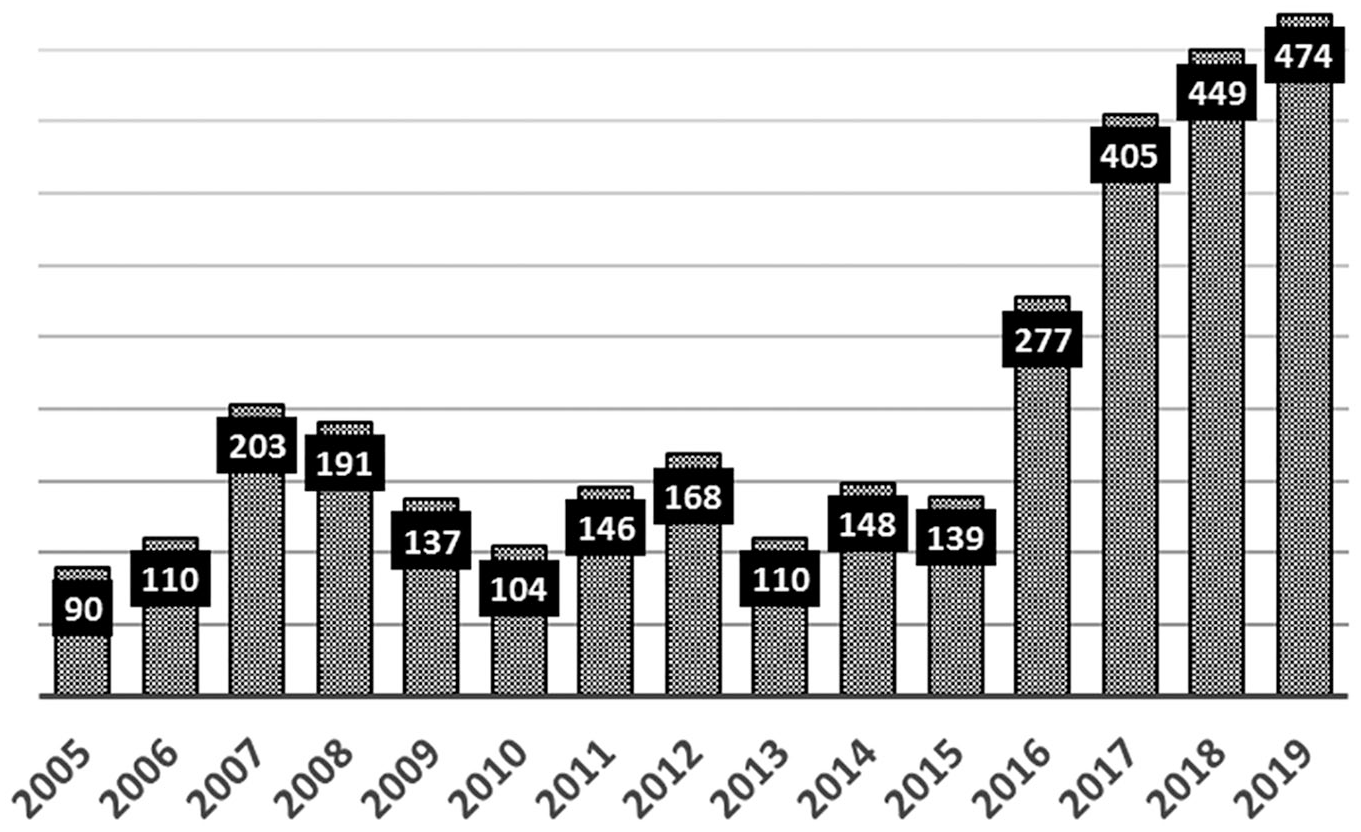
Number of pesticides approved annually (data from the Ministry of Agriculture, Livestock Raising, and Supply).
In addition to dismantling the regulatory apparatus for the registration of pesticides, Bolsonaro says that there will be no agrarian reform and is maintaining the FPA’s “Positive Agenda,” especially the denationalization of land that constitutes a direct attack on the demarcation of indigenous and quilombo territories. In December 2019, Provisional Measure 910 and Decrees 10165 and 10166 established new rules for land regularization. Measure 910 changed the provisions of Law 11952/2009 (which provides for land tenure regularization of occupations of lands located in federal areas), Law 8,666/1993 (which institutes rules for public tenders and contracts), and Law 6015/1973 (on public records). Decree 10165 amends Decree 9309/2018, which regulated Law 13465/2017 (which provides for land regularization in rural areas), and Decree 10166 deals with the process of selection, permanence, and issuing of deeds to beneficiary families of the National Agrarian Reform Program. The intention is to intensify the FPA’s agenda, especially with regard to the appropriation of land by foreigners. Backed by Law 13260/2016, the antiterrorism law passed by Rousseff’s government, Bolsonaro says that he will do everything possible to classify the MST as a terrorist organization. Another threat is the closure of rural schools located in areas of agrarian reform and MST political training schools such as the Paulo Freire Training Center, located in the Normandy settlement in Caruaru, Pernambuco.
The Challenges for the Peasant Movements: Final Reflections
The structural power of transnational capital was consolidated in Latin America, notably during the governments of the progressive left, which have since lost their hegemony and revealed contradictions with any kind of real popular political agenda. One regional trend was the adoption of a governance model agreed upon with big capital and the imposition on popular movements and organizations of a concept of political participation restricted to the electoral agenda. Faced with the breakdown of institutional mechanisms for the exercise of democracy and the rise of right-wing parties, the popular-democratic bloc is at a crossroads, since part of the crisis of institutional representation of the state is the result of the political strategy of a conservative pact and of class compromise and conciliation.
The PT governments broke with the political agenda of the popular-democratic bloc and instead upheld the continuity of the model of capitalist development. Austerity and containment of agrarian reform started before the return of the right; in a sense, the PT governments laid the basis for that return by failing to resolve structural and political contradictions and by providing agribusiness and financial capital with extraordinary access to rural areas and government programs. Temer and Bolsonaro assumed and intensified the political package of the PT governments in the context of the consolidated hegemony of transnational capital, the agrarian oligarchies, and the rural employers’ sector in the countryside.
Aware of the losses for the popular agrarian reform project, especially in relation to the historic opportunity for its consolidation, the MST carried out an internal assessment in which it highlighted the main challenges of the current situation (MST, 2017): the construction of popular unity and a new political strategy for the working class; the resumption of basic training to strengthen the organization of the working class in the countryside and in the city; the development of political training to expand and strengthen political and organizational frameworks; the building of class solidarity; and the reaffirmation of popular agrarian reform as a political project. As I have said, this project does not depend solely on the political praxis of the MST and the other peasant organizations. Political support for the PT was one of the major challenges faced by the MST, mainly because it had a clear idea of the party’s role in strengthening transnational capital in the countryside and in the parliamentary hegemony of the rural employers’ sector. The PT had arrived in government with the support of this sector and its traditional politicians, the historical oligarchs. The repositioning of right-wing movements found fertile ground in the contradictions and crisis of political leadership of the progressive Latin American governments, notably in their strategy of conservative pacts.
Florestan Fernandes (2008) warned that any prospect of true development in Brazil would face class interests. Historically, the absence of bourgeois or popular revolutionary processes has increased the dominance of the class interests of a particular social circle, leading to adaptation to the structure and dynamics of power. In a country marked by a long colonial period in which the latifundia and slavery were consolidated as a cultural and political-economic matrix regulated by the state, the metamorphosis of the agrarian aristocracy into an agrarian bourgeoisie linked to transnational capitalism was to be expected. It was also to be expected that the contradictions of the historical evolution of capitalism would be expressed in the rural world and that the agrarian question would remain unresolved in the framework of a popular emancipatory project. A careful reading not only of the Brazilian case but of that of Latin America will show that, historically, the expanded reproduction of capital in our region has been circumscribed in the countryside by the territorial expropriation of indigenous peoples, the peasantry, and other rural groups.
In this new stage of accumulation by dispossession, territory is increasingly an object of interest for transnational capital as the source of water, minerals, wind power, and other resources. In this context, it is obvious how fruitful it would be to revisit the critical theory of dependency for a new typology of dependency in Latin America during the progressive cycles and even in the phase of global monopolist integration of some countries of the core of the ALBA. Interpretation of the contradictions and antagonisms inherent in Latin American dependent capitalism is needed, above all, to identify the effects of monopoly action and transnational capital linked to neo-extractivism as well as the new elements that characterize dependency and underdevelopment in the region in the twenty-first century.
In Brazil, the class struggle in the countryside is characterized by the confrontation between the political forces with bourgeois leadership (with hegemony in the context of the national-popular alliance) and the conservative forces aligned with the interests of the local bourgeoisie and transnational capital. Thus it takes place institutionally, given the absence of a popular social political force capable of confronting the state. In this respect, a policy of class compromise is not enough to seize power without a radical social transformation of the mechanisms of reproduction of bourgeois hegemony.
The Brazilian state has historically had the role of replacing social classes with the potential for political leadership and focusing on the task of regulating the political agenda of the dominant classes—substituting domination for leadership (Coutinho, 1985). Therefore changes have always been the result of a shift in hegemony from one segment of the dominant classes to another over time, although always complementary in their political alliances. Thus, it was up to the state to control the popular sectors (read by Gramsci [1975] as a “passive revolution”), which presupposed the strengthening of the state in favor of the hegemonic forces and the exercise of transformism as a modality of historical development that necessarily excluded the popular masses.
The MST (2017) recognizes that the PT governments consolidated a class hegemony and an alliance with agribusiness and the agrarian-capitalist paradigm as a political basis for rural development. Agrarian policy served the interests of large corporations and transnational capital in the countryside, while subjecting family farming policy to the logic of subordination of this agrarian model. Despite the evidence of the PT’s contradictions, social organizations and grassroots movements (including the MST) supported it and Lula partly because of the strategic choice of opting for a “Popular Front” strategy against fascism, and their political positioning with regard to Lula’s arrest, the result of a right-wing pact with the judiciary to derail his candidacy for president in 2018. In addition, the Lula Livre (Free Lula) campaign views the defense of democracy as a political right—the idea that the people vote for the candidate they like and that right should not be restricted. 6
At the same time, Lulism was also manifested in the attachment of the grassroots organizations and popular movements to the figure of Lula, a man whose family was poor, a proletarian from the Northeast. In the social imaginary of the popular sectors, these elements became the more significant because of the historical symbolism they evoked, since the North and the Northeast had always had the lowest Human Development Index and suffered prejudice and racism resulting from internal colonialism and regional differences. Therefore, Lula became a highly popular politician, and his election represented the first time that a worker had become president of Brazil—a condition similar to that of Evo Morales, the first Aymara president of Bolivia. A critical understanding of the support for Lula involves the interpretation of Brazilian sociocultural and economic history and its interfaces with regional inequalities marked by the intersection between class and race.
Given the election of an extreme-right president, Jair Bolsonaro, the option of the MST and the other peasant social movements is to strengthen alliances for the unity of popular forces in the defense of democracy and in active resistance to the intensified violence in the countryside and the criminalization of social struggle. Prospectively, the active resistance of the MST advocates the defense of settlements understood as territories conquered in the historical struggle of the peasant class and as the seedbed for popular agrarian reform. However, as with other expressions of popular Latin American resistance, it will be essential for these settlements to develop elements of autonomy such as strategies for guaranteeing food, water, and seed sovereignty, mainly because the rise of the right has effected a rupture with the public dimension of the state with regard to policy of a popular nature.
Footnotes
Notes
Lia Pinheiro Barbosa is a professor in the graduate program in sociology at the Federal University of Ceará and in the Crateús Faculty of Education at the State University of Ceará and coordinator of the research group “Social Thought and Epistemologies of Knowledge in Latin America and the Caribbean.” Patricia Fierro is an American Translators’ Association–certified translator living in Quito, Ecuador.