






Abstract
Academic capitalism has become one of the most influential research lines related to higher education. However, its manifestations in developing countries need to be better understood. Changes are taking place in Brazil that can be attributed to a move toward academic capitalism, and concepts provided by the theory of academic capitalism offer a fertile framework for exploring them. Analysis of official documents, regulations, and the actions of a network of participants reveals the mechanisms that reconfigure the boundaries between the public and the private to establish an academic capitalism knowledge/learning regime. Academic capitalism in Brazil took its first steps after the 1968 reform and was consolidated in the 1990s and instrumentalized in the 2000s, and, judging from the associations between the current government and the business sector, it threatens to take an even more aggressive form in the coming years.
O capitalismo acadêmico tem se configurado em uma das linhas de pesquisa mais influentes no campo da educação superior. Há, porém, que melhor se entender suas manifestações em países em desenvolvimento. Estão em curso no Brasil mudanças que podem ser atribuídas a um contexto voltado para um capitalismo acadêmico, e os conceitos oferecidos por ela fornecem um fértil framework para explorar tais mudanças. A análise de documentos oficiais, artefatos legais e da atuação de uma rede de atores, são explorados os mecanismos que reconfiguram as fronteiras entre o público e o privado, colocando em movimento um academic capitalism knowledge/learning regime. No Brasil, o capitalismo acadêmico dá seus primeiros passos após a reforma de 1968; ascende e ganha contornos mais intensos a partir da década de 80; consolida-se a partir da década de 90; instrumentaliza-se nos anos 2000 e, com base nas associações entre o atual governo e o setor empresarial, ameaça assumir uma forma ainda mais agressiva nos próximos anos.
Recent studies (Mancebo and Silva Jr., 2015; Chauí, 2016; Leher, 2016a; Silva Jr. and Kato, 2016; Sigahi and Saltorato, 2018; 2020b) show that, much as have institutions in other countries (Slaughter and Cantwell, 2012), Brazilian higher education institutions have become increasingly operational, subject to external controls, and financialized, the result of a long process of neoliberal reforms that has blurred the boundary between public and private spheres. Slaughter and Rhoades (2004) developed academic capitalism theory to explain how the various groups of actors in the field of higher education—universities, teachers, students, administrators, rectors, and others—have responded to neoliberal tendencies that began to treat higher education policy as a subset of economic policy. The academic-capitalism-theory approach is not limited to the commodification of knowledge but also considers the changes in relations between universities and their social environment (Kauppinen and Kaidesoja, 2013; Sigahi and Saltorato, 2020a).
According to Cantwell (2015), academic capitalism is one of the most influential lines of research in the field of higher education. Seminal studies of it have been conducted in the United States, the UK, Australia, and Canada (Slaughter and Leslie, 1997), developed more intensely in the United States (Slaughter and Rhoades, 2004), and more recently extended to Europe (Slaughter and Cantwell, 2012) and Asia (Tang, 2014). However, there is a gap in the literature in relation to its use in developing countries (Maldonado-Maldonado, 2014; Sigahi and Saltorato, 2020a). In Brazil some have used the term "academic capitalism" (Leher, 2004; Silva Jr. and Kato, 2016) or "university capitalism" (Martins, 2008) to refer to neoliberal changes in higher education, but no one has explored the theory of academic capitalism as we propose to do here. The purpose of this paper is to demonstrate that changes in higher education are taking place in Brazil that can be attributed to academic capitalism and that the mechanisms and concepts of the theory of academic capitalism provide a fertile framework for exploring those changes. In the next sections, we first present the key concepts (mechanisms) that make up the conceptual structure of the theory. Next we examine the emergence and consolidation of academic capitalism in Brazil since 1960 through the study of the evidence for systematic changes in higher education policy (official documents, legal artifacts, and the performance of a network of actors and organizations) in terms of these mechanisms.
The Theoretical Framework
The theoretical framework includes five key mechanisms, which, as Slaughter and Cantwell (2012) point out, may occur sequentially, simultaneously, independently, or recursively:
New knowledge circuits, created from a variety of state resources by groups of actors in higher education to reconfigure the frontiers of knowledge. These circuits link state agencies, corporations, and universities in conducting market-oriented “entrepreneurial research and education" (Slaughter and Cantwell, 2012). Slaughter and Rhoades (2004) mention the circuits that connect government departments to corporations (e.g., aerospace, biotechnology, telecommunication) in funding university research projects aimed at the development of medical, pharmaceutical, military, and national-defense products. They also point to the new student markets, such as for distance education and MBAs and other professional Master’s degrees, that are widespread in the national context.
New funding flows, which provide financial support for activities that move the university toward the market (Slaughter, 2014). According to Slaughter and Cantwell (2012), these private and state flows come from activities related to patents, licensing, royalties, publishing (open access), translations, editing, spin-offs, technology parks, and university incubators. Funds are also generated through industry-university partnerships (consultancies), new forms of education (mass open online courses), new student markets, and fees charged for the use of parking and recreation facilities and computers, among other things.
Interstitial organizations, which link internal and external actors to the university. Examples of these are offices dedicated to the management, promotion, and regulation of distance education services, technology transfer, public-private partnerships, and intellectual property, including advisory councils composed of members of large corporations (Slaughter and Rhoades, 2004). In Brazil these organizations include foundations for scientific and technological development in universities (the Universidade Federal de Minas Gerais, the Universidade Federal de São Carlos, the Universidade de São Paulo, and the Universidade Federal de Paraná, among others, which numbered 98 in 2015), innovation agencies and offices, and student organizations (Empresas Júnior and the Ligas Universitárias, which have begun to reproduce neoliberal discourses among students).
Intermediary organizations, which are responsible for forming networks between public and private sectors through independent entities such as professional associations, foundations, events, forums, and think tanks. Generally, these organizations are composed of business leaders interconnected through networks that produce or reproduce discourses influencing higher education policy (Slaughter, 2014). Slaughter and Rhoades (2004) identify a number of such organizations in the United States related to patents, copyrights, intellectual property, and research/sales of educational and sports products and services. In Brazil, these organizations include development agencies (the Coordenação de Aperfeiçoamento de Pessoal de Nivel Superior [Coordinator for the Improvement of Higher Education Personnel–CAPES], the Conselho Nacional de Desarrollo Cientifico y Tecnológico [National Council for Scientific and Technological Development—CNPq], the Fundação de Amparo à Pesquisa do Estado de São Paulo [São Paulo Research Foundation—FAPESP), and the Financiadora de Estudos e Projetos [Funding Authority for Studies and Projects—FINEP]), international organizations (the World Bank, UNESCO, the International Observatory of University Reforms), private foundations (the Lemann Foundation, the Estudar Foundation), state agencies (the Conselho Nacional de Educação [National Education Council]), the Associação Brasileira de Entidades Mantenedoras (Brazilian Association of Supporting Entities), and UNESCO’s World Conference on Higher Education.
Expanded management capacity, involving new structures that promote a restructuring of university work aimed at reducing costs and capturing new slices of the educational market. Examples are the increase in the hiring of nonuniversity professionals (who usually work through interstitial organizations and outsourcing), the creation of hiring offices (Slaughter and Leslie, 2001), and the transformation of teachers into managers and rectors (university presidents) into CEOs (Slaughter and Rhoades, 2004).
According to Slaughter and Rhoades (2004) the manipulation of these mechanisms by the actors involved in higher education has fostered the incorporation of the behavior or ethos of market ideology, resulting in the displacement of a public-good knowledge/learning regime by an academic-capitalism knowledge/learning regime. By "regime" they mean the policies that set these mechanisms in motion, which are the product of a change in the political economy of nations and the actions of a network of actors and organizations engaged in activities that challenge the understanding of the boundaries between universities, corporations, and states.
Academic Capitalism in Brazil
The first signs of academic capitalism in the Brazilian context may be associated with the period that Chauí (2016) has called the “functional university” (1964–1980), when the commodification of higher education began (Martins, 2009; Dias Sobrinho, 2010). Through the 1968 Higher Education Act, the government allowed the creation of private establishments—new professional knowledge circuits destined for a niche of the educational market that was on the rise. Slaughter and Leslie (2001) identify as one manifestation of academic capitalism the understanding and sale of higher education as a product/service to students/parents who in turn are conceived as clients/consumers. Chauí (2016) observes that the unconstrained expansion of private institutions of higher education was a response to the demand of the new middle class (the market niche) for social ascent through a diploma.
In 1966, the Atcon Plan, commissioned by the Brazilian government from the United States (Martins, 2009), recommended the creation of new financing flows based on a business discourse (efficiency and income) to public universities, suggesting the need for the expansion of universities’ managerial capacity. Also in the 1960s, agreements between the Brazilian Ministry of Education and the U.S. Agency for International Development, which included U.S. financial assistance and advisory services, referred to transnational academic capitalism (Slaughter and Cantwell, 2012; Kauppinen, 2015). Intermediary organizations can be recognized in the now-defunct Conselho Federal de Educação (Federal Council of Education), which was responsible for increasing enrollment in public and private institutions by some 500 percent (Martins, 2009), and the World Bank, which became the largest international depository of studies and statistics on developing countries (Leher, 1999) and one of the most influential actors in higher education reform in Brazil.
Academic Capitalism and the World Bank
In the next phase, which Chauí (2016) has called the “university of results” (1985–1994), with the increasing colonization of higher education by neoliberal ideology, academic capitalism began to acquire more definite contours. Although there was a slowdown in the expansion of private higher education due to the economic crisis (Martins, 2009), institutions did not stop engaging in market behavior. New funding flows emerged from markets that had not yet been exploited, especially those coming from evening courses for “professional retraining” attended by professionals who were often already part of the labor market. The owners of private institutions of higher education began to recognize the potential competitive advantages that larger and more diversified course offerings would bring to the market, and mergers of small higher education institutions accelerated, tripling the number of private universities (Martins, 2009).
At the end of this phase there was a change in the World Bank’s role in the restructuring of higher education, especially in Latin America (Catani and Oliveira, 2000) with the publication of Higher Education: The Lessons of Experience (World Bank, 1994). Anchored in neoliberal philosophy, this document prescribed a shift in the support of higher education from government to other providers that drove universities toward a quasi-market arena (Slaughter and Leslie, 1997). Among its prescriptions was the creation of new financing mechanisms based on performance measurement as a corollary to the discourses aimed at competitiveness. In addition to these discourses there was an increase in nonuniversity institutions (polytechnic colleges, short-term professional and technical institutes)—new forms of education that competed for resources and stimulated a series of market activities on behalf of teachers and institutions (Slaughter and Leslie, 1997). The World Bank still directs the authorities of these countries to be attentive to market signals (Sguissardi, 2008), warning that research activities at universities are very expensive and inappropriate to their needs and their available resources. Thus it recommends increasing competitiveness and efficiency and greater private sector participation, precepts valued by what Slaughter and Rhoades (2004) call the academic-capitalism research regime as opposed to the public-good model of research guided by Mertonian norms.
Overall, the World Bank’s key orientations converge on the central idea of the theory of academic capitalism: shifting from a public-good knowledge/learning scheme to an academic capitalism knowledge/learning regime. This shift in regimes is not seen as an inexorable process, and it is considered possible to resist or develop other means of integration into the new economy (Slaughter and Rhoades, 2004). Still, Brazil has followed a good part of the World Bank’s manual (Mancebo and Silva Jr., 2015), showing itself to be one of the best students in the class (according to Sguissardi [2000; 2009], Chile is the main candidate for this position).
Blurring the Public-Private Boundary
The good performance of Brazil was consolidated in the last and current stage of the Brazilian university, which Chauí (2016) calls the “operational university” (1994–present) and which, not by chance, involves a succession of governments whose policies for higher education are closely linked to neoliberal ideology. Sguissardi (2000; 2005; 2009) shows that even in Fernando Henrique Cardoso’s first administration (1995–1998) it is possible to observe in the Brazilian scenario what Slaughter and Leslie (1997) identify in the United States: the gradual reduction of state resources directed to public higher education. Between 1995 and 1998 the total amount of resources, the percentage of the gross domestic product (GDP), and the percentage of the federal public fund (which is responsible, in the federal sphere, for financing government programs) allocated to federal institutions of higher education fell by 13 percent, 23.9 percent, and 25.6 percent (Amaral, 2003: 188; Sguissardi, 2005: 213).
In this four-year period of increasing competition for resources among institutions of higher education, the intermediation network created by UNESCO’s World Conference on Higher Education in Paris in 1998 published a series of "documents for orienting the reform of higher education” (World Bank, 1998; UNESCO, 1995; 1996; 1998a; 1998b; Attali, 1998). Guided by the principle of efficiency, these publications converged toward the presentation of several ideas that blurred the boundary between the public and the private sphere: universities as a strategic engine of economic development (Silva Jr., Spears, and Pimenta, 2014) and science as a productive force (Chauí, 2016); flexibility in the management of institutions of higher education to respond to the needs of the "knowledge society" market; diversification of types of institutions, courses, and contents (Catani and Oliveira, 2000) depending on market demands, among them university centers (short courses), colleges (mostly without research activities), and federal institutes for technical training and professional qualification; diversification of forms of financing such as the payment of monthly fees in public institutions of higher education, courses on demand, public-private partnerships (research, consultancy), and financing by alumni and credit agencies; and emphasis on the discourse of human capital (gifts, talents, merit, individual capacity), which normalized neoliberal changes in higher education (Tang, 2014)—apparent in statements such as UNESCO’s (1998a) "Higher education should be equally accessible to all on the basis of their respective merits” (Catani and Oliveira, 2000: 35); higher education closer to a private good than a public good (Sguissardi, 2005; 2008) (in Brazil the public university was never destined for the popular classes); and the widespread use of managerial language/logic (Catani and Oliveira, 2000), including expressions such as "generate gains," “stakeholders,” “performance,” “goal,” “productivity,” “competitiveness,” “effectiveness,” and “efficiency.”
In parallel, legal norms (Laws 9131 and 9394 and Decrees 2208 and 2306) followed the guidelines of the intermediary organizations, among them the creation of the National Education Council to deliberate on the authorization and accreditation of new courses, aiming to increase openings at no cost to the state (Corbucci, 2004); the Law on the Guidelines and Bases of National Education (Law 9394/96), which institutionalized the model of lucrative educational establishments with the objective of remunerating shareholders (Carvalho, 2013), transforming education into an important frontier of capital expansion; Decree 2026/96, which prioritized the evaluation of higher education indicators such as the gross/net enrollment ratio, the student/teacher ratio, and cost per student (Dias Sobrinho, 2010); Decree 2208/97, which separated general from professional education, linking the latter to strict market objectives (Mancebo and Silva Jr., 2015); and Decree 2306/97, which recognized higher education as a marketable service or an object of profit/accumulation (Sguissardi, 2008).
Upon his reelection to a second term (1999–2002), Cardoso continued the reforms begun in previous years. New documents by the multilateral agencies/intermediary organizations (World Bank, 1999a; 1999b; 2002; World Bank and UNESCO, 2000) were intercalated with new legal documents (Medida Provisória 1.865-4 and the 2001 National Education Plan), financing flows, knowledge circuits, the performance of interstitial organizations, and the expansion of the managerial capacity of educators. The World Bank (1999a; 1999b) advocated for the greater participation of the private sector in Latin America to strengthen higher education, which it considered a task "too large for any institution to accomplish alone" (World Bank, 1999a; Robertson, 2012: 290). To this end, it called for the creation of short-term private courses, polytechnics, and distance education entities (new knowledge circuits), enabling access to higher education for low-income people and the provision of public resources to the poorest. The government also created a new flow of financing through the Fundo de Financiamento Estudantil (Student Financing Fund—FIES), intended to finance undergraduate higher education for students who could not afford it. For some critics of this initiative, this amounted to the state’s buying existing openings (Corbucci, 2004). According to McCowan (2004), between 1999 and 2003 the FIES transferred R$1.7 billion of public resources to private institutions.
In the joint report of a task force, the World Bank and UNESCO (2000) addressed the fact that Brazil spent more on higher education than most of the Organization for Economic Cooperation and Development countries; the need for new financing flows, among them the collection of monthly fees by public universities; public-private partnerships (Leher, 2004; Welsh et al., 2008), which contributed to the establishment of a new economic efficiency logic in the public and private spheres (Silva Jr., Spears, and Pimenta, 2014: 3); and the lack of competitiveness among public institutions of higher education due to standards of equality of rights and the stability of public jobs, whereas in their view the distribution of resources should be based on performance (Sguissardi, 2000). When the Brazilian government approved a new National Education Plan (Law 10172 of 2001), the World Bank and UNESCO guidelines had a bearing on the process. The original text, prepared by educators, education professionals, students, and parents of students, among other representatives of society, suffered nine presidential vetoes, four of which canceled items that would have increased financial resources for higher education (Sguissardi, 2006). Regarding content, the education plan aimed to foster the accelerated expansion of sources of financing through the private sector, the rationalization of resources in institutions of higher education allowing the expansion of openings at no cost, and the development of public institutions of higher education with a business profile.
In the last year of the Cardoso period (1995–2002), the World Bank’s (2002) Constructing Knowledge Societies: New Challenges for Tertiary Education was key (Barreto and Leher, 2008). Its importance was in its discursive modifications: in the title one notices the change from “higher” to “tertiary” education and from the “promise" of the previous joint document (World Bank and UNESCO, 2000) to the “challenges.” Barreto and Leher (2008: 424) also note the recurrence of the word “emergence”: "The processes and relations of global space-time are represented as if they could not be contested, as if they simply happened; they lack subjects, and there are things that emerge that are supposed to be independent of them." These discursive displacements were the more effective in the context of Brazilian democracy, where there is little discussion because everything is considered urgent.
Establishing the Academic-Capitalism Knowledge/Learning Regime
By the time of the first administration of Lula da Silva (2002–2006), the essence of academic capitalism seems to have been consolidated in Brazilian higher education policy. Thus, although his educational agenda was presented as completely opposite to that of his predecessor, Lula made an effort to systematize what existed. In the view of Barreto and Leher (2008), whereas Cardoso made advances in the macro reordering of Brazilian education, Lula generated advances in its operationalization. The main instrument, established in 2004 and known as the National System for the Evaluation of Higher Education, had the task of accrediting, recognizing, and authorizing undergraduate courses, reinforcing the role assumed by the state in the framework of the reforms of the 1990s (“evaluator and regulator of the actions that take place in the social sphere”), strengthening the mechanisms of control over institutions of higher education (Otranto, 2006a: 23), and reducing its role as provider, as advocated by the World Bank (1994).
In the same year, Decree 5225/2004 elevated the federal technological education centers, traditional middle-level schools, to the category of institutions of higher education, thus making technical courses equivalent in status to those of universities. This measure was fully in line with what the World Bank advocated, since such institutions cost much less than universities. According to Mancebo and Silva Jr. (2015: 90), this decree combined a set of policies that "shift[ed] the right to education to the right to certification of schooling." Public-private partnerships were expressed through the Law of Technical Education (Law 10973) and the University for All Program (Law 11802). According to Mancebo, Maués, and Chaves (2006), the technical education law institutionalized new financing flows through partnerships between universities and companies: technology transfers, incubators in public space, sharing of infrastructure, equipment, and human resources, withdrawal of researchers from public universities to transform their inventions into business, and the offering of incentives for researcher-educators. Otranto (2006a: 24) argued that these seductive proposals had to be considered in the Brazilian context of severe deterioration of wages and working conditions and the diffusion of neoliberal ideologies. In this scenario, public-private partnerships deepened what Mancebo and colleagues called the "framework of the commodification of knowledge and of external control over universities and teaching," in which teachers became entrepreneurs and university facilities were used by companies at the expense of the state.
The University for All Program aimed to contribute to the expansion of access to higher education for the low-income population. From the point of view of Léda and Mancebo (2009), however, it amounted to the purchase of enrollment slots in private institutions of higher education, making education one of the most profitable sectors of the market (Barreto and Leher, 2008). Among the main criticisms of the program was the tax exemption granted to private institutions of higher education. According to Otranto (2006a), within four years this amount would be enough to create 1 million new enrollment slots in public universities, in contrast to the 120,000 scholarships the program provided.
Distance education, constantly referenced by the World Bank (1994; 1999a), had its legal bases established in Brazil by Decree 5622/2005. In 2003 an international seminar sponsored the World Bank and the International Observatory of University Reforms was held to stimulate the adaptation of Brazilian education to the new market demand (Otranto, 2006b: 46). Lima (2011) pointed to the articulation of a global educational market through the implantation of virtual universities as partners of foreign universities that at the time involved 4 million teachers, 80 million students, and 320,000 schools and organizations such as IBM and Microsoft, media companies, and multilateral organizations.
The Universidade Aberta do Brasil (Open University of Brazil) was created by the government in 2006 (Decree 5800) as “a university without walls, without a physically defined campus" (Buarque, 2014: 132). Sguissardi (2008) describes it as a private foundation that organizes distance education courses aimed at the certification of thousands of professionals engaged in the new economy. He notes that the corporate presence on its governing board (represented by the Confederação Nacional da Indústria (National Confederation of Industry) is treated as crucial for tertiary education to be considered relevant to the market. Dourado (2008) notes that in 2006 there were already 818,580 openings in this modality of education, 96.12 percent of them in the private sector. In 2016, the Universidade Aberta had 106 comprehensive institutions of higher education, 616 in-person support centers, 160,000 graduates, and 130,000 students (Arcanjo, 2016).
The second Lula administration (2007–2010) was marked by the Reorganization and Expansion of Federal Universities Plan, which lasted until 2012. Among the several criticisms of this program that alluded to the academic-capitalism framework (Sguissardi, 2008; 2009; Silva Jr., Spears, and Pimenta, 2014) was a point that generated contrasting results: autonomy as a necessary condition for the science of excellence. Mendoza (2007) and Glenna et al. (2007), who studied the perception of doctoral students and coordinators of research programs, respectively, saw no negative effects in the financing of their research by companies. In contrast, Welsh et al. (2008) argued that academic capitalism’s logic in universities posed a threat to ethics and research autonomy by increasingly reflecting corporate interests at the expense of the public good. According to Otranto (2006a), the financial autonomy preached by the World Bank represented the “freeing” of the university to raise funds in the market without legal ties, providing financial relief to the state. Further, it introduced the logic of results management to the university, conditioning the flow of financing to meet goals and thus limiting its autonomy. A new concept of autonomy is that it is simply the freedom to meet one’s objectives through competition for funds (Léda and Mancebo, 2009: 56)—what Sguissardi, Franco, and Morosini (2005: 20) call "autonomy to freely conform."
The transition between the Lula and the Rousseff government (2011–2016) saw the beginning of the subordination of higher education policy to economic policy. The National Postgraduate Plan (Silva Jr., Ferreira, and Kato, 2013) can be understood as a flexible legal
During the Rousseff administration, the World Bank expanded its activities, reinforcing the idea of diversification of higher education through the private sector, in its Education Strategy 2020 (World Bank, 2011). According to Robertson (2012: 295), the World Bank’s reports were triggered by crises, in this case the 2008 world crisis, which, far from being an obstacle, "created a window of opportunity for an expansion of the privatization agenda.” Thus it altered the meaning of an educational system, making the private sector (including for-profit institutions) a "key actor inside and not outside the system." Also in 2011, the Brazilian government created the National Program of Access to Technical Education and Employment (Law 132432), aiming to increase offerings in professional education through financial assistance, which achieved 9.4 million enrollments in 2015. There was also an expansion of the FIES, making it possible to finance professional and technical education through companies (Lima, 2015) and further increasing the expansion of capital in higher education.
In 2014, the new National Education Plan was presented. Lima (2015) was emphatic in stating that this plan, which had the National System for the Evaluation of Higher Education, public-private partnerships, the FIES, the University for All Program, the Universidade Aberta, and distance education as its axes, aimed to increase the privatization and entrepreneurialization of higher education, giving priority to large-scale certification. Piolli, Silva, and Heloani (2015) associated its goals with a externally imposed evaluation model that tended to intensify individualism and competitiveness in university work relations.
One final move of the Rousseff administration was the creation in 2016 of the New National Code of Science, Technology, and Innovation, which according to Silva Jr. and Kato (2016) can be translated as updating a project in terms of financial rationality. For them the new law accelerated the commodification of higher education, changing the institutional conditions for the production of knowledge and making regulation more flexible. In order to promote scientific development, research, scientific and technical training, and innovation, this new institutional framework was to regulate the performance of university professors in a regime of exclusive dedication to private companies and the sharing of space and intellectual capital among public institutions and private companies and even individuals.
Celebrity CEOs, Meritocracy, and the Risk Culture
In August 2016, Rousseff was removed from office and replaced by Michel Temer. The Temer government approved Constitutional Amendment 55 (which freezes federal expenditures until 2037 at 2016 levels), representing one of the most aggressive manifestations of academic capitalism. Similar to the active influence of U.S. CEOs on higher education policy identified by Slaughter and Rhoades (2004), in Brazil there is increasing participation of entrepreneurs in the political-educational environment, as is evidenced by the appointment of the former Lemann Fellow Teresa Pontual undersecretary of the Ministry of Education and the participation of the directors of Itaú, Unibanco, Gerdau, Ambev, and Natura in a public hearing on the future of Brazilian education (Borges, 2016). Another example is the intense merger-and-acquisition movement among large private educational groups, also involving national/international investment funds. The Kroton Educacional group, the leading provider of private higher education in Brazil (owner of Anhanguera, Fama, LFG, Pitágoras, Unic, Uniderp, Unime, and Unopar), recently acquired control of Somos Educação, the largest group focused on elementary education (owner of Ática, Saraiva, Scipinoe, Anglo, and Red Balloon, among others). Among its largest investors are the investment funds Blackrock Inc., Capital World Investors, and Gic Private Limited (Sguissardi, 2008).
Regarding the investment funds, Oliveira (2009) states that two transactions triggered their activity in the country: the acquisition of Universidade Anhembi Morumbi by the U.S. group Laureate in 2005, which marked the entry of a foreign institution into the higher education market in Brazil, and the acquisition of 70 percent control of Anhanguera Educacional by an investment fund managed by Banco Pátria, which received US$12 million from the International Finance Corporation (the entrepreneurial arm of the World Bank). Other investment funds with outstanding performances in the Brazilian scenario are the Apollo Group, the Whitney International University System, Carlyle (Sguissardi, 2008), GP Investimentos, UBC Pactual, the Capital Group, and the Cartesian Group (Carvalho, 2013). Private education is quantitatively dominant over public in all measured metrics (Table 1).
Synopsis of Higher Education 2015
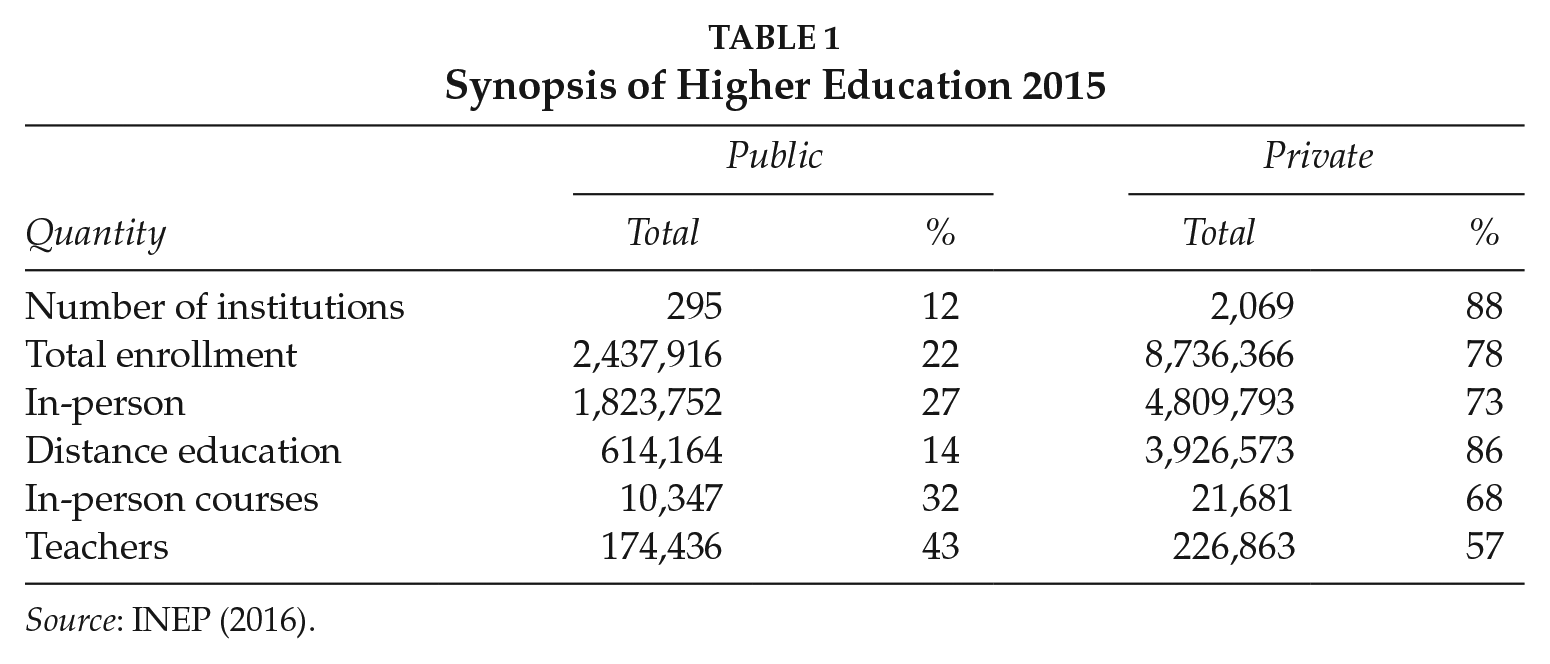
Source: INEP (2016).
The private sector has also found other ways to work in higher education: foundations headed by iconic entrepreneurs, among them Jorge Paulo Lemann, an emblematic actor in promoting concepts associated with academic capitalism. Among his initiatives in the education sector is the Lemann Foundation, which acts as an intermediary organization, connecting companies (Pearson, Falconi, PwC, Itaú), national and foreign universities (Harvard, Stanford, Oxford, Yale, MIT), and other foundations (the SciBR Foundation, the União Nacional dos Dirigentes Municipais de Educação [National Union of Municipal Directors of Education]). It funds research/doctoral studies abroad, general courses (educational management, formation of "educational leaderships"), distance education partnerships (Coursera, Khan Academy), educational consultancies, and the publication of reports on Brazilian and world education. Also under the command of Lemann is the Estudar Foundation, which can be characterized as an interstitial organization. Among its initiatives is the preparation program for admission to foreign universities (Estudar Fora), referring to private consulting services. It is able to penetrate the interstices of the public university through incubators, becoming the main mentor of student movements like Empresa Júnior and Ligas Universitárias.
Through these interstitial organizations, business ideology achieves the dissemination of values associated with competition, individualism, meritocracy, and the risk culture (Saltorato et al., 2014; Saltorato and Benatti, 2017), which are then reproduced by students in their speech, dress, and behavior in the management of student organizations such as the financial market leagues, Empresa Júnior, consulting clubs, and academic centers. Inspired by the most aggressive management models on the market, students legitimize/replicate self-imposed mechanisms of evaluation, control, performance measurement, and punishment/reward and structure selective processes, career paths, and hierarchies that rank everyone, promoting the most successful (and highlighting the losers).
The passage of Constitutional Amendment 55 is the most significant indication that academic capitalism is advancing in the Brazilian context. According to a study by the Chamber of Deputies (Consultoria de Orçamento e Fiscalização Financeira, 2016), over a period of 10 years the loss to the education sector will be approximately R$58.5 billion, which, according to resource dependency theory, will aggravate the conflict for resources among academic-capitalism actors, stimulating the application of evaluation metrics, forms of control, and social technologies and the creation of new ones. In this scenario of budget constraint, in which even the fulfillment of the goals of the national education plan will become more and more distant, there is fertile ground for the emergence and refinement of the mechanisms of academic capitalism, engaging the actors in the field in increasingly aggressive market activities.
Final Considerations
The current stage of institutionalization of academic capitalism in Brazil is the product of systematic change in higher education policy, the creation of legal artifacts that enable it, and the actions of a network of participants, and the theory of academic capitalism has proved useful for explaining this transformation. The emergence of new circuits of knowledge can be observed in a series of phases beginning in 1960 with the commodification of higher education, continuing in the 1990s, under the influence of the World Bank, with the creation of short-term private, polytechnic, and distance education courses, and going on in the 2000s to institutionalize these entrepreneurial activities. In the process, the idea of the need for new financing flows gained momentum, institutions of higher education explored new markets, new forms of education, and "entrepreneurial education and research," and the government created laws and established new financing institutions. Interstitial organizations brought together educators to supply professional specialization courses on weekends and to involve students from a wide range of fields in providing market advisory services through training for selection in which they aspire to participate. Student associations and academic centers began to adopt performance metrics for controlling their members, largely eliminating student debate and criticism on the course of higher education. Intermediary organizations issued prescriptions consonant with academic capitalism that had great influence on higher education policy. The emergence of these mechanisms required that universities expand their managerial capacity through the restructuring of teaching, the introduction of control and measurement metrics, and the hiring of nonacademic professionals. Added to this was the increasing role of celebrity CEOs in the political-educational milieu, through their foundations, official positions, or "counseling" to the government, resulting in the displacement of a public-good knowledge/learning regime by an academic-capitalism knowledge/learning regime.
This article has sought to clarify, from the perspective of the theory of academic capitalism, what is special about Brazilian higher education policy since the 1968 reform, demonstrating how changes in the political field have influenced transformations in the social and economic spheres. It has also aimed to fill the gap in the literature with regard to the role of multilateral organizations in academic capitalism by systematizing the documents of the World Bank and UNESCO in the language of academic capitalism. Its other contributions to the discussion include establishing the relationship between World Bank guidelines for higher education and specific concepts of the theory of academic capitalism; interpreting laws and governmental programs as devices for the reproduction of the mechanisms proposed by the theory of academic capitalism; interpreting student organizations as interstitial organizations that disseminate meritocratic discourse and result in culture; identifying the ways in which celebrity CEOs influence higher education; linking the widely used operational university theory (Chauí, 2003; 2016; Sigahi and Saltorato, 2018) with the theory of academic capitalism (Slaughter and Leslie, 1997; Slaughter and Rhoades, 2004); calling attention to the joint action of national and foreign educational companies in the creation of new knowledge circuits and financing flows; presenting data that represent, to some degree, one of the consequences of the predominance of financial logic over productive logic explored in important previous studies (Fligstein, 1990); and demonstrating that the theory of academic capitalism is a useful framework for understanding the transformations of higher education in Brazil.
Ylijoki (2003) and Välimaa (2014), among others, have argued that the theory of academic capitalism cannot be applied in the same way in different countries; hence the need for a better understanding of its explanatory power in developing countries (Maldonado-Maldonado, 2014). In this connection, the article has explored the transformations of Brazilian institutions of higher education through the action of policy makers and multilateral bodies in terms of the mechanisms of the theory of academic-capitalism framework. Future research could be devoted to exploring the actions of specific actors, considering other academic-capitalism research perspectives such as gender/ethnicity issues, cooperation between researchers, new education technologies, socialization processes among undergraduate/graduate students, and the manipulation of other forms of capital (social, cultural, symbolic, legal, financial, economic, academic) that permeates social actions, narratives, speeches, and technologies seeking to legitimize academic capitalism in Brazil.
Footnotes
Tiago F. A. C. Sigahi is a researcher at the Universidade de São Paulo. Patrícia Saltorato is an associate professor at the Universidade Federal de São Carlos and a researcher in the university’s Center for Studies in Economic Sociology. Among their publications is “Academic Capitalism: Distinguishing without Disjoining through Classification Schemes” (Higher Education 80 (1), 2020). Luis Fierro Carrión is a translator living in the Miami area.